Introduction
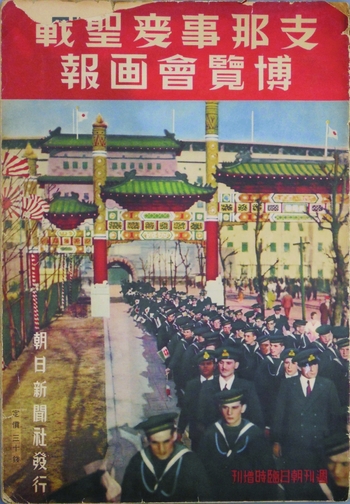
On a sunny day in the spring of 1938, a unit of Italian marines marched through Zhengyangmen, the famous gate of Beijing's historic city wall. However, the march did not take place in China, but on Japanese soil, in the vicinity of Osaka, and the gate the Italians passed through was a mere replica. Behind the gate lay not the Forbidden City but a baseball stadium, featuring a gigantic war panorama. Ahead, the marines did not see Peking's maze of narrow streets, but the ‘Gate of the Nanking Government’, half-destroyed as a symbol of the fallen and raped city. In truth, the Italians did not come as warriors or conquerors, but as mere visitors to a carefully staged exhibition. Nonetheless, the image of these Italian marines attending the ‘Exhibition on Holy War and the China Incident’ was all over the Japanese news (see Figure 1).
Italian marines visiting the ‘Exhibition on Holy War and the China Incident’.

Such a spectacle was the result of an alliance that was formed in November 1937 through Italy's accession to the German-Japanese Anti-Comintern Pact. In an era marked by the heightened aestheticization of politics in a Benjaminian sense,Footnote 1 the appearance of Italian marines in Osaka was but one episode among many. The first half of 1938, in particular, was inundated with a flood of highly visible shuttle visits and requests for cooperation between Italy, Japan, and Germany. During these ‘heydays of the Axis’,Footnote 2 the new alliance was transnationally celebrated. In Europe, Hitler's visit to Rome in May 1938 was a highlight, yet the phenomenon also manifested itself beyond Europe. The march of the Italian marines through Japan's recreated Zhengyangmen took place within the context of a larger spectacle, the ‘Missione del Partito Nazionale Fascista (National Fascist Party, PNF)’, upon which this article will focus.Footnote 3
As we accompany the PNF's mission on its two-month-long trip through East Asia, two processes become clear. On the one hand, the presence of the Italian Blackshirts in Japan helped place the nation's regional war with China within the broader context of worldwide conflicts. On the other hand, this trip palpably assisted in the incorporation of the new Axis alliance into an East Asian context, as the Italian visit was drawn on to support Japanese mobilization efforts on the home front. In the remainder of this article, we will see the degree to which these two processes were linked and mutually enhancing of one another. This article will also suggest that both developments were part of a much more far-reaching phenomenon, namely the globalization of the Axis alliance.Footnote 4 This process, it will be argued, was acted out on the stages provided by what is best described as the spectacle of global fascism.Footnote 5 The following will not only describe the choreography of the spectacle but also focus on international and popular reactions to the visit of the Italian fascists in spring 1938.
The year 1938 was one that enables us to better understand the global interrelations which marked the path towards the Second World War. In Europe, 1938 was—with the exception of Spain—the last year of peace; in Asia it was the first full year of war. Nonetheless, in spite of this divergence of experience, it was possible for Japan, Italy, and Germany to jubilantly celebrate 1938 as a year of newly minted friendships. A series of important decisions made over the course of the year mapped out the future path onto which Japan, Italy, and Germany were now embarking. Early in the year in Japan, the government of Konoe Fumimaro decided to fight the war in China until complete victory was achieved.Footnote 6 In Italy, the fascist regime took a radical turn by introducing race laws. In Germany, Hitler finally departed from any form of moderate foreign policy, a turning point that occurred in the spring of 1938,Footnote 7 right at the moment when the PNF mission arrived in Japan. From this point onwards, all signs pointed towards global expansion. As such, the Axis constellation, as represented by the fascist spectacles of 1938, pre-empted the alliance system of the Second World War. But in the spring of 1938, a new world war was still a thing of the future. Thus, in retrospect these days were the happy days of the Axis, with shared moments full of successes.
As part of a comprehensive series of global fascist spectacles, the Blackshirt mission of 1938 illuminates two things: the ideological nature of Axis diplomacy at a global level, and the local adoption and use of this alliance in the mobilization of the home front, especially in Japan. In exploring these themes, this article joins together strands of research that have individually proven highly productive in recent years yet remained thoroughly distinct from one another, very much rooted in national historical narratives.
The first of these is the study of fascist spectacle, a term we borrow from research on Italian fascism. Starting with Emilio Gentile's concept of fascism as a political religion, and ultimately taking up Walter Benjamin's thoughts on the aestheticization of politics, the study of Italian fascism over the last two decades has undergone its own cultural turn, as more scholars focus on the language, liturgy, art, architecture, and ritual it produced rather than economic and overtly political issues.Footnote 8 Scholars in this field have shown how the symbolic presentations of the Italian nation's acclaimed rebirth were rooted in the violent struggles immediately following the First World War, and how such presentations were institutionalized during the two decades of fascist rule.Footnote 9 However, how successful the regime in Italy was in getting the masses to go along with its spectacles remains a contentious issue, as the totalitarianization of Italian society as a whole remains debatable. The year 1938 may be seen as a high-water mark in this so-called ‘totalitarian thrust’ because of Hitler's visit to Rome and the passing of new race laws in Italy. However, critics of the ‘culturalist school’ have argued that by 1938 fascism in Italy had ‘exhausted its energies’ and diminished to the level of superficialities and platitudes.Footnote 10 They interpret the enhanced political pageantry of this year as more of a sign of crisis for the regime and its ideology. As fruitful as these discussions might be, they nevertheless focus on developments within Italy. As this article suggests, the dynamics of the fascist spectacle need to rather be discussed from a transnational perspective.
This brings us to a second strand of research this article connects to: home front mobilization and the total war phenomenon in early Shōwa-Japan (1926–1945), a topic which produced an extensive range of studies, constituting a whole strand of historical research in its own right.Footnote 11 However, this literature also strongly focuses on the domestic context.Footnote 12 In contrast, it is one of this article's contentions that bringing together discussion of both fascist spectacle and home front mobilization as transnational phenomena of the late 1930s can be mutually beneficial for both areas of research.Footnote 13
The third strand of research this article seeks to interweave with the others focuses on the history and significance of the Tokyo–Rome–Berlin Axis. For decades, historical studies of this alliance have considered it a weak, illusive, and hollow failure.Footnote 14 Once again, however, the transnational exchanges and encounters it produced, which we shall shortly explore in detail, have seldom been discussed or accorded much importance. Research on the relationship between Italy and Japan has been particularly scarce.Footnote 15 Yet the recognition that diplomacy is also a form of theatre, the performative aspects of which should be a focus, would certainly add to our understanding of the dynamics of the Axis alliance.Footnote 16
Lastly, it should be noted that combining these three existing strands of research—fascist spectacle, the Japanese home front, and Axis history—enables us to overcome that much debated dichotomy between fascist style and fascist substance.Footnote 17 In a sense, the remainder of this article argues that style (the spectacle) was an integral part of diplomacy (the substance). It suggests that a Japanese home front mobilization during the war in East Asia which drew on fascist spectacles provides evidence of the success of a new kind of Axis diplomacy. It also suggests that the interplay of diplomacy and spectacle that can be located in Japan in 1938 produced a new dynamic in the global relationship between Axis powers.
The first part of this article will describe the nature of the Italian PNF mission and its journey to Japan. The second part will examine how the war in China was put into a global context in Japan through the spectacle of the exhibition mentioned above. The third part then focuses on the reverse process—the localization of the Axis alliance within East Asia—by discussing the mission's travels throughout the Japanese empire and its colonies, and the significance that was attached to it within the context of pan-Asianism.
The Blackshirt mission on its way to Asia
The planning for an Italian friendship mission to Japan started immediately after the signing of the Anti-Comintern Pact in late 1937.Footnote 18 The intention was to send 18 delegates to East Asia for a period of two months.Footnote 19 Forty days were to be spent in Japan and the remainder in its colonies on the Asian mainland.Footnote 20 The mission was to take place at Mussolini's personal request and its programme was drafted by the foreign ministry and the party, and thus by Galeazzo Ciano and Achille Starace.Footnote 21 The mission was to be something ‘entirely new, quite without precedent’.Footnote 22 For once, this fascist rhetoric was not pure exaggeration or mere fantasy: the Missione del Partito Nazionale Fascista was in fact the very first international political mission undertaken by the PNF.Footnote 23 It was not designed as a state mission, nor was it an apolitical cultural exchange. It was designed and received as a ‘friendship mission’ and thereby emphasized the emotional linkage between the two regimes. It was also to be a mission of fascist Blackshirts. The Japanese certainly understood this message, since the press unanimously spoke of the visit as the kuro shatsu no shinzen shisetsudan [Blackshirt friendship mission].Footnote 24 In Italy, the Blackshirts were a product of the violent days of the paramilitary fascist squadrismo of 1918–24.Footnote 25 In Japan's fascist circles, such sartorial symbolism quickly became popular and some movements used similar uniforms for their organizations. Yet even in Italy, the formal adoption of the Blackshirt uniform, especially in international contexts, did not take place until the second half of the 1930s under the patronage of Starace, whose tenure as party secretary was widely associated with an obsession with style.Footnote 26
A key feature of the Missione was that the Italian fascist party was at the heart of it rather than the Italian state. This was a notable démarche since the state and the monarch—the traditional representatives of foreign policy—were conspicuously absent. At the moment that a global alliance was taking shape, the regime evidently wished to spotlight the significance of the fascist revolution on an international stage. To some extent, this contradicted the doctrines of the stato totalitario and the supremacy of the state over the party which Mussolini had propagated since the 1920s.Footnote 27 Even more notable is that the Japanese government acquiesced to this, as shown by the fact that Emperor Hirohito personally received the PNF mission. On this occasion, the members of the Missione wore black shirts, as reported by the media in both countries.Footnote 28 The use of these symbols of the fascist party, instead of a more conventional gala uniform, went against established diplomatic protocol in Japan—a protocol that the Japanese government had meticulously pursued and maintained since the late nineteenth century. As the only non-Western great power, Japan had joined the international diplomacy party late; thus, until well after the First World War, it had been especially important to the government not to go against established protocol. Nevertheless, the Japanese government treated the mission as an official state visit. Thus, by the spring of 1938, the expression of Italian-Japanese friendship had clearly moved beyond traditional forms of diplomacy to embrace new fascist ones. This is even more remarkable when we consider that, on the Japanese side, the mission was organized chiefly by the Ministry of Foreign Affairs, which was considered by many as rather traditional and conservative, and not by the military or one of the many ultranationalist organizations.Footnote 29 Thus, the invitation to Blackshirts to visit East Asia may be interpreted as a major concession to the new alliance partner; at the same time it implied Japan's commitment to participating in a new fascist style of diplomacy that was globally visible.
On Ciano's proposal, Mussolini appointed Giacomo Paulucci di Calboli as head of the mission. He was experienced Japan hand who he had served in the early 1920s as Italy's representative in Tokyo and was therefore considered an East Asia expert in fascist circles.Footnote 30 Paulucci belonged to the Duce's staff—initially, as cabinet chief of the foreign ministry, then from 1927 as secretary to the League of Nations, and, finally, from 1933, as president of the state-run film institute Luce.Footnote 31 In this capacity, he had also encouraged the exchange of media content with Japan by organizing a collaboration with the Asahi media conglomerate: regular dispatches of Italian newsreels—first overland via Russia, later by sea via Shanghai—started during the Italo-Abyssinian war of late 1935 to early 1936.Footnote 32 He had been an early and resolute proponent of Italian-Japanese rapprochement and was an outspoken Anglophobe.Footnote 33 At the same time, Paulucci did not belong to the ranks of the leadership with serious ambitions for power, so that competing figures in the party could not fault his appointment. All in all, this choice underlined the fact that this diplomatic mission served first and foremost representational purposes and lacked any immediate political goals.
The Missione should nonetheless be seen in the context of the two sides’ desire to strengthen their alliance. This wish for ever-closer collaboration had much to do with the attractiveness of Italy's anti-British position in the Mediterranean,Footnote 34 since Japan's relationship with the United Kingdom had rapidly deteriorated as a result of the outbreak of war in China in mid-1937. Fortified by its victory in Abyssinia in May 1936, Mussolini's Italy appeared stronger than ever. Indeed, as the mission unfolded, the Italian army made plans for the conquest of Egypt, to sate Mussolini's desire for an empire with scope for expansion in both Africa and Asia.Footnote 35 In view of these plans for expansion, it is hardly surprising that Mussolini intended to make Japan an ally in the fight against the United Kingdom, too.Footnote 36
However, the long shadow cast by the United Kingdom would prove ubiquitous, not only in the minds of the Missione's protagonists, but also, very palpably, along the mission's route to Asia. The Missione set off from Naples in mid-February on the Conte Biancamano, a modern Italian passenger steamer that, ironically, had been manufactured in the United Kingdom. Designed for scheduled service between Genoa and New York, this steamer had transported Italian troops to Africa during the Ethiopia war. Later on, in a further irony, the ship was confiscated by the Allies and served during the Second World War in both the Atlantic and the Pacific. Try as the Italians might, in 1938 there was no escaping Albion's far-flung presence. The ship had to pass through all of the zones of British dominance, via Port Said and Aden, Bombay, Singapore, and Hong Kong to Shanghai. While the travellers met Italian and Japanese missions and communities at each of these stops, the sheer global reach of the British empire could scarcely be ignored. In Shanghai, the Missione at last reached a Japanese sphere of influence; here the delegation transferred to a Japanese ship which finally docked at Nagasaki on 17 March.Footnote 37 Two days later they arrived in Tokyo, where an audience with the emperor marked the first highlight of their programme. During his first few days in Tokyo, Paulucci also met with Prime Minister Konoe Fumimaro and Foreign Minister Hirota Kōki. On 27 March, a ceremony took place at the newly opened Kōrakuen Stadium before 120,000 spectators, including Konoe and Hirota.Footnote 38 Thus, not only were the prime minister and the foreign minister, as well as Japan's emperor, personally involved in the organization of the mission, their involvement was also made visible to a large audience.
Following its triumphant reception in Tokyo, the mission continued to the Kansai region and its key cities of Osaka and Kyoto. The latter initially offered a breathless schedule of sightseeing, featuring the standard fare of temples and shrines. Osaka served as a deliberate contrast. Here, the past was left behind and the mission turned its attention to the present and the future. This city offered a large audience: according to Paulucci, around a million people welcomed the delegation upon its arrival, probably with encouragement from local, regional, and national authorities.Footnote 39 Here in the Kansai region, the heartland of ‘Japanese civilization’, the mission visited the ‘Exhibition on Holy War and the China Incident’.
Putting the East Asian war into a global context: Blackshirts at the ‘Exhibition on Holy War and the China Incident’
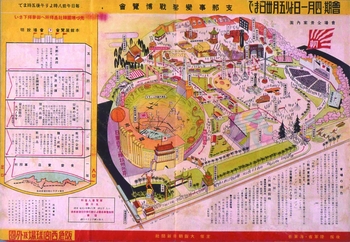
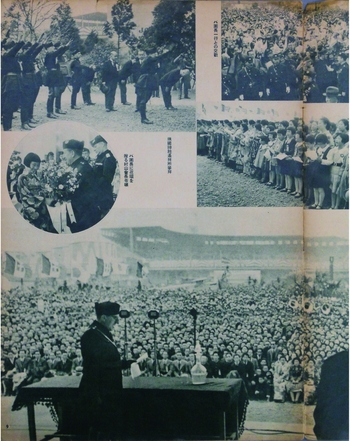
The exhibition near Osaka was one in a series of events of the early Shōwa period that were entirely dedicated to war. Between 1936 and 1940 over a dozen exhibitions that were put on across Japan focused expressly on the ‘China Incident’. However, with one-and-a-half million visitors, the ‘Exhibition on Holy War’ was one of the biggest.Footnote 40 It offered the full range of modern media such as panoramas and films (see Figure 2). These mechanized panoramas, along with walk-in bunkers and functioning military equipment, provided the visitors with an experience of war that was as realistic as possible. The main attraction was an enormous panorama that had been erected in a baseball stadium and that visualized the Chinese war theatre over some 20,000 square metres. The Blackshirts received a warm welcome in this converted stadium, which had previously been used for what was perhaps the most American of all sports.Footnote 41 Subsequently, in a more traditional context Paulucci and his men also paid their respects to a branch of the Yasukuni shrine where they honoured the Japanese dead with the fascist salute (see Figure 3).
General plan of the ‘Exhibition on Holy War and the China Incident’, graphic from 1938.

The PNF mission at the exhibition. Above left: Saluting at the branch of the Yasukuni shrine.

The mission visited the exhibition at what was a highly critical moment for Japan. Despite fast and far-reaching successes in the autumn and winter of 1937, an end to the war in China was now a distant prospect. Some days earlier, the battle of Taierzhuang (24 March–7 April 1938) had ended in the first defeat that the Japanese had suffered at the hands of Chinese troops. The myth of the imperial army's invincibility threatened to collapse. And while the Japanese population may not have realized the full extent of the difficulties, due to the censorship measures in place, overall the war euphoria of the previous year had vanished amid increasing uncertainty and fear. In this context, the visit of the fascist mission played an important role for the Japanese audience at this site: Japan's European allies could be witnessed in person as an integral part of its mobilization and war effort in China. This effect was reinforced by the fact that other Italian representatives also attended the exhibition. Just a few days after Paulucci's mission was there, the Italian marines (as described above) visited the site. This occasion was marked, once again, by the Asahi newspaper, which produced a special edition of its photographic magazine (see Figure 1).
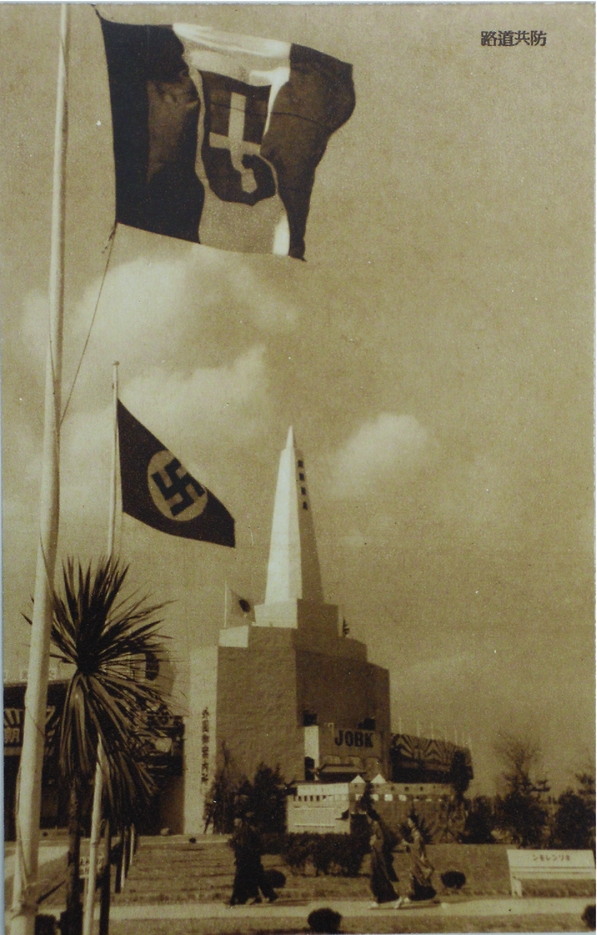
Even when Italians (and sometimes Germans) were not visiting the exhibition site in person, the symbols of the allies were omnipresent: they included, besides the obligatory flag decoration, flowerbeds in the colours of the Axis partners. A short while later, pavilions appeared at similar exhibitions that were entirely devoted to these Axis partners. Although none yet existed in Osaka in 1938, an ‘Anti-Comintern Road’ beckoned immediately after the entrance and, with its Axis flowerbeds, served as the focal point of the exhibition, leading visitors on to the war panorama (see Figure 4). The symbolic message which Paulucci's mission also enacted in visiting the exhibition site was plain to see. The path of anti-communism led directly to the war in China. In other words, the war in China was merely one aspect of a global struggle against communism. Significantly, this was exactly a line of argument that Japan's European allies had initially sought to avoid—mainly out of fear of becoming involved in a war in the Far East that might spread over the entire world.
Photograph of the ‘Exhibition on Holy War and the China Incident’ showing the ‘Anti-Comintern road’.

In reality, however, during the first months of 1938, the Chinese-Japanese war had already become more internationalized, and in this context, the Japanese government used the mission for its own purposes. Using its influence over Japan's media, it popularized its message that the war in China was an anti-communist one that ought to be understood in the context of a global struggle against communism which the Germans and Italians had been fighting in Spain since 1936. On the occasion of the mission's reception at Tokyo's Kōrakuen Stadium before 120,000 spectators, the Asahi newspaper ran an article on the event with the headline ‘The whole world is trembling in view of the Anti-Comintern's victory procession’.Footnote 42 The message for its readership was clear: through Italy's presence at the exhibition, the Japanese public were able to see the role Japan played in a worldwide fascist (counter-)revolution.
In Japan, the civil war in Spain had been closely watched from the beginning. In the wake of the Anti-Comintern Pact, the Japanese press became highly pro-nationalistic.Footnote 43 Anti-communism played a major role in the Japanese media's coverage of the Spanish civil war, and descriptions of the war as a passionate and emotionally laden ideological conflict abounded. Footnote 44 In particular, Japanese media interest in the conflict in Spain was sparked by the fact that, at first, this new global trouble spot shifted international attention back to Europe, thus giving the Japanese army in China more leeway to act. However, the outbreak of war in China saw that advantage lost and so Japan's imperial designs on China now had to be legitimized as part of a global civil war of epic dimensions. The observation that the Spanish Civil War and the conflict in China were related and even fuelled each other could hardly be denied by 1938. This interdependency between the Mediterranean and the Far East conflicts was a theme also taken up in the Italian media.Footnote 45
Against this background, the Anti-Comintern Pact was widely celebrated. During the mission's journey, the flags of National Socialist Germany, the other member of the Anti-Comintern Pact, were frequently displayed, as were the flags of regimes that would soon become pact members, such as Manchukuo and Spain.Footnote 46 Representatives of these countries were also invited to attend the festivities held in the Blackshirts’ honour. In Tokyo, the programme included a visit to the German embassy.Footnote 47 At the same time, all of these manifestations of global Axis solidarity—Japanese newspapers repeatedly referred to the ‘global anti-Comintern Axis’Footnote 48 —remained inscribed with a powerful pan-Asian subtext. Such a subtext perhaps became most apparent in the autumn of 1938, when Japan's prime minister, Konoe Fumimaro, proclaimed the reordering of Asia. It is no coincidence that it was a key demand of the Japanese government that further expansion of the Anti-Comintern Pact would have to cover China as well. Konoe expressed this as follows: ‘Japan [. . .] considers it an essential condition of the adjustment of the Sino-Japanese relations as that there should be concluded an anti-Comintern agreement between the two countries in consonance with the spirit of the anti-Comintern agreement between Japan, Germany and Italy.’Footnote 49
As for our understanding of the actual domestic impact of government and media attempts to embed the war in China in global contexts, it is necessary to consider the Japanese media landscape in the early Shōwa period. The visit of the fascist Missione to the exhibition near Osaka was staged as a media event, and pictures of the Italians reached virtually every household through daily newspapers and magazines. As with many similar events of the period, private organizers and state authorities worked hand in hand. The main sponsor of the ‘Exhibition on Holy War’ was the Asahi News media conglomerate.Footnote 50 At the same time, the Army, the Navy, the Ministry of Education and Culture, and the Ministry of Commerce and Industry officially participated as representatives of the state. The significance that the state accorded to this exhibition is also illustrated by the fact that Yonai Mitsumasa, the naval minister and future prime minister of Japan, opened it.
At this time the Japanese media was dominated by private sector news conglomerates active in the production of newspapers, magazines, books, and newsreels. Asahi News, which published the Asahi newspaper, was the largest. The Tokyo and Osaka editions of this daily had a circulation of several million; in the 1930s, it was already one of the world's most widely read newspapers, a status which it retains up to the present day.Footnote 51 Another highly successful product of this company was the photographic magazine Asahi Gurafu, which was founded in 1923 and which sold at the highly affordable price of 10 sen. Other media conglomerates such as Mainichi and Yomiuri also published their own photo magazines. After 1937 the subject of the war in China came to dominate all these magazines almost completely, consistently providing the lead story for Asahi Gurafu over a period of almost two years.Footnote 52 War meant business, as the factory worker Kumagaya Tokuichi later remembered: ‘News about China was everywhere. Even my father subscribed to the Asahi Graph [. . .]. By the end of 1937, everybody in the country was working. For the first time, I was able to take care of my father. War's not bad at all, I thought.’Footnote 53 Indeed, for Japan's early Showa media conglomerates those were good days too, as war's popularity became the main root of their business expansion, and publishers built an entire entertainment empire around the conflict. Asahi News alone sent hundreds of reporters to China.Footnote 54 The professionalism of its war reporting left an impression on Italian fascists, who admired its propaganda achievements, mentioning the ‘perfect organization’ and, above all, the dozens of aircraft which Asahi used in China.Footnote 55
This expansion in the war-reporting activities of Japanese media conglomerates occurred at the very moment when the state increasingly sought to influence the media and bring it under control. In this regard, the government was able to rely on a system of censorship that had existed since the late nineteenth century. However, at the time of Paulucci's visit to Tokyo, which coincided with the passing of the National Mobilisation Act in the Diet on 24 March 1938, these censorship measures were significantly tightened.Footnote 56 The law granted the government instruments of control over not only the media but also over the economy and the trade unions. In the following years, particularly from 1941 onwards, this control was gradually intensified and remained in effect until Japan's capitulation. At the same time, the government sought to compete with the private media companies. In early 1938, for instance, it launched its own photo magazine Shashin Shūhō, in an attempt to strengthen its coordination of mobilization propaganda.Footnote 57
Nevertheless, throughout the war, the Japanese state never achieved anything comparable to the degree of orchestrated control over the media exercised by its Axis partners in Europe. The 1938 legislation may have passed, but the competition between various authorities, such as the Ministry of the Interior and the Ministry of War, remained.Footnote 58 Moreover, since the Manchuria crisis of 1931, the Japanese media had revealed a strong independent initiative. One can only agree with Louise Young's judgement that ‘in fact, without any urging from the government, the news media took the lead in promoting the war’.Footnote 59 In our context, it should be added that this is not only true for the war but also for Japan's involvement in a global Axis alliance. Initially, press opinion concerning Italy and Germany was divided and sometimes critical; after the conflict in China escalated in 1937, however, Japan's private media assumed a leading role in promoting the alliance with Italy and Germany, no doubt for political as well as commercial reasons: the coverage of the war in China and Japan's global alliance turned out to be in tune with the contemporary public mood and with domestic consumer expectations.
Meanwhile in Italy, the Missione, in its way, turned out to be a media event as well. In its coverage of war events in East Asia, the Italian media was already wholeheartedly pro-Japanese, not only in the regime's own daily newspapers, such as the Popolo d'Italia, but also, for example, in La Stampa, with its close relationship with the Turin business community. Since, by this time, the Italian press had largely been brought into line with the regime's views, this is hardly surprising. In contrast, the day-to-day coverage of the mission itself was rather minimal, although the reports that did appear were naturally highly positive, which is likely to reflect the fact that only a few Italian correspondents were present in Japan, and Italy's daily newspapers therefore struggled to provide prompt reporting on the PNF's mission. Also, the transcontinental transmission of impressive visual material presented a technological challenge. Nonetheless, with a delay of nearly three weeks, some photographs did appear, such as those of the mission's arrival in Shanghai or at the ‘Great Popular Festival’ in Tokyo.Footnote 60 Eventually, on 20 April, the Giornale Luce showed film footage of the PNF's mission to Japan for the first time.Footnote 61 It took even longer for an official documentary film to appear in cinemas, even though Paulucci, as the director of Luce, certainly had the best equipment available as well as all the necessary connections.Footnote 62 In many ways, East Asia was still very far away from Europe in 1938, yet the delay in transmitting the images of the mission back to Italy hardly prevented their dissemination. Rather, it was more important for the party and the state to ensure that the Japanese-Italian friendship was visually depicted, even if such depictions can hardly be said to have constituted current news.
In addition, messages of Japanese-Italian fascist amity were embedded in the broader context of Italian war reporting from China. News from the East Asian war theatre featured very prominently in the Italian media, since all of the major daily newspapers had special correspondents. The well-known journalist Mario Appelius, a reporter who personified the global civil war between fascism and communism (having previously served as a war correspondent in Spain and before that in Ethiopia) was sent by Il popolo d'Italia to Shanghai. By asking whether ‘Russia would bolshevize China’, Appelius was following precisely the line of Japanese anti-Comintern propaganda.Footnote 63 He repeatedly emphasized that Japan's struggle in China was directed against a global rather than merely an East Asian enemy. So it was that in the spring of 1938, Italian news reports about the war in Spain, which dominated the media, were flanked by news about the war in China, thereby giving readers the impression that both conflicts were interlinked. As in the case of Spain, the mood in relation to the war in China was jubilant. In early May, the Popolo d'Italia referred to ‘another 200,000 [Chinese] dead’ and in the middle of the month, during Paulucci's visit to Shanghai, the newspaper reported that the Japanese had forced half a million Chinese soldiers to flee.Footnote 64 The PNF's mission provided the background against which the Italian press painted a pro-Japanese picture of the Chinese war.
All this was no accident for it was carefully orchestrated from above. The party leadership in Italy was highly satisfied with the outcome of the mission and intended to capitalize on it. On the occasion of a speech Galeazzo Ciano gave in front of a Milan conference of students of international relations on the subject of ‘Fascist Italy in the world’, he underlined the mission's significance while emphasizing that Japan was firmly part of the global struggle against communism.Footnote 65 Enthusiasm for the mission was also revealed by the reception it received on its return to Rome, where Mussolini and Ciano were personally in attendance to welcome it back. ‘This unprecedented mission triggered unprecedented enthusiasm in Japan,’ Ciano noted.Footnote 66 Paulucci in particular was credited with its success and, as a reward, Mussolini appointed him to an ambassadorship, following which he held a number of important appointments.Footnote 67 Paulucci would afterwards remain a key exponent of the Italian-Japanese Axis and be sought as an East Asia expert, as is documented by his many publications and lectures in the years that followed.Footnote 68
The PNF mission produced no concrete diplomatic or political results, but that had never been its purpose. Nonetheless, in the wake of the friendship mission, Italian officials did indeed have a much more positive view of Japan's role in its war with China and of the global significance of this conflict. Galeazzo Ciano noted in his diary: ‘The returned mission confirms the warmth of their feelings towards us and the singular military potential of Japan. [. . .] Contrary to what Judeo-Masonic propaganda wishes us to believe, Japan has only deployed a small part of her forces in China.’Footnote 69 Following the mission's return, Mussolini and Ciano became keener than ever to expand their alliance with Japan, and the Japanese government thought along similar lines.Footnote 70 On 31 May, news from Tokyo reached Rome that, in response to the PNF mission, the Japanese side wished to send its own friendship mission to Italy that autumn, including high-ranking members of the Army and the Navy.Footnote 71 Immediately after the PNF's visit, the Japanese government also proposed a bilateral secret treaty which stipulated benevolent neutrality as well as military cooperation.Footnote 72 Ciano noted on 31 May: ‘And we are not at all against it. On the historic level [it is clear] that Italy and Japan have to march together for a long time.’Footnote 73 Finally, on 19 July the Five Ministers Conference in Tokyo decided to strengthen the Anti-Comintern Pact.Footnote 74 With this in mind, the processes of putting the war in China into a global context and the globalization of the Axis do indeed reveal themselves to have gone hand in hand.
Certainly, mutual friendship missions were not the triggers of an enhanced rapprochement but rather a symptom. Yet for the entire period leading up to the outbreak of war in Europe, they also performed important political functions, such as the display of Axis solidarity at a global level. Given the absence of any full military alliance between the partners, such symbolic and informal acts were crucial, as attempts to strengthen the Axis alliance—be it in the bilateral form that particularly interested the Japanese Navy,Footnote 75 or in the form of a tripartite agreement that included Germany, for which the Army pushed over several years. Especially in the hectic months prior to the start of the European war, it proved difficult to come to an agreement that satisfied all sides and covered all eventualities. The lines of conflict not only ran between the three countries, but also within them. Thus, without any formal military alliance in place between the European and Asian Axis partners before September 1940, the simple propagandistic message of Italian-Japanese friendship and solidarity, as had been conveyed by the PNF mission, became all the more important.
(Re-)localizing the Axis: the mission in the service of pan-Asianism
Right from the start, it was the Japanese government that had insisted that the PNF's mission should visit not only the Japanese mainland but also China, Korea, and Manchuria. Japan's motives were obvious. An official mission by a European country would be construed as an endorsement of its East Asian empire. In this regard, Japan's efforts paid off, for by late January 1938 Ciano had agreed to this itinerary.Footnote 76 For Italy, this no longer posed any great diplomatic risk, as Mussolini had already recognized Manchukuo two months earlier, immediately after Italy had joined the Anti-Comintern Pact. Sending the Missione to Japanese colonial territory, only further underlined Italy's unequivocal position in the Far East conflict.
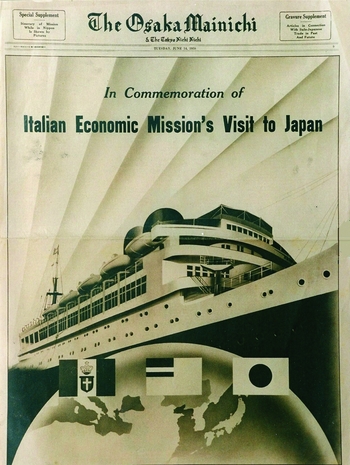
In this respect, the Italians were quicker off the mark than the Germans, which only began to realign their East Asian policy following Hitler's Reichstag speech of 20 February 1938 and the related political upheavals in the German foreign ministry and Army.Footnote 77 But according to diplomat Erich Kordt, it was only during Hitler's visit to Rome in May 1938 that he decided to ‘definitely opt for Japan in the Far Eastern conflict’.Footnote 78 And indeed, a few days after his return to Berlin, Germany officially recognized Manchukuo. Thus, the Italian influence on the Germans in this matter seems to have been considerable. But by this time, the Paulucci mission had already visited Manchuria, and a second fascist mission—the ‘Missione economica italiana in Giappone’ led by industrialist and businessmen Ettore Conti di Verampio—had already arrived in Shanghai and was on its way to Manchuria (see Figure 5). So, in relation to East Asia, the Italians were far ahead of the Germans in the first half of 1938. To American observers watching this rising constellation, it clearly appeared that Italy was prompting Japan: the Italian ambassador to Washington warned Rome that the ‘media’ and the ‘public opinion of the United States’ were accusing Italy of ‘having incited the Japanese in their operations against China’ and that they even attributed ‘greater responsibility to us than to the Germans’ for this conflict.Footnote 79
Special supplement of the Ōsaka Mainichi and the Tōkyō Nichinichi newspaper, celebrating the Italian economic mission, June 1938, with the flag of Manchukuo and a shortened distance between Europe and Asia in the middle.

With regard to East Asia, Germany and Italy were sometimes as much competitors as they were political partners. In this context, Renzo De Felice, an influential historian of Italian fascism and author of a 6,000 page biography of Mussolini, interpreted the Duce's efforts to grow closer to Japan as motivated solely by his desire to neutralize Germany's dominant position on the global political stage.Footnote 80 There is a grain of truth in this. As we have seen, fascist Italy tried to use the mission to pursue its own, powerful East Asia policy. However, by doing so—at least in the last few years before the outbreak of the Second World War in Europe—the Italian government did not just react to German initiatives. Quite the contrary: Italy was an independent and active actor in its own right, indeed taking the lead in East Asian affairs over its European partner in the first half of 1938. Moreover, Germany's international position was not the only factor that prompted the Italian mission to leave for Japan. The evidence suggests this effort took place on account of its own geopolitical logic. On the one hand, the anti-British position of the Japanese empire was attractive for fascist Italy. On the other, Rome hoped to be granted preferential terms of trade in the territories dominated by Japan, a hope that did not appear entirely unjustified, for Italy was the first great power to have granted such clear and unequivocal recognition to Japan's conquests on the Asian continent.Footnote 81 Yet on account of their anticipated gains, Italy's leaders all too easily overlooked the fact that, in agreeing to these extensive travels, they were permitting themselves to be exploited by Japanese pan-Asianist propaganda.
Japanese exploitation of the PNF's mission was already clear when it stopped at Shanghai for the first time. Here, the Italians entered delicate territory: even more than the struggles in northern China, the battle for Shanghai in late 1937 had drawn worldwide attention precisely because it was where Western colonial interests appeared to be threatened most directly. Hardly any other Chinese city was more international, and in hardly any other place in the world did representatives of the future adversaries in the coming global conflict live in such close proximity to one another. The PNF mission inevitably received a great deal of international attention. The American consul in Shanghai, for instance, reported back to the US secretary of state that the mission had received an ‘impressive welcome’ by the Japanese.Footnote 82
After the brutal fighting of late 1937, which had claimed around 40,000 Japanese and 250,000 Chinese military causalities, it was all the more important for the Japanese that the mission witnessed the return of peace and calm to the city.Footnote 83 A sense of harmony, a kind of pan-Asian peace, between the Chinese and Japanese was thus evoked. In the company of local military representatives, the Blackshirts toured areas of the city that had previously suffered the worst fighting but by this point had been successfully ‘pacified’. Paulucci was reported in the Shanghai press as having praised ‘the bravery of the Japanese troops’ and having had an overall impression that the city was very peaceful.Footnote 84 Meanwhile, back in Rome, the mission's arrival in Shanghai was considered of sufficient importance to merit a photograph being published in Popolo d'Italia.Footnote 85 This focus on Shanghai served as a means of explaining to the Italian public the uniqueness of Italy's position in Asia, and of proving that it had only very modest colonial interests in East Asia, unlike the other great powers, and thus had comparatively little to fear from a Japanese victory in China.Footnote 86
Further Japanese propaganda was generated through the PNF mission during the rest of its Asian journey, and became especially conspicuous during the roughly three-week round trip of Japan's East Asian empire, which the mission undertook on its way back from Tokyo. Having visited Korea, the Blackshirts subsequently embarked upon a visit to northern China and Manchuria, seeing Hsinking/Shinkyō, Mukden, and Dairen, Peking, Qingdao, and Tianjin. Their itinerary included an official meeting with the former Chinese, and now Manchurian, Emperor Puyi, staged by the Japanese military to emphasize Manchuria's national independence.Footnote 87 Overall, the Japanese military sought to create the illusion of an East Asian realignment that enjoyed the popular support of local Asians. Yet, for all their careful planning, it proved impossible to entirely ignore the ongoing tensions and violence. When the mission visited Tianjin, for instance, an attack on a Japanese newspaper was taken by the local Japanese authorities to be an attack on the PNF mission.Footnote 88 During the Blackshirts’ progress through Manchuria and China, the huge security measures put in place indicated the very fragile nature of the Pax Japonica.Footnote 89 Naturally, none of this was mentioned in the official Japanese press coverage. Instead, the mission was used to provide opportunities for Japanese journalists to paint peaceful images of harmonious pan-Asian co-existence.
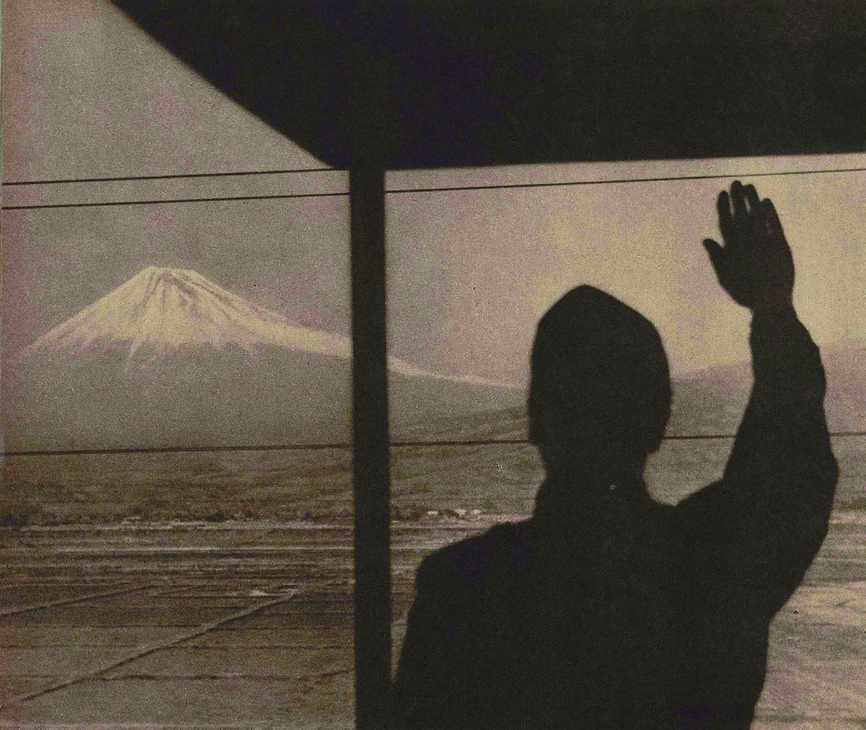
Yet, Japanese press coverage of the PNF mission was by no means limited to a pan-Asianist whitewash. It also provided insights into the worlds of Japan's European allies. Such international insights had long been used as a means of boosting sales for Japanese print-media; the novel feature here was the focus on fascist diplomacy.Footnote 90 The media attention reached a climax with Mussolini's visit to Germany in September 1937 and with Hitler visiting Italy in turn in the spring of 1938.Footnote 91 Japanese journals such as Asahi Gurafu were awash with images of these fascist diplomatic spectacles.Footnote 92 Pictures of Hitler, Mussolini, and the bombastic pageantry that accompanied their every move began to circulate more than ever before. Thus, at the very moment that the PNF mission toured Japan's East Asian empire, a domestic Japanese audience became increasingly familiar with the aesthetics of European fascism. Japan's media reinforced this awareness by showing the Italian members of the PNF employing the same visual semantics which included the use of certain uniforms and salutes across Asia that were common in fascist Europe. Sometimes, salutes were also slightly adapted to local settings: when passing Mount Fuji, Paulucci honoured the natural symbol of Japan with a fascist salute.Footnote 93 (See Figure 6.)
Photograph of Paulucci saluting the Fuji.

This (re-)localization of the Axis alliance once again acquired a global reach, as the pattern of dissemination, reception, and assimilation that I have hitherto outlined came full circle. As we will shortly see, Japan's portrayal of the PNF mission as an endorsement of its pan-Asian ambitions was one that Italian fascists largely embraced. This fact is especially striking when we consider the potential geopolitical risks that Japanese pan-Asianism posed for Italy (as well as for Germany). Although the leaders of both nations appreciated that the war in China diverted the world's attention from the European crisis, they were keen to have Japan end the hostilities as soon as possible to be ready to fight the real enemies—namely, the Soviet Union and/or the United Kingdom. Nonetheless, in spite of the aforementioned risks, all the evidence indicates that the Italians officially supported Japan's pan-Asian ambitions and its efforts to inscribe the global Axis alliance with a specifically pan-Asianist meaning. In line with Ciano's wishes, the PNF mission stressed that it was, above all, an ‘official’ mission. Whenever possible, its members donned their black shirts in public (although, interestingly, they did not do so while on British territory during their return journey).Footnote 94 Despite the presence of other Western representatives in the places they toured, they exchanged diplomatic courtesies only with the representatives of Japan, Manchukuo, and (Japan-friendly) China. The PNF mission therefore provided official Italian recognition and support for Japan's pan-Asianist ambitions even before Konoe officially proclaimed the new East Asian order in the autumn of 1938.
When we recognize the overtly anti-European aspects of Japan's pan-Asianist ambitions, such support becomes all the more fascinating. After all, Japan's call for an ‘Asia for the Asians’ was pretty unequivocal. It might well be suggested that its desire for Asian supremacy in the region posed a direct challenge to European fascist ideology and race theory. In addition, Japan's genesis during this time of what essentially amounted to a Monroe Doctrine for Asia had the potential to make the entire PNF mission a patently disconsonant and contradictory one. Even if these particular Europeans were its allies, why was Japan celebrating their presence on the very Asian soil it was so keen to cleanse of corrupting Western influence?
For its part, the PNF mission made a contribution to disseminating Japanese propaganda not just within Asia but beyond. Back home, Italian reactions to the mission consisted of more than a passive acceptance of Japan's seemingly ineluctable rise in East Asia yet simultaneously ignored the racial implications of such an advance. Popolo d'Italia described Manchukuo as a central element and a ‘national force within an oriental axis’ (‘forza nazionale dell'Asse orientale’).Footnote 95 In this manner, the puppet regimes in Manchuria and China became part of an internal Asian axis—a Tokyo-Hsinking/Shinkyō-Nanjing axis, so to speak. In other words, the global Anti-Comintern Pact had been given a local face with recognizably pan-Asian characteristics.
More importantly though, prevailing racial discourses in fascist Italy underwent a striking shift. In the early 1930s, the country's press had still generally been critical of Japanese expansion in China, deploying the old trope of the ‘yellow peril’. In early 1934, Mussolini himself had intervened in this discussion in a highly polemical fashion, thus disgruntling the Japanese.Footnote 96 However, following the arrival of the PNF mission in East Asia, all of this was forgotten; henceforth, it became taboo to raise the spectre of the yellow peril. When news reached Italy of the kind of Japanese delegations that had received the PNF mission in Singapore, Hong Kong, and Shanghai, the official reaction was highly positive. In Rome, these delegations were interpreted as providing evidence of the ‘large and expansive race’ which had already penetrated ‘the entire orient’, a fact to be greatly welcomed.Footnote 97 Fascist party organs such as Gerarchia took up Japanese pan-Asianist discourse to the extent that they declared that the era of the European mission in Asia was over, a development that was described as the logical outcome of history and as something ‘good’.Footnote 98 In the autumn of 1938, Gerarchia propagated the message: ‘Overcoming the illusion of Eurasia: Africa is where the whites still have much to do. The China incident [L'Incidente di Cina] once again attests to the genius and the work of the Duce.’Footnote 99 This article indicated an acceptance of Japan's historical task in Asia, thus anticipating the division of the world into blocs which the Axis powers negotiated a few years later as part of the Tripartite Pact.
Such a turning away from the discourse of the yellow peril might be interpreted as a post-racial moment for Italy; analogous developments have been described for Japan as well as the United States in the context of total war mobilization during the Second World War.Footnote 100 However, in Italy's case, an additional layer of complexity evolved. Just as the discourse of the yellow peril disappeared, the regime implemented a key change pertaining to its attitude towards race, expressed through anti-Semitic laws passed in November 1938. The close link between these two developments is confirmed by the excerpt from Ciano's diary quoted above, in which he accuses ‘Judaeo-Masonic propaganda’ of describing the Japanese as weak. However, Italy's simultaneous and somehow contradictory embrace of the racial discourses of its two allies—Germany and Japan—remains an open issue in the current scholarship and one that requires more future study.
Conclusion
Pan-Asian discourse remained popular in Italy for the next few years. In 1942, the Italian propaganda magazine Yamato published a special edition to mark the tenth anniversary of the founding of Manchukuo, with articles penned by the leaders of the two 1938 missions, Ettore Conti and Giacomo Paulucci.Footnote 101 In an article entitled ‘New order and the Manchurian empire’, Paulucci described the ‘collapse of the Anglo-American position in Asia’, which his mission had already anticipated, and concluded: ‘The new order, whose prophet is Mussolini and which has been put into practice in East Asia for the first time in Manchukuo, thus forcefully advanced in those parts of the world which are watered by the Pacific and Indian Oceans, and in Africa and Europe, too.’Footnote 102 With this statement, things came full circle. At the height of the Second World War, the new world order—the utopian focal point of the Axis powers’ joint project—was being interpreted in Italy as the product of two events of local origin: Mussolini's fascist revolution and Japan's expansion in the post-1931 period. For Paulucci, the PNF's mission had clearly brought together these two events in the spring of 1938 and thus encouraged a global revolution.
Three aspects of Paulucci's narrative stand out. The first is the fact that this global revolution had initially been implemented in Asia. The second (when seen in the context of the Blackshirt mission of 1938) the way in which national and regional processes with obvious local roots translated into global processes, only to be translated back into national and regional ones. Paulucci proclaimed Mussolini as the global prophet of the new fascist order: he viewed the upheavals in East Asia as a product of the Duce’s genius and will, an idea repeatedly expressed by Italian intellectuals in these years. Not only was this a greatly exaggerated, even absurd, idea, it was also a thoroughly Eurocentric interpretation of the events. A careful examination of the Blackshirt mission reveals that the figure of the Duce was almost never present in this fascist spectacle, even though the trip took place during a period of heightened accentuation of the Duce cult. Footnote 103 Therefore, the fascist spectacle could take on thoroughly different forms depending on the regional context. In Europe, the Axis celebrations of 1938 were based primarily on extravagantly orchestrated demonstrations of friendship between the two leaders. In Asia, this was neither possible nor necessary. But this did no harm to the spectacle itself.
The third aspect is the complete (and no doubt intentional) exclusion of Germany in Paulucci's account. This made sense, because for Italy the purpose of a mission such as the PNF's to Japan was, not least, to pursue an independent East Asia policy. This was intended to safeguard Italy's own place within the Axis alliance, particularly in relation to a Germany that threatened to become all-powerful. Thus, on the one hand, this novel form of fascist spectacle was a way of handling tensions and contradictions within the alliance. On the other hand, the spectacle of fascist diplomacy served, at the same time, to strengthen the alliance. In other words, if we look at it from a cultural historical perspective, the Axis appears significantly stronger, diverse, and also more global than conventional diplomatic history has perceived it to be.
For all the contradictions and oddities revealed by the PNF's mission to Japan, the undertaking shows how a new form of diplomacy based on fascist spectacle established itself around 1938. This process was not limited to the European arena; it was global from the very outset. To date, this new form of fascist diplomacy has not been taken all that seriously by scholars. Instead, it has been maintained that nothing in the way of concrete treaties or agreements was achieved in the spring of 1938—which is true both in the case of Hitler's meeting with Mussolini and Paulucci's mission to Tokyo. Both visits have thus been deemed diplomatic failures.Footnote 104 Hitler's visit to Rome, for instance, is said to have been ‘designed as an experiment in ideology, not diplomacy’.Footnote 105
However, as this article shows, the separation between style and substance/ideology becomes highly problematic when we examine Axis foreign policy in the late 1930s. It is certainly true that both this mission and Hitler's meeting with Mussolini occurred within an international context of heightened shuttle diplomacy. In the interwar years, this trend is even apparent in Franco-German relations, and in Anglo-Italian relations.Footnote 106 In mid-April 1938, for example, the Easter Accords between Italy and Great Britain were signed, while the Blackshirt mission was still in Japan. For the Mediterranean region, these treaties ensured a temporary peace; for the Axis, they meant a temporary setback.
Yet in the spring of 1938, style made all the difference. During the signing of the Easter Accords, both sides deliberately avoided any form of pageantry or celebration in connection with these agreements. In contrast, the diplomacy between the Axis powers included declarations of friendship, personal journeys by leaders, missions by party delegations, as well as cultural and youth exchanges—all practices that had a very different level of popular impact.Footnote 107 In other words, it was the choreography of the spectacle that made up for the missing treaties.
At a global level, other powers closely observed the diplomatic phenomenon of fascist spectacle. Precisely because nothing specific had been learned of the political discussions between the Axis protagonists or about new treaties, the formal aspects of these spectacles were studied carefully and taken seriously. In the United States, for example, the Blackshirt mission was interpreted as ‘indicative of the coherent spiritual union of Italy and Japan’.Footnote 108 Shortly after Pearl Harbor, in early 1942, the ‘Special Committee on Un-American Activities’ widely used materials from the Blackshirt missions in Congressional hearings to prove their point that there had in fact been a past history of global Axis collaboration.Footnote 109 From an American perspective, the PNF mission to Japan and East Asia was a founding moment for a tripartite alliance that on 7 December 1941 wreaked such destruction. As we have endeavoured to show, such an analysis has much to support it. The PNF mission of 1938 was part of a series of Axis exchanges that are best understood as examples of the new spectacle of global fascism, out of which an internationalized language of fascist diplomacy developed and from which a new sense of Axis solidarity arose.