Foreign aid is justified as a response to needs in poor countries, but its quantity and form depend on political and economic conditions in donor countries. For instance, research has long recognized that aid serves as an instrument of state-craft used to advance developmental and nondevelopmental goals, which can include policy concessions, recipient government stability, counterterrorism, access to natural resources, and democratization.Footnote 1 Yet donors differ significantly in bilateral aid giving.Footnote 2 Although some donor countries continue to provide government-to-government aid transfers, others have increasingly outsourced the delivery of aid to nonstate development actors, including international and local nongovernmental organizations (NGOs), international organizations such as the United Nations or the Global Fund,Footnote 3 and even private companies. For example, in 2007 governments of the Organisation for Economic Cooperation and Development (OECD) outsourced more than 30 percent (approximately US$ 41 billion) of their bilateral aid to nonstate development actors, thus “bypassing” the recipient government.
Previous research shows that donor governments, on average, employ bypass tactics in environments where poor governance poses a direct threat to effective aid delivery through the government-to-government channel.Footnote 4 Out of effectiveness concerns, donor officials turn to third-party actors for more effective aid delivery channels. Although donor governments such as the United States and the United Kingdom closely follow this delivery model, other donors, such as France and Germany, are less likely to resort to bypass tactics under conditions of poor governance.Footnote 5 Why are some OECD donors more likely to use government bypass tactics in countries with poor governance, whereas others prefer to stick with government-to-government aid?
I address this puzzle by developing and testing a model of endogenous aid delivery that accounts for heterogeneity in donor delivery preferences. I argue that donor differences in aid delivery are predicated on national orientations about the appropriate role of the state in service delivery. Foreign aid officials from governments with neoliberal political-economic policies turn to bypass when the public sector in the recipient country poses high risks for aid delivery. In donor countries where the organization of the political economy emphasizes a stronger state in service delivery, officials stress the importance of the public sector for the recipient country's long-term development and thus manage risks through direct involvement in the implementation of government-to-government aid.Footnote 6 Although statist donor elites view the role of aid as catalytic, contributing to development and growth by strengthening state capacity, their counterparts from market-oriented political economies view aid as an effort to directly improve the lives of the poor abroad, if necessary without engaging the recipient government.
This study makes three contributions to the foreign aid literature. First, it establishes that aid delivery mechanisms are a fundamental feature of foreign aid decision making. Second, the article presents a new framework that builds on separate foreign aid research agendas by showing how donor and recipient characteristics interact to influence donor decision making. Third, this study illuminates previously unexplored linkages between the organization of domestic political economies and foreign aid policy. By tracing the application of neoliberal economic policy in its application to foreign aid delivery across donor countries, I show that the domestic political economy of donors profoundly affects how they provide bilateral foreign aid.Footnote 7 Thus, the results of this article directly reinforce a prominent line of work by Katzenstein, Gourevitch, Simmons, Milner, Mansfield and Pevehouse, Nelson, and others that emphasizes the importance of domestic factors on foreign policy.Footnote 8
A Two-Part Theory of Bypass in Bilateral Aid
Every year donor governments provide bilateral aid to developing countries, many of which exhibit unproductive situations in which aid goes to waste through corruption or limited capacity on the part of state institutions.Footnote 9 One common approach to reducing the risk of aid captureFootnote 10 in bad governance environments is to outsource the delivery of foreign aid to nonstate actors. These nonstate actors include local and international NGOs, international organizations, and private development contractors. This tactic has been described as bypass. Recent experimental evaluations in Kenya suggest that NGO-administered school programs perform better than government-administered programs in improving education. Thus, there is some evidence that bypass can be a more effective delivery channel.Footnote 11
However, bypass is hotly contested among donor countries and marked differences exist in the degree to which donor governments pursue bypass tactics abroad. Although some donor governments use bypass tactics in bad governance environments, others make more limited use of it under similar conditions. Instead, the latter are more likely to pursue tactics that engage the government but that include mechanisms of control and oversight. Like bypass tactics, this more “hands-on” delivery tactic is designed to mitigate the rise of aid capture in recipient countries. Unlike bypass, this delivery mechanism hinges on engagement with the recipient government. These contrasting approaches raise the question of why donor governments use opposing strategies for pursuing the same goal in similar environments.
The ideas that undergird the organization of donor governments' political economies provide a potential answer to this puzzle. The debate about the appropriate strategy to deal with the risk of aid capture in poorly governed environments is largely ideological because it reflects contrasting conceptions about the state's role in aid delivery. Bypass tactics under conditions of bad governance emphasize efficiency gains in aid delivery through the use of market-type mechanisms. “Hands-on” government-to-government aid delivery emphasizes the importance of continued state engagement and capacity building in aid delivery under similar conditions. It is for that reason that one expects national structures in donor countries to matter for aid delivery.
For this article, the primary division among political economies is the mode of governance, the “kind” of state involvement in goods and service delivery rather than its size. The central question is who implements public-sector policy—that is, to whom the money gets channeled for implementation. During the first decades after World War II, Keynesian economic theory led to a broad consensus about the importance of the state in development.Footnote 12 Across Western industrialized states, governments opted for the state's strong role in delivering goods and services. In response to global economic crises in the 1970s, neoliberal ideas led to a significant change in how the state was perceived across many OECD countries. In response, many governments reorganized their political economies on principles of reducing the state, deregulating markets, and privatizing government services. In goods and service provision, neoliberal beliefs demanded government change from the role of direct provider into a role that focused on channeling public resources to attain policy goals in an efficient and effective manner by creating and relying on an open market where public and private entities compete for contracts to implement policy.Footnote 13 This separation of demand from supply was famously captured by Osborne and Gaebler as “steering not rowing.”Footnote 14 Greater emphasis was put on the use of benchmarks to indicate the efficiency and/or effectiveness of a program or implementing entity.Footnote 15 Knowledge of and perceptions about the relative effectiveness of public and private delivery channels increasingly determines who wins delivery contracts in goods and service provision. Over the past thirty years, as more governments adopted benchmarking practices in resource allocation, the rate of outsourcing public responsibilities to nonstate entities has increased.Footnote 16
Today, the United Kingdom leads the outsourcing ranking where expenditure of government outsourcing to nonstate actors for goods and services used by “general government” are at 14 percent of the gross domestic product (GDP), closely followed by the United States, Canada, and Australia.Footnote 17 Since the early 1990s, one also observes a consistent increase in the privatization of public service delivery in Scandinavian countries: severe recessions in the 1990s lead to a crisis of the welfare state, which in turn led to significant changes in the role and institutional character of the state in the economy and public goods provision.Footnote 18 Across Scandinavian economies, the introduction of private markets in welfare states, including health, child and elderly care, and education,Footnote 19 led to a paradigmatic shift in national orientation from big to small state in service delivery. Today, Denmark, Sweden, and Finland spend around 10 percent of their GDP on government outsourcing to nonstate actors for goods and services used by “general government.”Footnote 20
National orientations about the role of the state in domestic goods and service provision affect foreign aid decision making. Officials approach delivery decisions abroad in ways that are analogous to their practices at home: they rely on benchmarking practices for determining the relative effectiveness of the recipient government in implementing aid projects, compared with aid delivery through other means.Footnote 21 Benchmarking focuses on risks associated with government-to-government delivery. Knowledge about the risk of aid capture through the recipient public sector then affects perceptions about the relative effectiveness of the recipient government as a delivery channel. Good governance signals a lower probability of aid capture through the state, whereas bad governance signals a higher probability of aid capture through corrupt and inefficient state institutions.
When quality of governance is high, officials across political economies have a preference for government-to-government aid. By working with the recipient state, donors can continue to exert policy influence. Good governance also serves as an indicator for the existence of indigenous development capacity and the government's commitment to development. Such environments provide important local economies of scale that can increase the returns on aid.Footnote 22 In poor governance environments, on the other hand, knowledge about high risks for government-to-government aid transfers makes it less likely that neoliberal officials enter in aid delivery contracts with the recipient government. Because these countries have great demand for foreign assistance,Footnote 23 neoliberal donors turn to alternative mechanisms of aid delivery, such as NGOs based in donor countries, international organizations, and private companies.Footnote 24
As a former senior US official highlights: “We have a high stated concern for fiduciary and results risks in foreign aid. These concerns translate into why a lot more of US assistance is provided through NGOs or private firms. If we want our food security program to lift 15 million people out of poverty in five years in a given country, then it is hard to turn the money over to the recipient government and expect them to reach the targets, especially when the government is corrupt and lacks absorptive capacity.”Footnote 25 Another official elaborates further:
Governance is a big issue for us. We always care about it. When we learn of severe corruption in government we turn to our NGOs to deliver our assistance. Or, alternatively, we work with multilateral organizations like the UN Office for Drugs and Crimes [in Central Asia] by funding individual activities because they are well placed and they can deliver for us. We need to make sure that people get our help. If we continued working with the government we would not get anywhere.Footnote 26
On the other hand, Japan, South Korea, France, and Germany place greater emphasis on maintaining the state's “rowing” function, which implies a more active role of the state in development, and more specifically in service delivery. Although these economies, too, have increased competition in the public sector over the past two decades by introducing market-type mechanisms into goods and service delivery, they have done so to a lesser degree. According to the National Accounts Database, these four countries spend less than 8 percent of GDP on government outsourcing.Footnote 27 Public sectors have retained their capabilities to design and implement policy. In these countries, the state not only generates the demand but also assumes the role of the agent that generates supply in-house (for example, France)—or, alternatively, coordinates the supply via institutionalized, not necessarily market-based cooperation with nonstate entities (for example, Germany).Footnote 28
A senior Japanese government official explains the affinity between domestic and foreign policy decision making, and their implications for objectives in foreign aid like this:
The philosophy of Japanese aid is, in part, based on our own development after the World War II where we had a very strong state leadership and state capacity. In essence, Japan's growth was led by the state. We were not a socialist country but it was civil servants who planned development and led the country and this was successful to a certain extent. And we believe that in developing countries there should be a capacity on the state-side to be able to plan ahead and manage resources and allocate them adequately and properly. We place a lot of emphasis on working with the recipient state, working with public servants to realize a collective solution to development, just like we do at home.Footnote 29
Donor officials from countries where the state assumes a more involved function in service delivery are less likely to bypass recipient governments under conditions of bad governance. To mitigate risk of aid capture in poor governance environments, these donor officials prefer “hands-on” involvement in government-to-government aid transfers,Footnote 30 whereby donor governments can address inefficiencies through increased technical support and donor oversight.
Advocates of this tactic emphasize the importance of engaging with the public sector and improving local institutions for long-term development. As a French aid official said during our interview:
In France we respond to and penalize corrupt practices in the public sector but not by cutting aid to the government and shifting it to NGOs. We mitigate corruption through our strong due diligence process within the AFD [Agence Française de Développement]. In fact, France is at the maximum of government-to-government cooperation where we work closely with the institutions of our partners. If they have weak institutions we need to continue working with them, and accompany them with our capacity. We give them frequent advice where needed. We have almost daily dialogue with our partners on sector program choices and on the implementation of the projects. In fact we have offices of the AFD with experts in almost every country in which we work. We consider that it is not a good way to accept project implementation from an agency outside their own local structure.Footnote 31
This suggests that donors can resort to different tactics to mitigate the risk of aid capture in recipient countries. Consistent with my argument, the choice of delivery mechanism depends on donor countries' political economies.
A potential rejoinder to this argument linking donor political economies and foreign aid delivery is the possibility that foreign policy is a policy arena completely distinct from domestic policy. Indeed a rich literature on the “two presidencies” in American politics seeks to determine whether presidents exercise more power over foreign policy than domestic policy. Although the evidence remains mixed, several studies suggest that presidential influence is greater in foreign policy.Footnote 32 My argument, on the other hand, asserts that domestic economic policy-making encroaches on foreign economic policy via shared beliefs about the role of the state.Footnote 33 These beliefs not only influence the organization of donor political economies but they ensure their persistence by shaping rules and regulations across policy areas.Footnote 34
I identify cross-cutting legislative frameworks as a primary mechanism through which national orientations about the appropriate role of the state influence domestic and foreign policy-making. To illustrate, I draw on US legislation that anchors the “three Ms”Footnote 35 —markets, managers, and measurement—in public-sector governance. The US Performance and Results Act (GPRA) from 1993 drafted under George H.W. Bush, signed by Bill ClintonFootnote 36 and revised by Barack Obama in 2010,Footnote 37 tied performance results to budgetary decisions. It required all federal agencies to produce a strategic plan with organizational goals and objectives, a performance plan including measurement and data on meeting objectives, and a performance report including actual performance data. The legislation increased pressure across all agencies to carefully benchmark and manage for effectiveness by relying on markets. GPRA not only resulted in increased performance-based evaluation—it also caused a shift in resources away from programming and in-house policy implementation, which resulted in capacity loss in these functions. GPRA had direct effects on foreign aid agencies including the US Agency for International Development (USAID). It required USAID to adopt greater performance-based measurement of foreign aid programs, and simultaneously contract out USAID technical and program design functions to private actors to compensate for loss in operational capacity.Footnote 38 Domestic government agencies, such as the US Office of Management and Budget, ensure that these legislative reform initiatives are properly enforced. In Sweden agencies such as the Agency for Public Management and the National Financial Management Authority play important roles in enforcing public management reforms in foreign aid.Footnote 39
Insofar as donors seek to promote economic development, decision making in foreign aid delivery is shaped by the interaction of a donor's national orientation about the role of the state in public service delivery and governance characteristics in the recipient country.Footnote 40 Based on this logic, I hypothesize that donor officials from political economies that emphasize the market in goods and service delivery should be more likely to bypass the public sector in recipient countries with poor governance quality than their counterparts from political economies that emphasize a stronger role of the state in goods provision.
Research Design, Data, and Measures
I explain variation in donor outsourcing tactics across twenty-three OECD donor countries. The universe of recipient countries includes official development assistance (ODA) eligible countries as defined by the OECD. I use cross-national observational and elite survey data to test the argument. First, I test my claim at the of the donor-recipient dyad-year where temporal domain ranges from 2005 to 2011 because of data availability. Second, I present originally collected survey data on a cross-country sample of senior aid officials from donor countries where public sectors rely on markets for the delivery of services (United States and Sweden) and their counterparts from countries where the state assumes a more active role in service delivery (Japan, France, and Germany).
Cross-Country Analysis of Aid Delivery
The Dependent Variable: Outsourcing in Bilateral Aid
The outcome of interest is donor decisions to outsource the delivery of foreign aid to nonstate actors. I construct this measure using data drawn from the OECD's Credit Reporting System (CRS) aid activity database.Footnote 41
Information on the channel of delivery records the amount of bilateral aid flows channeled through different channel categories. I distinguish between government-to-government aid and aid channeled through nonstate development actors. I define government-to-government aid as any aid activity that involves the recipient government as an implementing partner. In contrast, aid delivered through nonstate development channels does not engage government authorities, and goes to nonstate actors for project implementation. The primary nonstate actors in this category include international and local NGOs, international organizations, public-private partnerships, and private companies. There is also a small residual channel category that includes research institutes and networks as nonstate implementation partners.
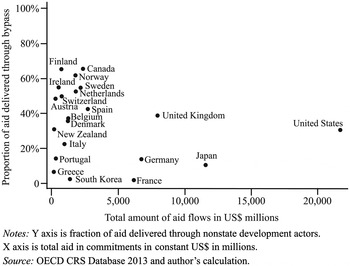
I operationalize the decision to outsource with a continuous measure, capturing the proportion of aid delivered through nonstate development actors. Figure 1 presents the proportion of nonstate aid each donor country allocates (y axis) across the full volume of aid flows in 2009. Among OECD donors, Finland channels the greatest proportion of aid through bypass actors, nearly 70 percent, followed by Canada, Norway, and Ireland. The United States outsources more than 30 percent of its bilateral funds. At the low end of the bypass axis are France, Greece, and South Korea, which send less than 8 percent of their aid through bypass channels.
Proportion of bypass aid for OECD donors, 2009

The Explanatory Variables: Donor Political Economy and Quality of Recipient Governance
Measuring national delivery preferences for goods and services
My argument builds on differences in national orientations about the role of the state in goods and service delivery. I conceptualize the main division among donor countries to be based on different mechanisms through which governments deliver goods and services. In some countries neoliberal beliefs promote competitive markets in delivery systems. In other countries more statist beliefs advocate nonmarket relations in goods and service delivery, either via in-house delivery or institutionalized delivery agreements with nonstate actors. To capture this variation in ideas that undergird the organization of political economies I rely on preexisting theoretical frameworks in the study of comparative political economy.
In a first step I leverage the binary division developed in the Varieties of Capitalism (VoC) tradition, which distinguishes political economies by types of governance modes.Footnote 42 In liberal market economies (LMEs) governments organize economic activity largely through markets—and economic decision making is a function of market-based competition. Consistent with VoC coding, I group the following Anglo-American donor countries in the neoliberal market category: United States, United Kingdom, Ireland, Australia, New Zealand, and Canada. To account for recent paradigmatic changes in national orientations from nonmarket to market-based delivery systems across Scandinavian countries,Footnote 43 I include Scandinavian countries in the LME category.Footnote 44
In coordinated market-economies (CMEs), on the other hand, governments frequently organize economic activity through nonmarket-based relationships that emerge from corporatist bargaining and/or include various forms of state intervention and regulation. I group France, Japan, South Korea, Germany, Austria, Netherlands, Switzerland, and Belgium in the CME category. I create an “other” category that subsumes countries with hybrid political economy types that include Spain, Portugal, and Greece.Footnote 45 I use the “other” category as a baseline category against which I statistically evaluate aid delivery patterns of LMEs and CMEs. Italy is excluded because of missing aid delivery data.
In a second step I further differentiate the binary division to account for differences in state structures among CME states. Katzenstein's and Evan's work shows that different kinds of state structures create distinct action capacities, and thus define the range of roles the state plays.Footnote 46
For instance, the professional bureaucracies in France historically produce and implement goods and services in-house.Footnote 47 One finds similar patterns in Japan and South Korea. Germany also relies on in-house delivery capacity but, simultaneously, delegates goods and service delivery to nonstate actors with whom the government has an institutionalized relationship. The latter type of delivery through nonstate actors is not a function of market-competition but arises from corporatist bargaining. Katzenstein calls this political economy type neocorporatist.Footnote 48
I follow suit and include Germany, Austria, Belgium, Switzerland, and the Netherlands in this category. Traditionally, Scandinavian economies have been described as neocorporatist where the state delivers goods and services through institutionalized arrangements with nonstate actors. However, economic crises in the 1990s brought about a fundamental change in delivery mechanism toward markets. I thus add a fourth political economy type that I call “Scandinavian.” Again I include Spain, Portugal, and Greece in the “other” category and use them as reference category in the statistical tests.
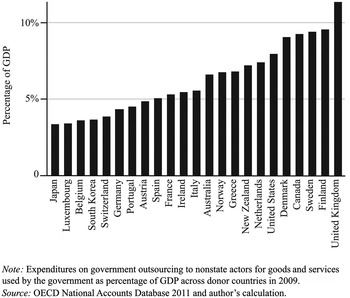
In a third step, I draw on a proximate expression of how political economic order occurs in politics in donor countries—a measure of “domestic government outsourcing” of services used by the general government as percent of GDP. I expect this measure to be determined by ideas that undergird the organization of political economies, which are captured by the previous political economy types. These data are from the OECD National Accounts Database and measure the degree to which governments use private contractors or the third sector to provide support services or perform back-office functions.Footnote 49 These data are available for only 2000 and 2009. In 2009, domestic government outsourcing of goods and services used by general government as percent of GDP represented an average of 12 percent across the OECD donor governments. In Figure 2, I plot the level of government outsourcing across all donor governments in 2009. This measure varies considerably from 3.5 percent in Japan to 12 percent in the United Kingdom.Footnote 50 The outsourcing average in 2009 is only a 2 percent increase from the average outsourcing in 2000, which implies that outsourcing does not change much over time. In subsequent analyses, I therefore employ a country's outsourcing average between 2000 and 2009.
Domestic government outsourcing across individual donors

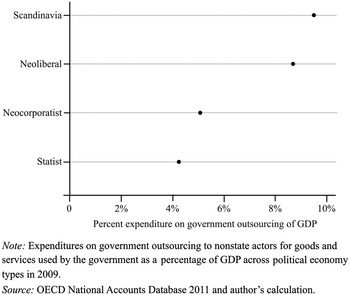
Figure 3 demonstrates that domestic government outsourcing is highly correlated with political economy types: although the Scandinavian type slightly tops the neoliberal one in domestic government outsourcing, the difference between these two (9.1 and 9.8 percent, respectively) and statist and neocorporatist types (4.5 and 4.9 percent, respectively) is considerable.
Domestic government outsourcing across individual donors and political economies

Measuring quality of recipient governance
When determining aid-delivery tactics, aid decision makers assess the likelihood of aid reaching the intended outcome in the recipient country. If state institutions are of poor quality, donor officials expect a higher probability of aid capture. In advancing the argument that national orientations condition the selection of delivery tactics when facing risk, I presume that, among officials from neoliberal economies there is a greater propensity to rely on bypass than among officials from more statist political economies. The quality of recipient governance is, therefore, an important variable in the model. I draw on data from the Governance Matters project.Footnote 51 I construct the recipient governance variable by including corruption control, government effectiveness, regulatory quality, and rule of law as indicators and averaging across them for any given year. The governance variable ranges between −2.5 and +2.5, which I rescaled to 0 and 5, with higher values representing a higher quality of governance. Among aid-receiving countries there is no country with a governance rating of 4 and higher.Footnote 52 Subsequent graphical illustrations will provide a 0 to 4 range of the variable.
In some aid-receiving countries, however, most notably in failed states, donors might face functionally incompetent governments, thus rendering bypass the sole aid delivery channel. To address this issue of constraint, I present the subsequent descriptive data using four different development environments in recipient countries that account for functional competence.Footnote 53
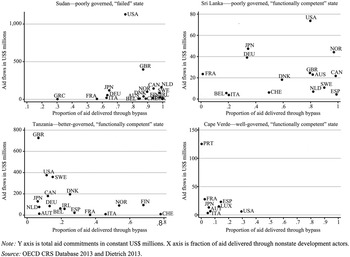
To illustrate recent donor aid delivery decisions in various situations of governance quality, I plot donor development cooperation for aid-receiving countries in 2009, where individual donors contributed at least US$ 2 million in development assistance. Figure 4 shows the bypass behavior of all active OECD donors in four recipient countries that vary in their governance characteristics. The countries include Sudan (a poorly governed, “failed” state), Sri Lanka (still poorly governed, functionally competent state), Tanzania (a better-governed, functionally competent state), and Cape Verde (a well-governed, functionally competent state) across the full range of possible bypass behavior (as captured along the x axis).
Proportion of bypass aid for OECD donors in select recipient countries, 2009

In the Sudan, which has a governance score of 0.86, all donor governments, with the exception of Greece, bypass the Sudanese government with more than 50 percent of their bilateral assistance. In the case of Sri Lanka, which has a governance score of 1.90, a majority of donors bypass with more than 50 percent of their bilateral assistance, and some donors outsourcing a somewhat lower proportion. Tanzania scores a 2.3 on the scale and, as expected, the majority of donors, with the exception of Norway, Finland, and Switzerland, channel less than half of their aid through nonstate channels. In Cape Verde, which scores 2.98 on the governance scale, donors channel only a small proportion through nonstate actors.
Although this graph provides descriptive evidence that donors, on average, respond to the quality of recipient institutions, differences nonetheless remain across donors. For instance, Japan and France do not outsource foreign aid in Sudan and Sri Lanka to the same extent as the United States, the United Kingdom, and Sweden. Moving from Sri Lanka to Tanzania, the latter three countries exhibit a different delivery tactic in favor of working with the recipient government, now more similar to Japan and France.
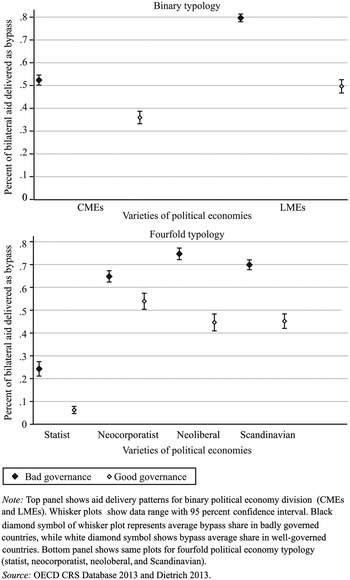
Figure 5 presents descriptive statistics that provide prima facie evidence that differences in aid delivery tactics exist across political economy types. The y axes represent the mean share of bypass. This mean share is separated into aid recipients that have “bad governance,” depicting countries with governance scores of 1.5 and lower, and aid recipients that have “good governance,” or a governance score of 2.0 and higher. The whisker plots are useful for illustrating the change in outsourcing share across the two types of political economies when moving from environments of high probability of aid capture to low probability ones. The raw data indicate that, regardless of political economy type, donors are responsive to the probability of aid capture in the recipient country. Importantly, however, the degree to which countries bypass recipient governments varies by political economy type. The top graph depicts differences between the CME and LME countries, whereby the LME countries exhibit greater reliance on markets than their CME counterpart, which is indicated by the relatively steep drop in bypass shares as the quality of governance changes from bad to poor. The bottom graph shows that neoliberal and Scandinavian political economies exhibit the steepest relationship when moving from poorly to better-governed recipient countries in the top panel.
Donor delivery tactics by political economy types, 2005–11

Controls
As the previous literature on aid policy maintains, various other factors shape donor decisions about the allocation of aid resources, including other recipient characteristics and nondevelopmental donor goals. I include them as controls to provide a fully specified model. All time-varying right-hand-side variables are lagged one year. I control for democracy based on the understanding that some donors may conceive of democratic institutions as political constraints that limit the ability of recipient governments and bureaucratic officials to capture aid flows. democracy is measured using the combined score of the Freedom House civil liberty and political rights indicators.Footnote 54 To make the scale of the measure more intuitive I invert democracy so that “1” represents the lowest level of democracy, whereas “7” stands for the highest level of democracy. The Freedom House data are widely used among donor governments in their assessments of democracy. During interviews with donor officials across OECD donor countries, this measure was most often mentioned as informing assessments of political regimes.Footnote 55
I control for natural disaster deaths based on the understanding that a greater number of deaths caused by natural disasters in the aid recipient, as recorded by the EM-DAT database, may prompt donors to provide a larger share of the pie to nonstate development actors that are specialized in postdisaster reconstruction efforts.Footnote 56 Following a similar logic, low-scale civil conflict, as recorded by the PRIO database, may create grievances that provide incentives for donors to favor more outcome-oriented aid delivery about ensuring that aid reaches the affected, thus increasing donor propensity to bypass.Footnote 57 I further include distance to account for the geographical proximity between donor and the aid-receiving countries. As distance between donors and aid-receiving countries grows, government-to-government relations between donor and recipient governments are expected to weaken, thus increasing donor propensity to channel aid through nonstate development actors. The distance data are drawn from Bennett and Stam's Eugene software and are logged.Footnote 58
Following previous studies, I also include confounders that capture donor nondevelopmental objectives. former colony status, as recorded by the CIA World Factbook, allows me to account for long-lasting diplomatic ties between the donor and the aid-receiving governments that may bias aid delivery in favor of government-to-government aid. trade intensity, measured as the logged sum of imports and exports between the recipient and the OECD countries from the IMF-DOT database, is a straightforward indicator of donor efforts to strengthen economic ties with the recipient government.Footnote 59 To control for security-related donor goals, I include security council, which is a binary variable indicating whether the aid recipient is an elected member on the UN Security Council. As works by Kuziemko and Werker as well as Vreeland and Dreher find, donor governments use aid to buy votes from rotating members of the UN Security Council.Footnote 60
I incorporate a binary control for major power status to account for the fact that major donors including the United States, United Kingdom, Japan, Germany, and France use foreign aid to influence policy abroad. I also include controls for total aid per capita, as well as democracy aid and social sector aid individually. I would expect democracy aid to have a positive effect on bypass insofar as democracy aid may be more likely to be associated with civil society support. By including social sector aid, I control for the possibility that donors channel aid through nonstate development actors because NGOs and IOs are in a better position to deliver services. This is distinct from my argument that suggests that donors turn to nonstate development actors because they want to decrease the probability of aid capture.
Analysis and Results
I now estimate the model that examines differences in aid delivery across political economies using the political economy type measure. I fit a linear ordinary least square (OLS) model with a log-transformed dependent variable to account for the proportional nature of the bypass share dataFootnote 61 and calculate clustered standard errors on the recipient country.Footnote 62 I investigate bias from serial correlation by applying the Wooldridge test for panel data.Footnote 63 The significance of the test-statistic (p = 0.029) indicates that autocorrelation may introduce bias in the estimates. I therefore include a lagged dependent variable in the main specification. The following equation delineates the fully specified statistical model, using the binary (LME, CME) division:Footnote 64
 $$\eqalign{{\rm \smallcaps{BYPASS}}_{it} & = \beta 0 + \beta 1 \, {\rm \smallcaps{LAGGED \ BYPASS}}_{it} \cr & \quad + \beta 2 \, {\rm \smallcaps{RECIPIENT\ GOVERNANCE}}_{it} + {\beta} 3 \, {\rm \smallcaps{PE}}_{LME,i} \cr & \quad + \beta 4\,{\rm \smallcaps{PE}}_{LME,i}\ast {\rm \smallcaps{RECIPIENT \ GOVERNANCE}}_{it} + {\beta} 5 \, {\rm \smallcaps{PE}}_{CME,i} \cr & \quad + \beta 6 \,{\rm \smallcaps{PE}}_{CME,i}\ast {\rm \smallcaps{RECIPIENT \ GOVERNANCE}}_{it} + {\beta} 7\, {Z} + \smallcaps{E}_{it},\;} $$
where bypass in foreign aid is the continuous log-transformed (OLS) variable, i represents country and t represents year, lagged bypass captures the share of bypass in the previous year, recipient governance denotes the (time-varying) quality of recipient governance, pe lme , pe cme denote the (time-invariant) political economy types of the binary typology, and recipient governance × pe lme,cme s denote the respective interactions, denotes the vector of (time-varying and time-invariant) control variables, and Eit is the error term of the equation. To account for unobserved confounders across recipient countries and years in the sample I include two-way year and recipient fixed effects in the main model specifications, as specified at the bottom of Table 1.Footnote 65
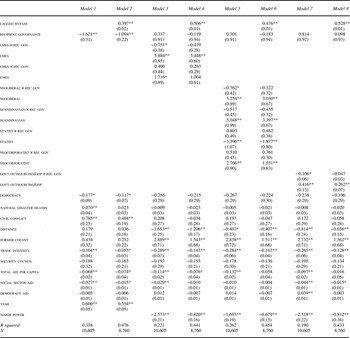
Donor political economy and bypassing governments in aid-receiving countries, 2005–11

Notes: Constant (all columns) not reported; region dummies for Sub-Saharan Africa, Latin America, Middle East, Asia, and Eastern Europe as omitted category (Models 1 and 2) are not reported; donor fixed effects (Models 1 and 2); year fixed effects (Models 3 to 8); recipient fixed effects (Models 3 to 8). CMEs = coordinated market-economies. LMEs = liberal market economies. Rec Gov = recipient governance. *p < .10; **p < .05; ***p < .01.
Table 1 presents my findings. The first two columns present OLS results for the specification (Models 1 and 2) that do not include political economy variables. They include the recipient governance measure and other potentially confounding factors as well as donor country and region fixed effects. This specification allows me to show the average effect of recipient governance prior to introducing the donor invariant political economy measures. Model 2 includes the lagged dependent variable. The results show that donors, on average, condition aid delivery tactics on the quality of recipient governance. The coefficient of recipient governance is negative and statistically significant indicating that donors respond to improvements in governance by reducing the share of aid channeled through nonstate development actors.
The results in Models 3 to 6 provide support for my main argument, which leads me to expect that donor countries whose political economies are organized by market principles are statistically different from other political economy types in how they respond to variation in governance quality in the recipient country.Footnote 66
Models 3 and 4 present results using the binary division between LME and CME types. I focus on Model 4 because it corrects for serial correlation by including the lagged dependent variable.Footnote 67 The coefficient of recipient governance expresses the statistical association between governance and bypass for the omitted group of donors (Spain, Portugal, and Greece), which is negative, as expected. The interaction term lmes × rec gov is negative, which indicates a steeper negative slope for the LMEs compared with the slope of the omitted group. The lmes constituent term is positive and significant, suggesting that moving from the omitted type to the LME category yields a significant increase in bypass when governance quality in the recipient country is 0. The interaction term cmes × rec gov is positive, which indicates a lower degree of responsiveness to changes in governance quality, relative to the omitted group of donors. The cmes constituent term is positive but insignificant.
Significance tests of the respective interactions (p = 0.001) and political economy constituent terms (p = 0.001) reveal that the two political economy types differ significantly from each other in terms of their aid delivery tactics. These findings offer statistical confirmation of initial inspections of the raw data as presented in Figure 2. Bad governance, as is the case in Sudan and Sri Lanka, has regulatory influence in terms of bypass tactics for the United States and the United Kingdom, but not France and Japan. When governance quality is higher, as is the case in Tanzania, donors who rely on markets in goods delivery are more willing to engage with the state because it now represents a trustworthy and capable development partner whose indigenous economies of scale are likely to boost the effect of aid delivered through the recipient government channel.
Models 5 and 6 present results for regressions that include the fourfold political economy typology. The neoliberal and Scandinavian political economies have positive and significant constituent terms, suggesting that moving from the omitted type to the neoliberal or Scandinavian category yields a significant increase in bypass when governance quality in the recipient country is 0. Both political economy types have negative interaction terms, which indicate steeper negative slopes, relative to those of the “other” group.
Significance tests of the political economy constituent terms (p = 0.001) reveal that the two political economy types differ significantly from the other statist and neocorporatist political economies in terms of their aid delivery tactics. Significance tests of the interaction terms reveal that the bypass tactic of neoliberal and Scandinavian political economies under conditions of bad governance is jointly significantly different (p = 0.002) from the statist and neocorporatist political economies. This suggests that they exhibit similar degrees of responsiveness to changes in recipient governance. Significance tests of the political economy constituent terms show that, again, neoliberal and Scandinavian aid delivery tactics are jointly statistically significantly different from the other two categories (p = 0.001) but not statistically different (p = 0.66) from one another.Footnote 68
In Models 7 and 8, I investigate the effect of domestic government outsourcing as a proximate expression of political economy type. I expect that the interaction of donor outsourcing and recipient governance contributes to explaining variation in delivery tactics. Consistent with Models 3 to 6, I focus on the interaction of government outsourcing and the quality of recipient governance, again controlling for potential confounders. government outsourcing is a continuous and time-invariant variable, measuring average government outsourcing between 2000 and 2009. The results in Model 7 and 8 provide statistical confirmation because they indicate differences in responsiveness to changes in government outsourcing. The coefficients of the interaction term and the government outsourcing constituent term are negative and positive, respectively.Footnote 69
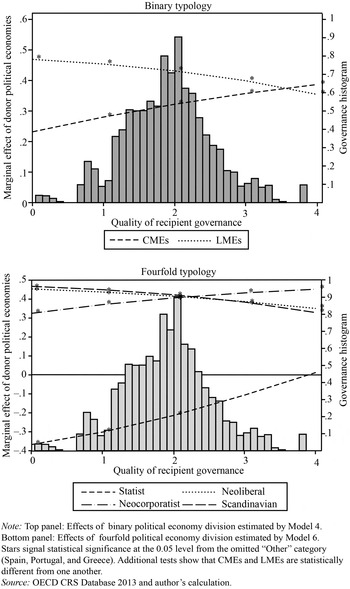
Figure 6 plots the marginal effects of political economy type on the share of bypass across different values of governance quality. The top panel of Figure 6 shows the results of Table 1, Model 4, which includes the binary division of political economy types. As indicated from the coefficients, the slope of the lmes is consistently negative. Differences in statistical significance are captured through 95 percent confidence intervals, which I visualize through stars. The stars indicate that the effects of either political economy type are statistically significantly different from the omitted “other” category (Spain, Portugal, and Greece), but not from each other. Moving into the LME category (from the baseline “Other” political economy type) yields a statistically significant increase in bypass share by 0.48 in badly governed countries (with a 1 for governance quality) from the baseline “Other” type. In better-governed countries (with a 3 for governance quality), the statistically significant increase associated with becoming a Scandinavian political economy type is smaller at 0.4 relative to the baseline “other” political economy type.
Marginal effects of political economy types across quality of recipient governmance

The bottom panel of Figure 6 shows the results of Table 1, Model 6, which includes the fourfold division of political economy types. As indicated from the coefficients, the slopes of the neoliberal and scandinavian political economies are similar and consistently negative. There are differences in statistical significance that are visualized through 95 percent confidence intervals captured through stars. Becoming Scandinavian (from the baseline “Other” political economy type) yields a statistically significant increase in bypass share by 0.48 in badly governed countries (with a 1 for governance quality) from the baseline “Other” type. In better-governed countries (with a 2 for governance quality), the statistically significant increase associated with becoming a Scandinavian political economy type is nearly identical relative to the baseline “Other” political economy type. This responsiveness to improvements in recipient governance is very similar for the classic neoliberal countries, although the differences are not statistically different from the omitted category. The slope of the statist political economies is positive. As the quality of governance improves, this group of countries, compared with the omitted category, does not increase the share of government-to-government aid. The slope of the neocorporatist political economy type is positive, suggesting that, compared with the omitted category, neocorporatist countries condition less on governance as the quality of governance increases.
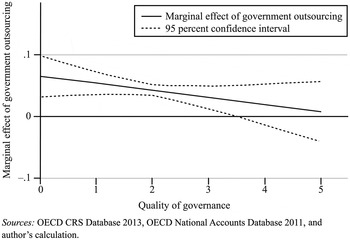
Figure 7 presents the marginal effects of government outsourcing on the share of bypass across different values of recipient governance. My argument leads me to expect that increases in domestic government outsourcing make donor governments more selective in their selection of aid delivery channels. The x axis captures different levels of governance quality, ranging between 0 and 5. Increasing the level of domestic outsourcing yields a statistically significant decrease in bypass share as the quality of governance increases; this statistical relationship holds for the large majority of the data points. In other words, donor political economies that emphasize efficiency in aid delivery will cut governments slack as they improve their governance and increase the share of government-to-government aid. The evidence presented in Table 1 supports my thesis that recipient governance plays a significant role in donor decisions about how to deliver aid but that differences exist across donors to the degree in which donor governments subscribe to bypass delivery tactics.
Marginal effect of government outsourcing on bypass share across quality of recipient governance

Among the controls trade intensity, total aid per capita, former colony, and major power are statistically significant across most models, and the direction of the coefficient behaves in the predicted direction. Although the coefficient of democracy behaves in the predicted direction, it is not statistically significantly associated with bypass. This may suggest that donors, on average, are not as responsive to the quality of government as they are to the quality of governance, all else equal. This finding, though resulting from a mere control variable, merits further study. The findings associated with democracy aid are inconsistent in terms of coefficient direction but mostly insignificant. This may be in part because the measure subsumes both governance aid and civil society aid that is channeled through government and civil society, respectively.Footnote 70
Further disaggregation may be of interest for future studies. The results for civil conflict are insignificant—the positive direction of the coefficient was anticipated and suggests that donors increase the amount of bypass during years of conflict. This, too, merits further study and has implications for important research that investigates aid allocation during or after episodes of conflict.Footnote 71
Finally, readers might be concerned about potential endogeneity. If bypass undermines or strengthens state institutions then the quality of governance is endogenous. However, the theory does not offer clear predictions for what direction the bias works. In interviews, more statist donor government officials suggested that bypass hurts recipient state institutions because it diverts resources away from the public sector and toward parallel structures that often lack alignment with public-sector policy. Neoliberal government officials, on the other hand, believe that bypass creates incentives for recipient governments to improve their governance quality as nonstate actors compete with the recipient public sector for foreign aid. To address the concern statistically, I estimate a model that controls for initial governance, which measures the value of governance during the first year of the estimation sample. By measuring governance at the earliest possible time, I minimize the effect of bypass on governance. What is more, recipient governance is a measure that changes slowly over time. Accounting for initial governance, the results do not change.Footnote 72
Within Subject Survey Data Analysis
I further test my argument with cross-country individual-level survey data of fifty-seven former or current aid officials from five countries.Footnote 73 The countries include France, Japan, Germany, the United States, and Sweden.Footnote 74 I selected these countries because of their political economy types. Four of the five donors are considered major donors. Sweden is a political economy that has undergone a change in political economy type. By supplementing cross-country analyses with survey data of foreign aid officials I am able to test important individual-level implications of my argument. I administered the majority of the survey in interviews, either face-to-face in person or on the phone. Some officials preferred to fill out the survey by e-mail.
Survey Design and Implementation
My argument posits that aid decision makers react to changes in the quality of governance in the recipient country and that aid officials from different political economies differ in the degree to which they use bypass tactics under conditions of bad governance in the aid-receiving country. The survey employs a within-subject design that exposed each official to three hypothetical low-income-country scenarios, which differ only in the quality of governance. The anchoring scenario, Country A, represents a well-performing low-income country with relatively low levels of corruption and strong state institutions.Footnote 75 Countries B and C are identical to Country A, with the exception of their governance characteristics. Country B captures weak state institutions—while corruption levels are relatively low. Country C captures a large-scale corruption scandal involving public-sector officials—while state institutions are relatively strong.Footnote 76
Subsequent to presenting each country scenario, I asked respondents to answer questions about their aid delivery preferences in their capacity as aid officials. The first question asked respondents to rank-order five aid delivery channels including the recipient government, international organizations, international NGOs, local NGOs, and private-sector actors. The scale ranges from 5—“works best for my country” to 1—“works worst for my country.” I focus on the rank order associated with aid delivered through the recipient government. If respondents rank the recipient government as a 5 it means that they have a clear no bypass preference. With descending rank order values, respondents indicate greater preferences for bypass.
To closely mimic the dependent variable of the observational data analysis, I further asked respondents to indicate their preferences regarding the proportion of government-to-government aid across the three scenarios. The second question asked them to determine the amount of government-to-government aid out of overall aid flows to the country—with answer categories including “none,” “some,” “quite a bit,” “a large amount,” and “all.” Similar to the rank-order measure, the value 5 is associated with a clear no bypass preference, with lower values indicating increasing preference for bypass.
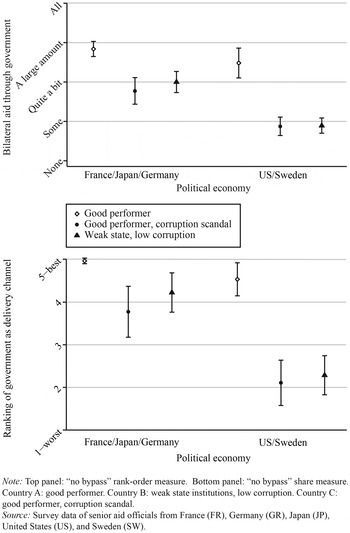
Figure 8 shows the point estimates as well as the associated confidence intervals for changes in quality of governance across aid officials from different political economies. The top panel of the figure provides estimates for the channel rank-order measure. The bottom panel presents estimates for the aid delivery share outcome measure. The descriptive data confirm my expectations. Officials from both types of political economies have a preference for the government-to-government channel when the quality of recipient governance is high. In countries with weak governance or corruption, differences among officials from different political economies are pronounced. Although the ranking mean is lower across both types of political economies, the mean of US and Swedish officials is statistically significantly lower. The pattern is the same for the aid delivery share measure presented in the right panel of Figure 8.
Point estimates and 95 percent confidence intervals for “no-bypass” aid delivery rank-order and “no-bypass” share of all bilateral aid by donor political economy across governance scenarios

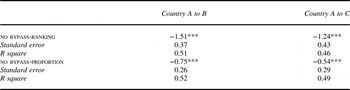
Next, I estimate the difference in differences to measure the effect of deteriorating governance within subjects. My argument predicts that the change in delivery tactics induced by Country B and Country C scenarios differs significantly across officials from different political economies. I expect officials from the United States and Sweden, on average, to change toward greater bypass than their counterparts from France, Japan, and Germany. The results confirm my thesis and are consistent with the observational data analysis. Table 2 shows the difference in differences estimates. The upper half of Table 2 represents the results of the estimates explaining the rank-order measure, no bypass-ranking. The estimated difference between officials from the two types of political economies as they move from Country A to Country B is -1.51 and statistically significant at the 0.01 level. Moving from Country A to Country B yields a statistically significant estimated difference of −1.24 at the 0.01 level. The results no bypass-proportion are presented in the lower half of Table 2. Again, the difference in response as respondents move from Country A to Country B or C are statistically different across officials from the two types of political economies. This suggests that officials of any background prefer to lower the government-to-government portion of bilateral aid in poorly governed countries but US and Swedish respondents did so to a higher degree, with statistically significant differences in means in the case of a corruption scandal or weak state institutions in recipient countries, respectively.
Difference-in-difference estimates of aid delivery ranking by donor political economy

Notes: In the top half of the table, respondents evaluate Country A (good performer), followed by Country C (corruption scandal). In the lower half of the table, respondents evaluate Country A (good performer), followed by Country C (weak state institutions). “No bypass-ranking” is based on rank-order of aid delivery preferences, with “5” indicating the recipient government is first choice. “No bypass-proportion” is based on proportional measure for aid delivery preferences, with “5” indicating all aid should go through the recipient government. *p < .10; **p < .05; ***p < .01.
Source: Survey data of senior aid officials from France, Germany, Japan, United States, and Sweden.
Why does one find this differential response in delivery tactics across officials? My argument posits that the organization of public goods delivery at home influences how officials approach the delivery of foreign aid abroad. Donor officials from countries that rely on markets to maximize outcomes prefer delivery tactics that achieve outcomes that are readily measurable and achievable in the short run. On the other hand, officials from countries where public-sector governance emphasizes a strong state in the delivery of public goods focus on collective long-term solutions that center on state-building efforts and, consequently, focus less on short-run results. The survey instrument includes two posttreatment questions that aim to tease out differences on these two dimensions.
The first question asks respondents to identify the appropriate time horizon for the evaluation of foreign aid success, measured in number of years. I expect respondents from France, Japan, and Germany to indicate preferences for longer time horizons than their counterparts from the United States and Sweden. Subsequently, I ask respondents to identify the appropriate amount of state-strengthening out of all aid, choosing among answers including “none,” “some,” “quite a bit,” “a large amount,” and “all.” I expect respondents from France, Japan, and Germany to exhibit a preference for more state-building aid, whereas I expect respondents from the United States and Sweden to exhibit less thereof.
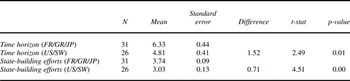
Table 3 presents the results of simple differences. Consistent with my expectations, the mean number of years considered appropriate for showing the success of aid efforts is lower among officials from the United States and Sweden, 4.56 years, indicating that their time horizons are significantly shorter than those among officials from France, Japan, and Germany, which exhibit a mean of 6.27. The difference of 1.71 years is statistically significant at the 0.01 level. Further, statistically significant differences exist between political economy types when respondents indicate their preferences for state building. A value of 5 indicates that “all” aid should be directed toward capacity building. Officials from the United States and Sweden show a mean of 3, whereas their French, Japanese, and German counterparts show a higher mean of 3.76. The 0.76 difference is statistically significant at the 0.01 level. These results buttress my claim that the differences in public sector governance shape donor governments' aid delivery preferences abroad.
Simple T-test results of time horizon associated with aid success and importance of state-building efforts as share of overall efforts

Notes: “Time horizon” captures number of years after which respondents measure success of foreign aid. “State-building efforts” captures the ratio of aid allocated toward state building versus direct aid, with “5” indicating all aid should be used to build state capacity and no aid should be allocated for direct relief purposes.
Source: Survey data of senior aid officials from France (FR), Germany (GR), Japan (JP), United States (US), and Sweden (SW).
Although I treat national orientations as exogenous, I acknowledge that national orientations are not fixed. In the 1990s, in response to severe economic crises, the Scandinavian countries political-economic worldviews changed from statist to neoliberal in service provision. Although data limitations preclude me from estimating a cross-national empirical model that evaluates within-donor variation in aid delivery, interview and survey evidence with Swedish donor officials suggests that Sweden's shift toward market-oriented goods and service delivery is reflected in foreign aid decision making. A former senior government official offers pointed support for this expectation:
Swedish aid policy today stresses results-based management, and therefore resembles British aid policy a lot more than it used to in the 1980s or 1990s. Results orientation starts under the Social Democrats in the wake of the real estate crisis in the 1990s when the government begins to liberalize the economy to enhance the efficiency of the welfare state. The budget is tight and there is pressure on the government to justify the aid expense. But results orientation is by no means unique to foreign aid. When you look at other policy areas such as the social transfer system, education, and child care you see similar practices. Today we have an open market in all areas of public goods in Sweden, and the Ministry of Foreign Affairs is developing a so-called “results-based strategy” for foreign aid. They want to make results more visible to the taxpayer. They want results in the short term.Footnote 77
I evaluated this claim using my sample of thirteen Swedish aid officials. Eleven out of thirteen respondents suggested that time horizons in aid evaluation had shrunk over the past twenty yearsFootnote 78 and ten out of thirteen respondents suggested that there currently is less emphasis on state strengthening than there was twenty years ago.
Conclusion
This study developed and tested a model of endogenous aid delivery that accounts for heterogeneity in donor delivery preferences. The origins of donor officials' baseline delivery preferences are based on one important feature of the political economy: the role of the state in goods and service delivery. I argue that donor governments whose political economies emphasize market-based delivery systems are more likely to pursue bypass tactics in poorly governed countries to circumvent aid capture by corrupt elites. As expected I find this prediction to hold for classic neoliberal political economies as well as for Scandinavian economies. Less market-oriented delivery systems are expected to bypass less in poor governance environments. Because their core orientation favors a stronger role of the government in the delivery of public-sector goods, information about recipient governance will trigger some but not big movements away from the core orientation. I find statistical support for this prediction. This study thus provides robust evidence for a prominent research tradition in international relations that studies the domestic politics of foreign economic policy.
This study informs the literature on aid effectiveness because it establishes a link between political economies and the different kinds of benchmarks that donor officials use to assess aid success. Donor governments that outsource aid delivery in countries with bad governance may achieve greater success in providing immediate relief to the poor through easily implementable health interventions than donor governments that continue to engage in institution building in collaboration with the state. However, outsourcing in foreign aid delivery might hamper or even undermine donor efforts to build up a state capable of managing its own development—an objective that ranks high for donor governments who prefer a tactic of greater engagement with the government in the developing country. Although donors often offer a combination of short- and long-term approaches, the results of this study imply that political economies may shape where donors governments stand on this fundamental dilemma in aid provision. What is more, this study suggests that the decision to provide government-to-government aid or aid through nonstate development actors is nonrandom and depends in part on the political economies of donor countries. Future evaluations of the effectiveness of foreign aid should thus account for this pattern of nonrandom assignment of aid.
My study also sheds light on potential trade-offs between aid effectiveness and policy influence. By setting up parallel structures, market-oriented donor governments may achieve greater success in providing direct relief to the poor. However, this approach may bring some unintended consequences. By de-emphasizing state building, donor governments may surrender the opportunity to strengthen relationships with state and local authorities. This may undermine donor ability to more directly shape policy and governance processes in aid-receiving countries. This potential dilemma merits further study.
My argument has implications for research that explains donor coordination—a practice encouraged by the OECD, on which little progress has been made.Footnote 79 If differences in national orientations toward the role of the state in goods and service provision make donor coordination difficult, then one should expect only countries with similar political economies to be able to coordinate successfully. This presents an interesting area for future research.
This study lays the groundwork for an extension that examines how national orientations evolve over time and, consequently, affect temporal variation in aid policy within donor countries. Although national orientations—much like domestic structures—are “sticky,” they are a product of politics where political parties renegotiate views about the appropriate role of the state in public goods delivery.Footnote 80 If, as is commonly done, one associates conservative parties with demands for more market orientation in service provision, then one should expect a conservative government to push for more performance-oriented aid delivery tactics. Anecdotal evidence lends support for this initial contention. Recent victories of conservative parties in market-oriented political economies, including Canada (2006), Sweden (2007), and the United Kingdom (2010) have led to reforms in the delivery of foreign aid. These reforms emphasize primarily efficiency criteria. The British conservatives make this case in their party's green paper in 2009:
We are absolutely clear that, as taxpayers feel the pinch, maintaining public support for our aid programme will require a much greater focus on performance, results and outcomes. Our bargain with taxpayers is this: in return for your contribution of hard-earned money it is our duty to spend every penny of aid effectively … We bring a natural scepticism about government schemes. In many developing countries, supporting the state means supporting a particular group or tribe. Labour sometimes gives aid directly to governments without adequate scrutiny.Footnote 81
In a similar vein, Sweden's conservative government alliance under Prime Minister Fredrik Reinfeldt emphasized performance and results orientation, as do conservative parties in Australia, Canada, and their correspondents in other OECD countries. If conservative political party ideology amplifies market-oriented tactics in public goods provision, then one should expect more outsourcing in aid under conservative governments than governments of the left. Whether exogenous changes in government affect aid delivery tactics therefore demands further inquiry.
Finally, this study may encourage future research that explores how ideas dovetail with interests. My argument centers on the role of beliefs about the appropriate role of the state in service delivery in foreign aid decision making. Another way of thinking about the role of ideas in aid delivery is that, over time, ideas about the appropriate role of the state in service delivery facilitate the creation and organization of particular bureaucratic structures.Footnote 82 These structures, in turn, generate domestic political interests and capabilities that get further accentuated in foreign policy.Footnote 83 In foreign aid, the introduction of markets in foreign aid delivery resulted in a reduction of the aid bureaucracy's capacity. Prior to the 1980s, the US government, through its main aid agency USAID, largely produced design and expertise in-house, sending many people abroad. In the 1980s, the US government turned to markets that resulted in a significantly weaker bureaucracy in terms of number of employees and expertise. Today, USAID staff largely assumes managerial functions.Footnote 84 It acts as a principal whose objectives are to find the best agent to implement aid effectively. The Swedish International Development Cooperation Agency (Sida) in Sweden has experienced similar changes. On the other hand, more “statist” beliefs have facilitated the persistence of strong bureaucratic structures that enable governments to directly implement foreign aid using in-house capacity and expertise, or by relying on long-institutionalized relationships with nonstate service providers. In France, the Agence Française de Développement (AFD) has extensive in-house capacity for aid policy design and implementation as well as extensive field presence in nearly all the countries that the French government gives aid to. Unlike USAID, the AFD serves as the primary agent for the delivery of French aid. In both types of donor political economies, ideas serve as true causal priors that affect the type of bureaucratic structures and whether the bureaucracy assumes the role of principal or agent. With these different types of structures come particular sets of public and private domestic interests that seek to perpetuate existing systems of delivery. These, interests, in turn, contribute to explaining the divergence over the way that the United States and France provide aid over the course of the past fifty years. I leave it up to future research to develop an argument of donor variation in aid delivery that weaves together ideational and interest-based explanations.
Supplementary Material
Supplementary material for this article is available at http://dx.doi.org/10.1017/S0020818315000302.