Introduction
Open planar dielectric resonators (DRs) based on dielectric disks, which diameters are much greater than their heights D > > H, have well-known advantages in millimeter wave-band in comparison with resonators formed by metal surfaces. These include the high Q-factor and the rarefied spectrum. A mode set of such resonators, as a rule, contains oscillations with high azimuthal indexes. In the scientific literature, such oscillations are called whispering gallery modes (WGMs), by analogy with acoustic modes characterized by an extremely small attenuation. From the standpoint of electromagnetism, WGMs provide high Q-factor due to low radiation into free space [Reference Annino, Cassettari and Martinelli1–Reference Kirichenko, Prokopenko, Filippov and Cherpak3]. However, the possibility of WGMs excitation in open planar DRs is limited by the fulfillment of the total internal reflection of waves from both a cylindrical surface of a dielectric disk and its flat bases. Therefore, there are limitations on both the diameter and the height of dielectric disks, which are related to the operating wavelength. A large number of researches are devoted to the study of the dependence of mode sets of planar DRs on their radiuses. The limits of applicability of such resonators with respect to the excitation of WGMs in them are determined in accordance with their planar dimensions. Regarding the choice of the height of the planar DR, expressions were also obtained that determine the minimum sufficient height of the open dielectric disk for the excitation of WGMs in a certain frequency range. The fulfillment of the inequality H ≥ λd/2 (λd is a wavelength in a dielectric material of a resonator) is the necessary condition for exciting WGMs in the planar DRs [Reference Yurchenko, Altintas, Ciydem and Koc4–Reference Кirichenko, Golubnichaya and Маximchuk6]. This inequality is obtained from an analysis of the physical nature of WGMs [Reference Annino, Cassettari and Martinelli1, Reference Kirichenko, Prokopenko, Filippov and Cherpak3]. From the standpoint of wave optics, Hmin = λd/2 is the minimal value of the resonator height, which is necessary to fulfill the condition of complete internal reflection of waves from the flat surface of a dielectric disk.
However, the possibility of using the planar DRs with lower heights has not been fully investigated. We have previously shown that in such resonators on the basis of thin dielectric disks with shielded flat surfaces, the fields of WGMs can be formed [Reference Kogut, Kogut, Dolya, Nosatiuk, Kharkovsky and He7]. Coating the flat bases of thin dielectric disks by reflective surfaces solves the problem of complete internal reflection of waves from the flat bases of thin dielectric disks. It was also noted that at the insertion of an air gap into the design of the resonator by displacing one of the metal mirrors along the axial coordinate, the frequency and energy characteristics depend on its height. The partial displacement of the resonant fields of WGMs from the dielectric to the air gap in such a tunable resonator is the reason for this effect. It is obvious that in this case the conditions for the reflection of waves are changed. Such a change in the conditions for forming the oscillations in a resonator based on a thin dielectric disk determines the composition of its mode set. It should be noted that the spectral characteristics such as mode set of the tunable planar DR have not been studied yet.
Since the electric component of the resonant field is responsible for the connection with the dielectric medium, the task of exciting WGMs in the planar DRs, which are much limited in the direction of the vector E, is interesting especially.
This paper is devoted to the study of the spectral characteristics of the tunable thin planar DRs with WGMs. The study of the energy characteristics of such a resonator in the Ka-band is interested too.
General view
Let us consider the simplest example of a disk DR. This is a dielectric disk made of an isotropic material with low loss, whose diameter is much larger than its thickness. Small radiation from the resonator is based on the mechanism of total internal reflection of waves from the surface of the dielectric disk [Reference Annino, Cassettari, Longo and Martinelli8, Reference Annino, Cassettari, Longo and Martinelli9]. The hybrid modes as ЕНnml and HЕnml can be excited in the disk DR. Three modal indexes n, m, and l determine the number of the resonant field variation along the azimuthal, radial and axial coordinates, respectively. An approximate analytical description of the resonance WGMs can be found in the works [Reference Annino, Cassettari, Longo and Martinelli9, Reference Peng10]. The behavior of the electromagnetic field inside the resonator is given in cylindrical coordinates by an expression of the form:

where J n (βρ) is the Bessel function of the first kind, β and h are the transverse and axial propagation constants, respectively, related by the equation [Reference Annino, Cassettari, Longo and Martinelli8]:

here$\;k = {\omega \over c}\sqrt {\varepsilon \mu }$ , c is the speed of light in vacuum and ω the angular frequency of the radiation; ε and μ are the real parts of permittivity and permeability of the material forming the resonator. In the following, the real part of permeability will be assumed equal to 1.
The electromagnetic characteristics of disk DRs with WGMs are given from the above description of the field. This is equivalent to the assumption that the field distribution of WGMs in the disk DRs can be obtained by WGMs of a related infinite waveguide, choosing a suitable axial propagation constant as pointed out in [Reference Annino, Cassettari, Longo and Martinelli8, Reference Annino, Cassettari, Longo and Martinelli9]. As in the case of WGMs of an infinite circular dielectric waveguide (DW) [Reference Wait11], special attention will be paid to the case of weak axial propagation constants (h < < k): a basic role will then be assigned to the modal index n.
Expression (2) is fundamental for calculating the spectral characteristics of disk DRs, determined by their electrical and geometric parameters. In this case, the axial propagation constant is the value which depends on the height H of disk DR [Reference Annino, Cassettari and Martinelli1]:

The coefficient of axial propagation γ is close to 1 and becomes equal to 1 when the field tends to zero on the plane surfaces of the resonator, as in the case of a metal cavity [Reference Kajfez and Guillon12]. Thus, expression (2) takes the form:

For disk DRs arranged such that their flat bases are between two metal planes, this expression is most suitable, since the field on the metal is zero. In this case expression (4) is exact. Further, the exact implementation of this equality will be especially important for the topic of this paper.
It can be seen that expression (4) makes it possible to determine the height H of the disk DR, starting from its spectral characteristics:

It is not difficult to see that the smallest value of the height of disk DR acquires when the transverse propagation constant tends to zero. The case when β = 0 is a transition of volume waves, a particular case of which are WGMs, into the surface waves [Reference Kirichenko, Prokopenko, Filippov and Cherpak3]. In this case, the minimum height Hmin of the disk DR for the WGM with the axially homogeneous field distribution (l = 0) is:

where λ d is the wavelength in the dielectric material of the resonator.
In our work, we will show that for the excitation of WGMs in the disk DR, whose height is less than the value Hmin, can be possible. WGMs with an axially homogeneous field distribution (l = 0) were not considered in the paper [Reference Annino, Cassettari and Martinelli1]. So, let us consider the case when the disk DR is located between two conducting planes. The height of the disk is $H\,\lt \,{{\lambda _d} \over 2}$ .
Object and methodology of investigations
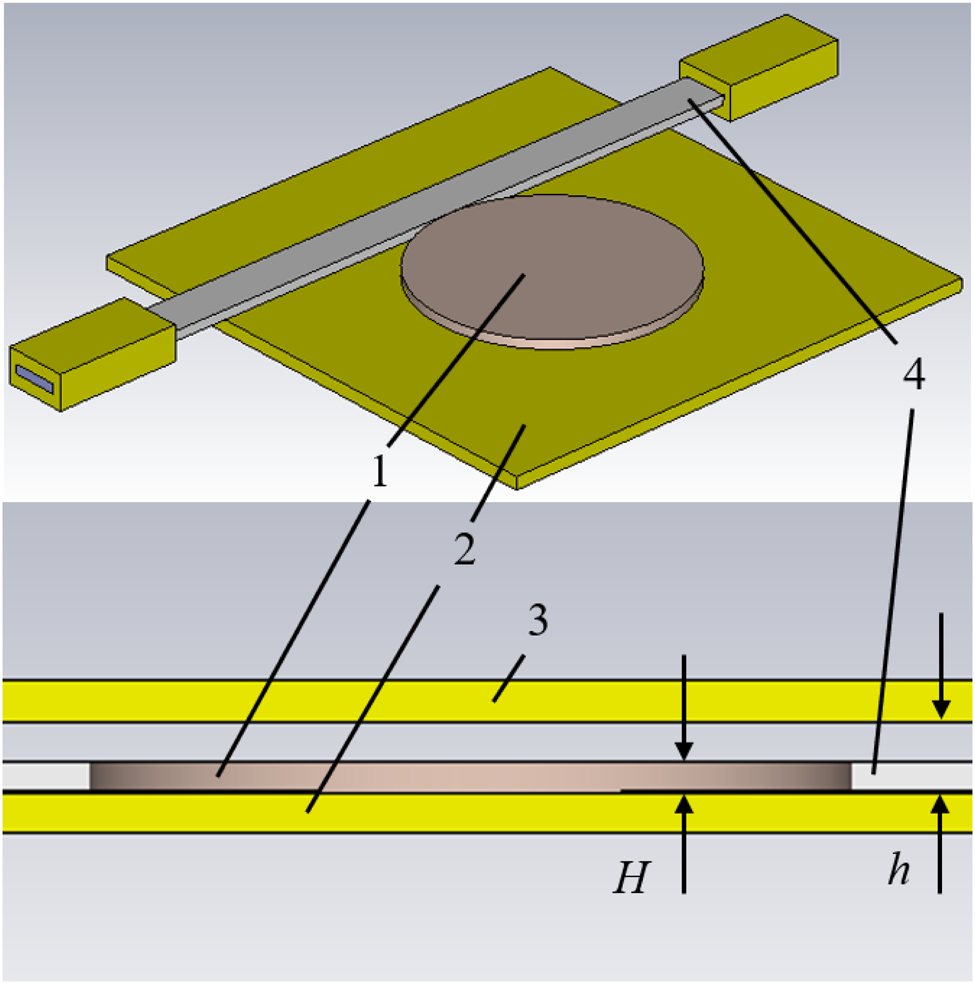
The object of carried out investigations is shown in Fig. 1. The dielectric disk 1 (Fig. 1) is made of sapphire Al2O3 (the anisotropy axis is perpendicular to the planar surfaces; ε⊥ = 9.4; tan δ = 10–4 at T = 293 K) with a radius of R = 20 mm and a height of H = 0.7 mm. It was located between two copper mirrors 2 and 3, in Fig. 1, with a thickness of 3 mm of square shape of 55 × 55 mm2. Copper mirrors covered the flat surfaces of the disk. One of these mirrors was movable along the axial coordinate (the height of the thin disk). This made it possible to insert the air gap into the design of the resonator (between the plane of the moveable mirror and the disk flat base) (Fig. 1).
Design of the thin planar DR excited on WGMs (top picture – without a movable mirror). 1-dielectric disk; 2,3 – copper mirrors; 4 – dielectric waveguide; H – height of the disk; h – height of disk with air gap.

Earlier, we have proposed using the coupling slot formed by a narrow end of a rectangular metal waveguide for exciting the HE-polarized WGMs in thin planar DRs [Reference Kogut, Kogut, Dolya, Nosatiuk, Kharkovsky and He7]. The coupling slot was placed in the plane of one of the metal mirrors which covered the flat bases of a thin dielectric disk. However, the S-parameter was very dense at such a method of excitation.
In addition to WGMs, oscillations formed by the reflection of the emitted waves from the surface of the metal mirrors were excited in such a resonator. It makes difficult the identification of the mode set of the thin planar DR at the experimental researches. For solving this problem, we propose using the non-radiating coupling element such as the DW 4. It is known that at small distances between the cylindrical surface of the dielectric disk and a DW there is a distributed electromagnetic coupling between them. The resonator carries out a “suction” of the energy of the electromagnetic field at its eigen frequencies. The distance between a DW and a thin dielectric disk was constant 0.5 mm. The rectangular DW with cross-section dimensions of 7.2 × 0.7 mm2 was used. It can be seen that the height (narrow wall) of a DW corresponds to the height of the dielectric disk. DW's parameter was used to excite WGMs in the thin planar DR. This provided the excitation of the HE-polarized WGMs in the resonator, which corresponded to the conditions of the considered task. The wide wall of a DW was located on the plane of a non-movable metal mirror. The material with low loss and low dielectric constant was chosen for the manufacture of a DW. Teflon was chosen for these purposes (tan δ = 2.10−4, ε = 2.08). This material is isotropic and technological during processing. The DW was located in the rupture of the waveguide line formed by a standard rectangular metal waveguide 7.2 × 3.4 mm2. To provide the smallest SWR, the ends of a DW were narrowed in the form of a wedge.
Experimental investigations were carried out in the Ka-band 26.5–40.0 GHz using a Pna-L Network Analyzer N5230a 10 MHz ÷ 40 GHz Agilent Technologies. Resonant frequencies and the unloaded Q-factor of the considered DR with and without an air gap were investigated. The unloaded Q-factor (Q0) was determined according to the resonant method by determining the loaded Q-factor (Ql) and the coupling parameter p as following:

where f0 – resonant frequency at SWR minimum, δf – the width of resonant response at half-power level.
Coupling modes between the resonator and DW were monitored by changing the signal SWR at the resonant frequency at introducing a small absorbing inhomogeneity into the resonant field. When the electromagnetic coupling is below critical one, the coupling parameter p = 1/SWR. When the electromagnetic coupling is above critical one, the coupling parameter p = SWR.
Spectral characteristics of thin planar DR
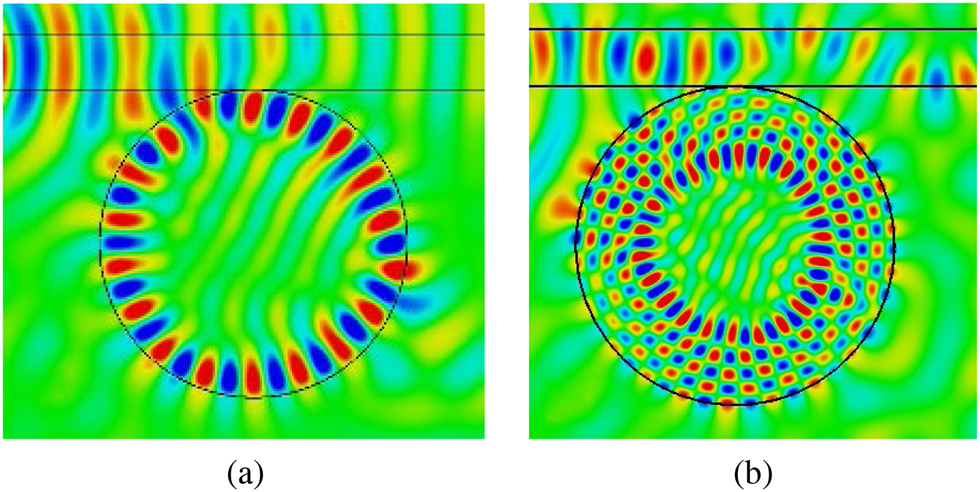
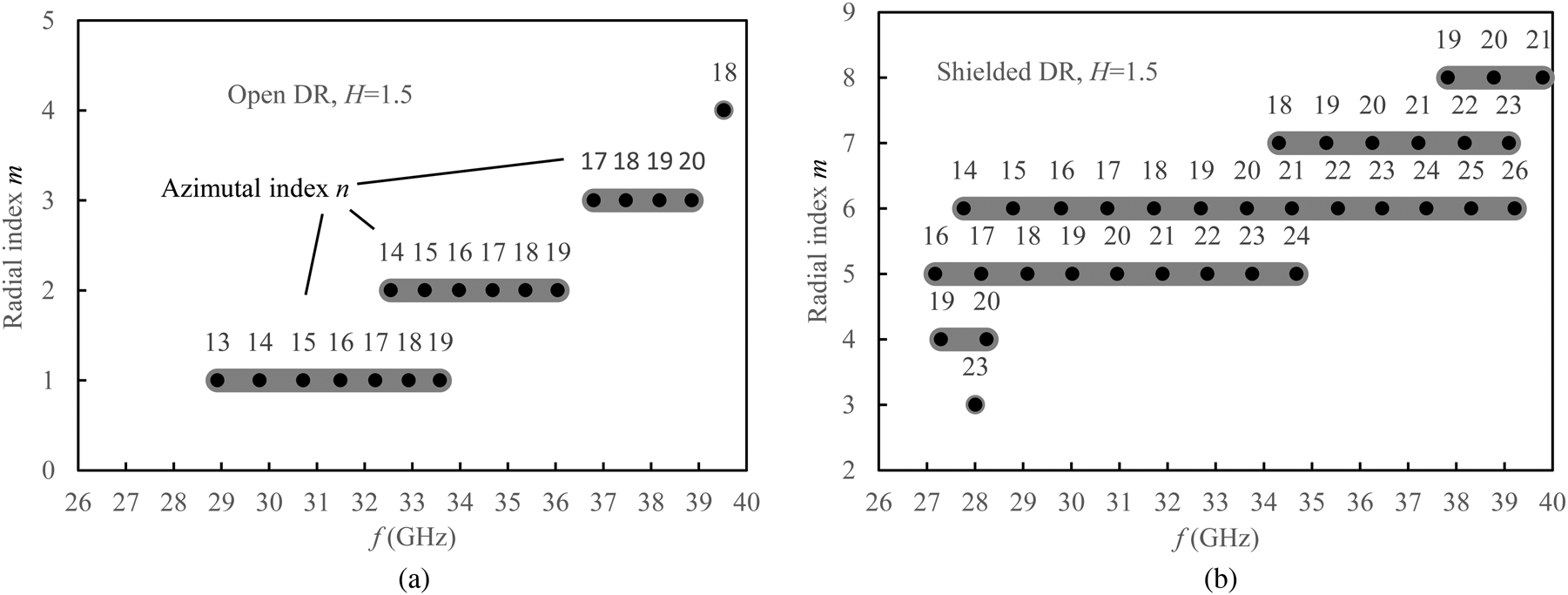
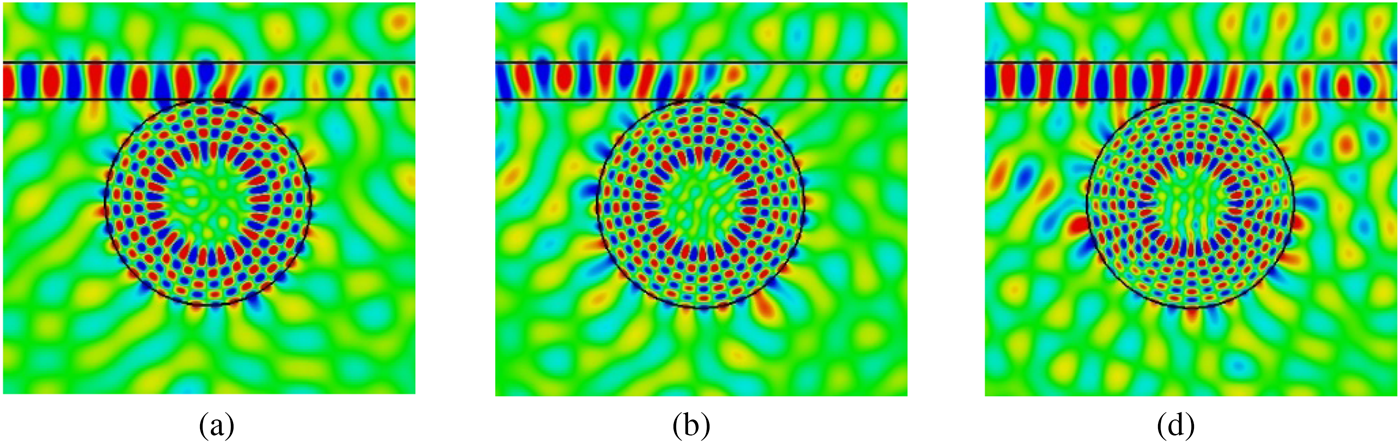
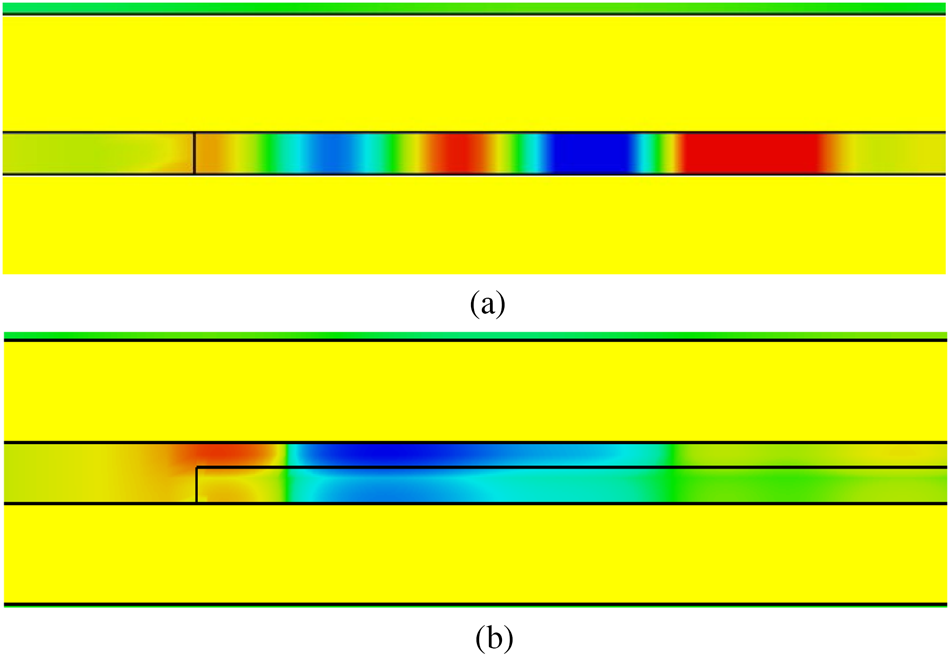
Firstly, let us find out the fundamental differences in a modal set between axially shielded planar DRs and similar open resonators. For this, consider the planar DRs with heights H > λd/2, which allow existing of WGMs in open dielectric disks. The researches carried out on the basis of computer simulation have found that the presence of the higher radial WGMs in the spectrum of an axially shielded resonator is main of them. Figures 2a and 2b, respectively, show the field distributions of WGMs at close resonant frequencies (f ≈ 32.8 GHz) of an open DR made of sapphire with height H = 1.5 mm and radius R = 20 mm and a similar axially shielded resonator (with conducting surfaces covering its flat bases). Figure 3 shows the mode sets of the open and axially shielded planar DRs. It can be seen that covering the dielectric disk by conducting surfaces leads to shifting the region of the “strong” field from the boundary to the center of the dielectric disk. In this case, the lowest radial modes with radial index m = 1 are absent in the spectrum of such axially shielded resonator in the considered Ka-band.
The field distributions of WGMs (n = 18 m = 1) in the open DR (a) and similar axially shielded resonator with WGMs (n = 22 m = 5) (b).

The mode sets of the open planar DR with a height of 1.5 mm(a) and axially shielded planar DRs with heights of 1.5 mm(b).

Returning back to the resonator with a height of 0.7 mm, it was found experimentally that the HE-polarized WGMs are not excited in the open thin planar DR with such height.
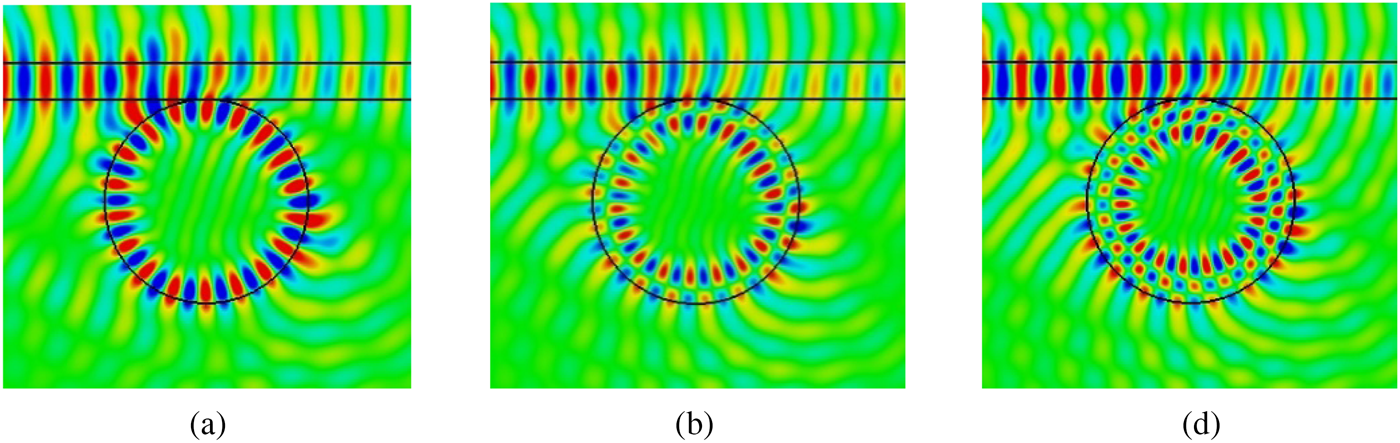
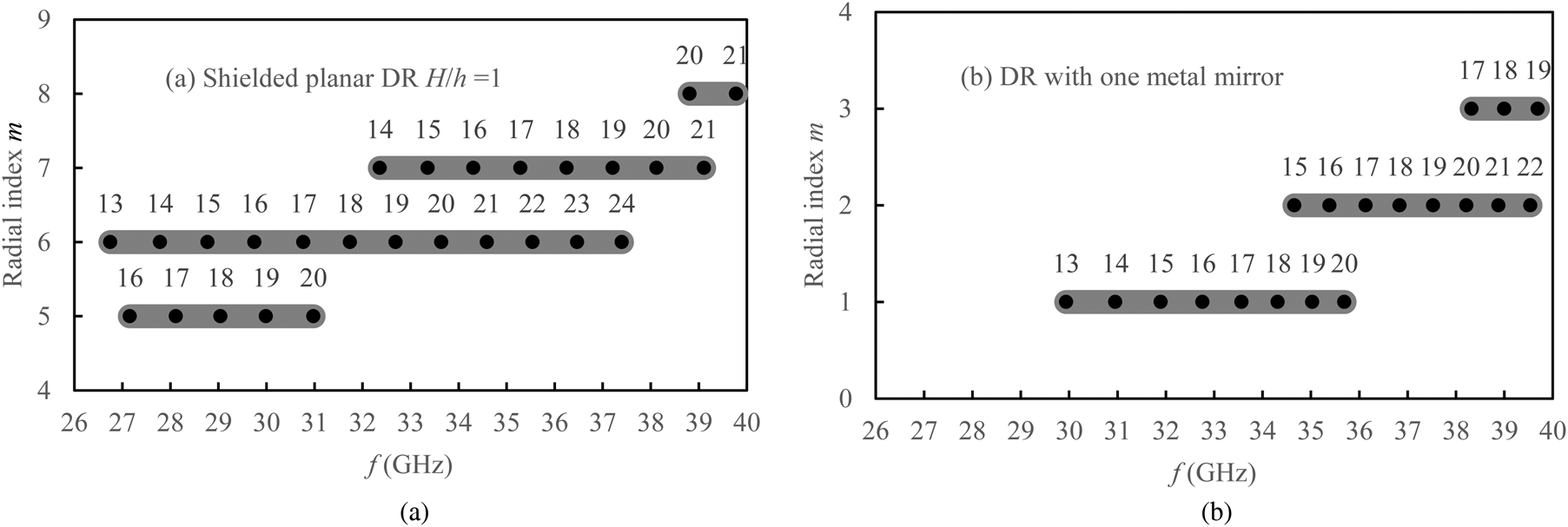
For solving this problem, we place a thin dielectric disk on the plane of one mirror only. Another flat base of the dielectric disk can be opened. In this way, the resonator becomes partially shielded. The most characteristic distributions of fields WGMs in partially and fully shielded planar DRs are shown in Figs 4 and 5, respectively. Mode sets of partially and fully shielded planar DRs are shown in Fig. 6.
Azimuthal field distribution of WGMs with radial indexes m = 1 (a); 2 (b); 3 (c) and azimuthal index n = 18 in the partially shielded thin dielectric disk with height H = 0.7 mm and radius R = 20 mm.

Azimuthal field distribution of WGMs with radial indexes m = 5 (a); 6 (b); 7 (c) and azimuthal index n = 18 in the shielded thin dielectric disk by tightly fitting metal mirrors.

The modal sets of the axially shielded planar DR (a) and DR with one metal mirror (b).

To identify the modes in accordance with the distribution of their resonant fields, computer simulation based on the standard software CST Microwave Studio 2016 was carried out. The results of the computer simulations made it possible to determine the distribution of the intensity of the resonant field of WGMs along the radial and axial coordinates. For comparison, the spectral characteristics of planar DRs with other heights were researched by the computer simulation. It was not possible to determine the modal set of the spectrum by the probe method in the distance between them.
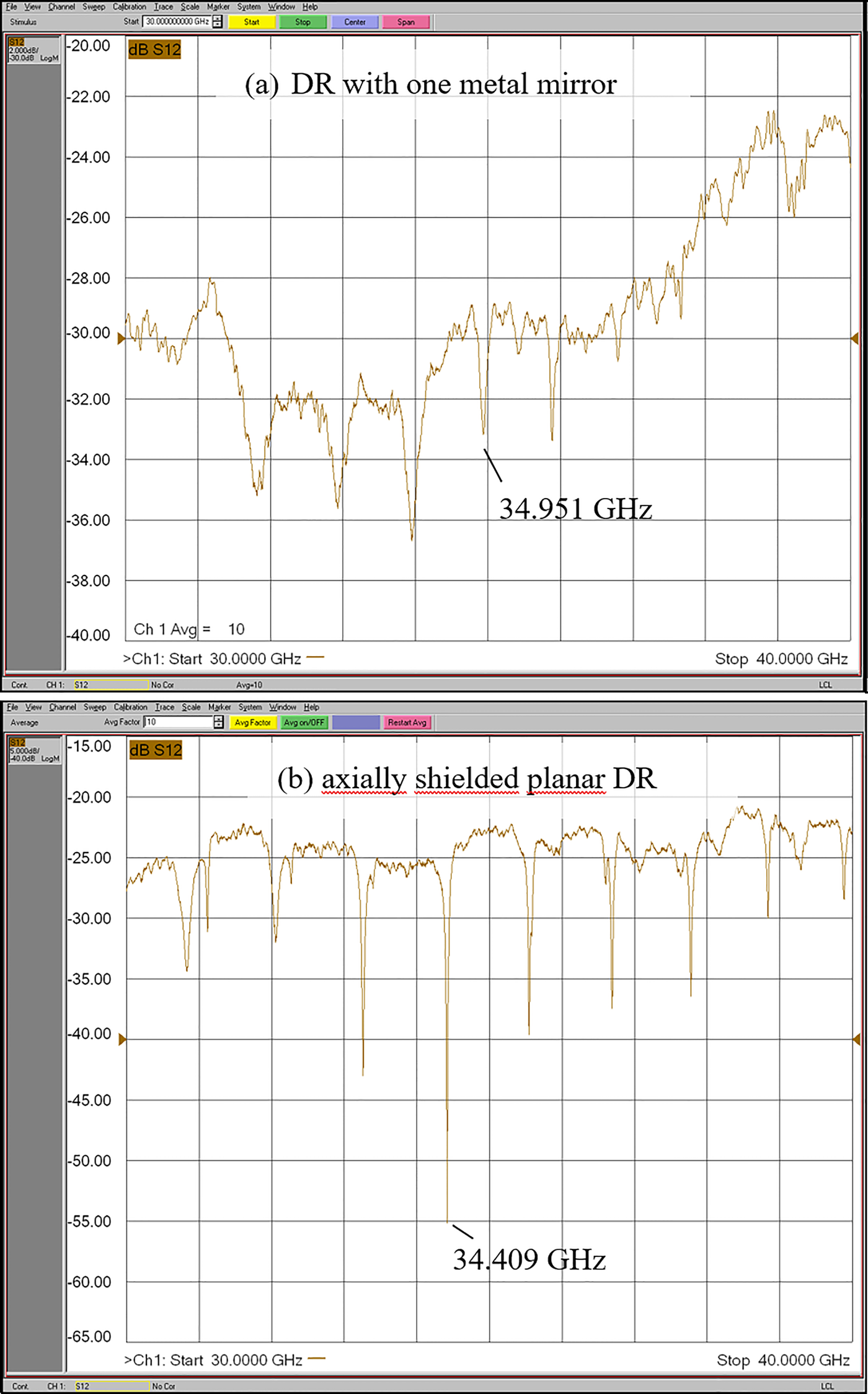
The difference in the absolute values of the resonant frequencies obtained experimentally and by computer simulation does not exceed 0.2%. Determining the difference between them was carried out by comparison of S-parameters obtained experimentally and by using CST Microwave Studio. Lowest values of S-parameters correspond to the resonant frequencies of several WGMs. The suction of energy at the eigen frequencies of the resonator is the cause of this effect. The largest difference between resonant frequencies of the WGMs in an experiment and at a computer simulation was 79 MHz for WGM for partially shielded DR with an azimuthal index n = 19 and radial index l = 1, which was excited at frequency (experimental result: f ≈ 34.951 GHz; computer simulation result: f ≈ 35.029 GHz) and fully shielded DR with n = 16 and radial index m = 7 (experiment result: f ≈ 34.409 GHz; computer simulation result: f ≈ 34.33 GHz). Figures 7a and 7b demonstrate S-parameters of partially and fully shielded planar DRs obtained experimentally. They demonstrate a variety of spectral characteristics of these resonators. They demonstrate a variety of spectral characteristics of these resonators. It can be seen that fully shielding of the planar DR leads to decreasing the amplitude of resonant responses and increasing the density of mode set. In addition to WGMs, the oscillations formed by multiple reflections of waves between two metal mirrors are excited in the fully shielded planar DR. The resonant responses with small amplitudes correspond to them (Fig. 7b).
S-parameters of partially (a) and fully (b) shielded planar DRs obtained experimentally.

It can be concluded that the presence of at least one reflecting surface from the side of the flat base of a thin dielectric disk is a sufficient condition for existing WGMs in the thin planar DR. Let us follow the dynamics of changes in the spectral characteristics of the tunable thin planar DR in the transition from full axial shielding (a disk between two metal mirrors) to partial shielding by displacement of one of the mirrors along the axial coordinate. From the standpoint of the geometrical optics, it is obvious that the removal of a metal mirror from the flat base of a thin dielectric disk leads to a change in the conditions of the reflection of waves from flat surfaces of the resonator. From the point of view of forming the resonant fields of WGMs, the importance of an air gap in the design of the thin planar DR is also obvious. As was shown in the paper [Reference Kogut, Kogut, Dolya, Nosatiuk, Kharkovsky and He7], the fields of WGMs deeply penetrate into the air gap. Therefore, the efficient value of the dielectric constant of the resonator is determined by the height of an air gap. In the future, to describe the tunable thin planar DR with an air gap, we will use the relative value H/h, defined as the ratio of the height H of the dielectric disk to the distance h between metal mirrors. It is obvious when metal mirrors fit snugly to the flat bases of the dielectric disk, the relative height is H/h = 1. When the parameter H/h = 1, a spectrum of the thin planar DR is dense. As noted earlier, WGMs with higher radial indexes m > 3 predominate in it.
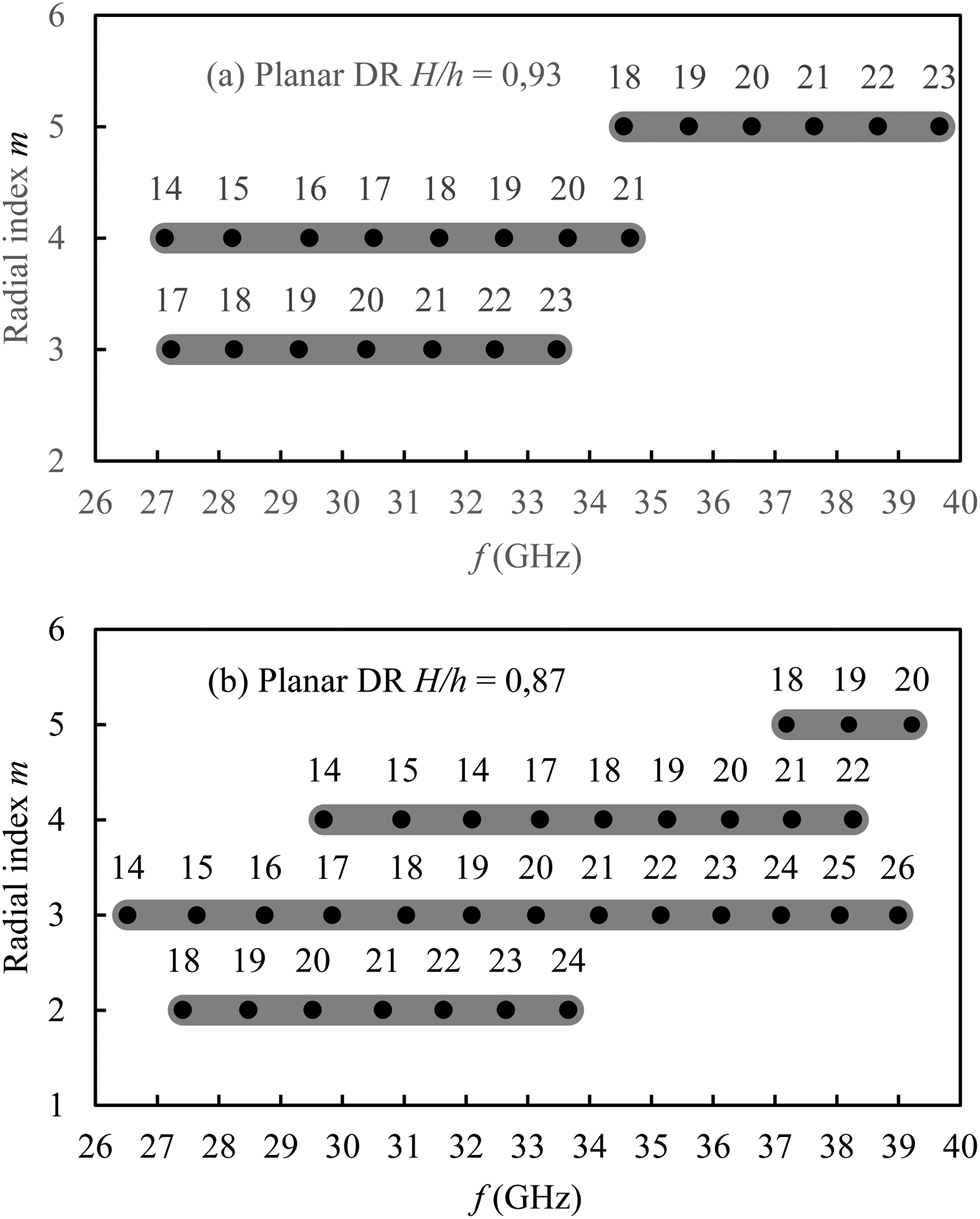
At creating even the minimal air gap with a relative height H/h = 0.93, the resonant frequencies of the higher radial modes are much increased. Starting from the relative heights of the resonator H/h = 0.87, the modal set of the thin planar DR is changed. Modes with lower radial indexes are prevailed in its spectrum, while higher radial modes in the considered Ka-band are not excited. Their resonant frequencies are outside the upper boundary of the Ka-band. For comparison, Fig. 8 shows the modal sets of the thin planar DRs with an air gap at H/h = 0.93; 087. Changing the modal set, accompanied by increasing the resonant frequencies of WGMs, is carried out up to value H/h = 0.1. It is easy to see that in this case, the height of an air gap is almost an order greater than the height of the dielectric disk. At H/h = 0.1 the modal set of the thin planar DR, values of resonant frequencies and distribution of WGMs fields correspond to the thin planar DR with one metal mirror (Figs 4 and 6). Thus, the spectral characteristics of the shielded thin dielectric disk with two metal mirrors are transferred to the spectral characteristics of a partially shielded resonator with one metal mirror.
The modal set of the axially shielded planar DR with different H/h ratio.

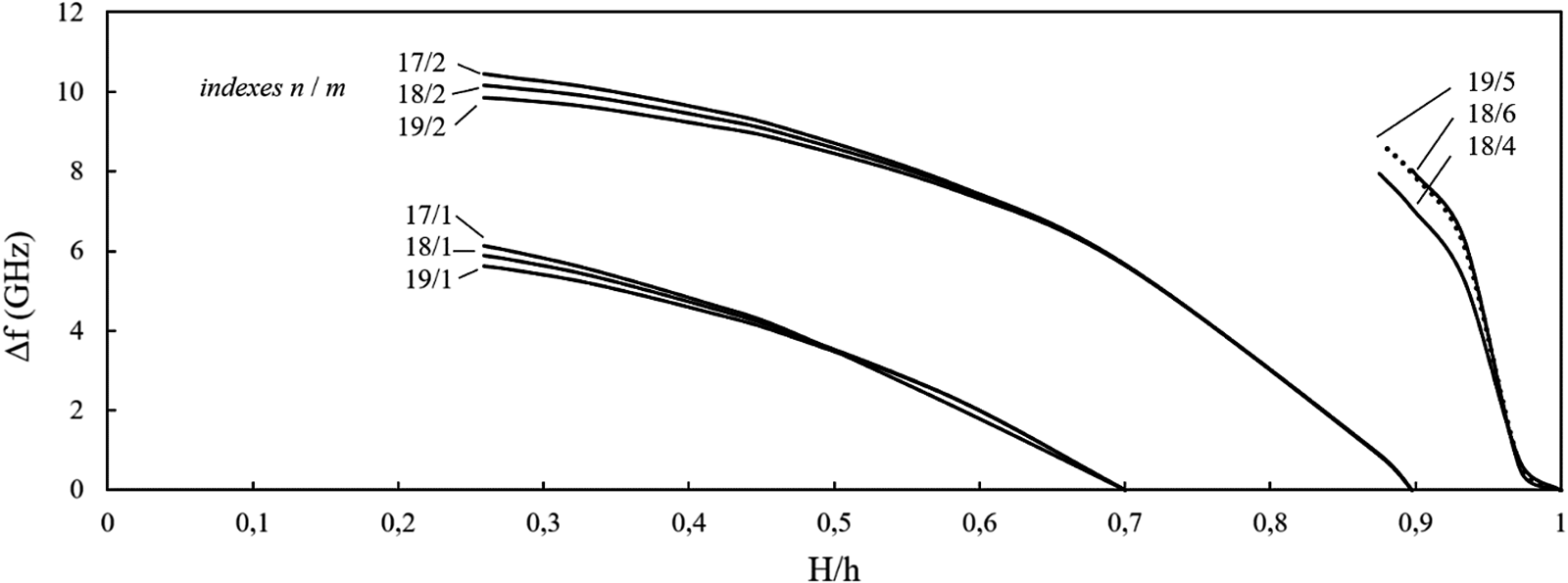
Above we talked that the creation of the air gap in the planar DR design leads to decreasing the resonant frequencies of the WGMs. Figure 9 shows the change in the resonant frequencies of WGMs with various radial indexes.
Frequency tuning of WGMs with various radial and azimuthal indixes.

The wide range of tuning the resonant frequencies of the tunable thin planar DR with a movable metal mirror is indicative. Changing the resonant frequencies of WGMs with different radial indexes can be carried out in the frequency range from 5.7 to 10.8 GHz (Fig. 8). It creates a good opportunity for using the thin planar DR as the basis of a tunable filter with a wide frequency range. It follows from the above that a modal set of the tunable thin planar DR depends by changing the conditions of complete internal reflection of waves from the surface of a moving metal mirror. It adjusts by changing the height of an air gap. The diversity of the spectral characteristics of axially shielded dielectric disks (not only thin disks) should take into account when solving specific applied tasks using such resonators.
Energy characteristics of thin planar DR
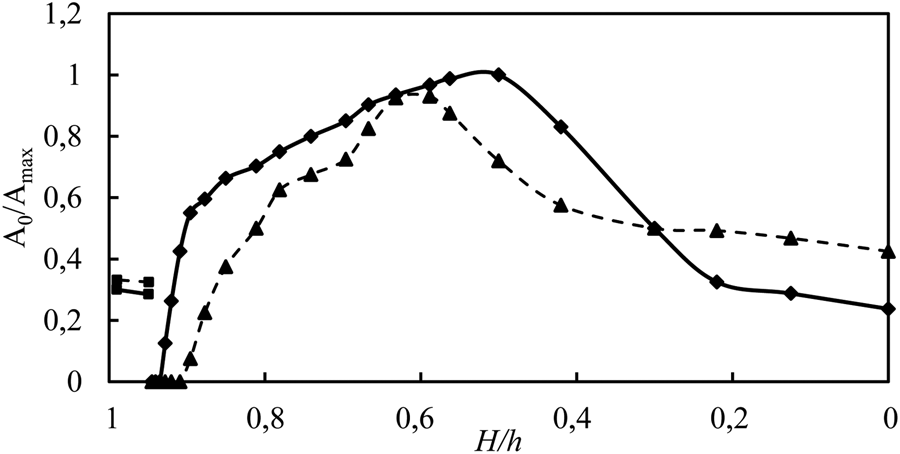
The task of the behavior of an unloaded Q-factor and amplitude-frequency characteristics of the tunable thin planar DR is no less interesting. Earlier, we noted that changing the axial distribution of WGMs caused by an air gap is the main feature of the behavior of energy characteristics of the thin planar DR [Reference Kogut, Kogut, Dolya, Nosatiuk, Kharkovsky and He7]. Obviously, the degree of such an influence of an air gap on the Q-factor of the resonator will be determined not only by the height of the air gap but also by choosing the operating wavelength. Therefore, researching the energy characteristics of the tunable thin planar DR at different frequencies is an interesting task. Thus, amplitudes of resonant responses, coupling parameters, and the unloaded Q-factor at frequencies close to 30 and 38 GHz were studied experimentally. Figure 10 shows the dependence of the relative amplitude A0/Amax (A0 – current amplitude value in SWR, Amax – its maximal value in SWR) of resonant responses at frequencies closed to 30 GHz (dotted line) and 38 GHz (solid line), on the relative height H/h of the tunable resonator with R = 20 mm and H = 0,7 mm. In fact, this dependence is an informative characteristic for estimating the efficiency of the excitation of WGMs in the thin planar DR with a movable metal mirror. The maximal efficiency of the excitation of WGMs corresponds to the maximal amplitude of resonant responses. At H/h ≈ 0.5 (when the height of an air gap is close to the height of dielectric disk) the dependence A0/Amax(H/h) has a maximum both in the low-frequency range of Ka-band and at higher frequencies. Earlier researches [Reference Kogut, Kogut, Dolya, Nosatiuk, Kharkovsky and He7] at exciting a thin planar DR by a radiating coupling slot have found that at such geometric parameters of the thin planar DR, the energy stored in the air gap exceeds the energy stored in the dielectric disk. In this case, such a resonator has the smallest energy loss. Further, decreasing the amplitude of the resonant responses at H/h < 0.5 determines by increasing the radiation loss [Reference Kogut, Kogut, Dolya, Nosatiuk, Kharkovsky and He7]. In the range of values of H/h = 0.1 ÷ 0.2, the radiation loss becomes so great that the excitation efficiency of the WGMs modes is rapidly decreased, while the value of relative amplitude tends to zero A0/Amax → 0. At such geometric parameters of the resonator, a movable metal mirror does not affect WGMs fields. Figure 10 shows that the excitation efficiency of WGMs in a resonator based on the partially shielded thin dielectric disk is close to the excitation efficiency in a thin planar DR with two metal mirrors tightly pressed to the flat bases of the dielectric disk. However, at the insertion of the air gap, it can be increased (more than two times).
The dependence of the relative amplitude A0/Amax (A0 – current amplitude value in SWR, Amax – its maximal value in SWR) of resonant responses with frequencies closed to 30 GHz (dotted line) and 38 GHz (solid line), on the relative height H/h of the tunable thin planar DR.

Comparing the amplitudes of resonant responses at different frequencies, we can conclude that their values at different heights of an air gap are close. Among the minor differences is the fact that the excitation efficiency of WGMs in the high-frequency region of the Ka-band is higher than at lower frequencies. In this case, the high-frequency modes have a longer “life time” with respect to changing the parameter H/h. For lower frequencies, the maximum excitation efficiency is provided at larger heights of the air gap, because of increasing the operating wavelength.
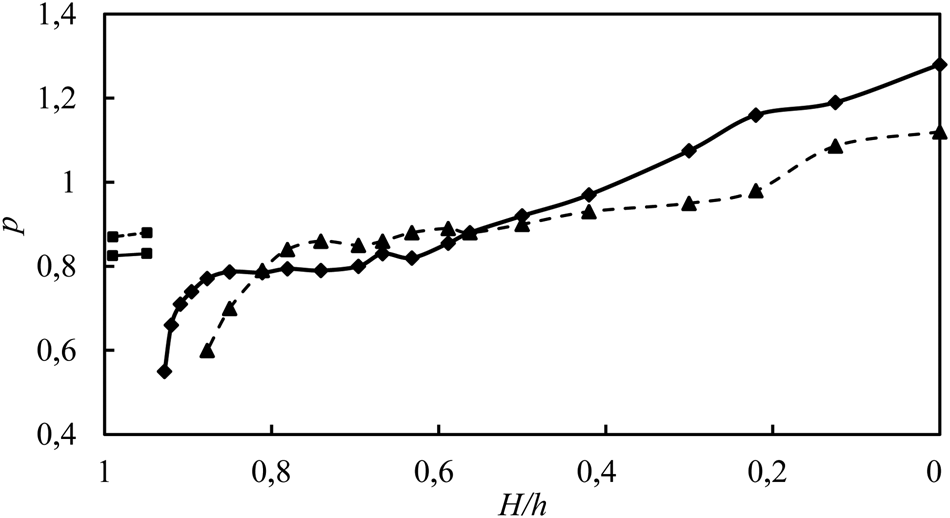
The dependence of the coupling parameter p of the thin planar DR with DW on the parameter H/h of the resonator indicates a high efficiency of excitation of WGMs (Fig. 11). By analogy with the amplitude characteristic, researches of the coupling parameter were carried out in the low-frequency range of the Ka-band (dotted line in Fig. 11) and at higher frequency (solid line).
The dependence of the coupling parameter p of the thin planar DR with a DW on the parameter H/h of the resonator for 30 GHz (dotted line) and 38 GHz (solid line).

It can be seen that at excitation of WGMs in the thin planar DR by DW, an effective electromagnetic coupling is achieved, both in the high-frequency range of the Ka-band and at lower frequencies. At low heights of an air gap (H/h = 0.8 ÷ 1.0), the regime of strong coupling with p > 1 is realized. It is determined by the high “concentration” of the resonant field in the region between the metal mirrors [Reference Kogut, Kogut, Dolya, Nosatiuk, Kharkovsky and He7]. At increasing the height of an air gap, decreasing the coupling parameter is explained by the shift of the resonant field from a dielectric to an air gap. In this case, the field amplitude in the excitation region is decreased.
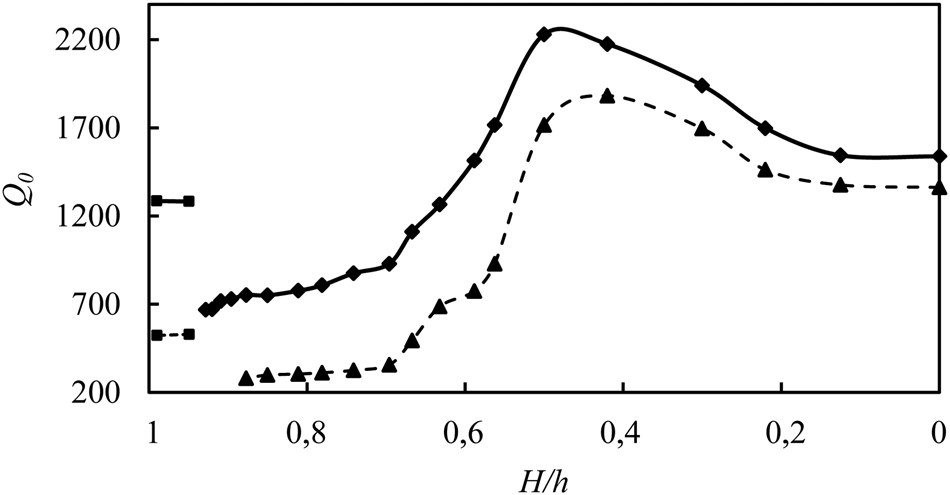
The dependence of the unloaded Q-factor Q0 of the tunable thin planar DR on the geometric parameter H/h indicates changing the energy loss of WGMs fields (Fig. 12). The unloaded Q-factor of the tunable thin planar DR at the high-frequency range of the Ka-band is shown by a solid line in Fig. 12, at lower frequencies – by a dotted line. It can be seen that the unloaded Q-factor of the tunable thin planar DR is characterized by the non-monotonic behavior (maximum). At an air gap 1 ≤ H/h ≤ 0.5, the unloaded Q-factor increases and at H/h < 0.5 it decreases.
The dependence of the unloaded Q-factor of the tunable thin planar DR on the geometric parameter H/h for 30 GHz (dotted line) and 38 GHz (solid line).

As noted in [Reference Kogut, Kogut, Dolya, Nosatiuk, Kharkovsky and He7], the reason for this behavior of the unloaded Q-factor of the tunable thin planar DR is the change in its eigen loss. At creating an air gap in the design of a thin planar DR, the maximum amplitude of the electric component of WGMs fields is shifted from the thin dielectric disk to an air gap (Fig. 13). Thus, not only dielectric loss is reduced, but also ohmic loss due to the decreasing field amplitude on the surface of metal mirrors. Figure 13 shows the axial distributions of WGMs fields in the thin planar DR without an air gap (a) and with an air gap at H/h = 0.5 (b) (CST Microwave Studio 2016).
The axial distributions of WGMs fields in the thin planar DR without an air gap n = 18 l = 5 (a) and with an air gap at n = 18 l = 2, H/h = 0.5 (b).

Thus, increasing the unloaded Q-factor of the tunable thin planar DR at H/h = 1.0 ÷ 0.5 is 45% for WGMs excited in the high-frequency range of the Ka-band, and 38% – for WGMs at lower frequencies. Increasing the height of an air gap at H/h < 0.5 leads to the increase of the radiation loss. Therefore, the unloaded Q-factor of the resonator decreases (Fig. 12).
It is interesting to note that the same values of the air gap heights correspond both to the maximum of the amplitude characteristic of the tunable thin planar DR and to the highest values of its unloaded Q-factor. The good agreement of the energy characteristics of such a resonator indicates the significance of the axial distribution of WGMs fields at forming the energy characteristics of the considered resonator.
Conclusions
It has been found experimentally and by computer simulation that the HE-polarized WGMs can be effectively excited in thin dielectric disks limited axially by reflecting surfaces at distributed electromagnetic coupling with a dielectric waveguide. The location of the thin dielectric disk at least on the one conducting surface is a sufficient condition for the existence of the HE-polarized WGMs in a thin planar DR. The spectral characteristics such as a modal set depend on the presence of an air gap in the design of the tunable thin planar DR. At increasing the height of an air gap, a transition from higher axial WGMs to the modes with lower radial indexes is carried out. Such spectral conversion of the tunable thin dielectric DR is accompanied by increasing the resonant frequencies of WGMs in a wide frequency range.
Changing the height of an air gap affects the energy characteristics of the tunable thin planar DR. Shifting the resonant fields of WGMs from the dielectric disk to an air gap is the reason for this effect. At certain heights of an air gap, increasing the unloaded Q-factor of the tunable thin planar DR and improving the excitation efficiency of WGMs can be achieved by decreasing the eigen loss of the tunable thin planar DR.
 Aleksandr E. Kogut received the M.S. degree in radiophysics and electronics from V. N. Karazin Kharkiv National University, Kharkiv, Ukraine in 1992, and Ph.D. degrees in radiophysics and electronics and physics and mathematics in 1997 and 1998, from O.Ya.Usikov Institute for Radiophysics and Electronics of NAS of Ukraine, Kharkiv, Ukraine (IRE NASU), respectively. In 2011, he received the Doctoral degree in Physics and Mathematics sciences (IRE NASU).
From 1997 to 2001, he was an assistant scientist with the Department of Solid State Radiophysics at the IRE NASU. Since 2001, he has been Researcher staff in the Department of Solid State Radiophysics (IRE NASU). From 2007 to 2014 he was Deputy Director of the IRE NASU. In 2011, he became the Lead Researcher and Head of the Research Group in Department of Solid State Radiophysics. His research interest includes the experimental electromagnetism in the microwave and millimeter waves, electrodynamics of high-Q resonance system, creation of the solid-state sources of millimeter waves.
 Mohammad Tariqul Islam is a Professor at the Department of Electrical, Electronic and Systems Engineering of the Universiti Kebangsaan Malaysia (UKM). He is currently the group leader of the Radio Astronomy Informatics group at UKM. He is the author of over 300 research journal articles, nearly 165 conference articles, four research-level books, and a few book chapters on various topics related to antennas, microwaves, and electromagnetic radiation analysis with 11 inventory patents filed. Mohammad Tariqul Islam is an expert researcher in the field of Telecommunication Engineering. He has researched in the areas of communication antenna design, radio astronomy antennas, satellite antennas, and electromagnetic radiation analysis.
Prof. Tariqul has been very promising as a researcher, with the achievement of several National and International Gold Medal awards, the Best Invention in Telecommunication award, and a Special Award from Vietnam for his research and innovation.
 Eugene A. Kogut was born in Kharkiv, Ukraine, in 1947. He received the M.S. degree in mathematics in 1970 from V. N. Karazin Kharkiv National University, Kharkiv, Ukraine, and Ph.D. degree in physics and mathematics in 1985 at the same university. He received the degree of Associate Professor of physics and mathematics, V. N. Karazin Kharkiv National University in 1991.
From 1970 to 1991, he was a university lecturer in V. N. Karazin Kharkiv National University. Since 1991, he was a Head of Department of Higher Mathematics and Computer Science. His current research interests include functional analysis, theory of operators in a Hilbert space, theory of filtering signals of linear continuous and discrete systems.
 Zoya E. Eremenko received the M.Sc. degree in radio technology from Kharkov Aviation Institute with honor, Kharkov, Ukraine, in 1984, the Ph.D. and Dr.Sc. Degrees in Phys. and Math. Sciences at A.Ya. Usykov Institute for Radiophysics and Electronics, National Academy of Sciences of Ukraine, Kharkov, in 1996 and 2011, respectively. She is chief of Department of acoustic and electromagnetic spectroscopy at the A.Ya. Usykov Institute for Radiophysics and Electronics, National Academy of Sciences of Ukraine. Her current research interests include wave propagation in the resonator layered structures with high loss liquids and chaos phenomena microwave resonator modeling.
 Roman S. Dolia received the B.S. degree in applied physics and M.S. degree in radiophysics and electronics from V. N. Karazin Kharkiv National University, Kharkiv, Ukraine, in 2013 and 2014, respectively. He is currently pursuing the Ph.D. degree in physics and astronomy at the O.Ya.Usikov Institute for Radiophysics and Electronics of NAS of Ukraine, Kharkiv, Ukraine.
From 2013 to 2014, he was an Engineer in the Department of Solid State Radiophysics (IRE NASU). Since 2014, he has been an Assistant of Leading Researcher with the Department of Solid State Radio Physics (IRE NASU). His current research interests include the development of L, X – bands microwave resonators system, small-sized Ka-band active and passive microwave devices, RF-circuits, development of novel high-Q resonators structures for microwave measurements and radar systems.
Mr. Dolia was a recipient of the Grant of the National Academy of Sciences of Ukraine. Since 2018, he has been Member of European Microwave Association.