INTRODUCTION
In India, balistid fish are abundant in the Gulf of Kutch, off the Maharashtra coast (Malwan), off Kerala (Quilon bank), Palk Bay and Andaman and the Lakshadweep Islands (Day, Reference Day1878; Venkataraman & George, Reference Venkataraman and George1965; Jones & Kumaran, Reference Jones and Kumaran1980; Balasubramanian et al., Reference Balasubramanian, Rajapackiam, Ameer Hamsa and Kasim1995; Murty, Reference Murty2002). Sahayak (Reference Sahayak2003) has recognized nine genera with thirteen species in the family Balistidae from India. Worldwide, about forty species in eleven genera (Nelson, Reference Nelson2006) have been reported. Fish of the genus Xanthichthys are reported from the Indo-Pacific and eastern Pacific. These fish are characterized by a moderately deep body with convex dorsal and ventral profiles of the head, cheek with three to six prominent grooves, snout moderately long, interorbital area convex, enlarged osseous plates behind gill opening absent, third dorsal spine minute not extending above dorsal edge of body and a narrow caudal peduncle. Although, five species are recognized under the genus Xanthichthys in the world (X. ringens, X. lineopunctatus, X. auromarginatus, X. mento and X. caeruleolineatus) (Randall et al., Reference Randall, Matsuura and Zama1978), none have been reported earlier from Indian waters. Froese & Pauly (Reference Froese and Pauly2010) state that Xanthichthys lineopunctatus has an Indo-Pacific distribution extending from East Africa south to Port Alfred east to the Ryukyu Islands. The species has hitherto not been reported from the Indian waters and the present account is the first record of this species from these waters.
MATERIALS AND METHODS
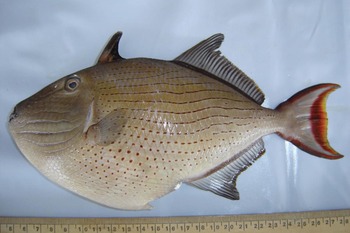
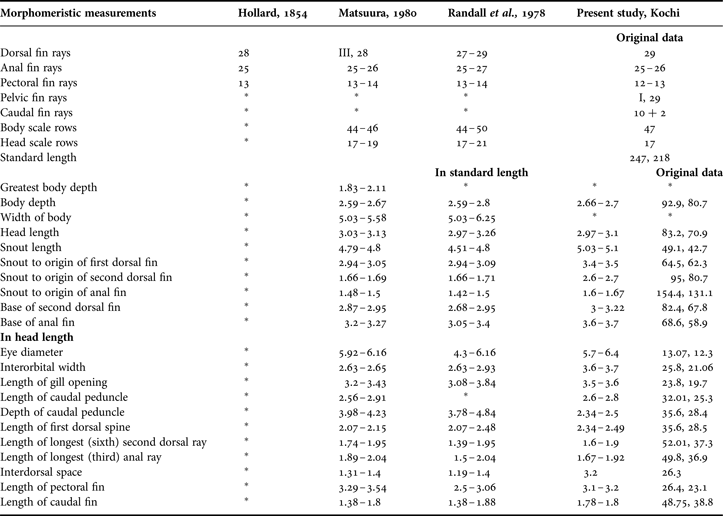
Two specimens (293 mm and 254 mm total length and weight 380 g and 310 g respectively) were collected (Figure 1) from the Cochin fisheries landing centre on the south-west coast of India in October 2004 and November 2005 and identified as Xanthichthys lineopunctatus (Hollard, Reference Hollard1854) based on the available literature (Fischer & Bianchi, Reference Fischer and Bianchi1984; Smith & Heemstra, Reference Smith and Heemstra1986; Froese & Pauly, Reference Froese and Pauly2010). The specimens were deposited in the National Marine Biodiversity Referral Museum at the Central Marine Fisheries Research Institute, Kochi (GB.43.1.10.4). The fish were caught by mechanized hook and line from a depth of 50 m. All comparative measurements were based on standard length (SL). SL was taken from the tip of the snout to the caudal base in millimetres. Proportions on the head are expressed in head length. The pectoral ray count does not include the small rudimentary ray at the upper base of the fin. Depth of the caudal peduncle is the least depth. Measurements of the longest fin rays are excluding the basal scaly sheath. The morphometric and meristic characters of the present specimen in comparison to earlier records are given in Table 1.
Xanthichthys lineopunctatus (Hollard, Reference Hollard1854) 254 mm total length, Kochi (Accession No. GB. 43.1.10.4).

Morphomeristic comparison of Xanthichthys lineopunctatus (in standard length and head length (mm)) from India with the earlier records.

*, no data available.
RESULTS
SYSTEMATICS
Order TETRAODONTIFORMES Berg (1940)
Family BALISTIDAE Risso, 1810
Genus Xanthichthys Kaup, 1856
Xanthichthys lineopunctatus (Hollard, Reference Hollard1854)
(Figure 1)
Synonyms: Balistes lineopunctatus Hollard, Reference Hollard1854; Balistes ringens (non-Linnaeus) Gunther, 1870; Xanthichthys lineopunctatus Berry & Baldwin, 1966.
MATERIALS EXAMINED
Xanthichthys lineopunctatus (CMFRI, GB.43.1.10.4: 2 specimens, 254 mm and 293 mm total length respectively), collected from Cochin fisheries harbour, Kerala, India.
DIAGNOSIS
Dorsal fin III, 29; anal fin rays 25–26; pectoral fin rays 12–13; cheek with three prominent slightly diagonal dark brown grooves extending from just behind and below corner of mouth nearly to gill opening. Upper half of body with longitudinal dark brown lines. No enlarged osseous scales behind gill opening.
DESCRIPTION
Body oblong, compressed laterally; body depth 1.9 times SL. Head deep; snout blunt; eyes moderate, diameter 4.7 times head length; head length 3.2 times SL; mouth small, supraterminal; soft dorsal fin, anal fin concave, pectoral fin short, broad, vertical spine short, blunt. Scales on lower two-thirds of head with a small yellowish spot. Scales on side of posterior half of body with some enlarged tubercles in the median line, forming feeble longitudinal ridges. Caudal fin lunate.
COLOUR
Body yellowish brown on dorsal side and lighter on the ventral side traversed horizontally by incomplete reddish brown lines from behind the operculum; dotted lines seen on ventral area. Dorsal and anal fin base deep reddish. Posterior end of caudal fin with a thick yellow area bordered by a lunate reddish brown area. Outer margins of dorsal and anal fins lined with yellow. The thick outer and inner edges of caudal fin are bordered deep brownish red. Head with small colourless grooves. In preserved condition, body becomes light grey, paler below, dark lines on the upper half of the body remain, and dots on scales remain. Brownish areas on the caudal concavity remain.
DISTRIBUTION
Reported earlier from East Africa, Philippines, South China Sea, Papua New Guinea, north-western Australia and Japan (Matsuura, Reference Matsuura, Carpenter and Niem2001).
REMARKS
The meristic and morphometric measurements of the present specimens are very much in agreement with that of the specimens of Xanthichthys lineopunctatus recorded by Hollard (Reference Hollard1854) from the Réunion Islands, Randall et al. (Reference Randall, Matsuura and Zama1978) from the Natal coast of South Africa and Matsuura (Reference Matsuura1980) from Japan (Table 1). The similarities in the meristic and morphometric measurements confirm the identity of this species from Indian waters. The species Xanthichthys lineopunctatus Hollard bears close resemblance to X. ringens (Linnaeus) from which it differs in the absence of the longitudinal dark brown lines on upper half of the body and presence of 39–44 scales between upper end of gill opening and caudal fin base in comparison to 44–50 in X. lineopunctatus. Though Klausewitz (Reference Klausewitz1974) had listed India as a new locality for X. lineopunctatus, Randall et al. (Reference Randall, Matsuura and Zama1978) opined that it could possibly be a mistake as the locality is Mauritius. Klausewitz (Reference Klausewitz1974) had actually listed fishes from the Maldives and he probably meant the Western Indian Ocean and not India as the locality. The present study is in concurrence with the view of Randall et al. (Reference Randall, Matsuura and Zama1978) and therefore the first report from the Indian waters.
The distribution extension of this species to Indian waters now marks the representation of genus Xanthichthys by a single species. Though a detailed collection was made by Sahayak (Reference Sahayak2003) for the balistids available in Indian waters, the presence of this fish was not recorded prior to the present work. The authors agree with the view of Claireaux et al. (Reference Claireaux, Webber, Kerr and Boutilier1995), that fish often demonstrate avoidance of unfavourable temperatures. The ability to detect and respond to temperature changes can lead to alterations in distribution as fish seek better environmental conditions. The climate changes which led to a rise in the sea surface temperature and therefore coral bleaching during 2004–2005 could have caused the fish to extend its range from native habitat to the west coast of India. The present record is also a pointer to the need for a further taxonomic inventory of the rich reef diversity of Indian waters which may result in recording many more species hitherto not known from Indian waters.
ACKNOWLEDGEMENTS
The authors are grateful to the Director, Central Marine Fisheries Research Institute, Kochi and the Heads of Division of Demersal Fisheries and Marine Biodiversity for the facilities provided and constant encouragement and support. The authors also express their gratitude to Shri. K.M Sreekumar for help rendered in the laboratory.