Introduction
Smoking is one of the leading causes of premature death and smokers with respiratory diseases, such as chronic obstructive pulmonary disease (COPD) and asthma, have an increased risk both from their condition and the adverse health effects of smoking (Hylkema, Sterk, Boer, & Postma, Reference Hylkema, Sterk, Boer and Postma2007). Although the impact of smoking on respiratory diseases has been well documented, with evidence for increased risk of complications, increased hospital time, accelerated decline in lung function and death (Burchfiel, Marcus, Curb, & Maclean, Reference Burchfiel, Marcus, Curb and Maclean1995); many people continue to smoke after diagnosis (Baron, Reference Baron2003). Current evidence suggests that disease progression and prognosis can be improved, with smokers benefitting from a reduction in patient symptoms like chronic cough, loss of breadth and wheezing and improved response to medication, if smokers with respiratory conditions quit smoking (Jiménez-Ruiz, et al., Reference Jiménez-Ruiz, Andreas, Lewis, Tonnesen, van Schayck and Hajek2015).
Smoking cessation is recommended as one of the most important measures in the management of COPD as it helps to reduce the risk of the disease developing and slows its progression (Tønnesen, et al., Reference Tønnesen, Carrozzi, Fagerstrom, Gratziou, Jimenez-Ruiz and Nadini2007; Tønnesen, Reference Tønnesen2013). Although there is research which shows that smokers with COPD are less likely to quit than those without impaired lung function (Shahab, Jarvis, Britton, & West, Reference Shahab, Jarvis, Britton and West2006) few studies have investigated the effectiveness of smoking cessation interventions with this population (Wagena, van der Meer, Ostelo, Jacobs, & van Schayck, Reference Wagena, van der Meer, Ostelo, Jacobs and van Schayck2004). Of the five randomised controlled trials identified in previous systematic reviews of the effectiveness of smoking cessation interventions for smokers with COPD (van der Meer, Wagena, Ostelo, Jacobs, & van Schayck, 2001, updated Reference van der Meer, Wagena, Ostelo, Jacobs and van Schayck2003; Wagena et al., Reference Wagena, van der Meer, Ostelo, Jacobs and van Schayck2004), none included an approach using computer-tailored feedback reports, and the most recent concluded that it was ‘difficult to establish the most effective approach to smoking cessation to take with a COPD population’ (Piresyfantouda, Absalom, & Clemens, Reference Piresyfantouda, Absalom and Clemens2013, p.1961).
Traditional self-help interventions e.g. booklets and manuals, are generic materials and do not provide unique information to each individual. Advances in computer technology have led to the development of interventions that are unique to each individual. Materials that are computer tailored to the specific needs of the individual have shown promise as a high reach, low cost intervention for smoking cessation (Noar, Benac, & Harris, Reference Noar, Benac and Harris2007). These tailored interventions are based on information collected from each person by an assessment questionnaire; the data is then entered into a computer program in order to generate unique personalised reports for the individual (Strecher & Velicer, Reference Strecher and Velicer2001).
The computer-tailored system utilised in this study is based on theoretical models such as social cognitive models of behaviour change and cognitive behaviour therapy that have been shown to be important in the behaviour change process (Sutton & Gilbert, Reference Sutton and Gilbert2007). In a previous study evaluating the efficacy of the feedback reports generated by this computer program, the results showed significantly increased seven day point prevalent and one month prolonged abstinence rates in the intervention group (p < 0.02) at the six month follow-up (Sutton & Gilbert, Reference Sutton and Gilbert2007). Though these innovative interventions have been developed and evaluated in the general population (Gilbert et al., Reference Gilbert, Nazareth, Sutton, Alexis-Garsee, Morris and Nazareth2013), there is little evidence reported on the design and evaluation of these systems with smokers diagnosed with chronic illnesses (Gritz, Vidrine, & Fingeret, Reference Gritz, Vidrine and Fingeret2007).
The study therefore had two aims: (1) to understand smokers’ (those with and without a respiratory illness) experiences when trying to quit; and (2) to determine participants’ perceptions of computer-tailored feedback developed for smoking cessation.
Methods
Study Setting
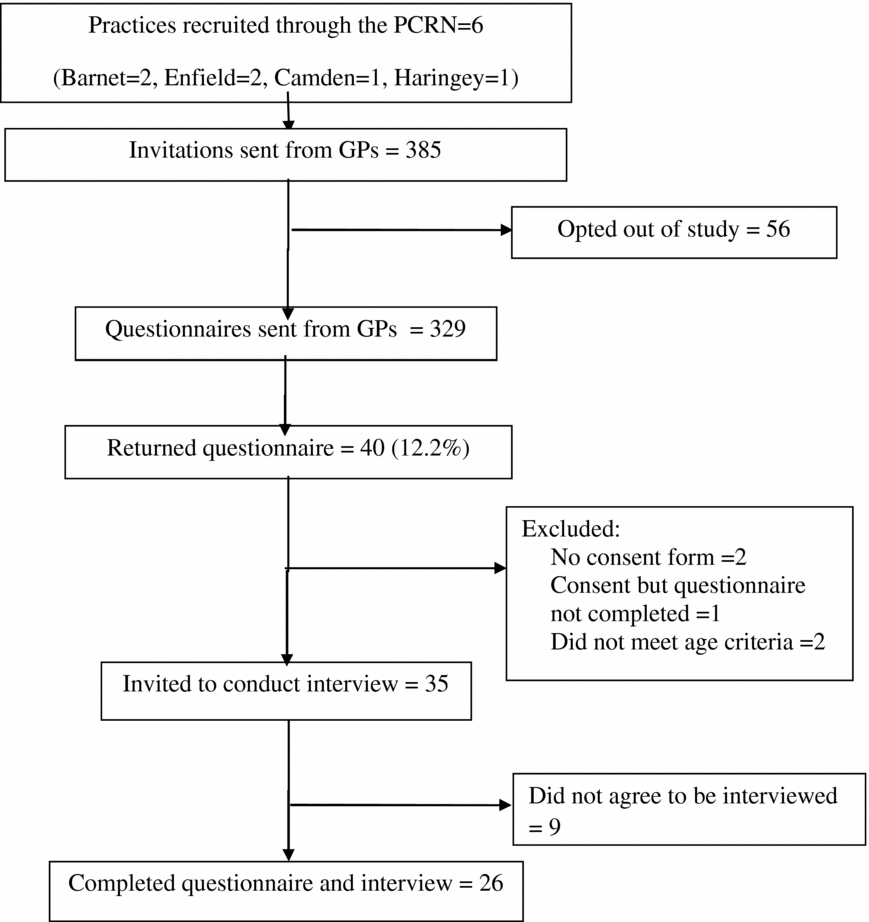
This study was approved by the NHS National Research Ethics Committee, UK. Six general practises representing small (n < 2,500) and large (n > 10,000) list sizes in North London were recruited with the help of the North Central London Research Consortium (NoCLoR). Smokers aged 35–65, with and without a respiratory illness, were identified using the practise computer systems (Gilbert et al., Reference Gilbert, Leurent, Sutton, Morris, Alexis-Garsee and Nazareth2011) to help us understand whether smokers with respiratory illnesses have similar or different needs to ‘healthy’ smokers so that more individualised interventions can be developed to help all smokers quit. They were identified according to at least one of three criteria: (1) recording of mild or moderate COPD in notes (i.e. Global Initiative for Chronic Obstructive Lung Disease (GOLD) 1 or 2): (2) Medical Research Council (MRC) dysponea scale grade of 1 to 4; or (3) FEV1 ≥ 50%. All smokers identified with COPD (n = 61), and 60 smokers without COPD were randomly selected from each practise. Those considered unsuitable for the study by the general practitioner (GP) (due to severe communication problems; smoked cigars, pipes and cannabis, or terminally ill or severe cognitive impairment; n = 36), were excluded from the study. The remaining participants (n = 385) were sent a letter of invitation from their GP, together with an information sheet and reply card. Participants were asked to return the reply card if they decided to ‘opt out’ (Junghans, Feder, Hemmingway, Timmis, & Jones, Reference Junghans, Feder, Hemmingway, Timmis and Jones2005) of the study, and those not returning the reply card (n = 329) were sent a pack which included a consent form and assessment questionnaire. Smokers who returned their consent form and completed questionnaire (n = 40) to the research centre at Middlesex University were sent a computer-tailored advice report based on the information obtained in the assessment questionnaire, together with the NHS booklet, Stop Smoking Start Living (NHS, 2006), and were contacted to request an interview.
Participants
Of the 40 participants who returned the questionnaires, 26 agreed to be interviewed and completed the study (Figure 1). Fifteen smokers had respiratory illnesses, nine with a formal COPD diagnosis and six with asthma. There were no significant differences between participants who completed the study and those who did not agree to be interviewed.
Flowchart showing participants recruited to the study.

Measures
The questionnaire developed for this study assessed demographic characteristics, intention to quit, motivation, dependence, self-efficacy, advantages and disadvantages of quitting and the MRC Dyspnoea Scale for grading participants’ level of breathlessness (Bestall et al., Reference Bestall, Paul, Garrod, Garnham, Jones and Wedzicha1999). All data collected, except the MRC Dyspnoea Scale, was used both to describe the characteristics of the sample and to generate the tailored reports which referred to relevant sections in the NHS booklet.
The Personal Tailored Feedback Report
The content of the feedback report was based on relevant theories of smoking cessation and behaviour change, including social cognitive theory (Bandura, Reference Bandura and Bandura1986) and the Perspectives on Change model (Borland, Balmford, & Hunt, Reference Borland, Balmford and Hunt2004). The content was also informed by evidence from the smoking cessation literature, including the findings from a previous study of the characteristics of a sample of callers to the Quitline, and was developed in consultation with smoking cessation counsellors, and thus included conventional wisdom e.g. emphasising the importance of setting a quit date and advice about pharmacotherapy. To produce the advice report, data from the questionnaire was entered into a database, and a computer program combined the data with the appropriate messages to generate a three-to-four page personal feedback report for each participant. The programme could generate over 3,300 million different letters.
Interviews
Semi-structured interviews were conducted with 26 smokers and all participants received £30 for a 90 minute interview, plus an additional £10 for travel, if appropriate. An interview guide developed for the study explored participants’ views of smoking, cessation and the study specific computer-tailored feedback, and included questions on smoking, smoking cessation support, tailored advice report and quitting preference.
Data Analysis
The data collected from the questionnaire were analysed descriptively. The audio recordings of the interviews were transcribed verbatim, checked for errors and entered into NVivo version 8, and thematic analysis (Braun & Clarke, Reference Braun and Clarke2006) of the complete data set undertaken. Specifically an inductive and semantic level approach was used, data was coded without trying to fit into a pre-existing coding scheme or any researcher preconceptions, and themes were identified at the surface meaning of the data, rather than looking beyond what the participant said. The interview transcripts were read and re-read by the main researcher, and the research assistant. Each interview was separately coded and initial ideas were documented. They then met to discuss and/or challenge the independent codes identified. This discussion showed consistency in the codes identified and as such a thematic map was developed to represent the identified codes. An independent reviewer also coded half of the transcripts to help verify the thematic analysis and extract any additional items. Finally, the two sets of thematic maps were verified by the other members of the research team. The research team confirmed that all identified themes were supported by the data.
Results
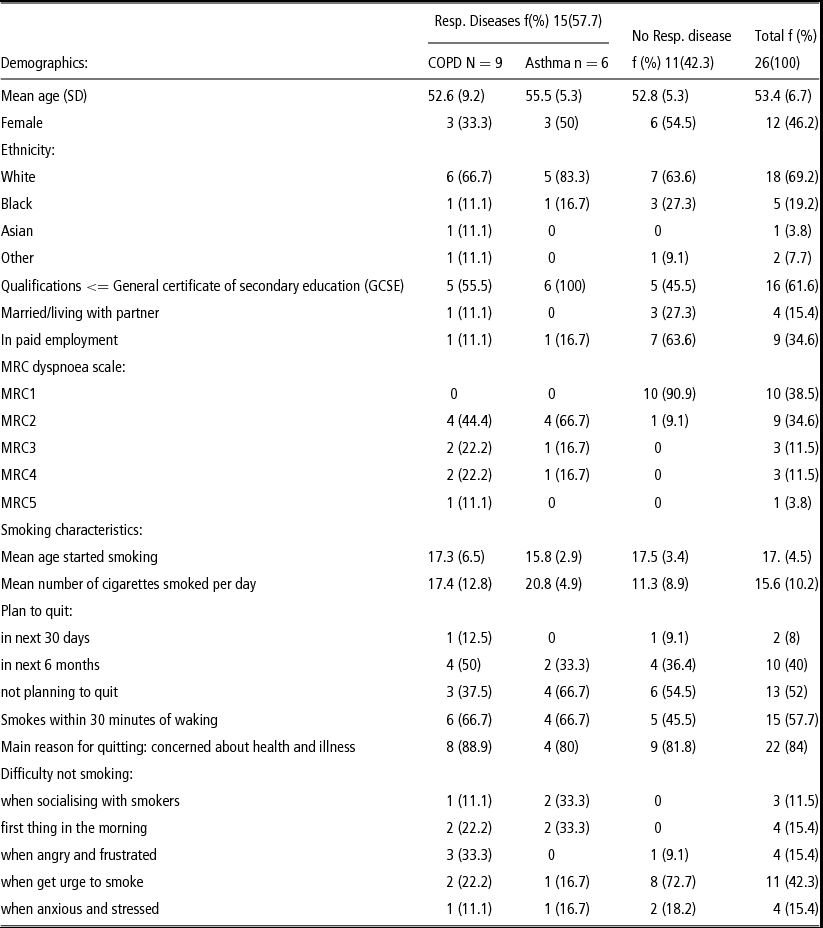
Table 1 shows the characteristics of those recruited to the study by diagnosis.
Characteristics of those interviewed

The mean age of participants was 53.4 (SD = 6.7) and 53.8% were male. They smoked on average 15.6 (SD = 10.2) cigarettes per day, 52% were not planning to quit in the near future and 57.7% smoked within 30 minutes of waking. As shown in (Table 1) most participants with a respiratory illness (COPD or asthma) were male, single, unemployed with minimal qualifications, experienced greater breathlessness as indicated by the MRC Dysponea Scale, generally smoked within 30 minutes of waking and smoked more cigarettes per day than those without a respiratory illness. These initial differences were not apparent in the results of the thematic analysis, outlined below, as all participants experienced similar barriers when trying to quit, though those with a respiratory illness described barriers that were particular to their condition.
Thematic Analysis
Two main themes emerged from interviews with the participants: conflicts with quitting, and a new personal experience. Smokers with and without a respiratory illness expressed similar views about their experience with the tailored feedback and their barriers to quit, except that those with a respiratory illness (COPD and asthma) expressed some fear associated with their condition, which delayed quit attempts.
Theme 1: Conflicts with Quitting
This theme describes participants’ struggles to quit. In particular, the five subthemes below describe how the combination of positive smoking experiences, including feelings of pleasure, along with negative experiences such as unsuccessful previous quitting experience, and knowledge of health conditions have made quitting difficult.
1. Smoking helps me
Participants’ reasons for continued smoking permeated the entire data-set. These reasons seemed to hold great significance and impacted their perceived ability to quit. In particular, there were repeated examples within the transcripts of cigarettes being used as a ‘coping mechanism’; as ‘dependable and rewarding’ and as a ‘habit’. Participants viewed smoking as a necessary coping mechanism for stress, traumatic life events, weight gain, illness, anxiety and depression as shown in the quotes below.
[Smoke] forty to sixty a day, now. I was ten, I was, yeah, but because of the problem I got now [COPD] it's, it's stress, and you know thinking about like, there is no cure for what I got, you know. Like that stresses me a lot and instead of stopping yeah, I keep on smoking, you know. [P13: M, 43, COPD]
Yep, I mean for me the things that I do enjoy about cigarettes are that I use them as, as breaks. I only get sort of 5 minutes here and there to relax and I can use a cigarette as an excuse to do that. I mean to step away from my desk at work or you know to finish a chore and then go and relax for 5 minutes. So I, it's a reliable pleasure and there aren't many, that many (laughs). [P30: M, 55, No COPD]
No, and because I suffer with my nerves see, that's, cigarettes do calm me down, I know it sounds silly but having a cigarette calms me down. [P19: F, 52, Asthma]
2. Previous Negative Quitting Experience
Participants’ previous negative quitting experiences also acted as a barrier to quit (e.g. ineffective use of NRT; experience of withdrawal symptoms and weight gain).
. . .what worries me more at the moment is the weight. . . That's, that's what, and that is partly why me not giving up if I'm honest about it. Frightened of putting more weight on. [P10: M, 55, Asthma]
. . ., I managed to last three weeks and I had real problems with side effects. I hadn't used patches, I hadn't discussed it with anybody so I was lightheaded all the time, really stressed out, and so..[P3: F, 61, No COPD]
3. Does smoking really affect my illness?
Other barriers to quit were directly related to participants’ illnesses. In particular, participants with respiratory conditions seemed to underestimate the impact their smoking was having on their condition and described a lack of understanding of the relationship between their illness and smoking (see quote below) and the importance of quitting sooner rather than later.
My lungs were messed up. And I was told that in 2005 and she said ‘you've got to stop smoking now, not in the future, now is your best chance.’ But I never noticed it was hurting me so much then I could still breathe and I thought, well I carried on. [P21: M, 55, COPD]
I don't think it [bronchitis] have really nothing to do with my smoking. When you get bronchitis I do not want to see a cigarette,. . ., when the bronchitis finally goes I smoke again. [P20, F, 59, Asthma]
4. Limited Support Network
Participants generally described inadequate or inappropriate forms of support provided by the GP, which included not being advised to quit smoking, and a lack of time. In most cases, participants were aware they could receive support from the stop smoking services, but they did not want to be a part of a group intervention and were not convinced that it would be effective.
It's [stop smoking services] like AA for smokers. Well that would make it worse because you'd be, I don't know how alcoholics get away with that because all you'd be thinking about would be cigarettes then wouldn't it be a group of people talking about cigarettes. [P36: F, 61, No COPD]
Others expressed difficulty with quitting without the necessary support from friends, family members or health professionals. In particular those with respiratory diseases reported a lack of support which took many forms including feelings of loneliness, lack of guidance by health professionals and a lack of encouragement from friends and family that smoke.
No, no, no, no, no. He's not. He [GP] just tell you like ‘you got that and the reason you have to stop smoking, there is the nurse over there, you can go and find, find your way and look for help’. That's it! You know what I mean? So he just make you more upset, angry. [P13: M, 43, COPD]
But the difficulty is that I live with a, a partner and it's like it's something we enjoy doing together and if I, if I'm, if I'm determined to say ‘no, no, I've really go to stop doing this’ the other one's not of the same mind. [P5: M, 62, COPD]
5. Denial, Fear and Excuses
Participants expressed a desire to quit but those with COPD seemed to experience fear associated with their illness and in some cases held fatalistic attitudes about quitting smoking.
And I kinda, I've seen that and I've realised that and that's and that's what's making me now think, I, I, I really need to stop. But then I'm, but I'm also scared of stopping. Because even if I still, still stop smoking who's to say that I won't get cancer? Who's to say that I won't get any of these things once I do stop smoking? [P22: F, 41, COPD]
It hurts, it hurts a little bit because I know at the end of the day even if I give up smoking I know there's a possibility I'm still going to end up on oxygen, you know I do know that. [P9: F, 54, COPD]
This sense of fear was not found in ‘healthy’ smokers, however, ‘healthy’ smokers also made excuses for not attempting to quit.
. . .because my mother smokes. And she smokes, my mother is 80 and she smoked probably for 60 years. And there's nothing wrong with her health so this is another reason. [P1: F, 47, No COPD]
Theme 2: A New Personal Experience
Participants’ perception of the tailored feedback they received was important to determine whether this could be a way to intervene with smokers. Participants generally thought the concept of having a tailored feedback report to be a new experience and the subthemes below highlight the importance of a more personalised service when communicating with smokers.
1. Someone's interested in me!
Views on this type of intervention varied as some were reluctant to read it as they were not ready to quit, while others felt that some of the suggestions were too ‘simplistic’ with a lack of ‘new information’ in it. However, most (approximately 69%) felt that it was a positive experience (as shown in quotes below). Others also felt that the feedback report showed that someone ‘cared’ and provided more relevant advice than that provided by the practise nurse.
No I think this is about right myself because this is, this, this isn't a leaflet, as such. This is something designated to me. (Flips pages) And, and I think it's a, it's a marvellous idea, better than, better than just going to see the practice nurse and her, her saying you know ‘oh we'll try, we'll try you with these patches and that. [P11: M, 64, Asthma]
Because it's the first time that anybody has ever done anything like, that has actually been tailored to my needs. It makes sense like. It's, to me it's like somebody's actually, actually taken a personal interest in me, you know, and what is best for me like. And that's the first time I've ever had anything like that. [P28:M, 42, No COPD].
The feedback also prompted many participants to actively implement behaviour change strategies suggested in the tailored feedback they received. For example, some used distraction or delaying tactics to reduce the number of cigarettes smoked per day, others outlined various plans to quit, from choosing a firm date, quitting with a ‘buddy’, cutting down to quit to using medications and/or the NHS Stop Smoking Services.
But after reading things from the leaflet, I said to myself that it [smoking] really doesn't make sense. It's a waste of time and it's a waste of money. Yeah, now I've decided to quit [P14: M, 45, No COPD]
Because I, I, I actually filled in the back as well as I actually put them on my fridge. Yeah, I got one, I photocopied and I've got a ‘no smoking’ on my, on my front door as well. Yeah. Yeah, because I'm reading it and, and it, it did, it made, it made me feel ‘what can I do?’. So when I started asking, like answering the questions, and then I thought yeah if I plaster this on you know ‘just because you have a coffee you don't need a fag after your coffee, don't smoke now, not yet. [P22: F, 41, COPD]
2. Strategies for improvement
Participants were also keen to outline strategies to improve the tailored feedback and encourage cessation. These included a sense that the feedback report should not be sent in isolation, but that an opportunity for an appointment to discuss smoking behaviour should also be presented.
Yeah and you can actually get feedback, although it, maybe having them both, maybe having the leaflet, reading through it and then being able to like you know if there's any questions there that I need answered be nice to have that answer yeah. [P22: F, 41, COPD]
I'd just say don't leave a big gap, I'd emphasise the fact that, that people once they've had a failed attempt they tend to leave it for ages, they go ‘oh I can't do it, I'm never going to be able to stop.’ And it's not until 6 months later or a year later or 5 years later they wake up again and go ‘oh I better have another attempt.’ But, you should just, just try and encourage them to, even if you have failed put them down again, 2 weeks later, or 3 days later or even 3 hours later have another go. [P21: M, 55, COPD]
Others expressed the desire to have both positive, reinforcing information about trying again after a failed attempt as shown in the above quote, as well as more negatively worded information about the health risks of smoking, although participants were keen to say they would also particularly like more information about help available to quit, as shown in the quotes below.
. . . it's not scare, like to scare someone but like to, to be like more, more real towards someone. Yeah. Like say, you can tell, you can say, I don't know, ‘smoking can give you heart attack, heart disease, or blood clots or. . .’, I don't know. [P13: M, 43, COPD]
. . .a little bit of you know, what's available, as opposed to a number. Because if you know what's available, a little bit more, then you might be inclined to ring the number because you think, ahh you think, maybe that would work for me, I'll ring the number. [P1: F, 47, No COPD]
Discussion
This study explored the experiences of smokers with respiratory diseases when trying to quit and their perceptions of computer-tailored feedback as a possible smoking cessation intervention. The qualitative data suggested that although many interviewees would like to quit smoking, they find it difficult to do so and a short term stand-alone computer-tailored intervention may not be effective on its own. Although the intervention was viewed as more tailored than that provided by the GP practise and prompted some to think about quitting, participants thought it would be better if combined with more intensive support possibly over a longer period of time.
The study sample highlights important characteristics typical of ‘hardcore’ smokers; a higher proportion were unemployed, single, approximately one-third were from an ethnic minority group and smoked about a pack a day. Previous research has found that heavy smokers may need more support when quitting (Dijkstra, De Vries, Roijackers, & Van Breukelen, Reference Dijkstra, De Vries, Roijackers and Van Breukelen1998; Strecher et al., Reference Strecher, Kreuter, Den Boer, Kobrin, Hospers and Skinner1994), and smokers with chronic illness may find it harder to quit (Eklund, Nillsson, Hedman, & Lindberg, Reference Eklund, Nillsson, Hedman and Lindberg2012; Wagner, Heapy, Frantsve, Abbott, & Brug, Reference Wagner, Heapy, Frantsve, Abbott and Brug2006). The data also suggested that interviewees used cigarettes to cope and highlighted many barriers to quitting, some of which were deeply embedded in their everyday lives e.g. illness which then resulted in fear in those with COPD. This is supported by previous research which showed that COPD smokers have ‘difficulty in finding the right time to quit’ (Eklund et al., Reference Eklund, Nillsson, Hedman and Lindberg2012, p.1) and that smokers from disadvantaged communities find it difficult to cope without a cigarette (Bancroft, Wiltshire, Parry, & Amos, Reference Bancroft, Wiltshire, Parry and Amos2003; Stead, MacAskill, MacKintosh, Reece, & Eadie, Reference Stead, MacAskill, MacKintosh, Reece and Eadie2001); and struggle to overcome barriers to quit (Copeland, Reference Copeland2003). It is therefore possible that the computer-tailored feedback reports did not adequately cater to the needs of these smokers, by providing the intensive help necessary as advocated by the recent statement on smoking cessation interventions for those with pulmonary disease (Jiménez-Ruiz, et al., Reference Jiménez-Ruiz, Andreas, Lewis, Tonnesen, van Schayck and Hajek2015). A longer term intensive tailored approach might improve the success of this intervention.
However, the tailored intervention reports did seem to give participants a ‘voice’ as they were keen to outline cessation strategies that they had implemented or were thinking of implementing. Therefore, although a short-term stand-alone computer-tailored intervention may not be sufficient, these positive behaviour change discussions are a testament to the impact of the tailored feedback in prompting quit attempts. Also, the feedback report had a positive impact on a large proportion of smokers as it was viewed as being personalised, encouraged a re-evaluation of smoking habits and increased knowledge of smoking behaviour. The suggestions made for improvement of the intervention, can be relatively easily implemented although there is some argument about the value of the inclusion of more negatively framed health information for smoking cessation (Copeland, Reference Copeland2003; Rothman, Salovey, Antone, Keough, & Martin, Reference Rothman, Salovey, Antone, Keough and Martin1993).
In a recent review of behaviour change interventions with ‘disadvantaged groups’, it was suggested that interventions with fewer techniques may be more effective (Michie, Jochelson, Markham, & Bridle, Reference Michie, Jochelson, Markham and Bridle2009). Though pharmacotherapy and behavioural support have been shown to be effective for smoking cessation (van der Meer et al., 2001, updated Reference van der Meer, Wagena, Ostelo, Jacobs and van Schayck2003), there is a lack of research on the factors important for behaviour change in different subgroups of smokers. Therefore, given the characteristics of smokers recruited to this study, it is not known whether it may be useful to provide a more extensive intervention for these smokers over a longer period of time, as suggested by the interviewees with a combined intervention, or whether a more focused tailored intervention using fewer techniques would be more effective.
This study also highlights the importance of support mechanisms for smokers wanting to quit. Although a recent systematic review was unable to quantify the effectiveness of family-focussed smoking cessation interventions for smokers with COPD (Luker, Chalmers, Caress, & Salmon, Reference Luker, Chalmers, Caress and Salmon2007), participants in this study expressed the importance of support from family and friends in a quit attempt, and thus this may be an area for future research. Also, previous studies have outlined that computer tailoring should mimic interpersonal counselling (Strecher & Velicer, Reference Strecher and Velicer2001) provided by advisors and practise nurses. However, some quotes suggest that the advice given by practise nurses is not tailored or personal enough, which may have contributed to participants’ views about the lack of support they received from health professionals. Although there is no specific stop smoking guidance for smokers with chronic illnesses, a recent review (Stead, Berguson, & Lancaster, Reference Stead, Berguson and Lancaster2008) has highlighted the benefit of advice given by the GP and an intervention such as this could be efficiently and cost effectively incorporated into GPs standard treatment.
Strengths and Limitations
A strength of this study is that it identifies a population that has the most difficulty quitting, and is the first to explore the feasibility of offering smokers with respiratory disease computer-tailored advice.
However, despite the study being designed to facilitate recruitment of those with respiratory disease, only a small number of those with a formal diagnosis of COPD were recruited, though some participants indicated higher levels of breathlessness than that recorded on their records, which is a limitation. Encouragingly using the GP practises computer systems to proactively recruit participants can result in higher response rates from the general population of smokers than those achieved using reactive methods (Gilbert et al., Reference Gilbert, Sutton, Leurent, Alexis-Garsee, Morris and Nazareth2012).
GPs play an important role in the identification and management of respiratory illnesses and a recent review (Stead et al., Reference Stead, Berguson and Lancaster2008) has highlighted the benefits of advice given by GPs. Most participants in this study were reluctant to approach their GP for support, though most would welcome a more tailored and personal approach from health professionals.
In conclusion, this study gave some insight into the needs of those with respiratory illnesses and more research is needed to focus on the needs of these smokers and those with other chronic diseases, exploring whether interventions designed for the general public can be extended to these groups. In view of the participants’ comments on using more negatively framed information within the feedback, it may be useful to examine the role of message framing in smokers with chronic illness.
Acknowledgements
Recruitment would not have been possible without the support of North Central London Research Consortium and the GP practises that participated in this study. Most importantly, we would like to thank the participants who volunteered to participate in this study and shared their experiences.
Financial Support
This study was funded by the International Primary Care Respiratory Group (IPCRG)’s UK Respiratory Research Foundation (UKRRF), an NIHR funder. The UKRRF received a charitable donation from Pfizer towards this study.
Conflict of Interest
None.
Ethical Standards
The authors assert that all procedures contributing to this work comply with the ethical standards of the relevant national and institutional committees on human experimentation and with the Helsinki Declaration of 1975, as revised in 2008.