


I. The current state of family law cases, family courts’ caseloads, and the automation of the civil judiciary in the EU Member States
Although approximately the last two decades (2000–2024) saw a steady decline in the number of divorce and separation cases in most European Union Member States, the family courts have been dealing with a relatively high number of cases involving elements such as disputes over parental authority and visitation, and modifications of proceedings or maintenance. Figure 1 shows the absolute numbers of court divorces (and separations), and Figure 2 illustrates the family courts’ caseloads; the statistics in both figures show these trends in relation to the five largest EU countries in terms of population, namely Germany, France, Italy, Spain and Poland.Footnote 1
The number of divorce (and separation) cases handled by family courts in Germany, France, Italy, Spain, and Poland in 2000–2024.
Source: Germany – Destatis; France – Références Statistiques Justice; Italy – ISTAT; Spain – INE; Poland – Główny Urząd Statystyczny and Ministerstwo Sprawiedliwości.

Figure 1. Long description
A line graph titled Divorce Cases, 2000-2024. The horizontal axis represents the year, ranging from 2000 to 2025. The vertical axis represents the number of divorce cases, ranging from 0 to 200000. The graph includes five lines representing different countries: France, Germany, Italy, Poland, and Spain. Each line shows the trend in the number of divorce cases over the years. Germany shows a peak around 2005 and a steady decline thereafter. France shows a peak around 2005 and a fluctuating trend with a significant drop around 2020. Italy shows a steady increase until around 2015 and then a slight decline. Poland shows a steady increase until around 2010 and then a slight decline. Spain shows a peak around 2005 and a steady decline thereafter.
The number of family court caseloads in Germany, France, Italy, Spain, and Poland in 2000–2024 (approximate; cross-country comparability limited due to differences in procedural classification).
Source: Germany – Destatis; France – Références Statistiques Justice; Italy – ISTAT and Ministero della Giustizia; Spain – INE and Consejo General del Poder Judicial; Poland – Główny Urząd Statystyczny and Ministerstwo Sprawiedliwości.

Statistics from other EU jurisdictions, such as Romania, the Netherlands, Belgium, Austria, Greece, the Czech Republic and Sweden, which together constitute 20% of the total EU population, confirm the same trends.Footnote 2
An additional trend that emerges from the public data is that divorce proceedings no longer account for the largest share of family cases in courts across multiple EU Member States. The balance shifted to disputes concerning the determination and modification of parental responsibility.Footnote 3
According to the 2022 European Commission for the Efficiency of Justice (CEPEJ) Evaluation Report, child proceedings, as part of family cases, are among the more complex and time-consuming categories of civil litigation, often involving multiple procedural stages and specialised evidentiary requirements.Footnote 4 The 2024 CEPEJ Evaluation Report presents a growing emphasis on judicial training in child-friendly justice, with judges increasingly participating in specialised programmes on handling child cases and creating a child-friendly environment in the court.Footnote 5
Data from the 2024 CEPEJ Evaluation Report indicate that courts in many European jurisdictions operate under significant workload pressure, as reflected in clearance rates at or below 100%, persistent backlogs, and extended disposition times. Considering that family law proceedings form part of the broader civil caseload, these indicators suggest that family courts in many jurisdictions face similar issues. Notably, the most pronounced bottlenecks in civil courts have been found in the first instance.Footnote 6
Data from the 2025 EU Justice Scoreboard indicate that on average the duration of civil law proceedings at first instance ranges from approximately 200 to 400 days across EU Member States, with significantly longer timelines observed in some jurisdictions, such as Italy and Greece. Appeal proceedings across the EU typically last between approximately 150 and 350 days, although significant variation persists across Member States.Footnote 7
On a more positive note, the 2024 CEPEJ Evaluation Report highlights the increasingly positive role of information and communication technologies (ICT) in supporting the functioning of civil courts, including family courts, by supporting case management, facilitating access to justice, and enabling remote hearings. However, the level of ICT usage in civil courts varies significantly across European jurisdictions, with an average score of approximately 4.27 out of 10 and a clear divide between highly digitalised systems (e.g., Estonia, Italy, Spain) and less advanced ones (e.g., Netherlands, France, Cyprus).Footnote 8
In recent years, in parallel to the expansion of ICT, there has also been a gradual introduction of AI into the judiciary. This process is still quite new, given that AI tools were still not being used in the judicial sector as late as 2022. Applying AI in civil cases can encompass elements such as automatically suggested decisions, anonymisation, the translation of legal language into clearer language, and the addition of speech-to-text features to writing-assistance tools, as well as the generation of an “automatic transcript from a recording” during court hearings. At the time of writing, even in the most advanced area of AI deployment in the judiciary, namely the automatic suggestion of decisions, only Latvia (across all matters) and Luxembourg (in criminal cases only) report using such systems.Footnote 9
In light of the current workload pressures faced by civil (family) courts, the palpably growing importance of ICT and AI in civil proceedings, and the significant disparities across EU Member States in relation to AI use, it is pertinent to ask to what extent the EU AI Act (2024) may provide a comprehensive framework for the broader use of AI in family courts. At the same time, it is necessary to consider the EU AI Act’s systemic and practical constraints on the use of AI in family courts. Finally, it is worth examining the role the EU AI Act may play in advancing the use of AI in family law, both at the EU level and within the EU Member States’ national legal frameworks.
II. The use of AI in family law: ongoing debates and ideas about practical applications
Family law is traditionally considered a field that requires more than legal and technical expertise. Felicity Bell described the skills needed as “life skills” because they are acquired through experience rather than formal training.Footnote 10 “Life skills” here means a specific psychological and social awareness that encompasses empathy and the ability to read a wide spectrum of human emotions, which makes family law informally but inextricably connected to psychology.Footnote 11 Notably, family lawyers must not only support people through pivotal moments in their lives and uphold ethical duties but also ensure that children’s interests and views are properly considered.Footnote 12 The special position of family law within the legal system is not limited to the western hemisphere. In Japan, for example, the family courts are required to follow specific natural law principles, such as an orientation towards restoring human relationships, protecting the weaker party, and safeguarding the wider interests of society.Footnote 13 In some jurisdictions, family lawyers identify themselves as a separate group of practitioners with unique traits and a specific “legal culture.”Footnote 14
It is therefore not surprising that the use of AI in family law provokes strong emotions, especially given the notion that it can enhance systemic efficiency but only at the expense of challenging human judgment and emotional intelligence.Footnote 15 Still, some researchers argue that AI has proven to be a powerful catalyst for the re-emergence of people-centric skills, which are essential in family law.Footnote 16 Interestingly, the deliberations on AI in family law have moved beyond its role in legal practice and family proceedings to increasingly encompass the growing phenomenon of AI companionship, which may emerge as a novel issue.Footnote 17
The debate among theoreticians and practitioners about the use of AI in family law has a long history. It emerged as early as the 1990s in discussions about creating a decision-support tool in discretionary areas of law. Lilian Edwards and John A. K. Huntley claimed that AI could be applied in family law as a decision-support tool to enhance dispute resolution, but firmly rejected the possibility of automated judicial decision-making.Footnote 18 Almost ten years later, John Zeleznikow examined legal principles in family law and the AI-supported application in Australia (i.e., Split Up) and wrote that AI-based decision-support systems could enhance consistency and transparency in legal decision-making, but only in domains where judicial discretion is sufficiently structured and amenable to formalisation.Footnote 19 In 2019, Harry Surden argued that even the most advanced AI algorithms had fallen far short in advanced cognitive processes, such as analogical reasoning, that are the basics of legal practice. However, algorithms may nonetheless assist family lawyers by identifying relevant patterns and connections in case law from other legal fields that would typically remain outside their professional scope.Footnote 20 The same author maintained in his 2019 paper that because AI systems rely on pattern recognition and computational heuristics rather than genuine human-like cognition, they are unlikely to replace lawyers, whose work fundamentally depends on judgment, reasoning, and contextual understanding that the current artificial intelligence could not match.Footnote 21
A truly transformative development that has also had a profound impact on family law practice was the public release of ChatGPT in November 2022. More than three years after the opening of this new chapter in AI access, the emerging evidence suggests that individuals increasingly rely on AI tools for preliminary guidance in family law matters, including divorce; however, empirical research remains limited and largely qualitative.
The evolution of attitudes towards AI and the scope of its application in family law are well illustrated by the Conflict Resolution with Equitative Algorithms (CREA) project. CREA is an EU initiative that developed a game-theoretical decision-support system for family law disputes, particularly asset division. The first project ran from 2017 to 2019. It was later enhanced by CREA2 (2022–2024), which uses AI tools, including an LLM-powered chatbot and blockchain, thereby improving access to justice and supporting both individuals and legal professionals. Subsequent developments under CREA3 (2024–2026) will further expand these capabilities by integrating more advanced AI functionalities and moving towards a more fully AI-driven dispute resolution environment.Footnote 22
Given the rapid changes in AI in recent years, including the success of the CREA project, the question is no longer whether to use AI in family law but rather to what extent and in what ways it should be integrated into legal practice, decision-making and dispute resolution processes. Even if the use of AI in family law still arouses negative emotions, its complete exclusion from family law proceedings seems both impractical and counterproductive in the long term.Footnote 23 AI has the potential to improve access to legal services for the general public, especially for individuals lacking the financial means to secure legal representation.Footnote 24 AI solutions may also be described as inherently egalitarian, as they are not limited to large firms. Many sole practitioners and small family law firms have already embraced practical AI-assisted tools in their daily legal practice.Footnote 25
Didier Guével argued in 2018 that “no one can, like AI, read millions of pages per second; no one can accumulate a comparable memory, nor make as many connections as possible.”Footnote 26 His words, delivered from a judge’s perspective, convey more than just an assessment of AI’s technical capabilities. Today, in the era of pervasive use of automated algorithms, family lawyers, whose work is closely tied to understanding human emotions and mindsets, cannot disregard general societal trends and beliefs. OECD studies indicate that AI has already reached the point where it is widely perceived as superior to humans in analysing large datasets, particularly regarding pattern detection.Footnote 27
It is therefore not surprising that the debate about the use of AI in family law is unfolding in parallel with its practical implementation by private law firms. While in the past such instances were isolated and were largely limited to selected countries, the current level of AI adoption among legal practitioners compels scholars to systematise and critically engage with this phenomenon. Although there is no separate data on family lawyers, the most recent studies indicate that approximately 47% of legal professionals in the UK and the EU regularly use AI tools in their work.Footnote 28
Among the existing scholarship on the current and projected application of AI in family law, Aliya Saied-Tessier provides one of the most comprehensive frameworks, structured around three principal areas. The first is that AI can enhance the user experience by offering translation tools, virtual assistants and accessible legal guidance, thereby helping individuals navigate complex procedures. The second is that it can improve administrative efficiency through document review, automated drafting and case management, reducing the burden on courts and legal practitioners. Third, it can support decision-making through mechanisms such as online dispute resolution, predictive analysis and risk assessment.Footnote 29 Saied-Tessier’s paper builds upon and further develops earlier contributions by Felicity Bell, David Hodson and John M. Greacen.Footnote 30 This list is not exhaustive, as other scholars, such as Paweł Książek, have also proposed viewing AI’s role in family law as a potential educator, caregiver and representative.Footnote 31 Personally, I have also suggested using automated algorithms to improve the efficiency of the child maintenance system by implementing a new continuous billing system.Footnote 32
III. Methodology
This paper adopts a combined methodological approach, integrating doctrinal, normative and socio-legal perspectives. The doctrinal method is primarily employed to achieve a complete understanding of the conceptual bases of legal principles and a range of rules in a particular area, namely to analyse the provisions of the EU AI Act and their relevance for the potential application of AI in family courts. To provide a more comprehensive picture of the legal framework, references to family law practice are also included.Footnote 33 Building on this, the normative approach is used to critically assess whether the regulatory model adequately reflects the specific characteristics of family law, particularly its discretionary, relational and context-sensitive nature that is, however, strongly embedded in legal requirements and ethical norms. This assessment is achieved by grounding in the recognition of the existing human rights and basic rights relating to family life.Footnote 34 Finally, the socio-legal perspective situates the legal analysis within broader social and practical contexts, considering how AI tools are already used in family courts and family law practice and by people seeking family law assistance, as well as the impact of these tools on the justice system, procedural fairness, and decision-making processes.Footnote 35
IV. The principles of the EU AI Act that relate to family law
The EU AI Act has garnered much attention from legal scholars and continues to do so, and many comprehensive academic studies have been conducted on its principles and content, including extensive monographs and commentaries.Footnote 36 It is presented as a pinnacle of European endeavour to improve the internal market by laying down harmonised rules for a trustworthy and human-centric AI.Footnote 37 The EU AI Act also pursues external objectives by promoting EU values in AI development.Footnote 38 Although its provisions are entering into force gradually, from February 2025 to August 2027,Footnote 39 the European Parliament emphasises the regulation’s pioneering nature, arguing that the EU is a global leader in the normative governance of AI.Footnote 40
Under Article 3(1) of the EU AI Act, an AI system is defined as a machine-based system designed to operate with varying levels of autonomy, capable of adapting after deployment, and generating outputs such as predictions, recommendations, or decisions that influence physical or virtual environments.Footnote 41 As Recital 12 explains, the definition is intentionally broad and technology-neutral, covering a wide range of systems, particularly those based on machine learning, logic- and knowledge-based approaches, and statistical methods.Footnote 42
By adopting the definition of AI in the EU AI Act, an AI system in the context of family law may be understood as a machine-based tool that operates with a degree of autonomy and generates recommendations, predictions or decisions relevant to matters such as divorce, child residence or asset division. Such a system may assist in drafting documents, evaluating evidence, proposing settlements or assessing risks, thereby influencing legal outcomes and the exercise of judicial discretion.
The central regulatory principle of the EU AI Act is that AI systems must be subject to a risk-based classification. Systems are categorised according to the level of risk they pose to fundamental rights, safety and societal interests, ranging from unacceptable (prohibited) to high, limited and minimal. While the EU AI Act does not establish the risk-based classification in a single provision, its central regulatory logic is reflected primarily in Article 6, which is complemented by Articles 5 and Annex III.Footnote 43 The higher the risk, the stricter the regulatory obligations are that are imposed on providers and deployers. This approach ensures proportionality while enabling effective oversight of potentially harmful AI applications.Footnote 44 The risk-based approach underpinning the EU AI Act has been the subject of scholarly analysis, particularly regarding whether it is sufficient to safeguard fundamental rights, including the right to family life.Footnote 45
The adoption of a risk-based approach in the EU AI Act has significant implications for any use of AI systems in family law. Given the wide spectrum of existing tools capable of supporting family law practice and assisting individuals seeking legal aid, each AI system should be classified according to which of the four-tier risk descriptions it poses to the parties involved and to the overarching principles of the legal system. The analysis should not ignore AI in domains that have traditionally relied on human cognitive skills, such as decision-making and the assessment of the child’s best interests. Thus, any AI system supporting the work of family courts and capable of directly or indirectly influencing judicial decision-making should be duly assessed and, if necessary, subject to strict compliance requirements, such as human oversight, transparency, and risk management.
At this point, however, it should be noted that the EU AI Act does not regulate legal professionals as such, including family lawyers, but applies to them indirectly insofar as they develop, deploy, or use AI systems in their practice. Family lawyers may fall within the scope of the regulation as “deployers” when they are using AI for tasks such as document drafting, legal analysis and dispute resolution. The level of regulatory obligations depends on the classification of the AI system, with stricter requirements applying when such systems are high risk, especially when they affect judicial decision-making or fundamental rights.Footnote 46
On the other hand, the EU AI Act applies to the use of AI by courts and judicial authorities, meaning that any integration of AI into family court proceedings, whether for case management, decision support, or risk assessment, must comply with the same regulatory standards. The critical difference between the treatment of legal practitioners and judicial authorities stems from Annex III (8), which stipulates that the regulations apply to AI systems used “by a judicial authority or on their behalf to assist a judicial authority in researching and interpreting facts and the law and applying the law.”Footnote 47
Consequently, while the EU AI Act does not directly target family lawyers as broadly understood, it nonetheless shapes both legal practice and adjudication by regulating AI technologies and assigning a defined risk classification to specific activities. Additionally, under Article 2, the EU AI Act has extraterritorial reach, similar to the GDPR, applying not only within the EU but also to non-EU lawyers when they use AI systems in the EU or when their outputs affect individuals there.Footnote 48 This interpretation was officially confirmed by the International Association of Advocates.Footnote 49
Due to the EU AI Act’s general nature and its primarily harmonising objective, family lawyers only have a few AI provisions to deal with that are relevant to family law in the context of AI technologies. Recital 2 emphasises that the Regulation must be applied in accordance with the EU values that are enshrined in the Charter of Fundamental Rights of the European Union, including the protection of natural persons, democracy and the rule of law. Although the family is not expressly mentioned, the protection of natural persons necessarily extends to all family members regardless of their age or position within the family.Footnote 50
Another indirect reference to family law appears in Recital 29, which recognises the vulnerability of certain groups, including minors and individuals in disadvantaged social or economic situations. By prohibiting AI systems that exploit such vulnerabilities in ways likely to materially distort behaviour and cause harm, the provision establishes a normative framework for family law cases, such as those involving children, parental responsibility or welfare assessments, in which individuals are inherently highly susceptible. Although not designed specifically for family law, Recital 29 provides an important safeguard against the use of manipulative or exploitative AI in areas closely connected to the protection of family life and the best interests of the child.Footnote 51 The protection of children’s rights, as a key component of family law matters, is also reflected in Recital 28.Footnote 52
A rare explicit reference to family law appears in Recital 48, which specifies that the fundamental rights protected under the Charter include the right to “respect for private and family life,” a consideration that is particularly relevant when assessing the extent to which an AI system may adversely affect fundamental rights for the purpose of its classification as high risk.Footnote 53 The right to “respect for private and family life” stems from Article 7 of the Charter and encompasses the right to respect a person’s home and correspondence.Footnote 54
In addition to the direct references in the EU AI Act, it is essential to identify the general principles governing the use of AI systems in family proceedings. In this respect, as reflected in Recital 10, the EU AI Act applies without prejudice to existing EU data protection instruments, particularly the GDPR.Footnote 55 Consequently, any AI system deployed in the field of family law must be assessed not only under the EU AI Act but also in light of EU data protection law. Accordingly, AI systems used in family proceedings or in the provision of family law advice, often involving highly sensitive personal data, must comply with both the risk-based requirements of the EU AI Act and the substantive obligations of data protection law, which confirms the complementary nature of these regimes.Footnote 56
V. Prohibited AI practices in family law
Article 5 of the EU AI Act establishes a broad regime of prohibited AI practices. The rationale for this decisive legislative measure appears to stem from the need to address the growing and well-documented issue of AI misuse.Footnote 57 The provisions in Chapter II aim to establish “red lines” and make the EU a region where only trustworthy, general-purpose AI systems are used. Article 5 adds another layer of protection within a broader framework of fundamental rights.Footnote 58 There is a consensus that manipulative or discriminatory AI systems operating without regulation can undermine democratic values, erode protections for vulnerable groups, and normalise practices such as surveillance, coercion and inequality.Footnote 59
As Michèle Finck aptly argues, Article 5 has a distinct regulatory scope, addressing AI practices, whereas the remainder of the Act focuses on systems and general-purpose AI models.Footnote 60 The adoption of this type of subject-matter-oriented regulation has specific consequences for the potential use of AI in family law, creating an open-ended category of practices that, while commonly accepted in traditional legal practice, become entirely impermissible when processed by AI, as they may pose a threat to fundamental values.
In short, Article 5 refers to systems that use manipulative or deceptive techniques to distort behaviour, as well as those that exploit individuals’ vulnerabilities, particularly children or persons in dependent situations. It also bans social scoring systems that classify individuals in ways that lead to unfair treatment and certain profiling-based predictive assessments that lack objective justification. In addition, it prohibits specific biometric practices, such as categorising individuals based on sensitive attributes.Footnote 61
The “red lines” introduced by the EU AI Act are especially relevant in family law contexts. Family law is closely intertwined with human psychology, and many of its solutions are grounded in the emotional relationships between the parties to a dispute. It is not difficult to imagine an AI-generated recommendation that, through both subtle and more overt forms of manipulation or deception, may influence a judge or a party to a dispute towards taking a particular course of action.
For instance, if an AI-powered mediation tool is used in a child residency dispute, it subtly frames its recommendations to pressure one parent to accept reduced contact with the child. It repeatedly emphasises emotionally loaded statements such as “accepting this arrangement will minimise harm to your child,” while downplaying alternative options. By exploiting emotional vulnerability and presenting biased information, the system effectively nudges the parent towards a specific outcome. If such influence materially distorts the parent’s free and informed decision-making, it will be prohibited under Article 5(1)(a).
Alternatively, an AI-assisted decision-support system can be used by a family court, and this system generates a recommendation for child residence that is presented to the judge with selectively framed reasoning. For example, the system emphasises risk-related factors concerning one parent while downplaying positive evidence and highlighting emotionally charged considerations, such as “potential instability,” without adequate context. Although formally advisory, the presentation may subtly influence judicial perception. If such framing amounts to the use of manipulative techniques that materially distort decision-making, particularly by biasing the assessment of evidence, it could fall within the scope of Article 5(1)(a) and Recital 29.Footnote 62
Importantly, the EU AI Act’s normative approach to manipulation does not fully reflect the characteristics of manipulation identified in psychological research, namely intentional behaviour and the pursuit of personal gain. There is a risk that it will be difficult to prove AI’s manipulative practices, particularly when AI-generated outcomes cannot be attributed to typical human conduct. Some research indicates that the EU AI Act marks a step forward in recognising and addressing the risks posed by manipulative AI, but that significant gaps in legislation might threaten its overall effectiveness.Footnote 63
Moreover, manipulation and deception may often go hand in hand with the exploitation of vulnerabilities, particularly in sensitive cases. For instance, an AI-driven legal advice chatbot used in a child residence dispute may identify signs of emotional distress and financial insecurity in one party and then subtly steer the parent towards accepting an unfavourable settlement by framing it as the “least stressful” and “most stable” option. In doing so, the system not only exploits the parent’s vulnerable emotional and socio-economic situation but also relies on manipulative and potentially deceptive framing.
Beyond concerns about manipulation and deception, the exploitation of vulnerabilities has broader implications for the application of the best interests of the child principle. In child residence disputes, AI systems capable of identifying and exploiting a parent’s emotional or financial vulnerabilities may influence decisions that ultimately shape the child’s future. For instance, an AI-assisted parenting platform may detect that a parent is experiencing severe anxiety about losing daily contact with their child or firmly believes that the child is being emotionally harmed by living in two separate households. Rather than encouraging an objective assessment of the child’s individual circumstances, the system may reinforce these existing fears and beliefs by repeatedly recommending that shared parental responsibility is rejected and encouraging the parent to seek sole parental responsibility by presenting only certain pieces of legal information and emphasising the perceived risks associated with shared parenting arrangements. Although such recommendations might appear supportive and reasonable, they could steer the parent towards decisions that reflect their emotional state rather than the child’s actual needs and welfare. This illustrates why AI systems used in family justice should be required to incorporate child-centred standards rather than merely optimise outcomes based on the preferences, beliefs or vulnerabilities of individual users.
The exploitation of age-based vulnerabilities might be a particularly significant problem in family courts, especially if a court-employed AI tool for assessing child welfare relies on behavioural data and psychological indicators to evaluate the child’s preferences. The system might place disproportionate weight on short-term emotional responses, thereby exploiting the child’s age-related vulnerability and immaturity. If such an assessment influences judicial decision-making, it will constitute a prohibited practice.
Another critical issue emerges if a family court employs an AI-based decision-support system that assigns each parent a “parental fitness score” derived from aggregated data, including past interactions with social services, employment stability and behavioural indicators. Although advisory in nature, the ranking may influence the judge’s assessment and be reused in other proceedings involving the same individual. Where such scoring leads to detrimental treatment and substitutes an individualised judicial evaluation, it may fall within the prohibition of social scoring.
Although Article 5(1)(d) is primarily directed at predictive policing in criminal law, its underlying rationale may also be relevant in family law, where similar profiling-based predictions of future parenting could lead to unjustified and potentially discriminatory outcomes. Similarly to social scoring, if a family court employs an AI system to predict the likelihood of future child neglect based primarily on profiling indicators such as socio-economic background, past family history and behavioural patterns, the system might generate a “risk score” suggesting a high probability of future harm, despite the absence of concrete evidence of actual misconduct. In this case, the practice would likewise be prohibited under the EU AI Act.
Another crucial issue arises from AI-driven emotion recognition. It is not difficult to imagine a situation in which a family court uses an AI tool that automatically analyses video recordings of a child’s interactions with each parent during supervised contact sessions, inferring emotional states such as stress, attachment or discomfort from facial expressions and vocal patterns. The system subsequently produces reports purporting to identify the parent with whom the child is most likely to feel a heightened sense of security. Although such emotion recognition is not explicitly prohibited in family law contexts under Article 5(1)(f), its functional similarity to banned uses in education raises significant concerns. Where the system’s outputs influence judicial decision-making, there is a high risk of the use of such a system falling within or near the scope of prohibited practices due to its intrusive and potentially unreliable assessment of emotional states.
Finally, the EU AI Act’s catalogue of prohibited practices concludes with a biometric categorisation. One might imagine a family court employing an AI system that analyses the facial features, speech patterns and online activity of parents involved in child residency proceedings to infer sensitive traits such as religious beliefs or sexual orientation. The system then incorporates these inferred characteristics into its assessment of parental suitability, for example, by suggesting potential value conflicts that could occur in upbringing. Such biometric categorisation of sensitive attributes, particularly where it influences judicial decision-making, would fall squarely within the prohibition under Article 5(1)(g).
In conclusion, the EU AI Act establishes a regime of prohibited AI practices designed to address documented risks of manipulation, exploitation and discrimination. Its “red lines” from Article 5 are particularly significant in family law, where decisions are closely tied to emotional dynamics and vulnerability. AI systems may subtly influence parties or judges, exploit emotional or age-related vulnerabilities or rely on profiling and scoring mechanisms that undermine individualised assessment. Although some provisions are primarily aimed at other fields, their rationale extends to family proceedings. While the EU AI Act represents an important step in regulating harmful AI uses, identifying and proving manipulation in non-human decision-making processes remains a significant challenge.
It may also be cautiously observed that certain practices that are prohibited when carried out by AI, such as influencing decision-making, assessing credibility or drawing inferences about personal circumstances, have traditionally formed part of the evaluative function of family courts. However, their automation through AI raises distinct concerns regarding transparency, accountability, and the protection of fundamental rights.
VI. High-risk AI practices in family law
The next category of AI systems governed by the EU AI Act is that of high-risk AI systems. These are defined primarily in Article 6 and further specified in Annex III, which identifies areas where the use of AI is considered particularly sensitive. Such systems are deemed high risk where they pose a significant threat to health, safety or fundamental rights, or where they are deployed in critical domains such as infrastructure, education, employment, access to essential services, law enforcement, migration and the administration of justice. As a result, they are subject to stringent regulatory requirements.Footnote 64 According to the European Commission’s estimate, high-risk systems constituted between 5% and 15% of all AI systems in 2021.Footnote 65
AI systems adopted in family law proceedings, particularly those supporting judicial decision-making and assessing parental suitability or factual background, are likely to fall within the high-risk category, given their direct impact on fundamental rights, including the best interests of the child and the right to family life. Consequently, when an AI system is used in family law, it is assessed as high risk, and additional, more stringent requirements apply.
For instance, Article 10 on data governance provides that training, validation and testing datasets must be relevant, sufficiently representative, and, to the fullest extent possible, free of errors and biases to reduce the risk of discriminatory outcomes. This provision also imposes obligations regarding appropriate data collection, examination, and preprocessing practices, ensuring that the quality of the data is good enough to support an accurate and reliable system performance. In the context of family law, where decisions often rely on sensitive personal information and may significantly affect fundamental rights, including the right to family life, these requirements are of particular importance. Article 10 thus seeks to ensure that high-risk AI systems operate on a sound data basis to reduce the risk of erroneous or biased assessments in matters such as child residence, divorce, or maintenance obligations.Footnote 66
In addition, Article 11 requires technical documentation for high-risk AI systems, enhancing transparency and accountability. In family law proceedings, where AI may support decisions on parental responsibility or case analysis, this obligation allows courts to understand how systems operate, what data they use and their limitations. By enabling scrutiny and challenge, Article 11 reduces the risks of opaque or biased decision-making in sensitive judicial cases impacting fundamental rights, including the best interests of the child and family life.Footnote 67
Beyond data governance and technical documentation requirements, Article 12 imposes an obligation on high-risk AI systems deployed in family law to implement appropriate record-keeping and logging mechanisms to ensure the traceability of the system’s operations and outputs.Footnote 68 Traceability is highly relevant in family proceedings, where the ability to reconstruct how a given recommendation or assessment was produced may be crucial for judicial review and evidentiary purposes.
Article 13 lays down transparency-related obligations, requiring that systems are designed to be user-friendly and accompanied by instructions that enable users to understand their functioning and limitations, thereby supporting informed and responsible use by judges and legal practitioners.Footnote 69 Family law decisions often involve sensitive assessments of parental responsibility and the best interests of the child. Transparency helps ensure that AI-assisted recommendations can be properly interpreted, critically evaluated and, where necessary, challenged, reducing the risk of overreliance on opaque systems in matters directly affecting the right to family life.
Article 14 introduces the requirement of human oversight, ensuring that high-risk AI systems can be effectively supervised and, where necessary, overridden by human decision-makers.Footnote 70 Human oversight in family law is particularly critical, as decisions must remain sensitive to individual circumstances and cannot be entirely delegated to automated processes. In this regard, it is appropriate to endorse the view that keeping a human “in the loop” constitutes a deliberate attempt to maintain human agency and accountability and ensure quality control.Footnote 71
Article 15 requires high-risk AI systems to ensure accuracy, robustness and cybersecurity throughout their lifecycle.Footnote 72 In family law, unreliable systems may lead to flawed assessments in sensitive matters such as child residence or maintenance. Ensuring technical reliability is therefore essential to protect the right to family life.
To recapitulate, under the EU AI Act, AI systems used in family law proceedings are likely to qualify as high risk where they influence judicial decision-making or assess parental suitability, given their direct impact on fundamental rights, including the best interests of the child and the right to family life. As a result, their use entails stringent regulatory obligations. Courts must rely on systems trained on high-quality, representative data (Article 10), supported by detailed technical documentation that enables scrutiny (Article 11), and equipped with logging mechanisms that ensure traceability for evidentiary purposes (Article 12). Transparency-related requirements (Article 13) and human oversight (Article 14) are particularly crucial, preventing overreliance on automated outputs and preserving judicial discretion. Finally, accuracy and robustness (Article 15) are essential to avoid flawed outcomes. Collectively, these requirements aim to ensure that AI enhances, rather than undermines, fairness and accountability in family proceedings.
VII. Limited and minimal-risk AI practices in family law
In addition to prohibiting certain practices and regulating requirements for high-risk AI systems, the EU AI Act introduces, in Article 50, a distinct regime that applies independently of the high-risk classification. Since this category of systems hasn’t been labelled with a normative term, opinions among legal scholars are divided. Florian Thiel classified it as non-high risk.Footnote 73 However, the literal interpretation of the term non-high risk encompasses both prohibited practices and systems that present no risk, which might lead to incorrect identification. The other researchers who have considered this issue alternatively categorise them as “limited-risk” or “low-risk” systems, which, notwithstanding the precise distinction between the adjectives “limited” and “low,” aptly reflect a gradual spectrum of risk, ranging from minimal to prohibited practices.Footnote 74
Article 50 of the EU AI Act establishes transparency-related obligations for certain AI systems to prevent deception and protect users. It requires that individuals be clearly informed when they are interacting with AI rather than a human and when content has been generated or manipulated by AI. These obligations apply to conversational systems, such as chatbots, AI-generated or altered content, emotion recognition or biometric categorisation systems and deepfakes. Providers and deployers must ensure that such content is identifiable, including through appropriate labelling or technical means. The information must be presented in a clear and accessible manner. The purpose of these requirements is to reduce risks of manipulation, misinformation, impersonation and consumer deception while enabling individuals to make informed decisions and maintain trust in digital environments.Footnote 75 Article 50 met with scholarly criticism because although it aims to promote awareness of and trust in human–AI interaction, its legal and practical effectiveness remains limited due to the narrowly defined content of the obligation, which merely requires notification that an AI system is being used and does not sufficiently address the complexities of AI-driven interactions.Footnote 76
In family law, this is especially significant in client-facing tools, such as legal chatbots, where individuals must be clearly aware of the nature of the system they are engaging with. By contrast, this scenario is unlikely to arise in family courts unless the justice system permits the submission of documents through AI-managed platforms, in which case similar transparency-related considerations would apply. A similar situation arises when planning litigation strategy. While such functions do not fall within the courts’ role, in legal practice, the use of AI in developing case strategies should be transparently disclosed. Clients must be made aware when strategic recommendations are generated or supported by AI systems to ensure informed decision-making and maintain trust in legal representation.
In accordance with Article 50 of the EU AI Act, the use of AI by family courts for auxiliary factual tasks, such as drafting procedural documents, summarising case materials or adapting documents into child-friendly language, will generally fall within a limited-risk framework, as these applications primarily trigger transparency-related obligations. However, an important qualification must be made. The level of risk may shift to high where the use of AI goes beyond a merely supportive function and begins to influence the outcome of the proceedings. In such cases, the system may fall within the scope of high-risk AI, given its potential impact on judicial decision-making and fundamental rights. A similar observation applies to legal research. While AI may serve as a useful tool to enhance the efficiency of judicial work, it may also influence decision-making when its outputs are relied upon beyond a purely supportive function, notably if AI-generated content is not subject to judicial oversight.
An interesting case of AI use in family courts concerns automated translation systems. Despite the growing demand for translation services driven by the increasing number of cross-border marriages, the debate about and empirical research on their accuracy relative to certified human translators do not yet provide a clear basis for their widespread adoption.Footnote 77
It is not difficult to envisage family court judges using automated translators in their daily work to communicate more efficiently with parties who have limited language proficiency. In principle, under Article 50, such use would generally be classified as posing limited risk, as it mainly triggers transparency-related obligations rather than the more stringent requirements. However, when a family court relies on automated translation systems to interpret evidentiary materials to support its decision-making, such use would be considered high risk.
Another issue, rarely addressed in the legal literature, concerns the potential overreliance on automated translation systems in communication with the parties. Over time, such reliance may shape the judge’s perception of a party’s personality, which could, at least in part, influence the assessment of parental suitability and thus significantly impact the judicial decision.
To recapitulate, the use of machine translation tools and the extent to which they may be employed in family proceedings will largely depend on the judge and the parties, who must remain aware that the price of communicating without a sworn translator is the risk of AI influencing the case.
Among all AI-supported actions currently adopted in legal practice, those that pose minimal risk in family proceedings under the EU AI Act are limited to case management and speech-to-text recognition. The role of AI in legal practice is to perform administrative functions, such as organising documents, scheduling hearings, tracking deadlines, and streamlining content collection, without interpreting evidence or influencing judicial reasoning. As such, AI-driven case management and speech-to-text recognition do not affect the parties’ substantive rights or the outcome of the case, thereby significantly reducing concerns about bias, opacity or undue influence on judicial discretion.
However, it is necessary to highlight that if AI systems prioritise certain cases over others, even based on ostensibly neutral criteria (e.g., urgency or case type), they may embed hidden biases or reflect flawed assumptions, potentially disadvantaging certain litigants. The risk might become less limited or even high where AI influences procedural fairness. For example, automated scheduling or document handling that systematically delays one party, overlooks submissions or allocates unequal preparation time may undermine equality. Thus, while case management tools are generally minimal risk, insufficient oversight or opaque prioritisation mechanisms may elevate them to a serious procedural concern.
Similarly, the legal risk related to the use of speech-to-text recognition increases significantly when such systems analyse or interpret human behaviour. AI tools that assess credibility, emotional state, parental fitness or the risk posed to a child as part of the judicial assessment may even fall within the category of high-risk AI systems. The use of voice-based emotion recognition is especially controversial due to concerns regarding scientific reliability, bias, trauma-related behaviour and discrimination. Furthermore, the processing of highly sensitive personal and biometric data in family proceedings raises substantial concerns under the GDPR, particularly regarding data minimisation, lawful processing, confidentiality and the protection of vulnerable individuals, especially children.
VIII. Summary
While the EU AI Act was not designed specifically with family law in mind and contains only a limited number of broadly framed references to this field, its provisions nevertheless have a significant impact on the use of AI in family proceedings and a more moderate, though still relevant, influence on the work of family practitioners. The Act recognises that rights to privacy and family life are particularly protected values and form an essential part of the EU’s human rights framework.
The catalogue of prohibited practices introduced by Article 5 of the EU AI Act expands the protection of individuals in family proceedings. Banned AI systems include those that employ manipulative or deceptive techniques capable of distorting behaviour, exploit vulnerabilities, such as age or emotional distress, or enable social scoring. These practices are highly relevant in the decision-making process in family law, which relies to a significant extent on understanding human emotions, assessing the best interests of the child and promoting amicable methods of resolving personal conflicts.
Any use of AI in judicial decision-making in family courts is classified as high risk under the EU AI Act and is therefore subject to additional regulatory requirements. For this reason, systems designed to support the assessment of facts, evaluate risk or directly or indirectly recommend outcomes are unlikely to be introduced into courtrooms soon, even though they are not actually prohibited. In this respect, family law practice is in a considerably more favourable position than some other areas of law, and a faster adoption of such tools and experimentation with their capabilities can be expected in family law.
Notably, within the framework of the EU AI Act, certain programmes may already, subject to certain safeguards, actively support the work of family courts as limited- or minimal-risk systems. These include systems that assist with legal research, document drafting and paraphrasing, language translation and case management. Still, it should be emphasised that these systems are not entirely risk-free, as any influence on the outcome of proceedings would automatically result in their classification as high risk.
One might agree with Dominika Braun and Tomasz Harasimiuk that the EU AI Act’s risk-based approach is rooted in the recognition that AI technologies are neither inherently beneficial nor harmful, and that their societal impact is dependent on use, technical complexity, purpose, and the degree of human involvement.Footnote 78 This view is highly relevant in the family law context, where systems potentially assessed as minimal or limited risk might be classified as high risk or even prohibited if they influence decision-making or are contrary to fundamental EU values.
Protection against prohibited practices and heightened caution in decision-making do not, however, stem from the belief that family court decisions are invariably sound. A human judge may likewise be mistaken in assessing facts and in making predictions concerning the best interests of the child. Indeed, there is ample testimony among family judges pointing to the intractable nature of certain cases and to persistent disagreements over fundamental issues that cannot be resolved through legislative reform or technological solutions. As long as the ideas of fairness and impartiality are essential, family justice is sometimes about “taking difficult decisions in challenging circumstances.”Footnote 79
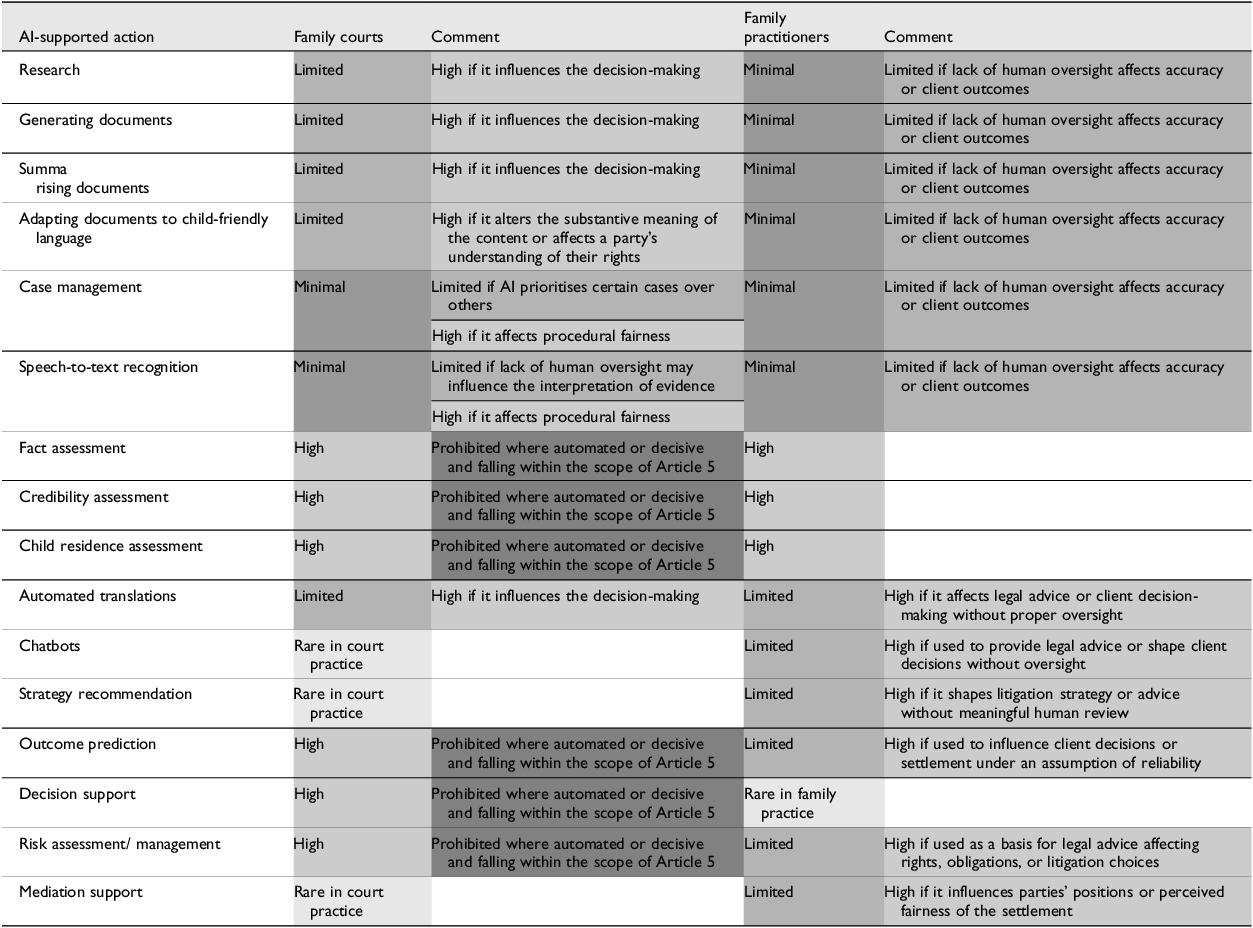
Based on the analysis in this article, Table 1 summarises the functional classification of AI-supported activities in family proceedings and legal practice. However, it is necessary to highlight that under the EU AI Act, risk is determined not by the type of activity but by the specific use case and its impact on fundamental rights. As a result, several categories (e.g., document generation, summarising or adapting) may span different risk levels depending on their role in decision-making processes. In addition, some of the AI-supported activities listed in the table are uncommon in family courts or family practice, and thus the associated risks have not yet been fully assessed.
Risk classification of AI-supported actions in family law proceedings (with legal practice as the reference) under the EU AI Act’s framework.

Table 1. Long description
A table summarizing the functional classification of AI-supported activities in family proceedings and legal practice. The table has 15 rows and 4 columns. The columns are labeled AI-supported action, Family courts, Comment, Family practitioners, and Comment. The rows are labeled with different AI-supported actions such as Research, Generating documents, Summarizing documents, Adapting documents to child-friendly language, Case management, Speech-to-text recognition, Fact assessment, Credibility assessment, Child residence assessment, Automated translations, Chatbots, Strategy recommendation, Outcome prediction, Decision support, Risk assessment/management, and Mediation support. Each row contains comments on the level of risk associated with each AI-supported action in family courts and family practitioners.
Given the contents of Table 1 and the overarching principles of the EU AI Act, the new regulatory framework serves not only as a protective mechanism but also as a symbolic affirmation of the primacy of human authority over AI systems.Footnote 80 In the context of family law, its normative function extends beyond safeguarding fundamental rights to include a gradual, risk-based approach. More importantly, it establishes human oversight as an essential condition for the lawful and legitimate use of AI in judicial proceedings. Thus, the central conclusion arising from the analysis of the EU AI Act is not merely that it classifies AI systems by risk level, but the recognition that AI-assisted actions in family proceedings must remain subject to meaningful human control.
Perhaps somewhat unexpectedly, it can be argued that the EU AI Act largely reflects the core value defended by family lawyers: the need to preserve the human element in decision-making processes that profoundly affect people’s private lives.
Financial support
The submitted paper has not been funded or financially supported by any institution.
Competing interests
The submitted paper has no competing interests that are not apparent from affiliations.
Use of AI
The author didn’t use generative AI in drafting this article.



 Open access

