Rates of experiencing sexual coercion are disturbingly high, ranging from 55% of 18- to 19-year-olds experiencing some form of sexual coercion in the past (Young, Furman, & Jones, Reference Young, Furman and Jones2012) to 43% of adolescent girls and 36% of adolescent boys reporting a sexual coercive incident (Hickman, Jaycox, & Aronoff, Reference Hickman, Jaycox and Aronoff2004). Sexual coercion has been defined as manipulative actions and the use of substances to ensure sexual favors against a partner's will (Ageton, Reference Ageton1983; Teten, Hall, & Capaldi, Reference Teten, Hall and Capaldi2009). It is generally understood that sexual coercion is not trivial, because these forms of manipulation for sex are often precursors to more serious sexual aggression, such as rape and sexual violence (Malamuth, Reference Malamuth2003). Moreover, being a victim of sexual coercion increases the risk by sevenfold of experiencing a future coercive event (Young & Furman, Reference Young and Furman2008) as well as the development of problem behavior, substance use, and sexual risk-taking behaviors (Young et al., Reference Young, Furman and Jones2012). Given the high frequency and the impact of sexual coercion on problem and health behaviors, more knowledge about the ecology and development of sexual coercion perpetration will help to inform the design of effective prevention and health promotion efforts (Hall & Barongan, Reference Hall and Barongan1997; Wekerle & Wolfe, Reference Wekerle and Wolfe1999).
Sexual coercion is often embedded within a general deviant lifestyle that is characteristic of high levels of antisocial behaviors, substance use, and risky sexual behaviors (Abbey & McAuslan, Reference Abbey and McAuslan2004; Hall, DeGarmo, Eap, Teten, & Sue, Reference Hall, DeGarmo, Eap, Teten and Sue2006; Teten et al., Reference Teten, Hall and Capaldi2009). These problem behaviors have been shown to be a consequence of child maltreatment, and sexual coercion, in particular, is linked to the experience of sexual abuse in childhood (Gilbert et al., Reference Gilbert, Widom, Browne, Fergusson, Webb and Janson2009; Jones et al., Reference Jones, Runyan, Lewis, Litrownik, Black and Wiley2010; Wolfe, Scott, Wekerle, & Pittman, Reference Wolfe, Scott, Wekerle and Pittman2001). Less understood are the transactional processes between maltreatment and later sexual coercion. The current research investigates whether peers play a significant role in the transactions from maltreatment to sexual coercion. Because early adolescence is considered to be a sensitive period of susceptibility to peer influence (Monahan, Steinberg, & Cauffman, Reference Monahan, Steinberg and Cauffman2009), peer groups are an important context in which problem behaviors emerge. Thus, peer groups might serve a key socializing function for the development of sexual coercion (Abbey & McAuslan, Reference Abbey and McAuslan2004; Hall et al., Reference Hall, DeGarmo, Eap, Teten and Sue2006; Teten et al., Reference Teten, Hall and Capaldi2009).
Two peer-linked socialization experiences are hypothesized to be relevant to the development of sexual coercion. The first is homophily, which describes the formation of peer groups during early adolescence based on similarity of attitudes, values, and social standing (Kandel, Reference Kandel1978). Specifically, the social augmentation model suggests that attenuated family relationships and marginalization in school create a motivation for youth to self-organize into gangs that support coercive and deviant norms, reinforcing a variety of problem behaviors (Dishion, Ha, & Véronneau, Reference Dishion, Ha and Véronneau2012; Ge, Brody, Conger, Simons, & Murry, Reference Ge, Brody, Conger, Simons and Murry2002; Kandel, Reference Kandel1978). The second socialization experience involves daily conversations with friends, often referred to as deviancy training. These interactions promote growth in various forms of problem behaviors, including antisocial behavior, substance use, and violence (Piehler & Dishion, Reference Piehler and Dishion2014). This phenomenon has also been recognized as peer contagion of problem behaviors (for a review, see Dishion & Tipsord, Reference Dishion and Tipsord2011). To date, there is little longitudinal research on peer socialization processes that are specifically prognostic of future sexual coercion.
While deviancy starts during early adolescence and peaks around middle adolescence (Dishion & Patterson, Reference Dishion, Patterson, Cicchetti and Cohen2006), sexual coercion starts after youth become sexually active, and peaks around young adulthood (Teten et al., Reference Teten, Hall and Capaldi2009). This implies a developmental sequence that begins with adolescent friendships that may support coercive friendship norms. Over time, these norms emerge into sexually coercive practices in late adolescence and early adulthood (Capaldi, Dishion, Stoolmiller, & Yoerger, Reference Capaldi, Dishion, Stoolmiller and Yoerger2001). Although the vast majority of this research is on males, recent research suggests both males and females engage in some forms of sexual coercion (Capaldi, Knoble, Shortt, & Kim, Reference Capaldi, Knoble, Shortt and Kim2012).
In the current study, we investigate how maltreatment predicted gang affiliation in early adolescence. Gang affiliation was expected to relate to subsequent socialization of sexual coercion within male and female friendships during middle adolescence. This socialization process was hypothesized to predict levels of sexual coercion for both males and females during early adulthood.
Toward a Transactional Model of Sexual Coercion
Transactional models of development emphasize the central role of families to socialization experiences in other ecological settings (Sameroff, Reference Sameroff and Collins1981, Reference Sameroff2009). Child maltreatment reflects a core socialization experience that has a cascade of effects on the development of healthy future relationships. In particular, it is well established that maltreated adolescents are at increased risk for maladaptation across a variety of domains (Cichetti & Toth, Reference Cicchetti and Toth2005). Experiencing maltreatment increases the risk of engaging in violence and crime as well as sexual adjustment problems (Lansford et al., Reference Lansford, Dodge, Pettit, Bates, Crozier and Kaplow2002). For example, maltreated adolescents and adults are more likely to be arrested for prostitution or to be paid for sex, and are more likely to engage in high-risk sexual behaviors that increase HIV risk, other sexually transmitted diseases (Arriola, Louden, Doldren, & Fortenberry, Reference Arriola, Louden, Doldren and Fortenberry2005; Senn, Carey, Vanable, Coury-Doniger, & Urban, Reference Senn, Carey, Vanable, Coury-Doniger and Urban2007; Wilson & Widom, Reference Wilson and Widom2008), and pregnancy (Thornberry, Ireland, & Smith, Reference Thornberry, Ireland and Smith2001; Lansford et al., Reference Lansford, Miller-Johnson, Berlin, Dodge, Bates and Pettit2007). In addition, experiencing sexual abuse increases the risk for perpetrating sexual coercion during adolescence and adulthood, although this has been mainly investigated among incarcerated men (Romano & De Luca, Reference Romano and De Luca1997). Because these problem behaviors take place in the peer context, it is not surprising that maltreatment has been linked to difficulties establishing and maintaining healthy peer relationships. Maltreated adolescents have been shown to be more aggressive toward peers (Salzinger, Feldman, Hammer, & Rosario, Reference Salzinger, Feldman, Hammer and Rosario1993), are rated as less popular and more disliked by peers, teachers, and parents (Dodge, Pettit, & Bates, Reference Dodge, Pettit and Bates1994), increasing the likelihood of being rejected by peers (Bolger & Patterson, Reference Bolger and Patterson2001; Chapple, Tyler, & Bersani, Reference Chapple, Tyler and Bersani2005; Kim & Cicchetti, Reference Kim and Cicchetti2010).
Emotion regulation has been identified as one mechanism linking maltreatment and peer problems. Not being able to regulate one's own emotions or to recognize negative affect has been found to predict victimization and peer rejection (Rogosch, Cicchetti, & Aber, Reference Rogosch, Cicchetti and Aber1995; Shields & Cicchetti, Reference Shields and Cicchetti2001). However, in a longitudinal study of maltreated and nonmaltreated children, Kim and Cicchetti (Reference Kim and Cicchetti2010) did not find that emotion regulation problems due to maltreatment were directly related to peer rejection. Instead, emotion regulation was indirectly related to peer rejection through increased externalizing behaviors. Nevertheless, these studies reveal important links between maltreatment and peer problems, but they are limited with respect to accounting for transactional developmental dynamics in the emergence of sexual coercion within intimate relationships.
Most youth mature out of problem behavior during early adulthood. However, it is also true that desistance in some behaviors may be accompanied by growth in other problem behaviors (Patterson, Reference Patterson1993). We propose that some youth persist or even escalate specific behaviors, such as sexual coercion and relationship aggression (Odgers et al., Reference Odgers, Moffitt, Broadbent, Dickson, Hancox and Harrington2008; Shortt, Capaldi, Dishion, Bank, & Owen, Reference Shortt, Capaldi, Dishion, Bank and Owen2003). The social augmentation hypothesis was introduced to explain how a history of peer rejection renders young adolescents more vulnerable to peer influence and self-organization into gangs (Dishion, Nelson, & Yasui, Reference Dishion, Nelson and Yasui2005). In particular, young adolescents are increasingly attuned to peer approval and acceptance because of increased cognitive awareness of social standing (Blakemore & Choudhury, Reference Blakemore and Choudhury2006). When peer acceptance is thwarted, and youth feel marginalized, networks are formed with other rejected peers in which the problem behaviors are more prevalent (Dishion et al., Reference Dishion, Ha and Véronneau2012; Ellis & Zarbatany, Reference Ellis and Zarbatany2007; Ladd, Reference Ladd1983). Acceptance in light of previous rejection might be an especially strong socialization process, because obtaining a group membership is highly reinforcing. It is not surprising that gang membership at 14 has been predicted by both academic failure and peer rejection at age 11, even when controlling for previous problem behaviors (Dishion et al., Reference Dishion, Nelson and Yasui2005). Thus, maltreatment can contribute to gang formation through peer rejection (Lansford et al., Reference Lansford, Dodge, Pettit, Bates, Crozier and Kaplow2002).
In addition to peer rejection, a longitudinal study using the same data set as the current paper found that youth experiencing attenuated family ties and socioeconomic status increased the likelihood that youth would organize into gangs (Dishion et al., Reference Dishion, Ha and Véronneau2012). Gang affiliation, in turn, predicted sexual promiscuity, early childbearing, and more offspring throughout adolescence and early adulthood. It seems that gang affiliation has value for procreation, because being involved in a gang at age 14 was by far the strongest predictor of later sexual activity and the number of children. This study suggested the need to consider how interest in sexual experiences might drive the formation of gangs and why adolescence may be a critical time for peers and for friendships, in particular, to influence the high-risk trajectory to sexual coercion. Previous studies showed that hostile masculinity norms, such as rape-supportive attitudes and beliefs, and promiscuous-impersonal sex behaviors, such as misinterpretation of sexual cues, early sexual debut, a high number of sexual partners, and sexual risk taking, predict the most persistent and highest levels of sexual coercion in adolescents and early adults (Abbey & McAuslan, Reference Abbey and McAuslan2004; Abbey, Zawacki, Buck, Clinton, & McAuslan, Reference Abbey, Zawacki, Buck, Clinton and McAuslan2001; Capaldi, Stoolmiller, Clark, & Owen, Reference Capaldi, Stoolmiller, Clark and Owen2002; French & Dishion, Reference French and Dishion2003; Hall et al., Reference Hall, DeGarmo, Eap, Teten and Sue2006; Teten et al., Reference Teten, Hall and Capaldi2009). However, it is unclear how these attitudes and behaviors are reinforced by peers.
Social learning theory (Bandura, Reference Bandura1986) suggests that adolescents learn from their peers through modeling and imitation. Deviancy training is a peer influence process between friends in which they repeatedly reinforce talk about antisocial acts and attitudes by showing high levels of positive affect, such as laughter and high fives (Dishion, Spracklen, Andrews, & Patterson, Reference Dishion, Spracklen, Andrews and Patterson1996; Granic & Dishion, Reference Granic and Dishion2003). The continuous reinforcing of deviant talk is thought to draw teens into a deviant lifestyle that sets norms around antisocial behavior and attitudes, increasing future engagement in antisocial and violent behaviors (Dishion et al., Reference Dishion, Spracklen, Andrews and Patterson1996). The strong impact of peer socialization was highlighted in an observational study conducted by Piehler and Dishion (Reference Piehler and Dishion2007). Remarkably, when adolescent friends exhibited dyadic mutuality, usually an index of relationship closeness and quality, combined with greater deviancy training during their interactions, it was predictive of adolescents' engagement in future antisocial behavior as compared to friends who were less mutual. In contrast to the general belief that these friendships may be less satisfying, deviant friendships are experienced as very rewarding, which makes them an influential context for problem behaviors. These findings stress the importance of considering relationship dynamics in the prediction of problem behaviors.
Little is currently known about how peers contribute to the development of sexual coercion. A few notable longitudinal studies showed that engaging in deviant peer relationships predicted levels of sexual aggression from early to late adolescence (Foshee et al., Reference Foshee, Reyes, Ennett, Suchindran, Mathias and Karriker-Jaffe2011; Miller, Gorman-Smith, Sullivan, Orpinas, & Simon, Reference Miller, Gorman-Smith, Sullivan, Orpinas and Simon2009; Schnurr & Lohman, Reference Schnurr and Lohman2008). One of the few observational studies that investigated the impact of deviant male friendships on future aggressive behaviors toward partners (Capaldi et al., Reference Capaldi, Dishion, Stoolmiller and Yoerger2001) found evidence that peer socialization about the opposite sex is a strong predictor of future partner aggression. In particular, observed hostile talk about the opposite sex that ranged from disrespectful comments to the endorsement of severely aggressive behavior toward women predicted increased aggression in future partner relationships while controlling for past aggression. Another observational study found that observed peer pressure from a best friend and self-reported pressure from the peer group were both predictive of later aggression toward romantic partners during adolescence (Schad, Szwedo, Antonishak, Hare, & Allen, Reference Schad, Szwedo, Antonishak, Hare and Allen2008). These results imply that peers set the stage for partner aggression by reinforcing deviant norms about the opposite sex. However, these studies did not include sexual promiscuity as an additional risk factor and did not assess sexual coercion.
Because both sexual promiscuity and sexual coercion have been shown to be characteristics of a deviant lifestyle (Capaldi et al., Reference Capaldi, Dishion, Stoolmiller and Yoerger2001; Ehrensaft, Moffit, & Caspi, Reference Ehrensaft, Moffitt and Caspi2004; Magdol, Moffitt, Caspi, & Silva, Reference Magdol, Moffitt, Caspi and Silva1998), sexual coercion might be a consequence of a tendency toward sexual promiscuity. More specifically, high levels of sexual activity, including the age at first sex and number of partners, are associated with future levels of sexual coercion (Abbey & McAuslan, Reference Abbey and McAuslan2004; Abbey et al., Reference Abbey, Zawacki, Buck, Clinton and McAuslan2001; Hall et al., Reference Hall, DeGarmo, Eap, Teten and Sue2006; Teten et al., Reference Teten, Hall and Capaldi2009). Thus, sexual promiscuity might set the stage for the development of sexual coercion as a maladaptive, learned behavior.
Gender Differences
Gender differences in longitudinal research in the development of sexual coercion are often studied in the context of romantic relationships, which is referred to as intimate partner violence. A meta-analysis by Archer (Reference Archer2000) showed that females were slightly more likely to engage in intimate partner violence. This was confirmed by a systematic review by Capaldi et al. (Reference Capaldi, Knoble, Shortt and Kim2012), who also discussed studies that found equal participation of men and women in intimate partner violence (e.g., Woodward, Fergusson, & Horwood, Reference Woodward, Fergusson and Horwood2002). A more nuanced picture was provided by Ehrensaft et al. (Reference Ehrensaft, Moffitt and Caspi2004), who distinguished between intimate partner violence with and without clinical consequences (i.e., whether a partner is in need of medical attention, police interference, or agency services in abuse cases, and a control group with no violence). They found that women were more likely to perpetrate violence in the nonclinical group, thus exerting sexual coercion without clinical consequences. In contrast, men and women were equally likely to be violent in the clinical group, while women more often needed medical attention. This suggests that intimate partner violence has more severe health consequences for women, but that both females and males are using aggression toward partners in the clinical group. However, the majority of research on sexual coercion outside romantic relationships has been mainly investigated among men (e.g., Teten et al., Reference Teten, Hall and Capaldi2009) and is based on cross-sectional research. These studies suggest that men reported being more sexually coercive (O'Sullivan, Byers, & Finkelman, Reference O'Sullivan, Byers and Finkelman1998). Longitudinal studies that investigated the importance of deviant peer groups and friendships generally found no gender differences, implying that deviant peer relationships are predictive of sexual coercion for both males and females (Foshee et al., Reference Foshee, Reyes, Ennett, Suchindran, Mathias and Karriker-Jaffe2011; Miller et al., Reference Miller, Gorman-Smith, Sullivan, Orpinas and Simon2009; Schad et al., Reference Schad, Szwedo, Antonishak, Hare and Allen2008).
The Current Study
We aimed to investigate how gang affiliation in early adolescence predicted subsequent sexual promiscuity and socialization of sexual coercion within male and female friendships during middle adolescence. Furthermore, we investigated sexual promiscuity and coercive talk about the opposite sex as predictors of levels of sexual coercion during early adulthood. We hypothesized that gang affiliation would predict higher levels of sexual promiscuity and encourage coercive relationship talk about the opposite sex. Both sexual promiscuity and coercive relationship talk were expected to predict higher engagement in sexual coercion during late adolescence and early adulthood. These longitudinal relationships were taken into account while accounting for experiences of childhood maltreatment. We expected that overall levels of sexual coercion would be higher among men, but that the developmental model would be relevant to both males and females.
Method
Participants
This study was part of a larger project that implemented a randomized trial of the Family Check-Up (FCU), a family-centered intervention starting in middle school (Dishion & Kavanagh, Reference Dishion and Kavanagh2003). The goal of the intervention was to reduce adolescent problem behavior and improve mental health by supporting family engagement and using assessment-driven feedback to motivate parents to improve their parenting practices, particularly in the areas of supervision, involvement, and management of their child's behavior. Participating youth (n = 998) were recruited in sixth grade from three middle schools in a metropolitan community in the northwestern United States, and have been followed across nine waves of data collection until approximately age 23, with 86% retention. At the beginning of the study, parents of all sixth-grade students in two cohorts were approached for participation, and 90% consented; youth were then randomly assigned to control or intervention conditions. Parent consent and youth assent were obtained at each subsequent wave of data collection until youth turned 18, at which point consent was obtained directly from the youth. Intervention status was controlled for in the current analyses.
In the current study, we examined data when youth were on average age 14.1, SD = 0.40, Time 1 (T1); 17.0, SD = 0.77, Time 2 (T2); 19.1, SD = 0.69, Time 3 (T3); 22.3, SD = 0.62, Time 4 (T4); and 23.3, SD = 0.64, Time 5 (T5). The sample included 526 males (52.7%) and 472 females (47.3%). The sample was composed of 423 European Americans (42.3%), 291 African Americans (29.1%), 68 Latinos (6.8%), 52 Asian Americans (5.2%), and 164 (16.4%) youths of other ethnicities, including biracial. Biological fathers were present in 585 families (58.6%). Annual family income ranged from $5,000 to more than $90,000, with the median family earning between $30,000 and $40,000.
Assessment procedures
At T1 (age 14), data were collected from youth via surveys administered at school in the eighth-grade classroom. Teachers and school counselors also completed brief questionnaires about student behavior and returned them to project staff. At T2 (age 17), data were collected via surveys that were mailed to the home of each participant and returned to the project office at the time of a peer interaction observational assessment. Follow-up survey assessments were mailed to participants at T3 (age 19) and T4 (age 22), and completed at their convenience.
At T2, youth also participated in a videotaped peer interaction task with a same-sex, self-nominated friend who was between 14 and 21 years old and had no familial relationship to the adolescent. Each dyad participated in a 45-min videotaped discussion covering eight topics, including planning an activity together, a current problem of the participant, a current problem of the peer, drug and alcohol use, goals for the next year, friends and peer groups, dating, and planning a party. Observational assessments followed standardized scripts and were conducted in the project office. The parent(s) of the friend were contacted to obtain informed consent if he/she was younger than 18.
These video interactions were coded by a team of 20 trained undergraduate research assistants, using both microcoding and macrocoding systems. Each trial was coded with the Noldus Observer Pro for duration and sequence of behaviors as defined in the Topic Code (Piehler & Dishion, Reference Piehler and Dishion2004). The Topic Code contains two categories for talk used by members of the dyad: “following the rules” and “breaking the rules.” Periods of nonspeaking and assents were also coded. Observers coded each task in two passes; the target child and peer's behavior were coded separately. Once this coding was complete, coders provided global coder impressions (macroratings) of peer interaction dynamics (Dishion, Peterson, Piehler, Winter, & Woodworth, Reference Dishion, Peterson, Piehler, Winter and Woodworth2006). Approximately 15% of the data were randomly sampled and dual coded to assess reliability and ensure that interrater agreement remained at 80% or more for individual conversation topic codes and 85% or more for macroratings.
Measures
Gang affiliation (T1; ages 13–14 years)
This latent variable was measured using four separate indicators, which included the perceptions of school staff, students’ peers, and the youth's report of their own behavior (Dishion et al., Reference Dishion, Ha and Véronneau2012). Teachers rated each student on one item asking about their perception of students’ involvement with deviant peers (i.e., “hangs around with troublemakers”), with scores ranging from 1 (never, almost never) to 5 (always, almost always). Two school counselors also provided ratings for each student about whether the adolescent was perceived to be a part of gang-involved crowds (i.e., “To what extent is [name] part of the crowd who likes gangs?”), on a scale ranging from 1 (not at all) to 5 (completely). The two school counselors’ ratings were averaged together. In addition, we used one item from the self-report survey asking participants whether they had spent time with gang members as friends during the past month, with scores ranging from 1 (never) to 6 (more than 20 times). Finally, peers’ crowd nominations supplied a measure of whether each youth was perceived as part of a gang by classmates (classmates rated the item “To what extent does [name] hang out with gang members?”). Because the size of grade populations differed, a proportion score was calculated on the basis of number of nominations of gang involvement and number of classmates, with a range of 0 (no nomination) to 50 (nominated by half of one's classmates).
Adolescent sexual promiscuity (T2; ages 16–17 years)
This latent construct was based on three self-report indicators (Dishion et al., Reference Dishion, Ha and Véronneau2012). The first indicator was derived from two questions: one asking participants whether they had ever had sexual intercourse, and the other asking about their age when it first occurred. Participants who were not yet sexually active received a score of 0, and other participants received a score of 1 if they had their first intercourse at age 16 or 17 years, a score of 2 if it was at age 14 or 15 years, and a score of 3 if it was at age 13 years or earlier. The next indicator was a binary item (yes–no) indicating if the adolescent engaged in unsafe sexual practices that could lead to pregnancy, based on whether they ever had sexual intercourse and how often they used a contraceptive method. The last indicator was based on a question asking about the number of sexual partners of the opposite sex participants had in the past year.
Coercive relationship talk (T2; ages 16–17 years)
This latent variable was based on three observational indicators: shallow talk, coercive joining, and deviancy training. Shallow talk was measured with coder macroratings of the dating discussion and global impressions after viewing the complete eight-task peer interaction. In the dating discussion, participants were asked to discuss some of the things they liked and did not like about people they might date. They were asked to discuss personality traits that they liked or disliked, such as being outgoing, friendly, mean, or shy, but not to discuss appearance. Each member of the dyad was rated to what extent they discussed the following topics: (a) superficial qualities of a (potential) partner, and (b) negative aspects of past/current relationships. In addition, after viewing all eight interaction tasks, coders provided overall ratings for each member of the dyad on the same 9-point scale to indicate the extent to which each (c) made negative/biased statements about the opposite sex, (d) commented on others’ body image/appearance, (e) mentioned engaging in risky sexual behavior, and (f) stated their level of involvement in sex activities. Each item was rated on a 9-point scale (ranging from not at all to very much), except for item f (level of sexual involvement), which was rated on the following 9-point scale (ranging from 1 = no indication, 5 = mentioned heavy petting, to 9 = mentioned intercourse). A mean score of both dyad members of all items were used to measure shallow talk. Cronbach αs for shallow talk was 0.81. Coercive joining was based on the complete interaction, and each member of the dyad was rated on the following dimensions (Van Ryzin & Dishion, Reference Van Ryzin and Dishion2013): (a) dominant behavior (e.g., dismissive of friend, did not attend to friend's statements, interrupted friend, gave commands to friend); (b) hostile or abusive references toward others (e.g., romantic partners or mutually known peers); and (c) obscene language and gestures. Each item was rated on a 9-point scale (ranging from not at all to very much). Ratings from both members of the friendship dyads were used to measure coercive joining. Cronbach αs for the ratings were 0.73, 0.81, and 0.71 respectively. All three measures were moderately correlated (rs between .28 and .55, p < .01) and combined in a single latent construct. Deviancy training was based on the real-time coding of the eight peer interaction tasks using the Topic Code microcoding system (Piehler & Dishion, Reference Piehler and Dishion2007; Van Ryzin & Dishion, Reference Van Ryzin and Dishion2013). All verbal and nonverbal behaviors that were not appropriate to the setting or task, or that violated community or societal rules, were coded as deviant talk. This included references to all illegal activities, causing purposeful physical or emotional harm to someone else, and behaviors that were inappropriate to this particular setting (e.g., crude gestures or songs and talking about or doing gross activities). A percent duration score of deviant talk was created, which is the percentage of the total time an individual engaged in deviant talk. The percent duration scores for each member of the dyad were averaged to form an overall percent duration score for the dyad. A larger percentage of the interaction devoted to discussing deviant topics was thought to reflect more extensive deviant influence within the dyad.
Sexual coercion (T3–T5; ages 19, 22, and 23 years)
This latent construct was measured using seven separate indicators of sexual behavior in early adulthood. At T3 (age 18–19), participants were asked two items about how often in the last year they had offered someone alcohol and marijuana “in the hope that they would relax and go further” with them. Responses ranged from 1 (never) to 5 (always). They were also asked how often they continued to advance after a partner said “no” (i.e., “When you are with someone how often do you try to go further after they have said no?”). Responses ranged from 1 (almost always or always) to 5 (never or almost never), and were reverse scored.
At T4 (age 21–23), participants were asked similar questions, except that the timeframe asked about the last 3 months rather than the last year. Participants were asked two items about how often in the last 3 months they had offered someone alcohol and marijuana “in the hope that they would relax and go further” with them. Responses ranged from 1 (almost always or always) to 5 (never or almost never), and were reverse scored. Participants were again asked, “When you are with someone, how often do you try to go further after they have said no?” Responses ranged from 1 (almost always or always) to 5 (never or almost never), and were reverse scored.
Finally, we used arrest and court records gathered at T5 (age 22–24) to identify participants who had been charged with sex crimes. These arrest data were coded for when the sex crime occurred, at T3, T4, or T5. Criminal records for each participant were searched via the Oregon State Police and the Oregon Judicial Information Network (OJIN). Oregon State Police gather information about felony and major misdemeanor crimes across Oregon, as well as arrest information; these data are referred from local law enforcement. OJIN is a case-tracking system directly linked to Oregon's state court system. OJIN is designed to collect case information from multiple sources throughout the state that can then be accessed at various points in a case's history. When data from these two sources conflicted, data from OJIN were prioritized because this source provided more complete information.
To expand the search beyond Oregon, participants were asked at T3 to list every city and state where they had ever lived, and at T5 everywhere they had lived since age 18. These data were supplemented with information previously gathered for purposes of recruitment and retention to make a list of all states to be searched and the names of participants who had lived in each state. In all the states that were searched, we initially attempted to go through statewide systems, if available, to gather comprehensive records. If that tact proved to be impossible, courts in the individual counties where participants had lived were contacted. Two states would not provide data to us, but would allow us to come and search records ourselves. In these cases, we subcontracted with an outside agency to collect these records. Ultimately, records were collected on 94.8% of the sample.
Each charge was coded into an offense type, assigned a severity code based on the class of offense, and then assigned codes for weapon/violent offenses, sex crimes, domestic violence, alcohol offenses, and drug offenses. Sex offenses typically varied from prostitution to rape. For the purposes of the present study, we focused on violent sexual crimes, or offenses that were coded as both a weapon/violent offense and a sex crime. These crimes included offenses such as rape, unlawful sexual penetration, and sexual penetration with a foreign object. A sum of violent sex crimes committed at T3, T4, and T5 was created for each participant. Scores ranged from 0 to 9 (M = 0.06, SD = 0.55).
Retrospective recall of maltreatment (T3; age 19)
At age 19, participants were asked to recall their history of maltreatment from family or other sources throughout childhood (Goldberg & Freyd, Reference Goldberg and Freyd2006). A latent construct was based on the adolescent's report of the frequency of physical, emotional, and sexual abuse before the age of 18. Physical abuse was measured with three questions that assessed the number of times they (a) were attacked by someone close, (b) witnessed someone very close injured by another person, and (c) witnessed someone very close attack a family member, with all three occurrences resulting in bruises, burns, or physical injury. Emotional abuse was measured with four questions that assessed the number of times (a) they were emotionally or psychologically mistreated for a significant period of time, (b) a family member betrayed their trust, (c) they were abandoned or rejected by a parent or caregiver, and (d) they witnessed someone close committing suicide or being killed. Sexual abuse was measured with two questions that assessed the number of times (a) they were forced to have some form of sexual contact, such as touching, oral sex, or penetration, with someone close, and (b) they were forced to have some form of sexual contact, such as touching, oral sex, or penetration, with someone not close. Response categories for all questions were 0 (no abuse), 1 (once), 2 (2–5 times), and 3 (6–10 times), and a mean score was calculated for physical, emotional, and sexual abuse. The Cronbach α values were 0.71, 0.95, and 0.74 respectively.
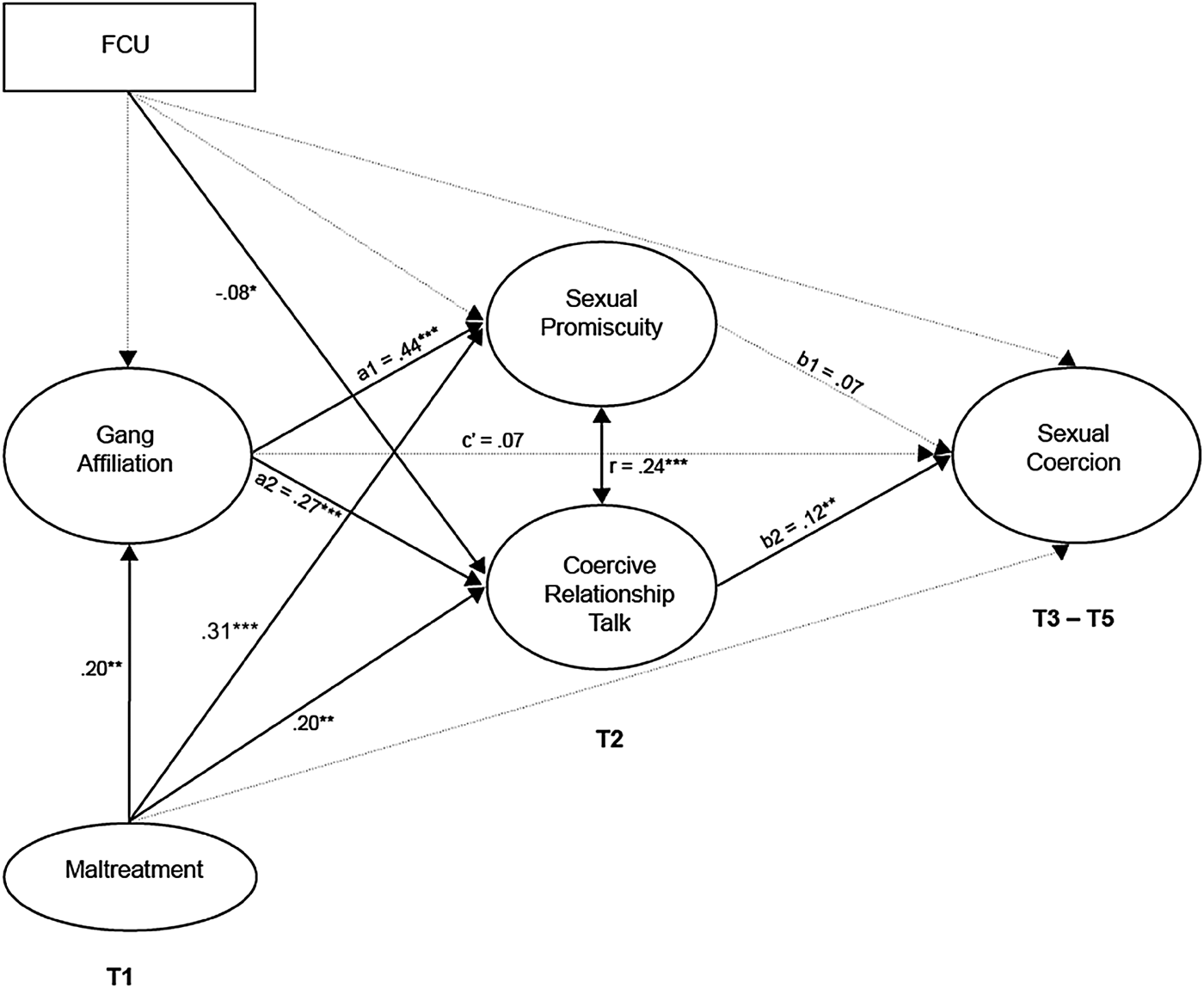
Strategy of analyses
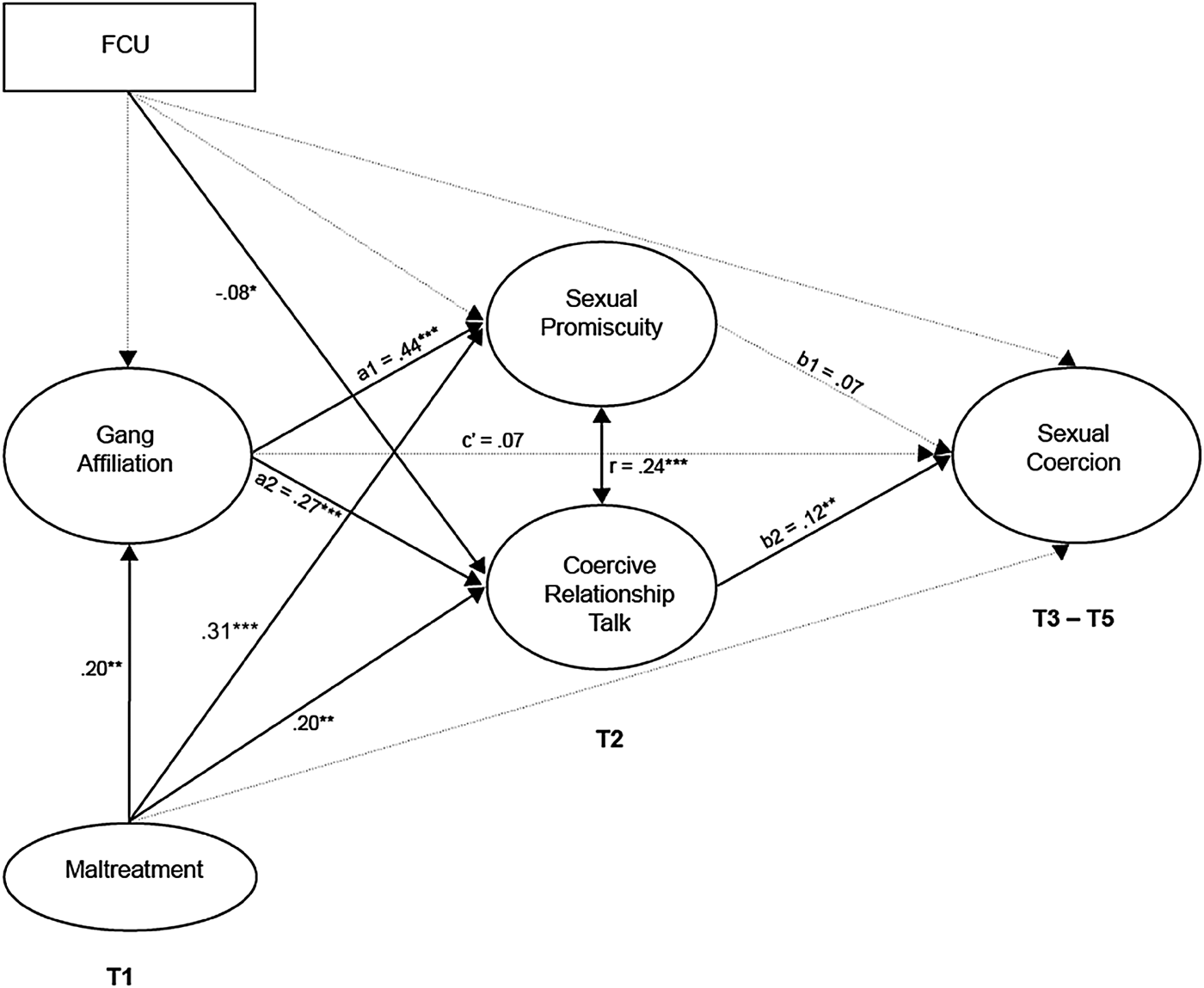
We used structural equation modeling with Mplus 7.3 (Muthén & Muthén, Reference Muthén and Muthén1998–2012) to evaluate a mediation model (MacKinnon, Reference MacKinnon2008). Gang affiliation at T1 directly predicted sexual coercion at T3–T5 (c′ path) and indirectly predicted sexual promiscuity (a1 path) and coercion talk (a2 path) at T2, which in turn predicted sexual coercion at T3–T5 (respectively, b1 & b2 paths). Figure 1 shows the mediation model (the factor structure part is omitted). This mediation model was estimated after controlling for the FCU intervention status and maltreatment. We used the joint significant test and the distribution of the product method to evaluate the mediation model (MacKinnon, Lockwood, Hoffman, West, & Sheets, Reference MacKinnon, Lockwood, Hoffman, West and Sheets2002). The joint significance test evaluates the statistical significance for the constituting mediating paths separately, and the indirect or mediation effect is considered significant when all coefficients are significant. The distribution of the product method tests the mediation effect by computing the distribution of the product of two normally distributed path coefficients. The product of two normally distributed random variables does not necessarily follow a normal distribution. The distribution of the product method computes the correct distribution for the indirect effect so that a statistical test (with confidence intervals) can be conducted with a given Type I error (α), which tests whether the indirect effect is zero or not. The weighted least squares mean and variance adjusted estimator in Mplus was used to deal with the categorical variables in the model. The overall fit of the model was assessed with indices of chi-square, root mean square error of approximation, and comparative fit index. The root mean square error of approximation <0.05 and comparative fit index >0.95 values indicated good fit. The RMediation package (Tofighi & MacKinnon, Reference Tofighi and MacKinnon2011) implements the distribution of the product method and was used to evaluate the indirect effect. We used maximum likelihood analysis, which can provide unbiased estimates in the presence of missing data if the data are missing at random (Enders, Reference Enders2010).
Mediation model of sexual coercion. Note that standardized estimates are shown and dotted arrows indicate nonsignificant paths. Family Check-Up (FCU) indicates intervention status and maltreatment was measured retrospectively at Time 3. T1–T5, Times 1–5. *p < .05. **p < .01. ***p < .001.
Invariance of the mediation effect between males and females was evaluated using multigroup analysis in the structural equation model framework (Millsap, Reference Millsap2011). Invariance in the factor structure (factorial invariance) was evaluated to ensure that the constructs were measured equivalently between males and females. A weak invariance model, strong invariance model, and strict invariance model was fitted in Mplus to test whether each invariance stage held using the DIFFTEST (Muthén & Muthén, Reference Muthén and Muthén1998–2012). The weak invariance model served as a baseline model. The model identification rule proposed by Yoon and Millsap (Reference Yoon and Millsap2007)Footnote 1 was used to circumvent the problem of choosing a reference indicator in multigroup analysis. In the weak invariance model, the factor loadings are constrained to be equal between the gender groups. Subsequently, a strong invariance model and strict invariance model were fitted to the data to test, respectively, the invariance in the intercept/thresholds and the invariance in the residual variances between males and females.
After establishing factorial invariance, the regression parameters in the mediation model were tested to be equal between the gender groups. The nested models of freely estimating the path coefficients were fitted, and then the paths were constrained to be equal between males and females. The constraint was done simultaneously for all of regression parameters including the correlation between sexual promiscuity and coercion talk. A DIFFTEST between the constrained and unconstrained model was conducted to determine the invariance in the two gender groups.
Results
Sample descriptive statistics
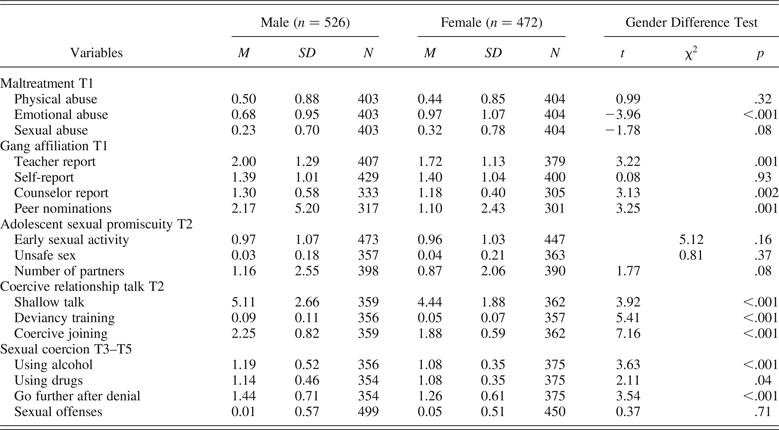
The sample statistics for each of the indicators of the constructs by gender is given in Table 1. Independent t tests showed that females had higher emotional abuse mean scores than males. At age 14, males were more involved with gangs than females, as indicated by teachers, counselor ratings of gang involvement, and peer nominations. Moreover, males showed higher levels of observed shallow talk, deviancy training, and coercive joining at age 16–17. Males were also more likely to self-report using alcohol and drugs in the hope that a person would go further sexually, and to go further after denial.
Descriptive statistics by gender and testing for gender differences
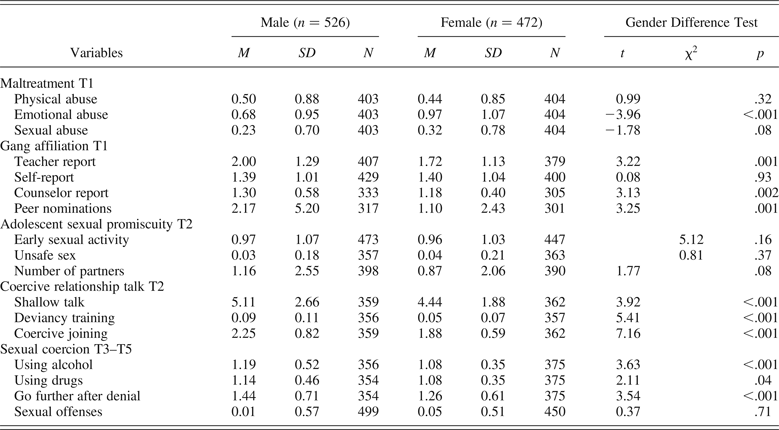
Note: T1–T5, Times 1–5.
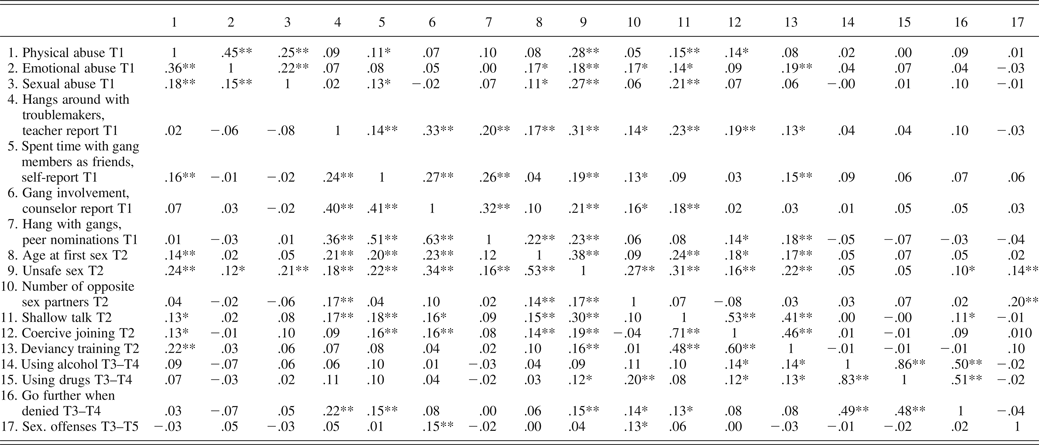
The bivariate correlations among variables are shown in Table 2. Correlations among the indicators for maltreatment, gang affiliation, sexual promiscuity, coercive talk, and sexual coercion were generally significantly correlated in the expected direction for both males and females. Sexual offenses were not related with the other indicators for sexual coercion.
Correlations among all measures
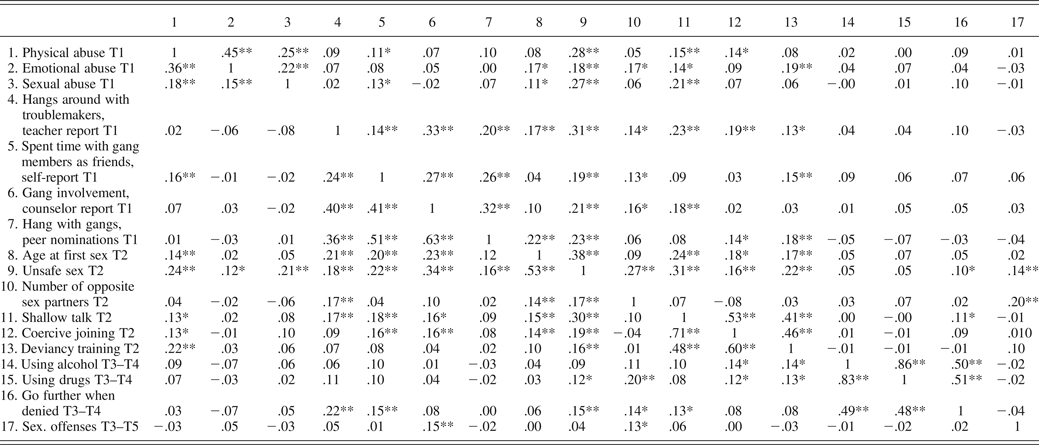
Note: Correlations for females are shown above the diagonal and correlations for males are shown below the diagonal. T1–T5, Times 1–5.
*p < .05. **p < .001.
Mediation analysis
As shown in Figure 1, it was hypothesized that both sexual promiscuity at age 16 and coercive relationship talk would predict future sexual coercion. In addition, we hypothesized that gang affiliation in early adolescence would be predictive of both coercive relationship talk and sexual promiscuity. In this sense, coercive relationship talk and sexual promiscuity were hypothesized to mediate the relationship between gang affiliation and later sexual coercion. Fit indices indicated that the mediation model fitted well to the data, χ2 (122) = 277.99, RMSEA = 0.04, and CFI = 0.97. The unstandardized effect estimates were as follows after controlling for intervention status and maltreatment: gang affiliation at T1 significantly predicted coercive relationship talk at T2 (a2 = 0.71, SE = 0.13, p < .001). Gang affiliation at T1 also predicted sexual promiscuity at T2 (a1 = 0.81, SE = 0.09, p < .001). Only coercive relationship talk at T2 predicted sexual coercion at T3–T5 (b2 = 0.03, SE = 0.01, p = .004). Sexual promiscuity at T2 was not significant related to sexual coercion at T3–T5 (b1 = 0.02, SE = 0.02, p = .20). Moreover, the direct effect of gang affiliation at T1 on sexual coercion at T3–T5 was not significant (c′ = 0.05, SE = 0.03, p = .08). In addition, there was a positive correlation between the residuals of sexual promiscuity at T2 and coercive relationship talk at T2 (r = .24). The correlated residuals here suggest that some of the covariation between these two constructs is unaccounted for in the context of the measurement model. An increase in maltreatment predicted higher gang affiliation (p = .01), higher sexual promiscuity at T2 (p < .001), and higher coercive relationship talk (p = .001). Receiving the intervention predicted lower coercive relationship talk at T2 than the control (p = .049). In total, 24 adolescents reported being homosexual. The reported results were essentially the same when considering a sample that excluded these participants from the analyses.
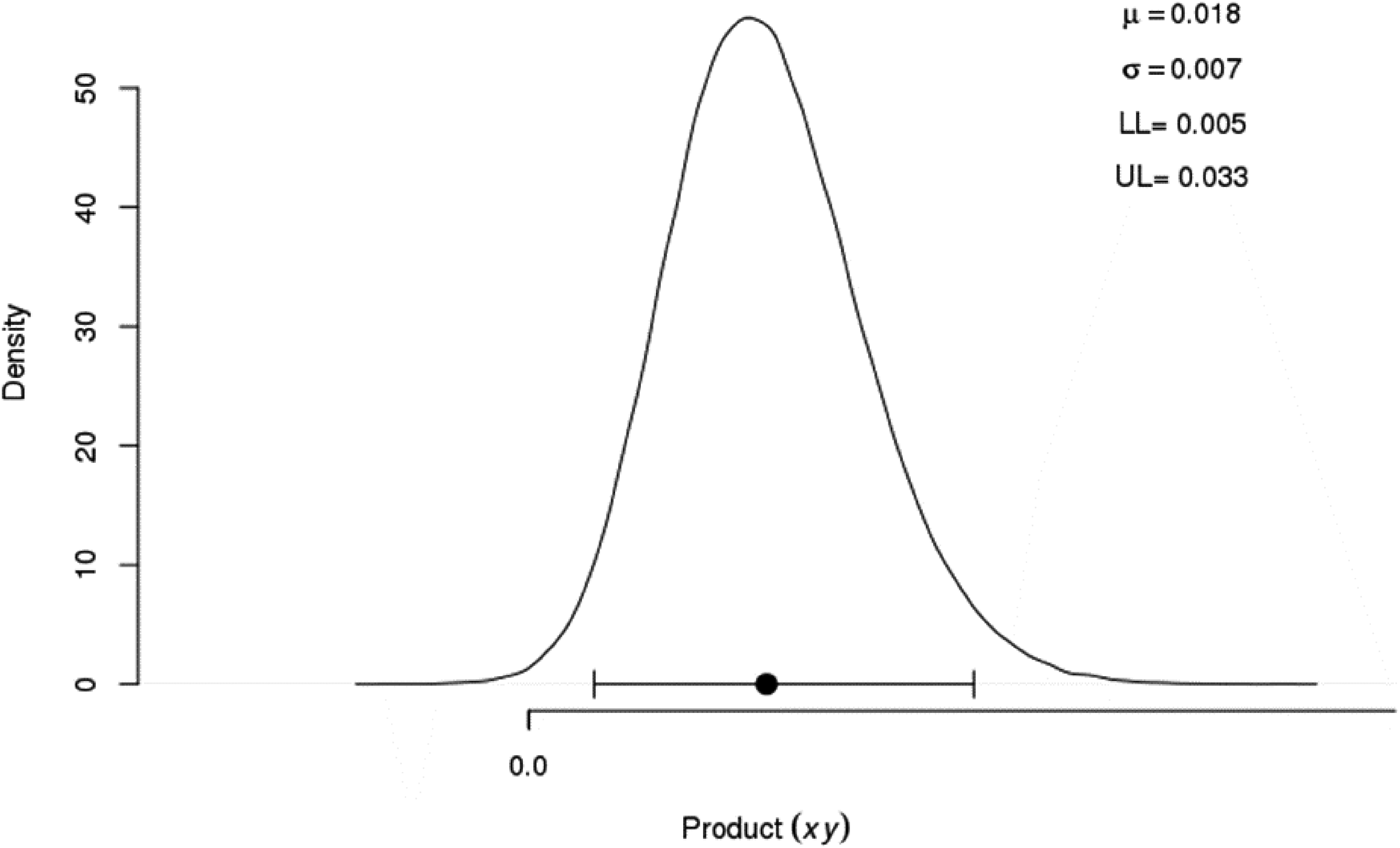
The joint significant test demonstrated that the gang affiliation → coercive relationship talk → sexual coercion indirect effect was significant, indicating that coercive relationship talk significantly mediated the link between gang affiliation and sexual coercion. This was also confirmed in the distribution of the product method; the indirect effect was significant at a2 × b2 = 0.02, 95% confidence interval = (0.005, 0.033). Figure 2 depicts the distribution of the indirect effect (i.e., product of the two regression coefficients). In contrast, the mediation of sexual promiscuity was not supported. Specifically, the gang affiliation → sexual promiscuity → sexual coercion indirect effect was not significant.
Distribution of the indirect effect using the distribution of product method to test the mediation effect of coercive relationship talk. The dot represents the point estimate (μ) of the average indirect effect of coercive relationship talk, and the horizontal bar shows the 95% confidence interval. Given that the 95% confidence interval is greater than zero, support was found for the significant mediating effect of coercive relationship talk. LL, Lower limit of the confidence interval; UL, upper limit of the confidence interval; σ, standard deviation of the product distribution.

Invariance between gender groups
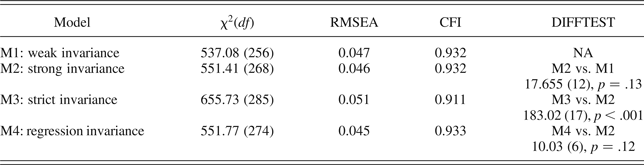
We tested the hypothesis that the model shown in Figure 1 accounted for variation in sexual coercion equally well for males and females. Table 3 contains the model fit information and DIFFTESTs conducted for the invariance tests between gender groups. The weak invariance model (M1) was accepted as the baseline model because the model fitted adequately to the data, χ2 (256) = 537.08, RMSEA = 0.05, and CFI = 0.93. Adding intercept/threshold equivalence constraints between males and females was also accepted in the strong invariance model (M2), Δχ2 (12) = 17.66, p = .13. However, the strict invariance model (M3) was rejected, Δχ2 (17) = 183.02, p < .001. The strict invariance model is a rather stringent model that is often rejected in factorial invariance work, and generally researchers do not pursue this model to establish factorial invariance (Millsap, 2011). Therefore, based on the strong invariance model, we concluded that factorial invariance held across gender groups; we then tested the invariance in the regression parameters. The regression invariance model (M4) revealed that the main regression parameters and the residual correlation between sexual promiscuity and coercion talk were equivalent between females and males, Δχ2 (6) = 10.03, p = .12. In sum, we were able to find factorial invariance of the studied constructs. Thus, the relationships between the constructs were equivalent between females and males.
Discussion
The current longitudinal study showed that gang affiliation during early adolescence promoted coercive relationship talk in adolescent friendships, which in turn predicted sexual coercion during adulthood. These developmental pathways were found to be true for both males and females, even though males on average were more engaged in gangs, coercive relationship talk, and sexual coercion. However, sexual promiscuity in adolescence was not predictive of future sexual coercion in early adulthood. Maltreatment indirectly predicted future sexual coercion by increasing gang affiliation and coercive relationship talk. Maltreatment was also related to higher sexual promiscuity. The pattern of findings suggests that peer socialization and support for coercive relationship norms set the stage for coercive tactics for sexual intimacy 5 years later in development.
These findings extend current developmental models by showing that sexual coercion emerges from transactions in adolescent peer groups. Specifically, youth self-organize into gangs in early adolescence as a result of maltreatment and, over time, coercive relationship norms are reinforced in the context of adolescent friendships. The tendency to engage in shallow and manipulative discussions on intimacy predicts the use of those sexual coercive strategies as indicated by self-reports as well as police arrest records. Thus, the manner in which one “fits in” to a peer group is prognostic of how one orients to intimacy in other relationships. These findings extend theories about sexual coercion that merely focus on individual characteristics of perpetrators, such as the narcissistic reactance theory of rape and sexual coercion (Baumeister, Catanese, & Wallace, Reference Baumeister, Catanese and Wallace2002). This theoretical perspective predicts that men high in the narcissism personality trait are more likely to engage in sexual coercion, especially when sexual bids are rejected by women. However, the current data instead suggest that the focus on one's own needs in sexual relationships is actually shared and reinforced in the adolescent peer group and that this applies to both males and females. These findings suggest the promise of a developmental psychopathology perspective on adaptive and maladaptive sexual relationships, as well as a transactional approach to understanding peer influence.
The relative power of the peer group is particularly remarkable. It is noteworthy that the construct of coercive relationship norms within friendship was based on a brief (35 min) sample of videotaped interactions with one particular friend assessed at one point in development. This finding is consistent with the work of Capaldi and colleagues (2002), who found that ratings of hostile relationship attitudes based on a 5-min discussion predicted aggression with a romantic partner 5 years later. In addition, a high level of stability in observed deviant talk among friends has been reported over a 5-year period. Among 204 males, a .53 correlation was found between the duration of deviant talk bouts as assessed at ages 14 and 18 (Dishion & Owen, Reference Dishion and Owen2002). These findings suggest that friendship transactions are robust and salient to adolescent development. Furthermore, these findings fit with several studies showing the predictive power of friendship interactions on adolescent and adult development (Piehler, Véronneau, & Dishion, Reference Piehler, Véronneau and Dishion2012).
It was unexpected that no support was found for the link between sexual promiscuity and later sexual coercion. It is unclear from the current study whether sexual coercion happened in the context of a romantic relationship or in situations that increase the likelihood of sexual promiscuity, such as bars or parties with high levels of substance use. This distinction is important because sexual coercion might serve different functions, depending on the social context. Within both human and chimpanzee populations, there are indications that male sexual coercion within relationships is elicited by suspicions of a partner's sexual promiscuity (Goetz & Shackelford, Reference Goetz and Shackelford2006; Muller, Kahlenberg, Thompson, & Wrangham, Reference Muller, Kahlenberg, Thompson and Wrangham2007). Sexual coercion in relationships is therefore thought to be a mate-guarding strategy by constraining a partner's sexual promiscuity and may function to increase the certainty of being the father of potential offspring. In contrast, sexual coercion in sexual promiscuity situations might function as a direct way to increase the number of potential partners. This fits with the confluence model that proposes that men high in promiscuous-impersonal sex, who have preference for engaging in casual, uncommitted relationships, are more likely to engage in sexual coercion when their bids for sex are rejected (Malamuth, Linz, Heavey, Barnes, & Acker, Reference Malamuth, Linz, Heavey, Barnes and Acker1995). Future studies that include the context of sexual coercion may find that sexual promiscuity predicts later sexual coercion.
Because research and theory on female sexual coercion is underdeveloped (Bouffard, Bouffard, & Miller, Reference Bouffard, Bouffard and Miller2015), it is challenging to explain why no relationship was found between sexual promiscuity and later sexual coercion for females. Recent studies revealed no gender differences in mate preferences for short-term mating (Ha, Overbeek, & Engels, Reference Ha, Overbeek and Engels2010; Ha, Van den Berg, Engels, & Lichtwarck-Aschoff, 2012), implying similar benefits of short-term mating for women and men. Perhaps similar to males, females who are engaged in gangs and deviant friendships may use sexual coercion within relationships as a mate-guarding strategy, while using sexual coercion in sexual promiscuity contexts to increase the number of potential partners. Alternatively, some preliminary evidence has identified both female promiscuous behavior and previous sexual victimization as a risk factor of sexual coercion (Bouffard et al., Reference Bouffard, Bouffard and Miller2015; Russell & Oswald, Reference Russell and Oswald2001). Longitudinal research is needed to determine the direction of effects. However, for females, affiliation with gangs might elicit a cycle of increased sexual promiscuity that puts females at risk for victimization experiences, which in turn increase the likelihood of engaging in sexual coercion.
In line with previous studies, maltreatment was related to gang formation and sexual promiscuity. It was unexpected that maltreatment was not predictive of sexual coercion, but was indirectly predictive through both gang affiliation and coercive relationship talk with friends. These findings extend previous research that found that maltreated adolescents experienced higher levels of problems with peer relationships (Bolger & Patterson, Reference Bolger and Patterson2001; Chapple et al., Reference Chapple, Tyler and Bersani2005; Kim & Cicchetti, Reference Kim and Cicchetti2010). This study shows that experiencing maltreatment increases the social augmentation value of deviant peers as well as sexual coercive norms regarding romantic relationships within the daily interactions with friends. No direct effects were found on sexual coercion, possibly because general maltreatment was measured and not specifically sexual abuse as in previous research (Arriola et al., Reference Arriola, Louden, Doldren and Fortenberry2005). The low frequency of sexual abuse prohibited the test of the direct effect on sexual coercion. A limitation of the current study is that maltreatment was measured at the age of 18 and not prospectively, which likely decreases the accurate measurement of maltreatment. Moreover, no other data on maltreatment were collected, such as from other reporters or official records of child protective services. Prospective data from multiple sources are likely to most reliably yield indicators of maltreatment (Cicchetti & Toth, Reference Cicchetti and Toth2005).
Model testing for invariance between males and females
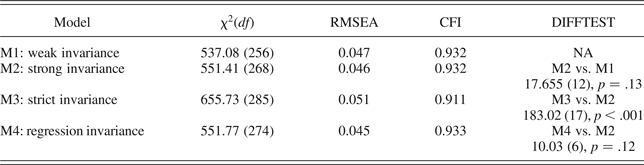
Note: RMSEA, Root mean square error of approximation; CFI, comparative fit index; M1–M4, Models 1–4.
It is worth noting that this sample was involved in a randomized experiment of the FCU model as implemented in public middle schools (Dishion & Kavanagh, Reference Dishion and Kavanagh2003). Although randomization to the FCU resulted in reductions in drug use (Dishion, Nelson, & Kavanagh, Reference Dishion, Nelson and Kavanagh2003) and antisocial behavior by age 18 (Van Ryzin & Dishion, Reference Van Ryzin and Dishion2013), the intervention did not have a direct effect on sexual coercion in the present study. Instead, a direct effect was found for randomization to the FCU on observations of coercive relationship talk with friends 5 years later. Moreover, coercive relationship talk with friends was prognostic of later sexual coercion in early adulthood. This indirect intervention effect is similar to what was reported by Caruthers, Van Ryzin, and Dishion (Reference Caruthers, Van Ryzin and Dishion2014), revealing an indirect effect on high-risk sexual behavior in early adulthood through direct effects on improvement of family relationships and parent monitoring. Taken together, the two analyses of the same longitudinal data set suggest the FCU improves relationships with parents and peers, which in turn decreases sexual risk and coercive behaviors. However, family interventions to date have not focused on empowering parents and caregivers to track and prevent early adolescent self-organization into gangs. Previous research on the short-term outcomes of the FCU did show reductions in deviant peer involvement (Dishion, Bullock, & Granic, Reference Dishion, Bullock and Granic2002), but these effects clearly did not prevent youth in the intervention group from affiliating with gangs. This is not surprising, because criminological researchers have long lamented the difficulties in preventing and reducing gang formation (Klein, Reference Klein, Dodge, Dishion and Lansford2006). It would seem that gang formation is truly transactional, with factors inherent in community inequities, neighborhood networks, and school marginalization being likely candidates (Sampson & Laub, Reference Sampson and Laub1994).
We hypothesize that a universal approach that begins prior to puberty and continues through adolescence is needed to prevent gang involvement and gang affiliation that promote sexual coercion specifically. Social disorganization theory suggests that communities compromised by poverty and unemployment are fertile ground for the formation and operation of gangs (Sampson & Laub, Reference Sampson and Laub1994). From an ecological framework (Bronfenbrenner, Reference Bronfenbrenner and Vasta1989), it would seem reasonable to infer that peer selection and socialization processes vary widely by community in the function and content of the social interactions. Poverty, marginalization, and community dynamics may fuel the development of violent norms. Thus, prevention of poverty and marginalization of youth prior to early adolescence would likely have an impact on gang formation.
As youth mature into puberty, with the accompanying sexual motivations and interests, such norms may translate into intimate relationships. Interventions that discourage a shallow approach to intimate relationships and promote healthy romantic relationships may be most effective during the time that youth are becoming interested in romantic relationships. The focus on promoting safe and responsible sexual practices, however, varies in effectiveness (Bennett & Assefi, Reference Bennett and Assefi2005). For example, Moberg and Piper (Reference Moberg and Piper1998) reported that the prevention of unsafe sexual practices in high schools resulted in the experimental group having more unsafe sex. Therefore, messaging to adolescents during a time of heightened sexual interest needs careful consideration. It is possible that a health promotion approach to relationships could be similarly effective as the health promotion strategy embodied in the life skills training program developed and tested by Botvin and Wills (Reference Botvin, Wills, Bell and Battles1985) to promote healthy lifestyles and prevent drug use.
The current findings should be interpreted with respect to this study's limitations. Sexual coercion was measured with both self-reports and court records of arrest; however, we did not measure the context in which the sexual coercion occurred (i.e., whether these aggressive sexual acts occurred in existing romantic relationships or whether it was used to pursue short-term sexual relationships). Furthermore, the incidence of severe sexual coercive acts, as documented by court and arrest data, was very low; thus, this study could not look at more severe forms of sexual coercion, such as serial rapes and sexual offenses. Moreover, although analyses excluding homosexual adolescents showed similar results, the number of homosexual adolescents was too small to conduct any group comparisons. An additional limitation is that the current model did not account for differences in pubertal maturation. Pubertal maturation was only available for a portion of the sample, and previous analyses showed that pubertal maturation was not related to gang affiliation and was a weak predictor of sexual promiscuity (Dishion et al., Reference Dishion, Ha and Véronneau2012). Nevertheless, these data suggest that peers have a socialization function in the development of sexual coercion, and point toward the need to integrate the peer ecology into the design of efforts to prevent coercive relationship patterns and to promote healthy intimate relationships in both males and females.