

This article examines the qualia of coarseness and fineness as they are manifested across multiple domains of semiosis in rural China. I show how these “qualia” become embodied in two divergent figures, the “rural rich” (tuhao)Footnote 1 and the “high-quality citizen.” For urban elites, these two figures are thought to be emblematic of the perceived “civilizational” (wenming de) gap between rural and urban China as a whole. In rural China, however, these two figures organize social distinctions in quite different ways. As mirror images of each other, the tuhao and the high-quality citizen represent, we might say, modernity gone wrong and modernity gone right. The high-quality subject is one who has been fully interpellated by the state. She has internalized the values and ideology of the CCP and is fully civilized (wenming). By contrast, the tuhao carries with her the trappings of a modern subject, yet her inner essence remains unchanged. More so than the peasant, a figure who remains at all levels stubbornly unmodern, the tuhao represents an acute danger to the order of modern Chinese society, as she presents the façade of modernity without its substance. Her outward appearance of modernity is seductive; she may lead astray others who mistake her ersatz modernity for the real thing.
To identify the tuhao and reform her into a high-quality citizen, then, is at the center of Chinese state projects aimed at improving the quality (suzhi) of its rural citizens. The tuhao is not simply embarrassing, but is a major obstacle to shaping the rural Chinese workforce into the right type of modern subject. At a national level, urban elites fret over the low-quality of rural Chinese, and national-level bureaucrats implement nation-wide policies aimed at remedying these problems.
In rural China, local bureaucrats and rural China’s aspiring middle classes echo but do not merely repeat elite urban concerns. At the local level, the bureaucrat who is assigned the task of reforming her lower-quality peers is always in danger of being mistaken for them. As a result, she must simultaneously continuously perform her own quality in a way legible to the outsider—the urban elite, or the foreign anthropologist. In other words, her project is one of Bourdieuian “distinction” at the same time as it is about ostensibly erasing local difference.
In this article I examine how these projects of distinction and improvement play out in a yoga studio in Huangshan, a rural region in Southern Anhui province. While a yoga studio may be imagined as a space of pure leisure, in Huangshan yoga had its origins in and was still strongly tied to government projects of quality-raising. Yoga, an activity for harmonizing and disciplining the mind and body, resonated in the minds of its practitioners with the state project of harmonizing Chinese society and disciplining the unruly rural subject. In a space where people are particularly attuned to mental and bodily self-improvement, I show how across semiotic domains, the qualia of coarseness and fineness become embodied and define the tuhao and the high-quality subject. I do so by looking at gossip, a key genre through which the local semiotics of coarseness, fineness, and quality (suzhi) are fashioned and refashioned.
Qualia of Coarseness and Fineness
An “icon” represents its object through resemblance; however, as the philosopher Nelson Goodman points out, similarity or likeness between objects never lies in their objective shared qualities but arises through the construction of a relation of likeness. Indeed, there are infinite ways in which objects may be “like” or “unlike” each other, and socially meaningful similarity must always be constructed by making certain qualities salient and others not: “The fact that a term applies, literally or metaphorically, to certain objects may itself constitute rather than arise from a particular similarity among those objects” (Goodman Reference Goodman1972, 440). That is, he notes, what makes a soft note similar to a soft blanket is our own perception of the quality of softness as applying to these things. The abstractable quality of “softness” that Goodman identifies is what we call “qualia,” the “embodied, conventional and hence experience-able forms of abstract qualities” (Gal Reference Gal2013, 32–33), which allow us to experience different things as similar or alike in an important way.
Nancy Munn draws on Peirce’s concept of “qualisigns,” which she defines as “certain embodied qualities that are components of a given intersubjective spacetime … whose positive or negative value they signify” (Reference Munn[1986] 1992, 16–17) have the ability to transform social relations by signifying or indexing the transformation of value that they are seen as icons of. In Gawa, Munn shows how qualities of “lightness” or “heaviness” stretch across disparate objects such as bodies, canoes, actions, times of day, and so forth. Lightness positively transforms value as it expands “spacetime,” that is, it extends the possibility of social relations, while heaviness, which contracts spacetime, negatively transforms it by foreclosing certain potential. To be seen as producing or embodying certain types of qualities is thus to be seen as a certain sort of social person, with social repercussions. (As Munn notes, at the extreme, to be seen as subverting value is to be labeled a witch.) In a quite different context from Gawa and within a quite different system of value, I examine at how embodied qualities in people transform value, and the social repercussions of this transformation.
In Gawa, qualia line up in “diagrammatic” opposition such that for every socially significant quality that is capable of producing a certain sort of value, there must necessarily be its opposite. Thus, lightness, which is value-expanding, is opposed to heaviness, which is value-contracting. Clifford Geertz (Reference Geertz1960) and Joseph Errington (Reference Errington1988) also show that similar binary logics organize Javanese society, where speech, gesture, materials, and so on, are categorized under the qualia of either “fine” (alus) or “coarse” (kasar). As in Java, in Huangshan the qualia of coarseness and fineness are seen to structure social difference on a wide-ranging scale. For example, when I asked a group of young women about the difference between Northern versus Southern China, Li, a woman in her early twenties who had grown up in Huangshan but was getting a master’s degree elsewhere in China, answered with the following answer:
It’s just that I feel, I think, Northern cuisine is more coarse, and Southern cuisine is more refined. Just take mantou [steamed buns], the mantou they make is machine-made, and actually not very good. Our typical mantou, I don’t know if you’ve discovered our typical mantou is very light/hollow. The South—when they cook in the North, it’s all large-bowl dishes. Potatoes and other things, stews and things like that, bean sprouts, big soup. Southerners cook things more carefully, stirfrying, steaming, a bit more meticulous.Footnote 2
Li takes a question about differences between people and answers it through describing differences between food. Northern Chinese cuisine is rough or coarse (cao), qualities that adhere to the texture of the food (machine-made mantou versus light classic mantou), the type of food (stews, potatoes, bean sprouts), and the methods of cooking (roasting, cooking large-bowl dishes). In contrast, Southern China, to which Huangshan is seen to belong, makes food that is delicate (jingxi) and meticulous (jiangjiu).
Here, we can see that rough (cao) versus delicate (jingxi) serve as the organizing logic separating Northern and Southern Chinese cuisine, and by extension, Li implies, Northern and Southern Chinese people. Roughness or coarseness is manifested in food by using heartier, coarser-textured foods like potatoes and cooking techniques like roasting; and it is manifested in language through the use of dirty or vulgar speech. Li’s childhood friend Xin is an elementary school teacher in rural Huangshan and attended teacher training school in the northern part of Anhui province, widely considered to be part of Northern China. She tells me, “those up in the North, basically when they open their mouths it’s vulgar speech that comes out, out of every ten sentences, five of them are vulgar.”Footnote 3 The qualities of coarseness and fineness are also embodied in people as well. As Li says, “I’ll tell you, Southern women compared to Northern ones are a bit more delicate, a bit delicate and quiet.”Footnote 4 In Li and Xin’s description of the differences between Northern and Southern Chinese people, we can see how a schema of coarse versus refined organizes and defines the various differences (see fig. 1).
Cross-semiotic coarse-fine opposition as expressed in conversation

On the one side, we have “coarse” (cao) and “vulgar” (zang). On the other, we have “light” (kong), “careful” (jingxi), “meticulous” (jiangjiu), “delicate” (jingzhi), and “quiet” (ningnjing). I choose the English term “fine” to best capture the umbrella of related terms used in Chinese, which unite the idea of delicateness with that of meticulousness or carefulness. Although fairly subtle, we can see coarseness of Northerners negatively evaluated by these young women, who find their speech “dirty” (zang) and steamed buns unappetizing (nanchi).
For my interlocutors, young women who have spent little time in Northern China, these differences remain fairly abstract and are indeed the conventional differences that both Northern and Southern Chinese draw on to define the differences between the regions.Footnote 5 Moreover, while Northern Chinese may be coarse, this does not easily map onto a straightforward relationship of superiority or inferiority, as the North is the political and industrial center of China while the South is its economic center. As we can see from the reference to machine-made steamed buns, Northern Chinese coarseness exists in an interesting relationship to mechanization and, we might assume, modernity.
The binary between the qualities of coarse and fine remain the organizing logic for understanding social difference at the local level. As scholars of circulation have shown (see e.g., Lee and LiPuma Reference Lee and LiPuma2002; Gal Reference Gal2003; Gaonkar and Povinelli Reference Gaonkar and Povinelli2003), however, when a conceptual apparatus is applied or projected in another context, the meanings and value judgments shift as the sorts of differences they point out cannot and do not remain stable. I will show that, in Huangshan, qualities of coarseness are mapped on to or seen to be embodied in the peasant and her more successful counterpart, the tuhao, while qualities of fineness are mapped onto the “high-quality” (suzhi gao de) woman.
Suzhi: A Background
Teacher Yuan and I sat on the floor one evening after yoga class. Things had not been going well recently, and Teacher Yuan was stressed. Our New Year’s celebration [xinnian hui] had been a minor disaster, and everyone was mad at Teacher Yuan for reasons beyond her control. “But it’s not just the people who came [who were mad].” She told me. “Some people didn’t even participate. Banban originally signed up, and then she told me she couldn’t make it.”
“What? Why couldn’t she come?” I asked.
“It’s not even just the New Year’s Party. She said that she wasn’t coming to that, or back to yoga ever again.” I was surprised. Banban was a friendly woman in her early 30s and an enthusiastic participant in yoga and yoga studio activities. What had made her so angry she was quitting yoga?
“It’s Huang.” said Teacher Yuan. “Banban can’t stand her. A couple of weeks before the New Year, Banban came to yoga a little late, and the door was left open. Huang said that only people with low quality [suzhi] leave the door open. Banban was furious. She hadn’t even left the door open, but Huang was still accusing her of having low suzhi.”
I was puzzled. “Why couldn’t she just ignore Huang?” I asked. “She says mean things [nanting de hua] all the time. She’s only one person, and Banban shouldn’t let her ruin yoga for her.”
“But Yan [me], you don’t understand. She insulted her suzhi. What was Banban supposed to do? If it had been something else, fine. But not her suzhi.”
Suzhi, a term which loosely translates as “quality,” has been written about extensively in the anthropological literature in China (Anagnost Reference Anagnost2004; Kipnis Reference Kipnis2006, Reference Kipnis2007; Yan Reference Yan2003). Originally a somewhat obscure term used to indicate a person’s natural qualities in philosophical discussions of nature versus nurture, the meaning of suzhi underwent a radical transformation in the last thirty years of the twentieth century when it became a key concept in Chinese family planning policies in the late 1970s. Adopting a rhetoric of quality over quantity, the One-Child policy promoted limited birth as a way to raise the suzhi or “human quality” of the Chinese population, which through its sheer numbers was seen as excessive and disorderly (luan). By the mid-1980s, suzhi, or lack thereof, was a nebulous but ubiquitous term used to explain the shortcomings of Chinese people on an individual or national basis, and to explain, justify, but also to simultaneously remedy vast inequalities between rich/poor, urban/rural, and Eastern/Western China.
For the mid-level government bureaucrats and aspiring middle class women with whom I spent most of my time, having one’s high suzhi recognized by others was incredibly important. Although Tunxi was most famous for its proximity to Yellow Mountain (Huangshan), one of China’s most famous mountains and a major tourist attraction, Anhui province is best-known nationally for its crushing poverty and famine. Throughout the 1980s and 1990s, Anhui was the source of most migrant labor to China’s wealthier Eastern Seaboard. For residents of China’s large metropolises, the figure of the “Anhui maid” (Anhui baomu) represented the province in urban imaginations (Sun Reference Sun and Wang2007, Reference Sun2009; Yan Reference Yan2008).Footnote 6 Although neither the poorest nor the least developed province by quantitative measures, its close proximity to China’s wealthiest provinces and its history of twentieth century famines that spurred mass outward migration meant Anhui was framed as inhabiting a “chronotope” of China’s recent impoverished pre-Reform and Opening Movement past (Bakhtin Reference Bakhtin, Holquist and Emerson1981). As a result, it was considered to be one of the most “backward” (luohou) provinces in China, and its inhabitants were seen to be particularly lacking in suzhi (Yan Reference Yan2003, Reference Yan2008).Footnote 7 Despite being a part of the province, Huangshan locals agreed with the assessment that most Anhuinese were particularly “backward” and “uncouth” (tu). They strongly distanced themselves from an Anhui identity by referring to themselves as as Huangshanese (Huangshanren) or Huizhounese (Huizhouren) rather than Anhuinese. Locals considered Huangshan to be the only cultured (you wenhua de) part of Anhui and resented being included in any general classification of the Anhuinese character.Footnote 8
Kipnis (Reference Kipnis2006) writes that through linking suzhi to government-enforced family planning policies, the concept of “quality-raising” has become inextricably tied to state power. For the yoga students, particularly those who were government employees, being a high-quality woman meant behaving and conducting oneself in ways that were promoted by or aligned with state values. To be a high-quality woman, then, was to be a modern citizen as defined through the terms of the Chinese state. A high-quality woman would be capable of appropriately reproducing (i.e., giving birth to and raising the right kind of child[ren]) and producing (i.e., creating the right type of commodity or service) in a way that made China a global superpower competitive with “advanced” nations like the United States or Japan.
The stakes of being high-quality, then, went far beyond etiquette and aesthetics. In Huangshan, a beautiful but “undeveloped” region of China, membership in the CCP and employment in government or one of the few state-owned enterprises were the only sources of white-collar employment and, thus, the main avenues of rural social mobility. As a result, most yoga students were employed in government-related industries, and most saw their own values and goals as aligned with those of the state. For Banban, a low-level government employee, being told by Huang, a high-ranking cadre, that her suzhi was lacking was much more than a simple insult from a classmate: it was a judgment of her fitness as a Chinese citizen by a spokesperson of the party.
Most anthropologists examine suzhi from the perspective of the urban elite, for whom the rural migrant worker provides a ready foil (Anagnost Reference Anagnost2004; Yan Reference Yan2008). Here, I want to move past this rather reductive binary to examine what sort of work conceptualizations and mobilizations of suzhi do outside a major urban setting. In one sense, discourse around suzhi is an example of “fractal recursivity,” which Irvine and Gal define as “the projection of an opposition, salient at some level of a relationship, onto some other level” (Reference Irvine, Gal and Kroskrity2000, 38), as the rural/urban and cultured/uncultured divide becomes projected on the local level.
At the local level, the many yoga students who worked as civil servants in local government saw Tunxi as an urban center and themselves as local cultural elites in comparison to the rural masses in the Huangshan countryside. Being high-quality meant being more highly educated than one’s cohort, being employed in government, and, often, being a Party member. Huang and her friends frequently contrasted themselves to both uncultured peasants (nongmin) and tuhao. Becoming a civil servant required passing difficult, highly competitive exams, and those yoga students who had tested into white collar positions saw the process as more meritocratic and thus more reflective of one’s suzhi than the Chinese college entrance exam (gaokao), which they saw as easy to game with enough money and effort.Footnote 9 Although civil servants had lower incomes than tuhao or even than many employed in low/mid-level service industry jobs, they saw themselves as an increasingly under-appreciated cultural vanguard who had forgone the ability to purchase name brand cars (or cars at all) or designer clothes in order to serve the general good.
At the same time, suzhi discourse in the yoga studio undercut the idea of stable, ontological binaries between high and low suzhi individuals. Most importantly, although a high-status government job could be a reflection of high suzhi and/or the natural outcome of possessing it, manifestations of suzhi were not found in one’s social identity but instead located in one’s daily behaviors, dispositions, and ethical orientations. Suzhi, while often correlating with education or career, was not reducible to either, nor was the correlation exact. Suzhi always existed in excess of any categories of definition, which made determining what exactly the qualities of quality were and how to recognize a high-quality individual somewhat fraught. According to Huang:
Suzhi, it’s embodied [tixian] in the most basic parts of your life. For example, if you open a door, and if there are people behind you, need to hold the door open and wait for them to go through. This is one sort of behavior. A second one is, if you’re in a public place, you have to speak in a low volume, because if you speak loudly you will affect others, and not everyone wants to listen to what you’re saying. A third one is, well, it’s the same as when we practice yoga. If you are casually answering phone calls, wandering around, it affects other people. Frankly, it’s the sort of thing I can’t stand the most. I would like to say something, but not everyone wants to hear what you have to say.
Huang’s definition of suzhi forefronts the everyday behaviors that make someone high-quality, which mainly boil down to being considerate of others. In defining suzhi, Huang simultaneously demonstrates her own suzhi by mentioning how she would like to correct others’ faults, but that she is attentive to how such an unwelcome act would be perceived by others. While many other students found Huang to be particularly overbearing and to put her own needs first, Huang performs to me, the foreign anthropologist, her own ability to attend to others.
This sort of ethical value, consideration of others, is also at the center of state campaigns to increase the general suzhi of the Chinese populace. In urban areas such as Beijing, state campaigns to promote waiting patiently in line have framed increasing one’s awareness of others as necessary to civilized public order (wenming de gonggong zhixu). At the same time, government programs to retrain civil servants have centered around fostering attentiveness to the needs of others. Civil servants have been reviled in the media and by the general public as being unwilling to help ordinary citizens, to the point that bureaucrats have been attacked with acid by angry people who felt their needs had been ignored. A series of manuals, collectively titled Civil Servants’ Professional Morality (Gongwuyuan Zhiye Daode), were published in 2015 as part of an effort to remind civil servants of their primary goal to “serve the people” (wei renmin fuwu). The training has emphasized that civil servants should follow the “warmth, patience, meticulousness, enthusiasm, and attentiveness principle” (rexin, naixin, xixin, yongxin, zhuanxin yuanze).Footnote 10 Huang, a high-ranking civil servant, is thus reinforcing in her definition not simply how suzhi can be manifested in ordinary behavior, but also the connection between the Chinese state and the ethical value of caring for others.Footnote 11
Whose Yoga? Language and the Qualia of “Quality”
For Huang, suzhi is manifested in socially meaningful tokens of behavior, action, or demeanor—the volume of one’s voice, the closing (or not) of the door. These tokens, or diacritics, as is often the case in social life, become “enregistered” as emblems of social types (Agha Reference Agha2007). In this section, I will show how in the yoga studio, the social type of the tuhao is produced across multiple modalities of semiosis through dialectical processes of “rhematization” and “dicentization.”
Rhematization is a process through which indexical or symbolic signs are taken as iconic, that is, as formal likenesses of their objects. This is a process of simplifying the sign relationship, or “downshifting” (Parmentier Reference Parmentier1994, 18–19). In the social realm rhematization is a process of stereotypy in that “linguistic features that index social groups or activities appear to be iconic representations of them, as if a linguistic feature somehow depicted or displayed a social group’s inherent nature or essence” (Irvine and Gal Reference Irvine, Gal and Kroskrity2000, 37).Footnote 12 This process, like all semiotic processes, is a dialectical one: a quality or feature is seen to index a particular social type. This indexical connection is then metapragmatically justified as revealing inherent qualities which differentiate that social type from others. This in turn leads to an analogical extension in which that underlying logic of differentiation is expanded to encompass any number of other traits or qualities, which therefore become available to be recognized as indices of that social type (without necessary reference to the original metapragmatic justification).Footnote 13
In Huangshan, it is through this dialectic process of metapragmatic justification and analogic extension that the previously separate qualities of “coarseness” (cu) and “earthiness” (tu)Footnote 14 have become fused together, such that any manifestation of either is seen to iconically index the social type of the low-quality tuhao, who stands in contrast to the high-quality citizen.Footnote 15
Cu-ness is found in certain aural, kinesthetic, and visual qualities. To be cu is to be loud: to clomp one’s feet when one walks, to set things down heavily, to eat noisily, to speak in a loud voice without modulation based on context, to laugh loudly, to listen to loud music, and so forth. It is also to expansively take up space: to stick one’s elbows out, to squat, to bump against others, to spread one’s belongings out, to stand too close, to bump into people while walking, to spit or urinate on the sidewalk. In other words, to be cu is to involuntarily command the attention of passersby, through movement, through speech, through appearance, and through noise. To be cu is to be careless, in all senses of the term. It is to not value things, oneself, or others. Indeed, cuxin (coarse-hearted) or careless is the antonym of xixin (fine-hearted) or careful, one of the principles of public service mentioned in the manual of professional morality and one that was written on customer service reminders posted in government offices. If we return to Huang’s definition of low-suzhi as lacking consideration of others in one’s daily behavior, we can see that to be cu then means to lack suzhi.
Traits of tu-ness iconically index qualities of the peasant; dark, sun-damaged skin, a lack of education, and nonstandard Mandarin point to (as an index) the peasant by virtue of likeness (as an icon). These qualities are not in themselves inherently cu,Footnote 16 but they become linked through the creative process of “reintensionalization.” Qualities of cu-ness like squatting or spitting locally index the peasant. As these traits become naturalized qualities inherent to peasantness, the peasant herself becomes cu, and thus any other inherent quality of hers, such as dark skin or nonstandard Mandarin, becomes cu through the process of analogical extension. In this way, cu and tu are “bundled” together such that to be tu is to be cu and to be cu is to be tu (for an explanation of qualia bundling, see Keane Reference Keane2003). Dark skin is then thought to take on a “coarse” quality, and thus a negative moral valence. The figure of the tuhao may have money, but she is still marked by her looks and speech as tu, and therefore still cu, and thus has a negative moral valence in Tunxi.
Rhematization results in a naturalized connection between tu and cu, such that signs of peasantness are also signs of roughness. Identifying the peasant or the tuhao, however, does not merely rely on recognizing preexisting signs, but also involves the active creation of signs as a sign of tu-ness. This interpretive process—the creation of signs as socially significant indexical links to culturally meaningful (intensional) categories, has been called “dicentization” (Ball Reference Ball2014). Contrasted with rhematization, dicentization is a process of “upshifting” (Parmentier Reference Parmentier1994),Footnote 17 that is, of taking a relationship of formal similarity (icon) as a causal relationship (index). Unlike rhematization, which naturalizes the relationship between signs and their objects, dicentization heightens the significance of the connection, drawing attention in the moment to the nature of the sign-object relationship. Dicentization is the process that underlies ritual efficacy as rituals work through creating a “diagram” of sorts which then instantiates that which it diagrams. In this way, it is a particular sort of “indexical icon,” one that actualizes that which it indexes through the act of indexing (see Tambiah Reference Tambiah1985; Silverstein Reference Silverstein and Lucy1993, Reference Silverstein2004; Ball Reference Ball2014).Footnote 18 Lee and LiPuma note that linguistic performatives, like ritual, are indexical icons (Reference Lee and LiPuma2002); I argue that in daily life, the process of dicentization can be similarly performative in that the act of reinterpretation (i.e., of interpreting an icon as an index) itself creates individuals as belonging to stereotyped social categories.Footnote 19 That is, the act of identifying people as belonging to certain groups is often the process by which they become members of such groups. In other words, processes of rhematization and dicentization are two parts of the dialectic by which social personae are defined and recognized in the world: indexical relations are read as iconic, such that individual qualities are taken as inherent to a social type, and in turn iconic relations are read as indexical, such that any individual’s formal resemblance through such qualities is taken as indexing (and thereby often creating) membership in that group.
Here I show how Wu, the assistant yoga teacher, was made to be a tuhao by other yoga students through a process dicentization, that is, through taking what they saw as icons of peasantness as indices of peasantness. Wu, in her early thirties, was a stay-at-home mother and wife to a wealthy older businessman. She came from a family of modest means in rural She countyFootnote 20 and was widely considered to have married up financially. Once her daughter was in school, she took up yoga to occupy her time, eventually training and becoming licensed to be a yoga teacher in her own right. Wu was a very pleasant and unprepossessing woman who never said anything negative about others. She was highly unpopular, however, as many women, especially Huang, were offended that a young woman with average looks, middling education, and with no obvious talents had been so materially successful at a young age. The tipping point for many women was when Wu received a red Audi as a present from her husband.
As a result, Wu was frequently the target of negative gossip in the yoga studio, much of which was centered around her obvious tuhao-ness. Moreover, while I found Wu to be sweet, humble, unpretentious, hardworking, and uncomplaining, all positive moral qualities and extremely suited to yoga, many other students identified her as a tuhao and therefore as morally suspect, a woman of low suzhi and thus an unwelcome presence in the yoga studio.
First, although Wu’s skin was only somewhat on the darker side, Huang and other students frequently commented on how dark Wu’s skin was, emphasizing this marker of peasant status. While there is significant natural variation in Chinese skin color, skin color was seen as something the individual had quite a lot of control over. The genetic heritability of skin color was acknowledged; however, it was simply an obstacle some women had to work harder to overcome. Extreme avoidance of sun exposure and extensive use of whitening lotions were considered ways women could make their skin lighter. Dark skin on someone who did not have to work outside and who could afford lotions, then, was seen as a mark of laziness, or perhaps a form of “letting oneself go.” Wu’s “dark” skin was then a stubborn assertion of her peasant status despite the free time and money she might have to remedy her skin color. Moreover, as an index of cu-ness and tu-ness, it was speculated that she must also be careless in other ways. Women talked about how it was likely that she was also a lackadaisical housekeeper and cook and an indifferent mother. To the extent that Wu’s skin was dark, we might consider it to be coincidentally like the dark skin of a peasant, an accident of genetics, and one that tells us nothing about her current social status, moral character, or lifestyle.Footnote 21 These yoga students did not consider Wu’s skin to merely formally resemble that of a peasant, but rather indexed a causal relationship: it was not the case that Wu looked like a peasant, but rather, because Wu was a peasant, therefore she was careless, and therefore she had dark skin.
Likewise, although I did not notice this, even Wu’s friends would frequently remark on how old Wu looked. One of Wu’s good friends, a divorced woman about eight years older than Wu, would frequently comment on how, when she and Wu were out, people assumed Wu was older than her. Yoga students would note that the large age gap between Wu and her husband was more acceptable, because Wu was so much older looking than her age. In a society where hard manual labor prematurely ages poorer workers, looking young is not simply about vanity, but is also a way of expressing one’s class position. For yoga women to insist that Wu looked much older than her age was then in part to assert Wu’s peasantness: while she may no longer be a peasant, her body still managed to be dark and rapidly aging, regardless of her apparently cushy lifestyle.
Even traits that were unambiguously positive were suspect when associated with Wu. Her expensive and understated clothing, far out of the price range of most government workers, was often derided as tacky or ill-fitting. Even if individual pieces were acknowledged to be tasteful, how Wu put them together was off. She didn’t have an “eye” for fashion, only her husband’s credit card. Wu’s extreme thinness, an otherwise valorized trait by yoga students who were obsessed with losing weight, on Wu became unhealthy and unattractive. Although many yoga students had body images and diets which might have met medical diagnostic criteria for anorexia, Wu’s unhealthy eating habits were the ones that were gossiped about. Thus, women who bragged about consuming no more than an apple and three hard boiled eggs a day would express their concern at how little Wu ate,Footnote 22 and how “haggard” Wu’s increasingly thin body was becoming.
These traits, which were unnoticed or unremarked on when manifested by other women were suddenly made significant when embodied by Wu. Wu’s collection of traits—dark, old-looking, thin, expensively dressed—do not neatly map on to a social persona, but were rather made to do so through this dialectic of dicentization and rhematization: through the attribution of a causal link to a formal resemblance (dicentization), the ways in which Wu was seen to resemble a peasant were a sign that she was a peasant. Through the analogical expansion (i.e., reintensionalization) of qualia that adhered to the peasant (rhematization), any perceived trait of Wu’s (even one like wearing expensive clothing) were seen as peasant-like. To put it plainly, once traits of Wu’s that indexed her as being a peasant were observed, then suddenly everything Wu did became a sign of being peasant-like, and therefore coarse.
This creative process of making Wu a tuhao through identifying key qualities that supposedly differentiated her from other yoga students was also manifested at the level linguistic perception. The ability of people to perceive the sensuous qualities they expect to perceive has been well attested in the anthropological literature from Franz Boas (Reference Boas1889) onward. Sociolinguists have tested this observation through laboratory perception studies, which have found that people perceive different phonetic qualities depending on assumed speaker identity. Niedzielski (Reference Niedzielski1999) finds that, when presented with identical speech tokens, Americans heard markers of Canadian vowel-raising among “speakers” they were told in advance were Canadian, but not in the speech of those they were told were American. Similarly, Strand and Johnson (Reference Strand, Johnson and Gibbon1996) and Strand (Reference Strand1999) find that listeners locate the /s/-/ʃ/ boundary differently depending on the perceived gender of the speaker, an effect even more pronounced if they are shown male or female faces with the sound. The effect of perceived speaker identity on perception of speech can allow people to “hear what they want to hear,” creating socially meaningful differences in speech where objective linguistic difference may not exist. With this in mind, let us return to Huang and Wu, presented in a vignette from my fieldnotes:
It was Christmas Eve dinner. I was treating three yoga students to post-yoga practice steak dinners at the coffee shop next door, a custom which they informed me with certainty was an American Christmas Eve tradition. My guests included Huang, Wen, a 32-year-old single woman and employee of the city Financial Bureau [shi caizheng ju], and Lin, also in her mid-40s and an employee at the Ministry of Culture [wenhua ju]. All three students were regulars at the 6 p.m. class. At the dinner, the conversation turned, as it so often did, to gossip about the other yoga students. Huang said that she didn’t like going to the afternoon class or the 7:30 class, as both were “disorderly” [luan qi ba zao]. She especially didn’t like the afternoon class, as it was filled with people who did business [gao shengyi de ren], and they were uncultured [meiyou wen hua]. She continued, saying that they didn’t understand what yoga was about and frequently talked during the class. She then gave an example of a woman who spoke for 20 minutes on the phone. Lin looked surprised and asked if the other students said anything. Huang sniffed and said no. Given that both Huang and Lin often surfed their smart phones during yoga rest period, and had on occasion answered a call, I was a bit surprised by their comments. They continued with particular dislikes of particular yoga students.
Their greatest dissatisfaction, however, was reserved for Wu. “She’s such a tuhao” scoffed Huang. Huang told us she had been avoiding Saturday afternoon yoga because she really couldn’t stand it when Wu led yoga. “She speaks like a 50 or 60-year-old without even a middle school education.” Wen pointed out that Wu was, in fact, younger than her. Huang looked completely shocked. “How can someone so young have such terrible Mandarin?” Without pausing for an answer, she continued, “not only does she have a strong She accent, but she also talks through her nose.” Huang made a face of disgust and says that there was no way she could do yoga with someone who spoke like that. Wen pointed out that Teacher Yuan was also from She county, and Huang didn’t have a problem with her Mandarin. “I’m from She county too” Huang responded, “and I don’t have such nonstandard Mandarin.” She confirmed that the yoga teacher’s Mandarin was fine, and soothing to listen to. “Yuan’s Mandarin is fine. But Wu’s is too distracting to listen to.” Again, I was surprised by this criticism. While I too found Wu’s voice to be loud and nasally, I didn’t notice that her Mandarin was all that less standard than Teacher Yuan’s, which I found to be very heavily accented, to the point I often had trouble understanding her in daily conversation.
As we can see here, being perceived as speaking Shepu (She-accented Mandarin),Footnote 23 does not simply depend on the objective phonetic evaluation of the aural qualities of one’s speech. For Huang, and to a lesser extent Wen and Lin, Wu’s Shepu was unbearable while Yuan’s Shepu was almost unnoticeable. While Wu more frequently spoke at a louder volume than Yuan, her voice was higher pitched, and she perhaps had somewhat more exaggerated qualities of Shepu, Yuan also spoke in a noticeably Shepu cadence and, particularly if she were excited, could speak quite loudly. On the other hand, when leading yoga class, both Yuan and Wu made a concerted effort to speak in a “yoga voice,” which was slower, quieter, and adhered more closely to standard Mandarin phonology, tone, and prosody patterns.Footnote 24 However, as women from rural backgrounds with little formal education in Standard Mandarin, both Yuan and Wu’s Mandarin still deviated from Standard, either through use of dialect-inflected pronunciation or through substituting Standard Mandarin phonetic features in words where they were not present. In the examples presented below, I have bolded deviations from Standard Mandarin for retroflex initials and nasal endings.
1. Wu’s speech
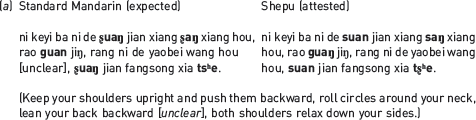

2. Teacher Yuan’s speech

Wu, perhaps self-conscious that some students considered her be uncultured, was particularly fastidious in modulating her voice while leading yoga, speaking in a noticeably slower and softer manner. At the same time, Wu’s yoga Mandarin contained systematic deviations from the Standard. As we can see in example 1a, Wu pronounces “side,” ce (tsʰe), with a retroflex “ch” (tʂʰ). According to my observations, this was a regular change she made every time she said the word ce. By contrast Wu’s pronunciation of “ʂʰ” retroflex did not seem to follow such a systematic pattern, and, similarly, she would interchange velar and alveolar nasals. In example 1b, she actually pronounces a palato-alveolar sibilant (ɕiao) as an alveolar sibilant (siao), which is an even more marked deviation from Standard Mandarin.
While Yuan did in general pronounce her retroflex initials and nasal finals more in line with Standard Mandarin, her pronunciation systematically deviated from Standard Mandarin for certain commonly used words such as “shuang” (ʂuaŋ) (both/pair). In example 2b she says “suan sou,” but it was not uncommon for Yuan to say, “suan shou.”Footnote 25 Although less systematically than Wu, Yuan would on occasion overcorrect, in this case substituting the palatal-alveolar retroflex “tʂ” for the alveolar sibilant “s” in jiaose (role).
Although there are slight observable differences, I would argue that Huang’s singling out of Wu’s yoga Mandarin as noticeably less standard than Yuan’s yoga Mandarin, does not reflect objective difference in the aural phonetic qualities of their speech. Rather, Huang already considered Wu to be a tuhao, and so she looked for signs of unculturedness in Wu’s Mandarin. In this case, Wu’s lack of knowledge of Chinese standard phonology and her Shepu prosody were thus taken to iconically index Wu’s own general coarseness, unculturedness, laziness, and general tuhao-ness. Huang saw Wu as idle and stupid, a woman who was entirely supported through marriage and not through her own talents as a worker.
A straightforward interpretation might be that Huang and the other bureaucrats found it unfair that, despite having more prestigious careers than Wu, they would never be able to afford the material goods that she could. While this is certainly the case, I would argue that the concerns over Wu’s low-quality also reflect a much deeper anxiety. For Huang, yoga is explicitly part of a state project of suzhi-raising, so a yoga teacher so obviously lacking in suzhi is not simply an annoyance; it is a threat to the fundamental purpose of yoga. Wu’s position as a teacher means that she is an authority figure whose role is to raise the quality of other women. By being so low-quality, however, she threatens not only to not raise the quality, but to actively lower the quality of women who study with her and who are attracted to her slim physique and expensive clothes. A tuhao as a yoga teacher actively harms yoga as a civilizing project.
Wu’s contagious tu-ness also threatens the high-quality status of Huang and other bureaucrats, who as aspiring middle-class women in a poor area of rural China are already in a precarious position. Even an indirect association with Wu risks the collapse or erasure of the carefully drawn distinctions made by Huang, Wen, and Lin. Again, I might suggest that the intense negative gossip around Wu in my presence was a performative prophylactic. By pointing out Wu’s clear inferiority, Huang and others were demonstrating to me that they could see a difference between her and them (even if I could not).
What Is the Huizhou Woman?
As an anthropologist, I was in Huangshan primarily to observe rather than to judge, but the fears of Huang and others like her were not unfounded. To Chinese urban elites, the distinction between Huang and Wu may have been unobservable, or (perhaps worse), observable but insignificant. I finish this article by turning to a final vignette which reveals why aspiring middle-class Huangshan women felt such urgency in performing their high-quality.
On a sunny weekday afternoon in mid-February, 2015. Xin, Pan, Li, and I gathered in a coffee shop on the outskirts of Tunxi City, in the Huangshan area of southern Anhui province. Xin and Pan, women in their early twenties, were good friends of mine, and Li was a childhood friend of Xin’s. Li was getting a master degree’s in chemistry in a large city in a different province but was home for winter break. Xin, an elementary school teacher at a village school, was also on winter break, and Pan, who was from Northern Anhui province, was on maternity leave, so all three had time to spend a lazy afternoon chatting over coffee. I had been conducting interviews of women, and Xin recommended I interview Li to get the perspective of a local woman who now lived outside the area. In the noisy coffee shop over green tea lattes I asked Li about her life, her goals, and her views on womanhood in contemporary China.
In terms of the national imagination of Chinese womanhood, Huangshan is not simply any place. The modern region of Huangshan is coterminous with Huizhou, a distinct political, linguistic, and cultural region pre-Republican China. Huizhou was and is closely associated with Neo-Confucian scholarship, and the figure of The Huizhou Woman has been imagined as the ideal neo-Confucian woman: obedient, graceful, and with an endless capacity for self-sacrifice. The Huizhou Woman as a trope of ideal neo-Confucian womanhood was popularized in the 2006 TV series Huizhou Woman (Huizhou nüren), a costume drama that followed the lives of women in a traditional family compound in Qing Dynasty China. In present-day Huangshan, the legacy of the Huizhou Woman is at the center of how local material culture is curated: memorial arches to virtuous widows, destroyed elsewhere in China during various revolutions, have been preserved and are now being collected into “memorial archway parks.” The distinct architecture of local houses is noted for the presence of an upstairs women’s quarters, where women were supposed to spend their days in seclusion from the outside world. “Nüren de shenghuo ku” (Women’s lives were hard) was a common refrain I heard from people in the area when talking about the past or when showing me the local architecture.
In my interviews, then, when I asked the question, “Do today’s Huizhou women have any particular characteristics?” the expected answer based on previous interviews is that women would link themselves, either positively or negatively, to the ideal Chinese femininity imagined of their ancestors. Some women thought that today’s Huizhou women still retained vestiges of neo-Confucian femininity, such as a gentle demeanor. Other women thought that the Huizhou woman no longer existed, replaced instead by the modern Huangshan woman who bore no remarkable characteristics. When I asked this question of Li, however, I got a different response:Footnote 26

Here, we can see in the answer to my question about the modern Huizhou woman (i.e., the Huangshan woman), I get two divergent answers. Xin gives me the expected answer, if we think of the modern Huangshan woman as descended from the ideal neo-Confucian Huizhou woman. Li, however, who lives in urban China and who now sees her hometown through the lens of an urban elite Other, finds today’s Huangshan woman “rustic,” or tu. In other words, while Xin, a local who stayed, is able to see that the Huangshan woman is delicate, a word which describes qualities under the umbrella of “fine,” Li is no longer able to make the distinction between the rustic peasant and the high-quality urban Huangshan woman. In a “fractally recursive” scalar shift, now that Li is familiar with a “real” city, she is no longer able to see her hometown as anything but a rural backwater. Indeed, I would argue that Li’s new “double consciousness” confirms the worst fears of local middle-class women like Xin. It is not that Li cannot actually see the difference between Tunxi urbanites and peasants, it is that she can recognize them but does not see them as significant.Footnote 27
What is important is not simply the answers, but also the phonic qualities of the answers. Xin stretches out and exaggerates the high pitch of “wen,” which in standard Mandarin is a high level tone. Rou in standard Mandarin is rising tone, and Xin’s extra high-pitched wen is then contrasted with a deep fall for the /r/ in rou, which she then gradually brings back up from low to mid tone. Tu is pronounced with the falling then rising contour tone in Standard Mandarin, which is often abbreviated to a low tone in natural speech. Li, unlike Xin, does not exaggerate the contour of tu, but instead pronounces the whole thing as an exaggerated low-tone with a gravelly voice. The second time, after Xin contradicts her with her sonorous reply, Li restates her answer, this time playing up the contrast between their two responses by lowering her tone further and increasing her use of gravelly voice. She also over-aspirates the initial /t/, a voiceless denti-alveolar stop, playing up the plosive quality.
In their responses, we can see that Li and Xin modulate their voices so that the phonic qualities of their words iconically index the answers they give. Li’s low gravelly tone iconically indexes the earthy, rough qualities of the peasant woman. By contrast, Xin’s clear, high-pitched and sonorous wen stands in direct contrast to Li’s tu and iconically indexes the light, clear and feminine qualities of the “delicate” Huizhou woman.
Xin’s answer, however, contrasts with Li’s in another way beyond the iconicity of the phonic qualities. While Xin is an elementary school teacher and is trained in standard Mandarin, she generally speaks with a light local accent and with local tonal prosody when with her friends. In her answer to my question, however, she emphasizes her ability to produce proper standard Mandarin, a shibboleth of being a high-quality citizen as defined by the state the contemporary PRC. In so doing, Xin is also performing her own ability to be a fully modern high-quality woman. Indeed, when Li presses Xin to agree with her that the modern Huangshan woman is rustic, Xin responds, “today there’s already no such thing as a Huizhou women, (we’ve) fundamentally converged with modernity.”Footnote 28 Contradicting her earlier statement that there is such a thing as a modern Huizhou woman, one who (like her ancestors) is delicate, she asserts that the modern Huangshan woman is today completely modern. One interpretation might be that at first she gave the default or expected answer to my earlier question, but when pushed to think about it by Li, she expresses her actual thoughts on the issue.
I would like argue instead that Xin is disputing in a different way Li’s image of the rustic Huangshan women by denying the particular chronotope to which Li imagines the Huangshan woman as belonging. For local Huangshanese, the region’s neo-Confucian heritage links it to a chronotope of China’s high-cultural past. From the birth of neo-Confucian philosophy in the Song dynasty to the end of the Ming dynasty, the Jiangnan region in South-Central China served as the cultural, economic, and political center during a time viewed as a Golden Age of Han Chinese culture. Although the Huizhou Woman belongs to the past, it is an elite and cultured high-quality one.
If she no longer shares a connection to her cultured ancestors in a Golden Age, then the Huangshan woman belongs squarely in a chronotope of the present, “fully converged with modernity” at a time when China is yet again becoming a global superpower. What Xin is rejecting is Li’s placement of the Huizhou woman in a chronotope of the near past. Not affiliated with the golden age of elite Chinese Han culture nor with China’s modern achievements. This woman, Li’s rustic Huangshan woman (like Anhuinese more generally), is a product of China’s rural poverty and linked to a time when China existed as a poor agrarian country.
Li continues to paint a vivid picture of the current Huizhou woman, the “overly earnest” bumpkin who wears pajamas (shuiyi) out of the house, sits about in her old-fashioned and necessarily rural home, and plays mahjong, a game associated with gambling.

This woman clearly belongs to a twentieth-century past, when Huangshan was culturally, economically, and politically marginal.
In The Fame of Gawa Nancy Munn shows how qualia characterize intersubjective spacetime, shaping the temporal rhythms and spatial logics of activities. The house, the garden, and the sea are all thought to have “light” or “heavy” qualities which determine how and when people operate in these spaces. Sleeping, a product of eating, is a “heavy” activity appropriate only in the space of one’s house during night time. To sleep during the day, or in public, is then to embody “heaviness” in a way which negatively transforms value, both by failing to produce food (through productive work) which could be traded to maintain social relations, and also by drawing negative attention to oneself as “lazy.” If we take Munn’s concept of the qualia of spacetime and juxtapose it with a Bakhtinian concept of the chronotope, I argue we can understand what sort of stakes exist for aspiring middle-class women in Huangshan, China. The quality of coarseness, as I have shown, is seen to be embodied by the peasant and manifested cross-semiotically through rough, clumsy or careless behavior, speech, dress, and dark, coarse skin. The quality of coarseness and the figure of the peasant are both imagined to inhabit a chronotope of the recent past, when China was (like the peasant) poor, rural, and unsophisticated. By contrast, for bureaucrats and civil servants like Huang and Xin, the modern Huangshan woman and her ancestor, the Huizhou Woman, embody qualities of fineness, that is, delicateness, sensitivity, carefulness, and meticulousness. Although they are thought to belong to different chronotopes (the neo-Confucian past vs. contemporary China), both figures represent periods when Chinese women had the potential to be of high-quality. And while neo-Confucian and Socialist ideologies or values have frequently been considered antithetical, the two chronotopes parallel each other through their shared qualities: the delicateness of the neo-Confucian woman mirrors the considerate meticulousness of the modern Chinese bureaucrat who attends to the needs of those around her (see fig. 2).
Stated qualities adhering to peasants, tuhao, and high-quality citizens expressed through a schema of coarse-fine opposition.

In urban China, the migrant worker has been the source of media panic over the presence of “low-quality” rural masses taking over urban spaces. If we might see these rural migrants as, to borrow from Mary Douglas ([1966] Reference Douglas2002, 44), “matter out of place,” I argue that in the countryside, the tuhao represents a related but different “matter out of time.” The tuhao appears modern and has access to the material trappings of modernity often unavailable to the high-quality rural citizen, yet she brings with her the qualities of a past educated rural Chinese would prefer to forget. Her danger to the local rural bureaucrat is twofold: by fooling local peasants, she has the potential to derail the rural modernizing project; by fooling wealthy urban elites, she has the potential to contaminate the rural bureaucrat with her coarseness and erase outside recognition of the distinction between the two.



