Every year, the harvests of the Elizabethan countryside were carefully divided in the fields. For every ten sheaves of wheat, nine were removed for the farmer; the tenth was set aside, for the church. That ‘sacred tenth’, the tithe, provided the living for the parish's clergy, and it represented a cornerstone of parish finance. Spiritually significant, the tithe was nevertheless grounded in the more practical and pragmatic aspects of parish life: maintenance, sustenance, and the vagaries of pre-industrial economics. They provided the clerical income necessary to inculcate any type of reformed doctrine, but they were also subject to the socio-economic pressures felt across sixteenth-century England. In Elizabethan England, these pressures were compounded by the continued reliance on pre-Reformation parameters and structures in a rapidly changing world. This intersection of continuity and change produced a system that was simultaneously fundamental to the operation of the church and rife with conflict.
This article will examine the impact of these continuities and changes in the ownership of ecclesiastical property over the course of the Elizabethan period, focusing on the institution of impropriations: lay ownership of ecclesiastical tithes that came with the responsibility for much of the parish maintenance and financial sustenance. In doing so, it will explore fundamental conflicts engendered by a quintessentially Elizabethan confluence of past and present, which so coloured the late sixteenth century. By examining the ways in which the fissures of economic and social stability caused by the Reformation were re-fused and remade, this article will suggest that on both a national and a local scale, the administration of the parishes involved and invested the laity in the preservation of the post-Reformation church. Moreover, they helped not only to sustain the reformed church in England, but also to expand its capabilities at a time of great uncertainty and vulnerability.
The practice of impropriations has been condemned both in contemporary literature and in current historiography. Impropriations were censured, as we shall see, both by centrist and evangelical figures in the Elizabethan church.Footnote 1 As with tithe practice more generally, impropriations were especially singled out by Victorians engaged in debates over tithe reform.Footnote 2 More recent criticism has largely followed that of Christopher Hill, who placed impropriations at the heart of the Economic problems of the church.Footnote 3 As he put it, ‘the economic problems of the church could easily have been solved by the restoration of impropriations’.Footnote 4 Here, Hill argues that impropriated tithes siphoned crucial resources away from the ministry and fundamentally weakened the English church; moreover, Hill describes a church rapidly degenerating in its fabric and foundation as a result of impropriatory greed.
Such an argument must be taken seriously. The ownership of such a vast amount of church property by the laity did have a profound impact on both the economic and social dimensions of the Elizabethan church. To understand this impact fully, however, we must first look at the practical implications of impropriations, as well as the larger ideological and political context of the debates surrounding impropriated tithe reform.
I
The basic mechanics of tithes were not particularly complicated. Tithes were categorized twice, determining both the source and the recipient of the income.Footnote 5 First, tithes were classified as one of three kinds: predial, personal, and mixed tithes. Predial tithes comprised a tenth of the yield from crop-based agriculture and timber or ‘that which doeth arise and growe by reason and virtue of the groundes'.Footnote 6 Personal tithes were due on any income made through manufacture or trade, ‘that which doeth arise and come by means of lawful and honest commoditie obtained and procured by Art, science, & the manual occupation of some person’.Footnote 7 Mixed tithes were to be paid on the yield of agricultural products that had been developed by man, including animal husbandry and its products.Footnote 8 Thus, for example, corn and hay were assessed as predial tithes, income from crafts as personal, and wool and milk as mixed tithes. Tithes were further divided into two classes, great (magnae) and small or lesser (parvae). Great tithes comprised corn, hay, and timber, while lesser tithes were composed of all other predial, personal, and mixed tithes. Generally speaking, the rector of the church received the great tithes, while the vicar received the small tithes.Footnote 9
One can imagine an idealized parish in which this system worked perfectly and rationally. Rural and crop-based, the majority of its economy would be based on grain agriculture, with supplemental agricultural income garnered from milk and cheese, and smaller portions from a few skilled craftspeople and tradesmen. The grain, as a predial and great tithe, would be due to the rector, while a tenth of the dairy products and of the income of the craftspeople would be due to the vicar. The reality, however, was far messier and murkier, complicated by hundreds of exceptions, variations, and local customs, as well as the influences of the sixteenth century's changing economy and rapidly shifting demographics.Footnote 10
The most entrenched difficulties of tithing in Elizabethan England were the legacy of the late medieval and early Reformation church. The pre-Reformation church had an already complicated relationship with the tithe system. In part, this was due to the vagaries of custom and local agricultural patterns; coastal towns relying heavily on fisheries would have had quite a different tithe yield from great grain-growing parishes of the flatlands or the sheep-filled hills in the Peak district.Footnote 11 More structurally important, however, was the impact of religious houses on the economics of the pre-dissolution church.
Monastic estates were themselves generally not tithable. While the Fourth Lateran Council had exempted only certain orders, grants from the king and parliament had generally elided this distinction, with the majority of monastic land excused from tithe payments.Footnote 12 Parishes with land owned by religious houses, therefore, would see significantly smaller rates of tithe payments than those without such exempted land.
Even more importantly, late medieval England saw a growing incidence of parishes appropriated to religious houses. In such cases, the institution itself became the rector of the parish, and thus was entitled to its tithe profits. Rectors served as the administrator of the parish, co-ordinating both its spiritual and practical management. Religious houses held rectories not as individuals but as corporations, collectively serving as rectors for their parish. While responsible for the provision of sacramental and pastoral services, rectors were not accountable for performing the ceremonies themselves. Instead, lay ministers were appointed as the local vicars or curates, receiving a small stipend (and often the small tithes) for their services. In exchange for this provision, the rector received the great tithes of the parish, as well as supplemental income from glebe land, mortuaries, and assorted fees.Footnote 13 Rectors were thus often disconnected from the day-to-day life of the parish, managing and administrating from a distance.Footnote 14
Pre-Reformation corporate rectors were not solely religious houses: church officials, cathedral chapters, the universities, and local clerics also served this role. Monastic houses, however, were notable for the volume and concentration of parochial power that they wielded. Though lay gifts of appropriations were officially forbidden by the Statute of Mortmain in 1279, this law was routinely circumvented by licences granted from the crown throughout the fourteenth and fifteenth centuries.Footnote 15 Religious houses controlled a significant portion of the tithes raised in the pre-Reformation parish; by the late fifteenth century, roughly 37 per cent of parishes were held by religious houses.Footnote 16 This number is made more remarkable by its comparison to the total number of late medieval parochial benefices, which shrank in the face of the Black Death's demographic devastation and longer-term changes in agricultural practices and mobility patterns: while the number of parochial benefices dropped by 7 per cent in the period from 1291 to 1535, the number of appropriations skyrocketed by over 60 per cent.Footnote 17 Such a concentration of economic power was even more pronounced in the most heavily monastic counties, such as Yorkshire, where religious houses held nearly two-thirds of all parishes.Footnote 18
Religious houses thus occupied a special and privileged place in the pre-Reformation ecclesiastical economic landscape. They were exempt from paying tithes in any parish where they might hold land, while also receiving tithed income from those parishes that they claimed by appropriations. Added to the inconsistencies of local custom, these exemptions and appropriations helped create a medieval English tithing system that was byzantine in its particulars.
II
Such convolution and opacity was entrenched by the Reformation. Statutory law of tithes under both the Henrician and Edwardian parliaments privileged continuity over change. In doing so, they ensured that the complications of the medieval system would be cemented in the economics of the English parish. However, while the basic economic structure of tithes became ossified in the post-Reformation church, the institutional basis of tithe ownership had been fundamentally changed by the dissolution. This essential disconnect between pre-Reformation structure and post-Reformation reality created a situation in which the influence of laymen was ever more deeply embedded in the economics of the English church.
From the beginning of the dissolution, statutory law fused medieval tithe rights of religious houses to the rest of monastic property. The rights to appropriated parishes – that is, the rights to collect tithes as the rector of a parish – could be bought and sold like any other piece of the ex-religious estate. Parishes with these lay rectors became known as impropriate parishes, with the lay rectors known as the impropriators. Moreover, tithe exemptions granted to monastic property were granted to this land in perpetuity, long after the monastic houses had been dissolved and the land resold. As the Act for Dissolution of Monasteries and Abbeys put it, ‘every of them, according to their estates and titles, [are] discharged and acquitted of payment of tithes, as freely, and in as large and ample manner as the said . . . ecclesiastical governors and governesses . . . enjoyed the same’.Footnote 19 Thus, the crown was exempt from paying tithes on confiscated land, as were future purchasers or grantees of this land; indeed, the value of ex-religious estates was augmented by these statutes, making grants of monastic estates that much more attractive.Footnote 20
Edwardian statute law largely reinforced the Henrician laws, again exempting ex-religious land from the payment of tithes.Footnote 21 The heart of these laws lay in the past, not in the future. In putting such a keen emphasis on precedent in a time of such rapid change, they allowed for a continuation of customs that may well have amplified political goodwill while forestalling widespread resistance. As we will see, there was significant political resistance to stripping monastic estates of their tithable land, and such a position certainly made sense for the economic interests of the crown. However, these laws also placed unprecedented opportunity for profit in the hands of the owners and farmers of ex-monastic land. With the Elizabethan Settlement relying on Edwardian statute law, the ramifications of these Reformation compromises rang through the sixteenth century.
With the monastic manorial land sales of the dissolution came the selling and reselling of those rectorial tithes that had once been appropriated to the monasteries. The encroachment of the laity into the ownership of tithes – the impropriations – created perhaps the most contentious aspect of Elizabethan ecclesiastical finance. Here too the problems and debates of the Elizabethan church were rooted in the decisions of the early Reformation. The scale of this enterprise was enormous: on the eve of the dissolution, around 3,300 parishes were appropriated to monasteries; by the end of the Elizabethan era, the number of impropriated benefices had reached nearly 3,850.Footnote 22 Thus, a large portion of tithes paid by English parishioners were diverted not to the ministry, or even to the lessees of the clerical property, but directly to members of the laity.
Impropriations became a key line in evangelical critiques of the Elizabethan church. These attacks sprang in large part from practical theological concerns: if funds were leeched away from spiritual livings to engross the coffers of the laity, they argued, these benefices could not attract the quality of minister needed to enact a true Reformation. Many of the most influential evangelical authors of the Elizabethan period wrote furious tracts denouncing impropriations as both corrupting and corruptions. Edward Dering, in a sermon before the queen in 1569, decried impropriations as ‘abominations’ that had ‘defiled’ benefices.Footnote 23 Dudley Fenner warned that if these ‘sacriledges of Abbies’ were not reformed, those who ‘stand with this provision, shal be guilty of the bloude of all them that perish through the defaulte of teaching’.Footnote 24 John Field's Admonition to the parliament demanded that impropriations be removed to reform the church's ‘deformities’.Footnote 25 Anthony Gilby called impropriations ‘wicked’, ‘evil’, and ‘Popishe’.Footnote 26 Arthur Dent painted them as the creations of the ‘filthy villaines’ of religious houses who had ‘devoured all the fat morsels every where’ by getting ‘the church-livings into their hands: they first made impropriations.’Footnote 27 In a 1589 sermon whose vehemence may have forced him to move across the country to Bristol, Norwich's William Burton exclaimed
now many congregations will hardly maintaine one good preacher of the gospel. And no marvail, for then there were too many foolish bees that brought al their hony into the popes hive, and now we have too many drones that sucke all the honey out of the churches hive: nay now we have too many horseleeches, which always crie geve, geve.Footnote 28
A rhetorical success, impropriation reform remained a legislative failure. As early as 1563, speeches in parliament denounced the ill-effects of impropriated livings. The Speaker of the House himself, Thomas Williams, decried abuses of impropriations, arguing that ‘The universities are decayed, and great market towns and others without either school or preacher’, while ‘the poor vicar hath but only £20, and the rest, being no small sum, is impropriate’.Footnote 29 A parliamentary campaign against impropriations continued in some earnest for the first half of Elizabeth's reign. At least three separate bills attempting to reform the impropriation system were drafted in this period: a ‘Bill for reformation of the abuse that cometh by impropriations’ in 1563; ‘Article for an act in parliament, touching Impropriations’ in 1572; and ‘Articles for an act of parliament touching impropriations’ in 1576.Footnote 30 As with most legislation bent on reforming the church in an evangelical or presbyterian manner, none of these bills were passed into law.
Impropriation reforms were also bundled in omnibus evangelical bills. The notoriously presbyterian ‘Bill and Book’ legislation brought by Anthony Cope in 1587, for example, suggested an end to lay control of tithing as part and parcel of the complete dismantling of ‘the Quenes supreme authorytye & government ecclesiastycall’.Footnote 31 Opposition speeches in parliament focused closely on the implications of impropriation reform, especially as couched in such radical legislation. The three speakers marshalled by the crown to contest Cope's bill were a testament to the overwhelming hostility to impropriation reform: Christopher Hatton, lord chancellor, queen's favourite and a religious conservative, whose speech was effectively ghost-written by the arch-orthodox Richard Bancroft; Anthony Mildmay, chancellor of the exchequer and noted evangelical; and Thomas Egerton, solicitor general and frequent prosecutor of recusants.Footnote 32 A short analysis of the rhetoric used in these speeches demonstrates the main impediments to any sort of impropriation reform: a potent entropic combination of economic interests, state power, and religious factionalism.
The overwhelming and obvious obstacle to impropriation reform was the sheer volume of economic interests opposed to reform. Impropriated tithes, like all monastic property, had been sold and resold in the years since the dissolution, long since becoming a cornerstone of family estates and economics.Footnote 33 Furthermore, thousands of people who did not own the tithes were heavily invested in their right to tithes; the prevalence of tithe farmers and rectorial lessees extended the economic influence of these impropriated benefices. Impropriations and their leases were part of a system too entrenched and entangled in the English economy for reform to be considered seriously. Indeed, the last large-scale economic transformation of the country – the dissolution of the monasteries – had succeeded politically in large part due to the very same propertied interests challenged by reform. Not even Queen Mary, who was less than overly politic in matters of religion, had seriously ventured to annex former monastic property.Footnote 34 As Hatton argued in his speech, those who sought to increase clerical salaries by revoking impropriated tithes undermined the estates of many in the political class: ‘for the enrichinge of them selves, they labor . . . to impoverishe us’.Footnote 35 The connection of economic interest and opposition to reform was not unique to Hatton. Some dozen years earlier, when trying to explain lack of progress in increasing clerical salaries, John Whitgift had written ‘That this was a certain and sure principle, that the temporality would not lose one jot of their commodity in any respect, to better the livings of the church.’Footnote 36
Both lay and ecclesiastical investment in impropriations was so significant as to render any scheme of elimination untenable. In addition to extensive holdings by the crown and by members of gentry, rectorial tithes were held in great number by the episcopate itself; the see of York, for instance, collected over a quarter of its income from rectories in the beginning of Elizabeth's reign.Footnote 37 Such a proportion had only increased following the laws of 1 Eliz. c. 19, which had allowed the crown to exchange its own rectorial holdings for any episcopal estates held by a unoccupied see.Footnote 38
John Bridges, dean of Salisbury and stalwart defender of Elizabethan orthodoxy, answered the presbyterian call for an end of impropriations, arguing that the end of impropriations would threaten the economic security of both church and secular society:
Wherby not onely Bishoprikes, Colleges, Cathedrall churches, and Hospitalles, but all the estates, even the highest and all in civill policy (under pretence of reforming the Church and dividing the Church livings) might be called in the compasse of this newe division . . . therefore the devise of this division may not be attempted, without the incurring greater inconvenience than our brethren would shun.Footnote 39
To supplement the income of the parochial ministry, many of the most powerful lay and clerical officials would suffer deep financial injury.
The economic arguments against impropriations reform did not, however, rest entirely on personal interest. Opponents argued that larger issues were at stake, including a burgeoning sense of property rights and the larger security of the state. When Hatton told parliament that impropriation reform ‘toucheth our inheritances’, he was pointing not simply to individual economies but to the larger tenets of property law.Footnote 40 Proposals to seize tithable income were, at their heart, a radical restructuring of property. Such restructuring, some argued, was entirely illegitimate. As Bridges wrote of these proposals, ‘which to be done without the owners good willes, that peradventure also bought it with their money, or by exchange with the Prince for other lands, by what title should we terme this restoring?’Footnote 41
All three speakers pointed also to the crippling effect that such reforms would have on the crown. Egerton noted that the proposal meant ‘The Quenes revenues … shall be decayed and taken from hir.’Footnote 42 Hatton argued that ‘her majesties strength stendeth very much upon her revenues . . . Now what a losse . . . if as hath beene said, all her impropriations shuld be taken from her.’Footnote 43 The stakes for undermining the state were enormous and pressing, especially from an international context: fears of Catholic plots were rising across the country; Mary, Queen of Scots, had been executed not a month earlier; and the worry over the threat posed by the Spanish was quickly building. Undermining the crown at such a crucial juncture was self-destructive. After all, as Mildmay plainly put it, ‘we live here under a Christian Princess’.Footnote 44 Impropriation reform, he argued, would cause an erosion of state economic power that could ultimately backfire; those who disliked the rule of Elizabeth certainly would like the rule of a Catholic monarch far less. This may have been baldly cynical, xenophobic rhetoric, but in the context of a sharpening international political crisis, it remained compelling logic.
The final nail in the coffin of impropriation reform was its fundamental association with radical religion. An awareness of the weaknesses of the Elizabethan church was widespread – after all, even such stalwarts as Whitgift himself had bemoaned the deleterious effects of impropriated tithes – but, as anti-reformists argued, reclamation of impropriations was merely part of a larger project of radical reform. Presbyterians of the 1570s had been explicit about just such a connection. Field's Admonition sought the elimination of impropriations in order to free parishes to choose their own minister: ‘Your wisedomes have to remove Advousons, Patronages, Impropriations, and Bishops authoritie . . . and to bring in that old and true election, whiche was accustomed to bee made by the congregation.’Footnote 45 This connection tainted all proposals for impropriation reform, at least in the eyes of episcopal defenders like John Whitgift. Whitgift was deeply suspicious of calls for tithe reform, which he thought cloaked the truly destructive intent of its presbyterian backers. Though he felt that impropriated tithes encouraged some abuses, he thought the status quo a necessary evil: ‘And therefore his judgment was, to keep that they had; for better they should not be; they might be worse; and that he thought by many was intended.’Footnote 46
As time went on, Whitgift became even more explicit in his condemnation of these proposals. As he put it, ‘he feared, lest under the pretence of reforming the one, the dissolution and utter undoing of all the other would be sought for’. Which, he added, would be ‘the ruin of the Church at last, the fall of religion, and the decay of learning.’Footnote 47 It is tempting to think of this as merely a rhetorical device to protect vested economic interests, but the actions of the religious radicals themselves confirmed Whitgift's suspicions. By centring impropriation reform in virulently anti-episcopal legislation like the Bill and Book, they ensured that even potentially sympathetic evangelicals like Mildmay would reject any overhaul of the system.
Complaints against impropriations were not new; they echoed complaints against monastic appropriations made decades before dissolution.Footnote 48 And yet, as the debate around Cope's bill makes clear, the stakes of this debate were higher and more sharply defined in the Elizabethan church than in pre-Reformation years. Both supporters and opponents of impropriation reform argued that they were trying to preserve and protect the Protestant church in England. For the reformers, impropriations stood in the way of a learned and pure church, impoverishing the ministry and undermining the development of a purer church in England. Anti-reformers, while often conceding the faults of the Elizabethan ministry, argued that impropriations were part of the larger hierarchy of social and religious order; attempts at further reform, they argued, were part and parcel of a dangerous radicalism that threatened the security of the church and of England itself. Here again, then, the Elizabethan attempts to enforce continuities with the early Reformation came into conflict with attempts to finish a ‘half-started’ Reformation.
III
In the Elizabethan parish, then, impropriations remained a way of life. On the whole, the basic economic complaints of the evangelicals were warranted. To be certain, from the time of the dissolution vicarages had been generally worth less than rectories, with the stripping of the great tithes having a significant financial impact. Jeremy Collier's summary of the Henrician valuation of church property, the 1534 Valor Ecclesiasticus, gives a useful overview of the situation at the end of the period of monastic appropriations.Footnote 49 Of the 8,803 parishes, around two-thirds were rectories and a third vicarages. Vicarages made up a disproportionate percentage of the poorest parishes, with around 42 per cent valued at under £10.Footnote 50 More moderate parishes – those worth between £10 and £20 – were represented almost exactly proportionally. The wealthiest parishes, however, were almost exclusively rectories: rectories composed 76 per cent of rectories worth between £30 and £40, and 80 per cent of those worth over £40.Footnote 51 It is difficult to make iron conclusions based on these figures; as Christopher Hill notes, the Valor does not take into account clerical tithe leases (resulting in diminished returns) or pluralities.Footnote 52 Nor do these valuations account for ways in which pre-Reformation clerical income could be supplemented, such as fees for sacramental services.Footnote 53 Nevertheless, it is clear that appropriated benefices were, on the whole, less valuable livings for their clerical incumbents.
Tracing the values of benefices into the Elizabethan period is difficult and inexact. Though reports were commissioned on the wealth of high ecclesiastical officials, no survey equivalent to the Valor was made during Elizabeth's reign.Footnote 54 Indeed, the Valor remained the basis for many valuations well after changes in agricultural practice, ecclesiastical structure, and inflation rendered its sums useless. For example, a valuation of the diocese of Norwich commissioned in the 1580s is, upon closer inspection, identical to the valuations made a half-century earlier.Footnote 55 Though it is tempting to use larger surveys of ecclesiastical livings, like ones conducted by godly ministers in 1586, these present their own problems.Footnote 56 Leaving aside the political biases of the authors, who were apt to judge their fellow ministers harshly, there seemed to be a general state of ignorance, or at least confusion, about the worth of benefices; as the Berkshire ministers wrote, ‘The valew of each of the benefices before named from the beginning maye be other wise, for in this behalf we have nothing but by conjecture.’Footnote 57 Nevertheless, some general observations can be sketched. The economic disparity of rectories and vicarages generally continued into the Elizabethan period, and may indeed have grown slightly; while the value of the livings, on the whole, matched or exceeded the rapid inflation of the sixteenth century, vicarages’ worth generally grew at a slower rate on average than did that of rectories.Footnote 58 Importantly, though, those benefices poorer in the Elizabethan church were also those that had been poorer in the pre-Reformation years. The Elizabethan church did not so much see an expansion of clerical poverty as an entrenchment of earlier economic realities.Footnote 59
The image of a grasping laity happy to gut their impropriated benefices of desperately needed funds runs throughout evangelical literature, as we have seen. This trope has been picked up by modern historians, especially those who relied most heavily on printed and pamphlet literature. This is, of course, most true in the case of Christopher Hill, whose magisterial work on ecclesiastical finance features relatively little in the way of actual archival economic evaluation. Despite this, the power of Hill's analysis has successfully dominated the literature of the past fifty years. However, in order to understand fully the relationship between rector and church, we must turn away from the pamphlets and towards the lived reality of the Elizabethan parish.
The most visible sign of rectorial influence on the parish lay in the upkeep of the chancel, the area of the church once considered most holy and thus funded by the great tithes of the church. With the advent of the reformed services and a new focus, in many parishes, on a communion table in the nave of the church, the relative spiritual and ceremonial significance of the chancel had declined; nevertheless, like so much of Elizabethan ecclesiastical property law, the pre-Reformation traditions stood, and the liability for chancel upkeep remained the responsibility of the rector.Footnote 60 If in reality lay impropriators were roundly neglecting their ecclesiastical responsibilities, one would expect chancels to be largely dilapidated, especially in areas such as Yorkshire where impropriated benefices were plentiful.
At first glance, this is indeed the situation. Every visitation includes entries that bespeak wholesale neglect of church fabric by the rectors. The churchwardens of Kirkby Moorside in Yorkshire complained in 1575 that ‘the chauncell is in great ruyne and decaye (and hath bene so these vij yeres) both in the walles, glasse wyndowes and leades thereof; and it hath bene often compleyned upon and no redresse had’.Footnote 61 The same visitation found the parish church of Adwicke-by-the-Street with ‘their chauncell and high quere . . . In ruyne and decaie (the Queene's Majestie beinge patronne) so that devine service cannot be said in it, nor the Communion ther ministred for daunger of falling downe upon their heads.’Footnote 62 Sparham had a chancel so decayed in 1578 that ‘reyne come in’.Footnote 63 The chancel of Thirling in Norfolk was described as being ‘in verie great decaie of the Roffe and glazing and als the seats therin are decayed, so that yt lyeth like a dowehouse’Footnote 64 It is clear that some churches suffered greatly from the negligence of their rectors. Compelled to come to church, parishioners would have to sit in churches without windows, with crumbling walls, subject to the whims of wind and rain and even the occasional bird.
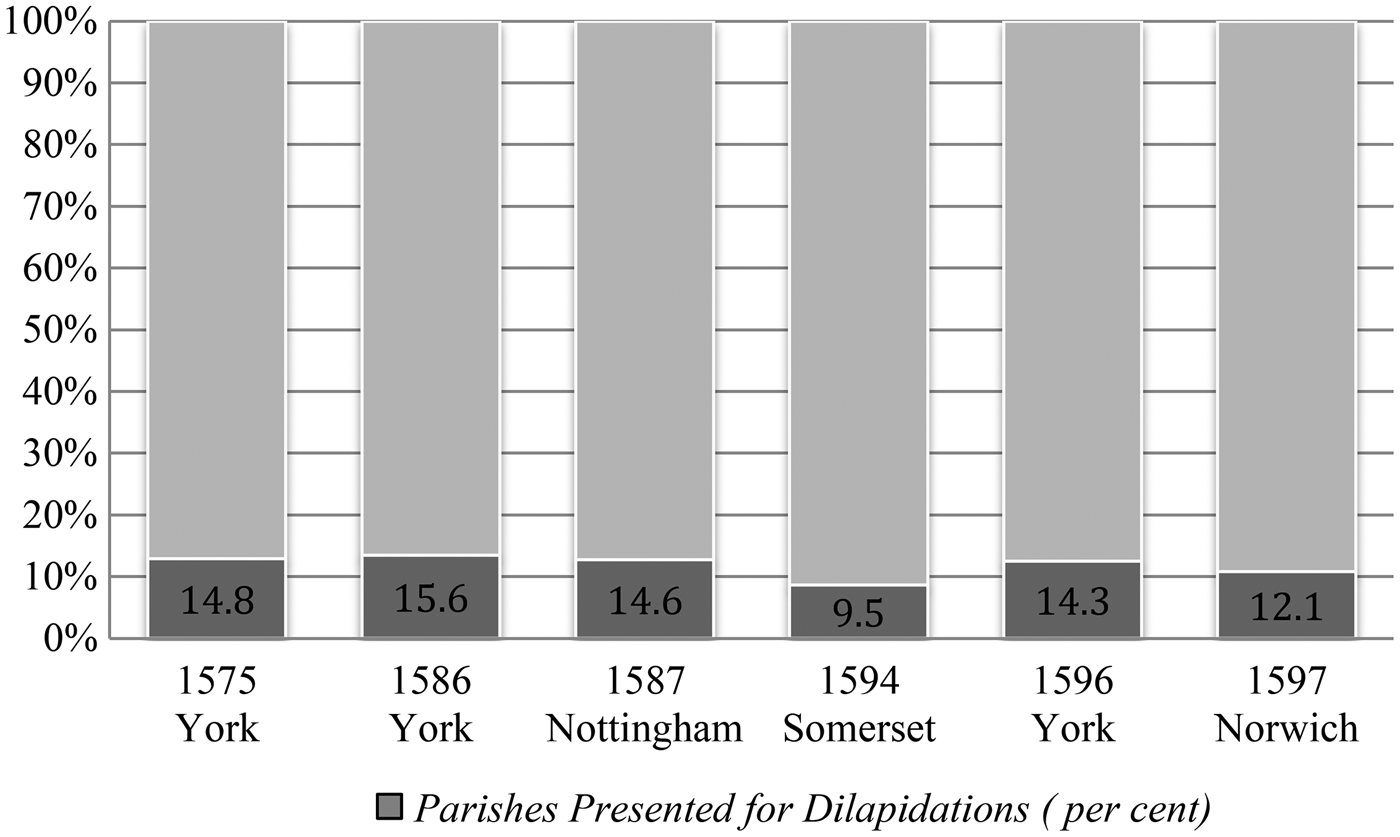
And yet, to a remarkable degree, lay impropriators provided for the material needs of their parishes. Taking a more comprehensive view, the picture is far less extreme than anecdotal evidence implies. Of the 506 parishes and chapelries reporting in Archbishop Grindal's 1575 visitation of the province of York, only 14·8 per cent presented their chancels in any sort of decay.Footnote 65 In the archdeaconry of Nottingham, 14·6 per cent of churchwardens' presentments from 1587 report dilapidated chancels.Footnote 66 The 1594 visitation of Somerset yielded 9·5 per cent of parishes reported for chancel decay.Footnote 67 In 1597, the episcopal visitation of Norwich saw similar rates of repair, with only 12·1 per cent of the 987 parishes recording chancels in decay.Footnote 68
Presentations and visitation records, of course, present methodological problems. It has long been acknowledged that churchwardens may have sought to avoid local tensions or the involvement of church courts in disputes by under-reporting faults, often replying simply ‘omnia bene’.Footnote 69 And yet, despite the potential for such deliberate obfuscation, there is reason to believe that the number of chancels presented for dilapidations approximated reality. Concern about church dilapidations – driven in part by the vocal critics of impropriations – led Elizabeth in 1602 to commission an official report on the state of the church fabric. The results cleave closely to the rates of dilapidation presentations in the ecclesiastical courts. In the archdeaconry of Lincoln, for example, 511 extant churches and chapels were examined. Of these, 9·4 per cent had default in chancel but not in church and 5·1 per cent default in both; in all, just 14·5 per cent of extant parish churches had decayed, dilapidated, or disarrayed chancels.Footnote 70 Such a figure maps closely onto the presentments from York, Norwich, and Somerset. Thus, while the visitation records must be read with a degree of caution, they can provide a roughly reliable survey of the state of Elizabethan chancel dilapidation.
The relative rate of chancel dilapidation remained strikingly stable in the last thirty years of Elizabeth's reign. In the archdeaconry of Cleveland, a reasonable sample of Yorkshire parishes, the rate of presentment remained relatively steady throughout the Elizabethan period: 15 presentments were made in 1578; 13 in 1590; 9 in 1595; and 12 in 1600.Footnote 71 Larger surveys of Yorkshire, although spottier in their archival survival, point to a similar steadiness. J. R. Purvis's analysis of Yorkshire visitations shows a dilapidation rate of 15·6 per cent in 1586 and 14·3 per cent in 1594 (Figure 1).Footnote 72
Visitation chancel dilapidation presentments.

Even these relatively low rates of disrepair can be qualified. Visitations reported various levels of decay, from the ruinous examples given earlier to far more mundane presentments for minor dilapidations. These less serious dilapidations are often presented generically: ‘in some decay’ or ‘a little decayed’. In other entries, though, the disrepair is more specific. Presentments were made because the chancel was ‘in some lytle decay in the tyles’ or ‘not decently whited’; in other cases it was the pavement that was ‘a little decayed’.Footnote 73 Of particular trouble were the windows, constantly broken by the wind or by storms; dozens of chancels were presented for ‘want of glasinge’ or windows ‘slightly in decay’.Footnote 74
While it would be unwise to read too closely into the descriptions of chancel dilapidations given in visitations – most of which simply record the chancel as ‘decayed’ – it is possible to get a rough sense of the relative severity of their decay. While many presentments are generic, the most dire are often qualified as being in ‘great decay’ or as ‘ruinous’. As a whole, cases of severe neglect are quite rare. Of those Cleveland chancels reported in 1575 as decayed, for example, only five are listed in great decay: a mere 3·8 per cent of all parishes.Footnote 75 In the archdeaconry of Norwich, only thirteen parishes are presented for ruinous chancels, or 4·9 per cent of all parishes.Footnote 76
The kind of grasping greed bemoaned by godly ministers and contemporary historians alike was certainly present in the Elizabethan impropriator. Nevertheless, rectors seem relatively responsive to church maintenance. While some chancels were left in neglect over the course of a long period of time, most were fixed by the time of the next visitation. The deanery of Sparham in Norfolk illustrates this case nicely. In the episcopal visitation of 1593, five parishes were reported for chancel dilapidations. Of these, three were minor: Foulsham was ‘not sufficiently repaired’, Sparham's chancel windows ‘want some glasinge’, and Little Witchingham was simply listed as having decayed windows. Two, though, were in far worse repair, with Wood Norton described as ‘verie ruinous’ and Thurning as in ‘very great decay’.Footnote 77 Four years later, in the next episcopal visitation, only one of the presentments was repeated. Thurning was reported, ironically enough, for the mess created by construction: ‘The Chauncell is very undecent within both for want of whiteinge and also filthye with durte & stones ever since it was mended.’Footnote 78 The cold whipping winds of north Norfolk worked their worst on the deanery of Sparham, and in the 1603 archdeaconal visitation, four of the six chancels presented had appeared in the books at some point over the previous decade. On the surface, it looks like neglect; upon closer inspection, it was more probably the grinding reality of maintaining public buildings. Of these four, only one, the parish church of Brandiston, seems to have been the result of an unfixed earlier presentment. In contrast, the parish of Haveringland had their 1597 presentment dismissed upon proof of window repair; six years later, the windows had broken once again.Footnote 79
Indeed, proof of repair is often noted in act books and presentations. The parish of Haifax presented that ‘the churche and chauncell ar somethinge in decaie, but ar begonne to be furnished’.Footnote 80 In Farnham, Cheshire, the visitation commented that ‘the chauncell is somewhat decaied but preparacion is made for repair of it’.Footnote 81 The report made by the parishioners of Bythchfeld, Lincoln, indicated that ‘by order taken with the parishioners and with Mr Wymberley my l. Bushopp of Lincoln his farmer of the parsonage a speedie repayre wylbe had, the same beinge alredy in hand’.Footnote 82 Though the chancel in Hillfarrance needed its tiles repaired, the visitation book noted that the fault ‘through the late tempestuous weather wants covering, but they say it shall be repaired forthwith’.Footnote 83
Such repair could be quite expensive. As the rector of Great Ryburgh, Norfolk, testified, ‘I have also glased at myne owne proper cost & chardge all the windowes in the Chauncell. Which ar in noomber v & those verie large & greate, which did coste mee with the scripture written within the seid Chauncells walles more than xx li.’Footnote 84 Leonard Pilkington, parson of Middleton-in-Teesdale, Durham, petitioned the crown for building supplies to supplement his own expenses laid out to repair the ‘chancell off that kyrke, which cost me at the poynte off 40 l at one tyme’.Footnote 85 Indeed, in cases where chancels were deeply decayed, the cost of reconstruction could outstrip the profits yielded by the benefice. A precise accounting of the proportional cost of such renovations is again hampered by a lack of accurate Elizabethan valuations. Extrapolating from the puritan survey of Cornwall parishes, though, we can estimate a rough median annual value of around £40, before any deductions for subsidies, fees, or stipends for curates, visiting lecturers, or (in the case of impropriate rectories) vicars.Footnote 86 Imagining such costs as running roughly at a minimum of one third of a parish's value, the net profit can be estimated at a very approximate median of £25 per annum. Thus, natural disasters or the neglect of previous rectors could lead to costs totalling several years' rent.
Even the regular upkeep of a chancel reduced the net profit of the rectory. The experience of the churchwardens, responsible for the upkeep of the non-rectorial church fabric, is instructive. Keeping the church roof free from leaks was an expensive business, and annual repairs had to be made to prevent serious damage. Few years went by in any well-maintained parish without some payment for tiles, lead, solder, or payments to the ‘plummer’ for his work on the church or other parish buildings. The roof of St. Michael in Bedwardine, for instance, was retiled in 1559, 1566, 1571, 1580, 1584, 1590, 1594, and 1598.Footnote 87 In the parish of Prescot, Lancashire, wardens recorded payments for roof repair or roofing supplies for all but six years of Elizabeth's reign.Footnote 88 Rectors not wishing to incur summonses before church courts or the extensive expenses of repairing ruins would have had to undertake similar repairs on the chancel.
None of this is to say that chancel disrepair was not a real problem for the Elizabethan church. An emphasis on enforcing the impropriators' responsibility towards parochial upkeep remained a priority for the ecclesiastical visitations. Visitation articles routinely enquired ‘whether the chauncell . . . be in good reparacions’, the results of which inquiries can be found in the aforementioned presentations.Footnote 89
IV
As noted above, chancels could be decayed to the point of danger for the congregation; even in places with far less damage, a deteriorated chancel was hardly a symbol of the kind of devotion hoped for by English reformers. And there were indeed cases of serious neglect, such as in the coastal parish of Owthorne in the East Riding, which was presented in 1567 for decay; 1591 for decay; 1596 ‘utter ruin and decay, like to fall and endanger the body of the church’; and 1600, again for decay.Footnote 90 The survey of churches commissioned by Elizabeth were in part a reflection of real problems in areas of the country.
Such examples were, however, the exception rather than the rule. That the contemporary literature does not reflect the relative rarity of such decay must be due at least in part to the potency of the anecdotes of utter neglect.Footnote 91 The relative rate of repair, however, undermines the historiographical depiction of impropriate rectors as fundamentally damaging to the health of the Elizabethan church. That paying rectorial tithes directly to the ministry would bolster the economic state of the clergy is manifest; while godly complaints of clerical poverty were perhaps overstated, the extra income would certainly have made ministry a more remunerative profession. However, what undermined clerical capital may in fact have bolstered the security of the church more generally. The gentry, nobility, crown, episcopate, and all others involved in the leasing and farming of church property had an investment in the Elizabethan church, both literally and, to an increasing extent, figuratively.
Such an involvement has long been recognized by cultural historians, who point to monuments and church iconography as evidence of construction of a godly lay identity flourishing by the later Elizabethan period.Footnote 92 What is largely missing from the historiography of Elizabethan church finance is an understanding that impropriations were also a mechanism that tied the better sort to the welfare of the parish. Just as the sale of monastic property had put a serious dent in the re-Catholicization of England under Queen Mary, the continuance of impropriation rights under Elizabeth helped to cement a relationship between economic and religious interests.
However, if the value of impropriate rectories were merely in their rents – if this were merely a matter of gross self-interest – we might expect a far higher degree of dilapidation than the records actually reflect. That the rate of dilapidation was so low, especially in the face of the real expense that repairs required, indicates that greed was held in check either by internal or external compulsion.
Internally, rectors could be motivated by their own religious impulses. Impropriated benefices, with their concomitant control of clerical purse-strings, were particularly attractive to those wishing to shape benefices according to their proclivities. In some cases, rectorial tithes were sought precisely to advance the impropriators' personal religious interests. The notably evangelical Henry Hastings, fifth earl of Huntingdon, took a twenty-one-year lease of Whitby's rectory for precisely such a purpose: the lease was made ‘to the intent that a godlye learned and sufficiente preacher may continue to be there resydente duringe the tyme and terme aforesayde’.Footnote 93 Though ideologically opposed to impropriated benefices, many godly patrons saw no need to cut off their noses to spite their faces; they too would take impropriated rectories, if only to prevent them falling into the hands of less assiduous patrons.
How much impropriations affected the quality of the clergy remains a matter of debate. To be sure, livings in vicarages tended on the whole to be poorer than in rectories, but as Michael Zell points out, there was extensive local variation; in addition, the poorest livings by the late Elizabethan period tended to have been the poorest livings in the pre-Reformation, undermining the notion that lay impropriators were somehow more deleterious to the parish clergy than monastic rectors had been.Footnote 94 It should be noted that impropriators' efforts to squeeze money from parishes by appointing sub-par clergy on the cheap would have been stymied at least in part by the increase in licensing qualifications and examinations for ministers.Footnote 95 Moreover, this income formed only a portion of the total clerical living. Glebe land, ceremonial fees, and occasional supplementary stipends voted by the churchwardens or vestry could all augment otherwise low incomes.Footnote 96 Thus, even in impropriated parishes held by less than assiduous laity, clerical support and the overall quality of the clergy could be mitigated by outside sources of income.
Externally, the expansion of the visitation system, with its increased regularity, organization, and diligence, resulted in lay impropriators held in greater accountability by the state church. Failure to repair the chancel would bring one into the orbit of the ecclesiastical courts, with all their attendant costs, inconvenience, and power of moral discipline.Footnote 97 If the property rights to a rectory were transferred by sale or by death, the new rector could sue for the costs of any dilapidations, as well as for the court fees engendered by the suit.Footnote 98 Moreover, even if one did not own a rectory oneself, good stewardship of the parish might have economic ramifications. The rights to continue to lease or farm a rectory could be influenced by the evidence of fabric care taken under previous leases. The lessees of the parsonage of Astonfield, Staffordshire, for example, requested a renewal of their lease based partly upon the ‘great sums of money lately expended by them in repair of the chancel’.Footnote 99 Upkeep of a chancel and relative care for a parish's incumbent could help to ensure the continuance of profitable leases. Thus, the economic and institutional consequences for dilapidations tempered the wisdom of squeezing all possible profit from a rectory.
Impropriations may have stood in the way of a fully reformed church. The diversion of income from the preaching ministry remained the core complaint of the evangelical pamphleteers throughout the Elizabethan period. And yet the system of impropriated tithes tied together the fortunes of the church and the landed laity. That such economic interest may have fortified support for the church is recognized.Footnote 100 But the extent to which the practical responsibilities of these lay rectors were taken seriously has been vastly undervalued. Some certainly did exploit the system of impropriations for their economic gain and did so at the expense of the parish. The great majority, however, remained largely diligent in their maintenance of church fabric. Fighting a constant battle against the depredations of nature and the decay of ancient buildings, these lay rectors provided for the physical needs of their churches to a remarkable level. Thus, the continuities of rectorial tithing preserved by the Elizabethan church and state allowed for an ever-deeper weaving of the English church and the wealthier segments of the laity, both on a macroeconomic and a minutely practical scale.
V
Despite the gloomy reports of the tract writers and the equally gloomy perspective of modern historiography, the economic realities of the Elizabethan church were far from a disaster. To be sure, there were real problems: an underfunded ministry, a lack of clerical control of ecclesiastical income, and in some places serious material dilapidations. On the whole, though, the church coped rather well. If underfunded, the ministry was nevertheless of a far higher standard than in pre-Reformation years; if the clergy lacked control of finances, the vast majority of lay impropriators fulfilled the basic duties they were assigned; if dilapidations occurred, they were for the most part fixed quickly and effectively through the combined effort of rector and parish. There was much to be admonished and much to be disparaged, but these problems were both acknowledged and managed. That the church failed to live up to the expectations of its puritan critics is far from a surprise, and modern historians must ask themselves to what standard they are holding the Elizabethan parish. If the parish was far from ideal, it was also far from broken.Footnote 101
Many of the struggles the Elizabethan church faced were a long-standing legacy of the early Reformation. Compromises made in the first tumultuous decades of religious change fundamentally shaped the parameters of the late sixteenth century. This was true practically as much as spiritually. The political and economic decision to transfer tithe rights from religious houses to the impropriators reworked structures of power, placing much of the responsibility for the church's economic security on the laity. And while the reliance on custom and the continuation of pre-Reformation tithe exemptions may have promoted stability in the short term, it set the stage for extensive conflict in the long term.
Although the Elizabethan church maintained the policies of previous Reformation regimes, such continuity should not imply consensus. Impropriations, for example, were widely contested both in print and in parliament. Paradoxically, however, it was often this very contention that led to the cementing of the status quo. Desperate to avoid instability that could threaten both the crown and the church, ecclesiastical officials and the queen herself routinely rejected calls for economic reform. Whether these efforts might have been more successful if not tied to more radical rhetoric is questionable; a host of other interests, including the economic interests of many members of parliament, were closely aligned with a continuation of these compromises. Nevertheless, the connection between reform and radicalism left such proposals dead in the water. Fears of a weakening government meant that this continuity was actually the product of conflict, not of consensus.
The economic realities of the parish were subject to the same pressures and tensions as the rest of Elizabethan economic life. New strains were placed on the laity by rapid inflation, a demographic explosion, and a shifting economy. Many of the realities decried by the tract writers were part and parcel of these larger patterns. The growing social stratification, fuelled at least in part by the shifts in the property market caused by the reallocation of ex-religious land, could engender significant conflict in the parish. Nevertheless, these shifts also stimulated support for the church. Local elites, eager to manifest their social status, opened their pocketbooks to the parish. Nor was this phenomenon limited to the better sort: the church was an expression of the community, and those who paid its penny rates felt as much entitled to its primary spiritual and communal benefits as those sitting in the box pews. The Elizabethan church could be the site of harsh social hierarchy and moral condemnation, but it also served as a great equalizer. Rich men may have sat in a finer seat, but all heard the same sermon.
The economic life of the Elizabethan parish demonstrates the increasingly important role played by the laity in the post-Reformation English church. Large swathes of ecclesiastical property were maintained, administrated, and supported by the laity. Both conflict and community tied the laity closer to the inner workings of the church: from the consistory court to the accounting ale, parishioners had an expanded accountability and responsibility for its conservation. In turn, this gave the laity greater stake and agency in the church. Again, however, it must be noted that this was a process of laicization and not secularization. The context and the expectations for lay participation in the church were essentially religious: those gathering to collect the church rate were engaging in a new iteration of late medieval communal piety; tithe payments, whether made to layman or vicar, still financed the ministry and the upkeep of the chancel. Participation may have been compulsory, but in its practice the laity were drawn closer to the church than ever before.
At its core, the Elizabethan church was in relatively good repair. The destruction and iconoclasm of the mid-sixteenth century – a pattern certainly present in the early years following the Settlement – gave way to a programme of repair that was at once unglamorous and fundamental to the health of the church. In the space opened up by the Reformation's rents in the social and physical fabric of the parish, new bonds between church, state, and society were knit. For if the Reformation was destructive, it left in its wake huge opportunities for development, expansion, and a new kind of creation. In the end, it is to the small moments that we must turn: the deposition in a bundle of cause papers, the broken window on a north Norfolk coast, logs hauled across the Yorkshire moors. It is, in many ways, the creation of precedent, of everyday patterns of life and living, in which we can find the real shape of religious change: in the mundane and in the ordinary we see the processes of historical change at work.