INTRODUCTION
The genus Hirsutonuphis was erected by Paxton (Reference Paxton1986), in the subfamily Onuphinae, as part of one of the most important generic revisions of the taxonomy and relationships of the family Onuphidae. In addition, she established that Hirsutonuphis is the only genus in the Onuphidae where the maxillary carriers are of diagnostic importance. Paxton (Reference Paxton1986) included in this genus the onuphids with modified parapodia with long dorsal cirri, giving them a ‘hairy’ appearance. This, combined with the name Onuphis, the first genus described in this family, provided the name for the newly erected genus. Initially, five species were included in the genus Hirsutonuphis: four from the Pacific Ocean (Onuphis zebra Berkeley & Berkeley, Reference Berkeley and Berkeley1939 and Onuphis acapulcensis Rioja, Reference Rioja1944 from the Mexican Pacific; Onuphis gygis Paxton, Reference Paxton1979 and Onuphis mariahirsuta Paxton, Reference Paxton1979 from Australia), and only one species from the Atlantic Ocean, in Belize: Onuphis geminata Fauchald, Reference Fauchald1980. Subsequently, Paxton (Reference Paxton1996) described three new species from Australian waters: Hirsutonuphis armillata, H. intermedia and H. macrocerata, thus increasing the presently recognized species in the genus to eight.
The members of the family Onuphidae have been reported from all the seas of the world and at all depths (Paxton, Reference Paxton1986); however, it seems that the species of Hirsutonuphis mainly occur in the Pacific Ocean. In fact, the two species recorded from the Eastern Tropical Pacific were collected in Mexican waters: H. zebra is from Punta Gorda, Baja California, and H. acapulcensis is from Acapulco, Guerrero. Recently, in the course of a revision of biological material collected on the continental shelf of the Gulf of California, we found specimens belonging to the genus Hirsutonuphis, which had evident morphological differences, not only from the species recorded in the Mexican Pacific, but also from all the species so far described.
Therefore, the aim of this study is to describe this new species of Hirsutonuphis from the Mexican Pacific, to provide a taxonomic key to all species of the genus, and to discuss the particularities of the known world distribution of the genus.
MATERIALS AND METHODS
The polychaete specimens analysed here were collected on the continental shelf of the Gulf of California, on-board the RV ‘El Puma’ from the Instituto de Ciencias del Mar y Limnología (ICMyL), Universidad Nacional Autónoma de México (UNAM), during the oceanographic expedition ‘Cortés 2’ of March 1985. The samples were collected with a Smith–McIntyre grab (0.1 m2), and the geographical position of the stations was determined by Global Positioning System (GPS). The polychaetes were fixed in 4% formaldehyde and preserved in ethanol 70%. Scanning electron microscope (SEM) photographs of important diagnostic characters of the species were taken with JEOL JSM6360LV equipment, following standard methodology.
Paxton (Reference Paxton1986) standardized the nomenclature of the morphological characters used until then under different names. To describe the new species, we used her terminology complemented, when appropriate, with her own additions of a later study (Paxton, Reference Paxton1998) and those of Budaeva & Fauchald (Reference Budaeva and Fauchald2011). The numbers and measurements annotated in the description correspond to the holotype, but variations found in the paratypes are also included; the total length of the specimens (without antennae), the length of the antennae and palps, and the body width (without parapodia or chaetae) at chaetiger 10, were measured.
The holotype and paratypes are deposited in the National Polychaete Collection located at the Instituto de Ciencias del Mar y Limnología (ICMyL), Universidad Nacional Autónoma de México (UNAM) (CNP-ICML, UNAM; DFE.IN.061.0598), and at the Los Angeles County Museum of Natural History (LACM-AHF POLY), USA.
SYSTEMATICS
Phylum ANNELIDA Lamarck, 1809
Family ONUPHIDAE Kinberg, 1865
Subfamily ONUPHINAE Kinberg, 1865
Genus Hirsutonuphis Paxton, Reference Paxton1986
Hirsutonuphis paxtonae sp. nov.
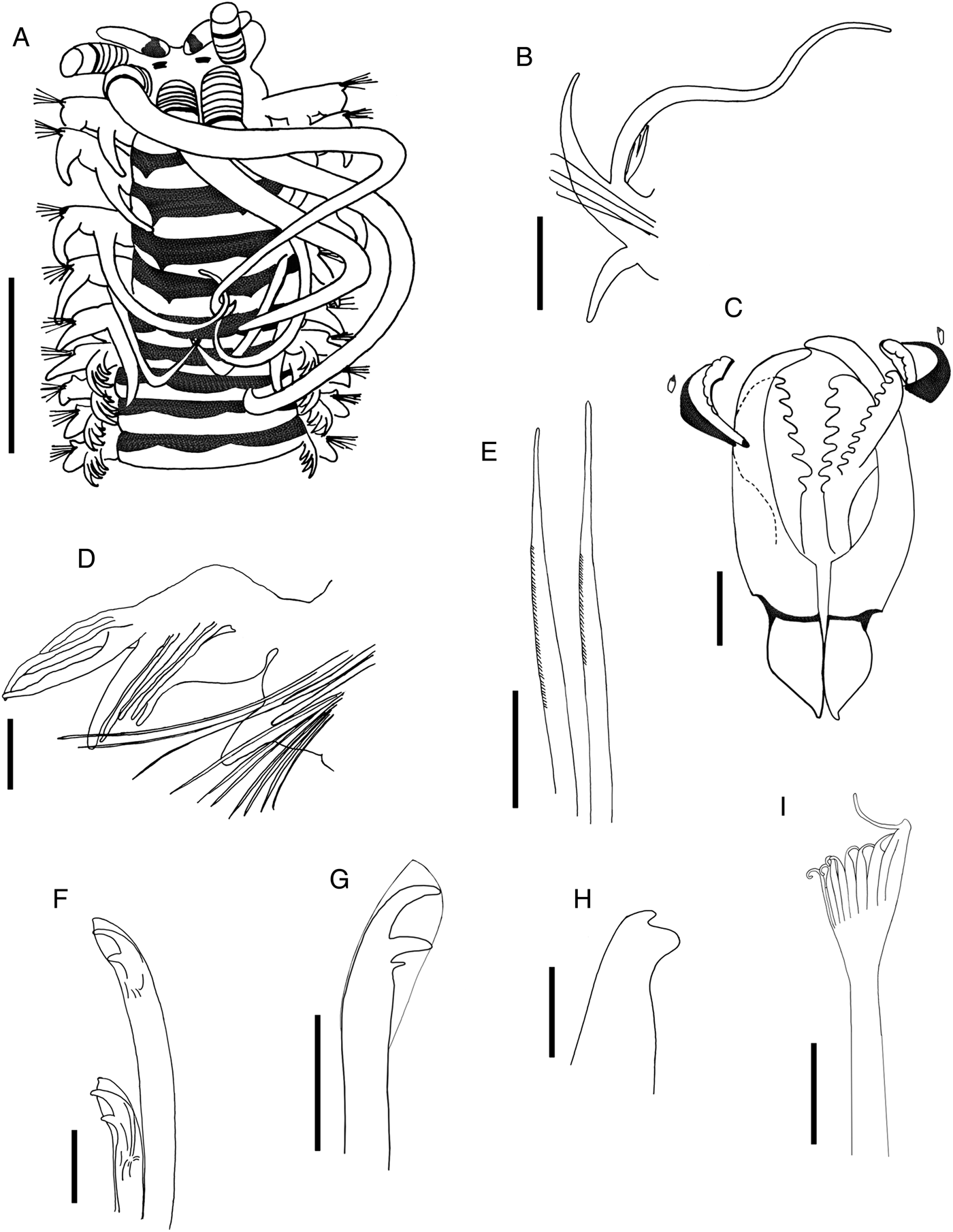
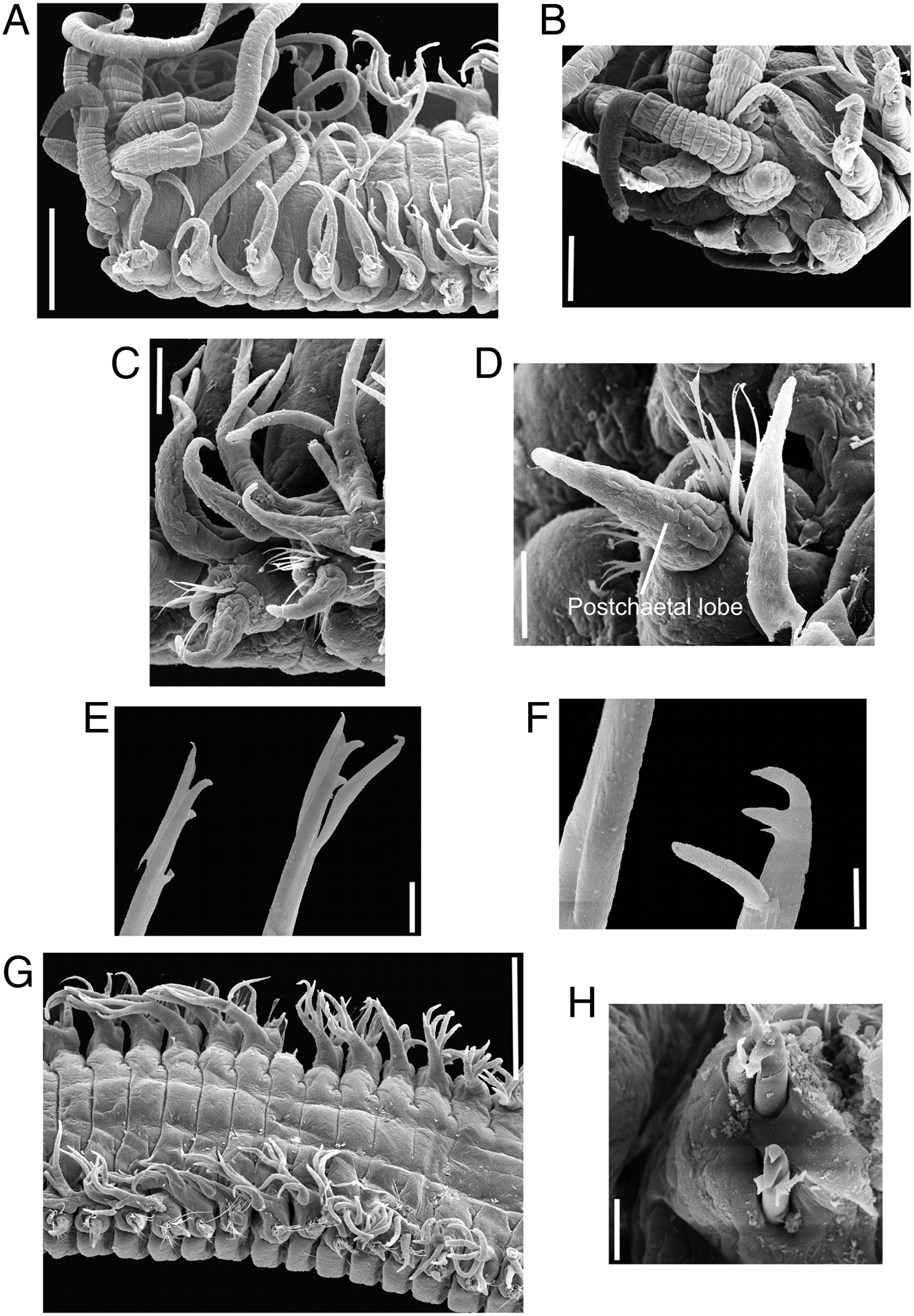
(Figures 1A–I, 2A–H)
Onuphis sp. 1 González-Ortiz et al., Reference González-Ortiz, Hernández-Alcántara and Solís-Weiss1997: 392.
TYPE MATERIAL
Holotype: CNP-ICML POH-52-002: Expedition Cortés 2; Station 3, Santa María Bay, Gulf of California, 25°2.4′N 108°31.7′W; 32 m depth, on fine sands; coll. P. Hernández-Alcántara, 10 March 1985.
Paratypes: CNP-ICML POP-52-002: two specimens, one of them coated with gold for SEM studies; same station as holotype. LACM-AHF POLY 5319: two specimens; same station as holotype.
DIAGNOSIS
Body large, slender, with transversal dark band on dorsum of peristomium and on each chaetiger, gradually fading from chaetigers 12–27. Ceratophores of antennae and palps with 7–11 rings and moderately long styles. Ventral cirri cirriform on anterior 6–7 chaetigers. Pseudocompound bi- and tri-dentate hooded falcigers on first 5–6 chaetigers. Pectinate chaetae from chaetigers 6–11, slightly oblique with ten teeth. Bidentate subacicular hooded hooks from chaetigers 18–21. Branchiae from chaetiger 6 with up to 4–9 filaments.
DESCRIPTION
Holotype incomplete with 52 chaetigers, 15 mm long, 1.6 mm wide (not including chaetae). All paratypes incomplete with 59–73 chaetigers, 10–25 mm long, 1–2 mm wide. Body large, slender, with transversal dark band on dorsum of peristomium and on each chaetiger, gradually disappearing from chaetiger 18 (12–27 in paratypes).
Prostomium short, with anterior median incision; one pair of eyes located between palps and lateral antennae. Dark brown pigmented area present on bases of frontal lips and distal parts of ceratophores of antennae and palps (Figure 1A). Frontal lips oval; upper lips oval with median section. Nuchal grooves separated in midline, curved towards base of median antenna. Palps 1 mm long (0.5–1 mm in paratypes), reaching back to chaetiger 2 (2–3 in paratypes), much shorter than antennae. Peristomium without distinct anterior fold, similar in size to first chaetiger and appearing to extend along nuchal grooves to median antenna. Peristomial cirri inserted in anterior region of peristomium, between median and lateral antennae, reaching back to first chaetiger (Figure 2A, B). Antennae with moderately long styles about equal in length, measuring about 4 mm long (3–4 mm in paratypes), reaching back to chaetiger 14 (9–16 in paratypes). Lateral antennae inserted slightly in front of median antenna. Ceratophores of lateral antennae with eight rings (7–11 in paratypes); ceratophores of median antenna also with eight rings (7–8 in paratypes) (Figures 1A & 2A, B).
Hirsutonuphis paxtonae sp. nov. (holotype): (A) anterior end, showing pigmentation pattern, dorsal view (palpostyles details omitted); (B) parapodium 6, anterior view; (C) maxillae, ventral view; (D) median parapodium, anterior view; (E) limbate chaetae; (F) pseudocompound bidentate hooded falciger; (G) pseudocompound tridentate hooded falciger; (H) bidentate subacicular hook; (I) pectinate chaeta. Scale bars: A, 1 mm; B–D, 0.2 mm; E, H, 20 µm; F, G, I, 10 µm.

Hirsutonuphis paxtonae sp. nov. (paratype) (A) anterior end, dorsolateral view; (B) anterior end, front view; (C) parapodia 6 and 7, lateral view; (D) parapodium 10, postchaetal lobe and chaetae, without cirri or branchiae, posterior view; (E) pseudocompound bidentate hooded falcigers; (F) pseudocompound tridentate hooded falciger; (G) central body, dorsolateral view; (H) bidentate subacicular hooks. Scale bars: A, G, 0.5 mm; B, 0.2 mm; C, 0.1 mm; D, H, 20 µm; E, 10 µm; F, 5 µm.
Anterior five pairs of parapodia modified (6 in a paratype), moderately elongated, directed anterodorsally (Figure 2A). Dorsal cirri digitiform, very long, with basal swelling: those of chaetigers 1 and 2 reaching back to chaetiger 5 (5–6 in paratypes), those of chaetiger 3 back to chaetiger 7 (7–8 in paratypes), gradually reduced in length; in median and posterior region of body, dorsal cirrus reduced so that its length is shorter than that of segment (Figure 2G). Postchaetal lobes subulate, best developed on first five parapodia (Figures 1B & 2C, D), gradually reduced in length toward posterior part of the body. Ventral cirri cirriform on first seven chaetigers (6–7 in paratypes) (Figure 1B), as long as the chaetiger's length; then replaced by glandular pads without transition zone of glandular pads and reduced cirri. Interramal papillae absent on all parapodia. Branchiae from chaetiger 6, with thick stem and pectinate filaments; first branchia with two filaments, increasing to maximum of six filaments (4–9 in paratypes) (Figures 1B & 2A, C, G).
Parapodia sub-biramous with notopodia reduced to dorsal cirri (Figures 1B & 2A). Neuropodia with two bundles of simple limbate chaetae (Figures 1B & 2C, D), in the median segments, neuropodia have an upper bundle of thin and slender limbate chaetae and a lower bundle of thick and short limbate chaetae which are replaced by hooded subacicular hooks posteriorly. First five modified chaetigers (six in one paratype) with bi- and tri-dentate pseudocompound hooded falcigers. Bidentate falcigers with a large slender upper fang and a secondary inferior tooth, shorter but wider than upper fang (Figures 1F & 2E), and tridentate falcigers with a large slender upper fang, wide secondary tooth, and small third tooth at the base of second tooth (Figures 1G & 2F). Pectinate chaetae absent on anterior modified parapodia, occurring as 1–2 per parapodium from chaetiger 6 (7–11 in paratypes), slightly oblique with about 10 teeth of similar size (Figures 1I & 2D). A pair of bidentate hooded subacicular hooks from chaetiger 21 (18–21 in paratypes) (Figures 1H & 2H). Pygidium unknown, posterior segments missing.
Mandibles whitish, with slender shafts; maxillae with moderately long Mx III, small Mx V; Mx VI absent. Carriers heart-shaped: lateral triangular area between MX I and carriers, and anterior median region of carriers strongly sclerotized. Maxillary formula: Mx I = 1 + 1; Mx II = 7 + 7; Mx III = 9 + 0; Mx IV = 6 + 7; Mx V = 1 + 1 (Figure 1C).
REMARKS
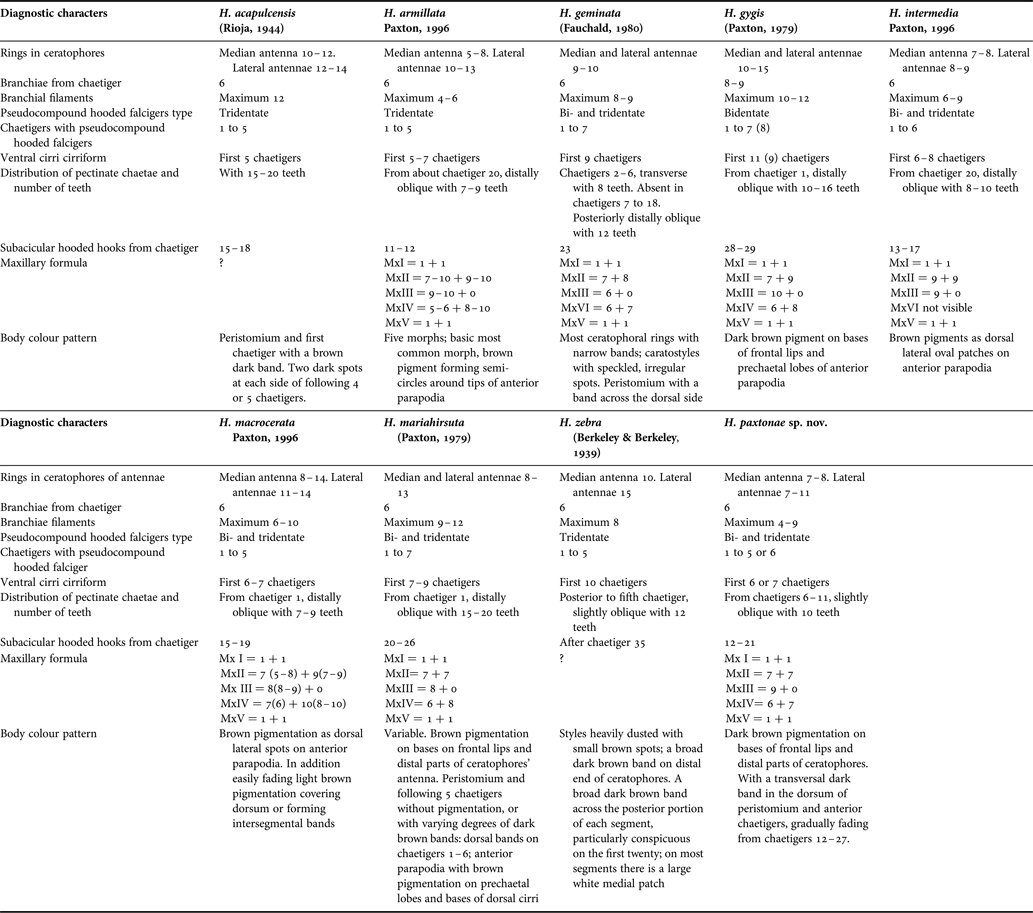
Hirsutonuphis paxtonae sp. nov. belongs to a group of species with bi- and tri-dentate pseudocompound falcigers and thus can be clearly separated from the species with exclusively tridentate pseudocompound falcigers (H. acapulcensis and H. zebra, described from the Mexican Pacific coasts, and H. armillata collected in Australia) or exclusively bidentate falcigers (H. gygis recorded in Australia) (Table 1).
Comparison of taxonomic characters in Hirsutonuphis species.
Hirsutonuhis paxtonae sp. nov. can also be differentiated from the other five Hirsutonophis species with bi- and tri-dentate pseudocompound hooded falcigers, by being the only species lacking pectinate chaetae (10 teeth) in the anterior modified chaetigers, since they appear from chaetigers 6–11 (Table 1). In both H. macrocerata and H. mariahirsuta, from Australia, pectinate chaetae are present from chaetiger 1 (7–9 teeth and 15–20 teeth, respectively), while in H. intermedia also from Australia, they are found posteriorly, from chaetiger 20 (8–10 teeth). Hirsutonuhis geminata from Belize, is a unique species in the genus, in having a discontinuous distribution of the pectinate chaetae: they are present in chaetigers 2 to 6 (with 8 teeth), but absent from chaetiger 7 through to about chaetiger 18 (Table 1).
According to the descriptions and remarks about the Australian species made by Paxton (Reference Paxton1979, Reference Paxton1996), the colour pattern can be used to distinguish the species of this genus. The colour pattern in H. paxtonae sp. nov., a dark brown band in the dorsal region of the peristomium and on each chaetiger, which gradually fades from chaetigers 12–27, differs from other species with bi- and tri-dentate pseudocompound falcigers (Table 1), even from H. mariahirsuta, in which large variations in pigmentation are present: the peristomium and following five chaetigers without pigmentation, or with varying degrees of dark brown segmental bands, basically on the central region of each chaetiger.
ETYMOLOGY
This species is named in honour of Dr Hannelore Paxton, one of the most important Australian polychaetologists, whose extensive and excellent studies on the family Onuphidae have added considerably to our knowledge of the polychaetes.
TYPE LOCALITY
Santa María Bay (25°2.4′N 108°31.7′W), Gulf of California, eastern Pacific.
HABITAT
The specimens of H. paxtonae sp. nov. have only been collected from the type locality at 32 m depth, on fine sands (96%), salinity of 35.04 psu, temperature of 14°C, 1.02 ml/l of dissolved oxygen and 5.7% of organic carbon content in the sediment.
DISCUSSION
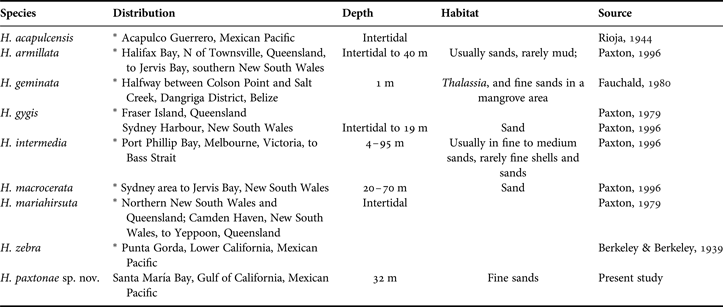
Hirsutonuphis paxtonae sp. nov. from the Gulf of California, Mexican Pacific, is the ninth described species in the genus. Even though the polychaetes of the family Onuphidae have been widely recorded in all the seas of the world, so far the genus Hirsutonuphis has been essentially restricted to the Pacific Ocean, and the distribution of each of the nine species described (including H. paxtonae sp. nov.) is practically limited to their type locality (Table 2). Despite this, a distribution pattern can be inferred from the geographical position and depths under which those species were collected, i.e. the genus is better represented at depths shallower than 40 m in the Pacific Ocean, since only H. macrocerata and H. intermedia have been recorded on the outer continental shelf (75 and 95 m, respectively), and only H. geminata has been described from the Atlantic Ocean (Belize, Caribbean Sea). Besides, with the exception of H. geminata, which was collected in sea grasses and mangroves in Belize, the species of this genus have been basically found in sand substrates of different textures, but rarely in muds.
World distribution, depth and substrate recorded for all species in the genus Hirsutonuphis.
*, type locality.
The restricted distribution of each of the species of Hirsutonuphis is more evident when looking at their records in the Pacific Ocean, where they have been found exclusively on Australian shores (south-western Pacific) (Paxton, Reference Paxton1979, Reference Paxton1986) and in Mexico (north-eastern Pacific) (Hernández-Alcántara et al., Reference Hernández-Alcántara, Tovar-Hernández and Solís-Weiss2008). Obviously, the small number of known species and the scarce records so far available make it necessary to do more in-depth research on the presence of Hirsutonuphis worldwide, to verify its distribution ranges and try to prove if this so far apparent disjunctive distribution can be a geographical attribute distinctive of the genus.
KEY TO DESCRIBED SPECIES OF HIRSUTONUPHIS (EMENDED FROM PAXTON, 1986, 1996)
1. Anterior dorsal cirri as thick as antennae; pseudocompound falcigers on anterior chaetigers bidentate .............................. H. gygis (Paxton, Reference Paxton1979)
– Anterior dorsal cirri much thinner than antennae; pseudocompound falcigers on anterior chaetigers tridentate or bi- and tridentate .............................. 2
2. (1) Conical interramal papillae on chaetigers 11–18; bidentate subacicular hooks after chaetiger 35 .............................. H. zebra (Berkeley & Berkeley, Reference Berkeley and Berkeley1939)
– Interramal papilla absent .............................. 3
3. (2) All pseudocompound falcigers tridentate .............................. 4
– Pseudocompound falcigers bi- and tridentate .............................. 5
4. (3) Bidentate subacicular hooks from chaetigers 15–18; tips of anterior parapodia with no pigmentation; median antenna with 10–12 rings .............................. H. acapulcensis (Rioja, Reference Rioja1944)
– Bidentate subacicular hooks from chaetigers 11 to 12; brown pigmentation on bases around tips of anterior parapodia; median antenna with 5–8 rings .............................. H. armillata Paxton, Reference Paxton1996
5. (3) First bidentate subacicular hooks before chaetiger 19 .............................. 6
– First bidentate subacicular hooks after chaetiger 20 .............................. 7
6. (5) Colour pattern of brown lateral spots; pectinate chaetae from chaetiger 1; lateral ceratophores with 11–14 rings; very long antennae, median as long as laterals, to chaetigers 7 .............................. H. macrocerata Paxton, 1996
– Colour pattern of brown lateral oval patches; pectinate chaetae from about chaetiger 20; lateral ceratophores with 8–9 rings; moderately long antennae, median half as long as laterals, to chaetigers 4–6 .............................. H. intermedia Paxton, Reference Paxton1996
7. (5) Pseudocompound falcigers bi- and tridentate in first 5–6 chaetigers; pectinate chaetae from chaetigers 6–11 .............................. H. paxtonae sp. nov.
– Pseudocompound falcigers bi- and tridentate in first seven chaetigers; pectinate chaetae from chaetiger 1 or 2 .............................. 8
8. (7) Pectinate chaetae from chaetiger 1, distally oblique with 15–20 teeth; branchiae with up to 9–12 filaments .............................. H. mariahirsuta (Paxton, Reference Paxton1979)
– Pectinate chaetae from chaetiger 2, distally transverse with eight teeth, absent in chaetiger 7 through to about chaetiger 18, posteriorly each is distally oblique with 12 teeth; branchiae with up to 8–9 filaments .............................. H. geminata (Fauchald, Reference Fauchald1980)
ACKNOWLEDGEMENTS
Thanks are due to Yolanda Hornelas for the electronic microscope photographs, to the staff of the Laboratorio de Microcine of the Sciences Faculty, UNAM for their help in the drawings processing and to Samantha Rupit for editing the figures. The two anonymous referees are also thanked for their comments.