The role of the clinical engineer or biomedical engineer in a hospital setting has been under constant redefinition during the last thirty years, starting at the time when a Biomedical Engineering Department consisted of a group (eight to twelve biomedical equipment technicians or BMETs) under the supervision of a biomedical engineer, up to now, when a Biomedical Engineer (BME) can fill the role of Chief Technology Officer or its equivalent in charge of all technology-wise acquisitions and administration in a health delivery system.
In the late 1970s, the role of the biomedical engineer at the hospital included the evaluation of equipment for possible purchase (although purchases were mostly centered on specific requests made by physicians), organization of BMETs into teams to carry out preventive-corrective maintenance and electrical safety and sometimes included the incorporation of low level modifications and designs onto existing equipment (Reference Dyro4;Reference Grimes7). During the 1980s and 1990s, an emphasis was given to quality control, user training and education, accreditation of hospitals, and more structured purchasing and evaluation of technology (Reference Bauld1–Reference Dyro4), and biomedical engineers tended to carry out an increasingly administrative workload, so much so, that the American Council of Clinical Engineering has defined the clinical engineer as “A professional who supports and advances patient care by applying engineering and management skills to health care technology” (Reference Frize5;Reference Frize6).
At the present, the role of the clinical engineer has expanded to include information technology, clinical facilities (clinical space design, power, gases, water, and so on) in addition to technology assessment and strategic planning (Reference Koop, Mosher and Kun8). Most regrettably, the current thinking includes the idea that the clinical engineer should be involved in ALL these activities and that he/she is the person who is the best qualified to perform jobs in these subdisciplines having to do with technology in the hospital settings. For example, the inclusion of architectural design and modification of buildings have been mentioned as tasks belonging to Clinical Engineering (Reference Shaffer9). Therefore, in some cases, we believe that management skills have been preferred over engineering skills when selecting personnel for the tasks in the clinical environment. It is not reasonable to suppose that a Clinical Engineer can be competent at solving all questions in plant engineering, instrumentation, imaging and safety as well as designing hospital additions and modifications, together with running training programs for technicians and nurses.
As demands on the competencies of Clinical Engineers rise, there has to be a paradigm shift that is similar to the way physicians support each other by interconsults: Engineers are no longer capable of being specialists in everything and must delegate some tasks to others that have more experience in particular fields in the hospital environment.
As if the previous issues were not of concern, it should be mentioned that healthcare facilities are particularly vulnerable to the action of destructive natural phenomena. Large social and economic losses are associated to damage and operational interruption of healthcare facilities, in such a manner that there have been several initiatives worldwide to promote the achievement of the concept of Safe Hospital. According to the Pan-American Health Organization, Safe Hospital can be defined as a healthcare facility whose services remain accessible and operating at full installed capacity within its own infrastructure, immediately after the occurrence of destructive phenomena of natural origin.
Because the highly complex and refined operation of a hospital demands safety and order, its structural design needs to acknowledge that a health facility is a complex system that involves several subsystems (structural, nonstructural, and contents). Rational damage control requires the development of performance-based design methodologies, the harmonization of design actions in the different subsystems, and response control in these subsystems through the implementation of innovative structural systems. The design of healthcare facilities within a multihazard environment requires a full understanding of the issues that need to be addressed to achieve the concept of safe hospital. Any framework formulated to guide the architectural conception and structural design of an hospital requires, within a multidisciplinary setting, an early strategically planning that is based on a full understanding of the potential losses, the cost/benefit balance of the different risk mitigation options, and the different socioeconomic needs and possibilities.
We propose this alternative approach to deal with the problem of multiple competencies incorporating the knowledge and experience of a multidisciplinary group to deal with large and complex issues within the field of hospital engineering. This group has been drawn from researchers, undergraduate and graduate students in fields that range from architecture to civil and biomedical engineering. In this approach, different experts collaborate even at the planning stage to minimize problems during the execution of the project. In this way the need for redesigns is minimized, when the specifications of a clinic are written together between the people responsible for the architectural work and those in charge of the equipment of the different laboratories. Experts on structural safety are also brought in at the planning stage to minimize storm and earthquake damage in structures that are supposed to provide shelter after catastrophic events.
METHODOLOGY
Over the years, as the acquisition processes for medical technology in Mexico have been increasingly regulated, much of the “expensive” technology has been bought following a bidding procedure where the process includes following some “guidelines” suggested by an office that depends from the National Secretariat of Health. These guidelines include some technical specifications on the type of equipment that is to be acquired. Unfortunately, because this office is budget limited and understaffed, it seems that some of these guidelines do not include interdisciplinary analysis for all of the technical options and configurations that different makes of equipment present. It appears that in some cases the guidelines have not been carefully prepared and thus seem to be taken from a single vendor's technical specifications.
In addition to these guideline limitations, in the case of federally and state-funded projects, the medical agencies requesting the acquisition of equipment must request a “certificate of necessity” from this same agency which should carry out an analysis on the availability of the same type of equipment in the vicinity where it is supposed to be installed. Only after these requirements have been met, an actual invitation to bid can be carried out.
Our proposal is based on the fact that the University hosts research groups dealing with engineering and technology in health care, including Biomedical Engineering, Health Economics, Architectural Design and Structural Engineering. These groups reside at different locations (Azcapotzalco, Iztapalapa, and Xochimilco campii) and have now united to coordinate activities dealing with the previously mentioned aspects. On one level, the group can provide the information that is required to guarantee that all the guidelines and certificates of necessity can be resolved. For example, in the case of an invitation to bid for a computed tomography (CT) scanner, experts can provide all the information regarding diverse systems and options that can be appropriate for the institution that is requesting the service and can suggest both minimal and maximal characteristics of this type of equipment. On another level, the University can provide detailed blueprints for a complete project such as a clinic or community hospital, where every type of equipment is specified in detail. It can also supervise providers of turnkey projects. The specific methodology varies with the type of problem, but the following description will address most cases.
Planning Phase
Definition of the Project. Generally this starts as the definition of the goals or wishes of the “buyer.” The services to be provided should contemplate sustainability, use of renewable natural resources, and energy efficiency. Because there are several types of outpatient clinics and the goals of the clinic can vary, interviewing the officials involved in the planning process is of crucial importance, as several details of what is expected can be obtained firsthand.
Determination of Location: Size and Special Considerations. This information is taken into account to provide an initial sketch of the project that will incorporate data on climatic and seismic activities in the area. A healthcare facility should incorporate the guidelines for a “safe hospital,” as it should be considered as a shelter in the case of emergencies. Participation by both a hospital architect and a structural engineer is essential.
Determination of Equipment Needs. Availability of similar equipment at locations in the vicinity; cost-effectiveness planning; incorporation of data on equipment availability at the state-wide level combined with morbidity and mortality figures. The incorporation of information regarding “plant” installations including electrical, hydraulic, and telecommunications should be carried out at this stage as well.
Execution Phase
Initial Design of Specification of Equipment and Preinstallations. Here, the specification of equipment is essential, and several iterations with the architects may be necessary to avoid last minute modifications caused by a faulty understanding of equipment characteristics.
Construction, Installation of Equipment, and Simulation of Operation. These processes are well understood, but a simulation of operation, walk-throughs, and the analysis of patient flow are normally carried out to avoid “bottlenecks” using process management systems.
Startup Operation, Adjustments, and Evaluation. In any initial operation, adjustments are to be expected. If the planning and design phases have been correctly executed, adjustments should be minimal. After several months of operation, an analysis of the operating characteristics of the facility should be carried out to validate assumptions during the planning phase and to incorporate this experience into new designs.
RESULTS
Several case studies are presented where the network has been working at different levels to solve different types of problems.
Case Study 1
The first project involved a small forty-bed hospital located in a small coastal city. An evaluation and analysis of the institution's operation detected severe problems with the facilities, electrical installations, staff attitude, and selection of the adequate medical equipment, especially when the high temperature and humidity average levels at that location were taken into consideration. The case dealt with the selection of incubators for the neonatal care unit. This project started as a specific request made by the hospital's director and the negotiation with a charitable foundation donating the equipment. As a result of the evaluation, the best possible models of incubators were selected; after a quantitative and qualitative analysis of several incubator models from different providers, some models were deemed acceptable. After the preselection, negotiations including training, 5-year warranty, labor, and parts supplies were carried out and an agreement was signed with the chosen provider, whose manufacturing facility was previously evaluated to ensure compliance with quality control procedures. The result was satisfactory for both negotiating parts. In this instance, University personnel with experience in technological evaluation worked together with experts in critical care instrumentation to generate a set of guidelines that were used during the selection process. In addition, graduate students with experience in the field of medical instrumentation and evaluation agreed to do several onsite visits to obtain first-hand evidence on the actual operating conditions of the equipment.
This case was handled mostly by the Biomedical Engineering branch of the network being described. However, an ex-post facto analysis demonstrated that a stronger interaction with hospital architects would have been desirable in order for them to present suggestions of small modifications that would have improved the facilities globally instead of just relying on nonspecialized construction workers that provide a functional, but not optimized solution. It should be noted that the possibility to negotiate with several equipment providers can lead to an advantageous solution in terms of warranty, replacement parts and service. This approach is different from the customary procedures in invitations to bid. A solution must be reached where the possibility of negotiation is conserved, while the equal opportunity for all vendors to participate is guaranteed.
Case Study 2
A hospital associated with the National Institutes of Health was in the process of acquiring a CT scanner when a New Hospital Director was appointed. This director, in the process of familiarizing himself with the programs he “inherited,” decided to appoint the University as an expert on medical instrumentation and imaging and to ask for an appraisal of the situation. The BME branch of this group analyzed the bidding procedures, the contracts and asked several questions that needed to be answered before the formalization of the reception could be signed. In particular, these particular tasks had to be completed: (i) Verification of the preinstallations. (ii) Verification of the technical information provided. (iii) Verification of the operation of all the software that should have been included. In particular the calibration procedures, the preventive and corrective maintenance routines, and the validity of the software licenses for the entire duration of the CT's lifetime. (iv) Conclusion of a course on operation, fault detection and preventive and corrective maintenance, given to BME personnel at the hospital, together with appropriate courses for radiology technicians and radiologists. The recording of all lectures and practice studies was strongly suggested. (v) CT calibrations carried out in the presence of BME personnel in order for them to be able to perform periodic verifications of the state of operation of this equipment. (vi) Studies of particular importance to the hospital should be carried out in the presence of engineers, technicians and radiologists to ensure that the correct parameters of operation have been comprehended. (vii) The equipment provider must present an estimation of the costs associated with the long and short-term operation of this system, including the cost per slice, subdivided into the fraction incurred by the operation of the X-ray tube. The cost of replacement of the tube should be included. (viii) All of these considerations must be written down and signed in the equipment's operation log.
During this study, several anomalies were discovered: The equipment being bought was constructed by one of the three major vendors of imaging equipment worldwide. However, they did not participate in the bidding process. A local company won the bid and then proceeded to subcontract the equipment from the major vendor. The questions arose as to who was installing the equipment, because it appeared that the major vendor was providing the technicians, which was a breach of contract (bid-winning companies should provide training and do installations themselves). A second question arose regarding the existence of replacement parts within the winning company's warehouses, and finally, there was a major question posed as to the adequacy of the equipment being bought (sixty-four-slice CT specially built for cardiac studies) for a general hospital with no cardiac specialties, as well as the elevated sale price (as much as an magnetic resonance imaging scanner).
The hospital took these results in hand and acted in accordance to its administrative procedures to correct the anomalies.
Case Study 3
This project was started by the collaboration between the habitability laboratory (consisting of designers and architects) of the University together with the health service system of the national petroleum company. The original idea was to build a clinic to deal with the large number of patients arriving at the emergency room at the local company hospital. In this case, the first architectural designs were drafted by the lab, and the structural engineering and biomedical engineering groups were contacted later to act as consultants.
It quickly became evident that more information was necessary to be able to plan for the level of equipment that would be necessary in addition to taking into account considerations regarding hospital safety from the structural point of view. On one hand, it would be necessary to establish the type of clinic to be designed, as in this case, many ER visits are made by patients just to obtain medical justification of absences. On the other hand, the clinic could be equipped to provide real first-level care, mostly for the prevention of obesity and breast cancer or other programs that the company might deem important.
After consulting with the client, it was determined to equip the clinic with the latter type of equipment and it soon became apparent that some of the areas in the architectural design were too small to accommodate some types of equipment such as dental X-rays. This redesign was fortunately done before construction started, so it was not too costly. The project has proven to be successful, and the company has contacted the University again to design and construct one hospital and an additional clinic.
In terms of achieving the concept of safe hospital for this healthcare facility, it was important to acknowledge the possibility of occurrence of severe wind loading. Early interaction with the structural engineering firm allowed for a careful conception of the structural system of the two buildings that allocate the clinic. Careful considerations for the design of the facade elements and their anchors to the structural system were made to avoid inadequate performance during hurricanes.
DISCUSSION
Regarding equipment specification and acquisition, one of the main problems regarding equipment vendors in the public health sector during the bidding process is the relationship between the quality of the equipment proposed and the price in the final bids. This easily leads to the acquisition of equipment that passes the lowest technological and quality standards at the lowest costs. An innovation in the procedure in the invitations to bid was to request high quality and technological standards that sometimes no provider was able to comply to, but that would lead to the selection of equipment with the highest standards at the lowest possible cost.
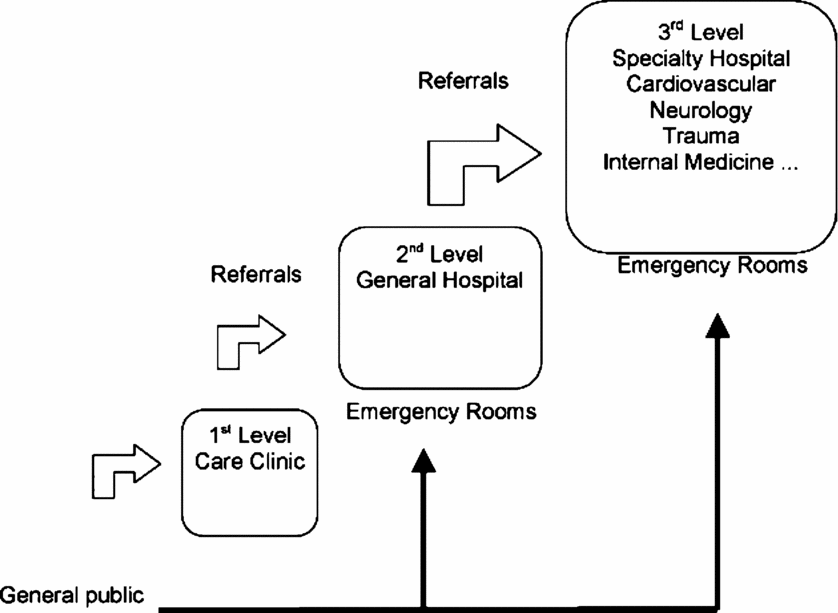
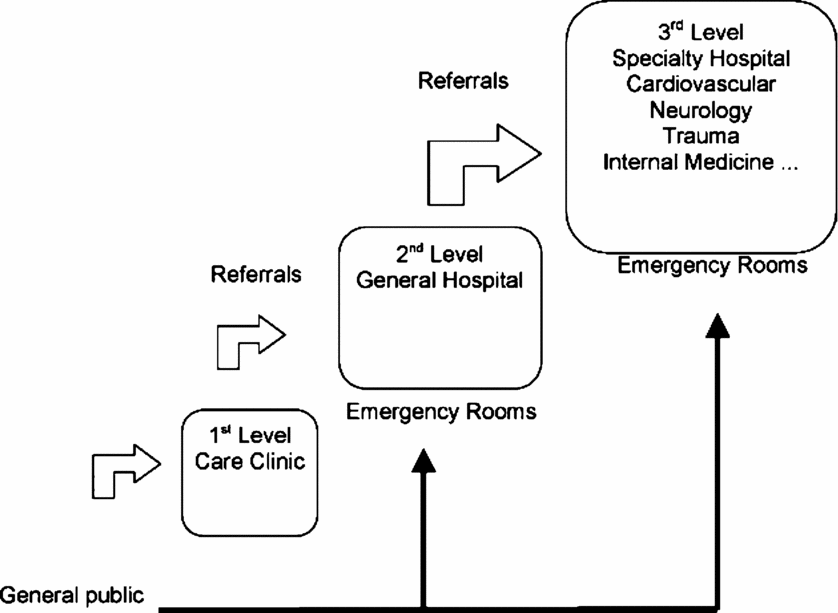
In the case of the structure of the three-tier hospital complexity model that is current in Mexico, the experiences led us to suggest a change from the existing policies of having a pyramid of increasing technological complexity at three different levels toward a system that is able to resolve a high percentage of procedures at the most basic level. At present, the system is supposed to provide help first at a basic level, and later to go up in medical and technological complexity through referrals. However, the quality of attention at the basic level is lacking in so many areas, that most patients bypass these services and instead go to the nearest or largest hospital and prefer to wait for hours inside the emergency room. Figure 1 shows this situation, where white arrows show the approved procedure for admission, and the black arrows show admission through emergency rooms. Better healthcare delivery is possible through adequate planning activities and assignment of efficient technology to the lower levels in the hospital complexity.
Operation of the three-level healthcare paradigm in Mexico: Regular admission should be through the main entrances (white arrows), while most admissions nowadays are through the emergency room. Patients are supposed to go to their community healthcare center to be evaluated by nurses and nursing assistants. These 1st level clinics do not have facilities for hospitalization nor for emergencies. Most patients go directly to the hospitals, but because they have not been referred to the hospitals, they wait for hours in the emergency rooms for care. Some hospital directors have even modified hospital admissions so that all of them now go through the emergency room.
In several instances, the suggestion of moving medical care “away from the hospital into the community clinic” has been presented. In Mexico, the concept of quality home health care is virtually unknown, but telemedicine infrastructure is growing, and the use of these resources at the health clinic level (1st level care) will help avoid sending patients up to the next level of health care, avoiding the bottlenecks that hamper high-quality care throughout the system.
In the case study involving the complete turnkey construction of a clinic, the experience has incorporated input from all the areas in the network, and the results show a solution that is better integrated than when different stages of a project are handled by different entities.
Frequent consults between the design team and the technology management (BME) group will result in less time devoted to last minute modifications that are frequent while the equipment installation phase is going on.
CONCLUSIONS
While interdisciplinary work has been mentioned frequently in the literature with respect to clinical engineering and technology management, this is an instance where actual results have been presented and the experience has proven to be convincing in the sense that it now seems evident that this approach should be seriously considered in the case of projects involving several aspects of design and construction of medical technology systems. The old paradigm of having a hospital engineer with multiple competences will no longer be tenable, and the multidisciplinary approach that is better adapted to emerging (Reference Zambuto10) technologies in health care will have to prevail.
CONTACT INFORMATION
Fabiola Martínez Licona, EngM (fmml@xanum.uam.mx), Associate Professor, Centro Nacional de Instrumentación e Imagenología Médica, Universidad Autónoma Metropolitana–Iztapalapa, Av. San Rafael Atlixco 186 Col. Vicentina, Mexico D.F. 09340
Joaquín Azpiroz Leehan, PhD (jazp@xanum.uam.mx), Associate Professor, Centro de Investigacion en Instrumentación e Imagenología Médica CI3M, Universidad Autónoma Metropolitana–Iztapalapa, Av. San Rafael Atlixco 186 Col. Vicentina, Mexico D.F. 09340
Miguel Cadena Méndez, ScM (mcm@xanum.uam.mx), Associate Professor, Centro de Investigacion en Instrumentación e Imagenología Médica CI3M, Universidad Autónoma Metropolitana–Iztapalapa, Av. San Rafael Atlixco 186 Col. Vicentina, Mexico D.F. 09340
Salvador Duarte Yuriar, ArchD (sduarte@correo.xoc.uam.mx), Associate Professor, Department of Methods and Systems, Universidad Autonoma Metropolitana–Xochimilco, Calzada del Hueso 1100 Col. Villa Quietud, Mexico City, Mexico D.F., 04960
Raúl Molina Salazar, PhD (myrm@xanum.uam.mx), Associate Professor, Department of Economics, Universidad Autonoma Metropolitana–Iztapalapa, Av. San Rafael Atlixco 186 Col. Vicentina, Mexico D.F. 09340
Amador Terán Gilmore, PhD (tga@correo.azc.uam.mx), Associate Professor, Department of Materials, Universidad Autonoma Metropolitana–Azcapotzalco, Av. San Pablo N° 180 Col., Reynosa Tamalulipas, Mexico City, Mexico, D.F., 02200