When Wolfgang Amadeus Mozart was born, the da capo aria was ubiquitous in both comic and serious opera. By the time he reached maturity, however, composers of comic opera had a much more diverse arsenal of formal schemes at their disposal. This article investigates the mechanisms by which the structural parameters of the aria were significantly expanded over the course of roughly ten years, c1750–c1760. While it is tempting to ascribe these developments to the inventive powers of composers such as Baldassarre Galuppi and Niccolò Piccinni, I argue instead that a librettist, Carlo Goldoni, along with two elite singers with whom he frequently collaborated, were in fact the driving force behind the reimagining of the aria in comic opera.
While there has been a great deal of research on the relationship between star singers and the composers who wrote for them, librettists are often left out of the equation.Footnote 1 Mozart famously compared his relationship with singers to that of a tailor who creates a set of clothes that perfectly suit the dimensions of a given body.Footnote 2 In such a formulation there is no third party. One might extend Mozart's metaphor, however, by including another employee in the tailor's shop. Thus imagined, the librettist would function in the role of the measurer, whose responsibilities include sizing up the basic dimensions and determining the number of items that will constitute a given outfit, which the seamstress (composer) is free to realize with whatever cloth, colours and ornaments are deemed appropriate.
In the instance of Goldoni's collaboration with Francesco Baglioni and Serafina Penna, the singer–librettist axis played a formative role. It was not the case, however, that this relationship was always the most important node in the production of comic opera. Many other individuals and groups, such as impresarios and set designers, or institutional forces, such as the carnival season or royal weddings, played important roles in shaping a given opera. Like librettists, composers were expected to cater to the needs and preferences of the singers they had at hand, though in very different ways. On the other hand, it was not uncommon for librettists and composers to write according to generic codes when creating a new opera in another city for singers that they had never met. In the operas discussed here, however, Goldoni worked closely with both Penna and Baglioni for an extended period and strayed substantially from the inherited conventions in his attempts to create roles that suited them.
Carlo Goldoni
Goldoni described his approach to collaborating with singers in his account of an interaction early in his career with the composer Antonio Vivaldi and the prima donna Anna Girò.Footnote 3 Goldoni was hired by the management of the theatre to alter a pre-existing libretto, La Griselda (1701) by Apostolo Zeno, that was to be newly set by Vivaldi for the Ascension season of 1735. Chief among Vivaldi's concerns was ensuring that Girò, who was Vivaldi's student and for whom he acted as an agent, had suitable arias. In particular, Vivaldi identified an important moment, early in the opera, that would not present Girò in the best light. According to Goldoni, Vivaldi stated:
L'auteur [Zeno] y a placé à la fin un air pathétique, mais Mademoiselle Giraud n'aime pas le chant langoureux, elle voudroit un morceau d'expression, d'agitation, un air qui exprime la passion par des moyens différens, par des mots, par exemple, entrecoupés, par des soupirs élancés, avec de l'action, du mouvement; je ne sais pas si vous me comprenez.Footnote 4
The author [Zeno] placed a pathetic aria at the end [of the scene], but Mademoiselle Girò does not like languorous singing, she would like a piece of expression, of agitation, an aria which expresses passion by different means, by words, for example, interspersed with soaring sighs, with action, with movement; I don't know if you understand me.
Vivaldi's predicament underlines the fact that when composers went about setting an aria they were, first and foremost, responding to a textual prompt that dictated the type of aria they had to write. They were free to realize the specifics of the aria to the best of their ability, but in doing so they had to adhere to the premise laid out by the librettist.
In a normal situation, as opposed to a revival, the librettist would be expected to make any alterations desired by the singers before the libretto was sent to the composer. Goldoni bewails this duty in his La bella verità (1762), a meta-theatrical work that pokes fun at the difficulties inherent in the production of comic opera. The fictional librettist in this opera, Loran Glodoci (an anagram of Carlo Goldoni) complains about the number of revisions demanded of him in his first aria.

This aria's exaggerated description of singers as fickle and demanding is meant for comic effect, especially because it would have been delivered by an actual singer. In reality, the insistence of singers that they be provided with suitable arias was the most important part of preparing an opera for the stage. Goldoni was very clear that the fate of a given opera was almost entirely down to the performance of the singers, noting, ‘L'esito dipende talora dalla musica, per lo più dagli attori’ (The result depends sometimes upon the music, but mostly on the actors).Footnote 6 He also believed that the quality of the libretto was a secondary concern, asking, ‘Sì, ma a che serve che il libro sia passabilmente buono, se le attrici bravi non sono?’ (Yes, but what is the point of a passable libretto if the actors and actresses are no good?).Footnote 7 He felt that this was especially true of comic opera, writing that ‘dans l'opéra comique principalement, j'ai vu la bonne exécution soutenir souvent des ouvrages médiocres, et très rarement réussir les bons ouvrages mal exécutés’ (in comic opera especially, I have often seen good performance support mediocre works, and very rarely seen a good work succeed despite bad execution).Footnote 8 Even a talented singer would be unable properly to execute an aria that was at odds with their skills and preferences. While Goldoni may not have appreciated the extra work, he certainly understood the necessity for such revisions.
When a librettist worked with a singer for the first time, this process of writing and rewriting arias seems to have been almost inevitable. When he had the opportunity to work with singers over the course of multiple seasons, however, Goldoni became intimately familiar with their dramatic abilities and was able to write arias that departed substantially from the standard formal patterns and aria types. The first singer to motivate Goldoni in this way was Francesco Baglioni, a pillar of the comic-opera circuit who had already had some twenty years of experience singing at the elite level when he began his extensive collaboration with the librettist.Footnote 9
Francesco Baglioni
Had Baglioni never met Goldoni, he would still be counted amongst the most important performers of comic opera in the eighteenth century. Baglioni began his career as a singer of comic intermezzos in 1729. He then made his name in Rome, where he premiered La finta cameriera, Madama Ciana and La commedia in commedia in 1738.Footnote 10 Barbara Dobbs Mackenzie, in her study of the development of comic opera from a local phenomenon to an international genre in the 1740s, argues that ‘of all the new elements in Roman comic opera, it was the involvement of a Roman singer, Francesco Baglioni, that may have been the most significant’.Footnote 11 In particular, she draws attention to the part Baglioni played in the dissemination of the operas he created in Rome, noting that ‘none of the other singers [who sang in the premieres of these operas] appeared in many performances beyond Rome’.Footnote 12
Baglioni was reportedly able to make his audience ‘die of laughter’.Footnote 13 He did this primarily by importing techniques from the spoken theatre. In his research on the influence of both scripted comedy and the commedia dell'arte on comic opera, and the extensive interpenetration of these three worlds, Gianni Cicali identifies Baglioni as one of the best representatives of the phenomenon that he calls the ‘actor-singers’ (‘attori-cantanti’).Footnote 14 Unlike performers of serious opera, whose delivery built upon the stylized declamation of spoken tragedy, actor-singers like Baglioni would have introduced features like erratic movement, caricature and exaggerated facial and bodily expressions to enliven their roles. Through his performance of operas such as La finta cameriera Baglioni set a benchmark, and established the expectation that professional performers of comic opera had to be able to act at a high level.
Another important aspect of Baglioni's legacy was the considerable number of children he fathered, who included some of the most notable performers of the subsequent generation.Footnote 15 Mozart's first opera, La finta semplice, was written with Baglioni's daughter Clementina as the intended prima buffa (though that performance never materialized), and Baglioni's grandson Antonio created two notable Mozartian roles, Don Ottavio and Tito.Footnote 16 Most of Baglioni's children began their careers taking smaller roles alongside their father, and undoubtedly honed their craft under his direction. They represent, therefore, one of the most tangible links between the generations of Goldoni and Mozart.
The arias that Baglioni sang in the first part of his career display a rigid consistency in their formal organization. Mackenzie notes that almost all arias in this repertoire, for both the comic and the serious characters, are in da capo form.Footnote 17 For example, in the four most frequently performed operas of this period (La finta cameriera, La commedia in commedia, Madama Ciana and La libertà nociva) there is a total of ninety-eight arias, all but six of which are da capo.Footnote 18 Almost all of the non-da capo arias in this repertoire are cavatinas, short lyrical pieces that usually set a single stanza of text.
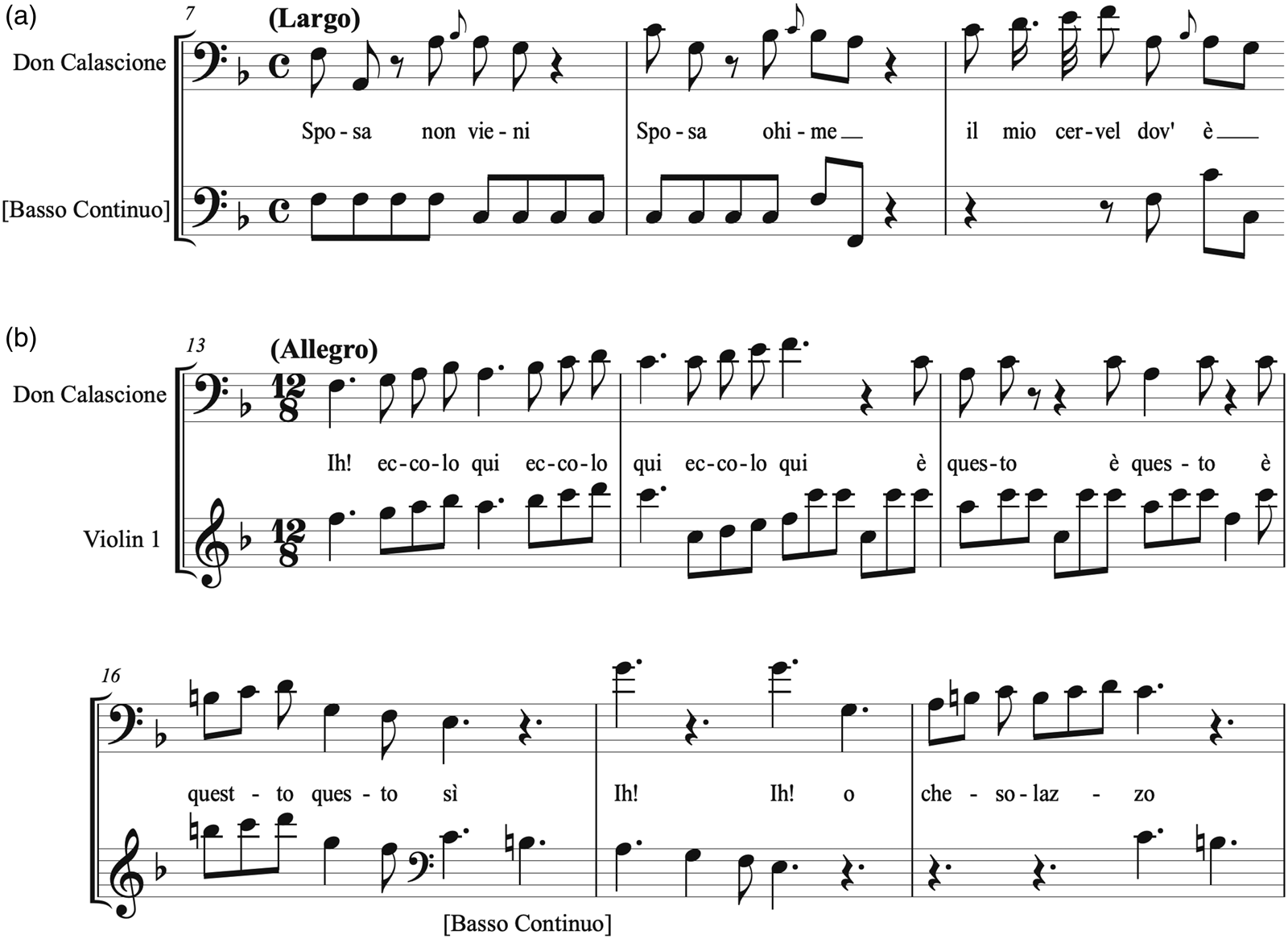
The consistency of formal organization observed across this repertoire makes any deviations especially remarkable. One of the most interesting, especially in so far as it foreshadows Goldoni's later experiments, is the aria ‘Sposa non vieni’ from La finta cameriera.Footnote 19 Baglioni built his career on this opera, performing it in at least thirteen distinct productions. ‘Sposa non vieni’ is the first aria for his character, Don Calascione. The crux of this character is a contradiction between the role he should be playing (serious lover) and the one he ends up filling (buffoon). The aria opens with a lyrical Largo in common time that seems to suggest the Don might be capable of dignified love (Example 1a). This dissolves quickly, however, into an irreverent and energetic section in 12/8 (Example 1b). The two sections then alternate back and forth until the arrival of a third distinct musical idea, also in 12/8, that sets the second stanza of the text, followed by a dal segno cue. The resulting form (ABABAB C ABABAB) thus adheres to the basic premise of the da capo aria while also allowing for a great deal of contrast by way of the frequent alternation between the first two sections.Footnote 20
Gaetano Latilla, ‘Sposa non vieni’, La finta cameriera, Act 1 Scene 11: (a) bars 7–9; (b) bars 13–18. Biblioteca del Conservatorio di Musica Luigi Cherubini, ms. D. 180

Changes of metre and tempo within an aria were uncommon during this period. Of the twenty-six other arias in La finta cameriera, for example, only three feature a change of metre. In all three of these cases the change occurs at the beginning of the B section of the da capo form, the one position where such a change was regularly permitted. Changes of both metre and tempo within the A or B section of the da capo form were exceptional in comic opera before Goldoni.
There is, however, a precedent for arias that include multiple changes of metre and tempo, in the comic intermezzo.Footnote 21 In his study of this genre Charles Troy compares the intermezzo style with the style of the dramma per musica as follows:
In contrast to the set pieces in contemporary opere serie where the ideal, at least, was to establish and maintain a single affect throughout an aria, composers of intermezzi seem to have felt no compunction whatsoever about introducing drastic changes of style and tempo within a given number when such changes were suggested by the text.Footnote 22
While the comic intermezzo is often acknowledged as an important precedent for comic opera, this particular aspect was absorbed only gradually. Most arias from comic operas written before 1750 replicated the formal patterns of the da capo aria that was then prevalent in serious opera.
It should be stressed, however, that the da capo arias in comic opera, while formally analogous to those of serious opera, bore only a slight resemblance to their model. The fully fledged da capo aria was the ideal tool for expressing the magnificent gestures and powerful emotions of its native environment, and its formal features were developed as a response to the requirements of the serious genre. The binary distinction between the two parts, which usually takes the form of an A section that contrasts with or is qualified by the B section, reflects the fundamental conflicts (for example, love versus duty or pride) that drive the librettos of Metastasio and his imitators. Singers were also well served by the da capo aria. The repetition built into the form provided performers with a regular forum in which to display their creative powers through ornamentation and improvisation. Similarly, the sheer size of many mid-century da capo arias attests to the vocal athleticism and endurance of the singers. These and other aspects of the form made it the ideal vehicle for generations of performers of serious opera. In comic opera, however, the form was ill-suited to the fast pace of the action and did not provide an opportunity for comic singers to display their unique abilities. Despite this incompatibility, the da capo aria remained ubiquitous in comic opera before 1750.
It would require a performer with considerable status and one with a strong concept of the roles they liked to sing to break such a well-established convention. Baglioni would have first encountered arias with multiple changes of metre and tempo during his early days as a singer in intermezzos. He then carried that concept with him when he moved to comic opera. By the time he began his collaboration with Goldoni, singing this type of aria was an established habit that Baglioni had been cultivating for at least a decade, but probably much longer. This formal tendency reflects, therefore, something of Baglioni's skills and preferences. He thrived in arias with frequent contrast and rapid transitions. Presumably he also excelled at sharply defining the sections, thus exaggerating the absurdity of vacillating between such extreme emotional states.
Later in his career Baglioni also showed a clear preference for arias that end in a hectic climax, usually incorporating a great deal of patter. This feature is generally not present in arias from the first part of his career (pre-Goldoni) because it cannot be accommodated by the da capo form. In its ‘home’ genre of serious opera sung by virtuosic high voices, the da capo aria ends resplendently with improvised vocal ornamentation of the A section on its repeat. For basses like Baglioni, on the other hand, that type of improvisation was generally not an option.Footnote 23 This means that the repeat of the A section had to be just that, a repetition. The vacuity of this formal feature is brought in for criticism in many early comic-opera texts.Footnote 24 The solution to this problem was not realized, however, until comic-opera had chafed under the yoke of its inherited conventions for some two decades.
Goldoni and Baglioni began working together in Venice in the Ascension season of 1749. The earliest fruits of their collaboration display a tendency to explore alternatives to da capo form.Footnote 25 In most of these operas Baglioni had at least one large multi-sectional aria, often at a crucially important moment of the plot.Footnote 26 These arias function as musical and dramatic high points that are marked as especially significant by their formal novelty. Baglioni's other solos tend toward the opposite extreme, often taking the form of cavatinas or simple arias set in a single tempo throughout. While these arias are less formally complicated, they are every bit as much a deviation from da capo form. In both the simple and the multi-sectional pieces hectic climaxes are almost guaranteed. The following analysis highlights two numbers from Il filosofo di campagna (Venice, 1754) that exemplify the two types of aria that Goldoni wrote for Baglioni. This opera was by far the most influential result of their collaboration, enjoying more than fifty distinct productions over the course of the century.Footnote 27
Both arias considered here display a tendency that would become almost de rigueur in the second half of the century, the drive towards climactic endings. Mary Hunter aptly summarizes this phenomenon as follows: ‘Opera buffa arias often expend considerable time on ending materials, with much repetition and significant amounts of raw time given to the announcement and enactment of the end. Arias for basso buffo are particularly clear in this regard’.Footnote 28 Hunter also notes that these ‘performative climaxes . . . emphasize the individuality of the singer’.Footnote 29 This drive toward closure, which allows the singer to create so much of the excitement and comedy of a buffo aria, is necessarily rooted in the text. This is certainly the case in the first full aria for Nardo, Baglioni's character in Il filosofo di campagna. The last two lines of the text are essentially a stage direction that invites Baglioni to tumble to the floor head first.

While it may not seem remarkable to readers that are accustomed to the varied textual prompts of a librettist like Lorenzo da Ponte, this aria is remarkable in the context of the 1750s because it clearly precludes a da capo setting. In the original 1754 libretto and those of most subsequent productions the da capo arias are given in the standard format of two stanzas set off from each other by indentation (see Figure 1). This aria, on the other hand, is given as a single block of text (see Figure 2). The placement of the tronco lines suggests that it should be broken into three distinct sections (as I have divided it above) that gradually accumulate energy leading up to the final line. This sort of climactic ending implies that the aria should end with that line, which would allow Baglioni to demonstrate his acrobatic ability as he exits the stage.
Carlo Goldoni, ‘Se perde il caro lido’, Il filosofo di campagna (Venice: Fenzo, 1754), Act 1 Scene 1

Goldoni, ‘Vedo quell'albero’, Il filosofo di campagna, Act 1 Scene 7, lines 1–10

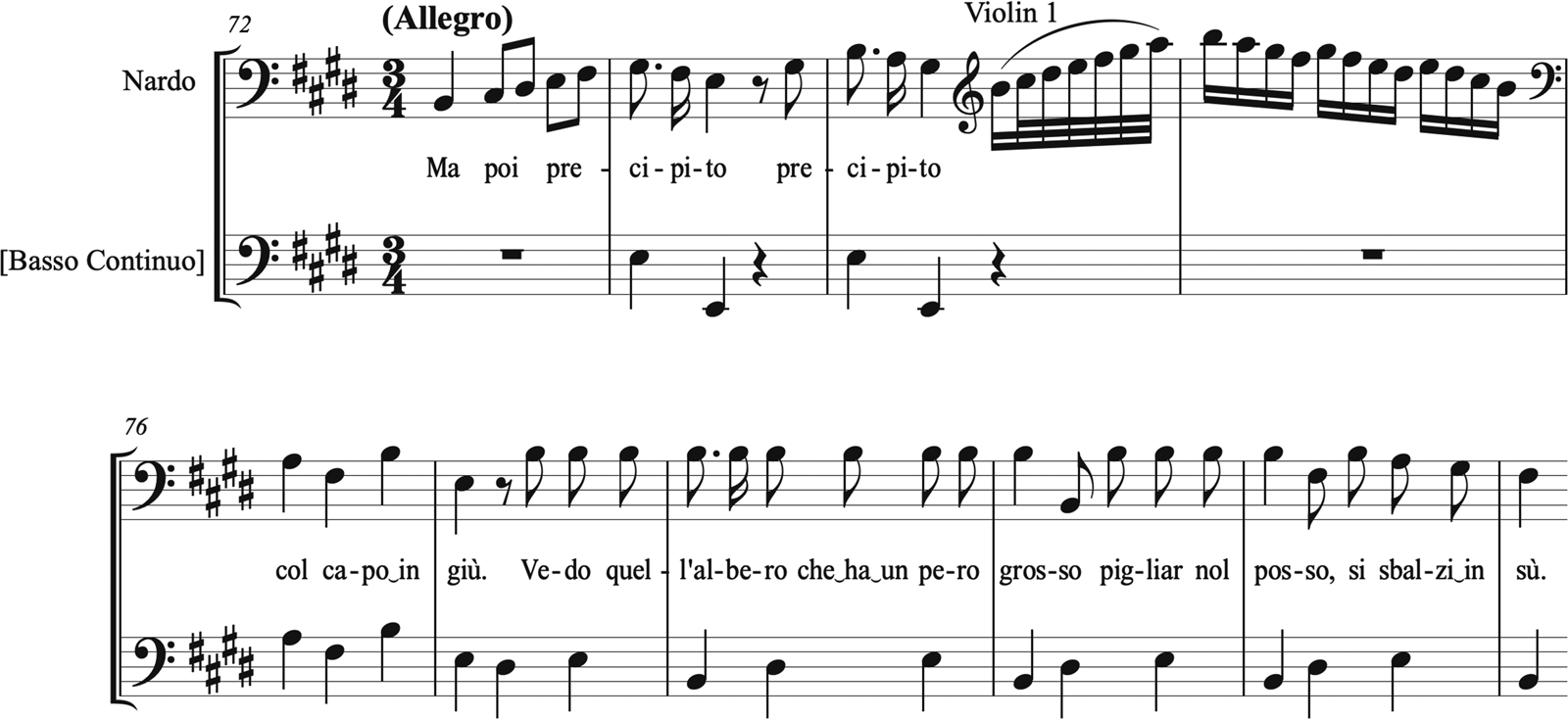
Galuppi's setting of this aria follows the basic outline of the text. It employs a single tempo throughout and gradually increases the level of excitement, working up to the end of the third stanza. The entire text is then repeated without any major changes to the musical setting, except that it works to an even more frantic climax that includes a compressed repetition of most of the text in patter (Example 2, bars 77–81). In addition, Galuppi adds delightful flourishes in the first-violin part that represent the treacherous leaps described in the text (bars 74–75). His handling of the vocal line also articulates the flat-footed scansion of the text remarkably well. Fine details of this nature fall within the composer's purview. The structure and type of the aria, however, is built into the text. Had Galuppi decided to realize this aria in da capo form or included multiple sections set off by different metres, he would not have been flexing his creative muscles, but would have been failing to do his job.
Baldassarre Galuppi, ‘Vedo quell'albero’, Il filosofo di campagna, Act 1 Scene 7, bars 72–81. Bibliothèque Nationale de France, Département de la Musique, X-776, 30001488

This aria is little more than an appetizer, however, that introduces Nardo's comic side. His clowning is complemented by a sentimental vein that is developed in pieces like his cavatina ‘Amor se vuoi così’ (Act 2 Scene 12). The inevitable collision of these two strains occurs in Act 2 Scene 14, where Nardo undertakes the ‘philosophy’ that lends the opera its title. In this scene Nardo must decide whether he can marry Lesbina, the lowly servant that he had confused for her wealthy mistress. He ultimately concludes, ‘Serva o padrona sia, tutt’è lo stesso’ (whether she is servant or mistress, it is all the same).Footnote 31 The seriousness of this conclusion and the flippancy with which Nardo arrives at it both play out in the aria that follows (‘Se non è nata nobile’).
The text of this aria is divided into two sections by a change of poetic metre. Such a change mid-aria is, in the context of the 1750s, a highly unusual feature. Although da capo arias are built upon a fundamental contrast between the A and the B sections, they are usually set in one poetic metre throughout, as are almost all of the other arias in this opera.Footnote 32 In ‘Se non è nata nobile’ the first stanza is set in settenario (usually seven syllables per line) and the second shifts abruptly to senario (usually six syllables per line). It should also be noted that the first stanza is highly irregular in its use of verse types. A well-behaved stanza of Italian poetry should use mostly versi piani, which place a stress on the penultimate syllable.Footnote 33 Stanzas typically conclude with versi tronchi that end on a stressed syllable and thus perform a closing function. The poet may also occasionally employ versi sdruccioli, which include two syllables after the stress, but these are rare. While the second stanza of ‘Se non è nata nobile’ is completely typical, the first stanza is dominated by versi tronchi and includes as many versi sdruccioli as it does versi piani. This transition from the metric instability of the first stanza to the regularity of the second serves to further distinguish between the two parts of the text.

Galuppi's setting of this aria distinguishes the two stanzas of the text by way of corresponding changes in musical metre and affect. In addition, he plays on this distinction as a means of creating the final climax, in the form of an artful blunder. The music for the first stanza is an Andante in 2/4 that incorporates dotted rhythms at the level of both the semiquaver and the demisemiquaver along with sighing gestures that project a stately impression (Example 3a). This is as close as someone like Nardo can get to what Wye Allanbrook called the ‘exalted march’.Footnote 35 He does not pull it off, but it seems like he thinks he does. The music for the second stanza sees Nardo abandon his pretence and give in to his desire to celebrate his new spouse. This is expressed through a perky 3/8 that is something like a gigue (Example 3b). The lilting scansion of the text feels rather at home in a triple metre, as does the first stanza's enumeration of ideal feminine attributes in the sturdy regularity of the march. The repetition of both sections allows Baglioni to execute three transitions that highlight the ridiculousness of this pairing of regiment and reverie.
Galuppi, ‘Se non è nata nobile’, Il filosofo di campagna, Act 2 Scene 14: (a) bars 1–4; (b) bars 45–52; (c) bars 106–116

The climax of the aria comes in bars 106–115, when text from the first stanza is crammed into the music of the second stanza (Example 3c). In these bars the accented syllables of the text, which usually fall on strong beats, occur in very strange places (for example, the third and fifth semiquavers in a bar of 3/8). This text setting is, from a technical perspective, wrong. Its application here is adroit, however, as it highlights the incompatibility of the two stanzas and allows Baglioni to work up to an exciting conclusion that revels in the disorderly setting of the text.
This aria, and others like it, established a robust tradition that includes warhorses like ‘Non più andrai, farfallone amoroso’ and ‘Madamina, il catalogo è questo’.Footnote 36 It also demonstrates the triangular and collaborative nature of aria production. Galuppi's decision to create especially disruptive patter by placing the text of the first verse in the wrong musical metre is only possible because of the varied nature of Goldoni's textual prompt. Nor would there be any clear reason for the musical metre to change at all without the corresponding change in poetic metre. The impetus for all these abnormal features ultimately stems from Baglioni's skills and preferences. Arias like this were his calling card, and while they eventually became widespread, they grew out of the abilities of a single singer.
There were certainly other performers, like Franceso Carattoli and Filippo Laschi, who performed roles akin to those written for Baglioni around this time. In should be noted, however, that both of these men, like most comic performers of their generation, began their careers singing roles written for Baglioni and/or singing minor roles alongside him. Their adoption of his idiomatic aria types is therefore best understood as an imitation rather than a coeval development. There were also performers like Pietro Pertici and Alessandro Renda who rivalled Baglioni as actors but could not match his musical ability and tended to sing short, simple arias comprised of stock material.Footnote 37
During this period Goldoni was largely based in his native Venice and wrote only a few librettos for other cities. Similarly, Baglioni spent a good deal of time in Venice in the early 1750s. It is not surprising that they worked primarily with Galuppi, who was the most established composer in the city at that time. It is not at all clear that, as Daniel Heartz argued, that Galuppi was the only ‘composer who did prove a match for Goldoni's comic gifts’.Footnote 38 As I discuss below, other composers, like Ferdinando Bertoni and Domenico Fischietti, produced settings that are every bit as sensitive and responsive to the text and which, in some cases, exhibit formal structures that are even more irregular than those produced by Galuppi. This is probably due to the fact that Bertoni and Fischietti were setting arias written for a different singer.
Serafina Penna
The earliest surviving librettos that list Serafina Penna among the cast come from Naples in 1743–1744, and in these she is described as hailing from various cities in Tuscany.Footnote 39 For the first four years of her career, Penna moved in a decidedly Neapolitan orbit. She sang librettos by authors such as Antonio Palomba that were set by graduates of the Neapolitan conservatories. She also sang alongside established veterans of the Teatro dei Fiorentini and the Teatro Nuovo such as Alessandro Renda. While Penna tended to sing Tuscan rolesFootnote 40 in these operas, she appeared alongside many performers who specialized in dialect roles, an experience that would echo throughout her career. Penna arrived in the Veneto in 1749, when she sang with Baglioni in Goldoni's L'Arcadia in Brenta. After that she remained in Venice, with occasional ventures into other northern Italian cities, for the rest of her career. Over the course of their long collaboration Goldoni wrote seventeen original roles for Penna, more than for any other singer.Footnote 41
Penna's music is usually notated in alto clef, and her range and tessitura would be described today as that of a mezzo soprano. Over the course of her career, she interpreted roles that spanned the dramatic gamut of comic opera as it existed during her lifetime. She played everything from wily female servants who spoke in bawdy dialects to haughty serious men who sang fully fledged da capo arias in Tuscan. This dramatic range set Penna apart from Baglioni. Her capacity to perform in so many diverse styles inspired Goldoni to combine these disparate elements within the space of a single aria, opening up the possibility of greater formal complexity.
The texts that Goldoni provided for Penna exhibit a great variety of metrical structures and employ other methods, such as the use of different dialects, to establish stark moments of contrast. The use of different dialects in comic opera was not new. There was a long tradition of comic characters, often the lowliest and the most foolish, who typically spoke only in their given dialect, both in arias and recitative. This was in part a professional consideration, as performing certain dialects was a skill that non-native speakers or non-specialists might not be able to do well. In several of Penna's arias dialect is used as a special effect, marking off certain stanzas, much in the same way that changes in poetic metre had in the arias for Baglioni. This effect, when combined with changes of poetic metre, allowed for the creation of very distinctive text prompts.
A good example of an aria that uses both changes of poetic metre and different dialects is Penna's ‘Non sarebbe cosa strana’ from Le pescatrici (1752). The first two stanzas of this text are set in ottonario (usually eight syllables per line). The first stanza is in Tuscan, or standard Italian, and employs a regular placement of stressed syllables. The second stanza, on the other hand, incorporates some borrowings from the Venetian dialect: ‘putta’, ‘siora mare’ and ‘zerva’ (maiden, madame mother, servant).Footnote 42 This use of dialect words pairs with the obstinate repetition of stressed syllables (‘una putta brutta brutta’) to produce a very crude effect. The third stanza is then delineated by the adoption of a singsong quinario (usually five syllables per line). This text thus prompts three distinct musical sections, which is how the aria was realized by composer Ferdinando Bertoni.
For the first stanza Bertoni selected 3/4 time and an andantino tempo marking (Example 4a). In the opening ritornello the violins introduce a noble cantabile decorated by dotted filigree and appoggiaturas (not shown). This section highlights Penna's capacity for serious singing. It gives way quickly, however, to a jocular and punchy section in 2/4 that sets the second stanza of text (Example 4b). Penna's vocal line in this section consists of phrases that rarely exceed two or three beats in length. Here her comic potential is realized. The third section, in 6/8, sets the third stanza as a lyrical but unpretentious gigue that turns to the minor mode (Example 4c). After this the second and third sections are repeated, producing an overall form of ABCBC.

Ferdinando Bertoni, ‘Non sarebbe cosa strana’, Le pescatrici, Act 2 Scene 8: (a) bars 13–18; (b) bars 26–33; (c) bars 54–58. Museum Schloss Delitzsch, Bibliothek, Mus.3125-F-1, 30000042

A similar strategy was employed by Galuppi in his setting of the aria ‘A Bulogna no s’ dà’, which was written for Penna to sing in the premiere of Le virtuose ridicole in Venice in 1752. This aria employs dialect in a much more pronounced way, assigning each verse its own regional tongue. The first verse is in Bolognese, the second in Tuscan and the third in Venetian.Footnote 44 In Galuppi's setting each stanza receives a distinct metre and tempo. The aria gradually accelerates, moving from 2/4 Andante to 6/8 Allegro, and finally culminating in a 3/8 Allegro assai.

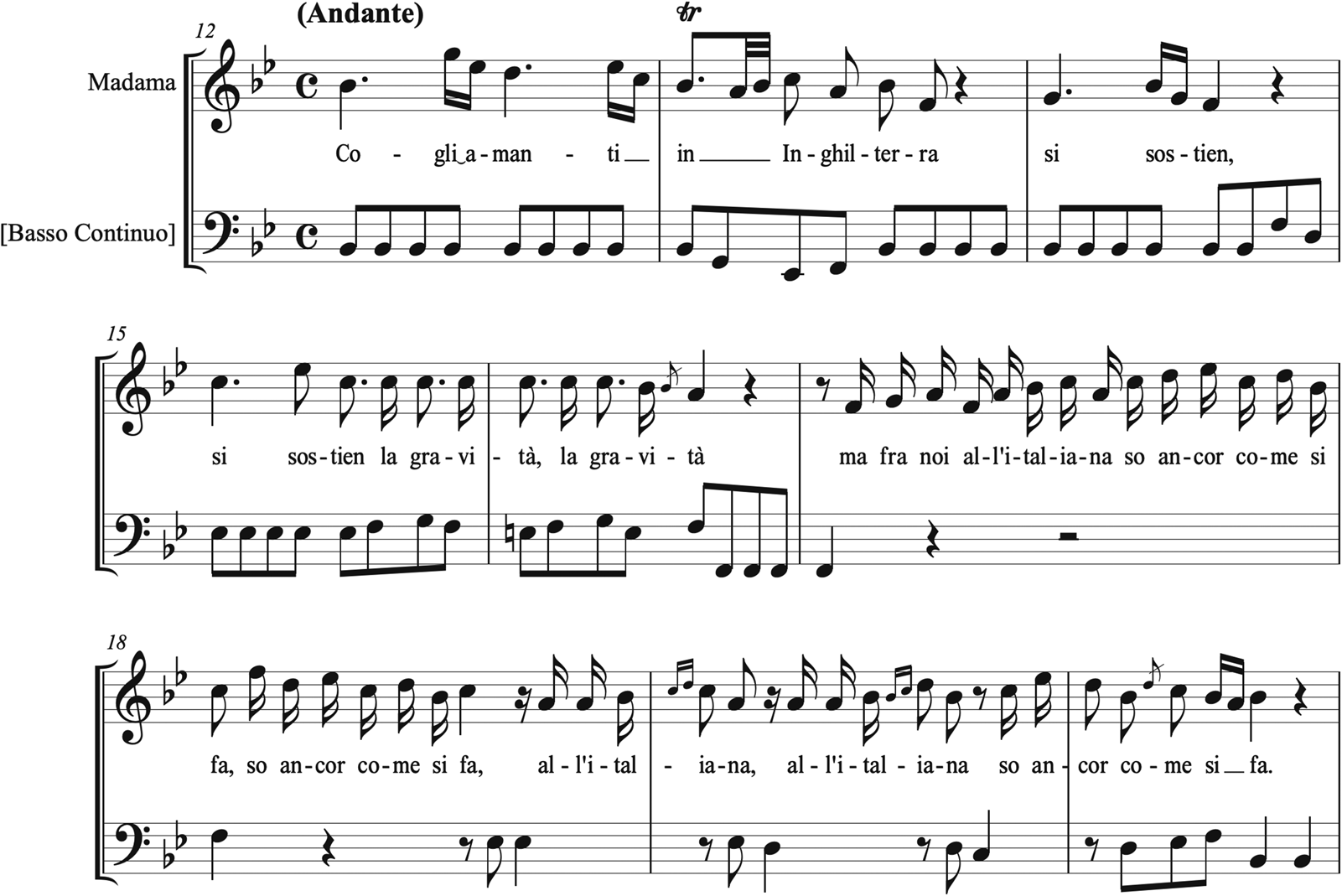
This aria is very similar to ‘Non sarebbe cosa strana’ in that its text has three distinct sections that are delineated musically by a change in metre and tempo. This was not, however, the only tool employed by the composers who set arias for Penna. Many arias rely more heavily on the delivery of the vocal line to mark off distinct sections. A good example of this comes in Penna's ‘Cogli amanti in Inghilterra’, from La ritornata di Londra, which was set by Domenico Fischietti for Venice in 1756. In this opera Penna plays a character named Madama Petronilla, a celebrated prima donna who has recently returned to Italy from a season in England. In this aria she contrasts the manners of the two nations, noting the civility of the English and the lack of pretence among the Italians. This distinction is reflected in the vocal line, which employs a lofty cantabile whenever discussing the English and a rapid patter for the Italians (Example 5).Footnote 46 While there is no change of tempo or metre in this moment, there is a clear transition of musical style that produces an equivalent effect.Footnote 47
Domenico Fischietti, ‘Cogli amanti in Inghilterra’, La ritornata di Londra, Act 1 Scene 11, bars 12–20. Museum Schloss Delitzsch, Bibliothek, Mus.3269-F-501, 30000042

This type of aria allowed Penna to display her strengths as a performer. It incorporates an array of vocal techniques that range from serious cantabile to parlando buffo lines. Placing these elements in immediate succession highlights the contrast and draws attention to Penna's virtuosic navigation of these diverse stylistic elements. Eventually, singers like Penna would be distinguished as performers of the role di mezzo carattere, a term that did not come into standard use until decades later. While the term was used by Goldoni in some librettos from around this time, it is hardly an established role category. Rather, it is a response to the unique talents of performers like Penna.
La buona figliuola
While some operas written for Penna and Baglioni found success outside their native Venice, most did not travel much further afield than Bologna or Milan. The first work by Goldoni to achieve international acclaim was his La buona figliuola. The female lead of this opera, Cecchina, tends to receive more attention today, but the work was initially very much a vehicle for the star tenor, Giovanni Lovattini.Footnote 48 The opera was not, however, written for Lovattini, or really for anyone. Unlike almost all of Goldoni's other operas, the libretto for La buona figliuola was written without specific singers in mind, and the singers who ultimately created the opera were less than satisfactory. In his memoirs Goldoni recalls:
L'opera [La buona figliuola] fit beaucoup de plaisir, et il auroit plu davantage, si l'exécution eût été meilleure; mais on s’étoit pris trop tard pour avoir de bons acteurs . . . les efforts des compositeurs ne suffisoient par pour suppléer aux défauts des acteurs.Footnote 49
The opera [La buona figliuola] gave much pleasure, and it would have pleased more if the performance had been better; but we were too late in looking out for good actors . . . the efforts of the composers were not enough to make up for the faults of the actors.
This disappointment, in such an influential work, seems almost tragic in light of Goldoni's propensity for creating unique roles for specific performers and his ability to tailor arias around their skills and preferences. Viewed in light of the dissemination of this opera, however, it is a felicitous accident.
In order to survive the vicissitudes of the international circuit an opera must be, at least to some extent, formulaic and adaptable. In La buona figliuola, the experiments that Goldoni had been carrying out in librettos written for singers such as Baglioni and Penna harden into conventions that are less specifically oriented around the talents of a given singer, and more open-ended in how they might be realized. Both of these features are demonstrated in the aria ‘Alla larga, alla larga, signore’ for Cecchina. The text for this aria does not include any cues that require a specific skill (for example, the rapid juxtaposition of dialects alla Penna), nor does it force the performer to engage in any buffoonery (such as falling out of a tree alla Baglioni). It does, however, include more than one poetic metre (decasillabo (usually ten syllables per line) and senario) and uses different registers of language that suggest a change in musical style.
Unlike the arias written for Penna and Baglioni discussed above, however, the organization of this text is open-ended. The first stanza is unified by both metre and tone. While the poetic metre changes going into the second stanza, the lofty language and haughty metaphor (being wounded by love) are maintained. A composer could therefore read the first two stanzas as distinct units (thus emphasizing the metre of the text) or choose to set them as a single musical section (thus emphasizing the content and tone of the text). Similarly, the second and third stanzas might be read as connected because they are both dominated by senario, or they could be distinguished on the basis of a shift to a more colloquial and less metaphorical use of language in the third stanza.

The decision to favour one reading over another would depend upon the needs of a given singer. Salvatore Perillo, who was setting this aria for Penna, opted to set each of the stanzas in its own metre, thus creating a tripartite aria along the lines of Penna's arias discussed earlier. Piccinni's Cecchina was created by the musico Tommaso Borghesi, a singer who filled the niche demand for male performers of female roles that was made necessary by Rome's long-standing prohibitions against women appearing on stage. When he set this aria for Borghesi, Piccinni decided to employ only two metres (one for stanzas one and two and another for stanza three), emphasizing the binary distinction between the elevated and colloquial use of language, a less progressive approach that may well have been welcomed by a singer with a more traditional background.Footnote 51
Conclusion
Neither of these settings would have been conceivable even ten years before the premiere of La buona figliuola. This fact alone demonstrates how quickly the conventions of comic opera changed during the period in question. The inherited tradition of relying on da capo form for almost all arias had been replaced by a more flexible and open-ended model. While da capo form still appeared frequently in arias for minor comic characters and almost exclusively for serious characters, it was no longer a ‘rule’, but rather one option among many. This new framework, which could accommodate the needs of many singers and the particulars of many performance situations, initially arose out of Goldoni's attempts to tailor arias around the unique talents of Baglioni and Penna.
Baglioni's propensity for contrasting affects and his desire to work up to climactic endings meant that his arias could not end with a return of the opening material. The alternation of contrasting materials and the explosions of patter that are appended to his big numbers were, initially, special effects reserved for this unique performer. This approach proved fruitful, however, and served as the foundation for a type of aria that has been called the male buffo aria and that would eventually become almost as formulaic as the da capo model it replaced. Penna's three-part arias, on the other hand, are less present in the relatively small sliver of Viennese works from the 1780s that attracts the attention of so many modern scholars of eighteenth-century opera.Footnote 52 This does not mean that they were less influential, though. For the generation of librettists and composers who were active c1760–c1770, this type of aria (along with its variants) was a standard vehicle for star singers of roles di mezzo carattere.Footnote 53
Still, the diffusion of these new ideas was not immediate or universal. Most theatres in northern Italy were heavily dependent on Venice for new operas. This meant that the works of Goldoni circulated rapidly across that circuit and through those central European centres, like Dresden and Prague, that were also served by the comic companies of northern Italy. Piccinni had endeared Goldoni to the Romans, but in the southern part of the Italian peninsula these developments were slower to take hold.Footnote 54 Outside Italy, Goldoni was championed primarily by Lovattini, who brought La buona figliuola with him as he travelled from Vienna to London, and, to a lesser extent, by Piccinni, who brought it to Paris. This opera then took on a life of its own beyond the individuals who created it. Librettos survive for no fewer than seventy distinct productions given before 1790 in every major European centre that could seriously claim to present comic opera. This work rapidly promulgated the developments discussed here and provided a model for librettists and composers of the following generation.Footnote 55
My primary purpose here, rather than tracing the dissemination of specific formal procedures, has been to shed light on the mechanism by which these forms came into being. The musicological assumption that the heroic and voracious genius of elite composers constantly drives the progress of music does not apply here.Footnote 56 In fact, the situation was often quite the opposite, in so far as the composer was typically the last to learn of new developments. The frustrations and desires of singers were the headwaters of operatic experimentation. Singers inspired and, in many cases, corrected the efforts of the librettist, who then, in turn, prompted the composer. While there are many developments in opera over the course of the century, this basic flow of ideas was almost always operative.