Non-technical Summary
Pterotheca is a distinct fossil gastropod genus that has previously been found in the Upper Ordovician and lower Silurian rocks in many parts of North America and Europe. Recently, a large collection of Pterotheca was obtained from rocks of middle Telychian (Llandovery, early Silurian) age in the Hunan Province of South China, providing the first record of this genus in Asia and in the low-latitude peri-Gondwanan region. Morphological analysis suggests that the close relatives of Chinese Pterotheca species are found in the Telychian of Scotland. The morphology of the Chinese species also implies the possibility that one of the Pterotheca species may be ancestral to the Devonian gastropod Aspidotheca. The Pterotheca species from South China possibly lived a slowly crawling life on a soft substrate, feeding on algae and/or detritus, and were adapted to a shallow-water setting with substantial terrigenous input. Given that almost all the known Silurian Pterotheca species occurred in sea-level fall and lowstand periods, isolation and enhanced ocean circulation during the early Silurian sea-level fall may have facilitated the speciation of Pterotheca globally; the connection of a sea pathway during the Rhuddanian (earliest Silurian) sea-level rising after the end-Ordovician glaciation could have led to the primary dispersal of Silurian Pterotheca.
UUID: http://zoobank.org/c121a52b-2d95-4eca-880c-0969424836f1
Introduction
Pterotheca Salter, Reference Salter1853 is an unusual bellerophontoid gastropod that completely reduced its coil (Wahlman, Reference Wahlman1992; Clarkson et al., Reference Clarkson, Harper and Peel1995; Ebbestad and Gutiérrez-Marco, Reference Ebbestad and Gutiérrez-Marco2017). The genus is readily identifiable with its low circular, ovate to subrectangular shell, median carina, and triangular internal septum. It occurs in the Upper Ordovician to the Llandovery (lower Silurian) in North America, Europe, and some other regions (Knight et al., Reference Knight, Cox, Keen, Batten, Yochelson, Robertson and Moore1960). It has been erroneously described as a brachiopod (Atrypa transversa Portlock, Reference Portlock1843) and has often been classified with the pteropod or heteropod gastropods, hyolithids, or even operculum of cephalopods. On the basis of the comparison of morphological trends, Wahlman (Reference Wahlman1992) analyzed the taxonomic relationships of several Middle to Late Ordovician bellerophontoid gastropods from the Cincinnati Arch Region of North America and assigned Pterotheca to the subfamily Pterothecinae Fischer, Reference Fischer1883 of the family Carinaropsidae Ulrich and Scofield, Reference Ulrich and Scofield1897. The most recent study upheld this classification and assigned Pterotheca to the superfamily Bellerophontoidea M'Coy, Reference M'Coy1851 (Ebbestad and Gutiérrez-Marco, Reference Ebbestad and Gutiérrez-Marco2017).
Pterotheca species have been recorded from the Upper Ordovician strata of Laurentia, Baltica, Avalonia, and peri-Gondwana, while the Silurian species have hitherto been found in the Llandovery (lower Silurian) of Scotland (four species), England (one species), and Spain (one species) (Table 1), representing their patchy distribution in marginal Laurentia, eastern Avalonia, and high-latitude peri-Gondwana, respectively. Ebbestad and Gutiérrez-Marco (Reference Ebbestad and Gutiérrez-Marco2017) summarized the stratigraphical and geographical occurrence of all known Silurian Pterotheca species and discussed their morphological variations and temporal and spatial distribution. In that study, they proposed that the Silurian Pterotheca lineage can be recognized in all the mentioned areas before the end-Ordovician extinction.
Alphabetical list of Silurian Pterotheca species and their stratigraphical and geographical occurrences, sedimentary facies, associated fauna, and inferred paleoenvironments.

In this paper, two new species of Silurian Pterotheca, Pterotheca yongshunensis and P. xiushanensis, are described from the Telychian of South China, which belongs to low-latitude peri-Gondwana. In total, 238 specimens of Pterotheca species were collected from the upper Xiushan Formation of Hunan Province. The new species are compared with known Silurian Pterotheca species, and their morphology and paleoecologic and paleogeographic significances are discussed. The discovery of Pterotheca in South China raises a question of how the morphologically distinctive species of the genus originated in the northeastern peri-Gondwana region, which is believed to be geographically widely separated from eastern Laurentia and Avalonia (Ebbestad and Gutiérrez-Marco, Reference Ebbestad and Gutiérrez-Marco2017; Scotese, Reference Scotese2021), or in other words, how the species were dispersed from the Western Hemisphere into South China in the late Llandovery.
Geological setting
The first locality yielding the genus Pterotheca in South China is the Wanping section, Yongshun County, Hunan Province, where the gastropods were recorded in the Xiushan Formation (Figs. 1, 2.1). Other known localities yielding Pterotheca include some sections in the Baojing and Xiushan counties at the border of western Hunan Province and eastern Chongqing Municipality. The Xiushan Formation, ~400–600 m thick and widely distributed in southwestern China (i.e., Hubei, Hunan, Sichuan, and Guizhou provinces and Chongqing Municipality), is divided into two members. The Lower Member is characterized by yellowish-green siltstone, silty mudstone, and fine sandstone containing a few low-diversity brachiopods, trilobites, and gastropods. The Upper Member is dominated by yellowish-green mudstone and siltstone and is interbedded with thin-bedded and nodular limestone in the upper part (Fig. 2.2–2.5). Abundant shelly fossils such as trilobites, brachiopods, gastropods, cephalopods, and hyoliths, which are collectively known as the Xiushan Fauna (Rong et al., Reference Rong, Chen, Wang, Geng, Wu, Deng, Chen and Xu1990) (i.e., Coronocephalus–Sichuanoceras–Salopinella–Stomatograptus sinensis Fauna; Ge et al., Reference Ge, Rong, Yang, Liu, Ni, Dong and Wu1979; Rong et al., Reference Rong, Chen, Wang, Geng, Wu, Deng, Chen and Xu1990), occur within the Upper Member of the Xiushan Formation. At the Wanping section, Pterotheca co-occurs with some other elements of the Xiushan Fauna within approximately 30 m thick, thick-bedded, yellowish-green silty mudstone in the middle–upper part of the Upper Member (Fig. 2).
Distribution of Telychian (Silurian) strata in South China and the location of the studied area in Hunan Province, and lithostratigraphic subdivision of the Llandovery in northwestern Hunan (modified after Wang et al., Reference Wang, Rong, Tang, Huang, Zhang and Zhao2021; Chen, Reference Chen2023). Fm., Formation; Sys., System; Ser., Series; Sta., Stage; Lithostrat., Lithostratigraphy.

(1) Sedimentological column of the Wanping section. (2) Major outcrop feature of the Upper Member of the Xiushan Formation. (3) Photomicrograph of (2) showing silty mudstone microfacies. (4) Thin-bedded limestone ribbons of the Upper Member of the Xiushan Formation. (5) Photomicrograph of (4) showing bioclastic lime mudstone microfacies. Hammer in (2) and (4) is 32 cm long.

The Xiushan Formation was assigned a Telychian age on the basis of the occurrences of the graptolites Monoclimacis griestoniensis (Nicol, Reference Nicol1850), M. opercula Mu et al., Reference Mu, Li, Ge, Chen, Ni, Lin and Mu1974, and Stomatograptus sinensis Wang, Reference Wang1965 and was correlated with the M. griestoniensis Biozone to the Oktavites spiralis Biozone (Chen et al., Reference Chen, Rong, Wang, Geng, Chen, Chen and Rong1996). Because of the occurrence of the conodont Pterospathodus sp., the Lower Member of the Xiushan Formation was correlated with the Pterospathodus eopennatus Superbiozone (Chen et al., Reference Chen, Wang and Fan2016), while the Upper Member was assigned to the middle Telychian and correlated with the Pterospathodus eopennatus Superbiozone to the P. celloni Superbiozone based on the discovery of P. eopennatus and P. sinensis (Wang et al., Reference Wang, Chen, Wang and Tang2010; Chen et al., Reference Chen, Wang and Fan2016). Therefore, the age of our new Pterotheca material collected from the Upper Member of the Xiushan Formation is middle Telychian, falling into the previously established stratigraphical range of the genus (Upper Ordovician to lower Silurian) (Ebbestad and Gutiérrez-Marco, Reference Ebbestad and Gutiérrez-Marco2017).
Materials and methods
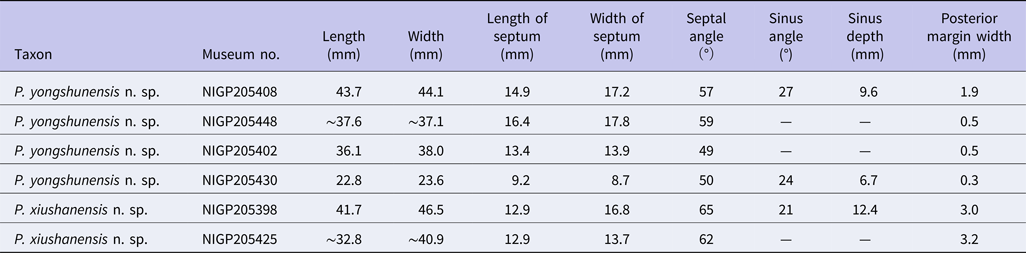
In total, 238 specimens of Pterotheca were collected from the Wanping section, of which 60 well-preserved specimens are studied herein in detail. The specimens were measured and identified on the basis of their general outline shape, ornamentations of shell, and apex, sinus, median carina, and septa features (Fig. 3). Specimens were coated with magnesium powder before photography (Figs. 4–7) and measured by Image J and/or CorelDRAW 2021 on photographs, noting that the specimens with skewness that is possibly related to taphonomic deformation are measured on retro-deformed images using CorelDRAW 2021, where the shell is symmetrical along the median axis. Eight morphological parameters were measured on the specimens: the length and width of shell, the length and width of the septum, septal angle, sinus angle and depth, and posterior margin width (Fig. 3; Table 2; Supplementary material) following the suggestion of Ebbestad and Gutiérrez-Marco (Reference Ebbestad and Gutiérrez-Marco2017). The measurement data were analyzed using Microsoft Excel.
Generalized external (dorsal) and internal shell morphology of Silurian Pterotheca from South China and the structural terms and dimensional parameters used in this study (following Ebbestad and Gutiérrez-Marco, Reference Ebbestad and Gutiérrez-Marco2017).

Pterotheca yongshunensis n. sp. from the Xiushan Formation of the Wanping section. (1, 2) P. yongshunensis n. sp. (NIGP205408, holotype). (3) P. yongshunensis n. sp. (NIGP205448, paratype 1). (4–6) P. yongshunensis n. sp. (NIGP205402, paratype 2). (7, 8) P. yongshunensis n. sp. (NIGP205430, paratype 3). (1, 3, 4, 7) Dorsal views; scale bars = 10 mm. (2, 5, 6) Marginal apex and posterior margins (white arrows); scale bars = 2.5 mm. (6) Detail of upper surface of internal septum of (4) showing wavy growth lines; scale bar = 5 mm. (9) Details of medial sinus (white arrow points to the posterior part of sinus) and shell ornamentation of radial striae; scale bar = 5 mm.

Completely preserved Pterotheca yongshunensis n. sp. from the Xiushan Formation of the Wanping section. (1–3) P. yongshunensis n. sp. specimens with marginal apex (NIGP205423, NIGP205427, NIGP205428). (4–9) P. yongshunensis n. sp. specimens with submarginal apex (NIGP205394, NIGP205424, NIGP205442, NIGP205399, NIGP205449, NIGP205440). Scale bars = 10 mm. Yellow arrows in (1) and (5) show inferred deformational trends.

Pterotheca xiushanensis n. sp. from the Xiushan Formation of the Wanping section. (1) Dorsal view of holotype (NIGP205398). (2, 3) Pterotheca xiushanensis n. sp. (paratype, NIGP205425). (3) Detail of (2) shows the straight posterior margin, wide and flat area between posterior margin and apex, and moderately incurved apex. Scale bars = 10 mm.

Polymorphic variation in Pterotheca yongshunensis n. sp.; yellow arrows show inferred deformational trends. (1) “Broad” shaped shell. (2) “Long” shaped shell. (3) Left-skewed form. Note the separated and sheared ventral and dorsal valves of a brachiopod (red arrows) co-occurring with the skewed Pterotheca. (4) Co-occurring trilobites (Coronocephalus gaoluoensis Wu, Reference Wu1979) show the same deformational trend as deformed Pterotheca. (5) Right-skewed shell preserved together with left-skewed shell. (6) Same deformational orientation between skewed trilobite and Pterotheca. Note the Pterotheca is asymmetrical and left-skewed (highlighted by black dashed line and yellow arrow). (7) Compactional deformation of the shell preserved perpendicular to the bedding surface. Scale bars = 10 mm.

Measurements of type specimens of Pterotheca yongshunensis n. sp. and P. xiushanensis n. sp. See Figure 3 for explanation of the parameters.

Repositories and institutional abbreviations
All specimens are deposited in the Nanjing Institute of Geology and Palaeontology, Chinese Academy of Sciences (NIGPAS), Nanjing, China.
Systematic paleontology
Superfamily Bellerophontoidea M'Coy, Reference M'Coy1851
Family Carinaropsidae Ulrich and Scofield, Reference Ulrich and Scofield1897
Subfamily Pterothecinae Fischer, Reference Fischer1883
Genus Pterotheca Salter, Reference Salter1853
Type species
Atrypa transversa Portlock, Reference Portlock1843 (p. 455) assigned by Salter (Reference Salter1853, p. 61), probably from the Sandbian Bardahessiagh Formation of Desertcreat, Tyrone, Northern Ireland (Ebbestad and Gutiérrez-Marco, Reference Ebbestad and Gutiérrez-Marco2017).
Holotype
A nearly complete adult shell (NIGP205408, Fig. 4.1, 4.2). Llandovery (early Silurian), middle Telychian; silty mudstone layers of the middle–upper part of the Upper Member of Xiushan Formation; Wanping section, Yongshun County, Hunan Province, China.
Diagnosis
Large-sized Pterotheca species with wavy, radial striae and a low-relief marginal to submarginal apex. Shell very low, circular to subovate, weakly ornamented with growth lines bundled into periodic co-marginal bands and irregular surface elevations.
Description
The shell is very low, circular to subovate, 44.1 mm wide and 43.7 mm long in the holotype, ~37.1 mm wide and ~37.6 long in the paratype 1, 38.0 mm wide and 36.1 mm long in the paratype 2, and 23.6 mm wide and 22.8 mm long in the paratype 3. Length thus being 95%–101% of the width in the type specimens, and in all the measured specimens, the length/width ratio ranges between 80% and 115% (Supplementary material), showing highly variable shapes (Figs. 4–7). Maximum width is at mid-length. Shell is symmetrical, although some specimens show occasionally asymmetrical deformation (Figs 5.1, 5.5, 7.3, 7.5, 7.6; see Discussion). The median dorsal carina in the holotype is partially broken, but anteriorly shows a very narrow V-shaped apertural sinus (Fig. 4.1). The paratype 1 (NIGP205448) shell is not complete, but it exposes a complete upper surface of septum (Fig. 4.3). The septum is triangular, gently convex dorsally, and expands anterolaterally from apex of shell. Anterior margin of the septum is defined by a pair of anteriorly divergent curves, forming parallel wavy growth lines on the upper surface (Fig. 4.3). In the paratype 2 (NIGP205402), parallel wavy growth lines on the upper surface of the septum can also be seen (Fig. 4.4, 4.6). The septa in the holotype and paratypes 1, 2, and 3 are 34%, 44%, 37%, and 40% of shell lengths, and are 39%, 48%, 37%, and 37% of maximum widths, respectively. In all the measured specimens, the length of septum/length of shell and width of septum/width of shell range between 29% and 54% and between 26% between 48%, respectively. The width of the septum in the holotype is 115% of its length, with the septal angle at the posterior being 57°. In other specimens, the septum width/length ratio is 78%–152%, with a septal angle of 44°–67°.
The shell is generally flat laterally along the acute carina, thus not expressing any trilobation of the shell, and in the paratype 3 (NIGP205430), the dorsal part of the shell is mostly well preserved, showing a narrow and sharply elevated median carina (Fig. 4.7, 4.9). The apertural margin swings sharply backward, forming a narrow V-shaped sinus. In the holotype, the angle of the sinus is 27° and reaches back 22% of its shell length, where it turns into the sharp carina; in paratype 3, the angle of the sinus is 24° and reaches back about 30% of the shell length, where it merges with the sharp carina. In other well-preserved specimens, the angle of the sinus ranges from 14.1° to 33.6° and reaches back 22%–36% of the shell length (Supplementary material). No evidence of the occurrence of any slit or selenizone is observed.
The apex is very low, marginal to submarginal and weakly incurved, forming a slight separation of two lobes of the shell at the posterior margin (Fig. 4.2, 4.5, 4.8); thus, the posterior margin width is almost negligible in some of the specimens (e.g., Figs. 4.4, 4.7, 5.1–5.3). In larger specimens, the overgrowth of the shell will connect the separated posterior parts and form a very narrow marginal area with parallel growth lines with the posterior margin width being 0.6%–5.7% of the shell length. The posterior margin is concave, wavy to flat, and upcurved in later growth, and thus the dorsal curvature and elevation of the posterior margin are most noticeable in larger specimens (e.g., Figs. 4.1, 4.2, 5.4–5.9).
The concentric growth lines of shell are co-marginal at the posterior part, forming periodic co-marginal bands (e.g., Figs. 4.1, 4.4, 5.1, 5.2, 5.5, 5.6). Surface ornamentation also consists of radial, wavy striae (Figs. 4.1, 4.7, 4.9, 5), superimposing upon irregularly shaped surface elevations that are more distinctive in the posterocentral part.
Etymology
From the name of the Yongshun County where the Chinese Pterotheca was first discovered.
Material
Holotype (NIGP205408, Fig. 4.1, 4.2) and three paratypes that show septa structures, adult shell with marginal apex, a complete juvenile shell, respectively (NIGP205448, paratype 1, Fig. 4.3; NIGP205402, paratype 2, Fig. 4.4–4.6; NIGP205430, paratype 3, Fig. 4.7–4.9), and 54 well-preserved specimens (e.g., Fig. 5); all are housed in Nanjing Institute of Geology and Palaeontology, Chinese Academy of Sciences (NIGPAS), Nanjing, China.
Measurements
See Table 2, Figure 8, and Supplementary material.
Linear measurements of Silurian Pterotheca species: P. avirostris Pitcher, Reference Pitcher1939, P. gath, P. hispanica, P. mullochensis, Pterotheca aff. P. mullochensis, P. multidecorata, P. yongshunensis, and P. xiushanensis. (1) Length versus width. (2) Length of septum versus width of septum. (3) Width of shell versus width of septum. (4) Width of shell versus width of shell/width of septum. (5) Width of shell versus septal angle. (6) Width of shell versus width of shell/septal angle. (7) Length of shell versus posterior margin width. (8) Length of shell versus posterior margin width/length of shell. (9) Septal angle versus posterior margin width/length of shell.

Remarks
Pterotheca yongshunensis n. sp. is similar to Pterotheca. aff. P. mullochensis Reed, Reference Reed1909 (Clarkson et al., Reference Clarkson, Harper and Peel1995) in its large shell, low relief, ovate to circular shape, narrow carina, and generally marginal apex. The major differences between these two species are the existence of radial striae ornamentation in P. yongshunensis and the asymmetrical shell in Pterotheca aff. P. mullochensis. In addition, Pterotheca aff. P. mullochensis has a much wider and shallower sinus and lower length/width ratio. The general shape, sinus depth, and concentric bands of P. yongshunensis are also similar to that of P. hispanica Ebbestad and Gutiérrez-Marco, Reference Ebbestad and Gutiérrez-Marco2017, but the latter is much smaller in size, lacks radial ornamentation, and has a higher and more projecting apex (Fig. 9). Of the previously described Pterotheca species, only P. multidecorata Reed, Reference Reed1909 has an ornamentation of radial striae, which distinguishes it from all the other known species. However, the shell of P. multidecorata is much higher than that of P. yongshunensis, and P. multidecorata has lateral folds along the median carina, forming marked trilobation of the shell.
General outlines and the features of apex (red line highlighted) and posterior margin of Pterotheca hispanica Ebbestad and Gutiérrez-Marco, Reference Ebbestad and Gutiérrez-Marco2017, P. yongshunensis n. sp., P. xiushanensis n. sp., and the Devonian genus Aspidotheca Spriesterbach, Reference Spriesterbach1919.

Multiple measurements of Silurian Pterotheca, including the new species of P. yongshunensis in this study, show nearly equal length/width and length of septum/width of septum ratios between different species, except for the length/width ratio of the septum of Pterotheca aff. P. mullochensis, which has been previously discussed by Ebbestad and Gutiérrez-Marco (Reference Ebbestad and Gutiérrez-Marco2017) (Fig. 8.1, 8.2). These values reflect the general features of the shape of this genus. The lower width of shell against width of septum ratio in the Chinese Pterotheca separates the Chinese species from the other known species except for Pterotheca aff. P. mullochensis (Fig. 8.3). The ratios of width of shell against width of shell/width of septum show remarkable variations. Ebbestad and Gutiérrez-Marco (Reference Ebbestad and Gutiérrez-Marco2017) interpreted this phenomenon as intraspecific variability; our new measurements on P. yongshunensis support this assertion (Fig. 8.4). Although there is a large variation in the septal angle of P. yongshunensis, which may represent intraspecific variation as well as some taphonomic deformation, they can still be roughly distinguished from other species (Fig. 8.5, 8.6).
In our collection of P. yongshunensis, some specimens show either intraspecific variations or taphonomic deformation to varied extents (Fig. 7), indicating that measurements based on a single indicator, such as septal angle, width/length ratio, and general shape of shell may not be precise enough to differentiate species (see the following). Our measurements on posterior margin width and the ratio of posterior margin width/length of shell have differentiated P. xiushanensis n. sp. (see the following) from P. yongshunensis (Fig. 8.7, 8.8). It seems that the features of posterior margin and apex are important and reliable in distinguishing species, as most of the Silurian species have a marginal apex while some Ordovician Pterotheca have a hook-like apex.
Pterotheca xiushanensis new species
Figure 6
Holotype
A nearly complete shell (NIGP205398, Fig. 6.1). Llandovery (early Silurian), middle Telychian; silty mudstone layers of the middle–upper part of the Upper Member of Xiushan Formation; Wanping section, Yongshun County, Hunan Province, China.
Diagnosis
Large-sized Pterotheca species with wavy, radial striae and wide space between posterior margin and apex. Apex is moderately elevated. Posterior marginal area is largely flat, with gently curved growth lines. Shell widely expanded, with median part moderately elevated, weakly ornamented with growth lines bundled into periodic co-marginal bands and irregular surface elevations.
Description
The holotype (NIGP205398) shell is circular, 41.7 mm wide and 46.5 mm long, with length-to-width ratio of 90%. Maximum width is at mid-length (Fig. 6.1). The paratype (NIGP205425) is not complete (the anterior part is broken off), with a maximum width of 32.8 mm. Shell is symmetrical, dorsal median carina is sharply rising and acute, dorsal part around median carina is moderately elevated compared with the flat and wide area between the posterior shell margin and apex. The apex of dorsal carina in holotype is partially broken off, but the anterior part of carina shows a very narrow V-shaped apertural sinus (Fig. 6.1). In the holotype, the angle of the sinus is 21° and reaching back 30% of its shell length, where it turns into the sharp carina. No evidence of the occurrence of any slit or selenizone is observed. Apex is submarginally elevated and moderately incurved. The posterior margin width is 7% and 9.9% of shell length (Table 2). The posterior margin is straight to slightly concave, and dorsally flat (Fig. 6.1–6.3).
Holotype and paratype shells expose septa, but no growth lines are preserved on the upper surface. The septum is triangular, gently convex dorsally, and expands anterolaterally from the apex of shell. The septum in holotype is 31% of the shell length and 36% of the shell maximum width, and the septum width/length ratio is 130% with a septal angle at the posterior of 65°. In the paratype, the septum is 33% of the shell maximum width, and the septum width/length ratio is 106% with a septal angle of 62°. The concentric growth lines of shell are co-marginal at the posterior part, forming periodic co-marginal bands. Surface ornamentation consists of radial, wavy striae (Fig. 6.1, 6.2), superimposed on irregularly shaped surface elevations.
Etymology
From the name of the Xiushan County where the lithostratigraphic formation (the Xiushan Formation) yielding Chinese Pterotheca was named.
Material
Holotype (NIGP205398, Fig. 6.1) and a paratype with good preservation of the posterior margin (NIGP205425, Fig. 6.2, 6.3), all of which are housed in Nanjing Institute of Geology and Palaeontology, Chinese Academy of Sciences (NIGPAS), Nanjing, China.
Remarks
The species Pterotheca xiushanensis n. sp. resembles P. yongshunensis n. sp. in its large shell, radial striae ornamentation, acute carina, and deep, narrow median sinus, but differs in its larger width between the posterior margin and apex (Fig. 9; Table 2). The flat dorsal posterior marginal area in P. xiushanensis also distinguishes it from P. yongshunensis. The septal angle in P. xiushanensis is significantly larger than that in most other Silurian Pterotheca species, except for two specimens of P. yongshunensis (NIGP205424 and NIGP205437) with septal angles of 65° and 67°, respectively (Fig. 5.5). These two specimens have lower posterior margin width/length of shell ratios, and one of them shows some right-skewed deformation (Fig. 5.5). Therefore, their larger septal angles may be related to the superimposition of intraspecific variation of P. yongshunensis and taphonomic deformation. P. xiushanensis also shares similarity with P. yongshunensis and P. multidecorata in having the ornamentation of radial striae but is distinguished in its moderately elevated median part of shell, which is evenly lower than that of P. multidecorata, and the lack of trilobation of the shell.
It is noteworthy that, according to Wahlman (Reference Wahlman1992), the relief and position of the apex are vital for distinction of subfamilies of Pterothecinae Fischer, Reference Fischer1883 (includes Pterotheca Salter, Reference Salter1853 and Cyclotheca Teichert, Reference Teichert1935) and the Devonian Pedasiolinae Wahlman, Reference Wahlman1992 (includes Aspidotheca and Pedasiola Spriesterbach, Reference Spriesterbach1919), in which Pterotheca and Cyclotheca are characterized by shell having a marginal incurved apex whereas Aspidotheca and Pedasiola are characterized by a submarginal elevated apex. Accordingly, on the basis of these apex features and outlines of shell, P. xiushanensis is comparable to the Devonian Aspidotheca (Knight et al., Reference Knight, Cox, Keen, Batten, Yochelson, Robertson and Moore1960; Teichert, Reference Teichert1961), except for the much simpler structures on the septum and the lower elevation of the apex in P. xiushanensis (Fig. 9). Although Wahlman (Reference Wahlman1992) considered that the genera Aspidotheca and Pedasiola may have developed in a lineage separate from the Carinaropsinae, our discovery of P. xiushanensis implies the possibility that Aspidotheca evolved from Pterotheca.
Taphonomic deformation caused some polymorphic variation in Chinese Pterotheca
Many known Pterotheca species, such as P. mullochensis and P. gath Lamont, Reference Lamont1978, have remarkably asymmetrical shells (Reed, Reference Reed1909; Clarkson et al., Reference Clarkson, Harper and Peel1995; Ebbestad, Reference Ebbestad, Clarkson, Harper, Taylor and Anderson2007; Candela and Crighton, Reference Candela and Crighton2019). Reed (Reference Reed1909) may have assumed that the skewness exhibited by his specimens may have resulted from tectonic distortion, as he did not comment on the asymmetry phenomenon (Clarkson et al., Reference Clarkson, Harper and Peel1995). However, Clarkson et al. (Reference Clarkson, Harper and Peel1995) proposed, on the basis of their numerous specimens of P. gath (P. trimerelloides Clarkson et al., Reference Clarkson, Harper and Peel1995 in their study should be regarded as a junior subjective synonym of P. gath according to Ebbestad, Reference Ebbestad, Clarkson, Harper, Taylor and Anderson2007) from the Silurian Wether Law Linn Formation of Scotland, that a survival strategy that presents to a predator a mosaic of different search images accounted for the variability of the Pterotheca morphology. There was no evidence indicating preferred orientation or taphonomic deformation of the associated fauna of the Scottish species, and thus taphonomic artifact as basis for the marked shell variations was excluded in their study.
In our present collection of Chinese Pterotheca, polymorphic variation is also present in P. yongshunensis n. sp. However, only 18% (11 out of 60) of the complete specimens show clear evidence of asymmetry (e.g., Figs. 5.1, 5.5, 7.3, 7.5, 7.6), which is different from P. gath, where every specimen is skewed (Clarkson et al., Reference Clarkson, Harper and Peel1995). Our specimens also show a complete transitional range of shell morphologies from left-skewed (Figs. 5.1, 7.3, 7.5, 7.6) to right-skewed (Figs. 5.5, 7.5) and from ‘broad’ (Fig. 7.1) to ‘long’ shaped shells (Fig. 7.2, 7.4). As P. xiushanensis n. sp. is rare in the Wanping section, the morphological variation of its shell remains unclear. Because the shell morphologies vary significantly, some measurements such as the septal angle, the length/width ratio, and the septal length/width ratio, cannot be relied on to distinguish species. Instead, we suggest using the features of the posterior margin and apex and the shell ornamentation to differentiate species of Pterotheca (Figs. 8, 9).
Some of the polymorphic variations of P. yongshunensis from its type locality in South China seem to be triggered by taphonomic deformation. First, some well-preserved Pterotheca specimens are not distorted, showing regularly circular and symmetric shells (Figs. 4–6), in contrast to some extreme examples in which the shells are preserved perpendicular to the bedding surface with evidence of compactional deformation (Fig. 7.7). Second, in some cases in which two specimens are preserved on the same bedding surface, there is clear evidence of preferred orientation, showing right-skewed shell co-occurring with the left-skewed shell (Fig. 7.5). Third, many associated fossils from the Xiushan Fauna bed, such as trilobites and brachiopods, show similar deformation to that of the Pterotheca specimens, as would surely be evident in the separated and sheared ventral and dorsal valves of the associated brachiopod (Fig. 7.3). One example shows two trilobites (Coronocephalus gaoluoensis Wu, Reference Wu1979) co-elongated with Pterotheca (Fig. 7.4), given that the length/width ratios of the two trilobites are 1.90 and 1.53, respectively, and undeformed Coronocephalus gaoluoensis normally has a length/width ratio of ~1.65–1.75 (measurements based on materials from Chen et al., Reference Chen, Han and Luo2011 and our new collections). Further, the same deformational orientation can also occur between skewed trilobite and Pterotheca within one rock specimen (e.g., Fig. 7.6). Previous researchers believe that Pterotheca might naturally change their shape because of inherent plasticity, or that Pterotheca might have developed different shapes as a survival strategy (Clarkson et al., Reference Clarkson, Harper and Peel1995). However, we found that taphonomic deformation seems to have influenced many of our new Pterotheca specimens and in some degree led to their morphological variations. Despite our new findings, we cannot rule out the possibility of previous hypotheses.
Paleoecologic features of Pterotheca and its associated Xiushan Fauna
All known Pterotheca species are recorded from normal marine to very shallow, quiet lagoonal or tidal-flat environments near the shore (e.g., Robertson, Reference Robertson1989; Clarkson et al., Reference Clarkson, Harper and Peel1995). Its associated fauna includes standard marine brachiopod–trilobite assemblages and/or ostracods, bivalves, and gastropod-dominated assemblages, which indicate a relatively restricted environment. Accordingly, Pterotheca is a fully marine gastropod, with some species, such as P. expansa (Emmons, Reference Emmons1842), P. gath, and P. saffordi (Hall, Reference Hall1861), being tolerant of periodically fluctuating salinity (Wahlman, Reference Wahlman1992; Clarkson et al., Reference Clarkson, Harper and Peel1995). The morphology of their broad explanate shells and septa is analogous to that of the modern limpet Crepidula, which implies that species of Pterotheca also lead a nearly sedentary life as surface scrapers and/or detritus feeders (Wahlman, Reference Wahlman1992). It is noteworthy that all known Silurian Pterotheca species are from siliciclastic deposits (Table 1), implying that they were adapted to or even depended on influx of terrigenous clastics, in contrast to the Ordovician Pterotheca species, which are recorded from either siliciclastic or carbonate settings (e.g., Reed, Reference Reed1909; Wahlman, Reference Wahlman1992; Clarkson et al., Reference Clarkson, Harper and Peel1995). However, this distribution might merely reflect the fact that Pterotheca occurrences in Silurian carbonates have not yet been recognized. Thus, this paleoecological hypothesis will be further refined with the discovery of more Silurian specimens.
The remarkable expansion and flattening of the shells of Silurian Pterotheca, especially for the present new species from South China, reflects the likely development of a large foot to prevent sinking into the mud or silt deposits (e.g., Peel, Reference Peel1984; Ponder et al., Reference Ponder, Lindberg and Ponder2020), and thus suggesting an adaptation to life on the soft fine-grained substrate. Such an adaption is also corroborated by the development of its thin and lightweight shell. None of our current specimens is encrusted or drilled by other organisms, indicating that the Chinese Pterotheca had a slow-moving lifestyle rather than a stationary life; moreover, its widely expanded soft part may partially cover the dorsal part of shell like many recent limpet gastropods such as Megathura crenulata (Sowerby, Reference Sowerby1825).
The Pterotheca-associated benthic fauna of the Xiushan Fauna, such as brachiopods and trilobites, are also ecologically significant. The brachiopod fauna from the upper Xiushan Formation is assigned to the Salopinella–Xinanospirifer Assemblage by Chen and Rong (Reference Chen and Rong1996) and was recently revised to the Nalivkinia magna–Striispirifer–Xinanospirifer–Aegiria Assemblage by Chen (Reference Chen2023). These highly diverse brachiopods are interpreted to have been living in a normal, shallow subtidal environment and to constitute a Benthic Assemblage (BA) 2 to 3 (Chen and Rong, Reference Chen and Rong1996; Chen, Reference Chen2023). The trilobites of the upper Xiushan Formation, as represented by the remarkable Coronocephalus Assemblage, are considered to be successfully adapted to the typical sedimentary environments of the Xiushan Formation and its contemporaneous strata of similar lithofacies. Only a few relics of this assemblage survived to the latest Telychian in the similar shallow siliciclastic marine environments in the border area of Sichuan and Shaanxi provinces (Wu, Reference Wu1990; Wu and Lane, Reference Wu, Lane, Chen and Rong1996) as sea-level fluctuations and tectonic events after the late Telychian may have resulted in habitat loss and extinction of these specialized trilobites in South China. Furthermore, the thick siltstone-dominated succession (commonly 100s of meters), as well as the occasional occurrence of shale breccia, suggest a rapid deposition of the Xiushan Formation (Chen et al., Reference Chen, Rong, Wang, Geng, Chen, Chen and Rong1996) and thus an effective terrigenous input with increasing accommodation space due to stagewise tectonic tilting during the Kwangsian Orogeny (Chen and Rong, Reference Chen and Rong1996; Wang et al., Reference Wang, Rong, Tang, Huang, Zhang and Zhao2021). The sedimentary structures and microfacies of the Xiushan Formation at the Wanping section, which show rapid deposition of fine-grained sediments without obvious sedimentary indicators of traction and gravity flows, support its previous interpretation of a shallow subtidal marine environment. In addition, the Xiushan Formation yields a large number of completely preserved gastropods, trilobites, and brachiopods, indicating that the fossil assemblage, including Pterotheca, did not undergo long-distance transportation. Therefore, the sedimentary characteristics of the Xiushan Formation can indicate the living environment of Pterotheca in the early Silurian. Accordingly, the Pterotheca species documented here from the Xiushan Formation possibly lived a slowly crawling life like algae scrapers and/or detritus feeders on a soft substrate and were probably adapted to a shallow subtidal setting (BA2–BA3) with a substantial terrigenous input.
Paleogeographic implications of Silurian Pterotheca from South China
All the previously known Silurian species of Pterotheca were from the Rhuddanian–Telychian (Llandovery, lower Silurian) of Scotland, England, and Spain, indicating their patchy paleogeographic distribution in marginal Laurentia, Eastern Avalonia, and high-latitude peri-Gondwana (Reed, Reference Reed1909; Pitcher, Reference Pitcher1939; Lamont, Reference Lamont1978; Clarkson, Reference Clarkson, Harper and Peel1995; Ebbestad and Gutiérrez-Marco, Reference Ebbestad and Gutiérrez-Marco2017). The new records of the P. yongshunensis n. sp. and P. xiushanensis n. sp. from the Telychian of South China extend the distribution of the Silurian Pterotheca (Fig. 10) into the low-latitude northeastern peri-Gondwanan region, although it is unclear whether Pterotheca was dispersed to this remote region by means of oceanic circulation after the end-Ordovician mass extinction or if it had already inhabited there earlier in the Ordovician (Ebbestad and Gutiérrez-Marco (Reference Ebbestad and Gutiérrez-Marco2017).
Llandovery paleogeographic reconstruction and the patchy distribution of all known Silurian Pterotheca species (color points) (modified after Ebbestad and Gutiérrez-Marco, Reference Ebbestad and Gutiérrez-Marco2017; Scotese, Reference Scotese2021).

The new occurrence records of Silurian Pterotheca in South China, along with the data of sedimentary facies and ecological features related to the genus's other occurrences in the Silurian (Table 1), provide a new possibility for the distribution pattern of Pterotheca. Our new species P. yongshunensis n. sp. is closely comparable to the Scottish Pterotheca aff. P. mullochensis (Clarkson et al., Reference Clarkson, Harper and Peel1995), which was also recorded from Telychian strata. It seems likely that their ancestor experienced a quick spread into Laurentia and South China, which paleogeographically appear to be far from each other (e.g., Ebbestad et al., Reference Ebbestad, Frýda, Wagner, Horný, Isakar, Harper and Servais2013; Scotese, Reference Scotese2021), and that was followed by a short period of isolation. As mentioned, the South China species also resemble the Scottish P. multidecorata in their distinctive radial ornaments, along with the similarity of their associated fauna, which is characterized by the abundant occurrence of brachiopods, hyoliths, and gastropods, indicating similar paleoenvironments in both marginal Laurentia and South China during the middle Telychian (Table 1).
To better understand the paleobiogeographic dispersion of Pterotheca species in early Silurian, we try to correlate the stratigraphic occurrences of Pterotheca (Ebbestad and Gutiérrez-Marco, Reference Ebbestad and Gutiérrez-Marco2017; this paper) with the global sea-level curves well constrained by graptolite and conodont biozones (Loydell, Reference Loydell1998; Johnson, Reference Johnson2006, Reference Johnson2010; Haq and Schutter, Reference Haq and Schutter2008). The results demonstrate that most of the Silurian Pterotheca species seem to diversify in their distributional areas along with major regressions or lowstand stages in the early Silurian (Fig. 11). However, the results also show two possible exceptions: the occurrences of P. mullochensis from the Rhuddanian Mulloch Hill Sandstone Formation and those of Pterotheca aff. P. mullochensis from the Telychian Deerhope Formation of Scotland seem to be associated with global transgressive periods (Fig. 11). The lithofacies and sequence stratigraphic studies of the Deerhope Formation and the underlying Reservoir Formation indicate a local submarine fan depositional system in the late Telychian, which generally shows a shallowing-up sequence with a hydrodynamic condition similar to a regression stage (Robertson, Reference Robertson1989). Therefore, we assume that the early Silurian regression and lowstand periods promoted the paleogeographic isolation and thus diversification of Pterotheca species in different regions and latitudes. These widespread Pterotheca species were adapted only to marine siliciclastic environments, possibly because they benefited from the influx of terrigenous materials for nutrients, while enhanced oceanic circulation promoted an abundance of primary producers such as algae (e.g., Arthur and Sageman, Reference Arthur, Sageman and Harris2005; Cramer and Saltzman, Reference Cramer and Saltzman2007; Ver Straeten et al., Reference Ver Straeten, Brett and Sageman2011; Zhang et al., Reference Zhang, Liu, Wang, Rong, Zhan, Xu and Tang2018). The Rhuddanian represents a stage of remarkable transgression after the end-Ordovician glaciation, and the global sea-level rise has led to the full connection of the epeiric seas of different continents and their adjacent oceans. The earliest Silurian connection of a sea pathway could have caused the primary dispersal of Silurian Pterotheca, possibly starting from the eastern Laurentia as implied by the occurrence of P. mullochensis from the Rhuddanian Mulloch Hill Sandstone Formation of Scotland, into Avalonia, Iberia, and South China, where the Pterotheca species diversified and left their fossil records in the Aeronian and Telychian.
Correlation of stratigraphic occurrence of all known Silurian Pterotheca species with global sea-level curves, showing that most of the Pterotheca species occurred in regression and sea-level lowstand intervals with the exceptions of P. mullochensis and Pterotheca aff. P. mullochensis that occurred in globally transgressive periods. Gray shadows indicate global regression and lowstand periods during the early Silurian. P., Pterotheca; Pt., Pterospathodus; R., Rexroadus. Biostratigraphy and sea-level data from Johnson (Reference Johnson2006); Pterotheca occurrence data from Ebbestad and Gutiérrez-Marco (Reference Ebbestad and Gutiérrez-Marco2017) and this study.

Conclusions
The bellerophontoid gastropod Pterotheca is for the first time recorded from the Upper Member of the Xiushan Formation (middle Telychian, Llandovery of Silurian) in Hunan Province, South China, and two new species, P. yongshunensis and P. xiushanensis, are described. This occurrence of the genus in South China is the first record in the low-latitude peri-Gondwanan region, and a morphological comparison with other species reveals a close relationship with those from the Telychian of Scotland. In the present collection of specimens, polymorphic variations within P. yongshunensis n. sp. are observed, which are attributed herein to intraspecific variations and taphonomic deformation. The features of the posterior margin and apex, and the shell ornamentation, are critical in differentiating species. A morphological comparison of the present Pterotheca species with other related genera and species suggests that the Devonian Aspidotheca likely evolved from a species of Pterotheca through continuous variations of marginal apex to submarginal apex.
We interpret Silurian species of Pterotheca newly discovered in South China to have lived as slowly crawling algae scrapers and/or detritus feeders on a soft substrate, similar to interpretations of life habits of Pterotheca from North America and Scotland by Wahlman (Reference Wahlman1992) and Clarkson et al. (Reference Clarkson, Harper and Peel1995), and to have been adapted to the shallow-water setting with a substantial terrigenous input. The correlation of stratigraphic occurrences of Silurian Pterotheca with biostratigraphically well-constrained sea-level curves indicates that the global Rhuddanian transgression could have led to the primary dispersal of Silurian Pterotheca from eastern Laurentia to Avalonia, Iberia, and South China, and the isolation and enhanced oceanic circulation during the early Silurian regression and lowstand periods may have facilitated the diversification of Pterotheca species in the Telychian of Llandovery.
Acknowledgments
We appreciate the constructive comments and suggestions from J.O.R. Ebbestad and I. Percival. We thank X. Long for support in the field. Financial support was provided by Ministry of Science and Technology (grant no. 2023YFF0803703) and National Natural Science Foundation of China (grant no. 42030510). This paper is a contribution to IGCP project 735 “Rocks and the rise of Ordovician life.”
Competing interests
The authors declare that they have no known competing financial interests or personal relationships that could have appeared to influence the work reported in this paper.
Data availability statement
Data available from the Dryad Digital Repository: https://doi.org/10.5061/dryad.8cz8w9h16.