INTRODUCTION
The question of whether sentence processing in a second language (L2) is fundamentally similar or different to sentence processing in a native language (L1) has been widely debated (e.g., Clahsen & Felser, Reference Clahsen and Felser2006; McDonald, Reference McDonald2006). Within the domain of anaphora resolution, the question of whether L2 learners can acquire nativelike interpretive preferences for null and overt pronouns, as in (1) and (2), has played an important role in informing theories of L2 acquisition (e.g., Sorace, Reference Sorace2011).
-
(1) As Peter sat with John on the bus, he found a bag under the seat.
-
(2a) Kathós o Pétros kathótan me ton Jáni sto leoforío, pro vríke mia tsánta káto apó to káthisma.
“As Peter sat with John on the bus, pro found a bag under the seat”
-
(2b) Kathós o Pétros kathótan me ton Jáni sto leoforío, aftós vríke mia tsánta káto apó to káthisma.
“As Peter sat with John on the bus, he found a bag under the seat”
In nonnull subject languages, overt pronouns refer to salient antecedents, maintaining reference to the current discourse topic (Arnold, Eisenband, Brown-Schmidt, & Trueswell, Reference Arnold, Eisenband, Brown-Schmidt and Trueswell2000; Givón, Reference Givón, Haiman and Munro1983). In (1), although the pronoun he is technically ambiguous, it will likely be interpreted as referring to the subject antecedent Peter rather than the object antecedent John. In languages that allow null and overt pronouns, null pronouns perform similar discourse functions as overt pronouns in nonnull subject languages, while overt pronouns indicate a topic shift (Givón, Reference Givón, Haiman and Munro1983; Papadopoulou, Peristeri, Plemenou, Marinis, & Tsimpli, Reference Papadopoulou, Peristeri, Plemenou, Marinis and Tsimpli2015). The null pronoun in (2a), designated by pro, thus likely refers to the subject antecedent Petros, while the overt pronoun in (2b) will usually be interpreted as referring to the object antecedent Jani.
Research has investigated whether L2 speakers from nonnull subject backgrounds can acquire these preferences for null and overt pronouns in a null subject L2. Less research has investigated whether L2 learners with a null subject L1 are able to acquire and process overt pronouns in a nonnull subject L2 in a nativelike way. Additionally, resolving ambiguous pronouns may involve revising an initially assigned interpretation if subsequent information biases against it. Such reanalysis processes are crucial to the resolution of temporary syntactic ambiguities (Jacob & Felser, Reference Jacob and Felser2016; Pozzan & Trueswell, Reference Pozzan and Trueswell2016). However, reanalysis in L2 pronoun resolution has not been systematically examined.
Against this background, the current study has two aims. The first is to investigate the processing and interpretation of overt pronouns in a nonnull subject L2 (English) by L2 speakers from a null subject background (Greek). The second is to investigate whether L2 speakers can revise an initially assigned interpretation to a pronoun when subsequent information biases against it. To these aims, we report two visual world paradigm studies investigating pronoun resolution in English and Greek. To begin, we first discuss research investigating L2 anaphora resolution and reanalysis during L2 processing in turn.
Anaphora Resolution in L2 Acquisition
A typical finding for pronoun resolution in null subject L2s is that L2 speakers can become nativelike in their use of null but not overt pronouns, with L2 learners showing an increased tendency to interpret overt pronouns as maintaining the current discourse topic (Belletti, Bennati, & Sorace, Reference Belleti, Bennati and Sorace2007; Sorace & Filiaci, Reference Sorace and Filiaci2006). Such results have been reported for L2 speakers from null and nonnull subject L1s, suggesting this pattern cannot entirely be explained as L1 transfer (Sorace, Reference Sorace2011).
Few studies have investigated anaphora in nonnull subject L2s. Wilson (Reference Wilson2009) and Ellert (Reference Ellert2013) investigated German. A nonnull subject language, German has overt personal pronouns, which refer to discourse topics, and so-called d-pronouns, which index a topic shift. Wilson (Reference Wilson2009) found that L1 English speakers of L2 German interpreted personal pronouns in a similar way to L1 speakers, but did not consistently interpret d-pronouns as indexing a topic shift. Similar results were reported by Ellert (Reference Ellert2013), who tested learners of German with L1 Dutch, a nonnull subject language that, like German, has both personal and d-pronouns. Thus, like null and overt pronouns, the differences observed for L2 speakers of German between personal and d-pronouns cannot entirely be explained by L1 transfer (Sorace, Reference Sorace2011).
These results suggest L2 speakers from a nonnull subject background can interpret overt personal pronouns in a nonnull subject L2 in a nativelike way, but do not shed light on the issue of whether such preferences can also be acquired by L2 speakers from null subject backgrounds. It could be that speakers of a null subject L1 can acquire the interpretive preferences of overt personal pronouns in a nonnull subject L2, particularly if topic maintenance is a “default” strategy for overt pronouns (Givón, Reference Givón, Haiman and Munro1983). Alternatively, it could be that the topic shift property of overt pronouns in a null subject L1 influences how overt pronouns are interpreted in a nonnull subject L2.
Diaconescu and Goodluck (Reference Diaconescu and Goodluck2004) investigated the interpretation of overt pronouns in sentences like (3) by L2 English speakers of L1 Romanian, a null subject language.
-
(3a) Rick knew who Janice sang a song to before he went to sleep.
-
(3b) Rick knew which brother Janice sang a song to before he went to sleep.
Frazier and Clifton (Reference Frazier and Clifton2002) previously found L1 English speakers were more likely to interpret a pronoun as referring to a wh-filler when it contained a lexical noun phrase, as in (3b), compared to a bare wh-phrase, as in (3a). Diaconescu and Goodluck found that proficient Romanian L2 speakers of English also exhibited this preference. This might suggest L2 speakers from a null subject L1 interpret overt pronouns in a nonnull subject L2 in a nativelike way. However, Diaconescu and Goodluck also translated sentences like (3) into Romanian, and found that L1 Romanian speakers exhibited similar preferences. This suggests lexical fillers increase prominence regardless of language. Thus, the role of L1 transfer in Diaconescu and Goodluck’s L2 results is unclear.
One study that reported effects of L1 transfer in the L2 acquisition of overt pronouns was conducted by Roberts, Gullberg, and Indefrey (Reference Roberts, Gullberg and Indefrey2008). They investigated acquisition of overt pronouns in L2 Dutch, by learners of L1 German (a nonnull subject language) and L1 Turkish (a null subject language) using stimuli like (4).
-
(4a) De werknemers zitten in het kantoor. Terwijl Peter aan het werk is, eet hij een boterham.
“The workers are in the office. While Peter is working, he is eating a sandwich.”
-
(4b) Peter en Hans zitten in het kantoor. Terwijl Peter aan het werk is, eet hij een boterham.
“Peter and Hans are in the office. While Peter is working, he is eating a sandwich.”
In (4a), the subject of the second sentence (Peter) is the only antecedent in the discourse for the pronoun. In (4b), both this sentence internal antecedent, and the sentence external antecedent Hans are potential antecedents. In an offline task, all groups chose the sentence internal referent Peter as the antecedent for the pronoun in sentences like (4a). For sentences like (4b), both the L1 Dutch speakers and L1 German speakers almost always chose the sentence internal referent, while the L2 Turkish speakers chose it approximately half of the time. This indicates the L1 Turkish speakers often interpreted the overt pronoun as indexing a topic shift, suggesting transfer from the L1 to the L2. In an online task, a different pattern emerged. Both L2 groups had longer reading times at the pronoun in (4b), when there are multiple feature-matching antecedents in the discourse, compared to (4a), when only the sentence-internal referent matches. The L1 group showed the opposite pattern. Roberts et al. interpreted the L1 results as indicating easier processing for the pronoun when the local antecedent (Peter) had been previously mentioned, and the L2 results as indicating difficulty when multiple feature-matching antecedents were in the discourse. In this case, Roberts et al. argued the longer reading times indexed difficulty in integrating syntactic and discourse-level information online to resolve the ambiguous pronoun. Roberts et al. thus explain the L1/L2 differences they observed as indicating L2 speakers, irrespective of language background, have difficulty integrating multiple information sources online during processing. This is similar to the most recent formulation of Sorace’s (Reference Sorace2011) Interface Hypothesis, which predicts difficulty in L2 acquisition at linguistic interfaces, and explains this difficulty in terms of difficulty in integrating information from syntax and other cognitive domains during processing.
Reanalysis during L2 Sentence Processing
Resolving linguistic ambiguities requires the ability to revise an initially assigned interpretation to a sentence if subsequent information biases against it. Research in L1 processing has shown that comprehenders do not always fully revise initially assigned interpretations to temporarily ambiguous sentences (Christianson, Hollingworth, Halliwell, & Ferreira, Reference Christianson, Hollingworth, Halliwell and Ferreira2001; Slattery, Sturt, Christianson, Yoshida, & Ferreira, Reference Slattery, Sturt, Christianson, Yoshida and Ferreira2013). For L2 speakers, studies have shown that L2 learners exhibit reading time slowdowns, like L1 speakers, when a temporarily ambiguous sentence is disambiguated away from an initially preferred syntactic analysis (e.g., Dussias & Cramer Scaltz, Reference Dussias and Cramer Scaltz2008; Frenck-Mestre & Pynte, Reference Frenck-Mestre and Pynte1997). While such effects indicate attempted reanalysis, they do not provide evidence with regard to whether or not reanalysis was complete.
Two studies that examined this issue found high rates of reanalysis success in L2 learners. Roberts and Felser (Reference Roberts and Felser2011) reported some evidence for less complete reanalysis for a group of advanced L2 learners versus L1 speakers for certain types of temporarily ambiguous sentences (e.g., “While the band played the song pleased all the customers”), with L2 learners being less accurate than L1 speakers on comprehension questions (e.g., “Did the song please the customers?”) that tapped reanalysis. However, Hopp (Reference Hopp2015) reported equally high comprehension accuracy in L1 speakers and advanced L2 learners in similar sentences, suggesting nativelike reanalysis is possible in the L2.
In both of these studies the comprehension question tapped whether the ambiguous phrase (e.g., “the song”) was correctly reanalyzed as the subject of the embedded sentence, rather than the persistence of the initially assigned direct object interpretation. Slattery et al. (Reference Slattery, Sturt, Christianson, Yoshida and Ferreira2013) claim that although L1 syntactic reanalysis in such cases may be complete, the initially assigned interpretation may not be fully erased. Jacob and Felser (Reference Jacob and Felser2016) investigated this issue during L2 processing in an eye-movement experiment that tested sentences like (5).
-
(5) While the gentleman was eating the burgers were still being reheated in the microwave.
Question: Was the gentleman eating the burgers?
Although the burgers may initially be interpreted as the direct object of eat, it is disambiguated as the subject of an embedded clause at the auxiliary were. Compared to an unambiguous condition containing a comma (“While the gentleman was eating, the burgers …”), Jacob and Felser found longer reading times postdisambiguation, indicating attempted reanalysis. Both L1 and L2 speakers sometimes answered posttrial questions incorrectly (answering “yes” in (5)), with the L2 speakers making more errors than the L1 speakers, suggesting increased persistence of the initially assigned interpretation in the L2 group (see also Pozzan & Trueswell, Reference Pozzan and Trueswell2016). This suggests L2 speakers attempt reanalysis like L1 speakers, but have a reduced ability to abandon an initially assigned interpretation.
The Current Study
The goal of the current study was to use the visual world paradigm to investigate how L2 speakers from a null subject background process and interpret overt pronouns in a nonnull subject L2. The results of Roberts et al. (Reference Roberts, Gullberg and Indefrey2008) suggest L2 speakers with a null subject L1 may not interpret overt personal pronouns in a nonnull subject L2 in a nativelike way, but as this is the only published study on this type of transfer, further investigation is required to assess the generalizability of their results. We were also interested in investigating whether L2 speakers are willing to revise an initially assigned interpretation to a pronoun when subsequent information biases against it.
EXPERIMENT 1
Experiment 1 investigated overt pronouns in L1 English speakers and L2 speakers from a null subject L1 (Greek). Participants heard sentences as in (6) and viewed one of two displays (Figure 1) while their eye movements were monitored. The display depicted the subject and object antecedents (Peter and either Mrs. Jones or Mr. Smith in (6)), each of which appeared next to one of two items (the ice cream and drink in Figure 1). A third item, the scenery (the till in Figure 1), appeared under the two antecedents. This was included to divert participant gaze away from the human referents after they were mentioned but before the pronoun was encountered. A comprehension question tested the interpretation of the pronoun after each trial.
-
(6a) Subject Bias, Unambiguous
After Peter spoke to Mrs. Jones by the till in the shop, he paid for the expensive ice cream that looked tasty.
-
(6b) Subject Bias, Ambiguous
After Peter spoke to Mr. Smith by the till in the shop, he paid for the expensive ice cream that looked tasty.
-
(6c) Object Bias, Unambiguous
After Mrs. Jones spoke to Peter by the till in the shop, he paid for the expensive ice cream that looked tasty.
-
(6d) Object Bias, Ambiguous
After Mr. Smith spoke to Peter by the till in the shop, he paid for the expensive ice cream that looked tasty.
Question: Who paid for the expensive ice cream?
Example visual displays in Experiment 1.

In (6a, c) there is only one gender-matching antecedent for the pronoun, the subject of the first clause in (6a) and the object in (6c). The pronoun is ambiguous in (6b, d) when it is first encountered. However, once the biasing noun (ice cream) is heard, the display biases interpretation to the subject antecedent in the subject bias conditions and the object antecedent in the object bias conditions. After participants heard each sentence, the display changed such that the two items (ice cream and drink) and the scenery disappeared while the referents remained. The comprehension question was then asked, and participants answered by clicking on the appropriate section of the display. This design allows investigation of both initial interpretive preferences when the pronoun is first encountered, and reanalysis processes when subsequent visual information biases one interpretation over another.
We predicted L1 English speakers would rapidly use gender information to guide pronoun resolution (Arnold et al., Reference Arnold, Eisenband, Brown-Schmidt and Trueswell2000), such that there should be more looks to the subject antecedent shortly after the pronoun in the subject bias, unambiguous (SBU) condition and more looks to the object antecedent in the object bias, unambiguous (OBU) condition. As overt pronouns have a subject preference in English, we expected L1 speakers to look more to the sentence subject, and less to the syntactic object, in both the subject bias, ambiguous (SBA) condition and object bias, ambiguous (OBA) condition once the pronoun is encountered, but before the biasing noun is heard. Once the biasing noun is encountered, participants should look to the subject portion of the display in both subject bias conditions, and the object portion of the display in both object bias conditions. With regard to comprehension questions, the L1 speakers should almost always choose the subject in the SBU condition and almost never in the OBU condition. They should also mostly choose the subject in the SBA condition. If the visual display biases L1 interpretation after the biasing noun is encountered, there should be fewer subject responses in the OBA condition than the SBA condition.
As Greek has gendered pronouns, we expected L2 speakers to use gender information (Patterson, Trompelt, & Felser Reference Patterson, Trompelt and Felser2014) and thus should behave similarly to the L1 speakers in the unambiguous conditions. Different predictions can be made in the ambiguous conditions. One possibility is that L2 speakers with a null subject L1 have difficulty in acquiring nativelike preferences for overt pronouns in the L2, and instead may be more likely to interpret overt pronouns as triggering a topic shift as a result of L1 transfer (Roberts et al., Reference Roberts, Gullberg and Indefrey2008). In this case, upon encountering the pronoun, the Greek L2 English speakers should look more to the object antecedent, and less to the subject antecedent, in the two ambiguous conditions. Alternatively, if L2 speakers from a null subject background can acquire nativelike interpretive preferences for subject pronouns in L2 English, they should behave like the L1 speakers in both unambiguous and ambiguous conditions. We expect L2 speakers to look to the subject following the biasing noun in the subject bias conditions and the object in the object bias conditions. For the comprehension questions, in the unambiguous conditions we expect the L2 speakers to behave like L1 speakers. If initially assigned interpretations are more likely to persist during L2 comprehension (Jacob & Felser, Reference Jacob and Felser2016; Pozzan & Trueswell, Reference Pozzan and Trueswell2016), the L2 speakers should behave differently from the L1 speakers in the ambiguous conditions, and should be more reluctant to abandon their initially assigned interpretation. That is, if L2 speakers’ eye movements indicate an initial object bias after the pronoun, but before the biasing noun is heard during processing, they may not revise this initially assigned interpretation in the SBA condition. Alternatively, if L2 speakers can acquire the subject bias for overt pronouns in English, they should show reluctance in revising this initial preference for the subject antecedent in the OBA condition.
English proficiency may also influence how L2 speakers process and interpret pronouns. If proficiency influences L1 transfer, we may observe a stronger object preference in the ambiguous conditions for lower proficiency L2 speakers, with higher proficiency leading to a clearer subject antecedent preference in these conditions.
Participants
Participants were 35 native English speakers (1 male; mean age 20.5) and 41 Greek L2 English speakers (3 males; mean age 19.6). L1 speakers were tested in the United Kingdom at the University of Reading, while the L2 speakers were tested in Greece at the Aristotle University of Thessaloniki. The L2 participants completed the Oxford Placement Test (OPT) with an average score of 47/60 (range 36–58), placing them between the “lower intermediate” and “very advanced” brackets. All L2 speakers learned English in a school environment after age five and used English for academic purposes, being enrolled in degree programs in which the curriculum is taught in the L2. Participants received course credit for their participation.
Materials
Twenty-four sentences like (6) were constructed. The first clause began with a temporal adverb and contained the two antecedents and the “scenery.” The second clause always began with a subject pronoun. The same four referents were used across all sentences. The full list of items is available as online supplementary materials. The experimental items were recorded by a native English speaker and spliced at the clause boundary, so that the second clause was identical across conditions. The clause boundary constitutes a natural pause and as such splicing did not interrupt the natural intonation of the sentences. Each sentence was coupled with a display as in Figure 1. The human referents always appeared at the top of the screen, with the “scenery” below. The position of the subject and object antecedents on the left and right of the display was counterbalanced across items.
Twenty-eight fillers were constructed, which consisted of a sentence followed by a question. Some were distractors that included the same referents as in the experimental items and had a similar sentence structure, but without pronouns (e.g., Before Susan talked to Mrs. Jones near the ladder outside, the sun started to shine). Some included the same referents in different sentence structures (e.g., Peter spoke to Susan about the snail by the fence), while others included different referents (e.g., The sailor said that the doctor worked at the hospital). Filler displays changed between the sentence and question as in the experimental items. Participants did not receive feedback to their responses.
Procedure and Data Analysis
Experimental and filler items were pseudorandomized with no two experimental items appearing next to each other and spread across four lists in a Latin-square design. Forward and reverse orders of each list were constructed such that there were eight presentation lists in total.
Eye movements were recorded with a Tobii eye-tracker. Footnote 1 An experimental session began with calibration of the eye-tracker on a five-point grid. Instructions were then given that were recorded by the same speaker as the experimental and filler items. The four referents used across the critical items (Peter, Susan, Mr. Smith, and Mrs. Jones) were introduced to participants. Participants were instructed that they would hear some sentences while viewing some displays, and were told to listen to each sentence and answer a comprehension question after each trial using a mouse to click on a part of the screen. Two practice items, which were similar to the fillers, preceded the main experiment.
Before each trial, participants had to look at a cross at the center of the screen. The cross then disappeared and the display appeared. Participants were given a 1 second preview before the sentence began. The entire experiment lasted 45–60 minutes.
Results
The displays were divided into three interest areas. The subject antecedent area consisted of the top right half of the display in Figure 1 (the subject antecedent and the item next to it), while the object antecedent area consisted of the top left half (the object antecedent and the item to the right of it). The scenery consisted of the object depicted in the lower half of the display. We calculated the proportion of looks to both the subject and object antecedents in the four conditions in two time windows. The pronoun time window began at the onset of the pronoun and lasted for 1,200 ms, while the biasing noun time window lasted for 1,200 ms beginning from the onset of the biasing noun. The average onset of the biasing noun was 2,093 ms after the onset of the pronoun.
For the statistical analysis, we further partitioned each time window into a series of 200 ms bins. Separate analyses were conducted for the proportion of looks to the subject and object antecedents in each bin using linear-mixed effects models with crossed random effects for subjects and items (Baayen, Davidson, & Bates, Reference Baayen, Davidson and Bates2008). The empirical logit transformation was applied to the data and the analysis weighted using the procedure described by Barr (2008: 470). For each bin, the statistical model included fixed main effects of “group” (L1 vs. L2), “antecedent” (subject vs. object), and “ambiguity” (unambiguous vs. ambiguous), all of which were deviation-coded (-0.5/05 respectively), and all interactions. Subject and item random intercepts and random slopes for each fixed effect were included using the “maximal” random effects structure that converged (Barr, Levy, Scheepers, & Tily, Reference Barr, Levy, Scheepers and Tily2013). Footnote 2 For fixed effects, p values were estimated from the t distribution (Baayen, Reference Baayen2008: 248). In the case of reliable three-way interactions, 2 × 2 analyses were conducted on each group separately. For two-way interactions between antecedent and ambiguity, planned comparisons compared the two unambiguous conditions to test application of gender information during processing. We also compared looks in the unambiguous conditions to the two ambiguous conditions, to test for preferences for either the subject or object antecedent.
Pronoun Time Window.
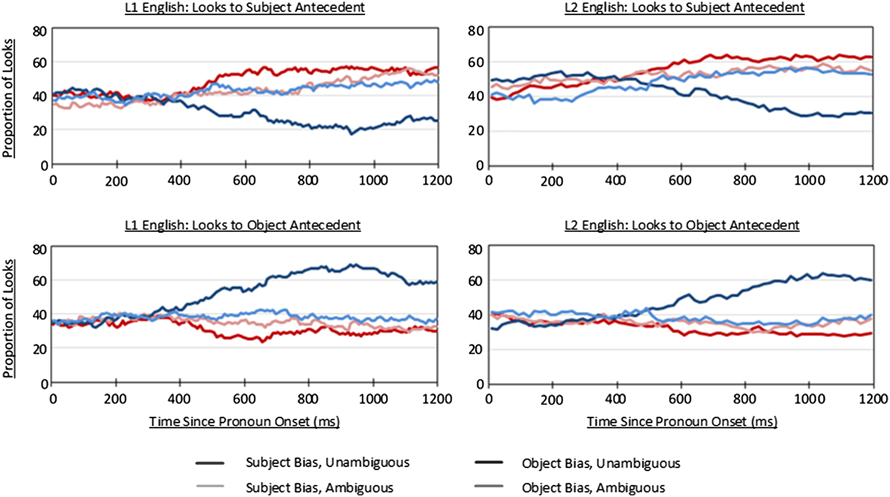
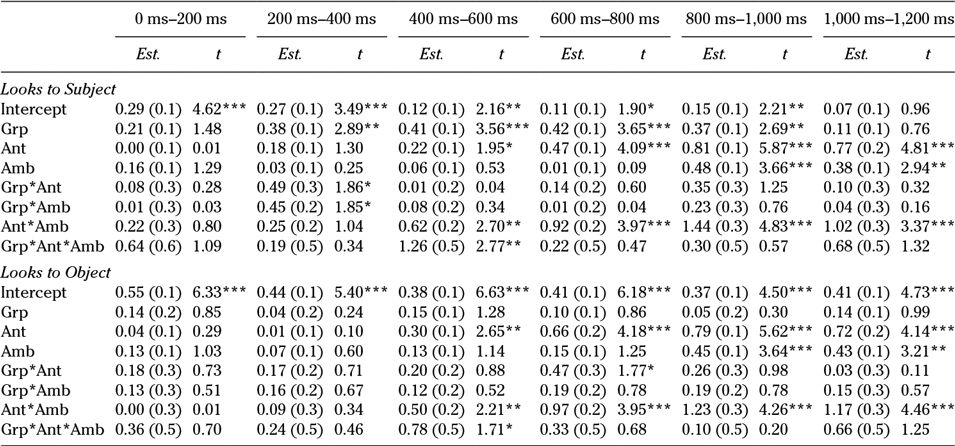
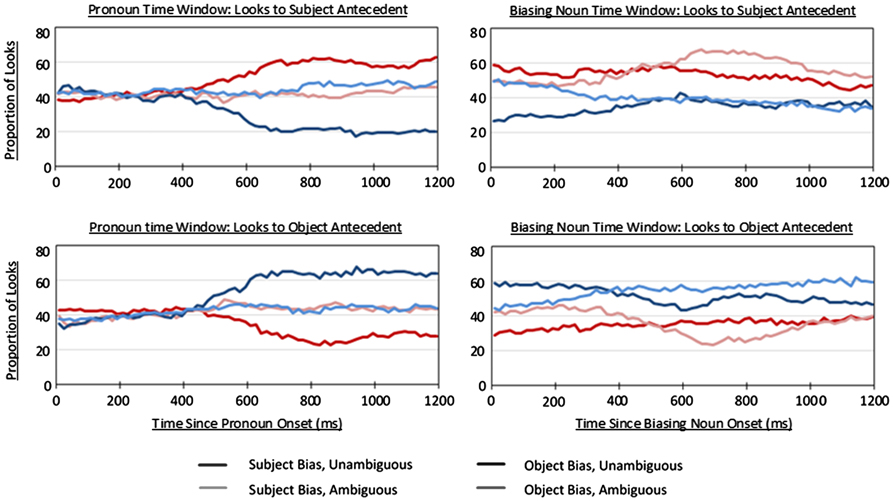
The proportion of looks to each antecedent during the pronoun time window is shown in Figure 2. Differences begin to appear around 400–600 ms. Both groups show more looks to the subject in the SBU condition and more looks to the object in the OBU. Between 600 ms and 800 ms, the two ambiguous conditions fall between the two unambiguous conditions, but toward the end of the time window, the ambiguous conditions pattern more like the SBU than the OBU condition. A summary of the statistical analysis is provided in Table 1. In the following text, we discuss the main findings in more detail.
Looks to the subject and object antecedents at the pronoun time window in Experiment 1.

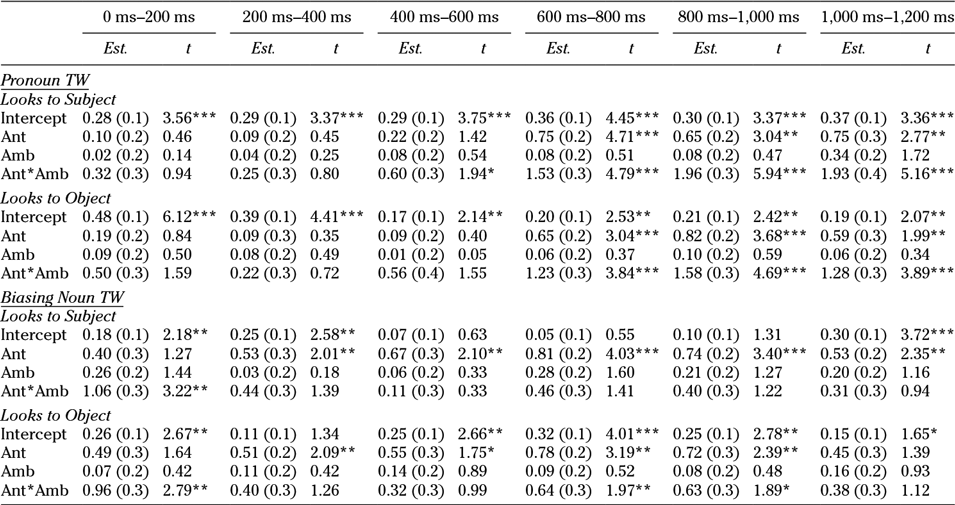
Statistical analysis for the pronoun time window in Experiment 1

Notes. Grp = Group, Ant = Antecedent, Amb = Ambiguity; Est. = Model Estimate (SE in brackets).
* = p < .10, ** = p < .05, *** = p < .001.
In the 200–400 ms bin there was a significant main effect of group in the looks to the subject, with the L2 speakers on average looking more at the subject than the L1 speakers. There were no significant interactions with group in this bin, but there was a reliable three-way interaction in the 400–600 ms bin in the looks to the subject.
Analysis of the L1 data in this bin yielded a significant antecedent by ambiguity interaction (estimate = 1.23, t = 3.64, p < .001). Planned comparisons indicated that there were significantly more looks to the subject in the SBU condition than the OBU condition (estimate = 0.84, t = 3.65, p < .001). Numerically, there were more looks to the subject in the SBU condition than the two ambiguous conditions, although the comparison was significant between the SBU and SBA conditions only (SBU vs. SBA, estimate = 0.52, t = 2.25, p = .025; SBU vs. OBA, estimate = 0.14, t = 0.60, p = .552). There were numerically more looks to the subject in the two ambiguous conditions than the OBU condition, though the comparison was only significant between the OBU and OBA conditions (OBU vs. OBA, estimate = 0.71, t = 2.76, p = .006; OBU vs. SBA, estimate = 0.33, t = 1.29, p = .199). For the L2 data, the analysis yielded no significant differences. These results suggest differences were beginning to emerge, particularly between the two unambiguous conditions, for the L1 speakers but not the L2 speakers.
For the looks to the object in this bin, there was a significant main effect of antecedent and a significant antecedent by ambiguity interaction. Planned comparisons indicated there were significantly more looks to the object in the OBU condition than all other conditions (all estimates > 0.35, all t > 2.20, all p < .028). The proportion of looks to the object did not differ between the SBU and two ambiguous conditions (both estimates < 0.220, both t < 1.17, both p > .244). These results suggest participants were looking more toward the object in the OBU condition only in this bin. As for the looks to the subject in this bin, these differences were largely carried by the L1 group, though for the looks to the object the three-way interaction was only marginally significant.
In the 600–800 ms bin, there was a significant antecedent by ambiguity interaction in the absence of significant interactions with group in both the looks to the subject and the object. Planned comparisons indicated that there were more looks to the subject in the SBU condition than all other conditions (all estimates > 0.42, all t > 2.56, all p < .011). There were also more looks to the subject in the two ambiguous conditions than the OBU condition (both estimates > 0.46, both t > 2.82, both p < .006). These results suggest that the SBU condition had the most looks to the subject while the OBU condition had the fewest, with the two ambiguous conditions patterning between the two unambiguous conditions. A similar pattern was observed in the looks to the object. Planned comparisons indicated more looks to the object in the OBU condition than all other conditions (all estimates > 0.46, all t > 3.46, all p < .002). Numerically there were more looks to the object in the ambiguous conditions than the SBU condition, although only the comparison between the SBU and OBA conditions was significant (SBU vs. OBA, estimate = 0.52, t = 2.94, p = .003; SBU vs. SBA, estimate = 0.33, t = 1.64, p = .102).
Significant antecedent by ambiguity interactions, in the absence of significant interactions with group, were observed for looks to both the subject and object in the 800–1,000 ms and 1,000–1,200 ms bins. In both bins, there were significantly more looks to the subject in all conditions compared to the OBU condition (all estimates > 0.88, all t > 4.83, all p < .001), while the SBU condition did not differ significantly from the two ambiguous conditions (all estimates < 0.34, all t < 1.91, all p > .056). In both bins, there were significantly more looks to the object in the OBU condition than all other conditions (all estimates > 0.98, all t > 5.18, all p < .001). There were no differences between the SBU and SBA conditions with regard to the looks to the object in either bin (both estimates < 0.23, both t < 1.11, both p > .270). There were more looks to the object in the OBA than SBU condition in the 800–100 ms bin (estimate = 0.39, t = 2.20, p = .028) but not the 1,000–1,200 ms bin (estimate = 0.28, t = 1.29, p = .197). These results indicate that, by the end of the pronoun time window, participants were looking equally more to the subject, and equally less to the object, in all conditions compared to the OBU condition.
Pronoun Time Window Summary.
Differences between the two unambiguous conditions began to appear around 600 ms. In the 600–800 ms bin, there were more looks to the subject in the SBU condition and more looks to the object in the OBU condition. In this bin, the ambiguous conditions patterned between the two unambiguous conditions. Later in the time window, there were significantly more looks to the subject in all conditions compared to the OBU condition, while differences between the SBU condition and the two ambiguous conditions were smaller or not significant. These results suggest gender information was applied quickly by both groups in the unambiguous conditions, with a subject antecedent preference emerging for all conditions except the OBU condition by the end of the time window.
There was some evidence that L1 speakers’ eye movements began to diverge earlier than the L2 speakers. For the looks to the subject in the 400–600 ms bin, the L1 speakers began to show significant differences, most clearly between the two unambiguous conditions, when no significant differences were observed in the L2 data. This pattern suggests slightly slower L2 processing, but overall these results are not indicative of qualitatively different patterns between L1 and L2 English speakers.
Biasing Noun Time Window.
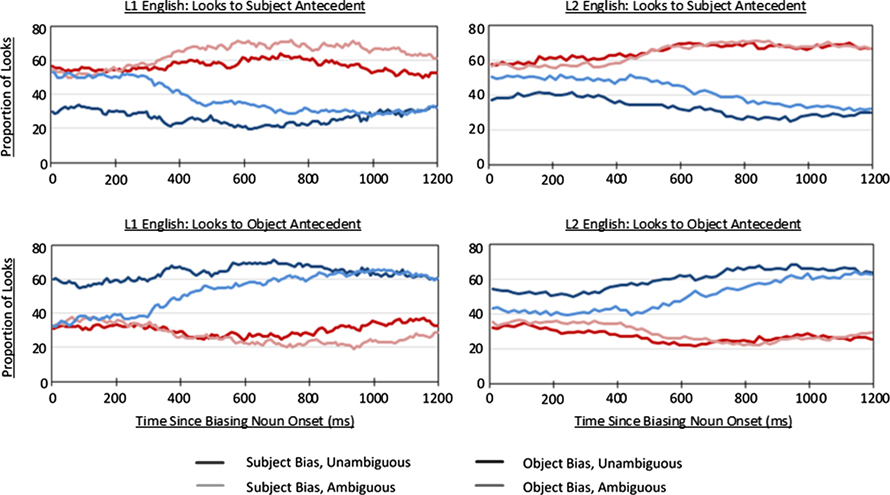
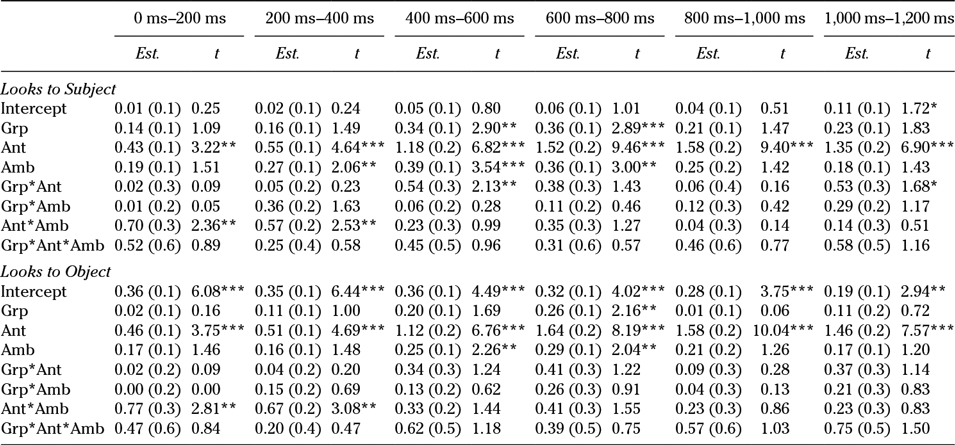
The results at the biasing noun time window are shown in Figure 3, and a summary of the statistical analysis is provided in Table 2. Descriptively, the subject antecedent bias from the pronoun time window persists until the biasing noun is encountered. Later in the time window, both groups look more to the subject in the subject bias conditions, and more to the object in the object bias conditions.
Looks to the subject and object antecedents at the biasing noun time window in Experiment 1.

Statistical analysis for the biasing noun time window in Experiment 1

Notes. Grp = Group, Ant = Antecedent, Amb = Ambiguity; Est. = Model Estimate (SE in brackets).
* = p < .10, * = p < .05, ** = p < .001.
In the 0–200 ms and 200–400 ms bins we observed significant antecedent by ambiguity interactions for the looks to the subject and the object. In both bins, there were more looks to the subject in each condition compared to the OBU condition (all estimates > 0.45, all t > 2.72, all p < .007), while the SBU condition did not differ from the two ambiguous conditions (all estimates < 0.27, all t < 1.47, all p > .144). There were more looks to the object in both bins in the OBU condition compared to all other conditions (all estimates > 0.52, all t > 3.41, all p < .001). The SBU and SBA conditions did not differ in either bin (both estimates < 0.26, both t < 1.46, both p > .145). The looks to the object in the SBU and OBA conditions did not differ in the 0–200 ms bin (estimate = 0.26, t = 1.53, p = .127), but by the 200–400 ms bin, there were more looks to the object in the OBA condition than the SBU condition (estimate = 0.43, t = 2.40, p = .017).
There were significant main effects of group, antecedent, and ambiguity in the 400–600 ms bin in the looks to the subject. There were more looks to the subject in the subject bias conditions than in the object bias conditions, and generally more looks to the subject in the ambiguous conditions. There was also a group by antecedent interaction, with the size of the difference between subject bias and object bias conditions being larger in the L1 group than the L2 group. For the looks to the object, the main effects of antecedent and ambiguity were significant, in the absence of reliable interactions with group, reflecting more looks to the object portion of the screen in the object bias than subject bias conditions, and in the unambiguous than ambiguous conditions.
In the 600–800 ms, 800–1,000 ms, and 1,000–1,200 ms bins there were significant main effects of antecedent for the looks to the subject and object, with more looks to the subject in the subject bias conditions, and more looks to the object in the object bias conditions. In the 600–800 ms bin there was also a significant main effect of ambiguity, with more looks to the subject in the ambiguous than unambiguous conditions, and more looks to the object in the unambiguous than ambiguous conditions. There were no significant interactions between group and any other independent variables in any of these bins.
Biasing Noun Time Window Summary.
At the start of the biasing noun time window, there were equally more looks to the subject in all conditions compared to the OBU condition, and more looks to the object in the OBU condition than all other conditions. These results indicate the subject preference, in all conditions except when the pronoun unambiguously referred to the object, continued from the pronoun time window until the biasing noun time window. The proportion of looks to the subject in the OBA condition then began to shift from the subject to the object and, by the end of the time window, participant gaze focused on the subject in the subject bias conditions and the object in the object bias conditions.
There were few suggestions of L1/L2 differences. In the 400–600 ms bin, the size of the difference between the subject bias and object bias conditions was larger for the L1 group with regard to the looks to the subject than the L2 group. While this may suggest a slightly larger effect for the L1 group in this one bin, it does not indicate qualitatively different processing strategies.
Comprehension Questions.
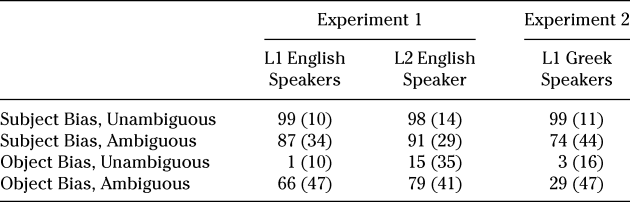
Comprehension question results are shown in Table 3. Both groups chose the subject antecedent almost always in the SBU condition and almost never in the OBU condition. The subject antecedent is also preferred in both ambiguous conditions, suggesting that even though the display biased the object antecedent in the OBA condition, the linguistic bias to the subject antecedent was often not overridden.
Percentage (standard deviations in parenthesis) of subject antecedent responses in Experiments 1 and 2

As the questions required a binary response, analysis was conducted using logit mixed models (Jaeger, Reference Jaeger2008) with fixed and random effects as specified for the eye-movement data. This revealed significant main effects of group (estimate = 0.79, z = 2.67, p = .008), antecedent (estimate = 4.28, z = 14.54, p < .001), and ambiguity (estimate = 1.02, z = 3.48, p < .001). The group by antecedent interaction was significant (estimate = 1.98, z = 3.37, p < .001), as was the antecedent by ambiguity interaction (estimate = 6.38, z = 10.85, p < .001) and the three-way interaction (estimate = 3.34, z = 2.84, p = .005).
Analysis of each group yielded significant main effects of ambiguity (L1 speakers, estimate = 8.50, z = 5.23, p < .001; L2 speakers, estimate = 4.69, z = 4.69, p < .001) and significant antecedent by ambiguity interactions (L1 speakers, estimate = 14.24, z = 4.39, p < .001; L2 speakers, estimate = 11.46, z = 4.21, p < .001). Planned comparisons focused on the ambiguous conditions. Both groups had more subject antecedent responses in the SBA condition than the OBA condition (L1 speakers, estimate = 1.23, z = 3.02, p = .003; L2 speakers, estimate = 0.74, z = 2.44, p = .015). Both groups provided a similar proportion of subject antecedent responses in the SBA condition (estimate = 0.35, z = 1.13, p = .258), but the L2 group provided significantly more subject antecedent responses in the OBA condition than the L1 group (estimate = 0.85, z = 2.29, p = .022).
These results indicate both groups used gender information to guide interpretation in the unambiguous conditions. Although both ambiguous conditions indicate a subject antecedent preference, the fact that there were fewer subject antecedent responses in the OBA condition for the L1 speakers indicate that they were more willing than the L2 speakers to revise the initial subject antecedent interpretation that was observed in their eye movements, when the display subsequently biased against it.
L2 Proficiency.
We also examined effects of L2 proficiency by conducting an analysis of the L2 data that included OPT scores as a continuous predictor. In the following text we only report significant interactions between OPT score and the experimental manipulations, and are particularly interested in whether the subject antecedent preference is affected by proficiency. The crucial interactions are thus the two-way interaction between OPT score and antecedent, and the three-way interaction.
The analysis yielded some evidence of a clearer subject antecedent preference during processing in the pronoun time window as OPT scores increased. In the 800–1,000 ms bin, there was a significant three-way interaction between OPT score, antecedent, and ambiguity for the looks to the subject and the object (subject looks, estimate = 0.11, t = 2.01, p = .045; object looks, estimate = 0.16, t = 2.43, p = .015). To describe this interaction, consider the proportion of looks to each antecedent for the intermediate (n = 19) and advanced (n = 22) L2 learners. Both advanced and intermediate L2 learners were likely to be looking at the subject in the SBU condition (on the empirical logit scale, advanced = 0.58; intermediate = 0.80), but not in the OBU condition (advanced = −1.35; intermediate = −0.89). Footnote 3 The advanced L2 learners were likely to be looking at the subject in both ambiguous conditions (SBA = 0.23; OBA = 0.44), while the intermediate L2 learners only showed this subject bias in the SBA condition (SBA = 0.46; OBA = 0.00). A similar pattern, with a stronger subject bias in the OBA condition for advanced L2 learners, was observed for the looks to the object (estimates for advanced L2 learners, SBU = −1.30, SBA = −0.98, OBU = 0.64, OBA = −1.26; for intermediate L2 learners, SBU = −1.30, SBA = −1.10, OBU = 0.48, OBA = −0.47).
These results suggest a stronger subject antecedent preference across both ambiguous conditions for advanced compared to intermediate L2 learners in this bin. However, there were no interactions between OPT score and antecedent, nor any three-way interactions, in other bins at the pronoun time window, nor the biasing noun time window or comprehension questions, suggesting proficiency did not influence the overall strength of the subject antecedent bias or the likelihood of successful reanalysis. Footnote 4
Discussion
The results of Experiment 1 indicate that after encountering the pronoun, L1 and L2 English speakers rapidly used gender information to restrict coreference in the two unambiguous conditions. In the ambiguous conditions, participants were more likely to look at the subject antecedent than the object antecedent, indicating that listeners preferentially interpreted the overt pronoun as maintaining the current discourse topic. This subject preference persisted during the comprehension questions. Although there was some evidence of slower L2 processing shortly after the pronoun was encountered, the results of Experiment 1 are not indicative of qualitatively different processing patterns, and we found no evidence of Greek L2 English speakers interpreting overt pronouns in English as indexing a topic shift, as in their L1 (Papadopoulou et al., Reference Papadopoulou, Peristeri, Plemenou, Marinis and Tsimpli2015).
We did observe in the comprehension questions that the L2 group were more likely to interpret ambiguous pronouns as referring to the sentence subject than the L1 group when the display biased against this interpretation. Combined with the results during the pronoun time window, which indicated that ambiguous pronouns were preferentially initially interpreted as referring to the sentence subject, these results suggest the L2 speakers were less willing than the L1 speakers to revise their initial subject antecedent interpretation when the display subsequently biased against it. Note that the size of the difference in the comprehension questions between the L1 and L2 groups in the OBA condition (66% vs. 79% subject antecedent responses respectively) suggests a difference in degree of persistence of the initial subject antecedent interpretation in the L1 and L2 groups, rather than qualitatively different patterns. We return to this issue in the General Discussion section.
There was some evidence of a slightly clearer subject antecedent preference shortly after the pronoun was encountered as English proficiency increased. However, proficiency did not reliably influence the strength of the subject antecedent preference in the comprehension questions. In sum, the results of Experiment 1 indicate that L1 Greek speakers of L2 English interpret overt subject pronouns in L2 English similarly to L1 English speakers. This suggests L2 speakers from a null subject language can acquire nativelike interpretive preferences for overt subject pronouns in a nonnull subject L2. These data contrast with the results of Roberts et al. (Reference Roberts, Gullberg and Indefrey2008). We return to this issue in the General Discussion section.
To ensure that our results indicate acquisition of a property that is not present in the L1, it is important to be sure that Greek speakers interpret overt pronouns in their L1 as indexing a topic shift, rather than maintaining the current discourse topic. Filiaci, Sorace, and Carreiras (Reference Filiaci, Sorace and Carreiras2013) reported that overt pronouns in different null subject languages are not always consistently biased to topic shift antecedents. This leaves open the possibility that the topic shift bias for overt pronouns in Greek may not be as strong as the topic maintenance bias for null pronouns. A recent study by Papadopoulou et al. (Reference Papadopoulou, Peristeri, Plemenou, Marinis and Tsimpli2015) found that Greek adults do indeed interpret overt pronouns as signaling a topic shift, in sentences similar to those tested here (e.g., I jajá cherétise tin kopéla ótan aftí pernúse to dhrómo “The old lady greeted the girl when she was crossing the street”). However, to ensure that the preferences for overt pronouns in L2 English do indeed differ from the interpretive preferences of overt pronouns in L1 Greek, we adapted the materials from Experiment 1 and ran an additional experiment testing the interpretive preferences of overt pronouns in Greek.
EXPERIMENT 2
The materials from Experiment 1 were adapted into Greek as in (7).
-
(7a) Subject Bias, Unambiguous
Afú o Jánis mílise me tin kiría Eléni brostá sto tamío, aftós plírose ghríghora to paghotó pu íche aghorási.
“After John spoke to Mrs. Helen by the till, he quickly paid for the ice cream that (he) had bought.”
-
(7b) Subject Bias, Ambiguous
Afú o Jánis mílise me ton kírio Kósta brostá sto tamío, aftós plírose ghríghora to paghotó pu íche aghorási.
“After John spoke to Mr. Kostas by the till, he quickly paid for the ice cream that (he) had bought.”
-
(7c) Object Bias, Unambiguous
Afú i kiría Eléni mílise me ton Jáni brostá sto tamío, aftós plírose ghríghora to paghotó pu íche aghorási.
“After Mrs. Helen spoke to John by the till, he quickly paid for the ice cream that (he) had bought.”
-
(7d) Object Bias, Ambiguous
Afú o kírios Kóstas mílise me ton Jáni brostá sto tamío, aftós plírose ghríghora to paghotó pu íche aghorási.
“After Mr. Kostas spoke to John by the till, he quickly paid for the ice cream that (he) had bought.”
Question: Pjos aghórase to paghotó?
“Who bought the ice cream?”
As in Experiment 1, (7a, c) are unambiguous as a result of gender marking, while (7b, d) are ambiguous. At the biasing noun, the display provided a visual cue that biased interpretation to the subject antecedent in (7a, b) and object antecedent in (7c, d).
We predicted L1 Greek speakers would rapidly use gender information during pronoun resolution (Arnold et al., Reference Arnold, Eisenband, Brown-Schmidt and Trueswell2000), with more looks to the subject antecedent in the SBU condition and more looks to the object antecedent in the OBU condition. If L1 Greek speakers interpret overt pronouns in Greek differently to the L1 and L2 English speakers in Experiment 1, the ambiguous conditions in Experiment 2 should behave differently to those in Experiment 1. If overt pronouns in Greek trigger a topic shift (Papadopoulou et al., Reference Papadopoulou, Peristeri, Plemenou, Marinis and Tsimpli2015), we can expect more looks to the object antecedent in the ambiguous conditions when the pronoun is encountered and before the biasing noun is reached. At the biasing noun, we expect participants to look more to the subject in the subject bias conditions and more to the object in the object bias conditions. For the comprehension questions, the L1 Greek speakers should almost always choose the subject in the SBU condition and almost never in the OBU condition. They should also chose the object most of the time in the OBA condition, but not in the SBA condition.
Participants
Forty-three L1 Greek speakers (11 males; mean age 23, range 18–34), from the same student community as the L2 speakers in Experiment 1, participated in Experiment 2.
Materials
The experimental and filler items from Experiment 1 were translated into Greek and adapted as in (7). The lexical content of the sentences was altered to ensure the length, in number of syllables, between the object antecedent and pronoun was the same across both experiments, and to obtain contexts that sounded natural in Greek. As Greek is a free word-order language, although subject-verb-object order was used in most sentences, occasionally verb-subject-object was used to ensure felicity. Aspect in Greek is distinguished between perfective/telic and imperfective/atelic. In cases in which the action denoted in the subordinate clause had not finished while the event of the anaphoric clause took place, we used imperfective aspect, instead of the perfective in the English version. Finally note that the article preceding the biasing noun matches this noun in gender in Greek. The gender of the article could thus provide an additional linguistic cue that could bias interpretation before the biasing noun is encountered. To avoid this issue, within each sentence we used nouns of the same gender. This involved adapting some of the displays to include two objects with the same gender. All other aspects of the displays were identical to Experiment 1.
Twenty-eight filler items were also included, which were translation equivalents of the fillers in Experiment 1, with the same displays. Recordings of the sentences were made by a Greek native speaker.
Procedure and Data Analysis
Eye movements were recorded with a Tobii X60 eye-tracker. The procedure and instructions were the same as in Experiment 1. The data analysis, with two 1,200 ms time windows, was also the same as in Experiment 1. In Experiment 2, the onset of the biasing noun was on average 1,549 ms after the onset of the pronoun.
Results
The proportion of looks to each antecedent in the two time windows is shown in Figure 4. Table 4 contains a summary of the statistical analysis.
Looks to the subject and object antecedents in Experiment 2.

Statistical analysis for two time windows in Experiment 2

Notes. TW = Time Window, Ant = Antecedent, Amb = Ambiguity; Est. = Model Estimate (SE in brackets).
* = p < .10, ** = p < .05, *** = p < .001.
Pronoun Time Window.
Significant antecedent by ambiguity interactions were observed in the 600–800 ms, 800–1,000 ms, and 1,000–1,200 ms bins for the looks to the subject and the object. There were more looks to the subject in the SBU condition compared to all other conditions in each bin (all estimates > 0.62, all t > 2.25, all p < .025). The only exception was the comparison between the SBU and OBA condition in the 1,000–1,200 ms bin, which was marginal (estimate = 0.45, t = 1.89, p = .059). There were also more looks to the subject in the two ambiguous conditions than the OBU condition in each bin (all estimates > 0.76, all t > 3.05, all p < .003). In each bin, there were more looks to the object in the OBU condition than all others (all estimates > 0.74, all t > 2.48, all p < .014), and more looks to the object in the two ambiguous conditions compared to the SBU condition (all estimates > 0.61, all t > 2.33, all p < .020).
Pronoun Time Window Summary.
Following 600 ms post pronoun onset there were more looks to the subject in the SBU condition and more looks to the object in the OBU condition, indicating L1 Greek speakers rapidly used gender information to guide pronoun interpretation. Unlike in Experiment 1, where later bins indicated a subject antecedent preference in the two ambiguous conditions, in Experiment 2 the ambiguous conditions patterned between the unambiguous conditions, suggesting no clear preference for either antecedent.
Biasing Noun Time Window.
There was a significant interaction in the 0–200 ms bin for the looks to the subject and object antecedent. There were more looks to the subject in all conditions compared to the OBU condition (all estimates > 0.77, all t > 3.01, all p < .003). Although there were numerically more looks to the subject in the SBU condition than the ambiguous conditions, these comparisons were not significant (both estimates < 0.25, both t < 1.10, both p > .273). There were significantly more looks to the object in the OBU condition than the SBU condition (estimate = 1.00, t = 3.11, p = .002), and marginally more looks to the object in the OBU condition than the ambiguous conditions (both estimate > 0.39, both t > 1.68, both p < .092). There were more looks to the object in the ambiguous conditions than the SBU condition (both estimates > 0.50, both t > 2.07, both p < .039).
There was a significant main effect of antecedent for the looks to the subject across all other bins, with more looks to the subject in the subject bias than object bias conditions. The main effect of antecedent in the looks to the object, with more looks in the object bias than subject bias conditions, was significant in the 200–400 ms, 600–800 ms, and 800–1,000 ms bins. In the 600–800 ms bin, there was also a significant interaction. Here, there were more looks to the object in the object bias conditions than the subject bias conditions (all estimates > 0.49, all t > 2.04, all p < .042). The interaction effect seems to result from there being more looks to the object in the OBA than OBU condition, and the opposite trend in the SBA and SBU conditions, although neither comparison was significant (both estimates < 040, both t < 1.66, both p > .098).
Biasing Noun Time Window Summary.
At the beginning of this time window, there were more looks to the subject in the SBU condition and more looks to the object in the OBU condition. The ambiguous conditions differed to the OBU condition, while differences between the SBU and ambiguous conditions were weaker. Later in the time window participants generally looked to the subject in the subject bias conditions and object in the object bias conditions.
Comprehension Questions.
Comprehension question accuracy is shown in Table 3. The results indicate the subject antecedent was chosen almost all of the time in the SBU condition but almost never in the OBU condition. There is a preference for subject antecedent responses in the SBA condition but not the OBA condition. Analysis revealed a significant main effect of antecedent (estimate = 6.67, z = 10.75, p < .001) and a significant interaction (estimate = 7.91, z = 6.35, p < .001). A planned comparison indicated that there were significantly more subject antecedent responses in the SBA condition than the OBA condition (estimate = 2.57, z = 6.05, p < .001).
Discussion
These results suggest differences between Greek speakers resolving overt subject pronouns in their L1 compared to Greek speakers resolving overt subject pronouns in L2 English. While the L1 and L2 English speakers in Experiment 1 demonstrated a subject antecedent preference during the pronoun time window, the L1 Greek speakers in Experiment 2 exhibited no clear preference in this time window. There were also differences between Greek and English speakers in the comprehension questions. While the L2 English speakers in Experiment 1 exhibited a subject preference in both ambiguous conditions, the L1 Greek speakers in Experiment 2 exhibited a subject preference in the SBA condition and an object preference in the OBA condition. We discuss the implication of these results, along with the results of Experiment 1, in the following text.
General Discussion
This study investigated (a) the time-course of pronoun resolution in L1 and L2 English; (b) whether L2 speakers from a null subject background could acquire interpretive preferences for overt pronouns in a nonnull subject L2; and (c) the extent to which L2 speakers are willing to revise an initial interpretation assigned to a pronoun. We discuss these issues in turn.
Overt Pronouns and L2 Anaphora Resolution.
The results of Experiment 1 indicate L1 Greek speakers of L2 English process and interpret overt pronouns in a largely nativelike way. L1 and L2 English speakers rapidly used gender information to guide pronoun interpretation, and preferentially interpreted ambiguous pronouns as referring to the sentence subject and current discourse topic. These results indicate that L2 English speakers from a null subject L1, where overt pronouns index topic shifts, are able to acquire the topic maintenance properties of overt pronouns in English, in contrast to what would be predicted if L1 transfer influences L2 pronoun resolution. This finding contrasts with Roberts et al. (Reference Roberts, Gullberg and Indefrey2008), who found that Turkish L2 Dutch speakers interpreted overt pronouns in Dutch as indexing a topic shift, as in Turkish. There are a number of possible reasons for these differences.
One possibility could be that the L2 speakers we tested had a higher English proficiency than the Dutch proficiency of the L2 speakers tested by Roberts et al. (Reference Roberts, Gullberg and Indefrey2008). However, the range of English proficiency scores in our study (36–58/60) is similar to the range of Dutch proficiency scores reported by Roberts et al. (42–58/60). Obviously the English and Dutch proficiency tests are not fully comparable, but the similar ranges do not support the idea that the learners tested in the current study were systematically higher in proficiency. Additionally, the L2 learners in Roberts et al.’s study lived and worked in Holland at the time of testing, while the L2 learners in the current study were not immersed in English. We thus think it unlikely that proficiency can explain the divergent results obtained in the current study compared to Roberts et al. (Reference Roberts, Gullberg and Indefrey2008).
Another possibility could be that the topic shift preference of overt pronouns could be stronger in Turkish than Greek, leading to stronger transfer effects from Turkish than for Greek. It is difficult to assess this possibility as we are unaware of any studies that have directly compared overt pronouns in Turkish and Greek. Gürel (Reference Gürel, Liceras, Zobl and Goodluck2003) reported a topic shift preference for overt pronouns in native Turkish speakers, but only tested sentences containing an overt pronoun inside an embedded clause where the only antecedent in the discourse was the matrix subject (e.g., Mehmet o-nun sinema-ya gid-eceg-i-ni söyle-di “Mehmet said (that) s/he would go to the movies”; Gürel, Reference Gürel, Liceras, Zobl and Goodluck2003, p. 135), but did not test the types of sentences used in the current study. A topic shift preference for overt pronouns in Greek was reported by Papadopoulou et al. (Reference Papadopoulou, Peristeri, Plemenou, Marinis and Tsimpli2015) in sentences closer to those used here, suggesting our results are unlikely to be the result of a weak topic shift preference in L1 Greek. Although the results of Experiment 2 indicate that the topic shift bias of overt pronouns in Greek is not absolute, the pattern of results across Experiments 1 and 2, particularly in the comprehension questions, indicates different antecedent preferences in English and Greek. Despite these differences between L1 Greek and L1 English, the Greek L2 English speakers interpreted overt pronouns similarly to L1 English speakers.
We believe that differences in the pronominal systems being learned may explain the different results observed here for L2 English speakers and by Roberts et al. for L2 Dutch speakers. We propose that it is because Dutch has different pronominal forms that mark both topic maintenance and topic shifts, that L2 speakers from a null subject background may transfer properties of the L1 pronominal system to the incorrect pronominal form in the L2, allowing overt pronouns to index a topic shift. In a nonnull subject L2 like English, in which the pronominal system does not differentiate between pronouns that mark topic maintenance and topic shifts, L2 speakers seem to be able to interpret overt pronouns in a nativelike way, even if such forms index a topic shift in their L1. Thus, we suggest that the primary cause of the differences observed in our study compared to Roberts et al. result from differences in the complexity of the pronominal system being learned.
Another difference between our study and Roberts et al. is that the critical sentences tested in each study were of a different structure. In this study, the syntactic subject was the topic and the syntactic object the nontopic, while in Roberts et al. topichood was operationalized in terms of repeated reference to a particular individual in a short discourse. While differences in sentence structure may explain the different results observed here and by Roberts et al., our results nevertheless indicate that it is not always the case that speakers of a null subject L1 have difficulty in interpreting overt personal pronouns in a nonnull subject L2 in a nativelike way. How syntactic and discourse structure influence L2 acquisition of ambiguous pronouns may be a fruitful avenue of future research.
In addition to L1 effects on pronoun interpretation, Roberts et al. also reported L1/L2 differences during pronoun processing. They observed that L2 Dutch speakers, from both null subject and nonnull subject L1s, exhibited processing difficulty upon encountering a pronoun when there were multiple gender-matching antecedents in the discourse. They interpreted this as indicating difficulty in integrating multiple sources of information when processing ambiguous pronouns (see also Sorace, Reference Sorace2011). We however found little evidence of L1/L2 differences during processing at the pronoun. One example of an L1/L2 difference during pronoun processing that we did observe appeared 400–600 ms post pronoun onset. Crucially, if L2 speakers have difficulty in integrating information sources during the resolution of ambiguous pronouns, we would have expected the L1 and L2 English speakers in our study to have behaved similarly in the unambiguous conditions, but differently in the ambiguous conditions. Instead, while the L1 English speakers began to show differences in the 400–600 ms bin, the L2 English speakers did not show any differences in this bin. In later bins, the L1 and L2 English speakers behaved similarly. Thus, we believe our results are more consistent with indicating slower, rather than qualitatively different, L2 processing in this domain. Our results thus indicate, in contrast to the predictions of the most recent instantiation of the Interface Hypothesis (Sorace, Reference Sorace2011), that the L2 speakers in our study did not have increased difficulty compared to L1 speakers in integrating multiple information sources online to resolve ambiguous pronouns. More generally, these results also fit with other recent research suggesting similar parsing preferences in the L1 and L2 (e.g., Dussias & Cramer Scaltz, Reference Dussias and Cramer Scaltz2008; Hopp, Reference Hopp2015), at least in certain domains of sentence processing.
Reanalysis in L2 Processing.
Although our results indicate similarities in processing and interpreting overt subject pronouns in L1 and L2 English, we did observe L1/L2 differences with respect to reanalysis. In the comprehension questions, we observed a similar subject antecedent bias in the L1 and L2 groups for ambiguous pronouns in the subject bias condition, but in the object bias condition the L2 group provided more subject antecedent responses than the L1 group. Combined with the eye-movement results that indicated that pronouns in both the ambiguous conditions were initially interpreted as referring to the sentence subject, the higher proportion of subject antecedent question responses for the L2 speakers in the OBA condition suggests they were less likely than the L1 speakers to revise their initial interpretation of the pronoun referring to the sentence subject, when subsequent information biased against this interpretation. This finding is consistent with results indicating initially assigned interpretations are more likely to persist for L2 than L1 speakers (Jacob & Felser, Reference Jacob and Felser2016; Pozzan & Trueswell, Reference Pozzan and Trueswell2016).
Note that the size of the difference in the comprehension results for the L1 and L2 groups in the OBA condition suggests group differences in the persistence of the initially assigned interpretation for L1 and L2 speakers in our experiment was one of degree. Indeed, 37 of 41 L2 speakers and 23 of 35 L1 speakers chose the subject antecedent on at least four out of six trials in the OBA condition. This suggests that although the subject antecedent interpretation was more likely to persist for the L2 than L1 group, this initially assigned interpretation persisted for some participants in each group. It appears that across both groups there were individual differences in how susceptible participants were to revising their initially assigned interpretation as a result of our display manipulation. In our analysis that included L2 proficiency as a continuous variable, we did not find evidence that susceptibility to our display manipulation, in terms of rates of reanalysis success, increased with proficiency. The question of what factors influence reanalysis success in L2 speakers, and whether rates of reanalysis can become fully nativelike, in both anaphora resolution and more generally, warrants further empirical investigation.
Although the L1 group was more likely than the L2 group to revise its initially assigned interpretation when the display biased the object antecedent, both groups on the whole exhibited a subject antecedent preference in both ambiguous conditions. This may indicate that the visual bias was not sufficient to strongly influence pronoun interpretation. The fact that we observed some differences between the subject bias and object bias ambiguous conditions in Experiment 1 indicate that the display did have some effect on the final interpretation assigned to ambiguous pronouns. The results of Experiment 2 also suggest it is unlikely to merely be the case that the visual manipulation was too weak to influence interpretations, as L1 Greek speakers’ interpretive preferences were influenced by the display. Rather, the combined results of Experiments 1 and 2 suggest a stronger topic maintenance preference for overt pronouns in English than the topic shift preference for overt pronouns in Greek.
Finally, the fact that the L2 group was less likely to revise its initial subject antecedent interpretation than the L1 group based on bias in the display could be taken as evidence that L2 speakers exhibit greater difficulty than L1 speakers in integrating multiple linguistic and nonlinguistic information sources during processing, in line with Roberts et al. (Reference Roberts, Gullberg and Indefrey2008) and Sorace (Reference Sorace2011). Although we cannot rule out this possibility, crucially, and contra the predictions of Roberts et al. and Sorace, our results specifically indicate difficulty for L2 speakers in integrating information sources during reanalysis, rather than in guiding the initial interpretation that is assigned to an ambiguous pronoun.
CONCLUSION
We investigated anaphora resolution during L2 processing. Our results indicated L1 and L2 English speakers rapidly use gender information to guide pronoun resolution. L2 English speakers were able to process and interpret ambiguous pronouns in English in a largely nativelike way, even though their L1 displays different anaphoric biases. We did, however, find that the L2 group was less likely to revise an initial interpretation assigned to an ambiguous pronoun than the L1 English speakers. Taken together, these results indicate qualitatively similar processing and interpretive preferences in the domain of subject pronoun resolution in L1 and L2 English speakers, but suggest initially assigned interpretations are more likely to persist during L2 sentence processing.
SUPPLEMENTARY MATERIAL
To view supplementary material for this article, please visit https://doi.org/S0272263116000292.