


INTRODUCTION
Proteins excreted or secreted by parasites (ES) in vitro and presumed to be in vivo are thought to be essential for parasite maintenance within the host due to various functions such as penetration of host tissue barriers, feeding and evasion or modulation of the host immune response (Knox, 2000). Defining the nature of ES proteins provides an insight into the dynamics of the host-parasite relationship and has the potential to identify novel targets to control infection with a particular focus on vaccination. Blocking the function of ES proteins could prevent parasite establishment or accelerate expulsion. ES proteins are derived from the body surface or from specialized excretory-secretory glands and are often released in a stage-specific manner. Since these proteins are released from the parasite, they will be accessible to and may modulate the host's immune system.
Most work on T. circumcincta ES products has concentrated either on their effects on the host tissues or on characterization of proteases released in vitro. Stage-specific protease activity at a range of pH optima has been demonstrated in ES material from L3, L4 and adult T. circumcincta (Young, McKeand and Knox, 1995). The bovine parasite O. ostertagi is closely related to T. circumcincta. ES material from the parasitic stages of O. ostertagi has been characterized using various techniques. Substrate gel analysis has demonstrated the activity of stage-specific proteases with the ability to degrade a variety of substrates, including bovine IgG, in a pH-dependent manner (Geldhof et al. 2000). Vercauteren et al. (2003) identified a range of proteins by screening O. ostertagi cDNA libraries with a polyclonal rabbit serum raised against in vitro ES from the parasite. Some of these were not considered to be true ES proteins and may be present due to cellular damage, sloughing of cells and leakage. These included structural proteins such as actin and intracellular, metabolic enzymes such as cytochrome oxidase. Many of the proteins identified were confirmed as ES proteins by Western blot analysis or by the presence of signal peptides, and these included homologues of a globin-like protein, vitellogenin, heat shock protein and protein disulphide isomerase (Vercauteren et al. 2003).
Other components of T. circumcincta ES have received less attention. A group of stage-specific 31 kDa antigens from T. circumcincta, located in secretory organelles of the oesophageal glands and abundant in L3 ES, was identified by immunoscreening with serum from resistant sheep (McGillivery et al. 1992). Protection trials in 6-month-old lambs initially gave promising results, but these were not reproducible (Morton et al. 1995).
ES components have been evaluated as vaccine candidates in a number of ruminant nematode parasites with promising results (Schallig and Van Leeuwen, 1997; Tsuji et al. 2003; Yatsuda et al. 2003; Vercauteren et al. 2004) Proteins tested include Ancylostoma-secreted protein (ASP) homologues from Haemonchus contortus which achieved good levels of protection against haemonchosis in lambs when tested in vaccine trials (Schallig and Van Leewen, 1997). ASPs have now been cloned and expressed from several hookworm species and are considered as promising vaccine candidates (Goud et al. 2004). Moreover, ASP homologues have also been identified in ES material from adult O. ostertagi (Vercauteren et al. 2003) and calves immunized with a subfraction of ES highly enriched for ASPs had good levels (60% reductions in faecal egg output) of protective immunity against homologous challenge (Geldhof et al. 2002).
The aim of the present study was to culture T. circumcincta fourth-stage larvae and adults and to characterize some of the proteins released in vitro. The culture fluids were collected at several time-points and concentrated. The proteins present were then analysed by one-dimensional (1D) electrophoresis and Tandem Liquid Chromatography Mass Spectrometry/N-terminal sequencing.
MATERIALS AND METHODS
Parasites
Fourth larval stage
Donor lambs (6 to 10 months old) were given 100000 infective L3 orally. L4 parasites were harvested from the abomasa at necropsy 7 days post-infection using established procedures (e.g. Schallig and Van Leeuwen, 1997). The abomasa were incubated in physiological saline to release the L4 from the glands. The larvae were then cleaned either by sedimentation or agar migration, both of which are performed at 37 °C for 4 h. Larvae were separated from remaining debris using a Baermann funnel technique (Urquhart et al. 1987).
Adults
Donor lambs were again given 100000 L3 orally and parasites were recovered from abomasa 21 days after infection. Worms were rinsed several times in PBS to remove any remaining debris.
Cultures
Approximately 50000 L4 worms were rinsed briefly in RPMI-1640 containing antibiotics, then transferred to a sterile 250 ml conical flask containing 200 ml of RPMI-1640 with antibiotics, pre-warmed to 37 °C. The flask was then incubated at 37 °C with gentle agitation. After 2 h, the culture fluid was carefully poured asceptically into sterile 50 ml tubes and stored at −80 °C. Another 200 ml of RPMI-1640 were added to the flask asceptically and the worms incubated again at 37 °C. Culture medium was harvested in the same manner at 21, 40 and 48 h. At 4 h a 100 μl aliquot of culture was removed and the worms were observed under a dissecting microscope to verify their integrity.
Approximately 67000 adult worms were rinsed briefly in RPMI-1640 then cultured in the same way as the L4 but in 400 ml of RPMI-1640 in a 1 litre conical flask. Again, at 40 h, an aliquot of worms was observed under the microscope to verify their integrity.
Concentration of culture fluids
The culture fluids from L4 and adult worms were concentrated 500- and 250-fold, respectively, using Centricon® YM-10 centrifugal filter devices (Amicon, UK). Centrifugation was at 3000 rpm in a Jouan CR 4.22 centrifuge, pre-chilled to 4 °C, until the desired reduction in volume was achieved. Initial concentration was carried out in 15 ml total volume Centricons and further concentration of smaller volumes in 2 ml Centricons.
Protein concentration of culture fluids
These were determined using the BCA protein assay method (Pierce, UK) with the final OD read at 562 nm and bovine serum albumin protein standards for calibration. A small (2 ml) subsample was dialysed against PBS to remove the dye present in RPMI as this can interfere with the final OD reading.
Electrophoresis of ES material
An aliquot (20 μl) of the concentrated culture fluids were run on 4–15% Tris-HCl ‘ready gels’ (Bio-Rad) under reducing and non-reducing conditions and stained with Coomassie blue to detect the proteins present. All bands were labelled individually and excised, taking care to include as little unstained gel as possible. Each band was placed in a 1·5 ml Eppendorf tube.
LCMS and N-terminal sequencing
Each band was subjected to Tandem Mass Spectrometry and N-terminal sequencing at the Sir Henry Wellcome Functional Genomics Facility (SHWFGF), in the University of Glasgow. The details of the methods involved in producing the peptide mass fingerprints and sequences are available on the SHWFGF website (www.gla.ac.uk/departments/ibls/ASU/fgf/). Briefly, each band was washed in 100 mM ammonium bicarbonate followed by 50% (v/v) acetonitrile/100 mM ammonium bicarbonate. The gel was then shrunk in 100% acetonitrile and dried in a vacuum centrifuge. In-gel digestion of the protein was carried out by re-swelling the gel, in 0·2 mg trypsin in 10 ml of 25 mM ammonium bicarbonate, then covering in 20 ml of 25 mM ammonium bicarbonate and incubating at 37 °C overnight. Each sample was purified using a C18 ziptip (Millipore), according to the manufacturer's instructions. A Nano-Liquid Chromatography module, coupled to the mass spectrometer, was employed to further purify, concentrate and separate the peptides. The resultant peptides for each band were then analysed using the Q-Star Pulsar Mass Spectrometry/Mass Spectrometry (MS/MS) system from Applied Biosystems. The results were analysed using the MS/MS Ion Search function of the MASCOT search engine (www.matrixscience.com). The advantage of using this tandem MS/MS system, particularly for organisms for which protein mass data are limited, is that sequence databases may also be searched. This greatly increases the chance of identifying a particular protein.
RESULTS
Mini-gel analysis of ES material
The results are shown in Fig. 1. In L4 ES, about 12 distinct bands, ranging from 18 to over 200 kDa were present, whereas the adult profile was more complex. Most protein accumulated in the culture media up to 21 h for L4 (not shown) and 40 h for adult cultures (Fig. 1A). For both stages, very little protein was released into the culture media after 40 h. In L4 ES, a particularly strong band of 18 kDa was present at 2 and 21 h. In the adult ES, a pattern of >15 distinct bands varying from 18 to 115 kDa could be detected at 2, 21 and 40 h. A particularly prominent doublet was present at 18 and 20 kDa. Most other bands were not visible in culture fluids harvested after 40 h of in vitro maintenance.
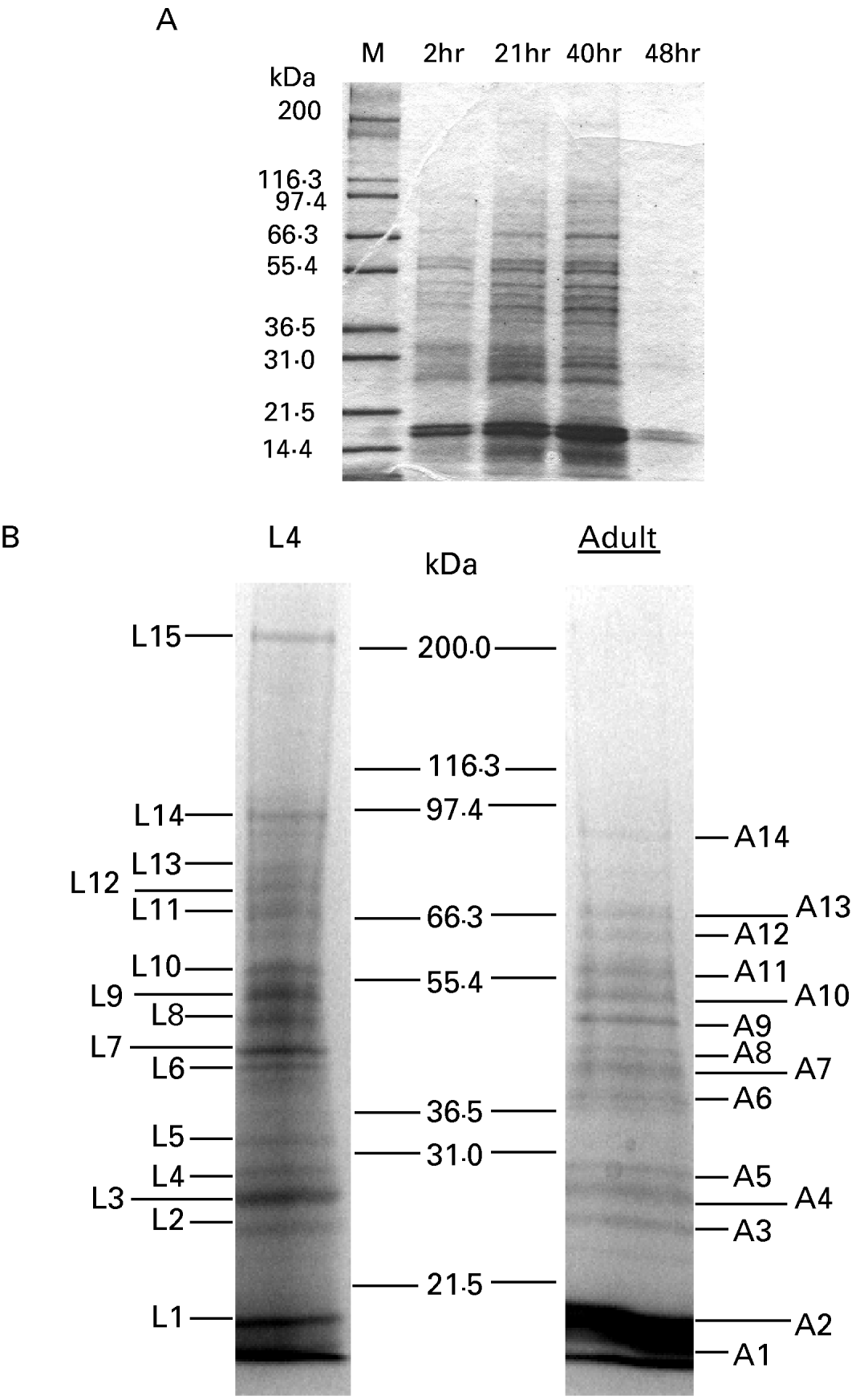
Fig. 1. L4 and adult Teladorsagia circumcincta ES proteins were concentrated 250-fold and electrophoresed under reducing conditions in a 4–15% gradient Tris-HCl mini-gel and peptides were visualized by Coomassie-staining. ES were harvested during the culture period at the times indicated. Adult ES are shown (panel A). L4 ES (concentrated×500) and adult ES (concentrated×250), were run on a 4–15% Tris-HCl mini-gel and Coomassie-stained (panel B). Labelled bands (L1–L15 and A1–A14) were excised, subjected to tryptic digest and the digest products analysed by Tandem Mass Spectrometry.
Tandem MS analysis
Concentrated 21 h culture fluids were run in 4–15% gradient Tris-HCl electrophoretic gels, stained with Coomassie blue. Bands were labelled (Fig. 1B) excised and analysed using tryptic digestion and Tandem MS. The resultant mass and sequence data were analysed using the MASCOT database. Those peptides giving database ‘hits’ with a Probability Based Mowse Score of 50 or more were considered significant, sharing identity or extensive homology with one or more sequences. Hits against trypsin were discarded as contamination due to the method of sample degradation. The results are summarized in Table 1 (L4) and Table 2 (Adult). Not all the sequenced bands gave significant hits.
Table 1. Results of Mass Spectrometry/N-terminal sequence analysis of ES material from the fourth larval stage of T. circumcincta (Significant hits are those with a total score greater than 50. The identity and source organism for the highest ranked hit for each group of peptides is given. Band reference numbers and approximate sizes refer to Fig. 1.)

Table 2. Results of Mass Spectrometry/N-terminal sequence analysis of ES material from adult T. circumcincta (Significant hits are those with a total score greater than 50. The identity and source organism for the highest ranked hit for each group of peptides is given. Band reference numbers and approximate sizes refer to Fig. 1.)

Several proteins were common to L4 and adult ES. A globin-like protein was present in both stages but appeared as a doublet of bands at 18 and 20 kDa in the adult. In both stages, these globin-like proteins were the most abundant components of ES. Proteins similar to fructose-1, 6-biphosphate aldolase, enolase and disulphide isomerase also appeared in ES from both developmental stages.
Fourth larval stage (L4)
Several proteins identified were similar to those detected in the ES of a closely related nematode, O. ostertagi (Vercauteren et al. 2003). These included a homologue of a detoxifying enzyme, thioredoxin peroxidase, the globin-like protein and protein disulphide isomerase (PDI). A 30 kDa protein showed similarity to a sequence from adult T. circumcincta which encodes a putative cysteine protease. Finally, a protein with homology to both a heat shock protein (HSP) from Panagrellus redivivus and a HSP precursor from C. elegans was identified.
Many of the proteins identified in L4 ES were homologues of metabolic enzymes, involved in various stages of energy metabolism. These included proteins showing similarity to a hypothetical C. elegans fructose-1, 6-biphosphate aldolase and a C. elegans enolase, both involved in glycolysis, and to mammalian fumarate hydratases, part of the tricarboxylic acid cycle. Also identified was a protein similar to a C. elegans mitochondrial carrier protein, ATP/ADP translocase.
Apparent structural proteins were also present. Band L7 contained a protein sharing considerable homology with actin 2 from the plant-parasitic nematode, Globodera rostochiensis, a major component of the cytoskeleton. Proteins showing similarity to C. elegans muscle components, tropomyosin and paramyosin, were present at approximately 42 kDa and 97 kDa respectively.
Adults
The results for Tandem MS/N-terminal sequence analysis of proteins from adult T. circumcincta culture fluids are summarized in Table 2. Again, the most prominent protein in adult ES was a homologue of a globin-like ES protein from Ostertagia ostertagi. Adult ES contained additional enzymes, namely a protein at ~20 kDa with sequence identity to a C. elegans nucleoside diphosphate kinase as well as proteins similar to a C. elegans aldo/keto reductase and a possible glycogen phosphorylase, arginine kinase from H. glycines and a putative glutamate dehydrogenase from H. contortus. Also, a protein of 29 kDa showed considerable similarity to a member of the 14-3-3 protein family isolated from C. elegans.
DISCUSSION
Although the protective potential of ES material is apparent, the nature of the antigens responsible is still largely unknown. Here, we report a preliminary proteomic survey of the ES products from fourth larval stage and adult T. circumcincta, the most common gastric nematode infecting grazing ruminants in temperate climatic regions of the world.
The analyses described were conducted on protein bands excised from one-dimensional SDS-PAGE gels at a time when the gene sequence data for T. circumcincta accessible in the databases comprised 590 L4 and 3200 adult expressed sequence tags. Despite the fact that each band is likely to comprise more than one protein, 15 L4 and 13 adult ES proteins were unequivocally identified, an outcome consistent with or surpassing that of cDNA library immunoscreening (Vercauteren et al. 2003).
ES from the later stages of the culture period contained only a few bands when visualized with Coomassie-staining, indicating that, in both stages, protein release had ceased. This cessation could be due to several factors, the most likely being that, despite the fact that the medium contained a range of nutrients, these were not sufficient for normal biosynthesis or that the worms did not feed in vitro. Therefore, the majority of proteins released may have been synthesized and stored before the culture period. If this were the case, it would indicate that the ES proteins detected would reflect those released into the host in vivo. Another possibility is that the worms die and start to degrade as the culture period proceeds. A reduction in the integrity of the worms would be expected to result in an increase in protein release due to leakage of intracellular and structural proteins into the medium. While the outcome of the proteomic survey did identify several structural and metabolic proteins in the ES from both parasite stages, it was notable that virtually no protein was detectable in ES harvested between 40 and 48 h. This observation, and the apparent sustained structural integrity of the worms, would indicate that the proteins detected are genuine ES products. T. circumcincta and O. ostertagi infect the abomasal glands of sheep and cattle, respectively, resulting in almost identical disease syndromes. The ES proteins from L4 and adult O. ostertagi were recently surveyed using cDNA library immunoscreening and 4 putative ES proteins, namely a polyprotein allergen, a globin-like molecule, a retinol binding protein and a protein with no homology to any sequences in the databases at that time, were identified in L4 ES (Vercauteren et al. 2003). Only a globin-like protein was identified in T. circumcincta L4 ES. Of 22 adult ES proteins identified in O. ostertagi, the most prominent were a homologue of an ASP and a vitellogenin (Vercauteren et al. 2003), neither of which were indicated in the 13 adult T. circumcincta ES proteins identified in the present study. The differing ES protein profiles of T. circumcincta and O. ostertagi may reflect subtle differences in parasite biology or, more likely, could reflect the methodological differences used in defining the nature of ES in the present and a previous study (Vercauteren et al. 2003). Here, we employed direct proteomic analysis of the ES proteins using mass spectrometry. Vercauteren et al. (2003), used cDNA library immunoscreening with antisera to ES, the output of which is likely to have been affected by differing immunogenicity of individual ES proteins and the number of recombinant plaques screened. However, a proteomics approach was used to show that the most abundant protein in adult O. ostertagi ES was an ASP (Geldhof et al. 2003a).
The present study identified 15 and 13 proteins respectively in L4 and adult ES respectively, several of which were homologues of enzymes involved in various stages of energy metabolism. Little is known about the role of many of these enzymes in gastrointestinal nematodes and whether they are involved in the host-parasite interaction, although several are known to be immunogenic in other host-parasite systems. L4 and adult ES contained a protein similar to a hypothetical C. elegans fructose-1, 6-biphosphate aldolase (FBA). This enzyme is involved in the early stages of glycolysis and is thought to be common to helminths and their mammalian hosts (Barrett, 1981). McCarthy et al. (2002) identified an FBA (Ov-fba-1) from the L3 stage of the filarial nematode Onchocerca volvulus by immunoscreening a cDNA library with serum from putatively immune humans confirming exposure to the protein during infection. Localization studies showed that the protein was expressed in body wall muscle and the reproductive tract of female worms and, additionally, in the third larval stage where the cuticle separates during molting (McCarthy et al. 2002), this latter observation possibly explaining how the protein is released from the worm and exposed to the immune system. In addition, the protein was recognized by humoral and cellular immune responses in infected and immune individuals in a region where onchocerciasis is endemic. Protection trials with recombinant Ov-fba-1 in a murine model resulted in a 50% reduction in larval survival.
Proteins showing similarity to another glycolytic enzyme, enolase, were also present in ES from both stages here. O. volvulus enolase (Ov-ENO) is highly concentrated in the musculature of all stages of the parasite and is recognized by serum antibodies from infected individuals (Jolodar et al. 2003). The authors suggested that these results, in addition to the plasminogen-binding properties of enolase, may intimate its involvement in plasmin-mediated degradation of the host's extracellular matrix, facilitating migration of the parasite through the tissues. Notably, enolase was also identified by proteomic analysis of ES from adult H. contortus (Yatsuda et al. 2003) which is related to T. circumcincta and which also resides in the ovine abomasum.
Adult ES contained a 20 kDa protein showing similarity to C. elegans nucleoside diphosphate kinase (NDPK). NDPKs are ubiquitous enzymes involved in phosphate transfer during the maintenance of intracellular reserves of deoxynucleoside triphosphates (Gounaris et al. 2001). Gounaris et al. (2001) demonstrated that the infective larvae of the nematode Trichinella spiralis secrete NDPK, which may promote nurse cell survival. T. circumcincta induces a range of morphological and biological changes in the abomasal glands which may, in part, be attributable to parasite ES (Scott and McKellar, 1998; Hertzberg et al. 2002). NDPK has been shown to play a role in extracellular nucleotide metabolism in human airways (Donaldson, Picher and Boucher, 2002). NDPK is expressed on the epithelial surface and in gland secretions and is thought to affect actions such as liquid secretion and goblet cell degranulation, through regulation of luminal nucleotide concentrations (Donaldson et al. 2002).
Other metabolic enzymes were identified in adult ES, including a 40 kDa protein with homology to a C. elegans aldo/keto reductase family member and a 60 kDa homologue of glutamate dehydrogenase (GDH) from H. contortus, both of which may be involved in amino acid catabolism (Barrett, 1981). GDH is expressed in the cytosol of intestinal cells in L4 and adult H. contortus (Skuce et al. 1999) and was identified previously in the ES components from adults of this species (Yatsuda et al. 2003).
A protein with a high level of identity with galectin was present in L4 ES of 34 kDa. Galectins or β-galactoside-binding lectins have been identified in a range of vertebrates and invertebrates including several parasitic nematodes. However, their functions are not yet clear as they appear to be involved in many biological processes such as differentiation and morphogenesis (Kasai and Hirabayashi, 1996). There is now strong experimental evidence that some galectins are secreted from cells by a mechanism distinct from classical vesicle-mediated exocytosis (Rabinovich et al. 2002). Galectins influence a variety of aspects of the innate and adaptive immune response, including cell growth regulation, activation, cell adhesion, chemotaxis and apoptosis (Rubinstein et al. 2004). It is possible that the release of galectins from L4 T. circumcincta may be involved in the cellular changes and immune responses in the abomasal glands induced during infection.
Proteins showing similarity to several structural proteins were identified in ES from both stages, including the cytoskeletal protein, actin, and the muscle components tropomyosin and paramyosin. Despite the fact that their presence in ES is more likely to reflect worm degradation during culture, their potential in inducing host protective immune responses cannot be ignored. Immune responses to tropomyosin have been associated with host protective immunity against Trichostrongylus colubriformis infection in guinea pigs (O'Donnell et al. 1989) and O. volvulus infection in humans (Jenkins et al. 1998). Moreover, paramyosin is a candidate vaccine antigen for a number of helminthoses including schistosomiasis (Gobert and McManus, 2005) and fascioliosis, in the case of the latter, the protein being expressed in gut cells and on the tegument (Cancela et al. 2004).
Some of the ES proteins identified have been the subject of more detailed analysis in other host parasite systems. A 20 kDa globin-like protein homologous to the equivalent protein isolated from O. ostertagi L4 ES (Vercauteren et al. 2003) that was also present in adult ES. Variable protection against O. ostertagi infection was reported in calves immunized with a globin-enriched fraction prepared from adult worms (Claerebout et al. 2005) while a secreted 18 kDa globin-like protein isolated from the ES products of T. colubriformis induced 60–84% protection against challenge with this species in guinea pigs (Frenkel et al. 1992).
A 30 kDa protein in L4 ES was identified as a putative cysteine proteinase. This proteinase is recognized by local IgA antibody responses to infection (Matthews, Redmond, Knox, unpublished), an observation indicative of in vivo release. Cysteine proteinase activity has been demonstrated in the ES products of O. ostertagi and vaccination with O. ostertagi adult ES, enriched for cysteine proteinases by thiol-Sepharose chromatography, induced a 60% reduction in post-challenge egg counts (Geldhof et al. 2000). Moreover, immunization of sheep with an H. contortus ES fraction enriched for cysteine proteinase activity prior to challenge infection, significantly reduced egg and worm burdens after a single challenge infection (Bakker et al. 2004). Cathepsin L proteinases secreted by all developmental stages of the liver fluke, F. hepatica, have been evaluated in vaccine trials and gave levels of protection of over 50% in cattle (Dalton et al. 1996) and from 30–60% in sheep (Piacenza et al. 1999).
Both adult and L4 T. circumcincta ES contained a 60 kDa protein similar to a protein disulphide isomerase (PDI), identified in the ES from the parasitic stages of O. ostertagi (Vercauteren et al. 2003). This ubiquitous enzyme is a catalyst of protein folding in eukaryotes via disulphide bond formation, a process that is rate-limiting during the generation of many secretory and outer membrane proteins (Pirneskoski et al. 2004). In nematodes, it is thought to play a crucial role in cuticle synthesis (Winter and Page, 2000). Western blot analysis of O. ostertagi ES has demonstrated recognition of parasite PDI by serum antibodies from naturally O. ostertagi-infected calves (Geldhof et al. 2003b). This finding suggests that PDI is released in vivo by the parasite, either by active secretion or by dying worms.
A 75 kDa protein with homology to heat shock proteins (HSPs) from C. elegans and Panagrellus redivivus, a small soil-dwelling nematode, was identified in L4 ES. In C. elegans, HSPs of around 70 kDa are coded for by the hsp70 multigene family, made up of at least nine members (Heschl and Baillie, 1990). HSPs (70 kDa) have been isolated from a range of vertebrates and invertebrates, including several parasitic nematodes. HSPs have been studied in several parasitic nematodes, being, for example, expressed in the reproductive tract and intestine of adult H. contortus and detectable in the L4 stage (Hartman et al. 2003). HSPs have also been localized to the glandular oesophagus in infective larvae of O. volvulus and to the hypodermis and cuticle of adults (Wu et al. 2000). The exact function of HSPs in nematodes is not yet known but, in disease models, they can promote the production of anti-inflammatory cytokines, indicating a role in immunoregulation (van Eden et al. 2005).
A thioredoxin (TPx) homologue (~27 kDa) was detected in L4 ES, being similar to a TPx identified in the ES products of adult O. ostertagi (Vercauteren et al. 2003). TPx is implicated in parasite defence against oxidative damage as a result of exposure to reactive oxygen species produced either as by-products of the parasite's metabolism or from host inflammatory cells. TPx was detected in L3, L4 and adult stages of D. immitis and was also present in the adult ES products (Klimowski, Chandrasheker and Tripp, 1997). Its sequence lacked a signal sequence, suggesting that it is not actively secreted but the authors suggest that it may be transported by an alternative mechanism (Klimowski et al. 1997; Rubartelli et al. 1992). TPx was also among several antioxidant enzymes present in ES material from adults of the liver fluke, F. hepatica (Jefferies et al. 2001). The identification of TPx in T. circumcincta ES suggests that these enzymes may also play an important role in defence against free radicals in this species. Expressed sequence tags from adult T. circumcincta have been identified which encode TPx (NEMBASE), suggesting that this enzyme is expressed in both parasitic stages.
The 14-3-3 proteins make up a ubiquitous and highly conserved family, which have been identified in a variety of eukaryotes but have not been characterized in parasitic nematodes (Dougherty and Morrison, 2004). A 29 kDa protein in adult T. circumcincta ES shows considerable similarity to a member of the 14-3-3 protein family isolated from C. elegans. These proteins have been ascribed a number of functions, particularly in signal transduction and development. In C. elegans, the protein kinase Raf is a signalling protein essential for larval viability and fertility (Hsu et al. 2002). Sequence analysis of Raf revealed a C-terminal 14-3-3-binding domain. Mutation of this domain reduces Raf activity, indicating that binding of 14-3-3 protein positively regulates Raf (Hsu et al. 2002). Thus far, studies involving mutation of C. elegans 14-3-3 genes have not resulted in defects in Raf function, but not all genes have been analysed (Hsu et al. 2002). 14-3-3 protein homologues have been identified in ESTs from several species of parasitic nematode, including N. brasiliensis and A. suum, but not from T. circumcincta.
In conclusion, the analysis of protein bands excised directly from one-dimension SDS-PAGE gels and subjected to tryptic digest followed by Tandem MS can provide an informative preliminary definition of the components comprising parasite ES. The analysis reported here has identified a number of proteins which might be critical for the maintenance of T. circumcincta in the abomasal glands and which might mediate some of the changes in gland morphology characteristic of infection (Scott and McKellar, 1998). Some of these proteins, by analogy to studies discussed in other host/parasite systems, may be useful targets for novel intervention strategies.
This work was supported by the Scottish Executive Environment and Rural Affairs Department (SEERAD) for which the authors are very grateful. The authors would like to thank Drs Jacqui Matthews and Peter Geldhof for their helpful comments on the manuscript.



