Introduction
In 1948, the World Health Organization (WHO) defined health as ‘a state of complete physical, mental and social wellbeing and not merely the absence of disease or infirmity’. Despite significant disability, hearing loss usually does not feature in the top prioritised diseases, as it does not result in increased mortality. As such, many health-related agencies and governments usually do not focus efforts on it.Reference Olusanya, Ruben and Parving1
Approximately 466 million people in the world are living with disabling hearing loss, with 34 million estimated to be children.2 Most of these children live in resource-constrained countries (i.e. Asia and sub-Saharan Africa), where access to screening, diagnosis and appropriate treatment is limited.Reference Stevens, Flaxman, Brunskill, Mascarenhas, Mathers and Finucane3,4 Approximately 5 out of 1000 children are either born with hearing loss or acquire it soon after birth.5 A child's normal development and educational achievements can be hampered by undiagnosed hearing loss. Thus, timely and appropriate diagnosis and intervention is crucial. The impact of hearing loss extends beyond the child's life to their families and the community.Reference Perier and De Temmerman6,Reference Schenkel, Rothman-Marshall, Schlehofer, Towne, Burnash and Priddy7 Early detection and effective management of congenital or early-onset hearing impairment is crucial for optimal speech and language development, as well as literacy skills.Reference Stevens, Flaxman, Brunskill, Mascarenhas, Mathers and Finucane3,Reference Kennedy, McCann, Campbell, Law, Mullee and Petrou8,Reference Moller9
The World Health Assembly10 ‘recognises that severe hearing impairment in children constitutes a serious obstacle to optimal development and education’. The World Health Assembly noted that language acquisition, and persistent inadequacy of resources for hearing impairment prevention, require the implementation of programmes at national levels, to prevent and/or control major causes of avoidable hearing loss. This includes ‘early detection in babies, toddlers, and children, as well as in the elderly, within the framework of primary health care’.10
This declaration has prompted many developed countries to implement programmes like universal newborn hearing screening, aimed at the early detection of hearing loss in children. Additionally, to detect late-onset and acquired hearing loss in children, some developed countries such as the USA have instituted guidelines for continual screening throughout childhood.11
In most resource-constrained countries, however, little action has occurred regarding early detection and the subsequent management of children with hearing loss. OlusanyaReference Olusanya12 reported on the neglect of childhood hearing loss in low-resourced countries, despite World Health Assembly recognition of it as a significant health problem. The author stressed the importance, and the need for data on hearing loss, to prioritise it as a public health concern. The current lack of data on paediatric hearing loss rates hinders the implementation of programmes aimed at early identification and intervention.Reference Olusanya12
The rates of paediatric hearing loss in Ghana are not well-documented. The absence of a national policy or mandate on newborn hearing screening or school hearing screening programmes, coupled with the lack of resources to perform newborn and well-child hearing evaluations, place unique challenges on the early identification of hearing loss and hearing rehabilitation. Anecdotal evidence from the Hearing Assessment Center at Komfo Anokye Teaching Hospital in Kumasi, Ghana, shows that hearing loss in many children is detected late, when speech and language acquisition, and cognitive development, have already been compromised.
In Ghana, population-based incidence studies on paediatric hearing loss are non-existent. The few studies available on hearing loss tend to be institutionally based. They have mainly attempted to characterise hearing impairment among patients at ENT clinics, to potentially determine causes and to identify maternal and infant risk factors predisposing children to hearing loss.Reference Acquah13–Reference Nyarko15 A cross-sectional study of both adults and children within the Offinso municipality of the Ashanti Region of Ghana reported the prevalence of hearing loss to be approximately 23 per cent.Reference Marfoh16 A separate study of school-aged children in the Ho municipality in the Volta Region of Ghana reported the prevalence of hearing loss to be 12 per cent.Reference Osei, Larnyo, Azaglo, Sedzro and Torgbenu17 Currently, the prevalence and incidence of paediatric hearing loss is unknown. Support for mandatory paediatric and childhood hearing screening in Ghana is lacking.
This study aimed to determine, in a community-based hearing screening project, the rates of hearing screening referral and follow up among children aged 3–15 years. This project also sought to describe the rates of hearing loss using a portable, tablet-based audiometric assessment tool and a validated auditory questionnaire in children in peri-urban Kumasi, and to describe the physical and otoscopic findings in the study participants.
Materials and methods
A population-based, cross-sectional design was utilised to determine hearing loss rates in children in peri-urban Kumasi in the Ashanti Region of Ghana, from March to August 2018. The project was nested within the Family Health and Wealth Study. This is an ongoing open cohort population-based study in peri-urban Kumasi, with families and households selected using a two-stage cluster sampling technique to measure the relationship between family size, health and wealth.
Using Cochran's formula for a finite population, the sample size for this study was determined using an assumed hearing loss prevalence of 10 per cent (established from estimated rates of hearing loss in Ghana), a confidence limit of 95 per cent, a precision of 4.5 per cent from the estimate and a design effect of 2. A minimum of 341 participants was required for the study based on a calculated power analysis.
The Committee on Human Research and Publication Ethics of the Kwame Nkrumah University of Science and Technology/Komfo Anokye Teaching Hospital approved the study. Additionally, administrative clearance was obtained from the Kumasi Metropolitan Director of Health, the Municipal Chief Executive and the District Director of Health of Asokore Mampong municipality.
Study participants
The target population for the research was all children (aged 3–15 years) within randomly chosen households that had been enumerated for the Family Health and Wealth Study in the Asokore Mampong municipality in the Ashanti Region of Ghana.
Data collection
Quantitative data were collected using the LittlEars auditory questionnaire (Med-El, Durham, North Carolina, USA) that has been validated for Ghana.Reference Offei and Coninx18 The questionnaire captures data on the auditory behaviour and functioning of children, with questions for parents or guardians such as ‘Does your child respond to a familiar voice?’, ‘Does your child look for a speaker he/she cannot see?’ and ‘Does your child know family members’ names?’.
Audiology students from Kwame Nkrumah University of Science and Technology were recruited as dedicated research assistants, and were trained to administer the LittlEars auditory questionnaire. In each community visited, a co-ordinator from the Family Health and Wealth Study assisted the principal investigator and research assistants to locate households that had been randomly selected for the Family Health and Wealth Study. These households had been clearly marked with a unique identification number. On locating a marked household, informed consent was sought from the family head or caregiver, and their children were recruited for the study. Assent was also sought from the children prior to their participation in the research.
Two methods to assess hearing performance were utilised in this study. First, data on auditory behaviour and functioning of the children were captured by interviewing their parents or caregivers using the LittlEars auditory questionnaire. The interview was conducted in Asante Twi (a local language) by the audiology staff from the Hearing Assessment Center at Komfo Anokye Teaching Hospital. The second step in data collection for this research involved capturing physical findings of children's ears using dedicated portable otoscopy. These examinations identified conditions that could potentially hinder testing, including ear canal foreign bodies, occluding wax or active discharge. The principal investigator was responsible for performing all ear examinations including otoscopy, while the specialist nurse was responsible for removing cerumen, debris or other foreign material in the external auditory canal, either with forceps or via ear irrigation.
Otoscopic examination was conducted using a Welch Allyn otoscope. When a child expressed fear of the otoscope being inserted into their ears, a Heinz headlight was successfully used to examine the external auditory canal and tympanic membrane. Cerumen, debris or other foreign bodies in the external auditory canal, identified during otoscopy, were removed via irrigation on site. A subsequent audiometric assessment was conducted after the principal investigator had repeated otoscopy to determine if irrigation was successful. The findings of the ear examination were captured on a data collection form designed by the principal investigator.
Pure tone hearing screening was then conducted, using the portable and validated ShoeBox audiometer (Clearwater Clinical, Ottawa, Ontario, Canada). Objectified audiometric data were gathered once the children were properly conditioned to respond to the presentation of screening stimuli. Two practising audiologists from the Hearing Assessment Center received training on the ShoeBox tablet audiometer prior to field testing, and conducted the audiometric hearing screening for each child in the study.
The testing was conducted in the specialist outreach services van of the Ministry of Health, Ghana. The vehicle is equipped with a sound-treated testing booth. Sound levels were measured in the van and in the screening booth within the van using a sound level meter at the start of screening each day. Measurements were taken again at midday and in the evening. Additionally, noise-monitoring software in the ShoeBox audiometer was used to monitor ambient noise levels that could affect measured thresholds during screening.
In each community, a quiet location with adequate waiting space for the children was identified, and this is where the screening van was parked. Community volunteers were identified to guide children and family members around hearing screening locations.
Once a child was declared to have passed the otoscopic examination by the principal investigator, they were ushered into the van for pure tone screening using the ShoeBox audiometer. In the van, a brief and simple explanation of the hearing screening procedure was given to the child. The audiologist entered each child's demographic details into the tablet and proceeded to condition the child.
The children were conditioned to raise a hand with the presentation of a 1 kHz warbled pure tone and to lower the hand with cessation of the tone. Conditioning was carried out for each ear in the same manner. Conditioning started at 45 dB and was attenuated at 10 dB steps to the screening level of 25 dB. A child was deemed ready to begin screening upon raising the appropriate hand with tone and lowering it with cessation.
Once the child showed readiness to be screened, monaural pure tone air conduction screening was conducted, starting with the right ear, at 25 dB, at 1, 2 and then 4 kHz. The same procedure was repeated for the left ear. Failure to respond at 25 dB hearing level at any frequency, in either ear, constituted a ‘refer’ result. Young children were accompanied by an older sibling or participant, in which case the older participant was screened first as the younger one watched. This was done to assuage fears of younger participants. Reponses to pure tone screening were recorded both manually by the examining audiologist and digitally on the tablet, and later uploaded to the cloud server of ShoeBox. The second audiologist also entered responses on a form given to each participant. The audiologist performing the pure tone screening and the colleague who entered the data were blinded to the LittlEars auditory questionnaire results, in order to retain internal validity of the study.
Any child who was referred on the basis of hearing screening results was given a referral form and asked to report to the Hearing Assessment Center at Komfo Anokye Teaching Hospital for a comprehensive hearing evaluation. The audiologist exchanged telephone numbers with the caregiver or parent of the child, and recorded the Family Health and Wealth Study unique identification number of the child's household.
Data handling
Throughout the period of data collection, regular meetings were held with data collectors to identify and address challenges faced in the field. The collected data were checked for completeness, and were coded and stored on Microsoft Excel spreadsheets. The data were cleaned (identifying any obvious errors) and subsequently imported into Stata® software (version 14.0) for analysis. The quantitative data were analysed using descriptive data analysis methods: percentages, frequencies, proportions, means and standard deviations were computed.
Results
Demographic characteristics
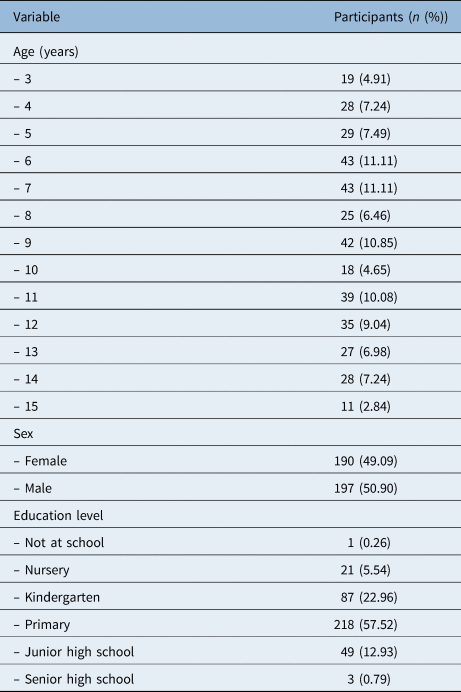
Of the 387 children screened, males constituted 50.9 per cent. Six and seven years were the more common ages of the children in the study sample. The mean age (± standard deviation) of children surveyed was 8.8 ± 3.38 years. The results also show that a majority (57.5 per cent) of children were in primary school; 28.5 per cent were in kindergarten or nursery, 12.9 per cent were in junior high school, 0.8 per cent were in senior high school, and 0.3 per cent were not in enrolled in school (Table 1).

Pure tone screening outcomes
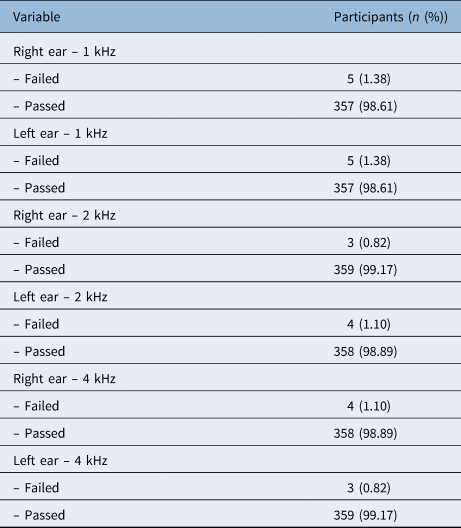
The outcomes of the audiometric screening performed using the ShoeBox audiometer are presented in Table 2. Of the 387 children recruited for the study, 362 successfully underwent audiometric screening. Thirty-two children were referred after screening (i.e. 25 children could not be conditioned to screening or departed prior to being screened, and 8 children were referred upon pure tone screening). Thus, of the 387 children recruited for this study, 32 children (8.3 per cent) were referred. During the study, the average sound pressure levels (SPLs) attained in the test van were 37 dB SPL in the testing booth and 42 dB SPL outside of the booth.

Further analysis of audiometric testing results showed that five children (1.4 per cent) were referred at 1 kHz in the right ear and five children (1.4 per cent) were referred at 1 kHz in the left ear. At 2 kHz, three children (0.8 per cent) were referred for the right ear, while four children (1.1 per cent) were referred for the left ear. Four children (1.1 per cent) were referred for the right ear at 4 kHz, while three children (0.8 per cent) were referred for the left ear at 4 kHz (Table 2).
Follow-up rate of children who failed screening
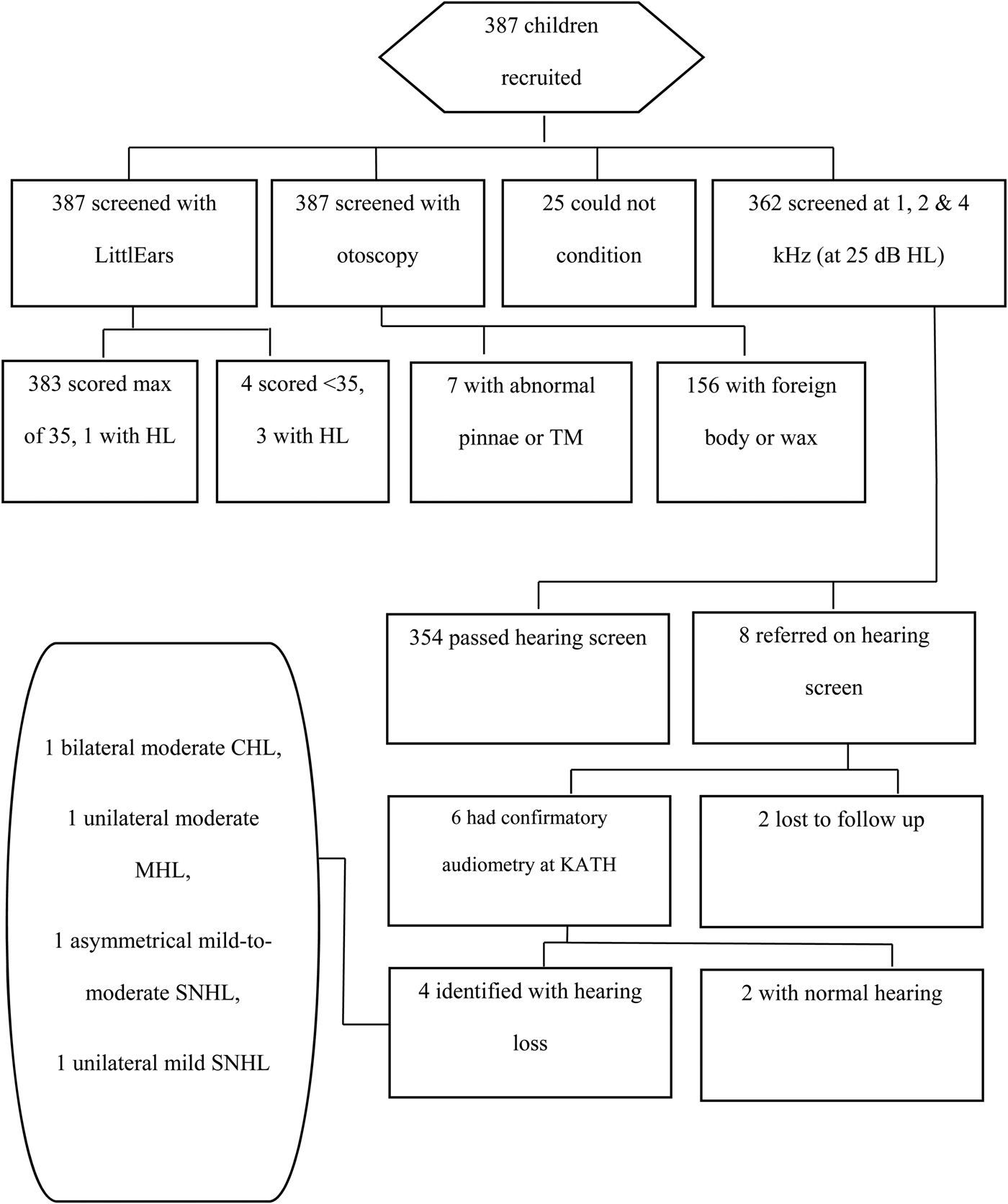
Of the 32 children who were referred on hearing screening, 6 (18.8 per cent) were followed up at the Hearing Assessment Center at Komfo Anokye Teaching Hospital for further evaluation, management and/or rehabilitation. One child reported within a month and five reported four months after the initial hearing screening. Two children in this subset of eight referrals were lost to follow up. As depicted in the flow chart in Figure 1, four children were ultimately identified with hearing loss: two had sensorineural hearing loss, one had conductive hearing loss and another had mixed hearing loss.
Study flow chart. HL = hearing loss; TM = tympanic membrane; CHL = conductive hearing loss; MHL = mixed hearing loss; SNHL = sensorineural hearing loss; KATH = Komfo Anokye Teaching Hospital

In-community auditory questionnaire use
The validated LittlEars auditory questionnaire had been completed by a parent or caregiver for all 387 of the children recruited. Of the 387 children, 4 (1.0 per cent) scored less than the maximum questionnaire mark of 35. These four individuals had reported scores of 20, 21, 33 and 34. Three of these four children were also referred on the basis of findings of audiometric screening performed with the ShoeBox audiometer.
Ear inspection and otoscopic findings
External ear and pinnae
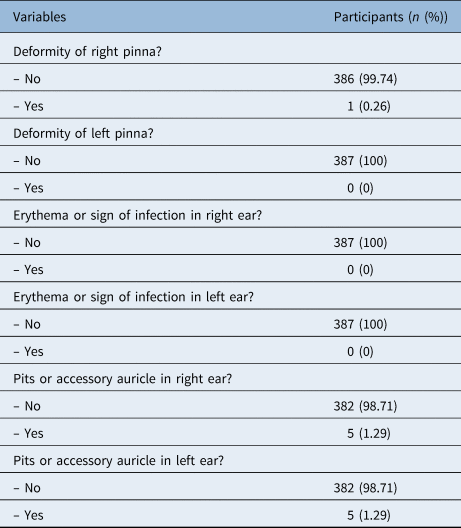
One child had a deformity of the right pinna, which was caused by a human bite. Five children (1.3 per cent) had either an accessory auricle or a pre-auricular sinus. None of the children had signs of active ear infection such as erythema or tragus tenderness (Table 3).

External auditory canal
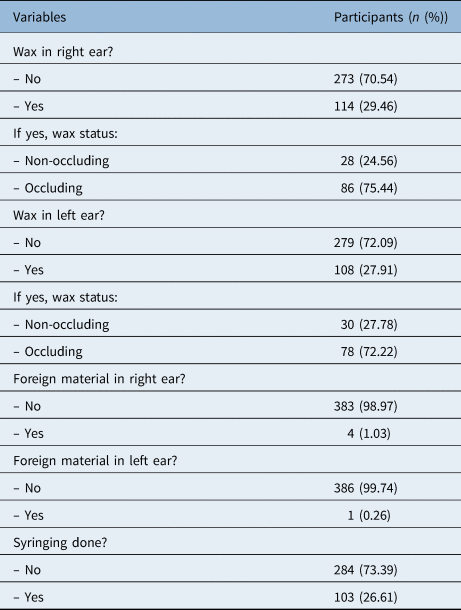
In all, five children (1.3 per cent of children) had a foreign body in one ear: four children had a foreign body in the right ear and one child had a foreign body in the left ear. Wax accumulation or impaction in the ear was the most common otoscopic finding among the children. A total of 151 children (39.0 per cent) were found to have wax in either one (n = 70; 18.1 per cent) or both (n = 81; 20.9 per cent) ears. Further analysis showed that 114 children (29.5 per cent) had wax in the right ear, 86 of whom (75.4 per cent) had occluding external auditory canal wax for which irrigations were required; 108 children (27.9 per cent) had wax in the left ear, 78 of whom (72.2 per cent) had wax occluding the ear canal that required flushing. Ear canal irrigations were conducted for 103 children (26.6 per cent) for occluding wax in one or both ears, or a foreign body in the ear (Table 4).

Tympanic membrane
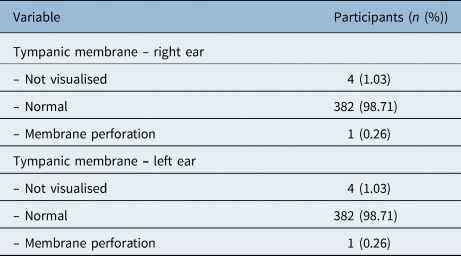
The tympanic membrane looked normal in the majority (98.7 per cent) of children. In 1.0 per cent of the children, the tympanic membrane could not be visualised because of unsuccessful removal of occluding ear wax. One child (0.3 per cent) had bilateral tympanic membrane perforations (Table 5).

Discussion
Paediatric hearing loss
In this study, 33 out of 387 children (8.3 per cent) were referred in the first stage of audiometric screening, either for their inability to be conditioned (n = 17), for departing before screening (n = 8), or for failure to respond to the presentation of screening tones (n = 8). Four of the 33 children referred (12.5 per cent) were found, on comprehensive audiological testing, to have hearing loss in the mild-to-moderate range. Both unilateral and bilateral threshold configurations were seen. The children went on to be treated at the Hearing Assessment Center or the ENT clinic at Komfo Anokye Teaching Hospital. Two children had normal audiometric results. Twenty-seven others had not attended for further testing at the time of writing this report.
To the best of our knowledge, this is the first population-based study to determine and report rates of hearing loss in children who live in peri-urban Kumasi, Ghana. Generally, there are a paucity of data on hearing loss in Ghana. The available studies tend to be facility-based and may not give accurate estimates, as people attending hospital-based clinics are more likely to have ear and hearing problems. Amedofu et al.Reference Amedofu, Ocansey and Antwi14 reported that hearing loss was present in 5734 out of 6428 patients (89 per cent) who complained of hearing problems at the ENT clinic at Komfo Anokye Teaching Hospital.
The rate of paediatric hearing loss in this study is lower than that estimated in a recent meta-analysis, which included 28 previously published papers on hearing loss prevalence in Africa.Reference Mulwafu, Kuper and Ensink19 That review reported a median hearing loss prevalence of 7.7 per cent for children or school-based studies, and 17 per cent for population-based studies, using a cut off at 25 dB. However, the authors cautioned that the figures might be inaccurate considering that few studies analysed in the review had employed statistically determined randomised cluster surveys.
The rate of identified hearing loss in the current study is also lower than the 24.9 per cent reported in a community-based study of children aged three to six years, conducted in a deprived area in South Africa using a smartphone for hearing screening.Reference Yousuf Hussein, Swanepoel, Mahomed-Asmail and Biagio de Jager20 However, a similar study conducted by the same authors in older children, aged five to seven years (cited in Yousuf Hussein et al.Reference Yousuf Hussein, Swanepoel, Mahomed-Asmail and Biagio de Jager20), revealed a remarkably lower rate of 4.3 per cent. The authors commented that ambient noise influences the screening failure and referral rates during portable in-community hearing screening. They concluded that less than optimal control of noise in the screening area, coupled with the low cognitive capacity among the significant number of younger children, may have contributed to the high rate in their study.Reference Yousuf Hussein, Swanepoel, Mahomed-Asmail and Biagio de Jager20 Noise was not a confounding factor in the current study because of the controls put into place at the time (use of a sound-treated van loaned by the Ghana Ministry of Health), and because of lessons learned in an initial pilot study conducted in the preceding months in the peri-Kumasi region (9th Annual Coalition for Global Hearing Health).
The paediatric hearing loss rate in this study, of children in peri-urban Kumasi, was 1.1 per cent. This rate is somewhat lower than, but more similar to, that reported among school children in Zimbabwe, of 2.4 per cent, for hearing loss above 30 dB HL at 1, 2 or 4 kHz.Reference Westerberg, Skowronski, Stewart, Stewart, Bernauer and Mudarikwa21 Our reported rate is slightly less than the WHO2 prevalence estimates of 1.9 per cent for sub-Saharan African children aged 5–14 years.Reference Mulwafu, Kuper and Ensink19 This may, in part, be due to an optimised audiometric testing environment in a sound-treated booth within the mobile screening van.
In-community hearing screening
Parents and caregivers were interviewed in their homes about their children's auditory behaviour using the LittlEars auditory questionnaire. The study results indicated that four children (1.0 per cent) scored less than the maximum mark of 35 on the LittlEars auditory questionnaire. Of the four who scored less than 35, three (75 per cent) were also referred based on screening audiometry results. This suggests that the LittlEars auditory questionnaire could be sufficient to identify children with less highly developed auditory behaviour. While we only had a small number of children with lower questionnaire scores that correlated with an audiometric-based referral, our data may support the use of the LittlEars auditory questionnaire for screening hearing loss in children of varied backgrounds. This study found that the LittlEars auditory questionnaire may be useful as a tool for screening auditory behaviour in children aged 3–15 years, even though it is presently validated for use in children aged below 2 years.Reference Bagatto, Moodie, Seewald, Bartlett and Scollie22
A guiding principle for screening programmes is to ensure sustainability and value for money, by avoiding situations where already-limited healthcare resources become overburdened by referrals because of a faulty screening tool. The Joint Committee on Infant Hearing11 has set the acceptable referral rate for newborn hearing screening at less than 4 per cent. When it comes to school-based and in-community hearing screening, however, an acceptable referral rate is yet to be determined. One study, which examined the failure criteria for school-based hearing screening in low-resourced contexts, determined that using a screening intensity of 25 dB HL contributed to a reduced failure rate.Reference Mahomed-Asmail, Swanepoel and Eikelboom23 The 2.2 per cent failed hearing screening rate obtained in this study falls within the recommended range of less than 4 per cent set by the Joint Committee on Infant Hearing. It is likely that carrying out the screening in a sound-treated van contributed to the low referral rate in this study.
Ambient room noise has been shown to hinder accurate hearing measurements by the ShoeBox, as was reported by a study conducted in semi-rural Kenya.Reference Jayawardena, Kahue, Cummins and Netterville24 Ambient noise did not play a role in the present study, to the best of our ability to control for it. Alternatively, one may argue that using the ShoeBox in a sound-treated van defeats the purpose of it being an appropriate tool for assessing hearing in the free field, outside sound-treated booths. For instance, a study conducted in the USA, which recommended its use under reasonably noisy conditions, recorded 39.5 dB as the ambient noise level in the room where the study occurred.Reference Thompson, Sladen, Borst and Still25 The ambient noise level measurements obtained in the community in the current study, however, exceeded that described as moderately noisy.Reference Thompson, Sladen, Borst and Still25 Noise levels measured in the communities in the current study ranged from 55–69 dB outside of the mobile van. Ensuring noise control in communities improves the reliability of the ShoeBox as a portable hearing screening tool in Ghana, as it would with any portable device used for screening.
Limitations of the current study included the unsuccessful conditioning of some children, resulting in their exclusion from the study. Using a sound-treated van did not depict the true in-home screening test, but this was necessary to carry out the study successfully, and to avoid unnecessary screening failures and referrals associated with excessive environmental noise. Another challenge was having to turn away children from households that had not been enrolled in the Family Health and Wealth Study. Parents who were not a part of the enrolled study, but who realised the usefulness of the hearing screening intervention, wanted to have their children included in the screening activity. As a compromise, the children in the unenrolled families were offered otoscopic examination, but were not included in the present report's analyses.
A major strength of this study was having a clearly defined study population, randomly selected at the household level, which could be accurately located using the unique identification number of the Family Health and Wealth Study. This ensured efficiency of recruitment and follow up of study participants. Despite this advantage, approximately 25 children were lost to follow up. In the authors’ view, these children are at high risk of hearing loss until further audiological interventions are completed, despite having achieved high scores on the LittlEars auditory questionnaire. This concern is based on the present study's finding of one child who achieved a LittlEars auditory questionnaire score of 35 but was found to have hearing loss.
Ear inspection and otoscopic findings
The most important finding on ear inspection and otoscopy, in this study, was the presence of wax in the external auditory canal. Thirty-nine per cent of children had wax in their ears, and in about 70 per cent of these cases the wax was occluding the ear and therefore required irrigation. This rate of 39 per cent is consistent with a study conducted in Limpopo, South Africa, where 36 per cent of children (children aged five to seven years) had occluding external auditory canal wax.Reference Phanguphangu26
With regard to other otoscopic findings, however, this study reported low rates compared to the Limpopo study.Reference Phanguphangu26 In our study, 1.3 per cent of children had a foreign body in the external auditory canal, compared with 4 per cent in the Limpopo study. Additionally, there were no cases of active ear infection in this study, and only one child (0.3 per cent) had tympanic membrane perforation, which was bilateral. Conversely, the Limpopo study reported that 8 per cent of children had otitis externa or otitis media, and 3 per cent had tympanic membrane perforations.Reference Phanguphangu26
Similar to our study, in Nigeria, among children aged 3.5–6 years, ear wax was the most prevalent finding on otoscopy, with a prevalence of 21.8 per cent.Reference Adebola, Ayodele, Oyelakin, Babarinde and Adebola27 In Ghana, a study among school children found a prevalence of ear wax in 40.9 per cent of males and 38.2 per cent of females,Reference Osei, Larnyo, Azaglo, Sedzro and Torgbenu17 which is comparable to the current study's findings.
Wax impaction is known to cause conductive hearing loss and may contribute to the development of ear infections. In a systemic review of the prevalence rates and causes of hearing impairment in Africa, Mulwafu et al.,Reference Mulwafu, Kuper and Ensink19 reported wax impaction as the third most common cause of hearing impairment (24 per cent). Considering that wax impaction is a reversible cause of hearing impairment, parents and caregivers need to be educated to send their children to providers for ear examination and wax removal. In Ghana, there are trained ENT specialist nurses working in the districts who can offer otoscopic and ear flushing services.
Follow up of children who failed screening
It is important that ENT providers who see children that fail initial hearing screenings conduct comprehensive examinations. These examinations, preferably carried out in conjunction with audiology appointments, serve the purpose of establishing a definitive diagnosis, as well as offering rehabilitative services, particularly in patients with a co-morbid presentation. High referral rates and suboptimal follow-up rates after hearing screening in children are undesirable. For newborn hearing screening, the Joint Committee on Infant Hearing11 proposes an ideal follow-up rate of 95 per cent, but states that a return rate of 70 per cent is more practical. Ravi et al.,Reference Ravi, Gunjawate, Yerraguntla, Lewis, Driscoll and Rajashekhar28 reported an estimated 20 per cent loss to follow up after hearing screening in children.
In the present study, 8 out of 33 children (25 per cent) (recalculated based on 8 screening referrals plus the 25 children who were not conditioned in the first stage of screening) who were referred on the basis of hearing screening findings subsequently reported to the Hearing Assessment Center at Komfo Anokye Teaching Hospital. This result is similar to the reported 30 per cent return for follow-up rate found among college students screened in a recent US study,Reference Taylor and Emanuael29 but is considerably lower than the benchmark follow-up rate of 70 per cent proposed by the American Joint Committee on Infant Hearing.11 Clearly, more work remains to be done in this area, a foreseeable challenge for low-resourced communities.
Policy implications for childhood hearing screening in Ghana
Our data estimate that in a specific community in one part of peri-urban Ghana, children are referred on the basis of hearing screening findings at a rate of 8.2 per cent. This is equivalent to that reported in several prior studies. This result helps objectify paediatric hearing referral rates and associated hearing loss as a legitimate public health problem in Kumasi, a finding that may serve to inform eventual policy-making regarding childhood hearing screening efforts in Ghana.
Although legislation on disability exists, Ghana currently has no policy on childhood or newborn hearing screening. Consideration should be given to a policy framework that looks at hearing screening in neonates and throughout childhood for the early identification of hearing loss and intervention, to mitigate the numerous challenges associated with hearing loss in children. The absence of such an overarching framework has given rise to erratic practices. For instance, screening for hearing loss in newborns is subject to the availability of equipment and the personnel to use it, and remains at the discretion of the heads of the various health facilities. Senior high schools, universities and other tertiary institutions also request the medical screening of new entrants, which often includes hearing screening; however, screening in basic schools is not standard practice. These institutional policies in instances where they are requested are not funded, and costs are born by the individuals.
A major hearing aid manufacturer established a foundation that recently (September 2018) inaugurated a Technical Working Group tasked with the responsibility of developing a National Strategic Plan for Ear and Hearing Health in Ghana.30 Ideally, this could assist in establishing childhood hearing screenings in Ghana.
A national policy on ear and hearing care could mandate newborn hearing screening. This would require standardisation of the clinical measures used in both the screening and identification phases of a comprehensive programme aimed at newborns, infants and older children. Establishing comprehensive yet age-appropriate forms of hearing screening using otoacoustic emissions (OAE), auditory brainstem responses (ABRs) or behavioural pure tone measures would be a worthy policy goal. Currently, ABR measures are non-existent at Komfo Anokye Teaching Hospital or the greater Ashanti Region where this study was conducted. A single piece of OAE equipment was required to be used at Komfo Anokye Teaching Hospital during the present study, which limited the scope of the present study to pure tone screening and questionnaire use in the study population.
Implementing a national policy regarding childhood hearing screening and hearing loss detection would mandate that measures be taken to train the staff needed for comprehensive ear and hearing care and education, including otologists, audiologists, ENT nurses, speech therapists, and educators for schools for the deaf. Currently these personnel are scarce.Reference Waller, Larsen-Reindorf, Duah, Opoku-Buabeng, Edwards and Brown31
Systems would have to be put in place prior to mandating newborn hearing screening, to ensure the proper tracking of children who fail initial hearing screening, for follow-up testing and rehabilitation. A policy on newborn hearing screening would include well-designed programmes that provide continuing education to healthcare workers about the importance and the potential cost-effectiveness of ear and hearing care, and the benefits of early hearing loss detection and intervention. School-based hearing screening would be implemented if there were a policy in place. Assessment of hearing would have to include reception into basic schools (nursery), versus the current situation where hearing screening may only be available for secondary and tertiary schools as part of a request for medical examinations.
The National Health Insurance Scheme in Ghana does not fund hearing aids. Those needing hearing aids may order them at a cost of between 1000 and 6000 Ghanaian cedis ($450–1250 USD), or depend on donations from non-governmental organisations and other agencies.32 The children identified with hearing loss in this study who require hearing aids have been registered, and are awaiting the next donation of hearing aids by the Starkey Hearing Foundation, a programme already in existence in numerous resource-challenged countries. Implementing a policy on childhood hearing screening means that plans would have to be made to ensure hearing aids are available and affordable for rehabilitating the hearing impaired, including young patients.
With regard to providing special education for children with severe-to-profound hearing impairment, Ghana has 14 schools for the deaf, with at least 1 located in each of its 10 regions. These schools would have to be adequately resourced to take care of children who require education there because they are seriously under-resourced.33 A policy on childhood hearing screening would benefit from programmes that raise the public's awareness about ear and hearing health, and the rehabilitative measures available, including education aimed at reducing the stigma and burden associated with hearing loss. In addition, steps must be taken to provide alternative means of communication, such as sign language, and providing subtitles or captions on audiovisual media.
• Paediatric hearing loss rates in Ghana are currently unknown
• Portable hearing screening technology and validated questionnaires are effective tools to gather in-community data
• Such tools enable better determination of hearing loss rates in low-resourced parts of the world
• Paediatric hearing loss is prevalent in Ghana, and should be treated as a public health problem warranting further evaluation and epidemiology characterisation
Conclusion
This study reported: a hearing screening referral rate of 8.2 per cent (32 out of 387), a follow-up rate of 25 per cent (8 out of 32) and a paediatric hearing loss rate of 1.1 per cent (4 out of 362) in peri-urban Kumasi. This latter rate approximates that reported by the WHO for children of the same age, suggesting that paediatric hearing loss is an important health problem in Ghana. In the present study, otoscopic examination revealed that 39 per cent of children had wax in their ears, and some children (1.3 per cent) had undiagnosed foreign bodies in the ear.
The LittlEars questionnaire was successfully used to assess the auditory behaviour of children, by interviewing their parents or caregivers in a local language (Asante Twi) within their homes. It was deemed to be sensitive to hearing loss and associated auditory behaviours, as three out of four participants who scored less than the maximum mark of 35 were also referred on audiometric screening with the ShoeBox portable audiometer, and ultimately were identified as having hearing loss. The ShoeBox, a portable tablet-based audiometer, proved to be reliable for in-community hearing screening. Controlling for ambient environmental noise is crucial for ensuring low referral rates, accurate data collection, efficient hearing loss identification, and effective use of limited financial and rehabilitative resources.
Acknowledgements
We would like to acknowledge the study population at Asokore Mampong in the Ashanti Region of Ghana. We are grateful to faculty and staff members of the Department of Otolaryngology/Head and Neck Surgery at the University of Michigan, as well as staff members of the Department of Otorhinolaryngology of Komfo Anokye Teaching Hospital, Kumasi, Ghana. We would also like to acknowledge the School of Public Health, Kwame Nkrumah University of Science and Technology, and the co-ordinators of the Family Health and Wealth Study, for their support in the conduct of this study. Funding for this study was provided by the Ghana Health Service and University of Michigan (2018 Hauslohner grant).
Competing interests
Drs Basura and Edwards received discounted pricing on the ShoeBox iPad audiometer used in Ghana.