1. Introduction
Debates on species monism often hinge on the purpose of a biological classification system. Many species monists, such as David Hull (Reference Hull and Wilson1999), have argued that species should be defined from the perspective of evolutionary biology. An evolutionary perspective, they claim, will lead us to accept a particular definition of the species category, one promising a unique classification. There remain debates about which evolutionary concept to use, but most think some single definition of the species category available. Species pluralists such as John Dupré (Reference Dupré1993) and Philip Kitcher (Reference Kitcher1984), by contrast, claim that there are legitimate perspectives on species besides that of evolutionary biology, such as that of ecology or the culinary arts. Depending on which perspective is taken, a particular classification will be selected—that which best serves the needs of the relevant practitioners. Thus, species pluralism results from perspectival pluralism; if there are multiple legitimate perspectives, there are multiple legitimate classifications. If evolutionary theory is the only perspective from which to view species, we are left with species monism.
In this essay, I take for granted the default perspective—evolutionary biology—and show that this perspective is ill-suited to categorize organisms such as bacteria. Evolutionary species concepts such as the biological species concept (BSC) and the various phylogenetic species concepts (PSCs) cannot be used to define the species category for bacteria without significant concessions to the original spirit of an evolutionary systematics.Footnote 1 To determine a unique classification, practitioners must either make arbitrary decisions about the composition of species taxa or decide which genes are the “core genes” of an organism. As one of the original attractions of evolutionary systematics was the possibility of not appealing to essential characters in any form, these are not trivial moves. If evolutionary species concepts force the reintroduction of essential characteristics, albeit of a different variety, the attraction of such concepts is severely undermined, leaving open the door to other perspectives on the nature of species.
These difficulties with evolutionary species concepts may have been overlooked due to a neglect of bacterial biology in philosophical discussions of species and an almost exclusive focus on metazoa.Footnote 2 For metazoa, reproduction and gene transfer go hand in hand, leading us to ignore the possibility that these two activities could ever become separated. Recent discoveries have demonstrated that bacteria frequently transfer genes outside reproduction in an activity known as horizontal gene transfer (HGT). As we will see, the occurrence of HGT undercuts claims that gene exchange is responsible for unifying population lineages, as well as throwing into doubt our understanding of just what these lineages are.
Of course, the inapplicability of BSC to bacteria might not seem like news. Whoever thought as much? Certainly not BSC's main enthusiast, Ernst Mayr, who has claimed that bacteria, being primarily asexual, only have typological species (Mayr Reference Mayr2001). But those who have dismissed the use of BSC in bacterial systematics have done so without taking into account HGT, a phenomenon that some biologists think makes BSC applicable to bacteria (Ravin Reference Ravin1963; Dykhuizen and Green Reference Dykhuizen and Green1991; Vellai et al. Reference Vellai, Kovacs, Kovacs, Ortutay and Vida1999; Lan and Reeves Reference Lan and Reeves2001; Wertz et al. Reference Wertz, Goldstone, Gordon and Riley2003). Thus, in order establish that no evolutionary species concepts are suitable, we must look more closely at the BSC in the light of research on bacterial sexuality.
Furthermore, it is commonly assumed that PSC and other lineage-based species concepts apply to all of life, including bacteria in some form (de Queiroz Reference de Queiroz and Wilson1999; Hull Reference Hull and Wilson1999). Here we will examine the lineages that are central to phylogenetic systematics. Because of divergences among the phylogenies of different organismal parts, I argue there are no particular lineages to which we can appeal when delimiting species—unless we are willing to accept that certain organism parts are essential to organism identity.
Although this article will remain agnostic about the metaphysical status of species taxa, it will use the language of individuality in order to simplify the presentation. The arguments should apply whether species taxa are seen as individuals or as sets. But though uncommitted about the ontology of species, the arguments here are still thoroughly metaphysical—not epistemological or methodological. I am not ultimately concerned with how biologists determine species boundaries, although empirical methods must be occasionally discussed. Instead, I will consider the extent to which evolutionary species taxa either lack sufficient justification or are principled only at the cost of being metaphysically suspect.
I begin with a briefing on bacterial biology. These biological details are required to evaluate the discussion that follows. I then make two arguments that target existing species concepts. In these, I consider how we can attempt to apply evolutionary species concepts to the bacterial world and point out the pitfalls of each attempt. Finally, I consider alternative pragmatic approaches to bacterial species advocated by contemporary biologists.
2. Biological Preliminaries
2.1. Inheritance
Bacteria, single-celled organisms that by both mass and census dominate the planet, reproduce via binary fission, a process in which a single parent cell divides to form two more or less equivalent progeny cells. The DNA copying mechanisms are relatively error free, so initially progeny cells have the same genetic endowment as parent cells.
Although much of a bacterium's genetic endowment is from its primary parent, this is not the only way that it can acquire genes. In the past decades, HGT has been found to occur both within conventional species groups and between them, both in the present and the distant past (see Ochman, Lawrence, and Groisman Reference Ochman, Lawrence and Groisman2000; Dutta and Pan Reference Dutta and Pan2002; Planet Reference Planet, DeSalle, Giribet and Wheeler2002).Footnote 3
The basic idea of HGT is that hereditary material can pass from one organism to another independently of reproductive events.Footnote 4 Upon entry of DNA into the recipient cell, genetic material can either remain as extrachromosomal DNA, as is the case with plasmids, or it can integrate into the host cell's DNA, in which case it will be, more or less permanently, a part of that cell and all of its progeny.
Margulis and Sagan (Reference Margulis and Sagan1995, 93) provide a helpful anthropomorphic illustration of what happens to organisms participating in HGT: “Imagine that in a coffee house you brush up against a guy with green hair. In so doing, you acquire that part of his genetic endowment, along with perhaps a few more novel items. Not only can you now transmit the gene for green hair to your child, but you yourself leave the coffee shop with green hair. Bacteria indulge in this sort of casual quick gene acquisition all the time.”
Although early reports of HGT came from research on drug-resistance determinants, many gene types are transferable; genes for proteins involved in functions such as the heat-shock response (Hsp70), energy use (ATPases), and protein synthesis (aminoacyl-transfer RNA synthases) have all been implicated in gene transfer events (Gogarten, Doolittle, and Lawrence Reference Gogarten, Doolittle and Lawrence2002).
Horizontal gene transfer can wreak havoc on long-held assumptions about species and phylogeny. As we will see, because of HGT putatively clonal organisms have innumerable parents, an individual organism's genes have different histories, and species cease to be monophyletic, violating assumptions of many phylogenetic analyses.
2.2. How Much HGT?
One might think that gene transfers between bacteria had no implications for systematics on the grounds that we can classify bacteria as being, for practical purposes, asexual. Unfortunately, as is well known, the alleged “simplifying assumption” of asexuality does not make for ease in dividing organisms into species taxa. Yet, in the present context, we have to ask if that simplifying assumption even makes sense. The answer to that question will depend on how much gene transfer actually occurs.
Determining the extent of gene transfer is complicated. It has been studied in three ways: (1) by comparing the phylogenies of different genes,Footnote 5 (2) by examining relative codon usage in different populations,Footnote 6 and (3) by measuring rates of transfer within extant populations using parametric tests.Footnote 7 Researchers claim that these techniques have revealed numerous transfer events. Even though it is difficult to detect transfers from close relatives, or transfers in the distant past, some organisms, like Aquifex aeolicus and Thermotoga maritime, seem to have acquired up to 24% of their protein sequences from organisms in the other prokaryote Ur-kingdom: Archae (Ochman et al. Reference Ochman, Lawrence and Groisman2000). A disturbing finding for some, this has provoked prescriptive gene rhetoric from biologists. La Cruz and Davies (Reference La Cruz and Davies2000, 129) mention that in transfer events “intergenic boundaries were not respected,” as if the genes were violating international trade agreements.Footnote 8
Unfortunately, it is not possible to give a good average figure for gene transfer, over either evolutionary or shorter time periods. This is because of the limited number of sequences analyzed, as well as because of difficulties in discovering facts about the distant past. But there is increasing agreement that HGT has been important in bacterial evolution: “The prokaryotic world is now often seen as a ‘genome space’ in which horizontal transfers between organisms appear to be the rule” (Daubin, Guy, and Perrière Reference Daubin, Guy and Perrière2002, 1080).
3. The Evaluation of Bacterial Species Concepts
Species concepts are commonly evaluated with the aid of explicit desiderata (Hull Reference Hull, Claridge, Dawah and Wilson1997; Mayden Reference Mayden, Claridge, Dawah and Wilson1997). Of course, if the desiderata are controversial, the conclusions of an analysis based on them are likewise so. In order to avoid disputes about the desiderata themselves, this article aims primarily to provide an internal critique of evolutionary species concepts, arguing that they incorporate commitments in tension with a common rationale for pursuing evolutionary systematics.
To illustrate this tension, we must first ask what motivates the pursuit of an evolutionary systematics in the first place. We can identify two central motivations. First, evolutionary species—however their details are understood—are attractive inasmuch as they point out “natural groupings” that either reflect the results of the evolutionary forces that created them (PSC) or describe those forces (BSC). We should be looking for the evolutionary groups because, according to most biologists, evolution is “the most basic perspective in biology” (Hull Reference Hull and Wilson1999, 33). This motivation is not in tension with the bacterial species we will discuss here. Bacterial evolutionary species should reflect natural patterns in the evolution of the microbial world.
A second motivation for the pursuit of an evolutionary systematics is that history seems to promise us not only natural species taxa but unique and monist-friendly ones as well: “Systematic principles that take history as basic seem appealing because they can promise a single classification” (Hull Reference Hull and Wilson1999, 35). To achieve this single classification, biologists are not required to declare some set of properties the most important to species identity.Footnote 9 On the contrary, typological species concepts require systematists to specify a character or cluster of characters necessary for species membership. Typological definitions founder on the question: “Can one level of similarity be specified—one level that can be applied equally across all organisms to produce even a minimally acceptable classification? The answer to this question, thus far, is no” (Hull Reference Hull and Wilson1999, 35).Footnote 10 We will find that this second motivation is in tension with the application of evolutionary species concepts to bacteria. This is because they either lead to multiple classifications or require biologists to prioritize certain organismal or species characteristics as particularly important.
Although the central argument here concerns this internal tension facing evolutionary species, in order to evaluate evolutionary species concepts it will at times still be necessary to appeal to two external desiderata, both of which are minimal and, hopefully, uncontroversial. First, I will insist on nonarbitrariness, meaning that arbitrary decisions should not be required in order to delimit species taxa. This standard is in line with the requirement that species should be natural units that are uncovered by biologists, not stipulated by them.Footnote 11 Second, species concepts should partition the bacterial world into different species taxa. That is, (1) each bacterium should be a part of some species, and (2) all bacteria should not be a part the same species. Species concepts must support some delimitation of species taxa, not merely lump all organisms together or leave each organism on its own. The satisfaction of each criterion is necessary for any adequate definition of the species category. Thus, if a species concept leaves either one of them unsatisfied, I will conclude that that concept does not provide a viable account of bacterial species.
3.1. Complications for the Biological Species Concept
The BSC provides a definition of the species category according to which species taxa are interbreeding natural populations that are reproductively isolated from other such populations (Mayr Reference Mayr1963). Through sexual transfers species form unified gene pools. In each generation, genes are shuffled through mating events, and beneficial mutations have a chance to spread to very distant, although reproductively connected, populations. This gene exchange is thought to be the mechanism that explains species cohesion, and it thus provides good grounds on which to define the species category.
If bacteria are asexual, as is commonly assumed, then BSC cannot be a viable definition of the species category. Strictly asexual organisms cannot form the unified gene pools required by the biological species concept (Mayr Reference Mayr1992, 23). But should bacteria actually be considered asexual? Via HGT a novel gene can spread in an otherwise clonal community. Thus HGT might provide a way for bacteria to be sexual and thereby to be a part of “interbreeding natural populations” (Mayr Reference Mayr1963, 19). But whether HGT is considered sufficient for sex depends on what we mean by sex, which is something worth considering here.
Broadly, biologists have meant at least three different things by sex. First, researchers who study evolutionary explanations for the presence of sex see it as (1) genetic exchange that is an adaptation resulting from selection for the benefits of such exchange (Redfield Reference Redfield2001). Second, evolutionary biologists who do not study the explanation of sex itself but instead use sex to understand evolution and speciation have considered sex to be (2) any process that involves the transfer of genetic materials (e.g., Dykhuizen and Green Reference Dykhuizen and Green1991; Tibayrenc Reference Tibayrenc1996; Belkum et al. Reference Belkum, Struelens, Visser, Verbrugh and Tibayrenc2001). Finally, some biologists consider sex to be (3) the transfer of genetic material during reproduction (e.g., Judson and Normark Reference Judson and Normark1996).
I suggest that we use that characterization of sex developed for a purpose that matches the purpose of this investigation. In that regard, definition 2 above is preferable to definition 1. Our concern is not to explain the presence of gene transfer processes, as in definition 1, but to use gene transfer processes to explain the development or maintenance of species, as in definition 2. Sex is whatever allows genes to be exchanged between members of the group—either through traditional mating or through other means. This is the importance of sexuality for BSC: “The biological species concept is defined explicitly in terms of reproductive mechanisms, but the concept is motivated largely by the idea that species taxa form a united and important type of genetic system. … From a genetic perspective, each biological species is a distinct gene pool” (Ereshefsky Reference Ereshefsky1992, 3). Although reproductive mechanisms are often used in definitions of the species category, Ereshefsky explains, they are proxies for the unity of gene pools, a unity that HGT also provides. But what about definition 3? Why do some scientists only consider sex to be a process of gene exchange during reproduction? Most likely, this is because, for many organisms, it is only during reproduction that genes pass between organisms. In circumstances in which nonreproductive gene transfer and recombination is possible, there do not appear to be theoretical reasons for treating nonreproductive gene exchange differently from recombination during reproduction.
Given that HGT can be considered a kind of sex, let us evaluate BSC's applicability to bacteria by considering the two requirements of Mayr's conception: (1) gene exchange (sex) must connect individuals in the group and (2) the group must be isolated from gene exchange from other such groups. I will address these requirements in turn.
Genetic transfer between conspecific bacteria does appear to be significant, fulfilling BSC's first requirement. Maynard Smith et al. (Reference Maynard Smith, Smith, O’Rourke and Spratt1993) investigated the population structures of five bacterial species and three kinds of protozoa and found that some bacteria are involved in such frequent intraspecies gene exchange that they are “essentially sexual” as a result of this gene mixing. Studies of the population structure of other bacteria have revealed additional evidence of intraspecies exchange. Dykhuizen and Green (Reference Dykhuizen and Green1991), Lan and Reeves (Reference Lan and Reeves2001), and Koehler et al. (Reference Koehler, Karch, Beikler, Flemmig, Suerbaum and Schmidt2003) all discuss other bacterial populations with high rates of intraspecies HGT.
But what about the second requirement of the BSC? While transfer within a population is monitored by examining recombination rates of individual alleles in that population, transfer events between species can be determined retrospectively by comparing gene phylogenies. Based on such studies, researchers claim that large parts of bacterial species’ genomes have been acquired from other species (Ochman et al. Reference Ochman, Lawrence and Groisman2000). As two biologists (Levin and Bergstrom Reference Levin and Bergstrom2000, 6981) have put it, from the perspective of bacteria, we sexual eukaryotes are “incestuous nymphomaniacs,” having sex far too often, and with partners very closely related to ourselves. Bacteria do it differently—less frequently and with more kinds of partners. Consequently, it appears that BSC's second criterion is not fulfilled—bacterial species are not genetically isolated, even when they are genetically connected themselves. Horizontal gene transfer brings about interspecies recombination, not just intraspecies recombination, and thus it seems that we can safely reject BSC as a definition of the species category for bacteria.
One may object that the above evaluation assumes some prior set of species taxa, those used by contemporary microbiologists. The fact that accepted bacterial species taxa do not correspond to the taxa delimited by BSC does not show that BSC is unsuitable. It remains possible that accepted species taxa are flawed.Footnote 12 In what follows, gene exchange itself will be used to delimit bacterial species taxa, and I will apply the desiderata stated earlier to gauge the adequacy of the attempts.
3.1.1. Problem No. 1: Nested Populations
Gene exchange in nature can occur at a continuous range of frequencies; in some communities genes are exchanged every generation, and in others, every millionth generation. Furthermore, there is variability with regard to which gene types are exchanged. Consequently, while all versions of BSC require that species are unified gene pools, BSC can come in different forms depending on both how much gene exchange is required for a gene pool to be considered unified and which genes are considered important to unify populations though exchange.
One approach to clarifying a bacterial BSC would be to draw species boundaries so as to include all organisms in potential genetic contact. The presence or absence of mechanisms of sexual isolation between different organisms would delimit species taxa, as has been popular in metazoan biology. Along these lines, biologists have investigated a number of isolation “mechanisms,” that is, ecological isolation, behavioral isolation, isolation due to obstacles to DNA entry, restriction endonuclease activity, and functional incompatibility (Cohan Reference Cohan2002).Footnote 13
Unfortunately, this proposal will not satisfy our desiderata for bacterial species. It seems that if potential genetic connectedness is used as the definition of the species category, there will be only one giant bacterial species, as well as a large number of bacteria that are not in any species at all because they are not involved in sex of any kind (Sonea and Panisset Reference Sonea and Panisset1983; Margulis and Sagan Reference Margulis and Sagan2002). Such a situation is not palatable based on the second desideratum, which required that a species concept actually partitions the bacterial world into different species taxa. Genetic contact is too liberal of a standard because the ability to receive and donate hereditary elements, particularly in plasmid form, is so common in the bacterial world.
Another option would be to choose some particular level of genetic connectedness and claim that species taxa are those populations of bacteria exhibiting that level of connectedness or more. Connectedness has been found of different strengths between different populations, as illustrated in Figure 1. Three bacterial communities are shown to be very tightly linked (the As, Bs, and Cs), while two larger communities are less tightly linked, where tightness of link is determined by frequency of gene exchange (the As and Bs, the As and Cs).
All organisms labeled A are members of some group that exchanges genes frequently, as with B and C. Gene exchange also occurs, albeit at lower frequency, between individual As and Bs, and between As and Cs. However, there is no direct exchange from B to C. Depending on the threshold chosen, the As can be considered a part of three different ‘species’ groupings (As, $\mathrm{As}\,+\mathrm{Bs}\,$, and
 $\mathrm{As}\,+\mathrm{Cs}\,$), and the same-species relation fails to be transitive.

Depending on how much connectedness is required, different and overlapping species taxa might be delimited. Unfortunately, choosing a benchmark level of connectedness will be in some sense arbitrary. Thus, in consideration of our requirement that there be no such arbitrary decisions required, we should reject this proposal as an understanding of bacterial species. Furthermore, no matter at which level the benchmark level of connectedness is set, some bacteria will not participate in enough HGT to be a part of a species taxa, leading to a failure of the partitioning desiderata.
3.1.2. Problem No. 2: Variable Gene Exchange
In the previous scenario, we described gene exchange occurring between organisms at variable frequency. This resulted in either a complete lack of species taxa or those that were too arbitrary for our purposes. Yet the situation described was actually simpler than what is found in nature, as it was assumed that all of a bacterium's genes could be transferred to a given recipient with equal ease. But biologists maintain that this is infrequently the case. Genes of a given bacterium can be transmitted with variable frequency to different sorts of recipients (Jain, Rivera, and Lake Reference Jain, Rivera and Lake1999; Daubin et al. Reference Daubin, Guy and Perrière2002). As we will see, this can lead to species boundaries that depend not only on the strength of genetic connection required but on the kinds of gene transfers that are considered.
For HGT to have any consequences, more is required than merely the physical entry of nucleic acids into a foreign cell. A successful transfer can only occur, yielding a new viable bacterium, if the new genes are not fitness lowering, and if there are enzymes capable of physically integrating the nucleic acid into either a stable plasmid or the host chromosome. If fitness were lowered by a transfer, the recipient organism and its progeny would be out-competed, and eventually no descendants of the transfer would remain. If neither recombination nor insertion were possible, the gene would not be part of descendant organisms in the first place. Lan and Reeves (Reference Lan and Reeves2001) explain that because of these factors, housekeeping genes are those most likely to be transferred between some sets of bacteria, usually those with more local genome sequence identity that facilitates recombination, while genes that facilitate niche adaptation, such as those that allow infective agents to penetrate the host epithelium, are transferred between other sets of bacteria.
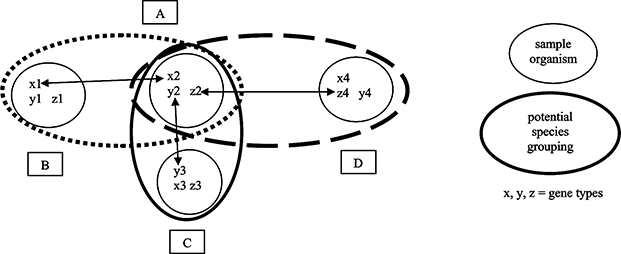
Interbreeding species concepts were fashioned for organisms whose genes recombined with equal frequency with any group of partners with which they recombined at all. Since genes in bacterial genomes can be heterogeneous with regard to the populations with which they will recombine, we are faced with the situation portrayed in Figure 2. One bacterium (A) with three genes (x2, y2, and z2) is shown. Each of its genes can only be exchanged with one other organism (B, C, or D). Hence, x2 can be exchanged with B, y2 with C, and so on.
Organism A can exchange each of its genes with one other kind of organism (B, C, and D). If the biological species concept were applied, many different species taxa could be delimited depending on which genes were of interest. If genes x and y were of interest, organisms A, B, and C would form a species, while D would not be included. If only gene z were of interest, A and D would form a species, excluding B and C.

Biologists discouraged by the fact that an all-genome BSC results in one megaspecies could exploit the selectivity of the exchange of particular genes to delimit species taxa, but they would need to decide which individual gene, or set of genes, to utilize. For example, focusing on the exchange of gene x above yields one taxon (A and B). An overlapping but nonidentical group is circumscribed if gene y is prioritized (A and C). Lawrence (Reference Lawrence2002, 455), for example, comments that because of the selective exchanging of genes in certain populations, some species “conform to the Biological Species Concept, but only for parts of their chromosomes.”
What could justify using a particular gene (or set of genes) to delimit species taxa? One justification for the practice is pragmatic. Within the framework of BSC, species taxa boundaries must somehow be delimited. By stipulating the use of some gene's transfer (or gene group), irrespective of its contents, we can settle the matter of species boundaries and move on to discuss more interesting questions. Such a stance is reminiscent of that of the pheneticist who selects a convenient similarity measure to demarcate species taxa in order to have a clear, operational procedure available, without claiming that his taxa are necessarily the only “natural” ones. Unfortunately, simply stipulating some subset of the genome whose exchange should be used to delimit species taxa has all the arbitrariness of the typologist's decision, without the ease of use provided by many typological definitions of the species category. Thus, it seems we can reject this proposed understanding of BSC.
Another option would be to base species taxa on the exchange of genes that seem to be particularly important to organism function, those sometimes called the “core genes.” For example, some biologists consider the informational genes—genes that code for proteins used in DNA replication, RNA transcription, and protein translation—to be core genes.Footnote 14 Since DNA replication, transcription, and translation are required for the survival and reproduction of the organism, prioritizing the transfer of related genes might make sense. Species would be populations of organisms that participated in informational gene exchange. Yet a biologist seems to be burdened here with a substantial commitment about the “important” or “essential” organismal processes. Another biologist could easily object that she thought that metabolic processes, and metabolic genes, form the core of the organism and, therefore, should be used in determinations of species taxa. The debate between such a pair of biologists would come down to their respective ideas about which processes and genes are important, a debate that we have no reason to think will be possible to resolve in a context-independent way. If one were to commit oneself to a particular organismal property as important, we would be sacrificing a major advantage of the evolutionary species concept—that such concepts do not require essentialist commitments.
A final response to this situation could be to avoid commitment to what genes should be used in delimiting species taxa by deciding to use them all. In this case, if there were potential hereditary exchange between organisms, those organisms would be part of the same species. However, this option runs up against the problems discussed in the previous subsection. If the exchangeability of all genes is considered, the bacterial world will not be partitioned into different species.
Thus, it seems that none of the proposals for making sense of bacterial species in terms of the biological species concept has been adequate. We can now consider whether phylogenetic species concepts are any more promising.
3.2. The Phylogenetic Forest
Phylogenetic species concepts come in many flavors, but all hold that species taxa are lineages, subject to one or more constraints, within a hierarchic phylogenetic tree (de Queiroz Reference de Queiroz and Wilson1999, Reference de Queiroz2005). As we discussed above, one putative advantage of the phylogenetic account of species is that, although there are innumerable properties that we might use to delimit typological species, there is only one property relevant to a genealogical systematics—history. And at least for meiotic organisms, there is only one history. David Hull (Reference Hull and Wilson1999, 35) has emphasized this advantage, writing that “even though phylogeny includes lots of merger there is one and only one phylogenetic ‘tree’.”
Here we will explore what happens to phylogenetic systematics when the assumption that there is only one history fails. Because of HGT there is not a unique phylogenetic tree. Instead, we will see that there are multiple nonequivalent trees that can be overlaid to create a web. In brief, this is because different genes and organismal parts, those which transmit hereditary characters and are thus relevant to an evolutionary systematics, have different phylogenies. To obtain a single tree, one must select particular organism parts, such as genes, gene groups, or membranes, and construct a genealogy of these objects. Such a tree can also be considered an organismal tree if we are willing to say that certain organismal parts are of greater importance than others or are essential to organism identity.
We can begin to understand the origin of our problem—the proliferation of bacterial phylogenetic trees—by examining a toy example from the study of ancient manuscripts. Imagine that we were interested in mapping the dissemination of Aristotle's little-known book, the Theophrastian Ethics (TE). This imaginary book has, I stipulate, six chapters, each of which considers issues in the ethics of animal care. Ten full manuscripts have survived to the present day, all containing a slightly different text. It seems that irresponsible book copiers of antiquity are to blame: the long, tedious process of copying led to daydreaming, alterations in spelling and word order, and even missing words. The first step in figuring out what Aristotle really wrote is to make a family tree of these manuscripts. Scholars start by examining different versions of the first sentence of chapter 1. Manuscripts numbered 1, 3, and 4 read (in translation) as follows: “Every animal, and likewise every caretaker of animals, seems to seek some good.” The remaining manuscripts contain the same sentence with the following difference: the word “fuzzy” is inserted between the first two words, reading: “Every fuzzy animal, and likewise every caretaker of animals, seems to seek some good.” Scholars have reasoned that it is unlikely that “fuzzy” was added by a copyist, considering what Aristotle writes later in the chapter, and therefore think that it was present in the original. Thus, given the tiny chance that the same word was deleted in different events, the most parsimonious explanation that scholars have come to is that a copyist deleted the word “fuzzy” when making his copy and that manuscripts 1, 3, and 4 are copies of that manuscript. Without going into any more details about this procedure, by using this technique of textual analysis, it is possible to produce family trees of these manuscripts and categorize them according to their historical relations to one another.
Everything was going well for TE scholars until a rogue professor decided that rather than examining the first chapter for dissemination mapping, he would look at chapter 4. Using the same sorts of techniques, he produced a completely different genealogy of our 10 manuscripts. This led to some angry conference sessions in which the rogue professor was threatened and alienated. Then, a breakthrough: an old letter was discovered, written by a TE scholar in the tenth century. In this document, the author describes a flood that occurred in the city of Cordoba. The bottom floor of the main library was inundated with water, leading to severe book damage, including damage to the only copy of TE in Spain. The author was able to salvage the first three chapters of TE, but the last three had become wet and the text incomprehensible. The author decided to travel to France, where a cathedral school was known to have a copy of the precious book. Once there, he copied the last three chapters of this local TE, bound it together with the three chapters he still had, and returned home. This seemed at the time to be the most efficient way to repair the damage done by the flood.
Once the letter containing this saga was uncovered, the scholarly dispute was resolved. Neither the investigators of chapter 1 nor those of chapter 4 were using sloppy techniques. It just happened that the genealogies for the two chapters were different, changing the genealogy revealed through textual analysis. It would not make sense for scholars to start a debate about whether the chapter 1 genealogy was the ‘real’ genealogy, because that chapter was the beginning of the book and the beginning of the book is the most important part for these purposes. And neither would it make sense for the chapter 4 advocates to claim that, because Aristotle says some crucial things about the ethics of vivisection there, that it should be used to decide the genealogy of the entire work.
Evidence suggests that bacterial phylogeneticists are in the same predicament as scholars of TE. Phylogeneticists who wanted to trace bacterial phylogeny looked at what became the bacterial “chapter 1,” the gene for the 16S rRNA molecule. This gene, which codes for an RNA molecule that is a constituent of ribosomes, was selected because it is present in all known bacteria and was thought not to have experienced divergent selection pressures. Change in the gene was thought to be a good marker of the speciation history of all of life.
Just as chapter 1 TE genealogies were considered at first to be genealogies of entire books, trees produced from 16S rRNA sequences were considered to be organism (or population) genealogies. It was assumed that genes moved between organisms only during reproduction. The recognition of HGT complicated this simple picture. One cannot assume that an individual gene traveled the same path through time and space as its neighboring gene or cell membrane, nor that the closest relative of one organism based on gene P is the same as the closest relative to that same organism based on one of its many other genes. The history of one gene is no longer a tool for indicating the phylogeny of the entire organism, just as the history of chapter 1 did not provide insight into the history of the other TE chapters. Of course, any given gene might have traveled through space-time along the same path as its neighbor on the genome in some lineages, but they are likely to have been separated in others. Even when they are not separated, this is merely a contingent matter. They could go their separate ways at any point.
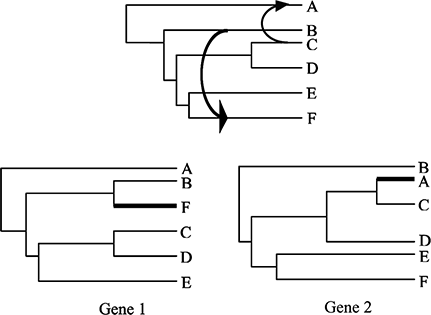
To visualize the problem, consider the hypothetical gene phylogenies in Figure 3. The trees representing the phylogenies for gene 1 and gene 2 show that even with only two transfer events, the phylogenies of two genes can be completely different. For example, if the phylogeny of gene 1 is taken to symbolize an organism phylogeny, A is the closest relative of C, while according to gene 2, D is the closest relative of C. An example with a more realistic number of transfers would be correspondingly more complicated.
Adapted from Philippe and Douady (Reference Philippe and Douady2003). Two gene transfer events can lead to differing phylogenies depending on which gene is used as the basis for the phylogeny (gene 1 or gene 2).

Since the topologies of the trees differ, both historical species taxa—which are the lineages between nodal points in the tree—and higher taxa will depend on which gene's history is taken as the “backbone,” that is, the gene whose history represents the branching pattern on the genealogical tree.Footnote 15 Note that this is not an epistemological problem. Divergent genealogies have not resulted from the fact that some of them are wrong and that we need some way of focusing in on the right ones. The phylogenies of organismal parts differ because their histories really do differ.
There are two general ways we can deal with this predicament. First, we could throw out the whole concept of an “organismal genealogy” and the genealogical systematics that would be based on it. Some biologists have claimed that the fact that different organismal parts have different genealogies has rendered “the concept itself, of organismal phylogeny impossible” (Doolittle Reference Doolittle1999; Philippe and Douady Reference Philippe and Douady2003, 498).Footnote 16 If we were to do this, and we were still interested in taxonomic species, we would need to find some other system of bacterial systematics. Such alternatives are discussed in the next section.
A second approach, one that we should explore in more detail given the attractiveness of genealogical systematics in other domains of life, would be to try in some principled manner to justify prioritizing the phylogenies of some organismal parts and to base our systematics on those phylogenies. The inheritance of these parts would be included in our definition of the species category. For example, if we prioritized the lineages traced by membrane-splitting events, the species would be suitably cut segments of the phylogenetic tree composed of lineages that follow the transfer of membranes. We can pursue this suggestion by considering genealogies based on the histories of either extragenetic elements (part 1), such as membranes, or on subgenomic elements, such as particular genes (part 2).
3.2.1. Extragenomic Genealogies
We have emphasized that there is no unique genome history for bacteria, but a bacterium is composed of more than just genes. Thus, we should investigate whether extragenomic factors could be used to define a unique bacterial systematics. An extragenomic genealogy is based on the inheritance of nongenetic entities or processes. The only candidate for a nongenetic hereditary element in bacteria is the membrane.Footnote 17 The possibility of basing a systematics on the history of membrane transmission seems attractive because there is a more or less unique membrane tree that traces cell splitting events.Footnote 18 If membrane transmission were a hereditary process, it might then be a candidate for providing the backbone phylogeny needed for our bacterial systematics.
Membranes are weakly inherited from parents to child—every child gets it membrane from its parent. According to Maynard Smith and Szathmáry (Reference Maynard Smith and Szathmáry1995) they are ‘simple replicators’, meaning that they are structures that can only arise from preexisting structures of the same kind. Some membranes are also ‘hereditary replicators’, meaning that they can exist in different states and the state of the parent is inherited by the child. As opposed to simple replicators, hereditary replicators can evolve if the states vary in a population and the different states lead to variable fitness in those that posses them.
There are two families of membrane traits known to have a hereditary character: membrane topology and protein polarity. Topological inheritance, the inheritance of the topology of the parent membrane, can result from a topology-preserving mechanism that divides a single membrane or as a result of numerous embedded membranes splitting in concert. Second, although the composition of membrane proteins is heritable via DNA, the orientation of those proteins can be inherited via membranes (Goodwin Reference Goodwin1994; Cavalier-Smith Reference Cavalier-Smith2000). Membrane-spanning proteins are usually asymmetrical, with one side contacting the cytoplasm and another contacting the extracellular fluid. In some organisms, that orientation is a parameter set by the parent membrane; barring catastrophe, the progeny membrane will maintain that polarity.
Although these are both interesting inheritance systems, and although cells with membrane heredity have been found in single-celled eukaryotes, they have not yet been found in bacteria. It thus does not make sense to ground a genealogy on membrane history since organismal genealogy should be based on the passage of some inherited characteristics. If no trait is transmitted from parent and child—even when physical materials are transferred—evolutionary change in populations on the basis of these objects is not possible.
One might worry that there are undiscovered hereditary membrane characteristics in bacteria. For the sake of argument we can set aside concerns about the lack of evidence for heritable membrane characters and consider whether, even if bacterial membranes did carry hereditary information, this should tempt us to construct a systematics based on a membrane-splitting history. There are two reasons that this would not be a promising suggestion. First, while a genealogy based on membrane history might be interesting to some biologists, such as those who are studying the evolution of membranes, many other evolutionary biologists would not have this preference. Many traits, arguably most organismal traits, are influenced by genes, not membranes. Since the inheritance of genes can come apart from the inheritance of membranes, a systematics based on membrane evolution could miss the important events of genome evolution. Many writers have emphasized that the perspective of evolutionary biology should be the basic perspective of systematics. Here is an example in which there is no single evolutionary perspective.
Second, even if we could justify an exclusive focus on membrane heredity, as Maynard Smith and Szathmáry (Reference Maynard Smith and Szathmáry1995) have argued, membranes, at least as we know them, are ‘limited’ hereditary systems, meaning that they can only occupy a finite number of states and do not hold the potential for unlimited, open-ended, combinatorial evolution. If this is true, it provides yet another reason to hesitate before elevating membranes to the privileged position of genealogical determiners.
3.2.2. Subgenomic Genealogies
While the history of an entire bacterial genome is not uniform, if we look for smaller stretches of DNA we might find sections with common histories. These could be used as the backbone on which to base our species and higher taxa. To that end, we can explore subgenomic genealogies based on the inheritance of a subset of the genome. Along these lines, some biologists have selected a gene or a small set of genes from which to create a bacterial phylogeny. Olsen and Woese (Reference Olsen and Woese1993) advocated a systematics based on the history of various ribosomal genes. Others have created genealogies that are averages of the genealogies produced by groups of genes, called “core genes” (Lan and Reeves Reference Lan and Reeves2001), or gene classes that are “important,” like “housekeeping genes” (Stackebrandt et al. Reference Stackebrandt, Frederiksen, Garrity, Grimont, Kämpfer, Maiden and Nesme2002).
Since genes are incontrovertibly hereditary elements, there is only one task in defending a systematics based on particular genes: justifying why particular genes should be prioritized over others. There are two ways that we might do this. The most common approach on the part of biologists is to look for sets of genes that, as a matter of contingent fact, seems to have only been transferred vertically, that is, along with the membrane during cell-splitting events. A systematics based on these genes could capture a significant part of the evolutionary history of bacteria. A practical problem with the suggestion is that there might not be any set of genes in existence—all genes might be transferred at one time or other. A theoretical problem with the suggestion is that, from the perspective of the other genes, or scientists interested in the evolution of those genes, genes equally involved in mutation, selection, and evolution, this decision seems arbitrary. The other genes affect important traits whose evolutionary history we might want to trace; there is even indication that traits that have been considered genera defining, such as photosynthesis, were horizontally transferred to the lineages they are used to delimit.
Alternatively, one could argue that particular genes, or groups of genes, are somehow most important to organismal identity or even essential to it. For example, Lerat, Daubin, and Moran (Reference Lerat, Daubin and Moran2003) have claimed that there are certain genes that should be considered essential, and the phylogeny of these genes should determine the organismal phylogeny. Essential genes are identified by the fact that homologues are present in all organisms. But essentiality is conceived as a “functional feature,” presumably meaning that essential genes are essential to the functioning of organisms.
There are various problems with the suggestion that “essential” genes should determine organism phylogenies. Most important, it is not clear that there is any way to cash out the claim. Would it mean that the gene was required for organisms to survive? This is clearly something sensitive to the environment in which the organism is living and to the other genes in the genome. Some metabolic genes that are normally important become unnecessary when a bacterium develops a new symbiotic relationship or moves to an environment that happens to be full of Adenosine triphosphate. Furthermore, by whatever standard we choose essential genes, we have no reason to think that their phylogenies would be identical.
If we do not claim that the “essential” genes are essential to organism function, but merely to organismal identity, we will be faced with problems similar to those facing typological species concepts, those which maintain that species are groups of organisms with common properties. Both perspectives require biologists to prioritize the importance of certain traits. In the case of the typologist, certain traits are considered essential for an organism to be a part of a species taxon, while in the case at hand, the possession of certain, putatively important genes would be necessary to be a part of any species at all, meaning that possession of these genes is an essential characteristic of the species category. The challenge for the typologist is that fact that it seems that any particular trait one picks as essential could be lost by a population while that population remained part of the same species. The “genealogical essentialist” faces that challenge that no matter which gene one picked to demarcate the organismal phylogeny, organisms could lose that gene, and yet one would still claim that those organisms were part of some species.
There is also a worrisome arbitrariness to the claim that certain organism parts are more important than others. One biologist might advocate a genealogy using the genes that play a part in metabolism, while others choose informational genes or genes important for niche infiltration. Genes in all these categories can be important for bacterial life, inasmuch as deleting or altering them will make life possible in a narrower range of conditions or not possible at all.
Although this investigation has assumed an evolutionary perspective, it is tempting to suggest again that an evolutionary perspective is not sufficiently fine grained to underlie a bacterial systematics. For organisms that participate in HGT, different parts of the organism have different evolutionary histories. To determine our evolutionary systematics, we must narrow our perspective to the evolution of particular organismal parts—whether they be genes, membranes, or otherwise. Yet we have no reason to think that there is a context-independent answer about the importance of different parts and the traits that depend on them. Different evolutionary biologists, those studying different features, will come to different conclusions about this. Organismal parts are not obviously arranged in any pyramid of importance. Selection of particular parts—in this case, genes—for our systematics will depend on the purpose of the investigation and the priorities of the investigators.
4. The Pragmatic
Given the difficulties we have encountered making sense of biological and phylogenetic species, it is unsurprising that some microbiologists have taken a more pragmatic approach to classification. Countless bacterial systematics have been constructed for many different purposes. The first such system was based on shape, while later systems were based on metabolic properties of bacteria, on how easily the bacteria took up stains, or on the diseases they caused. Biologists have been forthright that different properties, which can lead to crosscutting species taxa, shed light on different kinds of concerns. J. M. Young is representative with his claim that “no one system of classification is supreme, each offering a different perspective on evolutionary processes and serving different purposes” (Reference Young2001, 945). Roselló-Moran and Amann (Reference Rosselló-Moran and Amann2001, 41) comment that the present bacterial species concept is “acceptable and pragmatic” and “covers the primary goals of taxonomy such as a rapid and reliable identification of strains.”
The “official” definition of the bacterial species is genetic and typological. A species is a group of individuals with 70% DNA/DNA hybridization (Wayne et al. Reference Wayne, Brenner, Colwell, Grimont, Kandler, Krichevsy and Moore1987; Stackebrandt et al. Reference Stackebrandt, Frederiksen, Garrity, Grimont, Kämpfer, Maiden and Nesme2002), a measure correlated with sequence similarity. Variations of this concept are popular, such as those describing bacterial species as “groups of strains which individually show high levels of biochemical, genetic, morphological, nutritional and structural similarity” (Goodfellow, Manfio, and Chun Reference Goodfellow, Manfio, Chun, Claridge, Dawah and Wilson1997, 26).
One might imagine that genotypic and phenotypic similarity have been emphasized because biologists think they might be good indicators of common ancestry. However, the “rationale” for a genetic standard, many biologists say, is “the results of numerous studies, in which a high degree of correlation was found between genomic DNA similarity and phenotypic similarity (i.e. chemotaxic, serological, etc)” (Rosselló-Moran and Amann Reference Rosselló-Moran and Amann2001, 44). Rather than DNA similarity being chosen as an indicator of common ancestry, it has been chosen because it indicates phenotypic similarity, which is of primary interest. It is interesting to note that even microbiologists who are explicitly interested in phylogenetic classification sometimes justify phylogenetic classification on the basis of the fact that finding the phylogenetic groups is the best way to find the phenotypic clusters.
Increasingly, microbiologists have attempted genealogical classifications of bacterial species, often using rRNA phylogenies. The advantage of this approach is that rRNA genes are present in all bacteria, and the genes can be sequenced without the need to culture bacteria, something frequently impossible to do in laboratory settings. As we have discussed, this approach ignores the effects of HGT and, thus, only captures part of the pattern of bacterial descent. Another popular approach is to view the lineage as a “plurality consensus” of gene histories, which could be found through mapping descent at multiple loci using multilocus sequence analysis (MLSA; Gevers et al. Reference Gevers, Cohan, Lawrence, Spratt, Coenye, Feil and Stackebrandt2005). Even advocates of this method admit that “although the MLSA approach … is practical in grouping strains together, it uses core genes and ignores genes that lead to potentially significant difference among strains” (Gevers et al. Reference Gevers, Cohan, Lawrence, Spratt, Coenye, Feil and Stackebrandt2005, 737). It fails to capture both significant phenotypic differences and significant aspects of bacterial history.
No matter which properties one picks to demarcate bacterial species, named bacterial species have been found to be far more diverse in phenotypic and genetic composition than eukaryotic species (Staley Reference Staley1997; Maynard Smith et al. Reference Maynard Smith, Feil and Smith2000; Hanage, Fraser, and Spratt Reference Hanage, Fraser and Spratt2005). Only 40% genetic identity has been found within strains of E. coli, while there is virtually 99% percent identity within humans (Gogarten and Townsend Reference Gogarten and Townsend2005). By a 40% standard, all vertebrates would be part of the same species. This intraspecies diversity has attracted some microbiologists to explicitly fuzzy species concepts (Lawrence Reference Lawrence2002; Gogarten and Townsend Reference Gogarten and Townsend2005). Although certainly doubtful, some have gone as far as to suggest that bacteria might come in an “almost endless continuum of varieties” (Staley Reference Staley1997, 342). More common is the claim that bacterial species are merely less orderly than metazoan species.
Does the diversity in bacterial species concepts indicate that microbiologists are pluralists about bacterial species and systematics? No general claim on behalf of microbiologists is possible in this regard. Taxonomic pluralism, the belief that there exist multiple, parallel classification systems among which no one system can claim priority, certainly has proponents (Stackebrandt Reference Stackebrandt, Dworkin, Falkow, Rosenberg, Schleifer and Stackebrandt2006). Yet believing that there are multiple systems of classification, including species-level classification, falls short of a stronger pluralism—one holding that there are multiple natural classification systems based on evolutionary history. Those microbiologists who do believe that there could be multiple natural classification systems still often recommend adopting a single “expedient” method for naming organisms, while denying that there is only one set of natural relationships that such methods should track. Microbiologists struck by the problem of nonunique organismal histories have sometimes recommended abandoning the use of species concepts altogether (Doolittle and Bapteste Reference Doolittle and Bapteste2007).
Of course, some microbiologists attracted to phylogenetic classifications are less welcoming to either pluralism or a rejection of all species talk. Like metazoan systematists, they imagine that evolutionary history itself has bestowed us with a natural classification. Yet as we discussed above, if there is more than one evolutionary history, multiple evolutionary classifications are possible based on the histories of different organismal parts. We can decide to focus on the histories of particular parts, because this is practical or because there is uniformity in the histories of some sets of parts, but we should be forthright that this decision has been made by us, not by nature.
Some see the mess that is contemporary bacterial classification as just one stage on the way to the one best systematics. Biologists at the beginning of the molecular revolution also hoped that the accumulation of data about the history of bacteria and their physiology would finally allow biologists to demarcate species and higher taxa more precisely. However, an understanding of bacterial evolution has only made the picture more complicated, and no consensus approach to bacterial classification has emerged from the biological detail. That which has emerged, I have argued, is based on problematic assumptions. Details have revealed many interesting patterns in the evolution of bacteria, but no one set of species groupings traces all such patterns.
5. Conclusion
The original attractiveness of evolutionary classification was based on an almost exclusive focus on metazoan life. Basic assumptions of these evolutionary classifications, such as the existence of a unitary organismal history, are violated by bacteria. It is possible to shoehorn bacteria into a pattern of vertical descent that characterizes metazoan organisms. But it might be more commendable to take them—and their reticulated history—on their own terms.
The history of language classification reveals a similar lesson. As the linguist R. M. W. Dixon (Reference Dixon1997) has argued, linguists who cut their teeth on the classification of Indo-European languages have been imprudent in their approaches to other language groups, such as the aboriginal languages of Australia and Africa. While patterns of descent in Indo-European languages seem to be primarily vertical (called ‘genetic’ among linguists), lending themselves to display on a genealogical tree reminiscent of phylogenetic trees that biologists employ, other language groups are rife with horizontal (called ‘areal’) transfer in which language change has involved substantial movement of grammatical and lexical elements between contemporary languages. Ignoring such differences in descent pattern, for a time the now-discredited glottochronology method was used by linguists to gauge relationships between languages, assuming only vertical descent based on a small number of ‘essential’ words. It was assumed that genealogical relationships between these few words were representative of entire language histories, just as the history of a few genes has been taken as representative of organism histories that are far more complicated.
The main aspiration—although the least radical one—of this article has been to point out how complications in the evolution of bacteria can cause difficulties for the application of popular evolutionary species concepts. At their weakest, these arguments should be seen as a challenge to evolutionary systematics advocates to defend alternative ways of applying evolutionary species concepts to bacterial life. After all, in spite of the arguments presented here, it remains possible that some additional tweaking might make these evolutionary concepts salvageable. As a slightly more provocative conclusion, this article could be taken to show that evolutionary species concepts are not applicable to bacteria at all. It might then provide grounds for a weak pluralism about species classification for those who are committed to using evolutionary classification in other domains of life. This is a weak pluralism, rather than a strong pluralism, as it does not suggest that any given domain of life supports multiple, crosscutting species-level classifications that are equally legitimate. Instead, it suggests that although each domain of life might have its own best classification, the principles that ought to be used in each domain are different. Finally, in the discussions of the applicability of both PSC and BSC to the bacterial world, we saw that multiple, nonequivalent species taxa might be delimited from the same bacterial populations because of the divergent histories of bacterial genomes. Although more challenging, for this reason the arguments of this article may be seen by more sympathetic readers as suggesting a strong pluralism regarding bacterial species taxa.