

Collective memory is a central component of group identity. The importance of distant events is typically passed from generation to generation through acts of public remembrance and the teaching of history, using symbolic “sites of memory.”Footnote 1 Collective memory functions as “mythical glue” (Harari Reference Harari2015), helping humans to collaborate in large groups of genetically unrelated individuals by becoming members of “imagined communities” (Anderson Reference Anderson1983).
Although collective memory is a constant of human society, it is still unclear when it meaningfully affects important dimensions of behavior. Under which conditions does collective memory of past events come to matter for present-day behavior and attitudes? Despite a burgeoning literature on political legacies and long-term historical persistence (Simpser, Slater, and Wittenberg Reference Simpser, Slater and Wittenberg2018; Voth Reference Voth, Bisin and Federico2021), recent work increasingly suggests that the past only affects the present under specific circumstances (Cantoni, Hagemeister, and Westcott Reference Cantoni, Hagemeister and Westcott2020; Ochsner and Roesel Reference Ochsner and Roesel2017; Rozenas and Zhukov Reference Rozenas and Zhukov2019). What moderates the contingent effect of history on present-day behaviors and attitudes?
In this paper, we highlight the role of two factors, one behavioral and one institutional. The first one is associativeness of memory. When present events resemble the past, the salience of history increases in people’s minds, affecting their beliefs and associated actions. The second factor is the degree to which collective memory is institutionalized. Official commemoration of past events through symbolic state actions increases the likelihood that collective memory influences present-day behavior. We provide evidence for the interaction of the two factors: associativeness drives the time-variant effect of past events on present-day behavior, and that effect is increasing in the degree of institutionalization of collective memory.
Our empirical analysis focuses on economic and political behavior in the context of Greece. During Greece’s military occupation by Germany in World War II, German armed forces committed numerous war crimes, including mass executions and the destruction of entire villages. This violence was typically carried out in retaliation for local partisan attacks (Mazower Reference Mazower1995). Decades later, during the sovereign debt crisis of 2009–2014, political relations between the German and Greek governments once again turned acrimonious. Under European Union and German pressure, Greece had to implement stringent austerity measures. German newspapers were quick to blame “lazy Southerners” for the Euro debt crisis. As public discord erupted between the German and Greek governments, memories of Germany’s violent occupation of Greece during World War II resurfaced: Greek demonstrators waved placards of German chancellor Angela Merkel in a Nazi uniform, and consumer groups called for a boycott of German products.
To examine how collective memory interacted with contemporary political conflict to influence major individual decisions, we focus on car sales. Cars are “big ticket items,” representing a major expense for consumers. They are also an iconic German product. We analyze variation in car sales over time and across prefectures in Greece and ask: did German car sales during the debt crisis decline more in areas that suffered German reprisals during World War II—and especially in those that received official recognition as “martyred” towns?
Using original sources and secondary historiography, we construct a dataset of the universe of Greek towns that experienced German reprisals during World War II. We combine that with data on new car registrations. Applying a machine learning algorithm to the online archive of Greece’s largest newspaper, we compile a time-varying measure of political conflict between Greece and Germany. In addition, we conduct a survey in a sample of over 900 households in towns that experienced reprisals and a set of control locations.
Figure 1 previews our main result. The dotted line tracks the level of animosity between Germany and Greece based on our newspaper measure. As the debt crisis worsened, conflict surged, with months of peak conflict in early 2010 and the summer of 2012. The solid line shows the difference in German market share between prefectures with and without reprisals. From the two time series, it is evident that heightened public conflict between Germany and Greece coincided with lower German market shares in high- relative to low-suffering prefectures. Panel regressions confirm the pattern: the greater the share of reprisal towns in a prefecture, the greater the decline in market share for German producers in times of German–Greek conflict. We provide numerous pieces of evidence that these results are not due either to the differential time-varying effects of the crisis or the persistent influence of cultural characteristics of locations.
German–Greek Conflict and German Market Share in Prefectures with and without Reprisals
Note: The solid line is the difference in the seasonally adjusted (expressed as difference of month t from month t − 12) share of German car registrations in prefectures with reprisals versus those without. The dotted line is the monthly share of news articles related to German–Greek conflict. Both series are normalized by their standard deviation.

We find similar effects of collective memory on political behavior. Applying a dictionary approach to the universe of Greek parliamentary speeches since 2008, we identify parties with a critical stance toward Germany. We show that the vote share of those parties is identical across locations prior to the start of the debt crisis, but it steeply increases thereafter in municipalities that experienced reprisals. These results provide new evidence that economic and political behaviors respond to the reactivation of collective memory in similar ways.
We next explore in more depth how the past comes to matter for the present. Since the 1990s, Greece awards communities “martyr” town status if they suffered severely during the occupation—a purely honorific designation with no material benefits. Applications of towns for martyr status are assessed by a committee composed of academic historians. Government data on town-level destruction combined with information from the committee minutes allow us to identify an exogenous component in the assignment of martyr status. Higher wartime destruction in general led to higher acceptance rates, but with a pronounced discontinuity at around 50% of destruction. This suggests that the committee followed a behavioral heuristic for deciding status assignment. We find no evidence that towns were discretely more likely to apply for martyr status after crossing the 50% destruction threshold. Controlling for average levels of destruction, prefectures with a higher share of towns that received official martyr status saw market share declines for German cars above and beyond those experienced by prefectures with a higher incidence of reprisals. We find a similar result after isolating the exogenous component of martyr status, as predicted by the discontinuity at 50% of wartime destruction.
This finding indicates that public recognition of victim status can amplify collective memory. To examine the mechanisms behind the effects of state sanction, we conduct a telephone survey of mayors’ offices in towns affected by reprisals. We show that places that today continue to collectively commemorate their suffering during 1941–44 saw sharp declines in German car sales during periods of heightened disagreements between the German and Greek governments. These effects are similar in magnitude as for martyr towns, suggesting that formal recognition of past victimhood works in large part through memorialization and the visibility of past memory in public life. Qualitative evidence from martyr towns confirms this interpretation by revealing a stronger role of the memory of past atrocities in public events and in public education. The pattern is mirrored in political outcomes, with martyr municipalities and those with memorials registering similar increases in the vote share of anti-German parties after the crisis. We find no strong evidence of interaction between state recognition and family transmission of past trauma: martyr status has similar effects on residents native to a town and on more recent arrivals.
Our study makes several contributions. Work on historical legacies has identified countless ways in which past events affect present-day attitudes and behaviors, both through institutional and through social channels (Acharya, Blackwell, and Sen Reference Acharya, Blackwell and Sen2016; Guiso, Sapienza, and Zingales Reference Guiso, Sapienza and Zingales2016; Putnam and Leonardi Reference Putnam and Leonardi1993; Voigtländer and Voth Reference Voigtländer and Voth2012). Our paper adds to this literature by demonstrating that history’s effect on the present is not a linear function of time. Persistence can be time-varying, and the effects of the past may remain latent until reactivated by changes in the external environment. We thus contribute to a small number of studies that demonstrate the contingent effects of the past on present-day behavior and have emphasized the role of political leaders (Charnysh Reference Charnysh2015; Ochsner and Roesel Reference Ochsner and Roesel2017) and of the political context (Rozenas and Zhukov Reference Rozenas and Zhukov2019). To these factors we add a behavioral mechanism: the association of present events to significant historical experiences, which increases the salience of the past and makes memory a crucial determinant of behavior.
We also contribute to a narrower subset of the literature on persistence, which focuses on the effects of past conflict and repression. Several studies have demonstrated that past violence has a persistent influence on behavior and that this influence is transmitted across generations (Balcells Reference Balcells2012; Lupu and Peisakhin Reference Lupu and Peisakhin2017; Rozenas, Schutte, and Zhukov Reference Rozenas, Schutte and Zhukov2017). We add to this work by showing that negative attitudes toward the perpetrator of the violence may not manifest in behavioral outcomes unless triggered by external conditions. We also show that, beyond political attitudes and voting behavior, past violence can affect other aspects of individual decision making such as high-stakes purchasing decisions.
We also provide new evidence on the role of institutionalized collective memory. Through official recognition and rituals of collective remembrance, an adverse shock translates more sharply into attitudes that matter, especially when sanctioned from above. To work that has identified the importance of family (Lupu and Peisakhin Reference Lupu and Peisakhin2017), community (Charnysh and Peisakhin Reference Charnysh and Peisakhin2022), and local institutions (Wittenberg Reference Wittenberg2006) as vehicles of cultural transmission and identity preservation, we contribute evidence on the role of the state. We show that official state actions directed at preserving collective memory have strong effects on behavior when the past becomes relevant for the present, and we provide evidence that these actions work by making memory visible in public life for all residents of a community regardless of their personal or family connection to past violence. Our work thus also relates to studies that provide evidence on the material effects of symbolic politics (Rozenas and Vlasenko Reference Rozenas and Vlasenko2022).
Finally, we add to a literature in international political economy on the effects of consumer boycotts (Ashenfelter, Ciccarella, and Shatz Reference Ashenfelter, Ciccarella and Shatz2007; Hong et al. Reference Hong, Hu, Prieger and Zhu2011; Pandya and Venkatesan Reference Pandya and Venkatesan2016). In work most related to ours, Fisman, Hamao, and Wang (Reference Fisman, Hamao and Wang2014) examine a diplomatic incident between China and Japan caused by how Japanese textbooks treated the 1930s invasion of China. Unlike their setup, the effects we estimate are not due to changes in firm behavior or government actions but due to choices made directly by consumers. Our results suggest that collective memory of past violent actions can be a mechanism sufficiently powerful as to help overcome the collective action problem underlying the failure of many boycott efforts.
Collective Memory, Associativeness, and Behavior
Past events often cast a long shadow on present-day behavior. A large literature on historical legacies in political science and related disciplines provides evidence for the persistent effects of history on behavior and attitudes in a variety of domains from preferences for government intervention (Alesina and Fuchs-Schündeln Reference Alesina and Fuchs-Schündeln2007) to trust (Nunn and Wantchekon Reference Nunn and Wantchekon2011) and attitudes toward out-groups (Voigtländer and Voth Reference Voigtländer and Voth2012).Footnote 2
But why, and when, does the past persistently affect behavior? In pioneering work, Halbwachs (Reference Halbwachs1992) introduced the notion of collective memory as a link between past and present. Collective memory is the shared, mutually acknowledged history of a social group, which is reinforced through commemoration and forms part of “the connective structure of societies” (Assmann Reference Assmann2011). Collective memory is not only influenced by present events (Halbwachs Reference Halbwachs1992; Schwartz Reference Schwartz1982); it also structures a society’s understanding of those events and consequently the behavior of its members. Building on an interdisciplinary literature,Footnote 3 we propose two factors that determine when collective memory drives behavioral changes in response to changes in external circumstances.
The first factor is associativeness of memory. At the individual level, similarity of past and present events facilitates recall (Mullainathan Reference Mullainathan2002). At the group level, whenever present conditions bear some resemblance to those of a shared past, even if the latter has not been individually experienced by all society members, collective memory will structure present beliefs. Indeed, studies indicate that history’s effects on behavior are contingent on characteristics of the present situation (Rozenas and Zhukov Reference Rozenas and Zhukov2019) and actors like political elites or state-controlled media exploit associations between present and past events for political gain (Belmonte and Rochlitz Reference Belmonte and Rochlitz2019; Ochsner and Roesel Reference Ochsner and Roesel2017). We argue that memory can function as a latent variable that is activated under particular conditions—for instance, when chance events have elements in common to events in past history. Association then increases the salience of the past, making it more likely to influence behavior.Footnote 4
How much similarity is needed for associations to be made across disparate events? Memory recall is likely increasing in the degree of similarity between past and present circumstances (Mullainathan Reference Mullainathan2002). The level of similarity at which associativeness begins to operate is ultimately an empirical question. Existing studies (Ochsner and Roesel Reference Ochsner and Roesel2017) suggest that similarity of the main features of a situation, such as the actors involved and the type of relationship between them (adversarial vs. nonantagonistic), can be sufficient to trigger connections between past and present.
The second factor that determines whether collective memory has real effects is institutionalized commemoration. All societies preserve and reinforce memory using a variety of mechanisms such as the transmission of knowledge about past events or enforcement of behavior appropriate to the past through the family (Lupu and Peisakhin Reference Lupu and Peisakhin2017), community (Charnysh and Peisakhin Reference Charnysh and Peisakhin2022), or local institutions (Wittenberg Reference Wittenberg2006). Memory preservation can happen via more formal routes, such as state-sanctioned symbolic politics—for instance, parades or memorials—or through legislative actions (Savelsberg and King Reference Savelsberg and King2007). Studies indicate that such symbolic actions have material implications (Rozenas and Vlasenko Reference Rozenas and Vlasenko2022). We hypothesize that the degree to which commemoration is institutionalized matters for memory preservation, specifically, for how memory comes to matter when past events become salient.
There are two possible channels through which institutionalization may work. First, formal sanctioning of memory by the state leads to more intense commemorative activity and a higher visibility of past events in public life or in public education. Second, the act of formal sanctioning itself may have direct effects on the strength of memory; when a location is officially labeled as the victim of atrocities, residents of the location may be more likely to have knowledge of such atrocities, or even believe they bear responsibility to remember them. Either of those two pathways, or their combination, could amplify collective memory’s effects on behavior when the state formally contributes to memory preservation.
In summary, the present study examines not only whether associativeness between past and present matters for behavior but also whether this connection is moderated by the mechanism that preserves and transmits collective memory. In particular, we show empirically that the memory of past violence has a time-varying effect on behavior and attitudes toward the perpetrator of the violence, as the salience of present events increases associations with the past in people’s minds. The magnitude of this effect depends on the institutionalization of collective memory. The connection between past and present—though present in all locations that experienced violence—is stronger where memory is preserved through government recognition. We find that the visibility of past memory in public life—for instance, through the presence of public memorials—is the crucial driver of the effects of state-sanctioned collective memory.
Historical Background
Germany’s Wartime Occupation of Greece
In May 1941, Axis forces occupied Greece. The country was divided into three occupation zones, the largest of which was administered by Italy. Germany occupied less territory but controlled critical locations including Athens, Thessaloniki, and Crete. Bulgaria was in charge of a relatively small part of the country close to its own borders. From the beginning, the civilian population suffered from expropriations and plunder. The German armed forces requisitioned foodstuffs, causing a major famine during the winter of 1941–1942, leading to an estimated 300,000 deaths (Hionidou Reference Hionidou2006).
Reprisals against potentially uninvolved civilians in areas of armed resistance were first authorized by the German army in April 1941 in Yugoslavia (Mazower Reference Mazower1995). The High Command of the German Armed Forces laid down quotas for reprisal killings: 100 civilians were to be shot for each German soldier killed in a partisan attack, 50 for each soldier wounded, and so forth. Such reprisals against civilians became standard practice of German antipartisan operations in the Balkans and were later extensively used throughout Eastern Europe.
Crete saw the first German reprisals on Greek soil (Nessou Reference Nessou2009).Footnote 5 Partisan attacks were often followed by indiscriminate massacres of the civilian population and the destruction of every village near an attack. By 1944, an estimated 2,000–3,000 Greek civilians had been executed by German armed forces on Crete alone (Nessou Reference Nessou2009).
After Italy’s surrender in 1943, German forces occupied the zone held by its former ally. Fighting between guerrilla groups (andartes; mostly the Communist-led Greek People’s Liberation Army) and the Wehrmacht intensified. For example, during an antipartisan sweep by the 117th Jäger Division in the mountains near Kalavryta in the Peloponnese, Greek resistance fighters executed 78 German prisoners. In retaliation, German troops killed 693 of Kalavryta’s inhabitants, including women and children, on December 13, 1943 (Meyer Reference Meyer2002). Some 28 towns and villages in the area were destroyed. Similarly savage reprisals occurred all over Greece, including in the famous cases of Doxato, Kommeno, and Distomo. After the war, the Greek Ministry of Reconstruction estimated that between 11 and 31 thousand Greeks perished in reprisal attacks by German forces, with numerous villages and towns left destroyed (Doxiadis Reference Doxiadis1947, 35–7).
German–Greek Conflict during the Eurozone Crisis
The Greek sovereign debt crisis began in late 2009 when revised budget deficit figures revealed the country’s dire financial situation. This discovery led to successive downgrades of its credit rating. Eventually, with debt markets closed to the Greek government, an EU bailout became inevitable. Appendix Table A.1 summarizes the main events of the debt crisis.
From the beginning, the German government was skeptical of a financial rescue for Greece, emphasizing the scale of tax evasion and corruption as obstacles to any permanent improvement.Footnote 6 It finally agreed to the bailout in exchange for harsh austerity measures. Greek public opinion accordingly saw Germany as the instigator of foreign-imposed austerity. Figure A.1 provides evidence of this from our own survey data. Though the majority of respondents (83%) identifies Greek politicians as the single major actor to blame for the crisis, Germany comes in second place (5.58%) and ahead of the EU, the IMF, or US-based banks. More tellingly, when respondents are allowed to blame multiple actors for the crisis, blame attribution toward Germany is high. Over 60% of respondents completely agree with the statement that “Germany imposed austerity measures at a time when Greece was weak. This is what caused the country’s economic crisis.”Footnote 7
The reaction to German-imposed austerity was immediate and intense: in February 2010, the Greek Consumers Association called for a boycott of German products—explicitly highlighting the importance of cars.
Incendiary press coverage amplified the animosity. German newspapers portrayed Greeks as lazy cheaters, living it up at the expense of German taxpayers.Footnote 8 The cover page of a German weekly featured Aphrodite making a rude gesture; a tabloid urged Greece to sell some of its islands to repay its debts.Footnote 9 As the Greek economy contracted and unemployment surged, anti-German sentiment in Greece deepened. During the 2012 visit of German chancellor Angela Merkel to Athens, thousands of demonstrators filled the streets of Athens.Footnote 10
Memories of Nazi massacres during the Occupation frequently resurfaced in Greece during that period. When a journalist from the Daily Telegraph interviewed Greeks during the Euro debt crisis about their country’s treatment by Germany, the massacre at Distomo immediately came up. A 45-year old bar owner contrasted this atmosphere with the period immediately preceding the crisis: “Five years ago, no one had any problems with Germany.” In the past, family members of the victims of Distomo had sued for reparation payments, taking their case to the German courts and to the International Court of Human Rights. Although Germany’s Constitutional Court dismissed the case in 2003, it was revived when an Italian court awarded victims’ descendants Italian property owned by a German nongovernmental organization. The case reached the International Court in 2012, at the height of the Greek debt crisis, and featured prominently in the Greek press.Footnote 11
One may argue that Germany’s aggression in WWII and German-backed austerity in the 2010s were very different events, unlikely to be associated in anyone’s mind. Yet they were not treated as such by Greek media, politicians, and ordinary people. The associations made derived from a central similarity between past and present: the identity of the foreign power that was perceived as an aggressor. With Germany identified as the instigator of austerity, parallels were also drawn between the effects of WWII and those of the debt crisis. Although not comparable to a historical event that led to mass starvation and the killing of civilians, for many people the debt crisis was one of the worst things they experienced in their lifetimes—businesses bankrupted, pensions cut, and savings devastated. The main actor involved, the adversarial nature of the situation, and the negative implications for people’s lives appear to be the factors that triggered associativeness of collective memory in the case of the Greek debt crisis.
Data and Empirical Strategy
Conflict Index
We compile an index of conflict by computing the frequency of newspaper articles that refer to political tensions between Greece and Germany in a leading Greek newspaper, Kathimerini. We use a supervised learning approach: we first manually code articles relevant to German–Greek conflict and then use search terms distinctive of relevant articles to classify the remaining corpus. We detail our procedure in Section B.1.1 of the Appendix.
Figure 1 plots the share of conflict-related articles for the period 2009–2014. Although there is a gradual rise in the overall conflict article share after 2010, there are also numerous short-term spikes when public arguments between Greek and German politicians grew particularly heated. Several of them are concentrated in 2012, when unrest and protests against austerity in Greece coincided with dissatisfaction around the International Court’s ruling in favor of Germany on the issue of wartime reparations.
Car Registrations
Our main behavioral outcome variable is car sales. We focus on it for three reasons. First, car purchases represent a major purchasing decision, making this variable a good measure of how economic behavior responds to the interaction of time-varying political conflict and collective memory. Second, cars are an iconic German product. Car sales thus allow us to directly link anti-German sentiment to a behavioral measure. Political behavior such as voting is motivated only in small part by anti-Germanism, making the effects of collective memory harder to discern in political outcomes. Finally, from an empirical point of view, data on car sales is available at a high frequency, allowing us to examine how even short-run changes in the salience of current events interact with latent memory.
We use monthly data on new car registrations from the Greek Ministry of Transport and distinguish between German and non-German brands (see Appendix Section B.1.2).
Reprisals
We create a unique dataset of the universe of Greek towns that experienced reprisals by German occupying forces during World War II. With the help of a professional historian, we combine information from a variety of primary sources and secondary literature. A list of sources is provided in Table B.1. The final list contains 400 towns that experienced reprisals in at least one of the sources we consulted.
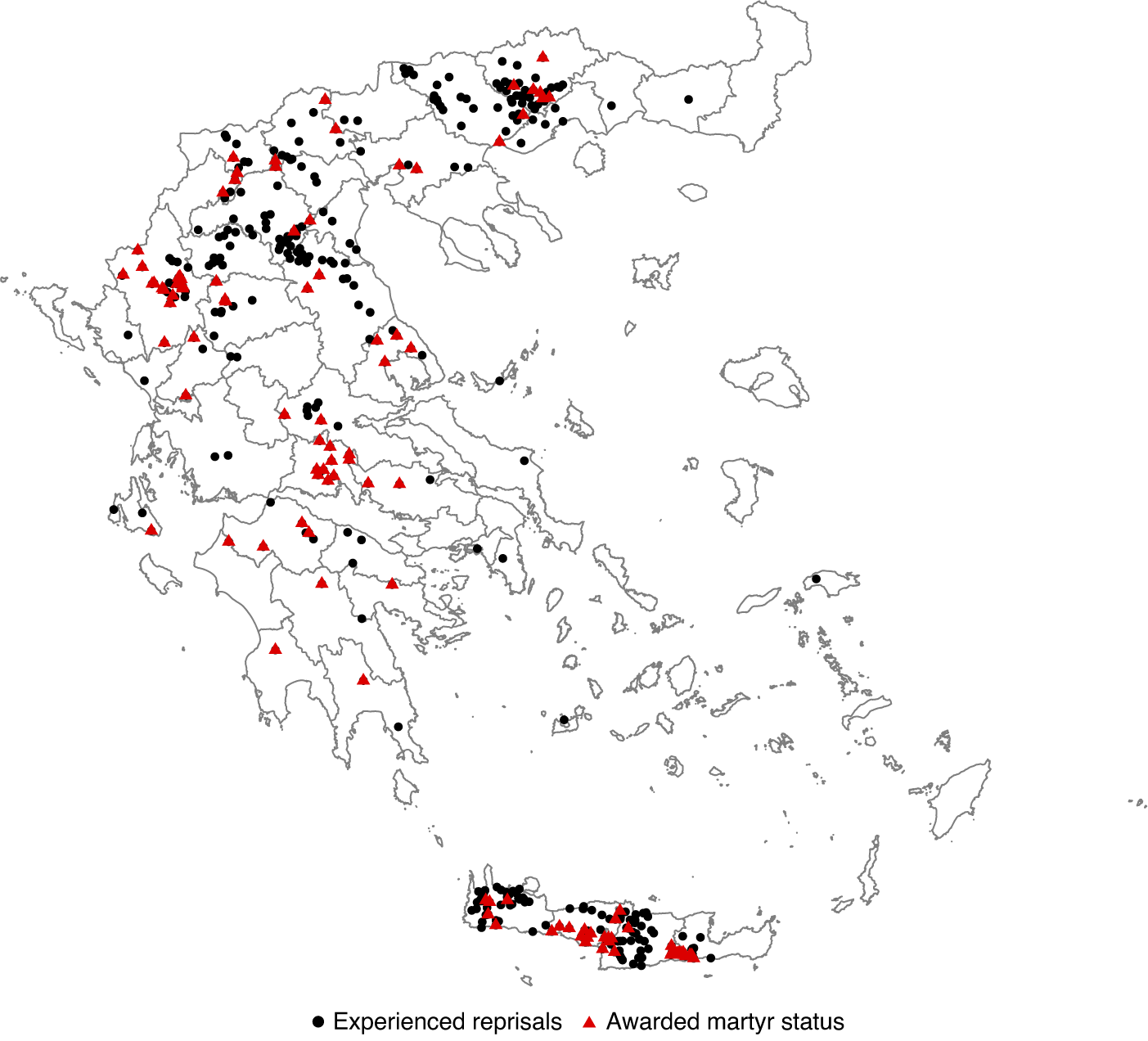
Figure 2 displays a map of German reprisals. It shows a high concentration of affected towns in Central and Northern Greece and on Crete. These are regions with rugged terrain, which attracted partisan activity, but instances of reprisals are also widely dispersed across the territory. At the prefecture level, average exposure to reprisals is not predicted by any economic, historical demographic, or political factor. Table B.2 in the Appendix shows that the only variables that are significantly higher in prefectures with reprisals are log population, the precrisis German market share, and distance from the prewar road network, which predicted partisan activity. Although our identification strategy does not require that prefectures with and without reprisals are balanced in terms of observables at baseline, our preferred specifications include interactions of all baseline controls with the monthly share of conflict articles to account for any differential responses driven by correlates of reprisal exposure.
The Geography of German Reprisals in Wartime Greece
Our main dataset of time-varying conflict, car sales, and reprisals contains information on 51 prefectures over the period January 2008 to December 2014. The main features of the data are summarized in Table B.3.
Additional Variables
We collect additional data to explore the mechanisms behind the effect of reprisals. Since 1992, the Greek government awarded towns that suffered reprisals during the German occupation martyr status. Towns could apply for this designation, which was decided by a committee of experts and awarded by Presidential Decree. Martyr status did not come with material benefits but did imply stronger and state-sanctioned commemoration of WWII atrocities.
There are 104 towns identified as martyred, of which 54 witnessed mass executions of civilians. The rest were burnt to the ground in retaliation for an insurgency attack against German armed forces in the vicinity (Nessou Reference Nessou2009). Their spatial distribution, which closely follows that of reprisals, is depicted in Figure 2. Table B.2 shows that prefectures with martyr towns are similar to other prefectures across a wide range of characteristics, with the exception of their distance to the prewar road network and a small difference in the share of residents with secondary education.
We also conducted a telephone survey of mayors’ offices in all towns that experienced reprisals to ascertain whether a community organizes a commemorative event or whether a monument exists. There are approximately twice as many towns with a monument or public event as there are places officially recognized as martyred.
Survey
In the summer of 2017, we conducted a telephone survey in Greece. We sampled a total of 928 individuals from 143 municipalities, distributed across 12 prefectures. Respondents were drawn from 30 reprisal towns and 113 control towns that did not see reprisals. For each prefecture, we tried to obtain an approximately balanced sample of respondents between reprisal and control towns.Footnote 12
In addition to socioeconomic characteristics, we collected information on respondents’ actual and ideal cars, views of Germany and its role in the crisis, and proxies of activism and national identity. Table B.4 in the Appendix provides summary statistics for our survey sample. The sample is balanced on observables—there are no significant differences of age or gender, and the proportion of unemployed tends to be higher in the locations unaffected by reprisals. Income and education levels are similar, and the cars owned by survey participants are about the same age in both groups.
Empirical Strategy
We begin by estimating the following equation for the share of German car sales in each prefecture i at time t:
 $$ {S}_{it}\hskip0.35em =\hskip0.35em {c}_i+{y}_t+{m}_t+{\gamma}_1{A}_t+{\gamma}_2{A}_t\times {T}_i+{e}_{it}, $$
where
 $ {S}_{it} $
is the share of German cars,
 $ {A}_t $
is the monthly share of conflict-related news articles,
 $ {c}_i $
are prefecture fixed effects,
 $ {y}_t $
are year fixed effects, and
 $ {m}_t $
are calendar month fixed effects that account for seasonality in the German market share.
In line with existing literature on the effects of violence and conflict (Condra et al. Reference Condra, Long, Shaver and Wright2018; Peffley, Hutchison, and Shamir Reference Peffley, Hutchison and Shamir2015; Voigtländer and Voth Reference Voigtländer and Voth2012), we operationalize the treatment at the prefecture level as an incidence count, equal to the number of towns that fell victim to reprisals.Footnote
13 To avoid a mechanically higher number of reprisal attacks in prefectures with more towns, we normalize this count by the total number of towns in existence in a prefecture in 1940. Our main measure of exposure to German war crimes is
 $ {T}_i $
, the share of a prefecture’s towns in 1940 that experienced an attack, which is equivalent to a prefecture-level incidence rate of reprisals. We also present results with an alternative measure of exposure—the share of population living in affected towns today. The main coefficient of interest is
 $ {\gamma}_2 $
—the extent to which the German car market share declines differentially in prefectures with more towns that experienced reprisals by the German army during World War II.
The need to aggregate town-level data up to the level of the prefecture—the level at which we have information on car registrations—is an inherent limitation of our setup. In Appendix Section C.5, we show that aggregation influences the precision of our estimates but does not affect the main conclusions we would draw from an analysis at the town level.Footnote 14
We augment the above specification with interactions of baseline prefecture-level controls with the monthly share of conflict-related articles, as well as interactions of prefecture fixed effects with calendar month fixed effects, to account for prefecture-specific seasonality patterns in car sales.Footnote 15 Our most parsimonious specification includes a full set of time (month) fixed effects and thus accounts for any unobservable factor that varies at the monthly level and affects all prefectures in the same way. We cluster standard errors at the prefecture level.
Main Results
Effects on Purchasing Behavior
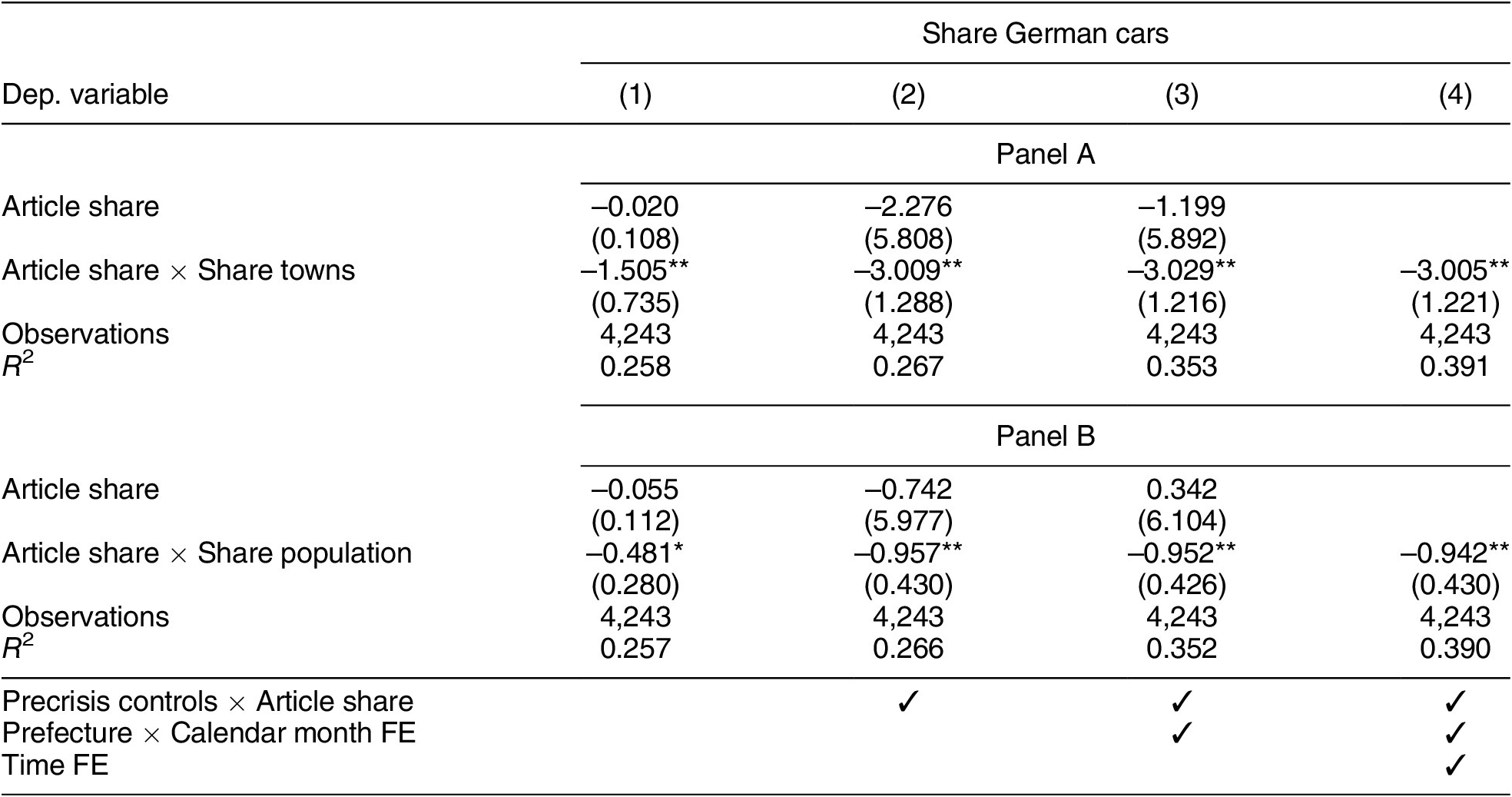
We present estimation results from Equation 1 in Panel A of Table 1. The share of conflict articles in a given month is negatively associated with the share of German cars, but the effect is not tightly estimated. However, months of high conflict are strongly and significantly correlated with a decline in German car sales in areas with a higher share of reprisal towns.
Baseline Results
Note: ***p
 $ < $
0.01, **p
 $ < $
0.05, *p
 $ < $
0.10.
In column 2, we add interactions of the conflict article share with precrisis control variables. This is intended to capture any differential effect that political acrimony between Germany and Greece after 2010 might have had in areas that were different before the crisis. In column 3, we add an interaction of prefecture fixed effects and calendar month fixed effects, thus accounting for seasonality patterns that potentially differ across prefectures. In column 4 we control for a full set of time fixed effects. The interaction coefficient increases in magnitude after these additions.
The estimated effects are substantively large compared with the average precrisis market share of German cars, which is close to 26%. The most parsimonious specification (column 4) implies that, relative to prefectures without reprisals, a prefecture with average exposure to WWII violence experienced a 4 percentage-point drop in the share of German cars at peak conflict (compared with the precrisis period); the most exposed prefecture, with over 30% of towns affected by reprisals, experienced a 17 percentage-point drop.
Our preferred measure for a prefecture’s exposure to reprisals is the share of reprisal towns, as it directly aggregates the unit of treatment assignment (the town) up to the prefecture level. Alternative measures of treatment intensity can be constructed if we first make assumptions about who is treated at the individual level and then aggregate up to the prefecture level. If we assume that the main effect of WWII reprisals is on current residents in affected towns—who also constitute the main decision-making unit that purchases cars—we can use the share of a prefecture’s precrisis (2011) population as a proxy of treatment intensity. Panel B of Table 1 shows that estimated effects using that measure are qualitatively similar to those in Panel A. Relative to prefectures without reprisals, the average prefecture that experienced violence registers a 2 percentage-point drop in the German car market share at peak conflict; the most exposed prefecture registers an 11 percentage-point drop.
The accuracy of this alternative treatment proxy depends on which individuals are actually treated. When a reprisal attack affects not only residents of the town but also those of neighboring towns, a population-based measure will underestimate the effect of reprisals.Footnote 16 As an additional notable disadvantage, this measure ignores potential postwar migration across towns. Victims of reprisals and their descendants may have moved to nearby towns in the same prefecture, especially in the case of towns razed to the ground by German forces. In line with these observations, magnitudes in Panel B are somewhat smaller than in Panel A.Footnote 17
Ruling out Alternative Explanations
Economic Effects of the Crisis
During the Eurozone crisis, Greece experienced a severe economic downturn. Poor current economic performance (and the prospect of future contraction) affected car purchases. German cars tend to be more expensive than those from other countries. Although non-German brands sold in Europe were worth an average of €23,000 in 2012, the average German car sold for €36,600—58% more (Directorate-General for Competition [European Commission] 2011). In the middle of the largest economic crisis to hit Greece in a generation, the taste for expensive cars may well have evaporated, providing an alternative interpretation of our main finding—if such effects differed by locality.
To account for the effect of the crisis, we employ three strategies, detailed in Appendix C.1. We first show that our findings are unaffected after controlling for a number of variables that capture differential economic performance, including time-varying measures of unemployment and economic policy uncertainty allowed to have differential effects by reprisal status and a prefecture-level measure of nighttime luminosity that proxies for economic activity. Second, we repeat our analysis by dropping luxury cars, which were more likely to have been affected by the crisis. Third, we use survey evidence on buying intentions to show that distaste, and not empty pockets, stopped Greeks in reprisal towns from purchasing German cars. Respondents in reprisal towns are less likely not only to own a German car but also to name a German car as their ideal car (Table C.3). They are also more likely to identify Germany as the actor responsible for the Greek crisis. Intentions and blame attribution serve as direct evidence of anti-Germanism rather than economic considerations driving car purchases.
Unobserved Culture
Another concern is that prefectures with a higher incidence of reprisals were characterized by higher prewar nationalism or a greater ability to organize collectively. If these traits persisted in the modern period, they could independently affect hostility against Germany. Our results would then reflect persistence of a cultural trait, not the effects of memory.
This interpretation is not supported by our evidence. The presence of reprisals is not correlated with prewar differences in ideology (Table B.2), and our survey indicates no differences in nationalism and only weak differences in activism across towns with and without a past of reprisals (Table C.4). To provide additional evidence that effects are driven by the memory of reprisals and not latent propensity to engage in conflict, we use historical information on the Greek partisan war and the logic of guerrilla conflict to isolate exogenous variation in German reprisals. An instrumental variables analysis confirms our main results (Section C.2).
Civil War Violence
During the last stages of Greece’s occupation by the Axis, violence erupted between different factions of the Greek resistance forces, primarily between the Communist Greek People’s Liberation Army and other noncommunist groups. Anticommunist resistance organizations covered a broad ideological spectrum, from republicanism to royalism, and clashed with the Greek People’s Liberation Army over control of territory in the context of a governmental power vacuum. These violent conflicts that took place during 1943–1944 culminated in a sequence of bloody battles in Athens, known as Dekemvriana, and constituted the first phase of the Greek civil war, which was to continue until 1949.
Early civil war violence may confound our results if it overlapped with reprisals committed by German occupying forces. We examine specifically the possibility that civil conflict between Greek resistance factions correlated with or was attributed to German activity such that our measure of reprisal exposure captures types of conflict dynamics unrelated to Germany. We find no evidence that would support such a scenario. Civil war battles during 1943–1944 took place in different locations than did the majority of German reprisals, and there is weak overlap between civil war violence and violence by German perpetrators at the prefecture level (Appendix Section C.3.1). Explicitly controlling for the share of a prefecture’s towns that experienced civil conflict during the end of WWII has no effect on our main coefficient of interest (Table C.7).
Boycott Campaigns
From the earliest stages of the debt crisis, consumer groups called for boycotts on German goods. Differential targeting of areas with boycott campaigns in a manner correlated with past reprisals—perhaps because certain locations would be expected to be more responsive to anti-German messaging—could potentially explain part of our observed effects. Yet such a concern does not correspond to the way boycott activity took place in practice.
Between 2010 and 2014, there were two types of boycott campaigns. The first type was led by the Greek Consumers’ Association and was national in scope. There is no evidence that this association targeted particular geographic areas. To the extent that it organized local activities, those took place in Athens, where the association is headquartered.Footnote 18
The second type of campaign was grassroot in nature. In this case, campaigns were not led by existing consumer groups; instead, boycott groups, organized through social media, spontaneously appeared throughout the country. Such boycott activity does not confound our suggested mechanism of associative memory but rather constitutes an additional piece of evidence in its favor. Because this activity was spontaneous, we might expect areas exposed to German violence during the occupation to be quicker to form boycott groups against German products. In this sense, like German car sales, boycott activity is a behavioral measure driven by assocations between the present and the (remembered) past.
We explore this connection between memory and boycott activity by identifying Facebook groups devoted to the boycotting of German products. We geocode the locations of group members with public profiles and compute their distance from the nearest town that experienced reprisals. Figure C.4 in Section C.3.2 of the Appendix shows a strong negative correlation between a location’s boycott group membership and its distance from the nearest reprisal town. This is consistent with our main findings on consumer behavior: proximity to reprisals is correlated with more intense boycott activity, not as a top-down product of centralized campaigns but as a consequence of grassroots consumer activism against German products.
Supply of German Cars
It is possible that the drop in the German car market share in prefectures with more reprisals is due not to demand- but to supply-side changes. To be clear, it would not be problematic for our results if changes in supply were driven by changes in demand—for instance, because dealers supply fewer German cars to areas that do not want to buy them. After all, supply and demand are simultaneously determined and we cannot independently identify their changes in our setup.Footnote 19 We do, however, address the possibility that factors other than anti-Germanism—for instance, the economic effects of the crisis or other time-varying unobserved confounders—affected the number of car dealerships that supplied German cars differentially in prefectures with more compared with fewer reprisals.
We scrape information on the location of all car dealerships with an online presence from the webpage car.gr, the largest online market of vehicles and vehicle parts in Greece during the period we study. We capture snapshots of the webpage for all years between 2008 and 2015 and examine changes over time in the distribution of dealerships by location and type of brand sold. This analysis uncovers no evidence of a differential drop in the share of dealerships that supply German cars in prefectures with a higher share of towns that experienced reprisals (Appendix Section C.3.3).
Additional Falsification Tests
In Appendix Section C.4, we show that there is no effect of reprisals carried out by Italian and Bulgarian occupying forces and no effects on the sales of non-German luxury cars or when using a time-varying measure of conflict with Italy. We also show that patterns of car sales did not differ across prefectures in periods when associative memory was inactive and that our results are robust to accounting for any remaining imbalances in precrisis purchasing behavior. Finally, we demonstrate that our results are not driven by the most widely known massacre locations, that they replicate when using alternative measures of German–Greek conflict, and that our inference is robust to patterns of serial and spatial correlation.
Effects on Political Outcomes
Our analysis so far has demonstrated that present events that recall the past can directly affect consumer behavior. Do similar effects extend to other aspects of behavior with more direct implications for politics? Here, we examine whether the reactivation of memories of violence affects voting patterns in Greece during the debt crisis. Relative to the analysis of consumption patterns, there are two limitations. First, although the debt crisis spans several election periods, voting outcomes are not observed at the high frequency of car registration data and do not allow us to examine immediate responses to spikes in Greek–German conflict. Second, electoral choices are determined by a host of party positions and characteristics, of which stances against Germany are only one—and arguably, in many cases a minor factor. The nationality of the manufacturer of cars allows us to directly link consumer behavior to consumers’ country-specific attitudes, but the link between party choice and parties’ expressed stance toward Germany is less direct.
We investigate whether voters in areas affected by reprisals were more likely to favor parties that held a critical stance toward Germany during the debt crisis. To identify anti-German parties, we take a data-driven approach and analyze the rhetoric of Greek MPs in parliamentary speeches. Figure 3 displays a measure of negative sentiment in MP speeches mentioning Germany, averaged over the 2009–2015 period. Unsurprisingly, MPs of opposition parties use a more negative tone in speeches referring to Germany compared with MPs from the two major parties of PASOK and Nea Dimokratia (ND). Syriza, the left-wing party that led the antiausterity opposition during the early period of the crisis and took power in the January 2015 legislative election, is significantly more anti-German than are PASOK and ND. It is less anti-German than the Communist Party (KKE), the conservative Christian party (LAOS), or the extreme right party (Golden Dawn), which entered Parliament for the first time during the debt crisis.
Average Sentiment in MP Speeches on Germany
Note: See Appendix Section B.1.3 for the computation of the sentiment measure. Bars denote averages across all party MPs and years for all speeches containing the token “German.”

To examine the time-varying effect of memory on voting behavior, we compare votes for more versus less anti-German parties before and after the crisis and differentially by past exposure to German war crimes. We use electoral data at the lowest level of administrative division, the municipal unit (
 $ N\hskip0.35em =\hskip0.35em \mathrm{1,035} $
), for six legislative elections between 2007 and 2015. The precrisis elections of 2007 and 2009 help rule out the presence of pretrends. We focus on parties that ran in both pre- and postcrisis elections and group them into more (KKE, LAOS, Syriza) and less anti-German (PASOK, ND).Footnote
20 We estimate the following for each party or group of parties:
 $$ {V}_{mt}\hskip0.35em =\hskip0.35em \sum_{\tau =\mathrm{Oct}\;2009}^{\mathrm{Jun}2015}\;{\beta}_{\tau }{R}_m\times \unicode{x1D7D9}\left(t\hskip0.35em =\hskip0.35em \tau \right)+{\gamma}_m+{\zeta}_t+{\varepsilon}_{mt}, $$
where
 $ {V}_{mt} $
denotes the vote share of the party in municipal unit
 $ m $
and election period
 $ t $
.
 $ {\gamma}_m $
and
 $ {\zeta}_t $
are municipal unit and election period fixed effects,
 $ {R}_m $
is an indicator for municipal units that contain towns with a past of reprisals, and 1(t = τ) is an indicator equal to one for each election period between September 2007 and June 2015.
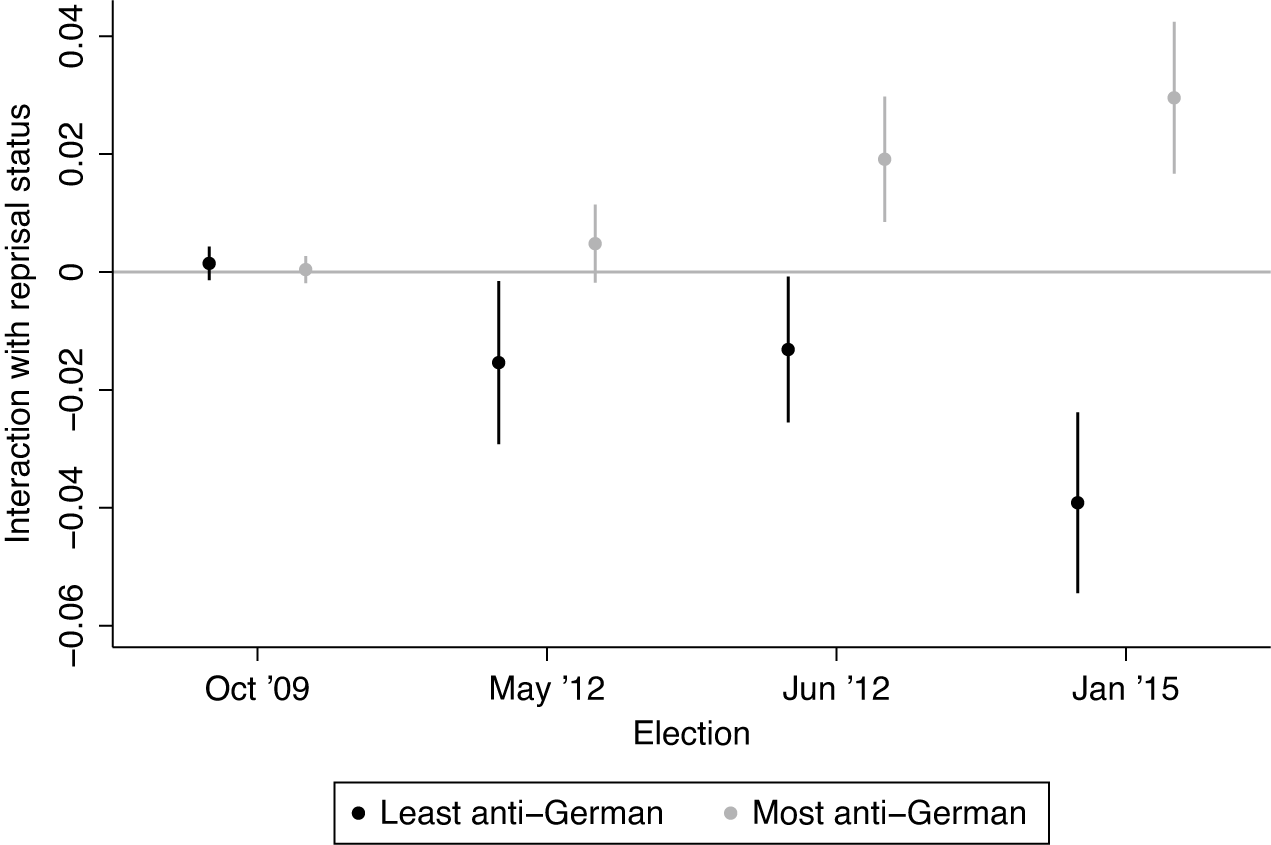
Figure 4 shows the results. Effects are relative to the 2007 baseline. There is no difference in vote patterns by reprisal status before the start of the crisis. Beginning with the first postcrisis election in May 2012, vote shares of more and less anti-German parties diverge across municipal units. The vote share of parties critical of Germany increases by up to three percentage points—a percentage equal to the electoral threshold in Greece—in municipal units with past exposure to reprisals. The vote share of PASOK and ND drops. Figure A.2 in the Appendix disaggregates the effects by party. Observed patterns are driven by all parties. The conservative Christian party and KKE, the two parties most critical of Germany in Parliament, experienced an immediate surge in support after the crisis. Support for Syriza increased after June 2012, culminating in the two 2015 elections, when the party had become the most viable opposition force in the fragmented political landscape of Greece. In terms of magnitude, differential support for Syriza is what drives the anti-German vote in reprisal municipal units. In the January and September 2015 elections, Syriza registered a 2 percentage-point higher vote share in municipal units that experienced reprisals.
Vote Share by Party Anti-Germanism and Reprisal Status
Note: The figure displays coefficient estimates of
 $ {\beta}_{\tau } $
from Equation 2 along with 95% confidence intervals. The dependent variable is, respectively, the aggregate vote share of ND and PASOK (black lines) and Syriza, KKE, and LAOS (gray lines). Standard errors are clustered at the municipal unit level. Table of full estimation results is provided with supplementary materials on the American Political Science Review Dataverse.
To mirror the more aggregate analysis of economic behavior, in Section C.5 of the Appendix we replicate these results at the level of the electoral periphery, a unit of analysis close to the prefecture (
 $ N\hskip0.35em =\hskip0.35em 56 $
). We find effects on voting patterns that are identical in direction but larger in magnitude than those at the municipal unit level, and we provide evidence that this difference is due to the presence of spillovers from localities directly affected by reprisals to neighboring localities.Footnote
21 This exercise demonstrates that our results in the analysis of car registrations are not the artifact of aggregation bias.
Taken together, the analyses of party vote shares echo our findings on purchasing patterns and indicate that reactivated memory affects all aspects of behavior, from consumption to political choices.
Institutionalizing Collective Memory
The Effect of State Recognition
In 1993, the Greek parliament debated recognition of Kalavryta as a martyr town. During the discussion, the idea of launching a procedure to award similar status to other towns affected by reprisals during World War II emerged. Towns destroyed during the German occupation could apply for martyr status designation. A committee of experts was convened to assess applications and award martyr status on the basis of objective criteria relating to housing destruction and population losses during WWII (see Appendix Section B.1.4). These criteria were flexibly interpreted by committee members and were not strictly followed in practice.
Martyr status is a purely honorific designation, with no material benefits for towns that acquired it. However, the martyr label is associated with both greater awareness of local WWII atrocities and a greater visibility of those atrocities in public life. All martyr towns—but not all towns that experienced violence in WWII—commemorate reprisals in some way. Schools in many martyr towns highlight local reprisals when otherwise teaching the history of WWII following Greece’s centralized educational curriculum. As a result, residents of martyr towns have greater awareness than do residents of other reprisal locations of not only WWII events but also their towns’ martyr designation. We provide more qualitative evidence for this claim when we discuss mechanisms behind the effect of martyr status.
We start by providing evidence that the ministerial committee tasked with awarding martyr status to towns affected by reprisals did so by following a relatively simple heuristic. The left plot of Figure 5 is a binned scatterplot of reprisal towns granted martyr status by percentage of destruction, with regression discontinuity curves fitted following Calonico, Cattaneo, and Titiunik (Reference Calonico, Cattaneo and Titiunik2015). The likelihood of receiving martyr status is increasing in the extent of destruction recorded in ministerial sources. The probability of receiving designation jumps around a destruction level of 50%. This is examined more systematically in columns 1–2 of Table A.2 for different polynomials in the destruction variable. Although martyr status jumps discretely, population in 1940 varies smoothly around the 50% threshold (columns 3–4).Footnote 22 As the reading of the committee minutes suggests, there was substantial leeway in making a final determination; the discontinuity at the 50% cutoff suggests that the committee de facto followed the rule of assigning martyr status to borderline cases whenever half or more of the town was registered as destroyed in official records.
Martyr Status and Destruction
Note: Binned scatterplot of towns granted martyr status (left) and towns that applied for martyr status (right) among towns that experienced reprisals, by percentage of destruction. Data restricted to towns with 40% to 60% destruction. Regression discontinuity curves with quantile-spaced partitioning follow Calonico, Cattaneo, and Titiunik (Reference Calonico, Cattaneo and Titiunik2015).
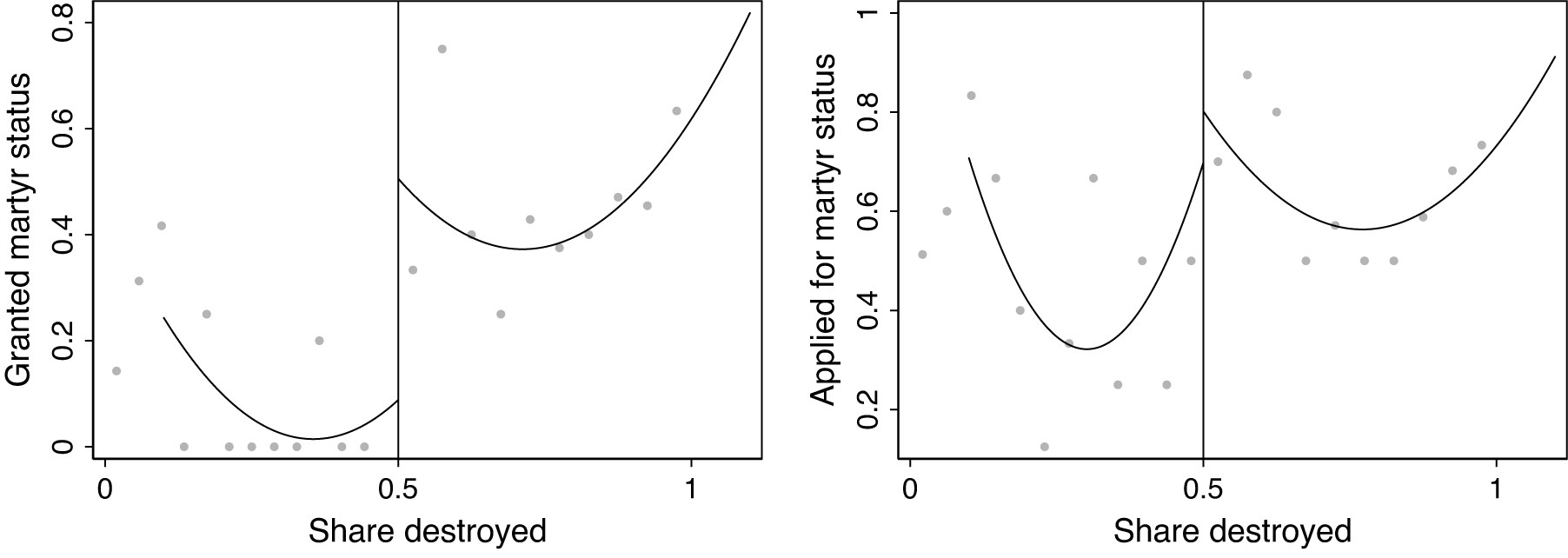
With the exception of Kalavryta, towns had to apply in order to be considered for martyr status. Applications requesting recognition were filed by 56% of towns that experienced reprisals, and 30% (or 54% of those that applied) were eventually granted the martyr designation. Towns with higher levels of destruction were more likely to apply (59% of towns with above 50% destruction compared with 50% of towns below). However, the right plot in Figure 5 and columns 5–6 of Table A.2 reveal no discontinuity in the number of towns that applied for martyr status. This is evidence that the 50% threshold influenced the decisions of the expert committee directly, not through the amount of applications that the committee received.
The evidence from the regression discontinuity design (RDD) and a close reading of the discussions of the committee minutes thus suggest that the awarding of martyr status—although correlated with destruction and population loss—also contains an important accidental element. Therefore, we ask whether the receipt of martyr status influences German car purchases above and beyond the effect of destruction itself. Panel A of Table 2 replicates results from Table 1 for purposes of comparison. In Panel B, we estimate Equation 1 using the share of martyr towns in a prefecture as the source of cross-sectional variation. The differential effect of conflict in prefectures with a higher share of martyr towns is negative and significant. The magnitudes are consistent across specifications, and the estimated effects are large: relative to a prefecture without martyr towns, the average prefecture with state-recognized memory experienced a drop of 5.7 percentage points in the German car market share at peak conflict.
The Effect of Martyr Status

Note: ***p
 $ < $
0.01, **p
 $ < $
0.05, *p
 $ < $
0.10.
Next, we conduct a horse race between the time-varying effect of reprisals and of public recognition. We always control for the average extent of destruction in a prefecture to account for the fact that martyr status is more likely to be awarded to towns with higher recorded levels of destruction. Panel C of Table 2 shows that prefectures with a higher share of martyr towns display large and significant differential drops in the German car market share in months of conflict. Prefectures more exposed to reprisals also register a differential drop, though this is smaller in magnitude and not statistically significant. That means that between two prefectures with the same average exposure to reprisals, the one with a higher share of officially recognized martyr towns saw a much sharper fall in German market share—publicly recognized status as a major victim of Nazi aggression matters over and above the occurrence of conflict itself.
Finally, we exploit the discontinuity in the awarding of martyr status at the 50% cutoff of destruction to isolate the exogenous component of public recognition. In Panel D of Table 2, we use the predicted share of martyred towns in a prefecture based on the 50% criterion to explain changes in market share. We create a dummy for towns that are assigned a predicted value > 0.5 in a regression of martyr status on a dummy for destruction higher than 50% and a quadratic polynomial in destruction. We then aggregate towns predicted to receive martyr status at the prefecture level as a share of all towns in 1940. The resulting variable confirms the large and significant effect of martyr status on car sales.
Because we do not have town-level data on car sales, we cannot implement an exact analogue to the RDD specification—showing that a narrow band of destruction driving assignment to martyr status is responsible for declining German market share. Instead, we show that the coefficient on the interaction between martyr status and article share remains negative and significant as the share of reprisal towns in a prefecture with destruction in the range of 25%–75% increases (Table A.3).
Mechanisms
The results of the previous section indicate that designation of martyr status effectively preserves latent collective memory, which can then become reactivated in the presence of associative stimuli. How is this achieved? Our evidence suggests that martyr status designation leads to more intense commemorative activity, directly supported by the state, that not only preserves memory among those affected and their descendants but also transmits it to members of the community without a direct personal or family experience of past violence. We present this evidence below.
The Implications of Official Recognition
Residents of martyr towns are reminded of WWII reprisals more frequently and more intensely than are residents of towns affected by German war crimes but without official recognition. Examples from public life and from local education illustrate this claim.
Public life. Towns that were designated as martyred form part of a network and nongovernmental organization called “Martyr towns and villages of Greece, 1940–1945—Greek Holocausts.” The expressed purpose of the organization, which was founded in 2000, is to preserve the memory of victims of WWII as well as to continue pushing for reparations for German war crimes.Footnote 23 Official martyr status—and not simply exposure to WWII reprisals—forms the basis of network membership, as highlighted in the organization’s founding documents and emphasized in its various announcements.
The network organizes frequent activities to commemorate civilian deaths resulting from the German occupation and publishes articles on the topic in the local press. Mayors of martyr towns send annual announcements to their communities, signing as part of the “Network of Martyr Towns,” on either the national holiday of October 28 commemorating Greece’s participation in WWII or the annual memorial of a reprisal attack. Figure D.1 displays an example of such an announcement for the martyr town of Chortiatis. Such actions ensure that the memory of reprisals remains visible and that most residents of martyr towns are aware of their town’s martyr status.
Education. Though Greece’s educational curriculum is centralized and the official content is uniform across locations, local reprisals are emphasized in schools of towns that experienced them and particularly in martyr towns. Various school webpages and blogs illustrate ways in which this is achieved (see examples in Section D of the Appendix). Schools in martyr towns and their neighboring communities educate students on past war crimes in their localities and organize visits to massacre memorials. As in the case of public life, such activities usually take place annually on the occasion of the national holiday or of the anniversary of reprisals. These efforts ensure that residents of martyr towns are socialized into the history of their town from a young age, and they form the basis of the formation and preservation of collective memory.
The Role of Public Commemoration
On occasions when WWII atrocities are commemorated, residents of martyr towns are also reminded of the official martyr status of their towns. Knowledge of martyr status may itself aid in preserving memory, as residents think of their town as exceptional or of themselves as having a responsibility to remember the past. Is it the strength of commemoration or the label itself that aids the preservation of memory in martyr towns? To address this question, we systematically measure public commemoration and its effects on the reactivation of memory. Many towns in Greece commemorate World War II atrocities, often by public festivities or through memorials. We conducted a telephone survey of municipal offices in all towns that experienced reprisals and coded whether the community commemorates the violence it experienced with a monument or ceremony.
Panels A and B of Table 3 show that the drop in German market share in months of conflict is significantly larger in prefectures with a higher share of towns that commemorate reprisals. The magnitude of the effects is larger than that of exposure to reprisals (Table 1). Public commemoration is an important vehicle of memory preservation, and more memorialization enhances the effects of time-varying conflict in triggering latent memory.
Pathways for the Effect of Official Recognition

Note: Reported p-values are from a test for the equality of coefficients on Article share × Share towns w/ memorial (nonmartyr) and Article share × Share martyr towns (Panel C) or Article share × Share pop. w/ memorial (nonmartyr) and Article share × Share martyr pop. (Panel D); ***p
 $ < $
0.01, **p
 $ < $
0.05, *p
 $ < $
0.10.
To understand whether public commemoration is the main driver of martyr status effects, we separately examine the effect of memorials and of official government recognition in Panels C and D of Table 3. Of towns officially recognized as martyr, 95.5% have a public commemoration or memorial, which is consistent with the evidence above on public commemoration being more intense in martyr towns than in other reprisal towns.
We construct a separate measure for the prefecture share of towns (Panel C) or population (Panel D) with a memorial that do not have official martyr status. Both martyr status and memorials in the absence of official recognition strongly predict differentially lower German market shares after 2010. The magnitude of their effects is comparable. Reported p-values indicate that martyr status has somewhat larger (Panel C) or similar effects compared with public commemoration (Panel D). This result suggests that memorials and public ceremonies are central in preserving collective memory. It also indicates that the label of martyr status may matter primarily through the degree of commemoration it brings with it.
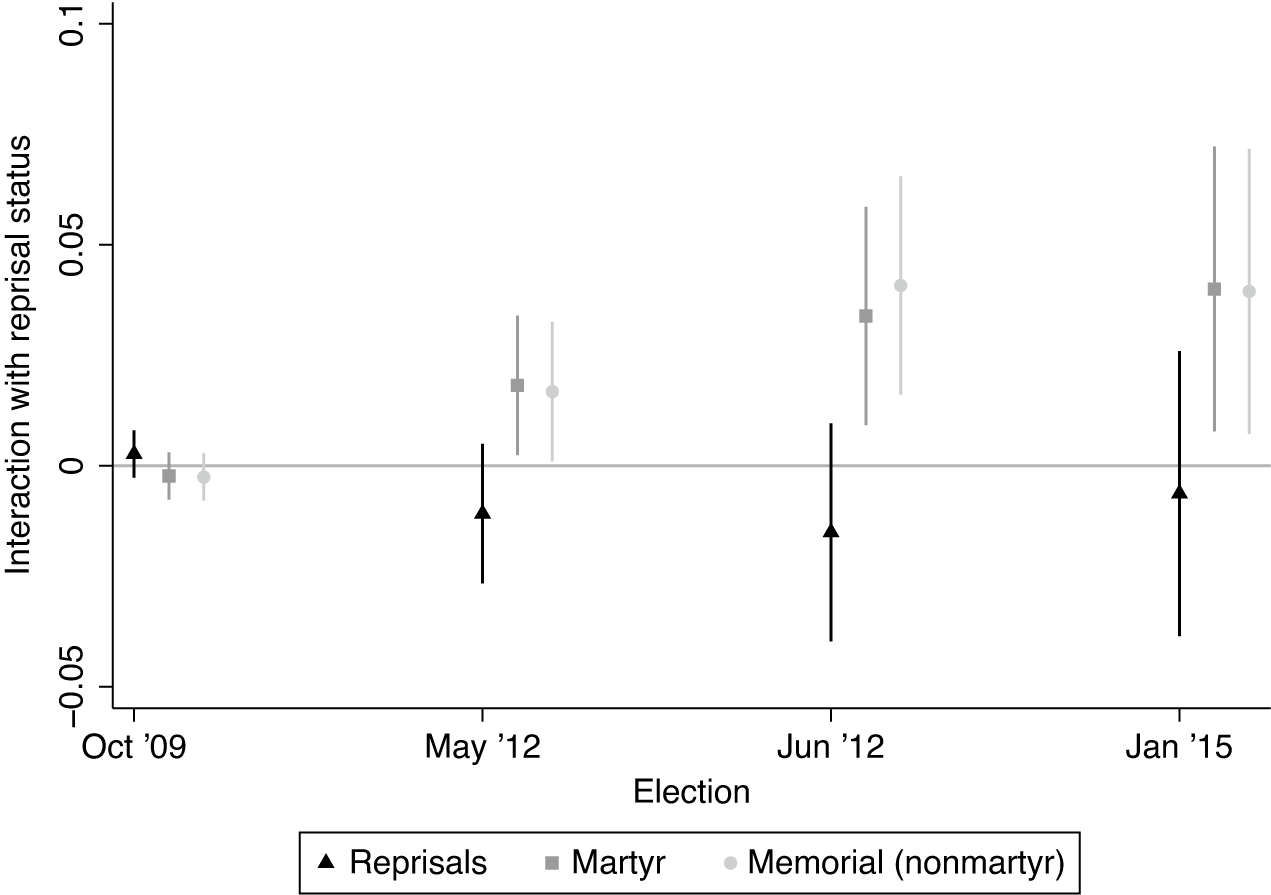
We then examine whether the same pattern replicates in the case of voting outcomes. We estimate Equation 2 by including interactions of period dummies with indicators for martyr status and for the presence of memorials in municipal units without official state recognition. Figure 6 displays results remarkably similar to those of Table 3 in the case of cars. The entire differential increase in the vote share of parties critical of Germany comes from municipal units that contain martyr towns. There is no significant difference between officially recognized victim status and commemoration (without martyr status). This supports the interpretation that state recognition of past violence works by raising the visibility of memory in public life. Without such visibility, time-varying conflict fails to trigger associations with past conflict: reprisal towns without official recognition or memorials do not experience differential changes in their voting outcomes postcrisis.
Anti-German Party Vote Shares by Martyr Status and Public Commemoration Activity
Note: The figure displays coefficient estimates and 95% confidence intervals for the interaction between election period and indicators for, respectively, reprisal status (black), martyr status (dark gray), and presence of memorials without official recognition (light gray). The dependent variable is the aggregate vote share of Syriza, KKE, and LAOS. Standard errors are clustered at the municipal unit level. Table of full estimation results is provided with supplementary materials on the American Political Science Review Dataverse.
The presence of memorials is a community-level decision that may be driven by patriotism and other correlates of anti-German sentiment. Although we caution against a causal interpretation of the influence of memorials, the findings in this section arguably suggest an important role for commemorative activities in driving the effects of state-sanctioned memory.
The Role of Family Transmission
Much of the literature on the legacy of conflict has focused on the role of family transmission as a channel of persistence. Our study instead highlights the role of the state in preserving collective memory through institutionalized commemoration. To what extent is there overlap or interaction between these two processes? Our analysis shows that state recognition has an independent effect on memory and behavior, over and above any process of intergenerational transmission. Based on exogenous variation in the degree of recognition as isolated by an RDD, two communities with similar characteristics, and thus presumably similar strength of family transmission, differ in their reactivation of latent collective memory as a result of differences in martyr status.
Although intergenerational transmission does not confound the effect of state sanction, it is possible that the two processes interact. Martyr status ensures visibility of the past for an entire community, but its effects on memory preservation could be stronger for community members with personal or family experience of German atrocities (Dinas, Fouka, and Schläpfer Reference Dinas, Fouka and Schläpfer2021). If that is the case, then state sanction’s effect may be to intensify the process of intergenerational transmission by widening the gap in the memory of conflict between those with familial exposure and everyone else.
Our data do not provide strong evidence for this scenario. Figure 7 plots average responses to survey questions capturing anti-German attitudes (see Table C.3) across reprisal towns (all of which have martyr status) and control towns, comparing individuals native to a town and others. We define as native those respondents born in the town and with at least one parent born in the town. These individuals may either have been directly affected by reprisals or have had family members who were and thus be carriers of local memory through family transmission channels. With the exception of actual purchasing behavior, there is no immediate visual evidence that differences between martyr towns and control locations come from natives. Both natives and nonnatives in martyr towns are less likely to desire a German car and more likely to blame Germany for the crisis than are respondents in control towns. We verify this in Table A.4 where we find no significant interaction effect between a town’s martyr status and a respondent’s native background, either on average or when we control for an additional set of respondent characteristics interacted with the martyr indicator.
State Recognition and Family Transmission
Note: Native refers to individuals born in a town and with at least one parent born in the town; 95% confidence intervals reported.

The survey data then indicate that martyr status does not significantly intensify any effects of intergenerational transmission or, alternatively, that it does not have more of an influence on those for whom intergenerational transmission is likely more active (natives). Combined with the rest of the evidence in this section, it appears that state sanction, working through public commemoration and the visibility of the past in various facets of public life, acts uniformly on the entire community, preserving collective memory for affected members and transmitting it to an equal degree to newer arrivals.
Conclusion
When does collective memory affect behavior? We argue that collective memory matters the most when the present is reminiscent of the past, for example by pitting the same groups of “insiders” and “outsiders” against each other. We also show that associativeness of collective memory is strengthened through government intervention by intensifying the presence of “places of memory”—from local plaques and statues to commemoration ceremonies.
Our main analysis focuses on high-frequency movements in political tension across countries and monthly variation in consumer behavior. Figure 1 and additional analyses (Figure A.4) show that consumers responded immediately to Greek–German tension and the economic effects did not carry over to following months. However, other results point to more than just short-lived changes in behavior and attitudes triggered by associative memory. Election data reveal a divergence between municipalities with different degrees of exposure to war crimes that increases over the course of several years. Additionally, we find significant differences in attitudes and buying intentions between martyr towns and towns not affected by WWII violence in 2017, several years after Greek–German relations had normalized. Together, our results suggest that associativeness of memory affects high-stakes economic behavior when the salience of past events is highest, but it can imprint less costly behaviors and attitudes for a longer period.
Our findings on changing patterns of consumer behavior could reflect either personal preferences—that is, a greater dislike of Germany—or concerns over the social acceptability of purchasing a German product. To some extent, social considerations are always a second-order mechanism; residents of martyr towns may worry about social ostracism or vandalism of their cars exactly because at least some of their neighbors hold deeply seated animosity toward Germany. True preferences and social concerns are thus likely to act together to produce the patterns we observe. Two additional pieces of evidence point to the secondary role of social considerations. First, the effects of exposure to reprisals are present for not only purchasing behavior but also purchasing aspirations expressed in the absence of community pressure (to the survey interviewer). Second, private vote choice follows similar patterns to publicly observable purchasing behavior. Nonetheless, this evidence remains suggestive, as our setup does not allow us to cleanly distinguish between private preferences and social desirability considerations.
One of our study’s central findings is that reactivation of collective memory has similar effects on economic and political behavior. We thus help to bridge literatures in political science and political economy, which have focused on these aspects of human decisions in isolation. By demonstrating that the official recognition of victim status matters over and above the memory of past violence, our paper is also the first to provide causal evidence for the role of institutionalized collective memory on economic and political decision making.
Supplementary Materials
To view supplementary material for this article, please visit http://doi.org/10.1017/S0003055422001095.
DATA AVAILABILITY STATEMENT
Research documentation and data that support the findings of this study are openly available at the American Political Science Review Dataverse: https://doi.org/10.7910/DVN/2YD8IS.
ACKNOWLEDGMENTS
We would like to thank three anonymous reviewers and the Editor for significantly improving the paper with their suggestions. For helpful suggestions we thank Alexander Apostolides, Leo Bursztyn, Bruno Caprettini, Luke Condra, Elias Dinas, Ray Fisman, Nicola Gennaioli, Luigi Guiso, Yannis Ioannides, Emir Kamenica, Tim Leunig, Sara Lowes, John Marshall, Guy Michaels, Stelios Michalopoulos, Nathan Nunn, Sonal Pandya, Elias Papaioannou, Luigi Pascali, Giacomo Ponzetto, Dominic Rohner, Alain Schläpfer, Guido Tabellini, and Nico Voigtländer. Seminar participants at Bocconi, Chicago, Columbia, CREI, Ente Einaudi, Harvard, LSE, UPF, Vanderbilt, the Workshop on Political Conflict in Washington University in St. Louis, the 2017 Zurich Conference on Origins and Consequences of Group Identities, the EREH-London conference, and the 12th Conference on Research on Economic Theory and Econometrics in Naxos provided useful advice. The Hellenic Statistical Authority kindly provided car registration data. We thank Evangelia Mathopoulou and Foteini Smyrni for valuable assistance in the collection of data on reprisals and public memorials.
CONFLICT OF INTEREST
The authors declare no ethical issues or conflicts of interest in this research.
ETHICAL STANDARDS
The authors declare the human subjects research in this article was reviewed and approved by Stanford University and certificate numbers are provided in the text. The authors affirm that this article adheres to the APSA’s Principles and Guidance on Human Subject Research.


 Open access


Comments
No Comments have been published for this article.