Concern about the educational attainment of Aboriginal and Torres Strait Islander students came to the political and societal forefront after the election of the then Prime Minister, Gough Whitlam, and the formation of the Schools Commission as evidenced in the consequential reports in 1975 by the Schools Commission and the Aboriginal Consultative Group (Aboriginal Consultative Group, 1975a, 1975b; Schools Commission, 1975). Prior to 1972, various policy acted to exclude and/or minimise Indigenous young people access to education, including the policy of assimilation (Hasluck, Reference Hasluck1950, Reference Hasluck1961), or more explicitly, policies such as the ‘Clean, Clad and Courteous’ Acts (Reynolds, Reference Reynolds2009). In the past three and a half decades, there has been a plethora of policy, review and evaluation to address the disparity between Aboriginal and Torres Strait Islander students and their non-Indigenous counterparts. Policy such as the National Indigenous Reform Agreement (Council of Australian Governments, 2008), and the Melbourne Declaration on Educational Goals for Young Australians (Ministerial Council on Education Employment Training and Youth Affairs [MCEETYA], 2008) informed the production of the Aboriginal and Torres Strait Islander Education Action Plan 2010–2014 (Ministerial Council for Education Early Childhood Development and Youth Affairs [MCEECDYA], 2011), from here on referred to as ‘the Plan’.
Central to this paper is how policy discourses maintain social and institutional constructs in regards to the positioning of Aboriginal and Torres Strait Islander students and their educational attainments. In other words, how bias and taken for granted assumptions become evident within policy through critical analysis of language use. First, the paper establishes the purpose of policy analysis and its contribution to the literature. Second, an overview of the methodological approach and the theoretical framework that informed the research is provided. Third, an example of how these contrasting approaches—one being based within Western academia and the other within the tenets of Indigenous methodologies—demonstrate the tensions at the cultural interface (Nakata, Reference Nakata2007). Finally, a synopsis of the major findings inclusive of the bias and taken for granted assumptions is identified in a critical analysis of the Plan (Hogarth, Reference Hogarth2015).
Policy Analysis
Henry, Lingard, Rizvi, and Taylor (Reference Henry, Lingard, Rizvi and Taylor2013, p. 35) define policy analysis as ‘the study of what governments do, why and with what effects’. Ozga (Reference Ozga2000) asserts that there is a need for policy analysis to hold policymakers accountable. Therefore, empirical research critically analysing Indigenous education policy is beneficial for stakeholders. Analysis ensures that alternative perspectives are provided to encourage change and reform to the educational agenda.
Henry et al. (Reference Henry, Lingard, Rizvi and Taylor2013) imply government produce policy to address some economic, social or political factor. In other words, the ‘problem’ needs a ‘solution’, that there is a vested interest in addressing the issue that will benefit the wider Australian society. By addressing the educational attainment of Aboriginal and Torres Strait Islander peoples, government indicates its desire for equity, to achieve parity between the potential life outcomes of Indigenous and non-Indigenous Australia.
Policy itself according to Henry et al. (Reference Henry, Lingard, Rizvi and Taylor2013) can be incremental and/or intertextual in nature. That is, the production of policy may be due to the policy cycle, where policy is developed to build on previous policy (incremental) or complementing and developed from other broader policies (intertextual). The Plan (Ministerial Council for Education Early Childhood Development and Youth Affairs [MCEECDYA], 2011) is both incremental and intertextual. It builds on recommendations as provided within the Review of Australian directions in Indigenous Education 2005–2008 for the Ministerial Council for Education, Early Childhood Development and Youth Affairs (David Unaipon College of Indigenous Education and Research, 2009) hence being incremental. Further to this,
The Plan seeks to progress the goals of the National Aboriginal and Torres Strait Islander Education Policy and the Melbourne Declaration on the Educational Goals of Young Australians and is part of a broader COAG reform agenda for school education that will contribute to closing the gap between the educational outcomes of Aboriginal and Torres Strait Islander students and their peers (Ministerial Council for Education Early Childhood Development and Youth Affairs [MCEECDYA], 2011, p. 4).
indicating the intertextual properties.
There is little research in the critical analysis of policy discourses (Taylor, Reference Taylor2004). In turn, critical analysis of the Plan (Ministerial Council for Education Early Childhood Development and Youth Affairs [MCEECDYA], 2011) is further minimised. Investigation of Indigenous education policy has been predominantly focused on specific aspects of Aboriginal and Torres Strait Islander student educational attainment. Exemplification includes improving the attendance of Aboriginal and Torres Strait Islander students and its influence on achievement (Dreise, Milgate, Perrett, & Meston, Reference Dreise, Milgate, Perrett and Meston2016; Ladwig & Luke, Reference Ladwig and Luke2014), encouraging parental engagement (Higgins & Morley, Reference Higgins and Morley2014; Hunt, Reference Hunt2013), or more specifically, analysis of Indigenous policy itself from a non-Indigenous perspective (Altman, Reference Altman2009; Altman, Biddle, & Hunter, Reference Altman, Biddle and Hunter2009; Altman & Fogarty, Reference Altman and Fogarty2010). This paper reveals the bias and taken for granted assumptions prevalent within the Plan that was produced to address the educational attainment of Aboriginal and Torres Strait Islander students from an Indigenous perspective.
Description of the Plan
In 2011, the Plan (Ministerial Council for Education Early Childhood Development and Youth Affairs [MCEECDYA], 2011) was endorsed by the Council of Australian Governments and released for distribution and implementation. It provided six domains, including the Readiness for School; Engagement and Connections: Attendance; Numeracy and Literacy; Leadership, Quality Teaching and Workforce Development; and Pathways to Post-School Options. The Report to the Aboriginal and Torres Strait Islander Education Advisory Group of the Education Council: Evaluation of the Aboriginal and Torres Strait Islander Education Action Plan 2010–2014 (ACIL Allen Consulting, 2014) suggested the revision or replacement needed to occur sooner rather than later to maintain the momentum of and sustain the gains achieved in the implementation of the Plan.
The Plan (Ministerial Council for Education Early Childhood Development and Youth Affairs [MCEECDYA], 2011) was developed to address the recommendations within the Australian Directions in Indigenous Education 2005–2008 (Ministerial Council on Education Employment Training and Youth Affairs [MCEETYA], 2006) and its consequent review conducted by the David Unaipon College of Indigenous Education and Research (2009), where the perceived assumptions held by educationalists that disparity in educational attainment has been normalised and that ‘incremental gains are acceptable’ (Ministerial Council on Education Employment Training and Youth Affairs [MCEETYA], 2006, p. 4). Further to this, the Plan was part of the response from Federal government to address the gap between Indigenous and non-Indigenous students (Council of Australian Governments, 2008). Primarily, the Plan had 55 key actions that would provide the data necessary for tracking the National Indigenous Reform Agreement, otherwise known as the Closing the Gap, targets pertaining to education. That is, the Plan is a ramification of other policies complementing and elaborating on broader, more generalised goals. An innovative approach to critically analyse the Plan was required.
Methods
To analyse the Plan (Ministerial Council for Education Early Childhood Development and Youth Affairs [MCEECDYA], 2011), I drew on Rigney's Indigenist Research Principles (Reference Rigney1999) and Fairclough's Critical Discourse Analysis framework (Reference Fairclough, Wetherell, Taylor and Yates2001a). As a neophyte Aboriginal researcher and a classroom teacher for almost 20 years, there was a need to address the deficit view prevalent within the education paradigm (see David Unaipon College of Indigenous Education and Research, 2009; Ministerial Council on Education Employment Training and Youth Affairs [MCEETYA], 2006). There was a need to personalise the methodology; to ensure that the research activity reflects the person I am (Gale, 1998 as cited in Henry et al., Reference Henry, Lingard, Rizvi and Taylor2013). To analyse the policy discourses, I needed a methodological approach that focused not only on the textual features, but also drew on the social conditions and processes of production and interpretation of text. Further to this, an Indigenous methodological approach ensured that the research ‘privileges the indigenous presence’ (Smith, Reference Smith1999, p. 6). Therefore, as Nakata (Reference Nakata2007) asserts the Indigenous researcher is required to gain an understanding of the knowledge that positions Aboriginal and Torres Strait Islander peoples to speak back into the contested space.
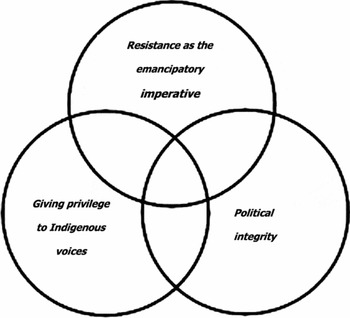
I found strength in Rigney and his approach when I read how ‘Indigenous Peoples must look to new anti-colonial epistemologies and methodologies to construct, re-discover, and/or re-affirm their knowledge and cultures’ (Rigney, Reference Rigney1999, p. 114), and in doing so, inform the struggle for self-determination by challenging the embedded Eurocentric context and colonial dominant power of educational institutions. Rigney's Indigenist Research Principles (Reference Rigney1999) framework provided a means to include Indigenist principles by providing a strategy for research rather than a research process. In other words, the principles—Resistance as an emancipatory imperative; Political Integrity and Privileging Indigenous voice—provided a means to identify the key assumptions within the Plan by identifying the subtle issues of power and dominance maintained in policy discourses through the use of deficit discourses. Figure 1 demonstrates how each of these principles is separate and yet interrelated, supporting the other.
Rigney's three Indigenist Research Principles. Adapted from ‘Internationalisation of an Indigenous anticolonial cultural critique of research methodologies: A guide to Indigenist Research Methodology and its principles’, by Rigney (Reference Rigney1999).

Rigney's Indigenist Research Principles (Reference Rigney1999) were articulated with Fairclough's Critical Discourse Analysis (Reference Fairclough, Wetherell, Taylor and Yates2001a) framework. Critical Discourse Analysis brings attention on discourse, which is evident in all social activities. Discourse is represented within written or spoken texts, it could be verbal or nonverbal or a combination of any means of communication. As a result, discourse is also a form of social practice. In other words, rather than being an external component to society, language is a fundamental part of society and its means to communicate.
Furthermore, language is used to establish and organise the ways people interact demonstrating the influence of discourse as a social practice but also social process (Fairclough, Reference Fairclough1989). This is demonstrated by the orders of discourse. A term originally used by Foucault (Reference Foucault1971), orders of discourse is defined by Fairclough as ‘a particular social ordering of relationships amongst different ways of making meaning’ (Fairclough, Reference Fairclough, Wetherell, Taylor and Yates2001a, p. 232). In other words, the internal relations demonstrated within a text, being the semiotic and linguistic factors, are combined with the external factors, being the social positioning of the individual as well as their knowledge, attitudes and beliefs, which in turn influences the interpretation and enactment (Taylor, Reference Taylor2004). Therefore, Critical Discourse Analysis provides opportunities for the discourses of the Plan (Ministerial Council for Education Early Childhood Development and Youth Affairs [MCEECDYA], 2011) to be analysed as to how it positions Aboriginal and Torres Strait Islander people and to what extent it is arguing for or against the people.
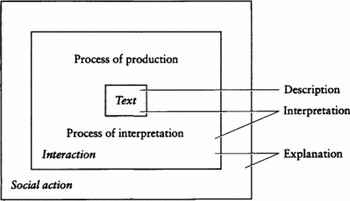
Critical Discourse Analysis was deemed as the most appropriate approach for analysis of data. Fairclough (Reference Fairclough2013) began developing an analytical framework in the 1980s that investigated language use and its ability to maintain and sustain deficit views and power. This methodology differed from the work of linguists and sociolinguists as it sought to understand how characteristics of discourse influenced societal conditions (Fairclough, Reference Fairclough2012). Figure 2 depicts a broad three-stage framework when analysing text: that is, Stage 1: description of the text; Stage 2: interpretation of the relationship between the text and interaction and Stage 3: explanation of the relationship between interaction and social context (Fairclough, Reference Fairclough1989). The articulation of Critical Discourse Analysis (Fairclough, Reference Fairclough, Wetherell, Taylor and Yates2001a) and Indigenist Research Principles (Rigney, Reference Rigney1999) enabled the critical analysis of the Plan (Ministerial Council for Education Early Childhood Development and Youth Affairs [MCEECDYA], 2011), and how discourse positions Aboriginal and Torres Strait Islander students’ educational attainment (see Hogarth, Reference Hogarth2015).
Fairclough's three-dimensional framework for Critical Discourse Analysis. Taken from Fairclough (Reference Fairclough2014).

The Articulation of Indigenist Research Principles and Critical Discourse Analysis
Specific textual features of discourse are identified within a text to assist in the analysis. In particular, declarative statements, euphemistic expressions, classification schemes and expressive modality provided focus and guided the project. In doing so, the experiential value of the word choices used within the Plan (Ministerial Council for Education Early Childhood Development and Youth Affairs [MCEECDYA], 2011) was analysed to determine the privilege assumed by the producers of the text. In turn, the text is interpreted from an Aboriginal standpoint making explicit the bias and taken for granted assumptions prevalent within the Plan that may hinder or challenge the interpretation of the text.
Declarative statements are used to establish a position of authority or trustworthiness (Fairclough, Reference Fairclough1989). Within a policy text, the use of declarative statements further demonstrates the power of government; of their position. Critical Discourse Analysis provides a means to challenge the societal and institutional constructs; to question the political integrity of the Plan (Ministerial Council for Education Early Childhood Development and Youth Affairs [MCEECDYA], 2011). In turn, the use of Rigney's Indigenist Research Principles confirms the taken for granted assumptions that Wodak and Meyer (Reference Wodak and Meyer2009, p. 3) assert are normalised through ‘the effects of power and ideology in the production of meaning’. That is, the authoritative positioning of government ensures the maintenance of the dominant social structures, and therefore, the positioning of Aboriginal and Torres Strait Islander peoples. This, in turn, can be used to marginalise Indigenous voice. Rigney's principles (Reference Rigney1999) therefore provide a mean to privilege Aboriginal and Torres Strait Islander people, their voice and their position.
Euphemistic expressions are used to substitute language used that have a negative connotation (Fairclough, Reference Fairclough1989). More recently, when referring to the Indigenous peoples of Australia, the distinction of Aboriginal and Torres Strait Islander peoples or First Nations peoples (Standing Council on School Education and Early Childhood (SCSEEC), 2013). The uses of euphemisms further define the positioning of Aboriginal and Torres Strait Islander peoples within the wider Australian society. The terms of reference within a policy text are important therefore to be analysed as the euphemisms determine the orientation of the text and influence the interpretation. Further to this, euphemistic expressions demonstrate the achievement of Aboriginal and Torres Strait Islander peoples in creating change and transformation in Australian society. The political integrity of the policy is then able to be questioned. In other words, Rigney's Indigenist Research Principles (Reference Rigney1999) present a means to provide an alternative perspective of policy discourses.
Classification schemes enable government to validate an ideological stance and therefore, normalise taken for granted assumptions such as the deficit view of Aboriginal and Torres Strait Islander students’ educational attainment (Ministerial Council on Education Employment Training and Youth Affairs [MCEETYA], 2006). Through the identification of classification schemes and the use of synonyms, the ideological stance of addressing the gap between Aboriginal and Torres Strait Islander and non-Indigenous students is established. This, in turn, provides a means to challenge the position of the policy and its discourses.
Modality, much like declarative statements, established ‘the speaker's authority with respect to the truth or probability of a representation of reality’ (Fairclough, Reference Fairclough2001b, p. 105). Modal verbs such as are, may, might and probably therefore indicate a commitment to the truth or potential future. In doing so, the purpose and aim of the Plan (Ministerial Council for Education Early Childhood Development and Youth Affairs [MCEECDYA], 2011) is established. However, Critical Discourse Analysis enables internal colonialism to be identified further maintaining a deficit view (Welch, Reference Welch1988).
The textual deconstruction into its textual features is then validated through the analysis of the societal and institutional constructs that inform the production and interpretation of policy. Within the mesolevels and macrolevels of Critical Discourse Analysis (Fairclough, Reference Fairclough, Wetherell, Taylor and Yates2001a), the Indigenist Research Principles (Rigney, Reference Rigney1999) guide the analysis. In doing so, the articulation of Critical Discourse Analysis and the Indigenist Research Principles provide a means to ‘defend from the position of knowledge about knowledge’ (Nakata, Reference Nakata1998, p. 4) from an Aboriginal woman and educators standpoint. Explication of how Critical Discourse Analysis and the Indigenist Research Principles are used within analysis follows to further demonstrate how a Western methodology and Indigenous methodology are used to identify the bias and taken for granted assumptions held by the producers of the Plan (Ministerial Council for Education Early Childhood Development and Youth Affairs [MCEECDYA], 2011).
Discussion
The Plan (Ministerial Council for Education Early Childhood Development and Youth Affairs [MCEECDYA], 2011) is divided into four separate sections. The first section is an introduction that provides detail on the processes undertaken with the production process and its position within other education policy contexts. It highlights how consultation with Aboriginal Consultative Bodies and educators as well as non-Indigenous education providers occurred. Drawing on the strategies and recommendations of previous and current policy, the Plan is then situated within the current context of how government is and their expectations for stakeholders in education in addressing the disparity between Indigenous and non-indigenous students’ educational attainment. It is important to note, that while I recognise the many and diverse key stakeholders involved and influential in the provision of education, the scope of this paper focuses on the governmental approaches as located within policy discourses only.
The second section further demonstrates the incremental and intertextual properties of the Plan (Ministerial Council for Education Early Childhood Development and Youth Affairs [MCEECDYA], 2011), where it describes the six domains in more detail. Here, the goals and targets are articulated as well as the performance indicators and outcomes that will inform the evaluation of implementation and progress in working towards the overarching goals as set within the National Indigenous Reform Agreement (Council of Australian Governments, 2008).
Further to this, the interconnectivity of the strategies in the Plan and their alignment to the National Education Agreement (Council of Australian Governments, 2012) are provided. For example, the initial outcome for the domain—Engagement and Connections within the Plan, states ‘Aboriginal and Torres Strait Islander students are engaged in and benefiting from schooling’ (Ministerial Council for Education Early Childhood Development and Youth Affairs [MCEECDYA], 2011, p. 13). This declarative statement is clearly derived from the National Education Agreement, where it states as one of its outcomes being that ‘All children are engaged in and benefiting from schooling’ (Council of Australian Governments, 2012, p. 4). Here, the all-encompassing reference to all children is exchanged with Aboriginal and Torres Strait Islander students to ensure the Plan specifically addresses the educational attainment of Aboriginal and Torres Strait Islander students.
Following this, section three provides the jurisdictional State properties, including the current approaches and strategies that further assist the implementation of the Plan (Ministerial Council for Education Early Childhood Development and Youth Affairs [MCEECDYA], 2011). That is, the endeavours of State-specific strategies that are already in place that may work towards addressing those within the Plan are articulated. Reference is also made to the Indigenous Education Consultative Bodies and their role and contribution to the national and systemic systems when producing and evaluating Indigenous education policy. It is interesting to note that with the change in funding in late 2014, the State Indigenous Education Consultative Bodies were no longer to be federally funded despite playing such a critical role in Indigenous education policy (Reconciliation Australia, 2016).
Finally, section four provides instruction on the reporting processes to evaluate the Plan's implementation (Ministerial Council for Education Early Childhood Development and Youth Affairs [MCEECDYA], 2011). Yearly reports were required from schools and systems to maintain accountability and transparency. In doing so, government further established their position of authority, as ‘overseers’ of policy implementation.
The purpose outlined in the Plan (Ministerial Council for Education Early Childhood Development and Youth Affairs [MCEECDYA], 2011) identifies that school education contributes to closing the gap between Aboriginal and Torres Strait Islander people and their non-Indigenous counterparts. For example, the Plan states that
Governments have agreed to take urgent action to close the gap between the life outcomes of Aboriginal and Torres Strait Islander people and other Australians (Ministerial Council for Education Early Childhood Development and Youth Affairs [MCEECDYA], 2011, p. 3).
This excerpt is indeed a declarative statement in which it emphasises the necessity for action. In doing so, the Plan declares that there are inconsistencies between the livelihoods of Aboriginal and Torres Strait Islander people and their non-Indigenous counterparts.
Further to this, expressive modality is present. The use of the phrase urgent action works to emphasise that Aboriginal and Torres Strait Islander people are in need of assistance. That is, they are to attain a certain undisclosed way of life determined by government. This excerpt demonstrates the assimilatory stance still held within modern Australian society. That is, despite the call for reconciliation and the recognition of the oppressive past reforms of assimilation and dispossession, Aboriginal and Torres Strait Islander people and their ways of living and being are still judged by the ideology of superiority and dominance (see Brady, Reference Brady1997; Foley, Reference Foley2003; Rigney, Reference Rigney2002). In doing so, the excerpt positions Aboriginal and Torres Strait Islander peoples as incapable by improving current conditions without assistance, minimising the opportunity for self-determination. Rigney's Indigenist Research Principle, Resistance as an emancipatory imperative, seeks to question the positioning of Aboriginal and Torres Strait Islander people as ‘oppressed victims in need of charity’ (Foley, Reference Foley2003, p. 48). The taken for granted assumptions demonstrate a binary where there is a definite distinction between Aboriginal and Torres Strait Islander peoples and their non-Indigenous counterparts ways of living and livelihoods.
Further to this, the use of the adjective urgent determines the time frame in which this needs to be addressed. The excerpt implicitly exerts there is an obligation to address the current inequalities evident in Australian society in the imminent future. Here, the political agenda and integrity of government are made explicit. Hidden within the policy discourse is the ‘functionalist assumptions about the way society works’ (Henry, et al., Reference Henry, Lingard, Rizvi and Taylor2013, p. 24). Key to the policy discourses is to ‘close the gap’; to achieve parity and in turn, works to counter the potential costs in provision of welfare, and issues in health and wellbeing (Dreise & Thomson, Reference Dreise and Thomson2014).
Results
The critical analysis of the Plan (Ministerial Council for Education Early Childhood Development and Youth Affairs [MCEECDYA], 2011) and the investigation of how policy discourses position Aboriginal and Torres Strait Islander peoples found that three major assumptions were prevalent. These included (a) the homogenous grouping of Aboriginal and Torres Strait Islander peoples, (b) the maintenance of a deficit view and (c) the disregard of the detrimental effects of past policies. Further to this, bias was also identified whereby (d) binary constructions within policy discourses continue to marginalise Aboriginal and Torres Strait Islander peoples. Particular focus on the findings of the analysis of the Plan provides insight into how the macrolevel of the Critical Discourse Analysis framework, the social conditions of production and interpretation, are evident at the microlevel, the policy.
Homogenous Grouping of Aboriginal and Torres Strait Islander peoples
Within the Plan (Ministerial Council for Education Early Childhood Development and Youth Affairs [MCEECDYA], 2011), a presupposition of Aboriginal and Torres Strait Islander peoples as a homogenous collective group was identified. This is exemplified where the Plan states ‘A curriculum and pedagogy that embed Aboriginal and Torres Strait Islander cultural perspectives will support attendance and retention’ (Ministerial Council for Education Early Childhood Development and Youth Affairs [MCEECDYA], 2011, p. 8). That is, while the factors that influence Aboriginal and Torres Strait Islander students’ educational attainment such as curriculum and culturally appropriate pedagogies were identified, the geolocation and cultural intricacies of individual groups were ignored. Instead, the onus of closing the gap is placed on schools at a local level. As Lowe (Reference Lowe, Purdie, Milgate and Bell2011) asserts government is shifting blame for the lack of progress in achieving parity from policy failure to schools and their underachievement in addressing the needs of Aboriginal and Torres Strait Islander students.
The attention on schools emphasises the crucial importance of engagement and connection with Aboriginal and Torres Strait Islander communities. It is within the implementation and interpretation of the Plan (Ministerial Council for Education Early Childhood Development and Youth Affairs [MCEECDYA], 2011) that the ‘one-size-fits-all’ agenda can be contextualised. However, the interpretation of policy is subject to the social conditions and processes of production as evidenced within the Critical Discourse Analysis framework (Fairclough, Reference Fairclough, Wetherell, Taylor and Yates2001a; see also Figure 2). That is, the attitudes, beliefs and values held in regards to the educational attainment of Aboriginal and Torres Strait Islander students may influence the strategies and actions taken by the schools when addressing the key actions as provided within the Plan. Further influencing the processes of interpretation are the deficit view maintained within policy discourses.
Maintenance of a Deficit View
The Plan (Ministerial Council for Education Early Childhood Development and Youth Affairs [MCEECDYA], 2011) continues to maintain, sustain and uphold a deficit view of the educational attainment of Aboriginal and Torres Strait Islander students. This is exemplified within the targets set for the Engagement and Connections domain whereby the increased number of Personalised Learning Plans for Aboriginal and Torres Strait Islander students and the development of School-Community Partnership Agreements limit the level of engagement of Aboriginal and Torres Strait Islander peoples. In doing so, this taken for granted assumption where low expectations are normalised discourages the engagement and connection of Aboriginal and Torres Strait Islander parents and community in Indigenous education. This, in turn, indicates a form of resistance employed by Aboriginal and Torres Strait Islander peoples by disengaging from the educational attainment.
Furthermore, by advocating the belief that Aboriginal and Torres Strait Islander peoples are in need of charity and assistance, the Plan (Ministerial Council for Education Early Childhood Development and Youth Affairs [MCEECDYA], 2011) indicates ideologies based within an assimilatory stance further marginalising Aboriginal and Torres Strait Islander peoples. That is, while the Plan advocates for improving the potential achievements and life outcomes of Aboriginal and Torres Strait Islander young people. It negatively positions Aboriginal and Torres Strait Islander peoples within the policy discourses. The Plan seeks for genuine partnerships to improve attendance and yet ignores the detrimental effects of past policies.
The Detrimental Effects of Past Policies
The disregard of the underlying factors that influence Aboriginal and Torres Strait Islander students’ educational attainment is evident in the Plan (Ministerial Council for Education Early Childhood Development and Youth Affairs [MCEECDYA], 2011). The intergenerational trauma prevalent in Aboriginal and Torres Strait Islander communities as the result of past policies and reforms effects the willingness of Aboriginal and Torres Strait Islander parents and communities in actively engaging and connecting with education (Atkinson, Reference Atkinson2013). Reviews and evaluations of policy, such as the Australian Directions in Indigenous Education 2005–2008 (Ministerial Council on Education Employment Training and Youth Affairs [MCEETYA], 2006, p. 16) highlight the detrimental effects of past policies on Aboriginal and Torres Strait Islander peoples where it states ‘Historically, the policies and practices of Australian governments were predicated on the supposed “inferiority” of Indigenous Australians’. However, regardless, the Plan positions itself as an authority on Indigenous education and upholds an expectation of engagement in Aboriginal and Torres Strait Islander students’ educational attainment from all stakeholders, including Aboriginal and Torres Strait Islander peoples. Within the policy discourses, there is little recognition of the trust and reciprocity that would need to be established or the time needed to develop such relationships. Once again, the onus is placed on schools with little advice or guidance on how this is achieved.
Binary Constructions
Prior to presenting the intricate biases within the Plan (Ministerial Council for Education Early Childhood Development and Youth Affairs [MCEECDYA], 2011) itself, note that the Plan presents a binary construction. By being a specific policy in addressing the educational attainment of Aboriginal and Torres Strait Islander students, it further develops the marginalisation of Aboriginal and Torres Strait Islander peoples in need of assistance. While I acknowledge and value the Plan's contribution in addressing the inequalities prevalent in Australian education systems, as the Australian Directions in Indigenous Education 2005–2008 (Ministerial Council on Education Employment Training and Youth Affairs [MCEETYA], 2006, p. 12) states ‘Quality teaching pedagogies for Aboriginal and Torres Strait Islander students are clearly quality teaching for any child’. Therefore, there is a need to articulate that implementation of the Plan could be beneficial for all low-achieving and disengaged students.
Further to this, the Plan (Ministerial Council for Education Early Childhood Development and Youth Affairs [MCEECDYA], 2011) constantly interchanges the terms of reference for non-Indigenous Australians while maintaining consistency when referring to Aboriginal and Torres Strait Islander peoples. For example, the terms ‘non-Indigenous’ (p. 6), ‘other students’ (p. 7), ‘other Australians’ (p. 7) and ‘their peers’ (p. 29) were all used to refer to non-Indigenous peoples in the Plan. The binary here is noteworthy as the Plan highlights that ‘In 2008, only one per cent of teaching staff in government schools were Aboriginal and Torres Strait Islander Australians’ (Ministerial Council for Education Early Childhood Development and Youth Affairs [MCEECDYA], 2011, p. 22), indicating that the dominant interpreters and implementers of the Plan were non-Indigenous themselves.
Conclusion
The analysis of the Plan (Ministerial Council for Education Early Childhood Development and Youth Affairs [MCEECDYA], 2011) demonstrated that there was indeed bias and taken for granted assumptions within policy discourses. The language used maintains a deficit view further hindering the struggle for self-determination. That is, that Aboriginal and Torres Strait Islander peoples are in need of assistance. Further to this, Aboriginal and Torres Strait Islander voice is being marginalised within the decision-making process of policy production.
Smith (Reference Smith2009) refers to new forms of colonisation that Indigenous peoples face. He highlights how colonialism has been absorbed within the education context and how we need to find new approaches to analyse and identify ‘the new blockages [. .] formed in the face of Indigenous aspirations’ (Smith, Reference Smith2009, p. 5). Within the critical analysis of the Plan (Ministerial Council for Education Early Childhood Development and Youth Affairs [MCEECDYA], 2011), the detrimental effects of past policies and their influence on the social constructs and processes of production and interpretation of policy become evident. Policy discourses also position Aboriginal and Torres Strait Islander peoples in a deficit view albeit hidden within the textual features. By investigating the power of language, the new forms of colonisation become explicit and provide an alternative standpoint.
Further investigation of policy discourses is necessary to further understand the discursive constructions that position Aboriginal and Torres Strait Islander peoples. One specific aspect of Fairclough's Critical Discourse Analysis framework (Reference Fairclough, Wetherell, Taylor and Yates2001a) is a certain stage of investigation that questions if those in power actually want to solve the ‘problem’. This very question continues to taunt me and has become a focus within my PhD candidature where I am critically analysing the National Aboriginal and Torres Strait Islander Education Strategy 2015 (Education Council, 2015), the policy that has superseded the Plan (Ministerial Council for Education Early Childhood Development and Youth Affairs [MCEECDYA], 2011).
About the Author
Melitta Hogarth is a Kamilaroi woman who is an Associate Lecturer at the Queensland University of Technology within the Faculty of Education/School of Curriculum. Prior to taking this position, Melitta taught for almost 20 years in all three sectors of the Queensland education system specifically in Secondary education. Melitta's interests are in education, equity and social justice. She is a PhD candidate and her research seeks to analyse how policy discourse positions Aboriginal and Torres Strait Islander peoples.