The developmental psychopathology and differential diagnosis of bipolar disorder can best be understood by recognizing the similarities and differences between child, adolescent, and adult mania. Because mania was initially defined in adults, understanding the phenomenology of this condition is a requisite for clinicians and researchers interested in bipolar disorder in youth. Ironically, this may not be as easy as one might hope. With the advent of managed care, patients are hospitalized briefly, medicated, almost instantly discharged, and seen briefly for “med-check” follow-ups or insurance will not cover the cost. Thus, clinicians rarely get to see how hypomania and mania evolve and resolve. Furthermore, credible research on people with mania and bipolar disorder requires the use of structured or semistructured interviews. Although these help to standardize the assessment, such interviews decompose the clinical aspects of the condition so the gestalt of the disorder is lost, much as knowing the details and colors of a Van Gogh painting would tell us its components but not what makes it special. As van Praag (1993) has observed
One can witness a standardized interview degenerating into a question-and-answer game: answers being taken on face value, not caring for the meaning behind the words, disregarding the as-yet-unspoken and oblivious to the emotional content of the communication…. There is the danger of the desk researcher studying rating scale and standardized interview results rather than actual patients. These may be data collected not by himself, but by a research assistant with little psychiatric experience and training.
Ideally, diagnosis of bipolar disorder at any developmental stage is based on a thorough evaluation of present symptoms, developmental history, and longitudinal course. A basic understanding of the diagnostic criteria is insufficient. When working with children and adolescents, it is critical that one have a working knowledge of normative cognitive, behavioral, and affective development, to determine whether a certain behavior is expected or pathological during the individual's present stage of development. Moreover, gathering a thorough developmental history is a critical step toward understanding the various factors that may be influencing a child's clinical presentation. A history should include information regarding prenatal risk factors, birth outcome, temperament, quality of attachment relationships, abuse history, early play behaviors, developmental milestones, adaptation to school and peer relationships, as well as relevant family factors, including parental psychopathology and family history of psychiatric illness. Evaluating young children may be particularly challenging given issues of assessment source, parental psychopathology, conflicting reports, and limitations of child self-report.
From a research standpoint, the study of juvenile onset mania requires a lifespan perspective that allows for examination of premorbid risk factors, as well as various influences that help shape the course of illness and long-term outcome. Such an approach also allows for the examination of continuities and discontinuities in phenomenology. At this time, there are only three published longitudinal studies of children with a bipolar disorder diagnosis (Biederman et al., 2004; Birmaher et al., 2006; Geller, Craney, et al., 2002; Geller, Tillman, Craney, & Bolhofner, 2004), and follow-up has been only into adolescence. Moreover, although standardized symptom ascertainment has been used, there is no “back translation” into the actual clinical picture with which the child presents. Studies of the childhoods of adults with bipolar disorder are unhelpful because detailed information regarding developmental history is almost never presented.
Given the limited availability of longitudinal data, several researchers have attempted to examine age-related differences in etiology, phenomenology, course, and treatment by comparing individuals with varying ages of onset. This is a tricky concept. Age of onset is usually fixed in retrospect unless the patient's first episode of illness is clearly an episode of acute mania. If the first episode is depressive in nature, it often takes a number of years before mania declares itself. In retrospect, one will say that the earlier depression was the “age of onset.” Because we would maintain that the phenomenology of mania is the most contentious aspect of bipolar disorder in children, it may be important to distinguish between age of onset, and the age at which a first manic episode occurred. The frequent co-occurrence of externalizing symptoms with bipolar disorder in youth may also make accurate identification difficult. When individuals are asked when their first symptoms began, if any kind of activated behaviors are highlighted as “first symptoms,” it is necessary to distinguish whether these were attention problems versus an anxiety state versus mania. That is difficult to do in the present, let alone using retrospective recall. Whether the downward trend of age of onset in recent years has to do in part with the redefinition of onset from clear mania/depression to symptoms of a possible comorbid or premorbid condition needs to be examined (see Chengappa et al., 2003; Leboyer, Henry, Paillere-Martinot, & Bellivier, 2005, for further discussion).
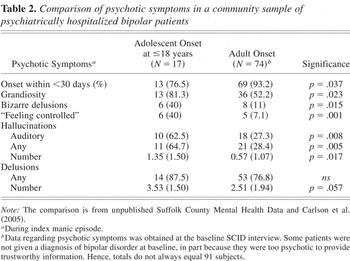
There have been several excellent reviews (Kowatch et al., 2005; Pavuluri, Birmaher, & Naylor, 2005) and articles addressing the symptomatology of early-onset mania (Geller, Zimerman, et al., 2002) and the controversy regarding the validity of a juvenile bipolar diagnosis (Carlson, 2005a). Therefore, this paper takes a different approach. We begin with a brief history of manic depression/bipolar disorder and review the phenomenology of mania in adults. Then, we address several specific issues in children and adolescents. We emphasize bipolar disorder's episodicity, its mood component (elation and irritability), its psychosis, and co-occurring conditions, and developmental phenomena. Where possible, we supplement information from the literature with data from studies available to us. These include data from the Suffolk County Mental Health Project regarding bipolar patients with psychosis following a first hospitalization (Bromet et al., 1992; Carlson, Bromet, Driessens, Mojtabai, & Schwartz, 2002; Carlson, Bromet, & Sievers, 2000; Schwartz et al., 2000), as well as preliminary data from an ongoing study of rages and tantrums. As Bowring and Kovacs (1992) pointed out many years ago, there is no template for juvenile bipolar disorder, no mental representation of how the condition really presents. Given that there is still a paucity of detailed cases in the current literature describing the phenomenology and course of children either with mania, or in whom mania has been considered, we will rely heavily on this material to flesh out the issues. Cases have been selected, with consent of parents, either because considerable detail and follow-up are available or they have been published elsewhere with greater detail (for the more interested reader) but longitudinal information is now available.
Criteria
It is difficult to derive a single definition of bipolar disorder. According to Goodwin and Jamison (1990), “The clinical manifestations of manic depressive illness are exceptionally diverse. Expressed through widely disparate temperaments, its symptoms, course, severity, and amenability to treatment differ from individual to individual” (p. 13). There are several permutations of depression and mania (Angst, Gerber-Werder, Zuberbühler, & Gamma, 2004), not all of which have a label. To address the heterogeneity among bipolar phenotypes, the Diagnostic and Statistical Manual of Mental Disorders (DSM-IV-TR; American Psychiatric Association, 2000) has divided bipolar illness into four subcategories: bipolar I disorder, bipolar II disorder, cyclothymic disorder, and bipolar disorder, not otherwise specified (NOS). Furthermore, each of these categories is accompanied by a variety of specifiers indicating severity and chronicity, seasonal patterns, and rapid cycling. Bipolar I disorder is considered to be the most severe among the bipolar disorders, requiring the presence of at least one manic or mixed episode. Bipolar II disorder is defined by the occurrence of one or more major depressive episodes accompanied by at least one hypomanic episode. Chronic episodes of hypomania and mild depression are the basis of cyclothymia.
Beginning with the DSM-III (American Psychiatric Association, 1980), attempts have been have been made to establish criteria for bipolar disorder that operationalize specific symptoms that occur during the course of depression or mania. When an individual endorses enough of these symptoms, he/she is given the diagnosis of a depressive and/or manic episode. This approach is somewhat different from The International Classification of Diseases (ICD-10; World Health Organisation, 1992), which has relied on pattern recognition to define bipolar disorder. The ICD-10 definition is as follows:
This disorder is characterized by repeated (i.e., at least two) episodes in which the patient's mood and activity levels are significantly disturbed, this disturbance consisting on some occasions of an elevation of mood and increased energy and activity (mania or hypomania), and on others of a lowering of mood and decreased energy and activity (depression). Characteristically, recovery is usually complete between episodes, and the incidence in the two sexes is more nearly equal than in other mood disorders. As patients who suffer only from repeated episodes of mania are comparatively rare, and resemble (in their family history, premorbid personality, age of onset, and long-term prognosis) those who also have at least occasional episodes of depression, such patients are classified as bipolar.
Manic episodes usually begin abruptly and last for between 2 weeks and 4–5 months (median duration about 4 months). Depressions tend to last longer (median length about 6 months), though rarely for more than a year, except in the elderly. Episodes of both kinds often follow stressful life events or other mental trauma, but the presence of such stress is not essential for the diagnosis. The first episode may occur at any age from childhood to old age. The frequency of episodes and the pattern of remissions and relapses are both very variable, though remissions tend to get shorter as time goes on and depressions to become commoner and longer lasting after middle age.
We hypothesize that the differences in DSM and ICD approaches account for a good deal of the controversy regarding the occurrence of bipolar disorder in children. A recent study showed that clinicians and researchers who subscribe to the gestalt approach diagnose bipolar disorder in children at a significantly lower rate than those who rely on symptom counts (Dubicka, Carlson, Harrington, & Vail, 2005).
Dimensions
Kraepelin first proposed the idea that all forms of affective disorder represent different manifestations of “a single morbid process” (Goodwin & Jamison, 1990; Loranger & Levine, 1978; Winokur, Clayton, & Reich, 1969). This concept was largely accepted by psychiatrists during the first half of the century. Indeed, in 1953 Campbell (p. 26) wrote, “It is important to realize that the manic reaction, melancholia, hypomanic reaction, cyclothymic personality, cycloid personality, depressive personality and periodic insanity, are all a part of the same disease process, and that any one of these may change into any other.” More recently, findings from twin and family studies have provided sufficient evidence to support the existence of a manic depressive or bipolar spectrum that includes subsyndromal affective lability, recurrent unipolar depressions, bipolar II disorder, and bipolar I disorder (Gershon, 1990; Goodwin & Jamison, 1990). The underlying assumption of a spectrum model is that what is genetically transmitted is not the disorder itself, but the biologic predisposition to affective disorder (Akiskal, 1996). Strong evidence for this model comes from twin study findings of monozygotic twin pairs in which one twin meets criteria for bipolar illness, while the other is cyclothymic or suffers from unipolar depression (Akiskal, 1986; Bertelsen, Harvald, & Hauge, 1977). Furthermore, first-degree relatives of bipolar probands have been found to exhibit higher rates of both bipolar and unipolar disorders, as well as subclinical levels of mood lability (Mendlewicz, 1988; Winokur et al., 1969).
DSM classification acknowledges the dimensional nature of bipolar illness to some extent by differentiating between hypomania and mania, and between dysthymia and major depression. Moreover, Akiskal (1996) has identified four temperaments, cyclothymic, hyperthymic, irritable, and dysthymic, which are considered to be on a continuum with bipolar disorder. These affective temperaments may be viewed as a milder or subsyndromal variant of bipolar illness, and also as a vulnerability factor for the development of full-blown disorder. Indeed, findings indicate that approximately one-third of individuals who manifest an affective temperament will eventually develop bipolar disorder (Akiskal, Djenderedjian, Rosenthal, & Khani, 1977; Depue et al., 1981). Furthermore, this model hypothesizes a reciprocal relationship between affective temperament and negative life experiences. Early caregiving experiences are thought to interact with constitutional vulnerability, thus making an individual more susceptible to the effects of later negative life events. Negative life events are believed to occur with greater frequency among individuals with temperamental dysregulation. In turn, such life experiences are thought to be responsible for triggering the onset of bipolar disorder (Akiskal, 1996).
The individual symptoms comprising mania (activity level, attention, irritability, hedonic capacity, psychosis) also occur as dimensions. Although a number of observational scales have been used to rate the severity of mania over the past 30 years (Altman, Hedeker, Peterson, & Davis, 1997), for reasons that are not altogether clear, the Young-Mania Rating Scale (Y-MRS; Young, Biggs, Ziegler, & Meyer, 1978) has gained ascendancy and is used in treatment studies. (It is named for the first author, not, as some have thought, because it was developed for young people.) This is somewhat ironic, because it does not cover all of the DSM-IV criteria, combines several concepts (like goal directed hyperactivity, grandiosity, and psychosis) in one rating, and heavily weights irritability and aggression, which are not specific to mania. A hypomania rating scale (Klein, Lewinsohn, & Seeley, 1996) found a normal distribution of hypomanic traits among high school students, although higher ratings were associated with greater impairment.
Recently, it has been proposed that the Child Behavior Checklist (CBCL; Achenbach & Edelbrock, 1981) may be used as a dimensional screening tool for identifying bipolar disorder in children and adolescents. More specifically, several studies have shown that children with a diagnosis of bipolar disorder manifest elevated scores on the Attention Problems, Aggressive Behavior, and Anxious/Depressed subscales of the CBCL, by parent report (Mick, Biederman, Pandina, & Faraone, 2003). Findings from the National Institutes of Mental Health (NIMH) high-risk study (Meyer et al., 2006) showed that this mania “proxy” appears to be sensitive to premorbid symptomatology in youth at risk for bipolar disorder, but was not uniquely predictive of a bipolar outcome in this sample. Rather, as a group, those children who met criteria for the mania “proxy” during childhood and/or adolescence manifested elevated levels of comorbidity at young adult follow-up, with particularly high rates of attention-deficit/hyperactivity disorder (ADHD), anxiety disorders, and cluster B personality disorders.
History
Current descriptions of mania and depression in adults have emerged largely from the vast clinical experience of psychiatrists like Kraepelin, a century ago, recognizing the symptom similarities of hundreds of patients over the course of time. What had been observed for centuries was that many people became depressed; for some, the depression was very severe, and although it went away, it sometimes recurred. Its episodic and autonomous nature distinguished it from situational depressions that were felt to be understandable under the circumstances. Furthermore, some people were observed to have not only periods of depression, but also periods of what seemed to be the opposite. Whereas depression was characterized by sadness, lack of interest, low self-esteem, psychomotor slowing, excessive sleeping and fatigue, the opposite state, mania, was characterized by a euphoric mood, interest in many things, inflated self-esteem, activation, decreased need for sleep, and excessive energy. Both states shared the symptom of irritability. Phenomenologists struggled with the similarities and differences between mania and depression, the fact that symptoms of each could co-occur with the other, and the observation that some people had few episodes with relatively good function in between, while others continuously cycled between mania and depression.
The relationship of psychosis to manic depression was also interesting. Kraepelin's (1921) initial term for the condition we now call “bipolar” was “manic depressive insanity.” DSM-I (American Psychiatric Association, 1952) grouped manic depression under psychotic reactions. Recognition that the states of mania were beyond the experience of most people, and that despite the bizarreness of the behavior the person could return to some semblance of normalcy made the condition unique. Early reports acknowledged the potentially severe and life-threatening nature of mania, as well as the range of psychotic symptoms that often accompanied either mood state (see Carlson & Goodwin, 1973, for a review).
The psychosis of manic depression took a back seat with the discovery of antipsychotic medications and their effectiveness for schizophrenia. Manic depression was gentrified in the 1950s and 1960s, and in DSM-II (American Psychiatric Association, 1968) its name was changed to manic-depressive illness. It took the discovery of lithium, and of the divergent diagnostic practices between the United States and Great Britain (Cooper et al., 1972), to return interest to manic depression and the level of severity subsumed with the condition. Much effort was then expended to characterize psychotic symptoms to determine when they were part of an affective versus a schizophrenic psychosis. Mood congruence and bizarreness were generally felt to be effective separators, with the acknowledgment that mood incongruence and even “first rank symptoms” could occur with affective disorders, especially at their most severe (Carlson & Goodwin, 1973; Taylor & Abrams, 1973). Unfortunately, it took even longer before the clinical community realized that adolescents could develop manic depression, and often, when they did, their psychosis was especially virulent and confusing (Carlson & Strober, 1978a, 1978b). Recognition that manic depression could occur in adolescents did not produce a great deal of acrimony, perhaps because the relatively more favorable outcome compared to schizophrenia made the conclusion palatable.
Our understanding of bipolar disorder in youth began with attempts to find early-onset versions of what Kraepelin appeared to be describing. When child psychiatrists in the 1920s and 1930s examined their patients looking for the same symptoms, they found that the kind of manic depression Kraepelin described did exist but was rare, occurred mostly in adolescents, was mostly depressive, and ran in families. In the 1950s, a series of papers on childhood manic depression was published, and again, the condition was found to be rare (e.g., 6/1000 manic-depressive patients, mostly adolescent, and mostly depressed), although there was some suggestion of an “alternate form” with more typical childhood behavioral psychopathology. A major paper of the day, published in 1960, reviewed the literature looking for strictly defined manic depressive psychosis in preadolescents. The authors found it to be rare in children younger than age 11 (Anthony & Scott, 1960). Subsequent research has supported this view that “classical” manic depression begins to emerge in adolescence especially in later adolescence (see Glovinsky, 2002, for a review).
With the discovery of lithium's effectiveness in lysing and preventing episodes of mania in adults, there was renewed effort to find comparable conditions in children for which the medication would be effective. The earliest studies of lithium in young people were case reports of teens with episodic illness, and there was some evidence that it helped (Annell, 1969). Physicians then began trying it in younger patients and for conditions other than typical mania. A wide net was cast looking for psychopathological conditions, with a positive family history, that might be lithium responsive (Youngerman & Canino, 1978).
Youngerman and Canino (1978) reviewed these early case reports and studies of lithium response in youth. Out of 211 published cases, the authors found 46 reports with enough detail to draw any kind of tentative conclusion. There were 22 cases in children: 2 had manic depression, 2 had an “atypical mood disorder,” 8 were “hyperkinetic,” and 10 were children with autism/childhood schizophrenia. Twenty-four cases in adolescents included 9 with manic depression, 13 with atypical mood disorder, and 2 who were hyperkinetic. Said another way, there were very few studies of children or teens who would be considered bipolar. Response to lithium was poor in those without classic manic depression.
This brief history underscores several observations: (a) classic manic depression appears to be rare in young people; (b) classic manic depression is more rare in children than adolescents; (c) there has been a long-standing interest in trying to find a symptom constellation especially in younger children that would be lithium responsive; and (d) children with behavior problems, even with a positive family history, had such a poor response to lithium that it probably disinclined clinicians to do more studies. Early studies in adults, where samples appeared equally heterogeneous, for whatever reason, had response rates that encouraged not only further investigation, but a whole psychopharmacology revolution. The fact that the response rates were most promising in what is considered classic manic depression may explain why response rates in young people were less encouraging.
Phenomenology of Adult Mania
A review of the phenomenology of bipolar disorder in adults reveals the following: depression is a common mood state of onset and the rate of developing mania depends on one's definition of mania and the length of follow-up (see Angst et al., 2004; DelBello et al., 2003, for a review). Within a manic episode, elation, extreme irritability and combativeness, and mood lability, including depression and crying, are frequently seen (Carlson & Goodwin, 1973; Goodwin & Jamison, 1990, p. 34). Mania usually has an acute onset, that is, over the course of a month. More than half of individuals with acute mania experience psychotic symptoms, with grandiosity and paranoia being the most common (Goodwin & Jamison, 1990, p. 34).
Most patients with bipolar disorder experience multiple episodes. About 20% function well between episodes, about 20% remain chronically ill with either depressive or irritable/hypomanic symptoms, and the remainder have some interepisode symptoms and functional impairment (Angst & Sellaro, 2000; Goodwin & Jamison, in press).
The following case provides an illustration of classic adult mania.
TONY had his first episode of bipolar depression at age 18 as a high school senior. At the time, it was felt that Tony was having an “identity crisis.” Subsequently, he went to college, became involved with drugs, and had what was probably a manic episode associated with polysubstance abuse. At age 28, he experienced another episode of psychotic mania not associated with drugs. His psychiatrist treated him with chlorpromazine and referred him to the NIMH to take part in a lithium study. The following account of Tony's manic symptomatology was abstracted from daily nursing notes (Carlson & Goodwin, 1973). There was no medication intervention due to the nature of the research study. Two complete episodes were documented during the admission, each of which was about 3 weeks. Here is a description of the first episode.
Over the first 3 days of his manic episode, Tony was described as anxious, speaking rapidly, flitting from one subject to another, and frequently changing clothes. He was often grandiose, stating “I think I'm something great and it scares me!” He wanted to grow a “Christ-like beard because I feel so faultless.” Sometimes he thought he was Jesus. His elated mood was seen in his comedic behavior. Hypersexuality emerged in several ways. On the one hand, Tony perseverated on his sexual identity. On the other hand, he would get agitated and say “All these women are driving me out of my mind!” As his mania accelerated, he talked incessantly, became angry and irritable, was easily overstimulated, and said “I have thoughts faster than I can think.”
Over the ensuing week, he became increasingly psychotic (“I see myself as a prophet”). He had visual hallucinations of being home and became scared when he realized he was hallucinating. He worried about phones being bugged, was afraid a dental X-ray would destroy his brain, and thought God was talking to him through a light bulb in the nurses station. He was described as irritable, verbose, intrusive, suspicious, demanding, verbally abusive, and manipulative. On occasion he was assaultive.
At his most symptomatic, Tony was confused, hallucinating, talking incoherently, screaming, throwing food, and hyperactive to the point of exhaustion. He was sent to the quiet room on several occasions. As the episode began to subside, he remained silly and bizarre, angry and agitated, distracted, still up all night, with some hallucinations and grandiose delusions. He gradually became less symptomatic, and 21 days after the episode had begun, it petered out without any medication.
Tony remained euthymic for the next 2 weeks, but subsequently experienced an increase in hypomanic symptoms, including elated mood, dysregulated sleep, and increased interest in sex. Recalling his previous psychosis, he was lucid enough to say, “I don't want to be Jesus Christ again.” Lithium carbonate was started at that point, and although it did not prevent the episode, it probably curbed the severity somewhat and shortened the course.
From a cross-sectional and longitudinal perspective, very few experts would contest that Tony suffers from the type of manic depression, which has been described since the time of Kraepelin. Most notably, his manic episodes had a clear episodic course, during which he experienced acute symptoms of anxiety, irritability, psychotic grandiosity, elation, and lability. These symptoms were unquestionably a marked deviation from his usual self.
Diagnostic Issues in Children and Adolescents
Introduction
Currently, the process of diagnosing bipolar disorder in children requires application of the adult criteria to this age group. For a variety of reasons, this is an exceedingly difficult task requiring very careful interviewing techniques, not just the blind application of criteria. Several modifications to the definition of mania have been proposed to fit the profile of emotion dysregulation commonly seen in young people. As such, bipolar disorder in youth has been described as having a chronic course, characterized by emotional and behavioral dysregulation with pronounced irritability, episodes lasting hours rather than days, and high rates of comorbid symptomatology. The question is whether these modified diagnostic criteria are identifying children with the same manic depressive illness that has been well documented in adults for the last century. Will these children grow up to manifest clear episodes of mania and depression? At what age does one start to see presentations similar to Tony's, and for the children who meet altered criteria for mania, will there be continuity with “classic” manic depression? Although these children present with similar symptom constellations cross-sectionally, it is likely that they represent a heterogeneous group with differing biological and environmental underpinnings, none of which are well understood. Based on a review of recent findings, we would surmise that, although some of these children may ultimately merit a diagnosis of “classic” bipolar illness, others may be on a pathway to chronic depression (Leibenluft, Cohen, Gorrindo, Brook, & Pine, in press), antisocial personality with mood symptoms (Carlson, Loney, et al., 1998), and/or borderline personality disorder (MacKinnon & Pies, 2006).
Assessment source
Assessing mood symptoms in children is a complex undertaking. For instance, from whom does one elicit the information? In adults, during the course of an acute manic episode, elation and grandiosity are either readily apparent, can be clarified by another observer who is able to describe symptoms clearly, or can be elicited from the subject. However, in children, parent/child concordance for manic symptoms appears to be poor (Thuppal, Carlson, Sprafkin, & Gadow, 2002; Tillman et al., 2004; Youngstrom et al., 2005). Researchers generally accept parental report, or combine all positive symptom endorsements to make a diagnosis. However, the validity of these approaches has not been established. Parents of children with attention problems not uncommonly note symptoms that are considered to be on the bipolar spectrum even when the child does not have bipolar disorder (Whalen et al., 2006). Carlson and Youngstrom (2003) found that, of 108 children psychiatrically hospitalized with a serious externalizing disorder, 55% had parents who said that their child met criteria for mania. Once hospitalized, a trained rater confirmed a diagnosis of mania using the Y-MRS in only one-third of these children, and this was for psychiatrically hospitalized children whose egregious behavior warranted an inpatient stay! Nor were manic symptoms seen for the duration of stay, which often lasted several months. Reasons for this disparity require further research.
Teachers have not traditionally been a source of information on mood symptoms. However, because manic behaviors are observable, teachers should be able to provide important information. Like attention problems, manic symptoms should be apparent in more than one setting. In the study described above (Carlson & Youngstrom, 2003), the best confirmation of bipolar disorder was parent/teacher agreement prior to the child's hospitalization.
Episodes
ICD-10's “pattern recognition” approach relies heavily on the concept of well-delineated episodes of mania and depression. The DSM (American Psychiatric Association, 2000) has operationalized mania as a “distinct period” of specific and co-occurring symptoms. In both definitions, this period must last long enough to be clearly different from a person's “usual self” so that we know that a manic/hypomanic episode is occurring, and long enough so one can be sure that it is “distinct” and not part of the general vicissitudes of his/her other problems. In children with chronic mood dysregulation, it may be difficult to identify a usual self. Moreover, determining onset of mania in a young child poses some difficulty, because many previously “easy” children develop more tempestuous “terrible 2s.” In addition, children who start school and run into social and academic difficulties often develop behavior problems that resemble modified criteria for a manic episode.
The difficulties in defining episodes in children have led to several efforts at operationalizing this concept for young populations. Leibenluft, Charney, Towbin, Bhangoo, and Pine (2003) have proposed four subtypes of early-onset bipolar disorder, each of which is characterized by a different criterion for episode duration. The “narrow” phenotype requires that patients meet strict DSM-IV duration criteria for mania or hypomania. This is also true for the “irritable (hypo)mania” intermediate phenotype. The “(hypo)mania NOS” intermediate phenotype is characterized by shorter episodes (1–3 days), and the “broad” phenotype represents children who manifest chronic irritability and hyperarousal (insomnia, agitation, distractibility, racing thoughts/flight of ideas, pressured speech, intrusiveness).
In a recent follow-up study of children diagnosed with bipolar disorder NOS, Birmaher et al. (2006) defined an episode as lasting “a minimum of 4 hours within a 24-hr period, and at least 4 cumulative lifetime days.” At a 2-year follow-up, they found that 20% of their sample had “upgraded” to longer episode duration.
Cardinal symptoms: Elation
Besides episodicity, elation and grandiosity should, by definition, distinguish mania from other forms of psychopathology and developmental phenomena. However, many have observed that these symptoms are rare in pediatric bipolar samples (Biederman, Russell, Soriano, Wozniak, & Faraone, 1998; Mick, Spencer, Wozniak, & Biederman, 2005; Wozniak et al., 2005), and theorize that irritability (rather than elation), especially the “super irritability” seen in extremely explosive children, is part of the developmental phenotype of very early onset bipolar disorder.
Others insist that, to merit a diagnosis of bipolar disorder, a child must exhibit euphoria and/or grandiosity (Geller, Craney, et al., 2002; Leibenluft et al., 2003). In our experience, euphoria, in contrast to silly, disinhibited behavior, is rarely observable in children in an office setting. Even on our inpatient unit where we have observed children over days and weeks, true euphoria is quite rare. Asking the patient, in this case a child, does not necessarily provide help because the concept of euphoria may be foreign to the youngster. Adults are more likely to have experience with euphoria, possibly as a result of getting high on drugs or alcohol. Children are asked about circumstances that made the child “super happy” and then if that has occurred outside of that context. This calls for a level of abstraction absent in many children, some adolescents, and even some parents.
The second issue is whether what children and parents identify as elation IS elation. For instance, 8-year-old Didi had had classic ADHD symptoms since preschool. She was a bossy chatterbox who liked to kibbitz, much to her classmates' dismay. Mother (but not teacher) said that Didi could be overly cheerful sometimes. Didi herself said she “feels silly for half the day.” She emphasized that silly is “more than happy, it is joking.” Funny things led her to become silly. She felt especially silly at recess, art, and drama but not math. When she has to work, she said that she still “feels” silly but does not “act” silly. Didi even said that she was feeling silly during the interview, but she did not appear “silly,” although she was certainly vivacious and exuberant. If euphoria is driving Didi's silly behavior, or if her silliness IS a manifestation of elation, she would get a “euphoria” designation. In contrast, her silliness may be how she feels in overstimulating situations and have nothing to do with euphoria.
Didi's other mood symptom was explosiveness. In this case, Didi, her mother, and teacher agreed that she had a very short fuse, and she had gotten a number of detentions for her explosive behavior. Irritable, explosive behavior has the advantage of being observable and less dependent on the accurate description of an internal state.
Didi's silliness and irritability were less compelling than the mood symptoms described in Tony's narrative. Nevertheless, her exuberant behavior, parental endorsement of manic symptoms, and family history of bipolar disorder in a second-degree relative had gotten her several courses of mood-stabilizing medication, as clinicians feared stimulants would make her manic. However, the absence of episodes, grandiosity, decreased NEED for sleep, goal-directed hyperactivity, and absence of teacher validation for anything but ADHD symptoms suggested a greater likelihood of ADHD. Didi, as it turned out, like children with the CBCL mania, “proxy” in the Multimodal Treatment Study of Children with ADHD (MTA; Galanter et al., 2003, 2005) responded very well to a long-acting stimulant. In fact, although there is an expert consensus for treating mania first when it co-occurs with ADHD (Kowatch et al., 2005), children like Didi underscore the importance of using stimulants if diagnosis is uncertain. Under those circumstances, discussion of possible worsening should take place with parents, although even that does not establish a mania diagnosis (Carlson & Mick, 2003).
In summary, there is evidence that what adults perceive as euphoric and silly behavior is not uncommon in younger children (Carlson, 2005a) and in children with conditions other than bipolar disorder. This should not be surprising. The same has been true for depression. However, understanding the normative range of elation in children, especially young children, will require further research. Although reliability can be achieved regarding elation/euphoria within research settings, cross-institutional and cross-national studies of this symptom would likely reveal considerable differences in interpretation.
Cardinal symptoms: Grandiosity
Three levels of misunderstanding can occur with grandiosity. The first occurs because children may be unable to accurately self-evaluate and distinguish between pretend and reality. Surprisingly, this is not necessarily age related, that is, in one study of children's understanding of magical beings, 5-year-olds appeared more believing than 3-year-olds (Woolley, Boerger, & Markman, 2004). Similarly, emotionally disturbed and learning disabled children exhibited decreased ability to distinguish between reality and fantasy in cartoons (Sprafkin, Kelly, & Gadow, 1987). Although these findings do not directly refute children's capacity to accurately appraise their own ability, it certainly suggests that one cannot assume a child's endorsement of grandiosity out of hand.
Another source of misunderstanding comes from misinterpreting the question (Breslau, 1987; Kessler, Rubinow, Holmes, Abelson, & Zhao, 1997). Moreover, although children with attention problems should not be grandiose, an artificially inflated self-regard (Hoza, Pelham, Dobbs, Owens, & Pillow, 2002) could be interpreted by some as grandiosity. That is, a child who says he is the most popular child in the class but has never had an invitation to a birthday party, or says he can build things better than anyone despite evidence to the contrary, or that he is planning on going to college despite having failed every course in high school for the past 2 years, could be interpreted as having an inflated self-esteem. Sometimes such assertions are defensive (i.e., s/he knows full well s/he has no friends, or has poor motor skills, but does not want to admit it), and sometimes a result of poor social awareness. For instance, BORIS, age 11, had been hyperactive, hyperverbal, impulsive, and irritable since toddlerhood. He described himself as an inventor, but rarely started, let alone finished projects. He also said he was very popular. His mother said he acted silly, and described Boris slamming himself into a tree and falling down, cartoon style, hoping some neighborhood boys would notice him, laugh, and ask him to play. This was not elation driven. It was not surprising that the other children shunned Boris completely, something that he could not admit.
Finally, it is also possible that what an adult thinks is grandiose is, in fact, occurring, but may be primarily driven by environmental, rather than endogenous, factors. This is illustrated in the case of George.
GEORGE (Carlson & Fahim, 1998) was a 6-year-old, second grade student, with a history of ADHD, who presented to the psychiatric emergency room multiple times over several months, for escalating “manic” behavior. He was psychiatrically hospitalized briefly a number of times over a 9-week period and tried on a variety of mood stabilizers and stimulants with little success. George's mother reported that, besides being irritable and explosive, George could be very silly at times, did not seem to need sleep, was sexually preoccupied, and grandiose insofar as he thought he should be able to do anything a grown-up should do (including have sex).
During his final hospitalization, George appeared grandiose, leaping around the room “Superman-like,” saying that he could do whatever he wanted, that he was the boss of all the grown-ups. He tried to have sex with another patient. He was highly distractible, irritable, and oppositional in the inpatient school. He was explosive when he did not get his way. The apparent onset was in second grade. For all intents and purposes, George sounded like a child with mania.
On closer inspection, however, George's difficult behavior began after his father had been sent to jail, the family had moved, and George was moved out of his special education class by his new district. He was being teased unmercifully by peers because of severe reading delays. In addition, his mother, without her husband's back up, was incapable of setting limits with George and he was, in fact, the “boss of the grown-ups” in his house.
In hospital with consistent limits, George's grandiosity and sleep difficulties quickly dissipated. Finally, George's explicit knowledge and interest in sex came from long hours watching X-rated videotapes, used by his mother as a way to keep George quiet. Ultimately, George was found to meet criteria for ADHD, responded to stimulants, a small classroom setting, and was placed out of home with a relative. There were no further hospitalizations or emergency room visits, and follow-up 5 years later revealed a youngster with continuing academic and social difficulties but no evidence of mood disorder.
The foregoing cases illustrate several important points: (a) the decision of what constitutes elation and grandiosity in children, especially young children, is not always clear. The spectrum nature of mood states means that the distributions of such feelings need to be understood at different ages and among children with different disorders. (b) Gathering input from multiple sources of information is critical for making a diagnosis of bipolar disorder in youth. The frequency of diagnosis of bipolar disorder will be much higher if one accepts any report versus a convergence of reports on the presence of manic behavior. (c) It is our belief that symptom context matters. Superficial “counting” of symptoms led clinicians to treat “George” uselessly with mood stabilizers. His lack of response did not indicate treatment refractoriness. It indicated the wrong diagnosis.
A case of “true” grandiosity
In our experience, true psychotic grandiosity is rare in children but it does occur.
DARREN was referred initially for psychiatric evaluation at age 5 for severely hyperactive, raging and disinhibited behavior since age 2. At age 5, Darren thought that he could swim across the ocean, because “I am a very good swimmer.” He said that sometimes “voices in his head” told him to do “bad things, like hit people.” Parents declined medication treatment and he was seen next at age 7 for continuing explosive, hyperactive behavior. On mental status exam, he no longer felt that he could swim across the ocean. “Only little kids think that!” he said. Treatment with risperidone for the next 18 months helped some until his 30-lb weight gain caused his parents to stop treatment.
At age 8.5 years, off medication, Darren's explosions were so bad they that he required restraint by several adults. He was preoccupied with dogs and tried to kidnap his neighbor's dog.
Darren was treated with ziprasadone to mitigate weight gain. He then started having nightmares about insects and vampires, was afraid to sleep in his room, refused to do schoolwork, and increasingly felt that people were out to get him. His rages would last up to 1.5 hr. He required hospitalization.
During hospitalization, Darren talked incessantly, asked repetitive questions, would start giggling for no apparent reason or bark uncontrollably. Peers avoided him, describing him as “weird” and “scary,” although with adults, he could be very engaging. He required numerous “time outs” and trips to the quiet room to help with self-control and noncompliant behavior.
Darren had true grandiose delusions. He told us that he controlled the way the waves came into shore (he lived near the beach). “I get my power from the moon.” “I have pent up energy.” “I cannot control my own strength.” He said that he possessed special “dog powers” including an “extraordinary” hearing ability. He also said that he had qualities of a fish (e.g., holes in his skin, similar to a fish having gills) that allowed him to breath under water.
On formal mental status, Darren was disinhibited, doing somersaults in his hospital room. He talked constantly, shifting from topic to topic, first talking about “special powers,” then about how much he “loves fire trucks.” Darren's mood varied from “happy” to “very scared.” When happy, he stated “I am smarter than most kids, I have a great grasp of the world of science, and I have special powers that other kids do not possess.” “I have too much energy inside me.” However, when sad, he stated “It is not safe to go home; there are bugs in my room and only the hospital is safe, because there are people constantly around to watch me all day long, and the unit is locked all the time.”
Darren was clearly grandiose. His delusions began quite abruptly. Interestingly, what had not been elicited in on structured interview, or previous psychiatric evaluations, was Darren's early history of an autism spectrum disorder (language delay, initial echolalia, then pragmatic language problems, perseveration on things like maps, animals, and bones of the body, severe tantrums with change, and disinterest in peers). His psychotic symptoms followed on the heels of autistic behaviors, vocal and motor tics, hyperactivity, language disorder, and oppositionality that had been present since infancy. At cross-sectional evaluation, Darren manifested symptoms and behaviors that were consistent with mania and Tourette disorder. In the absence of a developmental perspective, and without the history of autistic-like behaviors, adult psychiatrists thought that he had schizoaffective disorder.
Of interest, Darren's manic symptoms largely disappeared as soon as his ziprasadone was stopped. Indeed, ziprasadone-induced activation has previously been reported (Rachid, Bertschy, Bondolfi, & Aubry, 2004). In fact, children with pervasive developmental disorders may be especially sensitive to such adverse events (Carlson, 2005b). Darren's grandiose delusions were extensions of his autistic-like perseverations, and/or his concrete interpretations of what people had told him. For instance, he was told that he could “swim like a fish,” so he figured he could swim across the ocean. He had hyperacusis and likened himself to a dog with good hearing. His barking tic reinforced his dog interests. Trials of divalproex and lithium and other antipsychotics either did nothing or produced unacceptable side effects. He has been most stable on a combination of methylphenidate and clonidine, a treatment regimen for Tourette disorder not mania. Darren had a drug-induced mania, but the implications for future bipolarity are not yet clear.
Other developmental issues
Strikingly absent from studies of preschool and childhood mania/bipolar disorder is any reference to the influence of children's motor, language, educational development, and traumatic stress. When compared to adults with schizophrenia, individuals with bipolar disorder have not been found to have premorbid abnormalities in motor, language, or cognition (see Murray et al., 2004, for a review; Zammit et al., 2004). In contrast, a number of investigators have documented that early-onset affective disorders are associated with delayed motor milestones, speech impairment, reduced psychomotor functioning, and low educational scores (van Os, Jones, Lewis, Wadsworth, & Murray, 1997). In an examination of early- versus late-onset bipolar disorder, Sigurdsson, Fombonne, Sayal, and Checkley (1999) reported that early-onset cases, particularly those with psychotic symptoms, were significantly more likely to have experienced delayed language, social, or motor development. A recent study by Dekker, Koot, van der Ende, and Verhulst (2002) showed that children whose intelligence scores fell within the range of mild mental retardation to borderline intellectual functioning were more likely to have elevated scores on the CBCL subscales (parent and teacher report), which have been associated with mania (i.e., mania “proxy”; see Mick et al., 2003, for a review), suggesting that affective aggression and inattention may occur more often in children with developmental disabilities, but do not necessarily indicate the presence of a bipolar diagnosis.
The importance of recognizing these developmental deviations and delays are twofold: (a) treatment planning for such children should encompass a variety of interventions, not just interventions for mood; (b) imaging and neurocognitive investigations need to control for such abnormalities to understand whether the changes found are due a subtype of bipolar disorder, what used to be called “organic affective disorder” in DSM-III and DMS-III-R, for example, or to underlying developmental delays independent of bipolar disorder.
Comorbidity
Before tackling the question of comorbidity in child and adolescent bipolar samples, a brief discussion of comorbidity is necessary. As has been noted throughout the literature, in child clinical samples, comorbidity is the rule rather than the exception. This is particularly true for children diagnosed with early-onset mania, nearly all of whom meet criteria for a variety of externalizing phenomena (Carlson & Kelly, 1998). It has been argued that such high rates of comorbidity may be due to symptom overlap with other diagnoses of childhood. Alternatively, elevated comorbidity rates may be the result of narrowing diagnostic criteria for childhood-onset psychopathology, which has led to the need for more labels to describe the complex phenomena commonly seen in children.
Modern psychiatry increasingly uses comorbidity labels as a way of identifying homogeneous subgroups. For instance, a child who presents with symptoms of severe emotional dysregulation as well as features of a pervasive developmental disorder might be described as having comorbid pervasive developmental disorder (PDD) plus bipolar disorder. This differentiates him from a child with severe emotion regulation without autistic features, or a child with a diagnosis of PDD with ADHD and bipolar disorder. One would assume that these three children would likely have very different developmental histories, treatment responses, and course of illness. From a longitudinal perspective, these children might be said to be on three different developmental pathways.
Angold, Costello, and Erkanli (1999) have described comorbidity in terms of “homotypic” (i.e., different aspects of the same condition, such as dysthymia and major depression), “heterotypic” (close relationships between different disorders, such as depression and conduct disorder), “concurrent” (those conditions that are occurring at the same time), and “successive” (one disorder follows the onset of another, with no temporal overlap). Bipolar disorder can be diagnosed when the person is euthymic, and at that point may have other psychiatric conditions. In addition, each mood phase may have specific comorbidities.
Rates of “no comorbidity”
One way to examine comorbidity is, in fact, to examine rates of no comorbidity. This is inconsistently cited, however, in part because studies report rates of each diagnosis within the sample rather than within the subject (e.g., Dickstein et al., 2005; Faraone et al., 1997; Tillman et al., 2003). In comparison with adult clinical studies, rates of no comorbidity in child samples appear to be low (Findling et al., 2001; Kovacs & Pollock, 1995) to probably absent (Dickstein et al., 2005; Faraone, Glatt, & Tsuang, 2003; Geller, Zimerman, et al., 2002) to definitely absent (Carlson & Kelly, 1998). Therefore, there have been no studies comparing children with uncomplicated bipolar disorder versus those with complicated bipolar disorder, because the former do not exist or do not exist in sufficient numbers.
In contrast to prepubertal samples, adolescent onset samples have a higher prevalence of no comorbidity. Kutcher, Robertson, and Bird (1998) reported that 60% of previously hospitalized adolescents with bipolar I disorder had no psychiatric comorbidity. Kafantaris, Coletti, Dicker, Padula, and Kane (2003) found a no comorbidity rate of 28% in a sample of 100 hospitalized bipolar I teens. Finally, Srinath, Janardhan Reddy, Girimaji, Seshadri, and Subbakrishna (1998) and Janardhan Reddy and Srinath (2000) found a very low rate of comorbidity in an adolescent bipolar sample in India, with only two patients meeting criteria for a comorbid condition (in both cases conduct disorder).
Rates of comorbidity in community samples appear to be higher than in clinical samples, suggesting an ascertainment artifact. In the National Comorbidity Survey (Kessler et al., 1997), 100% of individuals who met criteria for bipolar I had a lifetime comorbidity, and 95.5% had three comorbidities. Rates of anxiety disorder were highest (92.9%), followed by substance abuse (71.0%) and conduct disorder (59.4%). The Epidemiologic Catchment Area studies found rates of conduct disorder to be higher in bipolar subjects under age 30 (32.6%) versus those aged 30 or older (16.3%, p < .05; Carlson, Bromet, & Jandorf, 1998). In the epidemiologic studies that have addressed bipolar disorder in youth (Carlson & Kashani, 1988; Lewinsohn, Klein, & Seeley, 1995), rates of lifetime mania (vs. hypomania or cyclothymia) were either low or absent, so comorbidity could not be addressed. However, high rates of comorbidity were detected among children with severe emotional lability.
Comorbidity with ADHD
Simultaneous comorbidity
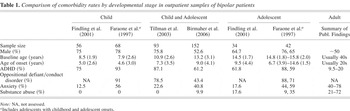
As can be seen in Table 1, male gender and rates of ADHD/externalizing disorder decrease with age of bipolar onset. The latter, when looked for in adults, range from 10 to 20% (Carlson, Loney, et al., 2000; Nierenberg et al., 2005; Sachs, Baldassano, Truman, & Guille, 2000). It remains unclear whether children with comorbid ADHD and bipolar disorder diagnoses are on a trajectory similar to children with mood disorders or those with externalizing diagnoses. On the one hand, Shaw, Lacourse, and Nagin (2005) found that the most hyperactive preschoolers were likely to remain chronically hyperactive through age 10, with 19% of these children continuing to manifest “overt conduct problems” (i.e., aggressive behavior) suggesting an externalizing pathway. Others would label these children with severe hyperactivity, fearlessness, and overt conduct problems as having bipolar disorder with comorbid ADHD (Biederman, Faraone, Chu, & Wozniak, 1999; Faraone, 2000; Geller, Craney, et al., 2002), which, similar to Shaw, Lacourse, and Nagin's (2005) findings, has proven to be a chronic, disabling condition (Biederman et al., 2004; Geller et al., 2004).
Comparison of comorbidity rates by developmental stage in outpatient samples of bipolar patients

The question of whether manic children might be nested in a population of youth with attention problems is not new, and was originally raised in a systematic way by Greenhill, Rieder, Wender, Buchsbaum, and Zhan (1973) when they undertook a trial of lithium in youngsters with what was then called hyperkinesis. The article described nine children (some of whom quite likely would have been called “juvenile manics” because of their giddiness, severe disruptiveness, and garrulousness) who had been poor dextroamphetamine responders. Treated with lithium and placebo in a double-blind, on–off fashion, only two children had short-term positive responses, specifically with an improvement in activity level, destructiveness, and uncooperativeness. Within a few months, however, these responses dissipated.
Differentiating between ADHD and/or mania is complicated by several features unique to children. First, in people of all ages, but particularly in those in whom no prior episodes have occurred, distinguishing between true comorbidity versus the early symptoms of mania or depression may be difficult. In schizophrenia, we know that many children have behavior and attention problems prior to the onset of even prodromal symptoms, let alone psychotic symptoms (Cornblatt, Obuchowski, Roberts, Pollack, & Erlenmeyer-Kimling, 1999; Erlenmeyer-Kimling et al., 2000; Meyer et al., 2005). At this state of our knowledge, we simply cannot say whether one condition evolved into the other, or was the same condition all along. The same conundrum occurs with bipolar disorder. If the onset is acute, with most of the signs and symptoms occurring simultaneously, it is possible to distinguish the episode from its comorbidity. If the onset is gradual, and if there is disagreement about how to interpret the symptoms, disentangling the condition from the comorbidities becomes extremely difficult. Cross-sectionally, both a child, especially a young child with ADHD, and an adult with acute mania will be hyperactive, hyperverbal, intrusive, volatile, disinhibited, and distractible. This is the symptom overlap issue that has been addressed by others (Geller, Zimerman, et al., 2002; Milberger, Biederman, Faraone, Murphy, & Tsuang, 1995).
Rarely addressed when comparing children with attention problems to children with bipolar disorder is that attentional difficulties come in all levels of severity, and itself is often complicated by the presence of other comorbidities. It is misleading to compare a manic child with ADHD (and the usual three other comorbidities) to a child with uncomplicated ADHD. Rather, one must control for the number and severity of comorbid symptoms, especially the level of complicating impulsive aggression, in order to see what is accounted for by mania. Carlson, Loney, Salisbury, and Volpe (1998) completed such a study, and found that, when controlling for externalizing features, only symptoms of depression and anxiety distinguished children with mania from those who had been diagnosed with ADHD. It is the combination of ADHD and conduct/oppositional defiant disorder that is associated with negative affect/irritability and from which juvenile mania needs to be distinguished (Cukrowicz, Taylor, Schatschneider, & Iacono, 2006).
Finally, symptoms of ADHD occur in a number of conditions which themselves may be confused with mania or exist with it. The rules of DSM preclude the diagnosis of ADHD if there is “pervasive developmental disorder, schizophrenia, or other psychotic disorder,” because ADHD-like symptoms often occur in those conditions. That means that when assessing a child who is exhibiting significant symptoms of hyperactivity, impulsivity, and inattention, one must rule out, or at least consider, PDD, schizophrenia, and other psychotic disorders.
The diagnostic explanation for Darren's behavior gets to the heart of comorbidity. He certainly “met criteria” for ADHD very early in his life. However, there were other developmental issues that suggested, at least initially, that another condition, autism, was accounting for his behavior. With time, and better language skills, more symptoms emerged or were articulated that were suggestive of mania. At 8 years old, Darren's symptoms and condition are still evolving. He appeared to develop a manic reaction to medication (called substance induced mania), which many feel is a predictor of bipolar disorder (Ghaemi, Hsu, Soldani, & Goodwin, 2003), but which, in fact, may be an artifact of medication effect on an immature brain (Carlson & Mick, 2003; Safer & Zito, 2006).
Successive (true) comorbidity
Attention problems and mania can be confused with each other, may be accounted for by other diagnoses, and can clearly co-occur. The following case provides an illustration of childhood ADHD, followed by a manic episode in young adulthood, both of which were likely impacted by significant life stress throughout development.
JILL's parents divorced when she was 15 months old. Her father had “mood swings” and his brother was taking lithium. Jill's mother had multiple boyfriends who often beat her while Jill watched. Jill felt that her mother was demanding and her mother described Jill as disruptive, nonconforming, and aggressive. Both were in and out of therapy.
When asked as an adult, Jill recalled that, starting from age 7, she had many ADHD symptoms as a child (made careless mistakes in her school work, did not complete her homework assignments, had trouble obeying, felt restless, lost things, was forgetful, distractible, disorganized, easily frustrated, and avoided work that required mental effort). By her own account, she became sexually promiscuous and drug involved at age 13. She cut school, was suspended multiple times, had to repeat eighth and ninth grades due to behavioral problems, was sent to two different group homes, and was arrested at age 14 (for drug possession). When she turned 16, she dropped out of school.
Jill, who worked as a topless dancer, met her husband and got pregnant at age 17. One month postpartum, over the course of 1 week, Jill became manic. She “started feeling really good, danced around a lot, said she could dance better than anyone else. She was talking constantly, rambling, saying the devil was in her, that she was a movie star.” She was sleeping only 5 hr a night. She also thought the devil was in her baby, that she was chosen to change the world and stop pornography. Jill interpreted radio broadcasts as telling people not to eat meat. She said that “if people didn't eat meat, there would be no sacrifice on earth and everyone would be happy.”
Jill was ultimately hospitalized for 4 months (this was 15 years ago). Her manic episode was characterized not only by psychosis but also what her chart called “temper tantrums.” On structured interview, done while she was hospitalized, Jill was coded as having elated mood, inflated self-esteem, decreased need for sleep, flight of ideas, rapid speech, and referential, religious and grandiose delusions. There were no hallucinations or “first rank symptoms.” Jill became depressed for 2 months shortly after hospital discharge. Her symptoms included no interest in anything including sex, lack of energy, inability to concentrate and weight gain. From the standpoint of bipolar phenomenology, Jill's history is quite typical.
In the follow-up course, over the next 10 years, Jill never had another episode of mania. Like many adults with untreated attention problems (Barkley, Fischer, Edelbrock, & Smallish, 1990; Mannuzza & Klein, 2000), she never sustained a job, was intermittently homeless, lost/gave up custody of her child, continued to abuse alcohol and drugs (cocaine and marijuana), and remained in an abusive relationship with her husband. She was treated mainly with depot neuroleptics because she was unreliable about taking medication. At 10-year follow-up, she was described as euthymic, coherent, had no evidence of psychosis, but did report residual symptoms of ADHD and irritability, and felt that these behaviors interfered with her family and work relationships, and especially with driving a car.
This case illustrates two points. The first is that clear-cut mania can be superimposed on ADHD. The second is that had a good childhood history not been obtained, Jill's chronic poor interpersonal, occupational, and cognitive functioning, as well as her substance abuse, would have been considered “scars” of bipolar disorder. Given the fact that she spent at most 6 months over her lifetime with a diagnosable mania or depression, it is much more likely that her poor outcome results from untreated ADHD and the scars of domestic turmoil.
Comorbidity with anxiety
Depression and anxiety are well-known comorbidities, so it should not be surprising that anxiety disorders and bipolar disorder co-occur with greater frequency than would be expected by chance in community studies (Kessler et al., 1997; Kessler, Stang, Wittchen, Stein, & Walters, 1999), outpatient studies (Boylan et al., 2004), and inpatient studies (Bauer et al., 2005). There is not much consistency about which subtypes of anxiety disorders are most frequent, and there is likely a high rate of comorbidity between subtypes of anxiety disorder. Where it has been investigated, the presence of anxiety disorder symptoms during episodes of either depression or mania is associated with higher rates of rapid cycling (Bauer et al., 2005; Boylan et al., 2004; McElroy et al., 2001), greater treatment resistance (Feske et al., 2000; Gaudiano & Miller, 2005), poorer functional outcome (Bauer et al., 2005; Boylan et al., 2004; Simon et al., 2004), and higher risk for suicidal behavior (Bauer et al., 2005; Chen & Dilsaver, 1995; Simon et al., 2004).
The temporal relation of anxiety disorder and onset of bipolar disorder may vary by anxiety subtype. In a study by Perugi, Akiskal, Toni, Simonini, and Gemignani (2001), social phobia and obsessive–compulsive were more likely to antedate bipolar disorder, whereas panic disorder more often began concurrent with a first episode of mania/hypomania in contrast to the other anxiety disorders. One of the most consistent findings, however, has been a high prevalence of posttraumatic stress disorder (PTSD), occurring at rates of 7 to 28% in outpatient and inpatient samples (Bauer et al., 2005; Kolodziej et al., 2005; Leverich et al., 2002; Marchand, Wirth, & Simon, 2005; McElroy et al., 2001), and 39% in epidemiologic studies (Kessler et al., 1997). This comorbidity predicts a significantly poorer course of illness and functional outcome (Bauer et al., 2005; Leverich et al., 2002; Neria, Bromet, Carlson, & Naz, 2005).
Prevalence estimates of comorbid anxiety disorders vary widely in child bipolar studies as well. Dickstein et al. (2005) found that 77% of children who met “narrow” criteria for bipolar I or II disorder had at least one comorbid anxiety disorder. Findling and colleagues (2001) reported significantly lower rates (12.5%) among children who met strict criteria for bipolar I disorder, but anxiety symptoms were only considered if they persisted during periods of euthymia. As with adults, comorbid anxiety among youth with bipolar disorder is associated with greater functional impairment (Dickstein et al., 2005), and where studied, usually precedes the onset of the bipolar disorder (Dickstein et al., 2005; Masi et al., 2001; Tillman et al., 2003).
It is important to recognize that most studies utilize retrospective data elicited during a structured interview, which makes it difficult to get an accurate and “textured” picture of how these co-occurring conditions actually evolve. One may get an artificial sense of this evolution if one follows the “rules,” and only counts onset by when the full disorder is present. This is illustrated in the case of Eve, an 18-year-old who had been out of school since 10th grade on home instruction. Results of a structured interview indicated that she had a history of drug abuse, which was followed by the onset of social phobia, then depression. However, a more detailed inquiry into her history revealed that she had suffered from separation anxiety at age 3, and had developed symptoms of social phobia (but not enough to meet criteria) and probable ADHD-inattentive type, in elementary school, but coped with them. Once she got to middle school, she stopped coping, turned to drugs, and finally met full-blown criteria for social phobia and agoraphobia. When she reached menarche, she started experiencing brief hypomanic spells before her menses, as well as periods of depression. In fact, although one could say she has a bipolar “spectrum” disorder, anxiety in one form or another has always been Eve's most compelling problem even though she never quite met criteria for any one of the disorders until late adolescence.
Simultaneous comorbidity
The case of Caryn provides further illustration of the complex interplay between maniclike symptoms and anxiety across development.
CARYN was evaluated at age 10 for recurrent depression. According to her mother, infancy and childhood were unremarkable. She started to avoid school in first grade, as she was having trouble learning to read. She had rages when thwarted. She started hearing “witches” voices that told her to hurt herself because she was bad. She was then hospitalized, and required numerous restraints because of her rages. She improved after several weeks on lithium, but 1 year later she developed another severe depression, stopped eating (and lithium), lost 20 lb., and became agoraphobic at which point she was rehospitalized.
Complicating this history was the fact that Caryn had some days when she would be, for a few hours a day, silly, giddy, and fun, dancing around and being overly “lovey-dovey.” During these periods, Caryn busied herself with cookie baking and arts and crafts projects. However, whenever her mother attempted to set limits, Caryn became so enraged the police were called. The next day, Caryn would be apologetic. Caryn's mother thought Caryn was mostly depressed. For weeks at a time, Caryn would sleep a lot, had no interests, said she hated herself, hated her life, thought everything was unfair, and had trouble in school. She suffered from anhedonia, lethargy, hypersomnia, felt worthless, and was sometimes suicidal. The “high” spells (as described above) were rare, but they were obvious when they occurred. In her “well” state, Caryn could get “normally angry” but her prevailing affect sounded anxious. Caryn described getting embarrassed when put on the spot and could not think. She said that she often had to write out what she wanted to say in advance. If the interviewer said something that she did not like or agree with, she would shut down and appeared frozen and near tears. She was anxious starting new things and so somatic that if one touched her arm, she would complain that her veins hurt.
Caryn also described ADHD symptoms (avoided homework because her “arm hurt,” would forget assignments, rushed class work, and skipped pages; she was disorganized). Regarding the “giddy” mood state that her mother described, she replied that her moods were “like any other kid's,” and became very defensive.
Caryn's teacher observed symptoms of ADHD, anxiety, and depression. There was no endorsement of hyperactivity or grandiosity, but the teacher agreed Caryn could act silly and impulsive.
Caryn was treated with combined lithium and fluoxetine for 5 years. She required a self-contained class. With this regimen, her rages, depression. and anxiety improved. It is unclear which intervention was responsible for her improvement.
Caryn was lost to further follow-up. Because of the brevity of her manic symptoms, she would get a bipolar disorder, NOS diagnosis. We do not know if her brief hypomanic spurts worsened to become full mania (Birmaher et al., 2006), persisted as part of her personality, or dissipated with maturity. She illustrates the admixture of anxiety, rage, ADHD, learning disorder, and possible bipolar spectrum disorder.
Successive comorbidity
As in the case of Jill, who met criteria for bipolar disorder superimposed on ADHD, Janet is a good example of someone with classic bipolar disorder superimposed on and mixed with anxiety.
JANET has been described in detail elsewhere (Carlson & Strober, 1978a). She was a shy girl, worried about being accepted by others, apprehensive of change, and sensitive to criticism. She was a perfectionist and good student. At age 12 (1 year postmenarche), she developed what was ultimately recognized as a severe depression. Starting in junior high, she felt overwhelmed, “nervous, dumb, and needing help.” Of interest, this was preceded by a period of what the family described as “nervousness,” but what, in fact, years later was recognized as hypomania (hyperactivity, extreme talkativeness, sleep loss, and multiple somatic complaints). Janet's depression was treated with psychotherapy and resolved after 9 months, only to be followed some months later by a more severe, psychotic depression that was misdiagnosed as schizophrenia. Her depression resolved after a year, and she was entered into a special school for children with emotional disturbance.
At age 16, Janet again developed an acute onset of what she called nervousness. She was extremely irritable, hyperactive, would not sleep, was boisterous, unusually talkative, emotionally labile, provocative, paranoid, and unpredictable. This was clearly a manic episode, and behaviors were totally out of character. Her symptoms remitted after 2 weeks of lithium treatment (1,800 mg/day), although she remained hospitalized until a stable home and school environment were in place.
Janet continued to cycle for the rest of adolescence, but less severely, on lithium carbonate. Her anxiety, and her desire to please and achieve, helped her finish high school and college, and stay in treatment. She has functioned well in a nursing administration position for the past 30 years. She remains an overly conscientious woman with subsyndromal but not overt anxiety symptoms.
Janet's story illustrates not only classic bipolar disorder superimposed on anxiety, but also, like Jill, the fact that the outcome of early-onset bipolar disorder is not necessarily predictable.
Maltreatment/trauma and mania
Several studies have revealed a significant association between childhood maltreatment and risk for various forms of psychopathology, including bipolar disorder (Garno, Goldberg, Ramirez, & Ritzler, 2005; Jaffee et al., 2005; Leverich et al., 2002; Levitan et al., 1998; Marchand et al., 2005; Neria et al., 2005). Adult clinical studies have consistently reported maltreatment rates of 40 to 50% among patients with bipolar disorder (Garno et al., 2005; Leverich et al., 2002), and similar rates have been found among children diagnosed with bipolar spectrum disorders (Marchand et al., 2005). A number of investigations have shown that childhood abuse among adults with bipolar disorder is associated with early onset of manic symptoms (Garno et al., 2005; Leverich et al., 2002), rapid cycling (Garno et al., 2005; Leverich et al., 2002), increased severity of symptoms (Garno et al., 2005; Leverich et al., 2002; Neria et al., 2005), poorer course of illness (Leverich et al., 2002; Neria et al., 2005), elevated risk for suicide attempts (Garno et al., 2005), and comorbid substance use disorder (Garno et al., 2005; Leverich et al., 2002).
When treating victims of abuse, clinicians may struggle to determine whether presenting difficulties are socioemotional sequelae of the abuse itself, symptoms of an emerging bipolar spectrum disorder, or both. Indeed, symptoms similar to pediatric mania have been found in maltreated children and adolescents including emotional dysregulation (Maughan & Cicchetti, 2002), irritability (Runyon, Faust, & Orvaschel, 2002), grandiosity (Toth et al., 2000; Vondra, Barnett, & Cicchetti, 1990), hypersexuality (Runyon et al., 2002), distractibility (Egeland, Sroufe, & Erickson, 1983), aggressiveness (Lansford et al., 2002; Maughan & Cicchetti, 2002), and increased rates of externalizing problems (Lau & Weisz, 2003), sleep difficulties (Runyon et al., 2002), and social problems (Lansford et al., 2002; Maughan & Cicchetti, 2002), compared to nonmaltreated youth. These issues of differential diagnosis may be seen in the case of Estella.
ESTELLA was born to substance abusing parents with a family history of “schizophrenia, mood swings, and learning disabilities.” She was a difficult toddler; her parents tied her and her sister to their beds, restrained them with ropes and chains, and locked them in closets. In subsequent foster care, she was sexually abused by another foster child.
Estella was speech delayed, very hyperactive and impulsive, aggressive, and noncompliant. She would hit, bite, and throw things things no matter where she was. She would not sleep at night, waking up at all hours, playing and making a mess. She was in a special education preschool for her language delays and behavior.
Between the ages of 6 and 12, she was psychiatrically hospitalized three times for severe rages that were frequent and long. Bipolar disorder was diagnosed on the basis of her sexually provocative behavior (she would chase boys and kiss them), ongoing sleep problems, hyperactivity and impulsive behavior, mood lability and “giddiness.” Years of psychotherapy, mood stabilizers, antipsychotic medication, stimulants, and special education did little.
On admission at age 12, Estella was attention seeking, bossy, provocative, extremely oppositional, and irritable. She soon switched to cheerful, dressing flamboyantly and with an excess of sparkly make-up and jewelry. Again, she was diagnosed with bipolar disorder based on parent history and observation. Her score on the Young Mania Rating Scale (Young et al., 1978) was 35. She had a rage episode on a home pass that was so severe that five security officers were necessary to return her to hospital. Despite various mood stabilizer combinations and antipsychotic additions, her mood continued to be elevated, and affect was extremely labile (tearful one minute and then laughing hysterically). She was observed to jump on the unit as a bunny, repeatedly saying, “I am happy! I am happy!” She was not grandiose. She was very talkative but without pressured speech. Under supervision, she was not hypersexual but she had poor physical boundaries.
Estella continued to have rages especially with family, set off when she perceived someone getting something (e.g., attention) that she was not getting. These precluded discharge. She was not manic during these periods. She expressed no remorse afterward, nor any real understanding of the fact that this behavior was interfering with her functioning. She has never been overtly psychotic or depressed.
Estella's symptoms and longitudinal clinical presentation are consistent with ADHD, oppositional defiant disorder, PTSD, and mania, although she does not really manifest clear episodes. Her rages are not rapid cycles, and they tend to be associated with a precipitant, a trivial one by most people's standards but not Estella's. Ultimately, this young woman manifests the devastating combination of genetic risk factors, possible in utero drug/alcohol exposure, and severe trauma as a young child. She meets criteria for chronic mania although she presents as a child with infantile emotion regulation. The question arises in young people like Estella as to whether the severe mood dysregulation and chronic outcomes are manifestations of what will develop into personality pathology, rather than an Axis I mood disorder.
For decades, adult researchers have struggled to distinguish “soft” forms of bipolar disorder from borderline personality disorder. The fact that there is a great deal of overlap between these two conditions has been used as evidence that they may be etiologically linked (Bowden & Maier, 2003; MacKinnon & Pies, 2006). Indeed, the early-onset form of bipolar illness shares many features with borderline personality disorder, including emotional lability, irritability and anger, anhedonia, suicidal behavior, and increased substance abuse (Bowden & Maier, 2003).
Rages
The possibility that children's rages are manifestations of bipolar disorder has captivated parents and clinicians alike. This state of affairs has eventuated in part because people in a manic episode can be very irritable, and become intensely angry and assaultive.
Clearly, rages may occur in adults and children with mania. Tony certainly had “rages” requiring seclusion. “Anger attacks” occur in up to 29% of unipolar and 62% of bipolar depressions (Perlis et al., 2004). The affective storm may be another term for within episode mood dysregulation (Leibenluft et al., 2003; Pavuluri et al., 2005) that some have described as ultradian cycling (Tillman & Geller, 2003) and may be common to both phases of bipolar disorder.
“Anger attacks” have also been reported in patients with anxiety (especially panic disorder), and cluster B and cluster C personality disorders (Gould et al., 1996). They are the hallmark of intermittent explosive disorder (Coccaro, Posternak, & Zimmerman, 2005). In preschool and school-age children, severe tantrums have been associated with anxiety disorders (Egger & Angold, 2006) and oppositional defiant disorder. Rages occur in inflexible children (Greene, 2001), in children with pervasive developmental disorders (Myles & Southwick, 2005), and in teens with borderline personality disorder (Becker, McGlashan, & Grilo, 2006). Whether the underlying neurobiology of rages is homogeneous, or differs by disorder, remains to be studied. At this point, we can say that although rages may occur in mania, they are not synonymous with or exclusive to it. There is actually little information on the phenomenology of a rage episode. Carlson, Potegal, Gutkovich, and Margulies (2005) have examined rages occurring in psychiatrically hospitalized children and found they last anywhere from 15 min to 2 hr. During a rage, children become agitated (angry and distressed). They are certainly not elated. They meet no other symptoms of mania (unless one considers hurling a chair goal-directed activity). Parents often volunteer that their child has a “mood swing” (by which they mean get very angry for no reason immediately obvious to parents) and clinicians appear to accept this as evidence of a manic episode.
In a recent survey of rage and tantrum behavior in 318 consecutively referred families to the Stony Brook Outpatient Department, Carlson and Blader (2006) found that 16% of parents said that their children had rages (hit, kicked, spit, or needed restraint), compared to more garden variety tantrums (screaming, threatening, slamming doors, etc.) present in 20% of children. Compared to children with tantrums, children with rages were significantly younger, female, and more likely to suffer from speech/language problems. There were no differences in race, income, or parent education, but raging children lived less often with biological mothers and had more lifetime stressors. Children with rages were significantly more likely to have outbursts with changes in routine, and when demands were not immediately met.
Parent–teacher agreement on the presence of rages or tantrums was poor (agreement in only 21.5% of cases). Rages were not found to be specific to any one diagnosis. Rather they appear to be a mixture of developmental and stress related responses that may occur in a number of disorders. Bipolar spectrum disorders were diagnosed in less than 25% of either raging or tantruming children. However, compared to the rest of the outpatient sample, raging or tantruming children were significantly more likely to be diagnosed with comorbid ADHD and oppositional defiant disorder/conduct disorder, bipolar spectrum, and speech/language disorders.
Development of emotion regulation
The concept of emotion regulation is central to the debate regarding juvenile onset bipolar disorder. In adults, the profile of bipolar disorder is characterized by episodic and dramatic shifts in mood state. These represent a clear change from baseline functioning, and are believed to be driven by endogenous factors, although onset may be influenced by stressful life events (Hammen & Gitlin, 1997; Leibenluft et al., 2003; Post, 1992). In contrast, children diagnosed with bipolar disorder have been described as having chronic and extreme emotional instability characterized by intense and enduring responses to negatively perceived environmental events (Leibenluft et al., 2003). Findings have shown that impairments in emotion regulation are at the core of these children's difficulties (Melnick & Hinshaw, 2000).
Gaining the capacity to regulate one's emotional responses is a salient task of late infancy (Zahn-Waxler, McKnew, Cummings, Davenport, & Radke-Yarrow, 1984). Initially, infants are not capable of self-regulation, and thus rely entirely on caregivers for modulation of emotional reactions (Sroufe, 1989). Over time, an infant becomes more active in the dyadic regulatory process, and eventually comes to modulate his or her own emotional responses (Sroufe, 1989). That is, while still relying heavily on adult caregivers, children begin to use attentional deployment in ways that serve to regulate emotional reactions (Posner & Rothbart, 2000; Rueda, Posner, & Rothbart, 2005). At this stage, children exhibit the ability to inhibit instinctive responses to carry out alternative, and more adaptive, courses of action. According to Posner and Rothbart (2000; Rothbart & Posner, 2005), emotion regulation skills undergo significant development in the second and third years of life, and continue to evolve through the early school years. At this stage, one can detect individual differences in maturation of emotion regulation capacities, with children who are delayed in this regard engaging in more frequent acts of hostile aggression, with decreased capacity for flexible, reflective thought in the face of challenge (Eisenberg, Fabes, Nyman, Bernzweig, & Pinuelas, 1994; Posner & Rothbart, 2000). By age 7, emotion regulatory abilities are believed to be fairly well established, and remain stable into adulthood (Rueda et al., 2005).
Extensive research has shown that both genetic and environmental factors are involved in shaping a child's ability to regulate his/her emotions, and that these skills are fairly well established by middle childhood. Moreover, temperament and cognitive factors clearly play a role. For instance, abnormalities in the development of attention and inhibitory control are likely to impede the process of regulatory control (Melnick & Hinshaw, 2000) and innate reactivity (Suveg & Zeman, 2004; Zimmermann & Stansbury, 2003), delays in language development, and/or pervasive developmental delays may alter the typical developmental course of emerging emotion regulation capacities (Konstantareas & Stewart, in press; Stansbury & Zimmermann, 1999).
It is not surprising, then, children who meet criteria for ADHD, anxiety disorders, PDD, and PTSD manifest disturbance in emotion regulation. Cross-sectionally, their symptoms of affective dysregulation fit the modified criteria for a manic episode, but from a developmental perspective, it may be more accurate to conceptualize their affective lability as an associated feature of their developmental delays and/or contextual risk factors.
Mania and psychosis in adolescents and adults
Psychosis has been an intrinsic part of manic depression since it was defined, and occurs in anywhere from 58 to 80% of adult bipolar samples. Symptoms include delusional grandiosity, persecutory and religious delusions, hallucinations of all sorts, and thought disorder. Hallucinations in mania are most often auditory, and, like delusions, may be either mood congruent (seem logical within the context of severe mania or depression) or, in the case of very severe mania or depression, mood incongruent. “Bizarre delusions” are usually associated with schizophrenia (e.g., thinking some kind of outside force is controlling you, or stealing your thoughts, or inserting thoughts into your head) but can occur during mania (Taylor & Abrams, 1973). Manic thought disorder includes distractibility, thinking fast, and as a result, talking fast, which together produce flight of ideas, sometimes loose associations, and in severe enough cases, incoherence (Carlson & Goodwin, 1973). Although rates of psychotic symptoms in adults are variable, delusions are always more common than hallucinations. Goodwin and Jamison (1990) summarized findings from 26 studies of psychotic features in adult mania, and found that grandiose delusions were the most common psychotic symptom (47%), followed by persecutory delusions (28%). Bizarre delusions (18%) and hallucinations (15%) were less prevalent.
The differential diagnosis of psychosis in adolescents is complicated by the fact that adolescents with mood disorders appear to suffer from higher rates of bizarre delusions and hallucinations than their adult counterparts (Ballenger, Reus, & Post, 1982; Rosen, Rosenthal, Van Dusen, Dunner, & Fieve, 1983; Schürhoff et al., 2000). For the purposes of this paper, we used data from the Suffolk County Mental Health Project to further examine differences in manifestation of psychotic symptoms, according to age at onset of bipolar illness. Data presented in Table 2 extend prior observations (Carlson, Bromet, et al., 2000) and illustrate that patients with early onset (≤18 years old) experienced more grandiose and bizarre delusions, more auditory hallucinations, and a broader range of hallucinations, relative to individuals with later onset. It is unclear why adolescents have a greater severity of psychotic symptoms, but it is likely that this accounts for more frequent misdiagnosis of schizophrenia compared to adults (Carlson & Strober, 1978a; Gonzalez-Pinto et al., 2004; Pavuluri et al., 2005).
Comparison of psychotic symptoms in a community sample of psychiatrically hospitalized bipolar patients

The diagnostic confusion between psychotic bipolar disorder and schizophrenia has subsided in recent years. By the mid-1990s, almost three-quarters of patients with psychotic mania had been correctly recognized by their outside clinicians, although in some of those cases it took up to 24 months for the diagnosis to actually be clarified (Carlson, Fennig, & Bromet, 1994). Antipsychotic medications (first and second generation) are first line treatments for both bipolar disorder and schizophrenia. However, the utility of lithium to prevent both mania recurrence and suicide (Cipriani, Pretty, Hawton, & Geddes, 2005), and lamotrigine to prevent bipolar depression (Calabrese et al., 2003), makes the distinction between the conditions important therapeutically. There are differences in illness course as well. Understanding this is an important part of the psychoeducational component of treatment.
Psychosis in children
Although psychotic symptoms are viewed categorically by the DSM, their dimensional nature has in fact been recognized for many years (see van Os, Hanssen, Bijl, & Ravelli, 2000, for a review). In addition, the sample source (inpatient, outpatient, community) may account for disparate observations regarding frequency and the long-term significance of hallucinations in children and adolescents with bipolar disorder (16–60%; Pavuluri, Herbener, & Sweeney, 2004). Hallucinations independent of bipolar disorder may be transient, and relatively benign (Garralda, 1984; Schreier, 1999), or nonspecific but associated with increased rates of psychopathology in general (Dhossche, Ferdinand, Van der Ende, Hofstra, & Verhulst, 2002; Escher, Romme, Buiks, Delespaul, & Van Os, 2002; Hlastala & McClellan, 2005), or associated with the subsequent development of schizophrenia (Cannon et al., 2002). Hlastala and McClellan (2005) found that “atypical” (fleeting, highly detailed, situationally specific, suggestible, or trauma-related) psychotic symptoms in young people were more closely associated with anxiety disorders (including dissociative disorders), trauma, and behavior disorders, than psychotic disorders, and subsided in response to treatments similar to those designed for the treatment of borderline personality disorder. Similarly, Kumra and colleagues (1998) found that children with transient, subthreshold psychotic symptoms and co-occurring mood lability, cognitive impairment, and externalizing symptomatology, do not continue to report psychotic symptoms at long-term follow-up (Nicolson et al., 2001; Stayer et al., 2005), although, in some cases, persistent mood lability may yield a diagnosis of bipolar disorder.
Some children manifest both “soft” psychotic symptoms and symptoms of PDD. These children exhibit significant mood lability, with episodes of behavioral disorganization lasting from minutes to days. Mood symptoms show substantial variability, and may occur with or without environmental precipitants. Moreover, there is a significant cognitive component, which resembles ADHD. There exists some controversy as to whether these children meet criteria for mania. Some have labeled this condition “multiple complex developmental disorder” (van der Gaag, Caplan, Engeland, Loman, & Buitelaar, 2005), and others have called it childhood onset borderline personality disorder (Cohen, Crawford, Johnson, & Kasen, 2005; Towbin, Pradella, Gorrindo, Pine, & Leibenluft, 2005). In contrast, Towbin and colleagues (2005) have hypothesized that autism-like traits are nonspecific indicators of serious early-onset disorders like bipolar disorder and schizophrenia. In support of this theory, they reported that 62% of children in their sample with “narrow phenotype” mania scored in the “autism range” on at least one checklist for autism or communication disorder.
Edward, described in greater detail elsewhere (Gartner, Weintraub, & Carlson, 1997), illustrates several of the forgoing points. He had symptoms that did not quite meet criteria for autism as a young child, but represented more than ADHD. He had early, severe disruptive behavior disorder symptoms, and there was a strong suggestion of episodicity and mania. As he got older, psychotic-like symptoms emerged. The preoccupations present as a young child persisted. It would be difficult to determine an age of onset because different symptoms began at different times, and it is unclear to what category they belonged. Initially diagnosed with schizotypal personality disorder and bipolar disorder, his condition has continued to evolve.
EDWARD was psychiatrically hospitalized at age 12 for explosive behavior, wishing he were dead, and hallucinations telling him to “do bad things.” Interests in superheroes, presidents, and the World Wrestling Federation completely dominated his life. He was rejected by peers because of his insensitive and sometimes bizarre behavior. Edward gave excited, disorganized monologues about world wrestling figures and encounters with spirits, believed that he had extrasensory perception and could pick up thoughts of others. His behavior necessitated numerous time outs. In response to redirection, he exhibited increasingly disorganized and inappropriate affect, with gales of laughter interspersed with angry tirades of verbal aggression (threats to hit, kill, or sexually assault others), all of which would then lead to seclusion. Treatment with lithium, an antipsychotic, and behavior modification helped, but Edward remained mildly euphoric, talkative, sometimes tangential, and mildly intrusive. He stopped seeing or hearing voices and spirits and thought they “probably” were not real. He remained chronically insensitive to his effect on peers, only superficially related to his primary caretaking staff, and perseverative on the World Wrestling Federation organization and parapsychology, although this could be redirected with firm limits.
A mixed episode of bipolar disorder had been diagnosed when Edward, age 9, was observed to be very gregarious, breaking into song without reason, proclaiming interest in becoming president, but also evidencing low self-esteem, recurrent thoughts of death or suicide, and restless and disturbed sleep. He would also switch spontaneously, or with minor provocation, from anger to giddiness and inappropriate laughter. Edward also believed in spirits, and said he heard voices at night saying his name so he refused to sleep alone in his room.
Past history revealed normal birth and milestones, but early, severe hyperactivity, impulsivity, temper tantrums, noncompliance, bossiness, intrusive, and bizarre play with peers, which caused him to be expelled from nursery school. Diagnosed with ADHD in second grade, Edward also wrote graffiti on a neighbor's house, tried to trick his sister into drinking a cup of urine, lied about physical abuse, muttered obscenities into the school's public address system, and was suspended from school numerous times for aggression. Stimulants and imipramine did nothing.
At age 16, Edward was rehospitalized for sexually inappropriate behavior with the sister whom he had been torturing his whole life. He was not in a manic state when he did this. In fact, his affect was flat; he denied psychotic symptoms but had a mild thought disorder, remained insensitive to the rights and feelings of others, and still wanted to be a World Wrestling Federation wrestler. Mood symptoms were less prominent compared to emerging negative symptoms.
Conclusion
For decades, if not centuries, clinicians have recognized two conditions. One is characterized by recurrent periods of mania, depression, and relative normality, or at least periods where mood symptoms are much less prominent. Although age of onset varies widely, adolescence and young adulthood are most common. Clinicians worldwide call this bipolar or manic depressive disorder. The other condition, recently defined as juvenile mania/bipolar disorder, is characterized by chronic mood lability and high rates of comorbid internalizing and externalizing symptomatology. It has a chronic disabling course. We have been grappling with how best to classify these conditions and separate them from other similar conditions for the last century. Our current stab at it has been to decompose each syndrome into a set of symptoms that hopefully minimally trained/experienced people can ascertain reliably. Unfortunately, as in the cases of Didi, Boris, and George, the diagnosis of bipolar disorder is often made by mindlessly applying criteria, and without carefully listening to the informant and child to ascertain what they mean by the examples they give of various symptoms, and without understanding developmental history and context. As illustrated in the above cases, the therapeutic implications of doing so can be considerable. Appropriate treatment for ADHD symptoms was withheld in all three cases out of fear of worsening a bipolar disorder, which was not, in fact, occurring. Not usually emphasized is that in the best research and clinical settings, it takes well-trained people many hours to elicit and ascertain symptoms, what they mean, and where they belong diagnostically.
We conclude that affective dysregulation is common to both conditions described above. However, in more classic bipolar illness, disordered affect regulation is intermittent. Tony, Janet, and Jill, who have adolescent-onset bipolar disorder, are recognized by most clinicians as having intermittent affective dysregulation. In contrast, in juvenile mania/ bipolar disorder age-appropriate affect regulation does not ever appear to have been acquired. In that regard, it is a developmental disorder. Like other developmental disorders, it is likely to occur as part of many conditions. The real diagnostic question becomes whether Caryn, Darren, Estella, and Edward have a condition onto which we can map treatment strategies, prevention strategies, and neurobiological findings from adults with bipolar disorder. Although some feel the answer is clear, it is our opinion that we do not yet know. Despite the fact that each of these individuals “met criteria” for mania at a particular point in time, it is likely that there are important differences in etiology, course, and outcome that need to be understood.
We argue, then, that bipolar research could benefit from a developmental psychopathology approach (Cicchetti, 1993; Sroufe, 1997; Sroufe & Rutter, 1984). Particularly with regard to pediatric bipolar disorder, researchers and clinicians will need to move beyond the level of symptom description to begin to study individuals over time, focusing on developmental, environmental, genetic, and neurobiological influences on manifest behavior. Ideally, individuals should be initially followed prior to onset of illness, in order to gain insight into various etiological processes, and followed well into adulthood, in order to shed light on risk and protective factors shaping their individual trajectories. These children (and adults) need to be better understood, and not simply lumped together because, in the cross section, they all have symptoms of mania. For instance, whereas Darren and Estella had clear developmental abnormalities evident in their language, relatedness, and inability to self-regulate present from infancy, this was not the case with Caryn. From her particular presentation, one might hypothesize that her condition is continuous with an adult mixed, rapid cycling bipolar outcome. In the case of Estella, the extent of her abuse has only complicated her initial risk factors and, as there is evidence that severe stress impacts brain development (Nemeroff, 2004), it is quite likely we are seeing more than bipolar disorder. Edward's episodes of mania seemed apparent after a while, but these episodes were superimposed on another disturbance that was not adequately explained by his mood disorder. It was the interaction of his episodes and his underlying problem that contributed to his impairment. Whether this combination of features constitutes comorbidity (schizotypy plus bipolar disorder), evolving schizoaffective disorder, or early onset bipolar disorder depends on one's perspective.
Our understanding of the current literature, and from evaluating many children referred with mood problems, is that not everyone who meets adult criteria for mania either really meets the intent of criteria or has the same condition. To conclude, at the risk of sounding cliché, we quote H. L. Menken: “every complex problem has a solution that is simple, neat and wrong.”