

Introduction
Stigma has long been central to debates around social security. Some have always seen stigma as essential in discouraging excessive claims; this was the logic of the Victorian workhouse, is implicit in the economic tradition of analysing stigma (Besley and Coate, Reference Besley and Coate1992), and continues today, with the right-wing American commentator Charles Murray arguing that ‘stigma makes generosity feasible’.Footnote 1 Others see stigma as a cause of non-take-up by the very people that benefits are designed to help, and moreover as a stark injustice in its own right. In a much-cited passage, Robert Pinker (Reference Pinker1971: 175) went as far as arguing that ‘The imposition of stigma is the commonest form of violence used in democratic societies … [It] can best be compared to those forms of psychological torture in which the victim is broken psychically and physically but left to all outward appearances unmarked.’ Versions of these debates can be found going back centuries (Golding and Middleton, Reference Golding and Middleton1982; Page, Reference Page1984; Stone, Reference Stone1984; Spicker, Reference Spicker1984).
Overlaid on this debate, though, there has been a more recent resurgence of interest. This has partly been because of an increasing focus among international poverty scholars on the ‘psychosocial’ dimensions of poverty, including disrespect, embarrassment and shame (Jo, Reference Jo2013; Pemberton et al., Reference Pemberton, Sutton and Fahmy2013). A cornerstone has been Amartya Sen's argument that the avoidance of shame is not just part of a relative definition of poverty, but also part of an absolute conception of poverty (Sen, Reference Sen1983: 167). There is evidence that the shame of poverty is globally universal (Walker et al., Reference Walker, Kyomuhendo, Chase, Choudhry, Gubrium, Jo, Lødemel, Mathew, Mwiine, Pellissery and Ming2013), and that benefits stigma itself has been found to contribute to it (Walker et al., Reference Walker, Kyomuhendo, Chase, Choudhry, Gubrium, Jo, Lødemel, Mathew, Mwiine, Pellissery and Ming2013: 226; Jo, Reference Jo2013: 524; Pemberton et al., Reference Pemberton, Sutton and Fahmy2013: 26), and we return to the relationship of shame and stigma below. Such findings have led the International Labour Organization to recommend basic income security for people unable to work that has ‘respect for the rights and dignity of people covered by the social security guarantees’ (Gubrium and Lødemel, Reference Gubrium, Lødemel, Gubrium, Pellissery and Lødemel2014: 212).
A further recent resurgence of interest has arisen in the UK, given a perception that benefits have become increasingly stigmatised due to a media and political discourse of ‘scrounging’ (Baumberg et al., Reference Baumberg, Bell, Gaffney, Deacon, Hood and Sage2012). This has been argued by UK charities, several of whom argued in 2012 that ‘this narrative of benefit scroungers . . . does risk stigmatising all people with a disability’.Footnote 2 It has also been suggested in the academic literature (Taylor-Gooby, Reference Taylor-Gooby2013), and claimants themselves report that, this discourse makes them feel stigmatised (e.g., Garthwaite, Reference Garthwaite2014; Walker et al., Reference Walker, Kyomuhendo, Chase, Choudhry, Gubrium, Jo, Lødemel, Mathew, Mwiine, Pellissery and Ming2013: 226). This does not mean that benefits stigma is only of interest in 21st-century Britain; rather, it seems to be an endemic feature of most social security systems (see below), that develops into an epidemic in particular circumstances.
Yet what has been missing throughout these debates is the quantification of benefits stigma; rarely for an important social policy issue, little quantitative evidence exists, and that which does (reviewed below) is largely dated and partial. Quantification undoubtedly requires the simplifying and reshaping of any object of study, putting dissimilar phenomena in the same conceptual box in order to count them; hence qualitative evidence is crucial (in the US, e.g., Seccombe et al., Reference Seccombe, James and Walters1998; in the UK, e.g., Garthwaite, Reference Garthwaite2014; Shildrick and MacDonald, Reference Shildrick and MacDonald2013). However, the lack of quantitative evidence prevents us from asking basic questions such as: how common really is benefits stigma in contemporary Britain? And is it true that there is a ‘dependency culture’ of low stigma in areas of high claims?
This paper reports the results of a nationally representative survey in Britain designed to answer such questions. Before this, however, the paper considers what benefits stigma is, what impacts it has, and how best to measure it.
Understanding benefits stigma
We define stigma as a situation ‘when a person possesses (or is believed to possess) “some attribute or characteristic that conveys a social identity that is devalued in a particular social context”’ (Crocker et al., 1998, cited by Major and O'Brien, Reference Major and O'Brien2005: 394–5) – in this case, claiming benefits.Footnote 3 This widespread definition dates back to Erving Goffman's influential work on managing potentially discreditable attributes (Goffman, Reference Goffman1963), although some of Goffman's views (particularly his treatment of disability stigma) have since been superseded (e.g., Major and O'Brien, Reference Major and O'Brien2005). Within this, we must further split ‘personal stigma’ from ‘stigmatisation’ (Chase and Walker, Reference Chase and Walker2013; Taylor-Gooby, Reference Taylor-Gooby1976: 36; Stuber and Kronebusch, Reference Stuber and Kronebusch2004). ‘Personal stigma’ is a person's own feeling that claiming benefits conveys a devalued identity. In contrast, ‘stigmatisation’ is the perception that other people will devalue your identity. There is no necessity for these to overlap; claimants can think that other people look down on claiming, while personally thinking that there is nothing to be ashamed of. There is also stigma in the process of claiming benefits, from a combination of the lack of privacy involved (particularly in means tests and cohabitation tests), to the demeaning experience of long waits, and the feeling of being looked down on by suspicious staff (Finn et al., Reference Finn, Mason, Rahim and Casebourne2008: 45–6). We refer to this as ‘claims stigma’ (see also Walker, Reference Walker2005: 197), and it often emerges in qualitative research as the most powerfully-felt stigma of all (Pemberton et al., Reference Pemberton, Sutton and Fahmy2013: 28).
In terms of why claiming benefits might be stigmatised, the predominant view (Stuber and Schlesinger, Reference Stuber and Schlesinger2006; Spicker, Reference Spicker1984; Pinker, Reference Pinker1971) is that stigma is rooted in norms of reciprocity. People who fail to reciprocate gifts incur social penalties, and to the extent that benefits are perceived to be gifts, benefits will be stigmatising. Beyond this, though, the degree of stigma depends upon whether claimants are perceived as ‘deserving’ recipients. There is extensive evidence that people make deservingness judgements based on inter alia claimants’ level of need, whether they are seen as blameworthy, and their gratitude for the gift (van Oorschot, Reference van Oorschot2000). Almost by definition, claimants seen as ‘undeserving’ have a devalued social identity. This helps explain why benefits stigma will vary across benefits and countries: stigma will be lower where claimants are seen as entitled to their benefits, and (where entitlement is weaker) where claimants are seen as more deserving. As Albrekt Larsen (Reference Albrekt Larsen2006) has argued, it is contributory or citizenship-based systems that tend to close down issues of deservingness (compared to means-tested systems) and which are therefore likely to have lower stigma.
This conceptual basis also allows us to understand the relationship between the closely related concepts of ‘stigma’ and ‘shame’. Shame is a powerful emotion involving a negative assessment of the self compared to one's own expectations and the imagined expectations of others (Chase and Walker, Reference Chase and Walker2013). It is likely to occur in social interactions where others (e.g., benefits officers) behave as if benefits claiming is stigmatised and, more broadly, it is a possible consequence of seeing claiming benefits as a devalued status. However, stigma may not lead to shame where people identify strongly with the identity in question and contest others’ devaluation (Major and O'Brien, Reference Major and O'Brien2005), or where people consider themselves to be deserving claimants, and feel that the stigma only applies to undeserving others. This has been documented in both the US (Seccombe et al., Reference Seccombe, James and Walters1998) and Britain, where claimants often regard themselves as deserving claimants while complaining about the ‘scrounging’ of others (Garthwaite, Reference Garthwaite2014: 12; Shildrick and MacDonald, Reference Shildrick and MacDonald2013: 301; Dean and Taylor-Gooby, Reference Dean and Taylor-Gooby1992; Chase and Walker, Reference Chase and Walker2013). As we shall see, this has important implications for understanding the extent and consequences of stigma.
The extent of benefits stigma
While we therefore have some understanding of benefits stigma, there is only a limited literature that has attempted to quantitatively measure its scope. Where surveys of claimants of means-tested benefits have been done, around half report feeling ‘embarrassed’ (Golding and Middleton, Reference Golding and Middleton1982) or ‘bothered’ (Cox, Reference Cox1968) about claiming. Fewer surveys focus on how claimants perceive others think, but 19 per cent of Danish and 34 per cent of Finnish long-term unemployed people report feeling that ‘people looked down a little’ on them because of their claim (Albrekt Larsen, Reference Albrekt Larsen2006, Table 7.2). Recent UK evidence also suggests that around a quarter of claimants have hidden their claim from other people at some point (Who Benefits?, 2013).
There are similarly few studies of the levels of stigma held by the general public. Those that do exist find that 1/2 to 2/3 of their samples would feel ‘embarrassed’ about claiming (UK: Who Benefits?, 2013) or ‘do not want other people to know’ (US: Stuber and Kronebusch, Reference Stuber and Kronebusch2004); that people ‘tend to look down’ on claimants (Scandinavia: Albrekt Larsen, Reference Albrekt Larsen2006 Table 6.2) or ‘don't respect’ them (US: Stuber and Kronebusch, Reference Stuber and Kronebusch2004); or that there is ‘a stigma’ to claiming (UK: Breese, Reference Breese2011). However, only one-in-ten say they would feel sufficiently ashamed to keep their claim a secret from their friends and family (UK: Turn2us, 2012). Similarly high proportions of people express claims stigma: just under half of low-income US families agreed that ‘the application process for welfare is humiliating’ and that ‘many people are poorly treated when they apply’ (Stuber and Kronebusch, Reference Stuber and Kronebusch2004), and similar proportions of British people in 2000 agreed that ‘people receiving social security are made to feel like second class citizens’.Footnote 4
This suggests that benefits stigma is widespread, even if many claimants do not feel stigmatised or ashamed. However, there are a number of problems with these studies: they were either conducted in the 1960/70s using small, unrepresentative samples (Golding and Middleton, Reference Golding and Middleton1982; Williamson, Reference Williamson1974), were only conducted with claimants rather than the general population (Handler and Hollingsworth, Reference Handler and Hollingsworth1969; Cox, Reference Cox1968), or are low-quality advocacy polls (Turn2us, 2012; Who Benefits?, 2013). Two recent studies (Albrekt Larsen, Reference Albrekt Larsen2006; Stuber and Kronebusch, Reference Stuber and Kronebusch2004) are particularly high-quality, but neither distinguishes ‘personal stigma’ from ‘stigmatisation’, nor compares stigma among claimants vs. non-claimants, nor examines whether there is any evidence of a ‘dependency culture’. Building on both of these studies in our own survey, we return to these issues below.
Stigma and benefits take-up
A more common way of looking at stigma is to see if people give shame-related reasons for non-take-up. Perhaps against expectations, these studies consistently show that shame/stigma is only cited by 5–25 per cent of eligible non-recipients, who instead predominantly say they are not eligible or do not need benefits (e.g., Daponte et al., Reference Daponte, Sanders and Taylor1999; Taylor-Gooby, Reference Taylor-Gooby1976). Qualitative evidence similarly suggests that stigma ‘was almost meaningless’ for people in desperate need (Rogers-Dillon, Reference Rogers-Dillon1995: 455), while polling of the general public finds relatively small numbers saying that ‘I would never claim welfare benefits, even if needed, as I couldn't live with the shame’ (4 per cent in Turn2us, 2012) or ‘I would feel embarrassed and therefore would not claim [benefits]’ (12 per cent in Who Benefits?, 2013).
While some therefore believe that stigma is not a major driver of non-take-up (Spicker, Reference Spicker1984: 65), another explanation is that stigma is being under-reported as ‘the admission of stigma is itself stigmatising’ (Taylor-Gooby, Reference Taylor-Gooby1976: 37), with some respondents instead using ‘colloquialisms of shame’ like ‘embarrassment’ (Chase and Walker, Reference Chase and Walker2013: 5), and others not admitting to negative feelings at all. Supporting this view (although see Daponte et al., Reference Daponte, Sanders and Taylor1999), some non-recipients continue not to claim after being told they are eligible (Taylor-Gooby, Reference Taylor-Gooby1976), and some claimants’ descriptions of not feeling eligible seem closely linked to stigma (Garthwaite, Reference Garthwaite2014: 9). Moreover, ‘it might be the factor of stigma which prevents potential claimants from absorbing the information which is presented to them about means-tested benefits’ (Lister, cited by Golding and Middleton, Reference Golding and Middleton1982: 161). Even if the role of stigma remains uncertain, it is clear that means-tested systems generally have lower take-up (van Oorschot, Reference van Oorschot, Townsend and Gordon2002). In our survey below, we provide updated evidence on shame as a stated reason for non-take-up.
‘Dependency culture’
Our survey enables us to investigate one further issue: the ‘dependency culture’ hypothesis. This does not just argue that claimants themselves do not stigmatise benefits, but that there are groups who collectively do not do so. For example, Charles Murray (1990/Reference Murray and Lister1996: 26) has argued that the values of the British underclass ‘are now contaminating the life of entire neighbourhoods—which is one of the most insidious aspects of the phenomenon, for neighbours who don't share those values cannot isolate themselves’. These ideas continue to be found within public debate; the Channel 4 television programme ‘Benefits Street’ in 2014 generated a series of headlines about the social norms in a street ‘where 90 per cent of the residents are on benefits’.Footnote 5 More credibly, unemployment has been found to have weaker impacts on wellbeing in high-unemployment areas (Clark, Reference Clark2003), and economic evidence convincingly shows that people are more likely to claim benefits if the people around them also claim (Bertrand et al., Reference Bertrand, Luttmer and Mullainathan2000; Rege et al., Reference Rege, Telle and Votruba2012).
However, as these researchers admit, these studies cannot disentangle stigma from information effects. Moreover, both qualitative studies and surveys have consistently failed to find a reduced work ethic among groups who are more likely to claim benefits (e.g., Shildrick and MacDonald, Reference Shildrick and MacDonald2013; Dunn, Reference Dunn2011; Dean and Taylor-Gooby, Reference Dean and Taylor-Gooby1992). Indeed, lower-educated people are more likely than those better-educated to say that a ‘bad job’ is preferable to unemployment (Dunn, Reference Dunn2011). Yet while these studies have made strong critiques of the dependency culture thesis, there is one claim that has not been directly tested: that people in high-claim areas have lower benefits stigma. The present study therefore offers a valuable opportunity to contribute direct, nationally-representative evidence to this debate.
Methods
We commissioned a bank of questions within an IpsosMORI face-to-face omnibus survey in May 2012, using quota sampling: Primary Sampling Units were randomly selected within relatively homogeneous ACORN area types, and interviewers then had to meet a quota by age, gender and working status within these streets. The resulting sample was then weighted by age, social grade, region and working status (within gender) according to a random probability sample. While not as desirable as full random sampling, it is nonetheless more likely to be nationally representative than nearly all previous surveys of benefits stigma, and also than the internet poll samples that are now becoming common in public attitude research. Given that the attitudes of benefit claimants themselves were of particular interest, we added a ‘claimant boost’ from two further waves; the total sample was 2,601, of whom 1,123 have claimed benefits/tax credits in the past year (results are reweighted to maintain representativeness).
In designing the questions for our new survey, we reviewed previous questions, but faced the problems that (i) almost none of these questions have been validated; (ii) nearly every study uses different questions; and (iii) none of the previous surveys differentiate between personal stigma and stigmatisation. We therefore designed new questions, building on previous studies and with reference to the wider literature on measuring stigmas such as disability (Van Brakel, Reference Van Brakel2006) and poverty (Reyles, Reference Reyles2007). Questions were both reviewed by our advisory group and underwent a small (n=4) cognitive testing.
Our first set of questions focused on stigma itself. This began by investigating personal stigma, asking ‘How much do YOU YOURSELF agree or disagree, that people should feel ashamed to claim…’, and then presenting the following five types of benefits in a random order:
• “. . .in-work Tax Credits? (These are wage top-ups for the low paid)
• . . .Jobseekers Allowance? (This is for unemployed people)
• . . .Employment and Support Allowance (This is for people whose sickness or disability limits their ability to work)
• . . .Income Support for single parents?
• . . .Housing Benefit? (This is help with rent for people on a low income)”
We decided to ask about being ‘ashamed’ rather than ‘embarrassed’ given recent academic debates around shame – note however that these are not questions about shame itself (whether respondents felt ashamed), but are questions about stigma (whether people should feel ashamed, as an indicator of a devalued social status). Respondents were asked to express agreement on a 0–10 scale, where 0 was labelled ‘strongly disagree’, 5 was labelled ‘neither agree nor disagree’, and 10 was labelled ‘strongly agree’. For analysis, we recoded 0–4 into ‘disagree’ and 6–10 into ‘agree’.
We then looked at stigmatisation, asking ‘How much do you think PEOPLE IN GENERAL in Britain would agree or disagree, that people should feel ashamed to claim [benefit]’, using the same list of benefits and response categories. Thirdly, to capture claims stigma, we invited people to agree/disagree (again on a 0–10 scale) with the statement ‘People are generally treated with respect when they claim benefits’. This question was deliberately worded in the reverse direction for balance, a decision we return to in the Conclusion.
Our second set of questions looked at the link between stigma and take-up, and the role of shame (people's own feelings) within this. Non-claimants were asked, ‘Which of the following, if any, would make YOU YOURSELF less likely to claim [tax credits/benefits], if you thought you needed and might be entitledto them?’ [emphasis in questionnaire]. Past-year claimants were instead asked, ‘Which of the following, if any, have made YOU YOURSELF delay or not claim benefits in the past, from the point you needed and thought you might be entitledto them?’ (There is evidence that non-take-up is often about delays in claiming (Craig, Reference Craig1991: 543–4)). Note that respondents were instructed to ignore issues about perceived need/eligibility, given the debate about whether this is stigma-related. Each respondent was asked two versions of this question, firstly about in-work tax credits and then about out-of-work benefits.
For both versions, respondents were given the following options, which we group into four categories:
1. Category: Personal shame: • How you would feel about yourself for claiming (e.g., ‘pride’, dislike of ‘charity’) • Thinking [benefits/tax credits] are for other people, not people like me
2. Category: Social shaming: • How family, friends or neighbours would react
3. Category: Claims shaming: • Having to provide personal information (about income or having a partner) • How I would be treated by officials while applying
4. Category: Non-shame reasons: • Too hard to figure out if I'm entitled • Too much hassle to apply for them • Another reason – please specify
The survey further asked about a number of socio-demographic factors that are used as controls below: gender, age group (16–24/25–34/35–44/45–54/55–59/60-to-pension age/older), presence of children, marital status (grouped into married/civil partnership/living together, single, widowed/divorced/separated), employment status (full-time/part-time/not working), tenure (owner-occupier/social housing/other), qualifications (degree/A-level/less than A-level/none) and own benefits claims (out-of-work benefits/in-work tax credits/other benefits). Unlike previous stigma studies, we also merged-in contextual data linked to people's home postcode. At the neighbourhood level (Lower Super-Output Areas), this included out-of-work benefit claims (as a share of the 16–64 population); at the local authority level, this included unemployment (as a share of the working-age population) and migration rates (the proportion of people born in non-western countries). Further details on the derivation and descriptive statistics of all variables are given in Web Appendix WA1. The Web Appendices and data (and Stata code) are openly available for other researchers’ use at www.benbaumberg.com/publications.htm.
Results
Levels of benefits stigma
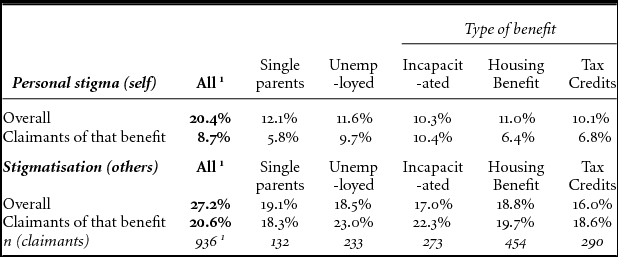
Respondent's reported level of stigma is reported in Table 1 below. Looking at the maximum stigma reported for any benefit (‘All’), 20.4 per cent personally think that people should feel ashamed to claim at least one benefit (‘Personal stigma’), while significantly more (27.2 per cent, p < 0.01) believe others feel that people feel ashamed to claim at least one benefit (‘Stigmatisation’). A further group of almost the same size said they ‘neither agreed nor disagreed’ (14.4 per cent for personal stigma, 20.3 per cent for stigmatisation; see Web Appendix WA2 for the full table and responses on the ten-point scale), which may indicate a further group of people who think that claiming is stigmatised but to a lesser extent.
Personal stigma and stigmatisation by benefit type (agree that should feel ashamed)

Source: Ipsos MORI benefits stigma survey 2012; n(overall)=2478-2517. 1For claimants, ‘all’=greatest stigma that a respondent reported about a benefit that they claimed.
Claimants sometimes – but not always – perceive less stigma than the general population (due to difficulties of comparability when aggregating across different types of benefit, we focus on individual benefits). Claimants of unemployment and incapacity benefits were as likely as others to believe they should feel ashamed to claim (about 10 per cent agreeing), but claimants of single parent benefits, housing benefit or in-work tax credits were less likely to agree they should feel ashamed (6–7 per cent agreeing vs. 10–12 per cent of non-claimants; p = 0.01, 0.05 and 0.01 for each benefit respectively). Levels of stigmatisation, however, were similar between claimants and the general population for each benefit. Overall, a sizeable minority of benefit claimants themselves think that people should be ashamed to claim their benefit (8.7 per cent of claimants) or think that people in general feel they should be ashamed (20.6 per cent), which potentially – if they do not deflect this (see above) – may lead them to feel shame.
Previous studies have shown marked differences in perceptions of stigma for different benefits – ‘welfare’ is considerably more stigmatised than Medicaid or social security in the US (Stuber and Kronebusch, Reference Stuber and Kronebusch2004; Williamson, Reference Williamson1974), and in Sweden, 68 per cent thought that people often look down on the recipients of social assistance, compared to only 19 per cent for unemployment benefit and just 4 per cent for the basic pension (Albrekt Larsen, Reference Albrekt Larsen2006). It is therefore surprising that there is so little difference in stigma across the five benefits here. There were statistically significant differences for both personal stigma and stigmatisation, with stigma being lowest for incapacity benefits and tax credits, and greatest for single parent benefits. However, the extent of the differences in Table 1 is relatively small. We return in the Conclusion to ways in which differences between benefits could be explored further in future research.
When we turn to claims stigma, levels increase considerably – as many as 57.8 per cent of people disagreed that ‘People are generally treated with respect when they claim benefits’ (with only 20.8 per cent agreeing), which is similar among claimants and non-claimants (57.1 per cent vs. 60.0 per cent disagreeing). Surprisingly, the association of claims stigma to personal stigma and stigmatisation is negative. For example, those who reported personal stigma were much less likely to report claims stigma (40.8 per cent vs. 20.8 per cent agreed claimants are treated with respect; weighted χ2 test p < 0.001). This suggests that the more stigmatising respondents think benefits should be, the less respectfully they think people should be treated, and the more likely they are to say that this (lower) threshold is met.
Stigma and benefit take-up
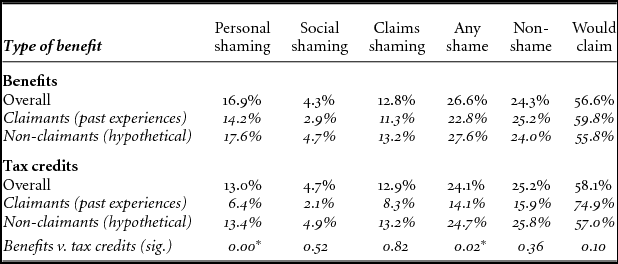
The second set of questions asked non-claimants if shame would affect their take-up of benefits if they were eligible and in need, or asked claimants if shame had stopped/delayed them claiming in the past; the results are shown in Table 2. Combining the two question versions, 16.9 per cent said that their benefits take-up would be affected by personal shame (pride, thinking benefits are for other people), 12.8 per cent by claims shaming (personal information or treatment by officials) and only 4.3 per cent by social shaming (how other people would react). In total, 26.6 per cent of people gave at least one shame-related reason for not claiming.
Stated reasons for not taking-up benefits/tax credits
Source: Ipsos MORI benefits stigma survey 2012. * = p < 0.05; n = 2530.
Comparing the type of benefit claimed, we see that people are slightly less likely to say that shame influences their decision to claim tax credits than out-of-work benefits (26.6 per cent vs. 24.1 per cent, p = 0.02) but that this is only the case for personal shame (16.9 per cent vs. 13.0 per cent, p<0.01), and not social shaming or claims shaming. The results are even more striking when we focus on the past experiences of claimants themselves. Only 14.1 per cent of tax credit claimants gave a shame-related reason for delaying or not-claiming tax credits in the past, compared to 22.8 per cent of benefits claimants.
Overlaps between stigmas
It might be expected that respondents are divided between those reporting no stigma and those reporting multiple types – but this is only partially the case. Even just comparing personal stigma and stigmatisation, 6.8 per cent of respondents reported personal stigma but not stigmatisation, while 13.5 per cent reported stigmatisation without personal stigma (66.1 per cent report neither, 13.6 per cent report both). This means that over one-third of respondents believe either that they should feel ashamed for claiming, or that other people think they should.
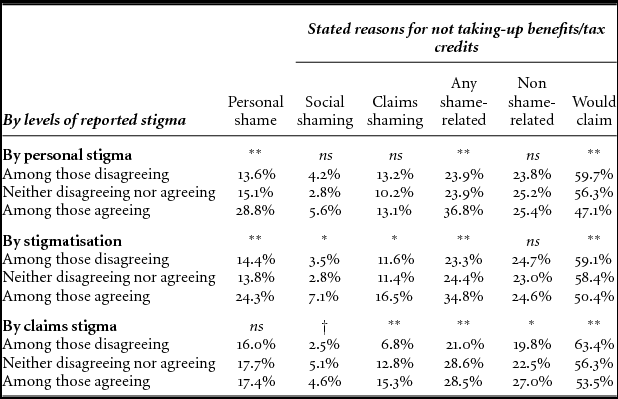
There is similarly only a partial overlap between these measures and the take-up-related questions, as shown in Table 3. People who agreed that a certain type of stigma existed were more likely to say that shame would affect their claim if they were needy and eligible. For example, 28.8% of people who agreed there was personal stigma also said that personal shame would influence their claim, compared to only 13.6% of those who disagreed there was personal stigma. (The equivalent figures are 7.1% vs. 3.5% for stigmatisation/social shaming, and 15.3% vs. 6.8% for claims stigma/claims shaming). Stigma is therefore more widespread than any single question captures: 48.7 per cent of respondents gave at least some sign of stigmatising benefits (personal stigma, stigmatisation, or a shame-related reason that would affect their decision to claim), and a further 30.2 per cent disagreed that claimants are treated with respect.
Association between stigma per se and stigma as a reason for non-take-up
Source: Ipsos MORI benefits stigma survey 2012. Significance (for joint significance of differences between all three categories): † p < 0.10, * p < 0.05, ** p < 0.01.
Stigma and ‘dependency culture’
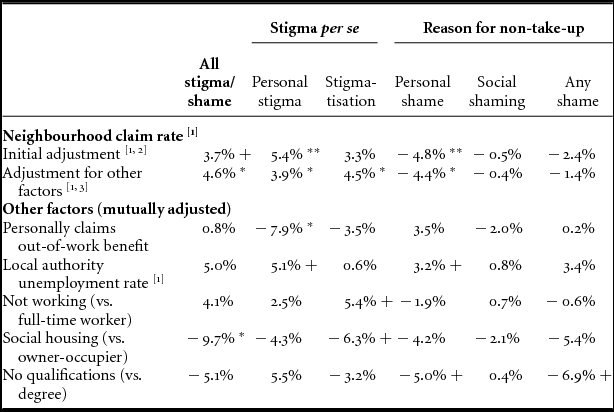
Finally, we test whether people in high-claim neighbourhoods report lower benefits stigma than others; the results are shown in Table 4. (The table does not show results for claims stigma, which shows no significant patterns across any socio-economic measure). In contrast to the ‘dependency culture’ hypothesis, the initial model shows that people in high-claim neighbourhoods report 5.4 percentage points more personal stigma than those in lower-claim neighbourhoods. When we simultaneously control for other socio-economic factors, these patterns are maintained, and we also find a further surprising result: people in high-claim neighbourhoods are also 4.5 percentage points more likely to think that other people feel they should be ashamed to claim benefits (‘Stigmatisation’). Overall, those in high-claim areas were 4.6 percentage points more likely to give at least one stigma/shame-related response across the survey (‘All stigma/shame’).
Socio-demographic patterning of reported stigma
Source: Ipsos MORI benefits stigma survey 2012. All estimates show average marginal percentage point effects; + = p < 0.10, * = p < 0.05, ** = p < 0.01. [1] ‘Claim/unemployment rates’ show the estimated difference between the middle of the top half vs. the middle of the bottom half of claims across areas (i.e. 75th vs. 25th percentiles). [2] ‘Initial adjustment’ is for age, gender, region, marital status, children, migration within the local authority, and personal benefit claims (out-of-work/tax credit/other). [3] ‘Adjustment for other factors’ additionally controls for local authority unemployment rate, work status, housing tenure, and qualifications.
Simultaneously, those in high-claim neighbourhoods were also less likely to say that personal shame would influence their decision to claim. This may reflect differences between morality and real-world preferences (as found for studies of the work ethic; Dunn, Reference Dunn2011: 6), such that those in high-claim areas are more aware that need ultimately trumps stigma (Rogers-Dillon, Reference Rogers-Dillon1995); or it may alternatively reflect differences in how stigma translates to shame, with those in high-claim neighbourhoods being more likely to contrast the deserving self with undeserving others (as discussed above). Table 4 similarly shows that other socio-demographic factors show reverse associations with stigma vs. shame as a reason for non-take-up, which may explain the inconsistent results found for the effect of education in the previous benefits stigma literature (Stuber and Schlesinger, Reference Stuber and Schlesinger2006; Handler and Hollingsworth, Reference Handler and Hollingsworth1969).
While not the focus of our study, it is worth noting that claimants themselves hold lower levels of personal stigma, but this is not the case for other forms of stigma/shame, and overall they are as likely to give a stigma-related response as non-claimants. There are also signs that out-of-work respondents and those in high-unemployment areas report some form of stigma more strongly (although these are not significant at conventional levels), and that those in social housing are less likely to give any stigma-related response. Many of the socio-economic patterns are weak and/or non-significant, however, as has been found in smaller previous stigma surveys (Handler and Hollingsworth, Reference Handler and Hollingsworth1969). Similarly, respondents aged 45+ were less likely to give a non-shame-related reason for non-claiming, but there were otherwise few significant patterns by age and gender.
Discussion
While stigma in the benefits system has long been debated, there have been few previous large-scale quantitative studies of benefits stigma, particularly in recent years. Using a new, nationally-representative survey with a boost sample of benefit claimants, we find that 10–12 per cent of respondents agree themselves that people should feel ashamed to claim each of five individual benefits (‘personal stigma’) and 16–19 per cent think that other people believe people should feel ashamed to claim (‘stigmatisation’). Looking at the proportions who report stigma for at least one benefit, 20 per cent agree that personal stigma exists and 27 per cent agree that stigmatisation exists – and as many as 34 per cent say either one or the other. Moreover, an outright majority (58 per cent) disagree that people are treated with respect when they claim (‘claims stigma’). It is therefore clear that benefits stigma is a multifaceted phenomenon, and that it is possible to capture this quantitatively.
We also asked respondents whether shame would influence their decision to claim benefits/tax credits, if they were needy and eligible. Over one-quarter (27 per cent) say that a shame-related reason would make them less likely to claim; this is similar (if slightly higher) than given by eligible non-respondents as reasons for non-take-up in previous surveys. It should be noted, however, that we asked if shame would make people less likely to claim, and not if it would stop them claiming. Shame as an influence on take-up is also reported by some people who did not report personal stigma or stigmatisation, and in total, 49 per cent of respondents give at least one stigma/shame-related response within the survey, with a further 30 per cent disagreeing that claimants are treated with respect when applying. While the prevalence of some specific types of stigma for specific benefits can be relatively low, stigma in general is not a marginal phenomenon.
One of the strengths of our survey was that we could compare stigma between claimants and non-claimants, a comparison rarely available in the previous literature. Claimants of certain benefits (in-work tax credits, housing benefit, income support for single parents) are less likely to report personal stigma for that benefit. This may reflect that those who hold less stigmatising beliefs are more likely to claim benefits than others, or alternatively it may suggest a tendency for claimants to deflect stigma onto others (as shown in previous qualitative research). However, there are no differences for other types of benefits nor other measures of stigma and, overall, claimants are just as likely as non-claimants to provide at least one stigma-related response. While establishing a causal link between mental health and benefits stigma is problematic (the strongest study is Lee and Oguzoglu, Reference Lee and Oguzoglu2007, who found weak, non-significant effects), the fact that one-third of claimants report personal stigma and/or stigmatisation, and 23 per cent of claimants report a shame-related reason for delaying their claim in the past, is potentially concerning.
Finally, our study is the first to directly test whether benefits stigma is systematically lower in high-claim neighbourhoods, as the ‘dependency culture’ hypothesis predicts. Put simply, our results offer little support for this, fitting the results from qualitative research and survey studies of attitudes to work. Respondents in high-claim areas are less likely to say that personal shame would influence their decision to claim, but more likely to report personal stigma (and, after adjustment, also stigmatisation). Overall, respondents in high-claim areas were more likely to report a stigma-related response, both before and after controlling for a variety of other socioeconomic factors. People's decisions to claim benefits may be influenced by those around them, but this does not mean that claims are less stigmatised in high-claims area.
Recommendations for future research
While the Ipsos MORI benefit stigma survey has a number of strengths (e.g., operationalising sub-types of stigma, claimant boost samples) – and is available for other researchers to re-use – it also has several limitations. Some of these apply to all such surveys: for example, we are dependent upon self-reports of stigma, and these will be underestimates to the extent that it is stigmatising for someone to say they feel stigma. The quota sample may also have greater biases than a full random sample, although the careful design of the quota minimises this, and non-response biases will exist to varying degrees in all surveys.
Our experiences also suggest several improvements for future surveys. The prevalence of personal stigma and stigmatisation in this survey are lower than previous surveys, which may be because the present study asked about feeling ‘ashamed’, whereas previous studies asked about feelings that are both weaker and less stigmatising to admit (e.g., feeling ‘embarrassed’, ‘looked down on’, or a lack of ‘respect’). While this was a deliberate choice – shame has been the focus of recent scholarship and is more policy-relevant – future surveys could capture both by allowing respondents to respond that (i) claimants should feel ashamed; (ii) claimants should feel embarrassed but not ashamed; or (iii) claimants should not feel embarrassed. It would also be helpful to make questions on claims stigma speak about ‘shame’ rather than ‘respect’, to make them comparable to questions on personal stigma/stigmatisation.
Our most surprising finding was the relatively small differences between the different benefits (much as these small differences were sometimes statistically significant), given that previous studies have found considerable variation. One explanation is that the benefits involved – with the exception of tax credits (see below) – are similarly stigmatised because of their similar principles (predominantly needs-based benefits for the working-age population) and delivery (via DWP). Another explanation, however, is that many respondents interpreted the questions as about ‘deserving’ claims, and the stigma differences across these types of benefit are primarily about how far claimants are seen as deserving. One way of exploring this would be to ask explicitly about the stigma of deserving claims, and then to separately ask about the share of claimants that are seen to be deserving.
This raises a broader question: given the close link between stigma and deservingness, to what extent is it useful to study benefits stigma directly? Deservingness is a critical component of support for the benefits system (van Oorschot, Reference van Oorschot2000), and benefits policy therefore needs to carefully consider its impacts on deservingness perceptions (Baumberg, Reference Baumberg2012). Nevertheless, our view is that there is some value in examining stigma and shame. Partly this is because shame is (by definition) a negative experience; even if many claimants deflect stigma onto others, shame is nonetheless a real aspect of a considerable minority of claimants’ experiences. Furthermore, stigma is part of the explanation – contentious in size, but not in existence – for the non-take-up of benefits by those who are in need and eligible, perpetuating hardships that the system was designed to avoid.
Policy implications
This paper has concentrated on describing benefits stigma, rather than investigating how to reduce it. Nevertheless, other studies suggest three ways in which benefits stigma can be reduced. Firstly, political and media rhetoric could become less stigmatising. We have elsewhere examined the nature of media reporting of benefits in the UK, the role that politicians play within this, and how these might be changed (Baumberg et al., Reference Baumberg, Bell, Gaffney, Deacon, Hood and Sage2012). Secondly, claims stigma could be reduced by making the operation of the benefits system more respectful. We agree with, for example, the claimant-led Citizen's Commission on the Future of the Welfare State (1997: 119) that benefits agency staff should be trained ‘to ensure that service users are treated positively, sympathetically and with respect, without stigma or hostility’, and that whenever claimants are asked to commit to perform certain activities, personal advisors likewise sign a commitment to offer certain levels of support. Where claimants feel a greater entitlement to support, we would expect stigma to fall (Gubrium and Lødemel, Reference Gubrium, Lødemel, Gubrium, Pellissery and Lødemel2014).
The third way of reducing stigma is perhaps the closest to the traditional heart of social policy: to change the structure of the benefits system. Britain has seen several deliberate attempts to create less-stigmatising benefits: 1960s research convinced Labour to replace the stigmatised ‘National Assistance’ with ‘Supplementary Benefits’ (according to Page, Reference Page1984: 44), while tax credits in the 1990s were explicitly designed to lower stigma and appear to have succeeded (see also Breese, Reference Breese2011). In general, we would expect less universal, less contributions-based, less generous, and more conditional benefits to be more stigmatised (Albrekt Larsen, Reference Albrekt Larsen2006), with global studies of shame providing some support for this (Gubrium and Lødemel, Reference Gubrium, Lødemel, Gubrium, Pellissery and Lødemel2014). As Richard Titmuss put it in Commitment to Welfare (Reference Titmuss1968: 135), the ‘fundamental challenge’ of social policy is therefore to create a universal infrastructure around which selective provision can target services ‘with the minimum risk of stigma in favour of those whose needs are greatest’.
However, this paper's main contribution is descriptive rather than prescriptive: to show that sub-types of benefits stigma can be conceptualised and measured; that stigma is reported by a considerable minority of claimants and non-claimants alike; and that there is evidence that contradicts the idea that this overspills into a ‘dependency culture’. In this, it hopefully sheds new light on an old problem, and provides a further academic grounding for policy debates that seem likely to recur for as long as we have a benefits system in the present form.
Acknowledgements
Thanks are due to the participants in the Ipsos MORI survey (and to Ipsos MORI themselves), to Elizabeth Finn Care/turn2us who funded the original study, and particularly to Kate Bell and Declan Gaffney who were co-authors on the initial project report, and invaluable in helping to develop my thinking on stigma.