INTRODUCTION
The Atlantic Forest is one of the richest biomes in the world, being home to an outstanding diversity of plants and animals (Galindo-Leal and Câmara, Reference Galindo-Leal and Câmara2003). For instance, out of 658 mammal species found in Brazil, 250 are present in the Atlantic Forest, 55 being exclusively found in this biome (Reis et al. Reference Reis, Peracchi, Pedro and Lima2006). Originally, almost the entire Brazilian coast was covered by Atlantic Forest, which now has been reduced to a series of small fragments (Ranta et al. Reference Ranta, Blom, Niemela, Joensuu and Siitonem1998; Ribeiro et al. Reference Ribeiro, Metzger, Martensen, Ponzoni and Hirota2009). Moreover, disturbances in such an important natural ecosystem can eventually bring humans into contact with wildlife-associated pathogens (Bradley and Altizer, Reference Bradley and Altizer2006).
Some fragments of Atlantic Forest in Brazil are embedded within highly urbanized areas (Galindo-Leal and Camara, Reference Galindo-Leal and Câmara2003), bringing wildlife and their associated pathogens into greater contact with domestic animals and humans. For instance, small mammals have been implicated in the transmission cycles of many tick-borne pathogens worldwide, including Anaplasma phagocytophilum, Babesia microti, Borrelia burgdorferi, and Rickettsia rickettsii (Bown et al. Reference Bown, Lambin, Telford, Ogden, Telfer, Woldehiwet and Birtles2008; Zhan et al. Reference Zhan, Cao, Chu, Jiang, Zhang, Liu, Dumler, Wu, Zuo, Zhang, Huang, Zhao, Jia, Yang, Richardus and Habbema2009). Incidentally, tick-borne diseases represent an emerging public health concern in Brazil (Silveira et al. Reference Silveira, Pacheco, Szabó, Ramos and Labruna2007; Spolidorio et al. Reference Spolidorio, Labruna, Mantovani, Brandao, Richtzenhain and Yoshinari2010). In this scenario, marsupials and small rodents have been regarded as some of the most probable amplifier hosts for R. rickettsii among Amblyomma cajennense and Amblyomma aureolatum ticks, respectively (Labruna, Reference Labruna2009). For example, opossums can serve as a source of R. rickettsii to Am. cajennense in the laboratory (Horta et al. Reference Horta, Moraes-Filho, Casagrande, Saito, Rosa, Ogrzewalska, Matushima and Labruna2009). In addition, Borrelia-like spirochetes were isolated from marsupials, rodents and their ticks in South-eastern Brazil, suggesting their participation in the epidemiology of the so-called ‘Baggio-Yoshinari Syndrome’ (Abel et al. Reference Abel, Marzagão, Yoshinari and Schumaker2000). These findings highlight the importance of studying the effects of Atlantic Forest fragmentation on small mammal-tick systems to better understand the eco-epidemiology of tick-borne diseases in this country.
Habitat fragmentation in the United States is associated with a reduction of mammal species diversity and elevation of population densities of white-footed mice (Peromyscus leucopus), the principal reservoir of B. burgdorferi (Bradley and Altizer, Reference Bradley and Altizer2006). Even if ticks infesting mammals in Brazil have long been studied (Barros-Battesti et al. Reference Barros-Battesti, Arzua, Linardi, Botelho and Sbalqueiro1998, Reference Barros-Battesti, Yoshinari, Bonoldi and Castro Gomes2000; Bittencourt and Rocha, Reference Bittencourt and Rocha2003; Martins et al. Reference Martins, Dantas-Torres, Nieri-Bastos, Marcili, de Siqueira, Aléssio, Mauffrey, DA Silva and Labruna2009), data on habitat fragmentation and its effects on tick-host-pathogen associations in the Atlantic Forest are meagre. We hypothesized that the Atlantic Forest provides an environment for small mammal communities and ticks, and that small mammals are constantly exposed to pathogens, such as Rickettsia spp. We assessed small mammal-tick associations in 6 Atlantic Forest patches and whether they differ among forest strata, sites, seasons, and host age classes or between sexes. We also investigated the exposure of small mammals to Rickettsia spp. This study suggests that disturbed Atlantic Forest fragments provide an environment for ticks and small mammals, which are highly exposed to Rickettsia spp. It also points out that forest patches settled in rural areas are often associated with higher diversity and density rates of both small mammals and ticks. These findings suggest that habitat destruction and urbanization might affect the risk of exposure to ticks and tick-borne pathogens in Atlantic Forest fragments.
MATERIALS AND METHODS
Study area
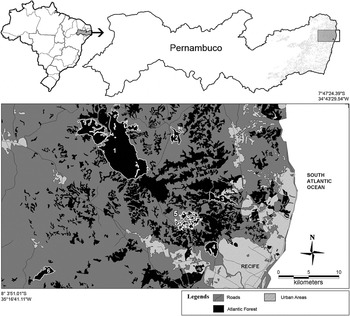
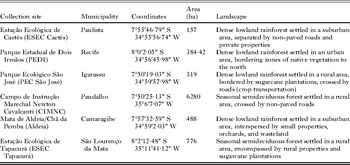
This study was conducted in 6 Atlantic Forest fragments (Fig. 1) located in the Recife metropolitan region (Pernambuco State, North-eastern Brazil), as follows: Estação Ecológica de Caetés (ESEC Caetés); Parque Estadual de Dois Irmãos (PEDI); Parque Ecológico São José (PEC São José); Campo de Instrução Marechal Newton Cavalcanti (CIMNC); Mata de Aldeia/Chã da Peroba (Aldeia); Estação Ecológica de Tapacurá (ESEC Tapacurá) (Table 1). With over 3·5 million inhabitants, this is the 5th largest metropolitan area of Brazil and scattered Atlantic Forest fragments are irregularly distributed over the region. Although each forest fragment studied here might have its own microclimate, they share the same macroclimatic characteristics. Accordingly, the region has a typical tropical climate, characterized by a wet season (March-August) and dry season (September-February).
Location of the 6 Atlantic Forest fragments in Pernambuco (North-eastern Brazil) surveyed during this study, with a view of main landscape features of the surrounding areas. 1, Campo de Instrução Marechal Newton Cavalcanti. 2, Parque Ecológico São José. 3, Estação Ecológica Caetés. 4, Parque Estadual de Dois Irmãos. 5, Mata de Aldeia. 6, Estação Ecológica de Tapacurá.

Characteristics of the six Atlantic Forest fragments located in North-eastern Brazil

Animal trapping and identification
From December 2007 to March 2009, small mammals were captured in the 6 Atlantic Forest patches. Field missions were carried out at 3-month intervals, during 5 consecutive nights (200 traps per night), corresponding to an overall sampling effort of 25 231 traps-nights. In 4 Atlantic Forest fragments (ESEC Caetés, PEDI, PEC São José, CIMNC), grids of 80 capture stations (2 traps per capture station) were set, 25 m apart, covering an area of approximately 3·9 ha. Animals were captured with 2 types of traps: Sherman live trap (23×8×9 cm) (H.B. Sherman Trap Co., Tallahassee, FL, USA) and handmade wire-mesh (Tomahawk) trap (small (30×10×10 cm) or large (50×17×17 cm)) (Gabrisa, Cafelândia, Brazil). Two traps (1 Sherman trap and 1 Tomahawk trap) were set in each capture station, one being placed on the ground and another in the understory attached to tree branches at 1–2 m above the ground. In addition, linear transects (range of length, 400–600 m) were established in pre-existent trails with traps (n=40) positioned 10–15 m apart. Each collection station included 1 trap, the position of which (on the ground or in the understory) was alternated at each station. In 2 Atlantic Forest fragments (ESEC Tapacurá and Aldeia) only linear transects were established, which maintained the same number of collection stations and disposition of traps as per grids. Trap types and positions were alternated to obtain an homogeneous sampling effort over the fragments surveyed.
Traps were baited with pieces of pineapple mixed with a Brazilian peanut candy called paçoca. Every morning, all traps were inspected to assess the presence of animals and to check the baits, which were changed whenever needed. Once captured, animals were restrained physically, placed into individual cloth bags and transported to our field facilities. Before tick collection, animals were subjected to anaesthesia with an association of ketamine (30 mg/kg for marsupials, 100 mg/kg for rodents, and 50 mg/kg for lagomorphs) plus xylazine (2 mg/kg for marsupials, 5 mg/kg for rodents, and 5 mg/kg for lagomorphs). Physiological parameters were monitored and after recovery from anaesthesia, animals were released in their original capture site. Before releasing, the animals were either marked with numbered ear tags or tattooed on their inner right thigh, type of marking being decided based on the animal's size.
Small mammals were identified using field guides of Neotropical rainforest mammals (Redford and Eisenberg, 1992; Emmons and Feer, Reference Emmons and Feer1997; Bonvicino et al. Reference Bonvicino, Oliveira and D'Andrea2008). Voucher specimens were deposited in the Mammal Collection of the Universidade Federal de Pernambuco, Brazil. Trapping and handling of small mammals has been authorized by the Instituto Chico Mendes para Conservação da Biodiversidade (ICMBio/SISBIO, No. 11854-1, 11854-2, 10769-2).
Tick collection and identification
Ticks were collected from the hosts by hand and placed into individualized labelled plastic bottles. In the laboratory, non-engorged or partially engorged ticks were placed into plastic bottles containing 70% ethanol. Conversely, fully engorged nymphs were kept in their original bottles and maintained in an incubator (27±1°C, 80% RH, 12-h light/12-h dark photoperiod) to moult into adults to facilitate species-level identification. Additionally, ticks found on researchers involved in the fieldwork were also collected. Ticks were identified using morphological keys for adults (Aragão and Fonseca, Reference Aragão and Fonseca1961; Onofrio et al. Reference Onofrio, Barros-Battesti, Labruna and Faccini2009) and nymphs (Martins et al. Reference Martins, Onofrio, Barros-Battesti and Labruna2010). Nomenclature of ticks follows a recent checklist of ticks found in Brazil (Dantas-Torres et al. Reference Dantas-Torres, Onofrio and Barros-Battesti2009) and generic names are abbreviated as proposed elsewhere (Dantas-Torres, Reference Dantas-Torres2008). Voucher tick specimens were deposited in the following collections (Accession numbers within parentheses): Instituto Butantan, São Paulo, SP, Brazil (IBSP) (9971, 9973–9975); Coleção Nacional de Carrapatos of the Faculdade de Medicina Veterinária e Zootecnia da Universidade de São Paulo, São Paulo, SP, Brazil (CNC) (1328–1339, 1319–1327, 1538–1545, 1549–1552); Instituto Oswaldo Cruz, Rio de Janeiro, RJ, Brazil (IOC) (0975–0978).
Detection of anti-Rickettsia spp. antibodies in rodents and marsupials
Sera from small mammals (n=218) were tested by indirect immunofluorescence assays, as described in detail elsewhere (Horta et al. Reference Horta, Labruna, Pinter, Linardi and Schumaker2007, Reference Horta, Sabatini, Moraes-Filho, Ogrzewalska, Canal, Pacheco, Martins, Matushima and Labruna2010). In particular, serum samples were tested for antibodies reactive to R. bellii (strain Mogi), R. amblyommii (strain Ac37) and R. rickettsii (strain Taiaçu). Slides were incubated with fluorescein isothiocyanate-labelled sheep anti-opossum IgG (CCZ, São Paulo, Brazil) and rabbit anti-guinea pig IgG (Sigma, St Louis, MO, USA) for marsupials and rodents, respectively; sera were considered positive if reactive at a 1:64 dilution.
Ecological parameters
Species richness (S) was recorded for both hosts and ticks for each Atlantic Forest fragment. Prevalence (P), mean intensity (MI), mean abundance (MA), and tick relative density indices (TRDI) were calculated as described previously (Bush et al. Reference Bush, Lafferty, Lotz and Shostak1997; Barros-Battesti et al. Reference Barros-Battesti, Yoshinari, Bonoldi and Castro Gomes2000). Tick records (n=158) included in the calculation of ecological parameters have been reported by Martins et al. (Reference Martins, Dantas-Torres, Nieri-Bastos, Marcili, de Siqueira, Aléssio, Mauffrey, DA Silva and Labruna2009).
Statistical analyses
Data comparisons were performed using Kruskal-Wallis, one-way ANOVA, Mann-Whitney U test, Student's t-test or Chi-square tests, as appropriate. Before analysis, data were checked for normality using Lilliefors test and, when appropriate, a logarithmic transformation (log 10) was used to eliminate heterogeneity of variances across groups of data. If the heterogeneity persisted, we used a nonparametric test. Differences were considered significant if P<0·05. Odds ratio (OR) was used to estimate the relative risk for tick infestation among forest strata, host age classes and sexes. Ninety-five per cent confidence intervals (95% CI) were calculated for each prevalence estimate. Pearson (r) (for parametric data) and Spearman (rs) (for nonparametric data) correlation coefficients were used to determine the level of correlation between some of the ecological parameters recorded. Two host species (represented by only 1 individual) and 1 forest fragment (i.e., PEDI, where only 5 animals were captured) were excluded from the analyses. Analyses were performed using BioEstat 5.0 (Ayres et al. Reference Ayres, Ayres and Ayres2007). Evenness (E) was calculated using PAST version 1.99 (Hammer et al. Reference Hammer, Harper and Ryan2001).
RESULTS
Host species, sex, age classes, and habitat preference
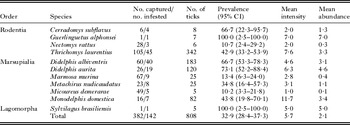
In total, 432 small mammals belonging to 20 species were captured. The number of individuals captured from each host species varied significantly (χ 2= 183·59, d.f.=8, P<0·0001, one-sample Chi-square test), 1 rodent species (T. laurentius) being the most frequently captured host (Table 2).
Small mammal species collected, number of ticks collected, prevalence, mean intensity and mean abundance

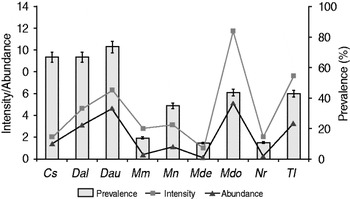
Ticks were found on 142 small mammals belonging to 11 species, with overall prevalence of 32·9% (95% CI: 28·4–37·3%), mean intensity of 5·7 and mean abundance of 2·1 (Table 2). The highest mean intensities and abundances of infestation were recorded for 3 marsupial species (Didelphis albiventris, Didelphis aurita, Monodelphis domestica) and 1 rodent (Thrichomys laurentius) (Fig. 2), which were frequently exposed to multiple tick stages (data not shown). Indeed, the number of infested individuals varied significantly according to host species (χ 2= 131·93, d.f.=8, P<0·0001, one-sample Chi-square test).
The sex ratio of small mammals captured was close to unity (198 females/184 males). Males harboured a larger number of ticks than females (χ 2=76·12, d.f.=1, P<0·0001, one-sample Chi-square test), but there was no difference in prevalence of infestation in relation to sex (χ 2=3·32, d.f.=1, P=0·07, two-sample Chi-square test). Most of the captured hosts were adults (n=292, 76·44%) (χ 2=106·82, d.f.=1, P<0·0001, one-sample Chi-square test), but no difference was found in relation to host age class (χ 2=0·40, d.f.=1, P=0·53, two-sample Chi-square test). However, crossing sex with age class data, adult males were significantly more infested than adult females (χ 2=4·71, d.f.=1, P=0·03, two-sample Chi-square test). Accordingly, adult males were at a higher risk of being infested by ticks as compared with adult females (OR=1·70; 95% CI: 1·05–2·75; P=0·04).
When grouping small mammals by microhabitat preference, the prevalence was much higher on predominantly terrestrial (n=265) (48·0%; 95% CI: 41·9–53·9) than on arboreal (n=117) mammals (12·9%; 95% CI: 6·8–18·9) (χ 2=42·83, d.f.=1, P< 0·0001, two-sample Chi-square test). Accordingly, the mean intensity and mean abundance was higher among terrestrial (6·1 vs 2·9) than on arboreal mammals (2·5 vs 0·3). Fitly, terrestrial mammals had a 6-times higher chance of being infested by ticks than arboreal mammals (OR=6·3; 95% CI: 3·5–11·3, P<0·0001).
Nine small mammal species captured were free of ticks (no. of individuals captured is within parentheses): Akodon cursor (32); Calomys expulsus (1); Caluromys philander (3); Monodelphis americana (2); Mus musculus (1); Oecomys bahiensis (1); Oxymycterus dasythrichus (1); Rattus rattus (8); Rhipidomys mastacalis (1). Some of these animals were infested by other ectoparasites, such as fleas and laelapid mites (data not shown).
Tick-small mammal associations
A total of 808 ticks (357 larvae, 416 nymphs, 20 females, 15 males) were collected, ranging from 1 to 68 ticks per host. Three tick genera were identified: Amblyomma (n=737; 91·2%); Haemaphysalis (n=4; 0·5%); and Ixodes (n=67; 8·3%). Four tick species were identified: Amblyomma fuscum; Amblyomma dubitatum; Haemaphysalis leporispalustris; and Ixodes loricatus. Amblyomma fuscum was found on 7 host species (Cerradomys subflavus, D. albiventris, D. aurita, Metachirus nudicaudatus, M. domestica, Nectomys rattus, T. laurentius) whereas Ix. loricatus was found on 5 marsupial species (D. aurita, D. albiventris, M. nudicaudatus, Micoureus demerarae, Marmosa murina). Amblyomma dubitatum and Ha. leporispalustris were exclusively found on a rodent (N. rattus) and on a lagomorph (Sylvilagus brasiliensis) species, respectively. Three D. aurita and 1 D. albiventris were co-infested by Am. fuscum (nymphs) and Ix. loricatus (adults) whereas 1 S. brasiliensis was co-infested by Amblyomma sp. (larvae) and Ha. leporispalustris (nymphs).
The majority of the ticks collected were Amblyomma larvae (n=353, 43·7%) and nymphs (n=384, 47·5%) that were found co-feeding on small mammals during the entire study period. Although the overall larva/nymph ratio was close to unity, larvae were almost 3 times more abundant during the wet season than in the dry season (mean abundances, 1·4 vs 0·5). Amblyomma immature ticks were collected from 109 hosts belonging to 9 species: C. subflavus (4); D. albiventris (28); D. aurita (13); M. nudicaudatus (7); Guerlinguetus alphonsei (1); M. domestica (7); N. rattus (3); T. laurentius (45); and S. brasiliensis (1). With the exception of 1 nymph of Am. dubitatum collected from a water rat (N. rattus), all nymphs were identified as Am. fuscum. Accordingly, 25 nymphs kept under laboratory conditions moulted into adults (female/male ratio, 1·5), being all Am. fuscum. These 25 nymphs were collected from 10 hosts belonging to 3 species: D. albiventris (2); D. aurita (3); and T. laurentius (5). Of note, no single adult specimen of Am. fuscum was found on any of the small mammals captured.
All adult ticks (20 females/15 males) collected were identified as Ix. loricatus, which was collected from 23 hosts belonging to 4 species: D. albiventris (13); D. aurita (8); M. nudicaudatus (1); and Micoureus demerarae (1). Larvae and nymphs of Ix. loricatus were collected from 14 marsupials of 3 species: Marmosa murina (9); M. demerarae (4); and D. aurita (1). Neither adults nor immature stages of Ix. loricatus were found on rodents.
Only 4 nymphs of Haemaphysalis were collected from a tapeti (S. brasiliensis). One nymph maintained in the laboratory moulted into a male of Ha. leporispalustris.
Tick infestation among forest fragments, seasons and strata
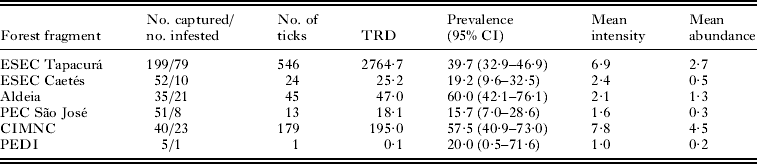
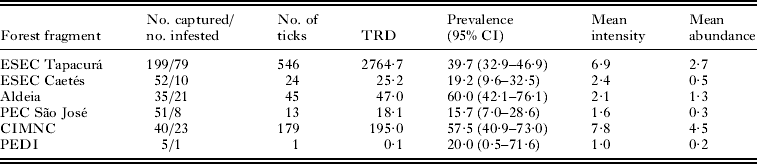
The overall number of animals captured in each forest fragment varied significantly (χ 2=256·04, d.f.=4, P<0·0001, one-sample Chi-square test) as well as the number of animals infested (χ 2=120·53, d.f.=4, P<0·0001, one-sample Chi-square test), the prevalence (χ 2=44·69, d.f.=4, P<0·0001, one-sample Chi-square test), the number of ticks collected (χ 2=1255·75, d.f.=4, P<0·0001, one-sample Chi-square test). Tick relative density indices recorded varied as well, being much higher in ESEC Tapacurá (TRDI=2764·7) and in CIMNC (TRDI= 195·0) (Table 3).
Number of small mammals captured/infested, ticks collected, tick relative density (TRD), prevalence, mean intensity, and mean abundance recorded among Atlantic Forest fragments
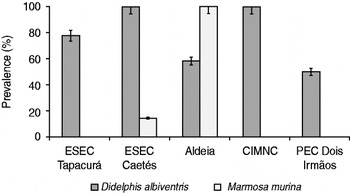
When animals were stratified by species, no differences were found in relation to the number of individuals captured (H=4·33, d.f.=4, P=0·363, Kruskal-Wallis) or infested (H=2·10, d.f.=4, P= 0·717, Kruskal-Wallis). However, 2 small mammal species (D. albiventris and M. murina) were evenly distributed (present in all the forest fragments), but the prevalence of ticks on them varied widely. Indeed, M. murina was captured in all forest fragments, but was found infested by ticks in only 2 forest fragments (Fig. 3). No significant correlations were found between forest fragment land area and any of the ecological parameters (data not shown).
Prevalence, mean intensity and mean abundance of tick infestation among host species. Cs, Cerradomys subflavus. Dal, Didelphis albiventris. Dau, Didelphis aurita. Mm, Marmosa murina. Mn, Metachirus nudicaudatus. Mde, Micoureus demerarae. Mdo, Monodelphis domestica. Nr, Nectomys rattus. Tl, Thrichomys laurentius. Error bars indicate 95% confidence intervals.

Prevalence of tick infestation on Didelphis albiventris and Marmosa murina in different forest fragments. Neither D. albiventris nor M. murina were found infested in PEC São José, which for this reason is not shown in the graphic. Error bars indicate 95% confidence intervals.

The number of animals captured did not vary between seasons (t=0·552, d.f.=8, P=0·596, Student's t-test) as well as the number of infested animals (t=0·292, d.f.=8, P=0·778, Student's t-test). Again, the number of ticks collected did not vary according to season (t=0·050, d.f.=8, P=0·961, Student's t-test). The prevalence of infestation did not differ significantly by season, except in 1 forest fragment (CIMNC) where the prevalence increased more than 2-fold during the wet season (χ 2=7·82, d.f.=1, P<0·01, two-sample Chi-square test). Again, only 1 tick species (Am. fuscum) was found during the dry season whereas 3 (Am. fuscum, Ha. leporispalustris, and Ix. loricatus) were identified during the wet season in CIMNC.
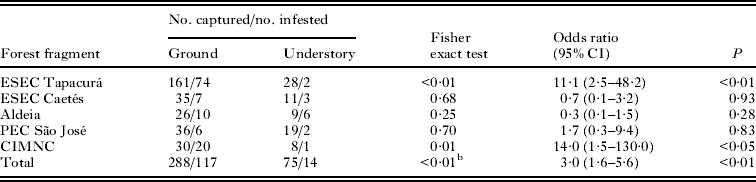
The number of small mammals captured on the ground in each forest fragment was higher than that captured in the understory (Z=2·402, P=0·016, Mann-Whitney U test). Again, the number of infested mammals captured on the ground was higher than that captured in the understory (t=3·330, d.f.=8, P=0·010, Student's t-test) (Table 4). Indeed, mammals captured on the ground had a 3 times higher risk of being infested than those captured in the understory (OR=3·0; 95% CI: 1·6–5·6; P=0·01). In particular, mammals captured on the ground in ESEC Tapacurá (OR=11·1; 95% CI: 2·5–48·2; P<0·001) and CIMNC (OR=14·0; 95% CI: 1·5–130·6; P=0·02) had an over 10 times higher risk of being infested by ticks than those in the understory.
Number of small mammals captured/infested on the ground and in the understory in each Atlantic Forest fragmenta
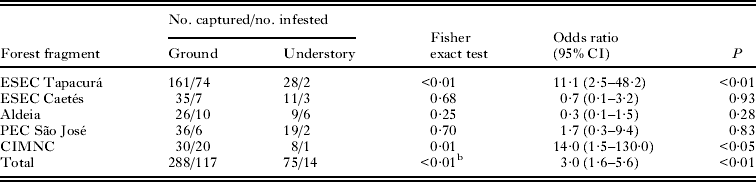
a This table includes only animals (n=363) for which information on place of capture (ground or understory) was available.
b χ 2=12·44, d.f.=1, P<0·01, two-sample Chi-square test.
Host richness and evenness were similar among forest fragments (data not shown). Accordingly, no correlation was found between host richness and tick species richness (r=0·22, R 2=0·05, P=0·68), forest fragment land area (r=0·22, R 2=0·05, P=0·68), trapping effort (r=0·22, R 2=0·05, P=0·68) or number of small mammals captured (r=0·22, R 2= 0·05, P=0·68).
Antibodies to Rickettsia spp. in rodents and marsupials
Out of 218 serum samples tested for antibodies to Rickettsia spp., 150 (68·8%; 95% CI: 62·7–75) were reactive to one or more antigens. In particular, 83 (68·6%; 95% CI: 60·3–76·9) out of 121 rodents tested positive. Forty-four rodents were positive to a single antigen, being 42 to R. rickettsii and 2 to R. bellii. Again, 18 rodents were reactive to 2 antigens, being 9 to R. bellii and R. rickettsii, 8 to R. amblyommii and R. rickettsii, and 1 to R. amblyommii and R. bellii. Finally, 21 rodents reacted simultaneously to R. amblyommii and R. bellii and R. rickettsii. In the same way, 67 (69·1%; 95% CI: 59·9–78·3) out of 97 marsupials tested positive. Eleven marsupials were reactive to 1 antigen, being 9 to R. bellii, 1 to R. amblyommii and 1 to R. rickettsii. Again, 21 reacted to 2 antigens, being 20 to R. bellii and R. rickettsii, and 1 to R. amblyommii and R. bellii. Importantly, 35 marsupials reacted simultaneously to all 3 antigens.
The seropositivity among tick-infested small mammals (75·3%; 95% CI: 66·3–83·7) and non-infested ones (63·7%; 95% CI: 55·1–72·2) did not differ significantly (χ 2=3·39, d.f.=1, P=0·07, two-sample Chi-square test).
Human parasitism by ticks
A total of 16 larvae of Amblyomma were collected from 3 researchers involved in the fieldwork. In particular, 2 cases of infestation were recorded in the dry season (1 in PEDI and another in CIMNC) and 1 (again in CIMNC) in the wet season.
DISCUSSION
This study suggests that disturbed Atlantic Forest fragments provide an environment for small mammals and ticks and that small mammals living in these areas are highly exposed to rickettsial organisms. This is inferred from the numbers of small mammals and ticks collected in all forest fragments studied, which generally remained constant across seasons. Interestingly, we found that over 90% of the ticks collected came from small mammals captured in 3 Atlantic forest fragments settled in rural areas. In such forest fragments, rodents and Amblyomma ticks predominated. On the other hand, marsupials and Ixodes ticks were typically found in forest fragments located in urban or suburban areas. These findings suggest that the risk of tick-borne pathogen transmission will vary according to environmental characteristics of the forest fragment, which in turn will directly influence both small mammal communities and tick populations. Because the human parasitism by Amblyomma larvae appears to be common in Atlantic Forest fragments (Dantas-Torres et al. Reference Dantas-Torres, Ferreira, Melo, Lima, Siqueira, Rameh-de-Albuquerque, de Melo and Ramos2010), people undergoing activities (ecotourism, research activities, forest dwellers) in these areas might be at risk of exposure to ticks and rickettsial organisms. Indeed, 16 Amblyomma larvae were collected from 3 researchers involved in the fieldwork of the present study.
We found that small mammals captured on the ground were at a higher risk of being infested by ticks. The tick burden was also heavier on certain host species (e.g., T. laurentius) and generally on adult males. These findings confirm that microhabitat preference and/or sex-related behaviour increase their risk of tick infestation in small mammals living in Atlantic Forest patches. Male small mammals have, generally, a larger home range than females, particularly during the breeding season (Streilen, Reference Streilen1982), which might increase their chances of being exposed to ticks. This is also true for predominantly terrestrial mammals whose ground activities can increase the risk tick infestation. In this regard, most of the small mammals trapped on the ground were infested by nymphs and larvae of Am. fuscum, which until recently was regarded as a rare South American tick species (Barros-Battesti et al. Reference Barros-Battesti, Onofrio, Labruna, Martins and Guglielmone2005). Adults of Am. fuscum predominantly parasitize cold-blooded animals, particularly boa snakes (Boa constrictor) (Dantas-Torres et al. Reference Dantas-Torres, Oliveira-Filho, Soares, Souza, Valença and Sá2008, Reference Dantas-Torres, Ferreira, Melo, Lima, Siqueira, Rameh-de-Albuquerque, de Melo and Ramos2010). It follows that, in nature, Am. fuscum undergoes a typical ditropic life cycle, that is, its immatures feed principally on small mammals whereas adults often parasitize reptiles. However, it is worth mentioning that Am. fuscum adults have occasionally been found on non-reptile hosts, including humans (Marques et al. Reference Marques, Col, Matos, Gonçalves, Pinter and Labruna2006). This might indicate that Am. fuscum has a low host-specificity, as previously hypothesized (Marques et al. Reference Marques, Col, Matos, Gonçalves, Pinter and Labruna2006), or that its host specificity might vary from region to region or even seasonally, according to the host community available. Certainly, besides the ecological aspect, the low host specificity of larvae and nymphs of Am. fuscum is also relevant from an epidemiological standpoint.
The overall prevalence of tick infestation and particularly the tick relative density recorded in this study was much higher than that reported in a previous study conducted in a disturbed Atlantic Forest fragment in South-eastern Brazil (Barros-Battesti et al. Reference Barros-Battesti, Yoshinari, Bonoldi and Castro Gomes2000). Certainly, local factors (i.e., microclimatic and physiographic features and host community) might influence the ecology of ticks infesting small mammals in Atlantic Forest fragments. In other words, the same tick species might exhibit different ecological patterns or behaviour in different geographical regions. This information might be relevant to understand the patterns of tick-borne pathogen transmission in different regions, as the local behaviour of a particular tick species with regard to the host community might increase the risk of pathogen transmission to humans. In the same way, the abundance of Amblyomma larvae in the studied small mammal communities was almost 3 times higher during the wet season. These data suggest that the risk of human parasitism by Amblyomma larvae (Dantas-Torres et al. Reference Dantas-Torres, Ferreira, Melo, Lima, Siqueira, Rameh-de-Albuquerque, de Melo and Ramos2010) might be higher during the wet season, when the population of immature ticks reaches its pinnacle. The finding of multiple tick stages co-feeding on small mammals will also stimulate discussions about co-feeding transmission and its importance to the circulation of pathogens in disturbed Atlantic Forest fragments, considering the known importance of this mode of transmission for the perpetuation of Lyme disease spirochetes in nature (Randolph and Gern, Reference Randolph and Gern2003).
Ticks identified in this study are widespread in Brazil and have previously been found infected by spotted fever group rickettsiae (Labruna, Reference Labruna2009). However, their role in pathogen transmission to humans is uncertain, mainly because the human parasitism by some of them is rare (e.g., Ha. leporispalustris) or unrecorded (e.g., Ix. loricatus) (Guglielmone et al. Reference Guglielmone, Beati, Barros-Battesti, Labruna, Nava, Venzal, Mangold, Szabó, Martins, González-Acuña and Estrada-Peña2006). For instance, Ix. loricatus has been shown to maintain R. bellii, a bacterium of unknown pathogenicity, through transstadial and transovarial passages (Horta et al. Reference Horta, Pinter, Schumaker and Labruna2006). Again, a recent study supported the role of Ha. leporispalustris in the enzootic maintenance of R. rickettsii (Freitas et al. Reference Freitas, Faccini and Labruna2009). Our findings demonstrate that rodents and marsupials inhabiting Atlantic Forest fragments in North-eastern Brazil are highly exposed to Rickettsia spp. While our results do not allow us to confirm whether the small mammals were actually infected by R. rickettsii, they suggest the circulation of spotted fever group rickettsiae in the studied area.
Our results suggest that people conducting activities in these areas are exposed to tick bites and, potentially, to tick-borne pathogens. Further research is needed to assess whether fragmented forests within an urban matrix have greater or lower tick infestation levels than more intact forests in a similar biogeographical area. Indeed, it is important to better understand whether small mammals living in Atlantic Forest patches in Brazil are involved in the maintenance of the enzootic cycle of tick-borne pathogens that could represent a threat to small mammals themselves or even to humans.
ACKNOWLEDGEMENTS
We thank the Conselho Nacional de Desenvolvimento Científico e Tecnológico (CNPq) for the financial support (process number: 478.229/2007-0) and the Laboratoire Population Environnement Développement, UMR-151 Université de Provence (IRD) for financial and logistic support. Thanks also to the AlBan Program that awarded a doctoral fellowship to Filipe M. Aléssio. Finally, we are indebted to Dr Andrey José de Andrade and to Dr Emanuele Brianti for their help with statistical analyses.