The absence of secure attachment during infancy and early childhood predicts problematic functioning, including elevated levels of anxiety (Colonnesi et al., Reference Colonnesi, Draijer, Stams, Van der Bruggen, Bogels and Noom2011), externalizing problems (Fearon, Bakermans-Kranenburg, van IJzendoorn, Lapsley, & Roisman, Reference Fearon, Bakermans-Kranenburg, van IJzendoorn, Lapsley and Roisman2010; Groh, Roisman, van IJzendoorn, Bakermans-Kranenburg, & Fearon, Reference Groh, Roisman, van IJzendoorn, Bakermans-Kranenburg and Fearon2012), and internalizing symptoms (Brumariu & Kerns, Reference Brumariu and Kerns2010; Shaw, Keenan, Vondra, Delliquadri, & Giovannelli, Reference Shaw, Keenan, Vondra, Delliquadri and Giovannelli1997); however, it would be a mistake to exaggerate the magnitude of the attachment-security effects under consideration.
Among children who are not securely attached, disorganized ones appear to fare the worst developmentally (Carlson, Reference Carlson1998; Carlson & Sroufe, Reference Carlson, Sroufe, Cicchetti and Cohen1995; Fearon et al., Reference Fearon, Bakermans-Kranenburg, van IJzendoorn, Lapsley and Roisman2010; Lyons-Ruth, Reference Lyons-Ruth1996; Lyons-Ruth, Easterbrooks, & Cibelli, Reference Lyons-Ruth, Easterbrooks and Cibelli1997; Moss & St.-Laurent, Reference Moss and St.-Laurent2001; van IJzendoorn, Schuengel, & Bakermans-Kranenburg, Reference van IJzendoorn, Schuengel and Bakermans-Kranenburg1999). However, there is notable and obvious variation in how the legacy of disorganization manifests itself: whereas some children show controlling–punitive behavior toward their parents/caregiver (e.g., aggression), others engage in controlling–caregiving behavior (e.g., helpfulness; Main & Cassidy, Reference Main and Cassidy1988; Moss, Cyr, & Dubois-Comtois, Reference Moss, Cyr and Dubois-Comtois2004; Wartner, Grossmann, Fremmerbombik, & Suess, Reference Wartner, Grossmann, Fremmerbombik and Suess1994). Prevailing theory suggests, and some evidence indicates, that these distinctive forms of disorganized attachment are the result of the distinctive parental care that each disorganized subgroup has experienced and/or the severity of the disorganization (Bureau, Easlerbrooks, & Lyons-Ruth, Reference Bureau, Easlerbrooks and Lyons-Ruth2009; George & Solomon, Reference George and Solomon1998; Moss et al., Reference Moss, Cyr and Dubois-Comtois2004; Solomon & George, Reference Solomon, George and Mayseless2006).
In the research reported herein, we consider an alternative, although not necessarily mutually exclusive, explanation of why disorganization takes different forms as children develop. Specifically, we adopt the view that the characteristics of the child may affect how disorganized attachment manifests itself (Fearon et al., Reference Fearon, Bakermans-Kranenburg, van IJzendoorn, Lapsley and Roisman2010; Fearon & Belsky, Reference Fearon and Belsky2011; Renken, Egeland, Marvinney, Mangelsdorf, & Sroufe, Reference Renken, Egeland, Marvinney, Mangelsdorf and Sroufe1989), thus testing the notion that the child's genotype may be important (Frigerio et al., Reference Frigerio, Ceppi, Rusconi, Giorda, Raggi and Fearon2009; Gilissen, Bakermans-Kranenburg, van IJzendoorn, & Linting, Reference Gilissen, Bakermans-Kranenburg, van IJzendoorn and Linting2008; Kochanska, Philibert, & Barry, Reference Kochanska, Philibert and Barry2009; Luijk et al., Reference Luijk, Velders, Tharner, van IJzendoorn, Bakermans-Kranenburg and Jaddoe2010; Zimmermann, Mohr, & Spangler, Reference Zimmermann, Mohr and Spangler2009). Using data collected from a large cohort of Norwegian children, we used a continuous, dimensional measure of attachment disorganization at age 4 derived from the Manchester Child Attachment Story Task (MCAST; Green, Stanley, Smith, & Goldwyn, Reference Green, Stanley, Smith and Goldwyn2000) to predict changes in parent-rated social functioning over the next 2 years, while evaluating the moderating influence of the catechol-O-methyltransferase (COMT) Val158Met genotype.
Types of Preschool Disorganized Attachment
Considerable change occurs in children's social behavior in the initial 4 to 6 years of life. In general, children follow a developmental path whereby aggressive behavior modestly increases during the initial 30 to 42 months of life and peaks at approximately 4 years of age before steadily declining (Cote, Vaillancourt, LeBlanc, Nagin, & Tremblay, Reference Cote, Vaillancourt, LeBlanc, Nagin and Tremblay2006; Tremblay et al., Reference Tremblay, Nagin, Seguin, Zoccolillo, Zelazo and Boivin2004). Regarding social skills, children advance from a simple instrumental use of social responses during infancy to voluntary pro- and antisocial behaviors during preschool and early school years. Children cognitively develop increased insight and sensitivity to social feedback and a readiness to influence others. There is thus a steady improvement in social skills (Berger, Reference Berger2011; Matthews, Deary, & Whiteman, Reference Matthews, Deary and Whiteman2009). Social skills encompass a variety of competencies, but a main distinction may be generated between two dimensions: other-oriented skills, which emphasize the needs of others, such as prosociality, cooperation, and responsibility, and self-oriented skills, which signify the adaptive ability to make oneself heard, to not be submissive in relationships, and to regulate attention and emotions that may thwart social relationships such as self-assertiveness and self-control (Groeben, Perren, Stadelmann, & von Klitzing, Reference Groeben, Perren, Stadelmann and von Klitzing2011; Rose-Krasnor, Reference Rose-Krasnor1997).
Children with histories of disorganized attachment in infancy tend to deviate from the above-delineated normative developmental pattern but differ in the manner in which they deviate (Moss, Bureau, St.-Laurent, & Tarabulsy, Reference Moss, Bureau, St.-Laurent, Tarabulsy, Solomon and George2011; Moss, Cyr, Bureau, Tarabulsy, & Dubois-Comtois, Reference Moss, Cyr, Bureau, Tarabulsy and Dubois-Comtois2005; O'Connor, Bureau, McCartney, & Lyons-Ruth, Reference O'Connor, Bureau, McCartney and Lyons-Ruth2011). During preschool or early school years, two distinctive disorganized subtypes can be distinguished (Bureau & Moss, Reference Bureau and Moss2010; George & Solomon, Reference George and Solomon1996, Reference George, Solomon, Cassidy and Shaver2008; O'Connor et al., Reference O'Connor, Bureau, McCartney and Lyons-Ruth2011). Individuals regarded as controlling–punitive use harsh commands, behave in threatening manners, and may exhibit physical aggression toward the parent, which explains why parents regard such children as unadaptable, moody, confrontational, hyperactive, and difficult to control (George & Solomon, Reference George and Solomon1996; Moss et al., Reference Moss, Bureau, St.-Laurent, Tarabulsy, Solomon and George2011). In the present study, a behavioral pattern that reflects a controlling–punitive style is defined by increased aggression and decreased self-oriented social skills (e.g., the ability to appropriately express feelings when wronged or to receive criticism well; Bureau et al., Reference Bureau, Easlerbrooks and Lyons-Ruth2009; Moss et al., Reference Moss, Cyr and Dubois-Comtois2004) from 4 to 6 years of age.
Disorganized children who manifest a controlling–caregiving style behave differently than controlling–punitive children. Controlling–caregiving children rarely show distress or express negative emotions when with their mothers and appear to want to prevent the parent from becoming upset; therefore, they behave in an exceptionally cheery, polite, and/or helpful manner (Moss et al., Reference Moss, Bureau, St.-Laurent, Tarabulsy, Solomon and George2011). Such children are attentive to the needs of the parent and generally refrain from challenging their parents, aiming to please them instead; as a result, the children keep their parents content. The naive observer might regard controlling–caregiving behavior as evidence of social competence. When rating child behavior, mothers may judge their children similarly and fail to appreciate that perhaps too much of a good thing (being other oriented, responsible, and cooperative) may actually reflect a strategy to maintain parental satisfaction and may not be psychologically healthy development. Children who manifest a controlling–caregiving style often appear socially competent, at least according to their parents' views, and they may be inclined to manifest a high degree of other-oriented social skills when with their parents. This is conceivably a proactive method of coping with aggressive or frightening parental behavior that is presumed to foster disorganization (David & Lyons-Ruth, Reference David and Lyons-Ruth2005; van IJzendoorn et al., Reference van IJzendoorn, Schuengel and Bakermans-Kranenburg1999). This style may actually explain why mothers of controlling–caregiving children perceive their children to be highly adaptable (Moss et al., Reference Moss, Bureau, St.-Laurent, Tarabulsy, Solomon and George2011) and emphasize their children's precociousness and taking responsibility for maternal emotions (George & Solomon, Reference George and Solomon1996).
This analysis leads us to predict that controlling–caregiving children will show increased other-oriented social skills toward parents and, to a lesser degree, display increases in self-oriented social skills from 4 to 6 years of age. We acknowledge that a high level of other-oriented social skills and a low level of self-oriented social skills may not be ideal indicators of excessive caregiving. Nevertheless, it appears reasonable to presume that this behavior style captures the essential aspects of controlling–caregiving behavior. If our analysis reveals that disorganization has different effects on children depending on their genetics, in a manner consistent with our specific predictions (see the following subsection), then this result will suggest that our controlling–caregiving indicators are reasonable proxies for this developmental construct. Because disorganization, by definition, refers to the nature of a relationship that a child has with his or her caregiver, we expect that the developmental sequelae of disorganization examined in this study will be evident when parents, and not teachers, serve as informants regarding child behavior.
The Genetic Moderation of Attachment Effects
Although behavior (not molecular) genetic studies indicate that attachment security is not heritable (Bokhorst et al., Reference Bokhorst, Bakermans-Kranenburg, Fearon, van IJzendoorn, Fonagy and Schuengel2003; Roisman & Fraley, Reference Roisman and Fraley2008), some molecular genetic studies reveal relationships between particular attachment classifications and genotypes. For example, research by Lakatos et al. (Reference Lakatos, Toth, Nemoda, Ney, Sasvari-Szekely and Gervai2000) observed that children classified as disorganized were more likely to carry the seven-repeat allele of the dopamine receptor D4 gene polymorphism. Some evidence reveals that gene–environment interactions influence attachment security and disorganization (Bakermans-Kranenburg & van IJzendoorn, Reference Bakermans-Kranenburg and van IJzendoorn2007; Cicchetti, Rogosch, & Toth, Reference Cicchetti, Rogosch and Toth2011; Spangler, Johann, Ronai, & Zimmermann, Reference Spangler, Johann, Ronai and Zimmermann2009). However, critically important recent efforts to replicate such molecular genetic correlates produced from small studies have failed when examining large, representative samples, and this result occurs whether the focus is on genotype–phenotype associations or gene–environment interactions (Luijk et al., Reference Luijk, Roisman, Haltigan, Tiemeier, Booth-LaForce and van IJzendoorn2011; Mesquita et al., Reference Mesquita, Soares, Roisman, van IJzendoorn, Bakermans-Kranenburg and Luijk2013; Roisman, Booth-LaForce, Belsky, Burt, & Groh, Reference Roisman, Booth-LaForce, Belsky, Burt and Groh2013).
However, we address a different molecular genetic question about attachment in this study: namely, whether particular polymorphisms moderate attachment effects on social behavior. Four recent studies have addressed this matter. The results indicate that the effects of early attachment security on later child functioning appear to be moderated by the child's genotype. The results of three investigations show that insecurely attached children carrying short alleles in the serotonin transporter linked polymorphic region underperform those carrying long alleles on measures of regulatory control (Kochanska et al., Reference Kochanska, Philibert and Barry2009), autonomy (Zimmermann et al., Reference Zimmermann, Mohr and Spangler2009), and stress response (Frigerio et al., Reference Frigerio, Ceppi, Rusconi, Giorda, Raggi and Fearon2009; Gilissen et al., Reference Gilissen, Bakermans-Kranenburg, van IJzendoorn and Linting2008). Insecurely attached children have also been observed to respond in more stressful manners than secure infants when carrying the CC allele of the gamma-aminobutyric acid receptor subunit alpha-6 genotype or the valine/valine (Val/Val) variant of the COMT gene (Frigerio et al., Reference Frigerio, Ceppi, Rusconi, Giorda, Raggi and Fearon2009).
In addition to these investigations of the genetic moderation of effects of attachment security versus insecurity, one molecular genetic study of attachment has examined whether genotype moderates the effect of disorganization on future child functioning. That study failed to detect evidence of such a Gene × Attachment interaction (Luijk et al., Reference Luijk, Velders, Tharner, van IJzendoorn, Bakermans-Kranenburg and Jaddoe2010). The acceptance of null results is risky because the absence of evidence is not evidence of absence, and it appears appropriate to continue to empirically address the possibility of a genetic moderation of the effects of disorganized attachment, as we do here. Thus, we evaluated such Gene × Disorganization interaction effects and relied on a measure of disorganization obtained at a different point in development than Luijk et al. (Reference Luijk, Velders, Tharner, van IJzendoorn, Bakermans-Kranenburg and Jaddoe2010). Whereas the prior investigation was based on the Strange Situation disorganization classification measured in infancy, we relied on a dimensional measure derived from a story-stem task (i.e., MCAST) administered at age 4. Moreover, rather than using an earlier measure of disorganization to predict later measurements of children's functioning, we used an index of disorganization to predict change in social functioning from 4 to 6 years of age. This approach not only preserved the temporal ordering of the predictors and outcomes examined but also emphasized development.
The Molecular Genetics of Social Behavior
Several genes involved in the dopaminergic and serotonergic systems have been linked to aggression, which was a core result of this study, and correlated with disorganization, including monoamine oxidase A (Frazzetto et al., Reference Frazzetto, Di Lorenzo, Carola, Proietti, Sokolowska and Siracusano2007; Weder et al., Reference Weder, Yang, Douglas-Palumberi, Massey, Krystal and Gelernter2009), COMT Val158Met (Albaugh et al., Reference Albaugh, Harder, Althoff, Rettew, Ehli and Lengyel-Nelson2010; Baud et al., Reference Baud, Courtet, Perroud, JoIlant, Buresi and Malafosse2007; Kulikova et al., Reference Kulikova, Maluchenko, Timofeeva, Shlepzova, Schegolkova and Sysoeva2008), dopamine transporter 1, dopamine receptor D2 (Guo, Roettger, & Shih, Reference Guo, Roettger and Shih2007), serotonin receptor, and serotonin transporter (Beitchman et al., Reference Beitchman, Baldassarra, Mik, De Luca, King and Bender2006; Haberstick, Smolen, & Hewitt, Reference Haberstick, Smolen and Hewitt2006; Zalsman et al., Reference Zalsman, Patya, Frisch, Ofek, Schapir and Blum2011). Although each of these genes is a reasonable candidate for investigating the genetic moderation of the effects of disorganized attachment on children's social functioning, our focus was restricted to the COMT gene because it was the only one available in our data. Future research should expand the focus of Gene × Disorganization interaction beyond what is reported herein.
The COMT gene carries a single nucleotide polymorphism located at codon 158 (Val158Met) that alters a single amino acid in the enzyme and replaces the amino acid valine with methionine (Lachman, Papolos, et al., Reference Lachman, Morrow, Shprintzen, Veit, Parsia and Faedda1996). COMT instructs the production of the enzyme COMT, which breaks down dopamine, epinephrine, and norepinephrine in the prefrontal cortex (PFC). The PFC is involved in complex human behavior, including the modulation of emotional reactions, empathy, self-awareness (Benton, Reference Benton, Levin, Eisenberg and Benton1991), judgment, foresight, planning, and working (short-term) memory (Fuster, Reference Fuster2011). The PFC also contributes to the assessment and control of social behavior (Allen, Reference Allen2009; Yang & Raine, Reference Yang and Raine2009). COMT accounts for more than 60% of dopamine degradation in the PFC but less than 15% of dopamine degradation in the striatum (Karoum, Chrapusta, & Egan, Reference Karoum, Chrapusta and Egan1994). Consequently, genetic variations within the COMT gene would be expected to have more dramatic effects on PFC functions than on the functions of other brain regions. An individual with the Val/Val genotype (homozygous for the valine allele) will have a fourfold higher COMT activity in the PFC compared to homozygous methionine allele carriers (Met/Met). Heterozygotes (Val/Met) will demonstrate intermediate activity (Weinshilboum, Otterness, & Szumlanski, Reference Weinshilboum, Otterness and Szumlanski1999). Because a variation in COMT activity influences dopamine levels, particularly in the PFC, we assume that children homozygous for the valine allele will have lower levels of dopamine than will methionine-carrying children. This expectation was central to our specific predictions regarding when disorganization will be related to behavioral change that is reflective of controlling–punitive or controlling–caregiving styles of functioning.
Valine alleles in combination with adversity, such as childhood sexual abuse (Perroud et al., Reference Perroud, Jaussent, Guillaume, Bellivier, Baud and Jollant2010), or present problems, such as attention-deficit/hyperactivity disorder (ADHD; Caspi et al., Reference Caspi, Langley, Milne, Moffitt, O'Donovan and Owen2008), predict elevated levels of aggression. Therefore, we anticipated that COMT would moderate the effect of disorganization on aggressive behavior. COMT in combination with ADHD has also been associated with impaired social understanding (Langley, Heron, O'Donovan, Owen, & Thapar, Reference Langley, Heron, O'Donovan, Owen and Thapar2010), which motivated the evaluation of whether COMT also moderated the effect of disorganization on various forms of social competence. We specifically hypothesize that a high level of disorganization in preschool children homozygous for valine will predict changes in behavior that are reflective of a controlling–punitive style: Val-Val carriers with histories of disorganization will show increased aggression and decreased self-oriented skills relative to their methionine-carrying disorganized counterparts. We further hypothesize that high levels of disorganization in children carrying the methionine allele will predict changes in behavior consistent with the emergence of a controlling–caregiver style: methionine carriers with histories of disorganization will show increased other-oriented social skills toward parents but will not necessarily show different changes in self-oriented social skills compared to less disorganized methionine carriers or disorganized valine homozygotes. We hypothesize that the above-described behavioral patterns will be specific to the parent–child relationship and do not expect the identical results when teachers rate the identical behaviors.
A preliminary step was performed before testing these hypotheses: as a component of the main analysis, we controlled for child gender and intelligence. The former decision was based on evidence (a) that school-age boys manifest distinctly higher levels of externalizing behavior than girls (Broidy et al., Reference Broidy, Nagin, Tremblay, Bates, Brame and Dodge2003; Cairns, Cairns, Neckerman, Ferguson, & Gariepy, Reference Cairns, Cairns, Neckerman, Ferguson and Gariepy1989), whereas girls are more cooperative (Kochanska, Coy, & Murray, Reference Kochanska, Coy and Murray2001); and (b) that gender may moderate the effect of COMT on aggression (Gogos et al., Reference Gogos, Morgan, Luine, Santha, Ogawa and Pfaff1998; Lachman, Morrow, et al., Reference Lachman, Papolos, Saito, Yu, Szumlanski and Weinshilboum1996). Intelligence was controlled because (a) we used a narrative story-telling task to assess attachment representations and (b) prior research indicated that children's attachment narratives are associated with verbal intelligence (McElwain, Booth-LaForce, Lansford, Wu, & Dyer, Reference McElwain, Booth-LaForce, Lansford, Wu and Dyer2008; von Klitzing, Stadelmann, & Perren, Reference von Klitzing, Stadelmann and Perren2007), as is COMT (Wacker, Mueller, Hennig, & Stemmler, Reference Wacker, Mueller, Hennig and Stemmler2012).
We adopted a continuous approach for measuring disorganization because it generated more variation and statistical power than pure categorical approaches (Futh, O'Connor, Matias, Green, & Scott, Reference Futh, O'Connor, Matias, Green and Scott2008; O'Connor et al., Reference O'Connor, Bureau, McCartney and Lyons-Ruth2011). Moreover, meta-analytic evidence has shown little if any difference in the predictive validity of categorical and dimensional scoring (Schneider, Atkinson, & Tardif, Reference Schneider, Atkinson and Tardif2001). In addition, DeCoster, Iselin, and Gallucci (Reference DeCoster, Iselin and Gallucci2009) observed that a continuous approach is preferable under most circumstances and that a categorical measure never performs substantially better than a continuous one. Other approaches to the measurement of preschool attachment that do not rely on the Strange Situation procedure have also applied dimensional scoring (e.g., Q-sort; Waters & Deane, Reference Waters and Deane1985). Ultimately, because dimensional scoring of the Q-sort has good convergent validity with the Strange Situation procedure and is regarded as a valid measure of attachment (van IJzendoorn, Vereijken, Bakermans-Kranenburg, & Riksen-Walraven, Reference van IJzendoorn, Vereijken, Bakermans-Kranenburg and Riksen-Walraven2004), we decided to use this method and scoring approach with the MCAST.
Method
Participants and recruitment
Two birth cohorts (born in 2003 or 2004) of children and their parents living in the city of Trondheim, Norway, were invited to participate in the Trondheim Early Secure Study. Details concerning the procedure and recruitment have been presented elsewhere (Wichstrom et al., Reference Wichstrøm, Berg-Nielsen, Angold, Egger, Solheim and Sveen2012); only a brief outline is provided here. The Strengths and Difficulties Questionnaire (SDQ) 4–16 version (Goodman, Reference Goodman1997), together with an invitation letter, was mailed to the parents (N = 3,456). Completed SDQs were returned at the ordinary community health checkup for 4-year-olds at well-child clinics, which all Norwegian children (are expected to) attend (3,358 families attended). Parents with inadequate proficiency in Norwegian were excluded (N = 176). The health nurse did not ask 166 parents to participate. At the well-child clinic, the eligible parents (N = 3,016) were informed of the study using procedures approved by the Regional Committee for Medical and Health Research Ethics. Written consent was obtained from the parents of 2,475 children (82.1% of children were eligible).
The SDQ total difficulties scores were divided into four strata. Using a random number generator, the defined proportions of parents in each stratum were selected to participate in a further study. The selection probabilities increased with increasing SDQ scores. Of the 1,250 parents invited to participate, we tested 936 (74.9%). The subsequent dropout rate did not vary by SDQ strata (χ² = 5.70, df = 3, p = .13) or gender (χ² = 0.23, df = 1, p = .63). Altogether, 762 children participated in the follow-up assessment 2 years later (Time 2 [T2]). Among these children, 704 were successfully genotyped for the COMT Val158Met polymorphism; these children formed the basis of the analysis sample.
Attrition analyses revealed no differences between the children genotyped and those not genotyped for the disorganization scores at Time 1 (T1; odds ratio [OR] = 0.78, confidence interval [CI] = 0.36–1.69, p = .52). At T1, the genotyped children had slightly fewer aggressive behaviors (OR = 0.97, CI = 0.94–1.0, p = .04) and higher verbal ability scores (OR = 1.01, CI = 1.00–1.02, p = .01) than those not genotyped. No differences were observed for social competence (OR = 1.01, CI = 0.99–1.03, p = .45) or gender (OR = 0.98, CI = 0.78–1.23, p = .85). The only multivariate significant predictor of participation at T2 was aggressive behavior (OR = 0.95, p = .02). In combination, the above-mentioned discriminating variables explained 0.9 % of the attrition according to the Cox and Snell proxy R 2. Table 1 indicates that nearly 25% of cases were missing data for the disorganization measure. This result was because some children were too immature to participate (12%), some were not motivated or refused to participate (6.9%), other problems occurred (1.0%), or technical problems contributed to the remainder of the missing data (e.g., no picture, no sound, or other recording problem, 4.7%). No significant differences emerged between those with and without missing data on the other primary study variables with one exception: more boys than girls had missing data (29.3% vs. 19.5%, χ2 = 9.05, df = 1, p = .03).
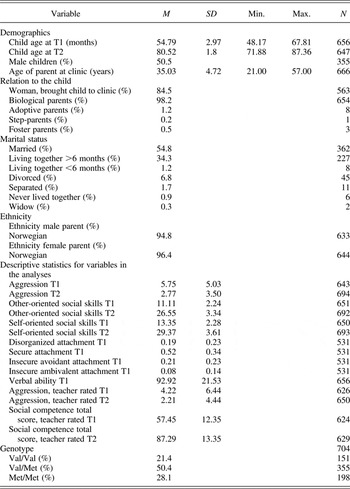
Sample characteristics (N = 704)

Note: T1, Time 1; T2, Time 2; Val/Val, valine/valine; Met/Met, methionine/methionine.
Procedure
After completing the SDQ, the parent who attended the well-child clinic visited the university with the child, typically within 2–4 weeks. Reexamination, including the collection of saliva samples for genotyping, occurred 2 years later when the child began first grade (T2). Most children attended the clinic with the identical parent at both T1 and T2: among the children who were with their mother at T1 (n = 563), 30 were with their father at T2 (5.3%). Among the 103 children who were with their father at T1, 12 returned with their mother at T2 (11.7%). Gender information was missing for 38 parents.
Measurements
The predictor measurements are described first followed by descriptions pertaining to dependent constructs and finally the control variables.
Predictor variables
Attachment disorganization
Disorganization was measured using the MCAST (Green et al., Reference Green, Stanley, Smith and Goldwyn2000). The MCAST has been applied in studies with low- and high-risk samples (Barone et al., Reference Barone, Del Giudice, Fossati, Manaresi, Perinetti and Colle2009; Futh et al., Reference Futh, O'Connor, Matias, Green and Scott2008; Green, Stanley, & Peters, Reference Green, Stanley and Peters2007; Leuzinger-Bohleber et al., Reference Leuzinger-Bohleber, Laezer, Pfenning-Meerkoetter, Fischmann, Wolff and Green2011; Minnis et al., Reference Minnis, Read, Connolly, Burston, Schumm and Putter-Lareman2010; Minnis, Green, O'Connor, & Liew, Reference Minnis, Green, O'Connor and Liew2009; Minnis, Green, O'Connor, Liew, Glaser, et al., Reference Minnis, Green, O'Connor, Liew, Glaser and Taylor2009; Wan & Green, Reference Wan and Green2010), and a number of results emphasize its reliability, internal consistency, and validity (e.g., Barone et al., Reference Barone, Del Giudice, Fossati, Manaresi, Perinetti and Colle2009). MCAST scores are not only stable over time but also correlate in expected manners with other key attachment measures (Green et al., Reference Green, Stanley, Smith and Goldwyn2000). In particular, disorganization has been observed to correlate positively with a mother's unresolved status measured using the Adult Attachment Interview (George, Kaplan, & Main, Reference George, Kaplan and Main1996) and independent teacher ratings of behavioral problems (Goldwyn, Stanley, Smith, & Green, Reference Goldwyn, Stanley, Smith and Green2000). Moreover, Futh et al. (Reference Futh, O'Connor, Matias, Green and Scott2008) observed that disorganization in the children's attachment narratives in the MCAST were associated with greater teacher- and parent-reported problems.
The MCAST uses doll play and story stems to elicit attachment representations. The procedure is that the child is initially shown a non-attachment-related vignette (i.e., a breakfast vignette) that is used to determine whether the child understands and can follow the procedural instructions. This vignette is followed by four attachment-related distress stories that are completed by the children. The administrator establishes a story, which includes a child doll and a mother or father doll (depending on the gender of the parent who accompanied the child to the clinic). The child's identification with the doll figures is emphasized (e.g., “Let's pretend this doll is you; this doll is your mother”). The stories begin with everyday events in which something bad/scary suddenly occurs (e.g., the child doll hurts its knee or has a nightmare). These stress inductions are designed to activate the child's attachment system and aim to facilitate specific attachment-related thoughts and behaviors comparable to the use of separation in the Strange Situation procedure (Ainsworth, Blehar, Waters, & Wall, Reference Ainsworth, Blehar, Waters and Wall1978) or the “five adjective question” in the Adult Attachment Interview (George et al., Reference George, Kaplan and Main1996). When the story climaxes, the administrator asks, “What happens next?” to facilitate the completion of the story by the child. The child is then asked about the feelings of the child/parent dolls.
In this study, the doll play was videotaped, and trained and reliable coders, who were unaware of any information regarding the child, coded each attachment-related story. The videotapes were scored according to a detailed coding manual (Green, Stanley, Goldwyn, & Smith, Reference Green, Stanley, Goldwyn and Smith2007), which specifies how disorganization should be scored on the basis of the child's behavior and his or her narrative during each vignette. Behavioral and narrative indications of disorganization included freezing or lapses at critical narrative points (e.g., a reunion between the child and mother dolls), narratives with no goal direction or major internal contradictions (e.g., proximity seeking then freezing), explicit expressions of the child doll's fear of the parent doll, disoriented or bizarre reactions, or multiple and incompatible strategies within a vignette (e.g., freezing, stilling, or incomplete movements).
We measured disorganization on a dimensional, rather than categorical, basis. The primary categorization (A, B, C, or D) of each vignette was coded as 1 (present) or 0 (absent), and a secondary classification was coded as 0.5 (present) or 0 (absent). An insecure–disorganized/disoriented (D) score was computed by averaging the primary and secondary scores (range = 0–1) across the four vignettes. Hence, a child who attained a primary classification of D on two vignettes and a secondary classification of D on one vignette would be provided a D score of 0.625 ([1 + 0 + 1 + 0.5]/4). Accordingly, the highest D score attainable was 1.0. A random 10% of the MCAST stories were recoded by additional raters who were blind to all information concerning the child and family, which resulted in an interrater reliability of 0.76 for the D scale across multiple pairs of raters. For the insecure–avoidant (A) scale the reliability was 0.71, and it was 0.70 for the insecure–ambivalent (C) scale. Because of the categorical nature of D scores in each vignette (present or absent), theta was used to calculate internal consistency across the four vignettes (θ = 0.79).
COMT
Two milliliters of saliva were collected using the Oragene DNA/Saliva Kit (DNA Genotek, Ottawa, Ontario) to genotype the children. DNA was later extracted and stored according to the manufacturer's protocol. The genotypes of the COMT Val158Met polymorphism were determined using a LightCycler real-time polymerase chain reaction (PCR) machine (Roche Diagnostics Scandinavia AB, Bromma, Sweden; Wittwer et al., Reference Wittwer, Ririe, Andrew, David, Gundry and Balis1997). The PCR was performed in 20 μl of reagent in a LightCycler System using 2 μl of genomic DNA and a LightCycler-FastStart DNA Master Hybridization Probes Kit (Roche Diagnostics) with previously published PCR primers and hybridization probes (Holmen et al., Reference Holmen, Midthjell, Forsèn, Skjerve, Gorseth and Oseland1990). Based on the melting-curve profiles, the genotypes of the participants were classified as Val/Val, Val/Met, or Met/Met. The COMT genotype frequencies were consistent with the Hardy–Weinberg equilibrium. The children's genotypes were divided into three groups: Val/Val (N = 151; 21.4%), Val/Met (N = 355; 50.4%), and Met/Met (N = 198; 28.1%). In the analysis, the methionine carriers were entered as one group (N = 553) with Val/Val carriers as the comparison group.
Dependent variables
Aggressive behavior
Aggressive behavior was measured by the aggressive behavior narrow band scale of the Children's Behavior Checklist, which was completed by the parents (T1 α = 0.88, T2 α = 0.84; Achenbach, Reference Achenbach1991). At T1, the 1.5- to 5-year (Children's Behavior Checklist 1.5–5) version was used, whereas the 6- to 18-year version was used at T2. A Teacher's Report Form (TRF/5–18; Achenbach, Reference Achenbach1991) was used to measure the teacher ratings of the children's aggression (T1 α = 0.93, T2 α = 0.92).
Social skills
Social skills were measured using the 39-item Social Skills Rating System (Gresham & Elliot, Reference Gresham and Elliot1990) completed by the parents, which measures four dimensions: cooperation (T1 α = 0.74, T2 α = 0.78; e.g., helping others, sharing materials, and complying with rules/directions), responsibility (T1 α = 0.66, T2 α = 0.72; e.g., the ability to communicate with adults and respect for property or work), assertion (T1 α = 0.73, T2 α = 0.80; e.g., appropriately expresses feelings when wronged, receives criticism well, and participates in organized group activities), and self-control (T1 α = 0.81, T2 α = 0.86; e.g., appropriately responds to teasing, takes turns, and compromises). Based on the hypotheses, the cooperation and responsibility subscale scores were averaged to create an other-oriented social skills scale, and the assertiveness and self-control scores were averaged to create a self-oriented social skills scale. The correlation between cooperation and responsibility was substantial (T1: r = .68, N = 704; T2: r = .70, N = 704, both p < .001), whereas the correlation between assertion and self-control was somewhat less substantial at T1 (r = .49, N = 704, p < .001) and large at T2 (r = .64, N = 704, p < .001). The teacher-rated global social competence measure (Gresham & Elliot, Reference Gresham and Elliot1990) consists of three dimensions: cooperation (e.g., keeps desk clean without being reminded and finishes tasks within time limits), assertion (e.g., invite others to join activities, initiate conversations with peers, and help the teacher without being told), and self-control (e.g., control temper in conflict situations and wait his or her turn; T1 α = 0.93; T2 α = 0.93).
Verbal ability
Verbal ability was measured using the Peabody Picture Vocabulary Test (Dunn & Dunn, Reference Dunn and Dunn1997; Williams & Wang, Reference Williams and Wang1997; α = 0.99). We also included child gender as a covariate.
Results
Descriptive statistics
Table 1 presents the descriptive statistics for all variables included in the primary structural equation modeling (SEM) analysis. Aggression decreased from age 4 to 6 years, whereas social competence, other-oriented social skills, and self-oriented social skills all increased, as was expected. Secure attachment had the highest mean level, whereas disorganization and insecure avoidance had similar scores and insecure ambivalent was less frequent, as was also expected. In terms of the disorganized attachment scores, 44.2% of children showed no evidence of disorganization and received a score of zero; 32.3% of children scored between 0.13 and 0.33, and 23.5% of the sample was characterized as highly disorganized (range = 0.38–1.00).
Independent sample t tests were conducted to compare aggression, other-oriented social skills, and self-oriented social skills scores for the two genotype groups at T1 and T2. There was no significant difference in aggressive behaviors between the genotypes at either T1, t (641) = –1.83, p = .07, or T2, t (692) = –0.93, p = .35. However, methionine carriers scored slightly higher on the self-oriented social skills than did valine homozygotes at T1, score = 27.32 versus 26.58, t (646) = 1.96, p = .05, and T2, score = 39.66 versus 38.43, t (690) = 2.19, p = .03. There were no significant differences between the genotypes for other-oriented social skills at T1 or T2: T1, t (648) = 1.69, p = .09; T2, t (689) = –1.04, p = .30. Independent sample t tests were also conducted to determine whether the gender of the parent accompanying the child affected the assessment of child aggression and social competence. No such parent gender difference was observed for aggression at T1, t (639) = 1.17, p = .24, or T2, t (676) = –1.08, p = .28, or social competence at T1, t (646) = 1.36, p = .17, or T2, t (675) = –0.27, p = .79.
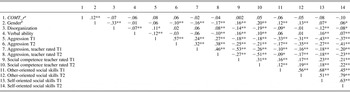
Table 2 displays the correlations among all study variables. Small but significant negative associations were observed between disorganization and verbal ability, other-oriented social skills (T1), and self-oriented social skills (T1, T2). Aggression was associated with disorganization (T1 only) and low levels of social competence (T1, T2).
Correlations between variables

Note: T1, Time 1; T2, Time 2.
a Catechol-O-methyltransferase (COMT): methionine/methionine (Met/Met) and valine/Met (Val/Met) = 0, Val/Val = 1.
b Boys = 1, Girls = 2.
*p = .05. **p = .01.
Primary analyses
We conducted the primary data analyses in two phases using SEM to evaluate whether the COMT Val158Met polymorphism moderated the effects of disorganized attachment on aggression and social skills. These analyses were followed by identical analyses focused on components of the social skills composite variable. Aggressive behavior and other-oriented and self-oriented social skill scores at T2 were regressed on the following T1 variables: aggressive behavior, other-oriented social skills, self-oriented social skills, gender, disorganization, and language skills. Aggressive behavior and social skills at T2 were allowed to correlate. Multigroup analyses were performed to compare the methionine carriers with the Val/Val carriers to test for Gene × Disorganization interaction effects. Initially, all path coefficients were freely estimated. This solution was compared to a solution in which the path coefficients between the disorganization outcomes at T1 and T2, aggressive behavior, and social competence were fixed to be equal in the two genotype groups. A robust maximum likelihood estimator was used. Because the χ2 differences between the restricted and freely estimated models by the robust maximum likelihood were not χ2 distributed, the two models were compared according to Satorra (Reference Satorra, Heijmans, Pollock and Satorra2000) procedure.
These primary analyses were performed using Mplus 7.11 (Muthén & Muthén, Reference Muthén and Muthén1998–2012). With a screen-stratified sample, all parameters were weighted with the inverse of the drawing probability for each subject (i.e., low screen scorers were “weighted up” and high scorers were “weighted down”). This method provided unbiased general population estimates (Horvitz & Thompson, Reference Horvitz and Thompson1952). Missing data among those children who were genotyped were handled according to the full information maximum likelihood procedure.
Prediction of T1 to T2 change in aggression and social competence
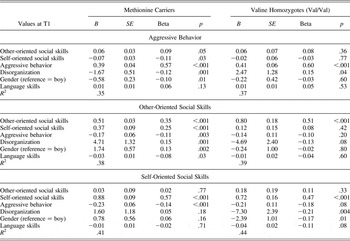
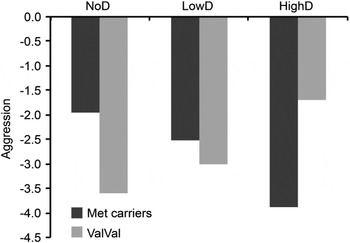
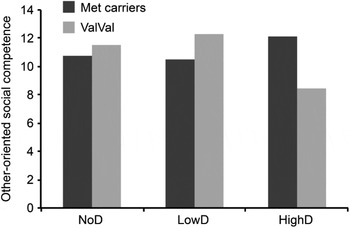
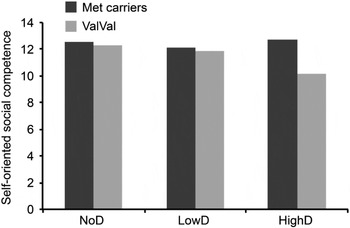
Table 3 presents the results of the initial phase of the multigroup SEM analysis designed to determine whether COMT moderated parent-rated aggressive behavior and social competence in disorganized children. For valine-homozygous individuals, greater disorganization predicted more aggressive behavior and less other-oriented social skills. These children also decreased in self-oriented social skills with increasing levels of disorganization after controlling for the identical measurements (and gender and verbal ability) at 4 years of age. The opposite pattern of results was observed for carriers of the methionine allele: greater disorganization predicted a significant decrease in aggression and significant increase in other-oriented social skills. Comparisons between the models in which the path coefficient was freely estimated and the models in which the path was fixed to be equal across the groups yielded significant differences for aggression (Δχ2 = 13.61 df = 1, p = .0002), other-oriented social skills (Δχ2 = 9.19, df = 1, p = .002), and self-oriented social skills (Δχ2 = 7.80, df = 1, p = .005). Namely, genotype moderated the effect of disorganization on social development in the predicted manner. Because we used a continuous D score scale in the above analyses, it is possible that the reported results emerged because of trivial changes at the lower end of the D score continuum. To determine whether the results were maintained for children with high levels of disorganization as was predicted, the D scale was rescaled, to distinguish children scoring at the top (23%) of the distribution from those scoring low or with no score. The resulting interactions are illustrated in Figure 1 (aggression), Figure 2 (other-oriented social skills), and Figure 3 (self-oriented social skills). The figures reflect subgroup mean comparisons of change from T1 to T2 and contrast the outcome scores for the two genotypes according to D subgroups. Figure 1 shows that although most children showed a decrease in aggression, methionine-carrying high disorganization (HighD) children showed the greatest decrease, whereas valine-homozygotic HighD children showed the smallest decrease in aggression. This genotypic difference between HighD children was significant, χ2 (1) = 7.13, p = .008. However, children whose D score was zero (NoD) showed the opposite pattern, such that valine homozygotes decreased the most in aggression and methionine carriers decreased the least, χ2 (1) = 7.11, p = .008. Figures 2 and 3 show that all children increased in social skills, but methionine-carrying HighD children showed the greatest increase in other-oriented social skills, whereas valine homozygotes with high D scores showed a comparatively smaller increase in other-oriented social skills. This genotypic difference between the HighD scoring children was significant, χ2 (1) = 16.22, p = .0001. NoD and low disorganization (LowD) children did not differ in other-oriented social skills according to genotype. A similar pattern of development, although less strong, was observed with respect to self-oriented social skills: HighD children homozygous for the valine allele showed less increase compared to methionine carriers, χ2 (1) = 3.78, p = .05. Thus, in summary, only HighD children had social developments that changed according to genotype.
Prediction of aggressive behavior and social competence in 4- to 6-year-olds in accordance with disorganization and genotype

Note: Val/Val, Valine/valine.
The subgroup mean comparison predicting change in aggression from age 4 to 6 according to the disorganization score at age 4 in methionine (Met) carriers and valine (Val) homozygotes, respectively. NoD, no disorganization; LowD, low disorganization score; and HighD, high disorganization score.

The subgroup mean comparison predicting change in other-oriented social competence from age 4 to 6 according to disorganization scores at age 4 in methionine (Met) carriers and valine (Val) homozygotes, respectively. NoD, no disorganization; LowD, low disorganization score; and HighD, high disorganization score.

The subgroup mean comparison predicting change in self-oriented social competence from age 4 to 6 according to disorganization scores at age 4 in methionine (Met) carriers and valine (Val) homozygotes, respectively. NoD, no disorganization; LowD, low disorganization score; and HighD, high disorganization score.

To investigate whether the detected interactions between genotype and disorganization were because of an absence of security, the previously reported regression analyses were rerun to control for a composite security score reflecting the sum of MCAST insecure-ambivalence and insecure-avoidance. The COMT × Disorganization interaction remained significant in predicting T2 aggressive behavior, Δχ2 (1) = 14.11, p < .0002, other-oriented social skills, Δχ2 (1) = 8.45, p = .004, and self-oriented social skills, Δχ2 (1) = 7.34, p = .007.
It was predicted that the genetic moderation of the effects of disorganization would be restricted to parental reports based on the view that disorganization is a relationship-specific measure. To examine whether the observed interactions were specific to parents, we reran the analyses using the continuous D score with teacher ratings of aggression and social skills. The results indicated that higher D scores did not predict aggression (Val/Val, β = –0.01, p = .92, methionine carriers, β = 0.04, p = .55); however, social skills decreased significantly in methionine carriers (Val/Val, β = –0.10, p = .44, methionine carriers, β = –0.12, p = .02).
Secondary analyses
Although these analyses were not the central focus of this study (because of an absence of the temporal ordering of predictors and outcomes) we examined whether genotypes moderated the effect of disorganized attachment at age 4 on child aggression, other-oriented social skills, and self-oriented social skills when adjusting for the covariation between these social outcomes and gender and language skills. Thereafter, we examined the identical Gender × Attachment interaction at age 6. The results showed that disorganization was significantly associated with aggression at age 4 among methionine carriers, although this result was not significant compared to valine homozygotes (Val/Val, β = –0.08, p = .37, methionine carriers, β = 0.13, p = .02, χ2 = 3.18, df = 1, p = .07). Disorganization was not significantly associated with other-oriented social skills (Val/Val, β = 0.04, p = .71, methionine carriers, β = –0.07, p = .19, χ2 = 0.81, df = 1, p = .37) at age 4. Regarding self-oriented social skills, there was no association among the valine homozygotes (β = –0.12, p = .14), but HighD methionine carriers showed a lesser degree of such skills (β = –0.10, p = .04), although this difference in the effect of D between genotypes was not significant (χ2 = 0.81, df = 1, p = .37). At age 6, there was no longer any association between disorganization and aggression for any of the COMT genotypes (Val/Val, β = 0.09, p = .33, methionine carriers, β = –0.05, p = .25, χ2 = 1.92, df = 1, p = .17). However, among methionine carriers disorganization was now (as opposed to age 4) associated with more other-oriented social skills (β = 0.10, p = .04). This result was not observed among the valine homozygotes (β = –0.11, p = .29), which bordered on significance (χ2 = 3.25, df = 1, p = .07). Disorganization was associated with significantly less self-oriented social skills at age 6 among valine homozygotes (β = –0.23, p = .02) but not methionine carriers (β = –0.01, p = .77, χ2 = 3.89, df = 1, p = .05). In sum, there was a significant association between disorganization and aggression and low self-oriented social skills among methionine carriers that was observed at age 4 but not at age 6, whereas the previous nonsignificant association with other-oriented social skills became significant at age 6. However, disorganization was not associated with social outcomes among valine homozygotes at age 4, but at age 6, they showed decreasing self-oriented social skills with increasing disorganization.
Treating all methionine carriers as members of a single group rested on the premise that the effects of disorganization on social competence and aggressive behavior would not vary across hetero- and homozygote methionine carriers. To test this premise, we reran the analyses investigating the possible differences between the two methionine-carrying groups. No differences were observed.
Discussion
For more than 25 years, developmentalists have chronicled the development of children with disorganized attachment histories (Main & Cassidy, Reference Main and Cassidy1988; Moss et al., Reference Moss, Cyr, Bureau, Tarabulsy and Dubois-Comtois2005; O'Connor et al., Reference O'Connor, Bureau, McCartney and Lyons-Ruth2011; Wartner et al., Reference Wartner, Grossmann, Fremmerbombik and Suess1994). This research has yielded a clinical and empirical consensus that as children age and reaches late preschool or early school age, their disorganization manifests in at least in two different manners. Whereas some disorganized children behave in a punitive and aggressive manner toward their parents, other disorganized children behave in a particularly pronounced cooperative, caregiving manner (Main & Cassidy, Reference Main and Cassidy1988; Wartner et al., Reference Wartner, Grossmann, Fremmerbombik and Suess1994). Previous research has raised the possibility that these differences are a function of the children's rearing environments (Bureau et al., Reference Bureau, Easlerbrooks and Lyons-Ruth2009; George & Solomon, Reference George and Solomon1998; Moss et al., Reference Moss, Cyr and Dubois-Comtois2004; Solomon & George, Reference Solomon, George and Mayseless2006) and may thus reflect different manners of coping with a disorganization-inducing family environment, including parenting.
In this study, we tested an alternative explanation of the divergent developmental legacies of disorganization; namely, that genotype might contribute to the differences in aggressive behavior and social competence displayed by controlling–punitive and controlling–caregiving children. The results of this prospective study of a large community sample of Norwegian 4-year-olds was consistent with expectations that valine-homozygous and methionine-carrying children who scored high for disorganization as preschoolers would develop in contrasting manners in the transition to school. Highly disorganized children homozygous for the valine allele become more aggressive over time and show reduced self-oriented social skills compared to less disorganized children, whereas aggressive behavior decreased and other-oriented social skills increased in methionine-carrying children who scored high on disorganization in preschool compared to those who scored low on disorganization. In addition, these children did not completely match a controlling–caregiving (comparatively little aggression and high other-oriented social skills) or controlling–punitive style (comparatively higher aggression and lower self-oriented social skills) at either age 4 or age 6. Nevertheless, with increasing levels of D, 6-year-old valine homozygotes showed lower self-oriented skills, whereas methionine carriers showed higher other-oriented skills.
These differences at age 6 and because the two genotypes develop in opposite directions (in terms of change over time) with regard to social functioning, suggests that we may be tapping into a developmental process that has not yet produced sufficient change to generate differences in functioning at age 6. This suggestion leads to speculation that differences in the direction of growth may become sufficient with more time to generate detectable differences in functioning at older ages. Such a result would be consistent with Bureau et al. (Reference Bureau, Easlerbrooks and Lyons-Ruth2009), who proposed that behavioral differences in disorganization subtypes (punitive, caregiving, and disorganized profiles) become pronounced by 8 to 9 years of age.
However attractive this proposal is, it remains difficult to explain all the results from this study. Nevertheless, it remains notable and seemingly important that genotype interacted with disorganization when focusing on change over time from ages 4 to 6. Within this time frame, children generally develop more social skills (Berger, Reference Berger2011; Matthews et al., Reference Matthews, Deary and Whiteman2009) and decrease in aggression (Cote et al., Reference Cote, Vaillancourt, LeBlanc, Nagin and Tremblay2006; Tremblay et al., Reference Tremblay, Nagin, Seguin, Zoccolillo, Zelazo and Boivin2004). In addition, cognitive skills increase during this period. Therefore, in this particular developmental phase, genotype may play a more active role than earlier in life, at least with respect to this particular behavioral phenomenon. It is well appreciated that gene functioning, including expression, varies across life (Meaney, Reference Meaney2010; Szyf, Reference Szyf2009a, Reference Szyf2009b).
Although we cannot be certain that increases in social competence of disorganized methionine-carrying children reflects a controlling–caregiving style of functioning, as we hypothesized, because this result did not emerge when teacher reports were considered and was not observed among the valine homozygotes, suggests that our judgment was not entirely misguided. Further support for this view derives from the fact that the children with disorganized histories showed increases in the other-oriented components of social competence. Such results, although not definitive, appear consistent with the notion that methionine carriers with disorganized histories of attachment become increasingly attentive toward and desirous of pleasing their parents, but not necessarily their teachers. Obviously, it would have been optimal if a less uncertain measure of controlling–caregiving behavior was available. Future research should include such a measure when aiming to extend this Gene × Attachment research.
In sum, the results of this inquiry suggest that disorganized children develop differently in their relationships with their mothers because of their version of the COMT gene or some other reasonably correlated factor. The COMT Val158Met accounts for much of the dopamine degradation in the PFC (Karoum et al., Reference Karoum, Chrapusta and Egan1994) and thus plays an important role in regulating dopamine concentration in this region of the brain that is critical for human behavior. The PFC is involved in complex mental processes (Benton, Reference Benton, Levin, Eisenberg and Benton1991; Fuster, Reference Fuster2011), including the assessment and control of appropriate social behavior (Allen, Reference Allen2009; Yang & Raine, Reference Yang and Raine2009). The COMT polymorphism has thus been related to self-regulation and attention (Diamond, Briand, Fossella, & Gehlbach, Reference Diamond, Briand, Fossella and Gehlbach2004; Egan et al., Reference Egan, Goldberg, Kolachana, Callicott, Straub and Goldman2001). Different levels of COMT activity conferred by the Val158Met genotypes may therefore play an important role in stress response and self-regulating mechanisms, which in turn may be related to the development of aggressive behavior and social competence, particularly in the case of children with histories of disorganized attachment.
The tonic-phasic theory (Bilder, Volavka, Lachman, & Grace, Reference Bilder, Volavka, Lachman and Grace2004; Grace, Reference Grace1991) may offer some explanation of the contributing mechanisms. The tonic-phasic theory states that the dynamics of dopamine regulation occur via two processes: a high-amplitude transitory, phasic dopamine release, which is caused by a dopamine neuron burst firing that is triggered by behaviorally relevant stimuli; and a sustained low-level “background” tonic dopamine release. Tonic dopamine release is thought to regulate the intensity of the phasic dopamine response through its effect on extracellular dopamine levels (Grace, Reference Grace1991). Because of different enzyme activity associated with COMT Val158Met, COMT Val158Met may influence the balance of tonic and phasic dopamine transmission (Bilder et al., Reference Bilder, Volavka, Lachman and Grace2004). For homozygous valine carriers, the breakdown of dopamine occurs two to four times faster than for methionine carriers (Weinshilboum et al., Reference Weinshilboum, Otterness and Szumlanski1999), which results in decreased overall dopamine concentrations in homozygous valine carriers compared to methionine carriers. Therefore, the effect of the methionine allele should be an increased tonic dopamine transmission in different regions of the brain. The valine allele is assumed to have complementary effects: increasing the phasic dopamine transmission while decreasing the subcortical tonic dopamine neurotransmission and overall dopamine concentration in the PFC (Bilder et al., Reference Bilder, Volavka, Lachman and Grace2004). The valine allele is associated with lower tonic dopamine, which is hypothesized to reduce executive function (Bilder et al., Reference Bilder, Volavka, Lachman and Grace2004; Goldberg et al., Reference Goldberg, Egan, Gscheidle, Coppola, Weickert and Kolachana2003), which may facilitate the propensity for reactive aggression when facing provocations, including those from demanding parents. Carriers of the methionine allele will have higher D1 and D2 transmission and thus more stable networks for short-term memory (Bilder et al., Reference Bilder, Volavka, Lachman and Grace2004). The better short-term memory among methionine carriers may equip highly disorganized children with another coping mechanism when facing stressful situations, such as an unstable or needy parent, thus leading them (over time) to act in a deliberate and planned manner rather than aggressively, which results in other-oriented behaviors over time.
Perroud et al. (Reference Perroud, Jaussent, Guillaume, Bellivier, Baud and Jollant2010) contend that with equal environmental exposure, stress-induced phasic dopamine release will be greater in valine allele carriers. This suggestion may explain why valine carriers facing adversities, possibly including disorganized attachment (and the rearing history it reflects), became more aggressive over time than did methionine carriers. Namely, this developmental pattern may have been the result of an increase in phasic dopamine transmission in response to environmental stress (Bilder et al., Reference Bilder, Volavka, Lachman and Grace2004), a suggestion that must be tested in future research before it can be confidently concluded.
The obviously speculative interpretation of the results reported herein is consistent with results of other Gene × Environment studies focused on COMT Val158Met, contextual adversity and aggression, for example, data showing that problematic behavior increases among valine homozygotes raised under conditions of socioeconomic disadvantage (Nobile et al., Reference Nobile, Rusconi, Bellina, Marino, Giorda and Carlet2010); that low birth weight coupled with valine homozygosity increases the risk of antisocial behaviors (Thapar et al., Reference Thapar, Langley, Fowler, Rice, Turic and Whittinger2005); and that the identical results are true for children with ADHD (Caspi et al., Reference Caspi, Langley, Milne, Moffitt, O'Donovan and Owen2008; Langley et al., Reference Langley, Heron, O'Donovan, Owen and Thapar2010).
In accordance with the tonic-phasic hypothesis (Bilder et al., Reference Bilder, Volavka, Lachman and Grace2004), methionine carriers may have dopamine levels that make self-regulation and cooperative social behavior more likely. Higher dopamine levels have been associated with an internal locus of control (Previc, Reference Previc2009). Therefore, it is possible that the higher dopamine levels of methionine carriers result in a less spontaneous and more deliberate approach to the threatening environment that disorganized children may experience. This approach may result in more proactive efforts to regulate the environment, including particularly other-oriented behavior, which was observed in our study. Although the primary results were consistent with our expectations and also appeared consistent with the tonic-phasic hypothesis (Bilder et al., Reference Bilder, Volavka, Lachman and Grace2004), more research is necessary before strong conclusions and interpretations can be drawn from our results. Our focus was exclusively on the COMT Val158Met polymorphism. Thus, future research should consider other genes implicated in the development of aggression, social skills, and related developmental constructs. Whether the results reported herein, which diverge from those of Luijk et al. (Reference Luijk, Velders, Tharner, van IJzendoorn, Bakermans-Kranenburg and Jaddoe2010), are a function of when and how we measure disorganization must be determined. For this reason, we believe that these results must be replicated with other measures of attachment disorganization (e.g., the Strange Situation procedure). Moreover, we consider it a limitation that mothers were overrepresented in both the attachment sequence and in reporting children's behaviors. Hence, we encourage future studies to rely on other informants.
Nevertheless, although Luijk et al. (Reference Luijk, Velders, Tharner, van IJzendoorn, Bakermans-Kranenburg and Jaddoe2010) diverged from the present study by including different genes and other outcomes, the authors demonstrated the similar interplay between genes and attachment (although not with disorganization) to explain developmental outcomes, thus suggesting that Gene × Attachment interactions are eligible for further examination. The present study indicates the complex dynamics of how disorganization influences social development from a genetic perspective, and presumably offers a window into the development of controlling–punitive versus controlling–caregiving behaviors in early childhood.