The face of traditional second language (L2) classrooms in colleges and universities across North America has been changing dramatically, especially in Spanish, Russian, East Asian, South Asian, and other less commonly taught languages. In addition to teaching the typical English-speaking L2 learner, these classes have been increasingly accommodating heritage language speakers or, in the present case, English-speaking individuals with some previous knowledge of the target language, acquired at home as a family language (Valdés, Reference Valdés2000). Faced with this increasing trend, many L2 practitioners readily recognize that having learners with different language backgrounds in the same classes poses serious pedagogical challenges, because there are obvious cultural differences between L2 learners and heritage speakers and different motivations for learning the target language (Carreira, Reference Carreira2004; Kagan & Dillon, Reference Kagan and Dillon2003; Lynch, Reference Lynch2003; Potowski, Reference Potowski2002). However, learning a language is also about meeting certain linguistic goals. At a more basic level, any pedagogical practice must be informed by a deep understanding of what L2 learners and heritage speakers have or do not have in common in terms of linguistic knowledge.
Although heritage speakers and L2 learners are very different in many respects, they are also very similar in others. The purpose of this study is to compare and contrast the linguistic abilities of L2 learners and heritage speakers of comparable written proficiency in the target language. Pinpointing specific areas of linguistic knowledge in which the two types of learners may differ or not is an important first step before engaging in any type of classroom-based instructional intervention. In general, and even within a language, heritage speakers are a quite heterogeneous group because they vary in their linguistic characteristics and language history (Kanno, Hasegawa, Ikeda, Ito, & Long, Reference Kanno, Hasegawa, Ikeda, Ito, Long, Brinton, Kagan and Bauckus2008; Kondo-Brown, Reference Kondo-Brown2005). It has been claimed that many heritage language speakers exhibit nontargetlike proficiency, which is likely because of apparent incomplete acquisition arising for a variety of reasons (Montrul, Reference Montrul2002, Reference Montrul2008; Polinsky, Reference Polinsky1997, Reference Polinsky, Brinton, Kagan and Bauckus2008a; Silva-Corvalán, Reference Silva-Corvalán1994, Reference Silva-Corvalán, Montrul and Ordóñez2003), when compared with the linguistic abilities of a monolingual or fluent bilingual speaker of the same age, social group, and cognitive development.Footnote 1 Because the phenomenon of incomplete acquisition has often been associated with the variable outcome typically observed in adult L2 acquisition (e.g., as explicitly stated in Schachter's incompleteness hypothesis, Reference Schachter1990), it may not be entirely obvious why, and how, incomplete acquisition can also be extended to some cases of early bilingualism.
Several studies have now reported that in terms of grammatical accuracy, L2 learners and heritage speakers make similar types of errors with inflectional morphology, for example (Håkansson, Reference Håkansson1995; Lipski, Reference Lipski, Roca and Lipski1993; Montrul, Foote, & Perpiñán, Reference Montrul2008). First language (L1) transfer is very common in L2 acquisition. Similarly, transfer from the stronger language (L2) to the weaker language (L1) is also very common and frequent in heritage speakers, and may often have a deterministic role in the patterns of incompleteness and fossilization attested in heritage language grammars (Kim, Montrul, & Yoon, in press; Montrul, Reference Montrul2004a; Montrul & Bowles, Reference Montrul and Bowles2009). Another characteristic shared by both L2 learners and heritage speakers involves exposure to variable amount and quality of input (i.e., restricted to certain contexts or interlocutors). This contrasts significantly with the linguistic environment of normally developing L1 acquiring children, who receive consistent and abundant input, and eventually develop targetlike knowledge and use of their native language. Finally, motivation and other affective variables, which are relevant in L2 acquisition, play a similar, if not greater, role in minority language maintenance. Issues related to language identity are prominent in heritage language use and (re)acquisition in a classroom setting (Potowski, Reference Potowski2007).
Essentially, then, although the linguistic outcome of L1 acquisition is typically characterized as uniform and complete, the outcomes of adult L2 acquisition and heritage language acquisition can be nonconvergent or incomplete for a variety of reasons (Montrul, Reference Montrul2008).Footnote 2 However, other crucial differences between adult L2 learners and heritage speakers concerns age of first exposure to the target language, context, and mode of acquisition. Heritage speakers receive predominantly oral input early in life, in a naturalistic setting, whereas L2 learners begin exposure to written and oral L2 input later in life, in a predominantly instructed setting. If age of acquisition is an important factor in bilingual outcomes, as many cognitive and linguistic approaches to L2 acquisition assume (Bley-Vroman, Reference Bley-Vroman1990; Clahsen & Muysken, Reference Clahsen and Muysken1986; DeKeyser Reference DeKeyser2000, Reference DeKeyser, Doughty and Long2003; Hawkins & Chan, Reference Hawkins and Chan1997; Hyltenstam & Abrahamsson, Reference Hyltenstam, Abrahamsson, Doughty and Long2003; Long, Reference Long1990; Meisel, Reference Meisel1997; Paradis, Reference Paradis2004; Schachter, Reference Schachter1990; Smith & Tsimpli, Reference Smith and Tsimpli1995), then it is possible that even if heritage speakers’ linguistic abilities do not match those of full native speakers, heritage speakers may still possess more nativelike knowledge of the target language than their L2 learner counterparts. According to theoretical positions that stress the role of age in language learning (Bley-Vroman, Reference Bley-Vroman1990; Clahsen & Muysken, Reference Clahsen and Muysken1986; DeKeyser Reference DeKeyser2000, Reference DeKeyser, Doughty and Long2003; Hawkins & Chan, Reference Hawkins and Chan1997; Hyltenstam & Abrahamsson, Reference Hyltenstam, Abrahamsson, Doughty and Long2003), early input matters because the mechanisms assumed to operate for language acquisition in childhood may be different from those deployed in adulthood. As pointed out by Bialystok and Hakuta (Reference Bialystok, Hakuta and Birdsong1999), the type of input (and literacy) as well as changes in other cognitive mechanisms are undeniably confounded with age. Therefore, even when researchers refer to age as a main factor, it is actually a macrovariable that subsumes a host of other interrelated and confounded factors, including cognitive development as well as amount, type, and modality of input.
Recent studies by cognitive psychologists (Au, Knightly, Ju, & Oh, Reference Au, Knightly, Jun and Oh2002; Au, Knightly, Ju, Oh, & Romo, Reference Au, Knightly, Jun, Oh and Romo2008; Knightly, Jun, Oh, & Au, 2003) of Korean and Spanish heritage speakers and L2 learners of very low proficiency in these languages suggest that early language experience definitely confers an advantage for heritage speakers in pronunciation and some aspects of phonology but not in morphosyntax.Footnote 3 In contrast, other researchers working from the perspective of linguistics have found qualitative and quantitative differences between heritage speakers and L2 learners in aspects of syntax and lexical semantics (Håkkanson, Reference Håkansson1995; Montrul, Reference Montrul2005, Reference Montrul, Slabakova, Montrul and Prévost2006). Although claims about potential advantages in one linguistic area but not in others support the modularity and selectivity of linguistic knowledge, the distinction between morphosyntax versus phonology as presented by Au and collaborators is too coarse grained. For example, Au et al.'s (Reference Au, Knightly, Jun and Oh2002) and Knightly et al.'s (Reference Knightly, Jun, Oh and Au2003) studies of Spanish heritage speakers tested gender agreement on nouns, verbal agreement, aspect, mood, pronouns, clitics, case marking, and negation in a 66-item aural grammaticality judgment task, with very few items per grammatical structure. However, the fact is that morphology and syntax are complex and comprehensive areas of linguistic knowledge. Even in L1 acquisition, these same grammatical domains have different developmental schedules and present different degrees of difficulty to children. For example, tense and agreement are mastered much earlier than mood. Thus, the question becomes, do heritage speakers have advantages over L2 learners in some areas of morphosyntax but not in others? A proper answer requires the investigation of specific grammatical areas in more depth, taking into account degree of linguistic complexity and patterns of language use within different structures subsumed under a given grammatical domain. These two crucial factors, for example, which were overlooked in Au et al.'s studies, are taken into account in the present study.
The present study revisits the questions of whether early input and language use confer an advantage to heritage language learners by investigating knowledge of object clitics and word order in Spanish L2 learners and heritage speakers of low–intermediate proficiency in the language. Obligatory clitic doubling with indirect objects and strong pronouns was one of the many structures tested by Au and collaborators.Footnote 4 Although these and many other aspects of object expression are quite frequent in the input and appear to be acquired by monolingual Spanish-speaking children by age 3 (Montrul, Reference Montrul2004b, chap. 3), they pose different degrees of difficulty for adult English-speaking L2 learners for reasons that we will address shortly. Thus, if age of acquisition and experience with input matter for this particular domain, heritage speakers may display more targetlike knowledge of clitics and word order than their L2 counterparts.
The next section introduces the linguistic background on Spanish object clitics, focusing on clitic placement, clitic doubling, and word order with topicalizations, followed by a selective review of how clitics are acquired by monolingual children, L2 learners, and bilinguals in the following section. Then the methods and results of three related tasks administered to all the participants in the present study are presented: an oral production task, a written grammaticality judgment task, a speeded visual picture–sentence matching task. To anticipate the main findings, the results of three tasks confirm that the early exposure hypothesis is largely correct. Contrary to the claimes of Au et al. (Reference Au, Knightly, Jun and Oh2002, Reference Au, Knightly, Jun, Oh and Romo2008) and Knightly et al. (Reference Knightly, Jun, Oh and Au2003), this study shows that the advantages for early language exposure found in phonology may also be true of some morphosyntactic domains as well: heritage speakers exhibit more nativelike knowledge, comprehension, and use of Spanish clitics than L2 learners. The final section concludes with a discussion of these findings for current theories of L2 learning and for the field of heritage language acquisition.
SPANISH CLITICS AND WORD ORDER
Spanish is a language that has both strong pronouns and clitics. Strong pronouns like mí, ti, él/ella, nosotros, and so forth are equivalent to the English strong pronouns me, you, him, and so forth (strong pronouns in Spanish also occur in object position, after the verb, as shown by ella in Examples 5 and 7). Unlike English, Spanish also has weak pronouns or clitics, such as me, te, lo, la, and le, which differ in case: accusative is used for direct objects and dative for indirect objects and other semantically determined arguments of the verb. Clitics have several syntactic properties that set them apart from strong pronouns (Cardinaletti & Starke, Reference Cardinaletti, Starke and Van Riemsdijk1999; Kayne, Reference Kayne1975; Strozer, Reference Strozer1976), but a main characteristic is that they must attach to a host, which in Spanish is the verb.
Clitic placement with respect to the verb is regulated by finiteness. When the verb is finite, the clitic pronoun precedes it, as in Example 1a. When the verb is an infinitive or other nonfinite form, the clitic must follow it, as in Example 2a. The opposite word orders with finite Example 1b and nonfinite verbs Example 2b are ungrammatical.
- 1.
a. Juan lo mira todos los días.
b. *Juan mira lo todos los días.
“Juan watches it everyday.”
- 2.
a. Ana canta la canción sin entenderla bien.
b. *Ana canta la canción sin la entender bien.
“Ana sings that song without understanding it well.”
In restructuring contexts, that is, a sequence of a modal, causative, or aspectual finite verb and a nonfinite form (gerund, infinitive, past participle) as in Example 3, object clitics can climb up before the conjugated verb (Example 3a) or stay low after the infinitive (Example 3b). Unlike in French and Brazilian Portuguese, the clitic in Spanish cannot appear in between the finite verb and the infinitive, as in Example 3c.
- 3.
a. Olga lo puede comprar.
b. Olga puede comprarlo.
c. *Olga puede lo comprar.
“Olga can buy it.”
Clitic doubling, the co-ocurrence of a noun phrase (NP) and the clitic, is optional, although much preferred in most Spanish varieties, with dative clitics and indirect objects, as shown in Example 4.
Clitic doubling with indirect objects is grammatical across all varieties of Spanish; there is no Spanish dialect in which indirect object doubling does not occur to some extent. In Latin American dialects, clitic doubling is actually the preferred option (Weissenrieder, Reference Weissenrieder1995).Footnote 5
Clitic doubling with accusative clitics and direct objects is ungrammatical in most Spanish varieties, except Argentine Spanish, so Example 6 does not have a clitic. Examples 5 and 7 show that with strong pronouns (dative and accusative), clitic doubling is always obligatory.
4. (Le) di un regalo a Patricia.
her gave a present to Patricia
“I gave a present to Patricia.”
5.

her gave a present to her
“I gave a present to Patricia.”
6. Florencia vio a mi abuela.
Florencia saw A my grandmother
“Florencia saw my grandmother.”
7.
Florencia her saw A her
“Florencia saw her.”

With respect to word order in more complex structures, Spanish topicalizes objects in clitic left dislocation constructions (CLLDs). In these constructions, clitic doubling with both accusative and dative clitics is obligatory in all dialects of Spanish, as shown in Examples 8b and 8c and 9b and 9c.
8.
9.
Although English allows topicalizations or contrastive left dislocations, as in Examples 10 and 11, a difference between Spanish and English is that the presence of clitics in Spanish is obligatory, when the direct object has a specific reference, as in Example 8b. With nonspecific direct objects, the construction is ungrammatical with the clitic (Contreras, Reference Contreras1978), as in Example 12.
10. The folders, I left in the office.
11. Water, I love to drink.
12. *Agua, me gusta tomarla.
“Water, I like to drink.”
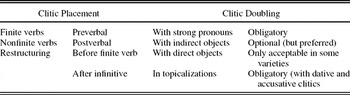
Table 1 summarizes the syntactic realizations of Spanish clitics. The syntactic literature on Romance clitics is very extensive, and only a small representative sample can be mentioned here. On standard analyses of Romance clitics within generative grammar, clitics are considered functional categories instantiating case, referentiality, and agreement (Sportiche, Reference Sportiche, Rooryck and Zaring1996; Uriagereka, Reference Uriagereka1995). On this account, clitics are base-generated in an agreement projection above the verb but within the inflectional phrase (IP): AgrO (Uriegereka, Reference Uriagereka1995) or AccVoice (Sportiche, Reference Sportiche, Rooryck and Zaring1996; see Example 13). The optional (but preferred) co-occurrence of a clitic and a prepositional phrase (PP) with indirect objects (clitic doubling) is captured very naturally under this analysis.Footnote 7 The position of clitics with respect to the finiteness of the verb in Spanish and other Romance varieties is also related to the strength of agreement features on finite and nonfinite verbs and verb movement within the IP (Kayne, Reference Kayne1991).
Summary of the realization of Spanish clitics

13.
Unlike clitics in main clauses and clitic doubling with indirect objects, clitic left dislocations have specific discourse functions. They involve topicalizing an object for contrast (e.g., contrastive topicalization according to Arregi, Reference Arregi2003) and engage the complementizer projection (CP). In clitic left dislocations the topicalized element is moved from its original position within the IP to the left periphery of the clause, to a functional projection above IP in the complementizer phrase (CP). Let us assume it is TopP, following Rizzi (Reference Rizzi and Haegeman1997). (See Rizzi, Reference Rizzi and Haegeman1997, for more specific details as to all the functional projections comprising the CP.) Topicalized elements must be specific (definite descriptions; but see Arregi, Reference Arregi2003, for examples of topicalizations with indefinites like algunos “some, plural” in Spanish). The topic moved to the left periphery is linked to an open position below the CP, which in Example 14 ia assumed as AgrO for the sake of argument. In Spanish, the open position is filled overtly by a clitic, when the topicalized element is specific. Therefore, clitic doubling in topicalizations of this sort is obligatory in Spanish.
14.
In general, clitics are very frequent with finite and nonfinite verbs, in spoken and written Spanish, especially in anaphoric contexts, or when they replace an object already mentioned in discourse. Davies's (Reference Davies1995) study of written and oral corpora from 10 Spanish dialects shows that in restructuring contexts, clitic climbing occurs up to 85% of the time, especially with the verb ir “go.” Clitic doubling with indirect objects is grammatical in all dialects and occurs around 75% of the cases in Latin American dialects (see references in Belloro, Reference Belloro2007).
By contrast, clitic left dislocations in Spanish, and topicalizations in general, are much less frequent crosslinguistically than nondislocated constructions with clitics. In a study eliciting speech from frog stories, Sánchez (Reference Sánchez2003) reports that monolingual Spanish-speaking children from Peru produced 30.8% of clitics but only 2.5% of clitic left dislocations. In addition, when clitic left dislocations occur in adult data, they are more frequent in spoken registers than in written registers.Footnote 8 The low frequency of clitic left dislocations in written language may be due to the fact that clitic left dislocations are produced in restricted pragmatic and discourse conditions.
The main facts to be investigated in this study are that English lacks the equivalent of clitic projections and clitic doubling, and has less flexible word order than Spanish. If heritage speakers were exposed to naturalistic spoken Spanish since early childhood, the functional categories or specific feature composition for clitics should have been selected early on. For an English-speaking learner of Spanish, by contrast, learning object expression in Spanish involves building the specific functional categories for dative and accusative clitics, and the question is how difficult learning clitics is for the L2 learners.
ACQUISITION OF OBJECTS AND CLITICS IN SPANISH
It appears that clitic pronouns are early acquired in typically developing Spanish monolingual children, because by age 2 they already produce clitics when referring to objects (Domínguez, Reference Domínguez, Montrul and Ordóñez2003; López Ornat, Reference López Ornat1994). Adultlike behavior is not instantaneous, however. Some studies have reported incidence of clitic/object omission errors (Fujino & Sano, Reference Fujino, Sano, Pérez-Leroux and Liceras2002), and gender agreement errors with accusative clitics (Domínguez, Reference Domínguez, Montrul and Ordóñez2003) in 2-year-old children. Perhaps the most interesting finding is that 2-year-old children hardly ever make clitic placement errors with finite and nonfinite verbs (Torrens & Wexler, Reference Torrens and Wexler1996). Object fronting and clitic left dislocations emerge soon afterward, before or around age 3, when the CP projection is in place (Grinstead, Reference Grinstead2004). When children move objects to the front of the clause, they produce the obligatory clitic (Grinstead, Reference Grinstead2004, p. 57).
As for knowledge of clitics in adult heritage language learners, Silva-Corvalán (Reference Silva-Corvalán1994) found that, despite evidence of attrition in the verbal system and pragmatic constraints on the distribution of subject pronouns, second- and third-generation Spanish heritage speakers were very accurate with their production of accusative and dative clitics in simple sentences. I corroborated this result (Montrul, Reference Montrul2004a).
There are several studies of clitics in L2 acquisition that show initial difficulty and protracted problems with some structures involving clitics in Spanish. Clitics and their placement with respect to the finiteness of the verb is subject to explicit teaching and practice in L2 classrooms, and despite some initial difficulties, advanced L2 learners are eventually successful (Duffield & White, Reference Duffield and White1999). Placement errors have also been observed in English-speaking learners of Spanish, even though English is assumed to lack clitics (Bruhn-Garavito & Montrul, Reference Bruhn-Garavito and Montrul1996; Duffield & White, Reference Duffield and White1999; Liceras, Reference Liceras1985). However, it is clitic placement with respect to word order of other constituents in the sentence that seems to be significantly more problematic for L2 learners than clitic placement with respect to verb finiteness. It is well known that English is a predominantly SVO language, with restricted flexibility for the ordering of phrases. By contrast, word order permutations are far more common in Spanish. Subject NPs, for example, can freely occur in preverbal or postverbal position, although this syntactic flexibility is strictly regulated by lexical–semantic and other discourse-pragmatic considerations. For English-speaking L2 learners, alternative word orders in Spanish can be potentially confusing at first, even in very simple sentences. VanPatten and Cadierno (Reference VanPatten and Cadierno1993) discussed sentences like Example 15, with a sentence initial clitic and a postverbal subject.
15. Lo besa la mujer.
him kisses the woman
“The woman kisses him.”
VanPatten and Cadierno (Reference VanPatten and Cadierno1993) reported that instructed beginner/intermediate English-speaking learners have difficulty interpreting the argument structure of these sentences. Learners confuse the accusative clitic lo with the nominative, subject pronoun él, for example, and incorrectly interpret the sentence to mean He kisses the woman, because they also do not know at this stage of their interlanguage development that animate objects must be preceded by the preposition a (El besa a la mujer; Bowles & Montrul, Reference Bowles, Montrul, Leow, Campos and Lardiere2009; Farley & McCollam, Reference Farley and McCollam2004).
Spanish clitic placement in simple sentences is easily acquired by English-speaking learners because it is the focus of intense instruction. By contrast, the acquisition of clitic left dislocations remains problematic at more advanced levels of proficiency. There may be several reasons for this. First, clitic left dislocations are significantly more frequent in spoken registers than in written texts or classroom input. Second, they are structurally more complex than a simple sentence with a clitic: they involve more syntactic transformations, they have semantic restrictions, and they occur in specific discourse contexts (Camacho, Reference Camacho1999; Liceras, Soloaga, & Carballo, Reference Liceras, Soloaga and Carballo1992; Silva-Corvalán, Reference Silva-Corvalán1984; Valenzuela, Reference Valenzuela, Slabakova, Montrul and Prévost2006).
The generalization emerging from these previous studies is that acquiring clitics and their placement with respect to finiteness is not very problematic: clitics within the IP are early acquired in L1 acquisition, robustly retained in second generation bilinguals, and easily acquired in L2 acquisition (probably attributable to intense instruction and their frequency in the input). However, when it comes to the acquisition of the interaction of clitics and word order, it appears that L2 learners exhibit protracted acquisition and possibly fossilization with clitic left dislocations, according to Valenzuela (Reference Valenzuela, Slabakova, Montrul and Prévost2006), who also tested near-native L2 speakers of Spanish. These structures are understandably more complex and subject to a high degree of instability in developing grammars because they engage the CP projection. Structures at the syntax-discourse interface according to Sorace (Reference Sorace2004), Sorace and Filiaci (Reference Sorace and Filiaci2006), and Tsimpli, Sorace Heycock, and Filiaci (Reference Tsimpli, Sorace, Heycock and Filiaci2004) are particularly prone to developmental instability in L2 acquisition, child bilingualism, and adult L1 attrition. Still, despite their complexity, it is important to find out whether these structures are more difficult for L2 learners than for heritage speakers, who presumably were exposed to them since early childhood.
THE STUDY
Research questions and hypotheses
Au et al. (Reference Au, Knightly, Jun and Oh2002) and Knightly et al. (Reference Knightly, Jun, Oh and Au2003) found that Spanish heritage speakers had advantages over L2 learners in phonology but not in morphosyntax, broadly defined. The present study examines whether their claim holds when one looks at a specific area of morphosyntactic knowledge in depth, such as clitics and word order. The available empirical evidence on acquisition of clitics and object expression in Spanish suggests that both L2 learners and heritage speakers have initial and persistent difficulties with different aspects of object expression. However, none of these studies has looked at these two groups utilizing the same tasks to assess whether the nature of the difficulties in this particular grammatical area are quantitatively and qualitatively similar for the two groups, or how these two groups differ from adult Spanish speakers assumed to have complete and stable knowledge of the language. These questions are important for understanding what specific aspects of linguistic knowledge heritage speakers retain from childhood and which others remain incomplete and possibly fossilized into adulthood. They are also important to understand the potential degree of incomplete acquisition of a language acquired before and after puberty.
A perennial debate in linguistic and cognitive approaches to L2 acquisition centers around the nature of L2 grammars acquired after a critical period, or whether L2 grammars are acquired through the same language specific (or implicit) mechanisms assumed to characterize L1 acquisition by children (Bley-Vroman, Reference Bley-Vroman1990; DeKeyser, Reference DeKeyser2000; Paradis, Reference Paradis2004; Schwartz, Reference Schwartz1999). Another related question is whether L2 learners acquire the same linguistic competence as native speakers, especially in cases where their native language does not include a given property instantiated in the target language (Bley-Vroman, Reference Bley-Vroman1990; White, Reference White2003). Au et al. (Reference Au, Knightly, Jun and Oh2002) and Knightly et al. (Reference Knightly, Jun, Oh and Au2003) suggest that early language experience confers an advantage to heritage speakers when it comes to (re)learning their heritage language in a formal environment, and indirectly suggest that a version of the critical period hypothesis explains these advantages over L2 learners (assuming they are exposed to comparable amounts of input). In light of this background, the hypotheses for the present study are the following:
1. If age of acquisition plays a role in the acquisition of morphosyntax, and because knowledge of clitics is typically acquired before the age of 3 by normally developing Spanish-speaking children, adult heritage speakers should have more nativelike knowledge of the syntactic distribution of clitics and their placement than L2 learners overall, because heritage speakers received input and acquired some degree of Spanish early in childhood.
2. From the structural point of view, object clitics and their placement in simple sentences involves the lower functional layer (IP or tense phrase), whereas clitic left dislocations engage the higher functional layer, the CP projection, which lies at the discourse–syntax interface. Given research findings on the instability of this particular interface (Montrul, Reference Montrul2004a; Sorace, Reference Sorace2004; Sorace & Filiaci, Reference Sorace and Filiaci2006; Valenzuela, Reference Valenzuela, Slabakova, Montrul and Prévost2006; Zapata et al., Reference Zapata, Sánchez and Toribio2005), we also expect to find within group effects. Both heritage speakers and L2 learners should have more robust control of clitics and clitic placement in simple sentences than of complex sentences with clitic left dislocations.
3. Clitic left dislocations are more frequent and productive in spoken than in written registers. Because heritage speakers have been primarily exposed to aural input since an early age, they are expected to be more targetlike with the production, comprehension, and acceptability of these constructions than L2 learners.
Method
Participants. The data reported in this article are part of a larger ongoing study comparing L2 learners and heritage speakers on different grammatical areas of Spanish (vocabulary, phonology, syntax, morphology).Footnote 9 More than 140 L2 learners of Spanish and Spanish heritage speakers have participated to date in the large-scale study. They all completed a linguistic background questionnaire and a short Spanish proficiency test. To make this study comparable to the studies of Au et al. (Reference Au, Knightly, Jun and Oh2002, Reference Au, Knightly, Jun, Oh and Romo2008) and Knightly et al. (Reference Knightly, Jun, Oh and Au2003), we only focus on the 24 L2 learners and 24 heritage speakers from this pool with the lowest proficiency in the language. (Results of all the proficiency groups are being reported in Montrul, in press.) The L2 learners were all native speakers of English, were raised in English-speaking families, and had started acquiring Spanish as a foreign language around or after puberty (age range = 12–25). At the time of the data collection, they were enrolled in low intermediate and intermediate Spanish language classes at the University of Illinois at Urbana–Champaign. Thirty-seven percent of this sample had some sort of short study abroad experience or had traveled for more than 2 weeks to a Spanish-speaking country.
Because heritage language learners form a heterogeneous group, several factors were taken into account so as to reduce variability within this group as much as possible. At least one of the parents of the heritage speakers had to be a first-generation immigrant, native speaker of Spanish. Furthermore, all heritage speakers had to be born and schooled in the United States, and had to have been exposed to English before the age of 6 (preschool). Heritage speakers who might have immigrated in childhood and may have received schooling in their country of origin were specifically excluded. Studies have shown that bilingual individuals with this profile have better command of the family language than simultaneous or near simultaneous bilinguals, who in turn, are more similar to L2 learners (Montrul, Reference Montrul2002, Reference Montrul2008). Like the L2 learners, all heritage speakers were graduate and undergraduate students at the University of Illinois at Urbana–Champaign, and were either taking or had taken Spanish language classes. Most of the heritage speakers were enrolled in the same classes as the L2 learners, and had academic literacy in Spanish.
Thirty-five percent of the heritage speakers reported that Spanish was their L12, 50% reported English, and the remaining 15% reported both languages. As for language used at home in childhood, 75% reported use of both Spanish and English, and 25% reported only Spanish. Eighty-five percent of the participants reported that both parents were from Mexico, for the other 15% one parent was from Mexico and the other one was born in the United States. Seventy percent of the parents spoke Spanish with the participants at home, 5% used English, and 25% used both languages. However, 30% of participants spoke Spanish with parents, 40% spoke English when spoken to in Spanish, and the rest spoke both languages. All the heritage speakers had siblings, but only 20% of the participants reported speaking Spanish with their siblings, 42% spoke only English, and 38% spoke both languages. Despite the fact that all heritage speakers continued to speak some Spanish throughout their lives, they rated their Spanish abilities as between 1 and 3 (mean = 2.8) on a self-rating scale with maximum 5 (native speaker command), whereas they rated their English between 4 and 5 (mean = 4.88). Twenty percent felt that Spanish was still their native language, and 80% considered Spanish was an L2. One hundred percent of the heritage speakers wanted to improve their ability in Spanish for both personal and professional reasons, and to learn things about the language (grammar, vocabulary, and spelling) that they had never learned before.
A group of 24 Spanish native speakers born and raised in Spanish-speaking countries (Mexico, Argentina, Venezuela, Spain, Costa Rica) formed the control group. The mean age for this group was 29.82 (range = 21–57).Footnote 10
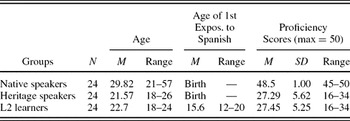
All subjects, including the native speaker controls, took a short Spanish proficiency test (vocabulary and cloze), the same test used in several other recent studies of L2 learners and heritage speakers (Montrul et al., Reference Montrul, Foote and Perpiñán2008). The test consisted of a total of 50 items. Reliability statistics computed on the written proficiency test using Cronbach alpha turned out to be quite high for the heritage speakers (r = .88) and the L2 learners (r = .83).Footnote 11 All the native speakers scored above 90% (score range = 45–50), whereas the L2 learners and the heritage speakers whose results are reported here scored below 68% (34 points). Scores on the proficiency test for the L2 learners and the heritage speakers were compared with an independent samples t test. Results indicated that the two groups did not differ from each other, t (46) = .48, p = .82 (Table 2).
Descriptive statistics for the variables age at testing, age of first exposure to Spanish, and proficiency scores according to experimental groups

Note: L2, second language.
Three tasks were used to investigate the research hypotheses regarding knowledge and use of clitics in different constructions. The first task is an oral production task that elicited use of clitics in different constructions and their frequency in spoken Spanish. Although correct use of a structure entails having the relevant grammatical knowledge, nothing can be concluded about grammatical knowledge when a structure is not produced. Therefore, the second task was an acceptability judgment task, which was used to investigate knowledge of grammatical and ungrammatical positions of clitics, word order, and clitic climbing in obligatory and optional contexts, all of which may not occur spontaneously in spoken language. Finally, because different word orders are possible in Spanish, the last task focused on speeded comprehension of object clitics in preverbal or postverbal positions with topicalized and nontopicalized constructions. The motivation behind this last task was to ascertain whether noncanonical word orders were more difficult to comprehend for the L2 learners than for the heritage speakers. It was assumed that the complementary information obtained from each of the three tasks can provide a better idea of whether the experimental groups differ or not in both knowledge and use of different structures involving clitics in Spanish.
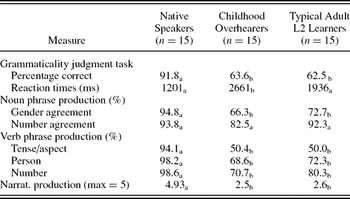
Tasks. Before presenting the rationale and details of the tasks used in the present study, let us briefly review Au et al.'s (Reference Au, Knightly, Jun and Oh2002) and Knightly et al.'s (Reference Knightly, Jun, Oh and Au2003) tasks and main findings. The morphosyntax part of their experiment used a timed aural grammaticality judgment task, an NP production task to test gender agreement, a verb phrase production task eliciting verbal morphology (tense, aspect, person, and number agreement), and an oral narrative to test overall proficiency in the language. Narrative production ratings were on a 5-point scale, with high ratings indicating better formulated sentences. The grammaticality judgment task included 66 grammatical and ungrammatical sentences testing gender agreement in nouns, tense, aspect, person, and number agreement in verbs, negation, and indirect object pronouns (clitics). Results showed statistically significant differences between the native speakers and the other two experimental groups. Unlike the results reported for phonology and pronunciation, where the heritage speakers were superior in their performance than the L2 learners, the heritage speakers (called childhood overhearers by Knightly et al., Reference Knightly, Jun, Oh and Au2003) and the L2 learners were not different from each other in any of these four measures. The scores are provided in Table 3. On the basis of findings such as these, Knightly et al. (Reference Knightly, Jun, Oh and Au2003) concluded that a childhood overhearing advantage (obviously due to both age and input) is domain specific; that is, it shows up in phonology but not in morphosyntax.
Participants’ performance on Spanish morphosyntax assessment tasks

Note: Adapted from “Production Benefits of Childhood Overhearing,” by L. Knightly, S. Jun, J. Oh, and T. Au, 2003, Journal of the Acoustical Society of America, 114. Copyright 2003 by the Acoustical Society of America. Adapted with permission. L2, second language. Within a row, means with different subscripts were reliably different from each other according to the Tukey honestly significant difference test (p < .01). Values with the same subscript were not reliably different from each other.
Like Au et al. (Reference Au, Knightly, Jun and Oh2002) and Knightly et al. (Reference Knightly, Jun, Oh and Au2003), knowledge of clitics in L2 learners and heritage speakers in the present study was assessed via an oral production task, a grammaticality judgment task, and a speeded comprehension task. Au et al. (Reference Au, Knightly, Jun and Oh2002) and Knightly et al. (Reference Knightly, Jun, Oh and Au2003) tasks and those used in the present study differed in the structures tested, the design, and the procedure.
Oral production task. To examine knowledge and use of clitics in oral production, all subjects were asked to narrate a story in the past (same used by Montrul, Reference Montrul2004a). This narrative successfully elicits a variety of verbs, objects, and third-person pronouns. The procedure was as follows. Participants, all tested individually one-on-one, sat with a research assistant in a quiet room and were told that they would see 14 color pictures narrating a famous children's story presented in a PowerPoint presentation. They were instructed to describe, with as much detail as possible, the story of Little Red Riding Hood in the past tense. The oral narratives for each participant were recorded and later transcribed.
Unlike Knightly et al. (Reference Knightly, Jun, Oh and Au2003), who used an oral measure to obtain a proficiency rating, the oral measure in the present study was used to investigate whether L2 learners and heritage speakers know about clitics and use them in connected discourse, and how their knowledge and use differs from that of native speakers and from each other's. The following specific questions were addressed by the analysis of the results: (a) What is the ratio of object clitics and lexical NPs in sentences with transitive and ditransitive verbs by native, L2 learners, and heritage speakers? (b) Are there errors in the placement of clitics with respect to verb finiteness in sentences containing a verb or sentences containing two verbs (modal/auxiliary + nonfinite form)? (c) Do L2 learners and heritage speakers produce clitic climbing? (d) Do they produce topicalizations with clitic-left dislocations? All these questions are relevant to address the three hypotheses formulated.
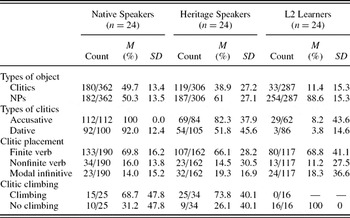
All transitive verbs produced with objects were tallied for each participant. The 24 native speakers produced a total of 362 transitive and ditransitive verbs (range = 11–28 verbs/narrative/subject), the 24 heritage speakers produced 306 verbs (range = 4–15), and the 24 L2 learners produced 287 verbs (7–18). We first examined type of object (clitic or NP). Clitics were coded for case (dative vs. accusative), and use in direct or indirect object contexts.Footnote 12 Dative and accusative clitics and object NPs were counted for each participant and the rate of clitic or NP use was calculated over the total of transitive verbs with direct and indirect objects. Second, clitics were classified by verbal context: with finite, nonfinite, and restructuring (modal/auxiliary + nonfinite) verbal forms. CLLDs were practically nonexistent in the data, except for two tokens produced by a native speaker. All raw counts were converted to percentages for each subject and submitted to statistical analysis. Table 4 shows the percentage distribution of clitics and NPs.
Count and mean percentage production of object clitics by group for the oral narrative task

Note: The results of clitic placement are based on 20 heritage speakers and 15 second language (L2) learners; the results of clitic climbing are based on 16 native speakers, 15 heritage speakers, and 5 L2 learners who used clitics in these configurations. NP, noun phrase.
A factorial analysis of variance (ANOVA) with repeated measures comparing type of object (clitic vs. NP) by group (native speakers, heritage speakers, L2 learners) showed a significant main effect for object, F (1, 71) = 52.31, p < .01, ηp2 = .32, indicating that more NP objects were produced than clitics. There was also a significant object by group interaction, F (2, 71) = 24.23, p < .01, ηp2 = .41. Post hoc analyses (pairwise comparisons and Tukey honestly significant difference [HSD], p < .05) revealed differences between the L2 learners and the two other groups with clitics. As can be seen from Table 4, the heritage speakers and the native control group produced between 40% and 50% of clitics and 60% and 40% NPs, whereas the L2 learners produced significantly fewer clitics, only 11.4%, than NPs, 88.6%.
Accusative clitics replace direct objects in most dialects; dative clitics are typically optional, although preferred, with ditransitive verbs and indirect objects. This trend is accurately reflected in the results presented in Table 4. A factorial ANOVA with repeated measures revealed a main effect for clitic type, F (1, 71) = 42.45, p < .01, η2p = .28. All groups produced more accusative clitics in required contexts than dative clitics. There was a significant main effect for group, F (2, 71) = 46.19, p < .01, η2p = .35, and a clitic by group interaction, F (2, 71) = 6.97, p = .002, η2p = .15. According to Tukey posttests (p < .05), the heritage speakers produced significantly more accusative and dative clitics (82.3% and 51.8%, respectively) than the L2 learners (48.2% and 3.8%, respectively). When accusative clitics were not produced, strong pronouns or redundant NPs were used instead, especially by the L2 learners, as Examples 16–19 show.
16. El cazador vinió para salvar la abuela y la chica pero el lobo comió ella. (#312, Low L2)
“The hunter came to save the grandmother and the girl but the wolf ate her.”
17. Se acerquió a su abuela. El lobo saltió y comió ella (#322, Low L2)
“He got closer to her grandmother. The wolf jumped and ate her.”
18. El hombre vio la chica y el lobo y él quería comer ella (#324, Low L2)
“The man saw the girl and the Wolf and he wanted to eat her.”
19. El hombre del bosque entra y ver y vi el lobo con el estómago lleno. Y cortó el lobo abierto para sacar la niña. (#604, Low HS)
“The man of the forest comes in and see and saw the Wolf with the stomach full. And he cut the wolf open to take the girl out.”
Table 4 also shows the syntactic distribution of clitics according to finiteness. A repeated-measures ANOVA with verb form (finite, nonfinite, modal/aux + nonfinite) as the within subjects factor showed a main effect for verb form, F (2, 58) = 85.53, p < .01, η2p = .45. Most clitics were produced with finite verbs. There were very few clitic verb placement errors. In finite contexts, the L2 learners produced only one error (0.36%) and the heritage speakers none. With nonfinite forms, there was a 10.4% error rate for the L2 learners and 2.8% for the heritage speakers.
Finally, the rate of clitic climbing versus no climbing in restructuring contexts (modal/aux + nonfinite) was examined, although not all speakers produced these forms. There was no effect for clitic position, F (1, 35) = .09, p = .76, ηp2 = .02, but there was a clitic position by group interaction, F (2, 35) = 6.39, p = .005, ηp2 = .22. Pairwise comparisons indicated that both the native speakers and the heritage speakers produced significantly more climbing than no climbing, whereas the few L2 learners who produced restructuring structures did not produce clitic climbing at all.
To summarize thus far, the results of the oral narrative task showed that the two experimental groups and the native speakers produce accusative and dative clitics in Spanish, suggesting that L2 learners and heritage speakers know that Spanish has clitics and they use them. Errors with clitic placement as a function of finiteness were minimal. However, the production rates of clitics by heritage speakers are closer to the production rates of the native speakers. The L2 learners not only produced clitics less frequently, but they also showed different patterns in the relative ratio of clitics and NPs, rates of clitic doubling with indirect objects, and rate of clitic climbing. Thus, contrary to the findings of Au et al. (Reference Au, Knightly, Jun and Oh2002) and Knightly et al. (Reference Knightly, Jun, Oh and Au2003 for morphosyntax, heritage speakers have advantages over L2 learners. These results are compatible with Hypothesis 1 because heritage speakers displayed more nativelike knowledge and use of clitics than the L2 learners.
However, because production is a small a window into competence, it reveals some aspects of linguistic knowledge but not the extent of the complexity of such knowledge. One cannot, for example, reach any conclusions about structures related to clitics that did not show up in the data, such as ungrammatical clitic placement or clitic left dislocations. The oral narrative data showed very few clitic placement errors with finite and nonfinite verbs, but will this knowledge be reflected in acceptability judgments? If asked to judge sentences with clitic climbing, do L2 learners know that these sentences are grammatical in Spanish even when they do not a produce them spontaneously at this stage of their development? Because topicalizations were not present in the oral narrative results, does this mean that L2 learners and heritage speakers do not know that definite objects in Spanish can be topicalized in clitic left dislocations, but a clitic is required? Therefore, to probe into more tacit knowledge of these structures, the second task was a written (untimed) written acceptability judgment task.
Written acceptability judgment task. The acceptability judgment task included a total of 90 sentences (45 grammatical, 45 ungrammatical), divided into 18 sentence types with five tokens per type. The 16 grammatical and ungrammatical sentence types discussed in this study are shown in Examples 20–35.
Object clitics as subjects:
20.
21.
Clitics with finite verbs:
22.
23.
Clitics with nonfinite verbs:
24.
25.
Clitics in restructuring contexts:
26.
27.
28.
Clitic doubling:
29.
30.
31.
Clitic doubling and left dislocations:
32.
33.
34.
35.
Because previous studies of incipient L2 acquisition indicate that L2 learners misanalyze sentence initial clitics as subjects (Van Patten & Cadierno, Reference VanPatten and Cadierno1993), the ungrammatical sentence types 20 and 21 were included to ascertain that the experimental groups know that clitic objects are objects and not subjects, especially when they appear in preverbal position with finite verbs. These sentences with object clitics in place of nominative pronouns were also included to counterbalance the number of grammatical and ungrammatical sentences in the design. Sentence types 22–28 tested grammatical and ungrammatical clitic placement in simple sentences as a function of verb finiteness, to confirm the patterns of language use observed in the oral task. Sentence types 29 and 31 were included to make sure the participants know that Spanish is a clitic doubling language. Although clitic doubling is optional with dative clitics (sentences 29 and 30 are both grammatical), the ungrammatical sentence type 31 tested knowledge of obligatory clitic doubling with strong pronouns. Sentence types 32 and 35, both grammatical, targeted basic knowledge of word order and topicalizations: SVO versus O-cl-V-S. All tokens of sentence type 33 included specific objects. To focus on the obligatory nature of the clitic, the ungrammaticality of clitic omission in clitic left dislocations was tested by contrasting sentences 34 and 35, with dative clitics.Footnote 13
The task was presented via a Web interface and conducted in the presence of a research assistant. Participants were tested individually, one on one. Sentences were randomized and presented with a 5-point acceptability scale underneath. To avoid binary responses (which increase chance performance), participants were instructed to rate each sentence on the scale, assigning the following values: 1 = completely unacceptable, 2 = acceptable in rare contexts, 3 = I cannot tell, 4 = acceptable in many contexts, 5 = perfectly acceptable.Footnote 14 Although the task was untimed and no reaction times (RTs) measures were collected, participants were asked to respond as intuitively as possible and not to go back to compare answers. Completion time for this task was approximately 15–20 min.
Before discussing the results of individual sentences, it is important to first show overall performance in this task, so as to compare our results to those of Au et al. (Reference Au, Knightly, Jun and Oh2002) and Knightly et al. (Reference Knightly, Jun, Oh and Au2003). To obtain an accuracy score by subject, individual ratings of 4 and 5 for grammatical sentences and 1 and 2 for ungrammatical sentences were recoded as 1 for correct, whereas the opposite (1 and 2 for grammatical and 4 and 5 for ungrammatical) was recoded as 0 (incorrect).
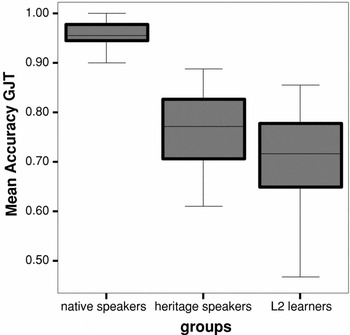
Responses with ratings of 3 (I don't know) were eliminated for the analysis.Footnote 15 This affected 3.5% of the heritage speaker data and 5.6% of the L2 learner data. The overall accuracy scores (in percentages) are displayed in Figure 1. A one-way ANOVA showed significant differences between the native speakers (M = 95.5, SD = 2.6) and the two experimental groups, F (2, 71) = 66.53, p < .01, but no differences between the L2 learners (M = 71.2, SD = 9.2) and the heritage speakers (M = 75.1, SD = 9.6), according to Tukey HSD test (p = .26). Correlations between the results of the proficiency measure and of the grammaticality judgment task were significant for the heritage speakers (r = .556, p = .006) and the L2 learners (r = .0440, p = .032). These overall results disconfirm the predictions of Hypothesis 1 (a main effect by group) and concur with the results reported by Knightly et al. (Reference Knightly, Jun, Oh and Au2003). If we were to stop here, we would also reach the conclusion that early exposure to the language confers no advantage for heritage speakers over L2 learners in aspects of morphosyntax, at least as measured by this type of task.
The mean accuracy on the acceptability judgment task by groups.

Because the different sentences tested do not involve the same level of syntactic complexity and are used more or less frequently in different contexts, it is important to see whether L2 learners and heritage speakers have more difficulty recognizing the grammaticality of clitics in simple sentences, for example, as opposed to sentences that require the movement of constituents within the same clause (e.g., clitic climbing or object–verb sentences) to the left periphery as in clitic left dislocations, or whether they recognize that clitic doubling is optional in some cases (e.g., with indirect objects) but required in others (with strong pronouns and in clitic left dislocations). Based on research findings on the instability of the syntax–information structure interface, Hypothesis 2 predicted within group effects. The hypothesis stated that both heritage speakers and L2 learners should have more robust control of clitics and clitic placement in simple sentences (within the IP projection) than of clitic left dislocations, which engage the CP projection. However, because clitic left dislocations are more frequent in spoken language, Hypothesis 3 also predicted a difference between the two experimental groups with these constructions, with the heritage speakers exhibiting more targetlike acceptability judgments than the L2 learners.
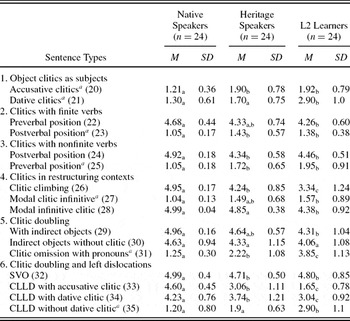
For the analysis by sentence types in Examples 18–33, actual numerical mean ratings (1, 2, 4, 5) were submitted to generalized linear modeling multivariate ANOVAs, with group as the between factor and specific sentence types as within factors. Table 5 shows the acceptability ratings on all sentence types presented in Examples 17–32. Pairwise comparisons were followed with the Tukey HSD post hoc test. The multivariate test showed a significant main effect for group, F (2, 71) = 8.38, p < .01, η2p = .77. Except for indirect objects without clitic, F (2, 71) = 1.68, p = .19, Tukey HSD tests revealed significant group differences at the p < .01 level between the native speakers and the two experimental groups for all other sentence types. However, the crucial question for Hypothesis 1 is whether the heritage speakers outperform the L2 learners. In general, we see from Table 5 that the native speakers outperformed the L2 learners in 15 of 16 sentence types. The heritage speakers fell in between: they did not differ statistically from the native speakers in seven sentence types, outperformed the L2 learners in eight types, and did not differ from L2 learners in other eight types. Thus, overall, the results show that the heritage speakers are more nativelike than the L2 learners.
Mean acceptability rating on grammatical and ungrammatical sentences with clitics

Note: 5 = grammatical, 1 = ungrammatical. The numbers next to each label correspond to Examples 20–35 in the text. Within a row, means with different subscripts were reliably different from each other according to the Tukey honestly significant difference test (p < .05). Numbers with the same subscript were not reliably different from each other. L2, second language; SVO, subject–verb–object; CLLD, clitic left dislocation construction.
aUngrammatical.
As for the individual sentence types, all groups know that accusative and dative clitics cannot be subjects (Example 18: Lo cocina buenas empanadas and “Her cooks good empanadas”; Example 19: Les no pasaron los exámenes “Them did not pass the exams”), although they differ in the strength of their ratings: accusative clitics, F (2, 71) = 7.3, p < .01, η2p = .17; dative clitics, F (2, 71) = 26.13, p < .01, η2p = .43. These two sentence types were included to ascertain that the experimental groups distinguish between object clitics and nominative pronouns, even when clitics must attach to a verb and can appear in preverbal position. If according to Hypothesis 1 the experimental groups have a mental representation for clitics, they should recognize that these sentences are ungrammatical in Spanish. In fact, all the groups rated these sentences quite unacceptable, suggesting that they do have basic knowledge of clitics. As predicted by Hypothesis 1, the L2 learners were more inaccurate at rejecting sentences with dative clitics, but not with accusative clitics, than the heritage speakers. However, rather than an age of acquisition and exposure to Spanish effect, the difference between judgments on accusative and dative clitic may be lexical confusion for the L2 learners (i.e., related to the morphological difference between lo/la and les), or else the L2 learners would rate both types of sentences alike.
Examples 22 and 23 under clitics with finite verbs and Examples 24 and 25 under clitics with nonfinite verbs in Table 5 show the contrast between grammatical and ungrammatical sentences with finite verbs (Juan lo mira todos los días vs. *Juan miralo todos los días, “Juan sees it every day”), and with infinitives (Pedro insistió en verla inmediatamente vs. *Pedro insistió en la ver inmediatamente, “Pedro insisted on seeing her immediately.”). These sentences represent use of clitics within the IP (simple sentences) and were included to address Hypotheses 1 and 2. If the L2 learners and heritage speakers have mental representations for clitics in Spanish, they may also know about their placement as a function of verb finiteness. All groups discriminated between grammatical and ungrammatical placement of clitics with finite and nonfinite verbs, even when the differences between groups was significant: finite preverbal position, F (2, 71) = 3.21, p = .04, η2p = .08; finite postverbal position, F (2, 71) = 5.87, p = .004, η2p = .14; nonfinite preverbal position, F (2, 71) = 10.5, p < .01, η2p = .23; nonfinite postverbal position, F (2, 71) = 11.88, p < .01, η2p = .25. These results confirm the results of the oral production task: both groups know clitics and know where to place them in simple sentences as a function of verb finiteness.
Rows under clitics in restructuring contexts in Table 5 present the mean acceptability scores of sentence types involving a sequence of a modal verb and an infinitive, which are also related to the verb finiteness: Example 26: clitic climbing (Olga lo puede comprar mañana “Olga can buy it tomorrow”), and optional operation; Example 27: the clitic appearing between the modal and the infinitive (Mod-cl-Inf: *Olga puede lo comprar mañana); Example 28: the clitic in the lower position, after the infinitive (Olga puede comprarlo mañana). In general, all groups rated the ungrammatical sentences in this group below 2 on the scale provided, and the sentences with the clitic after the infinitive (modal infinitive clitic) above 4. However, the key finding is the mean acceptability of clitic climbing, because in the oral task we saw that the heritage speakers produced these sentences whereas the L2 learners did not. The results of the acceptability judgment task converge with the results of the oral task: the heritage speakers accepted clitic climbing significantly more than the L2 learners, F (2, 71 = 20.25, p < .01, η2p = .37, as predicted by Hypothesis 1. Previous studies have shown that L2 learners do not readily accept clitic climbing in these constructions in grammaticality judgment tasks and largely prefer to attach the clitic to the non finite form, in the lower position (Bruhn-Garavito & Montrul, Reference Bruhn-Garavito and Montrul1996; Duffield & White, Reference Duffield and White1999). Although in the oral task, none of the L2 learners who produced restructuring constructions exercised this option, the results of the judgment task suggest that at least some L2 learners, but not all, still know that these sentences are possible in Spanish.
Let us now consider the other structures of interest in our study: clitic doubling and clitic left dislocations, which were also included to test the three hypotheses. Do L2 learners and heritage speakers know that objects can be topicalized in Spanish? Do they know that the clitic is obligatory in these constructions? It is first important to establish whether the experimental groups know that Spanish is a clitic doubling language, which is most frequent with dative objects. The results of the oral task showed that L2 learners and heritage speakers know these facts, but again, the heritage speakers produced more instances of clitic doubling than the L2 learners (Table 4). Rows under 5 in Table 5 show the ratings for sentences with ditransitive verbs and indirect object clitics (Example 29: Armando envió flores a una amiga vs. Example 30: Armando le envió flores a una amiga “Armando sent flowers to a friend”), which are both acceptable (although some speakers may prefer to use one option over the other), as well as ratings for ungrammatical sentences missing clitic doubling with strong pronouns (Example 31: *Mi esposo vio a ella en el cine “My husband saw her in the movie theater”). Comparison of clitic doubled and nondoubled indirect objects showed that sentences with clitic doubling with indirect objects were rated more acceptable than sentences with no clitics, F (1, 72) = 23.18, p < .01, η2p = .12, even by the L2 learners. This finding is consistent with patterns of language use and frequency of clitic doubling with datives in the input, in both oral and written registers. However, with clitic doubling, the native speakers differed from the L2 learners but not from the heritage speakers according to Tukey HSD (p < .05), F (2, 71) = 5.10, p = .009, η2p = .12. Ratings on clitic doubling with strong pronouns also differed by group, F (2, 71) = 26.13, p < .01, η2p = .43; the native speakers rated these sentences less acceptable than the L2 learners and the heritage speakers (Tukey HSD, p < .05). Yet, the heritage speakers found them less acceptable than the L2 learners, as predicted by Hypothesis 1. In general, all groups know that clitic doubling with indirect objects is optional, but many more L2 learners than heritage speakers do not know that the clitic is obligatory with strong pronouns. Acceptability of the optionality of clitic doubling with indirect objects reveals both grammatical knowledge and patterns of language use, whereas the nonoptionality of clitic doubling with strong pronouns strictly reveals grammatical knowledge. Thus, the different ratings of L2 learners and heritage speakers with strong pronouns may reflect a difference in grammatical competence related to age effects, as predicted by Hypothesis 1.
The last four rows in Table 5 display the results of sentences testing clitic left dislocations. Sentence types 30 and 31 contrast SVO sentences with the grammatical variant CLLD with accusative clitics (Juan dejó las carpetas en la oficina “Juan left the folders in the office” vs. Las carpetas las dejó Juan en la oficina “The folders, Juan left in the office”). The L2 learners and the heritage speakers did not differ from each other on their ratings on SVO sentences, but their ratings were statistically different from those of the native speakers with CLLD with accusative clitics, F (2, 71) = 77.39, p < .01, η2p = .69. An ANOVA comparing the two sentence types revealed that the overall ratings on SVO were higher than CLLD with accusative clitics, F (1, 71) = 143.9, p < .01, η2p = .47. As for the contrast between CLLD with and without dative clitics, sentence types 34 and 35, similar patterns obtained. Ratings of the grammatical sentences with clitics were higher than on the ungrammatical sentences without clitics, F (1, 71) = 15.47, p < .01, η2p = .53, suggesting that all groups know that clitics are obligatory in these constructions. However, the ANOVA followed by the Tukey HSD test showed that the heritage speakers were more nativelike than the L2 learners both with the grammatical (32), F (1, 71) = 8.76, p < .01, η2p = .20, and the ungrammatical (33) sentences, F (1, 71) = 5.72, p = .005, η2p = .14. Overall, the results of obligatory clitic doubling (sentence types 29, 32, and 33) and the CLLD constructions (sentence types 31, 32, and 33) show that heritage speakers find these structures more acceptable than the L2 learners. These results can be due to an early exposure effect, as predicted by Hypothesis 1, as a frequency of exposure effect, as predicted by Hypothesis 3 with clitic left dislocations, or to both.
In conclusion, the results of the acceptability judgment task confirm and expand the trends found in the oral task. Both L2 learners and heritage speakers have knowledge of the syntactic constraints and possibilities of object clitics in Spanish. The two groups were not different from each other on the following sentences types: accusative clitics in subject position, position of clitics with finite and nonfinite verbs, including the ungrammaticality of modal clitic infinitive in restructuring contexts, and optional clitic doubling with indirect objects. These are all constructions that supposedly engage functional categories within the IP (AgrOP/AccCl voice; AgrIOP/Dat voice). Yet, the heritage speakers approximate the native speakers in several key judgments concerning clitic climbing, obligatory clitic doubling with strong pronouns, and all the structures related to clitic left dislocations, lending support to Hypothesis 1 and Hypothesis 3. Because the strength of acceptance and of rejection of grammatical and ungrammatical sentences contrasting clitics and finiteness in simple sentences were stronger and more determinate than judgments on clitic left dislocations for the two experimental groups, Hypothesis 2, which predicted more solid judgments on clitic structures involving only the IP than on structures engaging the CP, is also confirmed by the results of this task.
Speeded visual picture–sentence matching task. The purpose of this task was to test knowledge and interpretation of sentences with clitics and objects in sentence initial position, some of which were not produced in the oral task, nor were they included in the acceptability judgment task. In addition to having problems with clitic left dislocations, previous studies have also shown that L2 learners misinterpret sentences with sentence initial object clitics and postverbal subjects, such as Lo saludó Juan “He said hi to Juan.”Footnote 16 Sentences with dislocations and sentence-initial clitics were not produced in the oral task, and were not rated as acceptable as other sentences in the grammaticality judgment task. The purpose of this third task, a speeded visual picture–sentence matching task, was to see whether heritage speakers and L2 learners have similar difficulties comprehending sentences with preverbal objects and postverbal subjects. If heritage speakers have advantages over L2 learners because they were exposed to the language earlier in life, they should be more accurate than the L2 learners with sentence-initial objects, as predicted by Hypothesis 1. For the two groups, Hypothesis 2 predicts that sentences with sentence-initial clitics and postverbal subjects should be easier to comprehend than clitic left dislocations, because the former engage the IP whereas the latter engage the CP. Finally, Hypothesis 3 also predicts that heritage speakers, who might have heard more clitic left dislocations than L2 learners, should be more accurate with these sentences than the L2 learners.
The task contrasted sentences with preverbal subjects and the same sentences with sentence initial clitics and clitic left dislocations (i.e., preverbal objects) under timed conditions.
The stimuli consisted of 40 sentences divided into eight types (five tokens per type), 20 distracter and 20 filler items. Four types contained accusative clitics (sentences 36–39 in the accusative condition), and the other four dative clitics (sentences 40–43 in the dative condition). Two types within each condition tested preverbal subjects and the other two preverbal objects. Sentence length was controlled within each condition. Two sentences from each condition plus an equal number of fillers formed a block, and there were five blocks total. Sentences were randomized automatically within each block. The order of pictures was also counterbalanced across the two conditions (half of the time, Picture 1 appeared first and in the other half Picture 2 appeared first).
The task was a speeded visual picture–sentence matching task. The procedure was as follows. Participants were presented with two pictures, A and B, on a computer screen with a written sentence underneath. The pictures were taken from the Spanish textbook Sabías que? (VanPatten, Lee, & Ballman, Reference VanPatten, Lee and Ballman1992) and depicted the same action, but with the participants reversed (e.g., a boy calling his parents vs. the parents calling their son). Participants had to decide, as quickly as possible, which picture the written sentence described, by pressing A or B on the keyboard. Time (ms) was measured from the presentation of the slide until the participant made a decision and pressed the A or B key, disappearing after 8,000 ms. The target pairs of pictures appeared four times, with one of the following sentences with alternative word orders underneath.
Accusative condition:
Preverbal subject:
36.
37.
Preverbal object:
38.
39.
Dative condition:
Preverbal subject:
40.
41.
Preverbal object:
42.
43.
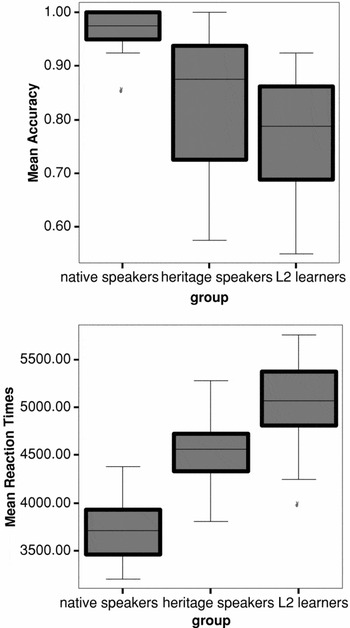
Although the main variable of interest was accuracy, speed of response (RTs) was also measured. Because the sentence types differed in length, speed was considered as a between-group variable and not as a within-group variable, across sentence types. Before submitting the data to statistical analysis, raw latencies for all subjects were examined to detect potential outliers. Trials longer than 2 SD above the mean for each subject per experimental condition were trimmed and replaced by the value of the mean + 2 SD above the mean for each subject in each condition. This procedure affected less than 1% of the native speaker group, 2.3% of the heritage speaker group, and 3.6% of the L2 learner group. Accuracy scores were calculated on all responses, whereas RTs were only considered for items answered correctly.Footnote 17 For the target items, two main analyses were conducted: one for accuracy scores and one for RTs. The boxplots in Figure 2 show overall mean accuracy and RT by group. The accuracy scores revealed differences between the native speakers and the two experimental groups, F (2, 69) = 21, p < .01, η2p = .34, but the L2 learners and the heritage speakers did not differ from each other in accuracy (Tukey HSD, p = .11). In terms of speed, the native speakers were faster than the L2 learners, F (2, 69) = 61.38, p < .01, η2p = .42, Tukey HSD, p < .01, and the heritage speakers (Tukey HSD, p < .01), but the heritage speakers were also significantly faster than the L2 learners (Tukey HSD, p < .01).
The speeded visual picture-matching task and the overall mean accuracy and mean reaction times by group.

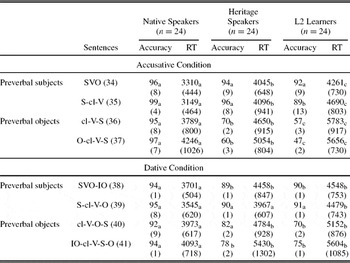
Table 5 shows the results by sentence types and groups. We will first discuss the results of the accusative conditions. A factorial ANOVA with repeated measures with preverbal argument position and sentence type as the within-subjects variables showed main effects for position, F (1, 69) = 80, p < .01, η2p = .53, indicating that accuracy on sentences with preverbal subjects was higher than on sentences with preverbal objects. There was also a main effect for group, F (2, 69) = 27.48, p < .01, η2p = .44. The native speakers were more accurate than the L2 learners (Tukey HSD, p < .01) and the heritage speakers (Tukey HSD, p < .01), whereas the heritage speakers were also more accurate than the L2 learners (Tukey HSD, p = .03). A position by group interaction, F (2, 69) = 18.79, p = .035, η2p = .35, followed by pairwise comparisons, revealed that the L2 learners and the heritage speakers were more inaccurate than the native speakers (Tukey HSD, p < .01) with sentences with object initial clitics (cl-V-S; heritage speakers’ accuracy 70%, L2 learners’ accuracy 57%) and with clitic left dislocation (O-cl-V-S) (heritage speakers 60%, L2 learners 47%), than with sentences with sentence-initial subjects and clitics (heritage speakers 96%, L2 learners 89%; Table 6).
The overall mean (standard deviations) for the percentage of accuracy and the RT on the experimental sentence types for the speeded visual picture-matching task in the accusative and dative conditions

Note: The numbers next to each label correspond to Examples 36–43 in the text. Within a row, means for the same measure with different subscripts were reliably different from each other according to the Tukey honestly significant difference test (p < .05). Numbers with the same subscript were not reliably different from each other. L2, second language; RT, reaction time; SVO, subject–verb–object; cl, cletic; IO, indirect object.
The one-way ANOVAs by speed showed significant differences between groups for each sentence type: SVO, F (2, 69) = 15.55, p < .01; S-cl-V, F (2, 69) = 24.87, p < .01; cl-V-S, F (2, 69) = 31, p < .01; O-cl-V-S, F (2, 69) = 16.132, p < .01. Except with SVO sentences, where the heritage speakers and L2 learners did not differ from each other, the heritage speakers were faster than the L2 learners according to Tukey HSD post hoc tests.
The results of the dative condition showed the same patterns as the accusative condition, except that accuracy on sentences with dative clitics was overall higher than on sentences with accusative clitics, especially with sentences with preverbal objects, F (1, 71) = 11.09, p < .01.Footnote 18 Sentences with preverbal subjects were responded to more accurately then sentences with preverbal objects, F (1, 69) = 32.96, p < .01, η2p = .323. A main effect for group, F (2, 69) = 8.2, p < .01, η2p = .19, and post hoc analyses indicated that the native speakers differed from the heritage speakers (Tukey HSD, p = .014) and from the L2 learners (Tukey HSD, p < .01). The L2 learners and the heritage speakers did not differ from each other (Tukey HSD, p = .574). A group by sentence interaction, F (2, 69) = 8.56, p < .01, η2p = .199, indicated that the heritage speakers were more accurate than the L2 learners on sentences with sentence-initial clitics (cl-V-O-S; 82% vs. 70%, Tukey HSD, p = .003). The RT analysis confirmed a main effect for group with all sentence types: S-cl-V-O, F (2, 69) = 12, p < .01; S-cl-V-O-IO, F (2, 69) = 10.1, p < .01; cl-V-O-S, F (2, 69) = 13.03, p < .01; IO-cl-V-S-O, F (2, 69) = 14.52, p < .01,Footnote 19 with speed differences between the native speakers and the L2 learners (Tukey HSD, p < .01), and between the native speakers and the heritage speakers (Tukey HSD, p < .01) on all sentence types. The heritage speakers were also faster than the L2 learners only with S-cl-V-O sentences, according to the Tukey HSD (p < .01).
In summary, the results of the speeded picture–sentence matching task showed differences in accuracy between the L2 learners and heritage speakers in sentences with sentence initial objects and with clitics. As predicted by Hypothesis 1, the heritage speakers are more nativelike than the L2 learners. Although the results of sentences with simple sentences (cl-V-S) can be due to an age effect, the results of clitic left dislocations with accusative clitics can be due to a frequency effect, as predicted by Hypothesis 3. It was not the case, however, that simple sentences with preverbal objects were comprehended significantly more accurately than sentences with clitic left dislocations, as predicted by Hypothesis 2. Finally, the analysis of RTs, also showed speed advantages for heritage speakers over L2 learners with some sentences with clitics. The heritage speakers’ latencies were closer to those of the native speakers, a finding that also supports Hypothesis 1.
DISCUSSION
Even when heritage speakers exposed to the heritage language since birth had longer exposure to the language than adult L2 learners, previous studies have found linguistic advantages for heritage speakers only in phonology, but results with respect to morphosyntax are contradictory (Au et al., Reference Au, Knightly, Jun and Oh2002; Håkansson, Reference Håkansson1995; Knightly et al., Reference Knightly, Jun, Oh and Au2003; Montrul, Reference Montrul2005). The purpose of this study was to investigate whether and how L2 learners and heritage speakers with low–intermediate proficiency in Spanish differed from each other and from native speakers in their knowledge of a specific aspect of morphosyntax, such as object expression. Unlike Au et al. (Reference Au, Knightly, Jun and Oh2002), who included object clitics as items in a test testing a variety of other properties of Spanish, the present study investigated this grammatical area in greater depth by examining structures with clitics, clitic doubling, and clitic left dislocations, and by using three sources of data: oral production, acceptability judgment, and speeded comprehension. Because a main difference between L2 learners and heritage language learners concerns age of acquisition and degree, extent, and type of exposure (i.e., both nature and timing of input), our goal was to understand which specific aspects of object expression are possibly influenced by these factors, as stated in the three hypotheses formulated. Findings from the L1 acquisition literature suggest that clitic pronouns and clitic left dislocations are acquired by the age of 3 in normally developing children (Montrul, Reference Montrul2004b, chap. 3). Because the heritage speakers tested in this study were all exposed to Spanish since birth, a natural prediction is that they should have acquired these properties early on. However, the key question is how much of this knowledge they have retained after English became their dominant language. Montrul (Reference Montrul2008) argues that both L2 learners and heritage language learners can have incomplete knowledge of the weaker language, which happens to be the L1 in heritage speakers and the L2 in L2 learners. Incomplete acquisition in early bilingualism is typically because of many possible factors leading to reduced exposure to and use of the family language during childhood in a language-minority situation. In contrast, in L2 acquisition incomplete acquisition may have two possible sources: limited exposure and restricted use of the L2 (Bialystok & Hakuta, Reference Bialystok, Hakuta and Birdsong1999) as well as to the maloperation of the alleged efficient language learning mechanisms available in childhood (Bley-Vroman, Reference Bley-Vroman1990; DeKeser, Reference DeKeyser2000; Hyltenstam & Abrahamsson, 1993).
From a pedagogical perspective, it is crucial to pinpoint the specific aspects of linguistic knowledge heritage speakers retain from childhood and to identify which others remain incomplete and possibly fossilized into adulthood so that they can be the focus of instruction in the classroom. Studies including an instructional intervention are extremely valuable to compare these two types of learners who these days find themselves in many of the same classrooms (see Montrul & Bowles, in press-b; Potowski, Jergerski, & Morgan-Short, Reference Potowski, Jegerski and Morgan-Short2009), but can only be undertaken once we gain a better sense of which aspects of linguistic knowledge are underdeveloped in these two types of learners. The results of this study suggest that when it comes to acquisition of object clitics in simple sentences, L2 learners and heritage speakers have relatively robust control of this aspect of Spanish and do not differ much from each other; where they differ is in their command of structures that are perhaps more frequent in spoken language or are optional, such as clitic climbing, clitic doubling, and clitic left dislocations.
Even when the structures targeted in this study are apparently acquired quite early in L1 acquisition, they also differ in linguistic complexity. Clitics and clitic placement are a core syntactic phenomenon, whereas clitic left dislocations engage the syntax–discourse interface. Recent findings suggest that in bilingualism and language contact situations, interface areas between syntax and other cognitive systems, including discourse-pragmatics, exhibit a great deal of developmental instability (Montrul, Reference Montrul2004a; Müller & Hulk, Reference Müller and Hulk2001; Sorace, Reference Sorace2004; Sorace & Filiaci Reference Sorace and Filiaci2006; Tsimpli et al., Reference Tsimpli, Sorace, Heycock and Filiaci2004). This led us to predict that both heritage speakers and L2 learners should have more robust control of clitics and clitic placement in simple sentences than of clitic left dislocations.
Following standard analyses within generative grammar, it was assumed that English differs from Spanish with respect to the availability of functional projections for clitics and word order possibilities. If successful L2 acquisition is possible when acquisition starts late, English-speaking L2 learners should be able to acquire the functional projections for clitics in Spanish. These are the claims of the general full access view within generative approaches to L2 acquisition (White, Reference White2003). By contrast, if late acquisition impedes successful acquisition by L2 learners, heritage speakers should have an advantage over L2 learners in all these grammatical areas. The partial/no access positions (Bley-Vroman, Reference Bley-Vroman1990; Clahsen & Musken, 1989; Hawkins & Chan, Reference Hawkins and Chan1997; Hawkins & Hattori, Reference Hawkins and Hattori2006; Meisel, Reference Meisel1997; Schachter, Reference Schachter1990), which implicitly assume maturational constraints, maintain that the L1 plays a deterministic role in L2 development and ultimate attainment.
The results of the three experiments can be summarized as follows. Both L2 learners and heritage speakers have robust knowledge of object clitics in Spanish and know where to place them with respect to the finiteness of the verb. The L2 learners and the heritage speakers produced clitics in the correct positions in finite, nonfinite, and restructuring contexts and accepted them in a written grammaticality judgment task. Both tasks also showed that the two groups know that Spanish is a clitic doubling language, especially with dative clitics. However, there were also notable quantitative differences between the two groups, consistent with Hypothesis 1. According to this hypothesis, heritage speakers would have advantages over L2 learners because of early exposure (which subsumes age and input). In the oral task, the heritage speakers produced more clitics in general, more clitic doubling structures with dative clitics, and more clitic climbing structures than the L2 learners, approximating the linguistic performance of the native speaker group in this respect. The same result was true of the acceptability judgment task, where the heritage speakers assigned higher ratings to clitic climbing than the L2 learners, sentences with obligatory clitic doubling (with strong pronouns), and sentences with clitic left dislocations. Finally, the SVO and cl-V-S contrast tested in the speeded visual picture–sentence matching task showed that the L2 learners were significantly more inaccurate and slower than the heritage speakers with sentences containing preverbal clitics and postverbal subjects (cl-V-S). Thus, overall, this study shows that heritage speakers with low proficiency in Spanish have more nativelike knowledge and use of clitics than L2 learners of low proficiency level.
Hypothesis 2 (simple sentences with clitics would be easier for the two experimental groups than sentences with dislocations) was also confirmed in both the acceptability judgment task and in the speeded comprehension task for the two groups. Leaving aside questions of language use for a moment, if age of acquisition is a factor, it appears to affect more directly complex structures involving the integration of syntax and pragmatics, such as clitic left dislocations, and sentences with sentence initial clitics and postverbal subjects (cl-V-S), because the grammaticality judgment and the comprehension task showed an advantage for the heritage speakers. An important finding from this study is that, at least in the domain of object clitics, Spanish heritage speakers’ grammars are quite targetlike: they do not display the extent of incomplete acquisition typically manifested in gender agreement (Au et al., Reference Au, Knightly, Jun and Oh2002; Håkansson, Reference Håkansson1995; Knightly et al., Reference Knightly, Jun, Oh and Au2003; Montrul et al., Reference Montrul, Foote and Perpiñán2008; Polinsky, Reference Polinsky, Brinton, Kagan and Bauckus2008a), tense and aspect (Au et al., Reference Au, Knightly, Jun and Oh2002; Knightly et al., Reference Knightly, Jun, Oh and Au2003; Montrul, Reference Montrul2002; Polinsky, Reference Polinsky2008b; Silva-Corvalán, Reference Silva-Corvalán1994), mood (Montrul, Reference Montrul, Potowski and Cameron2007; Potowski et al., Reference Potowski, Jegerski and Morgan-Short2009; Silva-Corvalán, Reference Silva-Corvalán1994) or differential object marking (Montrul, Reference Montrul2004a, in press; Montrul & Bowles, Reference Montrul and Bowles2009, in press). This suggests that object clitic pronouns and their placement is not an area that needs to be particularly emphasized in heritage language classrooms.
Although the syntax of clitic left dislocations may indeed be more complex than that of simple sentences, it is also the case that clitic left dislocation, are more frequently used in naturalistic spoken language. L2 learners typically begin exposure to the L2 in an instructed setting where written input predominates and the use of spoken Spanish is quite restricted.
Taking into account type of input and frequency of use, Hypothesis 3 predicted a group by construction interaction. Because heritage speakers have been primarily exposed to aural input since an early age, they were expected to be more targetlike with the production, comprehension and acceptability of clitic left dislocations, clitic climbing, and clitic doubling. This hypothesis was also supported by the data of the three tasks.
Turning now to the theoretical implications of these findings, is there evidence for age effects interfering with successful L2 acquisition? The fact that the heritage speakers outperformed the L2 learners in knowledge, use, and processing of complex structures with clitics suggests that there is. Although the heritage speakers bring all this knowledge from childhood, the L2 learners seem to have acquired some, perhaps piecemeal, knowledge of some structures related to clitics, but by no means all. This possibility is consistent with Bley-Vroman's (Reference Bley-Vroman1990) fundamental difference hypothesis, for example, for whom L2 learners mainly rely on problem-solving mechanisms, rather than full-fledged universal grammar, to construct a representation of the L2. However, because this study focused only on low–intermediate proficiency speakers we cannot make claims about ultimate attainment in L2 acquisition. Although differing from the generative approach in specific details, cognitive and neurolinguistic approaches to L2 acquisition and bilingualism make a distinction between implicit and explicit learning and storage of language (DeKeyser, Reference DeKeyser, Doughty and Long2003; Paradis, Reference Paradis2004). For these researchers, maturational constraints affect the implicit learning of languages, just as for Bley-Vroman (Reference Bley-Vroman1990) they affect full access to universal grammar and language-specific learning mechanisms. Especially at incipient stages of development, L2 learners rely on explicit learning.
Coming back to the results of the present study, the fact that L2 learners displayed stronger knowledge of clitics and their placement than of the other more complex structures may also be related to input, register (spoken vs. written), mode and context of acquisition, and type of learning. Coincidentally, clitics are explicitly taught and extensively practiced in language classrooms. Furthermore, they are very frequent in spoken and written Spanish. Clitic left dislocations, by contrast, are more frequent in spoken Spanish than in written Spanish and are hardly emphasized in language classrooms, at least much less than object clitics in simple sentences. Because L2 learners are instructed on clitics, it could be argued that clitics were not necessarily “acquired” by the L2 learners with the same linguistic or cognitive mechanisms utilized by heritage speakers early in childhood, contrary to what proponents of full access generative accounts maintain, and may not even be mentally stored and represented in the same way. Perhaps their L2 knowledge of clitics is primarily explicit and metalinguistic, especially for learners who are at low and intermediate levels of proficiency, whereas that of heritage language learners is more intuitive and implicit because clitics were acquired in a naturalistic setting, with no instruction. Indirect evidence that heritage speakers tested in this study may use or may have more implicit than explicit knowledge of clitics comes from the advantages observed in the oral narrative task and in the speeded comprehension task, two tasks that supposedly minimize the use of metalinguistic knowledge (Ellis, Reference Ellis2005; Jiang, Reference Jiang2007).
For generative approaches to L2 acquisition the difference between implicit or explicit linguistic knowledge is largely irrelevant: performance on any linguistic task is taken as evidence of linguistic knowledge regardless of where it is stored or how it may be accessed. Therefore, another possible interpretation of these findings is fully consistent with the full access position within generative grammar because L2 learners have acquired the relevant functional categories for clitics and have overcome the influence of the L1 (English) in this domain. However, many L2 learners are still highly constrained by their L1 with more complex structures, as the full transfer/full access hypothesis (Schwartz & Sprouse, Reference Schwartz and Sprouse1996) predicts. Even if the two groups have acquired the same type of knowledge, and even when language knowledge underlies language use, the L2 learners do not exercise the full spectrum of options available with more complex constructions, at least to the extent that many more heritage language learners and native speakers do. Therefore, the difference may just be one of different use (performance) as opposed to lack of relevant knowledge (competence).
A possible effect of language use may also underlie other results. As mentioned earlier, heritage speakers were predominantly exposed to spoken Spanish since childhood, whereas L2 learners were exposed to predominantly written and oral Spanish in an instructed setting. The oral task, in particular, showed that the heritage speakers used clitics in a more nativelike manner, whereas the L2 learners produced fewer clitics overall than the two other groups. Clitic climbing and clitic left dislocations are optional in the language, not necessarily ungrammatical, although I assume that one needs to have the relevant grammatical knowledge to produce these structures. The fact that L2 learners did not rate these “optional” sentences as high as the heritage speakers in the acceptability judgment task may reflect a preference of use, but not necessarily lack of knowledge. Clitic left dislocations, in particular, are more common in spoken Spanish than in classroom Spanish, so the fact that heritage speakers appear to know more about these structures and process them faster is closely related to the different type of input and to their language use, rather than to their underlying grammatical knowledge. It is often common to assume that language use reflects, to some extent, language knowledge. However, the opposite is, unfortunately, less clear, namely, whether and how language use affects language knowledge (cf. Au et al. Reference Au, Knightly, Jun, Oh and Romo2008). In summary, all this suggests that heritage language speakers and L2 learners differ significantly in their language use. Whether they differ significantly in their linguistic knowledge of clitics is less clear, and open to different interpretations. Different types of tasks may be needed to answer this question.
CONCLUSION
To conclude, age and experience (i.e., context of acquisition and type of input) not only confer an advantage for heritage speakers in pronunciation and phonology, but they also confer advantages in some aspects of morphosyntax, when linguistic complexity and patterns of language use within are given grammatical domain are taken into account. The results of this study support the perception that heritage speakers appear to know more or know the language differently than L2 learners. Because of their linguistic past, many heritage language learners have more nativelike and implicit knowledge and use of Spanish than proficiency-matched L2 learners exposed to the language later and primarily in an L2 classroom, at least in the grammatical area investigated in this study. Low proficiency heritage speakers have very solid knowledge and targetlike use of clitics and word order. However, it is an open question whether these advantages are also true of other aspects of syntax and morphology. Although the incidence of nativelike attainment appears to be much higher in heritage speakers than in L2 learners (Montrul et al., Reference Montrul, Foote and Perpiñán2008), other studies show that heritage language learners are also prone to fossilization in specific areas of their grammars, many of which, like clitics, are acquired very early in L1 acquisition (Montrul & Bowles, Reference Montrul and Bowles2009, in press; Polinsky, Reference Polinsky, Brinton, Kagan and Bauckus2008a, Reference Polinsky2008b). If these effects are because of different access to Spanish in comprehension and production, it is not clear why different access may bring advantages for heritage speakers over L2 learners with aspects of object expression, as this study shows, but not for mood morphology (Potowski et al., Reference Potowski, Jegerski and Morgan-Short2009), or relative clauses (O'Grady et al., Reference O'Grady, Lee and Choo2001). These effects, which are crucial to pinpoint the specific areas of grammatical knowledge and use that need to be emphasized in the classroom, can only be revealed by testing well-developed insights from linguistic theory through multiple and complementary measures tapping implicit and explicit knowledge of the language in comprehension, production, and processing. In addition, we need to examine more closely the types of input involved in the two populations.
ACKNOWLEDGMENTS
The research presented in this article was conducted under the generous support of a Beckman Award from the University of Illinois Campus Research Board, and it was presented in a number of venues. I am grateful to all the particioants in the study, as well as to Rebecca Foote, Silvia Perpiñán, Susana Vidal, Dan Thornhill, Ben McMurry, Brad Dennison, Alyssa Martoccio, and Lucía Alzaga, who worked as research assistants and helped with data collection and transcriptions. I thank three anonymous reviewers and my colleagues Rakesh Bhatt, Jason Rothman, Tania Ionin, and Melissa Bowles for their invaluable questions, feedback, and suggestions on previous versions of this manuscript. All remaining errors are my own.