The daily use of two languages has been hypothesized to require additional control of attention to accurately select and employ the target language (Bialystok, Reference Bialystok2009; Dijkstra, Grainger & van Heuven, Reference Dijkstra, Grainger and Van Heuven1999). That is, both languages are active and bilinguals must control their attention to the target language system and ignore cues from the competing language system (Green, Reference Green1998). Therefore, bilingualism may have the beneficial consequence of increasing attentional control processes in nonverbal domains, because those same general processes are required to manage multiple language systems (Bialystok, Reference Bialystok2011). Past studies have supported these claims, as the early acquisition and regular use of multiple languages has been shown to improve several cognitive outcomes – most consistently the enhancement of attentional control on tasks imposing response conflict (Bialystok, Reference Bialystok2001; Bialystok, Craik, Klein & Viswanthan, Reference Bialystok, Craik, Klein and Viswanathan2004; Bialystok, Craik & Ryan, Reference Bialystok, Craik and Ryan2006; Emmorey, Luk, Pyers & Bialystok, 2008). For example, bilingual adults show better interference suppression compared to their monolingual peers on the Stroop task (Bialystok, Craik & Luk, Reference Bialystok, Craik and Luk2008) and more proficient bilinguals demonstrate better attentional control than less proficient bilinguals (Zied, Phillipe, Karine, Valerie, Ghislaine & Arnaud, Reference Zied, Phillipe, Karine, Valerie, Ghislaine and Arnaud2004).
Neuroimaging studies have also provided evidence that bilinguals may have more efficient attentional control. During a non-verbal task-switching paradigm, behavioral data indicated greater switching costs for monolinguals than bilinguals. In the brain, bilinguals recruited both the left inferior frontal gyrus, a brain region used in switching and inhibitory control of languages, and the anterior cingulate cortex (ACC), a brain region involved in monitoring conflicting information, whereas monolinguals had activation primarily in the ACC (Garbin, Sanjuan, Forn, Bustamante, Rodríguez-Pujadas, Belloch, Hernandez, Costa & Ávila, Reference Garbin, Sanjuan, Forn, Bustamante, Rodríguez-Pujadas, Belloch, Hernandez, Costa and Ávila2010). Similarly, Abutalebi, Della Rosa, Green, Hernandez, Scifo, Keim, Cappa & Costa, (Reference Abutalebi, Della Rosa, Green, Hernandez, Scifo, Keim, Cappa and Costa2011) reported that bilinguals outperformed monolinguals on a response conflict flanker task and observed decreased activation of the ACC for bilinguals compared to monolinguals during the task, which was interpreted as more efficient neural processing in bilinguals. Furthermore, grey matter density in the ACC was significantly correlated with the functional conflict effect for both language groups, but a significant correlation between grey matter density in the ACC and behavioral data was only present for the bilingual group – suggesting a link between the bilingual experience, behavior, functional brain activity, and structural brain changes (Abutalebi et al., Reference Abutalebi, Della Rosa, Green, Hernandez, Scifo, Keim, Cappa and Costa2011). Together, these results support a bilingual advantage extending beyond language processing for performance on behavioral tasks necessitating attentional control and underlying neural substrates.
Although the benefits of bilingualism have been touted (Diamond, Reference Diamond2010), some studies have found no cognitive advantages for bilinguals. Gathercole, Thomas, Kennedy, Prys, Young, Guasch, Roberts, Hughes, and Jones (Reference Gathercole, Thomas, Kennedy, Prys, Young, Guasch, Roberts, Hughes and Jones2014) found no differences between monolinguals, simultaneous bilinguals (learning two languages from birth) or sequential bilinguals (learning second language after first) on a variety of tasks (Stroop, dimensional card sort, and metalinguistic tasks) across a wide age range (3- to 60-year-olds). Past studies have also reported that monolinguals outperform bilinguals on tasks relating to lexical access (Gollan, Fennema-Notestine, Montoya & Jernigan, Reference Gollan, Fennema-Notestine, Montoya and Jernigan2007), picture naming (Kaushanskaya & Marian, Reference Kaushanskaya and Marian2007; Roberts, Garcia, Desrochers & Hernandez, Reference Roberts, Garcia, Desrochers and Hernandez2002), and verbal fluency (Gollan, Montoya & Werner, Reference Gollan, Montoya and Werner2002; Rosselli, Ardila, Araujo, Weekes, Caracciolo, Padilla & Ostrosky-Solis, Reference Rosselli, Ardila, Araujo, Weekes, Caracciolo, Padilla and Ostrosky-Solis2000) – all studies that tap into language processing. Results from a recent fMRI study indicate that bilinguals may process language less efficiently than monolinguals, as bilinguals are more likely to utilize a more distributed language network (Palomar-García, Bueichekú, Ávila, Sanjuán, Strijkers, Ventrua-Campos & Costa, Reference Palomar-García, Bueichekú, Ávila, Sanjuán, Strijkers, Ventura-Campos and Costa2015), and this may partly account for these findings in bilingual disadvantages of verbal tasks.
Additionally, Fernandes, Craik, Bialystok, and Kreuger (Reference Fernandes, Craik, Bialystok and Kreuger2007) reported bilingual disadvantages in memory (verbal free recall) after participants completed a divided attention task. Concurrently executing a cognitively demanding divided attention task while encoding information negatively impacts subsequent memory of task stimuli (Baddeley, Lewis, Eldridge & Thomson, Reference Baddeley, Lewis, Eldridge and Thomson1984; Craik, Govoni, Naveh-Benjamin & Anderson, Reference Craik, Govoni, Naveh-Benjamin and Anderson1996; Fernandes & Moscovitch, Reference Fernandes and Moscovitch2000). As attentional control demands increase, due to switching between tasks (Craik et al., Reference Craik, Govoni, Naveh-Benjamin and Anderson1996) or being distracted by irrelevant stimuli (Wais, Rubens, Boccanfuso & Gazzaley, Reference Wais, Rubens, Boccanfuso and Gazzaley2010), later memory has been shown to be impaired. Fernandes and colleagues (Reference Fernandes, Craik, Bialystok and Kreuger2007) hypothesized that the negative impact on subsequent memory might be reduced for bilinguals, due to their enhanced levels of attentional control, and predicted that bilinguals would show smaller interference effects from divided attention on future memory performance. Contrary to their predictions, the researchers found no reduction in interference effects for bilinguals and, surprisingly, monolinguals outperformed bilinguals on subsequent verbal free recall. Although there are plenty of studies examining cognitive control and memory as separate entities, few studies have examined the interactions in differential performance between the two domains (Chun & Turk-Browne, Reference Chun and Turk-Browne2007; Mecklinger, Reference Mecklinger2010; Richter & Yeung, Reference Richter and Yeung2012). If attentional control and memory do influence one another, whereby memory is impaired when attentional control demands are high, why were bilingual disadvantages in subsequent memory reported for this task?
There are a few possible explanations for the surprising findings reported by Fernandes and colleagues (Reference Fernandes, Craik, Bialystok and Kreuger2007) and the current study further examines whether enhanced attentional control linked to bilingualism is associated with decreased divided attention costs on a difficult task-switching paradigm. First, the previous memory task's reliance on language (verbal free recall task) may have conflated disadvantages in lexical retrieval (Gollan et al., Reference Gollan, Fennema-Notestine, Montoya and Jernigan2007) with subsequent memory recall. We maximize the bilingual advantage in attentional control while minimizing lexical retrieval by using a recognition memory test of both words and objects instead of a verbal free recall test, to measure the effects of enhanced attentional control on memory encoding during divided attention. We hypothesize that, compared to monolinguals, bilinguals will recognize more stimuli overall, but will also demonstrate differences in memory performance for stimuli containing words vs. objects.
Second, the bilingual advantage in attentional control may influence memory encoding for attended vs. unattended stimuli differently. In a recent study by Richter and Yeung (Reference Richter and Yeung2012), participants performed a difficult set-switching classification task. As expected, during the divided attention set-switching phase, reaction time was slower and accuracy was poorer when the classification set switched across trials than when the classification set repeated across trials. The divided attention phase was followed by a surprise recognition memory task of the classification stimuli. The authors found that, relative to set-repeating trials, on set-switching trials participants showed both decreased memory for task-relevant attended (target) stimuli and increased memory for task-irrelevant unattended (non-target) stimuli. These findings suggest that a high cognitive load at the time of encoding decreases attention to the intended attentional target while impairing inhibition of attention to distracting stimuli. Thus, divided attention tasks may not affect the process of encoding itself, but rather affects the attentional control to stimuli that may be encoded. To differentially measure these costs we replicate and extend the study by Richter and Yeung (Reference Richter and Yeung2012) using their cognitive control and surprise memory recognition tasks. Using this paradigm results in measures of attentional control, as well as recognition memory of target and non-target stimuli. This allows for a more precise measure of divided attention costs on encoding. We hypothesize that since bilinguals demonstrate better interference suppression compared to their monolingual peers (Bialystok et al., Reference Bialystok, Craik and Luk2008), bilinguals will remember fewer non-target stimuli than monolinguals.
Finally, age of second language (L2) acquisition has recently been shown to be associated with both behavioral performance (Luk, de Sa & Bialystok, Reference Luk, de Sa and Bialystok2011; Sabourin & Vīnerte, Reference Sabourin and Vīnerte2015; Yow & Li, Reference Yow and Li2015) and neural correlates (Klein, Mok, Chen & Watkins, Reference Klein, Mok, Chen and Watkins2014; Mohades, Struys, Van Schuerbeek, Mondt, Van de Craen & Luypaert, Reference Mohades, Struys, Van Schuerbeek, Mondt, Van de Craen and Luypaert2012; Mohades, Van Schuerbeek, Rosseel, Van De Craen, Luypaert & Baeken, Reference Mohades, Van Schuerbeek, Rosseel, Van De Craen, Luypaert and Baeken2015) relating to bilingual cognitive advantages. Klein and colleagues (Reference Klein, Mok, Chen and Watkins2014) reported associations between age of acquisition and cortical thickness, with sequential bilinguals demonstrating thicker left inferior frontal cortex compared to simultaneous bilinguals or monolinguals. No structural differences in cortical thickness were found between monolinguals and simultaneous bilinguals and the authors posited that acquiring a second language after infancy may induce specific structural changes in brain areas associated with language (Klein et al., Reference Klein, Mok, Chen and Watkins2014), and therefore using or switching between two languages may require more effort for sequential bilinguals. Furthermore, children's early experiences may have far reaching consequences across multiple domains, due to the fact that perceptual, linguistic, and memory systems are less specialized early in development, so that early modifications in one system affect the development of other systems (D’Souza & Karmiloff-Smith, 2011; Newcombe, 2011). Several studies have found age of L2 acquisition effects when controlling for L2 usage or proficiency (Pelham & Abrams, Reference Pelham and Abrams2014; Sebastián-Gallés, Echeverría & Bosch, Reference Sebastián-Gallés, Echeverría and Bosch2005; Yow & Li, Reference Yow and Li2015). For example, age of L2 acquisition, and not proficiency, was associated with interference costs during a Stroop task (Yow & Li, Reference Yow and Li2015). We hypothesize that although both bilingual groups will outperform the monolingual group on the task-switching classification task, simultaneous bilinguals will commit fewer errors than the sequential bilinguals. Furthermore, we hypothesize that age of L2 acquisition for bilinguals will mediate the association between attentional control and subsequent memory.
Method
Participants
One hundred Georgetown University undergraduate students (82 females, M age = 20.40 years, SD age = 1.2, age range: 18–23 years) participated in this study for course credit. Twenty-eight additional participants were excluded from the analyses because of computer malfunction (n = 9), participant self-reporting as having ADHD (n = 11), or participant self-reporting as being trilingual (n = 8).
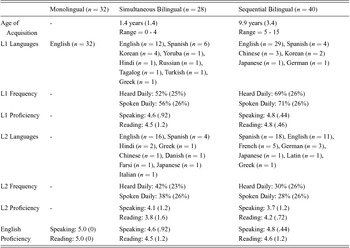
Participants completed a language background questionnaire that asked for details about each language they knew, and reported age of acquisition, proficiency, and frequency of use. As all participants were undergraduates enrolled at Georgetown University, all participants self-reported to be highly proficient in English. Participants who only listed one language were classified as monolingual (n = 32). Participants who learned a second language within the home environment before the age of 5 were classified as simultaneous bilinguals (n = 28) and participants who learned their second language after their first language but before the age of 15 were classified as sequential bilinguals (n = 40). The two subgroups of bilinguals did not differ in their self-rated proficiency in their first language (L1) or second language (L2). Information from the language background questionnaire is reported in Table 1.
Responses from Language Background Questionnaire.

Note: Means and standard deviations (in parentheses) for age of acquisition, frequency of each language heard/spoken, and proficiency with each language. Participants rated their proficiency using a 5-point scale.
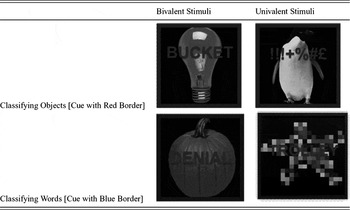
Examples of stimuli shown during the classification task.

Note: The bivalent stimuli included both a written word and an identifiable image, whereas the univalent stimuli included either a written word or an identifiable image. A red cue indicated object classification (human-made vs. natural) and a blue cue indicated word classification (abstract vs. concrete). Stimuli were presented for 300 milliseconds.
Computer tasks
All e-prime stimuli and procedures for the cognitive control classification task and surprise recognition memory task were identical to those used by Richter and Yeung (Reference Richter and Yeung2012).
Classification task
Objects and words were presented to participants on a screen and participants were instructed to classify the objects as human-made or natural and words as concrete or abstract. At the start of each trial, a specific color surrounding the picture of the stimulus instructed the participants on task type (red = object classification, blue = word classification), and participants recorded their responses on a standard computer keyboard using their index fingers for object classifications (“x” = human-made, “n” = natural) and their middle fingers for word classifications (“z” = abstract, “m” = concrete). Repeat trials consisted of trials where the same task type was presented in the previous trial (object, object), whereas switch trials occurred when a different task type was presented in the previous trial (object, word). The ability to ignore irrelevant stimuli was measured by the use of bivalent or univalent stimuli. Two-thirds of the trials used bivalent stimuli and the rest of the trials used univalent stimuli, see Table 1. Participants were first given a brief training then completed five blocks of 48 trials, where task and stimulus order in each block was randomized.
Surprise recognition memory task
After the classification task, participants completed a surprise recognition memory test. On each trial, participants were shown a word or object and were asked to judge if that word or object was previously presented during the classification task. Participants were instructed to rate each item from a scale of 1 (“I am sure it is new”) to 6 (“I am sure it is old”). After a brief training, participants completed eight blocks of 74 trials, with old and new items appearing in a 2:1 ratio. Each block contained only words or objects in a repeated ABBA order and stimulus order was randomized. Participants were given 2,500 milliseconds to respond.
Procedure
All testing was conducted with a native English-speaking experimenter. Participants completed a demographic survey before the computer tasks and completed the language background questionnaire after completing the computer tasks.
Results
A preliminary analysis examining associations between gender and any of the outcomes of interest yielded no main effects or interactions; therefore the data were collapsed across gender in the following analyses.
Classification task
For the classification task, reaction times and the number of errors were recorded for each trial. Following the Richter and Yeung (Reference Richter and Yeung2012) protocol, reaction time outliers (greater than two standard deviations of the mean) were identified separately for each task (object or word classification) and trial type (switch and repeat) for each participant and excluded from reaction time analysis. Two 3 (group: monolingual, sequential bilingual, simultaneous bilingual) x 2 (trial type: switch, repeat) mixed factorial ANOVAs were conducted on reaction times and error rates respectively. Robust switch costs were found on the classification task as the ANOVA yielded a significant main effect of trial type for both reaction times, F(1, 97) = 355.64, p < .001, ηρ2 = .79, and number of errors, F(1, 97) = 38.11, p < .001, ηρ2 = .28. The analysis also yielded a main effect of group for the number of errors, F(2, 97) = 3.50, p = .034, ηρ2 = .07, with significant differences between monolinguals and simultaneous bilinguals on number of errors (p = .04), but no difference between sequential bilinguals and monolinguals or sequential and simultaneous bilinguals. Additionally, no significant main effect of group or significant interactions between trial type and group for reaction time or the number of errors was found.
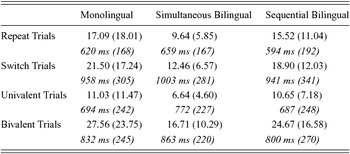
Examining switch and repeat trials separately, analyses yielded a significant main effect of group for switch trials, F(2,97) = 3.88, p = .02, ηρ2 = .07, with significant differences between monolinguals (M = 21.50, SD = 17.24) and simultaneous bilinguals (M = 12.46, SD = 6.57) on number of errors during switch trials (p = .02), but no difference between sequential bilinguals (M = 18.90, SD = 12.03) and monolinguals or sequential and simultaneous bilinguals. No differences in errors emerged for repeat trials; language group differences were also not found for reaction time. When examining associations between age of L2 acquisition and number of errors on both repeat and switch trials, significant positive correlations were found for both repeat (r = .293, p = .015) and switch trials (r = .269, p = .026), suggesting that bilinguals who acquired their second language earlier in life committed fewer errors in both repeat and switch trials during the classification task. These results suggest that participants responded faster and more accurately on repeat trials than on switch trials overall and simultaneous bilinguals made the fewest errors, see Table 3.
Means (standard deviations) for number of errors and reaction times by language group.

Recognition memory task
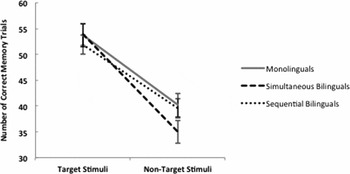
As we were only interested in whether the participant accurately recognized the stimuli as old or new, as opposed to the strength of their memory, memory responses were coded as correct if the participant rated a previously seen item with a 4, 5, or 6 and if the participant rated a new item with a 1, 2, or 3. An error was coded if they incorrectly rated a new item as old or conversely an old item as new. Only memory ratings for objects and words previously appearing on bivalent switch trials were calculated. For example, if given the bivalent stimuli in the classifying objects row of Table 1, the object, light bulb, would be the target (task-relevant) item whereas the word, bucket, would be the non-target (task-irrelevant) item. To examine differences in recognition memory for previously seen items, a 3 (group: monolingual, sequential bilingual, simultaneous bilingual) x 2 (target type: target, non-target) mixed factorial ANOVA yielded a significant main effect of target type, F(1,97) = 163.04, p < .001, ηρ2 = .63. Although a significant main effect of group was not found (F(2,97) <1, p = .60), the analysis yielded a trend for an interaction between target type and group (F(2,97) = 2.81, p = .06, ηρ2 = .06), with no group differences on previously seen target stimuli but simultaneous bilinguals accurately remembering fewer non-target stimuli, see Figure 1.
Mean memory performance for target and non-target stimuli across language groups with error bars indicating standard error of the mean.

Examining target and non-target trials separately, no significant main effects of group were found for either target (p = .75) or non-target (p = .12) stimuli. When examining associations between age of L2 acquisition and memory for target and non-target stimuli, no significant correlations were found. These results suggest that participants more accurately remembered target stimuli than non-target stimuli, with no differences in recognition memory across language groups overall.
To check for differences in recognition memory for objects vs. words, a 3 (group: monolingual, sequential bilingual, simultaneous bilingual) x 2 (stimuli type: object, word) ANOVA was conducted and yielded no main effect of group, F(2,97) <1, p = .50, no main effect of stimuli type, F(1,97) <1, p = .71, and no interaction, F(2,97) <1, p = .65. These results suggest that stimuli type (object vs. word) did not influence recognition memory accuracy. The sensitivity index d-prime (d’) was also calculated, but no differences were found between groups on this measure, F(2, 99) = 0.25, p = .78, suggesting that participants were not biased towards a single response.
Classification and memory
Next, we examined memory accuracy for target vs. non-target items that had previously appeared on bivalent classification trials. A 2 (target type: target, non-target) x 2 (trial type: repeat, switch) x 3 (group: monolingual, sequential bilingual, simultaneous bilingual) mixed factorial ANOVA on memory accuracy yielded no main effect of trial type (F < 1, p = .63), but a significant main effect of target type, F(1,97) = 868.43, p < .001, ηρ2 = .90, and a significant interaction between target type and trial type, F(1,97) = 11.05, p = .001, ηρ2 = .10, replicating the original Richter & Yeung (Reference Richter and Yeung2012) study. Main effects of language group (F< 1, p = .50) or other significant two-way or three-way interactions were not found. Memory for non-target items was higher on switch trials than repeat trials, whereas memory for target items was higher on repeat trials than switch trials. These results suggest that switching tasks (i.e., from classifying objects to classifying words) decreases attentional focus and increases the chances of distraction. On repeat trials, participants were able to maintain attention on the target and ignore the non-target, whereas this focus was disrupted on switch trials, leading to increased memory ratings for the non-target stimuli.
Finally, correlations between the numbers of errors made during the switch trials (switch errors) of the classification task and memory performance were examined. Overall, the number of switch errors was significantly negatively correlated for target stimuli (r = -.318, p = .001) and significantly positively correlated for non-target stimuli (r = .407, p < .001), suggesting that participants who committed fewer switch errors recognized more target stimuli and recognized fewer non-target stimuli. In order to examine associations between age of L2 acquisition, switch errors, and memory performance for target and non-target stimuli, partial correlations were conducted. Mediation analyses could not be conducted, as our previous recognition memory analysis found no significant correlations between age of L2 acquisition and memory performance. Controlling for age of L2 acquisition for simultaneous and sequential bilinguals, the correlation between switch errors and target stimuli was strengthened (r(65) = -.548, p < .001), but the correlation between switch errors and non-target stimuli was reduced to non-significant (r(65) = .223, p = .07). These results suggest that although attentional control (switch errors) significantly influenced subsequent memory for target and non-target stimuli for all participants, age of L2 acquisition for bilingual participants partially accounted for the association between attentional control and non-target stimuli, but not target stimuli.
Discussion
Bilingualism, which has been associated with increased attentional control (e.g., Bialystok et al., Reference Bialystok, Craik and Luk2008; Zied et al., Reference Zied, Phillipe, Karine, Valerie, Ghislaine and Arnaud2004), was related to fewer errors on the classification task. Consistent with our hypothesis, simultaneous bilinguals committed the fewest errors, with significant differences in number of errors between simultaneous bilinguals and monolinguals but no differences between simultaneous and sequential bilinguals or monolinguals and sequential bilinguals. Although bilingual status was related to better performance on the classification task, contrary to our hypothesis that better switching performance would be associated with an improvement in later memory performance, we found no significant differences in subsequent memory across language groups. We also tested the hypothesis that bilinguals would perform worse on word recognition as opposed to object recognition, but again we report no differences in memory performance for objects vs. words for bilingual participants. A marginally significant interaction was found, however, between target type and language group, revealing no group differences on previously seen target stimuli but with simultaneous bilinguals remembering fewer non-target stimuli. Finally, we replicated previous findings (Richter & Yeung, Reference Richter and Yeung2012) showing that the use of cognitive control affects the selectivity of incidental memory encoding of target and non-target stimuli – a distinction largely untested in previous literature. We extend this research by demonstrating that increased attentional control (demonstrated by fewer errors on switch trials during the divided attention task) was significantly associated with improved subsequent memory of classification task items; participants who committed fewer switch errors recognized more target stimuli and recognized fewer non-target stimuli. For bilinguals, age of L2 acquisition partially accounted for the association between attentional control and recognition memory for non-target stimuli, but not target stimuli.
Although attentional control and memory are intertwined processes, few studies have examined the interactions and differential performance between attentional control and memory (Buckner, Reference Buckner2003; Chun & Turk-Browne, Reference Chun and Turk-Browne2007; Mecklinger, Reference Mecklinger2010; Richter & Yeung, Reference Richter and Yeung2012). In the current study, participants must remember the task switching rules in order to select the appropriate or relevant stimuli during the classification task, and our results demonstrate that engaging in task switching impairs control of attention to distracting stimuli – increasing the likelihood of encoding non-target stimuli. We found marginal differences in memory scores for non-target stimuli compared to target stimuli across language groups, possibly suggesting that simultaneous bilinguals were less likely to be distracted by the non-relevant stimuli during encoding, resulting in lower memory scores for non-target stimuli. Individual differences in attentional control influence encoding of relevant and irrelevant information and our results support theories promoting the interdependence of memory and attentional control.
Overall, individual differences in attentional control were associated with subsequent memory performance, but significant group differences by language status in attentional control did not produce significant group differences in subsequent memory. This suggests that individual differences in attentional control, beyond early exposure to multiple languages, may influence memory encoding for both monolinguals and bilinguals. Examining age of L2 acquisition in bilinguals, we find that age of L2 acquisition partially accounts for the relation between attentional control and non-target stimuli, but not target stimuli. Similarly, Sabourin and Vīnerte (Reference Sabourin and Vīnerte2015) find differences between simultaneous and sequential bilinguals on Stroop task mixed-language trials that require interference suppression, but not on single-language trials. The authors suggest that simultaneous bilinguals are better able to focus on the task and ignore distracting information than sequential bilinguals and, though both bilingual groups may have acquired two languages early in life, differences in underlying processes, and not L2 proficiency, may account for disparities in results between simultaneous and sequential bilinguals.
The expectation that, compared to monolinguals, better performance by bilinguals on the switching task, due to enhanced attentional control, should result in better memory recognition of relevant stimuli and less recognition of irrelevant stimuli was not supported at the group level, but across all participants, individual differences in attentional control were related to improved memory for relevant information and reduced recognition memory for irrelevant stimuli. A past study had reported bilingual disadvantages in subsequent memory following a divided attention task (Fernandes et al., Reference Fernandes, Craik, Bialystok and Kreuger2007), and our results do not support those findings presumably due to less reliance on lexical retrieval during our recognition memory trials. A limitation in the current study was the use of self-rated L2 proficiency; future work should use measures of receptive and productive vocabulary to assess dual language proficiency in relation to cognitive domains.
Our results further support findings suggesting that the bilingual advantages in attentional control are due to enhanced capabilities of interference suppression (Bialystok et al., Reference Bialystok, Craik and Luk2008). Additionally, the current study investigates how task parameters and age of acquisition effects influence cognitive outcomes and may help to explain inconsistencies in results across bilingual cognitive control studies (Coderre, Van Heuven & Conklin, Reference Coderre, Van Heuven and Conklin2013; Paap & Greenberg, Reference Paap and Greenberg2013; Kousaie & Phillips, Reference Kousaie and Phillips2012; Sabourin & Vīnerte, Reference Sabourin and Vīnerte2015) and elucidate the relationship between divided attention and memory.