


Introduction
Stepped-care service design is advocated in the National Institute for Health and Clinical Excellence (NICE) guidelines for anxiety (NICE, 2011). The Improving Access to Psychological Therapies (IAPT) initiative is a large-scale (national) attempt to systematise stepped-care principles for the treatment of depression and anxiety, enabling the treatment of large numbers of patients each year across over 200 IAPT services in England. Stepped care follows the principle of offering the least restrictive and least intensive evidence-based intervention as a first-line treatment, followed by more intensive and costly interventions for those who require ongoing care (Bower and Gilbody, Reference Bower and Gilbody2005). First-line interventions in IAPT services are conceptualised as ‘low-intensity’ treatment, which typically involves six to eight sessions of guided self-help (GSH) based on cognitive behavioural principles. According to stepped-care principles, Step 1 involves an initial assessment by general practitioners or other healthcare providers, Step 2 involves low-intensity GSH interventions, and Step 3 involves more intensive psychological therapies.
Clinical guidelines emphasise the need to offer a choice of treatments to patients experiencing common mental health problems, as different interventions may suit different patients. The range of therapies available at Step 3 in IAPT services has increased to include a range of therapies including cognitive behavioural therapy (CBT), interpersonal psychodynamic psychotherapy, dynamic interpersonal therapy (DIT), eye movement desensitization and reprocessing (EMDR) and couples counselling for depression (Perfect et al., Reference Perfect, Jackson, Pybis and Hill2016). However, this expansion in patient choice has not been mirrored at Step 2 of IAPT services, as currently available guided self-help interventions are based on CBT principles and delivered in the form of computerised CBT, group-based CBT, or individual low-intensity CBT. To address this lack of patient choice, Meadows and Kellett (Reference Meadows and Kellett2017) developed a manualised version of cognitive analytic therapy (CAT-GSH) for delivery across the range of anxiety disorders. CAT-GSH was shown to have high adherence to GSH principles, generated low drop-out rates, was suitable for delivery at Step 2 and was clinically effective with a durable short-term effect. The evidence base for high-intensity CAT for anxiety disorders is supported by clinical trials (Boogar et al., Reference Boogar, Rezaei and Yosefi2013) and cohort studies (Tzouramanis et al., Reference Tzouramanis, Adamopoulou, Bozikas, Voikli, Zagora, Lombtzianidou, Mamouzelos and Garyfallos2010). The effectiveness of CAT for the treatment of common mental health problems also appears to be comparable to CBT and counselling in primary care settings (Marriott and Kellett, Reference Marriott and Kellett2009). However, CAT outcomes research has tended to mostly focus on the treatment of complex trauma and personality disorders, and its evidence base for the treatment of common mental disorders and particularly anxiety disorders is still scarce. Nevertheless, a recent meta-analysis of the CAT evidence base (Hallam et al., Reference Hallam, Simmonds-Buckley, Kellett, Greenhill and Jones2020) showed that CAT produces moderate-to-large improvements in interpersonal problems (ES = 0.74, 95% CI 0.51–0.97, n = 460) and large pre–post improvements in global functioning (ES = 0.86; 95% CI 0.71–1.01, n = 628).
When it is impossible to blind patients to treatment allocation in clinical trials, a potential major confound is that the effects reported may more possibly reflect the influence of patients’ preferences, rather than true therapeutic efficacy (Torgerson and Sibbald, Reference Torgerson and Sibbald1998). When those with strong treatment preferences refuse participation, the generalisability of the study is limited (Howard and Thornicroft, Reference Howard and Thornicroft2006). When preferences are assessed in trials, this tends to be limited to simply noting participants’ preferences (without these having an influence in treatment allocation), often using single-item questions and Likert scales of preference strength (King et al., Reference King, Nazareth, Lampe, Bower, Chandler, Morou, Sibbald and Lai2005). In partially randomized patient preference trials (PRPPT), participants receive detailed information on available treatment choices; those with strong preferences receive the therapy they want and can be observed as usual for all study outcomes, whilst those without a strong preference are randomized (O’Connor et al., Reference O’Connor, Boyd, Warde, Stolbach and Till1987). To our knowledge, the PRPPT approach has never been applied in a clinical trial of guided self-help. The objective of the present PRPPT is to contrast the efficacy and clinical durability of two differing types of manualised GSH (CAT-GSH versus CBT-GSH) for anxiety disorders delivered at Step 2 of an IAPT service.
Method
Study setting, methodology and recruitment
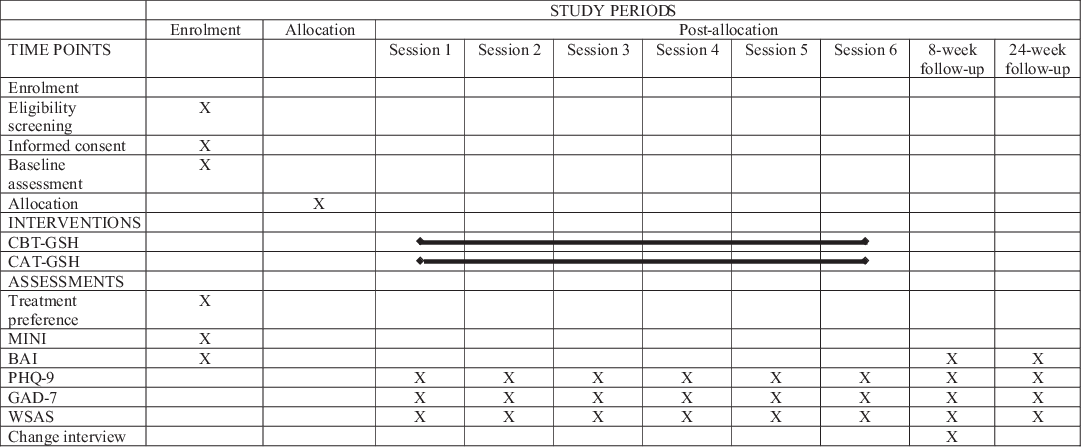
The design is a partially randomised patient preference design (Torgerson and Sibbald, Reference Torgerson and Sibbald1998). The study will take place in a single site: the Oldham IAPT service hosted by Pennine Care NHS Foundation Trust. When a patient is referred to the IAPT service at the routine telephone triage (and is suitable for a Step 2 intervention), they will be offered the option to participate in the trial. If the person is interested, then they will be offered a trial eligibility interview. Figure 1 illustrates the recruitment process using a CONSORT diagram, and Fig. 2 provides the SPIRIT summary.
Study flow diagram of referral, screening and allocation of patients. PHQ-9, Patient Health Questionnaire-9; GAD-7, Generalised Anxiety Disorder-7; WSAS, Work and Social Adjustment Scale; BAI, Beck Anxiety Inventory; MINI, Mini International Neuropsychiatric Interview.

SPIRIT diagram of assessments at enrolment, allocation, treatment sessions and 8- and 24-week follow-up. CBT-GSH, Cognitive Behavioural Therapy Guided Self-Help; CAT-GSH, Cognitive Analytic Therapy Guided Self-Help; MINI, Mini International Neuropsychiatric Interview; BAI, Beck Anxiety Inventory; PHQ-9, Patient Health Questionnaire-9; GAD-7, Generalised Anxiety Disorder-7; WSAS, Work and Social Adjustment Scale.

Inclusion and exclusion criteria
At the trial eligibility interview, potential participants will be screened with the shortened version of the Mini International Neuropsychiatric Interview (MINI; Sheehan et al., Reference Sheehan, Lecrubier, Harnett-Sheehan, Amorimm, Janavs, Weiller, Hergueta, Baker and Dunbar1998) to establish a diagnosis of an anxiety disorder. Participants will be included if they: (a) have self-referred or been referred by their General Practitioner or other health or social care professional for the treatment of a common mental health problem; (b) meet criteria for an anxiety disorder based on the MINI; (c) have clinically significant symptoms above the established cut-off on the BAI anxiety measure – see measures section; (d) want to engage in GSH to address their anxiety disorder; and (e) are motivated to engage in treatment and can attend six to eight sessions either face-to-face or on the telephone. Participants will be excluded if they: (a) are currently engaging in another IAPT Step 2 intervention; (b) do not currently meet criteria for an anxiety disorder; (c) do not meet caseness on the BAI; (d) meet criteria for depression and a co-morbid anxiety disorder, where the depression is more severe and is the patient’s main concern; (e) have a severe/chronic mental health problem and are already involved in psychiatric or secondary care mental health services; (f) have a diagnosis of social phobia or PTSD (IAPT guidelines indicate that these disorders are treated at Step 3); (g) the GSH sessions require an interpreter; and (h) are unable to read and write. Overall, the rationale for focusing the trial on anxiety disorders was because the CAT-GSH was originally developed solely for the treatment of anxiety disorders and also the acknowledged brevity of evidence of CAT anxiety outcome studies.
Interventions
The interventions will be delivered by qualified psychological wellbeing practitioners (PWPs). Interventions will be delivered either face-to-face or via the telephone. The CBT-GSH will follow the IAPT structured 6–8 session treatment protocols and associated client workbooks for the various anxiety disorders (Richards and Whyte, Reference Richards and Whyte2011). This is treatment as usual (TAU) in the IAPT service for patients with mild-to-moderate anxiety at Step 2. CAT-GSH is a structured low-intensity psychological intervention based on the principles of cognitive analytic therapy (Meadows and Kellett, Reference Meadows and Kellett2017). The approach is appropriate regardless of the type of anxiety disorder, as CAT adopts a transdiagnostic approach. The 6–8 CAT-GSH sessions are as follows: (1) identifying anxiety snags, traps and dilemmas and associated self-monitoring homework; (2) eliciting reciprocal roles from early experiences and associated self-monitoring homework; (3) linking the past to the present and writing a CAT problem statement; (4) creating a CAT diagrammatic reformulation of the anxiety and associated self-monitoring homework; (5) identifying exits/change methods associated with self-practice homework; and (6) working on endings and relapse prevention.
Intervention differentiation, fidelity and competency
The difference (and the patient choice) aspect of the trial is that the CBT-GSH and CAT-GSH systematically differ in the following ways: (a) CBT-GSH works primarily with the here-and-now and CAT-GSH works with the past and the here-and-now, (b) CBT-GSH relies on an effective therapeutic relationship, but does not explicitly make use of transference and counter-transference in the therapeutic relationship, whilst CAT-GSH does work with the therapeutic relationship and makes use of transference and counter-transference in the self-help exercises and (c) CAT-GSH is based on a dialogical and relational theoretical model and CBT-GSH is based on a cognitive behavioural theoretical model. Patient choice will be supported through a detailed information sheet containing descriptions of each form of GSH. This information sheet has been through five iterations with practising PWPs to ensure that treatments and randomisation are presented in equipoise. The strength of the preference is not measured in the trial, but is rather recorded as a strict choice. The low-intensity treatment competency scale (Kellett et al., Reference Kellett, Simmonds-Buckley, Limon, Stride, Hughes, Hague and Millings2020) will be used to assess treatment competency in each arm. One session per participant will be randomly selected for audio-recording and associated competency assessment, using a random number generator by Graphpad (2005).
Beck Anxiety Inventory (BAI; Beck et al., Reference Beck, Epstein, Brown and Steer1988)
The BAI is a brief (21-item; score range 0–63) and well-validated outcome measure for anxiety. BAI is scored as 0–9 normal or no anxiety, 10–18 mild to moderate anxiety, 19–29 moderate to severe anxiety and 30–63 severe anxiety. A significant reliable change on the BAI is a change score of ≥10 points. The BAI will be collected at the eligibility screening interview, and at 8- and 24-week follow-up. The BAI was selected as the primary outcome measure because of (a) its excellent psychometric properties and (b) as the measure is a good index of anxiety severity in primary care patients across a variety of anxiety disorders (Muntingh et al., Reference Muntingh, van der Feltz-Cornelis, van Marwijk, Spinhoven, Penninx and van Balkom2011). This method ensures that the primary outcome measure in this trial (BAI) is independent to the GAD-7 measure that is routinely reviewed by PWPs and patients to monitor response to treatment, thus circumventing potential demand characteristics, social desirability bias and serial dependency between repeated measures using the GAD-7 questionnaire.
Secondary outcome measures
Secondary data will include the number of sessions attended (i.e. minimal attendance 1–2 sessions, moderate attendance 3–5 and full 6–8 session completion), drop-out rate (percentage of participants not completing) and stepping-up rate (percentage of participants stepped up following GSH to step 3). As part of the IAPT minimum dataset (MDS) participants will be asked three closed questions concerning their employment and disability benefit status. IAPT MDS measures will be collected at each session, and at 8- and 24-week follow-up and consist of the Generalised Anxiety Disorder-7 (GAD-7; Spitzer et al., Reference Spitzer, Kroenke, Williams and Löwe2006), Patient Health Questionnaire-9 (PHQ-9; Kroenke et al., Reference Kroenke, Spitzer and Williams2001), Work and Social Adjustment Scale (WSAS; Mundt et al., Reference Mundt, Marks, Shear and Greist2002) and the IAPT Phobia Scale. There will be no extra burden on PWPs as the IAPT MDS is collected as a part of routine practice and the study coordinator will collect all the follow-up data.
Sample size
All analyses will be conducted on an intention-to-treat basis. Assuming a ‘small’ effect size of f = .2, a significance level of alpha = .05 with two study arms providing data at three time points (assessment, short and long-term follow-up) a total sample size of n = 134 gives 80% power to test for differences between CAT-GSH and CBT-GSH. This effect size has been selected a priori, informed by the psychotherapy trials literature which consistently indicates that outcome differences between psychological interventions are most often non-significant and small in magnitude (e.g. see Cuijpers et al., Reference Cuijpers, Van Straten, Andersson and Van Oppen2008; Cuijpers et al., Reference Cuijpers, Karyotaki, de Wit and Ebert2020).
If there are differences between those who have a preference for CAT-GSH and CBT-GSH and those choosing to be randomised this will necessitate a four-arm trial: (a) preference for CAT-GSH, (b) randomised to CAT-GSH, (c) preference for CBT-GSH and (d) randomised to CBT-GSH. The sample size would increase to n = 188 for a four-arm patient preference trial.
Allocation
This trial will employ a patient preference methodology (Torgerson and Sibbald, Reference Torgerson and Sibbald1998), with those participants who do not have a treatment preference being allocated to either CAT-GSH or CBT-GSH using block randomisation by a third party not directly involved in the treatment of study participants. It is impossible to blind both the participants and PWPs to treatment allocation. Allocation to either form of GSH will be recorded in a separate location in the patient data log.
Data collection, quality and management
The study coordinator will be trained in the administration of the MINI. Research screening interviews will be conducted face-to-face or on the telephone and the follow-ups will be collected via the telephone. PWPs will receive a 2-day training package on how to effectively deliver the CAT-GSH intervention. The feasibility and acceptability of the training will be assessed through attendance monitoring at the training and satisfaction with the training. A monthly 2-hour clinical supervision group will support the delivery of CAT-GSH and a monthly 1.5-hour clinical supervision group will support the delivery of the CBT-GSH. All PWPs will also receive weekly case management supervision for 1-hour in line with IAPT guidance. Data entry will be checked using a 5% double entry procedure. Anonymised measures data will be stored on a University of Sheffield password-protected secure server, with only named people having access. Names of participants on consent forms are stored separately from data in locked filing cabinets in the Trust. A separate key linking names to ID numbers used in data files will be stored on a password-protected file on a secure server, accessible by named personnel only.
Statistical analysis
The analysis will follow the Ward et al. (Reference Ward, King, Lloyd, Bower, Sibbald, Farrelly, Gabbay, Tarrier and Addington-Hall2000) approach of analysing whether there are any differences between randomised and preference within the arms and if there are no differences between these groups then collapsing the within-arm groups to form a two-arm trial. We will also analyse the comparison between the two randomised and two preference arms alone. The planned analyses are as follows based on intention-to treat principles: (a) CONSORT of patient preferences to demonstrate choice, response, completion, step-up, follow-up and drop-out rates in each arm, (b) comparative anxiety (BAI) treatment effect sizes in each arm at short- and long-term follow-up calculated and compared based on Cohen’s d+, (c) comparative treatment recovery rates (based on clinical and reliable change using the reliable change index with the BAI) in each arm at short- and long-term follow-up and (d) ANCOVA of between-arm differences over time on primary and secondary outcomes. To test the robustness of the results, we will repeat the analysis using longitudinal multi-level modelling, where repeated outcome measures (level 1) are nested within cases (level 2), controlling for baseline severity and introducing a group variable along with a group×time interaction term (the latter being the primary hypothesis test). All analyses will be carried out by a researcher who will be blind to group allocation.
Qualitative interviewing and analysis
At short-term follow-up (8 weeks), participants will be invited to participate in qualitative interviews concerning their experience of the intervention they have received. A purposive sampling strategy will be used to ensure relatively equal distributions of participants according to random allocation and gender. Only those participants that have a reliable and clinically significant pre–post change on the GAD-7 will be eligible for this interview. The rationale for using the GAD-7 for the qualitative aspect of the study was that a BAI outcome was being collected at 8 weeks, and we wanted to be able to interview participants at 8 weeks and therefore needed to use the post-treatment GAD-7 outcomes to direct this. The rationale for only selecting ‘recovered’ participants on the GAD-7 is that the study seeks to understand how GSH works – when there is sufficient evidence that is has worked and this will also enable a comparison of the change process between the theoretical models. Ten interviews from patients recovered following CAT-GSH and ten interviews for participants recovered following CBT-GSH will be conducted. The interview will be guided by the Change Interview (Elliott; Reference Elliott2010; adapted for the GSH context). Digitally recorded follow-up change interviews will be transcribed verbatim and analysed using two types of data-driven thematic analysis (TA), as described by Boyatzis (Reference Boyatzis1998): hybrid TA and inductive TA. First, using hybrid TA, research-driven themes relating to the feasibility and acceptability of CAT-GSH and CBT-GSH will be developed (Boyatzis, Reference Boyatzis1998). Second, using inductive TA, themes that maximally differentiate how and why change has occurred during each type of GSH will be developed.
Trial monitoring
The monthly trial steering committee consisting of the study coordinator, principal investigator and the chief investigator will collect and assess any adverse events for participants in the trial. Adverse events are defined as any serious event for a study participant that (a) results in death by suicide or homicide, (b) are defined as severe self-harm, (c) requires psychiatric hospitalisation, (d) results in persistent or significant disability or incapacity and/or (e) results in another medical or psychologically important condition occurring. Risk will be managed via the host Trust’s risk management policy.
Ethics
The study has been ethically reviewed: IRAS reference number, 240751. The study has been pre-registered: ClinicalTrials.gov identifier, NCT03730532. The study is supported with a research grant provided by the Association of Cognitive Analytic Therapists. Any protocol amendments will be communicated and approved via IRAS and the participant information altered accordingly. Informed consent will be achieved from participants via a study consent form as part of the research screening process by the study coordinator.
Discussion
Patient-preference trials remain relativity rare in mental health research despite the efforts to increase patient choice in clinical services. Extensive evidence exists concerning CBT-GSH, whilst sound research evidence concerning the acceptability, effectiveness and efficacy of other forms of GSH (i.e. those underpinned by different theoretical models) has lagged behind. Determining patient preferences is an important aspect of clinical trial design. It is acknowledged that the PRPPT design does not insulate against outcomes being affected by the influence of uncontrolled confounders in the preference groups (Halpern, Reference Halpern2003). The strength of this trial is that it is pragmatic and being conducted within an IAPT service, and therefore the results will be generalisable to other Step 2 IAPT services that use GSH in a one-to-one format. Clearly the trial has less relevance to those IAPT services that heavily rely on group psychoeducational interventions at Step 2. Delivery of Step 2 interventions are less researched then Step 3 interventions and this imbalance needs to be addressed and rebalanced. On completion, the findings from the trial have the potential to make a significant contribution to the expanding IAPT Step 2 evidence base.
Acknowledgements
The authors would like to acknowledge the role played by Stephanie Boyle in the ongoing management of the project.




Comments
No Comments have been published for this article.