










1 Introduction
Among the more basic results in modal logic are that the logics
$\mathbf {K}\oplus \Box p\to p$
 and
$\mathbf {K}\oplus \Box \Box p\to \Box p$
 have the finite model property (FMP), and likewise for the logics axiomatized by the converse axioms,
$\mathbf {K}\oplus p\to \Box p$
 and
$\mathbf {K}\oplus \Box p\to \Box \Box p$
 . Yet for the innocuous-looking analogues

it is unknown whether they too enjoy the FMP. In fact, they are the simplest instances of the following long-open problem:

This question appears in Problem 11.2 in Chagrov and Zakharyaschev [Reference Chagrov and Zakharyaschev2], who attribute it to Segerberg (see their 11.8 Notes). Earlier, Gabbay [Reference Gabbay3] had established the FMP in the cases where
$n=1$
 or
$m=1$
 , and around the same time, Zakharyaschev [Reference Zakharyaschev8] proved that all extensions of
$\mathbf {K4}$
 by modal reduction principles—formulas of the form
$\mathsf {M}p\to \mathsf {N}p$
 for
$\mathsf {M,N}$
 sequences of
$\Diamond $
 s and
$\Box $
 s—have the FMP. Zakharyaschev [Reference Zakharyaschev8] also remarked that “[...] the situation with FMP of extensions of
$\mathbf {K}$
 by modal reduction principles, even by axioms of the form
$\Box ^np \to \Box ^mp$
 still remains unclear. I think at present this is one of the major challenges in completeness theory.” A decade later, Wolter and Zakharyaschev [Reference Wolter, Zakharyaschev, Blackburn, Benthem and Wolter7] echoed this, reiterating the question (P) as Problem 6 and calling it “[p]erhaps one of the most intriguing open problems in Modal Logic.”
Only recently has there been partial breakthrough. Lyon and Ostropolski-Nalewaja [Reference Lyon and Ostropolski-Nalewaja6] used techniques from database theory, in particular (disjunctive) existential rules and (disjunctive) chase, to prove that if
$\Phi $
 is a finite set of formulas of the form
$\Box ^np\to \Box ^mp$
 where
$n>m>1$
 , then
$\mathbf {K}\oplus \Phi $
 is decidable.Footnote
1
Motivated by this, we solve half of problem (P), showing that if
$\Phi $
 is a set of formulas of the form
$\Box ^np\to \Box ^mp$
 where
$n>m>1$
 , then
$\mathbf {K}\oplus \Phi $
 has the FMP. As a corollary we recover the result of Lyon and Ostropolski-Nalewaja [Reference Lyon and Ostropolski-Nalewaja6]: if
$\Phi $
 is finite, then
$\mathbf {K}\oplus \Phi $
 is decidable. In contrast to their work, we prove the FMP and employ a different approach that combines a representation lemma with a filtration lemma.
We proceed as follows. Section 2 sets out the preliminaries, the proof strategy, and the main results. Section 3 contains the proofs: Subsection 3.1 proves a representation lemma, and Subsection 3.2 proves a filtration lemma; together, these yield the FMP.
2 Setup and results
We begin with some foundational definitions; for further background, readers may consult standard textbooks on modal logic (e.g., [Reference Blackburn, de Rijke and Venema1]).
Our language is the basic modal language, generated by the grammar

where
$p\in \mathsf {Prop}$
 are propositional variables and
$\bot $
 is the falsum constant. ‘
$\land $
 ’, ‘
$\to $
 ’, and ‘
$\Box $
 ’ are defined in the usual way.
Frames are pairs
$(W, R)$
 where
$R\subseteq W\times W$
 ; pointed frames
$(W, R,r)$
 are frames
$(W, R)$
 with
$r\in W$
 ; and models
$(W, R, V)$
 are frames
$(W, R)$
 with a valuation
$V:\mathsf {Prop}\to \mathcal {P}(W)$
 . Given a frame
$(W, R)$
 , the k-step relations
$R^k\subseteq W\times W$
 are defined recursively by

and we write
$R^k[w]\mathrel {:=}\{v\in W\mid wR^kv\}$
 for the set of k-step successors of
$w\in W$
 . A pointed frame
$(W, R,r)$
 is rooted (at r) if
$\bigcup _{k\in \omega } R^k[r]=W$
 .
Let
$\mathbf {K}$
 denote the least normal modal logic, and recall that formulas of the form
$\Box ^np\to \Box ^mp$
 are equivalent modulo
$\mathbf {K}$
 to
$\Diamond ^mp\to \Diamond ^np$
 ; for instance,

where, for a formula or set of formulas
$\Gamma $
 ,
$\mathbf {K}\oplus \Gamma $
 is the least normal modal logic containing
$\Gamma $
 . Henceforth, we adopt the diamond formulation, and reserve the notation
$\Phi $
 for an arbitrary set of formulas of the form
$\Diamond ^mp\to \Diamond ^n p$
 for
$n>m$
 . By Sahlqvist,
$\mathbf {K}\oplus \Phi $
 is sound and complete for the class of frames
$(W,R)$
 satisfying the following first-order condition, for all
$\Diamond ^mp\to \Diamond ^n p\in \Phi $
 :

We will show that it is complete for the class of finite such frames. Our proof proceeds by combining a representation lemma with a filtration lemma, for which we first need a few further definitions.
Definition 2.1. Let
$(W,R)$
 be a frame with root r. The depth of a world
$w\in W$
 w.r.t. r is the length of a shortest path from r to w. We denote this by

although we will often suppress the subscript and simply write
$\text {d}(w)$
 . Note that
$\text {d}_r(r)=0$
 .
Definition 2.2. The modal depth of a formula
$\varphi $
 , written
$\text {md}(\varphi )$
 , is the maximal number of nested modalities in
$\varphi $
 . That is,

Definition 2.3. Let
$(W, R, r)$
 and
$(W', R', r')$
 be pointed frames. We say that a map
$f:(W, R, r)\to (W', R',r')$
 is a (pointed) p-morphism if
-
(pointed) $f(r)=r'$
 ,
-
(forth) if $xRy$
, then
$f(x)R'f(y)$
, -
(back) if $f(x)R'y'$
, then there is
$y\in W$
s.t.
$f(y)=y'$
and
$xRy$
.


Definition 2.4. Let
$\mathfrak {M}=(W,R,V)$
 and
$\mathfrak {M}'=(W',R',V')$
 be models. For
$x\in W, x'\in W'$
 , we say that x and
$x'$
 are bisimilar, and write
$x\sim x'$
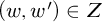
 , if there is a relation
$Z\subseteq W\times W'$
 such that
$(x,x')\in Z$
 and for all
$(w,w')\in Z$
 :
-
(a) for all $p\in \mathsf {Prop}: w\in V(p)\Leftrightarrow w'\in V'(p)$
; -
(b) if $wRv$
, then there is
$v'\in W'$
with
$w'R'v'$
and
$vZv'$
; -
(c) if $w'R'v'$
, then there is
$v\in W$
with
$wRv$
and
$vZv'$
.



The following is well-known and readily proven.
Fact 2.5. Let
$f:(W',R',r')\to (W, R, r)$
 be a p-morphism. For any model
$(W,R,V)$
 over
$(W,R)$
 , setting
$V'(p)\mathrel {:=}f^{-1}[V(p)]$
 yields a model
$(W', R', V')$
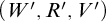 such that for all
$y,y'\in W'$
 ,

and

Moreover, for any models
$(W,R,V)$
 ,
$(W',R',V')$
 and points
$x\in W, x'\in W'$
 , if
$x\sim x'$
 , then
$x$
 and
$x'$
 satisfy the same formulas.
With this, let us outline the proof architecture. It consists of two lemmas: a representation lemma and a filtration lemma. Together, they produce a finite
$\mathbf {K}\oplus \Phi $
 model from any given
$\mathbf {K}\oplus \Phi $
 model. We state these lemmas next, omitting their proofs for now, and show how they combine to establish the FMP for
$\mathbf {K}\oplus \Phi $
 . (Recall that, throughout,
$\Phi $
 contains only formulas
$\Diamond ^m p\to \Diamond ^n p$
 with
$n>m$
 .)
Lemma 2.6 (Representation).
Let
$\varphi $
 be a formula. If
$\varphi $
 is satisfiable in a
$\mathbf {K}\oplus \Phi $
 frame, then it is satisfied at a root
$r\in W$
 of a model
$(W,R, V)$
 such that

and for each
$\Diamond ^mp\to \Diamond ^np\in \Phi $
 ,

Lemma 2.7 (Filtration).
Let
$\varphi $
 be a formula. If
$\varphi $
 is satisfied at a root
$r\in W$
 of a model
$(W,R,V)$
 fulfilling (1) and (2) for each
$\Diamond ^mp\to \Diamond ^np\in \Phi $
 , then
$\varphi $
 is satisfiable in a finite
$\mathbf {K}\oplus \Phi $
 frame.
Theorem 2.8.
$\mathbf {K}\oplus \Phi $
 enjoys the FMP.
Proof. Suppose
$\varphi $
 is satisfiable in a
$\mathbf {K}\oplus \Phi $
 frame. Applying the preceding lemmas in sequence, we get that
$\varphi $
 is satisfiable in a finite
$\mathbf {K}\oplus \Phi $
 frame.
Corollary 2.9. For
$\Phi $
 finite,
$\mathbf {K}\oplus \Phi $
 is decidable.
Proof. Finitely axiomatizable normal modal logics with the FMP are decidable.
3 Proof of the representation and filtration lemmas
3.1 Round one: The representation lemma
It remains to prove the representation lemma (Lemma 2.6) and the filtration lemma (Lemma 2.7). We begin with the former. Conceptually, the lemma is straightforward: it formalizes the idea that in a
$\mathbf {K}\oplus \Diamond ^mp\to \Diamond ^np$
 frame, whenever
$xR^mz$
 , there exist
$w_1,\ldots , w_{n-1}$
 s.t.
$xRw_1R\cdots Rw_{n-1}Rz$
 ; and if
$w_1,\ldots , w_{n-1}$
 fail to have the depth required by condition (2), we may add ‘duplicates’, which we will be denoting
$u_1, \ldots , u_{n-1}$
 , and extend R to a relation
$R'\supseteq R$
 by defining
$xR'u_{1}R'\cdots R'u_{n-1}R'z$
 so that the only paths to each
$u_{j}$
 pass through x, whence the
$u_{j}$
 s will have the required depth. Importantly, although
$R'\supseteq R$
 , the procedure preserves the depth of all points already present before the extension, and hence can be iterated without undoing earlier steps. This takes care of condition (2); an analogous idea handles condition (1).
To make this precise, we use a step-by-step argument that applies two sublemmas: one to enforce (2), and another to enforce (1).Footnote
2
We begin with the sublemma for condition (2). For clarity, note that the subscripts
$_i$
 and
$_{i+1}$
 in
$(W_i, R_i, r_i)$
 ,
$f_i$
 , and so on, used in the lemma statement are not variables but fixed labels, chosen for convenience in our later proof of Lemma 2.6.
Convention 3.1. Since
$\mathbf {K}\oplus \Phi $
 frames are closed under point-generated subframes, which are rooted by definition, we henceforth assume that pointed frames
$(W,R,r)$
 are rooted at r.
Lemma 3.2 (Sublemma for (2)).
Let
$f_{i}: (W_{i}, R_{i}, r_i) \to (W, R,r)$
 be a p-morphism, for
$(W_{i}, R_{i})$
 a Kripke frame and
$(W, R)$
 a
$\mathbf {K}\oplus \Phi $
 frame. Then for every
$\Diamond ^mp\to \Diamond ^np\in \Phi $
 , if
$xR_{i}^mz$
 , then (a) there are
$w_1,\ldots , w_{n-1}\in W$
 and
$v_{1},\ldots , v_{n-1}\in W_{i}$
 such that

and (b) for
$u_{1},\ldots , u_{n-1}$
 distinct points not in
$W_i$
 , the map
$f_{i+1}:(W_{i+1}, R_{i+1}, r_i)\to (W,R,r)$
 given by

where
$W_{{i+1}} \mathrel {:=} W_{i} \cup \{u_{1},\ldots , u_{n-1}\}$
 and

defines a p-morphism such that

Here, for all
$y\in W_{i+1}$
 ,
$\mathrm{d}_{i+1}(y)$
 denotes the length of a shortest path from
$r_{i}$
 to y in
$(W_{i+1}, R_{i+1})$
 ; and
$\mathrm{d}_{i}(y)$
 denotes the length of a shortest path from
$r_{i}$
 to
$y$
 in
$(W_{i}, R_{i})$
 .
Proof. Let
$\Diamond ^mp\to \Diamond ^np\in \Phi $
 be arbitrary and suppose
$xR_{i}y_1R_i\cdots R_i y_{m-1}R_{i}z$
 . By the forth clause, we get that
$f_{i}(x)Rf_{i}(y_1)R\cdots R f_{i}(y_{m-1})Rf_{i}(z)$
 . So as
$(W, R)$
 is a
$\mathbf {K}\oplus \Phi $
 frame, there must be
$w_1,\ldots , w_{n-1}\in W$
 s.t.
$f_{i}(x)Rw_1R\cdots Rw_{n-1}Rf_{i}(z)$
 . Applying the back clause
$n-1$
 times, we additionally find
$v_1,\ldots , v_{n-1}\in W_{i}$
 s.t.
$xR_{i}v_1R_i\cdots R_{i}v_{n-1}$
 and
$f_{i}(v_{j})=w_j$
 , for all
$j\in \{1,\ldots , n-1\}$
 . This proves (a).
Consequently, defining
$W_{i+1}, R_{i+1}$
 , and
$f_{i+1}$
 by adding fresh points
$u_{1},\ldots , u_{n-1}$
 as in the lemma statement, it only remains to show that
$f_{i+1}$
 is a p-morphism such that

and

We begin with showing that
$f_{i+1}$
 is a p-morphism. Observe that
$f_{i+1}(r_i)= f_i(r_i)=r$
 , since
$f_i$
 is a pointed p-morphism. For the forth condition, assume
$aR_{i+1}b$
 . We prove that
$f_{i+1}(a)Rf_{i+1}(b)$
 by cases.
-
• If $(a,b)\in R_{i}$
, then forth for
$f_{i}$
gives us
$f_{i+1}(a)=f_{i}(a)Rf_{i}(b)=f_{i+1}(b)$
. -
• If $(a,b)\in \{(x,u_1), \ldots ,(u_{j}, u_{j+1}), \ldots ,(u_{n-1}, z)\}$
, then
$f_{i+1}(a)Rf_{i+1}(b)$
follows because
$f_{i}(x)Rw_1R\cdots Rw_{n-1}Rf_{i}(z)$
. -
• If $(a,b)=(u_{j}, c)$
for
$c\in W_{i}$
s.t.
$v_{j}R_{i}c$
, then the claim follows by forth for
$f_{i}$
because
$f_{i+1}(u_{j})=w_j=f_{i}(v_{j})Rf_{i}(c)=f_{i+1}(c)$
.






For the back condition, suppose
$f_{i+1}(a)Rb'$
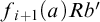 . If
$a\in W_{i}$
 , then
$f_{i}(a)=f_{i+1}(a)Rb'$
 , so by the back condition for
$f_{i}$
 , there is
$b\in W_{i}$
 s.t.
$aR_{i}b$
 and
$f_{i}(b)=b'$
 , hence also
$aR_{i+1}b$
 and
$f_{i+1}(b)=f_{i}(b)=b'$
 . If
$a\notin W_{i}$
 , so
$a=u_{j}$
 , then
$f_{i}(v_{j})=w_j=f_{i+1}(u_{j})Rb'$
 , so by the back condition for
$f_{i}$
 , there is
$b\in W_{i}$
 s.t.
$f_{i}(b)=b'$
 and
$v_{j}R_{i}b$
 . But then
$u_{j}R_{i+1}b$
 and
$f_{i+1}(b)=f_{i}(b)=b'$
 . Thus,
$f_{i+1}$
 meets the back condition, and we may therefore conclude that it is a p-morphism.
Lastly, we have to show that
$\text {d}_{i+1}(u_j)=\text {d}_{i+1}(x)+j$
 and
$\text {d}_{i+1}(y)=\text {d}_{i}(y)$
 for all
$y\in W_{i}$
 . To begin, observe that
$(W_{i+1}, R_{i+1})$
 is rooted at
$r_{i}$
 , hence
$\text {d}_{i+1}(y)$
 is well-defined for all
$y\in W_{i+1}$
 . Now to see that
$\text {d}_{i+1}(u_j)=\text {d}_{i+1}(x)+j$
 , note that all paths from
$r_{i}$
 to
$u_{1}$
 must start with an
$R_{i}$
 -path to x and end with
$(x,u_{1})\in R_{i+1}$
 ; similarly, paths to
$u_{j+1}$
 must start with an
$R_{i+1}$
 -path to
$u_{j}$
 and end with
$(u_{j},u_{j+1})\in R_{i+1}$
 . We thus obtain

We still need to verify that
$\text {d}_{i+1}(y)=\text {d}_{i}(y)$
 for all
$y\in W_{i}$
 . For convenience, write
$u_0\mathrel {:=}x$
 and
$u_n\mathrel {:=}z$
 , and observe that for each
$j\in \{1,\ldots , n-1\}$
 ,

This suffices because then for any
$R_{i+1}$
 -path (starting at
$r_i$
 ):
-
• if it contains $(u_{n-1},u_n)\in R_{i+1}$
, then there is a not longer
$R_{i}$
-path to
$u_n=z$
as
$xR_{i}y_1R_i\cdots R_i y_{m-1}R_{i}z$
implies that $$\begin{align*}\text{d}_{i}(z)\leq \text{d}_{i}(x)+m=\text{d}_{i+1}(u_m)\leq \text{d}_{i+1}(u_{n-1});\end{align*}$$
-
• if it contains $(u_{j},u_{j+1})\in R_{i+1}$
for
$j<n-1$
followed by
$(u_{j+1},a)\in R_{i+1}$
for
$a\neq u_{j+2}$
, then there is a not longer
$R_{i}$
-path to a as
$\text {d}_{i}(v_{j+1})\leq \text {d}_{i+1}(u_{j+1})$
and
$R_{i+1}[u_{j+1}]\setminus \{u_{j+2}\}\subseteq R_{i}[v_{j+1}]$
implies
$v_{j+1}R_{i}a$
.








Thus
$\text {d}_{i+1}(y)=\text {d}_i(y)$
 for all
$y\in W_i$
 , which concludes the proof of the lemma.
Next, we state and prove the sublemma used for enforcing condition (1).
Lemma 3.3 (Sublemma for (1)).
Let
$f_{i}: (W_{i}, R_{i}, r_i) \to (W, R,r)$
 be a p-morphism, for
$(W_{i}, R_{i})$
 a Kripke frame and
$(W, R)$
 a
$\mathbf {K}\oplus \Phi $
 frame. If
$wR_{i}v$
 , then for
$u\notin W_i$
 , the map
$f_{i+1}:(W_{i+1}, R_{i+1},r_i)\to (W,R,r)$
 given by

where

defines a p-morphism such that

Proof. Define
$W_{i+1}, R_{i+1}$
 , and
$f_{i+1}$
 by adding a point
$u\notin W_i$
 as in the lemma statement. Both that
$f_{i+1}$
 is a p-morphism and that

follow by simplified versions of the corresponding arguments from the preceding lemma.
Remark 3.4. Note, in particular, that both sublemmas preserve the depth of already existing points: when passing from
$R_i$
 to
$R_{i+1}\supseteq R_i$
 , we still have
$\text {d}_{i+1}(y)=\text {d}_i(y)$
 for every
$y\in W_i$
 .
With these sublemmas at hand, and keeping this observation in mind, we can now prove the representation lemma (Lemma 2.6).
Proof of the Representation Lemma 2.6.
If
$\varphi $
 is satisfiable in a
$\mathbf {K}\oplus \Phi $
 frame, then as
$\mathbf {K}\oplus \Phi $
 frames are closed under point-generated subframes,
$\varphi $
 is satisfiable at a root of a
$\mathbf {K}\oplus \Phi $
 frame.
It therefore suffices to show that for every
$\mathbf {K}\oplus \Phi $
 frame
$(W,R,r)$
 , there are a frame
$(W', R', r')$
 and a pointed p-morphism
$f:(W',R',r') \to (W,R,r)$
 satisfying (2) and

This suffices by Fact 2.5, because for any model
$\mathfrak {M}=(W,R,V)$
 over
$(W,R)$
 , defining
$V'(p)\mathrel {:=}f^{-1}[V(p)]$
 yields a model
$\mathfrak {M}'=(W',R', V')$
 over
$(W',R')$
 such that
${r'\sim f(r')=r}$
 , and
$f(y')=f(y)$
 implies
$y'\sim y$
 .
Accordingly, let
$(W,R,r)$
 be a rooted
$\mathbf {K}\oplus \Phi $
 frame. We may assume without loss of generality that
$|W|\leq \aleph _0$
 : the frame conditions for
$\mathbf {K}\oplus \Phi $
 are first-order and
$\Phi $
 is countable, so it follows by Löwenheim–Skolem through the standard translation that
$\mathbf {K}\oplus \Phi $
 has the countable model property.Footnote
3
We construct
$(W', R', r')$
 and f step by step, applying the preceding lemmas iteratively.
First, we set
$(W_0, R_0,r_0)\mathrel {:=}(W,R,r)$
 , and let
$f_0\mathrel {:=}\mathrm {id}:(W,R,r)\to (W,R,r)$
 be the identity map.
Then, we fix a countably infinite set X disjoint from W, and enumerate all tuples of

which is countable as
$\Phi , W, X$
 all are countable.
$(W_{i+1}, R_{i+1}, r_{i+1})$
 and
$f_{i+1}$
 are then constructed from
$(W_{i}, R_{i}, r_i)$
 and
$f_{i}$
 by applying the relevant preceding sublemma to the least tuple

of our enumeration constituting a defect for
$(W_{i}, R_{i}, r_i), f_i$
 . (If there are no defects, set
$(W_{i+1}, R_{i+1}, r_{i+1})\mathrel {:=}(W_{i}, R_{i}, r_i)$
 and
$f_{i+1}\mathrel {:=}f_i$
 .)
There are two types of defects. First, a tuple of the form
$\bar {x}=(x,y)\in (W\cup X)^2$
 constitutes a defect for
$(W_{i}, R_{i}, r_i), f_i$
 if

and in this case Lemma 3.3 is applied.
Second, a tuple of the form
$\bar {x}=(x,z, \Diamond ^mp\to \Diamond ^np)$
 constitutes a defect for
$(W_{i}, R_{i}, r_i), f_i$
 if

and in this case Lemma 3.2 is applied.
The added points—namely,
$\{u\}=W_{i+1}\setminus W_{i}$
 when applying Lemma 3.3, and
$\{u_1, \ldots , u_{n-1}\}=W_{i+1}\setminus W_{i}$
 when applying Lemma 3.2—are drawn from
$X\setminus W_i$
 , which is possible as
$X\setminus W_i$
 is infinite for all
$i\in \omega $
 , since we only draw finitely many points in each application of a sublemma.
Letting

we have to show that
-
• $f:(W', R')\to (W,R)$
is a p-morphism with
$f(r')=r$
; -
• $(W',R')$
is rooted at
$r'$
and satisfies conditions (2) and (3).


That f is well-defined as a function follows from all
$f_i$
 being functions and that, by definition,
$f_{i+1}{\upharpoonright } W_i=f_i$
 ; and that
$f(r')=r$
 is a consequence of
$r'=r$
 and
$f_0=\mathrm {id}$
 . It satisfies the forth clause because each
$f_i$
 does, and, likewise, it satisfies the back clause because each
$f_i$
 does. Thus, we conclude that f is a p-morphism.
Next, that
$(W',R')$
 is rooted at
$r'=r$
 follows from each
$(W_i, R_i)$
 being rooted at
$r_i=r$
 .
Lastly, to see that it satisfies the conditions (2) and (3), first observe that for all
$w\in W'=\bigcup _{i\in \omega } W_i$
 , there is a least
$i\in \omega $
 s.t.
$w\in W_i$
 and, as highlighted in Remark 3.4, for all
$j\geq i$
 ,
$\text {d}_j(w)=\text {d}_i(w)$
 ; hence
$\text {d}'(w)=\text {d}_i(w)$
 .
Now for condition (2), let
$\Diamond ^mp\to \Diamond ^np\in \Phi $
 be arbitrary and suppose
$xR^{\prime ^m} z$
 . Then there is a least
$i\in \omega $
 s.t.
$\{x,z\}\subseteq W_i$
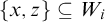 and
$xR_i^mz$
 . We also have
$\text {d}'(x)=\text {d}_l(x)$
 for all
$l\geq i$
 . If there are
$w_1, \ldots , w_{n-1}\in W_i$
 s.t.
$xR_iw_1R_i\cdots R_iw_{n-1}R_iz$
 and
$\text {d}_i(w_j)=\text {d}_i(x)+j$
 , then we have
$xR'w_1R'\cdots R'w_{n-1}R'z\text { and }\text {d}'(w_j)=\text {d}'(x)+j$
 , as required. If not, then as
$(x,z)\in W_i^{2}\subseteq (W\cup X)^{2}$
 , the tuple
$(x,z,\Diamond ^mp\to \Diamond ^np)$
 has been assigned some number
$k\in \omega $
 in our enumeration. So by construction, at some stage
$l\leq i+k+1$
 , Lemma 3.2 will have been applied to
$(x,z,\Diamond ^mp\to \Diamond ^np)$
 [or to another tuple whose resolution happens to fix this defect too],Footnote
4
and points
$u_1,\cdots , u_{n-1}$
 will have been added so that
$xR_{l}u_1R_{l}\cdots R_{l}u_{n-1}R_{l}z\text { and }\text {d}_{l}(u_j)=\text {d}_{l}(x)+j$
 . Consequently, also in this case, the condition holds, as then
$xR'u_1R'\cdots R'u_{n-1}R'z$
 and
$\text {d}'(u_j)=\text {d}'(x)+j$
 .
This shows that condition (2) holds. The proof of condition (3) is similar, but for completeness, we include it here as well. Accordingly, suppose
$xR'y$
 . Then there is a least
$i\in \omega $
 s.t.
$\{x,y\}\subseteq W_i$
 , and
$\text {d}'(x)=\text {d}_l(x)$
 for all
$l\geq i$
 . If there is
$y'\in W_i$
 s.t.
$xR_iy', \text {d}_i(y')=\text {d}_i(x)+1,\text { and }f_i(y')=f_i(y)$
 , then we have
$xR'y', \text {d}'(y')=\text {d}'(x)+1,\text { and }f(y')=f(y)$
 , as required. If not, then as
$(x,y)\in W_i^{2}\subseteq (W\cup X)^{2}$
 , the tuple has been assigned some number
$k\in \omega $
 in our enumeration. So by construction, at some stage
$l\leq i+k+1$
 , Lemma 3.3 will have been applied to
$(x,y)$
 , and a point u will have been added so that
$xR_{l}u, \text {d}_{l}(u)=\text {d}_{l}(x)+1, \text { and }f_{l}(u)=f_{l}(y)$
 . Consequently, also in this case, the condition holds, as then
$xR'u, \text {d}'(u)=\text {d}'(x)+1, \text { and }f(u)=f(y)$
 , which thereby completes the proof of the lemma.
3.2 Round two: The filtration lemma
Next and last, we prove the filtration lemma (Lemma 2.7). For this, we need one final definition.
Definition 3.5. Let
$\mathfrak {M}=(W,R,V)$
 and
$\mathfrak {M}'=(W',R',V')$
 be models. For a set of propositional variables
$\mathbf {X}\subseteq \mathsf {Prop}$
 , we define relations
${\sim ^{\mathbf {X}}_k}\subseteq W\times W'$
 recursively as follows for
$(w,w')\in W\times W'$
 :

In case
$w\sim ^{\mathbf {X}}_kw'$
 , we say that w and
$w'$
 are k-bisimilar (w.r.t.
$\mathbf {X}$
 ). When
$\mathbf {X}$
 is clear from context, we omit the superscript and write
$w\sim _kw'$
 .
Before proceeding to the proof of the lemma, we record some well-known and readily proven facts regarding k-bisimilarity.
Fact 3.6. Let
$\mathfrak {M}=(W,R,V)$
 and
$\mathfrak {M}'=(W',R',V')$
 be models, and
$\mathbf {X}\subseteq \mathsf {Prop}$
 a set of propositional variables. Then the following hold for all
$k\in \omega $
 :
-
• If $w\sim ^{\mathbf {X}}_kw'$
, then for all formulas
$\varphi $
such that
$\mathsf {Prop}(\varphi )\subseteq \mathbf {X}$
and
$\text {md}(\varphi )\leq k$
, $$\begin{align*}\mathfrak{M},w\Vdash\varphi \qquad\text{iff}\qquad \mathfrak{M}', w'\Vdash \varphi. \end{align*}$$
-
• ${\sim }\subseteq {\sim ^{\mathbf {X}}_{k+1}}\subseteq {\sim ^{\mathbf {X}}_k}$
. -
• If $\mathfrak {M}=\mathfrak {M}'$
, then
$\sim ^{\mathbf {X}}_k$
is an equivalence relation on W. -
• If $\mathfrak {M}=\mathfrak {M}'$
and
$\mathbf {X}$
is finite, then the set of
$\sim ^{\mathbf {X}}_k$
-equivalence classes is finite.


Proof of the Filtration Lemma 2.7.
Suppose
$\varphi $
 is satisfied at a root
$r\in W$
 of a model
$\mathfrak {M}=(W,R, V)$
 satisfying (1) and (2) for each
$\Diamond ^mp\to \Diamond ^np\in \Phi $
 . Letting
$\text {d}(x)\mathrel {:=}\text {d}_{r}(x)$
 and
$k\mathrel {:=}\text {md}(\varphi )$
 , we extract a finite
$\varphi $
 -satisfying
$\mathbf {K}\oplus \Phi $
 model through a particular kind of filtration. First, we define a binary relation
$\equiv $
 on
$W_{\leq k}\mathrel {:=}\{x\in W\mid \text {d}(x)\leq k\}$
 as follows:

where we have suppressed the superscript
$^{\mathsf {Prop}(\varphi )}$
 and written
$x\sim _{k-\text {d}(x)}y$
 rather than
$x\sim _{k-\text {d}(x)}^{\mathsf {Prop}(\varphi )}y$
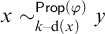 .
Since
$x\in W_{\leq k}$
 means
$\text {d}(x)\leq k$
 , we have
$k-\text {d}(x)\in \omega $
 for all
$x\in W_{\leq k}$
 , so
$\sim _{k-\text {d}(x)}$
 is well-defined. One then easily checks that
$\equiv $
 is an equivalence relation on
$W_{\leq k}$
 using that the relations
$\sim _{l}$
 are equivalence relations (cf. Fact 3.6). Then, by the last bullet point of Fact 3.6 and the fact that the set of propositional variables occurring in
$\varphi $
 is finite, i.e.,
$|\mathsf {Prop}(\varphi )|<\aleph _0$
 , we have that the set of
$\equiv $
 -equivalence classes

is finite, where
$|x|$
 denotes the
$\equiv $
 -equivalence class of x.
We then define a relation
$R^f\subseteq W^f\times W^f$
 by setting
$|x|R^f|y|$
 iff
$\text {d}(x)=k$
 or

Take note that we do not require that
$y'\in |y|$
 (and that
$\text {d}(x)<k$
 and
$xRy'$
 jointly imply
$y'\in W_{\leq k}$
 ).
Let us show that
$R^f$
 is well-defined, in that it doesn’t depend on the representatives of the equivalence classes. To see that it doesn’t depend on the representative for
$|x|$
 , observe that
$x\equiv x'$
 implies
$\text {d}(x)=\text {d}(x')$
 and
$x\sim _{k-\text {d}(x)}x'$
 , so if
$xRy'$
 and
$y'\sim _{k-\text {d}(x)-1}y$
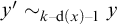 , then
$x\sim _{k-\text {d}(x)}x'$
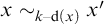 implies that there is
$y"$
 s.t.
$x'Ry"$
 and
$y"\sim _{k-\text {d}(x)-1}y'$
 , hence also
$y"\sim _{k-\text {d}(x)-1}y$
 . And to see that it doesn’t depend on the representative for
$|y|$
 , assume
$y\equiv y"$
 . Then
$y\sim _{k-\text {d}(y)}y"$
 , so
$\text {d}(y)\leq \text {d}(x)+1$
 implies
$y\sim _{k-\text {d}(x)-1}y"$
 (cf. Fact 3.6). Hence
$y'\sim _{k-\text {d}(x)-1}y$
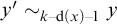 would imply
$y'\sim _{k-\text {d}(x)-1}y"$
 .
Thus,
$(W^f, R^f)$
 is a well-defined finite frame. To show that it is a
$\mathbf {K}\oplus \Phi $
 frame, we will use that the map
$w\mapsto |w|$
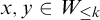
 is an R-homomorphism: if
$xRy$
 then
$|x|R^f|y|$
 , for all
$x,y\in W_{\leq k}$
 . Indeed, if
$xRy$
 , then clearly
$\text {d}(y)\leq \text {d}(x)+1$
 and
$y\sim _{k-\text {d}(x)-1}y$
 , so we have
$|x|R^f|y|$
 .
Now let
$\Diamond ^mp\to \Diamond ^np\in \Phi $
 be arbitrary and suppose
$|x|R^f|y_1|R^f\cdots R^f |y_{m-1}| R^f|z|$
 . We are to find
$|w_1|,\ldots , |w_{n-1}|$
 such that
$|x|R^f|w_1|R^f\cdots R^f|w_{n-1}|R^f|z|$
 . First, we observe that

since, whenever
$|w|R^f|v|$
 , we have
$\text {d}(v)\leq \text {d}(w)+1$
 : this is clear if
$\text {d}(w)<k$
 , and follows from
$\text {d}(v)\leq k$
 if
$\text {d}(w)=k$
 . Then, we continue by cases on
$\text {d}(x)$
 .
Case 1. If
$\text {d}(x)\leq k-m$
 , then we claim that there are
$y_i'\in W$
 , for
$i\in \{1,\ldots , m\}$
 , such that

where we for convenience have denoted
$y_m\mathrel {:=}z$
 . We argue by induction on
$i\in \{1,\ldots , m\}$
 .
For the base case, since
$|x|R^f|y_1|$
 and
$\text {d}(x)\leq k-m<k$
 , there is
$y_1'$
 such that
$xRy_1'$
 and
$y_1'\sim _{k-\text {d}(x)-1}y_1$
 . The former implies
$\text {d}(y_1')\leq \text {d}(x)+1$
 .
For the inductive step, since
$|y_j|R^f|y_{j+1}|$
 and
$\text {d}(y_j)\leq \text {d}(x)+j<k$
 , we likewise find
$y_{j+1}"$
 such that
$y_jRy_{j+1}"$
 and
$y_{j+1}"\sim _{k-\text {d}(y_j)-1}y_{j+1}$
 . Since
$\text {d}(y_j)\leq \text {d}(x)+j$
 , Fact 3.6 gives us
$y_{j+1}"\sim _{k-\text {d}(x)-j-1}y_{j+1}$
 . Further, by the induction hypothesis, we have
$y_j'\sim _{k-\text {d}(x)-j}y_j$
 , so since
$y_jRy_{j+1}"$
 , there is
$y_{j+1}'$
 s.t.
$y_j'Ry_{j+1}'$
 and
$y_{j+1}'\sim _{k-\text {d}(x)-j-1}y_{j+1}"$
 . From the former we get

and from the latter we get
$y_{j+1}'\sim _{k-\text {d}(x)-j-1}y_{j+1}$
 , which completes the induction and establishes the claim.
By assumption,
$(W,R)$
 satisfies (2), so
$xRy_1'Ry_2'R\cdots Ry_m'$
 entails that there are
$w_1, \ldots , w_{n-1}\in W$
 s.t.

Using this, we further split the case according to whether
$\text {d}(x)\leq k-n$
 .
Case 1a. If
$\text {d}(x)> k-n$
 , then there is
$w_j$
 with
$\text {d}(w_j)=k$
 for
$1\leq j\leq n-1$
 . So as
$w\mapsto |w|$
 is a homomorphism, we get a j-path
$|x|R^f|w_1|R^f\cdots R^f|w_{j}|$
 , and using that
$|w_{j}|R^f|w_{j}|$
 and
$|w_{j}|R^f|z|$
 as
$\text {d}(w_j)=k$
 , we can extend it to an n-path ending at
$|z|$
 .
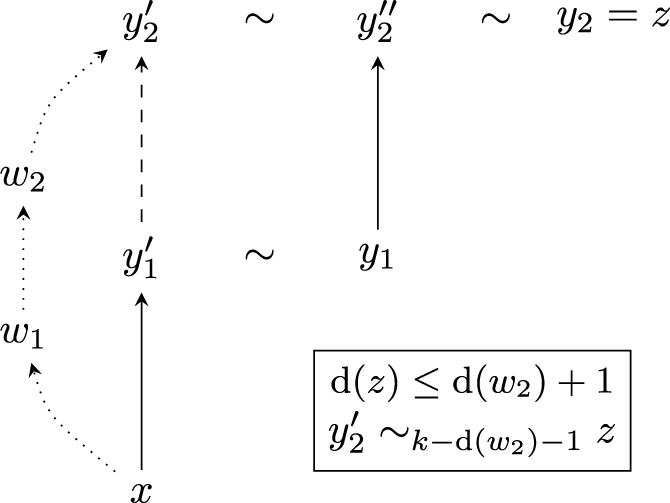
Case 1b (Figure 1). If
$\text {d}(x)\leq k-n$
 , then

so
$w_j\in W_{\leq k}$
 for all
$j\leq n-1$
 , hence

Thus, it will suffice to show that
$|w_{n-1}|R^f|z|$
 . Since
$\text {d}(w_{n-1})<k$
 , we have to show that

The former holds because

The latter is witnessed by
$y_m'$
 , in view of Fact 3.6 combined with

This completes the case where
$\text {d}(x)\leq k-m$
 .
Illustration of the key part of the argument, when
$\text {d}(x)\leq k-n$
 , for
$m=2,n=3$
 , so
$|x|R^f|y_1|R^f|z|\Rightarrow \exists |w_1|, |w_2|:\; |x|R^f|w_1|R^f|w_2|R^f|z|$
 .

Case 2. If
$\text {d}(x)>k-m$
 , then the subcase
$\text {d}(x)=k$
 is immediate, since in that case
$|x|R^f|x|$
 and
$|x|R^f|z|$
 . Accordingly, assume further that
$\text {d}(x)<k$
 , i.e.,
$\{0,\cdots , k-\text {d}(x)-1\}\neq \varnothing $
 .
We denote
$y_0\mathrel {:=}x$
 and use that for all
$i\in \{0,\ldots , k-\text {d}(x)-1\}$
 , there is
$y_{i+1}'$
 s.t.

This follows because
$\text {d}(y_i)\leq \text {d}(x)+i$
 and, for
$i\leq k-\text {d}(x)-1$
 , we have
$\text {d}(x)+i\leq k-1<k$
 . Thus, for such i,
$|y_i|R^f|y_{i+1}|$
 entails that there is
$y_{i+1}'$
 s.t.
$y_iRy_{i+1}'$
 and
$y_{i+1}'\sim _{k-\text {d}(y_i)-1}y_{i+1}$
 . And the latter implies
$y_{i+1}'\sim _{k-\text {d}(x)-i-1}y_{i+1}$
 , since
$\text {d}(y_i)\leq \text {d}(x)+i$
 .
Strengthening this, we claim that for all
$i\in \{0,\ldots , k-\text {d}(x)-1\}$
 , there is
$y_{i+1}"$
 s.t.

We prove this by induction on
$i\in \{0,\ldots , k-\text {d}(x)-1\}$
 .
For the base case, since
$x=y_0Ry_1'$
 , we get by condition (1) that there is
$y_1"$
 s.t.
$xRy_1", \text {d}(y_1")=\text {d}(x)+1,$
 and
$y_1"\sim y_1'$
 . Since
$y_{1}'\sim _{k-\text {d}(x)-1}y_{1}$
 , it follows that
$y_1" \sim _{k-\text {d}(x)-1}y_1$
 .
For the inductive case, since
$y_iRy_{i+1}'$
 and, by IH,
$y_{i}"\sim _{k-\text {d}(x)-i}y_{i}$
 , there is
$y_{i+1}"'$
 s.t.
$y_{i}"Ry_{i+1}"'$
 and
$y_{i+1}"'\sim _{k-\text {d}(x)-i-1}y_{i+1}'$
 . So by condition (1), there is
$y_{i+1}"$
 s.t.

Thus, as

we also have
$y_{i+1}" \sim _{k-\text {d}(x)-i-1}y_{i+1}$
 , as desired.
With the induction completed, it now follows that
$|x|R^f|y_1"|R^f|y_2"|R^f\cdots R^f|y_{k-\text {d}(x)}"|$
 , because
$w\mapsto |w|$
 is a homomorphism. This path can be extended to an n-path ending at
$|z|$
 , as we have
$|y_{k-\text {d}(x)}"|R^f|y_{k-\text {d}(x)}"|$
 and
$|y_{k-\text {d}(x)}"|R^f|z|$
 because
$\text {d}(y_{k-\text {d}(x)}")=\text {d}(x)+k-\text {d}(x)=k$
 .
This completes the case where
$\text {d}(x)>k-m$
 , and we may therefore conclude that
$(W^f, R^f)$
 is a
$\mathbf {K}\oplus \Phi $
 frame.
Finally, we let
$\mathfrak {M}^f\mathrel {:=}(W^f,R^f,V^f)$
 , where
$V^f$
 is the valuation on
$(W^f, R^f)$
 defined by setting

for all
$p\in \mathsf {Prop}(\varphi )$
 . Note that this is well-defined. We proceed to show that for all
$x\in W_{\leq k}$
 and
$\psi \in \mathrm{sub}(\varphi )$
 with
$\text {md}(\psi )\leq k-\text {d}(x)$
 :

As
$\mathfrak {M},r\Vdash \varphi , \text {d}(r)=0, \text {md}(\varphi )=k$
 , and
$\varphi \in \mathrm{sub}(\varphi )$
 , this would imply
$\mathfrak {M}^f, |r|\Vdash \varphi $
 , thereby completing the proof.
We prove this claim by an induction on the modal depth of
$\psi \in \mathrm{sub}(\varphi )$
 . For the base case, we prove the claim holds for all
$\psi \in \mathrm{sub}(\varphi )$
 with
$\text {md}(\psi )=0$
 . Since we, by definition, have

for all
$x\in W_{\leq k}$
 and all propositional variables
$p\in \mathsf {Prop}(\varphi )$
 , an easy induction establishes this biimplication for all Boolean combinations of propositional variables from
$\mathsf {Prop}(\varphi )$
 , hence for all formulas
$\psi \in \mathrm{sub}(\varphi )$
 with
$\text {md}(\psi )=0$
 .
For the inductive step, suppose for some
$i\in \{0,\ldots , k-1\}$
 that the claim holds for all
$\psi \in \mathrm{sub}(\varphi )$
 with
$\text {md}(\psi )\leq i$
 . We show it holds for all
$\psi \in \mathrm{sub}(\varphi )$
 with
$\text {md}(\psi )=i+1$
 . The proof is by structural induction on
$\psi $
 , where, once again, the Boolean cases are straightforward. So suppose
$\psi =\Diamond \chi $
 . Then
$\text {md}(\psi )=i+1$
 implies
$\text {md}(\chi )=i$
 ; and
$\psi \in \mathrm{sub}(\varphi )$
 implies
$\chi \in \mathrm{sub}(\varphi )$
 . Let
$x\in W_{\leq k}$
 with
$\text {md}(\psi )\leq k-\text {d}(x)$
 be arbitrary, and note that
$\text {d}(x)\leq k-i-1$
 .
If
$\mathfrak {M},x\Vdash \Diamond \chi $
 , there must be
$y\in W$
 such that
$xRy$
 and
$\mathfrak {M},y\Vdash \chi $
 . Since
$xRy$
 and
$\text {d}(x)\leq k-i-1$
 , we get that
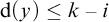
$\text {d}(y)\leq k-i$
 , whence
$\text {md}(\chi )=i\leq k-\text {d}(y)$
 and
$y\in W_{\leq k}$
 . Hence we can apply the induction hypothesis, yielding

and thus witnessing

as
$w\mapsto |w|$
 is a homomorphism, so
$xRy$
 implies
$|x|R^f|y|$
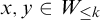
 , for
$x,y\in W_{\leq k}$
 .
Conversely, if
$\mathfrak {M}^f,|x|\Vdash \Diamond \chi $
 , then there is
$|y|$
 such that
$|x|R^f|y|$
 and
$\mathfrak {M}^f,|y|\Vdash \chi $
 . Observe that since
$\text {d}(x)\leq k-i-1$
 , we have
$\text {d}(x)<k$
 , hence
$|x|R^f|y|$
 entails that
$\text {d}(y)\leq \text {d}(x)+1$
 and there is
$y'\in W$
 with
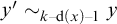
$xRy'\text { and } y'\sim _{k-\text {d}(x)-1}y$
 . So we have

hence by the induction hypothesis,

Lastly, because
$y'\sim _{k-\text {d}(x)-1}y$
 and
$\text {md}(\chi )\leq k-\text {d}(x)-1$
 , Fact 3.6 yields

whence

as required.
Acknowledgments
I thank an anonymous referee for helpful suggestions on the exposition.
Funding
The research was supported by the Nothing is Logical (NihiL) Project (NWO OC 406.21.CTW.023). Open access funding provided by University of Amsterdam.






 Open access

