Contemporary Hong Kong is riven by political and social polarization. The problem not only lies in the sharp ideological differences among Hong Kong people, but also the animosity between people of different political affiliations. Although it is impossible and undesirable to eliminate political differences, moderating affective polarization is one of the most important and challenging tasks faced by society. Since the advent of the Anti-Extradition Bill Movement in 2019, the government has emphasized the need for conversation, communication, and dialog. However, there is much evidence that in the absence of an appropriate framework, communication, and discussion can easily lead to more extreme ideas and negative emotions.
Is there a way to ‘cure’ polarization? Several scholars consider face-to-face contact, deliberation, or discussion as possible ways to reducing polarization. However, there are mixed results in the existing literature regarding the impact of deliberation or discussion on attitude polarization. In addition, to the best of our knowledge, deliberation has not been empirically studied in the Hong Kong context (except for an online deliberative poll conducted in 2020Footnote 1). Given this research gap and the existing social problems in Hong Kong, we conducted two pilot experiments to explore whether deliberation and discussion can lead to attitude moderation and affective polarization reduction. The contribution of this study lies in four aspects. First, to the best of our knowledge, political deliberation and discussion have not been studied in the Hong Kong context. Our pilot study is a first one to examine their effects on attitude and affective polarization amid the aftermath of Anti-Extradition Bill Movement. Second and relatedly, as a society with rising political polarization, our study offers practical implications with regard to the conundrum facing Hong Kong for policymakers and scholars. Third, most of the existing literature focuses on short-term effects of deliberation. The current study examined the long-term effects of deliberation and discussion on attitude polarization. Last, we also explored the effects of watching deliberation and discussion on attitude change. In the ensuing sections, we first introduce the situation of political polarization in Hong Kong. Then, we review the existing literature on ways to reduce polarization with a focus on deliberation and discussion. Finally, we provide the details for our pilot experiment and its findings.
1. Political polarization in Hong Kong
Hong Kong society has gone through several dramatic transitions since the 1980s (Lau, Reference Lau1982). The sovereignty handover in 1997 has triggered a series of social and political upheavals over the past two decades (Lee, Reference Lee2016; Lau, Reference Lau2017). In 2014, the outbreak of the Umbrella Movement introduced the idea of ‘civil disobedience’ to Hong Kong's social movement. Protesters occupied the streets to express their frustration with the government. In the wake of the Umbrella Movement, several pundits and critics have claimed that Hong Kong society has been torn apart.
Aside from the media's portrait of a ‘divided Hong Kong,’ empirical studies also find evidence of polarization. Lee (Reference Lee2016) investigated opinion poll data and found that opinion polarization in Hong Kong increased from 2003 to 2014, in terms of attitudes toward government performance. Using time-series data of public opinion polls, Wu and Shen (Reference Wu and Shen2020) found that Hong Kong public opinion in the last 15 years has polarized in the political, economic, and livelihood domains. In particular, public opinion is increasingly and rapidly polarizing in the political domain.
When political tensions are heightened, polarization occurs much more quickly. In a study conducted at the time of the Umbrella Movement in 2014, Lee (Reference Lee2016) found that social media use, traditional media use, and interpersonal discussion all produced attitude polarization. Another study showed that during contentious political times in Hong Kong, increased online incivility and cyberbalkanization have contributed to increased polarization (Lee et al., Reference Lee, Liang and Tang2019).
The Anti-Extradition Bill Movement is an ongoing series of demonstrations and protests in Hong Kong that has taken place since March 2019. In February, the Hong Kong government proposed the Fugitive Offenders Amendment Bill to allow Hong Kong to detain and transfer fugitives wanted in countries and territories with which it has no formal extradition agreements, including Taiwan and mainland China. This bill triggered a huge controversy. The government insisted that the proposed amendments would ‘close up loopholes,’ so that the city would no longer be a safe haven for criminals, whereas opponents of the bill held that it would subject Hong Kong residents and visitors to mainland Chinese jurisdiction, undermining autonomy and civil liberties in Hong Kong.
The widespread opposition to the bill and the Chief Executive's hardline approach to the issue sparked massive protests. On 9 June, more than a million people marched peacefully to government headquarters to protest the bill, the largest street protest seen in 15 years. Under the pressure of public opinion, the government suspended the bill indefinitely and claimed it was ‘dead.’ However, as conflicts between protesters and police escalated, protesters made five major demands: complete withdrawal of the bill, a retraction of the definition of ‘riot,’ the release of arrested protesters, an inquiry into police misconduct, and the resignation of the Chief Executive. An increasing number of citizens showed strong antipathy to the movement, leading to the creation of groups opposing the protests and supporting the police. Peaceful demonstrations gradually turned violent.
The increasing political polarization has been manifested by the use of inflammatory language in social interactions. For instance, pro-establishment individuals call protesters ‘cockroaches’ (曱甴) whereas protesters shout that ‘the whole family of corrupt police will die’ (黑警死全家). Anti-government protesters called government supporters ‘blue corpses’ (藍屍) and ‘left dogs’ (左狗) on social media. Local pro-democracy party People Power displayed a banner that compared Carrie Lam to Hitler, labeling her a ‘ChiNazi,’ and anti-government protesters use the term ‘anti-ChiNazi’ to justify their actions.
Political polarization tends to have negative consequences, such as exacerbating social inequality and impeding the development of democratic politics (Barber et al., Reference Barber, McCarty, Mansbridge, Martin, Mansbridge and Martin2015). Simply put, the controversy surrounding the Extradition Bill further accelerated social and political polarization in Hong Kong. Even worse, political polarization has led to incivility, intolerance, and even violence.
2. Deliberation, discussion, and depolarization
Existing literature on polarization points at two major approaches to mitigating political polarization: direct contact approach and communication-based approach. Direct contact approach refers to facilitating direct contact between different groups of people that does not involve organized discussion of a particular topic. For instance, a study of student riots at Stanford University in 1970 found that significant attitudinal depolarization was achieved between students and the police by providing more direct contact between the two groups (Diamond and Lobitz, Reference Diamond and Lobitz1973). A recent study similarly found that positive, non-enforcement-related contact between the police and the public substantially improved public attitudes toward the police and decreased group conflicts (Peyton et al., Reference Peyton, Sierra-Arévalo and Rand2019).
Compared with direct contact, deliberative communication or, more simply, deliberation, might have longer lasting effects in attenuating polarization. Deliberation is widely practiced around the world to attenuate political polarization. Deliberation has received much scholarly attention in the last two decades, in fields such as philosophy, social psychology, communications, political science, and public opinion research (Chambers, Reference Chambers2003; Min, Reference Min2009; Landemore and Mercier, Reference Landemore and Mercier2010). The general communicative understanding of deliberation can be traced to Habermas's discourse theory of democracy. Deliberation was defined as a ‘higher-level intersubjectivity of processes of reaching understanding that take place through democratic procedures or in the communicative network of public spheres’ (Habermas, Reference Habermas1996: 299). This definition has been adopted and developed by several deliberation theorists. Furthermore, Cohen (Reference Cohen1989) specified four crucial principles of deliberation: argumentativeness, inclusiveness, freedom from coercion, and rationality. The argumentative theory of reasoning holds that receiving information from people who have different perspectives will have epistemic and transformative benefits, encouraging recipients to modify their opinions and reduce their prejudice and extreme attitudes (Landemore and Mercier, Reference Landemore and Mercier2010). This suggests that attitude moderation induced by deliberation may persist over the long term. A deliberative poll experiment found that some participants change their attitudes after the experiment and the change can last for months (Hall et al., Reference Hall, Wilson and Newman2011). However, the long-term effects of deliberation are seldom examined.
Prior empirical studies provide evidence that deliberation has the potential of reducing public attitude polarization (Diamond and Lobitz, Reference Diamond and Lobitz1973; Peyton, et al., Reference Peyton, Sierra-Arévalo and Rand2019; Strandberg et al., Reference Strandberg, Himmelroos and Grönlund2019). For example, Strandberg et al. (Reference Strandberg, Himmelroos and Grönlund2019) found that the deliberation groups showed a tendency of depolarization whereas the discussion groups did not. The exposure to different political views through deliberation increases individuals' awareness of the rationales underlying opposing views and political tolerance (Mutz, Reference Mutz2006).
The resulting increase in awareness and tolerance makes individuals more open to opposing viewpoints and attitudes, which leads to attitude depolarization. For instance, a recent study found that deliberation between citizens and politicians in a citizens' forum in a Finnish municipality on the issue of closing village schools and building a school center had a negative effect on the division of opinion among deliberators and achieved greater opinion convergence (Strandberg and Berg, Reference Strandberg and Berg2020). However, not all deliberation studies found opinion changes. For instance, Strandberg and Grönlund (Reference Strandberg and Grönlund2012) examined the effects of online deliberation on energy issues and only found modest effects. Caluwaerts and Reuchamps (Reference Caluwaerts and Reuchamps2014) also indicated that overall deliberation effects on opinion change were limited. Therefore, we propose the following research question:
RQ1: What is the effect of deliberation on reducing political polarization?
Deliberation is a costly event to organize. A brochure of detailed information needs to be prepared by the organizer before deliberation. The brochure should contain balanced and detailed information about the topic, such as background and history of the topic, the controversy of the topic in society, and examples of opinions from different sides, which help participants understand the topic thoroughly. In addition, a successful deliberation requires experienced moderators. The moderator needs to explain the rules and regulations to the participants, maintain the order of deliberation, and distribute time and chances for expression equally.
In contrast, casual discussion requires much less resource. Similar to deliberation, discussion requires participants to exchange opinions on a given topic. Discussion also encourages mutual understanding and active expression. However, the host will not interfere in the discussion unless an extreme situation happens. In casual discussion, participants are not required to equally contribute to the discussion and therefore, it is possible that some individuals will dominate the whole session. Compared to deliberation, the environment for discussion is more natural.
The effects of organized discussion in natural condition, however, are seldom studied by scholars. Current studies on political discussion mostly focus on interpersonal discussion in daily life or online discussion. Interpersonal discussion is found to be correlated with political knowledge, attitudes, and behaviors (Kenny, Reference Kenny1998; McLeod et al., Reference McLeod, Scheufele and Moy1999; Amsalem and Nir, Reference Amsalem and Nir2019). However, these studies usually collect self-reported discussion habits, instead of using experiment. Without knowing if the content of discussion is topic-relevant, the mechanisms of how discussion influences people remain unclear. Some studies find frequency of online discussion is correlated with attitude polarization (Hutchens et al., Reference Hutchens, Hmielowski and Beam2019; Yarchi et al., Reference Yarchi, Baden and Kligler-Vilenchik2021). However, reading and replying to posts or comments online is not face-to-face interaction whereas a conversation requires synchronous communication. Additionally, it is possible that political polarization drives people to discuss online, rather than the other way around (Jiang et al., Reference Jiang, Chen, Yan, Lerman and Ferrara2020). Therefore, apart from testing the effects of deliberation on depolarization, we also wish to examine the effects of casual discussion which requires fewer resources to organize.
RQ2: What is the effect of discussion on reducing political polarization?
3. Watching deliberation and discussion: a vicarious experience
Public discussion and deliberation can only accommodate a limited number of participants, but it can reach a wider group of people by utilizing communication and media technologies. To better inform the public, political discussions such as legislative council meetings, election debate, and policy hearings are usually broadcasted. After the Anti-Extradition Law Amendment Bill Movement started, the Hong Kong government organized Chief Executive's community dialog with 150 randomly selected citizens and live broadcast of the event (The Guardian, 2019). Lots of people have witnessed this dialog by watching TV or online broadcasting. However, what audiences learn from the political discussions is barely known.
It is unclear to us if political deliberation can be held and shown to a larger group of audience, what effect will have on the audience. A person's behavior can be influential to its observers. According to the social learning theory (Bandura and Walters, Reference Bandura and Walters1977), by observing others' behaviors, attitudes, and outcomes of those behaviors, people learn about new behaviors and act following them. Observational learning, which is also called vicarious learning, connects people's process cognition and motivation to act within the social context. What people learn from observing others can alter their attitudes, perceived subjective norms, self-efficacy, and the following behaviors (Bartle and Harvey, Reference Bartle and Harvey2017).
From this perspective, individuals can learn how to make an argument, form an attitude, and debate with different opinions from observing political discussions. For example, exposure to news outlets with high levels of political content such as public television news and broadsheet newspapers contributes to political knowledge gains and increases the propensity to turn out to vote (De Vreese and Boomgaarden, Reference De Vreese and Boomgaarden2006). Also, given political discussions can lead to ‘conversational violence’ or more polarized opinions (Luginbühl, Reference Luginbühl2007; Ugarriza and Trujillo-Orrego, Reference Ugarriza and Trujillo-Orrego2020), observing political discussion, especially those held in disorder could have negative influences on audiences. Studies found that online media users who are exposed to incivility from out-party sources become more polarized (Druckman et al., Reference Druckman, Gubitz, Lloyd and Levendusky2019) and less willing to read more information (Kim and Kim, Reference Kim and Kim2019).
Previous studies on the impact of political deliberation and discussion focus more on the participants' experience, neglecting the fact that the general public can also be influenced by observing. The current study investigates not only the impact of participating in political discussions, but also the impact of watching political discussions. Therefore, we proposed the following two questions.
RQ3: What is the effect of watching deliberation on reducing political polarization?
RQ4: What is the effect of watching discussion on reducing political polarization?
Finally, audiences' memory about the messages they receive might change as time passes by. When audiences receive powerful and convincing message, their attitudes tend to turn toward the advocacy of the message at the beginning but later gravitate back toward their prior opinion (Eagly and Chaiken, Reference Eagly and Chaiken1993). In contrast, people who receive information from a less credible source are less persuaded right after the information exposure, but are more persuaded later, which is called sleeper effect in persuasion (Hovland and Weiss, Reference Hovland and Weiss1951). Studies on long-term effects of deliberation suggested different results. Grönlund et al.'s (Reference Grönlund, Setälä and Herne2010) study on public opinion regarding the status of the Swedish language in Finland detected small opinion changes within 3 months. Other deliberation studies indicate the same (French and Laver, Reference French and Laver2009; Hall et al., Reference Hall, Wilson and Newman2011). However, Andersen and Hansen (Reference Andersen and Hansen2007) found larger changes in opinion 3 months after a deliberative poll. Regardless of the direction of change, previous studies suggest some possibilities for long-term deliberation effects. Thus, we propose the following research question.
RQ5: Are there long-term effects for RQ1 to RQ4?
4. Method
Following prior studies, the study used controlled experiments to explore the effects of deliberation on depolarization. Social interaction is a complicated process. Laboratory experiments provide researchers with high levels of control, allowing us to make causal inferences.
4.1 Topic selection
The first step for the design of the study involves the choice of a social issue for discussion. To ensure that attitude polarization exists for the issue to be discussed, a pre-survey was conducted to find out the issue with sufficiently large attitudinal difference. The online survey was contracted out to a professional market research company, and was fielded from 29 May to 2 June in 2020 with quota sampling method to match the demographic features of Hong Kong residents. A total of 500 individuals completed the survey. The response rate was 19.8%. Questions about three potential topics were included in the survey: the Lantau Tomorrow Vision, the National Anthem Law, and the Article 23 legislation. The respondents were asked to indicate their levels of support for the issue on a scale of 0–10, where 0 indicates ‘strong opposition’ and 10 indicates ‘strong support.’
The data show that the average levels of support are 3.38, 3.43, and 4.05 for the Lantau Tomorrow Vision, the National Anthem Law, and the Article 23 legislation, respectively. To quantify polarization, standard deviation was used as an indicator and a large standard deviation suggests heterogeneity among the public. The standard deviations for the topics were 3.07 (the Lantau Tomorrow Vision), 3.55 (the Article 23 legislation), and 3.59 (the National Anthem Law). The data suggest that people had the most diverse opinion toward the National Anthem Law. However, soon after our survey was conducted, the National Anthem Law passed its second reading on 30 June, which makes it an issue without space for further negotiation. Therefore, the project was left with two choices. Between the two, the issue regarding Article 23 legislation had a relatively higher level of attitude polarization. Thus, the project used Article 23 legislation as the topic for its experiment design.
The Basic Law – Hong Kong's mini constitution, came into effect on 1 July 1997, the day the territory was returned to China (Gittings, Reference Gittings2013). Article 23 is an article in the Basic Law, requiring Hong Kong to enact laws on its own to prohibit any act of treason, secession, sedition, subversion against the central government, or theft of state secrets, as well as to ban foreign political organizations or bodies from conducting political activities in the city and local political organizations or bodies from establishing ties with foreign political organizations or bodies (Gittings, Reference Gittings2013). In February 2013, Hong Kong government proposed a National Security (Legislative Provisions) Bill 2003 to the Legislative Council for fulfilling the constitutional requirement specified in Article 23. The proposed bill, however, caused controversy and debates for months. The fear of losing freedom and the frustrations caused by other social events (e.g., the economic drop during the SARS health crisis) led to a massive demonstration on 1 July 2003. After half-million people protested against the law and, the government withdrew the bill. After 2003, the Pro-Beijing camp continued suggesting the government to propose a bill based on Article 23 anew, whereas the Pan-democratic camp speaks against Article 23 legislation, claiming it will take away the freedom of speech in Hong Kong. On 30 June 2020, affected by the Anti-Extradition Law Amendment Bill Movement, the Chinese government imposed a partially equivalent security law on Hong Kong covering secession and subversion under Article 18 of the Basic Law. The laws about treason, sedition, and theft of state secrets are not covered by the new Article 18 Law, and remain to be implemented under Article 23 by the Hong Kong government. In other words, the Article 23 legislation is still unfixed and under social discussion.
4.2 Experimental design
Given the exploratory nature of the study, two simple pilot experimental studies with randomized pre-test post-test design were conducted. To answer the first two research questions, study 1 investigates whether deliberation and casual discussion can lead to attitude moderation. Participants who fit our selection criteria were assigned into two groups randomly: the deliberation group and the casual discussion group. Both groups participated in a 90-min discussion session. For the deliberation condition group, participants were required to follow the norms of deliberation under the guidance from an experienced facilitator. In addition, they were required to read a booklet containing detailed information about the issue for 25 min prior to the discussion. For the casual discussion group, participants were not exposed to the booklet and they were not required to follow the norms of deliberation. The same facilitator played minimal roles in coordinating the discussion. Participants from both groups were asked to fill out two questionnaires before and after deliberation/discussion. To answer the second research question, study 2 examines whether exposure to deliberation and casual discussion can depolarize people with different political opinions. In this study, participants who fit our criteria were randomly assigned to two groups: watching deliberation group and watching casual discussion group. Participants from both groups were asked to fill out two questionnaires before and after they watched a video containing discussion/deliberation of the chosen social issue. To check the robustness of experimental effects, for both study 1 and study 2, a second post-experimental survey was conducted 1 month after the experiment with the repeated measures.
4.3 Participant recruitment
The project contracted out participant recruitment to a marketing data collection company. The participant recruitment was conducted in July 2020. For study 1, only Cantonese-speaking residents in Hong Kong were invited. To minimize participants’ heterogeneity, participants are all aged between 30 and 40, and the number of men and women for each group were equal. Previous studies have typically recruited 5–16 participants to form a deliberation group. Due to budget restraint, this study recruited six participants to each experiment condition. All the 12 participants have finished or received some college education, but their occupations and income levels were diverse. Before inviting participants, the data collection company conducted a pre-screening survey to create a potential participant pool. Participants were asked to rate what extent they support the legislation of Article 23, from 0 ‘strong opposition’ to 10 ‘strong support.’ Those who rated 0–2 or 8–10 were considered as holding strong opposition or strong support. For each experiment group, the study selected three individuals who strongly supported Article 23 legislation and three individuals who strongly opposed it.
For study 2, the participant recruitment process is much simpler. A total of 50 individuals were selected from the data collection company's participant pool using quota sampling and their gender and age distribution largely follows the feature of Hong Kong population. Most of the participants attended college. The occupations and income levels were diverse among the participants. Before joining the experiment, participants sign a consent document agreeing that they will complete a survey questionnaire 1 day before the experiment, right after the experiment, and a month after the experiment. The response rate of the third survey is 100%.
4.4 Experiment stimuli
For deliberation group in study 1, the experiment stimulus is composed of two parts: the information booklet containing detailed introduction to the chosen issue of deliberation and the facilitator who maintained the order of the deliberation. The booklet was designed based on information from a diverse range of sources, including the websites of Hong Kong government and NGOs, academic publications on the topic, and news reports. The booklet includes three parts, the background, the part of the Basic Law related to Article 23 legislation, and information regarding relevant laws and regulations in other countries. The booklet includes ‘for’ and ‘against’ arguments on the issues to be deliberated. The facilitator played different roles in two conditions. We adapted norms of deliberation from a previous study (Strandberg et al., Reference Strandberg, Himmelroos and Grönlund2019), which encourage a good manner (e.g., ‘Participants should not interrupt others’), rational discussion (e.g., ‘Participants should justify their opinions’), and mutual understanding (e.g., ‘You should justify yourself and look for something in common between the two sides’). We also provided training to the facilitator before the experiment. Before the deliberation, the facilitator announced the deliberation norms to all participants. The facilitator was trained to make sure every participant joins the conversation within equal time and to interfere when the rules are broken (e.g., overtime speech).
For both conditions in study 1, the facilitator asked a set of prepared questions for people to discuss, such as ‘What is your attitude to the legislation of Article 23?,’ ‘What are your justifications?,’ and ‘From your perspective, how will the legislation of Article 23 influence the future of Hong Kong, in terms of social/economic/political development?’
For study 2, the experiment stimuli were videos recorded from study 1. Study 1 obtained participants' permission for video shooting before the experiments. The project promised to keep the video records for research use only. Since the discussion or deliberation process in study 1 lasted about 90 min, which is too long to be presented to participants in study 2, only 30 min of discussion or deliberation were selected for study 2. To maintain content similarity, the two videos produced focus on discussing the same questions from the facilitator. They were ‘Do you support the Article 23 legislation?,’ ‘What's your argument?,’ and ‘What's your responses to arguments from others?’ We kept the full conversations of the selected section without editing. At the beginning of the video, the subtitles explained what the video was about to the audiences: ‘To understand how Hong Kong citizens think about the Article 23 legislation, we invited 6 citizens to discuss this topic on August 8th, 2020. Among the 6 participants, three of them support the legislation and the other three oppose it. You will watch the video of the discussion and please complete a survey after watching the video.’
4.5 Experimental procedure
For study 1, the recruited participants were required to fill out a pre-test survey 1 day before the discussion. Then they were invited to the discussion site at an office building. The experiment was conducted on 8th August, in the afternoon. Immediately after the discussion ended, all participants filled out a post-test survey. For study 2, the recruited participants were required to fill out a pre-test survey first 1 day before watching the video. Then they were randomly assigned into the two conditions and were instructed to watch a video edited from either study 1's discussion group or deliberation group. When they finished watching the video, a post-test survey was administered. Study 2 was conducted on 5 September. The questionnaire for study 2 was similar to that in study 1, except for the questions about the participation experience were adapted to asking about the video watching experience instead of discussion experience. One month after studies 1 and 2, all participants were asked to fill out a survey with the same set of questions.
4.6 Measurement
4.6.1 Issue attitude toward Article 23 legislation
Issue attitude toward Article 23 legislation was measured by one question. Participants were asked to indicate their level of support for the legislation on a scale of 0 to 10 where 0 indicates ‘strong opposition’ and 10 indicates ‘strong support.’
4.6.2 Issue attitude polarization
Levels of polarization were measured by the levels of variance within the group in terms of their issue attitude. In other words, issue polarization is a group level measure, calculated by the standard deviation of issue attitude score within a group.
4.6.3 Affective polarization
Following previous literature, affective polarization was measured by two items. Individuals were asked to indicate their levels of favorableness toward those who held similar views toward Article 23 legislation on a scale of 0 to 10, where 0 indicates ‘no favorable feeling at all’ and 10 indicates ‘very favorable.’ And they were also asked to indicate their levels of favorableness toward those who held opposing views toward Article 23 legislation. The difference between the two items formulates the item of affective polarization.
4.6.4 Issue knowledge
Issue knowledge was measured by seven questions about the Article 23 in Hong Kong's Basic Law. Participants were presented with multiple-choice questions to test their familiarity about the issue. A correct answer was coded as 1 and an incorrect answer was coded as 0. The total number of correct answers was calculated as the issue knowledge of the participant, with a range from 0 to 7.
4.6.5 Local and national identity
Local and national identity were measured by two items. Local identity was measured by indicating their levels of identification with being a Hong Konger on a scale of 0 to 10, where 0 means ‘no identification’ and 10 means ‘high identification.’ Similarly, national identity was measured by indicating their levels of identification with being a Chinese on a scale of 0 to 10, where 0 means ‘no identification’ and 10 means ‘high identification.’
4.6.6 Stereotypes
Stereotypes were measured by a series of bipolar adjective scales, which is also called trait battery. Trait battery is frequently used by previous studies to measure affective polarization (Iyengar et al., Reference Iyengar, Sood and Lelkes2012; Garrett et al., Reference Garrett, Gvirsman, Johnson, Tsfati, Neo and Dal2014; Levendusky, Reference Levendusky2018). Ten pairs of adjectives were given for respondents to rate their impression on people who held opposing views toward Article 23 legislation from 0 to 10, where 10 represents the negative impressions. The pairs of words were: Hong Konger vs not Hong Konger, modest vs conceited, generous vs petty, friendly vs unfriendly, honest vs dishonest, moral vs immoral, gentle vs provocative, open-minded vs conservative, intelligent vs stupid, selfless vs greedy. The average of the 10 items forms the scale of stereotypes to the opposition camp.
4.6.7 Social trust
Following Grönlund et al. (Reference Grönlund, Setälä and Herne2010), the scale of social trust was measured by seven statements: ‘Most people are basically good and kind,’ ‘It is safest to assume that all people have a vicious streak and it will come out when given a chance,’ ‘Honesty is the best policy in all cases,’ ‘There is no excuse for lying to someone else,’ ‘Anyone who completely trusts anyone else is asking for trouble,’ ‘Generally speaking, people won't work hard unless they're forced to do so,’ ‘Generally speaking, would you say that most people can be trusted?’ Respondents were asked to rate the statements on a scale of 0 to 10, where 0 means ‘totally disagree’ and 10 means ‘totally agree.’ The mean score of the seven items forms the scale of social trust.
All the above measures were administered in the pretest and the two post-test surveys.
5. Findings
5.1 Study 1
The analysis took three steps. First, we examine the effects of deliberation and casual discussion on depolarization separately (comparison of pre- and post-tests). Second, we check if the immediate effects induced by the experimental effect can last for a month using a paired t-test. Third, we conduct analysis at the individual level to demonstrate attitude change in both experiment conditions.
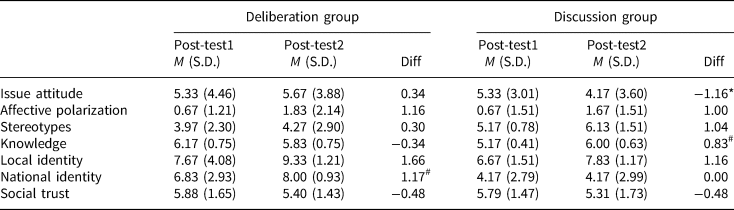
Table 1 shows the findings for study 1. Statistical significance notation is provided in the table, but since our sample size is very small, interpretations regarding statistical significance should be cautious. According to Table 1, issue attitude did not change much in both settings. Additionally, it seems issue polarization increased in both conditions, judging by the rise of standard deviation of the attitude scores. However, in both deliberation condition and casual discussion condition, affective polarization and stereotype were reduced. Knowledge did not experience much change in both conditions, but in deliberation condition social trust and national identity increased. Local identity experienced a slight decrease in both conditions.
Differences between deliberation and discussion groups (study 1, T1 and T2, N = 12)

a Diff: the difference between data at two time points.
*P < 0.05, #P < 0.10.
Table 2 demonstrates the comparison between the first and the second post-discussion/deliberation survey. Post-test 1 refers to the survey result immediately following the experiment and post-test 2 refers to the survey result 1 month after the experiment. A general trend we observed is that quite a few prominent effects we observed in Table 1 start to attenuate. The short-term effects for affective polarization, stereotypes, and local identity, became weaker 1 month after. For issue attitude, the discussion group became more negative. For issue polarization, no consistent pattern was observed. For national identity, the deliberation group increased further but the discussion group remained the same. Finally, social trust experienced a minor decrease.
Differences between deliberation and discussion groups (study 1, T2 and T3, N = 12)

# P < 0.10, *P < 0.05.
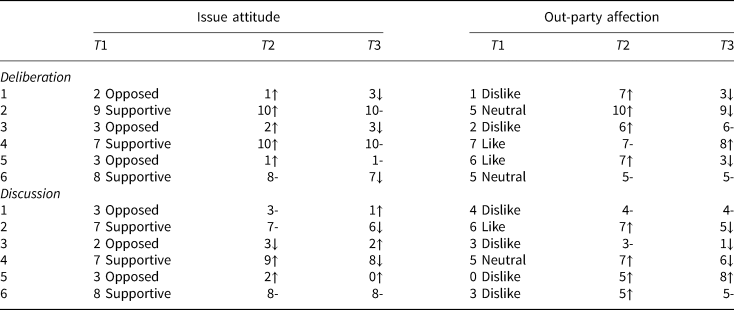
Focusing on issue attitude polarization and affective polarization, we presented individual level analysis in Table 3 to show the dynamic results of issue attitude and out-party affection change among participants before the experiment (T1), right after the experiment (T2), and 1 month after the experiment (T3). Most participants experienced attitude change at different times. For the deliberation group, five out of six participants became more polarized on Article 23 legislation issue right after the experiment, although three out of six participants' attitude alleviated after a month. The change in issue attitude is much less salient among participants of the discussion group. The three participants in the discussion group who opposed the legislation of Article 23 became slightly more polarized at the end. The results of out-party affection show that for four out of six participants in the deliberation group, their affection toward people from the opposite camp increased prominently (became more positive) at T2 but dropped at T3. Three participants in the discussion group showed the same pattern.
Trend of polarization among the deliberation and discussion groups over time

For issue attitude: ↑means more polarized, ↓ means less polarized, - means unchanged.
For out-party affection: ↑means more positive affect, ↓ means more negative affect, - means unchanged.
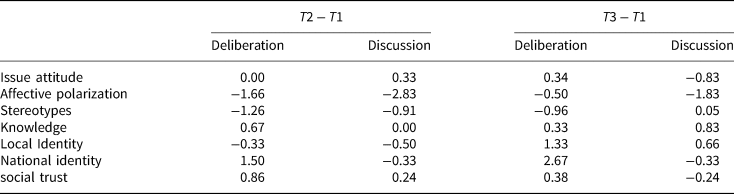
Regarding the differences between deliberation and discussion conditions, we compared the mean difference of each variable at different times (see Table 4). For short-term effects, the directions of changes in issue attitudes, affective polarization, stereotype, knowledge, local identity, and social trust were the roughly same between the deliberation and discussion groups. However, deliberation increased national identity whereas discussion decreased national identity. For longer-term effects, the directions of changes in attitudes and perceptions between the deliberation and discussion groups showed more different patterns. Only knowledge and local identity changed in the same direction whereas changes in other variables went in the opposite direction between the two conditions.
Group differences across time (study 1, N = 12)

5.2 Study 2
The data analysis procedures for study 2 are similar to those of study 1.
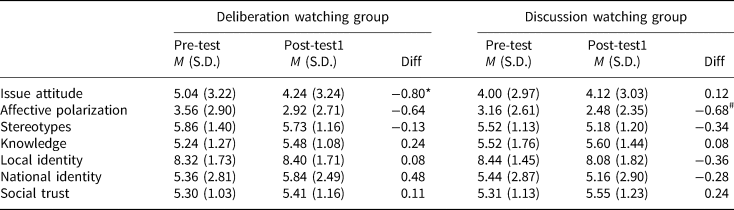
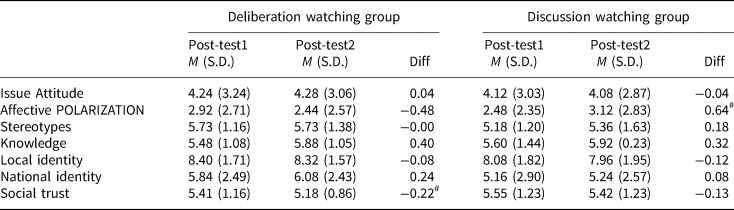
Table 5 summarizes the difference between groups watching deliberation and discussion. The finding seems to suggest that the general finding is very similar to study 1 but with much weaker effects. First, issue polarization (standard deviation of issue attitude) slightly increased but issue attitude change did not show consistent pattern. Second, affective polarization and stereotypes toward the other camp were reduced in both conditions. Third, knowledge experienced very marginal increase in both conditions. For national and local identity, no consistent patterns were found. Finally, social trust slightly increased in both conditions.
Differences between groups watching deliberation and discussion (study 2, N = 50)

*P < 0.05, #P < 0.10.
Table 6 summarizes the difference between groups watching deliberation and discussion after a month. Overall, changes in this table were very small. Judging by size of change, there are two notable findings. First, in watching deliberation group, affective polarization further reduced 1 month after but in casual discussion group, the effects disappeared. Second, issue knowledge in both conditions further increased slightly.
Differences between groups watching deliberation and watching discussion (study 2, T2 and T3, N = 50)

# P < 0.10.
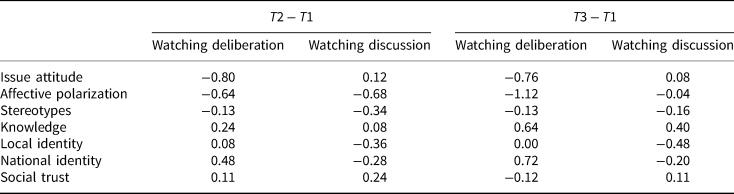
We also compared the mean difference of each variable between watching deliberation and watching discussion groups in study 2 (see Table 7). For short-term effects, the changes in affective polarization, stereotypes, knowledge, and social trust between watching deliberation and watching discussion groups were in the same direction. In contrast, watching deliberation decreased support for the issue, and increased local as well as national identity whereas watching discussion had the opposite impacts. For longer-term effects, the changes in affective polarization, stereotypes, and knowledge were the same between deliberation watching and discussion watching groups, but the changes in other variables went in the opposite directions.
Group differences across time between groups (study 2, N = 50)

6. Conclusion and discussion
This study conducted two pilot experiments to examine the impacts of casual discussion and deliberation on political attitudes in Hong Kong after the Anti-Extradition Bill Movement. Despite the limited number of participants, the two preliminary experiments found some promising and interesting findings.
The main findings from this study could be summarized in four points. First and foremost, the most important finding from this study is that dialog and communication regardless of format can significantly reduce affective polarization and increase social trust. In other words, through face-to-face interaction, individuals can increase favorable feelings toward people of opposite political camps. Such effect can last longer for more than 1 month, although the effects seem to reduce to different extent. One explanation for such effects could be that discussion provides opportunities for people to directly interact with people of different views so that they can understand individual differences better in a politically polarized society. The current media landscape in Hong Kong is filled with news media full of partisan biases. These media often portray people of holding different political views as unscrupulous, ignorant, and uncivil. Exposure to these media in the long run will ossify inaccurate and dehumanizing stereotype toward people of different opinions in people's mind. But, direct participation in talking with people of opposite camp will show that people of opposing views are normal people with dignity.
Second, deliberation and casual discussion did not show empirical evidence that they can influence people's issue attitude. And therefore, neither deliberation nor discussion can reduce issue attitude polarization at the group level. Even, in study 1, the variance of issue attitude increases in both experiment conditions. We do not know if the increase is systematic or idiosyncratic but obviously, very similar to findings from previous studies, opinion change through discussion is difficult. In the face-to-face discussion of the two groups, several participants recognize the other side's point of few, yet at the same time, they stand firmly with their own opinion. For instance, participant #6 in the deliberation group, a female who supported the legislation of Article 23 mentioned: ‘I think the legislation of Article 23 is still necessary… But I understand the current social environment is not perfect for the discussion of Article 23, so the government might need more time to reduce people's fear of and confusion about Article 23.’ For another, participant #1 in the casual discussion group, a male who opposed the legislation of Article 23, suggested more communication before the legislation: ‘As #6 said, more communication is needed. The terms in Article 23 are vague. How can Hong Kong people trust Beijing if there's not enough communication?’
Third, watching discussion or deliberation demonstrated similar effects as participating in discussion or deliberation. However, the sizes of effects were smaller to the extent that most of the statistical significance tests did not produce several statistically significant results. Obviously, due to the small sample size and the pilot study nature of this research, the exact mechanism of such change is difficult to pin down. But, one possible explanation could lie in the vicarious experience of watching discussion and deliberation. When people watch such discussion, they will naturally stand by those participants who share their political views. Prior to watching the video, they hold very negative views toward people of different camps. Yet, after they watched the video, they will see commonalities, and to some extent understand that people of opposite camps are ordinary Hong Kong people. Thus, hatred and bias could be reduced, even if their political views remain the same.
Finally, previous studies on deliberation found mixed results regarding opinion change across time (Andersen and Hansen, Reference Andersen and Hansen2007; French and Laver, Reference French and Laver2009; Grönlund et al., Reference Grönlund, Setälä and Herne2010; Hall et al., Reference Hall, Wilson and Newman2011), and our findings also indicate such complication. The experimental effects right after the experiment and the effects 1 month after showed various patterns. But, in general, compared to those in the discussion group, the effects in the deliberation group seem to be more stable, as the measures mostly changed in the same direction for both short and long terms. In terms of comparing watching deliberation and discussion, we did not find systematic difference. But, due to the fact that we only have one group of discussion and one group of deliberation for the two respective experiment conditions, the differences in statistical significance test could highly possible be the product of a small sample size.
The findings of this study suggest that governments and non-governmental organizations shall not place too much expectation on swaying people's issue attitudes successfully by communication campaigns or communication initiatives. It is very difficult to change people's view toward a political issue in the short run. Instead, it is important to look beyond issue attitude changing as communication objectives. One positive impact of communication is that people will develop positive views toward the opposite camp. Providing people with chances to talk to the opposite camp is crucial in curing social cleavage.
In summary, the study found that participation in deliberation and discussion could not change people's view toward a political or social issue, but could change people's view toward opposing party. Political dialog between people of different views could be a potential way to alleviating the social and political polarization Hong Kong is experiencing today. In the end, it is important to emphasize that, what has been done in this study is very preliminary. Due to resource limitations, the current study only tested one topic on a group of people with particular demographic features. In addition, to avoid over-interpretation, we did not discuss and explain all the nuances we presented in the findings section, and choose to focus on the broader trends that the pilot experiment found. But, whether these findings could be generalized to other topics and to other sectors of the population remains to be seen and more future studies are needed to answer this question.
Financial support
This study was supported by the Public Policy Funding, Policy Innovation and Co-ordination Office, Hong Kong Government (Project Number: SR2020.A1.008).
Supplementary material
The supplementary material for this article can be found at https://dataverse.harvard.edu/dataset.xhtml?persistentId=doi:10.7910/DVN/W9DAQM.