On September 20, 2017, Hurricane Maria made landfall south of Yabucoa Harbor, Puerto Rico, as a Category 4 storm, causing an estimated US $90 billion in damages and disrupting access to essential services.1 The American Community Survey estimates that 1 081 110 of the 5 450 472 Puerto Ricans residing in the United States live in New York State.2 Because New York City (NYC) was possibly a primary destination for Puerto Ricans displaced by the storm, the NYC Department of Health and Mental Hygiene (DOHMH) enhanced daily syndromic surveillance activities to characterize related emergency department (ED) visits, to assess any surges in health care demand, and to detect unusual visit patterns or needs among those possibly displaced by Hurricane Maria.
Syndromic surveillance has been used following extreme weather events before. For example, following Superstorm Sandy, syndromic surveillance was used to monitor trends in ED visits, comparing visit volume in impacted and non-impacted areas of the city.Reference Lall, Abdelnabi and Ngai3 Other jurisdictions have also used syndromic surveillance in this way. A study on ED presentations after Superstorm Sandy allowed the State of New Jersey to discover a primary surge of trauma-related ED visits among the elderly population.Reference McQuade, Merriman and Lyford4 Similarly, the Tennessee Department of Health used syndromic surveillance to find concerning clusters of illness in patients displaced by Hurricanes Harvey and Irma in 2017.Reference Wiedeman, Shaffner and Squires5 The Florida Department of Health heightened syndromic surveillance following Hurricane Irma to identify an increase in carbon monoxide exposures and poisonings linked to generator use.Reference Falise, Griffin and Fernandez6
In NYC, syndromic surveillance has been useful for routine surveillance on a variety of health outcomes, as well as for informing situational awareness during public health emergencies.Reference Lall, Abdelnabi and Ngai3 However, this analysis represents the first time that NYC has used enhanced syndromic surveillance to identify and characterize ED visits among an impacted group.
METHODS
The DOHMH syndromic surveillance system collects daily ED data from all 53 NYC hospitals to identify clusters of illness and monitor near real-time trends in ED visits.Reference Lall, Abdelnabi and Ngai3 Enhanced syndromic surveillance can be targeted toward a specific event or disaster to provide information for a prompt public health response. Following Hurricane Maria landfall in Puerto Rico, an algorithm for related patient visits was developed. The algorithm used Perl Regular Expressions to identify any mention of key words: Puerto Rico (“Puerto,” “Rico,” “hurricane,” “Maria”) in the ED chief complaint and also searched for Puerto Rico patient home Zip Codes.
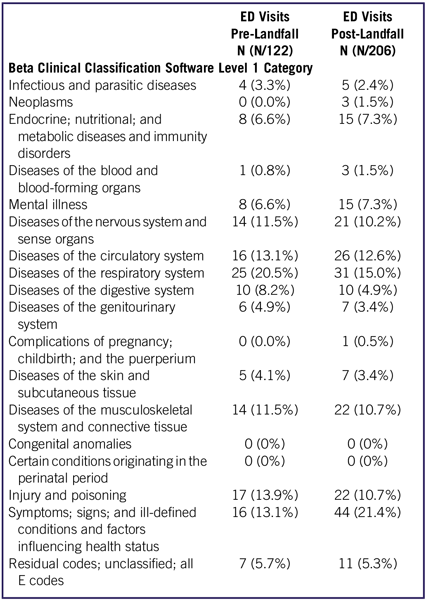
To assess differences in visits, ED visits were restricted to the 8 weeks before and after Hurricane Maria made landfall in Puerto Rico from July 26 to November 14, 2017. The baseline was defined as the 8-week period leading up to the landfall from July 26 to September 19, 2017. To evaluate for seasonality, related ED visits in the 2017 pre-hurricane (July 26–September 19) and post-hurricane (September 20–November 14) periods were compared with the same periods in 2016. Using the Beta Clinical Classification Software for ICD-10-CM/PCS, each patient discharge diagnosis code was mapped to 1 of 18 categories (Table 1). For visits without discharge diagnosis information, the free-text chief complaint was used to determine the appropriate category. Because each visit could have more than 1 discharge diagnosis code, categories were not mutually exclusive. To assess the impact of Hurricane Maria on visits for prescription refills or essential medical equipment (eg, dialysis or oxygen), visits with mention of key words “medication,” “prescription,” “med refill,” “dialysis,” or “oxygen” in the chief complaint were identified. The Fisher’s exact test was used to test for differences in visit categories before and after hurricane landfall. T-tests were used to compare average counts of related visits pre- and post-landfall in 2017 with the same period in 2016. P-values of <0.05 were considered statistically significant. All analyses were conducted using SAS 9.4 (SAS Institute Inc., Cary, NC).
Classification of ED Visits Relating to Puerto Rico – New York City, July 26 to November 14, 2017

RESULTS
Our case definition identified 331 visits, and, after a manual review, 3 invalid cases were removed for our analysis. During the 8-week baseline period leading up to landfall, from July 26 to September 19, 2017, the syndromic surveillance system identified 122 ED visits (average 15.3 per week) relating to Puerto Rico. Discharge diagnosis was missing for 24.1% (79/328) of related visits, which was significantly more than among all visits during that time (205 688/1 060 315, 16.0%, P < 0.001). The percent of related visits missing discharge diagnosis did not vary before (25/122, 20.5%) and after (54/206, 26.2%) Hurricane Maria made landfall (P = 0.241).
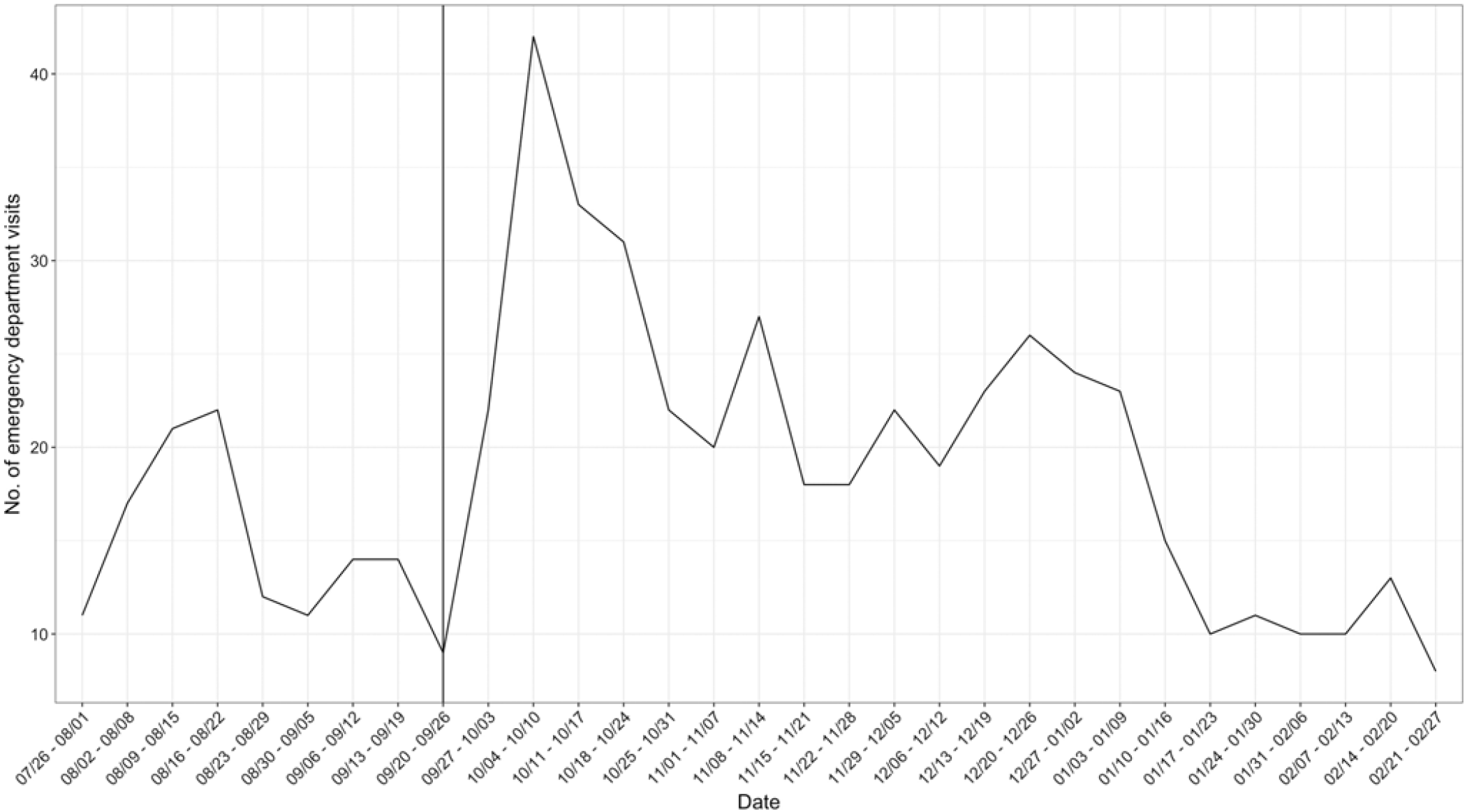
During the 8 weeks including and following landfall from September 20 to November 14, 2017, 206 visits (average 25.8 per week) relating to Puerto Rico were identified, representing a 68.9% increase from the baseline. Excluding the week of landfall when transportation out of Puerto Rico was limited, 215 total Puerto Rico related visits were observed in the 8 weeks from September 27 to November 21, 2017 (average 26.9 per week), representing a 76.2% increase. The number of visits relating to Puerto Rico peaked 2 weeks post-landfall at 42 visits for the week of October 4 to October 10, 2017 and remained above the baseline average of 15.3 visits per week for 15 consecutive weeks after Hurricane Maria made landfall (Figure 1). The average number of Puerto Rico or hurricane-related visits was similar in the pre-hurricane period (late July to mid-September, P = 0.368) in 2017 compared with the same period in 2016, but average visits were elevated in the post-hurricane period (mid-September to mid-November) in 2017 compared with the same period in 2016 (P < 0.001).
Weekly Count of Emergency Department Visits Relating to Puerto Rico – New York City, July 26, 2017 to February 27, 2018.

By diagnosis category, the largest increase was seen among visits for symptoms, signs, or ill-defined conditions and health status factors. Nonspecific visits without a definitive diagnosis, but involving an abnormal clinical or laboratory finding, such as fatigue or unspecified abdominal pain, were assigned to this category. Post-landfall, 21.4% (44/206) of visits were in this category compared with 13.1% (16/122) prior to landfall, an 8.3 percentage point increase (P = 0.076). This change was not found to be statistically significant.
ED visits for injury and poisoning declined from 13.9% (17/122) before Hurricane Maria made landfall to 10.7% (22/206), while visits categorized for mental illness increased from 6.6% (8/122) to 7.3% (15/206) during this period. Psychiatric illness, such as anxiety, dementia, schizophrenia, and mood disorders, was the most common presentation for mental health visits, accounting for 5.7% (7/122) of visits pre-landfall and 6.3% (13/206) of visits post-landfall. Visits for substance abuse comprised 0.8% (1/122) of visits pre-landfall and 1% (2/206) of visits post-landfall. None of the changes were found to be statistically significant, and visit counts were too small to provide insight into specific patterns.
In the 8-week window following Hurricane Maria landfall, 9.2% (19/206) of visits relating to Puerto Rico involved a medication refill or essential medical equipment compared with 1.6% (2/122) before landfall. Dialysis and medical device issues made up 0% of visits pre-landfall compared with 1.5% (3/206) of visits post-landfall. Medication-related visits, 1.6% (2/122) of visits pre-landfall and 7.8% (16/206) of visits post-landfall, were largely nonspecific. Despite a 7.1 percentage point increase overall (P = 0.005), visits for prescription refills or essential medical equipment accounted for a modest percent of the increase in visits post-landfall.
DISCUSSION
In this study, NYC was specifically interested in the use of the DOHMH syndromic surveillance system to monitor for any surge in health service use and, if needed, efficiently target resources to facilities with the greatest need. Given the large NYC Puerto Rican population, it was likely that the city would be a primary destination for Puerto Ricans impacted by the storm. Enhanced syndromic surveillance was thus set up to assess any surges in related ED use. There were concerns about meeting health needs related to the loss of medication and unreliable power given the major infrastructural and electrical grid damage that Puerto Rico sustained.Reference Concepción-Acevedo, Patel and Luna-Pinto7 Additionally, NYC wanted to assess any increase in mental health related visits because traumatic events are known to cause a range of psychological consequences.Reference Goldmann and Galea8
Following landfall of Hurricane Maria, there was an increase in ED visits related to Puerto Rico in NYC. While this report looked at the 8 weeks preceding and following Hurricane Maria landfall, ED visits remained elevated for 15 weeks after landfall. Previous research found flood exposure during Hurricane Sandy positively associated with anxiety, depression, and posttraumatic stress disorder,Reference Lieberman-Cribbin, Liu and Schneider9 and exposure to hurricane stressors during Katrina was also strongly linked to anxiety-mood disorders.Reference Galea, Brewin and Gruber10 Though the number of NYC ED visits for mental illness increased over our study period, we did not find a statistically significant change in volume. The small number of visits identified and lack of statistically significant results potentially led to the discordance between our and previous hurricane research. We also did not find any significant patterns for physical illness, despite an increase in visits with a diagnosis related to symptoms, signs, or ill-defined conditions and health status factors. Related visits involving a medication refill or essential medical equipment did significantly increase post-landfall but represented only a small proportion of visits after Hurricane Maria. Additionally detailed information for these visits was often lacking, preventing further analysis.
This study’s limitations center on our ability to identify and classify ED visits related to Hurricane Maria. The number of related hurricane visits identified by this enhanced surveillance was relatively small and may not be representative of all affected individuals. Seasonal variations in ED visits may have impacted visit volume and influenced differences observed pre- and post-landfall. Also, the information we receive describes basic visit demographic information along with the chief complaint and the discharge diagnosis. Both chief complaint and discharge diagnosis can vary in their degree of detail, and the latter may not be filled for every visit.Reference Lall, Abdelnabi and Ngai3 Identification of visits was dependent on the mention of Puerto Rico or Hurricane Maria in a patient’s chief complaint or on a Puerto Rico Zip Code on record with the patient’s address. Visits without any of these identifiers would have been missed and thus the visits described here may not be representative of those displaced by Hurricane Maria who sought care in NYC EDs. A Puerto Rico Zip Code was useful in identifying most of the related visits (73% of cases), and only 1.7% of all ED visits within the analyzed time period were missing patient Zip Codes. However, 27% of the related visits were identified by key words alone without a Puerto Rico Zip Code.
Similarly, the identification of visits for prescription refills or essential medical equipment was dependent on the mention of related key words in the patient’s chief complaint. While missing identifiers in the chief complaint may have led to misclassification, 82% of visits with a discharge diagnosis for prescription refill had a medication key word mention in the chief complaint.
Visits may also be misclassified based on the discharge diagnosis available in the syndromic surveillance system. During the evaluated time period, almost a quarter of related visits were missing discharge diagnosis. The discharge diagnosis for these visits was determined using the chief complaint, which was easy to do given the relatively small number of visits overall. However, in a larger emergency event, a timely review of the chief complaint for discharge diagnosis assignment may not be possible. Additionally, we know that the discharge diagnosis does not always line up with the information provided in the chief complaint text. Of visits analyzed with discharge diagnosis information, only 86.7% of presenting complaints lined up with the discharge diagnosis. Thus, we may be missing supplemental information when discharge diagnosis is missing from the syndromic visit record.
Our experience using the diagnosis categories was mixed. The Beta Clinical Classification Software allowed for a quick categorization of visits where discharge diagnosis was available. While most of the categories provided are homogeneous, some categories represent broad collections that may not be as useful for analysis or a public health response. In this study, the category for symptoms, signs, or ill-defined conditions and health status factors describes a broad range of diagnoses, including fatigue or unspecified abdominal pain. However, these diagnosis categories do allow for quick analysis, so it may be useful to quickly help identify health concerns during a larger public health emergency.
It is important to note that a lack of significant findings from syndromic surveillance should be interpreted to mean we were unable to detect a pattern, not that there is no pattern to detect. Despite the limitations of our study, the information provided from this enhanced syndromic surveillance was useful for our own situational awareness of NYC ED visits among an impacted population following Hurricane Maria. Though no public health actions were taken based on our findings, development and implementation of the methods could prove useful in future public health emergencies.
CONCLUSION
Implementation of this enhanced syndromic surveillance was easy to set up and maintain. Syndromic surveillance provided timely, detailed information on NYC ED visits related to Hurricane Maria, and the method may be useful for future natural disasters. Though enhanced syndromic surveillance in disaster response activities is often used, it is rarely published. Sharing methodologies and insights can benefit public health surveillance and enhance the effectiveness of future disaster characterizations and responses.
Statement of IRB Exemption
Syndromic surveillance is conducted by the New York City Department of Health and Mental Hygiene as public health surveillance, exempt from the Department of Health and Mental Hygiene Institutional Review Board.
Conflict of Interest Statement
The authors have no conflicts of interest to declare.