Introduction
The last few decades have seen an increasing interest in life-span development and the prevalence of posttraumatic stress disorder among war veterans and war children. Various explanations have been suggested for the prevalence of mental illness in combat veterans and participants without such experiences. For instance, a study supported depression after combat events in Finnish veterans from World War II (1939–1945) aged 65–84 years (Molgaard et al., Reference Molgaard1991). Finnish researchers (Hautamäki and Coleman, Reference Hautamäki and Coleman2001) explained a low prevalence (< 10%) of PTSD among Finnish war veterans as the result of high social solidarity in Finnish society linked to existing mental wellbeing in late adulthood. Andersson found a hidden health trauma of PTSD among Finnish evacuees comparable to level of trauma reported in European Jews who survived the holocaust in a group of war children separated by force from their parents during World War II (Andersson, Reference Andersson2011).
However, few studies have been performed to evaluate perceptions of the early parent-child relationship linked to the development of individual vulnerability in elderly war children and war veterans. In the last few years, Andersson (Reference Andersson2010; Reference Andersson2012; Reference Andersson2013) identified the association of psychopathology and trauma in Finnish war children. The result takes into account the interactionistic interplay between concepts of individual vulnerability and environmental characteristics during the war between the Soviet Union and Finland in 1939–1945. These studies about Finnish evacuees separated from their parents during the war showed significantly higher scores of parental rejection than among control children, who remained in Finland during World War II. In this connection, the attachment theory proposed by Bowlby (Reference Bowlby1969; Reference Bowlby1973; Reference Bowlby1980) postulates that a child develops internal working models (IWM) of self and others in interactions with his/her principal caregivers. These working models reflect awareness; they later determine the information that one attends to and how one interprets and records information. An inappropriate parental rearing style might affect psychological adjustment, leading to further development of dysfunctional IWM and psychopathological manifestations (Bowlby, Reference Bowlby1980; Andersson, Reference Andersson2006). PTSD in children and adolescents/adults occurs frequently along with mood and anxiety disorders (Copeland et al., Reference Copeland, Keeler, Angold and Costello2007). In early childhood, when caring parenting goes wrong, there may be a prerequisite for insecure attachment and a hampered life style because parents have not been able to meet the need for secure base attachment. Events like these can be enough to provoke trauma in children, leading to further development of IWM of self and others based on insecure attachment and discomfort with closeness.
Attachment theory demonstrates an organizing principle that may explain important aspects of interpersonal relationships during a life span. Effects of traumatic separation and bereavement in childhood and adult psychiatric disorder found in Finnish war children suggest the need for further examination of dimensions of lifetime trauma. In view of catastrophic events of parental separation in early childhood, it seems reasonable to assume that early childhood behavioral disorganization would be an appropriate response to loss and separation (Bowlby, Reference Bowlby1979). Taking into account attachment theory and the Kellerman diagnostic classification system of the DSM-IV for the holocaust survivor syndrome and child survivor syndrome (Kellermann, Reference Kellermann1999), it was predicted that idiosyncratic vulnerability based on the quality of the relationship between the origin of childhood perception of parental upbringing and attachment would be found in the present study.
Using data from the Finnish war child investigation, including Finnish war veterans at Karolinska Institute in Solna/Stockholm, Swedish perceptions of childhood parental rearing and mental health characteristics in late adulthood were analyzed.
The following predictions were made:
-
(1) the perception of EMBU midparent rejecting, perception of EMBU midparent emotional warmth, and perception of EMBU midparent overprotection would be significantly higher among Finnish evacuees of World War II than Finnish combat veterans of World War II,
-
(2) the interaction between long-term trauma of attachment and dysfunction of self-schemas should contribute to the development of a higher degree of psychopathological manifestations among Finnish than Finnish combat veterans,
-
(3) the affective perception of parental rearing would be associated with insecure attachment and discomfort with closeness for Finnish evacuees, while the childhood perception of parental rearing behavior in Finnish combat veterans would be associated with secure attachment and psychological wellbeing,
-
(4) consequently, following the DSM-IV diagnostic criteria with regard to the Kellerman classification symptoms equivalent to the Holocaust Survivor Syndrome and the Child Survivor Syndrome would be found among Finnish evacuees but not among Finnish combat veterans.
Methods
Participants
Convenience (non-random) samples of healthy participants were recruited in both Sweden and Finland. A condition for participation in the study was that they could declare that they had not suffered from (or been treated for) a mental illness or taken part in a similar study earlier. Another condition was that they could read and understand Swedish. In the voluntary and anonymous collection process in both countries, chairmen, leaders of local Finnish War Associations, and the Disabled War Veterans Association of Finland and Sweden distributed and collected the questionnaires from the participants. After that, the forms were delivered to the author in Stockholm. A convenience sample (n = 163) of Finnish evacuees and Finnish combat veterans, collected within the framework of a larger ongoing study of childhood experiences and psychopathology, was included in the study. One male participant in the control group had to be excluded because of incompleteness of data. The final sample consists of n = 98 men and n = 65 women with mean age of 76.0 years and SD 8.5 at the time of the study. A mean age of 69.4 years, SD 2.3 for the test group of Finnish evacuees (n = 98) of 40 men and 58 women was identified. The control group of Finnish war veterans (n = 65) consisted of 58 men and 7 women with a mean age of 85.9 years, SD 3.6. Earlier findings about age differences in national and international samples, as well as convenience (non-random) samples, have demonstrated that scores on the EMBU do not appreciably affect age and, for this reason, are not considered problematic (Arrindell et al., Reference Arrindell, Perris, Arrindell and Eisemann1994). In the present series, differences of age between the study groups were likewise considered not to affect scores on the EMBU. In the test group, 9% of the participants had never been married; 55% were married or living in a stable partnership. About 12% were widowers/widows, and 6% of the controls had never been married, 46% married or living in a stable partnership, and 37% were widowers/widows. The educational level among Finnish evacuees showed 32 participants with 9 years of compulsory school versus 22 for veterans, 32 evacuees with upper secondary school versus 19 for veterans and 34 evacuees with university education and/or the equivalent versus 24 veterans with the same level of education. Neither education, marital status (n = 98 Md 2.02, SD 0.82, t-test 2-tailed = ns vs. n = 65 Md 2.03, SD 0.84 and n = 98 Md 2.89, SD 1.3 vs. n = 65 Md 3.2, SD 1.4, t-test 2-tailed = ns), age nor gender differed between Finnish war children and Finnish combat veterans. All participants gave informed consent to participate in the study. The ethics committee at Karolinska Institute, Solna/Stockholm, Sweden, approved the study design.
Instruments
Three self-report questionnaires were used in the present study: the EMBU, a Swedish acronym for “Own memories of parental rearing” (Perris et al., Reference Perris, Jakobsson, Lindström, von Knorring and Perris1980), posttraumatic stress disorder checklist PCL-M (Weathers et al., Reference Weathers, Litz, Herman, Huska and Keane1993; Blanchard et al., Reference Blanchard, Jones-Alexander, Buckley and Forneris1996; Andersson, Reference Andersson2010), and adult scale questionnaire, ASQ (Feeney et al., Reference Feeney, Noller, Hanrahan, Sperling and Berman1994). The EMBU questionnaire is an instrument that assesses perceptions of parental rearing behavior and taps into three factors: rejecting, emotional warmth, and overprotection, from 81 items about father and mother separately. Each item is scored on a Likert scale. If needed, composite mid-parent scores can be used that reflect a family measure based on scores of father + scores mother/2. All items are behavior-oriented in their formulation, and the EMBU can also be used with 14 subscales (facets). In a transcultural study in 16 countries, the factors of rejecting, emotional warmth, and overprotection could be verified and their generalizability across countries was shown (Arrindell et al., Reference Arrindell, Perris, Arrindell and Eisemann1994). Cronbach's α coefficients for the factors of immediate interest have been found earlier to be highly satisfactory (0.87–0.95). In this study, the Cronbach's α coefficients were highly satisfactory for both test group participants (0.91) and controls (0.90).
The posttraumatic stress disorder checklist (PCL) is a self-report measure that taps into 17 psychometric properties of clinical symptoms. The items are scored on a Likert scale from not at all (1) to extremely (5). Criterion B, i.e. intrusion with 5 symptoms of characteristics, taps into experiences of traumatic experiences, criterion C, i.e. avoidance contains 5 symptoms with persistent avoidance of trauma, and criterion D, i.e. hyperarousal, concerns 7 different symptoms of arousal. The PCL follows the diagnostic criteria of DSM-IV 309.81 Posttraumatic stress disorder (A.P.A, 2000). There are three versions of PCL; PCL-M (military) for symptoms in response to “stressful military experiences,” PCL-C (civilian) in relation to “stressful experiences” and the PCL-S (specific), which focuses on symptoms in relation to a specific identified event. The PTSD checklist can be used in three ways: (a) monitoring symptoms in clients before and after intervention, (b) diagnosing PTSD, and (c) individual screening for PTSD. The military version PCL-M and the civilian version PCL-C were included in the battery of the questionnaire to allow comparison between the study groups. Additionally, the self-reporting questionnaires reflected the participant's penciled notes, comparable to symptoms in response to military experiences, various sexual assaults, direct physical attacks, and indirect attacks (against family members, friends or relatives), “I want my Mummy” and cold, harsh surroundings. Finnish evacuees scored higher on PCL-C symptoms and PCL-M symptoms than control participants, with the exception of criteria for sleeping difficulties, which indicated greater and more disturbing sleeping problems for the latter group. Underlying dimensions of the PCL-M were used in the current study. The PCL-M (test group 0.93 vs. controls 0.92) and PCL-C (0.94 vs. controls 0.92) presents highly satisfactory Cronbach's α coefficients.
The ASQ is a self-report tool that is used to obtain measures of attachment in adults. Each item of the ASQ is scored on a Likert scale and consists of five factors: confidence in self and others, discomfort with closeness, need for approval, preoccupation with relationships, and relationships as secondary. The factor of confidence in self and others taps into a secure attachment, whereas insecure participants score higher on the remaining four subscales. Cronbach's α coefficients for the ASQ were highly satisfactory (test group 0.84 vs. controls 0.87).
Statistical analyses
The Statistical Package for Social Sciences (SPSS, version 11.0), including sample power as a function of the level of significance (α), was used in the study. Previous standardization, mean scores, standard deviations, t-test 2-tailed, and alpha power were determined. Odds ratios derived from the formula (a/c) / (b/d) were compiled (Bland and Altman, Reference Bland and Altman2000). Calculations of Cohen's d with effect size r (Cohen, Reference Cohen1988) using means and standard deviations of the test group and controls were performed. Cronbach's αcoefficients were calculated as well. Additionally, multiple linear regression models were examined.
Results
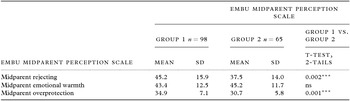
Initially, mean scores, SD's and independent samples t-test for perception of EMBU midparent factors are shown in Table 1. Midparent rejecting, midparent emotional warmth, and midparent overprotection correlate closely with available Swedish normative data. The self-reported values present significantly higher scores on midparent rejecting (0.002***) and significantly higher scores on midparent overinvolvement (0.001***) among Finnish evacuees than Finnish combat veterans. Parental rearing behavior seems to have been dominated by violence and punitive actions among Finnish evacuees. Using means and standard deviations for the factor of midparent rejecting, Cohen's d = 0.51, a medium effect size r = 0.25 was detected. The corresponding result for variable midparent Overprotection revealed Cohen's d = 0.65 with medium effect size r = 0.25. Midparent emotional warmth rearing showed trivial thresholds, i.e. Cohen's d = −0.15, and effect size r = −0.07, indicating that hypothesis 1 is only partly supported. Low and insignificant differences of perception on midparent emotional warmth rearing indicate that small attachment differences often contribute to powerful effects on pattern of attachment and personality development in adults (Bowlby, Reference Bowlby1969). To validate this assumption, the interaction effects were calculated in multiple regression models below.
Descriptive statistics mean, SD, T-test, 2 tailed for scores of rejecting, emotional warmth, overprotection of the EMBU midparent perception scale in a test group of evacuated Finnish war children (n = 98) versus a control group (n = 65) of Finnish combat veterans

Group 1 = evacuated Finnish war children n = 98; group 2 = Finnish combat veterans n = 65.
Sign: ns = not significant; * = p < 0.05; ** = p < 0.01; *** p < = 0.001.
Caregiver-guided self-regulation of emotion in Finnish evacuees as measured by the facets of midparent shaming scores and midparent guilt engendering scores differed significantly between Finnish evacuees and Finnish combat veterans (midparent shaming = Md 8.8, SD 3.3 vs. Md 7.5 SD 2.9, t-test 2-tailed = 0.01**, alpha power 0.73 and midparent guilt engendering = Md 11.4, SD 4.3 vs. Md 9.6, SD 3.6, t-test 2-tailed 0.01**, alpha power 0.79). Identified facets of midparent parenting appear to be relevant for upbringing through control with high levels of rejection, as well as low levels of care and psychological wellbeing.
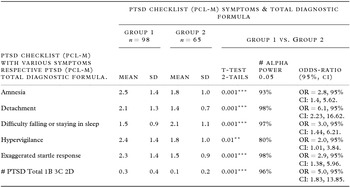
Relevant results of various symptoms of PTSD (PCL-M) from the two populations are summarized in Table 2. As a response to traumatic events and in line with the prediction, there are significantly higher levels of dissociative symptoms in test group participants than controls. The two populations showed 95% confidence intervals between Finnish evacuees and Finnish combat veterans for central core clusters of PTSD checklist (PCL-M) symptoms. Furthermore, the result of t-test 2-tailed, alpha power, and odds ratio values present a robust output for the following symptoms: amnesia, i.e. inability to recall an important aspect of the trauma, detachment, i.e. feeling of detachment or estrangement from others, hypervigilance, exaggerated startle response, and the PTSD total diagnostic formula of 1B 3C 2D symptom as well. The symptom of difficulty falling or staying asleep scored significantly higher in Finnish war veterans than Finnish evacuees.
Descriptive statistics (mean, SD for group 1 and 2), T-test, 2-tailed, alpha power and odds ratio for Finnish evacuees (n = 98) versus Finnish combat veterans (n = 65) in scores of DSM-IV PTSD checklist (PCL-M) symptoms respective PTSD (PCL-M) total diagnostic formula#

Items range from “not at all” (1) to “extremely” (5) for DSM IV posttraumatic stress disorder checklist (PCL-M) in Group 1 n = 98 Finnish evacuees; Group 2 n = 65 Finnish combat veterans. Alpha power = 0.05, 2-tailed, for test of the nil hypothesis for variances (t-test) by samples.
Only significant values above 0.01** are reported. Others in the running text.
# Note; PTSD Total diagnostic formula: 1B 3C 2D with at least 3 items >3–5.
Moreover, by way of example for the criterion of detachment, one goal of the proposed study is to test the null hypothesis that the two population means are equal. The criterion for significance (α) of detachment has been set at 0.05. The test is 2-tailed, which means that an effect in either direction will be interpreted. With the proposed sample size of 98 and 65 for the two groups, the study will have power of 97.7% to yield a statistically significant result. This computation assumes that the mean difference is 0.7 (corresponding to means of 2.1 vs. 1.4), and the common within-group standard deviation is 1.1 (based on SD estimates of 1.3 and 0.7). This effect was selected as the smallest one that would be important to detect in the sense that any smaller effect would not be of clinical or substantive significance. It is also assumed that this effect size is reasonable in that it could be anticipated in this particular field of research. Consistency, a second goal of the study of detachment, is to estimate the mean difference between the two populations (i.e. precision for estimating the effect size). On average, a study of this design would enable the author to report the mean difference with precision (95% confidence level) of ± 0.35 points. For example, an observed difference of 0.7 would be reported with a confidence interval of 0.35–1.05. The precision estimate here is the median. Precision will vary as a function of the observed standard deviation (as well as sample size) and will, in any single study, be narrower or wider than this estimate. In this computational option, the variance is estimated (t-test) as a response to traumatic events. The remaining five computations in Table 2 show satisfactory power for a test of the hypothesis and precision for estimating the effect size on DSM-IV criteria of amnesia, hypervigilance, exaggerated startle response, and PTSD total 1B 3C 2D as characteristic symptoms among test group participants. On the other hand, Finnish combat veterans suffer from the DSM-IV diagnostic criteria of difficulty falling and staying asleep.
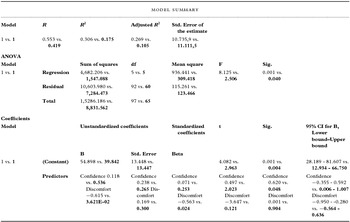
Calculations show coefficients of the linear equation with the Enter method (Table 3), involving the following independent variables: confidence in self and others, discomfort with closeness, need for approval, preoccupation with relationships, and relationships as secondary, which best predict scores of perception of midparent emotional warmth rearing for the two groups (controlled for gender and age). The Model summary presents seven independent variables in the regression model, and the value of the R 2 accounts for 18% of the total variation in the dependent variable of EMBU midparent emotional warmth for Finnish combat veterans versus 31% of the total variation in the dependent variable for Finnish evacuees. The ANOVA calculation rejects the null hypothesis of no difference in means because the calculated p-value (Sig. for Finnish evacuees 0.001 vs. Finnish combat veterans 0.04) determines the significance of the test. Even when coefficients were taken into account with all factors controlled (including age and gender), Finnish evacuees had significantly higher scores on discomfort with closeness (0.05), while Finnish combat veterans showed significantly higher scores on confidence in self and others (0.001). Other variables in the regression analyses were not significant predictors. Overall, the various independent variables did only a modest job of explaining individual group differences of attachment: the R 2 was only 0.31 for Finnish evacuees, meaning that 69% of the variability in the number of dimensions could not be explained in terms of the demographic and clinical factors used in the regression analyses. At the same time, the predictive model for Finnish combat veterans does a modest job of explaining individual group differences of attachment: the R 2 was only 0.18 among veterans, meaning that 82% of the variability in the number of dimensions could not be explained in terms of the demographic and clinical factors used in the regression. Nevertheless, the significance of this model in predicting the criterion variable demonstrates that there is a linear relationship between the dependent variable of perception of EMBU midparent emotional warmth rearing and secure attachment for Finnish combat veterans, while insecure attachment with lack of psychological wellbeing in late adulthood occurs in Finnish evacuees.
Linear Regression with Enter method and the independent variables confidence, discomfort with closeness, relationships as secondary, need for approval and preocccupation with relationships respective perception of EMBU midparent emotional warmth as dependent variable for Finnish evacuees (test-group n = 98) from the W W II, 1939–1945 versus Finnish combat veterans (in bold n = 65) from the W W II, 1939–1945 (controlling for sex and age)

Abbrevations: Confidence = Confidence in self and others. Discomfort = Discomfort with closeness. Note: The predictor's relationships as secondary, need for approval and preocccupation with relationships do not reach statistical significance neither among test-group participants nor in control participants. Simultaneously, there were no sex or age differences between the groups.
As predicted in hypothesis 4 symptoms equivalent to the holocaust survivor syndrome and the child survivor syndrome suggested by Kellermann (Reference Kellermann1999) could be found among Finnish evacuees but not in the group of Finnish combat veterans. For the first group it concerns (1) the PTSD total diagnostic formula and (2) C-criteria with inability to recall important aspects of the trauma, (3) C-criteria and feeling of detachment or estrangement from others, (4) D-criteria with hypervigilance, (5) D-criteria with exaggerated startle responses. Diagnostic features are reported at the significance level between 0.01** − 0.001***. Meanwhile, minor significant levels for Finnish evacuees versus veterans reveal B-criteria of recurrent distressing dreams of the trauma event (0.05*), B-criteria of intense psychological distress at exposure to external or internal clues that symbolize an aspect of the traumatic event (0.05*), C-criteria for markedly diminished interest or participation in significant activities (0.05*) and D-criteria for irritability or outbursts of anger (0.05*). Linear regression and the coefficients of determination for the presumed cause of the dependent variable of type A preoccupied (anxious) insecure attachment on the independent effect variables numbing and avoidance show p-values of the F-test by the overall model that the value is significant only for Finnish evacuees and not for controls (p = 0.001 versus p = 0.501). The R 2 = 0.298 means that approximately 30% of the variability of the dependent variable corresponds to the two effect variables of numbing and avoidance.
Discussion
Bowlby's attachment theory was used as a theoretical frame of reference in the present study. The findings demonstrate that exposure to combat events and parental separation during World War II between the Soviet Union and Finland still continues to place Finnish veterans and Finnish children displaced in time of war at risk for adverse psychological and social outcomes. However, there is little knowledge about determinants of long-term trauma effects in the populations of Finnish combat veterans or Finnish evacuees and consequently few comparisons are available. Finnish children forcibly displaced during the Soviet–Finnish war show internalized dysfunctional meaning structures of personality related to coping and attachment (Holmes, Reference Holmes1993; Madigan et al., Reference Madigan, Bakersman-Kranenburg, van Ijzendoorn, Moran, Pederson and Benoit2006). The results are in part consistent with predictions of the study and the literature. In brief, it seems that the attachment status of Finnish evacuees with early traumatic life events poses a risk that is linked to lack of parental affection in early childhood.
The second hypothesis supports attachment as a function of the infant-parent relationship, with OR = 6.1, 95% CI: 2.23–16.62 for diagnostic criteria of detachment (C4). The results also indicate unconscious perception and perceptual defense (Bowlby, Reference Bowlby1973; Dixon and Henley, Reference Dixon and Henley1991) among Finnish evacuees, with amnesia linked to the role of a central and unconscious part of working models of relationships (Table 2). Crittenden (Reference Crittenden, Cicchetti and Toth1994) maintained that such IWM are a mental structure capturing (a) a participant's specific representation of herself/himself in a relationship, (b) the attachment figure in the context of the self, and (c) affect in combination with (a) and (b). Also in line with Crittenden affect is the function of a rapid, effectual appraisal system that mediates associations between perception, affect, and behavior. The presence of central working models of exaggerated startle responses and hypervigilance were also found among the test group participants. Core structures among Finnish evacuees are resistant to change because they seem to have been internalized in early childhood. These inner structural features of personality are conceptually consistent with prior research and present a conceptual parallelism between findings of the present study and those suggested by Crittenden and Bowlby.
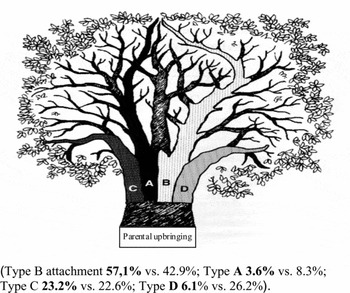
Furthermore, the findings support the prediction of attachment in adulthood for the two study groups. The hypothetical continuum of attachment style questionnaire (ASQ) reduces to two significant dimensions – secure attachment and insecure attachment, whereby Finnish evacuees revealed insecure attachment and Finnish combat veterans showed secure attachment. Closely following Ainsworth et al. (Reference Ainsworth, Blehar, Walters and Wall1978) and Bowlby's constructs of attachment (Bowlby, Reference Bowlby1969), the central concept of a safe base for a secure attachment (Figure 1) was found among Finnish combat veterans, i.e. type B with identified models of self and other capturing positive self and positive others (57.1% vs. 42.9% in evacuees). On the other hand (Crittenden, Reference Crittenden2002), idiosyncratic vulnerability obtained by insecure attachment was confirmed in adult Finnish evacuees i.e. type A with identified models of self and others capturing negative self and positive others due to preoccupied insecure attachment (8.3% vs. 3.6% in controls); type C with identified models of self and others capturing positive self and negative others due to the dismissal of ambivalent attachment (22.6% vs. 23.2% in controls) and type D with identified models of self and others capturing negative self and negative others due to fearful disorganized attachment (26.2% vs. 6.1% in controls). Childhood perception of parental rearing behavior is based on type B attachment with a positive self and positive reflective others in parental emotional warmth settings for controls, whereas Finnish evacuees show significant multiple personalities (Crittenden, Reference Crittenden, Cicchetti and Toth1994). These two groups developed different perceptual ranges in the course of attachment behavior, and series of relationships between children and caregivers can be seen as cornerstones of individual differences. The caregiver as a source of familiarity through perception of midparent emotional warmth was found to influence secure attachment in Finnish combat veterans. On the other hand, Finnish evacuees experienced high levels of tension and behavioral disorganization without proximity for maximal modulation of arousal with the outcome of insecure attachment. Resilience or vulnerability to stressful life events is determined to a very significant degree by the pattern of attachment developed during the early years.
Illustration of attachment theory with outcome of four attachment categories among adult Finnish combat veterans (n = 65) and in adult Finnish Evacuees (n = 98) of World War II (controlled for gender and age).

Other significant diagnostic findings were present in the study. The multi-axial diagnostic system of the DSM-IV revealed symptoms at similar level to those seen in holocaust survivor syndrome and child survivor syndrome in Finnish evacuees, while these clinical diagnoses were not found among controls (Kellermann, Reference Kellermann1999). Additionally, the existence of a complex form of posttraumatic stress was recognized through the symptom of dissociation, which indicated parts of the personality that developed to avoid traumatic memories and perform everyday functions, while other parts of personality remained locked in traumatic experiences and defensive effects. The degree of predictability of results from early childhood attachment was surprising, because perceived parental rearing seems to play a final role in the developmental process of mental wellbeing versus mental illness. It concerns present identification of relationships between disorders of emotional warmth parenting and development of dysfunctional working models on the one hand, and the emergence of various spectrums of posttraumatic psychopathology on the other hand.
Endorsement of individual vulnerabilities
To the best of our knowledge, this is the first investigation conducted from a life cycle perspective with integrated complex emotions based on series of perceptual-cognitive-physiological-behavioral reactions. The psychic aftermath of World War II between the Soviet Union and Finland supports a breakthrough for identified mechanisms of unconscious perception and perceptual defenses in Finnish war children. Parental separation in early childhood is a specific vulnerability factor (Lahti et al., Reference Lahti2012) for the diagnostic criterion 309.81 posttraumatic stress disorder among Finnish evacuees, analogous to the holocaust of the memory culture of Finnish evacuees (Andersson, Reference Andersson2011) and PTSD in Vietnam combat veterans (Bremner et al., Reference Bremner, Southwick, Brett, Fontana, Rosenheck and Charney1992). Evacuated children lost their primary attachment figure of origin in Finland. Exposed to dysfunctional family backgrounds in such circumstances in Sweden, the only working strategy was to cope with their own fear of rejection. In adult life, the outcome of separation led to permanent consequences for this group, and 30% of Finnish evacuees confirmed diagnostic criteria for posttraumatic stress disorder, as opposed to 7% among combat veterans from Finland. In readjusting themselves, this group of Finnish evacuees lost their attachment hierarchy of origin as developed in close relationships with their parents of origin in Finland. The new attachment hierarchy was based on feelings of detachment and estrangement from others. Parental separation seems to be an important element of long-term psychopathological response to trauma and within attachment theory psychopathology is viewed as a developmental construct. The effects of dysfunctional IWM, with mechanisms of disturbances in the attachment processes between the care recipient and caregiver proposed by Bowlby (Reference Bowlby1969; Reference Bowlby1973; Reference Bowlby1980) were identified for test group participants. It concerns (a) trauma of physical parental separation, (b) trauma linked to acute loss of emotional warmth parenting, and (c) internalized patterns of (a) + (b) that influence the development of individual vulnerability. Furthermore, the development of autonomic balance for the regulatory system, with emergence of the self, is permanently disordered as a function of caregiver-guided self-regulation, with high scores of midparent shaming and midparent guilt engendering. The findings seem to be equivalent to the impact of shame distress suggested by Schore: “The psychological state of shame distress represents a sudden shift from sympathetic-predominant. . ..to parasympathetic-dominant trophotropic arousal. . . The caregiver influences the parcellation of the two limbic circuits. . . and thereby the permanent excitation-inhibition (automatic) balance of his prefrontolimbic regulatory system” (Schore, Reference Schore2003).
The sacrifice of military service has earlier been explained as a function of social solidarity and continued significance given to the Finnish society (Hautamäki and Coleman, Reference Hautamäki and Coleman2001). Clinical evidence sheds further light on the explanations of low prevalence (7%) of posttraumatic stress disorder among Finnish combat veterans, while data invite further exploration into the holocaust syndrome among Finnish evacuees.
Limitations
Yearly SPA rehabilitation of war veterans is a Finnish specialty of war compensation that might impact the prevalence of PTSD in combat veterans. However, the results of the present study should be interpreted in the context of several limitations. Like other studies concerning perceived parental rearing, the present investigation is based on retrospective self-reports. A detailed account of this issue was presented earlier (Lundberg et al., Reference Lundberg, Perris and Adolfsson1999; Andersson, Reference Andersson2006) concerning results about memories of perceived parental rearing behavior and was found to be quite stable and non-biased. The series of the present study are convenience samples and therefore cannot be regarded as representative of the entire population of evacuated Finnish war children or the entire population of Finnish combat veterans. However, they are not from a single region of Sweden or Finland, since they were collected in various counties across Sweden and Finland. Various participants in independent investigations, however (Perris, Reference Perris1996), support the view that they have to be taken into account as a factor that contributes to the development of individual vulnerability. Furthermore, participants are only allegedly healthy, because no records of their mental health were available. Statistics cannot prove causal relationships but only confirm correlations between predicted variables and presumed effects. Enduring stressors highlight vulnerability to trauma among adult Finnish evacuees separated from their parents of origin during World War II. Maladaptive “parental upbringing,” as well as its specificity and causal significance in posttraumatic stress disorder, remain to be demonstrated. Although several important predictive variables were identified in this study, further research is needed to explore other potential causes of symptoms.
Conflict of interest
None.