Introduction
Research from the World Mental Health Surveys estimates that 70.4% of individuals are exposed to at least one traumatic event during their lifetime (Benjet et al., Reference Benjet, Bromet, Karam, Kessler, McLaughlin, Ruscio, Shahly, Stein, Petukhova, Hill, Alonso, Atwoli, Bunting, Bruffaerts, Caldas-de-Almeida, de Girolamo, Florescu, Gureje, Huang, Lepine, Kawakami, Kovess-Masfety, Medina-Mora, Navarro-Mateu, Piazza, Posada-Villa, Scott, Shalev, Slade, ten Have, Torres, Viana, Zarkov and Koenen2016), and posttraumatic stress disorder (PTSD) – contingent upon trauma exposure – is the fifth most common psychiatric disorder (Kessler et al., Reference Kessler, Berglund, Demler, Jin, Merikangas and Walters2005). Trauma and PTSD have adverse consequences not only for emotional health but also for physical health (Koenen et al., Reference Koenen, Sumner, Gilsanz, Glymour, Ratanatharathorn, Rimm, Roberts, Winning and Kubzansky2017). Indeed, trauma exposure and PTSD prospectively predict higher risk of developing cardiovascular disease (CVD) (Boscarino, Reference Boscarino2008; Rich-Edwards et al., Reference Rich-Edwards, Mason, Rexrode, Spiegelman, Hibert, Kawachi, Jun and Wright2012; Vaccarino et al., Reference Vaccarino, Goldberg, Rooks, Shah, Veledar, Faber, Votaw, Forsberg and Bremner2013; Gradus et al., Reference Gradus, Farkas, Svensson, Ehrenstein, Lash, Milstein, Adler and Sørensen2015; Sumner et al., Reference Sumner, Kubzansky, Elkind, Roberts, Agnew-Blais, Chen, Cerdá, Rexrode, Rich-Edwards, Spiegelman, Suglia, Rimm and Koenen2015), the leading cause of morbidity and mortality in industrialized countries. Experts in clinical psychology and cardiology have now called for increased CVD surveillance after trauma, as well as PTSD treatment trials powered to detect potential reductions in CVD risk associated with PTSD treatment gains (Burg and Soufer, Reference Burg and Soufer2016). However, to advance surveillance and intervention efforts, it is important to identify intermediary mechanisms by which trauma and PTSD affect CVD risk. Furthermore, PTSD is a disorder with high heterogeneity in symptom presentation (Galatzer-Levy and Bryant, Reference Galatzer-Levy and Bryant2013). Identifying which aspects of PTSD particularly affect intermediary mechanisms will help to target interventions most effectively.
Hypertension is a major modifiable CVD risk factor and a promising intermediary mechanism by which trauma and PTSD may influence CVD risk (Benjamin et al., Reference Benjamin, Virani, Callaway, Chamberlain, Chang, Cheng, Chiuve, Cushman, Delling, Deo, de Ferranti, Ferguson, Fornage, Gillespie, Isasi, Jiménez, Jordan, Judd, Lackland, Lichtman, Lisabeth, Liu, Longenecker, Lutsey, Mackey, Matchar, Matsushita, Mussolino, Nasir, O'Flaherty, Palaniappan, Pandey, Pandey, Reeves, Ritchey, Rodriguez, Roth, Rosamond, Sampson, Satou, Shah, Spartano, Tirschwell, Tsao, Voeks, Willey, Wilkins, Wu, Alger, Wong and Muntner2018). Both trauma and PTSD have been linked to increased hypertension risk across cross-sectional (Cohen et al., Reference Cohen, Marmar, Ren, Bertenthal and Seal2009; Granado et al., Reference Granado, Smith, Swanson, Harris, Shahar, Smith, Boyko, Wells and Ryan2009; Riley et al., Reference Riley, Wright, Jun, Hibert and Rich-Edwards2010; Glaesmer et al., Reference Glaesmer, Brähler, Gündel and Riedel-Heller2011; Pietrzak et al., Reference Pietrzak, Goldstein, Southwick and Grant2011; Stein et al., Reference Stein, Aguilar-Gaxiola, Alonso, Bruffaerts, de Jonge, Liu, Caldas-de-Almeida, O'Neill, Viana and Al-Hamzawi2014) and longitudinal studies (Sumner et al., Reference Sumner, Kubzansky, Roberts, Gilsanz, Chen, Winning, Forman, Rimm and Koenen2016; Howard et al., Reference Howard, Sosnov, Janak, Gundlapalli, Pettey, Walker and Stewart2018). Additional studies have indicated that individuals with trauma and sub-clinical PTSD symptoms also have elevated hypertension risk compared to individuals without trauma (Pietrzak et al., Reference Pietrzak, Goldstein, Southwick and Grant2011; Sumner et al., Reference Sumner, Kubzansky, Roberts, Gilsanz, Chen, Winning, Forman, Rimm and Koenen2016). These findings suggest that identifying mechanisms of cardiovascular risk even in trauma-exposed individuals who do not meet full diagnostic criteria for PTSD may hold promise for offsetting risk.
PTSD can be broadly conceptualized as comprising dimensions of fear and dysphoria (Zoellner et al., Reference Zoellner, Pruitt, Farach and Jun2014). Fear refers to an alarm response to real or perceived danger, whereas dysphoria refers to low positive affect and anhedonia. Network analysis of PTSD symptoms suggests that fear responses are key elements of acute and chronic posttraumatic responses, whereas dysphoric symptoms are secondary responses that emerge over time and are common to other psychiatric disorders, including depression (Bryant et al., Reference Bryant, Creamer, O'Donnell, Forbes, McFarlane, Silove and Hadzi-Pavlovic2017). A key pathological process in PTSD is difficulty suppressing fear in safe situations, and PTSD has been conceptualized as a disorder of pathological fear learning (Foa and Kozak, Reference Foa and Kozak1986).
Examining dimensions of fear and dysphoria after trauma in relation to risk of developing hypertension offers one approach for investigating if underlying dimensions of PTSD symptomatology are differentially associated with cardiovascular risk. These two dimensions can then be decomposed further. Three lower-order symptom dimensions – re-experiencing, avoidance, and anxious arousal – reflect fear and are captured by reports of intrusive thoughts, active avoidance of trauma reminders, hypervigilance, and exaggerated startle (Elhai et al., Reference Elhai, Biehn, Armour, Klopper, Frueh and Palmieri2011; Armour et al., Reference Armour, Carragher and Elhai2013; Armour et al., Reference Armour, Műllerová and Elhai2016). Two lower-order symptom dimensions – dysphoric arousal and numbing – contribute to dysphoria. These dimensions are reflected by general distress, manifested by reports of restlessness and agitation, and emotional numbing (Elhai et al., Reference Elhai, Biehn, Armour, Klopper, Frueh and Palmieri2011; Armour et al., Reference Armour, Műllerová and Elhai2016). However, most research on PTSD and CVD has treated PTSD as a unidimensional experience, and it remains unclear if particular aspects of PTSD symptomatology are more or less strongly associated with CVD risk. To date, only one study has considered how PTSD dimensions specifically relate to physical health outcomes. El-Gabalawy and colleagues examined cross-sectional associations of the lower-order symptom dimensions of re-experiencing, avoidance, anxious arousal, numbing, and dysphoric arousal with lifetime history of various physical health conditions, including high blood pressure, in the National Health and Resilience in Veterans Study (El-Gabalawy et al., Reference El-Gabalawy, Blaney, Tsai, Sumner and Pietrzak2018). No significant associations of any symptom dimensions were evident with high blood pressure in this sample of predominantly male, older veterans.
We previously showed that PTSD symptoms on a screening questionnaire were modestly associated with incident hypertension in a dose–response fashion in a longitudinal study of 47 514 younger and middle-aged women in the Nurses’ Health Study II (NHS II) (Sumner et al., Reference Sumner, Kubzansky, Roberts, Gilsanz, Chen, Winning, Forman, Rimm and Koenen2016). In the current study, we examined PTSD symptom dimensions – fear and dysphoria, as well as lower-order symptom dimensions of fear and dysphoria, based on a PTSD diagnostic interview – in relation to incident hypertension over 24 years in a subset of the women in the NHS II who were trauma-exposed and had completed the trauma and PTSD screening questionnaire (n = 2709). Given rich data in the NHS II, we were able to adjust for a range of socio-demographic, family history, biomedical, and health behavior covariates. We hypothesized that posttraumatic fear responses would predict the rate of developing hypertension more strongly than dysphoria responses. For example, repeated triggering of fear responses to trauma-related cues and even safety signals in one's environment can lead to autonomic imbalance, which, in turn, can increase risk of developing CVD by contributing to hypertension, increased inflammation, oxidative stress, and endothelial damage (Wentworth et al., Reference Wentworth, Stein, Redwine, Xue, Taub, Clopton, Nayak and Maisel2013).
Methods
Participants
The NHS II cohort includes 116 429 female US nurses enrolled in 1989 at ages 25–42 years and followed biennially with questionnaires. The current study examined a subset of 2709 women who completed a PTSD diagnostic interview as part of a PTSD substudy in 2009 (Koenen et al., Reference Koenen, De Vivo, Rich-Edwards, Smoller, Wright and Purcell2009), were trauma-exposed, provided dates for their trauma exposure, and were free of hypertension and CVD [myocardial infarction (MI) and/or stroke] as of the time they were exposed to trauma. This study was approved by the Partners Healthcare Human Research Committee. Return of questionnaires by mail constituted implied consent; women verbally consented to complete the PTSD interview. The authors assert that all procedures contributing to this work comply with the ethical standards of the relevant national and institutional committees on human experimentation and with the Helsinki Declaration of 1975, as revised in 2008.
Trauma and PTSD assessment
Women in the current study completed a supplemental trauma and PTSD screening questionnaire in 2008 and a PTSD diagnostic interview via phone in 2009 (see online Supplementary Methods for details). On the screening questionnaire, lifetime trauma exposure and date of first trauma exposure were assessed with a 16-item modified version of the Brief Trauma Questionnaire (Morgan III et al., Reference Morgan, Hazlett, Wang, Richardson, Schnurr and Southwick2001); 54 224 women completed this questionnaire. Eighty-one percent of respondents reported trauma exposure on this questionnaire, and the PTSD interview was administered to a subset of these women. A total of 3013 trauma-exposed women completed the interview; the 2709 women who provided dates for their trauma exposure and were free of hypertension and CVD as of the time they were trauma-exposed formed our analytic sample. During the interview, women indicated whether they experienced any of 25 potentially traumatic events or ‘any other very stressful situation or event.’ Respondents specified their worst event and when it occurred. The 17 Diagnostic and Statistical Manual of Mental Disorders (DSM)-IV PTSD symptoms (American Psychiatric Association, 2000) were assessed with respect to this worst event using a slightly modified version of the PTSD Checklist-Civilian version (Weathers et al., Reference Weathers, Litz, Huska and Keane1994) conducted in interview format (Kessler and Üstün, Reference Kessler and Üstün2004). Participants were asked to think of the period following the event when symptoms were most intense and reported whether they had ever been bothered by each of 17 symptoms on a 0 (‘Not at all’) to 4 (‘Extremely’) scale.
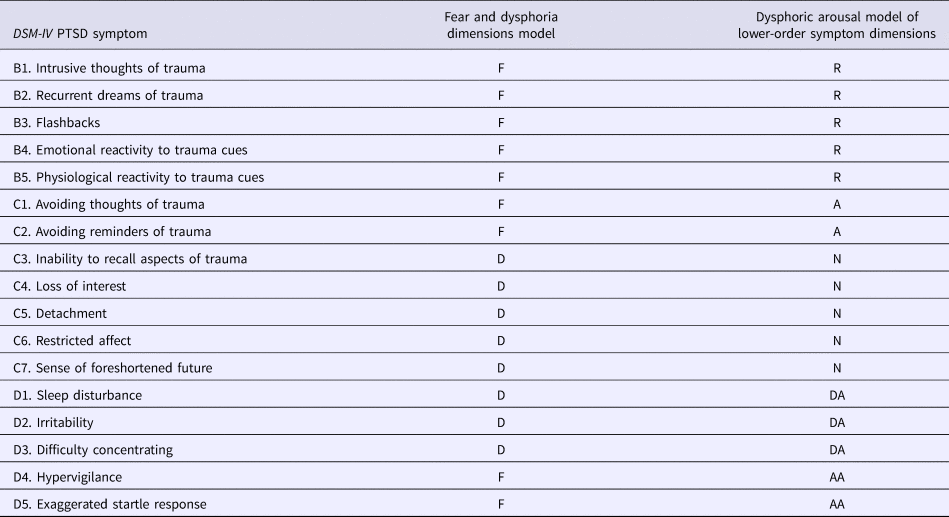
For this study, responses to the 17 PTSD symptoms were used to define the PTSD symptom dimensions following prior research on the dimensional structure of PTSD (Elhai et al., Reference Elhai, Biehn, Armour, Klopper, Frueh and Palmieri2011; Mota et al., Reference Mota, Sumner, Lowe, Neumeister, Uddin, Aiello, Wildman, Galea, Koenen and Pietrzak2015; Table 1 shows item mappings). No PTSD symptoms were missing for participants. We examined PTSD dimensions in two ways. First, we considered two higher order domains: posttraumatic fear and dysphoria. For each domain, responses to relevant symptoms (nine fear symptoms; eight dysphoria symptoms) were summed, resulting in a fear symptom score ranging from 0 to 36 and a dysphoria symptom score ranging from 0 to 32. Each dimension showed good internal consistency reliability (Cronbach's α for fear and dysphoria dimension scores were 0.85 and 0.83, respectively). Due to positive skewness, we divided the fear and dysphoria scores into quintiles according to the distribution of scores in this sample and modeled them accordingly, with the lowest quintile as the reference group.
PTSD item mappings of the (1) fear and dysphoria dimensions model and (2) five-factor dysphoric arousal model of lower-order symptom dimensions

DSM-IV, Diagnostic and Statistical Manual of Mental Disorders, 4th edition; F, fear; D, dysphoria; R, re-experiencing; A, avoidance; N, numbing; DA, dysphoric arousal; AA, anxious arousal.
Second, we investigated lower-order symptom dimensions of re-experiencing, avoidance, anxious arousal, numbing, and dysphoric arousal derived from the five-factor dysphoric arousal model (Elhai et al., Reference Elhai, Biehn, Armour, Klopper, Frueh and Palmieri2011) reflecting specific sub-domains of fear and dysphoria (Table 1). For each dimension, responses to the items capturing that dimension were summed. Scores ranged from 0 to 20 for re-experiencing (five items; Cronbach's α = 0.79), from 0 to 8 for avoidance (two items; Cronbach's α = 0.65), from 0 to 8 for anxious arousal (two items; Cronbach's α = 0.74), from 0 to 20 for numbing (five items; Cronbach's α = 0.75), and from 0 to 12 for dysphoric arousal (three items; Cronbach's α = 0.72). Because these five dimensions did not have comparable score ranges, we Z-scored each dimension score and used the continuous Z-score measure in our models. This approach facilitated comparison of effect sizes for each of the continuous lower-order symptom dimensions when they were all included in the same model.
All women in this study were trauma-exposed, and we assigned participants PTSD symptom dimension scores in a time-updated manner based on their ages of first and worst trauma exposure. Each woman's baseline for this study was determined by when she was first exposed to trauma, as reported on the trauma and PTSD screening questionnaire. As the vast majority of women (91.1%; n = 2468) were first exposed to trauma prior to cohort enrollment in 1989, we set their baseline for the current study as the 1989 assessment. However, some women had later baselines for this study because they were exposed to their first trauma after 1989 (online Supplementary Fig. S1). Similar to prior NHS II studies of PTSD (Sumner et al., Reference Sumner, Kubzansky, Elkind, Roberts, Agnew-Blais, Chen, Cerdá, Rexrode, Rich-Edwards, Spiegelman, Suglia, Rimm and Koenen2015, Reference Sumner, Kubzansky, Roberts, Gilsanz, Chen, Winning, Forman, Rimm and Koenen2016), women were assigned a score of zero on the PTSD symptom dimensions as of the date they reported their first trauma (i.e. they contributed person-time as trauma-exposed but without PTSD symptoms from their first trauma because symptoms were not queried in response to women's first trauma). Women were assigned the PTSD symptom dimension scores derived from the interview as of the date they reported their worst trauma on the interview.
Hypertension assessment
At each biennial questionnaire from 1991 to 2013, participants indicated whether they had physician-diagnosed hypertension in the past 2 years. In a validation study in a subsample of randomly selected NHS II participants, 94% of women who self-reported physician-diagnosed hypertension had hypertension confirmed via medical record review (Forman et al., Reference Forman, Curhan and Taylor2008). Blood pressure was also measured in an age-stratified sample of 194 NHS II participants to examine unreported hypertension. Of 161 women not reporting hypertension, only 11 (7%) had a blood pressure >140/90 mmHg; none had >160/95 mmHg (Chasan-Taber et al., Reference Chasan-Taber, Willett, Manson, Spiegelman, Hunter, Curhan, Colditz and Stampfer1996).
Covariates
Potential confounders included age, race/ethnicity, maximum parental education at the participant's birth, and maternal and paternal history of hypertension. We also considered age 5 somatotype to account for the association of childhood adiposity with later hypertension risk; participants selected one of nine pictograms that reflected their body shape and size at age 5. Time-varying indicators for the following hypertension-relevant medical risk factors, medications, and health behaviors were also included as covariates: oral contraceptive use, menopausal status and hormone therapy, aspirin use, acetaminophen use, other nonsteroidal anti-inflammatory drug use, antidepressant use, hypercholesterolemia, body mass index (BMI), smoking, alcohol consumption, physical activity, and diet quality. These variables were assessed at each woman's study baseline via self-report and updated every 2, 4, or 6 years (see online Supplementary Methods for details).
Statistical analysis
We used Cox proportional hazards models to estimate hazard ratios (HRs) and 95% confidence intervals (CIs). Each participant contributed person-time from her baseline (i.e. according to date of first trauma exposure) until her last questionnaire, hypertension onset, death, or end of follow-up in 2013. Individuals who developed CVD (MI and/or stroke) during the study (n = 18) were censored at CVD onset.
We fit separate models for each PTSD symptom dimension, with the PTSD dimension as the independent variable predicting incident hypertension. We first considered models for the broader fear and dysphoria dimensions and then for the lower-order symptom dimensions. For the fear and dysphoria dimension models, categorical quintile variables were the predictors. As in prior NHS research (Adebamowo et al., Reference Adebamowo, Cho, Sampson, Katan, Spiegelman, Willett and Holmes2005; Devore et al., Reference Devore, Kang, Stampfer and Grodstein2012), we re-ran the models to perform tests of trend; for these analyses, the median value of the quintile was assigned to all women and analyzed as a continuous predictor. For the lower-order symptom dimensions, Z-scores for the dimensions were examined as continuous predictors. For each PTSD symptom dimension, we examined a minimally adjusted model including socio-demographics, parental history of hypertension, and childhood adiposity (Model 1), followed by a model further adjusted for biomedical and health behavior covariates (Model 2).
We also estimated the unique effect of PTSD symptom dimensions on incident hypertension by including the other dimension(s) in the model with biomedical and health behavior covariates to investigate the effect of a given PTSD symptom dimension over and above the other(s). For a more nuanced consideration of the contributions of the two broader symptom dimensions, we also considered residualized dysphoria and fear symptom variables (derived from linear regression models fitting dysphoria symptoms to fear symptoms and fear symptoms to dysphoria symptoms) as covariates included in the models with the original fear and dysphoria variables, respectively (Wurm and Fisicaro, Reference Wurm and Fisicaro2014). This is consistent with prior epidemiologic research seeking to identify the extent to which two highly correlated variables can be attributed to variance that is shared v. that which is unique to each (Lambiase et al., Reference Lambiase, Kubzansky and Thurston2014). In the current study, this approach allowed us to further examine the extent to which associations of one symptom dimension with incident hypertension might be due to variance that is unique v. shared with the other symptom dimension. Additionally, because many hypertension events occurred before the PTSD interview in 2009, we considered the possible impact of recall bias on associations of interest in a sensitivity analysis. Among women free of hypertension in 2009, we examined associations of PTSD with incident hypertension events reported after 2010 (n = 1924; 156 hypertension events; 14 621 person-years), adjusting for Model 1 covariates.
Missing data in covariates were handled by assigning a missing category. Biomedical and health behavior covariates were updated every 2, 4, or 6 years as available. For each disease risk period of prediction (e.g. hypertension from the 1997 questionnaire), biomedical and health behavior covariates were lagged by one period (e.g. data from the 1995 questionnaire) and PTSD symptom dimensions were lagged to represent the year prior to the period for these time-varying covariates (e.g. PTSD symptom dimension score in 1994).
Results
Participant characteristics
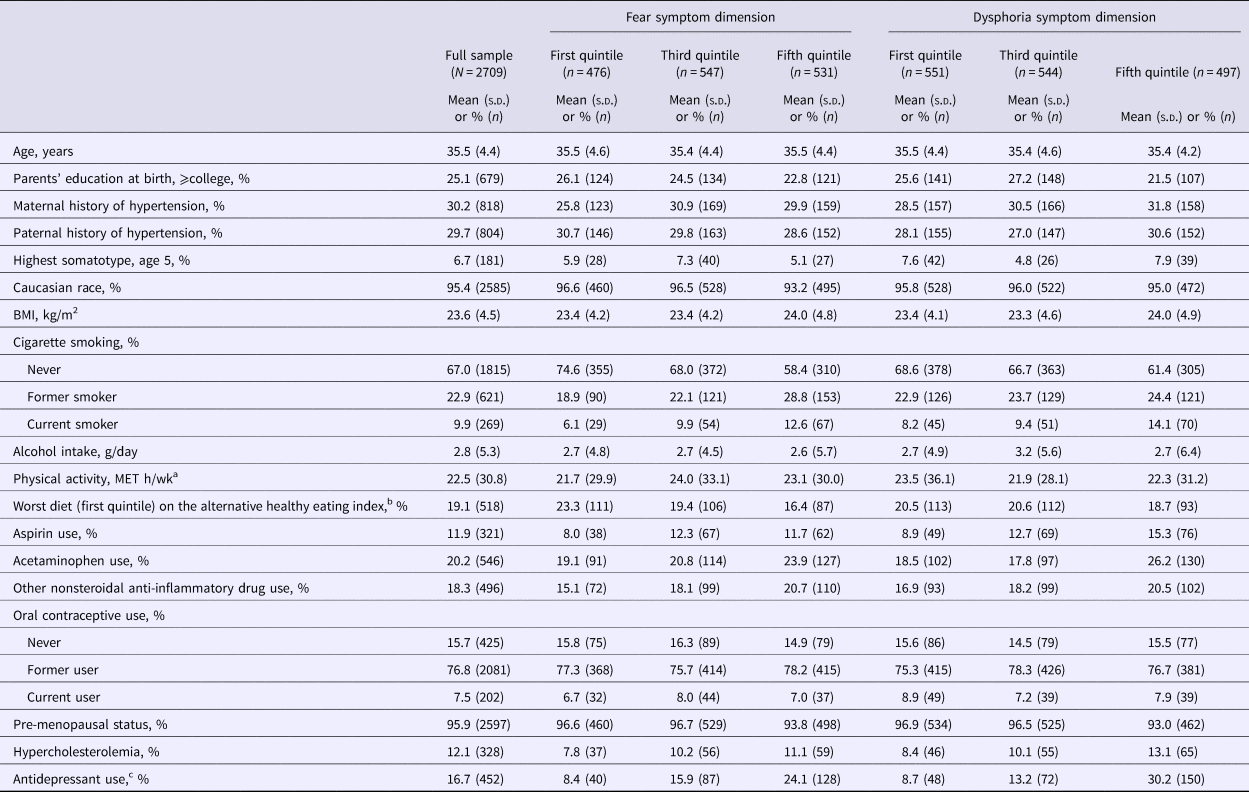
Table 2 presents participant characteristics at the cohort baseline in 1989, both for the full sample and for women with low, medium, and high levels of the fear and dysphoria symptom dimensions as of 1989. On average, women were relatively healthy (e.g. mean BMI in the normal range, most were nonsmokers). Maternal and paternal hypertension were each reported by approximately 30% of the sample, and a sizable proportion was taking anti-inflammatory medications (one in five women reported acetaminophen use). Women with high fear and dysphoria symptom levels had higher rates of current smoking, hypercholesterolemia, and anti-inflammatory medication and antidepressant use than women with low symptom levels, and they were less likely to be pre-menopausal. The fear and dysphoria symptom dimensions were highly positively correlated (r = 0.68, p < 0.0001), and the lower-order symptom dimensions exhibited moderate positive correlations (online Supplementary Table S1).
Participant characteristics at the Nurses’ Health Study II cohort baseline in 1989 for the full sample and for low, medium, and high levels of the fear and dysphoria symptom dimensions as of 1989

a MET h/wk = metabolic equivalent hours/week.
b First assessed in 1991.
c First assessed in 1993.
Posttraumatic fear and dysphoria and incident hypertension
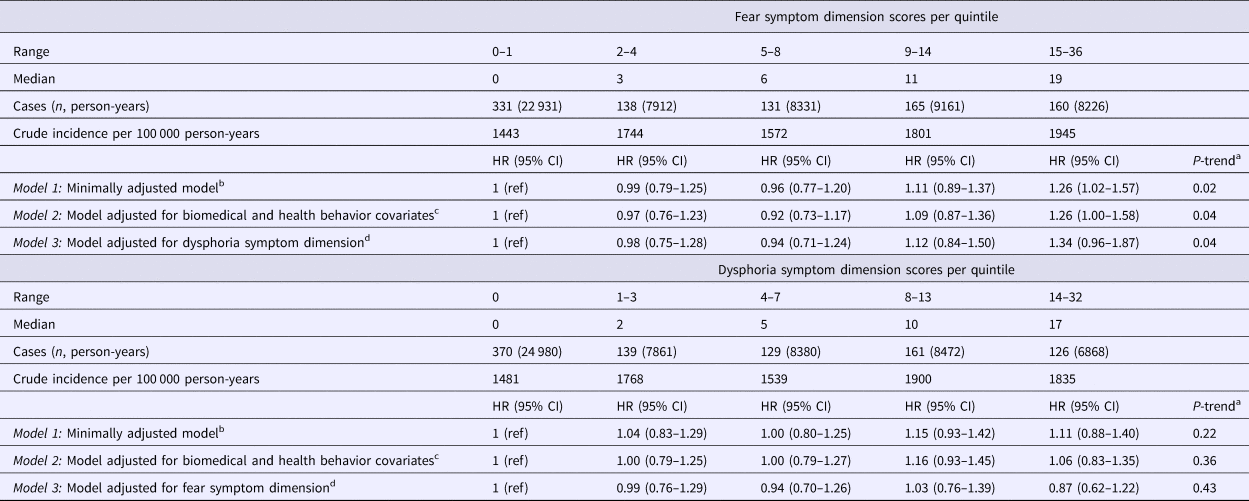
Over the study period, 925 women developed hypertension. The numbers of hypertension cases per person-years and crude incidence rates for the fear and dysphoria symptom dimension quintiles are presented in Table 3. In separate analyses examining exposure to either fear or dysphoria symptom dimensions, only fear symptoms were significantly associated with incident hypertension (P-trend = 0.02; Table 3). Women in the highest v. lowest quintile of fear had a 26% higher rate of developing hypertension over the follow-up period (Table 3, Model 1). The effect estimate for the highest quintile was identical, although with a wider CI, after adjusting for biomedical and health behavior covariates; the test for trend remained significant (P-trend = 0.04; Table 3, Model 2).
Adjusted HRs (95% CIs) for the association of posttraumatic fear and dysphoria symptom dimension quintiles with incident hypertension in 2709 trauma-exposed women, 1989 to 2013 assessments

HR, hazard ratio; CI, confidence interval.
a Tests for trend were performed using the median value of each quintile as a continuous variable in models.
b Adjusted for age, race/ethnicity, parental education, maternal and paternal history of hypertension, and age 5 somatotype.
c Adjusted for variables in Model 1 plus oral contraceptive use, menopausal status, hormone therapy use, hypercholesterolemia, acetaminophen use, aspirin use, other nonsteroidal anti-inflammatory drug use, antidepressant use, BMI, cigarette smoking, alcohol intake, physical activity, and diet quality.
d Adjusted for variables in Model 2 plus the other PTSD symptom dimension quintiles.
Relative to considering the fear dimension alone, when exposure to dysphoria was simultaneously included in Model 2, the magnitude of the effect estimate for the highest quintile of fear was similar [HR = 1.34 (95% CI 0.96–1.87); Table 3, Model 3]. There was no evidence that dysphoria quintiles were related to increased hypertension risk in this model. Results with residualized fear and dysphoria covariates considered in separate models suggested that the unique aspects of fear, but not dysphoria, and variance common to fear and dysphoria were associated with increased risk of incident hypertension (online Supplementary Tables S2 and S3).
Lower-order symptom dimensions and incident hypertension
The effect estimates for the lower-order symptom dimensions were generally similar in size but only re-experiencing symptoms, a lower-order component of fear, were significantly associated with increased incident hypertension risk in the minimally adjusted model and the model adjusted for biomedical and health behavior covariates (Table 4, Models 1 and 2). In these models, a 1-s.d. increase in re-experiencing symptoms was associated with a 9% higher rate of developing hypertension. Elevated avoidance symptoms, another lower-order component of fear, were also significantly associated with incident hypertension in the minimally adjusted model, where a 1-s.d. increase in avoidance symptoms was associated with an 8% higher rate of hypertension onset (Table 4, Model 1). Neither of the lower-order components of dysphoria – numbing or dysphoric arousal – was significantly associated with incident hypertension (Table 4). The effect estimate for re-experiencing symptoms in relation to incident hypertension remained elevated and similar in size [HR = 1.10 (95% CI 0.97–1.24); Table 4, Model 3] when adding the other lower-order symptom dimensions to Model 2.
Adjusted HRs (95% CIs) for the association of a 1 standard deviation-increase in lower-order posttraumatic symptom dimensions with incident hypertension in 2709 trauma-exposed women, 1989 to 2013 assessments

HR, hazard ratio; CI, confidence interval.
Posttraumatic symptom dimension variables were modeled as z-scores. There were 925 incident hypertension events over 56 561 person-years.
a Adjusted for age, race/ethnicity, parental education, maternal and paternal history of hypertension, and age 5 somatotype.
b Adjusted for variables in Model 1 plus oral contraceptive use, menopausal status, hormone therapy use, hypercholesterolemia, acetaminophen use, aspirin use, other nonsteroidal anti-inflammatory drug use, antidepressant use, BMI, cigarette smoking, alcohol intake, physical activity, and diet quality.
c Adjusted for variables in Model 2 plus the other four lower-order symptom dimensions of the dysphoric arousal model.
Findings for prospectively detected hypertension
This analysis included 156 new cases of hypertension that onset after 2010. The pattern of findings in this restricted sample was similar to results from the primary models. Adjusting for socio-demographic, early childhood, and family history covariates, higher levels of fear were associated with increased hypertension risk. However, although effect estimates were of greater magnitude than those in the main models, they were less clearly monotonic [HR for second quintile = 1.30 (95% CI 0.74–2.30); HR for third quintile = 1.06 (95% CI 0.58–1.93); HR for fourth quintile = 1.14 (95% CI 0.64–2.04); HR for fifth quintile = 1.60 (95% CI 0.90–2.84)], and findings did not reach statistical significance (P-trend = 0.17).
Discussion
In our sample of 2709 trauma-exposed women, we present the first study of dimensions underlying PTSD, namely fear and dysphoria, in relation to incident hypertension over a 24-year follow-up. Posttraumatic fear symptoms were significantly associated with greater risk of subsequently developing hypertension, with those in the highest v. lowest quintile having a 26% higher rate of hypertension onset. Additional analyses with lower-order dimensions of PTSD provided initial evidence that re-experiencing may be an important aspect of posttraumatic fear responses that is related to hypertension. In contrast, posttraumatic dysphoria symptoms did not significantly predict incident hypertension.
PTSD is a heterogeneous disorder comprising dimensions of fear and dysphoria, and fear responses are considered a core component of PTSD (Zoellner et al., Reference Zoellner, Pruitt, Farach and Jun2014; Bryant et al., Reference Bryant, Creamer, O'Donnell, Forbes, McFarlane, Silove and Hadzi-Pavlovic2017). Although research has linked trauma and PTSD to CVD events and risk factors like hypertension (Glaesmer et al., Reference Glaesmer, Brähler, Gündel and Riedel-Heller2011; Vaccarino et al., Reference Vaccarino, Goldberg, Rooks, Shah, Veledar, Faber, Votaw, Forsberg and Bremner2013; Gradus et al., Reference Gradus, Farkas, Svensson, Ehrenstein, Lash, Milstein, Adler and Sørensen2015; Sumner et al., Reference Sumner, Kubzansky, Elkind, Roberts, Agnew-Blais, Chen, Cerdá, Rexrode, Rich-Edwards, Spiegelman, Suglia, Rimm and Koenen2015, Reference Sumner, Kubzansky, Roberts, Gilsanz, Chen, Winning, Forman, Rimm and Koenen2016; Howard et al., Reference Howard, Sosnov, Janak, Gundlapalli, Pettey, Walker and Stewart2018), most of this research has treated PTSD as a unidimensional construct, investigating either binary diagnosis or total symptom score levels. This approach cannot facilitate identifying key aspects of PTSD symptomatology that may contribute to increased cardiovascular risk after trauma. Examining how dimensions underlying the PTSD phenotype relate to CVD risk factors and outcomes may hold promise for discovering aspects of posttraumatic psychopathology that are specifically ‘cardiotoxic’ and may be particularly effective targets for interventions.
We identified that elevated fear symptoms after trauma were most strongly associated with subsequent hypertension in trauma-exposed women, even when adjusting for a range of hypertension-relevant biomedical and health behavior covariates. Fear symptoms remained associated with hypertension onset when further adjusted for dysphoria in two ways: including (1) dysphoria symptom dimension quintiles and (2) quintiles of the dysphoria symptom dimension residualized on fear. Furthermore, when quintiles of a fear symptom dimension residualized on dysphoria were included in a model with the original dysphoria symptom dimension quintiles, the effect estimate for the highest residualized fear quintile remained elevated and similar in size to those in the original models. These results suggest that variance common to fear and dysphoria but also unique aspects of fear are relevant components of PTSD symptomatology that are most strongly associated with hypertension risk.
Examining how lower-order symptom dimensions of the dysphoric arousal model were related to incident hypertension provided initial insight into what might be driving the associations with fear. Elevated re-experiencing symptoms – a component of the fear dimension – emerged as the lower-order symptom dimension that was particularly linked to increased hypertension risk; this lower-order dimension had the largest effect sizes that were also statistically significant when adjusting for biomedical and health behavior covariates. Although preliminary, this finding is consistent with other results from trauma-exposed samples suggesting that re-experiencing symptoms, including intrusive thoughts and physiological reactions to trauma reminders, are particularly prominent manifestations of posttraumatic fear (Norrholm et al., Reference Norrholm, Jovanovic, Olin, Sands, Bradley and Ressler2011, Reference Norrholm, Glover, Stevens, Fani, Galatzer-Levy, Bradley, Ressler and Jovanovic2015). In our study, avoidance symptoms – another lower-order dimension of fear – were also associated with incident hypertension, but they did not remain a significant predictor when adjusting for biomedical and health behavior covariates. The other lower-order dimension of fear – anxious arousal, characterized by hypervigilance and exaggerated startle – did not significantly predict incident hypertension. However, research has failed to observe significant associations between self-reported startle and physiological measures of startle (Norrholm et al., Reference Norrholm, Glover, Stevens, Fani, Galatzer-Levy, Bradley, Ressler and Jovanovic2015), suggesting that the anxious arousal lower-order dimension may not map on as closely to fear responding as other lower-order dimensions of fear. Although these initial findings are intriguing, the effect estimates for the lower-order symptom dimensions were all elevated and relatively similar. More work is needed to replicate these findings and tease apart the mechanisms that are related to fear processes at a more fine-grained level of analysis.
Indeed, we need direct tests of how posttraumatic fear in particular may contribute to adverse cardiovascular outcomes like hypertension, and the literature offers testable pathways to consider. Repeated episodes of sensory-memory re-experiencing of the trauma can lead to elevated catecholamine levels and over- and under-activity of the sympathetic and parasympathetic nervous systems, respectively (Pitman et al., Reference Pitman, Rasmusson, Koenen, Shin, Orr, Gilbertson, Milad and Liberzon2012; Miller and Sadeh, Reference Miller and Sadeh2014); all of these factors play well-established roles in blood pressure regulation (Mannelli et al., Reference Mannelli, Pupilli, Lanzillotti, Ianni and Serio1990; Mancia and Grassi, Reference Mancia and Grassi2014). These physiological alterations can also contribute to elevated pro-inflammatory cytokines, increased oxidative stress, and endothelial damage (Wentworth et al., Reference Wentworth, Stein, Redwine, Xue, Taub, Clopton, Nayak and Maisel2013; Miller and Sadeh, Reference Miller and Sadeh2014). Consistent with this notion, re-experiencing symptoms were found to be the PTSD symptom cluster most robustly associated with an increased inflammatory response to stress (measured by interleukin-6 levels) in patients with a recent MI (Lima et al., Reference Lima, Hammadah, Wilmot, Pearce, Shah, Levantsevych, Kaseer, Obideen, Gafeer, Kim, Sullivan, Lewis, Weng, Elon, Li, Bremner, Raggi, Quyyumi and Vaccarino2018). Prior work has also demonstrated elevated threat reactivity (i.e. symptoms of psychological and physiological reactivity to trauma reminders, hypervigilance, and exaggerated startle) was associated with higher levels of C-reactive protein, a pro-inflammatory marker, in veterans with PTSD (O'Donovan et al., Reference O'Donovan, Ahmadian, Neylan, Pacult, Edmondson and Cohen2017). Furthermore, a study considering linkages between fear, inflammation, and CVD risk demonstrated that greater resting activity of the amygdala, a brain region involved in fear responding, was associated with both elevated arterial inflammation and subsequent CVD events (Tawakol et al., Reference Tawakol, Ishai, Takx, Figueroa, Ali, Kaiser, Truong, Solomon, Calcagno, Mani, Tang, Mulder, Murrough, Hoffmann, Nahrendorf, Shin, Fayad and Pitman2017). Additionally, arterial inflammation accounted, in part, for the amygdalar activity-CVD event relation. Further comprehensive empirical tests of this model will help to identify key intermediary pathways linking PTSD with adverse cardiovascular outcomes.
Findings from the current study have potential implications for understanding cardiovascular risk mechanisms more broadly. Fear responses are not only a key element of PTSD but also of anxiety disorders, such as specific phobias and panic disorder. Anxiety disorders have also been associated with adverse cardiovascular outcomes, including hypertension (Player and Peterson, Reference Player and Peterson2011). Focusing on how fear-related responses are linked to cardiovascular outcomes may help us to understand how a broad range of psychological disorders characterized by fear may be related to poor cardiovascular health. This transdiagnostic approach is consistent with the NIMH Research Domain Criteria approach of studying dimensions that cut across traditional mental disorder diagnostic categories (Cuthbert and Insel, Reference Cuthbert and Insel2013).
Our results also have potential implications for intervention. Ultimately, it is important to treat PTSD in ways that reduce all manifestations of the disorder and allow individuals to engage fully with their lives. Nevertheless, our findings could help to identify and target manifestations of posttraumatic psychopathology that are associated with cardiovascular risk even in trauma-exposed individuals who do not meet full criteria for PTSD and thus would not be likely to receive treatment for a diagnosed disorder. Exposure therapy targets fear responses directly by extinguishing them (Briscione et al., Reference Briscione, Jovanovic and Norrholm2014), and it is possible that trauma-exposed individuals who do not meet criteria for PTSD but have elevated fear responses might experience a benefit from exposure with respect to their cardiovascular health. Testing if interventions that target PTSD symptomatology have a positive effect on cardiovascular health is needed, and work that focuses on PTSD symptom dimensions that align with the targets of empirically supported treatments can help to guide this line of research.
Methodological limitations of the current study include the retrospective assessment of trauma and PTSD. Furthermore, we relied on self-reported PTSD dimensions. These dimensions can be assessed objectively; fear can be measured at the physiological level, and dysphoria can be measured using attention allocation patterns (Briscione et al., Reference Briscione, Jovanovic and Norrholm2014; Lazarov et al., Reference Lazarov, Ben-Zion, Shamai, Pine and Bar-Haim2018). Research incorporating these objective measures will extend the work based on self-report. We also assessed DSM-IV PTSD, as the DSM-5 revision was not available when the study was conducted. Even though most symptom criteria were retained in DSM-5, and the dysphoric arousal model has been found to provide a good representation of DSM-5 PTSD symptoms (Tsai et al., Reference Tsai, Harpaz-Rotem, Armour, Southwick, Krystal and Pietrzak2015), it is important to test whether our findings are obtained using DSM-5 PTSD dimensions. Another limitation is the use of self-reported hypertension, although it has been validated in this cohort (Chasan-Taber et al., Reference Chasan-Taber, Willett, Manson, Spiegelman, Hunter, Curhan, Colditz and Stampfer1996; Forman et al., Reference Forman, Curhan and Taylor2008). Survivor bias could also be a concern because women needed to remain in the study until 2009 to provide trauma and PTSD data. However, cohort retention is high (>90% biennial questionnaire response rate), and less than 2% of NHS II participants were deceased by trauma and PTSD assessment. Additionally, generalizability of findings may be limited as the NHS II cohort is predominantly white and highly educated. Despite these limitations, this study is characterized by several strengths that make it unique, including an interview assessment of PTSD dimensions, longitudinal follow-up of women, and consideration of a wide range of covariates.
Conclusions
Research has linked PTSD to adverse cardiovascular outcomes, but treating PTSD as a unidimensional construct may fail to capture what is driving associations of risk. Here, we demonstrate a promising framework for identifying what aspects of posttraumatic psychopathology may be most cardiotoxic. Our results suggest that elevated fear responses after trauma may be particularly pernicious with respect to developing incident hypertension. A key question for future work is to examine if intervening to reduce these posttraumatic manifestations of fear can have a positive impact on maintaining healthy blood pressure levels.
Supplementary material
The supplementary material for this article can be found at https://doi.org/10.1017/S0033291718003914.
Author ORCIDs
Jennifer A Sumner, 0000-0002-0217-7171.
Acknowledgements
We acknowledge the Channing Division of Network Medicine, Department of Medicine, Brigham and Women's Hospital, and Harvard Medical School for managing the NHS II.
Financial support
This work was supported by the National Institutes of Health (K.C.K., grant number R01MH078928; K.C.K. and L.D.K., grant number R01MH101269; and J.A.S., grant numbers K01HL130650; and UM1CA176726).
Conflict of interest
None.