


Introduction
Over the past 50 years, psychiatric care in Ireland has undergone major structural changes, transitioning from institutionalisation to a largely community-based approach (Walsh Reference Walsh2015, Reference Walsh, Daly and Moran2016). Inpatient psychiatric care, however, remains a cornerstone of the mental health system (Health Service Executive 2023) and accounts for a large proportion of the total annual public mental health expenditure. Understanding the diagnostic drivers of inpatient bed use is critical for strategic planning for both inpatient and outpatient services.
Cumulative bed days, rather than number of admissions, reflects the resources involved in inpatient care provision for specific disorders. More severe and impairing disorders, such as schizophrenia, bipolar disorder, severe depression, and eating disorders, are likely to take up a high proportion of inpatient bed days due to their chronicity and associated disability. Statistics on the Irish inpatient registry, National Psychiatric Inpatient Reporting System (NPRIS), are produced annually (Daly et al. Reference Daly, Lovett and Lynn2025). However, multi-year national-level analyses that detail the specific distribution of bed days across diagnostic categories, sex, and age groups are lacking in the Irish context.
To provide a foundational overview of the diagnostic landscape of inpatient psychiatric care in Ireland, we used data from the NPIRS to carry out detailed analyses of psychiatric inpatient bed use according to diagnosis, as well as according to sex and service type (child and adolescent mental health service (CAMHS) units; and adult mental health service (AMHS) units). Our primary analyses focused on public psychiatric bed use, with secondary analyses detailing private psychiatric bed use.
Methods
Participants
The study used data from the National Psychiatric Inpatient Reporting System (NPIRS), which is managed by the Health Research Board (Daly et al. Reference Daly, Lovett and Lynn2024, Reference Daly, Lovett and Lynn2025). NPIRS is a national database which records data on patient admissions to, and discharges from, psychiatric hospitals and units on the Register of Approved Centres in Ireland under the Mental Health Act 2001. This includes public Health Service Executive (HSE)/HSE-funded facilities, independent/private and private charitable units, and the National Forensic Mental Health Services at the Central Mental Hospital.
Admissions represent events or episodes rather than persons and thus reflect the activity of inpatient services. For this investigation, we used anonymised aggregated public and private hospital data from acute inpatient services provided during 2013–2023, together with diagnostic and sociodemographic stratification. A list of the hospitals included in this investigation is reported in supplementary Table 1.
Measures
All analyses were stratified by service type (public or private inpatient unit). Units were categorised as CAMHS units (typically for patients under 18 years) or AMHS units (typically for patients over 18 years). We report on male and female patients separately.
Diagnoses. Primary diagnoses were identified for each observation using the international classification of disease version 10, section F. These diagnoses were grouped into 13 different one-cypher or two-cypher diagnostic categories including: any mental disorder (F10–F99), substance use (F1X), schizophrenia-spectrum disorders (F2X), bipolar disorders (F30/F31), depressive disorders (F32/F33), other mood disorder (F34–F39), neurotic, stress-related & somatoform disorders (F4X), eating disorder (F50), other behavioural syndromes (F51–F59), personality disorders (F6X), intellectual disabilities (F7X), developmental disorder (F8X), behavioural or emotional disorders of childhood (F90-F98), and mental disorder not otherwise specified (F99).
Outcome
We report on the number of inpatient bed days.
Analysis
We conducted a descriptive analysis of the total number of bed days in public and private inpatient services. We report the total number of bed days for the period and when stratified by diagnosis. We also report the number of bed days by diagnosis on admission, stratified by male vs. female and by CAMHS vs. AMHS. We also report the median bed days per diagnosis and when stratified by sex and CAMHS and AMHS units. Statistical comparisons of the number of bed days per admission was conducted using Mann Whitney-U test.
Results
Public hospitals
Descriptives
Between 2013 and 2023 there were approximately 4 million bed days in which a person was in public inpatient care (k = 3,993,628). Men accounted for 51.2% of the inpatient bed days (k = 2,044,738). CAMHS units accounted for 4.6% (k = 182,998) of inpatient bed days while AMHS account for 95.4% (k = 3,810,630) of bed days.
Diagnosis
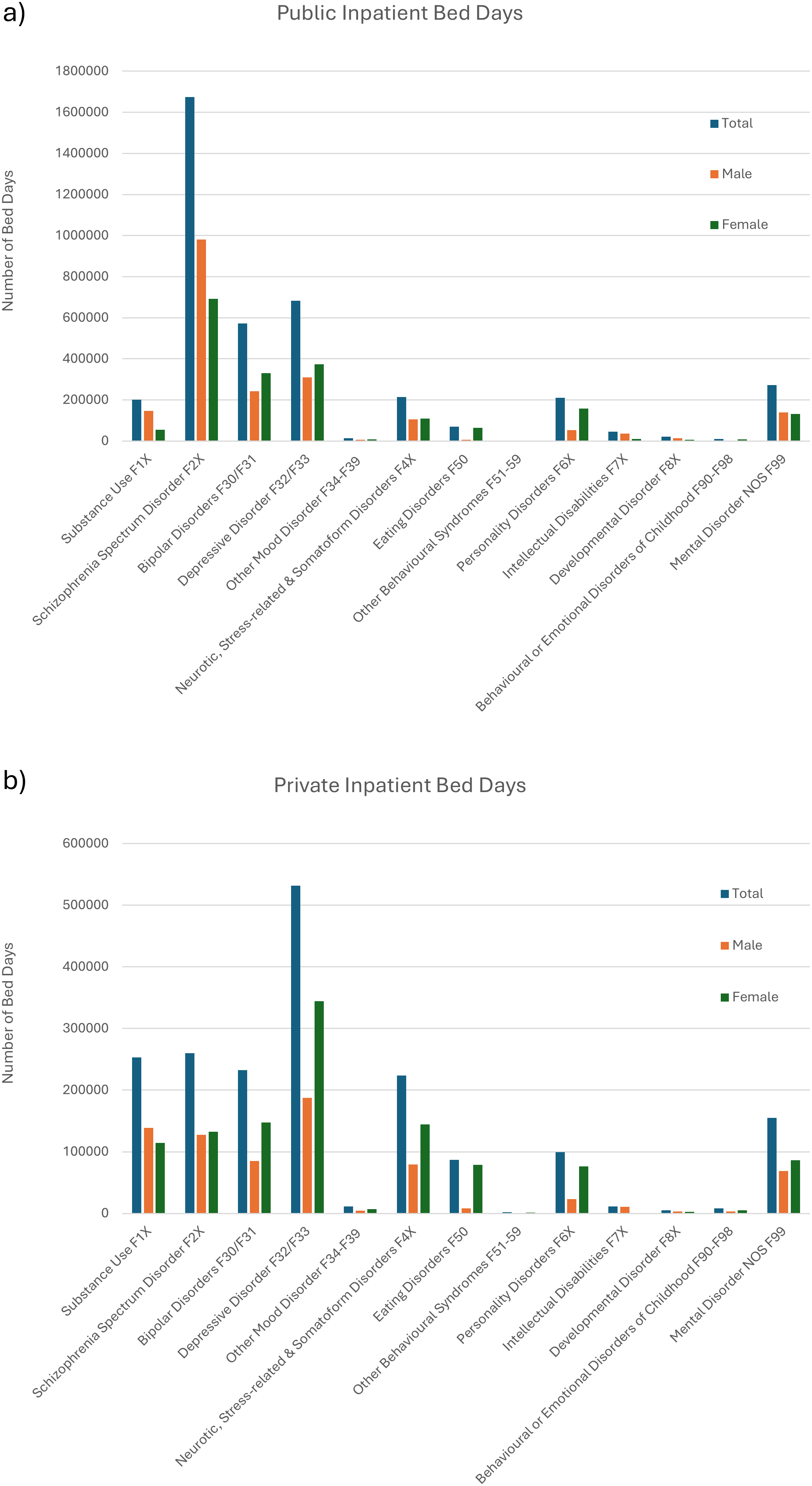
Schizophrenia-spectrum disorders accounted for over 40% of the 4.0 million bed days (F2X: 41.9%, k = 1,673,529). This was followed by depressive disorders (F32/F33: 17.1%, k = 683,300) and bipolar disorder (F30/F31: 14.3%, k = 572,391). These diagnostic trends were broadly similar when stratified by sex (see Figure 1a).
Bed days when stratified by diagnosis and sex for (a) public; and (b) private inpatient services for the years 2013–2023.

Figure 1. Long description
Panel A: A vertical bar graph titled ‘Public Inpatient Bed Days’ shows the number of bed days for various diagnoses, stratified by gender. The x-axis lists diagnoses such as Substance Use, Schizophrenia, Bipolar Disorder, Depressive Disorder, and others. The y-axis represents the number of bed days, ranging from 0 to 1800000. The graph includes three data series: Total, Male, and Female, each represented by different colors. The highest number of bed days in panel A is schizophrenia spectrum disorders (F2X) in the total sample and males and females seperately. Panel B: Another vertical bar graph titled ‘Private Inpatient Bed Days’ displays similar data for private inpatient services. The x-axis and y-axis are labeled the same as in Panel A. The range on the y-axis is from 0 to 600000. Depressive Disorder F32/F33 shows the highest number of bed days, with notable differences between genders.
Diagnosis by service type
In CAMHS units, eating disorders accounted for the largest number of bed days (25.6%, k = 46,850), followed by depressive disorders (18.6%, k = 34,006) and schizophrenia-spectrum disorders (16.1%, k = 29,847), see Figure 2. In AMHS units, schizophrenia-spectrum disorders accounted for the largest number of bed days (43.1%, k = 1,643,682), followed by depressive disorders (17.0%, k = 649,294) and bipolar disorders (14.7%, k = 560,160).
Mosaic plot of public inpatient bed days when stratified by diagnosis and service type; CAMHS or Adult services.

Bed days per admission
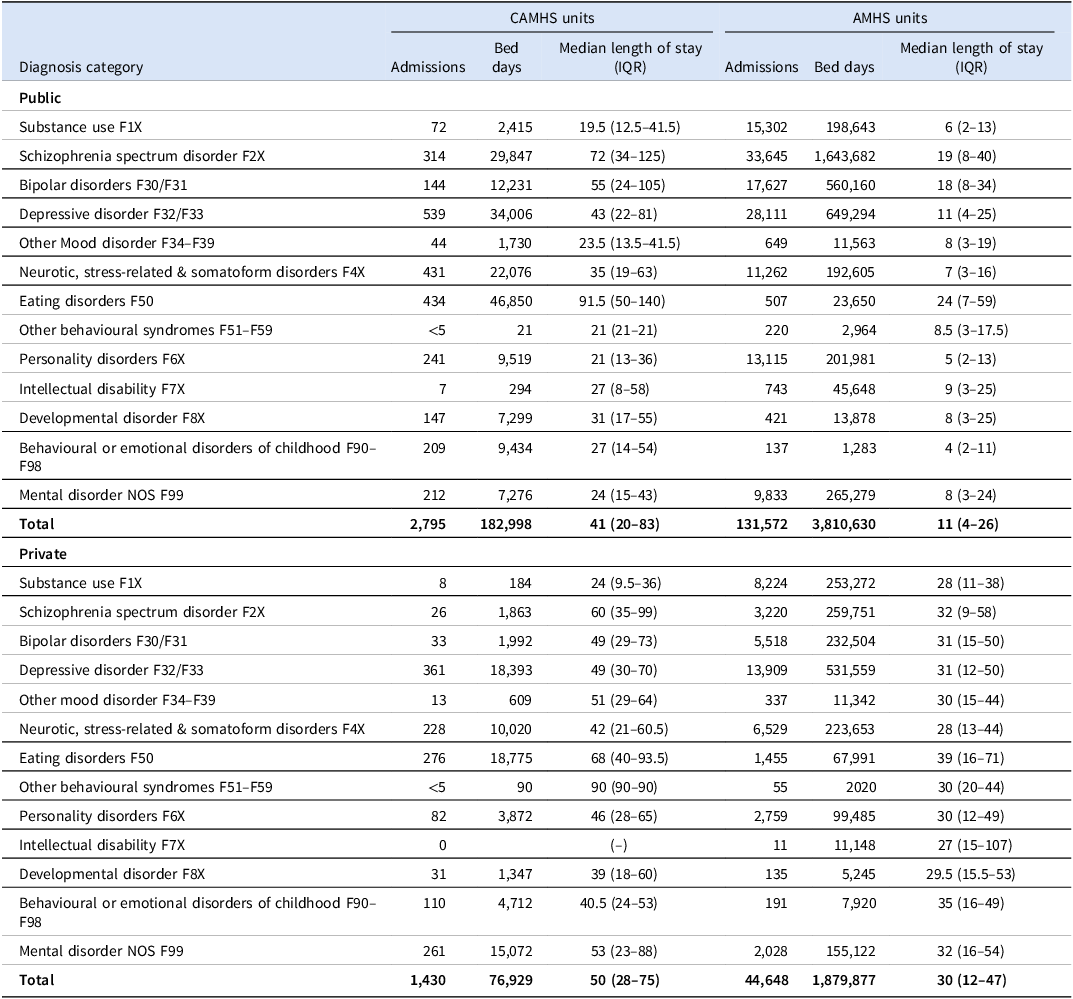
The overall median number of bed days per admission was 11 days (IQR: 4–27). There were differences by diagnostic categories, with eating disorders (50 days, IQR: 14–110), schizophrenia spectrum disorders (19 days, IQR: 8–40), and bipolar disorders (18 days, IQR: 8–34) having the longest number of bed days per admission (see Table 1). There was a small but significant difference between male and female patients in bed days per admission (11 (IQR: 4–26) vs 12 (IQR: 4–28) days respectively, p < 0.001). There was a large difference in the number of bed days per admission between CAMHS patients (41 days, IQR: 20–83) and AMHS patients (11 days, IQR: 4–26, p < 0.001).
Number of admissions, number of bed-days and median length of stay when stratified by diagnostic category, age group and service type

Table 1. Long description
The table presents data on admissions, bed days, and median length of stay for various diagnostic categories across CAMHS and AMHS units, stratified by public and private service types. It includes 12 rows and 10 columns. Column headers are Diagnosis category, Admissions, Bed days, Median length of stay (IQR) for CAMHS units, Admissions, Bed days, Median length of stay (IQR) for AMHS units. Row labels include diagnostic categories such as Substance use F1X, Schizophrenia spectrum disorder F2X, Bipolar disorders F30/F31, Depressive disorder F32/F33, Other Mood Disorder F34-F39, Neurotic, stress-related somatoform disorders F4X, Eating disorders F50, Other behavioural syndromes F51-F59, Personality disorders F6X, Intellectual disability F7X, Developmental disorder F8X, Behavioural or emotional disorders of childhood F90-F98, Mental disorder NOS F99, and Total. Notable trends include higher bed days and median length of stay in AMHS units compared to CAMHS units across most diagnostic categories. The table also shows a significant number of admissions and bed days for Schizophrenia spectrum disorder F2X and Depressive disorder F32/F33 in both service types.
Patients in CAMHS units with eating disorders had a median of 91.5 (IQR: 50–140) bed days per admission, whereas patients in AMHS units with eating disorders had a median 24 (IQR: 7–59) bed days per admission (p < 0.001). For schizophrenia spectrum disorders, CAMHS patients had a median 72 days per admission (IQR: 34–125), compared to 19 days for AMHS patients (IQR: 8–40; p < 0.05).
Private hospitals
Descriptives
Between 2013 and 2023, there were approximately 1.8 million bed days in which a person was in private inpatient care (k = 1,879,877). Women accounted for 60.6% of the private inpatient bed days (k = 1,140,106). CAMHS patients accounted for 4.1% (k = 76,929) of inpatient bed days while AMHS patients accounted for 95.9% (k = 1,802,948) of bed days.
Diagnosis
Depressive disorders accounted for the largest proportion of private bed days (F32–33: 28.3%, k = 531,559). This was followed by schizophrenia-spectrum disorders (F2X: 13.8%, k = 259,751) and substance use disorders (F1X: 13.5%, k = 253,272). There were some discrepancies when stratifying the private bed days by sex (See Figure 1b), with eating disorders accounting for 69% (F50: k = 78,527) of female bed days and 1.1% (k = 8,239) of male bed days and substance use accounting for 18.7% (k = 138,695) of male bed days and 10.0% (k = 114,577) of female bed days.
Diagnosis by service type
In CAMHS units, eating disorders accounted for the largest number of bed days (F50: 24.4%, k = 18,775), followed by depressive disorders (F32–33: 23.9%, k = 18,393) and mental disorder not otherwise specified (F99: 19.6%, k = 15,072), see Figure 3. Among patients in AMHS units, depressive disorders accounted for the largest number of bed days (28.5%, k = 513,166). This was followed by schizophrenia spectrum disorders (F2X: 14.3%, k = 257,888), substance use disorders (F1X: 14.0%, k = 253,088) and neurotic, stress, and somatoform disorders (F4X: 11.8%, k = 213,633).
Mosaic plot of private inpatient bed days when stratified by diagnosis and service type; CAMHS or Adult services.

Figure 3. Long description
Panel A: Mosaic plot for CAMHS Private Inpatient Services. The plot is divided into several colored rectangles representing different diagnoses. The diagnoses include Eating Disorders F50, Depressive Disorder F32/F33, Mental Disorder NOS F99, Neurotic, Stress-related & Somatoform Disorders F4X, Schizophrenia Spectrum Disorder F2X, Bipolar Disorders F30/F31, Behavioural or Emotional Disorders of Childhood F90-F98, Personality Disorders F6X, Developmental Disorder F8X, and Other Mood Disorders. Each rectangle’s size indicates the proportion of bed days attributed to each diagnosis. Panel B: Mosaic plot for Adult Private Inpatient Services. This plot also consists of colored rectangles representing different diagnoses. The diagnoses include Depressive Disorder F32/F33, Schizophrenia Spectrum Disorder F2X, Substance Use F1X, Bipolar Disorders F30/F31, Neurotic, Stress-related & Somatoform Disorders F4X, Eating Disorders F50, Mental Disorder NOS F99, Personality Disorders F6X, Intellectual Disabilities F70-F79, and Other Mood Disorders. The size of each rectangle reflects the proportion of bed days for each diagnosis.
Bed days per admission
Private inpatient services had a longer median number of bed days per admission (30 days, IQR: 13–48) than public inpatient services (11 days), (IQR: 4–27, p < 0.001). These services also differed by diagnostic categories in the number of bed days per admission, with eating disorders (43 days, IQR: 18–77), behavioural and emotional disorders of childhood onset (38 days, IQR: 23–51), and mental disorder not otherwise specified (34 days, IQR: 16–58) having the longest admissions. There was a small but significant difference between male and female patients in bed days per admission (30 days, IQR: 12–45 vs 31 days, IQR: 13–50, p < 0.001, respectively). Patients in CAMHS units (50 days, IQR: 28–75) had more bed days per admission when compared with those in AMHS units (30 days, IQR: 12–47, p < .001). Again, patients in CAMHS units with eating disorders had a median 68 (IQR: 40–93.5) bed days per admission while those in AMHS units with eating disorders had 39 (IQR: 16–71, p < 0.05). Differences were also seen in schizophrenia spectrum disorders (CAMHS patients: 60 days, IQR: 35–99; vs AMHS patients: 32 days, IQR: 9–58, p < .001).
Discussion
This national analysis provides a foundational overview of the diagnostic and demographic drivers of acute psychiatric inpatient care in Ireland. These findings identify the diagnostic groups that account for the largest proportion of service demands in public and private inpatient CAMHS and AMHS. Key findings include the high proportion of bed days taken up for treatment of schizophrenia spectrum disorder (42%), particularly in AMHS, and the high level of bed usage for eating disorders (26%) in the CAMHS inpatient group. The marked differences in duration of admissions between CAMHS and AMHS were also notable.
Schizophrenia spectrum disorders accounted for, by far, the most bed days of any diagnostic group (42%), followed by depressive disorders (17%) and bipolar disorders (14%). There is evidence that specific community interventions can reduce admissions in schizophrenia spectrum disorders (Health Service Executive 2019). For example, a recent retrospective cohort study of nearly 15,000 patients attending early intervention in psychosis (EIP) services assessed 12 components of EIP care found that two factors were associated with a reduced risk of inpatient admission or referral to a home treatment team, specifically use of clozapine and smaller care coordinator caseload (Williams et al. Reference Williams, Penington, Gupta, Quirk, Tsiachristas, Rickett and Crawford2026). These findings suggest that a focus on developing EIP services emphasising improved access to clozapine and expanding care coordinator posts across the country may be an effective and evidence-based approach to reducing the high rates of inpatient care for people with schizophrenia spectrum disorders. For CAMHS patients with schizophrenia spectrum disorders, the median duration of admission (72 days) was more than three-times that of adults, highlighting the importance of developing and researching specialist EIP services tailored to the needs of children and adolescents.
The median duration of admissions was far longer for all diagnoses in CAMHS compared to AMHS public units, including 91 vs. 17 days for eating disorders, 72 vs. 19 days for schizophrenia spectrum disorders, and 55 vs. 18 days for bipolar disorders. This may reflect the fact that early-onset disorders are often more severe (Immonen et al. Reference Immonen, Jääskeläinen, Korpela and Miettunen2017; Joslyn et al. Reference Joslyn, Hawes, Hunt and Mitchell2016; Yao et al. Reference Yao, Yang, Wang, Chen, Wang, Zhang and Zhang2024; Zisook et al. Reference Zisook, Lesser, Stewart, Wisniewski, Balasubramani, Fava and Rush2007) and often respond more poorly to both pharmacological (Hetrick et al. Reference Hetrick, McKenzie, Bailey, Sharma, Moller, Badcock and Meader2021) and psychological (Saunders et al. Reference Saunders, Suh, Buckman, John, El Baou, Pilling and Stringaris2025) treatments. However, it may also reflect structural and cultural factors, such as a relative lack of community alternatives to admission for severe mental illness in CAMHS, such as day hospitals. It may also reflect a culture of prioritising short admissions in AMHS units.
For admissions to public CAMHS the diagnostic group associated with the highest amount of bed usage was eating disorders (26%), with a median duration of admission of 92 days, almost four-times the median duration of admissions for adults with eating disorders. This suggests there is scope to further develop specialist community services for eating disorders in children and adolescents, which can help to expedite inpatient discharges (Fenner and Kleve Reference Fenner and Kleve2014; Gowers et al. Reference Gowers, Clark, Roberts, Griffiths, Edwards, Bryan and Barrett2007; Pehlivan et al. Reference Pehlivan, Miskovic-Wheatley, Le, Maloney, Research Consortium, Touyz and Maguire2022). Notably, our study only included psychiatric units. Children and adolescents with severe eating disorders are often admitted to acute medical/paediatric wards due to physical health issues, sometimes in advance of a subsequent transfer to a psychiatric hospital (Lovett et al. Reference Lovett, Casey, Daly, Lynn, Driscoll and Clifford2025; Owens et al. Reference Owens, Attia, Fitzpatrick, Phillips and Nolan2023), suggesting that the true duration of inpatient admissions for this group may be even longer than our findings suggest.
The pattern of bed use in private hospitals differed markedly from public services. In private hospitals, depressive disorders accounted for the largest proportion of bed days (28%), whereas schizophrenia spectrum disorders, the dominant diagnostic group in public hospitals, accounted for only 14% of private bed days. Women accounted for 61% of private inpatient bed days, compared with 49% in public hospitals. Additionally, the median length of stay in private hospitals was substantially longer than in public hospitals (30 vs 11 days), a difference that persisted across most diagnostic categories. These differences may reflect differences in the case mix of patients attending the services as well as differences in the pathways to care and funding structure of these services.
It is important to note that, beyond the specific disorders or diagnoses, admission decisions are also shaped by systemic factors, including referral pathways and resource constraints. For example, presenting to the emergency department may increase likelihood of admission, irrespective of diagnosis. What is more, Ireland’s mental health expenditure falls short of the 10% recommended by Sláintecare, which impacts on admissions in a number of ways, including in terms of inpatient bed availability but also in terms of resourcing community alternatives to inpatient admission.
Our findings align with admissions data from England’s National Health Service (NHS) (Degli Esposti et al. Reference Degli Esposti, Ziauddeen, Bowes, Reeves, Chekroud, Humphreys and Ford2022; Thompson et al. Reference Thompson, Shaw, Harrison, Ho, Gunnell and Verne2004). Using data from 1999–2020, Degli Esposti et al. (Reference Degli Esposti, Ziauddeen, Bowes, Reeves, Chekroud, Humphreys and Ford2022) found that schizophrenia spectrum disorders accounted for 42% of total bed days, followed by depression (14.6%) and bipolar disorder (9.9%). They also observed that eating disorders were the largest contributor to CAMHS inpatient bed days. Similarly, the Australian Institute of Health and Welfare (2024) reported that schizophrenia spectrum disorders accounted for the largest share of bed days nationally.
Although many countries produce psychiatry-specific hospital statistics (Eurostat 2023; Nomesco-Nososco 2024), these typically report the number of available beds, admissions per diagnosis, or average length of stay. Such metrics do not capture disorder-specific resource use, which enables evidence-based planning of resource requirements and deployment.
Strengths and limitations
This investigation includes data on all acute unit psychiatric inpatient admissions in Ireland between 2013 and 2023. However, several limitations should be noted. First, the absence of individual-level data prevented more detailed analyses (e.g., per-person longitudinal patterns). Second, the data period includes the COVID-19 pandemic, which was observed to affect service availability and bed capacity (Barrett and Richardson Reference Barrett and Richardson2020). The design of the registry does not allow for longitudinal linkage, limiting the ability to assess repeat admissions or continuity of care. Finally, this investigation quantified the proportional contribution of different mental disorder categories to acute inpatient services, rather than long stay care or psychiatry of later life services. As such this investigation does not include ICD-10 F0X diagnosis (organic, including symptomatic, mental disorder) such as dementia in Alzheimer’s disease (F00.x) or vascular dementia (F01.X) nor services that only care for long stay patients or psychiatry of later life patients.
Conclusion
This national analysis provides a quantitative map of the drivers of acute psychiatric inpatient bed use in Ireland. In public services, schizophrenia spectrum disorders alone account for more than 40% of all bed days, pointing to the need for evidence-based strategies to reduce hospitalisations in this patient cohort. This includes expanding access to early intervention in psychosis services, with a particular focus on optimising interventions that reduce admission, such as clozapine pathways and care coordination. For children and adolescents, the data point to the need to strengthen community-based alternatives to hospital admission and services for eating disorders and early-onset psychosis. Overall, these data provide a clear empirical basis for future service planning, highlighting where targeted enhancements to community-based care could most effectively reduce the need for hospitalisation.
Supplementary material
The supplementary material for this article can be found at https://doi.org/10.1017/ipm.2026.10243.
Funding statement
This project was supported by awards to IK from the Health Research Board (ECSA-2020-005), the Academy of Medical Sciences (APR8\1005), and the UK Department for Business, Energy and Industrial Strategy.
Competing interests
The authors declare none.
Ethical standards
This study used retrospective anonymised data for this secondary analysis. There were no potential harms or risks identified to the individual and reported results were aggregated preventing disclosure (primary or secondary). The National Psychiatric Inpatient Reporting System data processing is justified by the Health Research Board’s statutory authority per SI no. 279/1986 and Section 2(b) of SI No.305/2007 for public interest or in the exercise of official authority vested in the Health Research Board.



 Open access

