Introduction
Recent critical research has attended to gender representation in global and local language coursebooks (Gray, Reference Gray2013; Elmiana, Reference Elmiana2019; Lee & Chin, Reference Lee and Chin2019). The current study extends this research and examines diachronic gender representation in New Headway (NH) ‘a remarkable publishing phenomenon’ in English language teaching (ELT) (Gray, Reference Gray2010, p. 96). This study utilizes Multimodal Critical Discourse Analysis (MCDA) to examine the evolution of visual and textual representations of gender across five editions of the New Headway Elementary (NHE) student book published between 1993 and 2019. We address the question: How have societal gender norms that are represented in NHE changed over 25 years?
Method
Coursebook: NHE
The New Headway series is one of the most popular in ELT internationally. We limited our analysis to the elementary level as this is likely to be the most often used coursebook of the series since it is for beginners. We estimated that elementary level learners tend to depend on visual components of the book more than higher levels, which renders multimodal analysis salient. NHE presents numerous illustrations, images, photographs, cartoons, and paintings along with texts in different colors, fonts, and layouts. The print book is always accompanied by audio and/or video materials, which adds to its multimodal nature.
NHE has been published in five editions over twenty-five years (NHE1, 1993; NHE2, 2000; NHE3, 2006; NHE4, 2011; NHE5, 2019), all of which were included in our diachronic analysis. Ufuk Keles had used the first four editions when learning and teaching English, which contributed a unique perspective to the analysis.
MCDA
We used the MCDA approach (Fairclough & Wodak, Reference Fairclough, Wodak and Dijk1997; Kress & van Leeuwen, Reference Kress and Leeuwen2001), which focuses on the discursive construction of power relations through different modes of communication. This approach identifies the ways in which certain versions of social reality are presented to serve the interests of those in power, marginalize others, and normalize corresponding hierarchies in power relations. Because gender is socially constructed by these hierarchies, we used MCDA to examine the reproduction of gender norms in ELT coursebooks in multiple modalities.
Data analysis
We treated all visual and textual content of the coursebook as data and analyzed them in three phases. First, we coded images individually to examine what was ‘happening’ within them along with accompanying text and/or audio. Then, we analyzed page layouts to see how different modes are integrated in the design. Third, we carried out textual analysis of the learning activities which appear across five editions, and which include extensive written text. We completed the analysis of one unit across the five editions before moving to the next unit.
Findings
Gender in NHE: overall view
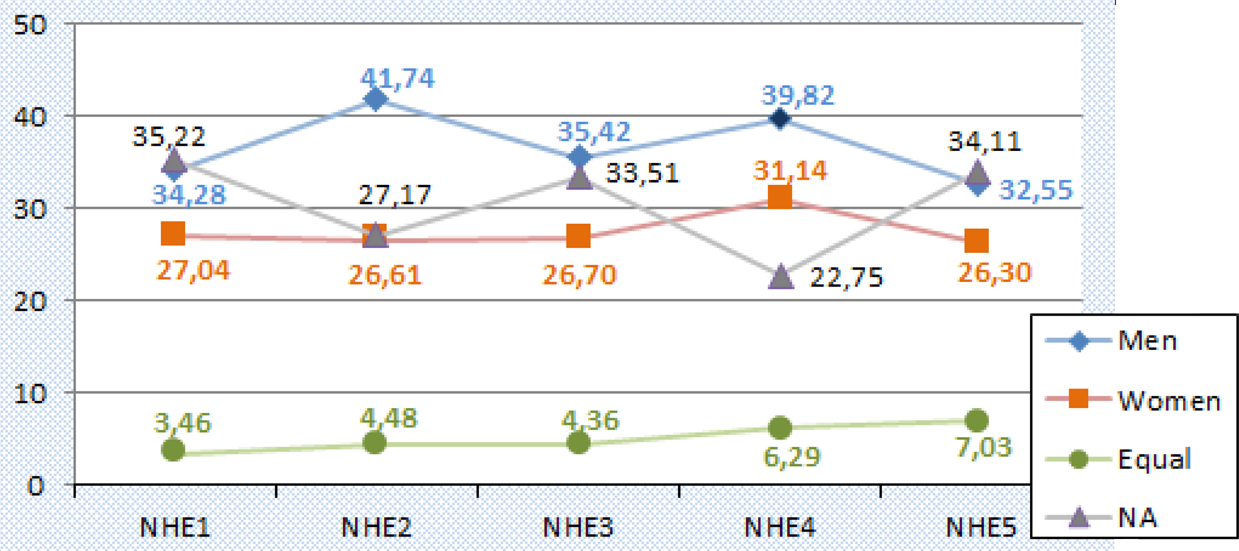
NHE is solely heteronormative binary (man vs. woman) in its gender representation and with no nonconforming gender connotations (e.g., gender-neutral pronouns, people in same-sex relationships, cross-dressers, photos of LGBTQ+ individuals). Patriarchal norms dominate the gender representation in NHE, and women are underrepresented in visual content (Figure 1).
Gender representation (images)

Gender representation in four spaces
Domestic space
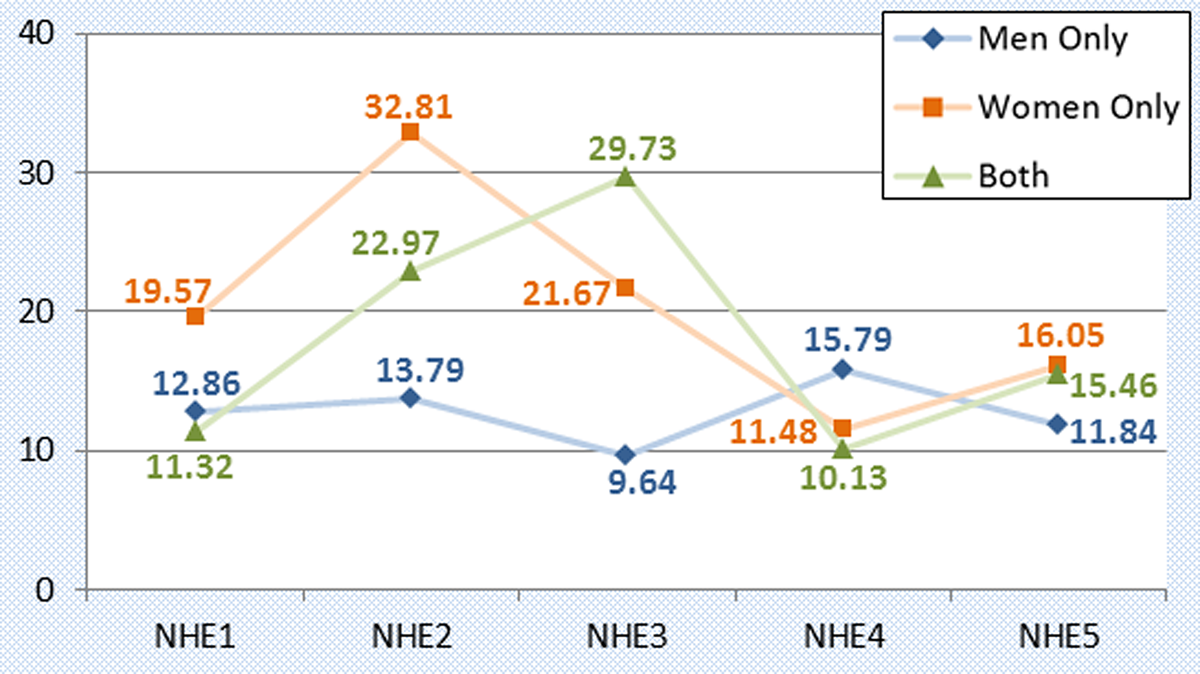
Our analysis demonstrates differences in gender representations in domestic space throughout NHE (see Figure 2). NHE's first three editions represent women at home more than men, which changes in NHE4 with more domestic representation of men than women. However, in NHE5, women are represented in the house more. While the inequality of gender representation in domestic space is most prevalent in NHE2, less bias against women is noticed in later editions.
Gender representation in domestic space

In the constructed world of NHE (especially in NHE1 and NHE2), women and men perform ‘traditional’ domestic roles. NHE depicts women as mainly responsible for taking care of children (e.g., Bobbi Brown, making breakfast for her sons, NHE2, Unit 4); serving their husbands (e.g., Mrs. Garret in NHE1, Unit 3, and Mrs. McSporran in NHE2, Unit 3, and NHE3, serving wine to their husbands); inviting family and friends over; preparing parties (e.g., Mary, NHE1, Unit 11; Megan, NHE4, Unit 4); shopping for food; and cooking, even though they have a concurrent professional life. In NHE's representation, women need to cook even when they do not like it (e.g., Bobbi Brown, a TV newscaster in NHE2, Unit 4), whereas men cook only when it is their hobby (e.g., Bobbi's husband, Don, in NHE2, Unit 4).
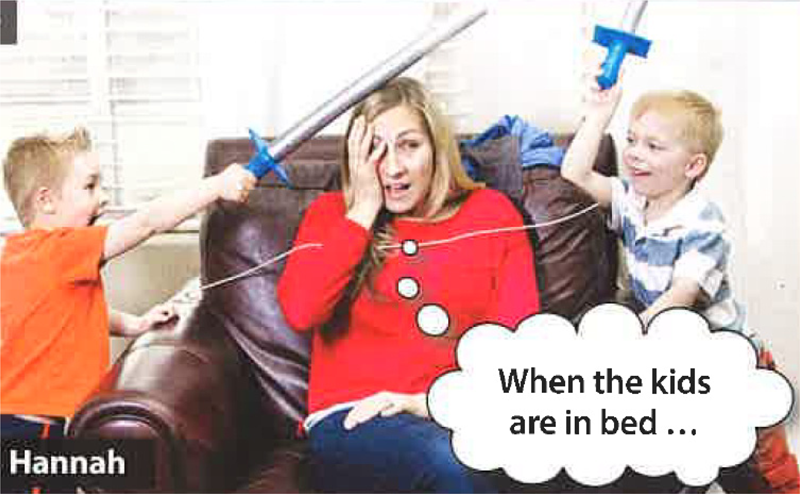
Additionally, NHE portrays men as fathers socializing with other family members or friends (e.g., Jamie Cullum, playing cards with friends, NHE4, Unit 3) and playing with their children (e.g., James, NHE5, Unit 2) (Figure 3). Conversely, instead of engaging in fun activities in domestic spaces, we observe mothers assigned with the responsibility for caregiving and meeting their children's basic needs (e.g., NHE5, Unit 11). In Figure 4, Hannah is a mother ensuring that her children are not injured while playing. Her plan is to drink a glass of wine when the kids are in bed. Relaxing, for her, hinges on fulfilling her nurturing role.
James playing with his son

Hannah waiting for her sons’ bedtime

Lastly, fathers are portrayed as contributors to their children's accomplishments. For example, Ivan's (a teenage genius) father plays a central role in his son's development (NHE1, Unit 6). As one of the top chess players in the world, Ivan practices chess problems with his father ‘all day, every day, morning, afternoon, and evening’ (p. 43). In their children's success stories, mothers’ role is limited to taking care of their children's basic needs at an early age. For instance, in NHE3, Unit 7, the child movie star Shirley Temple Black acknowledges her mother's caregiving by saying: ‘I didn't go to school. I studied at the studio and my mother looked after me there’ (p. 53).
Professional space
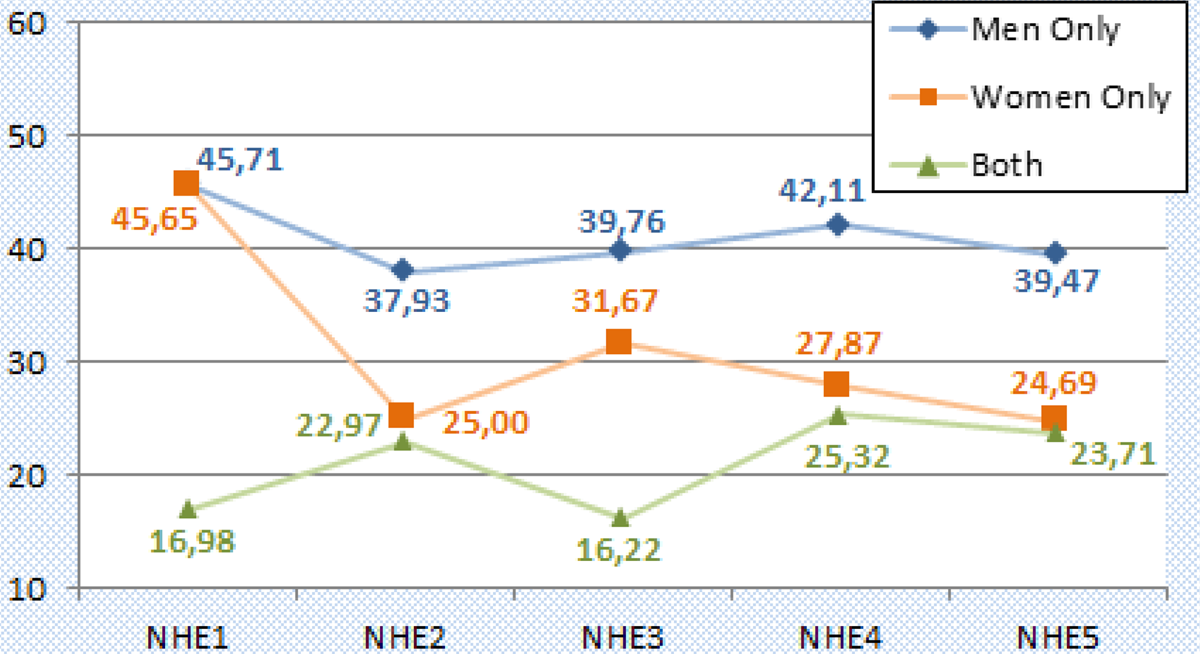
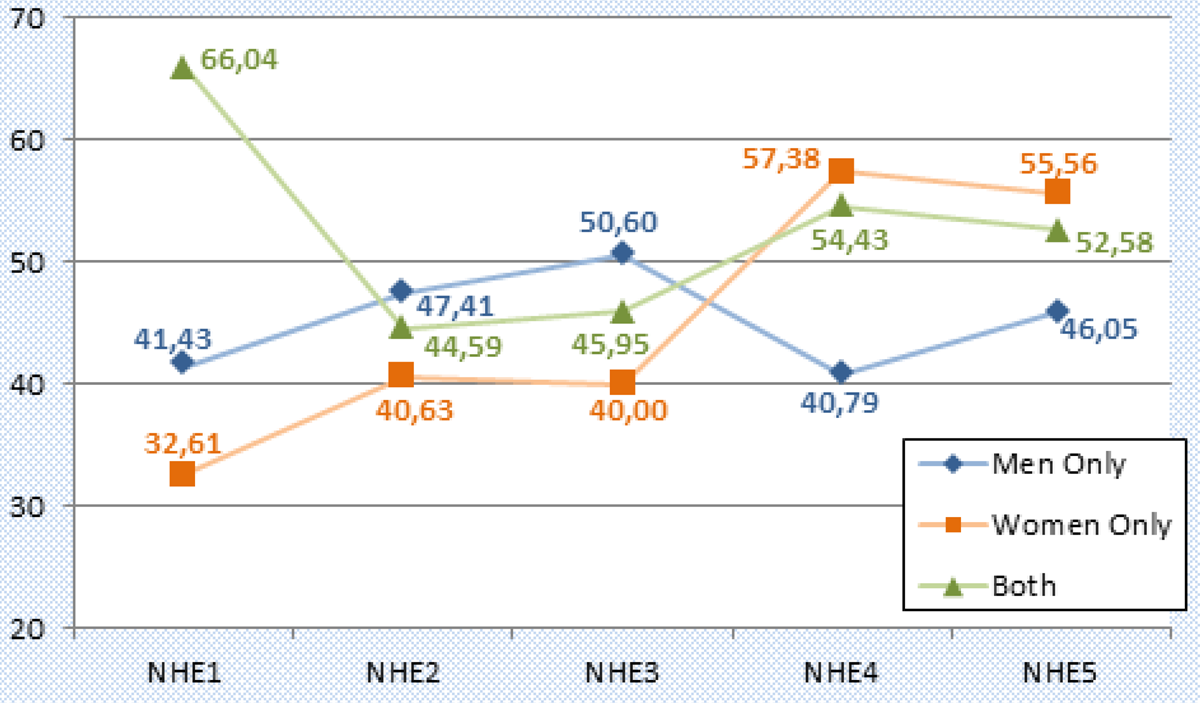
Although NHE1 represents women and men almost equally in professional spaces, later editions portray men at work more often than women (Figure 5).
Gender representation in professional space

As Figure 5 shows, both Men-Only and Women-Only representations decrease over five editions. This fall is more drastic for women than men. That is, while Men-Only representation drops slightly, Women-only representation declines by almost a half. Conversely, there is an increase in the portrayal of both genders together, which implies that the workplace has become a more mixed-gender space. Overall, these figures indicate that professional spaces remain dominated by men although the workplace has become a more mixed-gender space in the constructed world of NHE.
Additionally, the number of jobs and job-related cultural items associated with men and women in NHE is biased against women. Men are represented in a greater number of jobs with a larger variety of cultural items than women. Also, the scrutiny of gender-specific jobs shows that NHE involves 33 jobs are presented as exclusively for men. These jobs mostly require a university degree, a significant amount of expertise and/or talent (e.g., art dealer, horse jockey, photographer), and substantial physical power (e.g., mechanic, sailor, and warrior). Additionally, NHE portrays men doing jobs requiring driving (e.g., taxi driver, fire engine driver) and involving security (e.g., policeman, fireman, and soldier). Regarding the professional representation of women, only 12 jobs are exclusive to women. Four of these require a university degree (e.g., dentist, human resources (HR) specialist, interpreter, and zoologist), and five require extensive talent and/or expertise (e.g., fashion designer, hairdresser, model, news presenter, and yoga instructor). The other three female-exclusive jobs are relatively low paid jobs (e.g., flight attendant, house cleaner, and secretary). Moreover, some jobs are dominated by one gender. For instance, of 11 pilots, just one is a woman (Amelia Earhart, NHE3, Unit 7). Similarly, there are only two female compared to seven male doctors, and this representation is first introduced in NHE3. Although a male nurse is presented in NHE1, Unit 2, and NHE2, all the other nurses are female. Lastly, NHE demarcates men's professional and domestic lives, whereas women's professional representation is often framed with their caregiving roles (e.g., Oprah Winfrey's biography, NHE4).
NHE's last three editions address women's underrepresentation in professional spaces by portraying women in jobs that are different from those in earlier editions. For example, from the third edition (2006) women are represented in formerly male-exclusive jobs such as lawyers (NHE3, NHE4), inventors (NHE3, NHE5), academicians (NHE3, NHE4), doctors (NHE3, NHE4), and pharmacists (NHE3). Women now appear in professions which require a university degree and extensive expertise like school principals (NHE3, NHE4), pilots (NHE3), zoologists (NHE4, NHE5), and HR specialists (NHE5).
Recreational space
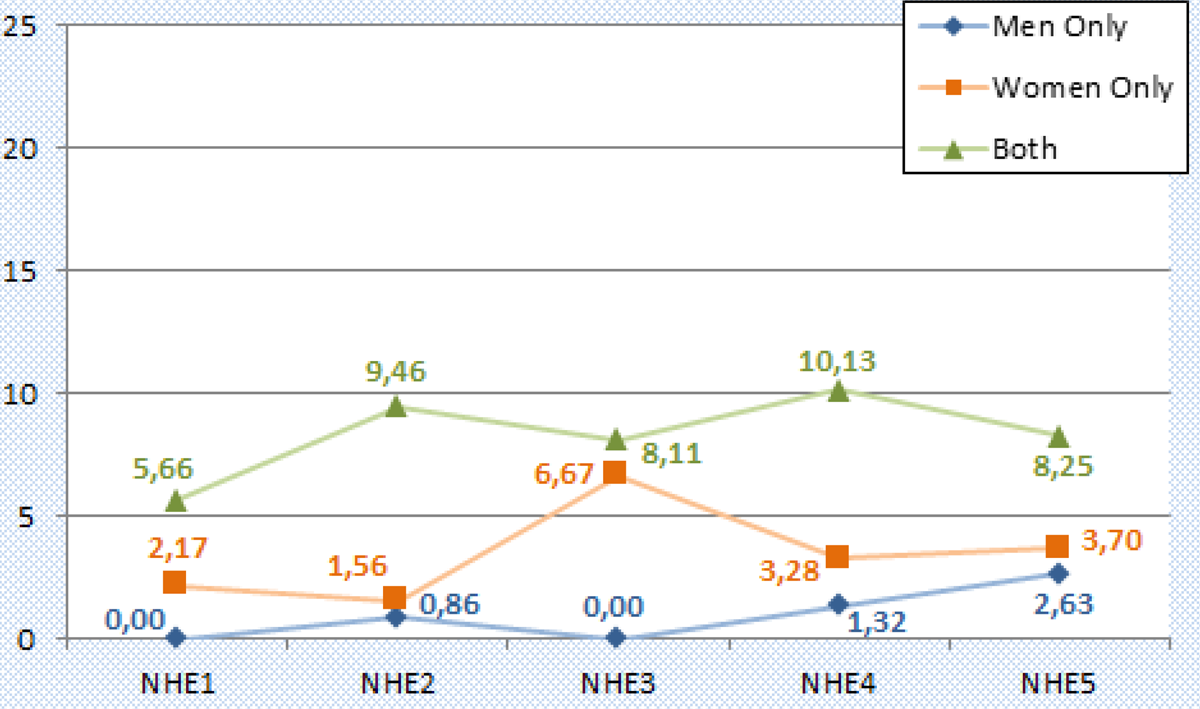
Across NHE's five editions, women's recreational representation increases almost four times more than men's (Figure 6). The first three editions picture men more than women in places other than home and workplace, but this trend shifts in the next two editions. Additionally, a closer examination of leisure activities across all editions shows that men are represented as having more varied activities and hobbies than women. Of the 30 gender-specific activities, 16 belong to men, and 13 to women. Male-exclusive hobbies are mostly related to sports. Men are depicted in team sports, such as baseball and ice-hockey, while almost all female-exclusive recreational activities are individual sports such as free-diving, and water-skiing. Women are almost never depicted as doing team sports except for Ceri Bewan (NHE3), a rugby player, and a woman playing tennis with a male partner (NHE4). This finding implies that doing team sports is a way of socializing for men in their free time while such an inference cannot be made for women.
Gender representation in recreational space

Shopping for clothes is a female-exclusive leasure activity in NHE. Men are portrayed as customers in shops several times, but shopping is a needs-based activity for them. Men prepare a shopping list (e.g., Barry in NHE2, Unit 9; Duncan and Nick in NHE4, Unit 8; and Jack and Matt in NHE5, Unit 8) or have something in mind, and buy only those items (e.g., a man looking for a shirt to go with his new suit/jeans, NHE2 and NHE3, Unit 11). NHE depicts women making a list or having something in mind, yet their shopping is never limited to the list (e.g., the image of a smiling woman carrying lots of bags in NHE4, Unit 10, with the caption: ‘She's buying everything!’ (p. 81)). Similarly, in NHE5, Unit 4, Emma is out shopping with her friend Rachel, but she cannot resist buying a new handbag, which is judged by Rachel as: ‘You don't need any more handbags!’ (p. 42).
Educational space
Educational space is the least represented element for both women and men (Figure 7); however, NHE tends to represent women as students and teachers more often than men.
Gender representation in educational space

Educational space includes more gender-equal representation than the domestic, professional and recreational spaces, but there are still disparities. Male students are represented with a larger variety and number of cultural items compared to female students. While the number of teachers mentioned is equal (14 females, 14 males) across the five editions, male teachers teach a greater variety of school subjects and sports such as English, Mathematics, History, swimming, and skiing than females. Female teachers are represented with only two specializations, i.e. language teaching and yoga.
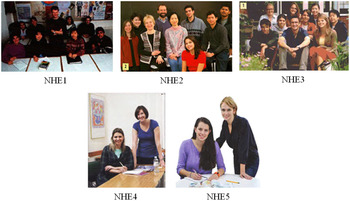
Although teaching English is not a gender-exclusive job in NHE, the representation of teachers indicates differences. For example, a language learner's description of her English teacher in each edition is informative (Figure 8). In NHE1 and NHE3, the English teacher is a man and in NHE2, NHE4, and NHE5 a woman. A comparison of the adjectives used to describe the English teacher reveals the differences in how the textbook writers present teachers in relation to their gender. That is, the representation of a ‘desirable' English teacher in NHE varies according to gender: men (very) funny, and women being young and (very) nice. In addition, the male teacher positioned in the center of the images implies that he is the one that has the authority, while the female teacher is always depicted as being in a supportive role as she is positioned in the periphery rather than the center.
The English as a second language classroom(s) across five editions

Conclusion
Our analysis of the four spaces in NHE's five editions indicated that – despite few minor revisions toward more equal gender representation – NHE's discourse reproduces the dominant ideologies that delineate the hierarchical relationships between women and men and maintain gender stereotypes (Gray, Reference Gray2013; Elmiana, Reference Elmiana2019; Lee & Chin, Reference Lee and Chin2019). Our diachronic analysis detected several attempts by the coursebook authors to attend to and critique gender inequities. However, the four revised editions of NHE have not made any substantive contribution to the equitable discursive representation of gender in domestic, professional, recreational, and educational spaces.
Supplementary material
To view supplementary material for this article, please visit https://doi.org/10.1017/S0261444820000579
Ufuk Keles is a Fulbright grantee from Turkey. He is pursuing his Ph.D. in Curriculum and Instruction at the University of Alabama, USA. Previously, he was an English teacher for 15 years at a university in Turkey. His research interests include language teacher and learner identity, social justice in ELT, multicultural education, and qualitative research in education. He has published in various journals including European Journal of Language Policy, International Multilingual Research Journal, The Qualitative Report, and Journal of Multilingual and Multicultural Development. He is currently working on his autoethnographic dissertation, featuring his language learner, teacher, and researcher identity.
Bedrettin Yazan is an associate professor at the Department of Bicultural Bilingual Studies at the University of Texas, San Antonio. He is a former English as a foreign language teacher and currently serves language teacher candidates and doctoral students. His research interests include language teacher learning and identity, language policy and planning, World Englishes, and collaboration between English as a second language and content-area teachers. His recent work has appeared in ReCALL, Teacher Education Quarterly, International Multilingual Research Journal, TESOL Journal, and European Journal of Language Policy. He is the co-editor of a recent volume (with Kristen Lindahl) Language teacher identity in TESOL: Teacher education and practice as identity work (Routledge).