Introduction
In the midst of World War II hostilities, planners and architects in Great Britain began to look forward to the peace beyond when the flow of commissions would recommence and their twentieth-century mission of liveable and efficient cities could be reinvigorated. Planners, keen to test new ideas for the reconstruction of blitzed cities, envisaged a post-war world where open spaces would be better integrated into urban development, traffic congestion could be alleviated, slum housing replaced and provision of community facilities enhanced. They drew on the propagandizing work of an earlier generation to argue for ground-breaking planning legislation and strategic state intervention, harnessing different media to leverage influence. One of the tools they employed was the staging of numerous town planning exhibitions around the country.
Exhibitions provide a useful lens through which to view mid-twentieth-century planning.Footnote 1 The expense and effort required to mount them means that they almost self-select to mark important and pivotal moments. They capture the importance of particular planning proposals through the manner of their staging, the notables who opened them, visitor numbers and reactions and the extent of publicity generated. Exhibitions provided a site for planners to interact with each other and with other groups, making and enhancing diverse networks of influence. They helped advance and test new approaches to design installations. They acted as a stimulus for associated events such as lectures, seminars and films. Their visual content and lay out provide key insights into how planning was conveyed to the broader public. The specific aim of these exhibitions was to communicate a better future for cities to a war-weary if not planning-fatigued public while simultaneously representing a means of engaging the community in the cause of enlightened civic education.
The 1940s saw a remarkable efflorescence of planning exhibitions in Britain, culminating in the ‘live architecture’ exhibition at Lansbury for the 1951 Festival of Britain.Footnote 2 A seminal event amidst this series was the Exhibition of the County of London Plan, staged in two London venues between July and November 1943. The publication of the County of London Plan was a major milestone in post-war British planning. Officialdom in war-torn Britain looked to planning as one of the ways of ‘winning the peace’. It was also a major milestone in the career of its co-author Patrick Abercrombie, reconfirming his national, Commonwealth and indeed international fame.Footnote 3
The aim of this article is to reveal the structure and organization that lay behind the mounting of the County of London Plan Exhibition, exploring its genesis as a key moment in communicating the future promise of post-war British planning. Drawing on primary research at the London Metropolitan Archives, we specifically examine the work of the London County Council (LCC) as it negotiated for resources to assemble material to mount the exhibition in the midst of a city at war as well as the political and logistical influences on how this iconic plan was communicated to the public.
The London County Council
While ‘awkwardly sandwiched’ between a close and overbearing central government and a multitude of petty local boroughs, the LCC (1889–1965) was nevertheless ‘the “flagship” of British local government: larger, more adventurous, more intelligent and better organized than other town and county administrations across the country’.Footnote 4
In the 1940s, the council was still Britain's most powerful and influential municipal entity, befitting its status as local authority for the largest city in western Europe. The number of its employees had peaked at 85,676 in 1933 with the LCC implicated in many facets of everyday life including tramways, housing, hospitals and schools. The sheer scale of this municipal behemoth can be understood when comparing it with the 111,000 non-industrial staff employed in all central government departments (excluding the Post Office) in 1930. While the number of employees fell during the post-war period as functions and staff were taken over by central government, the staff still numbered 79,435 people in April 1948.Footnote 5 At the time when the County of London Plan was exhibited, the LCC was Britain's second most important institution of representative democracy, dominating and shaping the lives of Londoners and flagship of the British municipal tradition.Footnote 6
The County Council's exhibitions
Over the first half of the twentieth century, the LCC had built a substantial international reputation and skills base in showcasing its own municipal improvements and progress, adding to an array of transatlantic municipal exchanges and competitions.Footnote 7 Highlights included winning a Gold Medal from the 1904 Louisiana Purchase Exhibition for its model of a shield used to build the Blackwall Tunnel and a diploma for its exhibit at the International Exhibition of Hygiene in Dresden in 1911.Footnote 8 The council frequently participated in international exhibitions, for example preparing materials for the 1914 Lyons Exhibition on progress in municipal administration, lending models of the newly built Kingsway and Aldwych redevelopment to the Boston 1915 ExhibitionFootnote 9 and sending models of cottages to the 1920 Irish Health Exhibition in Belfast.Footnote 10 Delegations were also sent to selected events such as the Congrès Internationale et Exposition de l’Art de Construire les Villes et de L’Organisation de la Vie Municipale in Ghent in 1913.Footnote 11 The LCC could therefore count itself as a beacon at the dawn of the municipalist movement.Footnote 12
Adding to its international profile, exhibitions at local events supported an evolving geography of exhibitionary spaces across the capital. Models produced for exhibitions in the 1910s would find their way into the storage rooms of the newly established Science Museum in South Kensington.Footnote 13 The council eagerly participated in the Franco-British Exhibition 1908 at White City in Shepherd's Bush, using the event to promote its effective administration and advertise the council's tramway services and development of surplus land.Footnote 14 Similarly, it also provided an exhibit worthy of its position ‘as the greatest municipal authority in the world’ to the Japan-British Exhibition 1910 in the same location. Here, the emphasis was municipal services, including a cross-section of ‘underground London’, elevations and diagrams of artisans’ dwellings, lodging houses, fire stations and other buildings erected by the council including a model of a sewage works.Footnote 15 Such activity reflected the pride and purpose of an enlightened and progressive municipality.
Exhibitions represented a useful propaganda medium for the LCC where it could celebrate its own achievements. During the highly successful London Government Exhibition celebrating its work across all municipal services in 1935, a crowd of 120,000 was attracted during the opening week.Footnote 16 At a smaller scale, the 1938 Green Belt Exhibition, staged in Charing Cross Underground Station, comprised a relief model of London stretching out to the green belt and featured specially commissioned aerial photographs.Footnote 17 This event cemented the council's association with a highly popular planning policy.Footnote 18 And on it went; that a major exhibition would be countenanced for an initiative as significant as the County of London planning process was arguably never in doubt.
The 1943 County of London Plan Exhibition's preparation, staging and aftermath were to coincide with unprecedented attempts among planners and architects to secure and sustain support for planning during the early 1940s.Footnote 19 The public appetite for post-war reconstruction and planning peaked shortly after the blitz, but with interest thereafter flagging. Mass Observation, a group interested in popular and radical social science, noted the increasing interest among people for less planned and orderly lives at the end of hostilities and concluded that there was a gap between the ideals of planners and those of ordinary people.Footnote 20 While attempting to ‘win the peace’, the LCC and its leader Lord Latham were in a race against time to prevent this gap from widening further.
The County of London Plan 1943
The County Plan prepared by Patrick Abercrombie, then nearing the end of his tenure as Professor of Town Planning at University College, and John Forshaw, the LCC's chief architect, cuts straight to the major defects of London as deriving not just from the blitz but the uncorrected legacies of pre-war blight. Indeed, the real problems were more fundamental than war damage and related to traffic congestion, depressed housing areas and obsolescence, especially in the East End, inadequate and poorly distributed open space, indiscriminate jumbles of land use, houses and industry jammed between transport corridors and lack of coherent architectural development. The way forward was seen as not universal rebuilding or comprehensive dispersal, but to ‘endeavour to retain the old structure where discernible and make it workable under modern conditions’.Footnote 21 The so-called ‘egg diagram’ of social and functional communities prepared by Arthur Ling and D.K. Johnson – the most famous image associated with the plan and an idea which reportedly arrived late and disrupted finalization of the planFootnote 22 – captures that enhancement of the existing organic social structure, a vision at once forward-moving and conservative.Footnote 23
With a 50-year planning horizon and the result of a painstaking two years of work, the County of London Plan aimed to lay bare the legacy of decades of poor planning and proposed to redevelop many parts of the centrally built up area of the capital, with the exception of central London which was the subject of a separate plan-making process.Footnote 24 The Plan was important for at least two additional reasons. First, as part of a triumvirate of master plans comprising also the Greater London Plan 1944 and the Holden-Holford City of London Plan 1947, it laid down key principles helping to forge an extremely durable consensus on how city and region should be planned.Footnote 25 The authors of all these plans, encouraged by the war conditions and the expectation of sweeping changes to planning legislation, collectively visualized a series of great projects extending over the coming half century.Footnote 26 These projects supported a flexible process that the LCC used until the late 1960s to manage its obligations and opportunities under the 1947 Town and Country Planning Act.Footnote 27 Secondly, the County of London Plan revived what its more famous author, Abercrombie, felt was a stalled career to represent one of his signature achievements. Returning from Ceylon where he had been working with his former student Clifford Holliday on the plan for a new university in 1940, he ‘was clearly depressed. In his early sixties, still full of energy and not yet at retiring age, he felt that the war had effectively ended his career’.Footnote 28 As it turned out, he would be immersed in post-war reconstruction from the time he stepped off the boat.
Abercrombie's talents were evident to the LCC's Civil Defence and General Purposes Committee three years before publication of the plan. As early as 1940, and even before the bombardment of London had begun, the LCC had been considering the question of a replanning scheme for the county. Under the leadership of the-then county architect F.R. Hiorns, from September 1940 a team of six clerks had been marking the extent and type of war damage on Ordnance Survey maps. To these maps were added ill-planned development and the distribution of industry and information on traffic and roads to constitute a critical documentation of baseline data to inform future re-planning. In March 1941, a request from Lord Reith, the minister of works and building, formally initiated the planning process with active encouragement to purchase the sites of war-damaged properties.Footnote 29 Hiorns was instrumental in recommending Abercrombie be hired by the council, initially in seeking a ‘confirmatory outside opinion in respect of the main lines of the scheme’.Footnote 30 His role would grow as would the commitment to and resourcing of a programme of public education. The exhibition would form only one part of a wider propaganda effort promoting the County Plan.
Establishing the exhibition
Several decades of exhibitionary expertise across the areas of education, housing, arts and town planning were brought to bear on the County of London Plan Exhibition. Organized in the midst of war, there was also a military thoroughness brought to its preparation with deployment of a veritable army of personnel to advertise the exhibition and link up with important stakeholders. The exhibition preparation formally commenced in April 1943 with inputs required from virtually every significant LCC committee: town planning, civil defence, parks, housing, education, hospitals, social welfare, finance and public control. Apparently, only the welfare of the blind, supplies and parliamentary committees were not involved. The Civil Defence and General Purposes Committee, chaired by Lord Latham, was the key entity in approving the process for disseminating the written plan by approving the cost of printing and publishing, the selling price and the advertising strategy. A driving consideration was that this official plan for the future of London should attract at least as much publicity as ‘the widely advertised unofficial plans which have been issued for the redevelopment of London’.Footnote 31 These would have included the London Society's scheme outlined in its pamphlet, London Needs a Plan (1931),Footnote 32 the Royal Academy Planning Committee's Interim Report (1942),Footnote 33 the Modern Architectural Research Society's ‘Master Plan for London’ (1942)Footnote 34 and the Royal Institute of British Architect's (RIBA) London Regional Reconstruction Committee Exhibition held in 1943 at the National Gallery.Footnote 35
Four months before the exhibition opening, the LCC engaged the London Press Exchange Ltd (LPE), a well-established advertising agency, which had become the main producer of government advertising during World War II.Footnote 36 The agency's main tasks were to provide general advice during the preparatory stages of the exhibition, collaborate on publicizing the published plan and provide publicity advice. Consequently, in its first memo to the LCC the agency advised on a broad communications strategy. LPE stated that the proposed exhibition venue at the LCC headquarters County Hall on the south bank of the Thames River was not ideal, being away from the capital's visitor-generating main attractions, and asked the LCC to consider a second showing in the West End. They also advised on quite detailed aspects, recommending that ‘simple entertainment’ should be offered during press conferences; that every effort should be made to get one-way traffic around the exhibits, eventually ‘circulating into the centre of the hall to in front of the large scale plan’; that extended opening hours be set (10am–7pm Monday to Saturday with a late night on Friday – in the end a 2pm opening time was agreed to); and that the council distribute a pocket sized souvenir instead of the initial idea of a ‘quarto 4 page leaflet’.Footnote 37 All of these points would be taken up by the LCC.
It was in the area of advertising and publicity that the LPE provided the most crucial sounding board. The dialogue between it and the LCC reveals much about the negotiations that had to be undertaken between different ministries and actors to secure publicity during wartime, as well as the variety of means that were employed to spread the messages in the plan. Various difficulties were confronted. First, the LCC faced the problem of dealing with the press who wanted to know the details of the plan which had to remain secret until it had been officially approved and published. The LPE and the LCC agreed that a good way to keep the plan in the public eye would be to conduct in-house interviews with Forshaw and Abercrombie ‘purely as individuals’ and then to disseminate these profiles to the newspapers.Footnote 38
A second problem was securing enough sites on which to display posters and banners and find other ways of advertising the exhibition. The idea of having loudspeakers announcing the exhibition at Victoria Station was explored and the need to negotiate with Civil Defence establishments was thought to be crucial.Footnote 39 Civil Defence infrastructure, such as air raid protection shelters, was controlled by individual borough councils, so the LCC wrote to each of the 28 councils within its boundary to ask for their permission to post advertisements and offering to deploy its ‘Heavy Rescue’ personnel to carry out the bill posting.Footnote 40 This was important not only because resilient Londoners spent so much time in these places, but because advertising in front of bomb sites and in air raid shelters would give added power and poignancy to a plan for the redevelopment of London. Council property under the control of the Valuer's Department and the Education Office plus the council's vans provided other obvious locations for posting as did meal service locations. More complex negotiations were necessary with central government ministries. For example, discussions were needed with the War Savings Department to give up advertising hoardings pasted over a sandbag and plywood construction to protect the Shaftesbury Memorial or ‘Eros’ statue in Piccadilly Circus. Eventually, the National Savings Committee, which controlled the site, reached agreement with the LCC.Footnote 41 More readily given were permissions from the Ministry of Food to remove streamers from County Hall and substitute these with banners advertising the exhibition,Footnote 42 as well as from the London Passenger Transport Board to display advertising posters in underground rail stationsFootnote 43 and the Automobile Association to secure direction signs for the event.Footnote 44
While council officers liaised with various organizations, the LPE drew up a descriptive summary of the plan to be sent out to those newspapers ‘who will not have the expert review staff to deal with the book’.Footnote 45 Personal connections were also mobilized to ensure good coverage and potentially disarm any major criticism. The director general of the BBC, Robert Foot, a personal friend of Sir Eric Salmon, the county clerk, was invited to County Hall to discuss a proposal for Lord Latham to make a radio broadcast on the plan.Footnote 46 Five senior staff at the Bank of England were given a preview of the plans and diagrams by Forshaw and Abercrombie at County Hall, opining that they hoped those responsible for planning the City of London would show the same breadth of view.Footnote 47
In the meantime, the LPE and the LCC discussed the people to be formally consulted on the plan. There was a statutory requirement to consult with ‘prescribed persons’ under the Town and Country Planning Regulations, 1935, including all borough councils, the Passenger Transport Board, the railway companies and the various utility suppliers in addition to a range of professional and advocacy bodies such as the London Society and the Town Planning Institute. A total of 76 consultees received a copy of the plan. It was also thought necessary to send a special hand-out to the national press and a swath of international press agencies, including Reuters, the Australian Associated Press, various US press agencies and the London correspondents of the New York Herald Tribune and the New York Times. A copy of the plan was additionally to be sent to the heads of planning agencies in cities such as New York, Moscow and Stockholm. Cities under German occupation were also targeted, including Amsterdam. Publication of the plan and its exhibition were important to inform the public in exercising their right to public expression. The rationale linked to a democratic model of governance, albeit occupying a relatively lowly rung of what Arnstein would later conceptualize as the ladder of citizen participation.Footnote 48 As Lord Latham made clear, ‘although I would not go so far as to endorse the business slogan “the customer is always right” I would at least concede that the customer has a right to an opinion’.Footnote 49 The plan itself and the feedback generated were expected to be collated and examined further by various committees en route to plan implementation.
Disseminating the message
From the outset, the idea of how best to disseminate the messages of the County of London Plan was a central concern. The possibility of an overseas exhibition was floated by the Ministry of Information.Footnote 50 Other mooted media nationally included a film, a lantern slide lecture and bespoke educational initiatives targeting adult education and school children. This multi-pronged attack expressed not only the promotional culture within the LCC but the broader ideology of progressive salesmanship of planning schemes pioneered and refined before the war, particularly in the United States.Footnote 51 Not all the promotional ideas were to be taken up but there was clear intent not to let the plan just speak for itself.
In addition, the proposal for a smaller, popular edition of the County of London Plan book drew support early on.Footnote 52 Once the exhibition was under way, the LPE set to work brokering a deal with Allen Lane, the head of Penguin, who considered that the work was ‘so important that he would not want to make a profit on it’.Footnote 53 Instead of a summary of the plan, a sympathetic critique was intended. Written largely by the librarian of the RIBA, E.J. Carter, the work contained new illustrations by the architect Ernö Goldfinger to help illustrate key concepts and was richly illustrated with both plans and photographs of the models in the exhibition.Footnote 54 It was broadly praised by the Town Planning Institute when eventually published in 1945, especially in view of the difficulties of producing such work given wartime paper shortages.Footnote 55
The suggestion of a film emerged from a member of the public, an engineer called John Hutcheon, who wrote to Lord Latham and emphasized that the exhibition content was altogether ‘too tiresome for the normal brain’.Footnote 56 Latham's reaction to this unsolicited suggestion is not recorded and instead the Ministry of Information wrote to the LCC three weeks later with a concrete proposal to make a film with the LPE thinking along the same lines as well.Footnote 57 The poet, architectural commentator and passionate enthusiast of Victorian architecture, John Betjeman, was involved in producing the Ministry of Information film and proposing to the LCC its format and length.Footnote 58 It was anticipated that a 20 minute film would be suitable for screening in the United States and the Soviet Union as well as Great Britain. Already at this early stage, the basic ideas behind ‘Proud City’Footnote 59 could be seen to be taking shape: the overall argument was not to be about sweeping away the old, but in building up what is good already in line with the general Forshaw–Abercrombie philosophy. Diagrams were not to be included and one style of architecture was not to be envisaged nor particular forms of design endorsed.Footnote 60
There was also enthusiasm to disseminate further the analysis and recommendations of the County of London Plan through adult and child educational channels. The LCC received petitions from the Army Bureau of Current Affairs which produced a booklet series entitled the ‘British Way and Purpose’.Footnote 61 They asked for materials on the County Plan to support a discussion with serving officers on the importance of town planning. This suggestion was pursued by the LCC and a 10 to 20 page booklet was proposed to go to every officer in the army as a basis for lectures and discussions. A pictorial treatment of the plan was also envisaged on the back of an army newspaper, the Map Review, Finally, a travelling exhibition consisting of up to 50 photographs mounted on board was proposed to circulate in sets to various units where they would be displayed for a week at a time.Footnote 62 While it appears that most of these events did not eventuate,Footnote 63 the negotiations were typical of those that senior county staff were willing to engage in to broaden and deepen interest in the plan.
A further medium of dissemination was to be through preparation of material for schools as it was thought to be necessary to impress upon the minds of young children the need for post-war planning.Footnote 64 Around 40,000 booklets each of 16 pages containing a very broad outline of the principal features of the plan were proposed to be printed. In addition, some of the maps were expected to be copied separately and sent to schools. In the end, it is not clear whether this was carried out. Given that production of any material was dogged by paper shortages, it is likely that with the publication of the Penguin edition of the plan this broader aim was satisfied. Nonetheless, schools were ardent stakeholders petitioning the LCC for more information on the County Plan. In response to one such request, 100 copies of the booklet ‘Plan London Now for Him!’, which included some of the most salient diagrams and wording from the plan, were sent to be sold at the Roan School for Girls.Footnote 65 The LCC was asked repeatedly to make available its large hemispherical map of London that dominated the entrance to the exhibition.Footnote 66 This request was refused because the amount of cardboard used in the map was too valuable and was earmarked for later recycling for construction purposes, indicating what is likely to have happened to most of the exhibitionary material.Footnote 67
The exhibition's content and venues
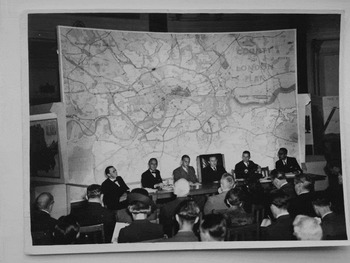
As to the exhibition proper, it was shown first between 14 July and 28 August 1943 at the London County Council's County Hall and subsequently at the Royal Academy of Arts from 3 to 28 November the same year. Using the circular conference space of County Hall as the venue for the initial showing, visitors were invited to turn left on entry into the exhibition and then to circulate clockwise around a series of 11 perimeter bays. The first of these sought to encapsulate ‘The Problem’ and the remainder dealt with more specific aspects including communities, industry, open spaces, roads and railways, redevelopment, central London, the South Bank and, finally, ‘general studies’. The intended sequence was from problems through analysis to solutions. Physical models of a redeveloped South Bank and central London were also on display. Near the exit after a 360 degree revolution, the centrepiece as envisaged by LPE was a large, diagrammatic plan of London encompassing many of the specific projects, which also formed the backdrop of the press conference to open the exhibition (Figure 1).Footnote 68
Press conference for the opening of the exhibition on 9 July 1943. Lord Latham (centre in the high back chair) presides. Patrick Abercrombie is far left and John Forshaw beside him.
Source: London Metropolitan Archives.

The follow-up exhibition in the Burlington Galleries at the Royal Academy – a prestigious venue for planning exhibitions dating back to the landmark international display organized by RIBA in 1910Footnote 69 – included largely similar material in a more conventional and recently repaired gallery. Added were two models showing suggested layouts for the redevelopment of Stepney and Bermondsey that were prepared by the Directorate of Camouflage of the Ministry of Home Security.Footnote 70
The exhibition's reception and impact
The result of the broader advertising campaign can be seen in the attendance numbers, which exceeded expectations considering that the war was uppermost in people's minds.Footnote 71 The first exhibition in County Hall was given a two week extension and in the end attracted a total of 54,732 people. The viewing organized later in the year at the Royal Academy attracted fewer visitors, confounding the LPE's prediction of a greater turnout, but still some 21,865 people attended. At both of these venues, leaflets were on sale to visitors at 3d each. At the County Hall, 53 per cent of visitors purchased the leaflet compared to 30 per cent at the Royal Academy.Footnote 72 Some 7,000 copies of the hardbound 188 page plan published by Macmillan were sold to the public during the first print run with a price subsidized by the council allowing them to recoup two-thirds of the cost. On the day the plan became available to the public, leading London booksellers sold out (and this was in addition to the 2,000 copies that had been ordered prior to publication). Plans were immediately put in place for a second edition of 3,000 copiesFootnote 73 and a subsequent print run of 5,000 copies.Footnote 74
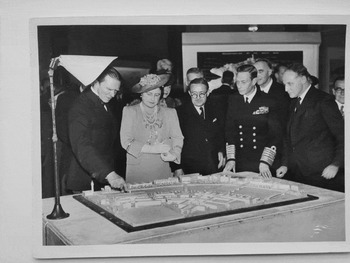
Such was the importance of the plan that steps were taken to ensure all different facets of London's governing elite were represented in some form at the two openings. Three formal openings were scheduled between 14 and 16 July with a government minister or their representative from the planning, transport and health portfolios each given an opportunity to open the exhibition. On the first day at County Hall, the exhibition was opened by William S. Morrison, the minister of town and country planning; on the second day by Sir Arthur Salter, joint parliamentary secretary of the Ministry of War Transport; and on the third day by Florence Horsburgh, parliamentary secretary at the Ministry of Health. Each opening was accompanied by an extensive array of distinguished invited guests, such as Sir Stephen Tallents, the public relations officer of the Ministry of Town and Country Planning; Lord Ashfield, chairman of the London Passenger Transport Board; and Sir Philip Game, the commissioner of police. King George VI and Queen Elizabeth also paid a visit on 20 July for an hour, guided around the exhibits by Forshaw and Abercrombie. They were presented with two specially bound and inscribed copies of the plan (Figure 2).Footnote 75 The follow-up exhibition at the Royal Academy in Piccadilly was similarly supported by high-profile attendees. It was officially opened on 3 November by the eminent architect Sir Giles Gilbert Scott.Footnote 76 Sir Eric Salmon went to great lengths to organize a series of talks during the exhibition period for the public's benefit. The notable figures initially invited to give addresses included the bishop of London and the dean of Westminster Abbey, both of whom declined. The former seemed a natural choice, being already heavily involved with replanning and the rebuilding of bombed churches.Footnote 77 The latter, although ‘deeply interested’, felt his ideas on the plan were not fully developed.Footnote 78 The eventual list of speakers included road engineer Sir Charles Bressey, author of the Highway Development Survey, 1937 (Greater London); H. Alker Tripp, assistant commissioner of police (traffic) and author of two influential books on town planning and traffic; the renowned planning consultant W.R. Davidge, a past president of the Town Planning Institute; W.H. Ansell, the immediate past president of the RIBA; Lionel Wilkinson, president of the Institution of Municipal and County Engineers; and Sir Montague Barlow, author of the influential ‘Barlow Report’ on employment distribution in Britain.Footnote 79
Inspecting a model for the redevelopment of the south bank of the Thames. Pictured left to right: Patrick Abercrombie, Her Majesty Queen Elizabeth, Lord Latham, His Majesty King George VI and John Forshaw (with permission from Alpha Photos).

The reaction from the press overall was largely laudatory, showing that the LPE had performed its briefing work well. The Architect and Building News described the County Hall exhibition as ‘well arranged’,Footnote 80 while the journal Building commented that the Conference Hall lent itself admirably to ‘the exposition of the analysis of the problem and the synthesis’.Footnote 81 A number of other articles commented on the sheer number of people visiting the exhibition.Footnote 82 One of the richest descriptions came from the unexpected source of a correspondent for the Sydney Morning Herald who described the thousands of people daily, for weeks, who
thronged either the national gallery [sic] or the London County Hall examining detailed maps of London's hopes; studying large plans hanging from the roof; wandering around charts and diagrams; wondering what would happen to their particular localities; and, above all, participating in an educational process described to me by a Cabinet Minister as one of the most moving things he had ever experienced.Footnote 83
Tragedy marred the exhibition, however, with the suicide in May 1943 of William Walcot, a leading draughtsman of his day and the artist who provided a number of beautifully rendered plans and visionary diagrams for the exhibition.Footnote 84 There was also some internal criticism of the exhibition. The London Press Exchange felt that the plans themselves lacked an ‘imaginative perspective’.Footnote 85 Amongst other grumbles, Reginald Henry Pott, the vice-chairman of the council, commented that the attendance at Sir Charles Bressey's talk at the Royal Academy was small, the general noise made by visitors to the exhibition interrupted the presentations and that the new layout was not ideal with a contour model hampering entry to the room.Footnote 86 But the general consensus was a successful event which augured well for the future of planning in the county.
Conclusion: all of London's a stage
In William Shakespeare's As You Like It the character Jaques opens a speech with the words ‘All the world's a stage.’ He goes on to compare the world to a stage and life to a play and charts the seven stages of a man's life from infancy to old age, or ‘second childishness’. As art imitates life in this speech so too did the Exhibition of the County of London Plan attempt to replicate and amplify the messages of the printed plan, employing London as a stage to advertise the exhibition and including a wide cast of actors to each play their part from Heavy Rescue personnel to the Automobile Association.
The stage had already been set, however, for the London County Council's style of elite networking, patient data gathering and capital-wide civic education. The Ministry of Information had been employing liberal-minded administrators for civic education throughout World War II, comprising aesthetes and arts managers, public relations chiefs and cultural welfare advocates.Footnote 87 One of the most famous was Kenneth Clark, the director of the National Gallery and a leading twentieth-century figure in culture and art history. At the height of the blitz in November 1940, Clark spoke to the Royal Institute of British Architects advocating a scheme to develop a national archive of buildings of merit that were in danger of damage by warfare, leading to the formation of the National Buildings Record. He presciently organized for the removal of Old Masters in the National Gallery's collection to a remote slate quarry in Wales for safe storage, thereby reinventing the Gallery as an exhibition space at the ‘heart of a modern, mobilised, cultured and democratic community’.Footnote 88 The Exhibition of the County of London Plan extended this commitment, gaining considerably from the spirit of civic education evident. It evinces the strong top-down commitment to town planning and educating the community as to its necessity. As LCC Leader Lord Latham urged in his foreword to the printed plan: ‘Let us begin now.’
The County Plan Exhibition highlighted how a distinctive large-scale spatial vision of London was brought to bear on its replanning and how the LCC vigorously sought to build a political consensus around its main elements through an extensive marketing campaign. The exhibition was an important part of a range of activities during the 1940s that aimed to keep afloat the public spiritedness engendered during the war and redirect it towards the cause of planning reform. The LCC used its considerable resources and networks to commandeer a vast amount of London's physical infrastructure to advertise the plan and exhibit it in two key locations. It engaged prominent figures to give addresses during the planning exhibition. The agency of the LCC made London a stage setting for its own planning. As Lord Latham told the press conference which preceded the official opening of the exhibition, ‘from the moment that the Plan is launched you can think of London as a vast forum in which the authorities and others…will subject it to analysis, admiration, energetic attack and constructive criticism’.Footnote 89
The exhibition and its subsequent publication were also an advertisement for the LCC and its democratic processes. As the popular edition of the County of London Plan emphasized, it might have been expected that the plan was to be circulated to the local authorities away from the public eye. Instead, ‘Londoners can be proud that the LCC has, as it were, plastered their plan on the hoardings and has said – “Here is an idea for your home town, come along with us to make it better than we have made it so far and help us to lead your fight to achieve it.”’Footnote 90 The exhibition also highlighted the role that exhibitions played as ‘assemblages’ of objects and networks. While they are ephemeral events with their displays and collections eventually being broken up and recycled in some form, when they were as timely and well publicized as the County of London Plan they could give rise to move permanent legacies in the form of books and film.
The subsequent implementation of the plan was more problematic and is explored elsewhere.Footnote 91 Well-researched and marshalling the latest concepts in neighbourhood planning, green infrastructure connectivity, housing redevelopment and urban design, the plan certainly foregrounded the subsequent Greater London Plan 1944 even if some of its micro-proposals proved illusory. In this article, our focus has been on the role of the exhibition as an element of a broader and well-established propaganda campaign for town planning. The County Plan Exhibition in 1943 represented a formidable attempt to realize what the contemporary commentator Sylvia Pollak called ‘the first aim of the planning educationalist’, namely ‘to arouse an awareness of the problems of reconstruction and a desire to contribute to their solution’.Footnote 92 On those terms at least, through attracting impressive visitor numbers and endorsement through vice-regal patronage, it surely succeeded.