Cropping systems in the North American Great Plains, especially no-till production systems, rely heavily on herbicides for weed control. However, the evolution of resistance to herbicides in many major weeds is constantly threatening agricultural productivity. Herbicides with new sites of action have not been released in recent years, and thus preserving the efficacy of herbicides is necessary to maintain the diversity of weed management tools (Duke Reference Duke2012). This is especially true for cropping systems that incorporate herbicide-resistance technologies (Tan et al. Reference Tan, Evans, Dahmer, Singh and Shaner2005).
After being introduced to North America in the 1800s as an ornamental species, kochia quickly became a major problem weed in the Great Plains (Friesen et al. Reference Friesen, Beckie, Warwick and Van Acker2009). The rapid evolution and spread of resistance to multiple herbicide modes of action makes the management of kochia challenging. Currently, there are at least 46 kochia populations with confirmed resistance to herbicides with different sites of action documented in 20 U.S. states, including acetolactate synthase (ALS)-, photosystem (PS) II-, and 5-enolpyruvylshikimate-3-phosphate synthase (EPSPS)-inhibitors, and synthetic auxins (Heap Reference Heap2017). Because of its outcrossing nature, combined with prolific seed production and a tumbling mechanism of seed dispersal, multiple herbicide-resistant kochia has become a major concern in croplands of the Great Plains states, such as Kansas (Varanasi et al. Reference Varanasi, Godar, Currie, Dille, Thompson, Stahlman and Mithila2015).
Dicamba, one of the most widely used synthetic auxin herbicides, has been an effective herbicide option for kochia control in croplands for decades. Following the widespread occurrence of glyphosate resistance in kochia, dicamba has become one of the key alternatives for kochia management in corn, sorghum, small grains, and other crops. However, several populations of kochia with evolved resistance to dicamba have been reported in Montana, North Dakota, Idaho, Colorado, Nebraska, and Kansas (Heap Reference Heap2017). Recently, Varanasi et al. (Reference Varanasi, Godar, Currie, Dille, Thompson, Stahlman and Mithila2015) reported a single kochia population from Kansas with resistance to herbicides with four sites of action, including dicamba. Furthermore, dicamba-resistant crops such as soybean have been rapidly and widely adopted in the United States. To maintain the efficacy and sustainability of this herbicide, it is essential to develop strategies that enable effective management of dicamba-resistant kochia, especially for populations that have evolved resistance to other herbicide sites of action.
Soil-applied PRE herbicides have been widely used to provide broad-spectrum and prolonged weed control. Herbicide programs that integrate PRE followed by POST applications are widely adopted in different cropping systems (Locke et al. Reference Locke, Reddy and Zablotowicz2002; Norsworthy et al. Reference Norsworthy, Ward, Shaw, Llewellyn, Nichols, Webster, Bradley, Frisvold, Powles, Burgos, Witt and Barrett2012). Dicamba is registered for PRE use in corn, sorghum, and soybean fields. The efficacy of PRE-applied dicamba on some weed species, such as pigweeds, lambsquarters, and horseweed (Bruce and Kells Reference Bruce and Kells1990; Hagood Reference Hagood1989; Johnson et al. Reference Johnson, Young, Matthews, Marquardt, Slack, Bradley, York, Culpepper, Hager and Al-Khatib2010), has been reported, but its efficacy on kochia, especially on dicamba-resistant (DR) populations, is not well characterized.
The majority of research on PRE-applied herbicides has focused on the influence of soil properties, such as organic matter content and soil pH, on herbicide efficacy (Blumhorst et al. Reference Blumhorst, Weber and Swain1990; Li et al. Reference Li, Liu, Xu and Lee2003). However, the influence of weed seed density on the efficacy of PRE-applied herbicide has received little attention. Taylor and Hartzler (Reference Taylor and Hartzler2000) reported that increased seed densities of weeds in the seedbank can reduce the efficacy of PRE-applied herbicides. Kochia is a prolific seed producer (Friesen et al. Reference Friesen, Beckie, Warwick and Van Acker2009), and seed densities in the field can be highly variable, ranging up to 2,600 seeds m−2 or more (Schweizer and Zimdahl Reference Schweizer and Zimdahl1984). Fay et al. (Reference Fay, Mulugeta and Dyer1992) reported kochia seed density of up to 30,000 seeds m−2 directly underneath an individual mother plant. The impact of kochia seed density on the efficacy of PRE-applied dicamba has not been previously reported. Therefore, research was designed with the following objectives: 1) determine the efficacy of PRE- vs. POST-applied dicamba to control both DS and DR kochia; and 2) evaluate the effect of increasing seed density on the efficacy of PRE-applied dicamba for controlling kochia.
Material and Methods
Materials and Growth Conditions
In 2012, kochia seeds were collected from a field in Haskell County, Kansas (37°29'48.5”N, 100°46'53.0”W). To obtain uniform dicamba-resistant and dicamba-susceptible kochia populations, 40 kochia plants from seeds collected from the field were self-pollinated to generate 40 lines of first-generation seeds, then 50 plants of each line were planted and treated with dicamba at the label-recommended use rate of 560 g ha−1. The remaining seeds of a uniformly resistant (survived) line and a uniformly susceptible (killed) line were selected as DR and DS determined that the resistance index (the ratio of the effective rate of an herbicide that controls 50% of a resistant biotype to that which controls 50% of a known susceptible biotype) of the DR kochia compared to the DS kochia was 20 (Ou et al. Reference Ou, Stahlman and Jugulam2015). Because of the short seed longevity of kochia, five DR kochia and five DS kochia plants were grown annually in isolation to prevent outcrossing. Mature seeds were bulk collected from the five DR and the five DS kochia separately and stored in the dark at 4 C to maintain good seed viability. Kochia seed (both DR and DS) harvested in May 2015 were used to conduct the experiments in this study.
Silty loam soil (1.2% organic matter, pH 8.21) collected near Manhattan, Kansas was used in this trial. The soil was steam sterilized at 70 C for 30 minutes in the Hummert’s Media Treatment System (Hummert International, Topeka, KS). During the experiments, trays were fertilized from the bottom weekly with Miracle-Gro® water-soluble all-purpose plant food (1% solution in water, N:P:K of 24:8:16, The Scotts Miracle-Gro Company, Marysville, OH). All experiments were conducted in a greenhouse (Department of Agronomy at Kansas State University, Manhattan, KS) under the following environmental conditions: 25/20 C (day/night) temperatures, 60% ±10% relative humidity, and 15/9 h day/night photoperiod supplemented with 120 μmol m−2 s−1 illumination provided by sodium vapor lamps.
Germination Test
Because kochia seeds lose viability rapidly, the germination rates of DR and DS kochia were determined before each experiment using the Petri dish method (Chachalis and Reddy Reference Chachalis and Reddy2000; Everitt et al. Reference Everitt, Alaniz and Lee1983) to obtain the exact number of viable seeds required for this study. Briefly, three replicates of 50 seeds from each accession were placed on 9.0-cm filter paper (Fisher Scientific, Waltham, MA) in 10-cm plastic Petri dishes (Phyto Technology Laboratories, Shawnee Mission, KS) with 5 ml distilled water. Petri dishes were sealed with Parafilm (Bermis company, Oshkosh, WI) and incubated in a dark room at 25 C. Seed germination was determined when a visible radicle protrusion occurred at 1 week after incubation. The germination rate for each population was calculated as G = (n 1 /50 + n 2 /50 + n 3 /50)/3, where n 1 , n 2, and n 3 are the number of germinated kochia seeds 1 week after incubation in petri dishes 1, 2, and 3, respectively. The number of seeds planted in each tray (N) was adjusted according to the germination rate G using the following formula: N = D×A/G, where D is the planting density of viable seeds, and A is the surface area of soil in the tray (0.0375 m2).
Efficacy of PRE- vs. POST-Applied Dicamba on DR and DS Kochia
Seedling trays (25 by 15 by 15 cm) were filled with steam-sterilized soil to a depth of 14 cm and were watered from the bottom to saturation. Kochia seeds were spread on top of the soil at a density of 300 viable seeds m−2 and covered with a thin layer of fine soil particles. Trays were randomly assigned to untreated, PRE, or POST treatments. After planting, dicamba (Clarity®, BASF Corp., Florham Park, NJ) at 280, 350, and 420 g ha−1 was applied to the soil surface in PRE treatment trays using a bench-type sprayer (Research Track Sprayer, De Vries Manufacturing, Hollandale, MN) equipped with a single moving flat-fan nozzle tip (80015LP TeeJet tip, Spraying Systems Co., Wheaton, IL) at a height of 30.5 cm delivering 187 L ha−1 at 222 kPa in a single pass at 3.21 km h−1. To incorporate the herbicide into the soil, water equivalent to 0.2 mm rain was applied to the soil surface using the same sprayer. In the trays assigned for POST treatment, dicamba at 560 g ha−1 (field recommended rate) was applied to 10- to 12-cm-tall DR and DS kochia at 4 weeks after planting.
The number of plants that survived in each tray was recorded at 1 through 8 weeks after planting. At 8 weeks after planting, all plant material above the soil surface in each tray was harvested and placed in a paper sack. After drying at 60 C for 72 h in an oven, plant material was weighed to calculate dry biomass. Each treatment was replicated four times and the experiment was repeated twice.
Efficacy of PRE-Applied Dicamba to Control Kochia at Different Seeding Densities
To determine the efficacy of PRE-applied dicamba on DR or DS kochia in this section of study, the same methods described previously in the PRE vs. POST experiments were used with the exception that four planting densities (300, 600, 900, or 1,200 viable seeds m−2) were used instead of one, and the dicamba rates changed to 0, 140, 280, 560, and 1,120 g ha−1. Treatments were replicated four times and the experiment was repeated three times.
Data Analysis
A completely randomized design was used in both studies. Data for the number of plants that survived and dry biomass were analyzed using two-way ANOVA (P<0.05) in Prism 7 (GraphPad Software, Inc., La Jolla, CA). In the efficacy of PRE- vs. POST-applied dicamba on DR and DS kochia experiment, data for the number of surviving plants and dry biomass were analyzed using two-way ANOVA (P<0.05) in Prism 7. Treatments were arranged in a factorial combination of four levels of seed density and four dicamba rates. There was no interaction between experimental runs and treatments; hence, the data from the three experimental runs were pooled together for the statistical analyses. The data from the study determining the efficacy of PRE-applied dicamba for kochia control at different seed densities were analyzed using the drc package (Ritz and Streibig, Reference Ritz and Streibig2005) in R (v.3.2.1 (R Core Team 2015)). The number of surviving plants and dry biomass data were subjected to nonlinear regression analysis using a four-parameter log-logistic model (Seefeldt et al. 1995):
 $$Y\,{\equals}\,C{\plus}(D{\minus}C)/(1{\plus}{\rm exp}[b({\rm log}(x){\minus}{\rm log}(I_{{50}} ))])$$
where Y refers to the response variable (either the number of surviving seedlings or the dry biomass), C is the lower limit, D is the upper limit, b is the slope, and I 50 is the rate (x) required for 50% response of the number of plants survived or biomass reduction. This model was used to estimate ED50 (dicamba rate required for 50% stand loss of kochia plants) and GR50 (dicamba rate required for 50% biomass reduction) values from the number of plants that survived and dry biomass of kochia, respectively.
Results and Discussion
Efficacy of PRE- vs. POST-Applied Dicamba on DR and DS Kochia
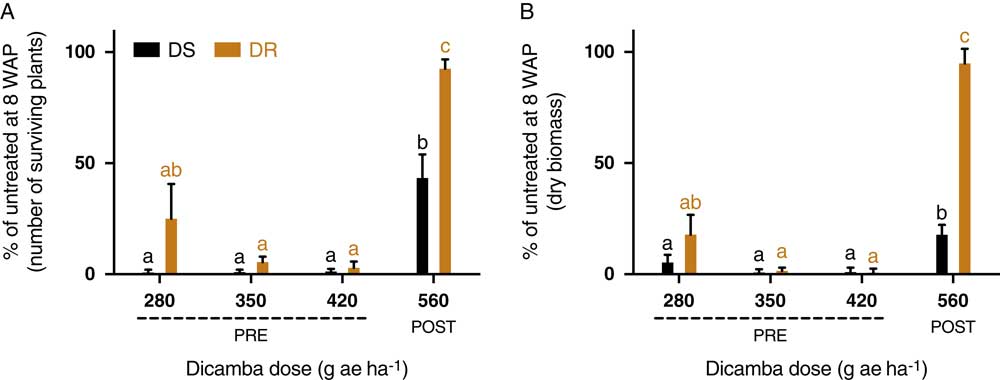
The number of plants that survived dicamba treatment indicated that PRE application of ≥280 g ha−1 dicamba controlled more than 99% of DS kochia plants (Figure 1A). In comparison, the POST-applied labeled rate of 560 g ha−1 of dicamba controlled 85% of the same kochia accession. PRE-applied dicamba at 280, 350, and 420 g ha−1 provided 75%, 94%, and 97% control of DR kochia, respectively, whereas POST application of 560 g ha−1 dicamba controlled only 10% of the DR accession. Similar results were observed for dry biomass measurements (Figure 1B). Specifically, PRE application of dicamba at 280, 350, and 420 g ha−1 reduced DS kochia 94%, 99%, and 100%, respectively, whereas the POST application of 560 g ha−1 reduced biomass 82%. Also, at least 98% DR kochia biomass reduction was achieved using PRE-applied dicamba at ≥350 g ha−1, while only 5% biomass reduction resulted from applying 560 g ha−1 dicamba POST.
Percentage of dicamba-susceptible (DS) and dicamba-resistant (DR) kochia control using PRE-applied dicamba at kochia density of 300 viable seeds m−2 compared with POST-applied dicamba based on the data of (A) number of surviving plants and (B) dry biomass. The bars marked by different letters are significantly (Fisher’s protected LSD, P value≤0.05) different in each panel.

The reduction in biomass accumulation indicates the plants that survived PRE-applied dicamba were severely injured: less biomass accumulated during the 8-week growing period following application. This is notable considering the low level of plant competition—most kochia seedlings were killed at germination or the early seedling stage. This reduction in biomass would likely also reduce per-plant seed production (Wilson et al. Reference Wilson, Wright, Brain, Clements and Stephens1995). Nevertheless, other management methods should be used to limit the renewal of the seedbank and reduce the development of dicamba resistance in kochia populations.
Efficacy of PRE-Applied Dicamba on Kochia at Different Seeding Densities
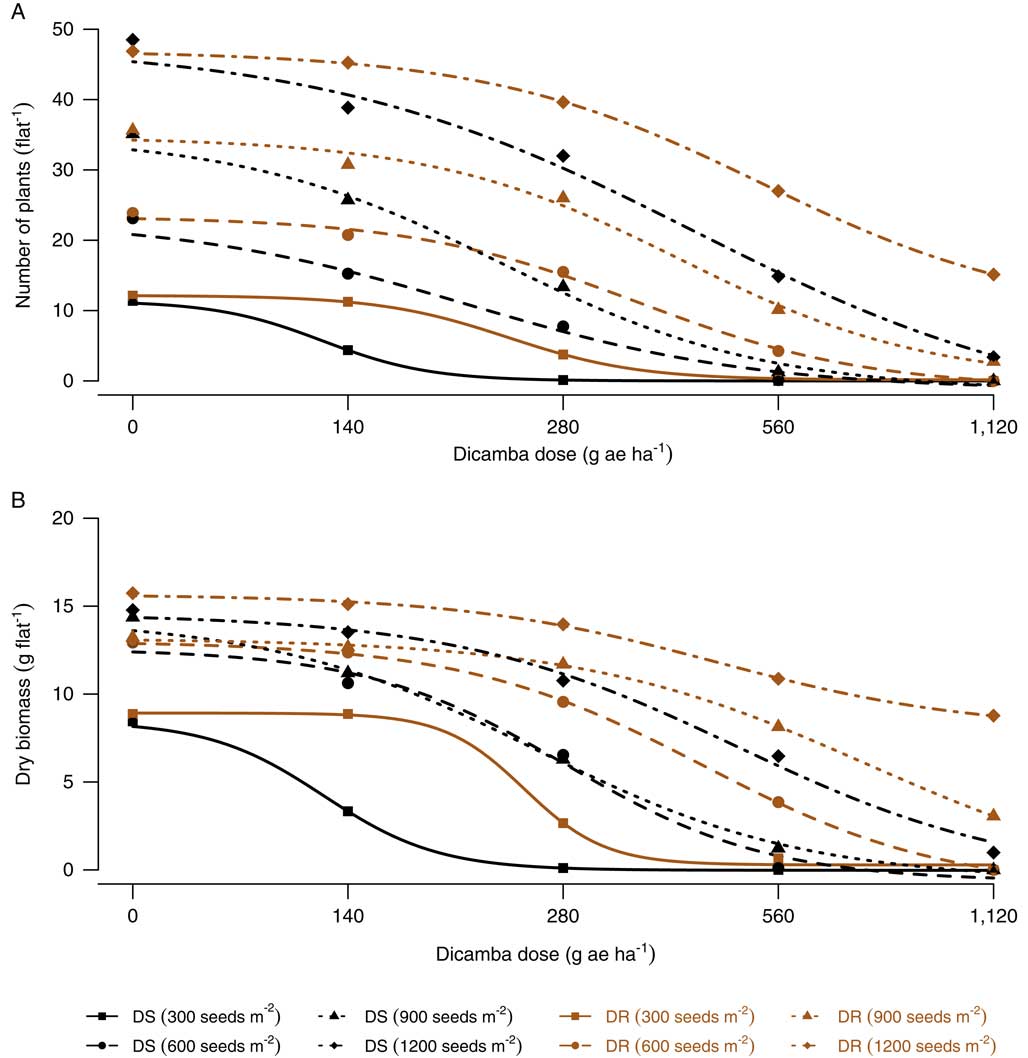
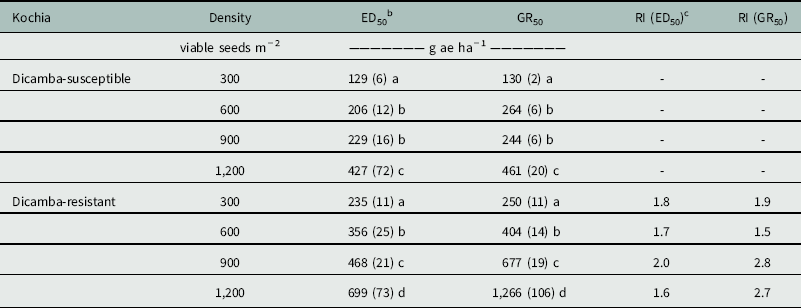
The efficacy of PRE-applied dicamba on both DS and DR kochia negatively correlated with seeding density. The values of ED50 (dicamba rate required for 50% stand loss of kochia plants) estimated with the four-parameter log-logistic model (Equation 1) are listed in Table 1, and model fitted curves for number of surviving plants are shown in Figure 2A. Regardless of the kochia accession, the ED50 values of dicamba increased with seeding density, except that the ED50 values were not different between densities of 600 and 900 viable seeds m−2 for DS kochia (Table 1). The ED50 for dicamba on DS kochia increased from 129 to about 206 g ha−1 when seeding density increased from 300 to 600 or 900 viable seeds m−2 and further increased to 361 g ha−1 when seeding density increased to 1,200 viable seeds m−2 (Table 1). For DR kochia, the trend of ED50 changes with increasing seeding densities was similar to that for DS kochia, but all ED50 values were significantly different at all four levels of seeding density tested. Specifically, when seeding density increased from 300 to 600, 900, and 1,200 viable seeds m−2, ED50 increased from 235 to 356, 468, and 699 g ha−1, respectively (Table 1).
Dose-response of kochia to PRE-applied dicamba at different seed densities as measured by (A) number of surviving plants and (B) dry biomass. (Non-linear regression model:
 $Y\,{\equals}\,C{\plus}(D{\minus}C)/(1{\plus}{\rm exp}[b({\rm log}(x){\minus}{\rm log}(I_{{50}} ))])$
).

Estimated values of ED50 and GR50 using the nonlinear regression analysis of four parameter log-logistic model.Footnote a

a
Model:
$$Y{\equals}C{\plus}(D{\minus}C)/(1{\plus}{\rm exp}[b({\rm log}(x){\minus}{\rm log}(I_{{50}} ))])$$
.
b ED50 (dicamba rate required for 50% stand loss of kochia) and GR50 (dicamba rate required for 50% biomass reduction) values were estimated using the number of surviving plants and dry biomass data, respectively. Values in parentheses are standard error. Different letters indicate a significant difference among the seed densities within each population (Fisher’s protected LSD, P value≤0.05).
c RI, resistance indices, the ratio of the effective rate that controls 50% of dicamba-resistant kochia to the effective rate that controls 50% of dicamba-susceptible kochia.
A similar relationship between seeding densities and GR50 was observed. As seeding density increased from 300 to 600 and 1,200 viable seeds m−2, GR50 values of DS kochia increased from 130 to 264 and 461 g ha−1, and GR50 values of DR kochia increased from 250 to 404 and 1,266 g ha−1, respectively (Table 1, Figure 2B).
The resistance indices indicate that significantly higher rates of dicamba were required to achieve 50% control of DR than were required to achieve 50% control of DS kochia at each seeding density (Table 1). Resistance indices comparing DR kochia and DS kochia in response to PRE-applied dicamba were 1.8, 1.7, 2.0, and 1.6 at seeding densities of 300, 600, 900, and 1,200 viable seeds m−2, respectively (Figure 2A). Similarly, the calculated resistance indices comparing DR kochia and DS kochia based on dry biomass data were 1.5, 1.9, 2.8, and 2.7 for seeding densities of 300, 600, 900, and 1,200 viable seeds m−2, respectively (Figure 2B). The resistance indices ranged from 1.5 to 2.8, which means that 1.5 to 2.8 times more PRE-applied dicamba was required to provide 50% control of DR kochia than was required to provide 50% control of DS kochia. However, previous research showed that the resistance index of this DR kochia accession compared to the same DS kochia (used in this research) in response to POST-applied dicamba was 20 (Ou et al. Reference Ou, Stahlman and Jugulam2015), which means that it required 20 times more dicamba POST to control the DR kochia accession than the DS kochia accession. The resistance index decreased drastically from 20 for POST-applied dicamba to 1.5 to 2.8 for PRE-applied dicamba.
Prolific seed production and a tumbling mechanism of seed spread make the seedbank of kochia highly variable (Friesen et al. Reference Friesen, Beckie, Warwick and Van Acker2009). The results of this study suggest that dicamba PRE-applied at 560 g ha−1 could possibly provide consistent kochia control in fields where seed densities range from 1 to 1,200 viable seeds m−2 if no dicamba resistance is observed in the field. At the same time, the 560 g ae ha−1 of PRE-applied dicamba may still provide consistent control if the DR kochia seed density is less than 600 viable seeds m−2 in the field. While there is currently no label recommended rate for kochia control using PRE-applied dicamba, it is critical to apply the full recommended rate of dicamba with complete coverage to ensure effective and consistent control of kochia throughout fields. Moreover, to reduce the selection of higher level of dicamba resistance in kochia populations, it is essential to practice the best weed management practices (Norsworthy et al. Reference Norsworthy, Ward, Shaw, Llewellyn, Nichols, Webster, Bradley, Frisvold, Powles, Burgos, Witt and Barrett2012) by adding other effective herbicides with different modes of action in the PRE application of dicamba.
The outcome of this research suggests that PRE application of dicamba may still be a feasible option to control kochia, even with widespread dicamba resistance in kochia on the Great Plains. However, no single specific tool can be the silver bullet to solve the worldwide problem of herbicide resistance. PRE application of dicamba should always be accompanied by other effective management tools to maintain sustainability.
Acknowledgements
Thanks to Dr. Aruna Varanasi, Dr. Amaranatha Reddy Vennapusa, and anonymous reviewers for comments that improved this manuscript. J. Ou’s graduate student assistantship from BASF Corp. is highly appreciated. This manuscript is approved for publication as Kansas Agricultural Experiment Station contribution no. 17-180-J.