


Vor dem Gesetz steht ein Türhüter.
Zu diesem Türhüter kommt ein Mann vom Lande und
bittet um Eintritt in das Gesetz. Aber der Türhüter
sagt, daß er ihm jetzt den Eintritt nicht gewähren
könne. Der Mann überlegt und fragt dann, ob er also
später werde eintreten dürfen.
“Es ist möglich”, sagt der Türhüter, “jetzt aber nicht.”
F. Kafka, Die Parabel “Vor dem Gesetz”
1 Introduction
This work is based on our previous paper [Reference Finashin and Kharlamov7]. So we start with recalling its setup and principal ingredients.
1.1 Short review of [Reference Finashin and Kharlamov7]
By definition, a compact complex surface X is a del Pezzo surface of degree
 $1$
, if X is non-singular and irreducible, its anticanonical class
 $-K_X$
is ample, and
 $K^2_X=1$
. The image of X by a bi-anticanonical map
 $X\to {\mathbb P}^3$
is then a non-degenerate quadratic cone
 $Q\subset {\mathbb P}^3$
, with
 $X\to Q$
being a double covering branched at the vertex of the cone and along a non-singular sextic curve
 $C\subset Q$
(a transversal intersection of Q with a cubic surface). In particular, each del Pezzo surface of degree 1 carries a non-trivial automorphism, known as the Bertini involution, that is the deck transformation
 $\tau _X$
of the covering.
Any real structure,
 $\operatorname {conj}:X\to X$
, has to commute with
 $\tau _X$
, and this gives another real structure
 $\tau _X\circ \operatorname {conj}=\operatorname {conj}\circ \tau _X$
which we call Bertini dual to
 $\operatorname {conj}$
. It is such a pair of real structures,
 $\{\operatorname {conj},\ \operatorname {conj}\circ \tau _X\}$
, that we call a Bertini pair. We generally use notation
 $\operatorname {conj}^{\pm }$
for Bertini pairs of real structures and write
 $X^{\pm }$
for the corresponding pairs of real del Pezzo surfaces to simplify a more formal notation
 $(X,\operatorname {conj}^{\pm })$
.
The bi-anticanonical map projects the real loci
 $X^{\pm }_{\mathbb R}$
to two complementary domains
 $Q^{\pm }_{\mathbb R}\subset Q_{\mathbb R}$
on
 $Q_{\mathbb R}$
, where the latter is a cone over a real non-singular conic with non-empty real locus. The branching curve C is real too, and its real locus
 $C_{\mathbb R}$
, together with the vertex of the cone, forms the common boundary of
 $Q^{\pm }_{\mathbb R}$
. Conversely, for any real non-singular curve
 $C\subset Q$
which is a transversal intersection of Q with a real cubic surface, the surface X which is the double covering of Q branched at the vertex of Q and along C is a del Pezzo surface of degree
 $1$
inheriting from Q a pair of Bertini dual real structures
 $\operatorname {conj}^{\pm }$
.
Recall also an intrinsic description of the basic
 $Pin^-$
-structure introduced in [Reference Finashin and Kharlamov7].
Theorem 1.1.1. There is a unique way to supply each real del Pezzo surface X of degree 1 with a
 $\operatorname {Pin}^-$
-structure
 $\theta _{X}$
on
 $X_{\mathbb R}$
, so that the following properties hold:
-
(1)
 $\theta _X$
is invariant under real automorphisms and real deformations of X. In particular, the associated quadratic function
$q_{X} : H_1(X_{\mathbb R};{\mathbb Z}/2)\to {\mathbb Z}/4$
is preserved by the Bertini involution.
-
(2)
$q_{X}$
vanishes on each real vanishing cycle in
$H_1(X_{\mathbb R};{\mathbb Z}/2)$
and takes value
$1$
on the class dual to
$w_1(X_{\mathbb R})$
. -
(3) If
$X^{\pm }$
is a Bertini pair of real del Pezzo surfaces of degree 1, then the corresponding quadratic functions
$q_{X^{\pm }}$
take equal values on the elements represented in
$H_1(X^{\pm }_{\mathbb R};{\mathbb Z}/2)$
by the connected components of
$C_{\mathbb R}$
.






(Here, by real vanishing cycles in
 $H_1(X_{\mathbb R};{\mathbb Z}/2)$
we understand cycles realized by loops pinched under nodal degenerations.)
The Picard group of a del Pezzo surface (as well as that of any rational surface) is naturally isomorphic to the second homology group with integer coefficients,
 $\operatorname {Pic} X=H_2(X)$
. It has a natural grading by canonical degree,
 $\alpha \mapsto -\alpha \cdot K_X$
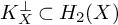
. In the case of del Pezzo surfaces of degree 1 the lattice
 $K_X^{\perp }\subset H_2(X)$
of elements of canonical degree
 $0$
is isomorphic to
 $E_8$
. If X is real, then the Picard group of real divisor classes is naturally isomorphic to
 $$ \begin{align*}H_2(X)\cap \ker(1+\operatorname{conj}_*)={\mathbb Z} K_X\oplus \operatorname{\Lambda}(X), \quad \operatorname{\Lambda}(X):= K_X^{\perp} \cap \ker(1+\operatorname{conj}_*).\end{align*} $$
For the list of isomorphism classes of the lattices
 $\operatorname {\Lambda }(X)$
, see Table 1 in Section 2.
None of the divisor classes of degree 0 is effective, and the only effective divisor classes of degree 1 are
 $-K_X$
and
 $-K_X-e$
where e is any root (an element of square
 $-2$
) of
 $K_X^{\perp }=E_8$
. The linear system
 $\vert -K_X\vert $
is a pencil of curves formed by pull-backs of the line generators of Q. Each of the classes
 $-K_X-e$
has a unique representation by an effective divisor. These effective divisors are
 $(-1)$
-curves and, in the context of del Pezzo surfaces, are called lines. Over
 ${\mathbb C}$
the lines are in one-to-one correspondence with the roots e in
 $K_X^{\perp }= E_8$
, and over
 ${\mathbb R}$
with the roots in
 $\operatorname {\Lambda }(X)$
.
It is the
 $\operatorname {Pin}^-$
-structure of Theorem 1.1.1 that opened a way to a signed count of real lines in [Reference Finashin and Kharlamov7] where we introduced two species of real lines
 $L\subset X$
distinguished by the values of
 $q_{X}([L_{\mathbb R}])\in {\mathbb Z}/4$
. Namely, we called a real line
 $L\subset X$
hyperbolic (resp. elliptic) if
 $q_{X}([L_{\mathbb R}])=1\in {\mathbb Z}/4$
(resp.
 $q_X([L_{\mathbb R}])=-1\in {\mathbb Z}/4$
), and attributed to it an integer weight
 ${\frak s}(L)=\pm 1\in {\mathbb Z}$
,
 ${\frak s}(L)\ \mod 4=q_{X}([L_{\mathbb R}])$
. As was shown in [Reference Finashin and Kharlamov7], the count of real lines with these weights gives the following fundamental relations:
 $$ \begin{align} \sum_{L\in\mathcal L_{\mathbb R}(X)} {\frak s}(L) = 2 \operatorname{rk} \operatorname{\Lambda}(X), \end{align} $$
where
 $\mathcal L_{\mathbb R}(X)$
denotes the set of real lines in X; and
 $$ \begin{align} \sum_{L\in \mathcal L_{\mathbb R}(X^+)} {\frak s}(L) + \sum_{L\in\mathcal L_{\mathbb R}(X^-)} {\frak s}(L) =16, \end{align} $$
where
 $X^{\pm }$
is any Bertini pair.
The divisor classes of lines together with
 $-K_X$
constitute the first layer in the semigroup of effective divisor classes, that is the set of effective divisor classes
 $\alpha $
of canonical degree
 $-\alpha \cdot K_X=1$
. Therefore, it is natural to combine the count of real lines with a count of real rational curves A belonging to the divisor class
 $-K_X$
. For a generic X, all these real rational curves A are nodal and we (similar to the above) attribute to each of them the weight
 ${\frak s}(A)=i^{q_X([A_{\mathbb R}])-1}w(A)$
, where
 $w(A)=(-1)^{c_A}$
is the modified Welschinger weight of A, with
 $c_A$
standing for the number of cross-point real nodes of A.
The linear system
 $\vert -K_X\vert $
is a pencil of curves of arithmetic genus 1 with one base point. Thus, we can count the Euler characteristic of
 $X_{\mathbb R}$
blown up at this base point by means of this singular elliptic pencil, and obtain
 $$ \begin{align*}\sum_{\mathrm{real \ rational}\ A\in \vert -K_X\vert } {\frak s}(A)= \sum_{\mathrm{real \ rational}\ A\in \vert -K_X\vert } (-1)^{c(A)}=\chi(X_{\mathbb R})-1, \end{align*} $$
since, for each
 $A\in \vert -K_X\vert $
, the class
 $[A_{\mathbb R}]$
is dual to
 $w_1(X_{\mathbb R})$
, and thus
 $q_X[A_{\mathbb R}])=1$
(see Theorem 1.1.1). On the other hand, from the Lefschetz fixed point formula,
 $\chi (X_{\mathbb R})-1=(8-\operatorname {rk} \operatorname {\Lambda }(X))-\operatorname {rk} \operatorname {\Lambda }(X)$
. Combining the above with the relation (1.1.1), we achieve the following result.
Theorem 1.1.2. For any generic real del Pezzo surface X of degree
 $1$
,
 $$ \begin{align} \sum_{L\in\mathcal L_{\mathbb R}(X)} {\frak s}(L) + \sum_{\mathrm{real \ rational}\ A\in \vert -K_X\vert } {\frak s}(A) =8. \hfill\Box \end{align} $$
An assumption of genericness stands here only to ensure that all rational curves in the pencil
 $\vert -K_X\vert $
are nodal. This assumption can be excluded by interpreting
 $c_A$
as a “virtual” number of cross-point real nodes.
1.2 Next step
In this paper, we study in a similar way the second layer, that is the set of effective divisor classes
 $\alpha $
with
 $-\alpha K_X=2$
. Each of such
 $\alpha $
is a sum of two elements from the first layer, since the elements of the first layer (that is
 $-K$
and classes of lines) generate the whole semigroup of effective divisor classes. To extend the relations (1.1.2) and (1.1.3) to the second layer, we exclude from consideration the double line divisor classes
 $-2K_X-2e$
where e is a root in
 $K_X^{\perp }$
, and the classes of type
 $-2K_X-e_1-e_2$
where
 $e_1,e_2$
are roots in
 $K_X^{\perp }$
with
 $e_1\cdot e_2 =-1$
. This is motivated by the fact that their Gromov-Witten invariants are zero, since none of these classes
 $\alpha $
contains a rational curve passing through
 $1=-\alpha K_X-1$
fixed generic point.
So, the remaining piece
 $\mathcal B(X)$
of the second layer and its real part
 $\mathcal B_{\mathbb R}(X)=\mathcal B(X)\cap \ker (1+\operatorname {conj}_*)$
splits as
 $$ \begin{align*} \begin{aligned} \mathcal B(X)&=\mathcal B^0(X)\cup\mathcal B^2(X)\cup\mathcal B^4(X),\quad \mathcal B^{2k}(X)=\{-2K_X-v \,|\, v\in K_X^{\perp}, v^2=-2k\}, \\ \mathcal B_{\mathbb R}(X)&=\mathcal B^0_{\mathbb R}(X)\cup\mathcal B^2_{\mathbb R}(X)\cup\mathcal B^4_{\mathbb R}(X),\quad \mathcal B_{\mathbb R}^{2k}(X)=\mathcal B^{2k}(X)\cap \ker(1+\operatorname{conj}_*). \end{aligned} \end{align*} $$
The curves
 $A\subset X$
in each of the divisor classes
 $\alpha \in \mathcal B^{2k}$
have arithmetic genus
 $2-k$
and form a linear system of projective dimension
 $3-k$
. Thus, we pick a point
 $x\in X_{\mathbb R}$
and for each
 $\alpha \in \mathcal B^{2k}$
consider the following sets of curves
 $$ \begin{align*} \begin{aligned} {\mathcal C}^{2k}(X,\alpha,x)=&\{A\subset X\,|\, A \text{ is rational}, [A]=\alpha,x\in A\}, \\ {\mathcal C}^{2k}_{\mathbb R}(X,\alpha,x)=&\{A\in {\mathcal C}^{2k}(X,\alpha,x)\,|\, A \text{ is real}\} \end{aligned} \end{align*} $$
and put
 $$ \begin{align*} \begin{aligned} &{\mathcal C}^{2k}(X,x)=\bigcup_{\alpha\in \mathcal B^{2k}(X)}{\mathcal C}^{2k}(X,\alpha,x), \quad {\mathcal C}_{\mathbb R}^{2k}(X,x)=\bigcup_{\alpha\in \mathcal B_{\mathbb R}^{2k}(X)}{\mathcal C}_{\mathbb R}^{2k}(X,\alpha,x)\\ & {\mathcal C}(X,x)= {\mathcal C}^{0}(X,x)\cup{\mathcal C}^{2}(X,x) \cup {\mathcal C}^{4}(X,x), \quad {\mathcal C}_{\mathbb R}(X,x)= {\mathcal C}^{0}_{\mathbb R}(X,x)\cup{\mathcal C}_{\mathbb R}^{2}(X,x) \cup {\mathcal C}_{\mathbb R}^{4}(X,x). \end{aligned} \end{align*} $$
For a generic point
 $x\in X_{\mathbb R}$
, each of these sets is finite, and each of the curves in these sets is either non-singular or nodal.
The main results of this paper are the following two theorems, which provide an extension of the strong invariance properties (1.1.2) and (1.1.3) from the first layer to the second.
Theorem 1.2.1. For any real del Pezzo surface X of degree 1 and any generic point
 $x\in X_{\mathbb R}$
, we have
 $$ \begin{align} \sum_{A\in {\mathcal C}_{\mathbb R}(X,x)}{\frak s}(A)=30 \end{align} $$
with
 $$ \begin{align} {\frak s}(A) = i^{\operatorname{\widehat q}_X([A])}w(A), \quad w(A)=(-1)^{c_A} \end{align} $$
where
 $\operatorname {\widehat q}_X([A])=q_X(A_{\mathbb R})$
and
 $c_A$
stands for the number of cross-point real nodes of A.
Theorem 1.2.2. For any Bertini pair of real del Pezzo surfaces
 $X^{\pm }$
of degree 1 and any pair of real generic points
 $x^{\pm }\in X^{\pm }_{\mathbb R}$
, we have
 $$ \begin{align} \sum_{A\in {\mathcal C}_{\mathbb R}^2(X^+,x^+)\cup{\mathcal C}_{\mathbb R}^4(X^+,x^+)}\widetilde{{\frak s}}(A) +\sum_{A\in {\mathcal C}_{\mathbb R}^2(X^-,x^-)\cup{\mathcal C}_{\mathbb R}^4(X^-,x^-)}\widetilde{{\frak s}}(A) =96 \end{align} $$
where
 $$ \begin{align} \widetilde{{\frak s}}(A) = \begin{cases} {\frak s}(A), \text{ if } A\in{\mathcal C}_{\mathbb R}^2(X^{\pm},x^{\pm}),\\ 2{\frak s}(A), \text{ if } A\in{\mathcal C}_{\mathbb R}^4(X^{\pm},x^{\pm}).\\ \end{cases} \end{align} $$
1.3 Motivations and order of presentation in the paper
It may be worth mentioning that our initial motivation was to study quadric sections of a real quadric cone
 $Q\subset {\mathbb P}^3$
that are 6-tangent to a fixed real sextic curve
 $C\subset Q$
and to elaborate for them a count which would have as strong invariance properties as the count of real 3-tangent hyperplane sections established in [Reference Finashin and Kharlamov7] as one of the main applications of the relation (1.1.2) (see below Subsection 5.1). It is from analysis of the underlying wall-crossing phenomena that we came to an idea to combine together
 $\mathcal B^{2}(X)$
and
 $\mathcal B^{4}(X)$
and developed the corresponding system of weights. In this way we arrived to Theorem 1.2.2 and only later on elaborated another, more arithmetic proof. We present here the both proofs believing that they both should help to reveal a general law. At least, it is this arithmetic proof that led us to an observation that by changing the system of weights and extending the count to
 $\mathcal B^0(X)$
we come to Theorem 1.2.1, where contrary to Theorem 1.2.2, invariance of count is achieved for each real structure separately (without coupling them into Bertini pairs).
The paper is organized as follows. The arithmetic proof is presented in Sections 2 and 3. Namely, in Section 2 we treat separately a bit more tricky case of maximal and submaximal surfaces, while the other cases are considered in Section 3. An alternative proof, via analysis of wall-crossing, is presented in Section 4. In Section 5, as an application of Theorem 1.2.2, we perform a signed count of sections
 $B=Q\cap Z$
by quadrics
 $Z\subset {\mathbb P}^3$
which are 6-tangent to a given real sextic
 $C\subset Q$
, and also make a few remarks on a symplectic perspective.
2 Preliminary count for surfaces with a connected maximal or submaximal real locus
2.1 Real forms of del Pezzo surfaces of degree 1 (see [Reference Finashin and Kharlamov7] and references therein)
Recall that the real deformation class of any real del Pezzo surface X of degree 1 is determined by the topology of
 $X_{\mathbb R}$
. There are 11 deformation classes. The corresponding topological types are shown in the first line of Table 1, where
 ${\mathbb T}^2$
stands for a 2-torus and
 $\mathbb {K}$
for a Klein bottle.
The root lattices
 $\operatorname {\Lambda }(X)=K_X^{\perp } \cap \ker (1+\operatorname {conj}_*)$

The lattice
 $\operatorname {\Lambda }(X)=K_X^{\perp } \cap \ker (1+\operatorname {conj}_*)$
is one of the main deformation invariants which plays a crucial role in the further proofs. These lattices are enumerated in the bottom line of Table 1.
This table is organized according to the so-called Smith type of surfaces, which is denoted by
 $(M-r)$
and indicates that in the Smith inequality,
 $\dim H_*(X_{\mathbb R};{\mathbb Z}/2)\leqslant \dim H_*(X;{\mathbb Z}/2)$
, the right-hand side is greater by
 $2r$
than the left-hand side. The
 $(M-2)$
-case includes four deformation classes and two of them, encoded with
 $(M-2)_I$
, are of type I, which means that the fundamental class of
 $X_{\mathbb R}$
is realizing
 $w_2(X)=K_X(\mathrm {mod}\, 2)$
in
 $H_2(X;{\mathbb Z}/2)$
.
Surfaces belonging to the same real Bertini pair have the same Smith type. The real Bertini pairs form 7 pairs of real deformation types. In 3 pairs the deformation types (indicated in the last 3 columns of Table 1) are dual to itself:
 $X^+$
is deformation equivalent to
 $X^-$
. The other 4 pairs are shown in the 4 columns marked M, (M-1), (M-2), and (M-3).
Since
 $\operatorname {conj}_-=\tau _X\circ \operatorname {conj}_+$
and
 $\tau _X$
acts in
 $H_2(X)$
as multiplication by
 $-1$
in
 $K^{\perp }_X$
, the lattice
 $\operatorname {\Lambda }(X^-)= K_X^{\perp }\cap \ker (1+\operatorname {conj}_*^-)$
coincides with
 $\ker (1+\operatorname {conj}_*^+)= K_X^{\perp }\cap \ker (1+\operatorname {conj}_*^+)$
. In particular, the lattices
 $\operatorname {\Lambda }(X^+)$
and
 $\operatorname {\Lambda }(X^-)$
are orthogonal complements to each other in
 $E_8=K_X^{\perp }$
.
2.2 Cremona transformation of Pin-codes
Consider a real blowup model
 $X\to {\mathbb P}^2$
of a real del Pezzo
 $(M-r)$
-surface X of degree 1 with r pairs of complex conjugate imaginary exceptional classes
 $\boldsymbol {\ell }_{8-2k}=-\operatorname {conj}_* \boldsymbol {\ell }_{8-2k-1}, 0\leqslant k\leqslant r-1$
, and
 $8-2r$
real exceptional classes
 $\boldsymbol {\ell }_1,\dots ,\boldsymbol {\ell }_{8-2r}$
. By the code of such model we mean a sequence
 $(a_0,\dots ,a_{8-2r})$
of residues
 $\pm 1\mod 4$
, where
 $a_i=\operatorname {\widehat q}_X(\boldsymbol {\ell }_i)$
for
 $i\geqslant 1$
and
 $a_0=\operatorname {\widehat q}_X(h)$
with h staying for the class realized by the pull-back of straight lines. The condition
 $\operatorname {\widehat q}_X(h+\ell _1+\dots +\ell _{8-2r})=q_X(w_1(X_{\mathbb R}))=1$
(see Theorem 1.1.1(2)) imposes the relation
 $$ \begin{align} a_0+\dots+a_{8-2r}=1\,\mod4. \end{align} $$
Lemma 2.2.1. An elementary Cremona transformation based on a triple
 $\boldsymbol {\ell }_i,\boldsymbol {\ell }_j,\boldsymbol {\ell }_k$
with
 $1\leqslant i< j<k\leqslant 8-2r$
changes each of the residues
 $a_0,a_i,a_j,a_k$
to the sum of three others, and does not change
 $a_l$
for
 $l\ne 0,i,j,k$
. In particular: a sequence
 $a_0,a_i,a_j,a_k$
formed by
 $1,1,1,1$
is replaced by
 $-1,-1,-1,-1$
and vice versa; a sequence
 $1,1,-1,-1$
is replaced by
 $-1,-1,1,1$
and vice versa; sequences
 $1,1,1,-1$
and
 $-1,1,1,1$
are not modified.
If
 $r>0$
and we perform an elementary Cremona transformation based on a triple
 $\boldsymbol {\ell }_i,\boldsymbol {\ell }_7,\boldsymbol {\ell }_8$
(where
 $\boldsymbol {\ell }_7,\boldsymbol {\ell }_8$
are conjugate imaginary), then the pair
 $a_0,a_i$
is changed to
 $a_i,a_0$
while the other elements of the code are not modified.
Proof. Such transformation changes
 $\boldsymbol {\ell }_i$
to
 $h-\boldsymbol {\ell }_j-\boldsymbol {\ell }_k$
and h to
 $2h-\boldsymbol {\ell }_i-\boldsymbol {\ell }_j-\boldsymbol {\ell }_k$
, and the result follows from quadraticity of
 $\operatorname {\widehat q}_X$
and its additivity on pairwise orthogonal elements.
2.3 Real rulings on del Pezzo surfaces of degree 1
Proposition 2.3.1. Let X be a del Pezzo surface of degree 1. If
 $\alpha \in \mathcal B^{4}(X)$
(respectively,
 $\alpha \in \mathcal B^{2}(X)$
), then the linear system
 $\vert \alpha \vert $
is a pencil (respectively, a net) of rational curves (respectively, curves of arithmetic genus 1) without fixed components and base points.
Proof. Let
 $\alpha =-2K-v\in \mathcal B^{4}(X)$
,
 $v^2=-4$
. Then, by Riemann-Roch theorem,
 $\dim H^0(X,\mathcal O_X(\alpha ))\geqslant \frac 12\alpha ^2-\frac 12\alpha K+1-\dim H^0(X,\mathcal O_X(K-\alpha ))= \frac 12{\alpha ^2}-\frac 12\alpha K+1= 2$
(here, the vanishing of
 $H^0(X,\mathcal O_X(K-\alpha ))$
is due
 $-K(K-\alpha )=-3<0$
). By adjunction,
 $g_a(\alpha )=\frac {\alpha ^2+\alpha K}2+1=0$
. Since
 $-K$
is ample and
 $-K\alpha = 2$
, we conclude that each curve
 $D\in \vert \alpha \vert $
is either an embedded nonsingular irreducible rational curve with
 $D^2=0$
, or
 $D=E_1+E_2$
where
 $E_1,E_2$
are
 $(-1)$
-curves with
 $E_1\cdot E_2=1$
. This implies that a generic
 $D\in \vert \alpha \vert $
is of the first kind, and, hence, the linear system is a pencil without fixed components and base points.
Now, let
 $\alpha =-2K-v\in \mathcal B^{2}(X)$
,
 $v^2=-2$
. Consider the line L of divisor class
 $-K-v$
and the pull backs
 $D_1,D_2$
of two distinct generators of Q with respect to the double covering
 $X\to Q$
. Note that
 $L+D_1+D_2\in \vert -K+\alpha \vert $
is a so-called 1-connected divisor (pairwise intersections of its 3 components are
 $\geqslant 1$
). Thus, due to Ramanujam’s vanishing theorem and Riemann-Roch, we have
 $\dim H^0(X,\mathcal O_X(\alpha ))= \frac 12\alpha ^2-\frac 12\alpha K+1-\dim H^0(X,\mathcal O_X(K-\alpha ))+\dim H^1(X,\mathcal O_X(K-\alpha )) = \frac 12{\alpha ^2}-\frac 12\alpha K+1= 3$
. By adjunction,
 $g_a(\alpha )=\frac {\alpha ^2+\alpha K}2+1=1$
. To check that the net
 $\vert \alpha \vert $
has no fixed components and base points, it is sufficient to notice that it contains a sub-pencil of reducible curves
 $L+D$
where
 $D\in \vert -K\vert $
are pull-backs of generators of Q, and to restrict the net to any of these reducible curves.
The following corollary is straightforward.
Corollary 2.3.2. Let X be a real del Pezzo surface of degree 1.
-
(1) If
$\alpha \in \mathcal B_{\mathbb R}^{4}(X)$
, then for any
$x\in X_{\mathbb R}$
there exists one and only one curve
$A\in {\mathcal C}^{4}_{\mathbb R}(X,\alpha ,x)$
. -
(2) If
$\alpha \in \mathcal B_{\mathbb R}^{2}(X)$
, then for any generic
$x_1\in X_{\mathbb R}$
, the curves
$A\in \vert \alpha \vert $
passing through
$x_1$
form a real pencil having a second fixed point
$x_2\ne x_1$
, and each singular curve in this pencil is nodal.□


2.4 Signed count in the case of connected M-surfaces
Proposition 2.4.1. If
 $X_{\mathbb R}= \mathbb {RP}^{2}\#4{\mathbb T}^2$
, then X admits a real blowup model with 8 real blown up points and code
 $(1,1,\dots , 1)$
.
Proof. Let us blow up
 ${\mathbb P}^2$
first at 4 generic points
 $p_1,\dots ,p_4$
and next make a generic infinitely near blowup over each of the points
 $p_i$
. The result is a singular del Pezzo surface of degree 1 with 4 nodes. A non-singular del Pezzo surface X obtained by its perturbation can be interpreted as replacing of the 4 infinitely near blow ups by blowing up at points
 $p_{i+4}\in {\mathbb P}^2$
located somewhere in close proximity to
 $p_i$
,
 $i=1,\dots ,4$
. Let
 $\boldsymbol {\ell }_i\in H_2(X)$
denote the exceptional class of blowing up at
 $p_i$
. In the real setting, our assumption
 $X_{\mathbb R}= \mathbb {RP}^{2}\#4{\mathbb T}^2$
means that all points
 $p_i, 1\leqslant i\leqslant 8$
, are real.
Note moreover, that
 $\operatorname {\widehat q}_X(\boldsymbol {\ell }_{i})$
and
 $\operatorname {\widehat q}_X(\boldsymbol {\ell }_{i+4})$
are of opposite signs, since
 $\boldsymbol {\ell }_{i}-\boldsymbol {\ell }_{i+4}$
is a vanishing class. According to (2.2.1), this implies
 $\operatorname {\widehat q}_X(h)=1$
. Then, as it follows from Lemma 2.2.1, an elementary Cremona transformation based at two negative and one positive classes
 $\boldsymbol {\ell }_i$
leads to a real blowup model with totally 3 negative classes
 $\boldsymbol {\ell }_i$
. After another transformation based at these three, we obtain a real blowup model with code
 $(1,1,\dots , 1)$
, as required.
To extend the result from a particular surface X (constructed above) to any other real del Pezzo surface
 $X'$
of degree 1 with the real locus
 $X^{\prime }_{\mathbb R}=\mathbb {RP}^{2}\#4{\mathbb T}^2$
, it is sufficient to use their real deformation equivalence, the invariance of the quadratic function
 $\operatorname {\widehat q}$
under real deformation, and the natural bijection between the set of real
 $(-1)$
-curves and the set of divisor classes
 $\alpha $
with
 $\alpha K=\alpha ^2=-1$
.
In what follows, for a given surface X, we use notation
 $$ \begin{align*} R^{2k}(X)=\{v\in K_X^{\perp}\,|\, v^2=-2k \},\ k\in {\mathbb Z}. \end{align*} $$
If X is real then we consider the real counterpart of the above sets of divisor classes and put
 $$ \begin{align*} R_{\mathbb R}^{2k}(X)=\{x\in R^{2k}(X)\,|\,\operatorname{conj}_*(x)=- x\}. \end{align*} $$
As is well known (and indicated in Table 1), if
 $(X,\operatorname {conj})$
is a maximal real del Pezzo surface of degree 1 and
 $X_{\mathbb R}$
is connected, then
 $X_{\mathbb R}= \mathbb {RP}^{2}\#4{\mathbb T}^2$
and
 $\operatorname {\Lambda }(X)=K_X^{\perp }$
, so that in this case
 $R_{\mathbb R}^{2}(X)=R^{2}(X)$
is nothing but the set of roots in
 $K_X^{\perp }=E_8$
. To enumerate the elements of this set and to determine their
 $\operatorname {\widehat q}_X$
-values, we use the special blowup model given by Proposition 2.4.1, which we call a positive blowup model.
Real roots in the case
 $X_{\mathbb R}= \mathbb {RP}^{2}\#4{\mathbb T}^2$

A straightforward calculation shows that with respect to a positive blowup model the 240 roots that constitute
 $R_{\mathbb R}^{2}(X)$
in the case
 $X_{\mathbb R}= \mathbb {RP}^{2}\#4{\mathbb T}^2$
split into 4 types with corresponding values of
 $\operatorname {\widehat q}_X$
as shown in Table 2
Footnote
1
. Each type is characterized there by its level equal (up to sign) to the coefficient at h in the basic coordinate expansion.
As a consequence the 240 elements in
 $\mathcal B_{\mathbb R}^{2}(X)$
split into 7 types with corresponding values of
 $\operatorname {\widehat q}_X$
as shown in Table 3.
 ${\mathcal B}_{\mathbb R}^{2}$
-classes in the case
 $X_{\mathbb R}= \mathbb {RP}^{2}\#4{\mathbb T}^2$

Next, we consider
 $\mathcal B^4_{\mathbb R}$
. As is known (see [Reference Conway and Sloane6, Table 4.9]), its number of elements is
 $2160$
. All 2160 elements are listed in Table 4.
 ${\mathcal B}_{\mathbb R}^{4}$
-classes in the case
 $X_{\mathbb R}= \mathbb {RP}^{2}\#4{\mathbb T}^2$

Proposition 2.4.2. If
 $X_{\mathbb R}=\mathbb {RP}^{2}\#4{\mathbb T}^2$
then, for any generic
 $x\in X_{\mathbb R}$
, we have
 $$ \begin{align*}\sum\limits_{A\in {\mathcal C}_{\mathbb R}^4(X,x)}\widetilde{{\frak s}}(A)=112. \end{align*} $$
Proof. Due to Corollary 2.3.2(1),
 $\sum \limits _{A\in {\mathcal C}_{\mathbb R}^4(X,x)}\widetilde {{\frak s}}(A)=\sum \limits _{\beta \in \mathcal B_{\mathbb R}^{4}(X)} i^{\operatorname {\widehat q}_X(\beta )}$
while according to Table 4,
 $\sum \limits _{\beta \in \mathcal B_{\mathbb R}^{4}(X)} i^{\operatorname {\widehat q}_X(\beta )}=2[-8+70-168+(280+8)-(280+56)]+420=112.$
2.5 Signed count in the case of connected
$(M-1)$
-surfaces

Proposition 2.5.1. If
 $X_{\mathbb R}= \mathbb {RP}^{2}\#3{\mathbb T}^2$
, then X admits a real blowup model with 6 real blown up points and code
 $(-1,-1,\dots ,-1)$
.
Proof. Like in the proof of Proposition 2.4.1 we construct a real del Pezzo surface X by blowing up
 ${\mathbb P}^2$
at three pairs of real points
 $p_i$
and
 $p_{i+3}$
,
 $i=1,2,3$
, located sufficiently close to each other in each pair. Then, we additionally blow up at a pair of imaginary complex-conjugate points
 $p_7$
and
 $p_8$
, assuming that the whole configuration of 8 points is generic. As in the proof of Proposition 2.4.1,
 $\operatorname {\widehat q}_X(\boldsymbol {\ell }_i)$
and
 $\operatorname {\widehat q}_X(\boldsymbol {\ell }_{i+3})$
are of opposite signs for each
 $i=1,2,3$
. This implies
 $\operatorname {\widehat q}_X(h)=1$
, and performing a Cremona transformation based at those 3 points
 $p_i$
for which
 $\operatorname {\widehat q}_X(\boldsymbol {\ell }_i)$
is positive, we obtain a blowup model with code
 $(-1,-1,\dots ,-1)$
, as required.
The same deformation arguments as at the end of the proof of Proposition 2.4.1 apply and extend the result from the surface X constructed to any real del Pezzo surface of degree 1 with real locus of the same topological type.
If
 $(X,\operatorname {conj})$
is an
 $(M-1)$
-surface and
 $X_{\mathbb R}$
is connected, then
 $X_{\mathbb R}= \mathbb {RP}^{2}\#3{\mathbb T}^2$
and
 $\operatorname {\Lambda }(X)= E_7$
(see Table 1). To enumerate the elements of
 $\mathcal B_{\mathbb R}^{4}$
and to determine their
 $\operatorname {\widehat q}_X$
-values, we use the special blowup model given by Proposition 2.5.1, which we call a submaximal negative blowup model.
First of all, we observe that among
 $2160$
classes
 $v\in K^{\perp } =E_8$
with
 $v^2=-4$
precisely
 $\frac {126\times 60}{10}=756$
are real, i.e. belong to
 $R^{4}_{\mathbb R}(X)$
. Same calculation as in M-case above shows that the corresponding 756 elements of
 $\mathcal B^{4}_{\mathbb R}(X)$
split into 11 subsets listed in Table 5. In accordance with notation in the proof of Proposition 2.5.1, by
 $\boldsymbol {\ell }_i$
(with unspecified value of index) there meant the classes of the 6 real exceptional divisors, while
 $\boldsymbol {\ell }_7,\boldsymbol {\ell }_8$
specify the pair of complex conjugate imaginary ones. Furthermore, each type is accompanied by an indication of its bi-level, that is a pair
 $(a,b)$
where a is the
 ${\mathbb Z}/2$
-residue of the coefficient at h and b the number of classes
 $\boldsymbol {\ell }_1,\dots ,\boldsymbol {\ell }_6$
which enter with odd coefficients in the expansion of the element. Due to the choice of the negative blowup model, for
 $\beta \in \mathcal B^{4}(X)$
of bi-level
 $(a,b)$
, the value
 $\operatorname {\widehat q}_X(\beta )$
(shown in Table 5) is equal to
 $a+b \mod 4$
. Therefore, in accordance with Corollary 2.3.2(1) and with Table 5 the following holds.
 ${\mathcal B}_{\mathbb R}^{4}$
-classes in the case
 $X_{\mathbb R}= \mathbb {RP}^{2}\#3{\mathbb T}^2$

Proposition 2.5.2. If
 $X_{{\mathbb R}}= \mathbb {RP}^{2}\#3{{\mathbb T}}^2$
then, for any generic
 $x\in X_{\mathbb R}$
, we have
 $$\begin{align*}\sum\limits_{A\in {\mathcal C}_{\mathbb R}^4(X,x)}\widetilde{{\frak s}}(A)=\sum\limits_{\beta\in \mathcal B_{\mathbb R}^{4}(X)} i^{\operatorname{\widehat q}_{X}(\beta)}=84. \\[-52pt] \end{align*}$$
□
3 Proof of Theorems 1.2.1 and 1.2.2
3.1 Signed count of curves in
${\mathcal C}_{\mathbb R}^2(X,x)$

Proposition 3.1.1. For every Bertini pair of real del Pezzo surfaces
 $X^{\pm }$
of degree 1, and any pair of real generic points
 $x^{\pm }\in X^{\pm }_{\mathbb R}$
, we have
 $$ \begin{align*}\begin{aligned} \sum_{A\in {\mathcal C}_{\mathbb R}^{2}(X^+,x^+)} {\frak s}(A)= 2(r^--r^+)r^+, & \qquad \sum_{A\in {\mathcal C}_{\mathbb R}^{2}(X^-,x^-)} {\frak s}(A)= 2(r^+-r^-)r^- , \\ \sum_{A\in {\mathcal C}_{\mathbb R}^{2}(X^+,x^+)\cup {\mathcal C}_{\mathbb R}^{2}(X^-,x^-)} {\frak s}(A) = & - 2(r^+-r^-)^2. \end{aligned} \end{align*} $$
where
 $r^{\pm }=\operatorname {rk} \operatorname {\Lambda }(X^{\pm })$
.
Proof. Any class
 $\alpha = -2K-e\in \mathcal B_{\mathbb R}^{2}(X^{\pm })$
gives a real net of curves of arithmetic genus 1 (see Proposition 2.3.1). By fixing a generic basepoint
 $x\in X_{\mathbb R}^{\pm }$
, we obtain a real pencil, whose other basepoint
 $x'\ne x$
has to be real (see Corollary 2.3.2). Singular curves from this pencil are irreducible (and thus, rational, with one node), except one curve, which has to be real and gives a splitting
 $\alpha =(-K)+(-K-e)$
. The first, anticanonical, component is a real curve of genus 1, passing through x, and the second component is a real line. After blowing up the points
 $x,x'$
we obtain a real fibration
 $X_{\mathbb R}^{\pm }\#2\mathbb {RP}^{2}\to \mathbb {RP}^{1}$
, so that counting the Euler characteristic of
 $X_{\mathbb R}^{\pm }\#2\mathbb {RP}^{2}$
by means of this fibration we get the relation (the last equality is due to the Lefschetz fixed-point formula)
 $$ \begin{align} -1+ \sum_{A\in {\mathcal C}_{\mathbb R}^{2}(X,\alpha,x^{\pm})}w(A)=\chi(X_{\mathbb R}^{\pm})-2=r^{\mp}-r^{\pm}-1 \end{align} $$
where
 $-1$
is the Euler characteristic of the reducible fiber and, in accordance with our notation,
 $w(A)$
stands for
 $\chi (A_{\mathbb R})=s_A-c_A$
(where
 $s_A$
and
 $c_A$
stand for the number of solitary and cross-point nodes, respectively).
On the other hand,
 $\sum \limits _{\alpha \in \mathcal B_{\mathbb R}^{2}(X^{\pm })} i^{\operatorname {\widehat q}_{X\pm }(\alpha )}=2r^{\pm }$
due to Proposition 3.4.5 in [Reference Finashin and Kharlamov7] (where it is written in a bit different notation, so that
 $\operatorname {rk} \Lambda (X)$
becomes
 $\operatorname {rk} R_{\mathbb R}(X)$
and
 $\sum \limits _{\alpha \in \mathcal B_{\mathbb R}^{2}(X)} i^{\operatorname {\widehat q}_{X}(\alpha )}$
turns into
 $\sum \limits _{l\in L_{\mathbb R}(X)} s(l)$
). Since furthermore
 ${\frak s}(A)=i^{\operatorname {\widehat q}_{X\pm }(\alpha )}w(A)$
, we conclude that
 $$ \begin{align*} \sum_{A\in {\mathcal C}_{\mathbb R}^{2}(X,x^{\pm})} {\frak s}(A)= \sum_{\alpha\in \mathcal B_{\mathbb R}^{2}(X^{\pm})}i^{\operatorname{\widehat q}_{X\pm}(\alpha)} \sum_{A\in {\mathcal C}_{\mathbb R}^{2}(X,\alpha,x^{\pm})}w(A)=2r^{\pm}(r^{\mp}-r^{\pm}). \end{align*} $$
The third identity in the statement is nothing but the sum of the first two.
3.2 On deformation invariance of partial counts
As it could be already observed in the proof of Proposition 3.1.1, the value of a sum
 $$ \begin{align} \sum_{A\in {\mathcal C}_{\mathbb R}^{2}(X,\alpha,x^{\pm})}i^{\operatorname{\widehat q}_{X\pm}(\alpha)} w(A) \end{align} $$
does not depend on a choice of the point x, and moreover is invariant under real deformations of
 $X^{\pm }$
. The same property holds for
 $\sum _{A\in {\mathcal C}_{\mathbb R}^{2k}(X,\alpha ,x^{\pm })}i^{\operatorname {\widehat q}_{X\pm }(\alpha )} w(A)$
with
 $k=0$
and
 $2$
. In fact, such an invariance property holds in much more general situation.
Proposition 3.2.1. For any
 $\alpha \in H_2(X)$
, a function
 $f:{\mathbb Z}\times {\mathbb Z}\times {\mathbb Z}/4\to {\mathbb R}$
, and a
 $\operatorname {conj} $
-invariant collection
 $\bf x\subset X$
of
 $\operatorname {Card}(\bf x)=-\alpha \cdot K_X -1$
points, the sum
 $$ \begin{align*} \sum_A f([\alpha]^2,\alpha\cdot K_X, \operatorname{\widehat q}_X(\alpha))w(A) \end{align*} $$
taken over all real rational curves A with
 $[A]=\alpha $
,
 $\mathbf {x}\subset A$
, depends only on
 $\alpha $
, f and the number
 $\operatorname {Card}(\mathbf {x}\cap X_{\mathbb R})$
of real points, but not on the set
 $\bf x$
itself. Such a sum is also invariant under real deformations of X.
Proof. Due to real deformation invariance of
 $q_X$
(see Theorem 1.1.1), the stated invariance of the sum (3.2.1) under real deformations of X and a choice of the point-collection
 $\bf x\in X$
follows from the same kind of invariance of the modified Welschinger invariant
 $\sum _{A}w(A)$
. The latter one coincides with the genuine Welschinger invariant up to the sign
 $(-1)^{g_a}$
where
 $g_a=\frac {\alpha ^2+\alpha K}2+1$
is the arithmetic genus of the curves A with
 $[A]=\alpha $
. For the genuine Welschinger invariant, the invariance in question is established in [Reference Brugallé4].
3.3 Signed count of curves in
${\mathcal C}_{\mathbb R}^4(X,x)$
if
$X_{\mathbb R}$
is other than
$\mathbb {RP}^{2}\#4{\mathbb T}^2$
and
$\mathbb {RP}^{2}\#3{\mathbb T}^2$


In the case-by-case analysis of each of the lattices
 $\operatorname {\Lambda }(X)$
from Table 1 we use such a root basis on which
 $\operatorname {\widehat q}_X$
is vanishing identically. For existence of such a basis, see [Reference Finashin and Kharlamov7, Lemma 3.1.2].
3.3.1 Cases
$X_{\mathbb R}=\mathbb {RP}^{2} \bot \!\!\!\bot k\mathbb S^2$

If
 $X_{\mathbb R}=\mathbb {RP}^{2} \bot \!\!\!\bot k\mathbb S^2$
,
 $0\leqslant k\leqslant 4$
, then
 $\operatorname {\Lambda }(X)$
is isomorphic to
 $(4-k)A_1$
. Since each
 $(-4)$
-vector in
 $(4-k)A_1$
splits into a sum of generators of a pair of
 $A_1$
-summands, the number of such vectors is
 $4\binom {4-k}2$
which is
 $0$
for k equal 3 and 4. Each
 $(-4)$
-vector v yields a unique curve
 $A\in {\mathcal C}_{\mathbb R}^4(X,-2K_X-v, x)$
(see Corollary 2.3.2(1)) and for them the value
 ${\frak s}(A)=i^{\operatorname {\widehat q}_{X}(v)}$
is
 $1$
since
 $\operatorname {\widehat q}_X=0$
on each
 $A_1$
-summand. Thus, we just count the number
 $\operatorname {Card}(R_{\mathbb R}^{4})$
of (-4)-vectors in
 $\operatorname {\Lambda }(X)$
:
 $$ \begin{align*}\sum_{A\in {\mathcal C}_{\mathbb R}^4(X,x)}{\frak s}(A)= \operatorname{Card}(R_{\mathbb R}^{4})=4\binom{4-k}2. \end{align*} $$
3.3.2 Cases
$X_{\mathbb R}=\mathbb {RP}^{2}\bot \!\!\!\bot \mathbb {K}^2$
and
$X_{\mathbb R}=(\mathbb {RP}^{2}\#{\mathbb T}^2)\bot \!\!\!\bot \mathbb S^2$


As it follows from Table 1, if
 $X^+_{\mathbb R}=\mathbb {RP}^{2}\bot \!\!\!\bot \mathbb {K}^2$
(resp.
 $X^+_{\mathbb R}=(\mathbb {RP}^{2}\#{\mathbb T}^2)\bot \!\!\!\bot \mathbb S^2$
) then
 $X^-_{\mathbb R}=\mathbb {RP}^{2}\bot \!\!\!\bot \mathbb {K}^2$
(resp.
 $X^-_{\mathbb R}=(\mathbb {RP}^{2}\#{\mathbb T}^2)\bot \!\!\!\bot \mathbb S^2$
) too, and in all the cases both
 $\operatorname {\Lambda }(X^{\pm })$
are isomorphic to
 $D_4$
. Note that
 $D_4$
can be seen as a sublattice of
 $4 \langle -1\rangle $
generated by the roots
 $e_0=(1,1,0,0), e_1=(1,-1,0,0), e_2=(0, 1,-1,0)$
and
 $e_3= (0,0,1,-1)$
. With respect to this presentation, the (-4)-vectors split into 2 kinds: sixteen vectors
 $(\pm 1, \pm 1, \pm 1, \pm 1)$
and eight vectors with one coordinate
 $\pm 2$
and the others
 $0$
. Thus, the vanishing of
 $\operatorname {\widehat q}_X$
on
 $e_0,\dots , e_3$
implies its vanishing on all the (-4)-vectors in
 $D_4$
. Indeed, it has then to vanish on
 $e_1+e_3$
and thus on all the sixteen first-kind (-4)-vectors (as they are congruent modulo
 $2D_4$
to each other), while vanishing of
 $\operatorname {\widehat q}_X$
on the eight second-kind (-4)-vectors follows from their presentation as a sum of
 $(\operatorname {mod}\,2)$
-orthogonal first-kind vectors. For each of
 $X=X^{\pm }$
, this gives (in accordance with Corollary 2.3.2(1))
 $$ \begin{align*}\sum_{A\in {\mathcal C}_{\mathbb R}^4(X,x)}{\frak s}(A)= \sum_{v\in R_{\mathbb R}^{4}} i^{\operatorname{\widehat q}_{X^{\pm}}(v)}= 16+8=24. \end{align*} $$
3.3.3 The case of
$X_{\mathbb R}=\mathbb {RP}^{2}\#{\mathbb T}^2$

According to Table 1,
 $\operatorname {\Lambda }(X)$
is
 $D_4\oplus A_1$
. Each (-4)-vector in
 $D_4\oplus A_1$
is either one of the (-4)-vectors of
 $D_4$
(24 choices), or a sum of one root in
 $D_4$
(24 choices) with one root in
 $A_1$
(2 choices). On the (-4)-vectors of the first-kind the form
 $\operatorname {\widehat q}_X$
vanishes, like in the previous case. On the latter sums we have
 $\operatorname {\widehat q}_X(v_1+v_2)=\operatorname {\widehat q}_X(v_1)$
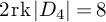
, and in accordance with [Reference Finashin and Kharlamov7] the signed count of the 2-roots
 $v_1$
gives
 $2 \operatorname {rk}|D_4|=8$
, which after that should be multiplied by 2 because of two choices of
 $v_2$
in
 $A_1$
. Thus, in accordance with Corollary 2.3.2(1),
 $$ \begin{align*}\sum_{A\in {\mathcal C}_{\mathbb R}^4(X,x)}{\frak s}(A)= \sum_{v\in R_{\mathbb R}^{4}} i^{\operatorname{\widehat q}_{X}(v)}= 24+16=40. \end{align*} $$
3.3.4 The case of
$X_{\mathbb R}=\mathbb {RP}^{2}\#2{\mathbb T}^2$

According to Table 1,
 $\operatorname {\Lambda }(X)$
is isomorphic to
 $D_6$
, which can be seen as a sublattice of
 $6\langle -1\rangle $
generated by the following roots
 $\boxed {\begin {matrix} -1&-1&0&0&0&0\\ 1&-1&0&0&0&0\\ 0&1&-1&0&0&0\\ 0&0&1&-1&0&0\\ 0&0&0&1&-1&0\\ 0&0&0&0&1&-1\\ \end {matrix}}$
The vanishing of
 $\operatorname {\widehat q}_{X}$
on these basic roots implies immediately its vanishing on the twelve (-4)-vectors that contain
 $\pm 2$
as one coordinate and
 $0$
as others. The rest of
 $(-4)$
-vectors are obtained from
 $(\pm 1,\pm 1,\pm 1,\pm 1,0,0)$
by permutation of coordinates (totally
 $2^4\binom 62$
). The
 $\binom 62$
permutations interpreted as partitions
 $n_1+n_2+n_3=4$
have either all
 $n_i$
even (
 $6$
possibilities), in which case
 $\operatorname {\widehat q}_X=0$
, of give two odd summands
 $n_i$
(
 $9$
cases), in which case
 $\operatorname {\widehat q}_X=2$
.
Thus, in accordance with Corollary 2.3.2(1),
 $$ \begin{align*}\sum_{A\in {\mathcal C}_{\mathbb R}^4(X,x)}{\frak s}(A)= \sum_{v\in R_{\mathbb R}^{4}} i^{\operatorname{\widehat q}_{X}(v)}= 12+16(9-6)=60. \end{align*} $$
3.4 Proof of Theorems 1.2.2 and 1.2.1
The results obtained above are summarized in Table 6 which is organized by columns according to Smith types of Bertini pairs and where the rows show the result of the signed count over
 $A\in {\mathcal C}_{\mathbb R}^{2k}(X,x)$
for
 $X=X^{\pm }$
in each Bertini pair. For the first 4 columns our convention is that
 $X^+$
refers to surfaces with connected real locus (see Table 1).
For
 $k=1$
, the results shown in Table 6 are given by Proposition 3.1.1. For
 $k=2$
, they are taken from Propositions 2.4.2, 2.5.2 and previous Subsection. For
 $k=0$
they are due to [Reference Brugallé2] (note that the original Welschinger weight used in [Reference Brugallé2] coincides with our
 ${\frak s}$
-weight in the case of curves
 $A\in {\mathcal C}_{\mathbb R}^0(X,x)$
, since their arithmetic genus
 $g_A=2$
is even, and thus
 $c_A$
and
 $s_A$
have the same pairity).
 $\sum \limits _{A\in {\mathcal C}_{\mathbb R}^{n}}{\frak s}(A)$
for each type of Bertini pairs
 $X^{\pm }$

To the right from the table, for each
 $n=0,2,4$
, these values are expressed as a single function of
 $r=\mathrm {rk}\operatorname {\Lambda }(X^{\pm })$
.
Adding the 3 terms
 $\sum _{A\in {\mathcal C}_{\mathbb R}^{0}(X,x)}{\frak s}(A)+\sum _{A\in {\mathcal C}_{\mathbb R}^{2}(X,x)}{\frak s}(A)+\sum _{A\in {\mathcal C}_{\mathbb R}^{4}(X,x)}{\frak s}(A)$
for each type of
 $X=X^{\pm }$
we obtain Theorem 1.2.1.
As we take the sum
 $\sum _{A\in {\mathcal C}_{\mathbb R}^{2}(X,x)}{\frak s}(A)+2\sum _{A\in {\mathcal C}_{\mathbb R}^{4}(X,x)}{\frak s}(A)$
for
 $X=X^+$
and add it with the same sum for
 $X=X^-$
, we obtain Theorem 1.2.2.
4 Wall crossing
Richtiges Auffassen einer Sache und Mißverstehen der
gleichen Sache schließen einander nicht vollständig aus.
F. Kafka, “Der Prozeß. Kapitel 9: Im Dom”
According to Theorems 1.2.1 and 1.2.2 the weighted counts from these theorems are invariant under choice of a del Pezzo surface and choice of a generic point. The proof presented above (in Sections 2 - 3) is achieved by a somehow case-by-case calculation. Here, we provide a somewhat direct proof of such an invariance based on a real version of Abramovich-Bertram-Vakil wall-crossing formula [Reference Vakil13, Theorem 4.2] and the underlying gluing procedure, see [Reference Itenberg, Shustin and Kharlamov9, Proposition 4.1] and [Reference Brugallé and Puignau5, Theorem 2.5].
4.1 Wall-crossing families
The bi-anticanonical map establishes an isomorphism between the moduli space of Bertini pairs of real del Pezzo surfaces X of degree 1 and that of real non-singular sextics C on the real quadric cone Q based on a non-empty real conic. In particular, such an isomorphism allows not only to identify the real deformation classes of these objects but also to visualize nodal degenerations of the former by means of nodal degenerations of the latter.
Let us say that a germ of a complex analytic family of sextics
 $C(t)\subset Q$
,
 $t\in D^2=\{t\in {\mathbb C}\,|\, \vert t\vert <1\}$
form a (simple) nodal degeneration, if
 $C(t)$
are non-singular sextics for
 $t\ne 0$
while
 $C(0)$
is uninodal. We name a nodal degeneration a Morse-Lefschetz family if the total space of the family is smooth (in other words, “wall-intersection” is transverse), and real if the complex conjugation on
 $Q\subset {\mathbb P}^3$
maps
 $C(t)$
to
 $C(\bar t)$
.
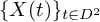
By taking the double coverings
 $X(t)\to Q$
branched along
 $C(t)$
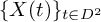
we obtain a complex analytic family
 $\{X(t)\}_{t\in D^2}$
where
 $X(t)$
are del Pezzo surfaces of degree 1 for
 $t\ne 0$
, while
 $X(0)$
is uninodal. Such a family will be called a Morse-Lefschetz family of del Pezzo surfaces of degree 1, if the family
 $C(t)$
is Morse-Lefschetz.
If the family
 $C(t)$
is real, then the real structure
 $\operatorname {conj}: Q\to Q$
lifts to a pair of Bertini-dual real structures on the total space of the family
 $\{X(t)\}_{t\in D^2}$
. In particular, for each
 $t\in {\mathbb R}\cap D^2$
, the surface
 $X(t)$
acquires a pair of Bertini dual real structures, whose real loci are denoted
 $X_{\mathbb R}^{\pm }(t)$
.
A real Morse-Lefschetz family
 $X(t)$
will be called bi-cone-like if the real node on each of
 $X_{\mathbb R}^{\pm }(0)$
is modeled locally by equation
 $x^2+y^2-z^2=0$
(rather than by
 $x^2+y^2+z^2=0$
). In terms of the exceptional divisor
 $E\subset \widetilde X(0)$
of the blowing up
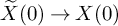 $\widetilde X(0)\to X(0)$
this means that the real locus
 $E^{\pm }_{\mathbb R}\subset \widetilde X^{\pm }_{\mathbb R}(0)$
is non-empty for both Bertini-dual real structures lifted to
 $\widetilde X(0)$
. In terms of
 $C(t)$
, this means that the node of
 $C_{\mathbb R}(0)$
is a cross-point (rather than a solitary point).
Proposition 4.1.1. Any two real del Pezzo surfaces of degree 1 can be connected by a finite sequence of real Morse-Lefschetz bi-cone-like nodal degenerations.
Proof. Let
 $C\subset Q$
be a real non-singular sextic whose real locus is connected. Then,
 $X^{\pm }_{\mathbb R}$
is homeomorphic to
 $\mathbb {RP}^{2}$
for both del Pezzo surfaces
 $X^{\pm }$
of the Bertini pair defined by C. Therefore, these
 $X^{\pm }$
are real deformation equivalent to each other. Thus, there remain to check that any real non-singular sextic
 $C'$
can be obtained from C by a finite sequence of real Morse-Lefschetz families avoiding solitary nodes. Such degenerations can be found, for example, on Fig.1 in [Reference Finashin and Kharlamov7].
In the rest of Section 4 we always suppose that:
-
(1)
$\{X(t)\}_{t\in D^2}$
is a real Morse-Lefschetz bi-cone-like family of del Pezzo surfaces of degree 1; -
(2)
$\chi (X_{\mathbb R}(t))<\chi (X_{\mathbb R}(-t))$
for
$t>0$
(for a bi-cone-like family this means that the node of
$X_{\mathbb R}(0)$
gives one-sheeted perturbation on
$X_{\mathbb R}(t)$
with
$t>0$
and two-sheeted on
$X_{\mathbb R}(-t)$
); -
(3)
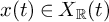
$x=\{x(t)\}_{t\in D^2}$
is a
$\operatorname {conj}$
-invariant family of basepoints,
$x(t)\in X(t)$
, in particular, for
$t\in {\mathbb R}$
,
$x(t)\in X_{\mathbb R}(t)$
; -
(4) the family x is generic, and
$x(0)$
is chosen on a real arc issued from the node in a generic direction, not at the node but sufficiently near to it. Such choice (used, in particular, in 4.7.2) is possible due to our assumption that the node is bi-cone-like.



4.2 Merging families of curves
For each
 $n\in \{0,2,4\}$
and a sufficiently small
 $\varepsilon>0$
, the family
 $$ \begin{align*} \cup_{t\in[-\varepsilon,\varepsilon], t\ne 0}{\mathcal C}^{n}_{\mathbb R}(X(t),x(t)) \end{align*} $$
has a natural structure of semi-analytic set with a proper, having finite fibers, projection to
 $[-\varepsilon ,\varepsilon ]\smallsetminus 0$
. Their union has a natural compactification by a finite set
 ${\mathcal C}_{\mathbb R}(X(0),x(0))$
formed by the curves on
 $X(0)$
obtained as limits of the curves from
 $\cup_n\cup _{t\in [-\varepsilon ,\varepsilon ], t\ne 0}\,{\mathcal C}^{n}_{\mathbb R}(X(t),x(t))$
. This gives us what we call a wall-crossing diagram: a compact 1-dimensional graph-like set
 $$ \begin{align*} {\mathcal C}_{\mathbb R}(X,x)=\cup_n\cup_{t\in[-\varepsilon,\varepsilon]}{\mathcal C}_{\mathbb R}(X(t),x(t)), \end{align*} $$
with a proper map
 $\pi :{\mathcal C}_{\mathbb R}(X,x)\to [-\varepsilon ,\varepsilon ]$
that sends
 ${\mathcal C}^{n}_{\mathbb R}(X(t),x(t))$
to t (cf., [Reference Itenberg, Shustin and Kharlamov9, Proposition 4.1]). We are interested only in the germ of this map at
 ${\mathcal C}_{\mathbb R}(X(0),x(0))$
and treat each of the elements of the latter as vertices, although some of them represent a smooth point with a non-singular projection, in which case we call a vertex inessential. More precisely, it happens if the curve A representing a vertex is not passing through the node of
 $X(0)$
; then it extends to a unique smooth family
 $A(t)\subset X(t)$
,
 $A(0)=A$
,
 $x(t)\in A(t)$
,
 $t\in [-\epsilon ,\epsilon ]$
.
For a fixed real Morse-Lefschetz family
 $(X(t),x(t))$
, there exists
 $\epsilon>0$
such that each positive (respectively, negative) semi-branch issued from any vertex
 $A\in {\mathcal C}_{\mathbb R}(X(0),x(0))$
represents a unique continuous family
 $A(t)\subset X(t)$
,
 $A(0)=A$
,
 $x(t)\in A(t)$
,
 $t\in [0,\epsilon ]$
(respectively,
 $t\in [-\epsilon , 0]$
). We name such germs of semi-branches positive and negative edges. A vertex has branch signature
 $(p,q)$
if it has degree
 $m=p+q$
with p positive and q negative incident edges. The set of all vertices of a fixed signature
 $(p,q)$
is denoted by
 $\mathcal V_{p,q}$
and the set of all vertices by
 $\mathcal V=\cup _{p,q\geqslant 0}\mathcal V_{p,q}$
.
The set of all edges of the wall-crossing diagram has a natural partition according to a partition of the sets
 $\mathcal B^n(X(t))$
,
 $t\ne 0$
, into
 $$ \begin{align*}\mathcal B^{n,k}(X(t))=\{ \alpha\in B^n(X(t))\,|\, \alpha\cdot v=\pm k\},\ \ k\geqslant0,\end{align*} $$
depending on the intersection index
 $x\cdot v$
with the vanishing class
 $v\in H_2(X(t))$
of the node of
 $X(0)$
. Namely, for
 $n=2, 4$
and every
 $t\ne 0$
, replacing divisor classes
 $\alpha \in B^n(X(t))$
by curves A representing
 $\alpha $
, we obtain a partition
 $$ \begin{align*} {\mathcal C}_{\mathbb R}^{n}({X(t)},x(t))= {\mathcal C}_{\mathbb R}^{n,0}(X(t),x(t))\cup{\mathcal C}_{\mathbb R}^{n,1}(X(t),x(t))\cup{\mathcal C}_{\mathbb R}^{n,2}(X(t),x(t)), \end{align*} $$
where
 $$ \begin{align*} {\mathcal C}_{\mathbb R}^{n,k}(X(t),x(t))= \{A\in {\mathcal C}^{n}_{\mathbb R}(X(t),x(t))\,|\, [A]\cdot v=\pm k\},\ k\geqslant0 \end{align*} $$
(for
 $n=0$
, we get a trivial splitting
 ${\mathcal C}^0_{\mathbb R}(X(t),x(t))={\mathcal C}^{0,0}_{\mathbb R}(X(t),x(t))$
, since
 $\mathcal B^0(X)$
contains only one element,
 $-2K_X$
). Such a partition is preserved under deformations and induces a partition of the edges into (n,k)-types. We denote by
 $\mathcal E^{n,k}_+(v)$
(resp.
 $\mathcal E^{n,k}_-(v)$
) the set of positive (resp. negative) edges of the given
 $(n,k)$
-type incident to a given vertex
 $v\in \mathcal V $
, and let
 $\mathcal E_\pm (v)=\cup _{n,k}\mathcal E^{n,k}_\pm (v)$
.
The value
 ${\frak s}(A(t))$
does not change with t for the curves
 $A(t)$
representing an edge
 $\varepsilon \in \mathcal E$
, so we get a well-defined sign
 ${\frak s}(\varepsilon)={\frak s}(A(t))$
. To measure how the signed count of edges is effected by a wall-crossing, we define
 $$ \begin{align*}\Delta^{n,k}_{p,q}=\sum_{v \in \mathcal V_{(p,q)}} \left(\sum_{\varepsilon \in\mathcal E^{n,k}_+(v)} {\frak s}(\varepsilon)- \sum_{\varepsilon \in\mathcal E^{n,k}_-(v)}{\frak s}(\varepsilon)\right). \end{align*} $$
Proposition 4.2.1. Assume that
 $(X(t),x(t))$
is a pointed Morse-Lefschetz family satisfying assumptions (1)-(4) of Subsection 4.1. Then each vertex of its wall-crossing diagram is either inessential, or has branch signature
 $(2,0)$
,
 $(4,0)$
, or
 $(2,2)$
. Moreover:
-
(A) At each vertex
$v\in \mathcal V$
we have
$\sum_{\varepsilon\in{\mathcal E}_+(v)} {\mathfrak s}(\varepsilon)=\sum_{\varepsilon\in{\mathcal E}_-(v)} {\mathfrak s}(\varepsilon)$
, and both sums vanish for
$v\in \mathcal E_{(2,0)}\cup \mathcal E_{(4,0)}$
. -
(B) The values of
$\Delta ^{n,k}_{p,q}$
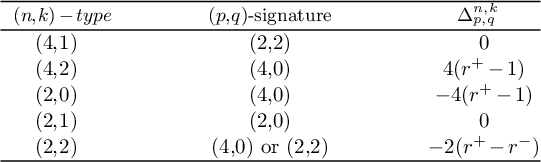
are as indicated in Table 7.Table 7
$\Delta ^{n,k}_{p,q}$
for essential vertices (
$r^{\pm }$
denotes
$\operatorname {rk} K^{\perp }\cap \ker (1\pm \operatorname {conj}_*)$
taken for
$X(t)$
with
$t>0$
)








This Proposition will be proved in Subsection 4.2.1. Before we derive from it the invariance property of the counts from Theorems 1.2.1 and 1.2.2, and make preparations in Sections 4.5 and 4.6.
4.3 Derivation of Theorem 1.2.1
Due to Proposition 3.2.1, our count does not change under real variations of X as long as X is preserved non-singular, and under variations of
 $x\in X_{\mathbb R}$
. Thus, for proving Theorem 1.2.1, it is sufficient to check the invariance under the wall-crossing, i.e., in real Morse-Lefschetz families of real del Pezzo surfaces of degree 1,
 $X(t), t\in {\mathbb C}, \vert t\vert \!<\!\!<\!1$
with
 $\operatorname {conj}(t): X(t)\to X(\bar t)$
. Due to Proposition 4.1.1, we may restrict ourselves only with nodal degenerations whose exceptional divisor E has
 $E_{\mathbb R}\ne \varnothing $
both for
 $X^+(0)$
and
 $X^-(0)$
. Then, Proposition 4.2.1(A) applies and shows even a stronger invariance statement: the invariance of the count (from Theorem 1.2.1) at each vertex of the wall-crossing diagram.
To obtain the value of
 $\sum _{A\in {\mathcal C}_{\mathbb R}(X,x)}{\frak s}(A)$
, it is enough now to consider a surface X with
 $X_{\mathbb R}=\mathbb {RP}^{2} +4{\mathbb S}^2$
. Then,
 $\Lambda (X)=0$
(see Table 1) which implies
 $\mathcal {B}^2(X)= \mathcal {B}^4(X)=\varnothing $
. Thus the above sum is reduced to the Welschinger invariant of
 $-2K$
, which is
 $30$
due to [Reference Brugallé2].□
4.4 Derivation of Theorem 1.2.2
As above, due to Propositions 3.2.1 and 4.1.1 we may restrict ourselves only with nodal degenerations whose exceptional divisor E has
 $E_{\mathbb R}\ne \varnothing $
both for
 $X^+(0)$
and
 $X^-(0)$
. Then, the invariance claimed follows from weighted summation for classes
 ${\mathcal C}^2_{\mathbb R}$
and
 ${\mathcal C}^4_{\mathbb R}$
indicated in the rightmost column of Table 7. Namely, it gives
 $8(r^+-1)-4(r^+-1)-2(r^+-r^-)=2(r^++r^-)-4=12$
coming from
 $X^+$
and the opposite sum from its Bertini dual,
 $-2(r^++r^-)+4=-12$
. Alternation of the sign here is due to our convention
 $\chi (X_{\mathbb R}^+(t))>\chi (X_{\mathbb R}^+(-t))$
for
 $t>0$
, which implies that
 $\chi (X_{\mathbb R}^-(-t))>\chi (X_{\mathbb R}^-(t))$
, since
 $\chi (X^+_{\mathbb R}(t))+ \chi ( X^-_{\mathbb R}(t))=2$
.
To obtain the value of
 $$ \begin{align*}\sum_{A\in {\mathcal C}_{\mathbb R}^2(X^+,x^+)\cup{\mathcal C}_{\mathbb R}^4(X^+,x^+)}\widetilde{{\frak s}}(A) +\sum_{A\in {\mathcal C}_{\mathbb R}^2(X^-,x^-)\cup{\mathcal C}_{\mathbb R}^4(X^-,x^-)}\widetilde{{\frak s}}(A), \end{align*} $$
we consider a Bertini pair
 $X^{\pm }$
where
 $X^+_{\mathbb R}=\mathbb {RP}^{2}\#4{\mathbb T}^2$
and
 $X^-_{\mathbb R}=\mathbb {RP}^{2} +4\mathbb S^2$
. The second sum is equal to
 $0$
, since it is empty because of
 $\mathcal B^2(X^-)=\mathcal B^4(X^-)=\varnothing $
(cf. the proof above). To treat the first sum, note that by definition of
 $\widetilde {{\frak s}}$
this sum is equal to
 $\sum _{A\in {\mathcal C}_{\mathbb R}^2(X^+,x^+)} \mathbf s(A) + 2 \sum _{A\in {\mathcal C}_{\mathbb R}^4(X^+,x^+)} \mathbf s(A)$
. Here, according to Proposition 3.1.1,
 $\sum _{A\in {\mathcal C}_{\mathbb R}^2(X^+,x^+)} \mathbf s(A)= 2(r^--r^+)r^+= - 128$
. By Theorem 1.2.1 we also have
 $\sum _{A\in {\mathbb R}^0(X^+,x^+)} \mathbf s(A) + \sum _{A\in {\mathcal C}_{\mathbb R}^2(X^+,x^+)} \mathbf s(A) + \sum _{A\in {\mathcal C}_{\mathbb R}^4(X^+,x^+)} \mathbf s(A) = 30$
while
 ${\mathcal C}_{A\in {\mathbb R}^0(X^+,x^+)} \mathbf s(A)=46$
(see Table 6). Taking this into account we get
 $-128 + 2(30-46+128)=96$
.□
4.5 Untwisting of Morse-Lefschetz families
To kill the monodromy in a Morse-Lefschetz family
 $X(t), t\in {\mathbb C}, \vert t\vert <\!\!<1$
, as above, we consider an associated untwisted family,
 $X'(\tau ), \tau \in {\mathbb C}, \vert \tau \vert <\!\!<1$
, induced by the base change
 $t=\tau ^2$
. The total space, a 3-fold
 $X'=\cup _{\tau } X'(\tau )$
, acquires a node at the nodal point of
 $X'(0)=X(0)$
. Blowing up at this node,
 $\widetilde X\to X'$
, leads to a new a family
 $\widetilde X(\tau ), \tau \in {\mathbb C}, \vert \tau \vert <\!\!<1$
with
 $\widetilde X(\tau )=X'(\tau )$
for
 $\tau \ne 0$
and
 $\widetilde X(0)$
formed by two irreducible components with normal crossing: one component, denoted
 $\widetilde X^1(0)$
, is the minimal nonsingular model of
 $X'(0)$
, and the other one, denoted
 $\widetilde X^0(0)$
, is isomorphic to
 ${\mathbb P}^1\times {\mathbb P}^1$
. These components intersect each other along a nonsingular rational curve E that represents the exceptional divisor of the blowup
 $\widetilde X^1(0)\to X'(0)$
and which can be seen in
 $\widetilde X^0(0)={\mathbb P}^1\times {\mathbb P}^1$
as the diagonal.
By contraction
 $\widetilde X^0(0)\to E$
along the lines of one of the rulings, we get a smooth family of smooth surfaces with
 $\widetilde X^1(0)$
as central fiber (see [Reference Atiyah1] for details). A choice of such a contraction provides then natural isomorphisms
 $$ \begin{align*} \operatorname{Pic}(\tilde X(\tau))=H_2(\widetilde X(\tau)) \overset{\simeq}{\longrightarrow}H_2(\widetilde X^1(0))=\operatorname{Pic}(\widetilde X^1(0)) \end{align*} $$
that preserve the intersection form. This allows us for simplicity of notation to use the same symbol for all corresponding divisors and homology classes. Although we also have a natural isomorphism between
 $H_2(\widetilde X(\tau ))$
and
 $H_2({X}({t}))$
with
 $t=\tau ^2$
for
 $\tau \ne 0$
, the composed map
 $$ \begin{align*} H_2({X}({t}))\overset{\simeq}{\longleftarrow} H_2(\widetilde X(\tau)) \overset{\simeq}{\longrightarrow}H_2(\widetilde X^1(0)) \overset{\simeq}{\longleftarrow} H_2(\widetilde X({-\tau})) \overset{\simeq}{\longrightarrow}H_2({X}({t})) \end{align*} $$
is not identity but the Dehn twist
 $x\mapsto x+([E]\circ x)[E]$
. This does not allow us to transport such a simplification of notation to the whole family
 $X(t)$
with
 $t\ne 0$
. However, if the Morse-Lefschetz family is equipped with a real structure, then there appear two lifts of the real structure to
 $\tilde X$
: one of them is coherent with the standard complex conjugation
 $\tau \mapsto \bar \tau $
, and the other one with
 $\tau \mapsto -\bar \tau $
. As a rule we privilege the first one, which, for real
 $t>0$
, identifies
 $X(t)$
as a real surface with
 $\tilde X(\tau )$
where
 $\tau>0$
,
 $\tau ^2=t$
. When we turn to
 $X(t)$
with
 $t<0$
, we use the second lift and identify
 $X(t)$
with
 $\tilde X(\tau )$
,
 $\tau ^2=t$
, where
 $\tau $
is pure imaginary with positive imaginary part. In such a way we transport the above simplification of notation to
 $X(t)$
with
 $t<0$
too. This allows us also to simplify our notation
 $\mathcal B(X)=\mathcal B^0(X)\cup \mathcal B^2(X)\cup \mathcal B^4(X)$
when applied to
 $X=\widetilde X(\tau )$
with
 $\tau \ne 0$
, to
 $X=\widetilde X^1(0)$
, and to
 $X=X(t)$
with any real
 $t\ne 0$
.
Note also that the real structures on
 $\tilde X(\tau )$
,
 $\tau>0$
, and on
 $\tilde X(i \tau ), \tau>0,$
converge to the same real structure on
 $\tilde X^1(0)$
and to different real structures on
 $\tilde X^0(0)={\mathbb P}^1\times {\mathbb P}^1$
. Due to assumption (2) in Subsection 4.1, the first one acts on
 $\tilde X^0(0)={\mathbb P}^1\times {\mathbb P}^1$
as
 $(p,q)\mapsto (\bar p, \bar q)$
, while the second one as
 $(p,q)\mapsto (\bar q, \bar p)$
.
4.6 Enumerating of limit splittings
In this subsection we consider a Morse-Lefschetz family
 $(X(t),x(t))$
as in Proposition 4.2.1. As is known (see [Reference Vakil13, Theorem 4.2] and [Reference Itenberg, Shustin and Kharlamov9, Proposition 4.1]), each family
 $A(t)\in {\mathcal C}_{\mathbb R}^{2}(X(t),x(t))\cup \, {\mathcal C}_{\mathbb R}^{4}( X(t),x(t))$
,
 $0\!<\! t\! <\!\epsilon $
(resp.,
 $-\epsilon \! <\!t\!<\!0$
), in
 $X(t)$
after a canonical lift
 $\widetilde A(\tau ): =A(\tau ^2)$
to
 $\widetilde X(\tau )$
with
 $0\!<\!\tau \!<\!\sqrt {\epsilon }$
(resp., with
 $\tau =i \tau ', 0\!<\!\tau '\!<\!\sqrt {\epsilon }$
) admits a well defined, and unique, extension up to a family
 $\widetilde A(\tau )$
defined for every
 $\tau \in {\mathbb C}, \vert \tau \vert <\sqrt {\epsilon }$
. As the first step of the proof of Theorem 1.2.2, we enumerate possible splittings
 $\widetilde A(0)=D{}+ rE$
,
 $r>0$
, in the limit
 $\widetilde A(0)=\lim _{\tau \to 0} \widetilde A(\tau )\subset \widetilde X^1(0)$
. As is known (Loc.cit.), in each of these splittings, due to a generic choice of
 $x(t)$
, the divisors D are always reduced irreducible rational and intersect E transversally.
Lemma 4.6.1. If
 $A(t)\in {\mathcal C}^{2}(X(t),x(t))$
, so that
 $[A(t)]= -2K-e\in \mathcal B^2$
, then the only 3 cases of splitting
 $\widetilde A(0)=D{}+ rE$
,
 $r>0$
, are like indicated in the table below. In the third case, we have
 $e=-[E]$
.

Proof. The divisor D, which is irreducible and pass, by definition, through a fixed generic point, can not be a component of the proper image
 $I\subset \widetilde X^1(0)$
of the generator of Q passing through the node of
 $C_0$
. Since
 $[D]=[\widetilde A(0)]-r[E]=-2K-e-r[E]$
and
 $[I]=-K-[E]$
, we conclude that
 $[D]\cdot (-K-[E])=2+e\cdot [E]- 2r\geqslant 0$
. This gives bound
 $r\leqslant 2$
, since
 $e\cdot [E]\leqslant 2$
by Cauchy-Schwarz inequality. Furthermore, by the same argument, if
 $r=2$
then
 $e\cdot [E]= 2$
and thus
 $[E]=-e$
. Both
 $r=1$
and
 $e\cdot [E]=2$
is impossible, since then
 $e=-[E]$
and
 $[D{}]=-2K$
which contradicts to
 $[D{}]\cdot [E]\geqslant 1$
. The remaining calculations trivially follow from
 $[D]=-2K-e-r[E]$
.
Lemma 4.6.2. If
 $A(t)\in {\mathcal C}^{4}(X(t),x(t))$
, so that
 $[A(t)]= -2K-v\in \mathcal B^4$
, then the only 2 cases of splitting
 $\widetilde A(0)=D{}+ rE$
,
 $r>0$
, are like indicated in the table below

Proof. Since
 $v\cdot [E]\leqslant [2\sqrt 2]=2$
, the same arguments as in the proof of Proposition 4.6.1 imply
 $r\leqslant 2$
and show that
 $r=2$
may hold only if
 $v\cdot [E]=2$
. The case
 $r=1, v\cdot [E]=2$
is excluded using
 $[D]\cdot [E]\geqslant 1$
, and the case
 $r=1, v\cdot [E]=0$
using
 $[D]^2\geqslant 0$
. The remaining calculations trivially follow from
 $[D]=-2K-v-r[E]$
.
Lemma 4.6.3. If
 $A(t)\in {\mathcal C}^{0}(X(t),x(t))$
, so that
 $[A(t)]= -2K$
, then the only splitting
 $\widetilde A(0)=D{}+ rE$
,
 $r>0$
, is

Proof. It follows from
 $[D{}]^2=(-2K-r[E])^2=4-2r^2\geqslant -1$
.
4.7 Proof of Proposition 4.2.1
Note first that our assumption
 $\chi (X^+_{\mathbb R}(t))<\chi ( X^+_{\mathbb R}(-t))$
for
 $t>0$
implies that the both rulings of
 $\widetilde X^{0}(0)$
are real, and thus, the real structure descends from the family
 $\widetilde X(\tau )$
to the family obtained by contraction of any of the two rulings. When passing from
 $X^+(t)$
to the Bertini dual family
 $X^-(t)$
, we do the same, only the direction is changing:
 $\chi (X^-_{\mathbb R}(-t))<\chi ( X^-_{\mathbb R}(t))$
if
 $t>0$
.
To treat the semi-branches issued from a vertex we apply the gluing procedure underlying Abramovich-Bertram-Vakil formula (see [Reference Itenberg, Shustin and Kharlamov9, Proposition 4.1] and [Reference Brugallé and Puignau5, Theorem 2.5]). Enumeration of the semi-branches issued from a vertex represented by a curve D is equivalent, by definition, to enumerate curve families
 $A(t)$
having in the limit
 $A(0)=D{}+rE$
,
 $r\geqslant 0$
. To do this we use Lemmas 4.6.1, 4.6.2, and 4.6.3. Due to Lemmas 4.6.1, 4.6.2, and 4.6.3,
 $r\leqslant 2$
and for each
 $r\leqslant 2$
there are 2 kind of cases to be considered separately:
 $D{}\cdot E=1$
and
 $D{}\cdot E=2$
.
4.7.1 Case
$\mathbf {r\leqslant 1}$
and
$\mathbf {D{}\cdot E=1}$


At each vertex of such kind we have 2 positive semi-branches. Namely, as it follows from Lemmas 4.6.1, 4.6.2, and 4.6.3, a pair of real curves
 $A'(t,) A''(t)\in {\mathcal C}_{\mathbb R}^{n,1}(X(t),x(t))$
,
 $t>0$
, with
 $n=2$
or
 $4$
and
 $[A^{\prime \prime }_{\mathbb R}(t)]=[A^{\prime }_{\mathbb R}(t)]+ [E_{\mathbb R}]$
, merge together in the limit
 $t\to 0^+$
. The curves
 $A'(t)$
,
 $A''(t)$
have the same number of cross-point nodes, while
 $$ \begin{align*} q([A^{\prime\prime}_{\mathbb R}(t)])=q([A^{\prime}_{\mathbb R}(t)]+ [E])=q([A^{\prime}_{\mathbb R}(t)])+ q([E])+2= q([A^{\prime}_{\mathbb R}(t)])+2. \end{align*} $$
This implies
 ${\frak s}(A'(t))+{\frak s}(A''(t)=0$
.
There are no negative semi-branches at such a vertex, since neither
 $[A'(0)]$
nor
 $[A''(0)]$
is orthogonal to
 $[E]$
, while the homology action of
 $\operatorname {conj}$
after wall-crossing is changed by reflection in
 $[E]$
.
4.7.2 Case
$\mathbf {r\leqslant 2}$
and
$\mathbf {D{}\cdot E=2,\, D{}^2=0}$


In this case the curve D generates a real rational ruling of
 $\widetilde X^1(0)$
. Thus, due to our choice as the base-point
 $x(0)\in X_{\mathbb R}(0)$
a point which is close to a generic point of
 $E_{\mathbb R}$
(see assumption (4) in 4.1), the curve D intersects E in 2 real points. Therefore, Lemmas 4.6.1(2) and 4.6.2(2) provide 3 groups of real families of curves sharing such a
 $D{}$
in the limit
 $t\to 0^+$
. They correspond to divisor classes of type
 $-2K-e-[E], -2K-e+[E]$
and
 $-2K -e$
,
 $e\in R^2(X(t))$
. The first two classes provide one merging pair of curves
 $A'(t),A''(t)\in {{\mathcal C}_{\mathbb R}^{4,2}(X(t),x)}$
,
 $t\geqslant 0$
, and the last class yields another merging pair
 $\widetilde A'(t),\widetilde A''(t)\in {{\mathcal C}_{\mathbb R}^{2,0}(X(t),x)}$
.
Equality of modulo 2 homology classes
 $[A'(t)]=[A''(t)]$
,
 $[\widetilde A'(t)]=[\widetilde A''(t)]$
, implies
 $\operatorname {\widehat q}([A'(t)])=\operatorname {\widehat q}([A''(t)])$
and
 $\operatorname {\widehat q}([\widetilde A'(t)])=\operatorname {\widehat q}([\widetilde A''(t)])$
. On the other hand,
 $A'(t)$
and
 $A''(t)$
has no singular points at all, while the number of cross-points in
 $\widetilde A^{\prime }_{\mathbb R}(t),\widetilde A^{\prime \prime }_{\mathbb R}(t)$
is by 1 greater than the number of cross-points in
 $D_{\mathbb R}$
, that is in
 $A^{\prime }_{\mathbb R}(0)$
. Therefore,
 $$ \begin{align*}{\frak s}(A'(t))={\frak s}( A''(t))=-{\frak s}(\widetilde A'(t))=-{\frak s}(\widetilde A''(t))\end{align*} $$
as it follows from the definition of weights (1.2.2). This implies that the sum
 ${\frak s}(A'(t))+{\frak s}( A''(t))+{\frak s}(\widetilde A'(t))+ {\frak s}(\widetilde A''(t))$
that corresponds to positive semi-branches issued from D is zero.
The situation with counting by means of the weights (1.2.4) is different. Here we need to treat the branches of type
 $(4,2)$
and type
 $(2,0)$
separately. For that, we use a bijection between the set of vertices D under consideration and the set of real rulings with
 $D\cdot E=2$
, and, in its turn, with the real roots e orthogonal to
 $[E]$
. Thus, taking the sum over this set of vertices we get
 $$ \begin{align*}\sum_{A\in{\mathcal C}_{\mathbb R}^{4,2}(X(t),x(t))}{\frak s}(A)= \sum_{e\in R^2(t),\, e\cdot E=0}\operatorname{\widehat q}(e)=2(r^+-1),\end{align*} $$
and
 $$ \begin{align*}\sum_{A\in{\mathcal C}_{\mathbb R}^{2,0}(X(t),x(t))}{\frak s}(A)= -\sum_{e\in R^2(t), e\cdot E=0}\operatorname{\widehat q}(e)=-2(r^+-1).\end{align*} $$
There are no negative semi-branches at this kind of vertices. Indeed, there are no real curves in divisor classes
 $-2K-e-[E], -2K-e+[E]$
on
 $X(-t)$
since these classes are not orthogonal to
 $[E]$
, and there are no negative semi-branches for
 $-2K -e$
, since, as it was already pointed out in the beginning, all the counted rational curves of class
 $-2K-e$
share in the limit the curve
 $D\subset \widetilde X^1_{\mathbb R}(0)$
that intersects
 $E_{\mathbb R}\subset \widetilde X^1_{\mathbb R}(0)$
at 2 real points, which obstructs gluing D with 2 generators of
 $\widetilde X^0(0)$
to have a real perturbation in
 $X(-t)$
(cf. [Reference Brugallé and Puignau5, Theorem 2.5]).
4.7.3 Case
$\boldsymbol{r\le 2}$
and
$\boldsymbol{D\cdot E=2,\ D^2=0}$


Here, we distinguish two sub-cases: the 2 points of
 $D\cap E$
are real or imaginary complex conjugate.
First, assume that the both points where
 $D{}$
meets E are real. Then Lemmas 4.6.1(3) and 4.6.3 provide four families of curves sharing the same divisor
 $D{}$
in the limit
 $t\to 0^+$
. Two of them represent divisor classes
 $-2K-[E]$
,
 $-2K+[E]$
and the other two belong to the same class
 $-2K$
. The first two classes provide one merging pair of curves
 $A'(t),A''(t)\in {{\mathcal C}_{\mathbb R}^{2,2}(X(t),x(t))}$
,
 $t\geqslant 0$
, and the last class contains another merging pair
 $\widetilde A'(t),\widetilde A''(t)\in {{\mathcal C}_{\mathbb R}^{0}(X(t),x(t))}$
.
Note that
 $\operatorname {\widehat q}$
vanishes for all these curves, since
 $$ \begin{align*}\operatorname{\widehat q}([-2K])=0, \, q([-2K\pm E])=\operatorname{\widehat q}([E])=0\end{align*} $$
and, thus,
 ${\frak s}$
for the curves involved coincides with the weights
 $$ \begin{align*}w(A'(t))=w(A''(t))=-w(\widetilde A'(t))=-w(\widetilde A''(t)),\end{align*} $$
where alternation is explained by the same reason as in the previous case. This gives
 ${\frak s}(A'(t))+{\frak s}(A''(t))+{\frak s}(\widetilde A'(t))+{\frak s}(\widetilde A''(t))=0$
for
 $t>0$
. Since, also as above, there are no negative semi-branches issued from D, we are done with part (A) of Proposition in the case of real
 $D\cap E$
.
If the 2 points of
 $D\cap E$
are imaginary complex conjugate, then we have two positive semi-branches
 $A'(t),A''(t)$
of divisor classes
 $-2K-[E]$
,
 $-2K+[E]$
and two negative semi-branches
 $\widetilde B'(-t),\widetilde B''(-t)$
of divisor class
 $-2K$
. The curves
 $\widetilde B'(-t),\widetilde B''(-t)$
acquire an additional, as compared with
 $A'(t),A''(t)$
, solitary point but have the same number of cross-points. Therefore, we have still a balance between positive and negative semi-branches:
 ${\frak s}(A'(t))+{\frak s}(A''(t))={\frak s}(\widetilde B'(t))+{\frak s}(\widetilde B''(t)).$
For completing the proof of part (B) of Proposition, it remains to evaluate the sum of
 ${\frak s}$
-weights over all positive semi-branches in a fixed class
 $-2K\pm [E]$
. Such a sum can be counted like in (3.1.1), in the proof of Proposition 3.1.1. Each class yields a sum equal to
 $\chi (X_{\mathbb R}(t))-1=r^+-r^-$
, and both classes together give
 $2(r^+-r^-)$
.□
5 Concluding remarks
5.1 Count of quartics 6-tangent to a sextic on a quadratic cone Q
For a given sextic
 $C\subset Q$
, a 6-tangent quartic is a transversal intersection
 $A=Z\cap Q $
of Q with a quadric Z such that the intersection divisor
 $Z \circ C=A\circ C$
contains each point with even multiplicity. Let us denote by
 $T(Q,C,z)$
the set of rational irreducible reduced 6-tangent quartics that pass through a fixed point
 $z\in Q\smallsetminus C$
. Consider, as usual, the double covering
 $\pi : X\to Q$
branched along C. For a generic
 $z\in Q\smallsetminus C$
and
 $\pi ^{-1}(z)=\{x_1,x_2\}$
, each of the induced projection
 $\pi _k: {\mathcal C}^2(X,x_k)\cup {\mathcal C}^4(X,x_k)\to T(Q,C,z), k\in \{1, 2\},$
is a bijection.
Over
 ${\mathbb R}$
, we pick a pair of real points
 $z^{\pm }\in Q^{\pm }_{\mathbb R}=\pi (X^{\pm }_{\mathbb R})$
and consider two sets of real 6-tangent quartics,
 $T_{\mathbb R}(Q_{\mathbb R}^{\pm },C, z^{\pm })=\{A\in T(Q,C,z^{\pm })\,|\, A \text { is real}\} $
. Let
 $\pi ^{-1}(z^{\pm })=\{x^{\pm }_1,x^{\pm }_2\}$
. Note that the real locus
 $A_{\mathbb R}$
of each
 $A\in T_{\mathbb R}(Q_{\mathbb R}^{\pm },C, z^{\pm })$
lies entirely inside region
 $Q^{\pm }_{\mathbb R}$
, and, thus, for each choice of
 $k=1,2$
, the curve A lifts to a unique real rational curve
 $A_k=\pi _k^{-1}\in {\mathcal C}^2_{\mathbb R}(X^{\pm }, x^{\pm }_k)\cup {\mathcal C}^4_{\mathbb R}( X^{\pm }, x^{\pm }_k)$
, and we obtain bijections
 $$ \begin{align*}{\mathcal C}^2_{\mathbb R}( X^{\pm}, x^{\pm}_k)\cup {\mathcal C}^4_{\mathbb R}(X^{\pm}, x^{\pm}_k) \to T_{\mathbb R}(Q^{\pm},C,z^{\pm}).\end{align*} $$
By Theorem 1.1.1(1),
 ${\frak s}(A_1)={\frak s}(A_2)$
for each
 $A\in T_{\mathbb R}(Q_{\mathbb R}^{\pm },C, z^{\pm })$
. This allows to distinguish two species of real 6-tangent quartics: hyperbolic if
 ${\frak s}(A_k)>0$
, and elliptic if
 ${\frak s}(A_k)<0$
. Recall, that by definition
 ${\frak s}(A_k)$
takes the values
 $\pm 1$
.
We also consider a larger set
 $\widetilde T_{\mathbb R}(Q^{\pm },C,z^{\pm })\supset T_{\mathbb R}(Q^{\pm },C,z^{\pm })$
that in addition to 6-tangent quartics contains those real conics in
 $Q_{\mathbb R}^{\pm }$
that are 2-tangent to C and pass through
 $z^{\pm }$
. For every
 $k=1,2$
, each of these conics A lifts to a unique curve
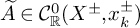 $\widetilde A\in {\mathcal C}^0_{\mathbb R}( X^{\pm }, x_k^{\pm })$
which provides us with a bijection
 $$ \begin{align*} {\mathcal C}^0_{\mathbb R}( X^{\pm}, x^{\pm}_k)\cup {\mathcal C}^2_{\mathbb R}( X^{\pm}, x^{\pm}_k)\cup {\mathcal C}^4_{\mathbb R}( X^{\pm}, x^{\pm}_k)\to \widetilde T_{\mathbb R}(Q^{\pm},C,z^{\pm}). \end{align*} $$
Similar to above, we call a real conic
 $A\in \widetilde T_{\mathbb R}(Q^{\pm },C,z^{\pm })$
hyperbolic if
 ${\frak s}(\widetilde A)>0$
and elliptic if
 ${\frak s}(\widetilde A)<0$
. We let also
 $\widetilde {{\frak s}}(A)=\widetilde {{\frak s}}(A_1)= \widetilde {{\frak s}}(A_2)$
for every
 $A\in T_{\mathbb R}(Q^{\pm },C,z^{\pm })$
.
Theorems 1.2.1 and 1.2.2 imply then the following result.
Theorem 5.1.1. Assume that a real sextic
 $C\subset Q$
is a transversal intersection of a real quadratic cone
 $Q\subset {\mathbb P}^3$
(whose base is non-singular and has non-empty real locus) with a real cubic surface. Then, the following holds for any generic pair of points
 $z^{\pm }\in Q^{\pm }_{\mathbb R}$
:
-
(1) The number of hyperbolic minus the number of elliptic elements in each of the set
$\tilde T_{\mathbb R}(Q^{\pm },C, z^{\pm })$
is 30. -
(2) The number of real quartics A that are 6-tangent to C (i.e. of elements in
$T_{\mathbb R}(Q^+,C,z^+)\cup T_{\mathbb R}(Q^-,C,z^-)$
) counted with weight
$\widetilde {{\frak s}}(A)$
is 96.


5.2 A few speculations on extension to symplectic setting
A natural question is how to extend the results obtained in [Reference Finashin and Kharlamov7] and in this paper to symplectic del Pezzo surfaces of degree 1, that is to rational symplectic 4-manifolds
 $(X,\omega _X)$
with
 $K^2_X=1$
. Alas, even for the existence of an appropriate
 $Pin^-$
-structure, additional conditions will have to be imposed (see Proposition 5.2.1). Namely, we restrict our consideration to those
 $(X,\omega _X)$
that are equipped with an analog of Bertini involution, that is a symplectic involution
 $\tau _X: X\to X$
which acts in
 $H^2(X)$
as a reflection in
 $K_X$
, and for which there exist
 $\omega _X$
-tamed
 $\tau _X$
-invariant generic J-holomorphic structures
 $J_X$
such that the following Bertini condition is satisfied: all J-holomorphic curves Poincaré dual to
 $K_X$
have a common point.
Due to these assumptions, the above curves form a symplectic Lefschetz pencil composed of curves of arithmetic genus 1, and then
 $\tau _X$
can be seen as an extension by continuity of the involution that acts on non-singular elements of the pencil as multiplication by
 $(-1)$
with respect to the group structure with
 $0$
in the fixed point of the pencil. Taking the quotient of X by
 $\tau _X$
, we obtain a symplectic quadratic cone (defined uniquely up to symplectic deformation): an orbifold symplectic manifold Q with one node q (the image of the above fixed piont p) and an orbifold Lefschetz pencil formed by curves of genus 0 passing through the node.
All this can be extended to the real setting, that is to symplectic manifolds equipped with an anti-symplectic involution. So, starting from a real rational symplectic 4-manifold
 $(X,\omega _X, J_X, \tau _X, \operatorname {conj}_X)$
with
 $K_X^2=1$
,
 $(X, \omega _X, J_X, \tau _X)$
satisfying the above Bertini condition, and an anti-symplectic involution
 $\operatorname {conj}_X$
commuting with
 $\tau _X$
, we get a real symplectic quadratic cone
 $(Q,\omega _Q,\operatorname {conj}_Q)$
with a real symplectic quotient map
 $\pi : X\to Q$
. The real part of Q is then diffeomorphic to the real part of a real algebraic quadratic cone over a real non-empty nonsingular conic, and
 $\pi _{\mathbb R}: X_{\mathbb R}\smallsetminus p \to Q_{\mathbb R} \smallsetminus q$
naturally turns into a composition of an embedding of
 $X_{\mathbb R}$
into a real line bundle
 $\xi $
over
 $Q_{\mathbb R}\smallsetminus q$
with the projection from the total space of the bundle to its base. The bundle
 $\xi $
is nontrivial, its Stiefel-Whitney class
 $w_1(\xi )$
is Poincaré dual to a line-generator of
 $Q_{\mathbb R}$
. In particular, this gives a natural diffeomorphism between the total space of
 $\xi $
and
 $(\mathbb {RP}^{2}\smallsetminus point) \times {\mathbb R}$
.
Thus, applying this construction we get an embedding
 $X_{\mathbb R}\smallsetminus p \to \mathbb {RP}^{2}\times {\mathbb R}$
defined uniquely up to isotopy and reversing of
 ${\mathbb R}$
-direction in
 $\mathbb {RP}^{2}\times {\mathbb R}$
. After that, we proceed as in [Reference Finashin and Kharlamov7]. The 3-manifold
 $\mathbb {RP}^{2}\times {\mathbb R}$
admits a unique (up to reversing)
 $\operatorname {Pin}^-$
-structure, the latter induces a unique (up to reversing)
 $\operatorname {Pin}^-$
-structure on
 $X_{\mathbb R}\smallsetminus p$
, which in its turn extends to
 $X_{\mathbb R}$
. Finally, between the two opposite structures we choose that one (which we called monic) whose quadratic function
 $q_X$
takes value
 $1$
on
 $w_1(X_{\mathbb R})$
.
As a conclusion, we obtain, in particular, the following statement.
Proposition 5.2.1. The above construction supplies each real symplectic del Pezzo surface
 $(X, \omega _X, J_X,\tau _X, \operatorname {conj}_X)$
of degree 1 satisfying Bertini condition with a
 $\operatorname {Pin}^-$
-structure
 $\theta _{X}$
on
 $X_{\mathbb R}$
, so that the following properties hold:
-
(1)
$\theta _X$
is invariant under real automorphisms and real deformations of
$(X,\omega _X, J_X, \tau _X, \operatorname {conj}_X)$
that respect Bertini condition. In particular, the quadratic function
$q_{X} : H_1(X_{\mathbb R};{\mathbb Z}/2)\to {\mathbb Z}/4$
associated with
$\theta _X$
is preserved by the Bertini involution. -
(2)
$q_{X}$
takes value
$0$
on each cycle in
$H_1(X_{\mathbb R};{\mathbb Z}/2)$
which is vanishing under deformations respecting Bertini condition and takes value
$1$
on the class dual to
$w_1(X_{\mathbb R})$
. -
(3) If
$X^{\pm }$
is a Bertini pair of real symplectic del Pezzo surfaces of degree 1, then the corresponding quadratic functions
$q_{X^{\pm }}$
take equal values on the elements represented in
$H_1(X^{\pm }_{\mathbb R};{\mathbb Z}/2)$
by the connected components of
$C_{\mathbb R}$
.


It looks to us plausible that the following conjecture should be true, and that its proof can be achieved by the methods borrowed from [Reference Shevchishin10], [Reference Shevchishin and Kharlamov11].
Conjecture 5.2.2. Each deformation class of real symplectic del Pezzo surfaces of degree 1 equipped with J-holomorphic structure satisfying Bertini condition contains a real algebraic del Pezzo surface of degree 1.
If this conjecture will turn out to be true, it will imply that the enumerative results obtained in this paper extend to the symplectic setting described above.
Acknowledgements
This work was finalized during staying of the second author at the Max-Planck Institute for Mathematics in Bonn. He thanks the MPIM for hospitality and excellent (despite a complicated pandemic situation) working conditions. The second author was partially supported by the grant ANR-18-CE40-0009 of Agence Nationale de Recherche and the grant by Ministry of Science and Higher Education of Russia under the contract 075-15-2019-1620 with St. Petersburg Department of Steklov Mathematical Institute.
We thank the referee for valuable remarks and suggestions.
Competing Interests
None.