Introduction
A widely held position is that the lack of HIV/AIDS knowledge and incorrect HIV/AIDS information in the first decade of the era of the AIDS pandemic is associated with higher rates of HIV infection. In sub-Saharan Africa, risky sexual behaviour (Agarwal et al., Reference Agarwal, de Araujo and Paudel2013) is an important factor that explains the highest AIDS prevalence rates (UNAIDS, 2014). Although findings on the relationship between HIV/AIDS knowledge and safer sex are mixed (Okonta & Oseji, Reference Okonta and Oseji2006; Agarwal et al., Reference Agarwal, de Araujo and Paudel2013), most efforts from the first generation of AIDS educational campaigns aimed at increasing HIV/AIDS knowledge, as the fundamental way of promoting safer sex among populations. To achieve this goal, social scientists and policymakers identified potential sources of socialization for conveying HIV/AIDS information (Arnett, Reference Arnett1995). These included families, peers, school/work, community, media, the legal system and cultural/belief systems. An abundant literature is now available which evaluates the effectiveness of reproductive health programmes and interventions (Paul-Ebhohimhen et al., Reference Paul-Ebhohimhen, Poobalan and van Teijlingen2008; Medley et al., Reference Medley, Kennedy, O'Reilly and Sweat2009; Harrison et al., Reference Harrison, Newell and Hoddinott2010; Michielsen et al., Reference Michielsen, Chersich, Luchters, De Kocker, Van Rossem and Temmerman2010). This body of research mostly identified school- and community-based HIV/AIDS interventions that utilized peer-to-peer education strategies or media campaigns during the implementation phase. Until recently, reproductive health interventions involving parents/families in sub-Saharan Africa have been missing (WHO, 2007a, b).
Previous research has also established that parents are the most important socializing agents for children (Arnett, Reference Arnett1995). It is with no surprise that practitioners have advocated that parents/families should be involved in most HIV/AIDS interventions targeting young people in sub-Saharan Africa (WHO, 2007a, b). However, this advocacy relies on an implicit assumption that parents are knowledgeable enough to teach their children about sexual topics including HIV/AIDS. The most efficient strategy to test this assumption is to compare the levels of HIV/AIDS knowledge for parents and their children. Unfortunately, evidence about the relationship between parents' and youth HIV/AIDS knowledge in developing and developed countries is lacking. Parents and families still are an under-studied and under-utilized resource in HIV/AIDS interventions around the world, especially in sub-Saharan Africa (Perrino et al., Reference Perrino, González-Soldevilla, Pantin and Szapocznik2000; Pequegnat & Szapocznik, Reference Pequegnat, Szapocznik, Pequegnat and Szapocznik2000; Pequegnat et al., Reference Pequegnat, Baunan, Bray, Diclemente, DiIorio and Hoppe2001; Tinsley & Lees, Reference Tinsley and Lees2004). Therefore, more reliable research is needed in order to respond collectively to the fight against AIDS, and to provide new insights into the roles of parents/families in fostering accurate HIV/AIDS knowledge. Indeed, parents are not the most cited sources of HIV/AIDS information in Korea (Yoo et al., Reference Yoo, Lee, Kwon, Chung and Kim2005) and Nigeria (Okonta & Oseji, Reference Okonta and Oseji2006), nor are they the preferred source of HIV/AIDS information in Swaziland (Buseh et al., Reference Buseh, Glass, McElmurry, Mkhabela and Sukati2002).
Only Sigelman and colleagues have explicitly tested the relationship between parents' and adolescents' HIV/AIDS knowledge, in the United States (US) in the early 1990s (Sigelman et al., Reference Sigelman, Derenowski, Mullaney and Siders1993, Reference Sigelman, Mukai, Woods and Alfeld1995). These studies reported no significant relationship between parents' and adolescents' HIV/AIDS knowledge. It is likely that measurement issues explain these findings because parents' and adolescents' HIV/AIDS knowledge were measured on different scales. Parents' HIV/AIDS knowledge was assessed using seven statements debunking widespread myths about HIV/AIDS, whereas adolescents' HIV/AIDS knowledge consisted of two different measures. The first measure, ‘overall risk factor knowledge’, was a 28-point item scale asking adolescents to estimate the chances of contracting HIV/AIDS from high- and low-risk behaviours. Similar to parents, a second measure captured adolescent knowledge of HIV/AIDS transmission myths (Sigelman et al., Reference Sigelman, Derenowski, Mullaney and Siders1993, Reference Sigelman, Mukai, Woods and Alfeld1995).
Recent studies in sub-Saharan Africa have addressed the potential role of families and parents in sexual initiation and HIV/AIDS knowledge among young people (Tsala Dimbuene & Kuate Defo, Reference Tsala Dimbuene and Kuate Defo2011a, Reference Tsala Dimbuene and Kuate Defo2011b, Reference Tsala Dimbuene and Kuate Defo2012; Kuate Defo & Tsala Dimbuene, Reference Kuate Defo and Tsala Dimbuene2012). The findings suggested that parents/families are a key component to which AIDS interventions should be directed (Tsala Dimbuene & Kuate Defo, Reference Tsala Dimbuene and Kuate Defo2011a). Additionally, this research suggested that living in two-parent families significantly increased the likelihood of reporting accurately about HIV/AIDS transmission routes and prevention strategies among youth, whereas it decreased the likelihood of misconception (i.e. myths) about HIV/AIDS transmission.
However, this research did not assess the direct effect of parents' HIV/AIDS knowledge on adolescents' HIV/AIDS knowledge. To fill this gap, the present study examines this direct effect using 306 parent–adolescent dyads in Bandjoun (west Cameroon). In this paper, it is postulated that HIV/AIDS knowledge acquisition is a cumulative process that depends upon parent gender, lifetime parent–adolescent communication about sexuality and the parent–adolescent education gap. Previous research also examined the influence of parent–adolescent communication about sexuality on adolescent outcomes such as risky behaviour (DiClemente et al., Reference DiClemente, Wingood, Crosby, Sionean, Cobb, Harrington and Davies2001; DiClemente & Crosby, Reference DiClemente, Crosby, Adams and Berzonsky2003). These authors concluded that parents' gender may affect the frequency of discussions about sexual topics, with mothers being more involved in child socialization, including sexual education. Therefore, it is anticipated that the mother–adolescent dyad will be more influential on adolescent AIDS knowledge due to the amount of time mothers spend with their children.
Moreover, sexual communication is considered the main channel through which parents/families transmit attitudes and values about sexuality to their children. The frequency and content of messages parents convey are important factors in fostering HIV/AIDS knowledge and promoting safer sexual behaviours (DiIoro et al., Reference DiIoro, Kelly and Hockenberry-Eaton1999; Markham et al., Reference Markham, Lormand, Gloppen, Peskin, Flores, Low and Duane House2010). The levels of parent–adolescent communication about sexuality in sub-Saharan Africa are reportedly low (Boileau et al., Reference Boileau, Rashed, Sylla and Zunzunegui2008); however, previous research has pointed to a positive association between lifetime parent–adolescent sexual communication and adolescents' HIV/AIDS knowledge (Tsala Dimbuene & Kuate Defo, Reference Tsala Dimbuene and Kuate Defo2011a). Finally, parental education is an important asset in teaching children about HIV/AIDS. Parental education facilitates parent–adolescent interactions and affects the content, frequency, openness and accuracy of messages (Klein et al., Reference Klein, Sabaratman, Pazos, Auerbach, Havens and Brach2005). When adolescents are more educated than parents, the effects of parental education may be less important because highly educated adolescents have access to a large number of HIV/AIDS information sources (e.g. class discussions about sexuality and HIV/AIDS, peers, radio/TV and magazines). Under the ‘parent–adolescent education gap’ hypothesis, the effects of parents' HIV/AIDS knowledge are enhanced when adolescents are more educated. Indeed, higher education often correlates with high levels of HIV/AIDS knowledge (Noden et al., Reference Noden, Gomes and Ferreira2010). Taken together, the combination of parents' high levels of HIV/AIDS knowledge and adolescents' education will increase adolescents' level of correct HIV/AIDS knowledge.
Methods
Study setting
Cameroon is often referred to as ‘Africa in miniature’ due to its geographic, climatic and ethnic diversity (with more than 200 ethnic groups). In contrast, Bandjoun, which is located in the grasslands of the west region of Cameroon, is culturally homogeneous. The majority of the population is of the Bamiléké ethnic group, the largest in Cameroon. Bandjoun has an area of 274 km2 and is representative of the belief system, customs and social structure of the population of west Cameroon (Kuate Defo, Reference Kuate Defo2005). It combines the features of a highly modernized environment with a typical traditional Cameroonian society. The urban and semi-urban localities have one of the country's universities, three public hospitals, two private hospitals, which have been in operation since the early 1950s, about a dozen public health centres, several traditional healers attracting people from various social strata, several high schools and infrastructure for communication and transportation. The large number of schools in Bandjoun is notably a result of the secular importance the local population attaches on their children's education. Compared with the rest of the country, the western part of Cameroon, including Bandjoun, is more educated. In the rural areas of Bandjoun, there are over 70 chiefdoms with traditional authorities and practices, an extensive practice of polygamy, agricultural production and extensive farming. The geographical distribution of the population in Bandjoun reflects one of the highest population densities, with a population of 51,624 inhabitants and a density of 188 inhabitants per km2 (BUCREP, 2010).
Concerning sexual education in Bandjoun, sexuality is a taboo topic like in many traditional societies in Cameroon (Kouinche & Tagne, Reference Kouinche, Tagne and Kuate Defo1998). Parents tend to remain silent when the time comes to teach children about reproductive health issues, a result of the socio-cultural environment and traditional practices of Africa, and of Cameroon in particular. Such contextual factors probably hamper the role parents can play in teaching children about sexuality and related consequences.
Participants and sampling design
Data were drawn from a random and representative sample of the Cameroon Family and Health Survey carried out in 2002 (2002 CFHS), under the auspices of the Population Observatory in Socio-clinical Epidemiology (POSE) in Bandjoun (west Cameroon). To ensure representativeness, the sampling design was built on an updated distribution of the population from the 1987 Cameroonian census. The 75 localities forming the Bandjoun subdivision were included in the survey (Kuate Defo, Reference Kuate Defo2005). Within each locality, all households were listed. Each locality used probability samples in which each household had a non-zero chance of inclusion. Proportionally to the size of each locality, a number of households were selected at random from the list of households, resulting in a total of 1765 households. Overall, 4950 individuals aged 10 years and older were interviewed. The response rate was 97%.
Well-trained and highly skilled interviewers administered detailed individual questionnaires in the local language about family, sexual behaviours, contraception, STI/HIV/AIDS, health and media exposure. Two additional questionnaires based on international instruments such as Demographic and Health Surveys (DHSs) were used to collect household and neighbourhood characteristics. Sample questions included household assets or possessions (e.g. electricity, radio, TV, refrigerator, clean water) and materials (e.g. walls, roof and floor). Neighbourhood-level characteristics consisted of the main access road, economic activities, telephone, market and the presence of a school in the community.
Ethical considerations
This study was approved by the National Ethics Committee of Cameroon (Yaoundé, Cameroon) and the Ethics Committee of the University of Montreal (Montreal, Canada). Because the individual risks were minimal or non-existent, the Ethics Committees and the research team agreed on a verbal consent being read to the participants in the local language to explain the goals of the intervention while maintaining their privacy and confidentiality. The interviews were conducted if, and only if, the respondents accepted participating in the survey; otherwise, the interviewers were asked to end the survey. Finally, confidentiality about the identity of respondents was maintained during the interviews due to the sensitivity of reproductive health topics.
The matched sample for the present study
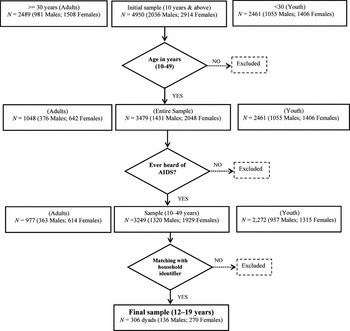
To achieve the main goal of the paper, subsamples of adults (30 years and older) and youth (12–19 years) were matched conditioned on ‘ever heard of AIDS’ (see Fig. 1). Where many adolescents or adults lived in the same household, only one was randomly selected to avoid over-representation. The final sample consisted of 306 parent–adolescent dyads.
Selection of the dyads included in the final sample.

Outcome variable
In this paper, the dependent variable ‘total HIV/AIDS knowledge’ was defined as the number of correct responses out of fifteen yes/no questions about AIDS transmission routes (seven items) and prevention strategies (eight items). Sample items include ‘AIDS is transmitted through mosquito bites’ or ‘using correctly condoms at every sexual intercourse can prevent AIDS’. Previous HIV-related studies often use cut-points (using the mean/median) to define and model HIV/AIDS knowledge as a dichotomous variable (Denison et al., Reference Denison, Tsui, Bratt, Torpey, Weaver and Kabaso2012). Obviously, this approach is very useful for data analysis purposes but it is not without limitations from an intervention perspective. For instance, some respondents may score higher on HIV/AIDS knowledge while not knowing that condom use can protect against AIDS. Although those individuals may have high scores on the overall HIV/AIDS, they can be at risk of contracting AIDS by ignoring this specific prevention strategy that is crucial in HIV/AIDS prevention. In this study, correct answers about AIDS transmission routes and prevention strategies were summed and ranged from 2 to 15. To account for the gradient in the levels of HIV/AIDS knowledge, ordered logistic regressions were performed to estimate the effects of the key independent variables.
Key independent variables
Four independent variables are of interest in this paper. (i) Parents' AIDS knowledge: parents answered the same questions about AIDS transmission routes and prevention strategies. In a similar way, parents' HIV/AIDS knowledge is built as for adolescents, allowing valid comparisons between parents and adolescents. (ii) Mother–adolescent dyad: this refers to the corresponding adult within the household, and is a dichotomous variable coded ‘0’ if adult is male and ‘1’ if female. (iii) Lifetime communication about sexuality: this consisted of an index (range 0–15) of five yes/no questions (puberty, sexual education, STI/HIV/AIDS prevention, pregnancy prevention and alcohol/drugs) collected at age 6, 12 and the time of the survey ascertaining that knowledge acquisition is a dynamic process over time. (iv) The parent–adolescent education gap: this was determined by comparing the number of completed years of schooling for parents and adolescents. It is a three-level variable, where ‘0’ denotes youth is less educated, ‘1’ denotes that both are equally educated and ‘2’ denotes that youth is more educated.
Control variables
Among the controls, the study included two indexes of the ‘quality of parent–adolescent relationships’ and ‘parental monitoring’ collected on a 5-point Likert scale at age 6, 12 and at the time of survey. Age and household socioeconomic status were also identified as influential factors on child cognition.
Statistical analysis
Statistical analyses were performed in three steps using STATA version 12 (StataCorp). Preliminary analyses were performed to test (i) multicollinearity problems using variance inflation factor (VIF) and tolerance defined as 1/VIF; and (ii) the proportional odds assumption for ordered logistic regression. Proportional odds assumption posits that the relationships between all pairs of outcome groups are the same. If this assumption is violated, different models for each pair of outcome groups should be used. The findings did not reveal either multicollinearity problems or the violation of proportional odds assumption.
In a second step, the degree of agreement between adolescents and parents on AIDS facts was assessed using the crude agreement and Cohen's kappa (Cohen, Reference Cohen1968). The crude agreement is the total percentage of adolescents and parents who agree across items; however, it is highly dependent on the number of categories and cases within each category. Kappa statistics are considered a better measure of agreement because they determine whether the level of agreement is significantly higher than the level expected to occur by chance. However, kappa measures often underestimate agreement for events with very low or high probabilities. To account for uncertainty associated with the responses both parents and adolescents provided, all estimates were bootstrapped using 1000 replications. Reliability measures were also calculated to check the validity of the key constructs. To test the study hypotheses, adolescents' HIV/AIDS knowledge was regressed on parents' HIV/AIDS knowledge to estimate the main effect. Subsequently, additive models were performed to assess the moderating effect of mother–adolescent dyad, lifetime communication and parent–adolescent education gap. Finally, three multiplicative models were performed to test interactions between parents' HIV/AIDS knowledge and each moderator.
It was suspected that the selection process of the final sample might have altered the representativeness of the original sample. Using the estimated coefficients from additive and multiplicative models, the quantities of interest were simulated to reduce the bias introduced by the matching procedure. These quantities of interest contain two forms of uncertainty (Davidson & MacKinnon, Reference Davidson and MacKinnon1992; King et al., Reference King, Tomz and Wittenberg2000): fundamental uncertainty arising from sheer randomness in the world, and estimation uncertainty arising from the limited number of dyads in the estimations. More specifically, predicted values are random draws of the dependent variable from the stochastic component of the statistical models, given a random draw from the posterior distribution of the unknown parameters. The required number of simulations to account for uncertainty is discussed in the literature (Andrews & Buchinsky, Reference Andrews and Buchinsky2000; Davidson & MacKinnon, Reference Davidson and MacKinnon2000). In this study, 1000 simulations were sufficient to provide stable and consistent estimates.
Results
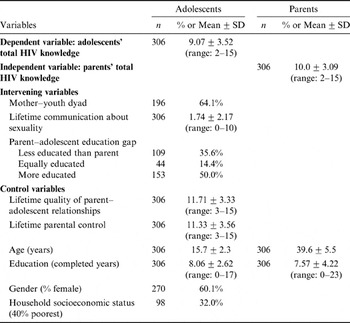
Table 1 reports the descriptive statistics of the matched sample. Table 1 summarizes the dependent and key independent variables. The level of HIV/AIDS knowledge was high for adolescents and parents with an average of 9.07 (SD=3.52) and 10.0 (SD=3.09), respectively. Additionally, zero-order correlations (results not shown) indicated a strong positive association between parents' and adolescents' HIV/AIDS knowledge (r=0.319; p<0.01). From the table it appears that 64% (196 out of 306 dyads) were mother–adolescent dyads. The lifetime communication about sexuality was low, as expected (M=1.74; SD=2.17). The parent–adolescent education gap showed that adolescents were more educated than their parents in 50% of the dyads (153 out of 306), reflecting the fact that, on average, the number of completed years of education was higher among adolescents. Table 1 shows that the quality of parent–adolescent relationships and the levels of parental supervision were high and averaged 11.7 (SD=3.33) and 11.3 (SD=3.56), respectively. Adolescents ranged in age from 12 to 19 years (M=15.7; SD=2.3) and they were highly educated (M=8.06 years, SD=2.62). Parents' age ranged from 30 to 49 years (M=39.6; SD=5.5). The final sample (306 parent–adolescent dyads) consisted of 60% female adolescents, of which 32% lived in poor households.
Summary statistics of the sample, 2002 CFHS

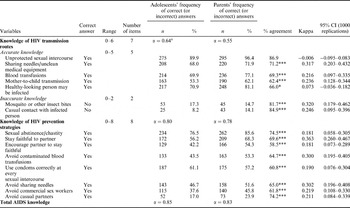
Table 2 displays the proportion of correct responses about AIDS transmission routes and prevention strategies. It shows that parents fared better than adolescents regardless of which AIDS fact was considered. For instance, 96% of parents (vs 90% of adolescents) reported that AIDS is transmitted through unprotected sexual intercourse. An exception was the correct use of condoms at every sexual intercourse (57% vs 61%). This result can be explained by the generation gap, in that young and older generations exhibit different attitudes to condoms, the latter being more conservative and reluctant. Table 2 also reports the levels of agreement between adolescents and parents on AIDS items, kappa statistics as measures of agreement or concordance and Cronbach's α as measures of the validity of the constructs. The levels of agreement ranged from 58.5% (encourage partner to stay faithful) to 86.9% (AIDS is transmitted through unprotected sexual intercourse). The lower levels of agreement about partner faithfulness can be interpreted as social desirability bias because parents are married and should be faithful towards his/her partner. Conversely, adolescents view sexual acquaintances as a source of pleasure or prestige, therefore distancing themselves from faithfulness. The levels of agreement were acceptable; however, kappa statistics were quite low. Such paradoxes have been discussed in the literature as the limitations of kappa indices to capturing agreements. Finally, Cronbach's α ranged from 0.55 to 0.85.
Frequency of correct responses on HIV transmission routes and prevention strategies among adolescents and parents, and agreement between adolescents and parents or parent-like figures among 306 parent–adolescent dyads, 2002 CFHS

a Cronbach's α reports the psychometric properties of the constructs.
***p<0.01; **p<0.05; *p<0.10.
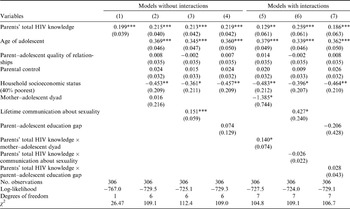
Table 3 reports simulated multivariate estimates from ordered logistic regressions. Model 1 shows that parents' HIV/AIDS knowledge was positively and significantly associated with adolescents' HIV/AIDS knowledge (β=0.199; p<0.01), indicating a strong main effect of parents' HIV/AIDS knowledge. When the intervening variables were included (Models 2–4), the findings went in the expected direction; nonetheless, only communication about sexuality reached statistical significance. Indeed, mother–adolescent dyad (β=0.016; p=0.075), lifetime communication about sexuality (β=0.151; p<0.01) and parent–adolescent education gap (β=0.074; p=0.574) were positively associated with adolescents' HIV/AIDS knowledge. Interestingly, the effects of parents' HIV/AIDS knowledge increased when intervening variables were included in the estimations.
Effects of parents' knowledge on adolescents' knowledge of HIV transmission routes and preventive strategies in the matched sample, 2002 CFHS

Robust estimates from 1000 simulations. Standard errors are in parentheses.
***p<0.01; **p<0.05; *p<0.10.
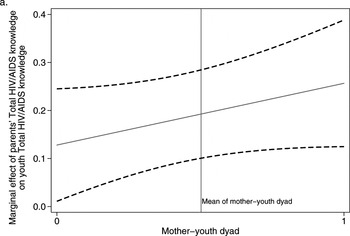
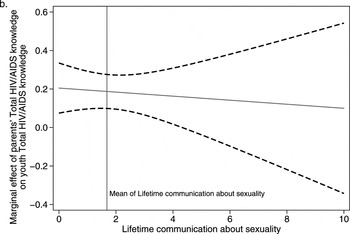
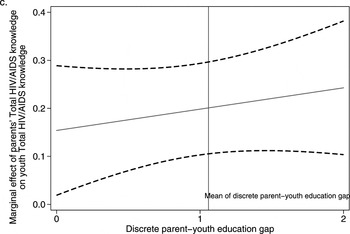
The interactions between parents' AIDS knowledge and intervening variables were also examined (Models 6–7). The findings show that the effects of parents' AIDS knowledge remained statistically significant. However, the effects of mother–adolescent dyad (β=−1.385; p<0.10) and parent–adolescent education gap (β=−0.206; p=NS) shifted and became negative. The effect of communication about sexuality increased in magnitude and became marginally significant (β=0.427; p<0.10). Subsequently, marginal effects were computed and plotted (see Fig. 2a–c) using Grinter, a STATA utility (Boehmke, Reference Boehmke2006), to better understand the effects of the key variables (parents' HIV/AIDS knowledge, parent–adolescent communication and parent–adolescent education gap) on adolescents' HIV/AIDS knowledge. In fact, the coefficients on constitutive and interaction terms are not effects (Kam & Franzese, Reference Kam and Franzese2007); they are not readily interpretable as in purely additive-separable ordered logistic regressions. The constitutive term (here, parents' HIV/AIDS knowledge) tells us the effect of the variable when the other interacting variables are equal to zero. Unlike additive models, the standard errors of the conditional coefficients vary according to the levels of the other independent variable (Friedrich, Reference Friedrich1982). Therefore, marginal effects provide an easy way to interpret estimated coefficients in multiplicative models. In Fig. 2a–c, the vertical axis represents the coefficients for the effects of parents' HIV/AIDS knowledge on adolescents' HIV/AIDS knowledge. Moving along the horizontal axis shows how the effects of parents' HIV/AIDS knowledge varied for each value of (i) mother–adolescent dyad (Fig. 2a), (ii) communication about sexuality (Fig. 2b) and (iii) parent–adolescent education gap (Fig. 2c).

Marginal effects of parents' HIV/AIDS knowledge over (a) mother–adolescent dyad, (b) lifetime communication about sexuality and (c) parent–adolescent education gap. The dashed lines give the 95% confidence intervals.

Continued

As shown in the multiplicative models, the effects of parents' HIV/AIDS knowledge increased as expected when moving from father–adolescent to mother–adolescent dyads (Fig. 2a), and when the parent–adolescent education gap favoured adolescents (Fig. 2c). Together, these two figures suggest amplifying effects of mother–adolescent dyad and parent–adolescent education gap. In contrast, the effect of parents' HIV/AIDS knowledge declined when communication about sexuality increased (Fig. 2b), which reflects the negative effect of the interactive term between parents' HIV/AIDS knowledge and communication about sexuality. This latter finding can be interpreted as ‘substitution-complimentary’ effects of parents' HIV/AIDS knowledge and parent–adolescent communication. In fact, the uncertainty associated with the contingent effect of parents' HIVAIDS knowledge is higher when parent–adolescent communication is above the average. The skewness of this variable may explain this finding; however, the findings are not altered after the variable is centred.
Discussion and Conclusion
Previous research has identified families/parents as an important source of HIV/AIDS information (WHO, 2007a, b). However, the lack of parental knowledge about HIV/AIDS has been reported to be a barrier to efficient communication with adolescents (Bastien et al., Reference Bastien, Kajula and Muhwezi2011). Despite overwhelming evidence for the need to involve parents as part of a comprehensive strategy to foster accurate HIV/AIDS knowledge among adolescents and to increase their ability to protect themselves against HIV/AIDS, studies comparing parents' and adolescents' HIV/AIDS knowledge are still lacking. To fill this gap, this study examined the direct relationship between parents' and adolescents' HIV/AIDS knowledge. Additionally, the paper tested the main effect of parental influences on adolescents' HIV/AIDS knowledge, and three hypotheses related to the moderating effects of mother–adolescent dyads, parent–adolescent communication and the parent–adolescent education gap.
First, the study found a significant positive effect of parents' HIV/AIDS knowledge on adolescents' HIV/AIDS knowledge in Bandjoun, west Cameroon. Adolescents' knowledge about HIV/AIDS significantly increased with the increase in parents' knowledge. This finding contrasts with US studies that showed that parents' HIV/AIDS knowledge was not associated with adolescents' HIV/AIDS knowledge (Sigelman et al., Reference Sigelman, Derenowski, Mullaney and Siders1993, Reference Sigelman, Mukai, Woods and Alfeld1995). Measurement issues probably explain these discrepancies: parents' and adolescents' HIV/AIDS knowledge were captured through different scales in the US studies. In contrast, this study used the same items to measure HIV/AIDS knowledge among parents and adolescents in similar contexts. Therefore, responses from parents and adolescents were easily comparable.
Second, the study provided only limited support for the moderating effects of parents' gender and parent–adolescent education gap: these findings did not reach statistical significance. In contrast, the effects of communication about sexuality were very appealing, showing a significant positive effect on adolescents' HIV/AIDS knowledge. To better understand the effects of parents' HIV/AIDS knowledge and parent–adolescent communication about sexuality, the paper tested the effects of each constitutive term and the interaction on adolescents' HIV/AIDS knowledge. The findings indicated that parents' HIV/AIDS knowledge, communication about sexuality and the interaction terms (parents' HIV/AIDS knowledge×communication about sexuality) were positively and significantly associated with adolescents' HIV/AIDS knowledge, suggesting an enhancing effect of the lifetime communication about sexuality. The higher uncertainty observed in Fig. 2b when parent–adolescent communication increased is an indication of the distribution of the variable in the sample, which was on average very low. This finding is obviously important from an intervention perspective since parent–adolescent communication about sexuality is the most effective way parents transmit attitudes, values and knowledge about HIV/AIDS to their children (Bastien et al., Reference Bastien, Kajula and Muhwezi2011). However, the findings from the current study may conflict with previous studies showing that content, timing and frequency of communication may be important in understanding the effects of parent–adolescent communication on adolescent reproductive health outcomes, and specifically on adolescents' HIV/AIDS knowledge. The yes/no questions used in this study do not capture the frequency of parent–child communication about sexuality. The content of parent–adolescent communication about sexuality was addressed using four topics about sexuality including puberty, sexual education, STI/HIV/AIDS prevention and pregnancy prevention, and a general topic about alcohol and drugs. To account for the timing, this study used a cumulative lifetime index of parent–adolescent communication about sexuality at three points.
While a few predictors of adolescents' HIV/AIDS knowledge were identified in previous studies, some socio-demographic characteristics examined in this paper were significant correlates of adolescents' HIV/AIDS knowledge in Bandjoun. For instance, adolescent age significantly increased the levels of AIDS/knowledge due to the fact that education increases with age. In contrast, household socioeconomic status was a strong impediment to knowledge acquisition: living in poor households significantly decreased the likelihood of HIV/AIDS knowledge among adolescents in Bandjoun.
This paper advocates for evidence-based reproductive health interventions: what parents know, what they should know and how they can act as sex educators. Therefore, recent efforts involving parents must be intensified to protect the next generation against HIV/AIDS (WHO, 2007a, b). This study underscores that HIV interventions involving parents must capitalize on parents' own knowledge to improve adolescents' HIV/AIDS knowledge. The enhancing effect of parent–adolescent communication about sexuality when combined with parents' HIV/AIDS knowledge provides a window of opportunity for improvement of reproductive health programmes and interventions in sub-Saharan Africa. Although the paper found a significant effect of parents' HIV/AIDS knowledge on adolescents' HIV/AIDS knowledge, the levels of parent–adolescent communication about sexuality still are very low, as shown in Table 1. Previous research has identified cultural and religious barriers that undermine parent–adolescent communication about sexuality (Ahmed et al., Reference Ahmed, Flisher, Mathews, Mukoma and Jansen2009). Studies have also found that mothers communicated more frequently about sexuality than fathers (Amoran et al., Reference Amoran, Onadeko and Adeniyi2005; Crichton et al., Reference Crichton, Ibisomi and Gyimah2012). Finally, parent–adolescent communication about sexuality is authoritarian, uni-directional and characterized by vague warnings rather than open discussions (Bastien et al., Reference Bastien, Kajula and Muhwezi2011). Therefore, initiatives to equip parents with appropriate skills to initiate open communication about HIV/AIDS topics are a promising avenue in reproductive health programmes and interventions in sub-Saharan Africa. However, a parental gender-based approach should be adopted because mothers and fathers have different influences and/or parenting styles.
There are three important limitations to consider when interpreting the findings of the current study. Although the matching approach is a methodologically sound test of the direct relationship between parents' and adolescents' HIV/AIDS knowledge, the gradual erosion of the original sample may have affected the representativeness of the final sample (see Fig. 1). The second limitation relates to the over-representation of mother–adolescent dyads. To estimate the effects of this over-representation, additional analyses (available upon request) were performed on a balanced parents' gender sample (n=220 dyads). The estimates were similar in signs and magnitude to those reported here, suggesting the absence of bias due to an over-representation of mother–adolescent dyads. The third limitation stems from the cultural homogeneity in Bandjoun. Data were collected in a setting with similar norms, attitudes and values about sexuality. Future research in different cultural settings is needed to address the cultural homogeneity bias.
Despite these limitations, this study is the first to establish a direct relationship between parents' and adolescents' HIV/AIDS knowledge in sub-Saharan Africa. Although there are numerous studies on the sources of information on HIV/AIDS, previous research has not sought to understand how adolescents and parents understand AIDS transmission routes and prevention strategies within the same context. These are important advances, especially if social scientists, policymakers and stakeholders anticipate parents playing more effective roles in AIDS education and prevention in the future. Over three decades after the first case of AIDS was discovered, it is pointless to assume that parents are knowledgeable enough and fully equipped to teach their children about AIDS without overwhelming evidence and context-specific studies.
Acknowledgments
This work was carried out as a part of the research programme on ‘Reproductive Behaviour, Population Health and Nutrition in Africa’ of the PRONUSTIC Research Laboratory at the Department of Demography of University of Montreal, Quebec, Canada. The data collection and fieldwork activities were supported by the Rockefeller grants RF 97045 #82 and RF 97045 #90. Funding was granted to Professor Barthelemy Kuate Defo (Principal Investigator) from the Department of Demography, University of Montreal, Quebec, Canada. An earlier version of this manuscript was presented at the IFORD International Colloquium ‘African Youth: Demographic Issues, Social Challenges, and Potential for Development’, Yaoundé, Cameroon, 19–23th November 2012. The author is also grateful to Jacques Ewoudou, Benic Amankwaa, Murray Weeks and his wife Francine Nzambiwishie Nakatela for fruitful comments on earlier versions of the manuscript.