Introduction
Cholesteatoma is a benign epithelial lesion of the middle ear and temporal bone that can expand and destroy the surrounding structures.Reference Castle1 Cholesteatoma is classified into two types: a congenital type and an acquired type. Among them, congenital cholesteatoma is mainly found in paediatric patients and is defined as an expanding cystic mass of keratinising squamous epithelium that does not expand out from behind the tympanic membrane. It is thought to be present since birth, and patients have no prior history of otorrhoea, perforation of the tympanic membrane or previous ear surgery, although a history of otitis media with effusion does not exclude congenital cholesteatoma.Reference Yung, Tono, Olszewska, Yamamoto, Sudhoff and Sakagami2 The incidence of congenital cholesteatoma is reported to be 0.12 per 100 000 children.Reference Bennett, Warren, Jackson and Kaylie3
Cholesteatoma is not responsive to antibiotic treatment, and if it remains in the middle ear for several years, it can grow large enough to destroy the middle-ear structures. It is estimated that the diameter of the mass in congenital cholesteatoma patients grows by 1 mm per year on average.Reference James and Papsin4 It silently grows during childhood and eventually causes conductive hearing loss when it invades the ossicles if it is not incidentally identified during a routine otological examination.
For these reasons, a cholesteatoma should be surgically resected, and the primary goal of cholesteatoma surgery is to completely eradicate the disease with the secondary goal of improving hearing and preventing residual and/or recurrent disease. In this article, recurrence of congenital cholesteatoma means regrowth of cholesteatoma that was not removed completely during previous surgery and was identified at a follow-up examination.Reference Nelson, Roger, Koltai, Garabedian, Triglia and Roman5
Compared with adult disease, the management of paediatric cholesteatoma is more challenging. Children have higher rates of residual or recurrent cholesteatoma compared with adults, possibly because of anatomical and physiological differences.Reference Kuo, Shiao, Yung, Sakagami, Sudhoff and Wang6 Immature anatomy and dysfunction of the Eustachian tube results in more frequent infections and retraction pockets. In addition, well-pneumatised mastoids in children allow for the development of more extensive disease compared with the more sclerotic mastoid bones in adults. Eustachian tube function improves with age, and children between 3 and 6 years of age have a worse Eustachian tube function than those aged 7–12 years.Reference Bylander7,Reference Bylander and Tjernstrom8 Despite these differences in clinical manifestations and physical background according to age, studies investigating the prognosis and treatment outcomes of congenital cholesteatoma have mainly focused on the extent of disease itself rather than the changing physical background according to age.
There is no clear consensus regarding the surgical management of cholesteatoma in children. The three most popular surgical techniques for the treatment of paediatric cholesteatoma are transcanal tympanoplasty, intact canal wall mastoidectomy and open cavity mastoidectomy. Although each present both advantages and disadvantages, surgeons should adopt a specific technique based on the location and extent of the cholesteatoma before or during surgery, as well as their preference and experience. In our current study, we investigated the clinical characteristics of paediatric congenital cholesteatoma and analysed the differences in the surgical findings and the outcomes of this disorder according to age.
Materials and methods
Patient selection
With the approval of the institutional review board (approval number: 2019–1110), we performed a retrospective analysis of the medical and operative records of paediatric patients who were diagnosed with cholesteatoma and who underwent surgical exploration at the Otolaryngology Department at the Asan Medical Centre, Seoul, Korea.
From the patients identified between August 1993 and January 2016, we selected 186 children (136 boys and 50 girls) who were followed for more than 2 years. The mean follow-up period was 47.0 ± 26.8 months. Congenital cholesteatoma was diagnosed based on the criteria of Levenson et al.,Reference Levenson, Michaels and Parisier9 which specifies the presence of a whitish middle-ear mass behind an intact tympanic membrane, an absence of tympanic membrane perforation and no previous otological procedures, such as ventilation tube insertion. The presence of an effusion in the middle ear was not an inclusion criterion.
Demographic data including age, sex, side of the lesion, chief complaints, follow-up period and any recurrences were reviewed. Age was taken to be age at the time of diagnosis. Patients were divided into three age groups for the analysis of the trend of the disease characteristics: less than or equal to 3 years, over 3 years and less than or equal to 7 years, and over 7 and up to 15 years of age. Cut-off values of the age of each group were set to secure at least 30 patients in each group to ensure the differences in the outcomes could reach statistical significance and to maintain the normality of the distribution of each group. In addition, patients over three years old showed much better compliance than patients under three years old, and we could get more detailed clinical information from them by communicating and giving instructions during pure tone audiometry. Patients under 7 years of age have a more immature Eustachian tube function, which we referred to when determining the cut-off value between the older two groups.Reference Bylander7,Reference Bylander and Tjernstrom8
Audiological and radiological evaluation
All patients were examined with tympanic endoscopy in the out-patient clinic. The location of the main mass was evaluated, and any extraordinary endoscopic findings were reviewed. Pre-operative and post-operative hearing thresholds were measured by pure tone audiometry. Pure tone audiometry was possible in 105 patients, and 4 frequency averages (0.5, 1, 2 and 3 kHz) were calculated for each patient. The mean follow up of the pure tone audiometry after the operation date was 33.2 months (1.6–168.5 months). Hearing levels of the patients who were unable to obtain a pure tone audiometry test because of a lack of compliance underwent an auditory brainstem response test for evaluation of their auditory function, although the results of this test were not analysed in this study. Impedance audiometry was conducted for all patients for evaluation of their sound conduction status, volume and pressure in the middle ear.
The disease extent was evaluated by a non-contrast temporal bone computed tomography (CT) scan, which is a standard modality of imaging for a cholesteatoma; axial and coronal images of both ears were taken and reconstructed from 0.6 mm slice thicknesses. The typical finding of cholesteatoma on CT scans was defined as a soft tissue density appearing to be a mass-like lesion with a clear margin or expansile characteristics. Pneumatisation of air cells, the extent of soft tissue density and erosion of the scutum and ossicle were also evaluated.
The presence of ossicle erosion and mastoid invasion was evaluated by an intra-operative view, which was reviewed based on the operation record. The subtype of cholesteatoma was also evaluated based on the intra-operative findings. The lesion was categorised as a closed type if the shape of the epithelial cyst was clear without exposure of the keratin. It was categorised as an open type if the lesion appeared as a flat keratinising epithelium without the formation of an epithelial cyst.Reference Lim, Yoon and Kang10
Operation of cholesteatoma and follow up of patients
The surgical modalities were divided into three categories: transcanal removal, intact canal wall mastoidectomy and open cavity mastoidectomy. Transcanal removal was usually performed under a microscopic view, but 4 out of 90 cases of a transcanal approach were performed under an endoscopic view. Ossicular reconstruction was simultaneously conducted if necessary.
The first follow up and wound evaluation was conducted around two weeks after surgery. Patients subsequently visited the clinic within a period of about six months for otoscopy, and their audiological outcome was also evaluated with pure tone audiometry if possible. However, the period between obtaining pure tone audiometry and the surgery varied according to the patient's characteristics and the surgeon's preferences. A follow-up CT scan was performed for 101 patients with a median follow-up period of 1.77 years after surgery. The other 85 patients were only followed up with an endoscopic examination. When there was suspicion of a recurrence, a CT scan was performed and a re-operation was planned.
Statistics
All values are expressed as a mean and standard deviation or percentage. The data were analysed using SPSS® (version 22.0). A parametric test was utilised when the number of samples in each category was the same, there were more than 30 participants, or the number in each category was between 10 and 30 with a proven normal distribution of the data by a Shapiro–Wilk test.
In order to compare the clinical characteristics, endoscopic findings, CT findings and intra-operative findings of the three age groups, Fisher's exact test was applied. For significant variables, post hoc analysis with a Bonferroni correction was performed among each of the three groups (p < 0.017). Significant differences among the groups in post hoc analysis are shown in Figure 1.
Age and sex distribution of patients with paediatric congenital cholesteatoma. The prevalence of cholesteatoma was higher in younger ages, with a greater prevalence seen in boys in nearly all age groups.

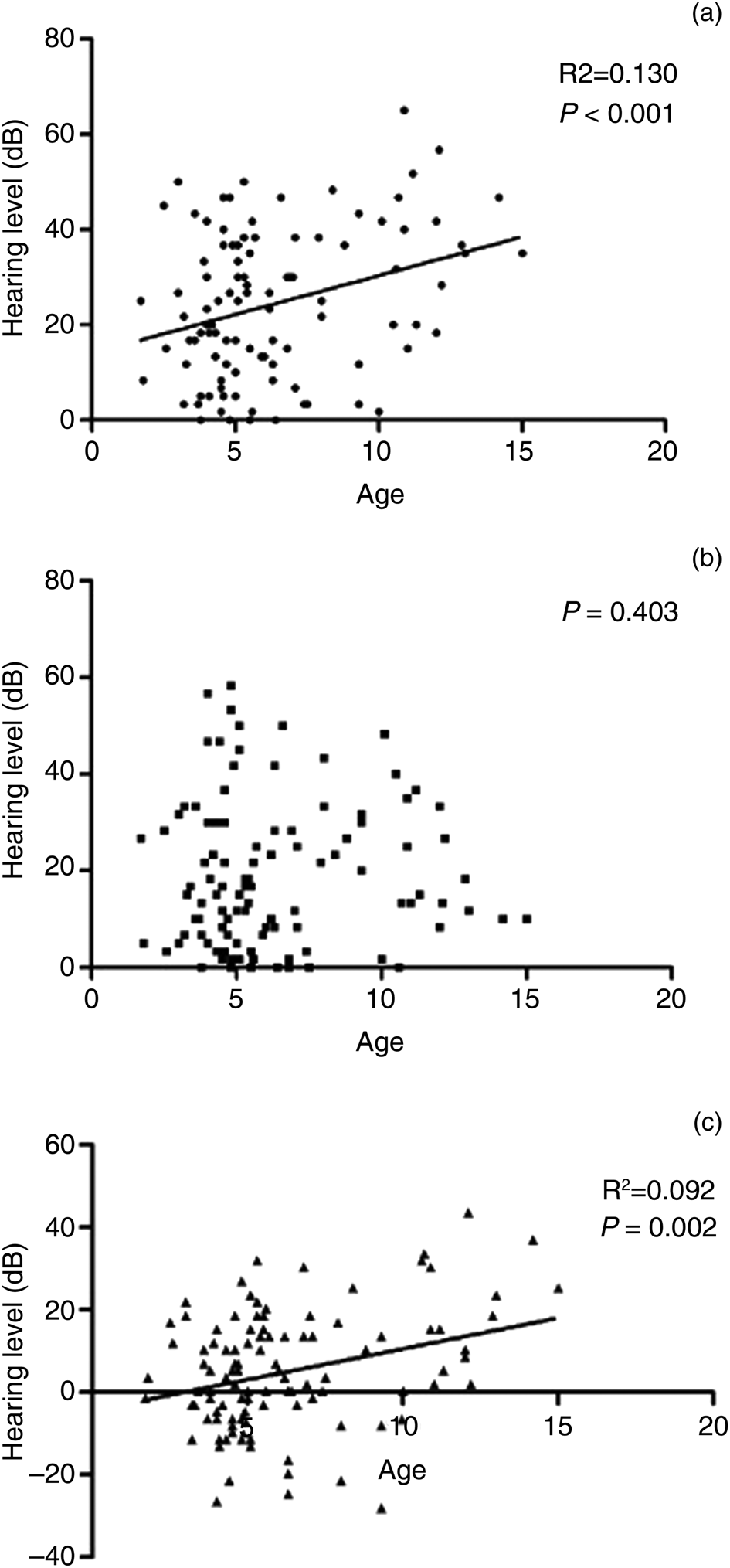
Peri-operative audiometric findings according to the clinical variables were analysed. Unpaired t-tests and the Mann–Whitney U test were used for comparisons of two categories, while the analysis of variance test and the Kruskal–Wallis test were used for comparisons of more than three categories. Relationships among the ages and peri-operative audiometric outcomes were analysed by the R-squared statistic and general linear models, as described in Figure 2.
Air–bone gap in the pre-operative and post-operative period measured by pure tone audiometry. (a) Pre-operative air–bone gap shows an increasing tendency as age increases (p < 0.05), while (b) post-operative air–bone gap shows no specific tendency. (c) Air–bone gap improvement tends to be higher in patients with increased age (p < 0.05).

For analysis of the impact of the clinico-pathological factors on the recurrence of paediatric congenital cholesteatoma, logistic regression analysis was utilised. Each variable was analysed for the identification of significant factors; p-values under 0.05 were considered statistically significant in univariate analysis. Multivariate analysis was then conducted for the significant factors identified in the univariate analysis to find independent risk factors of recurrence.
Results
Pre-operative clinical data
Demographic and clinical data of paediatric congenital cholesteatoma were reviewed (Table 1). The mean age of the study group was 4.9 ± 2.8 years. There were 49 (26.3 per cent) patients 3 years old or younger, 106 (57.0 per cent) patients between 3 and 7 years old, and 31 (16.7 per cent) patients aged over 7 years. Figure 1 shows that there were considerably more patients between 2 and 5 years of age, but the sex proportion did not significantly differ across ages. A total of 136 patients were male, more than twice the number (50) of female patients. Right side lesions accounted for 55.4 per cent of patients (103 cases), and left side lesions accounted for 44.6 per cent (83 cases).
Demographic data and clinical results of paediatric congenital cholesteatoma

SD = standard deviation
Most patients visited our hospital because of an incidental finding of a whitish mass behind the eardrum during otoscopic inspection by local physicians. Other chief complaints included hearing difficulty and a referral from another hospital because of otitis media with effusion. Some patients complained of otorrhoea and otalgia. There was one patient with facial palsy as the initial presenting symptom.
The mean follow-up period was 47.0 ± 26.8 months and a total of 33 patients (17.7 per cent) showed recurrence of cholesteatoma; these patients received revision surgery.
Otoendoscopic, computed tomography and intra-operative findings
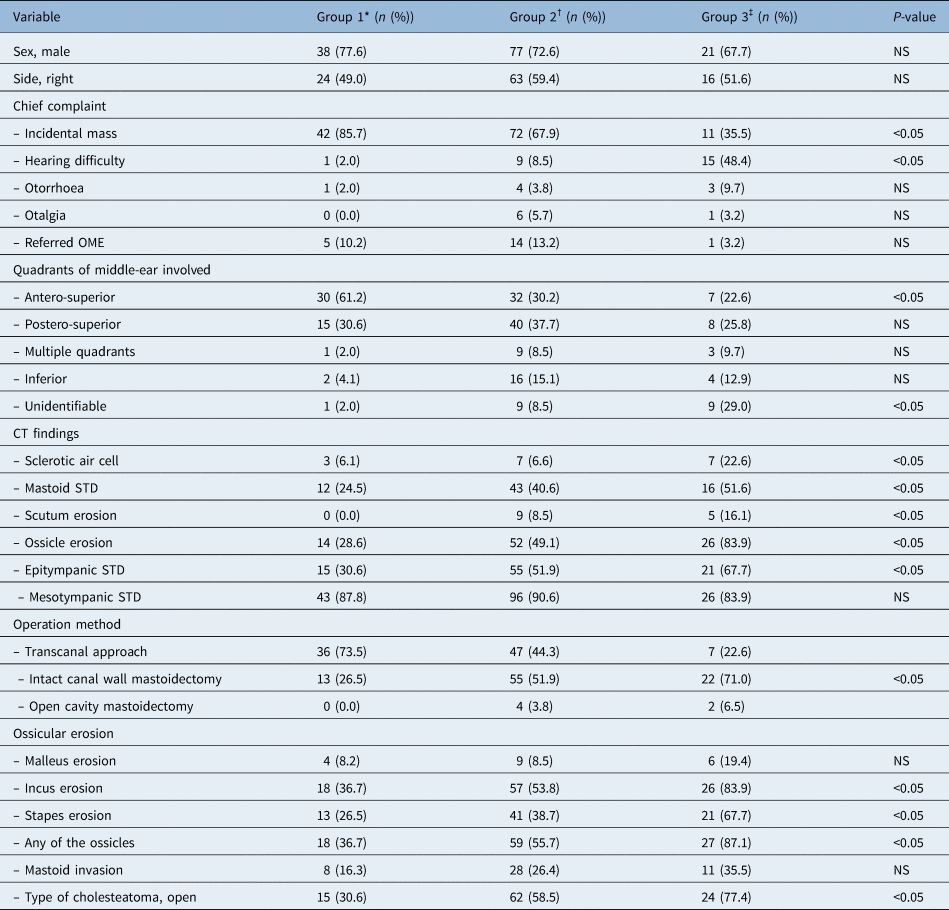
Table 2 shows clinical characteristics, otoendoscopic, CT and intra-operative findings in the three age groups. There were no significant differences in male-to-female ratio or cholesteatoma side among the three groups. Incidental mass shadow from otoendoscopic examination was the most prevalent in the 3 years or under and the 3–7 years age groups, whereas hearing difficulty was the most frequent chief complaint in the over 7 years of age group (p < 0.05). Antero-superior location of cholesteatoma (61.2 per cent) was the most frequent finding in the 3 years or under age group, whereas a postero-superior location (37.7 per cent) was the most frequent finding in the 3–7 years age group, and unidentifiable location (29.0 per cent) was the most frequent finding in the 7 years or over age group. Patients with this ‘otoendoscopically unidentifiable’ type visited the hospital with the chief complaint of a hearing disturbance (14 of 19 cases). Other chief complaints included four cases of recurrent otorrhoea and one case of recurrent otitis media with effusion.
Comparison of age distributions of clinical characteristics and otoendoscopic, CT and intra-operative findings in the three age groups

*Less than or equal to 3 years (n = 49); †over 3 years and less than or equal to 7 years (n = 106); ‡over 7 years of age (n = 31). CT = computed tomography; NS = no significance; OME = otitis media with effusion; STD = soft tissue density
Based on CT findings, greater patient age brought more prevalence of sclerotic mastoid, mastoid soft tissue, scutum erosion, ossicle erosion and epitympanic soft tissue (p < 0.05), whereas there was no significant difference in the ratio of mesotympanic soft tissue among the three groups.
For the management of cholesteatoma, we selected one of three basic techniques: transcanal tympanoplasty, intact canal wall mastoidectomy and open cavity mastoidectomy. Even though the ratio of transcanal tympanoplasty decreased and the ratio of open cavity mastoidectomy increased as patients got older, there were no significant differences in the ratio of transcanal tympanoplasty and open cavity mastoidectomy among the three groups. However, the 3–7 years age group had a significantly higher rate of intact canal wall mastoidectomy than the other two groups (p < 0.05).
During the operations, the ossicle and mastoid cavity were also evaluated. The more that patient age increased, the more the ossicular erosion rate of ossicles (except the malleus) increased (p < 0.05). Mastoid invasion rate showed no significant difference among the three groups, whereas the rate of open type cholesteatoma increased as patients got older (p < 0.05).
Pre- and post-operative audiological changes
Peri-operative audiological outcomes of 105 cases of paediatric congenital cholesteatoma were analysed and air–bone gaps (ABG) were compared according to age. The overall mean of pre-operative ABG was 24.3 ± 15.6 dBnHL, post-operative ABG was 19.3 ± 15.0 dBnHL and the ABG improvement was 5.0 ± 14.5 dBnHL. We had to compare peri-operative audiological changes between the 3–7 years age group and the 7 years and over age group because a small number of patients who were in the 3 years and under age group could not undergo audiological testing. Although the 7 years and over age group showed significantly higher pre-operative ABG than the 3–7 years age group, there was no significant difference in post-operative ABG between the two groups; therefore, post-operative hearing improvement was significantly higher in the 7 years and over age group (p < 0.05) (Table 3 and Figure 2).
Peri-operative audiometric findings in paediatric congenital cholesteatoma and differences of air–bone gap in the three age groups

*n = 5; †less than or equal to 3 years (n = 6); ‡over 3 years and less than or equal to 7 years (n = 69); **over 7 years of age (n = 30). We applied the Kruskal–Wallis test among the three groups. ABG = air–bone gap; SD = standard deviation
Recurrence after cholesteatoma operation
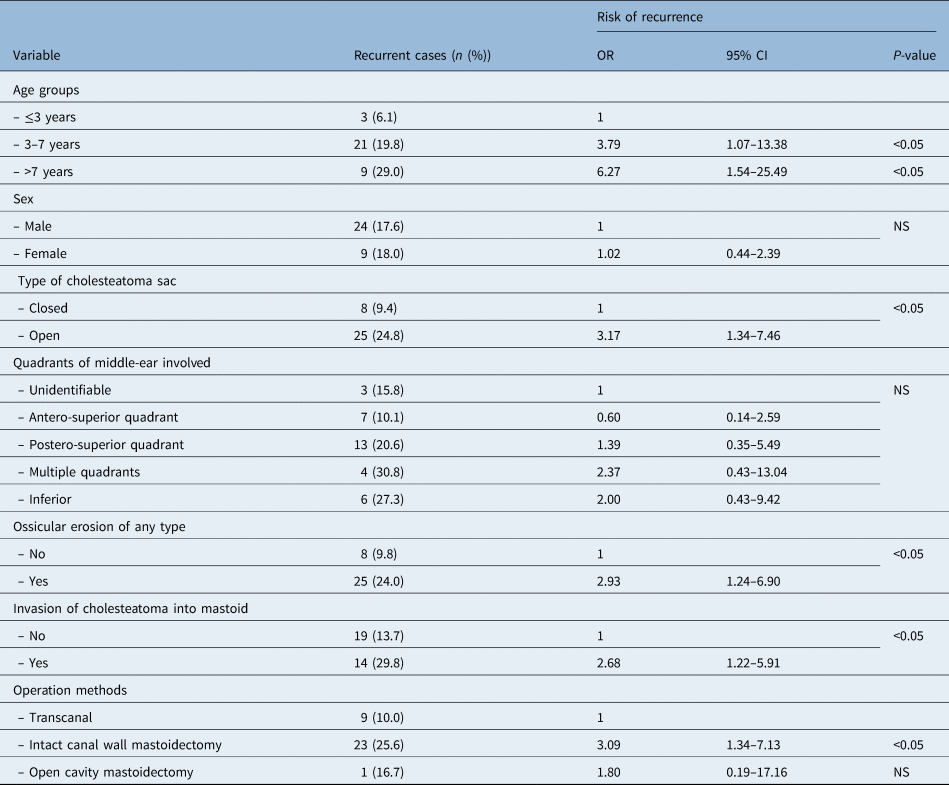
The clinical variables associated with the risk of recurrence were evaluated, and odds ratios were calculated (Table 4). Recurrence significantly increased as age increased. The youngest group only had a 6.1 per cent rate of recurrence, while for the middle age group it was 19.8 per cent and for the older group it was 29.0 per cent (p < 0.05). Sex was not significantly correlated with the recurrence rate. Open type cholesteatoma showed a higher risk of recurrence than the closed type (p < 0.05), but there were no significant differences among groups for the location of cholesteatoma in middle ear.
Univariate analyses of clinicopathological factors on recurrence risk of paediatric congenital cholesteatoma

P means p-value of odds ratio of the group compared with the first group of each variable on logistic regression analysis. *Significant p-value (p < 0.05) on logistic regression analysis. OR = odds ratio; CI = confidence interval
When there was ossicular erosion or mastoid invasion of cholesteatoma, the risk of recurrence was significantly increased. The recurrence risk of the transcanal approach (10.0 per cent) was lower than intact canal wall mastoidectomy (25.6 per cent) and open cavity mastoidectomy (16.7 per cent). Patients who underwent intact canal wall mastoidectomy had a significantly higher risk than patients who underwent the transcanal approach or open cavity mastoidectomy (p < 0.05), whereas there was no significant difference between patients who underwent the transcanal approach and open cavity mastoidectomy.
Discussion
The primary goal of cholesteatoma surgery is to eradicate the disease completely and to improve hearing. In general, cholesteatoma is more aggressive and has a higher recurrence rate in children than in adults.Reference Lynrah, Bakshi, Panda and Khandelwal11–Reference Cho, Kim, Jung, Jang, Lee and Lee13 Roger et al. reported that four factors were related to residual cholesteatoma in children: invasion of the posterior middle ear, the presence of ossicular erosion, the skill of the surgeon and the presumption of incomplete ablation.Reference Roger, Denoyelle, Chauvin, Schlegel–Stuhl and Garabedian14 Stangerup et al. found correlations between outcomes and age, poor Eustachian tube function, cholesteatoma extent and ossicular erosion.Reference Stangerup, Drozdziewicz and Tos15 In our present study, the overall recurrence rate of cholesteatoma after the first operation was 17.7 per cent, which is slightly lower than the values of 20–38 per cent previously reported.Reference Reuven, Raveh, Ulanovski, Hilly, Kornreich and Sokolov16,Reference Glikson, Feinmesser, Sagiv, Wolf, Migirov and Shapira17 When the group of patients with attic destruction or severe tympanic membrane retraction during post-operative follow up who were suspicious for a newly acquired cholesteatoma were excluded (9 patients), the actual recurrence rate was calculated as 12.9 per cent.
Our current data shows that the prevalence of congenital cholesteatoma was highest in children of age two to five and decreased after five years of age in our study cohort. In general, its incidence is increasing because of developments in diagnostic tools, such as microscopy and endoscopy, and regular otological examinations of children.Reference Nevoux, Lenoir, Roger, Denoyelle and Ducou Le Pointe18 More screening and early diagnosis of a pearly, whitish mass behind the intact tympanic membrane with otoendoscopes might lead to a higher prevalence of congenital cholesteatoma in younger children. In support of this, the chief complaint of patients in our study was an incidental mass found in local clinics. Potsic et al. also reported that the most common presentation was an asymptomatic mass lesion, found in 82 per cent of the cases.Reference Potsic, Korman, Samadi and Wetmore19 The number of patients who suffered from hearing difficulty as a chief complaint dramatically increased after seven years of age. Considering that ossicle erosion increased gradually with age, the reason for this drastic increase is that the symptoms could remain silent because the patients lacked the ability to communicate with their parents or did not understand their own symptoms at younger ages. Patients who visited the hospital for an incidental mass might also have undetected hearing loss or other undefined symptoms.
About 10 per cent of congenital cholesteatomas could not be identified via otoendoscopic examination. They are more likely to remain undetected until older ages, which explains the elevated proportion of this endoscopically unidentifiable type in older patients. These patients visited the hospital with a chief complaint of a hearing disturbance or recurrent effusion. Diagnostic tests should be considered in an active manner for patients with these symptoms.
The presence of cholesteatoma in multiple quadrants was found in only 7 per cent of patients, and this showed no significant relationship with age, hearing level or recurrence in our study, although it showed higher odds ratio of recurrence than the cases in which the lesion was in other specific locations. Patients with a lesion in only the anterosuperior quadrant showed a tendency for a lower recurrence rate, although this was not statistically significant. Potsic et al. reported that when the lesion existed in any quadrant except the anterior-superior quadrant, it was a predictor of residual cholesteatoma, with extensive disease being more common in those cases.Reference Potsic, Samadi, Marsh and Wetmore20
The CT scan findings of older congenital cholesteatoma patients showed more extensive disease with increased sclerosis, erosion of the ossicle and surrounding bone, and extension to the epitympanic space and mastoid; thus, they tended to need more aggressive surgical procedures. About 54 per cent of patients had open type cholesteatoma, and its incidence significantly increased with age. Bacciu et al. also reported a similar tendency according to age, but only 26 per cent of open type cases were identified in their study group.Reference Bacciu, Di Lella, Pasanisi, Gambardella, Saccardi and Bacciu21 Several hypotheses about the pathogenesis of open type cholesteatoma that can explain this tendency have been suggested, including rupture of a closed cholesteatoma or a relationship between the formation of a closed type cholesteatoma and middle-ear inflammation, but its aetiology remains unclear. Many closed type cholesteatoma patients were excluded from that study because of a short follow-up period, so the prevalence of open types should be identified in a more precise prospective study.
The pre-operative ABG increased with age because patients with an older age were more likely to have aggressive disease. However, ABG improvement of some patients with an older age was drastic, which resulted in a good hearing level under 20 dBnHL. Concurrent ossicular prothesis placement during the first surgery was more frequent in older patients, which could affect the results. However, this suggests that the patients diagnosed late can also achieve audiological outcomes as good as younger patients via ossicular reconstruction. This result emphasises the importance of regular otological and audiological evaluations of paediatric patients and CT scans for patients with conductive hearing loss or recurrent otorrhoea who are refractory to medical treatment in order to rule out endoscopically unidentifiable cholesteatoma.
Our study suggested that patients with an increased age, ossicular erosion, mastoid invasion, open type cholesteatoma and canal wall up mastoidectomy have an increased risk of recurrence. Stapleton et al. also stated that the extent of the primary lesion, ossicle erosion and the necessity for ossicle removal were positively correlated with residual disease of congenital cholesteatoma.Reference Stapleton, Egloff and Yellon22 Patients over 7 years old showed an especially elevated risk of recurrence. This suggests that older patients are actually late-detected patients with congenital cholesteatoma, and this late detection caused all of their other adverse changes, including ossicular and mastoid damage and cholesteatoma rupture, which led to an aggressive operation procedure; this highlights the importance of early detection of this condition.
Among surgical management approaches to paediatric congenital cholesteatoma, transcanal tympanoplasty plays a major role in the early stages. The recent use of endoscope-guided dissection enables more benefit for the prevention of residual cholesteatoma and facilitates a minimally invasive approach. James et al. reported a 19 per cent recurrence rate in the transcanal approach to paediatric congenital cholesteatoma: 24 per cent for microscopic surgery and 15 per cent for endoscopic surgery.Reference James, Cushing and Papsin23 We also introduced an endoscopic device in many cases, and our results showed a 10.0 per cent recurrence rate with the transcanal approach, suggesting the efficacy of a minimally invasive transcanal approach for managing paediatric congenital cholesteatoma. The frequency of a transcanal approach decreased as the patients’ age increased because an increased extent of disease increases the need for a mastoidectomy approach.
There is always a question as whether to preserve the posterior canal wall or not during a mastoidectomy procedure. Children do not like having their mastoid cavities cleaned and are reluctant to co-operate, which is one of the reasons many otologists prefer canal wall up mastoidectomy. Osborn et al. reported an 89.5 per cent canal wall preservation rate during mastoidectomy while achieving better audiometric outcomes and easier post-operative care in paediatric cholesteatoma patients, although their study did not separate congenital cholesteatoma from acquired cholesteatoma and direct comparison is inaccurate. The authors suggested the need for revision surgery was higher in the canal wall up mastoidectomy group (51 per cent) compared with the canal wall down group (21 per cent).Reference Osborn, Papsin and James24
In our results, when restricted to congenital cholesteatoma, only 3.2 per cent of patients underwent open cavity mastoidectomy, and 16.7 per cent of them should have had a revision operation. Patients who underwent intact canal wall mastoidectomy accounted for 48.4 per cent of the total patients and had a revision rate of 25.6 per cent, which was a slightly higher tendency of recurrence than that of the open mastoidectomy technique.
Chadha et al. suggested not only less ossicular damage and a better pre-operative hearing level as good prognostic factors of better hearing post-operatively, but also canal wall up mastoidectomy was better than the canal wall down procedure in paediatric cholesteatoma in terms of hearing improvement.Reference Chadha, Jardine, Owens, Gillett, Robinson and Maw25 Our study focused only on congenital cholesteatoma patients, who did not show a worse hearing outcome after open cavity mastoidectomy compared with intact canal wall mastoidectomy. The canal wall down approach should also be considered as a treatment option for complete eradication of very extensive disease with ossicular erosion and mastoid invasion or for patients with recurrence after canal wall up mastoidectomy, despite the need for regular follow up for cleaning the cavity after surgery.
There are several limitations of this study. We restricted our study population to age under 15 years, but congenital cholesteatoma is not only detected in the paediatric population but can also be found in adults. Although we indirectly measured the extensiveness of the disease with invaded quadrants, ossicular damage and mastoid invasion as categorised using Potsic's staging, we did not measure the exact size of the mass. Patients with minimally aggressive disease were likely to be lost during follow up, so the prevalence of aggressive disease is inaccurate. The follow-up period of pure tone audiometry was irregular, so it was not precise enough to clarify the prognostic factors of audiological outcomes. Audiological evaluation of patients under three years old was insufficient because children in this age group cannot comply with the procedure. This study was retrospective, and other neglected confounding factors could exist. The intra-operative findings were reviewed based on the operation record, but the information in the record can be subjective and can contain imprecise data. We considered the disease had recurred if cholesteatoma was identified during revision surgery, but newly acquired cholesteatoma because of attic destruction or severe tympanic retraction is not an actual recurrence of congenital cholesteatoma. However, combined congenital cholesteatoma also cannot be excluded in cases where newly acquired lesions seemed to be present, and sometimes distinguishing these cases was impossible because of insufficient data. We therefore assumed all of these cases to be recurrence, and thus the actual demographic data and the analysis of the risk of recurrence may differ from its actual manifestation.
• There were several clinical differences in older children compared with younger children in paediatric cholesteatoma
• Delayed detection of paediatric cholesteatoma can lead to ossicular damage and the need for aggressive operations
• Despite higher pre-operative air–bone gap in older children, hearing can be improved enough after proper surgery with ossicular reconstruction
• Physicians should familiarise themselves with the age-related clinical characteristics of paediatric cholesteatoma
Conclusion
In our study, there was a significantly higher rate of unidentifiable mass on otoendoscopic examination, ossicular erosion and open type cholesteatoma in older children compared with younger children. Delayed detection of paediatric cholesteatoma can lead to ossicular damage and the need for aggressive operations, which can result in worse hearing outcomes and elevated risks of recurrence. In addition, older age, open type cholesteatoma, ossicular erosion and mastoid invasion of cholesteatoma increased the recurrence rate after operation. However, despite higher pre-operative ABG in older children, hearing can be improved enough after proper surgery with ossicular reconstruction. Physicians should familiarise themselves with the clinical characteristics of paediatric cholesteatoma, especially regarding the age distribution of this condition.
Competing interests
None declared