Introduction
The rural areas of Europe represent 91% of the territory in the EU-27, with about 56% of the population living in them. Rural areas generate 45% of the gross value added in the EU-27 and 53% of the employment1. These indices adequately justify the importance of rural development.
In some countries, the rural sector has undergone an important quantitative loss. Concretely in Spain, in the past 40 years, the population of towns with less than 10,000 inhabitants was reduced from 57% of the Spanish population to only 23%. Meanwhile rural surface area covers more than 80.2% of the total surface area. These data alone are important enough to justify the study and development of a Rural Development Policy at more detailed levels2.
The environmental, cultural, social and economic relevance of agricultural activity in rural surroundings is indubitable. Nevertheless, in the past few decades the agricultural sector has lost its importance in the economy.
Abandonment of agricultural activity causes diverse problems: (1) environmental, since abandoning fields is one of the chief causes for the advance of desertification; (2) cultural, associated with the knowledge of the cultivation of these lands and the species grown on them, including the combination of ideas, beliefs and symbols that define in cultural terms the specific systematic relationships between local communities and their environmental surroundings; (3) social and (4) economic, since the cyclic renovation of the wealth produced by agriculture disappears when the land is dedicated to other activities such as construction. The economic circuit is reduced to the process of buying, constructing and selling property, and stops there, reducing new forms of producing wealthReference Mazón and Aledo3, Reference Aledo4.
In order to prevent some of these effects, the development of rural areas is being promoted. In many cases, however, the consequence of the means that are being used is the relative decrease in the weight of agriculture in the economic system. Non agricultural activities are increasing, such as crafts, recreation and tourism, which do not contribute to solving of the above-mentioned problemsReference Calatrava and Sayadi5.
Therefore, contributing solutions permitting farmers to maintain their income and avoid the abandonment of their activity is vitally important. The maintenance of agricultural surface areas within the ambit of good agricultural and environmental conditions has become a priority issue for the Ministry of Agriculture, Fisheries and Food2. One of the solutions that could be suggested in this context is organic production.
However, the consumption of organic food is not very well established, especially in southern European countries, where there has been a very important increase in this type of production in recent yearsReference Willer and Yussefi6. Competition from lower-priced products coming from Third World countries and the higher prices obtained abroad make this market seem a priori unattractive to producers.
All the same, many advantages exist: (1) the consumer is closer, so fewer intermediaries would be needed to get to market and producers could have greater control over the productReference Guptill and Wilkins7–Reference Saltmarsh10; (2) the local market could include social and economic advantages for producers and for the society in general, since local production creates jobs and produces wealthReference Weatherell, Tregear and Allinson9, Reference Chambers, Lobb, Butler, Harvey and Bruce Traill11, Reference Paddison and Calderwood12; (3) the local market is a more environment-friendly alternative, since contamination from transportation is decreasedReference Murdoch, Miele, Amin and Thrift13–Reference Pollan15. Therefore, this alternative is expected to imply economic, environmental and social benefits to local areas by providing more sustainable consumption patterns.
There is tremendous potential for local marketing of farm products, but there is a gap between consumers, demand and willingness of farmers to meet this demandReference Schneider and Francis16. The type of products, their method of delivery and pricing are important issues that have to be considered in this market choiceReference Stephenson and Lev17.
This study investigates organic production destined for local markets as an environment-friendly, potentially profitable alternative for farmers. To establish whether the proposed alternative is adequate, the willingness of consumers from these markets to pay was analysed. If the increase in price that consumers are willing to pay for the organic product surpasses the higher cost of organic production, the alternative could be considered economically viable and might be an agricultural ‘solution’ to prevent the abandonment of farm land.
This research center on a product of great importance in Europe, i.e., wine. Currently, the EU has over 2.4 million wine-producing enterprises cultivating 3.6 million hectares, equivalent to 2% of the EU agricultural surface area. Viticulture production in 2006 represented more than 5% of the EU agricultural production value, but wine consumption in the Union is in constant decline. Relevance of the sector in Spain is amply contrasted, since it is the leading country in the world in surface area dedicated to vineyards (1,135,000 ha), and the third in production (38.9 million hl)18. Wine and grape juice (must) production in Spain entailed €969.4 million in 2005, which represented 2.4% of the total gross agricultural output and 3.9% of the value from plant production19. Besides, in Spain, vineyards are the third crop with regard to surface area, after cereals and olive groves.
The viticulture sector in the economies of Castile-La Mancha and the Community of Valencia
This research was carried out in two Spanish regions (Castile-La Mancha and the Community of Valencia) where the agricultural sector has decreased significantly in recent years.
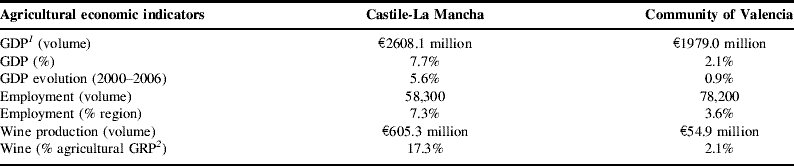
Castile-La Mancha is an interior region, located in the south-central part of Spain. The Community of Valencia is an area on the Spanish Mediterranean coast. Some agricultural economic data are shown in Table 1.
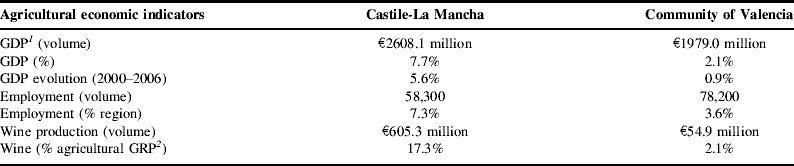
In view of the economic data, it seems obvious that the relative importance of the agricultural sector is greater in Castile-La Mancha than in the Community of Valencia. The importance of vineyards in terms of covered area and production is also greater in Castile-La Mancha than in the Community of Valencia.
Thus, Castile-La Mancha has 553,000 ha of vineyards, which is 47.6% of the national area cultivated with vineyards, and produces 17.7 million hl of wine, 48.6% of the total national production, while vineyards in the Community of Valencia extend over 86,161 ha, which is 7.4% of the total national area cultivated with vineyards, and production is 2.4 million hl, which is 6.7% of the total national wine production18.
Organic wine
This alternative is compatible with the new tendencies in food production associated with a higher awareness of consumers with regard to health and respect for the environmentReference Gil, Gracia and Sánchez22–Reference Vermeir and Verbeke24.
There seems to be a consensus in which the consumer perceives organic products as greater in quality and healthier as well as more respectful of the environment Reference Wolf, Johnson, Cochran and Hamilton25–Reference Yiridoe, Bonti-Ankomah and Martin27. Nevertheless, one of the greatest disadvantages of these products is their higher price due to greater production costs and to inadequate distributionReference Hamm, Gronefeld and Halpin28, Reference Joensen29.
Production costs of organic products in Spain are estimated to be, in general, about 22% higher than for the traditional productsReference Sáez30.
In the particular case of organic grapevine, it's estimated that production cost is about 20–25% higher than the cost of traditional grapevine crops, basically due to a 50–60% increase of labor cost.
For this reason farmers could make their production profitable if consumers would be willing to pay a percentage for organic wine similar to the increase in production costs for that wine. The price of a new organic wine destined for the local market is estimated to be 25% higher in price than traditionally produced wines.
Thus, determination of the increase in price that consumers are willing to pay would allow the estimation of whether the product could be profitable for wine producers. Whether wine consumers are willing to pay (or not) a surcharge for an organic wine with regard to a similar conventional wine should be determined. Then the percentage of increase would be established and the characteristics permitting the differentiation of potential organic wine consumers. All these determinations would be carried out by considering consumers from two regions where the degree of influence from the viticulture sector on the regional economy is different.
Starting from the above objectives, the following hypotheses were proposed for this study:
Hypothesis I: Organic wine production is a viable alternative in local markets.
Hypothesis II: The importance of the wine production sector on local economies is proportional to the willingness of consumers to pay more for organic wine.
Methodology
To determine the acceptance of an organic wine, the contingent valuation method (CVM) was used, which concretely measures consumer willingness to pay (WTP) for a certain product.
Traditionally, this method is used for goods that do not have a certain market and its applications to environmental valuation are consideredReference Venkatachalam31. The technique has been extended to other areas, the industrial and agro-food sectors being noteworthy.
Within the agro-food sector, the CVM has been applied to research relative to food safety, with the purpose of estimating WTP to prevent the potential risk involved in the consumption of a determined foodReference Cranfield and Magnusson32–Reference Posri, Shankar and Chadbunchachai34.
The applications of the CVM to agro-food marketing are also importantReference Ruiz and Iglesias35 in analyzing, the purchasing behaviour of individuals in retail food establishments. Other authors have used it to determine explanatory factors in meat consumptionReference Verbeke, Ward and Viaene36 and others to determine increases that consumers would pay for fair trade foodsReference Loureiro and Lotade37.
This method has been used previously in the concrete case of organic products. The analysis evolved from the first estimations of WTP for a residue-free productReference Misra, Huang and Ott38–Reference Buzby, Skees, Ready and Caswell40, taken up again later to estimate whether this type of product was dealt with as ‘safer’Reference Haghiri and McNamara41 even though it did not represent a specific reduction in food riskReference Buzby, Fox and Cruchfield42. Economic compensations have also been established for organic producers according to the level of damage appearing in the productReference Yue, Jensen, Mueller, Nonnecke, Bonnet and Gleason43. In other studies WTP has been consistently detected for a significantly superior product by a segment of consumers more sensitized to environmental issues who rate themselves as regular purchasers of these productsReference Gracia, Gil and Sánchez44–Reference Sánchez, Grande, Gil and Gracia46. In the case of organic wine, this methodology has been used to evaluate wine preferences in consumers from Colorado (USA)Reference Loureiro47.
Due to previous research, the CVM is sufficiently tested to allow the determination of whether consumers are willing to pay an increase in price that at least compensates for the extra cost of producing organic wine.
The CVM is based on a survey that establishes a hypothetical market situation where the offer is personified by the pollster and demand by the surveyee in such a way that the pollster tries to get the highest price that the surveyee is willing to pay for the good in questionReference Riera48.
To this end, a survey was made of wine consumers in the Community of Castile-La Mancha and the Community of Valencia (questionnaire in the Appendix). The survey was carried out during March 2007, by four properly trained pollsters. The total number of surveys was 800, half from Castile-La Mancha and is their higher price half from the Community of Valencia. For the sample design, population data was used from the 2006 National Statistics Institute19. Sampling was random and stratified with proportional adjustment to gender and age (18–29 years old, 30–49, 50–64 and over 64). Persons who were about to buy food for home consumption in stores, supermarkets and hypermarkets were surveyed, for a level of error equal to 5% and a 95.5% level of confidence (P=Q=0.5; k=2).
Besides the queries in the questionnaire that allowed the determination of WTP, others were included to characterize the organic wine consumer. These questions related to wine consumption and knowledge, and the consumption of organic products, as well as to surveyee lifestyle and socio-economic characteristics.
In the concrete case of questions relative to the determination of WTP, the mixed question format with a reference price was used. This is the most extensive format in studies that apply contingent valuation to marketing.
Thus, two consecutive questions were included: the first was a dichotomy where surveyees only answered whether they were willing to pay a determined increase in price or not. The second was an open question where they indicated the maximum increase in price that they would be willing to pay for organic wine compared to traditional wine.
This question format permits the acquisition of more reliable, disperse values but can introduce a warp in the guide priceReference Riera48. To prevent that, the sample was divided into four sub-samples. In each one, the first question of the CVM indicated a different starting increase in price (10, 25, 50 and 100%), above a reference price of 2 € per 0.75 litre bottle, an average sale price for young wine of a quality obtained through visual inspection by researchers in the establishments where the surveys were made.
To obtain the results for WTP, first a descriptive statistical analysis was used as an open question for both regions, and the averages obtained were compared in each case through analysis of variance (ANOVA).
Then a logistic regression was used (Eqn 1), with the answer to the closed question as the dependent variable. (Would they pay an increase in price for an organic wine or not?) Independent variables were the questioned increase and surveyee region of origin.

P: probability of paying (it takes on the value of 0 if the consumer is not willing to pay a determined increase in price and of 1 on the contrary).
β0, β1, β2, β3: coefficients of the equation.
X 1: percentage of price increase for organic wine.
X 2: the surveyee's region of origin (it takes on the value of 0 if the wine consumer is a resident of Castile-La Mancha and the value of 1 if from the Community of Valencia).
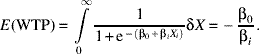
Through a simple transformation and under the hypothesis that the function of individual utility is linear, the average and the median of WTP coincide. So the average WTP can be calculated as a mathematical expression by using regression coefficientsReference Hanemann49, as shown in Equation 2.
Results
Consumer acceptance of an organic wine
In the first place, the percentage of consumers who would pay more for organic wine than a traditional wine was determined. In this way the size of the potential market for this product was established among consumers that perceive greater utility from the organic product. Then the concrete value of the organic product was quantified.
From the obtained data, a large percentage of consumers were found who would pay more for an organic wine, with a significantly greater percentage of these consumers in the Community of Valencia (80.2%) than in Castile-La Mancha (72.6%), since significant differences start at 1%.
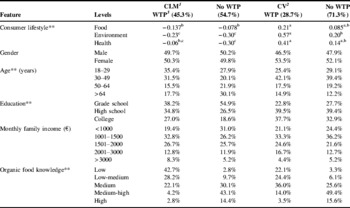
Then only those consumers were focused on who would pay the increase in price that guarantees product profitability to compensate the higher production cost of organic wine (around 25% higher). In Castile-La Mancha, 45.3% of these consumers would pay more than a 25% increase in price while this percentage would be 28.7% in the Community of Valencia (Table 2).
Percentage of consumers who were willing to pay a specific premium price for an organic wine.

** P<0.01 between the two sites.
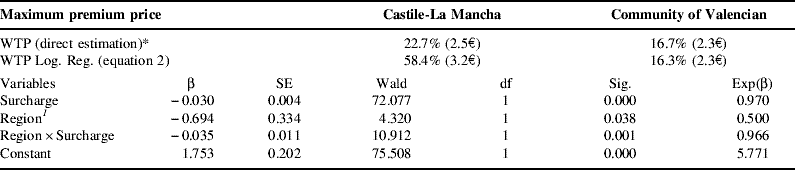
The average estimated premium price that consumers from Castile-La Mancha would pay for organic wine was 58.4% (€3.2) while those from the Community of Valencia would pay 16.3% (€2.3) (Table 3).
Maximum surcharge price (direct determination and logistic model) and variables obtained from the logistic modelFootnote 2 for organic wine.
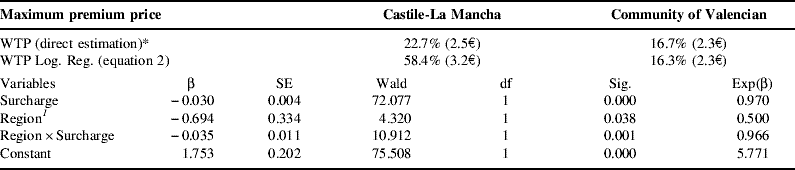
* Indicate the existence of significant differences for a maximum error level of 5%.
1 Dummy variable (1: Comunidad Valenciana consumers and 0: Castile-La Mancha consumers).
2 −2LL decrease (963 to 722), R 2 Cox and Snell: 0.292 and R 2 Nagelkerke: 0.390. Chi-squared in the Hosmer and Lemeshow test is not significant. 75.3% of the cases are classified correctly.
Once it was established that consumers were interested in the product, potential consumers from each region were characterized. Differences were also established of those who were not willing to pay the price increase that cultivating these products entails.
Characterization of organic wine consumers
To try to explain regional differences in WTP, consumers from both geographical areas were characterized according to their lifestyles, socio-economic characteristics and level of knowledge about organic food.
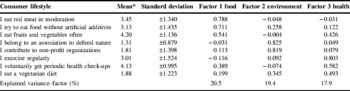
To determine the variables relative to organic wine consumer lifestyles, a preliminary factorial analysis was made, a varimax rotationReference Kaiser50. It allowed the information contained in a series of original variables to condense into a smaller series of composite dimensions (factors) with a minimum loss of information. Three factors were identified: one related with concern about food, another with concern for the environment and a third with concern for health. The total explained variance was 57.8% (Table 4).
Analysis of rotated factor matrix for consumer lifestyles.

Sample adequacy (Kaiser–Meyer–Olkin): 0.695.
Significance level of Bartlett roundness test: 0.000.
* Likert scale, from 1 (strongly disagree) to 5 (strongly agree).
Once the variables were identified that determined organic wine consumer lifestyles, their characterization was made in Castile-La Mancha as well as in the Community of Valencia, depending on whether or not they were willing to pay a minimum increase in price of 25% for an organic wine over a traditional one (Table 5).
Consumers characterization for market segments.

** Indicate the existence of significant differences for a maximum error level of 5%.
a–c Different letters indicate the existence of significant differences for a maximum error level of 5% (Tukey test).
1 CLM: Castile-La Mancha.
2 CV: Community of Valencia.
3 WTP: willingness to pay.
Concerning the variables relative to lifestyles, in the Community of Valencia consumers were more concerned for the environment, as well as for health and for food, than in Castile-La Mancha.
In concern for food, two differentiated sub-groups were observed. The first, having a greater concern for food, included all the consumers from the Community of Valencia. All consumers from Castile-La Mancha were found in the second sub-group, as well as those from the Community of Valencia who would not pay a 25% price increase. The latter were included in both groups, since their concern for food was intermediate.
In the variable concern for the environment, three differentiated sub-groups appeared. In the first, consumers from the Community of Valencia were found who had a greater concern for the environment and were definitely willing to pay 25% more for organic products. In the second, consumers from the Community of Valencia were found who had an intermediate concern for the environment and would not pay a 25% increase in price. The third sub-group was formed by those consumers from Castile-La Mancha who do not seem to be greatly concerned about the environment.
Three sub-groups appeared in the concern for health variable. The first was formed by consumers from the Community of Valencia who would pay a 25% price increase for organic wine and who showed great concern for health. The second was formed by consumers from the Community of Valencia who would not pay 25% more and by those from Castile-La Mancha who would pay more. Their concern for health was intermediate. The third was formed by consumers from Castile-La Mancha who would not pay 25% more for organic wine and whose concern for health was low. It must be emphasized that for the majority of considered variables, greater differences seemed to exist between consumers when the region of origin was taken into account than when WTP the price increase that guarantees product profitability was considered.
Results from the socio-economic variables indicated that significant differences only appeared concerning educational level and age. It is noteworthy that in this case the most relevant differences appeared according to consumer region of origin. Concerning the educational level variable, in Castile-La Mancha there is a greater percentage of consumers with an elementary education and in the Community of Valencia a greater percentage of consumers have a higher education.
For the age variable, in Castile-La Mancha, there is a higher percentage over 64 years of age and in the Community of Valencia there is a greater percentage of consumers between 30 and 49 years old. Besides, in Castile-La Mancha, the older population is less willing to pay more for the organic product, which is not as evident in the Community of Valencia. Concerning gender and monthly family income variables, significant differences did not appear in consumer distribution.
Referring to knowledge about organic products, a true or false question was introduced into the questionnaire about the organic product concept. Consumers were asked to indicate which answers they thought were correct. According to the number of right and wrong answers given by consumers, a variable was created denominated knowledge of organic products with five levels: 1 for low and 5 for high. A five-point Likert scale was used for their level of agreement, with 1 point for total disagreement and 5 for complete agreement.
The results of this variable indicated that significant differences between consumers from both regions existed at 1%. The percentage of consumers having a low or medium-low level of knowledge concerning organic products was greater in the Community of Valencia than in Castile-La Mancha. This fact could be due to the greater importance of the agricultural sector in Castile-La Mancha, where the society in general might be more ‘sensitized’ to this sphere.
Discussion
Validity of the contingent valuation
In this study, based on contingent valuation, a logistic regression model was used to analyze data. The model related WTP a price increase for organic wine with two variables, surveyee region of origin and the percentage of price increase for organic wine compared to a similar traditional wine. The data used were adjusted to the model since chi-squared in the Hosmer and Lemeshow test was not significant and 75.3% of the cases were classified correctly. Besides, the requisites were sufficiently fulfilled: −2LL decreased (from 963 to 722), the Cox and Snell R 2=0.292 and the Nagelkerke R 2 was 0.390.
The increase in price was the chief model predictor, as reported by others, but the region of origin was also significantReference Mather, Knight and Holdsworth51, Reference Loureiro, Gracia and Nayga52. As expected, the model indicated that the higher the increase in price for organic wine, the lower the probability of paying. In the proposed model, the relationship between belonging to a determined region and the probability of paying was also shown. When the respondent was from the Community of Valencia, the probability of paying was lower than from the region of Castile-La Mancha.
The other variables used in previous studies for predicting WTP for foodReference Loureiro, McCluskey and Mittelhammer53, Reference Guris, Metin and Caglayan54, as well as socio-economic characteristics of the individuals and their lifestyles, were not significant for explaining WTP an increase in price for organic wine.
These results indicated in the first place that the increase in price of the product is very important for wine consumers when purchasing organic wine. The form of the function used indicated that at very high increases there would hardly be any consumers willing to buy the product. Therefore, in spite of the potentially very high profitability per product unit, the eventual income would be very small, because not much of the product would be sold.
In the second place, the influence of surveyee region on WTP makes it seem necessary to plan different commercial strategies for each market.
Implications
This research has some practical implications. Organic wine is suggested as an alternative for vine growers who have suffered important income losses in recent years. These income losses are basically due to growing competition in viticulture markets and the decrease in current consumption. The higher price that organic wine could reach in markets would amply compensate for the higher cost of this type of crop particularly due to lower productivity and the greater need for labor.
From the results of this study, it can be stated that:
Hypothesis I is accepted: ‘Organic production is an adequate alternative for wines in local markets’ since more than 80% of consumers would consume organic wine. Besides, a high percentage of consumers would be willing to pay over 25% more for this type of wine: 45.3% of consumers in Castile-La Mancha and 28.7% in the Community of Valencia.
Hypothesis II is accepted: ‘The importance of the wine production sector on local economies is proportional to the willingness of consumers to pay more for organic wine’.
The average increase in price that consumers are willing to pay is especially high in Castile-La Mancha, a region where the agricultural sector is more important (7.4% of gross value added (GVA)) and where the weight of wine and grape juice (must) production is high in total gross agricultural output (22%). In this region, the increase in price is 58.4% (€3.2). In the Community of Valencia, where the weight of agriculture is lower (2.2% of GVA) and wine and must production is 3.3% of total gross agricultural output, the increase in price is 16.3% (€2.3).
Other variables were considered, such as educational level or concern for health, the environment and food, which might influence the acceptance of organic products. (In the Community of Valencia, the higher the educational level, the greater was the concern in all cases.) However, results did not allow for the establishment of a direct relationship between these variables and acceptance of organic products. Nevertheless, it seems important to establish information campaigns, since the level of knowledge about organic products was directly related to the acceptance of organic wine, especially in the Community of Valencia. Campaigns should be directed toward increasing knowledge about these products, which appeal to consumers concerned about health, the environment and food, since a priori they could be the first to adopt these products.
Limitations
The main limitation to this study is the method used. Contingent valuation belongs to the group of direct or hypothetical methods based on information furnished by individuals themselves when asked for their valuation of the object under analysisReference Azqueta55. This method presents an important limitation, the so-called hypothetical warp, which establishes that, since the questions are hypothetical, the answers could also be hypotheticalReference Mitchell and Carson56. Previous studies indicate that demand is overestimated by hypothetical methodsReference Balistreri, McClelland, Poe and Schulze57.
Nevertheless, the scarcity of a product at this time with these characteristics, an organic wine from each region, and the limited budget available for research has made the use of experimental methods difficult.
Finally, a classification of regions is lacking that would permit extrapolating the results and proposing similar commercialization strategies for each of the established types. This would also be useful for establishing the appropriateness in advance of an alternative strategy in a determined region to prevent futile efforts.
Conclusions
Progressive abandonment of farm land and the substitution of agriculture for other, basically urban, activities are facts that do not contribute to the sustainability of the planet. Therefore, the proposal of profitable alternatives for the agricultural sector is indispensable.
Besides being more environment-friendly (let us not forget food miles), the local market has frequently forgotten that such alternatives could be an attractive objective to viticulture growers, who could thus have greater control over their product in the presumably shorter distribution channel. This study also established that the proposed alternative is valid in regions with different economic realities, since regions with differing weight in the agricultural sector were considered, even though the strategies to follow might be different according to the region under consideration.
The price increases that organic wine consumers would be willing to pay are high enough to compensate amply for the additional cost involved in producing this type of wine. Generally, over 80% of the consumers were willing to consume organic wine.
In any case, it seems important that businesses interested in this alternative should make the benefits known of organic production and particularly the consumption of organic wine. For greater knowledge is directly related to a greater increase in price.
Appendix