Introduction
Parasitoids are insects belonging mostly to the Hymenoptera, an order that well could be 2.5 to 3.5 times larger than the order Coleoptera, currently the richest order in described species (Forbes et al., Reference Forbes, Bagley, Beer, Hippee and Widmayer2018). Parasitoids have high economic and ecological relevance as their larvae feed on other insect species, killing them in the process (Godfray, Reference Godfray1994), so they control populations of species that could otherwise damage wild and cultivated plants (LaSalle and Gauld, Reference LaSalle and Gauld1993). In addition, parasitoid populations depend on the abundance of their hosts and are also indicators of community diversity and abundance, which ultimately depend on vegetation integrity and productivity (Sharkey, Reference Sharkey2007).
Multiple studies explain the relationships between vegetation and parasitoids. The information reported to date is inconsistent because several authors claim that a more complex vegetation structure, with larger number of different microhabitats available, as shelters and food resources, support a higher parasitoid diversity (Price et al., Reference Price, Bouton, Gross, McPheron, Thompson and Weis1980; Russell, Reference Russell1989; Hawkins et al., Reference Hawkins, Shaw and Askew1992; Sääksjärvi et al., Reference Sääksjärvi, Ruokolainen, Tuomisto, Haataja, Fine, Cárdenas, Mesones and Vargas2006; Fraser et al., Reference Fraser, Dytham and Mayhew2007; Scherber et al., Reference Scherber, Eisenhauer, Weisser, Schmid, Voigt, Fischer, Schulze, Roscher, Weigelt, Allan, Beler, Bonkowski, Buchmann, Buscot, Clement, Ebeling, Engels, Halle, Kertscher and Tscharntke2010; Rubene et al., Reference Rubene, Schroeder and Ranius2015). In contrast, other authors claim that the herbivore-induced volatiles produced by different plant species are more important than plant complexity (e.g., Koricheva et al., Reference Koricheva, Mulder, Schmid, Joshi and Huss-Danell2000) because they attract different species of parasitoids (Godfray, Reference Godfray1994; Wäschke et al., Reference Wäschke, Hardge, Hancock, Hilker, Obermaier and Meiners2014).
The structural complexity and species richness are driven mainly by forest succession (Basset et al., Reference Basset, Aberlenc, Barrios, Curletti, Bérenger, Vesco, Causse, Haug, Hennion, Lesobre, Marqueás and Omeara2001). In tropical forests, early successional stages (less than 20 years old) differ from old forests in the taxonomic and functional diversity of vegetation, as well as in litter production and vegetation structure (Lohbeck et al., Reference Lohbeck, Poorter, Paz, Pla, van Breugel, Martínez-Ramos and Bongers2012; Nyafwono et al., Reference Nyafwono, Valtonen, Nyeko and Roininen2014; Souza et al., Reference Souza, Veloso, Espírito-Santo, Silva, Sánchez-Azofeifa, Souza e Brito and Fernandes2019). Some studies have explained the inverse relationship between forest successional stage and insect diversity focused on predators and herbivorous insects (Neves et al., Reference Neves, Silva, Espírito-Santo and Fernandes2014; Rubene et al., Reference Rubene, Schroeder and Ranius2015; Fonseca et al., Reference Fonseca, Silva, Falcão, Dupin, Melo and Espírito-Santo2018; Rocha-Ortega et al., Reference Rocha-Ortega, Arnan, Ribeiro-Neto, Leal, Favila and Martínez-Ramos2018). In contrast, several authors have reported different results for tropical dry forests, where herbivory levels and herbivorous insect diversity were higher in advanced successional stages (Silva et al., Reference Silva, Espírito-Santo and Melo2012; Neves et al., Reference Neves, Silva, Espírito-Santo and Fernandes2014). Considering this, we would expect parasitoid diversity to vary between forest successional ages, being highly sensitive to environmental changes, since parasitoids play a specialized ecological role and belong to upper trophic levels (LaSalle and Gauld, Reference LaSalle and Gauld1993; Shaw and Hochberg, Reference Shaw and Hochberg2001).
The present study is focused on sampling parasitoids of the family Ichneumonidae in a dry semi-deciduous tropical forest. This insect group comprises a high species diversity, being one of the species-rich families with over 25,000 known species (Yu et al., Reference Yu, van Achterberg and Horstmann2016). The populations of each species tend to be small and closely related to their hosts. Parasitoids are especially vulnerable because they are scarcely represented in conservations policies, particularly in tropical subhumid and dry forests that have been disturbed by anthropogenic activities such as agriculture and cattle ranching, and are poorly represented in preserved areas (Hernández-Stefanoni et al., Reference Hernández-Stefanoni, Dupuy, Tun-Dzul and May-Pat2010). The objective of the present study was to analyze the diversity of Ichneumonidae parasitoids in three forest successional stages. We hypothesized that parasitoid species richness and diversity would be higher in old forests but with lower abundances, consistent with their more complex structure. Also, the species composition of parasitoid assemblages may change according to forest age in terms of both species and guilds, especially regarding dominant species. This information will expand our knowledge of the diversity of parasitoids and the relationships between this insect group and vegetation structure along a successional gradient in one of the ecosystems most threatened by fragmentation.
Materials and methods
Study area
This study was conducted in the Kaxil-Kiuic private reserve, located at the south of Yucatan, Mexico (20°04ʹ N–20°06ʹ N; 89°32ʹ W–89°34ʹ W). The local climate is tropical warm with rainy summer and a dry season from November to April, with mean annual precipitation ranges between 1000 and 1100 mm. The landscape is dominated by seasonally dry semideciduous tropical forests (50%–75% of species shed their leaves during the dry season) of different ages after the abandonment of the traditional slash-and-burn agriculture. The canopy forest is 8–13 m high, with a few prominent old trees 15 to 18 m high. The most abundant tree species are Neomillspaughia emarginata, Gymnopodium floribundum, Bursera simaruba, Piscidia piscipula, and Lysiloma latisiliquum (Hernández-Stefanoni et al., Reference Hernández-Stefanoni, Dupuy, Johnson, Birdsey, Tun-Dzul, Peduzzi, Caamal-Sosa, Sánchez-Santos and López-Merlí2014).
Inside the tropical dry forest, we selected thirty sites belonging to three different types of land-cover and landscape structure (ten plots for each successional age), corresponding to different successional stages: early successional forest (hereafter young forest), six to nine years post-disturbance; intermediate successional forest (hereafter intermediate forest), 10 to 15 years post-disturbance; mature forest (hereafter old forest), +60 years post-disturbance (Hernández-Stefanoni et al., Reference Hernández-Stefanoni, Dupuy, Tun-Dzul and May-Pat2010, Reference Hernández-Stefanoni, Dupuy, Johnson, Birdsey, Tun-Dzul, Peduzzi, Caamal-Sosa, Sánchez-Santos and López-Merlí2014). The three successional ages have tree and shrubs as dominant growth forms. The young forest has a low relative low canopy stature (8–13 m) with a few prominent trees; in general have fewer species and less biomass than the older successional stages. The old forest has trees with 15–18 m of height (Hernández-Stefanoni, Reference Hernández-Stefanoni, Dupuy, Johnson, Birdsey, Tun-Dzul, Peduzzi, Caamal-Sosa, Sánchez-Santos and López-Merlí2014).
Parasitoid sampling
Ichneumonid insects were sampled using Malaise traps, which is the usual method in monitoring programs (e.g., Gauld, Reference Gauld1991; Longino, Reference Longino1994) and produces large captures of parasitic Hymenoptera (Sääksjärvi et al., Reference Sääksjärvi, Ruokolainen, Tuomisto, Haataja, Fine, Cárdenas, Mesones and Vargas2006; Fraser et al., Reference Fraser, Dytham and Mayhew2007; Chan-Canché et al., Reference Chan-Canché, Ballina-Gómez, Leirana-Alcocer, Bordera and González-Moreno2020). A total of 30 traps were placed with a north-south orientation to maximize sampling efficiency (Darling and Packer, Reference Darling and Packer1988), ten in each of the three forest successional stages, during the rainy season (August to November) of 2016. Every 15 days, samples were collected and preserved in 70% alcohol. All Ichneumonidae specimens collected were dry-pinned for taxonomic identification. Keys to the Neotropical fauna (e.g., Gauld, Reference Gauld1991, Reference Gauld1997, Reference Gauld2000; Gauld et al., Reference Gauld, Ugalde and Hanson1998, Reference Gauld, Godoy, Sithole and Ugalde2002), Mexican fauna (e.g., Kasparyan and Ruíz-Cancino, Reference Kasparyan and Ruíz-Cancino2005, Reference Kasparyan and Ruíz-Cancino2008) and Nearctic fauna (e.g., Townes and Townes, Reference Townes and Townes1962; Townes, Reference Townes1969, Reference Townes1970a, Reference Townes1970b, Reference Townes1971), were used to identify Ichneumonidae to the genus level and morphospecies. All specimens were deposited in the Colección Entomológica de Referencia (Reference Insect Collection) at Instituto Tecnológico de Conkal (Yucatan, Mexico).
Data analysis
The vegetation data used in this work (species richness, abundance, and species composition in each conglomerate) were evaluated previously by Hernández-Stefanoni et al. (Reference Hernández-Stefanoni, Dupuy, Tun-Dzul and May-Pat2010; Reference Hernández-Stefanoni, Dupuy, Johnson, Birdsey, Tun-Dzul, Peduzzi, Caamal-Sosa, Sánchez-Santos and López-Merlí2014); this evaluation was repeated in 2018 and 2021, and no changes were noted in the vegetation structure (Hernández-Stefanoni, personal communication). The diversity of Ichneumonidae was analyzed related to species richness, abundance, community structure, and true diversity of species and guilds. Trophic guilds followed the classification of Mazón and Bordera (Reference Mazón and Bordera2014):
-
Coc: parasitoids of cocoons and pupae.
-
cPh: parasitoids of concealed phytophagous larvae feeding inside above-ground plant parts, such as leaf rollers, leaf folders, gall formers, and leaf miners.
-
gPh: parasitoids of exposed phytophagous larvae feeding on external parts of plants, such as leaves, stems, flowers, and buds.
-
Mel: parasitoids of melitophagous larvae of bees that feed on stores of honeydew, nectar, and pollen, and of wasp larvae living in nests.
-
Myc: parasitoids of larvae living in the fruiting bodies of mushrooms and bracket fungi.
-
Sap: parasitoids of saprophagous larvae.
-
Unkn: parasitoids whose hosts remain unknown.
-
Xyl: parasitoids of xylophagous larvae, excluding those feeding on dead but not decomposing wood.
-
Zoo: parasitoids of zoophagous larvae and spiders.
-
Hyp: hyperparasitoids whose host range includes many species of primary parasitoids.
We used accumulation curves to visualize the completeness of sampling and extrapolate the species richness predicted by the nonparametric estimator Chao 1. We assessed differences in species richness between vegetation stages considering 95% confidence intervals (CI), generated by 1000 bootstrap resamplings (Colwell and Elsensohn, Reference Colwell and Elsensohn2014) and using the software Estimates 9.0. To test for abundance differences between successional stages (SS), a Generalized Linear Mixed Model (GLMM) was run, in which SS was treated as the fixed factor and malaise traps as the random factor. A Poisson distribution and a Log link function were used. In addition, we used a Bonferroni test to identify differences between SS. This analysis was run in The jamovi project (2022).
The structure of ichneumonid assemblages was compared using rank-abundance curves (Feinsinger, Reference Feinsinger2001). Ichneumonidae species diversity was calculated by means of true diversity measures, using the software SPADE (Chao and Shen, Reference Chao and Shen2010). These measures consider three diversity levels, based in Hill numbers qD (Jost, Reference Jost2006): 0D, which refers to species richness only; 1D, which is the ecological diversity if all species had the same relative importance, counting individuals equally and weighing species in proportion to their abundance, uses the inverse of the exponential of Shannon's entropy (Jost, Reference Jost2006); and order 2D, which considers only the dominant species, uses the inverse of Simpson index (Moreno et al., Reference Moreno, Barragán, Pineda and Pavón2011); with 95% CI to determine whether there were significant differences between forest stages.
We ran a cluster analysis (CA) and two-way cluster analysis (TWCA) to explore the similarity of successional age classes (SAC) and identify patterns of similarity in parasitoid species, parasitoid diversity variables (species richness, abundance, alpha diversity index), and indicator species of each SAC, using Euclidean measures based on quantitative data. These diversity variables (Appendix 1) were built in order to generate a dendrogram and to determine which values (abundance, Shanon's H’ or species richness and other alpha indices) were more correlated with plant diversity. To link plant community and abundance data with SAC, we used an Indicator Species Analysis (ISA) (Ter Braak and Prentice, Reference Ter Braak and Prentice1988; Dufrêne and Legendre, Reference Dufrêne and Legendre1997). Altogether, this information provided knowledge of the concentration of species abundance in a particular SAC and the fidelity of occurrence of a given species in that SAC. Indicator values for each species in each SAC were obtained and tested for statistical significance using the Monte Carlo test. ISA evaluated each species in terms of the strength of its response to the SAC, from the SAC matrix (3 conglomerates, belonging to the same sites selected to parasitoids sampling ×3 SAC). A threshold level of 60% with 95% significance (p-value ≤0.05) was selected as the cutoff value for identifying indicator species. These analyses were carried out with PC-Ord Ver.7 (McCune and Mefford, Reference McCune and Mefford2016).
The relationship between parasitoid species and plant richness, plant abundance, and SAC was tested through Redundancy Analysis (RDA; Legendre and Legendre, Reference Legendre and Legendre1998). Before running the analyses, we calculated the length of the gradient (Braak and Smilauer, Reference Braak and Smilauer2002) with a Detrended Correspondence Analysis (DCA; Hill, Reference Hill1979). The statistical significance of each forest characteristic (plant richness, plant abundance, and SAC), as well as of the four axes, was tested within the forward selection procedure using a Monte Carlo random permutation test (999 permutations, P ≤ 0.05). These analyses were run using the software Canoco 4.5.
Results
A total of 1522 individuals representing 18 subfamilies, 74 genera, and 168 morpho-species were captured during the studied period. The Chao richness estimator predicted a maximum of 199.5 species, so the species inventory from field sampling was approximately 84% complete. When the individual numbers from all sites were considered, Cryptinae and Cremastinae accounted for 60% of all individuals (464 and 445 individuals, respectively). Diapetimorpha, Xiphosomella, and Acerastes were the most abundant genera, with more than 100 individuals each (Appendix 2). Concealed phytophagous and cocoon parasitoids were the most abundant of the ten guilds defined in this work, with 511 and 364 individuals (34% and 24%, respectively) (fig. 1). The Ichneumonidae species and composition of community guilds are described below in terms of species richness, abundance, and true diversity across successional stages of vegetation in the tropical forest studied.
Guilds of parasitoids founded in different ages of abandonment after traditional slash and burn agriculture.

Ichneumonidae community composition
Species richness showed no differences according to the Chao 1 estimator with 95% CI (fig. 2), with 177 species in the young forest, 170 species in the intermediate forest, and 111 species in the old forest; sampling efficiency from each vegetation stage was 80, 60, and 71% from the total species, respectively.
Accumulation curves of the Ichneumonidae in the three vegetation ages in dry semideciduos forest for species collected in the Malaise traps.

Abundance differed between vegetation stages according to the GLMM (χ2 Wald = 1635; P < 0.001; Deviance = 4.31, AIC = 285.2); the number of individuals was higher in young forest (798 individuals) than intermediate and old forests, with 372 and 352 individuals, respectively (fig. 3).
Proportional abundance of Ichneumonidae genera in different ages of dry semideciduos forest.

Diversity, defined as the effective number of species, i.e., considering species richness 0D, showed no differences between vegetation stages because there is overlap at the 95% CI. These results are consistent with the accumulation curves. However, for ecological diversity 1D, the intermediate forest shows the highest diversity, with 71.6 species. This successional stage surpasses the old forest by 15.9 effective species and the young forest by 12.46 effective species (Table 1). Finally, based on the diversity 2D, all sites yield a lower number of effective species because this value focuses on the most common species. Thus, intermediate and old forests show non-random differences in diversity with 95% CI, reaching more than twice the number of effective species relative to the young forest (Table 1).
True diversity of Ichneumonidae as effective number of species and guilds for estimating species richness (0D), exponential of the Shannon index (1D), and inverse of the Simpson index (2D), of three different stages in the dry semi-deciduous forest

The higher diversity of 2D, in intermediate and old forests may be due to the higher evenness of the ichneumonid assemblage in both successional stages (fig. 4). In the young forest, the parasitoid assemblage was dominated by a single species, Eiphosoma sp. 1, with 22% of the total number of individuals, almost twice the proportion of the dominant species in the other stages, resulting in lower evenness and less diverse communities. To note, this same species was the most abundant in the intermediate forest, but the most abundant species in the old forest was Anomalon sp. (fig. 4).
Rank–abundance plots of ichneumonid ensembles collected from the three vegetation ages in a dry semideciduos forest. A logarithmic scale of abundance was plotted against the species-rank ordered by species, from those with the most abundant individuals to those with the fewest. The species codes were as follows (only the most abundant for every age): A, Eiphosoma sp.; B, Diadegma sp.; C, Anomalon sp. D, Diapetimorpha sp.; E, Carinodes sp.; F, Camera euryaspis.

Ichneumonidae guild composition
Guild richness was the same in the three different forest successional ages, with ten guilds (fig. 5). Abundance did not differ between vegetation stages according to the GLMM (χ2 Wald = 4.96; P = 0.08; Deviance = 5.26, AIC = 271.5).
Accumulation curves of the Ichneumonidae guilds in the three vegetation ages in dry semideciduos forest for species collected in the Malaise traps.

True diversity 0D was higher in the old forest, but only by three additional guilds. However, 1D and 2D showed the same diversity at 95% CI (Table 1, fig. 6). It is worth mentioning that parasitoids of melitophagous larvae of bees were observed only in the old forest (fig. 6).
Rank–abundance plots of ichneumonid guilds ensembles collected from the three vegetation ages in a dry semideciduos forest. A logarithmic scale of abundance was plotted against the species-rank ordered by guilds, from those with the most abundant individuals to those with the fewest.

Plant communities, parasitoids, and guild species
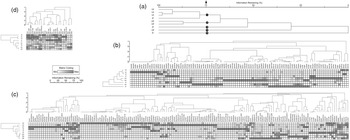
A total of 106 plant species were recorded (Appendix 3). Cluster and two-way cluster analyses broadly divided the SAC of plant species into five communities (at 75% similarity), regardless of their previously established SAC. Community 1 included the three conglomerates of young forest (YF) and one intermediate forest (IF); Community 2 included two conglomerates of the two old forest (OF); Communities 3, 4, and 5, included only one conglomerate per SAC (two belonging to intermediate forest (IF) and one to old forest (OF) (fig. 7a, b).
Cluster and Two-Way Cluster Dendrogram based on Euclidean measures, showing distribution of 106 plant species (a, b), 168 parasitoid species (c) and 26 parasitoid diversity variables (d), named in Appendix 1; in Successional Age Classes (SAC). The SAC are named by their indicator plant species. Colors are scaled from highest (deep gray) to lowest (faint gray) values within squares. The three conglomerate replicates for vegetation and sites for parasitoids, are shown as young forest (YF), intermediate forest (IF) and old forest (OF).

The ISA identified species for each SAC (threshold level ≥60% or P ≤ 0.05). YF showed two indicator plant species: Diphysa carthagenensis and Senna atomaria; in IF, there were seven indicator plant species: Arrabidaea floribunda, Bursera simaruba, Croton glabellus, Mimosa bahamensis, Neomillspaughia emarginata, Thevetia gaumeri, and Zapoteca formosa; OF included 22 indicator plant species: Acacia gaumeri, Bunchosia glandulosa, Bunchosia swartziana, Caesalpinia gaumeri, Coccoloba acapulcensis, Diospyros veraecrucis, Erythroxylum rotundifolium, Guettarda elliptica, Guettarda gaumeri, G. floribundum, Heteropterys laurifolia, Hippocratea excelsa, Jatropha gaumeri, Karwinskia humboldtiana, Machaonia lindeniana, Malpighia glabra, Melicoccus oliviformis, Neea psychotrioides, Platymiscium yucatanum, Sideroxylon obtusifolium, Tabebuia chrysantha, and Thouinia paucidentata (fig. 7a, b).
The parasitoid species more associated to YF were Eiphosoma sp. 8 and Eiphosoma sp. 7; in IF, Eiphosoma sp. 8 and Diadegma sp.; and in OF, Anomalon sp. 3 and Diapetimorpha sp. 1 (fig. 7c). As regards the parasitoids diversity variables in the Ichneumonidae guilds community, the better associated to YF were Coc, Unkn spp, Myc, cPh, Xyl, Zoo, and Hyp; in IF, gPh, Xyl, cPh, and Zoo; and in OF, Coc, Sap, and Mel (fig. 7d).
We analyzed the relationship of parasitoid species with plant species richness, plant abundance, and SAC. The RDA triplot showed a narrow separation along the axes, and the Monte Carlo permutation test was not significant for any of the four axes (Table 2). Nonetheless, plant species richness, plant abundance, and SAC were significant (F = 1.47, P = 0.02; F = 1.56, P = 0.01; and F = 1.33, P = 0.04, respectively) (fig. 8). However, the influence of each forest characteristic showed a differential response of parasitoid species. We identified seven groups of parasitoid species and three response patterns: (1) Neutral response: parasitoid species in groups A and E showed no association with forest characteristics; (2) Positive response: parasitoid species in groups F and G showed a positive association with three forest characteristics; (3) Negative response: parasitoid species in groups B, C, and D showed a negative association with forest characteristics (fig. 8).
Eigenvalues and Monte Carlo results for the Redundancy Analysis (RDA) of parasitoid species associated with plant species richness and abundance, and Successional Age Classes (forest characteristics, FC) in a tropical forest in southeast Mexico

Redundancy Analysis (RDA) scatterplot illustrating the relationships of parasitoid species (represented by groups) to richness and abundance of plant species and SAC (Successional Age Classes) in a tropical forest in Southeast Mexico. Group A: Baltazaria sp. 4, Bicryptella sp. 1, Brachycirtus sp. 1, Clydonium sp. 1, Diapetimorpha sp. 6, Diploginma fulvithorax, Eiphosoma sp. 9, Enicospilus sp. 2, Hylophasma sp. 1, Joppidium sp. 1, J. sp. 2, Lymeon sp. 1, Megaspilus sp. 2, Microcharops sp., Mnioes sp. 1. Group B: Allophrys sp. 1, Anomalon sp. 1, Baltazaria sp. 6, Carinodes sp. 3, Chilocyrtus sp. 2, Diapetimorpha sp. 4, Diapetimorpha sp. 5, Eusterinx sp. 2, Joppidium sp. 1, Lobaegis sp. 1, Neotheronia sp. 2, Neotheronia sp. 4, Temelucha sp. 2. Group C: Diapetimorpha sp. 9, Eiphosoma sp. 7, Eiphosoma sp. 8, Physotarsus sp. 2, Trathala sp. 2, Xiphosomella sp. 1. Group D: Eiphosoma sp. 4, Lymeon sp. 4, Physotarsus sp. 1, Polycirtus sp. 1, Pristomerus sp. 2. Group E: Venturia sp. 1, Xiphosomella sp. 2. Group F: Anomalon sp. 3, Carinodes sp. 5, Nonnus sp. 2. Group G: Ateleute sp. 1, Camera euryaspis, Diapetimorpha sp. 1, Lanugo yucatan, Podogaster sp. 1. We show only parasitoid species with best fit (based on longest length of the arrows).

Discussion
This study provides a better understanding of the changes in parasitoid communities inhabiting forests of different successional ages. The estimated value of Ichneumonidae species richness of 84% was adequate for comparative studies of parasitoid diversity, according to other studies providing results ranging between 70 and 80% of the expected number of species (Skillen et al., Reference Skillen, Pickering and Sharkey2000; Sääksjärvi et al., Reference Sääksjärvi, Haataja, Neuvonen, Gauld, Jussila, Salo and Burgos2004; Fraser et al., Reference Fraser, Dytham and Mayhew2007; Mazón and Bordera, Reference Mazón and Bordera2008; González-Moreno et al., Reference González-Moreno, Bordera, Leirana-Alcocer, Delfín-González and Ballina-Gómez2018). Besides, an intensive malaise-trapping regime is better for sampling over short periods of time (Saunders and Ward, Reference Saunders and Ward2018). In this case, we used a total sampling effort of approximately 4500 malaise trap-days considering all sites sampled over four months (1200 trap-days in each forest successional stage).
Ichneumonidae community composition
Several studies have shown that structural complexity, high plant diversity, or forest successional stage favor the species richness of herbivores (Wäschke et al., Reference Wäschke, Hardge, Hancock, Hilker, Obermaier and Meiners2014; Li et al., Reference Li, Aguilar and Berkov2017; Valtonen et al., Reference Valtonen, Malinga, Nyafwono, Nyeko, Owiny and Roininen2017; Rocha-Ortega et al., Reference Rocha-Ortega, Arnan, Ribeiro-Neto, Leal, Favila and Martínez-Ramos2018; Sánchez-Reyes et al., Reference Sánchez-Reyes, Niño-Maldonado, Clark, Barrientos-Lozano and Almaguer-Sierra2019) and their predators and parasitoids (Scherber et al., Reference Scherber, Eisenhauer, Weisser, Schmid, Voigt, Fischer, Schulze, Roscher, Weigelt, Allan, Beler, Bonkowski, Buchmann, Buscot, Clement, Ebeling, Engels, Halle, Kertscher and Tscharntke2010; Zhang and Adams, Reference Zhang and Adams2011; Borer et al., Reference Borer, Seabloom and Tilman2012; Zou et al., Reference Zou, Sang, Bai and Axmacher2013; Rubene et al., Reference Rubene, Schroeder and Ranius2015; Li et al., Reference Li, Aguilar and Berkov2017; González-Moreno et al., Reference González-Moreno, Bordera, Leirana-Alcocer, Delfín-González and Ballina-Gómez2018). However, these results were contrary to our expectations, as Ichneumonidae species richness was the same in all areas; this may indicate the capacity of these areas to maintain viable communities of parasitoids due to the connectivity between forest patches (Li et al., Reference Li, Aguilar and Berkov2017). These findings are similar to those reported in other studies that have shown no differences in species richness between habitats in the Ichneumonidae (Cryptinae) (González-Moreno et al., Reference González-Moreno, Bordera and Delfín-González2015) and in butterflies (Valtonen et al., Reference Valtonen, Malinga, Nyafwono, Nyeko, Owiny and Roininen2017). Some studies demonstrated that in areas of intermediate successional age, insect species richness is similar to values recorded in mature or undisturbed habitats (Winfree et al., Reference Winfree, Griswold and Kremen2007; Neves et al., Reference Neves, Silva, Espírito-Santo and Fernandes2014; Nyafwono et al., Reference Nyafwono, Valtonen, Nyeko and Roininen2014) or in secondary forests (Li et al., Reference Li, Aguilar and Berkov2017).
Arthropod abundance is occasionally affected by habitat succession or changes in land use (Teodoro et al., Reference Teodoro, Muñoz, Tscharntke, Klein and Tylianakis2011; Valtonen et al., Reference Valtonen, Malinga, Nyafwono, Nyeko, Owiny and Roininen2017). Nevertheless, some studies state that the abundance of parasitoids was independent of plant diversity and was best explained by the abundance of their hosts (Wäschke et al., Reference Wäschke, Hardge, Hancock, Hilker, Obermaier and Meiners2014): habitats with higher tree density and plant richness showed higher herbivore diversity and density (Leal et al., Reference Leal, Oliveira Silva, Sousa-Souto and de Siqueira Neves2016); accordingly, we expected a higher diversity of parasitoids, which means less abundance.
The highest Ichneumonidae abundance in the young forest may reflect the ability of specialist ichneumonids to colonize new areas in this successional stage. In fact, 66% of all individuals were koinobionts, which have a higher searching ability and were more mobile. Furthermore, this stage was dominated by species like Eiphosoma, which is more common in open habitats (González-Moreno et al., Reference González-Moreno, Bordera, Leirana-Alcocer, Delfín-González and Ballina-Gómez2018). This pattern was observed in other studies about bees (Winfree et al., Reference Winfree, Griswold and Kremen2007) and wasps (Rubene et al., Reference Rubene, Schroeder and Ranius2015), where species abundance and richness in young forest habitats were higher than in later successional stages because flowering plants are major resources for bees and wasps in these successional stages.
Some studies reported that habitats at intermediate successional stages are more diverse than old forests based on several taxa, like ants (Rocha-Ortega et al., Reference Rocha-Ortega, Arnan, Ribeiro-Neto, Leal, Favila and Martínez-Ramos2018), cerambycid Coleoptera (Li et al., Reference Li, Aguilar and Berkov2017), free-feeding species of herbivores (Neves et al., Reference Neves, Silva, Espírito-Santo and Fernandes2014), and butterflies (Nyafwono et al., Reference Nyafwono, Valtonen, Nyeko and Roininen2014). This finding may be explained by the intermediate disturbance hypothesis (Connell, Reference Connell1978), which postulates that early successional stages with high disturbance favor opportunistic disturbance-adapted species only, and thus diversity decreases. Moderate disturbance levels show the highest diversity, whereas late successional stages with low disturbance levels lead to competitive exclusion and loss of biodiversity. Besides, high forest cover has adverse effects on wasp diversity (Rubene et al., Reference Rubene, Schroeder and Ranius2015), likely because some species are associated with open habitats, as is the case of Eiphosoma (González-Moreno et al., Reference González-Moreno, Bordera, Leirana-Alcocer, Delfín-González and Ballina-Gómez2018), or because early stages have more clearcuts with flower-rich patches, which is particularly important for bee and wasp abundance (Rubene et al., Reference Rubene, Schroeder and Ranius2015). Considering the common species, old and intermediate forests are equally diverse, maybe because some species depend on late successional stages (Winfree et al., Reference Winfree, Griswold and Kremen2007; Rubene et al., Reference Rubene, Schroeder and Ranius2015).
One species of Anomalon attained the highest abundance in the old forest. This finding may be because this genus includes specialized endoparasitoids (koinobionts), and insects with narrow niches are more susceptible to rapid changes in microhabitats, such as forest fragmentation (Stork et al., Reference Stork, Coddington, Colwell, Chazdon, Dick, Peres, Sloan and Willis2009). Anomalon species are endoparasitoids mainly of Lepidoptera and Coleoptera (Tenebrionidae), the latter associated with trees (Cifuentes-Ruiz and Zaragoza-Caballero, Reference Cifuentes-Ruiz and Zaragoza-Caballero2014). They are also parasitoids of saprophagous larvae, so this result may be associated with the fact that decaying material is more abundant in old forests.
Ichneumonidae guild composition
The guilds observed in this study are consistent with those found in previous investigations in the region (González-Moreno et al., Reference González-Moreno, Bordera, Leirana-Alcocer, Delfín-González and Ballina-Gómez2018); no significant differences were found in either richness or diversity between the three forest successional stages. Some studies conducted in tropical dry forests have reported a higher percentage of leaf herbivory in trees growing in forests of advanced successional stages (Silva et al., Reference Silva, Espírito-Santo and Melo2012; Neves et al., Reference Neves, Silva, Espírito-Santo and Fernandes2014); this may foster the diversity of parasitoids belonging to different guilds.
The presence of parasitoids of melitophagous larvae of bees (Mel) in old forest patches suggests that this successional stage has enough hosts for the establishment of these guilds. Studies conducted in temperate forests confirm higher abundance and species richness of social bees in naturally regenerated forests observed as the successional stages progressed (Taki et al., Reference Taki, Okochi, Okabe, Inoue, Goto, Matsumura and Makino2013). Although several studies confirm that old forests with closed canopies are less favorable to bees than younger forests (Taki et al., Reference Taki, Kevan and Ascher2007), these studies were performed in temperate zones. Therefore, further studies on these aspects are required for tropical forests.
The group of parasitoids of concealed phytophagous larvae (cPh) was the most abundant guild in young and intermediate forests. This result was expected because this parasitoid type needs visual cues to find the host, such as damage by leaf miners (Quicke, Reference Quicke2015), which may be difficult to detect in old forests with a complex canopy cover (De Rijk, Reference De Rijk2016). Besides, Neves et al. (Reference Neves, Silva, Espírito-Santo and Fernandes2014) reported a higher frequency of leaf miners in the early and intermediate successional stages in a tropical dry forest relative to the late stage.
To note, the guild of parasitoids of exposed phytophagous larvae (gPh) was similar in young and intermediate successional forests, likely because these stages harbor similar hosts that show no preference between these successional stages (Fonseca et al., Reference Fonseca, Silva, Falcão, Dupin, Melo and Espírito-Santo2018).
On the other hand, we expected a higher diversity of cocoon parasitoids (Coc) in mature vegetation since generalist parasitoids (idiobionts) are favored in complex types of vegetation with high richness of potential hosts and non-host species (De Rijk, Reference De Rijk2016). Furthermore, generalist parasitoids respond with greater intensity to vegetation diversity, as they depend on a higher availability of host species and alternative resources that can be found in heterogeneous habitats (Sheehan, Reference Sheehan1986). Other studies support this finding, with specialist herbivores decreasing along a successional gradient (Sánchez-Reyes et al., Reference Sánchez-Reyes, Niño-Maldonado, Clark, Barrientos-Lozano and Almaguer-Sierra2019); the same pattern probably occurs for parasitoids. A study has reported that idiobionts dominated clearcuts rather than closed forests, and koinobionts were more common in mature managed forests and old reserves (Stenbacka et al., Reference Stenbacka, Hjältén, Hilszczański, Ball, Gibb, Johansson, Pettersson and Danell2010); however, this study was conducted in a boreal forest. The study suggests that latitude may be important because, contrary to the statements of several authors, idiobionts are more diverse in conserved tropical dry forests (González-Moreno et al., Reference González-Moreno, Bordera, Leirana-Alcocer, Delfín-González and Ballina-Gómez2018).
Plant communities, parasitoids and guild species
Species belonging to higher trophic levels, like parasitoids, might serve as indicators of ecosystem changes (Stenbacka et al., Reference Stenbacka, Hjältén, Hilszczański, Ball, Gibb, Johansson, Pettersson and Danell2010). Our results suggest that some tree and parasitoid species inhabiting tropical forests can be used as indicators of successional stages. In the young forest, D. carthagenensis and S. atomaria are representative Fabaceae trees found in the most arid zone of the peninsula of Yucatan (Hanan and Sousa, Reference Hanan and Sousa2009). Parasitoids of the genus Eiphosoma may be indicative of young and intermediate forests because these parasitoids are associated with open habitats (González-Moreno et al., Reference González-Moreno, Bordera, Leirana-Alcocer, Delfín-González and Ballina-Gómez2018). In mature dry forests, Anomalon and Diapetimorpha are well-represented. Anomalon is a specialized endoparasitoid mainly of Lepidoptera and Coleoptera (Tenebrionidae) larvae (Gauld, Reference Gauld1991); unfortunately, most of the hosts of Diapetimorpha are still unknown (Kasparyan and Ruíz-Cancino, Reference Kasparyan and Ruíz-Cancino2005); but some species like Diapetimorpha introita and D. macula, are parasitoids of important pest such as Spodoptera frugiperda and Lygropia tripunctata, respectively (Townes, Reference Townes1970a).
All the parasitoid guilds were observed in old forest, being Coc, the most representative guild. In tropical dry forests, some authors have found that leaf nitrogen content and specific leaf mass decreased as secondary succession progresses (Fonseca et al., Reference Fonseca, Silva, Falcão, Dupin, Melo and Espírito-Santo2018); which may reduce folivore populations, probably making their parasitoids less abundant in old forests compared to young ones.
Besides, the species Anomalon sp. 3, Carinodes sp. 5, Nonnus sp. 2., Ateleute sp. 1, Camera euryaspis, Diapetimorpha sp. 1, Lanugo yucatan, and Podogaster sp. 1 showed a positive association with plant species richness, plant abundance, and SAC. This can be explained by tree richness and density that represent high heterogeneity and availability of resources for herbivorous insects, allowing the coexistence of a large number of species (Neves et al., Reference Neves, Silva, Espírito-Santo and Fernandes2014). In general, all genera are endo- and ectoparasitoids mainly of Lepidoptera (Gauld, Reference Gauld1991; Kasparyan and Ruíz-Cancino, Reference Kasparyan and Ruíz-Cancino2005). Butterfly species richness, abundance, and diversity did not show an increasing trend along the successional gradient, but species richness and abundance peaked at intermediate stages (Nyafwono et al., Reference Nyafwono, Valtonen, Nyeko and Roininen2014).
Conclusion
The present study indicates that the successional age matters. Our results showed that forests in different successional stages harbor parasitoid communities that are similar in terms of species richness and types of guilds. However, we found differences in abundance, diversity, and predominance of parasitoid guilds, with diversity being highest in intermediate successional ages. A finding worth noting is that the old forest is characterized by the unique presence of parasitoids of melitophagous larvae of bees. The young forest harbors specialist parasitoids that are common in open areas, such as Eiphosoma, a genus that may be used in the future as an indicator of disturbance. On the other side, the genus Anomalon may indicate forests preservation. These parasitoid assemblages associated with young forests were partly replaced by generalist species in older forests. The results derived from this study demonstrate the importance of habitat maintenance to conserve the diversity of parasitoid insects, which are essential elements in food webs.
Supplementary material
The supplementary material for this article can be found at https://doi.org/10.1017/S0007485323000287.
Acknowledgements
We are grateful to the staff of the Kaxil-Kiuic Asociacion Civil (Yucatán, Mexico), specially to Ruby Capetillo and James Callaghan for providing authorization for allow access in this protected area. We also want to thank to María Virginia Solis Montero and Santos Armin Uc for their help with fieldwork and we greatly acknowledge to Dr José Luis Hernández-Stefanoni and Dr Juan Manuel Dupuy for their help with vegetation data. This study was supported by Project CONACyT titled ‘Diversidad de parasitoides y su relación con la complejidad estructural de la vegetación: modelos predictivos a nivel climático y de paisaje’. Reference: CB-2014-01, 241138.
Competing interests
None.