

Education is important for most people to be successful. A key factor for educational success and future career opportunities is school engagement. Children with greater school engagement achieve better grades and better psychological school adjustment (Fredricks, Blumenfeld, & Paris, Reference Fredricks, Blumenfeld and Paris2004; Froiland & Worrell, Reference Froiland and Worrell2016; Li & Lerner, Reference Li and Lerner2011; Upadyaya & Salmela-Aro, Reference Upadyaya and Salmela-Aro2015). Although school achievement is to a large degree influenced by a child's own engagement, motivation, and cognitive capacities (e.g., Upadyaya & Salmela-Aro, Reference Upadyaya and Salmela-Aro2013), the social environment of a child also plays a role in co-determining his or her level of school achievement (Eccles & Wigfield, Reference Eccles and Wigfield2002; Im, Hughes, & West, Reference Im, Hughes and West2016). While previous studies have shown that parents, teachers and peers have some influence on adolescents’ attitude towards and achievement in school (e.g., Upadyaya & Salmela-Aro, Reference Upadyaya and Salmela-Aro2013), research on sibling influence is sparse. Thus, the aim of this study was to investigate the effect of school engagement on school achievement in adolescent sibling pairs. In particular, we build on the notion that engagement is vital for success in general and school achievement in particular, and address the extent of how a child's school engagement affects his or her own school achievement as well as the sibling's achievement. Moreover, we address whether these effects depend on gender composition and birth order of the sibling pairs. In so doing, this article contributes to a broader understanding of the role of siblings in predicting school achievement and whether the effect of school engagement on school achievement depends on gender composition and birth order.
Social Environment and School Achievement
A key predictor of a child's school achievement is his or her social environment (e.g., Jensen, Reference Jensen, Sternberg and Grigorenko1997; Ware & Garber, Reference Ware and Garber1972). For example, significant others can directly improve a child's school achievement by helping with homework and indirectly by creating an environment that fosters school engagement (e.g., Keith & Cool, Reference Keith and Cool1992; Keith, Reimers, Fehrmann, Pottebaum, & Aubey, Reference Keith, Reimers, Fehrmann, Pottebaum and Aubey1986; Núñez et al., Reference Núñez, Suárez, Rosário, Vallejo, Valle and Epstein2015). Similarly, the social environment can alter levels of school engagement, which in turn can influence school achievement. School engagement describes a student's participation at school and can be considered as a multidimensional construct comprising behavioural, affective, and cognitive components (Lam et al., Reference Lam, Jimerson, Wong, Kikas, Shin, Veiga and Zollneritsch2014; Upadyaya & Salmela-Aro, Reference Upadyaya and Salmela-Aro2013; Wang & Degol, Reference Wang and Degol2014). According to the expectancy-value theory (e.g., Eccles & Wigflied, Reference Eccles and Wigfield2002), expectations, attitudes, and behaviour that a person exhibits towards a particular task or goal are influenced by the value the social environment assigns to this task or goal. Thus, if the social environment assigns a high status to school achievement, then individuals perceive this goal as important and accordingly exhibit a greater engagement. According to the social learning theory (Bandura, Reference Bandura and Goslin1969), a child's school achievement can be also indirectly influenced by role models in his or her social environment. While there are various aspects of the social environment that influence a child's school achievement, previous research has primarily concentrated on parental influences (see Upadyaya & Salmela-Aro, Reference Upadyaya and Salmela-Aro2013, for a review). The present study will shed light on the role siblings play in a child's school engagement and achievement.
Sibling Influence on School Achievement
In contrast to the role of parents, little attention has been paid to the influence siblings have on a child's school achievement, despite the fact that about 80% of individuals in Europe and the United States grow up with one or more siblings (Dunn, Reference Dunn, Grusec and Hastings2015). Because most siblings live in the same household, they spend a lot of time together, which affords opportunities to observe and learn from one another (Kramer, Reference Kramer2014; Tucker, McHale, Crouter, Reference Tucker, McHale and Crouter2008). Moreover, sibling relationships are complex as they contain a mentoring relationship (similar to parent-child relationships), as well as mutually influencing interactions (e.g., Cicirelli, Reference Cicirelli1995; Dunn, Reference Dunn1983; McHale, Updegraff, & Whiteman, Reference McHale, Updegraff and Whiteman2012). However, the nature and function of sibling relationships change through their development (Cicirelli, Reference Cicirelli1995; Dunn, Reference Dunn, Grusec and Hastings2015). In early and middle childhood, interactions between siblings can contribute to the social competence of the older sibling and cognitively stimulate the younger sibling (Dunn, Reference Dunn, Grusec and Hastings2015; Kramer, Reference Kramer2014). Up to adolescence, sibling relationships change from a more hierarchical — with older siblings having more power over the younger sibling — to a more egalitarian relationship (Buhrmester & Furman, Reference Buhrmester and Furman1990; Dunn, Reference Dunn, Grusec and Hastings2015). Moreover, the sibling relationship changes in intensity during childhood and adolescence. For example, Buhrmester and Furman (Reference Buhrmester and Furman1990) found that companionship and warmth between siblings decreases during adolescence. Yet, evidence suggests that siblings still play an important role in each other's life during adolescence (e.g., Burhmester & Furman, Reference Buhrmester and Furman1990; Updegraff, McHale, Whiteman, Thayer, & Delgado, Reference Updegraff, McHale, Whiteman, Thayer and Delgado2005). Moreover, sibling support remains relatively stable during the transition to young adulthood (Guan & Fuligni, Reference Guan and Fuligni2016), and siblings rely on each other as a source of advice about life plans and personal problems (Guan & Fuligni, Reference Guan and Fuligni2016; Tucker, Barber, & Eccles, Reference Tucker, Barber and Eccles1997).
Like parents, it is very likely that siblings have both a direct and an indirect influence on each other's school engagement and achievement. The direct influence occurs by helping each other with homework and assuming teaching roles, while the indirect influence occurs because siblings act as socialisation agents through their role model function (Bandura, Reference Bandura and Goslin1969; Buhrmester & Furman, Reference Buhrmester and Furman1990) or their expectations towards siblings’ achievements and goals (Eccles & Wigfield, Reference Eccles and Wigfield2002). Although it is plausible that younger siblings have some influence on their older siblings, the focus of existing research has mainly been on how older siblings influence younger siblings (e.g., Eccles, Early, Fraser, Belansky, & McCarthy, Reference Eccles, Early, Fraser, Belansky and McCarthy1997). Moreover, younger siblings have not been found as influential for older siblings’ development as the reverse (Buhrmester & Furman, Reference Buhrmester and Furman1990; Tucker, Barber, & Eccles, Reference Tucker, Barber and Eccles1997). Similarly, Tucker, McHale, and Crouter (Reference Tucker, McHale and Crouter2001) found that older siblings support younger siblings more than the other way around.
Birth Order and Gender Composition
With regard to birth order, findings of studies on siblings’ influence on academic achievement are mixed (e.g., Eccles et al., Reference Eccles, Early, Fraser, Belansky and McCarthy1997; Jensen & McHale, Reference Jensen and McHale2015; Widmer & Weiss, Reference Widmer and Weiss2000). A three-wave longitudinal study by Jensen and McHale (Reference Jensen and McHale2015) found that differences in academic interest in 387 adolescent sibling pairs did not predict siblings’ relative academic achievement. On the contrary, Widmer and Weiss (Reference Widmer and Weiss2000) showed that older siblings’ developmental adjustment was cross-sectionally positively related to younger siblings’ school success in 148 disadvantaged adolescent sibling pairs. However, Eccles et al. (Reference Eccles, Early, Fraser, Belansky and McCarthy1997) revealed that older siblings’ regulation (measured with the perceived support provided by the older sibling and the time spent with each other) was only related to academic achievement when the younger sibling was a boy. When the younger sibling was a girl, no relation was found between older siblings’ regulation and younger siblings’ academic success. Although these findings suggest that influences between siblings depends on the younger sibling's gender, yet the gender composition in the sibling dyads (e.g., same-gender siblings vs. mixed-gender siblings) were not considered. This study will address the effect of birth order and gender composition in sibling's school engagement and achievement.
With regard to the role of gender composition in sibling relationships, different views exist. One view is that older sisters relative to older brother assume upbringing functions more frequently, regardless of the gender of the younger child. Accordingly, older sisters are generally assumed to have a greater influence than older brothers on their younger siblings (e.g., Stoneman, Brody, & MacKinnon, Reference Stoneman, Brody and MacKinnon1986).
Another view stresses the degree of similarity between siblings that determines the influence of one sibling on the other sibling. Specifically, being of the same gender is often seen as a strong similarity factor (McHale et al., Reference McHale, Updegraff and Whiteman2012). However, there are two contrasting interpretations of whether similarity leads to more or less influence on siblings’ development. Referring to social learning theory, Bandura (Reference Bandura and Goslin1969) perceived that similarity results in greater potential influence via the identification process. Using deidentification theory, Schachter, Shore, Feldman-Rotman, Marquis, and Campbell (Reference Schachter, Shore, Feldman-Rotman, Marquis and Campbell1976) perceived that similarity leads to a need to differentiate themselves to avoid rivalry and conflict, which results in less influence between siblings. Studies testing the two approaches for school achievement found no evidence for the role of gender composition on either identification or deidentification processes in sibling dyads (Gamble, Yu, & Card, Reference Gamble, Yu and Card2010; Whiteman, McHale, & Crouter, Reference Whiteman, McHale and Crouter2007).
With regard to school engagement and school achievement, findings revealed mixed results on the role of gender composition in sibling pairs. Jensen and McHale (Reference Jensen and McHale2015), for example, found similar patterns between differences in academic interests and differences in grade points for sibling dyads regardless of their gender composition. Bouchey et al. (Reference Bouchey, Shouldberg, Jodl and Eccles2010) reported that the school engagement of the older sibling influenced the school achievement of the younger sibling, which was independent of the gender composition. However, it was found that the younger sibling's perception of the older sibling's academic success predicted the younger sibling's school achievement in same-gender dyads but not in mixed ones.
In sum, research on school engagement and achievement in sibling dyads revealed mixed findings with respect to birth order and gender composition. These mixed findings might be due to the use of different analytic techniques. Specifically, some studies focused on gender effects while ignoring birth order, and others focused on birth order while ignoring gender composition. The present study uses a dyadic approach that considers both gender composition and siblings’ birth order on school engagement and achievement.
The Present Study
The aim of the present study is to investigate the association between school engagement and school achievement in sibling dyads while taking both siblings’ gender and birth order into account. It is hypothesised that: (a) the effect of the school engagement of the older sibling on the school achievement of the younger sibling is larger than the effect of the school engagement of the younger sibling on the school achievement of the older sibling, and (b) these effects are stronger in same-gender sibling pairs than in mixed gender sibling pairs. This assumption is based on findings showing that same-gender siblings interact more often and more closely than siblings of opposite gender (e.g., Berk, Reference Berk2008; Blakemore, Berenbaum, & Liben, Reference Blakemore, Berenbaum and Liben2009; Farkas & Leaper, Reference Farkas, Leaper, Leman and Tenenbaum2014). The research questions were tested using the multimember multigroup actor-partner interdependence model (MMMG APIM) framework (Ledermann, Rudaz, & Grob, Reference Ledermann, Rudaz and Grob2017), which allows researchers to simultaneously consider the combination of both birth order and gender composition in sibling dyads. To our knowledge, the APIM has yet to be applied in a study that considers both birth order and gender composition in sibling pairs.
Method
Participants and Procedure
The current study uses data of siblings measured at the first wave of the Iowa Youth and Families Project (IYEP; Conger et al., Reference Conger, Lasley, Lorenz, Simons, Whitbeck, Elder and Norem2011). The IYEP was carried out between 1989 and 1992 and aimed to investigate the influence of economic stress triggered by the farming crisis in the 1980s on family members’ health and behavioral problems. The families were recruited in public and private schools in Iowa. For each family, the IYEP collected data at the families’ homes on a target child who was in the 7th grade in 1989, a sibling within 4 years of age of the target child, and both parents. There were data of 451 sibling pairs. To take birth order into account, the data were reorganised using siblings’ age. Younger siblings’ average age was 11.56 years (SD = 1.27) and older siblings’ average age was 13.92 years (SD = 1.47). Among younger siblings, 55% were female and 77% were second-born. Among older siblings, 49% of the older siblings were female and 78% first-born. There were 112 brother-brother dyads, 131 sister-sister dyads, 119 dyads where the older sibling was a male and the younger sibling was a female, and 89 dyads where the older sibling was a female and the younger sibling was a male. The sample was recruited in a rural area of the United States where most families were Caucasian and primarily middle-class.
Measures
School engagement
School engagement was assessed using the Commitment to School scale by Conger (Reference Conger1988). This scale consists of 16 items rated on a 5-point scale ranging from (1) strongly agree to (5) strongly disagree. Example items are ‘In general, I like school a lot’ or ‘School bores me’. Inverse items were recoded so that higher scores indicated more school engagement. The internal consistency measured by Cronbach's alpha was .89 for younger and .91 for older siblings.
School achievement
School achievement was assessed using the Achievement subscale of the School Problem Index by Elder (Reference Elder1988). This subscale consists of the following three standardised items: ‘Which is the closest to your grade point average?’ (0 = F; 10 = A); ‘Did you get a “D” or an “F” in any class on the last grade report?’ (yes/no); ‘How well do you think you keep up with your school work?’ (1 = I am very behind and it will be hard to catch up; 5 = ahead of most classmates in classwork). A mean score was created by averaging the z-standardised items. The internal consistency was .77 for younger and .79 for older siblings.
Parents education
Parents’ education was measured in number of years of formal education. Fathers’ education ranged from 8 to 20 years (M = 13.48, SD = 2.13), and mothers’ education ranged from 9 to 18 years (M = 13.28, SD = 1.65).
Number of siblings
The number of siblings was determined by the variables ‘Relationship to 7th grader (target)’. Scores ranged from 1 to 9 siblings (M = 1.89, SD = 0.92).
Statistical Analyses
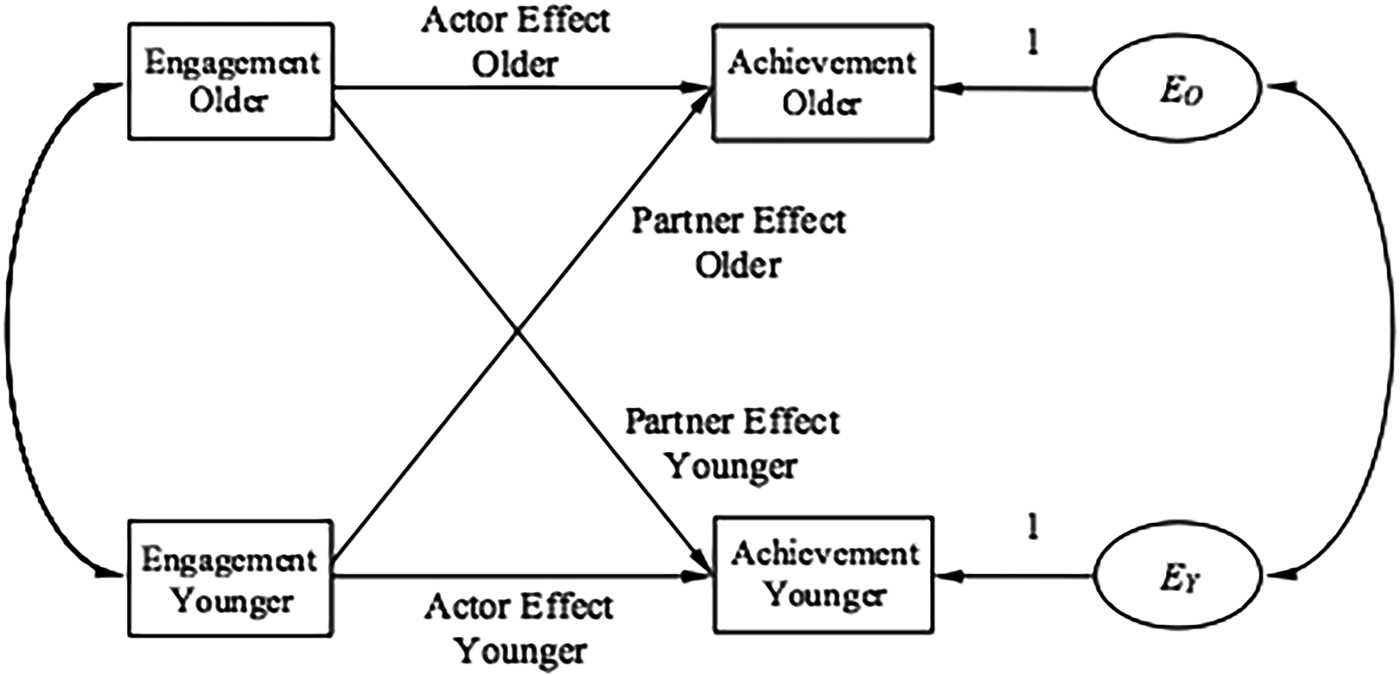
The hypotheses were tested using the 2-member, 4-group actor–partner interdependence model (2M4 G APIM; Ledermann et al., Reference Ledermann, Rudaz and Grob2017). Birth order was used as distinguishing variable and siblings’ gender was included as moderating variable. This allows us to test whether gender composition and birth order matter. There are four types of sibling pairs: (1) both siblings male, (2) both siblings female, (3) older sibling male and younger sibling female, and (4) older sibling female and younger sibling male. In each sibling pair, there are two actor (intrapersonal) effects and two partner (interpersonal) effects (see Figure 1). The four sibling pairs were estimated simultaneously, which allows a comparison of effects both within and between sibling pairs. Siblings’ age, number of siblings, and an average score of parents’ education were added as control variables. To analyse the model, we used R and the SEM package lavaan (Rosseel, Reference Rosseel2012).
The actor-partner interdependence model with school engagement predicting school achievement in older and younger siblings.

Results
Preliminary Analyses
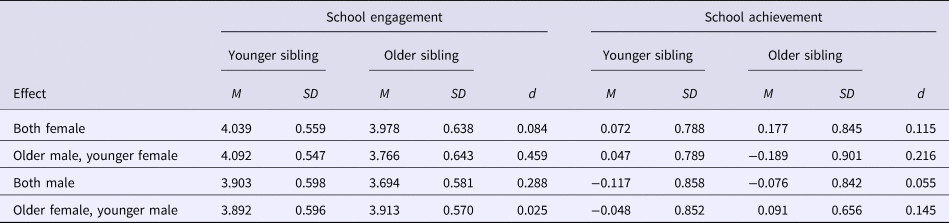
Table 1 displays the means and standard deviations (SDs) of the study variables. As can be seen, siblings generally reported high school engagement (all means > 3.5). Female siblings reported higher engagement than male siblings (M = 4.011, SD = 0.583 vs. M = 3.808, SD = 0.610; Cohen's d = 0.340) and younger siblings reported higher engagement than older siblings (M = 3.991, SD = 0.578 vs. M = 3.839, SD = 0.622; Cohen's d = 0.253). With respect to school achievement, female siblings reported higher scores in achievement than male siblings (M = 0.100, SD = 0.781 vs. M = −0.112, SD = 0.863; Cohen's d = 0.258). No difference emerged between younger and older siblings’ school achievement (M = −0.006, SD = 0.820 vs. M = 0.001, SD = 0.836; Cohen's d = −0.008). In male sibling pairs, younger siblings reported higher school engagement and higher school achievement than older siblings, whereas in female sibling pairs, younger siblings reported higher school engagement than younger siblings.
Means and Standard Deviations of Study Variables and Cohen's d Within Sibling Pairs

Note: School engagement could range from 1 (strongly agree) to 5 (strongly disagree); School achievement was standardized. SD = standard deviation; d = Cohen's d.
Pearson correlations between study variables are shown in Table 2. A strong positive correlation emerged between school engagement and achievement for both older and younger siblings. Correlations between siblings were positive for both school engagement and achievement with effect sizes ranging from small to medium according to Cohen's rules of thumb (Reference Cohen1992). Associations of these two variables with siblings’ age were negative and small in magnitude. Number of siblings and parents’ education were not substantially related with one another or the other variables.
Pearson's Correlations Among Study Variables for Older Siblings (Above the Diagonal) and Younger Siblings (Below the Diagonal)

Note: The correlations between the siblings are shown on the diagonal.
**p < .01, ***p < .001 (two-tailed).
School Engagement and Achievement
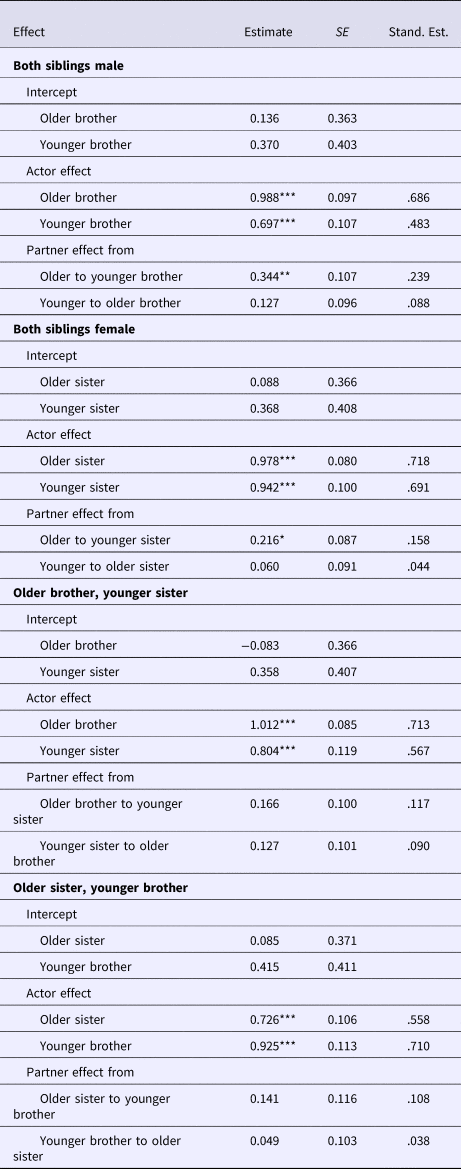
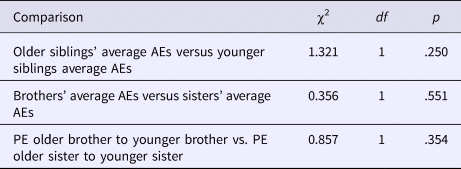
Table 3 has the results of the 2M4 G APIM for school engagement predicting school achievement controlled for siblings’ age, number of siblings, and parental education. As expected, all actor effects were positive and statistically significant, indicating that a person's own school engagement was a good predictor of his or her own school achievement. All standardised estimates were .45 or higher, signifying at least a medium effect size. The average of these actor effects neither differed by birth order nor by gender (see Table 4), meaning that there was no difference in the actor effects of older and younger siblings or males and females.
Results of the Unrestricted 2M4 G APIM for Engagement on Achievement for Sibling Pairs

Note: SE = standard error. Stand. est. = standardised estimate. Analysis statistically controlled for age of older and younger siblings, parental education, and number of siblings.
*p < .05, **p < .01, ***p < .001.
Comparison of Effects

Note: AE = actor effect, PE = partner effect.
There were also two positive and statistically significant partner effects: one from the older brother to the younger brother and one from the older sister to the younger sister. In male siblings, this partner effect was about half of the size of the actor effect of the younger sibling (0.344 vs. 0.697). In female siblings, the partner effect was about one-fourth of younger siblings’ actor effect (0.216 vs. 0.942). These statistically significant partner effects were between small and medium in size and not significantly different from one another in magnitude (see Table 4). This indicates that the degree by which older siblings influenced their younger siblings did not differ between male sibling pairs and female sibling pairs. The partner effects in mixed-gender dyads were not statistically significant, meaning that a person's school achievement was independent from his or her sibling's school engagement when siblings were of opposite gender. Moreover, none of the partner effects from the younger sibling to the older sibling were significant for any gender composition, indicating that the older sibling's school achievement is independent from the younger sibling's engagement.
Discussion
The aim of the current study was to investigate the relation between school engagement and school achievement in sibling pairs, taking both birth order and gender composition into account. The result that an adolescent's school engagement predicts his or her own school achievement independent of gender is in line with findings of previous studies (e.g., Upadyaya & Salmela-Aro, Reference Upadyaya and Salmela-Aro2013). While in same-gender sibling pairs, school engagement of the older sibling was positively related with the school achievement of the younger sibling, no such relation was found in mixed-gender sibling pairs. That is, younger siblings’ school achievement seems to be affected by same-gender older siblings but not vice versa and not in opposite-gender sibling pairs.
These findings are in line with theories and previous research. According to the expectancy-value theory, significant others do influence how a person weights a particular task or goal, such as becoming successful at school (e.g., Eccles & Wigflied, Reference Eccles and Wigfield2002). This has been repeatedly confirmed in studies on parental and peer influences (e.g., Ladd, Ettekal, & Kochenderfer-Ladd, Reference Ladd, Ettekal and Kochenderfer-Ladd2017; Upadyaya & Salmela-Aro, Reference Upadyaya and Salmela-Aro2013; Tan, Reference Tan2017). Certainly, siblings can be just as important in influencing goals as significant others (Dunn, Reference Dunn, Grusec and Hastings2015). However, according to the social learning theory (Bandura, Reference Bandura and Goslin1969), individuals who are especially high in status are considered as particularly influential, which applies almost always to the older sibling because he or she is older, and usually more skilled and more experienced overall (e.g., Tucker, Barber, & Eccles, Reference Tucker, Barber and Eccles1997). Social learning theory (Bandura, Reference Bandura and Goslin1969) also states that individuals are more likely to adopt a behaviour if the observer perceives the model to be similar to himself or herself. This is more likely to be true in same-gender sibling pairs (McHale, Updegraff, & Whiteman, Reference McHale, Updegraff and Whiteman2012). Specifically, research on gender development suggests same-gender siblings interact more often and more closely as well as mirror and reinforce each other more than opposite-gender siblings (e.g., Berk, Reference Berk2008; Blakemore et al., Reference Blakemore, Berenbaum and Liben2009; Farkas & Leaper, Reference Farkas, Leaper, Leman and Tenenbaum2014). Our finding that older siblings’ school engagement was related to younger sibling's school achievement in same-gender sibling relationships but not in opposite-gender sibling relationships supports this notion.
The effect of school engagement of the older same-gender sibling on younger siblings’ school achievement also goes beyond the effect of age, parent's education and family size, which are considered important determinants for school achievement (e.g., Blake, Reference Blake1981; Tan, Reference Tan2017; Updadyaya & Salmela-Aro, Reference Upadyaya and Salmela-Aro2013). The question of whether siblings are more important than parents or peers was not subject of the current study, but Eccles et al. (Reference Eccles, Early, Fraser, Belansky and McCarthy1997) found a supportive effect of older siblings on younger male siblings that went beyond the support of parents, school and peers, indicating that older siblings have an additional effect on adolescents’ school achievement. This is also in line with Bronfenbrenner's ecological systems theory (Reference Bronfenbrenner2005) suggesting that individuals live in various contexts that make a unique contribution to their development. In sum, the results of the current and past studies indicate that older same-gender siblings play a unique role in the development of younger siblings.
The findings of the current study have practical implications for both parents and professionals. The notion that older same-gender siblings serve as a role model for their siblings suggests that low school achievement of the younger sibling can be improved by increasing the school engagement of both the younger and older sibling. Thus, in same-gender sibling pairs, it might be beneficial to involve both siblings in a program or therapy when the school achievement of the younger sibling is low and the engagement of the older sibling is high. Parents could also try to strengthen the significance of the role of older siblings for younger siblings by increasing the older sibling's school engagement, knowing that a highly engaged older sibling can have a positive effect on the younger sibling's achievement.
Strengths and Limitations
The current study has several strengths, including the large sample comprising dyadic sibling data and the analysis of within-person and between-person effects in dependence of both gender and birth-order effects, which, to our knowledge, has not been done in previous research. Despite these strengths, there are some limitations. One limitation is that the processes were not investigated directly but only via structural variables. For example, although Whiteman et al. (Reference Whiteman, McHale and Crouter2007) did not find any evidence for the role of gender composition on either identification or deidentification processes in sibling dyads, evidence exist for the role of birth order. Thus, in addition to gender composition and birth order, future studies may investigate the role of relationship quality, including sibling rivalry or identification processes (Furman & Buhrmester, Reference Furman and Buhrmester1985). Moreover, the current study used self-report measures. Although adolescents themselves provide the best source to report how engaged to school they actually are, their view might be biased. Thus, adding additional sources on school engagement and school achievement might improve the validity of the conclusions. Another limitation of the current study is its cross-sectional design, which prevents conclusions concerning the direction of the effects. Based on previous work (e.g., Eccles & Wigfield, Reference Eccles and Wigfield2002; see also Fredricks et al., Reference Fredricks, Blumenfeld and Paris2004, for an overview) and the notion that students can prepare for exams and benefit from doing homework, we used school engagement as a predictor for school achievement. However, better grades are also likely to increase one's own motivation and school engagement (Jensen & McHale, Reference Jensen and McHale2015; Upadyaya & Salmela-Aro, Reference Upadyaya and Salmela-Aro2013). It is also likely that school engagement and achievement have a reciprocal relation such that school achievement also affects engagement. Related, the 2M4 G APIM is a versatile tool to analyse association between two variables in multimember data such as sibling pairs, but the analysis of longitudinal data within that framework is currently limited (see Ledermann et al., Reference Ledermann, Rudaz and Grob2017, for details). With regard to sibling relations, better school grades of a sibling might be an incentive to improve the school performance of the other sibling (Jensen & McHale, Reference Jensen and McHale2015). Whether siblings’ school engagement is a precursor of school achievement or the other way around might be subject of future studies.
Future Directions
The present study opens various avenues for future research. One way to extend the current study would be to look at specific aspects of both school engagement and achievement. School engagement is a multidimensional construct comprising behavioural, affective and cognitive components (e.g., Fredricks et al., Reference Fredricks, Blumenfeld and Paris2004; Lam et al., Reference Lam, Jimerson, Wong, Kikas, Shin, Veiga and Zollneritsch2014; Schueler, McIntyre, & Gehlbach, Reference Schueler, McIntyre and Gehlbach2018; Wang & Degol, Reference Wang and Degol2014; Wang, Fredricks, Hofkens, & Linn, Reference Wang, Fredricks, Ye, Hofkens and Linn2017). Furthermore, the role of siblings in school achievement may vary depending on the school subjects. Future research may also investigate gender composition and birth-order effects in other domains, such as sport and music.
Another way to extend the current study is to investigate whether results can be generalised to samples with individuals from other social classes, cultural backgrounds, family structures, and more recent data. In the current study, as in most previous studies on siblings, sibling effects were investigated within European or European-American middle-class families (McGuire & Shanahan, Reference McGuire and Shanahan2010). However, it is possible that older sisters may be especially likely to assume upbringing functions in cultures with a more traditional understanding of one's role and may hence have a stronger influence on their younger siblings than older brothers. There is also the question of whether and to what extent siblings have an influence on each other in single-parent families. In these cases, siblings may be more involved in child-rearing processes and accordingly have a stronger or different influence. Moreover, the data of the current study were gathered 30 years ago and the way in which adolescents interact with one another is undergoing dramatic changes because, among other things, of the new media and the way we communicate with each other. Also, with greater gender equality, traditional stereotypes are breaking down (e.g., Oláh, Richter, & Kotowska, Reference Oláh, Richter and Kotowska2014). It remains unclear how and in what way these societal changes effect the influence of siblings on their achievements. Nonetheless, the current study's use of this data is still warranted as it provides a theory supported application for substantive researchers to adapt.
Conclusion
The results of the present study indicate that school engagement of older siblings is related to school achievement of younger same-gender siblings. These findings provide evidence on the deployment of older siblings as a potential resource for promoting the school achievement of their younger siblings. This study makes a valuable contribution to the current research on siblings’ role in school achievement and individual development by considering both birth order and gender composition simultaneously.
Acknowledgment
We thank Laura Wiles for helpful comments on an earlier version of this article.