

1 Introduction
The structural characteristics of a welfare state can be better understood in terms of the rights that they confer, their institutional framework, finance mechanisms and ability to adjust to new emerging social risks in modern societies if we study their historic origins and the way in which they have been transformed over timeFootnote 1. There are, however, difficulties in conceptualizing a measure for these changes and making them operational, as is clearly illustrated in the lively theoretical debate on the «dependent variable problem» in the book by Clasen and Siegel (Reference Clasen and Siegel2007). Despite the limitations of using social expenditure for this purpose, this variable, which represents changes in the welfare state, can be used to measure the welfare effort of a society by calculating the percentage share of social spending in GDP. This provides an aggregate measure of the impact of the multiple explanatory factors of changes. Such an approach has been found to be useful in cross-country comparative research on the evolution of trends in welfare states, such as that carried out by Flora and Heidenheimer (Reference Flora and Heidenheimer1995), Baquir (Reference Baquir2002), Lindert (Reference Lindert2004) and Castles (Reference Castles2006).
It is within the above framework that this study is situated; we focus on the founding of and changes to the welfare state in Portugal. Its current characteristics are the outcome of influences deriving from factors from three phases of development. The first phase spans the creation of social insurance in 1935 (Previdência) as well as several reforms and adjustments to social welfare (Previdência Social) carried out during the Estado Novo (New State). During this period there was provision for classic social risks (mainly old age, incapacity and survival income transfers) in line with the precepts of social security and intra-professional solidarity, with a corporative base guaranteeing the social benefits associated with labour. The second phase followed the 25 April 1974 revolution, in which the restoration of a democratic regime consolidated citizens’ rights, ensuring their civil and political rights and both broadening and strengthening their social rights, some of which took on a universal nature. There remained, nonetheless, some gaps in the exercise of full social rights. These were the objects of reform in the third phase of development, which began in January 1986 with Portugal’s accession to the EEC/EU. This third phase is characterized by Europeanization Footnote 2 of the Portuguese welfare state. As shown in Pereirinha and Nunes (Reference Pereirinha and Nunes2006), in this period there was a shift in the context for making social policy away from the national to the supranational as well as a shift in the content of policy intervention with regard to its scientific and political significance and in the orientation of policies in terms of their major options and aims, the means and instruments of intervention and their co-ordination. These transformations reflect typical patterns in common with the welfare state schemes of other southern European countriesFootnote 3; it is possible to discern features grounded in a Bismarckian corporatist–continental model (social security), the Beveridgian influence underpinning the financial basis with universal contributions and an egalitarian bias, that is, funding by means of fiscal contributions in the democratic, post-dictatorship period (health care) and the broad aims for active social policy measures that are typical of the European social modelFootnote 4.
To date, despite the importance of the topic, there has been little research on the historical process of the origins and development of the Portuguese welfare stateFootnote 5. Significant contributions have been made by Patriarca (Reference Patriarca1995), Lucena (Reference Lucena1976a, Reference Lucena1976b) and Guibentif (Reference Guibentif1997) and the relevant entries in the Suplemento ao Dicionário de História de Portugal (Supplement to the Dictionary of Portuguese History), edited by Barreto and Mónica (Reference Barreto and Mónica2000). Similarly, there are few quantitative analyses on the evolution of social protection in Portugal under the New State. Many of the quantitative analyses covering this period that do look at social intervention by the state, such as the time series on public expenditure by Valério (Reference Valério1982, Reference Valério2001), are limited in scope and do not provide enough details on social expenditure to allow analysis of the social risks and their material and population coverage. Some recent studies on the trends in social expenditure do not include Portugal, like that of Tanzi and Schuknecht (Reference Tanzi and Schuknecht1995), or, when they do, they limit the analysis to a recent period due to the lack of statistics before 1980, the most common source being the Organisation for Economic Co-operation and Development (OECD)Footnote 6 (see Lindert Reference Lindert2004; Castles Reference Castles2006). Long-run analyses based on international statistical sources (OECD, United Nations (UN) or International Labor Organization (ILO)) do not include years before 1960. Such is the case of Bruto da Costa (Reference Bruto da Costa1986) and Esping-Andersen (Reference Esping-Andersen1993). Even studies that use national sources — like Carreira (Reference Carreira1996) — do not furnish data before 1960, and when they do, they are not always presented in the form of annual statistical series; nor can they be broken down into components of social expenditure.
Thus, by building and presenting a data series we seek to contribute to the quantitative data on the trends in social expenditure in Portugal as well as introduce indicators that will allow an interpretive analysis of the long-run trends in social expenditure. This will enable us to situate the Portuguese case in an international context as well as shed light on the historical process underpinning the construction and development of the welfare state in Portugal, identifying explanatory factors in the process and the phases in which major changes in state intervention occurred.
2 Social expenditure: concept, methodology and sources
Some reservations have been put forward in the literature with regard to using the variable of «welfare effort», expressed as the relationship between social expenditure and GDP, to measure transformations in the welfare state that derive from reforms or adjustmentsFootnote 7. Because it is expressed as a ratio, it depends on the variable in the numerator (social expenditure), which represents not only material and population coverage of social risk provision, in addition to the generosity of benefit payments and the value of services provided, but also demographic variables such as population size and demographic composition. Furthermore, the concept depends on the denominator, GDP, as a measure of economic performance. In other words, there is an influence of factors relating to qualitative aspects of the welfare state, as seen in the nature of the rights conferred and the scope and level of coverage, but there are also exogenous variables, which may be demographic or economic. Thus, the use of «welfare effort» as a variable must be warranted by the specific objectives of the study. Moreover, the content or components of social expenditure as well as the method of calculation must be appropriate to these objectives.
In this paper, we seek to bring historical data series on Portugal up to date by building a series that is compatible with international data in order to allow comparisons of the structural changes to and trends in state social intervention. Currently, the most appropriate data source for this purpose is the OECD Social Expenditure Database (SOCX) due to the scope of social policy it covers, the number of countries for which data are provided and the criteria underlying the conceptualization and the international comparisons of the social expenditure data seriesFootnote 8. The OECD defines social expenditure as:
«The provision by public and private institutions of benefits to, and financial contributions targeted at, households and individuals in order to provide support during circumstances which adversely affect their welfare, provided that the provision of the benefits and financial contributions constitutes neither a direct payment for a particular good or service nor an individual contract or transfer» (OECD, 2007, p. 6).
In order to be considered social expenditure, the benefit provision programmes must be based on forms of inter-personal redistribution among members of the programmes or involve compulsory participation, that is, benefits are not an outcome of a market transaction, but are financed through taxation or social security contributions.
It is important to distinguish between «public» and «private» social spending. This is based on the nature of the entity — public or private — that «controls the relevant financial flows» (OECD 2007, p. 6). Thus, for the OECD, the following are considered to be public social spending: (a) means-tested social transfers and compulsory social security transfers, which constitute the redistribution of resources between individuals; (b) benefits accruing from compulsory government-managed individual savings schemes, which do not constitute inter-individual redistribution; and (c) voluntary participation in public social security programmes, in particular those involving self-employed workers (OECD 2007, p. 9).
In this paper, social expenditure is defined as the amount spent, throughout the country, on the allocation to families of social transfers and services covering social risks by the welfare institutions operating in each year of the period under analysis, for which, in accordance with the legislation governing the welfare system, membership and contributions were compulsoryFootnote 9. Thus, we aim to approximate the OECD concept of public social expenditure. Nonetheless, it must be noted that neither the OECD databases nor the primary data sources used in this study make it possible to identify the amount corresponding to the transfer of funds from the state to the social welfare system, making it impossible to pinpoint the social public expenditure of the stateFootnote 10. This does not preclude us from presenting information about social protection expenditure for civil servants in the data seriesFootnote 11.
The second aim of this study is explanatory in nature. There is no database — either national or international — for social expenditure for the period of the New State (1933-1974) or for the period covering the transition to democracy (1974-1980); so it is necessary to build the respective data series. These two periods correspond to important stages in the construction of the welfare state in Portugal. Consequently, building the data series was guided by two objectives: on the one hand to bring the OECD series up to date retroactively, using the same content, as previously explained, and on the other, to ensure that each value of expenditure in the series can be broken down into its constituents and «explained» in light of what is known about the development of social policy measures and their implementation over the period concerned. As such, we seek to overcome some of the limitations previously encountered when using social expenditure as a variable in the analysis of the development of the welfare state. To build the series we choose to use a different methodological approach from previous studies on social expenditure in order to fill information gaps on the evolution of social expenditure and in the factors underlying this evolution over a longer period. Hence, (i) we use primary data sources dating from 1938; (ii) we attempt to break social expenditure data down by institution and type of social benefit; and (iii) we favour a methodological perspective that builds aggregates, rather than starting from aggregate monetary data, which cannot be broken down into separate items of social expenditure, and limits explanatory potential.
Given these goals, two decompositions of social expenditure are of interest: (i) a breakdown according to the type of welfare institution that was operating in each year; and (ii) a breakdown according to the social risks covered (equations [1A] and [1B], respectively). In an initial phase, we seek to isolate the impact of transformations in social institutions on social expenditure. This is obtained by summing the social spending (d) of each institution (a total of r institutions), as shown in (equation [1A]). In addition, we try to take into account the influence of three factors in the evolution of social expenditure (equation [1B]): social risk or material coverage (p); the population covered by social security for these risks (n); and the generosity of the respective benefit payments (benefit payment value, w). The value of the social expenditure for a given year (D) can therefore be calculated in two ways:


Equation [1A] corresponds to the institutional perspective of the social protection system for each year, while equation [1B] allows analysis of the impact on social expenditure of the three aforementioned factors: material coverage, population coverage and generosityFootnote 12.
The main sources for analysis of the New State period and the period of transition to democracy to 1980 are statistics from Estatísticas da Organização Corporativa e Previdência Social (Corporative Organization and Social Welfare Statistics) and the Anuário Estatístico (Statistical Yearbook), both from the Instituto Nacional de Estatística (INE, Statistics of Portugal). To use primary data sources was important in order to obtain all the elements that are relevant for measuring the activity of social risk protection of the welfare institutions operating in each year of the periods under study. The data gathered and treated encompassed the following areas: organizational characteristics of the welfare institution (number of institutions, number of members, or associates), the social risks covered by each welfare institution type (number of recipients of the benefit provided by each institution), institutional spending on covering these risks for the various types of social risk (which permits calculation of the average benefit payment to the recipients), as well as the administrative overheads of these institutionsFootnote 13.
For the post-1980 period, information is available from the OECD Social Expenditure Database; however, this database does not furnish specific data on the number of recipients or number of payments. To make the series consistent for the whole period 1938-1980, we identified the areas of social expenditure that would provide for meaningful analysis across the two sources: (i) old age, incapacity-related and survival pensions, (ii) health spending and (iii) family benefits. These three areas account for 90 per cent of the total social expenditure for Portugal in 1980 according to the OECD dataFootnote 14.
For the year 1980 data are available from both sources: INE, Statistics of Portugal and the OECD database. As a consequence, we considered that compatibility between the data derived from each source and the respective method used would validate the methodology. Despite the different criteria, the 1938-1980 series was consistent with the international data from OECD. We consider that the differencesFootnote 15 could be the result of methodological prudence in calculating social expenditure in the earlier series till 1980. It should be recalled that the estimates for social expenditure were based on the aggregate of the main benefit payments and the spending of the institutions that provided them for each year. In order to ensure consistency with the OECD data series, we chose to exclude social assistance spending. Similarly, possible health costs that were not separate from social assistance were not included, nor were retroactive corrections to the data. Despite the use of different methods for the two historical periods, it was possible to build a data series for social expenditure in Portugal for the period 1938-2003 that is able to provide a consistent reading for the 20th century and the beginning of the 21st centuryFootnote 16.
3 Trends in public social expenditure between 1938 and 2003
The descriptive and explanatory analysis of the measurement of social expenditure presented in this paper is based on the amount spent on benefits to the recipients and families covered by the welfare programmes or social security system, namely old age, incapacity-related and survival pensions, sickness benefits and health spendingFootnote 17, as well as family benefits, for each year of the period under study, in accordance with the legislation governing the social protection scheme.
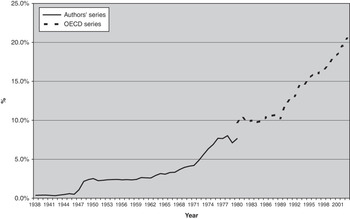
The data series for social expenditure in Portugal for the period 1938-2003 given as a percentage of GDP is shown in Figure 1. By means of an analysis of the trends in social expenditure, we seek to answer three questions: (i) How did total social expenditure change over the period? (ii) How did total social expenditure change with regard to the type of risks for which coverage was provided? and (iii) How did total social expenditure change in terms of the institutions involved in providing coverage for social risks? The analysis of trends will be complemented by a description of the main social policy measures that mark key moments in the process of building a welfare state in PortugalFootnote 18.
RELATIVE SHARE OF SOCIAL EXPENDITURE IN GDP IN PORTUGAL, 1938-2003

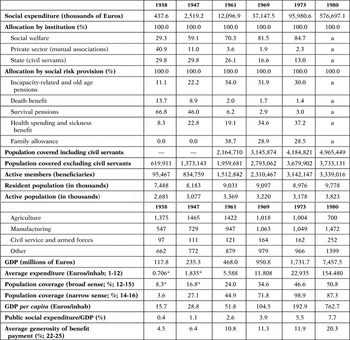
Social expenditure as a percentage of GDP shows an upward trend for the period under study, albeit with some variation in the rate of growth. These variations can be explained by social policy measures that were introduced during the sub-periods, which led to changes in the amount and composition of expenditure, whether through changes to the social risks for which there was coverage or through transformations in the nature of the welfare institutions providing this coverage. Table 1 synthesizes some relevant indicators that illustrate some of the more important changes that took place during the period 1980. They include the establishment of welfare institutions and their transformation into a social welfare system, and later on, to the social security system.
Development of the Portuguese welfare system from 1938 to 1980: some indicators

Notes: *Calculated on the basis of the population covered excluding civil servants.
—Unknown value.
aInsufficient information.
Sources: INE — Estatísticas da Previdência Social e Organização Corporativa (Statistics Portugal — Social Welfare and Corporative Organization); INE — Anuário Estatístico (Statistics Portugal — Statistical Yearbook); Nunes (Reference Nunes1991); Valério (Reference Valério2008); Maddison — Historical Statistics (http://www.ggdc.net/maddison/); OECD — Social Expenditure Database (SOCX).
The period between 1935 and the end of the war is characterized by a slight increase in social expenditure, which did not surpass 0.5 per cent of GDP. Nevertheless, it was during this period that the welfare system was first established as a corporative insurance scheme, then consolidated by extending population coverage resulting from the creation of mandatory Caixas (funds) for all professional activities. In addition, material coverage was expanded with the introduction of Abono de Família (family allowance) in 1942.
From the post-war period to 1960 the number of contributing members in the system remained relatively stable. There was, however, an extension in the levels of material benefits. In particular, health benefits (medical–social services) were extended, as was family allowance, and over this period social expenditure rose, reaching 2.6 per cent of GDP in 1960. This period also saw gradual changes in the institutional structure of welfare providers; there was a rise in the relative share of total social expenditure that was provided by the social welfare sector, and a decline in the relative share covered by the mutual assistance associations. While the former was a direct outcome of the progressive expansion of welfare institutions such as the Caixas Sindicais (union funds) and Caixas de Reforma (pension funds), the latter relied on contributions based on voluntary participation and solidarity among workers.
The 1960s are marked by the 1962 Social Welfare Reform, which led to the development of a unified social welfare scheme. The institutions that were previously described were merged into one body and the resultant structure underpins the social security scheme that operates today. This rationalization is considered a milestone in the process of the development of the welfare state in Portugal, as argued by Carolo (Reference Carolo2006), and it led to a significant increase in social expenditure, which reached 4 per cent of GDP in 1969.
The increase in social expenditure was even greater from 1969 to the end of the New State in 1974, during the Estado Social (social state) phase under the leadership of the Prime Minister, Marcelo Caetano. During this period several important gaps in the social protection network were filled, namely those corresponding to certain groups that had not been considered to be participating in the labour market (e.g. family allowance and old age pensions were extended to rural workers), as well as to professions that had previously been excluded from the social insurance scheme (such as hairdressers, newspaper sellers and maids). As a result, between 1971 and 1974 (i.e. before the beginning of the period marking the transition to democracy) social expenditure soared at an annual rate of 35-37 per cent, in nominal terms. In the last year of the New State, it stood at around 6 per cent of GDP. More than half of this increase — about 64 per cent — was due to a rise in spending on pensions, both incapacity-related and old age, in both the general scheme and the new special scheme for rural workers. While the increase in the public sector had little impact on social expenditure, in relative terms the greatest increase was in old age pensions for rural workers.
Further important developments of the welfare state in Portugal took place in the period of transition to democracy, between 1974 and the early 1980s. These changes resulted from the recognition of rights subsequent to the political institutionalization of social benefits. Social policies at this time were also directed towards expanding the scope of benefits, with the establishment of an unemployment benefit (1975) and social pensions that were based not on contributions but on citizenship (1977). In 1979, the provisional government of Maria de Lourdes Pintassilgo legislated a minimal social protection scheme in Portugal, including a social pension, a pension supplement for severe incapacity, an orphan pension, family allowance, a monthly cash benefit for handicapped minors and social services.
However, curiously, despite these major transformations, progress seemed to stagnate during the 1980s and this trend was only reversed at the end of the decade. The early 1980s sought to contain spending on social security by lengthening contribution requirements for eligibility to the old age pension and reformulating the social protection schemes for agricultural workers, which would culminate in the first Social Security Act of 1984.
The beginning of a new phase in the growth rate of social expenditure was seen in 1986. Standing at around 10 per cent of GDP, which equalled the highest levels reached at the end of the 1970s, social expenditure showed a rising trend, which would be consolidated from 1990 to 2003. The data presented here show not only a marked increase in spending, especially from 1990 onwards, but also a clear convergence with social expenditure levels in Europe, if we compare it with the EU-15 averageFootnote 19.
The analysis of social expenditure so far has provided an outline of the main stages in the development of a welfare state in Portugal. In doing so, it also identifies factors that can help explain the different phases within its development, reform and consolidation.
4 Explanatory factors for the trends in social expenditure
4.1 Institutional development
The first steps towards building a welfare state in Portugal date back further than the New State to the development of mutuals and to the establishment of many institutions with social goals, such as the Repartição de Beneficência (Assistance Office) and the Conselho Superior de Beneficência Pública (Higher Council for Public Assistance), which were founded in 1901 while Portugal was still a monarchy.
In 1916, the Ministry of Labour was established. The need for social reform to quell social disturbances among the working classes and to consolidate the republican regime in the aftermath of the First World War led to the need to approve a vast set of laws in 1919Footnote 20: the creation of compulsory social insurance for sickness, work-related accidents, incapacity, old age and survival; the creation of social grants for work; and the establishment of the Instituto de Seguros Sociais Obrigatórios e de Previdência Social (Institute of Compulsory Social Insurance and Social Welfare). The Institute of Compulsory Social Insurance and Social Welfare was dismantled during the New State in 1933 with the establishment of the Instituto Nacional do Trabalho e Previdência (National Institute of Labour and Welfare, INTP).
Thus, the foundations for social protection in Portugal were laid during the New State on the adoption of the Constitution in 1933 and the approval of the Estatuto do Trabalho Nacional (National Labour Statutes) in the same year. Shortly afterwards came the Lei das Instituições de Previdência (Welfare Institutions Act; law no. 1884, 16 March 1935), which is generally considered the Lei de Bases de Organização da Previdência (Welfare Organization Act). The aims of this law were to make the goals included in the National Labour Statutes operational and to define the general basis on which to build the welfare system (Maia Reference Maia1985). Welfare institutions were classified into four categories, even though not all of them might be considered, strictly speaking, corporativist institutions:
○ Category 1 — Corporativist-based welfare institutions: created by the national guilds and unions, the Caixas Sindicais de Previdência (Union Welfare Funds) covered risks incurred by illness, incapacity, old age and unemployment, and were financed exclusively by employer and employee contributions, with no involvement from the state; the welfare funds termed Casas do Povo (People’s Funds) covered all rural workers and agricultural producers in a situation similar to the rural workers from 1940, and membership was compulsory; the Casas dos Pescadores (Fishermen’s Funds) provided insurance for maritime fishermen and membership was compulsory.
○ Category 2 — Caixas de Reforma ou de Previdência (Pension Funds or Welfare Funds): these institutions were not corporativist-based, but were founded either by those involved or by the government. Financed exclusively by employer and employee contributions, they covered risks incurred by sickness, incapacity and old age. Membership was compulsory.
○ Category 3 — Associações de Socorros Mútuos (Mutual Assistance Associations): membership of these institutions was not mandatory, but voluntary.
○ Category 4 — Civil Servant and Administration Welfare Institutions. These included the Caixa Geral de Aposentações (General Pensions Fund) and the Montepio dos Servidores do Estado (Civil Servant Mutual).
The financial basis of an institution was affected by the fact that setting up a welfare institution depended on the initiative of its social partners. At first, welfare was financed neither by means of taxation nor by the state as a fiscal agent. Welfare funds were essentially based on the compulsory contributions of their members (employees) and contributors (employers). Thus, the social protection system was based on individual contributions, yet it was collective in nature by means of regulation and imposition by the state, albeit without recourse to the typical financing mechanism of a collective tax. Another noteworthy point is that the various institutions never operated at a loss because contributions covered their costs.
The financial base for the welfare institutions was important in that the actual evolutionary dynamics of welfare gradually forced the state to become involved either as a service provider or as a financial base for social protection, especially in the areas of assistance and health. In addition, the state’s involvement aimed to overcome shortcomings or unfairness, as shown by Carolo (Reference Carolo2006, p. 48). Thus, in the 1940s some steps were taken to expand the scope of the institutions operating, making general welfare provision compulsory for all salaried workers. Between 1940 and 1943, new welfare funds were created, many of them by the state, in order to integrate certain professional activities previously excluded from the system or to expand the family allowance policy.
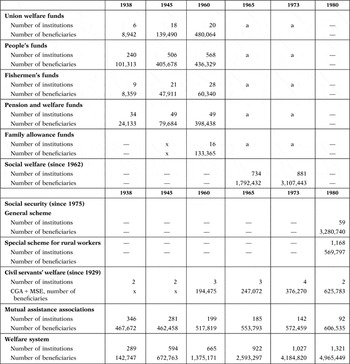
Table 2 summarizes the transformations to the organization of welfare from its origins in 1935 to 1980, with particular emphasis on the institutional changes brought about by the Social Welfare Reform of 1962. Changes in the number of institutions and the number of members of these institutions clearly illustrate a growth trend, especially because the process of progressive aggregations is the result of actual growth in the number of members and the increased scope of benefits. The sharp rise in the number of members of social welfare institutions (i.e. the Pension and Welfare Funds, the People’s Funds and Fishermen’s Funds) illustrates this process. Furthermore, although the Mutual Assistance Associations, which had been the main providers of social protection until 1935, showed relative stability in membership numbers in the early stages of developing welfare structures, the number of institutions declined over the whole period. This was a consequence of the growth in corporativist-based welfare structures, whose provision for protection against social risk became increasingly important.
Evolution of the institutional organization of the Portuguese welfare system

Notes: CGA: Caixa Geral de Aposentações (general superannuation fund); MSE: Montepio dos Servidores do Estado (civil servant mutual).
aIncluded in social welfare system.
— Non-existent.
xUnknown.
Sources: INE — Estatísticas da Previdência Social e Organização Corporativa (Statistics Portugal — Social Welfare and Corporative Organization Statistics); INE — Anuário Estatístico (Statistics Portugal — Statistical Yearbook).
The 1960s were marked by the Social Welfare Reform of 1962, enacted through law no. 2115, 18 June 1962. This law introduced significant changes to the organizational structure of welfare institutions; it expanded the system by means of extending the scope of benefits (i.e. material coverage) as well as population coverage, and contributed to the development of a General Social Security Scheme. In statistical terms, the distinction between the Union Welfare Funds (with a corporativist base) and the Pension or Welfare Funds (with a professional or company base) disappeared when they merged with the People’s Fund and the Fishermen’s Fund to form the Previdência Social (Social Welfare System). In addition, Caixas Distritais de Previdência (District Welfare Funds) were established. The whole system was restructured so that the funds were grouped on the basis of regions or districts, rather than sectors or professions. The restructuring allowed better coordination of the welfare institutions, which was important for the regionalization of the system. It also led to the provision of sectors not previously covered. Creation of the Caixa Nacional de Pensões (National Pension Fund) and the Caixa Nacional de Seguros e Doenças Profissionais (National Insurance and Profession-related Illness Fund) makes a specialization of the welfare funds clear with a view to extending the system in terms of population coverage and to improving the system in terms of social risk provision. The shift in policy towards a unified General Social Security Scheme was carried out through institutional centralization and a trend towards convergence among the institutional schemes operating.
4.2 Trends in population coverage
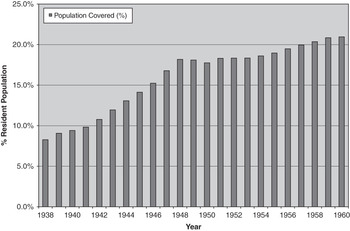
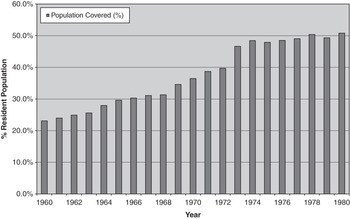
An initial overview of the trends in welfare provision for the Portuguese population can be obtained by comparing the number of recipients of welfare benefits and the resident population. This ratio can be interpreted as the percentage of resident population entitled to some degree of social protection through receipt of some kind of social benefit or service. Although this ratio is an imperfect indicator of social risk protection coverage for the Portuguese populationFootnote 21, it does reveal significant trends (Figures 2 and 3).
WELFARE POPULATION COVERAGE (EXCLUDING THE STATE) TO THE 1962 REFORMS

WELFARE POPULATION COVERAGE (INCLUDING THE STATE) FROM THE 1962 REFORMS TO 1980

In an initial phase between 1935 and 1948 (Figure 2), there was a marked increase in the percentage of the population who received welfare benefits, if we exclude information on the public sector, for which data were not available. Coverage then levelled off at around 17-18 per cent of the resident population till the early 1950s, then rose in the second half of the decade. By the 1960s coverage reached approximately 22 per cent of the resident population (or an extra 1 percentage point if public sector welfare recipients are included). However, if coverage is measured using the active population, there is a staggering increase in provision from around 3.6 per cent in 1938 to 44.9 per cent in 1961 (Table 1).
Figure 3 presents the results for population coverage from 1960 to 1980. There is a marked increase from 1963 and another from 1969, the latter corresponding to the introduction, under the Marcelo Caetano government, of new social benefits that extended provision to professions hitherto uncovered by the welfare system (e.g. rural/agricultural workers). The number of recipients rose between 1969 and 1973, and growth continued to 1980, albeit more slowly. The rate of increase was greater as a proportion of the total population than of the active population. This difference may be due to demographic factors; there was a sharp increase in the active population following decolonization started after the democratic revolution in 1974.
4.3 Trends in material coverage
In the post-war period important measures were taken to extend the material coverage of social protection to include provision against social risks concerning the family (i.e. the creation of family allowance) and to develop the health services. Later, in 1969, the most important innovation was the introduction of old age pensions and family benefits for rural workers.
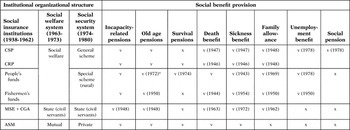
Table 3 synthesizes the transformations in material coverage, with details of the social benefits allocated by each institution as well as alterations in the scope of benefits over the period. It shows a trend towards standardization of the social risks covered by the different institutions, leading to some homogeneity of the social welfare system, especially between 1969 and 1973. Also noteworthy is the introduction of protection against unemployment and universal pensions after the transition to democracy in 1974.
Evolution of social benefits by institutional sector from 1938 to 1980

Notes: CSP: Caixas Sindicais de Previdência (union welfare funds); CRP: Caixas de Reforma e Previdência (pension and welfare funds); ASM: Associações de Socorros Mútuos (mutual assistance associations); CGA: Caixa Geral de Aposentações (general superannuation fund); MSE: Montepio dos Servidores do Estado (civil servant mutual).
*The people’s funds provided aid for sickness, incapacity, old age, and death since 1938.
vIn existence from 1938; x: non-existent; v (year): 1st year for which published data are available. The year may be later than the year in which the benefit was introduced.
Detailed analysis of the scope of benefits, that is material coverage, sheds light on the transformations to the institutions providing welfare, and this contributes significantly to explaining changes in social expenditure. According to the data provided by Pereirinha et al. (Reference Pereirinha, Arcanjo and Carolo2009), the creation of abono de família (family allowance) had a great impact on the levels of social expenditure. Although family allowance was created in 1942 (Decree law no. 32192, 13 August 1942), relevant data were not published until 1948. In this year, family allowance accounted for approximately 30 per cent of the total expenditure of social welfare institutions. Initially, special autonomous funds, which were similar in structure to the other welfare funds, were set up to provide family allowance; however, from 1945 onwards, the government moved to integrate this benefit progressively into the pre-existing scheme of welfare institutions. This led to the creation of family allowance services within the Union Welfare Funds, Pension and Welfare Funds and the Central Office for the Fishermen’s Fund, although some autonomous funds for family allowance remained operative. As important as the measure itself, the institutional experience gained through application of family allowance — it was an outcome of state social policy — was crucial to the institutional centralization that would be implemented with the Social Welfare Reform in 1962, and it was a central element in the regionalization of the social protection system with the creation of the District Welfare Funds.
There was similar, important state intervention in the area of health care. In 1946, legislation was passed that resulted in the establishment of the Federação das Caixas de Previdência (Welfare Fund Federation). This would lead to the creation and development of medical-social services by means of joint action by fund organizations for the provision of health care and sickness benefits.
The extension of family allowance to rural workers and the introduction of incapacity-related benefits and old age pensions (law no. 2144, 29 May 1969) for these workers, with their basis in the scheme of welfare funds, can be seen as developments in the same vein. Provision was essentially related to incapacity-related benefits, old age and survival pensions, death/funeral benefits, and later, family allowance as well as the complementary benefits associated with marriage, birth, breast-feeding, funerals and others.
The 1962 Social Welfare Reform also led to the general extension of health-care provision to the People’s Funds and Fishermen’s Funds and members’ relatives, as well as to improvements in the Social Insurance scheme and sickness benefit already in existence. Eventually, this aspect came to reflect a political priority of intervention that contributed to a universalizing trend in the area of health care. A direct result of this investment in health provision was a sharp increase from this period in social expenditure related to health, which included sickness benefits, and, above all, a shift in the relative share of health in social expenditure. In 1973, health expenditure made up about 37 per cent of the total social expenditure (Table 1).
5 Analysis of the trends in social expenditure: an explanatory outline
Further insights into the trends in social expenditure can be gained by means of an analysis of the impact of «coverage» (in terms of the number of recipients, that is, variation in the proportion of the population covered) and «generosity» (i.e. monetary variation in the average value of benefit payments) of social expenditure over time. Social expenditure can thus be expressed as given in equation [2], which is derived from the equation [1A]:

in which the relative share of social expenditure in the GDP for a given year (sd) is equal to the product of the coverage rate (cov), measured as the proportion of the resident population (POP), which, for the given year, is covered by the welfare system (N), and the degree of generosity (gen), measured as the relation between the average social transfer (W) and the GDP per capita (GDP/POP) for the same yearFootnote 22.
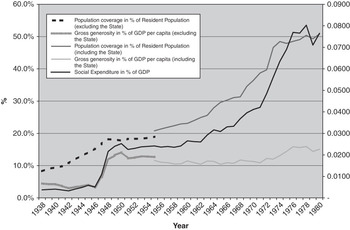
Figure 4 shows the relative share of social expenditure in GDP for the period 1938-1980 with regard to the components of coverage and generosity. In the period following the Second World War to the beginning of the 1950s there was a significant increase in generosity, as measured by the indicator described above, before and following that the indicator remained relatively stable. The jump corresponds to the period in which, as we have seen, new benefits (family allowance) were created and there was greater spending on health due to the creation and development of medical–social services. This increase in the scope of material coverage of risk gave rise to an increase in average social expenditure. By contrast, outside this period it is the impact of population coverage that is dominant. After 1974, the growth rate for population coverage slowed and the slight rising trend in gross generosity stabilized.
RELATIVE SHARE OF SOCIAL EXPENDITURE IN GDP: DECOMPOSITION OF THE IMPACT OF «POPULATION COVERAGE» AND THE IMPACT OF «GENEROSITY»

Having delineated key phases in the building of the welfare state, we calculated the variation in the relative share of social expenditure in GDP in terms of the impact of generosity and population coverage between the initial year (t1) and final year (t2) for each period:

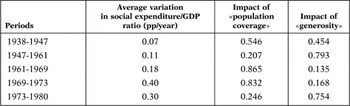
Table 4 shows the results of this breakdown. The results are consistent with the other analyses. In the period 1938-1947, which corresponds to the establishment and consolidation of welfare programmes, the impact of coverage and generosity is similar. In the post-war phase, 1947-1961, the impact of generosity is dominant, given the expansion in the scope of material welfare coverage and relative stability in population coverage. In the period covering the 1962 Social Welfare Reform the impact of coverage is dominant, and finally, in the period 1969-1974, the impact of coverage remains dominant, as does its relative importance as an explanatory variable. The period between 1974 and 1980 saw a moderate increase in population coverage while generosity was the principal explanatory factor for the increase in spending. A few reasons could combine to explain this. First, the fact that population coverage had become almost universal by 1973 (Table 1) would limit further growth in this dimension. Second, this period corresponds to the transition to democracy, and it involved the introduction of new benefits such as social pensions and unemployment benefits, and above all nominal increases in almost all social benefits, for example, the annual payment of 13 monthly pensions, among others. Last but not least, all systems are subject to demographic pressures and/or the effects of system maturation, especially pension schemes, given that they tend to increase exponentially.
Variation in percentage points (PPs) of social expenditure in GDP: decomposition of the impact of «population coverage» and «generosity», 1938-1980

Sources: INE — Estatísticas da Previdência Social e Organização Corporativa (Statistics Portugal — Social Welfare and Corporate Organization Statistics).
INE — Anuário Estatístico (Statistics Portugal — Statistical Yearbook).
Nunes (1991); Valério (2008).
OECD — Social Expenditure Database (SOCX).
Maddison (Reference Maddison2010).
6 Conclusions
This paper sought to fill a gap in information and analysis with regard to the New State (Estado Novo) period, using a quantitative approach to social expenditure trends in terms of the institutional structures for social protection, their magnitude and their scope in the coverage of social risks. Analysis of the data series we constructed, which was validated through examination of existing data sources — national (Portuguese) and OECD — and analysis of the social policy measures implemented over the period revealed that the trends in social expenditure were coherent with the different phases that characterize the institutional changes in the development of the welfare system in Portugal throughout the whole period, and its gradual transformation into a welfare state as was similarly taking place in Europe.
«Welfare effort», measured by the share of social expenditure in GDP, grew steadily till 1973, that is, during the whole New State period. However, it was at the end of the 1960s that the greatest growth rate took place, and this lasted till some time after the democratic revolution in 1974. This growth in social expenditure resulted from long-run institutional transformations in the welfare system. It became evident from the statistical analysis that four distinctive stages characterize the growth of social expenditure in the New State period: (i) in the early stage, from the creation of the welfare system till the end of the Second World War there were similar improvements in population coverage of social risks and generosity of social transfers; this is a period of growth and consolidation of the welfare provision of the major classical social risks for the working population; (ii) after the World War till the early 1960s the impact of generosity on the growth of social expenditure becomes dominant; this is a period of expansion of material welfare coverage, such as health services and family allowances, but of stability in the personal coverage of social risks; (iii) the impact of coverage becomes dominant from the early 1960s with the Social Welfare Reform in 1962 that unified and nationalized different occupational pension schemes; and (iv) during the last years of the New State, known as the social state (Estado Social) of Marcelo Caetano, till the revolution of 1974 in April, there was a similar pattern of high impact of coverage in the early 1970s, with the filling of some gaps in social protection and its extension to some unprotected categories of workers, mainly the rural population, thus giving rise to a large expansion of social expenditure.
A fifth stage, which covers the period after the revolution till the early 1980s is marked by a greater impact of generosity on the growth of social expenditure. This is a period of recognition and consolidation of social rights and expansion by the creation of non-contributory benefits to protect the remaining groups that had been excluded and to complete the universalization of the system. However, in terms of social expenditure it was a period of relative containment in comparison with the previous phase before the transition to democracy. Thus, this result does not provide evidence for the popularly held splurging myth of the 1974 revolution and its aftermath, despite it being a period of egalitarian and universalistic social policies. This is evident for health policy. At the end of the New State in 1973, health care already accounted for approximately one-third of total social expenditure. This can be seen as a solid financial base within social expenditure that was essential for the creation of the National Health Service in 1979.
In terms of international convergence, it can be considered that it is only from EU integration in 1986 that a clear phase of expansion took place, which would be paralleled by convergence with Europe from 1990. Old age pensions, rather than health care, contributed most to the strong increase in social expenditure in this period. Nevertheless, health has been particularly important in convergence with Europe, which is not surprising, given the universal coverage of the Portuguese National Health System.
Appendix
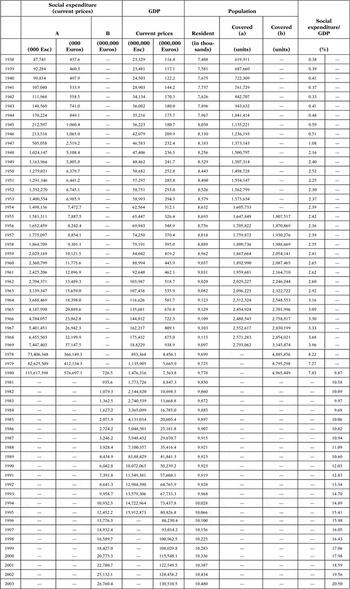
Evolution of Social Expenditure in Portugal, 1938-2003

Notes: A: authors’ calculation; B: OECD; a: excluding civil servants; b: including civil servants.
—information unavailablea.
Sources: INE — Estatísticas da Previdência Social e Organização Corporativa (Statistics Portugal — Social Welfare and Corporative Organization Statistics); INE — Anuário Estatístico (Statistics Portugal — Statistical Yearbook); OCDE — Social Expenditure Database (SOCX); Maddison (Reference Maddison2010); Valério (Reference Valério2008).