Introduction
Swine meat is at the top of meat production worldwide. Modern swine production is mainly based on large farms (Gonzalez-Bulnes et al., 2016) with improvements in thermal comfort mostly based on intense efforts in air conditioning, choice of building materials and typology of the shed. Currently, pig farming has become predominantly intensive with higher demands on technology, genetics and dietary standards. Therefore, a functional and well-designed ventilation system becomes essential to achieve the safe development of intensive pig farming (DU et al., Reference Du, Tao, Zhu, Li, Fu, Lai, Yang and He2024).
There are four main difficulties in controlling the ventilation of farrowing houses: ensure an environment that promotes both the productivity of piglets and sows, high energy costs, diseases and the emission of ammonia and odours (KIM et al, Reference Kim, Lee, Aarnik, Lee, Jeong, Jeong, Kim, Lee and Lee2023). Besides that, Brazil has regions and seasons with constant high temperatures where productivity is inferior to the genetic capacity of the animals, causing productive and investment losses. However, with the use of adequate facilities and modern techniques of handling and equipment, good zootechnical indexes can be achieved. However, in the farrowing houses, this problem is evidenced by two living categories with very different environmental requirements. Based on this, it becomes a priority to provide an environment in the farrowing houses that meets the need for thermal comfort of both piglets and sows (RIBEIRO et al, Reference Ribeiro, Lanferdini, Palencia, Lemes, Abreu, Cantarelli and Ferreira2018).
According to the literature review, the ventilation could be broadly divided into two categories (Hu et al., Reference Hu, Yang, Tao, Shi, Tu and Wang2023): general ventilation and individual ventilation. Nevertheless, general ventilation has some inherent disadvantages such as uneven indoor temperature, low indoor air speed, etc. On the opposite, individual ventilation provides consistent fresh air supply to each pen, which could theoretically address the issues cited. For example, Tabase et al. (Reference Tabase, Van Liden, Bagci, De Paepe, Aarnik and Demeyer2020) reported significantly lower temperature inhomogeneity in the horizontal direction when applying an underfloor air distribution system, as compared to tunnel ventilation.
A lack of information was observed regarding the energy consumption efficiency of different animal welfare and new technologies for heating/ventilation/cooling systems. As swine production is currently one of the leading agricultural activities in Brazil, with significant consumption production inputs such as energy grains and labour force, the validation of an efficient cooling system allows new research opportunities such as the use of renewable energy sources.
Therefore, the objective of this study was to evaluate the efficiency of three ventilation systems (natural, forced and refrigerated) in a farrowing house based on productive indexes (live weight, mortality and feed conversion) and animal’s physiological responses (surface temperature and thermal images).
Materials and methods
The experiment was conducted during spring season of 2020 in a pig farm located in the city of Dois Vizinhos, Paraná State, Brazil. This place can be characterized as a mesothermal humid subtropical climate (Cfa), with hot summers and frosts infrequent (Alvares et al., 2014). The average temperature of the hottest months is above 22°C and the coldest months are below 18°C, with relative air humidity of 65% and rainfall of 2100 mm per year, at latitude 25° 45’ 00’’ South and a longitude 53° 03’ 2’’ West, being at an average altitude of 509 meters.
A farrowing house with 12 bays was used, where the females remained until the weaning of the piglets, which happened 24 days after birth. The total number of animals used for this experiment was 12 females of the Agroceres PIC genetics, with 11 piglets each.
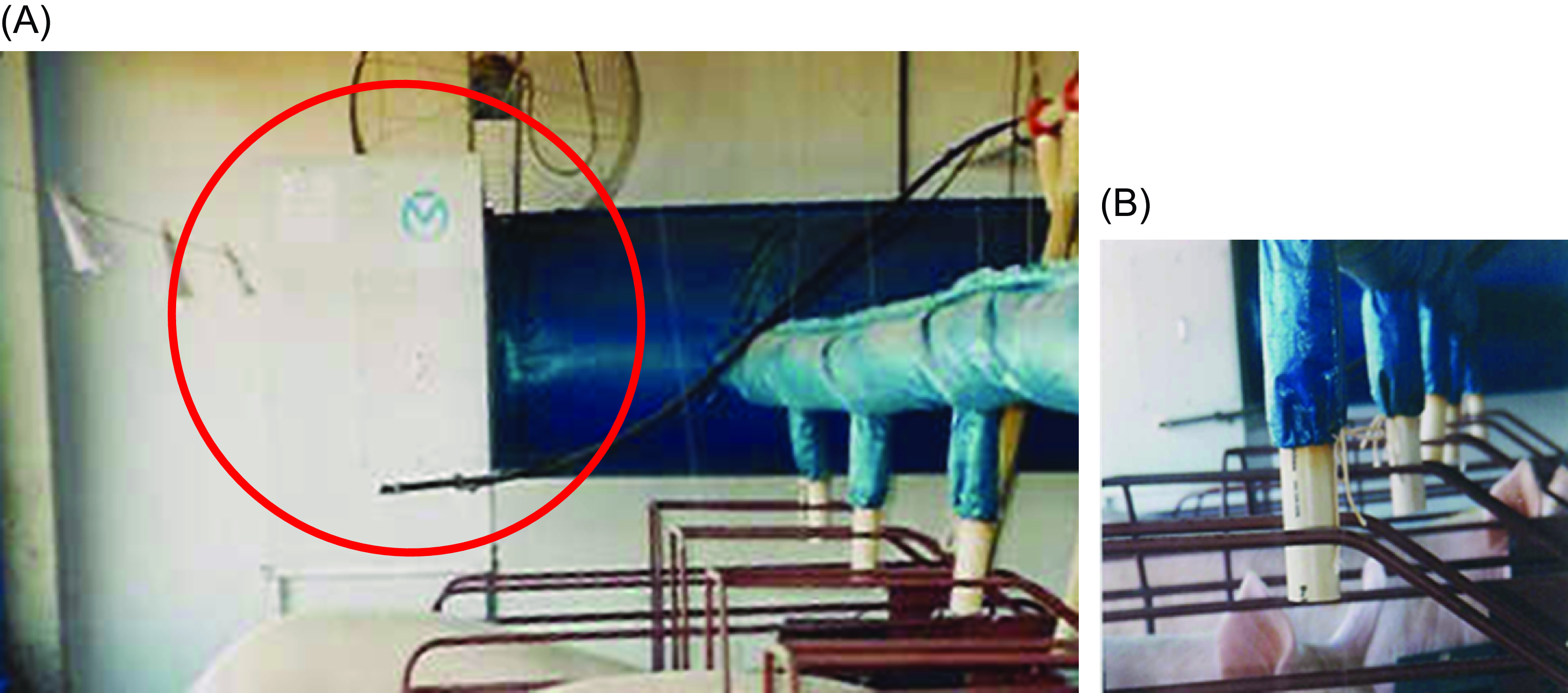
In the present study, three treatments were tested: forced ventilation (use of fan), refrigerated ventilation (use of adiabatic conditioner and forced ventilation) and natural ventilation (without ventilation equipment). Both environmental conditioning treatments were located, directed to the female, and tested concomitantly. The arrangement of the treatments in the installation can be seen in Figs. 1 and 2.
Treatment arrangement in the farrowing house, totalling 12 pens. Three pens under Treatment 1 (T1; refrigerated ventilation by adiabatic method), three pens under Treatment 2 (T2; forced ventilation by the use of a fan), and three pens under Treatment 3 (T3; natural ventilation, without any climatization system).

Adiabatic cooling equipment at the beginning of the duct (A) and view of the individual ducts located just above the sows (B).

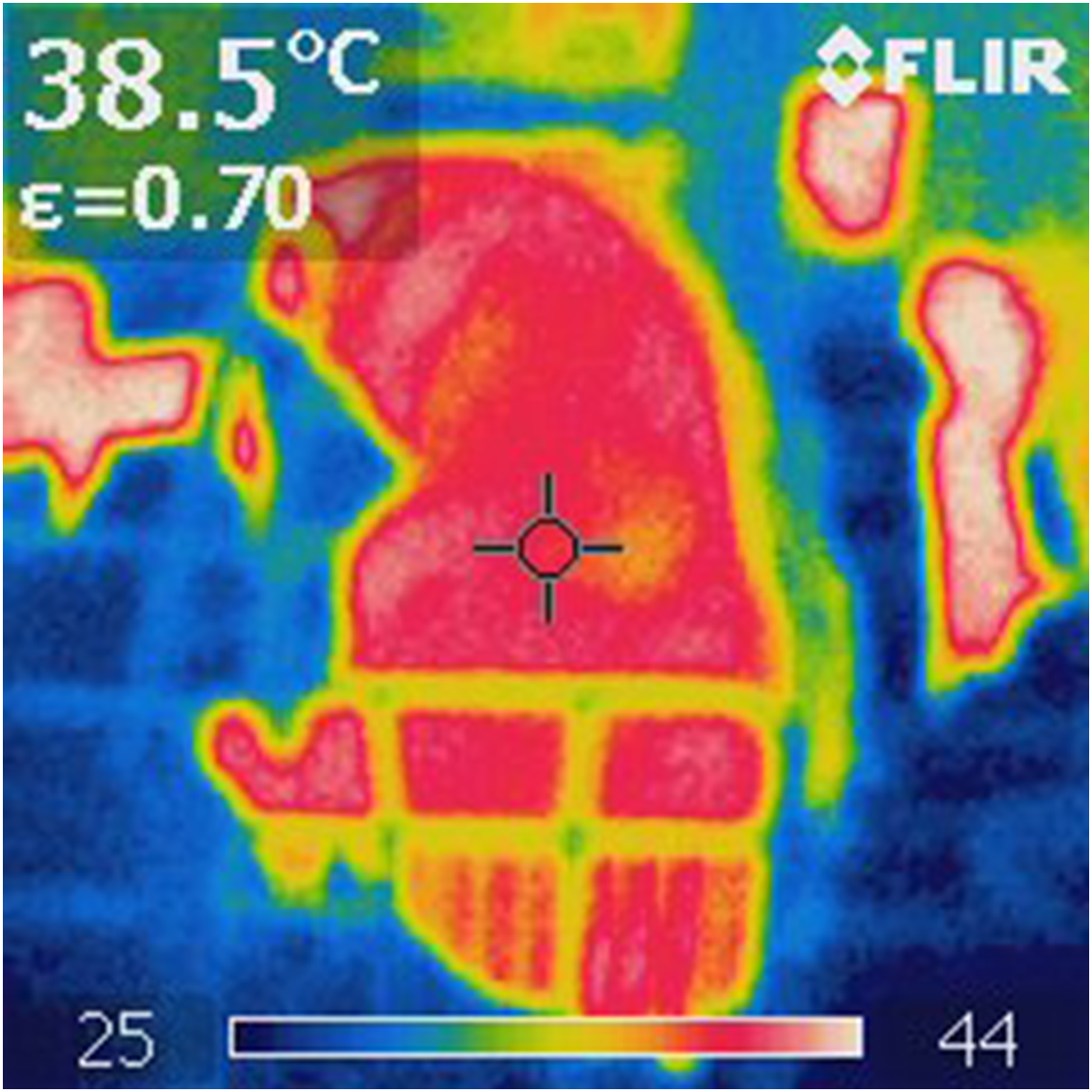
Thermal image of the sow with her piglets obtained by a thermographic camera. This image was analysed to extract the superficial body temperatures of the sow and piglets.

The installation used for the experiment had as constructive features: roof made of French clay tiles; walls of concrete blocks, covered with mortar and painted white; room dimensions 24 m long and 10 m wide; height of the foot of 3 m; and east-west orientation. Each pen measured 2 m × 2.40 m (W × L) with 1 m high masonry dividers between pens, which guaranteed that the ventilation of one pen did not interfere with the others.
The cooling equipment used in the treatment with refrigerated ventilation is called adiabatic conditioner. It works based on the cooling of the air by an isenthalpic process by means of the transfer of the sensible heat contained in the air in contact with the liquid surface. This process is done by washing the air flow, allowing its constant and continuous purification. The apparatus is composed of hard plastic plates, with a large wet surface, where the washes are carried out and the withdrawal of sensible heat. At the entrance of the apparatus, 150 mm diameter PVC pipes were placed inside the rooms and were carried to the top of the head of the matrices, thus providing cooler air than the outside (Treatment 1).
Treatment 2, or forced ventilation, utilized an axial fan of 0.735 kW (1 hp). Treatment 3, or natural ventilation, did not have any ventilation equipment.
The following environmental variables were recorded inside the room: Dry bulb temperature (DBT), relative humidity (RH) and air velocity (V) - a portable hygrothermoememometer (Pacer®) was used. These collections were performed daily at 12:00 noon, on top of the females in all pens.
Measurements were also taken in relation to the animal itself, being, surface temperature: an infrared thermometer of the brand Instrutherm®, model TI-900 was used. Measurements were performed weekly at 12:00 noon in piglets and females. For the females, the temperature was collected in three points: nape, dorsal and posterior area; already for the piglets, the place of the collection was the dorsal.
Thermal images: a digital thermal machine of the brand Flir Systems® was used. The images of the females and piglets were recorded weekly at 12:00 noon (Fig. 3). The piglets were removed from the skimmers and kept in the pens for 30 minutes as an adaptation period before measurements were taken thus, not interfering with the measurements.
Productivity: weekly data were collected on live-weight piglets and daily feed intake (after 7 days of age). For the females, the post-partum and post-weaning live weight and the daily feed intake were measured. Feeding of sows and piglets was controlled, initially 2.2 kg day–1/female and 4.2 kg day–1/female in the final period and for piglets, 0.366 kg day–1/bay throughout the period. The feed conversion was calculated at the end of the cycle for the females and weekly for the piglets (days 0–7, 8–14, 15–21).
The experimental design was a completely randomized block design, with three treatments, each sow representing an experimental unit, one sow per pen, four pens per treatment (repetitions), totalling 12 sows with 11 piglets each. The data were interpreted statistically through analysis of variance and the Tukey test at a 5% probability of error, using the program SAS (2008).
Results
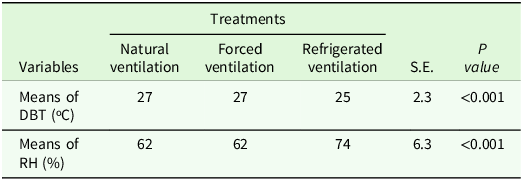
The results corresponding to the climatic parameters of dry bulb temperature (DBT) and relative air humidity (RH) (%) are presented in Table 1. It can be observed that there is a difference (P < 0.05) in DBT and RH among the types of ventilation tested, indicating that the room environment was influenced by the ventilation system adopted. The refrigerated ventilation system reduced in 2°C the room’s temperature compared to other systems and increased the RH by 12%, without exceeding the limits indicated in the literature which is 60–70% for all phases of production (Furtado and Machado, Reference Furtado and Machado2023).
Means of dry bulb temperature (DBT) and relative air humidity (RH) by the treatments tested

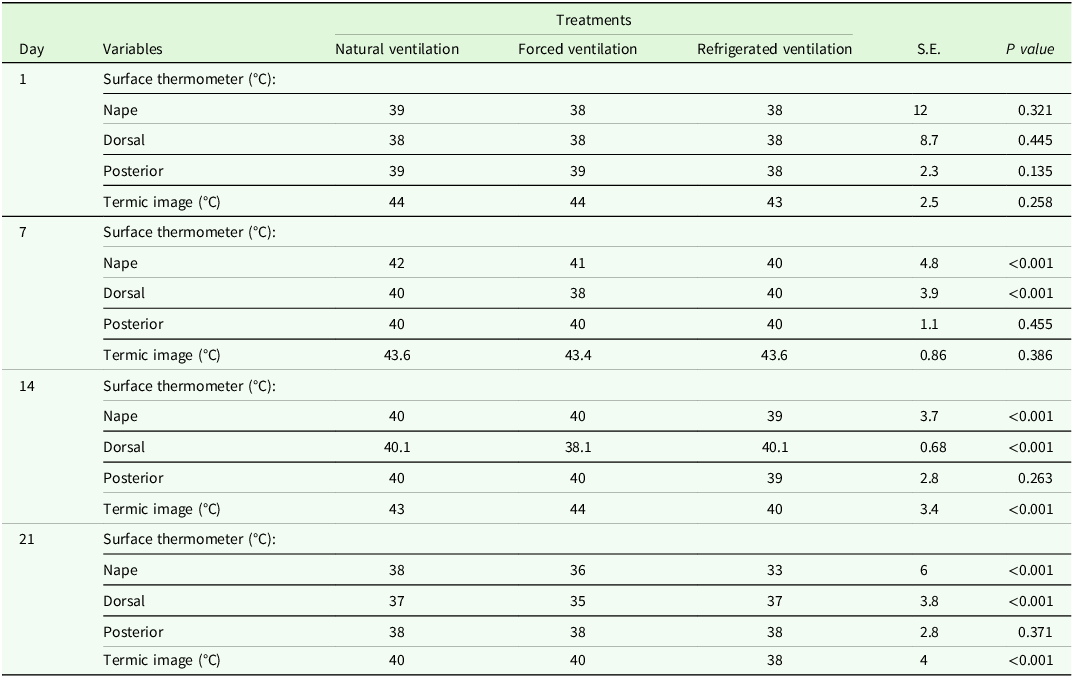
Table 2 shows the results of the analysis of variance for the physiological parameter of a female’s surface temperature. The results indicate that there are differences (P < 0.05) between the treatments for the surface temperature. As for piglets, according to Table 3, it was observed that there was no difference (P > 0.05) in the surface temperature during the study period.
Means of the treatments for female’s surface temperatures on the nape, dorsal, and posterior area, collected by a surface thermometer and a thermographic camera

Means of superficial temperatures (°C) on the dorsal of the piglets under all treatments tested obtained by thermal images registered by a surface thermometer

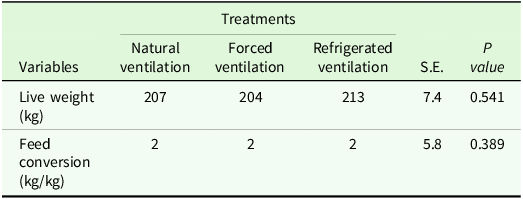
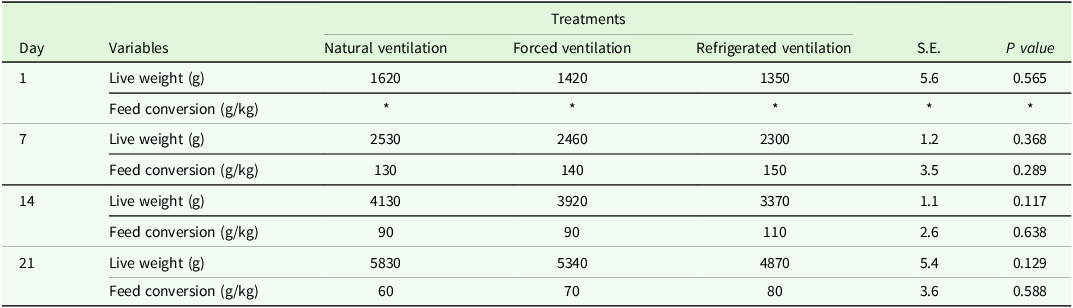
Through Tables 4 and 5, it was observed that there was no difference (P > 0.05) between the average weights of the females and the average weights and the feed conversion of the piglets. Thus, females housed under the refrigerated ventilation system presented higher average live weight along similar feed conversion rates.
Means of live weight and feed conversion of the females under the treatments tested

n = 4 sows per treatment.
Means of live weight and feed conversion of the piglets under the treatments tested

n = 44 piglets per treatment.
Discussion
The results showed that the refrigerated ventilation treatment had the lowest dry bulb air temperature (25°C). This result indicates that, with the use of the adiabatic refrigeration equipment located on the females, it was possible to decrease the temperature around them. This decrease was enough to reach an ideal temperature between the range of 10 and 25ºC (FASS, 2010). The advantages of using located cooling systems such as in this study are clear when compared to the use of an evaporative cooling system alone, where it was inefficient to assist sows deal with heat stress (HE et al., Reference He, Zheng, Lu, Yang, Xue and Yao2019).
This fact agrees with reports of DU et al. (Reference Du, Tao, Zhu, Li, Fu, Lai, Yang and He2024) where a located ventilation system in a farrowing house promoted a uniform indoor temperature and relative humidity distribution. Furthermore, the authors report that the individual ventilation systems compared with tunnel ventilation systems, considerably save air supply load and related energy consumption. This study provides new insights into the advantages of individual ventilation in improving thermal environments, minimizing airborne cross-infection and increasing ventilation efficacy in farrowing houses, thus contributing to achieving safe and sustainable production in pig farming.
Regarding relative humidity, the treatment that obtained the highest value was also that of refrigerated ventilation (74%), since the equipment used cools air from the evaporation of the water, corroborating with studies by Sartor et al. (Reference Sartor, Baêta, Tinôco and Luz2003). With this result, it can be concluded that adiabatic refrigeration should be used in a controlled way, since it contributes to the increase of the relative humidity inside the room, above the optimal value for pigs according to Koger et al. (Reference Koger, O’Brien, Burnette, Kai, Van Kempen, Van Heugten and Van Kempen2014), which is 60%. These results confirm those obtained by Baêta and Souza (Reference Baêta and Souza1997), showing that the use of adiabatic cooling systems leads to a decrease in dry bulb temperature and an increase in ambient humidity.
According to Godyn et al. (Reference Godyn, Herbut and Angrecka2018), fogging is a practice widely adopted in pig facilities to reduce ambient temperature, and its efficiency is influenced by the relative humidity of the air. In climates with high RH, fogging is more effective when used during the hottest hours of the day, when the relative humidity tends to be lower, favouring evaporation and, consequently, a reduction in temperature.
In the measurements using the surface thermometer directed to the nape of the females, the refrigerated ventilation system provided the lowest surface temperature value measured during the lactation period. The same did not occur when the measurements were done on the dorsal of the animals, in which the forced ventilation system obtained the lowest surface temperatures during the same period. For the measurements collected at the female’s posterior region, there was no significant difference for this physiological variable. This fact can be explained by the action of the hypothalamus in warm-blooded animals (Baêta and Souza, Reference Baêta and Souza1997).
This temperature sensor located at the nape of animals, by being directly cooled by the refrigerated ventilation system, can confuse the female by providing the information that her whole body is being refrigerated. Therefore, as the forced ventilation system provided higher surface temperatures in the neck region compared to the refrigerated ventilation system, the female’s metabolism continued to function for cooling, so there were lower temperatures obtained on the dorsum of females with this treatment.
For the measurements using the thermographic camera (thermal image), no significant difference was observed for the mean surface temperatures in the first two weeks of lactation. However, in the remaining period, the refrigerated ventilation system obtained the lowest means of superficial temperatures for the females. In this case, the superficial temperatures of the whole body of the animals were evaluated, being an important indicator of their well-being. For the piglets, the fact that there was no variation in their surface temperature is positive, indicating that the piglets are not affected or cooled by the cooling systems.
These results obtained in this research can be compared with those found by Bull et al. (Reference Bull, Harrison, Riskowski and Gonyou1997), who analysed the performance of females in cooling systems (adiabatic cooling, drip and cooling in the muzzle) and measured rectal temperature and respiration rate, concluding that animals prefer adiabatic cooling, presenting lower respiration rate and lower rectal temperature.
Studies by Quiñonero et al. (Reference Quiñonero, García-Santamaría, María-Dolores and Armero2009) and Muns et al. (Reference Muns, Malmkvist, Larsen, Sørensen and Pedersen2016), also report alterations in the physiological responses in females submitted to different air conditioning systems, where animals unable to move to support thermoregulation behaviour, require a refrigerated ventilation system to provide an environment with greater well-being. Muns et al. (Reference Muns, Malmkvist, Larsen, Sørensen and Pedersen2016), still emphasize that lactating females can reduce the consumption of ration, negatively impacting the performance of the piglets.
Vasdal, Wheeler and Bøe (Reference Vasdal, Wheeler and Bøe2009) report that piglets present a tendency to heap avoiding postural changes to heat loss, reducing the risk of hypothermia and adding adaptive functions to avoid being lost or to be detected by predators. This is a desired result because it indicates that the cooling system located in the females does not interfere with the thermal comfort of the piglets, which do not require cooling in this phase.
For Pandorfi et al. (Reference Pandorfi, da Silva, de Moura and Sevegnani2005), the internal body temperature of the newborn piglet drops from 1.7 to 6.7°C, shortly after birth. The time the piglet takes to reach again normal temperature values (39°C) depends directly on the ambient temperature, its body weight and the moment it begins to suckle. This indicates that the environment was adequate for the piglets because the surface temperature of the piglets was slightly above the internal body temperature considered adequate by the authors. This is relevant since piglets can indirectly have their body weight significantly reduced by the tenth day and at weaning if the sows are under heat stress (HE et al., Reference He, Zheng, Lu, Yang, Xue and Yao2019).
Regarding the sows, according to He et al. (Reference He, Zheng, Lu, Yang, Xue and Yao2019) heat stress results in productive and metabolic responses such as an increase in cortisol levels, body temperature, catabolism of amino acids and lipids, duration of eating and parturition, along with decreased eating efficiency. Thus, animal welfare regarding thermal comfort is a major concern in pig health evaluation (YAN et al., Reference Yan, Shi, Cui and Li2022). Abnormal body temperature readings are strong indicators of unhealthy and physiologically stressed animals, including potential zootechnical losses.
These results agree with those obtained by Tolon and Nääs (Reference Tolon and Naas2005), who report that the artificial climatization systems used (refrigerated ventilation and forced ventilation) have improved the thermal conditions inside the premises, influencing the response of the animals.
Similar results were obtained by Carvalho, Oliveira and Turco (Reference De Carvalho, Oliveira and Turco2004), who report that the use of nebulization and forced ventilation in swine facilities in the termination phase promoted improvement in comfort (measuring skin temperature), but did not improve the performance of the animals. In the same line and according to Nunes et al. (Reference Nunes, Costa, Oliveira, Donzele, Nunes and Carvalho2003), the use of the thermal conditioning system constituted by ventilation and nebulization did not increase the reproductive efficiency of the animals.
However, these data differ from those found by Perdomo (Reference Perdomo1999), who mentioned greater weight gain in piglets in the coldest season of the year, suggesting a positive effect of lower temperatures on lactating females. The low piglet’s feed conversion found in this study is due to the low feed consumption by piglets at this stage, with most of their food coming from breastfeeding. According to Agnol et al. (Reference Agnol, Meneghetti, Gaggini, Rodrigues, Genova, Carvalho, Carvalho, Costa, Paiano, Saraiva, Eyng and Oliveira2023) piglets submitted to creep feeding management at five days of age showed better growth performance post-weaning and in feed intake capacity associated with exploratory behaviour than piglets fed from ten days of age. However, in this work the live weight was satisfactory and did not change between ventilation systems, a desired fact.
Our study demonstrates that the located refrigerated system by adiabatic method above the sows promoted a better cooling efficiency and, therefore thermal comfort, without negatively affecting the piglets. These data can promote a higher search for renewable energy sources (such as solar panels) to power cooling systems, thus reducing excessive costs with electricity to property owners. A hybrid heating system for piglets developed by Sulzbach et al. (Reference Sulzbach, Mendes, Possenti, de Souza and Nunes2020) using solar panels to heat water and circulate it under the creep floor with copper pipes was more efficient in keeping the ideal thermal comfort to the piglets than the common use of lamps. This resulted in higher and more constant temperature in the creeps during the 21 days of production, higher weight gain and higher sale prices during commercialization, which highlighted the profitability of the renewable energy use.
Fernandes et al. (Reference Fernandes, Moreira, Longui, Rinaldi and Siqueira2011) evaluated the physiological behaviour and the zootechnical indexes of the sows and the piglets under different heating and cooling floor systems. The use of a cooling floor system for the sows resulted in higher thermal comfort with an average weight gain of 233 grams per day. These studies corroborate the need for new strategies to power thermal systems, that so efficient and needed to provide animal thermal comfort.
There was no mortality recorded for both animals. This episode reinforces the importance of environmental control of the facility, avoiding deaths due to excess heat, especially of females. Malmkvist et al. (Reference Malmkvist, Pedersen, Kammersgaard and Jørgensen2012), indicate that females can successfully perform thermoregulation mechanisms when subjected to temperatures between 15°C and 25°C.
Conclusion
The refrigerated ventilation system decreased the air temperature, and consequently increased the relative humidity. Moreover, this condition system decreased the superficial temperature of the females, without affecting the comfort of the piglets. With no difference in the productive indexes of the animals, animal welfare is the main improved aspect achieved. Thus, further investigation could be focused on the use of alternative energy sources to power thermal systems aiming to increase profit and to mitigate deleterious environmental effects.
Author contributions
Conceptualization, A.S.M.; methodology, A.S.M. and Y.C.C.; investigation, Y.C.C; writing — original draft, I.B.N and L.L.N.S.G.; writing — review and editing, C.S. and Y.A.S.; funding acquisition, A.S.M.; resources, I.B.N., C.S. and Y.A.S.; supervision, A.S.M., L.L.N.S.G. and Y.C.C. All authors read and approved the final manuscript.
Funding statement
No funds, grants, or other support was received.
Competing interests
The authors declare no conflicts of interest.
Ethical standards
The authors state that the procedures followed were following the ethical standards of the National Committee on Animal Experimentation. The animals were handled accordingly to the production practices standards of the multinational company of which the property where this study was conducted is part of. The animals suffered no abuse or were neglected in any way during this study.