Introduction
The pivotal role of external-beam radiotherapy in the management of patients with localised prostate cancer (PCa) has been well-established.Reference Beckmann, Garmo, Nilsson, Franck Lissbrant, Widmark and Stattin1–Reference Abdollahi, Tanha and Mofid3 In the early 1990s, to improve patient’s convenience and reduce the treatment time, hypofractionated regimens were proposed for radiotherapy (RT) of localised PCa.Reference Collins, Lloyd-Davies and Swan4 Ever since five randomised trials have demonstrated the non-inferiority of hypofractionated RT (HFRT) in terms of biochemical control and survival.Reference Incrocci, Wortel and Alemayehu5–Reference Lee, Dignam and Amin9 With the proven effectiveness of different HFRT schedules, the side effects will determine which HFRT schedule to apply. The incidence of acute bladder and bowel toxicities depends on the prescription dose, fractionation schedule, delivery technique, and image guidance protocol.Reference Rancati, Palorini, Cozzarini, Fiorino and Valdagni10 The literature review shows that the mean rate of grade ≥ 2 acute bladder toxicity with conventional and hypofractionated schedules is between 8·3–56% and 25–49%, respectively. These rates for grade ≥ 2 acute bowel toxicity are 5·3–44% and 4–38%, respectively.Reference Di Franco, Borzillo and Ravo11 The purpose of this study is to clinically evaluate the acute bladder and bowel toxicities of two different HFRT regimens in patients with localised PCa. These findings—next to the clinical efficacy—can guide to complete the puzzle of the optimum RT schedule for patients with localised PCa. To our knowledge, this randomised trial—along with the trial from Ghent University Hospital—is one of the first that has compared two HFRT schedules in terms of acute toxicities in patients with localised PCa.Reference Fonteyne, Sarrazyn and Swimberghe12
Materials and Methods
Ethical statement
Before commencing the study, ethical clearance was obtained from the Ethical Committee of Shahid Beheshti University of Medical Sciences, Tehran, Iran (Ethical code: IR.SBMU.MSP.REC.1398.158). Prior to assigning the patients to treatment groups, written informed consent was obtained.
Trial design and participants
This open-label trial was conducted at the Clinical Oncology Centre of Shohada-e Tajrish Hospital, Tehran, Iran. A total of 40 consecutive patients were enrolled between June 2018 and December 2019. Patients with histologically confirmed stage T1-T3aN0M0 PCa (according to the 7th edition of American Joint Committee of Cancer), prostate-specific antigen (PSA) ≤ 40 and Eastern Cooperative Oncology Group performance status of 0–2 were eligible.Reference Oken, Creech and Tormey13 Exclusion criteria included lymph node involvement, distant metastasis, co-existing malignancy (except for basal cell skin cancer), and previous RT to the pelvis. The participants were randomised 1:1 using sequential randomisation with 20 patients in each arm.
Treatment
As a part of the standard of care, patients with intermediate and high-risk disease received androgen deprivation therapy (ADT) for 3 months before and during RT. The ADT was continued up to 6 and 36 months, respectively.Reference Bian, Kuban and Levy14,Reference Muralidhar, Chen and Reznor15 Individuals in arm A were allocated to receive 56 Gy in 3·5-Gy fractions delivered 4 days/week over 4 weeks, and patients in arm B received 70·2 Gy in 2·7-Gy fractions delivered 5 days/week over 5 weeks. Prior to simulation, gold fiducials markers were implanted into the prostate using transrectal ultrasonography. One week later, the planning computed tomography (CT) scan was done in the supine position with a comfortably full bladder and empty rectum. The same situation was observed over the RT sessions. Segmentation was done as per the Radiation Therapy Oncology Group (RTOG) protocol.Reference Roach16–Reference Zaorsky, Showalter and Ezzell18 For better delineation of the target, T2-weighted magnetic resonance images (using a Siemens Avanto 1·5 Tesla magnetic resonance imaging scanner, Erlangen, Germany) were fused with CT scans (using the Siemens Emotion System spiral 16-slice, Erlangen, Germany). The risk-adapted clinical target volumes (CTVs) included prostate for low- to intermediate-risk patients and prostate with seminal vesicles for high-risk patients. Pelvic lymph nodes were not included in the treatment volumes. The planning target volume (PTV) was generated using an anisotropic margin by adding a 3 mm margin posteriorly and a 5 mm margin in other directions. All patients were planned with a nine-field intensity-modulated RT (IMRT) technique (0, 30, 60, 100, 150, 210, 270, 300, and 330°) using Eclipse™ Treatment Planning System (Varian Medical Systems, Palo Alto, CA, USA). The CTV and PTV were planned to receive at least 100 and 95% of the intended dose. The treatment was delivered using Varian Clinac 600C Linear Accelerator with 6 MV photon beams equipped with an 80-leaf multileaf collimator. All the plans were interactively optimised following our institutional planning protocol based on the study reported by Pollak et al.Reference Pollack, Walker and Horwitz7 The daily set-up verification and correction based on implanted fiducials applied using the electronic portal imaging device.
Follow-up and outcomes
Urinary and rectal symptoms were assessed at baseline and then weekly during the irradiation. The primary outcome is acute bowel toxicity occurring at the completion of HFRT or within 1 and 3 months later. The secondary outcomes are acute bladder toxicity (at time points similar to bowel toxicity) and PSA response. Acute toxicity was defined as events occurring up to 5 months after randomisation. RT-induced toxicities were scored using the RTOG grading system (Supplementary Material Table 1).Reference Cox, Stetz and Pajak19
This study was designed to reject the null hypothesis concerning the superiority of 4-week HFRT versus the 5-week schedule in terms of acute bowel—and also bladder—toxicity. In this regard, the study was run based on the one-stage Fleming’s design, and the sample size was calculated to rule out an upper limit of 40% of acute RTOG grade ≥2 bowel complications with an expected rate of 25%.Reference Fonteyne, Sarrazyn and Swimberghe12 A power of 85% (alpha level 0·096 one-sided) is obtained when including 24 patients per group.Reference Kim and Wong20 However, due to slow patient accrual, the study ended with 20 patients in each arm.
Statistical analysis
The incidence of acute toxicity was the primary endpoint of our analysis. First, the Kolmogorov–Smirnov test was applied to test for a normal distribution. Patient characteristics in each arm were compared using either the Mann–Whitney U test, Chi-square test or Fisher’s exact test depending on the type and size of data. Differences in proportions and comparisons of the acute toxicities between 4-week versus 5-week HFRT were performed by using the Chi-square or Fisher’s exact tests when appropriate. An independent sample t-test was conducted to evaluate the non-inferiority of the 4-week regimen to reduce the PSA. The statistical significance level was set to 0·05. All analyses were performed using IBM SPSS Statistics (version 26; IBM Corp., Armonk, NY, USA).
Results
From June 2018 to December 2019, 40 consecutive patients with localised PCa were randomly assigned to 56 Gy in 4-week HFRT (arm A) and 70·2 Gy in 5-week HFRT (arm B). Twenty patients were included in each arm. Endocrine therapy was implemented for all participants based on the pre-defined protocol. All patients received the treatment based on the assigned RT dose and schedule. IMRT as well as set-up verification and correction—based on implanted fiducials—was done in all participants. The equivalent dose in 2-Gy fractions (EQD2Gy) of arms A and B for PCa with an α/β ratio of 1·5 was 80 and 84 Gy, respectively. The EQD2Gy of arms A and B for acute toxicities with an α/β ratio of 10 was 63 and 74 Gy, respectively.
The baseline characteristics of participants are summarised in Table 1. The patients were predominantly elderly (median age, 72 years), 65% had T2 disease, 42·5% had a Gleason score of 7, 77·5% had PSA ≤ 20 ng/mL, and 60% were stratified in the intermediate-risk group. The distribution of patients based on baseline characteristics including age at diagnosis, clinical stage, Gleason score, baseline PSA and risk stratification was comparable between the treatment arms.
Baseline characteristics by treatment arm

a Based on American Joint Committee on Cancer, 7th edition, 2010.
b Based on D’Amico’s study, 1998.
HFRT, hypofractionated radiotherapy; PSA, prostate-specific antigen.
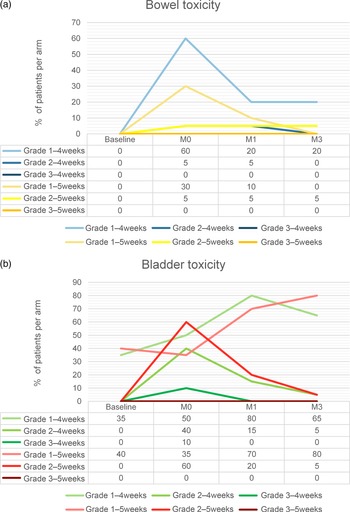
Before the start of HFRT, the participants of arms A and B had similar complaints of the bowel (0 versus 0%) and bladder (35 versus 40%, p = 0·74) symptoms. Acute radiation-induced bowel toxicity of arms A and B at the completion of HFRT was 60 versus 30% grade 1 and 5 versus 5% grade 2, respectively. We did not record any grade 3–4 acute bowel toxicity. Over time, the severity of bowel toxicity became 20% grade 1 and 5% grade 2 in the third month of follow-up of arms A and B, respectively. Acute radiation-induced bladder toxicity of arms A and B at the completion of HFRT was 50 versus 35% grade 1, 40 versus 60% grade 2, and 10 versus 0% grade 3, respectively. We did not record any grade 4 acute bladder toxicity. Over time, the severity of bladder toxicity became 65 versus 80% grade 1 and 5 versus 5% grade 2 toxicity at the third month of follow-up of arms A and B, respectively. Figure 1 shows the acute radiation-induced bowel and bladder toxicities of each HFRT regimen as a function of time. While the cumulative incidence of grade 2 or worse acute bowel toxicity was 5% for both arms, the cumulative incidence of grade 2 or worse bladder toxicity was 50% for arm A and 60% for arm B (p = 0·52).
Evolution in time of acute bowel (a) and bladder toxicity (b) per HFRT regimen.

We noted no significant difference between the treatment arms in terms of mean acute bowel toxicity score at the completion of RT (0·7 versus 0·4, p = 0·15) and the first month after RT (0·3 versus 0·2, p = 0·67), but a trend towards lower bowel toxicity in arm B in the third month after RT (0·2 versus 0·1, p = 0·07). There was no significant difference between the treatment arms in terms of mean bladder toxicity score at the completion of RT (1·6 versus 1·5, p = 0·23), the first month after RT (1·1 versus 1·1, p = 0·73) and the third month after RT (0·7 versus 0·9, p = 0·52). Likewise, the 4-week regimen was non-inferior in reducing the PSA during the 3 months after completion of RT [average PSA change −15·13 (arm A) versus −18·38 (arm B), p = 0·38].
Discussion
Based on our findings, the 4-week regimen was non-inferior to the 5-week regimen of HFRT in terms of acute grade 2 or worse bowel and bladder toxicity. Also, there was no significant difference between the arms over 3 months of RT; however, the 4-week regimen demonstrated a trend towards higher acute bowel toxicity in the third month of follow-up. This can be explained by the relative sensitivity of tissue stem cells of acute responding tissues to the fraction sizeReference McBride and Schaue21–Reference Withers23; however, this finding needs to be interpreted cautiously because all bowel toxicities in the 4-week arm were grade 1 and only one case with grade 2 bowel toxicity was reported in the 5-week arm. This difference may become significant in longer follow-up and more participants. The participants remain in follow-up and we will investigate this association in the future. Notwithstanding the predicted EQD2Gy for acute injury was 11 Gy higher in arm B, the acute toxicities of HFRT regimens were similar. This may be due to the small patient sample. More research is needed to better understand the radiobiology of acute injury in HFRT regimens concerning the α/β ratio.
Based on the results, bowel toxicity improved in terms of severity and rate over time. Even though bladder toxicity improved in severity, it remained in a relatively steady state of low-grade toxicity over the 3 months after completion of RT. Differences in cellular kinetics can justify this finding.Reference Denekamp24
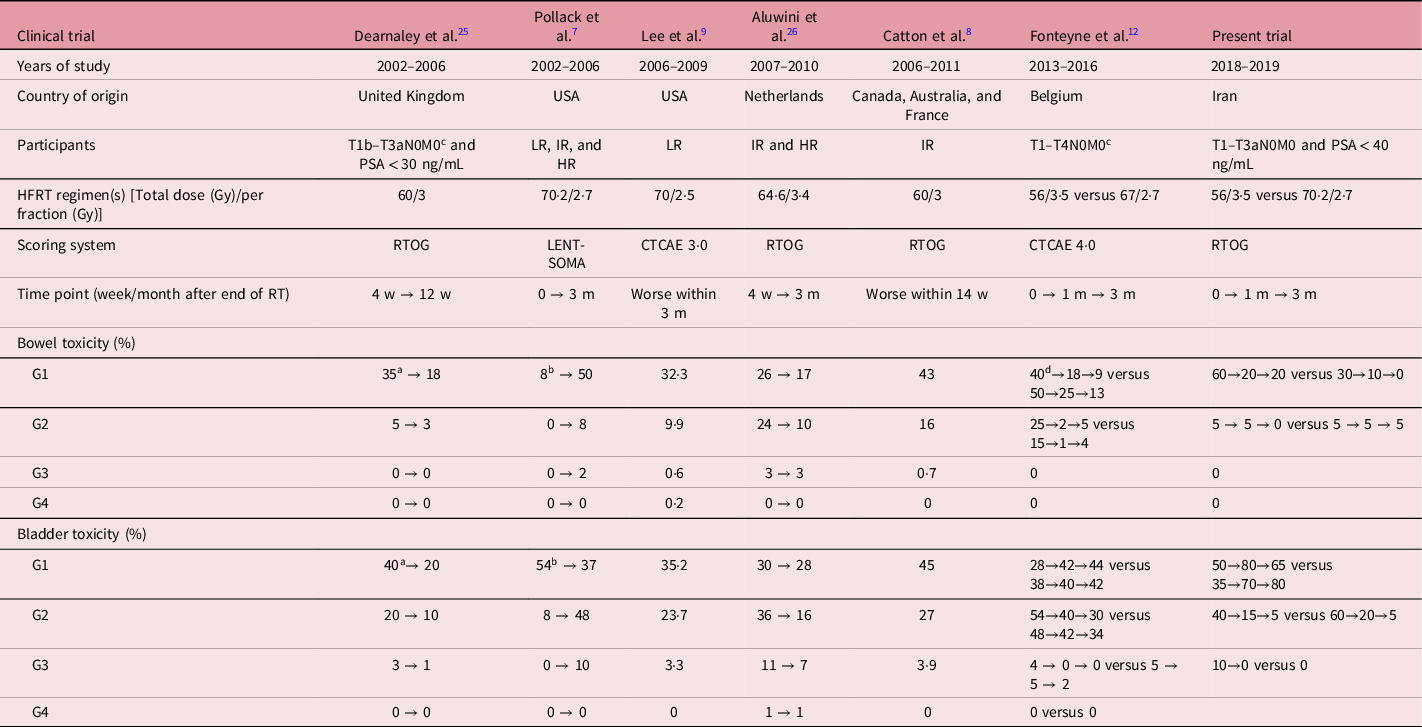
Several investigators have reported the acute toxicity of various HFRT regimens in various populations. The summary of these trials is presented in Table 2. The HFRT-induced toxicity appears to be temporary. Findings of the Conventional versus Hypofractionated High-dose intensity-modulated radiotherapy for Prostate cancer (CHHiP) trial demonstrated the peak of radiation-induced toxicities at the fourth to fifth week from the start of 4-week HFRT.Reference Dearnaley, Syndikus and Sumo25 We did not record toxicity during the HFRT sessions; however, the steady decrease in severity and rate of acute toxicities for both HFRT regimens is in line with the findings of the CHHiP trial.Reference Dearnaley, Syndikus and Sumo25 In comparison with CHHiP and HYpofractionated irradiation for PROstate cancer trials, we found much higher grade 1 bladder toxicity in the third month after the completion of HFRT.Reference Aluwini, Pos and Schimmel26 In comparing with Fonteyne et al. trial,Reference Fonteyne, Sarrazyn and Swimberghe12 notwithstanding the similar HFRT regimen of 56 Gy in 16 fractions, we recorded more grade 1 and less grade 2 of both bowel and bladder toxicities in the third month after completion of HFRT. This dissimilarity might be explained by the difference in treatment volumes or the importance of patient characteristics on radiosensitivity, such as patient’s age, use of cigarettes, and comorbidities.Reference Barnett, West and Dunning27
Overview of randomised trials reporting the acute radiation-induced toxicities of hypofractionated regimens

a The amounts are approximate according to Figure 1 of Dearnaley et al. trial.
b The amounts are approximate according to Figure 3 of Pollack et al. trial.
c Based on American Joint Committee on Cancer, 7th edition, 2010.
d The amounts are approximate according to Figure 1 of Fonteyne et al. trial.
LR, low-risk; IR, intermediate-risk, HR, high-risk; PSA, prostate-specific antigen; HFRT, hypofractionated radiotherapy; RTOG, Radiation Therapy Oncology Group; LENT-SOMA, Late Effects of Normal Tissues–Subjective, Objective, Management, and Analytic scales; CTCAE, Common Terminology Criteria for Adverse Events; w, week; m, month.
Some limitations of this study should be considered when interpreting the results. First, conducting sequential randomisation—instead of stratified randomisation—has resulted in more patients with high-risk disease in the 5-week arm which would bias the toxicity results by increasing the treatment volumes. In addition, the difference in the proportion of patients who did not receive ADT (i.e., low-risk patients) between groups may affect the results of PSA alteration. Second, the findings may have been confounded by the small number of patients. To resolve this critical issue, larger randomised clinical trials are necessary. Our study did not include the results for biochemical control and survival. To better compare the two regimens of HFRT, one should include their data in the analysis. Another potential limitation of this trial is its single-centre condition; therefore, the composition of participants, HFRT protocols, resources and staffing characteristics are potentially limiting to the generalisability of our results. Although these limitations are important, this study is one of the few randomised controlled trials to compare the acute adverse effects of two HFRT regimens.
Conclusions
The results of this trial demonstrate the safety of two HFRT regimens for localised PCa. Moreover, it demonstrates that the 5-week HFRT regimen for localised PCa is non-inferior to the 4-week regimen in terms of acute grade 2 or worse bowel and bladder injury.
Acknowledgements
The authors thank patients and their families for participating in this study.
Funding
Not applicable.
Conflicts of Interest
The authors have no relevant relationships to disclose.
Authors’ Contributions
M.H., M.B and B.M. designed the research; M.H. and M.A.T. performed the research; M.A.T. and F.T.-H. analysed the data; M.A.T. and F.T.-H. wrote the paper. All the authors reviewed and confirmed the final version of the paper.
Ethical Approval
In the act provided by Shahid Beheshti University of Medical Sciences, the ethical regulations dictated were approved to review of the medical records for the purposes of our study.
Patient Consent Statement
All patients freely and voluntarily consent to take part in the research study.
Availability of Data and Material
Data are available upon request.
Supplementary Material
To view supplementary material for this article, please visit https://doi.org/10.1017/S146039692100025X.