INTRODUCTION
Fiddler crabs of the genus Uca Leach, 1814 are a diversified group, inhabiting intertidal areas of estuaries and mangrove forests of the Old and New Worlds (Crane, Reference Crane1975). They are an important component of mangrove ecosystems and in transferring energy to both marine and terrestrial habitats, being consumed by a wide variety of fish, birds and invertebrates (Skov & Hartnoll, Reference Skov and Hartnoll2001; Skov et al., Reference Skov, Vannini, Shunula, Hartnoll and Cannicci2002; Litulo, Reference Litulo2004); and promote turnover of nutrients because of their burrowing habits (Aveline, 1980). The evident sexual dimorphism in the chelipeds is one of the most remarkable characteristics of these crabs (Crane, Reference Crane1975).
Nowadays, the genus Uca comprises 94 species (Beilinch & von Hagen, 2006), of which 10 are known from the Brazilian coast: U. (Leptuca) cumulanta Crane, 1943, U. (L.) leptodactyla Rathbun, 1898, U. (L.) uruguayensis Nobili, 1901, Uca (Minuca) burgersi Holthuis, 1967, U. (M.) mordax (Smith, 1870), U. (M.) rapax (Smith, 1870), U. (M.) thayeri Rathbun, 1900, U. (M.) victoriana von Hagen, Reference von Hagen1987, U. (M.) vocator (Herbst, 1804) and U. (Uca) maracoani (Latreille, 1802) (Melo, Reference Melo1996; Ng et al., Reference Ng, Guinot and Davie2008).
Uca (M.) victoriana was until recently known only from the type locality at Vitória, State of Espírito Santo (von Hagen, Reference von Hagen1987). Bedê et al. (Reference Bedê, Oshiro and Melo2007) reported it from farther south in the State of Rio de Janeiro.
Several recent studies have treated Uca populations in Brazilian mangroves, including size–frequency distribution, sex-ratio, reproductive season, and density, etc. (Frith & Brunenmeister, Reference Frith and Brunenmeister1980; Colpo & Negreiros-Fransozo, 2004; Costa & Negreiros-Fransozo, Reference Colpo and Negreiros-Fransozo2003; Castiglioni & Negreiros-Fransozo, Reference Castiglioni and Negreiros-Fransozo2005; Koch et al., Reference Koch, Wolff and Diele2005; Bezerra et al., Reference Bezerra, Dias, Santana and Matthews-Cascon2006; Bezerra & Mathews-Cascon, 2006, 2007; Castiglioni et al., Reference Castiglioni, Negreiros-Fransozo and Mortari2006; Benetti et al., Reference Benetti, Negreiros-Fransozo and Costa2007; Bedê et al., Reference Bedê, Oshiro, Mendes and Silva2008; Hirose & Negreiros-Fransozo, Reference Hirose and Negreiros-Fransozo2008; Costa & Soares-Gomes, Reference Costa and Soares-Gomes2009). The only study on population biology of U. (M.) victoriana was carried out by Bedê et al. (Reference Bedê, Oshiro, Mendes and Silva2008) in a tropical mangrove in the State of Rio de Janeiro. The scarcity of population studies on U. (M.) victoriana is due partly to difficulties in identifying this species.
Here we report, for the first time, U. (M.) victoriana in estuaries of north-eastern Brazil, extending its geographical range; and provide morphological characters to help distinguish it from similar species. We also investigated aspects of its population biology including the size–frequency distribution, body size, and sex-ratio.
MATERIALS AND METHODS
TAXONOMY
We based our taxonomic study on the type series deposited in the Zoologisches Museum der Universität Hamburg, Hamburg, Germany, and additional material in Brazilian repositories: the Museu de Zoologia of the Universidade de São Paulo, São Paulo (MZUSP); Museu de Zoologia of the Universidade Estadual de Santa Cruz, Ilhéus (MZUESC); and Centro Acadêmico de Vitória, Universidade Federal de Pernambuco, Vitória de Santo Antão Campus, State of Pernambuco (CAV-UFPE). We made the drawings with the help of a stereomicroscope fitted with a drawing tube.
SITE DESCRIPTION
In Pernambuco, we collected specimens of U. (M.) victoriana in mud sediments in areas with Lagungularia racemosa and Avicennia sp. In the Arinquindá River, we found it together with the congeners U. (M.) burgersi, U. (M.) thayeri and U. (L.) cumulanta; and in the Mamucabas River, with U. (M.) burgersi, U. (M.) thayeri, U. (L.) cumulanta and U. (L.) leptodactyla, in salinities from 2 to 30 practical salinity units (psu).
In southern Bahia, in the Almada River basin, we collected U. (M.) victoriana at both tidal and non-tidal stations. One of the stations was in freshwater, on a sandy substratum, with Armases rubripes (Rathbun, 1897), Cardisoma guanhumi Latreille, 1825, Ucides cordatus (Linnaeus, 1763) and U. (M.) mordax, known to establish larger populations in low-salinity areas (Melo, Reference Melo1996). In the Jucuruçu River, we collected it in the transition zone between mangrove and restinga forest, with U. (L.) leptodactyla, A. rubripes, A. angustipes (Dana, 1852) and Sesarma rectum Randall, 1840, on mud and sand sediments covered by shrub vegetation. At Barra do Cahy we collected it on a sand–mud sediment covered by shrub vegetation (probably family Poaceae), adjacent to the mouth of the Cahy River, with U. (M.) rapax, U. (M.) thayeri, Goniopsis cruentata (Latreille, 1803), A. angustipes and S. rectum. In the Patipe River, we found specimens on mud near the river bank. In Bahia, we collected it in salinities of 7 (Jucuruçu River), 9 (Patipe River), 15 (Barra do Cahy) and 25 psu (Itanhém River).
POPULATION BIOLOGY
Over one year, four sites with different types of substrate were sampled monthly from April 2008 through to March 2009 in mangroves of the Ariquindá River (8°46′43.69″S and 35°06′25.87″W) and the Mamucabas River (8°41′28.48″S and 35°06′09.32″W), both in the municipality of Tamandaré, Pernambuco. At each location, one person captured crabs during 30 minutes, at low spring tide. All crabs obtained were bagged, labelled and preserved in 70% ethanol until further analysis. Because we collected only a few individuals of U. (M.) victoriana at Ariquindá, the size–frequency distribution, body size of males and females, and sex-ratio were analysed only for the population from the Mamucabas River mangrove.
In the laboratory, specimens were identified, sexed, and checked for the presence of eggs on female pleopods. The carapace width (CW) was measured using a digital caliper (±0.01 mm). We recorded the number of crabs from each mangrove.
The population size structure was analysed from the size–frequency distribution of all individuals collected. Specimens were grouped in 0.5 mm size-class intervals from 4.0 to 12.0 mm CW. The number of classes was obtained by Sturges's formula (Conde et al., Reference Conde, Rull and Vegas1986): K = 1 + 3.22logN, where K = class number and N = number of crabs.
The mean size of males and females (ovigerous and non-ovigerous) was compared using Student's t-test (α = 0.05). The overall size–frequency distribution was tested for normality using the Shapiro–Wilk test (α = 0.05) (Zar, Reference Zar1996).
The sex-ratio was analysed for each month and size-class. A Chi-square (χ2) test for goodness of fit was used to evaluate whether the sex-ratio in each month, each size-class, and for the entire year differed significantly from 1:1 (α = 0.05) (Zar, Reference Zar1996).
Abbreviations used: f = female (s); m = male (s); ovf = ovigerous female; CW = carapace width.
RESULTS
Uca victoriana von Hagen, Reference von Hagen1987: p. 81, pl. 1–4; Coelho, Reference Coelho1995: p. 140; Melo, Reference Melo1996: p. 495, figure 1; Melo, Reference Melo and Young1998: p. 505; Bedê et al., Reference Bedê, Oshiro and Melo2007: p. 799, figure 1; Bedê et al., Reference Bedê, Oshiro, Mendes and Silva2008: p. 602; Uca rapax—Almeida et al., Reference Almeida, Coelho, Santos and Ferraz2006: p. 16 (in part); Uca mordax—Almeida et al., Reference Almeida, Coelho, Santos and Ferraz2006: p. 16 (in part); Uca (Minuca) victoriana—Beinlich & von Hagen, Reference Beinlich and von Hagen2006: p. 27; Ng et al., Reference Ng, Guinot and Davie2008: p. 241.
Second and third pereiopods of Uca (Minuca) burgersi Holthuis (A, C) and Uca (Minuca) victoriana von Hagen (B, D). (A, B) Female second pereiopod; (C, D) female third pereiopod. (A, C) São Paulo, Ubatuba, MZUSP 14515; (B, D) Espírito Santo, Vitória, MZUSP 18571. Scale bars = 0.2 mm.

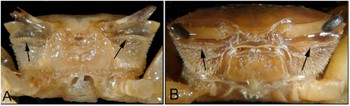
Suborbital margin (arrows) of U. (Minuca) victoriana von Hagen (A) and U. (Minuca) rapax Smith (B). (A) Holotype, CW = 11.0 mm, ZMH-K 28887; (B) male, CW = 18.3 mm, United States, Florida, Brevard County, USNM 170173.

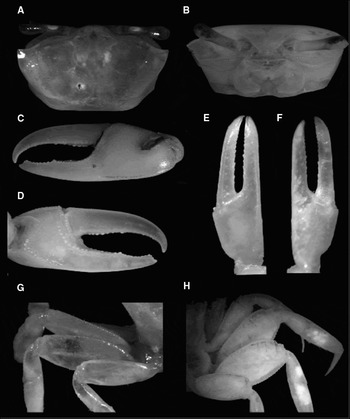
Uca (Minuca) victoriana von Hagen. (A) Dorsal margin of carapace; (B) frontal view; (C) outer major manus; (D) inner surface of major palm; (E) outer minor manus; (F) inner surface of minor palm; (G) ambulatory legs of males; (H) ambulatory legs of females. (A–G) Holotype, ZMH-K 28887; CW = 11 mm; H, paratype, ZMH-K 28887; CW = 10 mm.

Type-series
Brazil: Espírito Santo, Vitória. Holotype (ZMH-K 28887, 1 m); allotype (ZMH-K 28887, 1 f); paratype (ZMH-K 28887, 5 m, 9 f). Zoologisches Museum, Universität Hamburg, Hamburg.
Other material
597 males, 334 females (4 ovigerous). Brazil: State of Pernambuco—Tamandaré, Ariquindá River (CAV-UFPE 100, 25 m, 16 f, 1 ovf); Tamandaré, Mamucabas River (CAV-UFPE 101, 472 m, 298 f, 2 ovf); State of Bahia—Ilhéus, Parque Municipal Boa Esperança (MZUESC 124, 3 m, 2 f); Ilhéus, Acuípe River (MZUESC 1198, 2 m); Ilhéus, Almada River (MZUESC 1199, 2 m, 2 f; MZUESC 391, 2 m, 2 f; MZUESC 255, 4 m, 4 f); Prado, Barra do Cahy (MZUESC 1200, 4 m, 3 f); Prado, Jucuruçu River (MZUESC 1201, 2 m, 3 f); Alcobaça, Itanhém River (MZUESC 1037, 2 m); Mucuri (MZUSP 18641, 4 m). State of Espírito Santo—Serra, Lagoa do Baú (MZUSP 18640, 6 m); Vitória (MZUSP 18642, 2 m; MZUSP 16292, 16 m); Anchieta, Benevente River (MZUSP 18571, 49 m, 4 f, 1 ovf; MZUSP 18568, 2 m).
Distribution
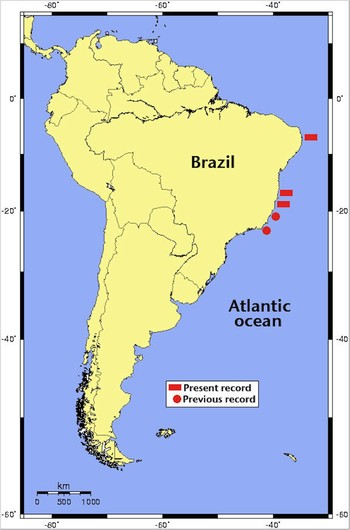
Western Atlantic—Brazil: States of Pernambuco, Bahia, Espírito Santo and Rio de Janeiro (Figure 4).
Known range of Uca (Minuca) victoriana von Hagen.

DIAGNOSIS
Male: front wider; orbits oblique; carapace strongly arched, but not semi-cylindrical; no pile or granulations on dorsal margin of carapace; antero-lateral margins short, straight, better defined on major side where they merge moderately sharply with dorso-lateral margins; on minor side, antero-lateral margins merge gently with dorso-lateral margins; eyebrow broad, lower margin slightly beaded; suborbital crenelations well defined and well separated throughout, enlarging toward outer orbital margins; setae in rows above and below crenelations sparse, almost absent; upper postero-lateral stria long. Fingers of minor cheliped long, with tiny serrations on inner margin, hairs on tip sparse. Antero-dorsal margins of major merus straight, oblique, arched on distal end which has small serrations. Upper margin of outer major manus covered by moderate granulation, decreasing in size toward ventral margin, a shorter straight depression filled with pile near ventral margin, near base of pollex; oblique tuberculate ridge on palm high at apex, smaller toward distal end; pollex as long as manus, with an enlarged tooth halfway to its tip; dactyl longer than manus, oblique, tip strongly curved downwards, below pollex tip; gap narrow, pile present. Merus of ambulatories moderately broad; pile present on dorsal margins of carpus and manus of first 3 ambulatories; no setae on ambulatories. Abdominal segments not fused.
Female: dorsal margin of carapace with minute granulations near antero-lateral margins, which merge roundly into dorso-lateral margins (as on the minor side in males); orbits slightly oblique, almost straight. Merus of ambulatories enlarged, both dorsal and ventral margins armed with few serrations; pile on dorsal margin of carpus and manus; setae absent on all ambulatories. Gonopore slightly raised without tubercles.
REMARKS
Uca (M.) victoriana is morphologically very similar to U. (M.) rapax and U. (M.) burgersi, resulting in confusion among these species. By comparing the type series and the additional material collected in Pernambuco and Bahia, we found some morphological differences among these fiddlers that we believe to be useful in avoiding misidentification of preserved specimens.
Uca (M.) victoriana can be distinguished from U. (M.) burgersi by the more slender ambulatory merus (Figure 1) and by the semicircular divergence of the proximal tuberculate pre-dactylar ridge on the major palm. Uca (M.) victoriana is more difficult to distinguish from U. (M.) rapax, but can be segregated by the suborbital crenellations, which are sinuous in U. (M.) victoriana and straight in U. (M.) rapax (Figure 2). Males of U. (M.) victoriana are readily distinguished from all other Brazilian species by the presence of pubescence on the outer major manus, near the base of the pollex.
POPULATION BIOLOGY
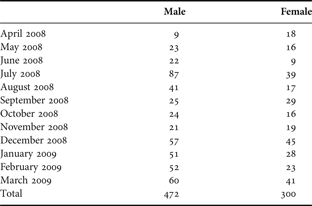
A total of 814 crabs were collected during the study period: 41 in the Arinquindá River, of which 25 were males, 16 non-ovigerous females, and 1 ovigerous female, all in June 2008; and 772 in the Mamucabas River, including 472 males, 298 non-ovigerous females, and 2 ovigerous females. The number of males and females (ovigerous and non-ovigerous) collected in the Mamucabas River is given in Table 1. Males ranged from 4.12 to 11.54 mm CW (mean ± SD: 7.46 ±1.60 mm), and females (ovigerous and non-ovigerous) from 4.44 to 11.15 mm CW (mean ± SD: 7.09 ± 1.45 mm), not differing significantly in size (t = −0.7445; P > 0.05).
Number of specimens of Uca (Minuca) victoriana von Hagen collected at Mamucabas River mangrove, State of Pernambuco, north-eastern Brazil from April 2008 to March 2009.
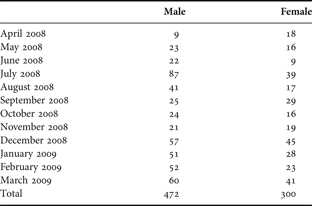
Figure 5 shows the yearly size–frequency distribution for males and for non-ovigerous and ovigerous females. Both sexes showed unimodal distributions, with a normal distribution for both males (W = 0.98283, P < 0.05) and females (W = 0.98509; P < 0.05). Males and non-ovigerous and ovigerous females were all most abundant in the medium size-classes (7.0–7.5 mm).
Size–frequency distribution of Uca (Minuca) victoriana von Hagen collected from the Mamucabas River mangrove, State of Pernambuco, north-eastern Brazil, from April 2008 through to March 2009. (A) Males; (B) females (ovigerous and non-ovigerous).

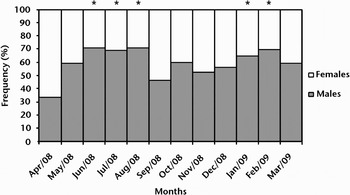
The overall sex-ratio was 1:1.57 (males:females) and differed significantly from the expected 1:1 proportion (χ2 = 38.32; P < 0.05); males were slightly more abundant than females. The monthly sex-ratio did not differ from the Mendelian proportion (P < 0.05), except in June, July, and August 2008, and January and February 2009, when males were more abundant (Figure 6). Males were more frequent than females in the larger size-classes (10.0–10.5 mm, χ2 = 9.78; 10.5–11.0 mm, χ2 = 4.57; 11.0–11.5 mm, χ2 = 4.50 and 11.5–12.0 mm, χ2 = 4.00; P < 0.05).
Sex-ratio of Uca (Minuca) victoriana von Hagen collected from the Mamucabas River mangrove, State of Pernambuco, north-eastern Brazil, from April 2008 through to March 2009. *, significant difference between number of males and females (ovigerous and non-ovigerous) (χ2; P < 0.05).

DISCUSSION
The finding of U. (M.) victoriana in Pernambuco and Bahia considerably extends its geographical range on the Brazilian coast. Bedê et al. (Reference Bedê, Oshiro and Melo2007) recently reported it from the State of Rio de Janeiro, extending its southern distribution. According to these authors, the small size of U. (M.) victoriana has contributed to limiting the number of records in Brazil, because of difficulties in collecting and identifying. We believe that the similar morphology with U. (M.) burgersi and U. (M.) rapax, as reflected in the large number of misidentified specimens found in Brazilian collections, was the main factor in the scarcity of records of U. (M.) victoriana. This species may occur along the coast of Central America and the Caribbean, and could be present (but misidentified) in other carcinological collections.
In the present study, we found specimens of U. (M.) victoriana mainly on muddy sediments, with its congeners U. (L.) cumulanta, U. (L.) leptodactyla, U. (M.) burgersi, and U. (M.) thayeri, and other crab species including Armases rubripes, Cardisoma guanhumi and Ucides cordatus. Von Hagen (1987) and Bedê et al. (Reference Bedê, Oshiro and Melo2007) also found U. (M.) victoriana in muddy sediments, with U. (L.) leptodactyla, U. (M.) burgersi and U. (M.) thayeri; and with U. (L.) cumulanta and U. (M.) thayeri, respectively.
The size–frequency distribution of U. (M.) victoriana in the Mamucabas River mangrove was consistently unimodal, indicating a stable population with continuous recruitment and a constant mortality rate through different life phases (Díaz & Conde, Reference Díaz and Conde1989). This is a common pattern in tropical fiddler crab populations (Litulo, Reference Litulo2005a, Reference Litulob; Bezerra & Matthews-Cascon, Reference Bezerra and Matthews-Cascon2006; Castiglioni et al., Reference Castiglioni, Negreiros-Fransozo and Mortari2006). Bedê et al. (Reference Bedê, Oshiro, Mendes and Silva2008) also reported a unimodal population for U. (M.) victoriana in a tropical mangrove in Rio de Janeiro. Temperate and subtropical Uca populations generally have a bimodal size–frequency distribution (Spivak et al., Reference Spivak, Gavio and Navarro1991; Mounton & Felder, Reference Mounton and Felder1995; Yamaguchi, Reference Yamaguchi2001). However, Bezerra & Matthews-Cascon (Reference Bezerra and Matthews-Cascon2007) found a bimodal size–frequency distribution with a seasonal breeding season in a tropical population of U. (M.) thayeri in the Pacoti River, State of Ceará, north-eastern Brazil. Bimodality or polymodality may result from slow growth during the immature or mature stages, recruitment pulses, migration, mortality, or differential behaviour (Díaz & Conde, Reference Díaz and Conde1989).
The difference between male and female carapace widths was not large in this population, the females being slightly smaller than males. In several Uca populations, males are larger than females (Colpo & Negreiros-Fransozo, Reference Colpo and Negreiros-Fransozo2004; Castiglioni & Negreiros-Fransozo, Reference Castiglioni and Negreiros-Fransozo2005; Castiglioni et al., Reference Castiglioni, Negreiros-Fransozo and Mortari2006; Bedê et al., Reference Bedê, Oshiro, Mendes and Silva2008; Hirose & Negreiros-Fransozo, Reference Hirose and Negreiros-Fransozo2008). This may occur because females concentrate their energy budget on gonad development (Díaz & Conde, Reference Díaz and Conde1989; Johnson, 2003; Hartnoll, Reference Hartnoll2006), whereas males reach a larger size because larger males have better chances of obtaining females for copulation, and win more intra-specific fights (Christy & Salmon, Reference Christy and Salmon1984). Bedê et al. (Reference Bedê, Oshiro, Mendes and Silva2008) found a population of U. (M.) victoriana in Rio de Janeiro with females larger than males, but did not discuss the possible causes.
The mean carapace width found by Bedê et al. (Reference Bedê, Oshiro, Mendes and Silva2008) for males and females was smaller than that in the population examined here. According to Campbell & Eagles (Reference Campbell and Eagles1983), environmental factors such as photoperiod, rainy season and food availability could be responsible for phenotypic differences among Uca populations. Differences in the mean body size of males and females between different populations in tropical mangroves were also observed by Colpo & Negreiros-Fransozo (Reference Colpo and Negreiros-Fransozo2004) in U. (M.) vocator, by Castiglioni & Negreiros-Fransozo (Reference Castiglioni and Negreiros-Fransozo2005) in U. (M.) rapax and by Benetti et al. (Reference Benetti, Negreiros-Fransozo and Costa2007) in U. (M.) burgersi. These authors attributed the size differences to different levels of food resources, especially the substrate organic matter content.
The overall sex-ratio in the present population was skewed toward males. Fiddler crab populations commonly deviate significantly from the 1:1 proportion (Genoni, Reference Genoni1985), and several Uca populations with similarly biased sex-ratios have been recorded (Spivak et al., Reference Spivak, Gavio and Navarro1991; Castiglioni & Negreiros-Fransozo, Reference Castiglioni and Negreiros-Fransozo2005; Litulo, Reference Litulo2005a, Reference Litulob; Masunari & Dissenha, Reference Masunari and Dissenha2005; Hirose & Negreiros-Fransozo, Reference Hirose and Negreiros-Fransozo2008; Costa & Soares-Gomes, Reference Costa and Soares-Gomes2009). According to Johnson (2003), deviations from the 1:1 ratio might result from sex differences in the spatial–temporal distribution and mortality rates. Sampling methods (Montague, Reference Montague1980) and differential predation on males and females (Wolf et al., Reference Wolf, Shanholtzer and Reimold1975) could also be responsible for biased sex-ratios.
Bedê et al. (Reference Bedê, Oshiro, Mendes and Silva2008) also found a deviated sex-ratio in a U. (M.) victoriana population in Rio de Janeiro, but with more females than males. According to Valiela et al. (Reference Valiela, Babiec, Atherton, Seitzinger and Krebs1974) and Emmerson (Reference Emmerson1994), male fiddler crabs are more easily found because they feed for longer periods on the surface. The deviations from the normal proportion of sexes appear to be related to the reproductive system, because males spend more time moving their major cheliped, holding and disputing territory to attract females, and feeding over long periods to compensate for the presence of a single cheliped which is used in food capture; and consequently they are easily caught (Valiela et al., Reference Valiela, Babiec, Atherton, Seitzinger and Krebs1974; Montague, Reference Montague1980; Emmerson, Reference Emmerson1994).
We could not determine the reproductive season of U. (M.) victoriana because of the few ovigerous females collected. Aciole et al. (Reference Aciole, Sousa and Calado2000) and Bezerra & Matthews-Cascon (Reference Bezerra and Matthews-Cascon2006), studying ecological aspects of U. (L.) leptodactyla in two mangroves of north-eastern Brazil, also found few ovigerous females in a one-year period. This may be because ovigerous females of broad-fronted fiddler crabs such as U. (M.) victoriana can incubate their eggs underground to protect them from extreme environmental conditions. Christy & Salmon (Reference Christy and Salmon1984), Murai et al. (Reference Murai, Goshima and Henmi1987) and Henmi (Reference Henmi2003) observed similar behaviour in U. (L.) pugilator (Bosc, 1802), U. (Paraleptuca) lactea (De Haan, 1875) and U. (P.) perplexa (H. Milne-Edwards, 1837), respectively. The ovigerous females had large broods, remained in their burrows throughout the incubation period, and did not feed during this phase. Bedê et al. (Reference Bedê, Oshiro, Mendes and Silva2008) did not report the number of ovigerous females of U. (M.) victoriana collected.
ACKNOWLEDGEMENTS
The authors are grateful to the Fundação de Amparo à Ciência e Tecnologia do Estado de Pernambuco (FACEPE), for financial support for fieldwork to D.S.C. (APQ: 0108-2.04/07), and to CNPq for a fellowship to D.S.C.; to Dr Petrônio Alves Coelho (UFPE) for his usual support; to the Universidade Estadual de Santa Cruz for financing the projects ‘Inventariamento da Fauna de Crustáceos Decápodos do Município de Ilhéus, Bahia’ (00220.1100.347) and ‘Diversidade de Crustáceos do Sudeste e Sul da Bahia, Brasil: I. Ambientes Costeiros’ (00220.1100.590). Special thanks to Dr Marcos Tavares for providing facilities for the revision of Uca species in the collection at the MZUSP, São Paulo and to T. Chad Walter (National Museum of Natural History/USNM) for providing the type series from the Zoologisches Museum Universität Hamburg, Hamburg, Germany; and to Dr Janet W. Reid for assistance with the English text. All sampling in this study was conducted in compliance with current applicable state and federal laws (ICMBio 14340-1).