Introduction
Understanding the consequences of herbivory on plant reproductive success is a key issue in ecology and conservation biology. Herbivores have a pivotal role in shaping plant life-history traits, structuring plant communities and influencing ecosystem functioning (Huntly, Reference Huntly1991; Maron & Crone, Reference Maron and Crone2006; Agrawal et al., Reference Agrawal, Hastings, Johnson, Maron and Salmien2012). Their evolutionary and higher-order ecological impacts are ultimately driven by the consumption of plant biomass and the resulting negative effects on plant survival and fitness (Crawley, Reference Crawley1983; Marquis, Reference Marquis1984).
Plants are susceptible to different types of herbivores that are usually specialized in consuming specific plant tissues or sap. Depending on the plant part consumed, herbivores can be grouped into three main categories: (1) belowground herbivores – species that essentially feed on plant roots, (2) folivores – species that primarily consume leaves (including sap-sucking, mining, and chewing herbivores), and (3) florivores – species that feed on reproductive and/or sterile flower parts (Strauss, Reference Strauss1997). While many herbivores fall into one of these categories, others are generalists and feed on various plant tissue types (Prokopy & Owens, Reference Prokopy and Owens1983). Despite this, the majority of studies addressing the impacts of herbivores on plant fitness involved herbivores specializing on a particular plant tissue (but see Poveda et al., Reference Poveda, Steffan-Dewenter, Scheu and Tscharntke2003; Wise & Cummins, Reference Wise and Cummins2006). In this respect, it is well known that belowground herbivory, folivory, and florivory, each taken separately have negative effects on plant reproductive output by reducing flower, fruit, and/or seed production/quality as well as by compromising pollinator attraction (Rausher & Feeny, Reference Rausher and Feeny1980; Maron, Reference Maron1998; Poveda et al., Reference Poveda, Steffan-Dewenter, Scheu and Tscharntke2003; Wise & Cummins, Reference Wise and Cummins2006; Botto-Mahan et al., Reference Botto-Mahan, Ramírez, Ossa, Medel, Ojeda-Camacho and González2011; Bruinsma et al., Reference Bruinsma, Lucas-Barbosa, tem Broeke, van Dam, Dick and Van Loon2014). These negative effects can either be caused by directly removing or damaging reproductive structures (i.e., flowers), or indirectly by removing photosynthetic or root tissues and suppressing the synthesis of assimilates that can be invested in reproduction (Lehtilä & Strauss, Reference Lehtilä and Strauss1999; Cardel & Koptur, Reference Cardel and Koptur2010; Barber et al., Reference Barber, Milano, Tiers, Bartolo, Hazzard and Adler2015; Tito et al., Reference Tito, Castellani, Fáveri, Lopes and Vasconcelos2016).
While several studies have addressed whether specialized herbivores affect plant fitness by removing either reproductive organs or leaf area, the multiple causes behind generalized herbivore-driven impacts on plant reproduction remain poorly explored. For instance, when focusing on plants that are attacked by generalist herbivores (or a range of different specialized herbivores) that feed on both leaves and flowers, a key question arises: which effects (leaf-consumption, flower-consumption, or their combination) are more detrimental to plant's reproductive success? The few studies that examined plant reproductive success affected by different types of herbivore damage (e.g., floral damage vs. leaf damage) were investigated through experimental simulation of herbivore attack (Mothershead & Marquis, Reference Mothershead and Marquis2000; García & Ehrlén, Reference García and Ehrlén2002; Wise & Cummins, Reference Wise and Cummins2006; Puentes & Agren, Reference Puentes and Agren2012) and at the short-term scale. However, wild plants living under natural conditions might suffer accumulated herbivore damage in different organs from year to year, which might alter their reproductive capacity.
Leaf-cutting ants of the genus Atta (Myrmicinae) are a prime example of generalist herbivores that harvest a vast diversity of virtually all aboveground plant tissues to cultivate their symbiotic fungus (Wirth et al., Reference Wirth, Herz, Ryel, Beyschlag and Hölldobler2003). Quantitatively, they are amongst the most dominant herbivores of the Neotropical region, with plant biomass intake rates ranging from ca 70 to 500 kg/per colony/per year and up to 15% of the standing leaf crop within their foraging territories (Wirth et al., Reference Wirth, Herz, Ryel, Beyschlag and Hölldobler2003 and references therein; Herz et al., Reference Herz, Beyschlag and Hölldobler2007; Costa et al., Reference Costa, Vasconcelos, Vieira-Neto and Bruna2008). Their impacts span multiple levels of biological organization, from individual plants to ecosystems (Wirth et al., Reference Wirth, Herz, Ryel, Beyschlag and Hölldobler2003; Leal et al., Reference Leal, Wirth and Tabarelli2014). Despite the widely recognized role of leaf-cutting ants as key herbivores of neotropical ecosystems, there is only limited knowledge available about the fitness consequences of their harvesting activities at the single plant level. The available studies indicate that leaf-cutting ants might have relevant and negative effects on plant reproductive success (Rockwood, Reference Rockwood1973; Barbosa, Reference Barbosa2009; Mundim et al., Reference Mundim, Bruna, Vieira-Neto and Vasconcelos2012). Such negative impacts may be (1) directly mediated by the collection of large amounts of flowers and fruits (Haines, Reference Haines, Golley and Medina1975; Wirth et al., Reference Wirth, Beyschlag, Ryel and Hölldobler1997; Reference Wirth, Herz, Ryel, Beyschlag and Hölldobler2003); (2) indirectly mediated by removing large amounts of leaf biomass resulting in a loss of photosynthetic area and thus assimilates needed for flower development and fruit production; or (3) through a combination of direct and indirect effects, when damage on both reproductive and photosynthetic structures simultaneously operates.
Here, we investigate in situ effects of leaf-cutting ants on plant reproductive success (measured as flower and fruit output) in the shrub species Miconia nervosa (Smith) Triana (Family Melastomataceae), and the causes underlying them. Miconia species are usually early successional plants that are highly abundant in human-disturbed habitats of the Atlantic forest (Tabarelli & Mantovani, Reference Tabarelli and Mantovani1999), where leaf-cutting ant species also proliferate (Wirth et al., Reference Wirth, Meyer, Almeida, Araújo, Barbosa and Leal2007; Meyer et al., Reference Meyer, Leal and Wirth2009). Particularly, we analyze whether the potential negative effects of Atta species on plant reproductive success are driven by the removal/damage of flowers or by cutting leaves. To this aim, we conducted an exclusion experiment that manipulates leaf-cutting ants access on leaves and/or reproductive organs of M. nervosa plants.
Materials and methods
Study area
The study was conducted in the ‘Reserva Particular do Patrimônio Natural de Frei Caneca’, a private protected area in the Atlantic forest located in the municipalities of Jaqueira and Lagoa dos Gatos in Pernambuco State, northeast Brazil (08°42′37″S, 35°50′01″W). The reserve covers an area of 630 ha dominated by a montane semideciduous forest (Veloso et al., Reference Veloso, Rangel and Lima1991). The climate is tropical with two well-defined seasons: a rainy season from March to September and a dry season from October to February. Mean annual temperature ranges between 22 and 24°C, with an annual rainfall of 1332 mm (IBGE, 1992). Predominant soils in the area are classified in the red podzolic and yellow podzolic soil groups (IBGE, 1992).
Study species
Miconia nervosa (Smith) Triana (Family Melastomataceae) is a 2–3 m tall early successional shrub native to rainforests of tropical America. In the Atlantic forest region, it is common in the understory of primary forests, along forest edges, and near gaps of secondary forests (Antonini & Nunes-Freitas, Reference Antonini and Nunes-Freitas2004). The species has inflorescences with many small flowers that produce many-seeded berry fruits (up to 500 seeds per fruit) primarily dispersed by birds (Goldenberg & Shepherd, Reference Goldenberg and Shepherd1998). The flowering period ranges from January to March (TC, personal observation).
In the study area, M. nervosa is subject to herbivory by two co-occurring species of the leaf-cutting ant genus Atta: A. cephalotes (Linnaeus) and A. sexdens (Linnaeus) (Côrrea et al., Reference Côrrea, Bieber, Wirth and Leal2005). Both species benefit from forest loss and fragmentation exhibiting colony density increments from six to 20 times in forest edges as compared to forest interior (Wirth et al., Reference Wirth, Meyer, Almeida, Araújo, Barbosa and Leal2007; Meyer et al., Reference Meyer, Leal and Wirth2009; Dohm et al., Reference Dohm, Leal, Tabarelli, Meyer and Wirth2011). Atta cephalotes colonies harvest different plant materials (flowers, fruits, leaves, and stems) from nearly 300 plant species (Falcão et al., Reference Falcão, Pinto, Wirth and Leal2011), including M. nervosa (Falcão, Reference Falcão2004). Both A. cephalotes and A. sexdens cut large amounts of green leaves during the non-reproductive phase of M. nervosa, while they harvest vegetative (i.e., leaves) and reproductive structures (i.e., buds and flowers) during the reproductive phase (TC, personal observation). They have been observed collecting fruits of Miconia species on the forest floor rather than on the plants (Dalling & Wirth, Reference Dalling and Wirth1998).
Experimental design
In order to experimentally disentangle the effects of floral and foliar herbivory by leaf-cutting ants on plant reproductive success, we used a randomized block design with nine replicates (blocks). Within each block, we selected three plants of M. nervosa (a total of 27 plants) with similar height and number of branches to control for the potential influence of plant ontogeny (Boege et al., Reference Boege, Dirzo, Siemens and Brown2007). The distance among plants was up to 3 m within each block, all plants being located next to the foraging trail of a nearby leaf-cutting ant nest, so that they had a similar probability to be cut by ants. Each plant within a block was assigned to one of the three following treatments: (1) undamaged plants, (2) leaf-damaged plants, and (3) flower + leaf-damaged plants. In August 2008, the standing ant herbivory level was estimated in ten randomly selected branches per plant using four visual categories (0–25, 25–50, 50–75, >75%). Nine plants (one plant per block) with 0–25% of leaf area consumption were classified as ‘undamaged’ and treated bi-monthly with sticky tanglefoot (Tanglefoot Company, Grand Rapids, Michigan, USA) at the stem base during the period of study in order to prevent ant access. Likewise, nine plants (one plant per block) with >50% of initial leaf area consumption were designated as ‘flower + leaf-damaged’ and free access of ants was allowed throughout the study period. We also selected nine plants (one plant per block) with >50% of initial leaf area consumption that was assigned as ‘leaf-damaged’ and subjected to bi-monthly application of tanglefoot at the base of all inflorescences to prevent ants from reaching flowers throughout the study period. To ensure that our experimental treatments were effective, selected plants were fortnightly surveyed for the presence of ants. These surveys highlighted the absence and presence of ants on the undamaged and damaged plants, respectively, as well as the absence of ants on isolated reproductive structures during the study period.
To estimate the reproductive success of M. nervosa plants, we tagged five inflorescences per plant, where we counted all flowers (buds in pre-anthesis) in January 2009 and the number of flowers that turn into fruits in February 2009. We then computed three measures of reproductive success: (1) flower production, as the number of flowers per inflorescence and plant; (2) fruit set, as the proportion of flowers that become fruits; and (3) fruit production, as the number of fruits per inflorescence and plant.
Although herbivory effects by leaf-cutting ants are disproportionately larger than herbivory effects caused by any other insect taxa in the neotropics (Coley & Barone, Reference Coley and Barone1996; Leal et al., Reference Leal, Wirth and Tabarelli2014), we adopted a conservative approach and also controlled for non-ant herbivory effects. To this aim, we performed monthly snapshot censuses from January to February 2009. At each census, plants were searched for herbivores by visual, non-destructive inspections on all leaf surfaces, associated branches, and reproductive organs during 3 min from 7:00 am to 17:00 pm (i.e., four 3 min surveys per plant). Non-ant insect herbivores collected on plants were maintained in 70% ethanol and identified to family level. All herbivores collected were deposited in the Laboratory of Insect Taxonomic and Ecology of the Universidade Federal de Pernambuco.
Statistical analyses
We performed general linear mixed models (GLMMs) to evaluate the effects of leaf-cutting ants on flower production, fruit set, and fruit production. Treatment was included as a fixed factor, abundance of other insect herbivores as a covariate, and block as a random factor. The abundance of other insect herbivores was only weakly related to treatment (see results), which did not prevent to include it in the statistical models as a covariate to control for non-ant herbivory effects. For the flower and fruit production models, we used Gaussian error distributions, whereas for the fruit set model, we used a binomial error distribution. We used post-hoc Tukey tests to interpret significant differences between treatments. All the analyses were performed in R (R Development Core Team, 2016), using the package lme4 version 4 1.1-7 (Bates et al., Reference Bates, Mächler, Bolker and Walker2015).
Results
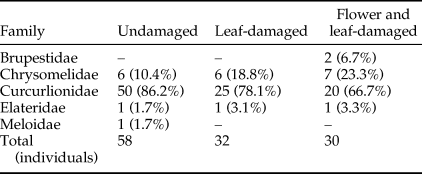
Our experiment revealed significant effects of leaf-cutting ant herbivory on the reproductive success of M. nervosa (table 1). Particularly, flower + leaf-damaged plants had 1.4 and 1.5 times fewer flowers than leaf-damaged and undamaged plants, respectively. Differences in the number of flowers between undamaged and leaf-damaged plants were non-significant (fig. 1a). Fruit set was also affected by leaf-cutting ant herbivory (table 1). In both undamaged and leaf-damaged plants, a significantly lower proportion of flowers developed into fruits (12 and 15%, respectively) compared to flower + leaf-damaged plants (fig. 1b). Besides, undamaged and leaf-damaged plants differed slightly in fruit set (fig. 1b). Despite these differences in flower production and fruit set, there was no difference in fruit production among flower + leaf-damaged, leaf-damaged, and undamaged plants at the end of the M. nervosa fruiting period (table 1, fig. 1c). Snapshot surveys of other herbivores revealed the presence of only beetles (Order Coleoptera) on M. nervosa plants, with Curculionidae being the most representative family (80% of all individuals; table 2). The abundance of other herbivores was higher in undamaged than leaf-damaged plants, but it did not differ between flower + leaf-damaged plants and any of the other two plant treatments (GLMM; χ2 = 10.4, P < 0.01; fig. 2).
Statistical outputs from the generalized linear mixed models analyzing the effects of leaf-cutting ant herbivory on the reproductive success of plants of Miconia nervosa in relation to different experimental treatments: undamaged, leaf-damaged, and flower + leaf-damaged.

Abundance of other insect herbivores was used as a covariate. Significant effects (P < 0.05) are shown in bold.
The effect of leaf-cutting ant herbivory on the reproductive success of Miconia nervosa plants. Mean (±SE) of (a) number of flowers, (b) fruit set, and (c) number of fruits in undamaged, leaf-damaged, and flower + leaf-damaged plants. Different letters indicate significant differences between experimental treatments according to post-hoc Tukey tests.

Abundance of other insect herbivores found on focal Miconia nervosa plants during snapshot surveys.

Since we only found Coleopteran herbivores, the total number of beetles and the relative proportion of the corresponding Coleopteran families on undamaged, leaf-damaged, and flower + leaf-damaged plants are provided.
Mean (±SE) abundance of other insect herbivores on undamaged, leaf-damaged, and flower + leaf-damaged plants. Different letters indicate significant differences between experimental treatments according to post-hoc Tukey tests.

Discussion
In this study, we investigated the effects of the consumption of reproductive (flowers) and vegetative (leaves) organs by leaf-cutting ants on the reproductive success of M. nervosa by using an exclusion experiment in the foraging areas of Atta colonies. Our findings indicate that flower consumption, rather than only leaf harvesting by ants is the key factor driving M. nervosa responses in different reproductive phases. Flower + leaf-damaged plants produced less flowers, but a higher proportion of these flowers turning into fruits compared to leaf damage-only and undamaged plants. Meanwhile, leaf-damaged and undamaged plants responded very similarly in all reproductive phases, although our results showed a weak decline in fruit set in leaf-damaged plants.
Leaf harvesting by leaf-cutting ants is known to cause a considerable reduction in the photosynthetic active leaf area of damaged plant individuals. To give an example, Wirth et al. (Reference Wirth, Herz, Ryel, Beyschlag and Hölldobler2003) reported species-specific proportions of leaf area loss ranging from <10% to almost 40% in individual trees harvested by leaf-cutting ants. Such folivory levels have frequently been demonstrated to translate into reduced reproductive output (Dirzo, Reference Dirzo, Medina, Mooney and Vázquez-Yánes1984a, Reference Dirzo, Dirzo and Sarukhanb; Marquis, Reference Marquis1992). Leaf-cutting ant folivory in M. nervosa individuals, however, may produce a different outcome, since leaf-damaged plants exhibited similar fruit production than undamaged plants. A possible explanation for the lack of reproductive losses in M. nervosa following leaf-cutting ant folivory might be the timing and the frequency of the harvesting during the study. Several studies have already shown that plant tolerance to arthropod damage is related to plant phenological stage (see review in Trumble et al., Reference Trumble, Kolodny-Hirsch and Ting1993; Fornoni, Reference Fornoni2011; Tito et al., Reference Tito, Castellani, Fáveri, Lopes and Vasconcelos2016). For instance, plants on vegetative growth are more likely to tolerate leaf consumptions than plants at the onset of flower production (Tito et al., Reference Tito, Castellani, Fáveri, Lopes and Vasconcelos2016). Leaf-cutting ants usually switch the plant material harvested during the course of the year (Wirth et al., Reference Wirth, Herz, Ryel, Beyschlag and Hölldobler2003). While in dry season leaf-cutting ants collect more non-green material (e.g., flowers, fruits, stipules), in wet season they collect more green-leaf material (Wirth et al., Reference Wirth, Meyer, Almeida, Araújo, Barbosa and Leal2007). Since M. nervosa plants bloom in dry season, probably they are able to compensate for the loss of great amounts of leaves during the wet season. Besides, although M. nervosa leaf-damaged plants have lost 50% of their leaf area at the beginning of the experiment, probably such damages have not occurred chronically during the entire year of study. If this is true, those plants are also likely to compensate for leaf-cutting ant damage. Unfortunately, the sampling of damage at the end of the experiment was restricted to measures related to reproductive success rather than vegetative structures, and we can only speculate at this point.
In contrast, flower + leaf-damaged plants decreased flower production, but increased almost 20% of the flowers that turned into fruits in relation to undamaged plants. The most plausible explanation may rely on the fact that leaf-cutting ants directly cutting flowers reduce the number of flowers to nurture. Consequently, the individual has more resources available to be allocated for the surviving flowers, which explains the increase of fruit set in flower + leaf-damaged rather than undamaged or leaf-damaged plants. We thus suggest a compensation mechanism (Krupnik & Weis, Reference Krupnik and Weis1999; Wise & Cummins, Reference Wise and Cummins2006) that implies no effects on final fruit production between leaf-damaged and undamaged plants. According to this, Puentes & Agren (Reference Puentes and Agren2012) showed that plants of Arabidopsis lyrata (L.) (an herb found in cold-temperate regions in Europe) whose flowers and leaves were damaged (simulated herbivory) increased the proportion of flowers that turned into fruits, and produced similar fruit production than undamaged plants. However, Tito et al. (Reference Tito, Castellani, Fáveri, Lopes and Vasconcelos2016) did not find a compensation mechanism in individuals of Actinocephalus polyanthus (Bong.) (a perennial herb commonly found in coast sand dunes in Brazil) where leaf-cutting ants damaged both flowers and leaves with strong declines in seed production. Since such study did not evaluate the plant's response on previous reproduction phases (e.g., flowering and fruiting periods), it makes difficult to establish a direct comparison with our results.
Although our results are only based in a single pioneer shrub species, they might translate to pioneer plants in general. Pioneer plants could better tolerate herbivory in habitats with high resource availability (nutrients and light) (Wise & Abrahamson, Reference Wise and Abrahamson2007) such as forest edges. For instance, pioneer plants exposed to high levels of light in forest edges created by forest fragmentation are likely to rapidly replace old leaves with new ones (Bazzaz & Carlson, Reference Bazzaz and Carlson1982). Since young leaves usually have higher photosynthetic rates than old leaves (Boege, Reference Boege2005), plants in forest edges might increase net carbon gain and consequently positively affect the ability of plants to reproduce even after being severely damaged by herbivores. This fact might explain the success of pioneer plants in forest edges of neotropical forests where leaf-cutting ants are highly abundant and where their herbivory rates are the highest (Urbas et al., Reference Urbas, Araújo Júnior, Leal and Wirth2007; Leal et al., Reference Leal, Wirth and Tabarelli2014).
Leaf-cutting ants are well known to play an important role in plant population and community dynamics in Neotropical forests (Mundim et al., Reference Mundim, Bruna, Vieira-Neto and Vasconcelos2012; Leal et al., Reference Leal, Wirth and Tabarelli2014; Costa et al., Reference Costa, Vasconcelos and Bruna2017; Farji-Brener & Tadey, Reference Farji-Brener and Tadey2017). The impact of leaf-cutting ant herbivory during different plant developmental stages (e.g., from seed to adult) is often negative, decreasing seed germination rate (Silva et al., Reference Silva, Leal, Wirth and Tabarelli2007), seedling survival (Silva et al., Reference Silva, Leal, Wirth and Tabarelli2007; Costa et al., Reference Costa, Vasconcelos and Bruna2017), and plant reproductive success (Mundim et al., Reference Mundim, Bruna, Vieira-Neto and Vasconcelos2012; Leal et al., Reference Leal, Wirth and Tabarelli2014; Tito et al., Reference Tito, Castellani, Fáveri, Lopes and Vasconcelos2016). However, we show that M. nervosa tolerates leaf-cutting ant herbivory. Given that the impact of Atta herbivory is species-specific (Mundim et al., Reference Mundim, Bruna, Vieira-Neto and Vasconcelos2012; Costa et al., Reference Costa, Vasconcelos and Bruna2017; Farji-Brener & Tadey, Reference Farji-Brener and Tadey2017), they might act as an important ecological filter especially in human-disturbed habitats where they are highly abundant (Wirth et al., Reference Wirth, Meyer, Almeida, Araújo, Barbosa and Leal2007; Meyer et al., Reference Meyer, Leal and Wirth2009; Dohm et al., Reference Dohm, Leal, Tabarelli, Meyer and Wirth2011; Siqueira et al., Reference Siqueira, Ribeiro-Neto, Tabarelli, Andersen, Wirh and Leal2017). Species that are able to tolerate leaf-cutting ant herbivory might become ‘winner’ species, while intolerant species are likely to decline their populations (‘loser’ species). The fact that some plant populations tolerate high levels of leaf-cutting ant herbivory, while others not, might alter the dynamics of tropical plant communities with relevant consequences on ecosystem stability and forest successional trajectories (Leal et al., Reference Leal, Wirth and Tabarelli2014).
Acknowledgements
We thank the financial support of the PROBRAL collaborating project (CAPES/DAAD, process 257/07), and the following agencies CNPq (processes 471904/2004-0, 473529/2007-6) and Schimper Foundation (process 1959/1-2). CNPq also provided scholarship during undergraduation studies to T. Câmara, post-doctorate senior to X. Arnan (PDS-167533/2013-4 and PDS-165623/2015-2), and a productivity research grant to I.R. Leal. We thank Gustavo Jardim P.S. Barros and José Alves de Siqueira Filho for allowing us to study at Frei Caneca Particular Natural Heritage Reserve. We are also grateful to Steve J. Jones, Tony, and Zezito for their help in the field.