Introduction
Lipid oxidation causes changes in flavour, which, along with a reduction in the nutritional quality of meat, has been identified as an important problem in the meat industry. These factors along with changes in consumers’ eating habits, have led to an increased interest in perceived healthy and functional foods. This includes the development of new convenience meat products which exhibit natural flavour and taste (Halvorsen et al., Reference HALVORSEN, HOLTE, MYHRSTAD, BARIKMO, HVATTUM, REMBERG, WOLD, HAFFNER, BAUGERØD, ANDERSEN, MOSKAUG, JACOBS and BLOMHOFF2002; Choi et al., Reference CHOI, PARK and KIM2010). Heat stress may adversely affect the structure and physiology of the cells, causing impairment of transcription, RNA processing, translation, oxidative metabolism, membrane structure and function (Iwagami, Reference IWAGAMI1996; Altan et al., 2003; Sahin et al., Reference SAHIN, ORHAN, SMITH and SAHIN2013). Oxidative stress is affected by heat stress, and is caused by redox imbalances in reactive oxygen species (ROS) and antioxidant defences and is capable of affecting redox-sensitive gene regulation, including the upregulation of genes positively associated with pro-inflammatory nuclear factor-κB (NF-κB) (Sahin et al., Reference SAHIN, ORHAN, TUZCU, ALI, SAHIN and HAYIRLI2010; Kim et al., Reference KIM, PARK, CHOI, CHUNG, PARK, JANG, AN, YU and CHUNG2013). To decrease oxidative stress, Nrf2 has been studied as it is a cytoprotective transcription factor that, in normal homeostasis, is retained in the cytoplasm through its interaction with the cytosolic repressor protein Kelch-like ECH-associated protein 1 (Keap1). Sahin et al. (Reference SAHIN, ORHAN, SMITH and SAHIN2013) has shown that, during stress, Nrf2 is released from Keap-1 and translocated to the nucleus. This then leads to transcriptional activation of antioxidant response element (ARE)-bearing antioxidants including NAD (P) H dehydrogenase, quinone oxireductase 1 (NQO1), superoxide dismutase (SOD), haeme oxygenase-1 (HO-1) and glutathione peroxidase (GSH-Px) (Howden, Reference HOWDEN2013). In an effort to increase lipid stability as a means of overcoming lipid oxidation, the use of dietary phytochemicals such as EGCG has been suggested (Njoku, Reference NJOKU1986; Tuzcu et al., Reference TUZCU, SAHIN, KARATEPE, CIKIM, KILINC and SAHIN2008; Choi et al., Reference CHOI, PARK and KIM2010). Regulation of many detoxifying enzymes by these compounds is mediated by ARE/electrophile response element (EpRE), which is located in the promoter region of related genes. Transcription factor Nrf2 binds to the ARE sequence to initiate gene expression.
Green tea extract contains a number of catechins, including epigallocatechin-gallate (EGCG), epigallocatechin (EGC), epicatechin-gallate (ECG), and epicatechin (EC) (Cabrera et al., Reference CABRERA, ARTACHO and GIMENEZ2006). The most abundant green tea polyphenol, EGCG may be responsible for many of the beneficial effects of green tea in clinical and animal studies as well as in cell culture studies (Cabrera et al., Reference CABRERA, ARTACHO and GIMENEZ2006; Tuzcu et al., Reference TUZCU, SAHIN, KARATEPE, CIKIM, KILINC and SAHIN2008). Several studies have demonstrated that green tea, particularly EGCG, possesses antioxidant (Tuzcu et al., Reference TUZCU, SAHIN, KARATEPE, CIKIM, KILINC and SAHIN2008; Sahin et al., Reference SAHIN, ORHAN, TUZCU, ALI, SAHIN and HAYIRLI2010; De Coentrão et al., Reference DE COENTRÃO, TEIXEIRA and NETTO2011), antimutagenic (Gupta et al., Reference GUPTA, SAHA and GIRI2002), antiproliferative (Crespy and Williamson, Reference CRESPY and WILLIAMSON2004), antibacterial (Cabrera et al., Reference CABRERA, ARTACHO and GIMENEZ2006), and chemopreventive activities (Katiyar et al., Reference KATIYAR, AGARWAL and MUKHTAR1992). Recently, active components from herbal plants have been explored as possible antioxidants (Dragland et al., Reference DRAGLAND, SENOO, WAKE, HOLTE and BLOMHOFF2003; Sahin et al., Reference SAHIN, ORHAN, SMITH and SAHIN2013). EGCG has been shown to be useful during heat stress through antioxidant and anti-inflammatory mechanisms (Tuzcu et al., Reference TUZCU, SAHIN, KARATEPE, CIKIM, KILINC and SAHIN2008; De Coentrão et al., Reference DE COENTRÃO, TEIXEIRA and NETTO2011; Sahin et al., Reference SAHIN, ORHAN, SMITH and SAHIN2013). Additionally, EGCG has anti-inflammatory properties in that it inhibits the NF-κB activity, which is a redox-sensitive transcription factor that coordinates the inflammatory response and it activates Nrf2 cell-signalling pathways, thus leading to the downregulation of tissues (Sahin et al., Reference SAHIN, ORHAN, TUZCU, ALI, SAHIN and HAYIRLI2010). In this review, new findings regarding the molecular targets of EGCG in the reduction of oxidative stress are discussed in heat stressed poultry. The potential application of the dietary EGCG for prevention of heat stress and their relevant signalling events are included.
The effects of EGCG supplementation on NF-κB
High ambient temperature is one of the environmental stressors that have been demonstrated to cause an increase in oxidative stress and an imbalance in antioxidant status (Halliwell and Gutteridge, Reference HALLIWELL and GUTTERIDGE1989; Sahin and Kucuk, Reference SAHIN and KUCUK2003; Sahin et al., Reference SAHIN, ORHAN, SMITH and SAHIN2013). Free radicals can cause oxidation of cellular lipid, DNA, and carbohydrates and consequently damage the function of normal cells (Halliwell and Gutteridge, Reference HALLIWELL and GUTTERIDGE1989). This imbalance between oxidant generation and defence mechanisms results in oxidative stress. This then leads to cell and tissue injury as well as the perpetuation of the inflammation oxidative stress cycle through the activation of NF-κB. This molecule is a redox-sensitive transcription factor that mediates the transcription of several inflammatory genes which codes for cytokines and adhesion molecules. When NF-κB is activated several cytokines are produced in excess, leading to the formation of oxidative free radicals thus establishing a vicious cycle between inflammation and oxidative stress (Kim et al., Reference KIM, CHA and SURH2010; Saldanha et al., Reference SALDANHA, LEAL, STENVINKEL, CARRARO-EDUARDO and MAFRA2013).
The oxidative stress-sensitive transcription factor, NF-κB, is activated by proinflammatory cytokines, free radicals and DNA damage (Gilmore, Reference GILMORE2006). It plays a critical role in the regulation of a number of genes important in cellular responses such as inflammation, innate immunity and cell death. Under normal conditions, this molecule which is a heterodimer of p65 and p50 subunits, exist in the cytoplasm as latent, inactive transcription factor. This is because NF-κB is normally bound to an inhibitory protein, I-κB. Upon stimulation by factors such as stress, diet, free radicals, inflammatory stimuli, and cytokines, there is an increase in the phosphorylation of I-κB resulting in NF-κB being rapidly released from I-κB. The NF-κB then translocates into the nucleus and actively target gene expression involved in inflammation responses (Gupta et al., Reference GUPTA, SUNDARAM, REUTER and AGGARWAL2010). Inflammation at the cellular level can thus be described as an increase in the proinflammatory transcription factor NF-κB in the nucleus with a concomitant decrease in its inhibitor, I-κB. Epigallocatchin-3-gallate-induced inactivation of NF-κB is linked to enhancement of phosphorylation-dependent degradation of IκBα, increase in nuclear translocation of p65 protein, and inhibition of IKK activity (Khan et al., Reference KHAN, AFAQ, SALEEM, AHMAD and MUKHTAR2006)
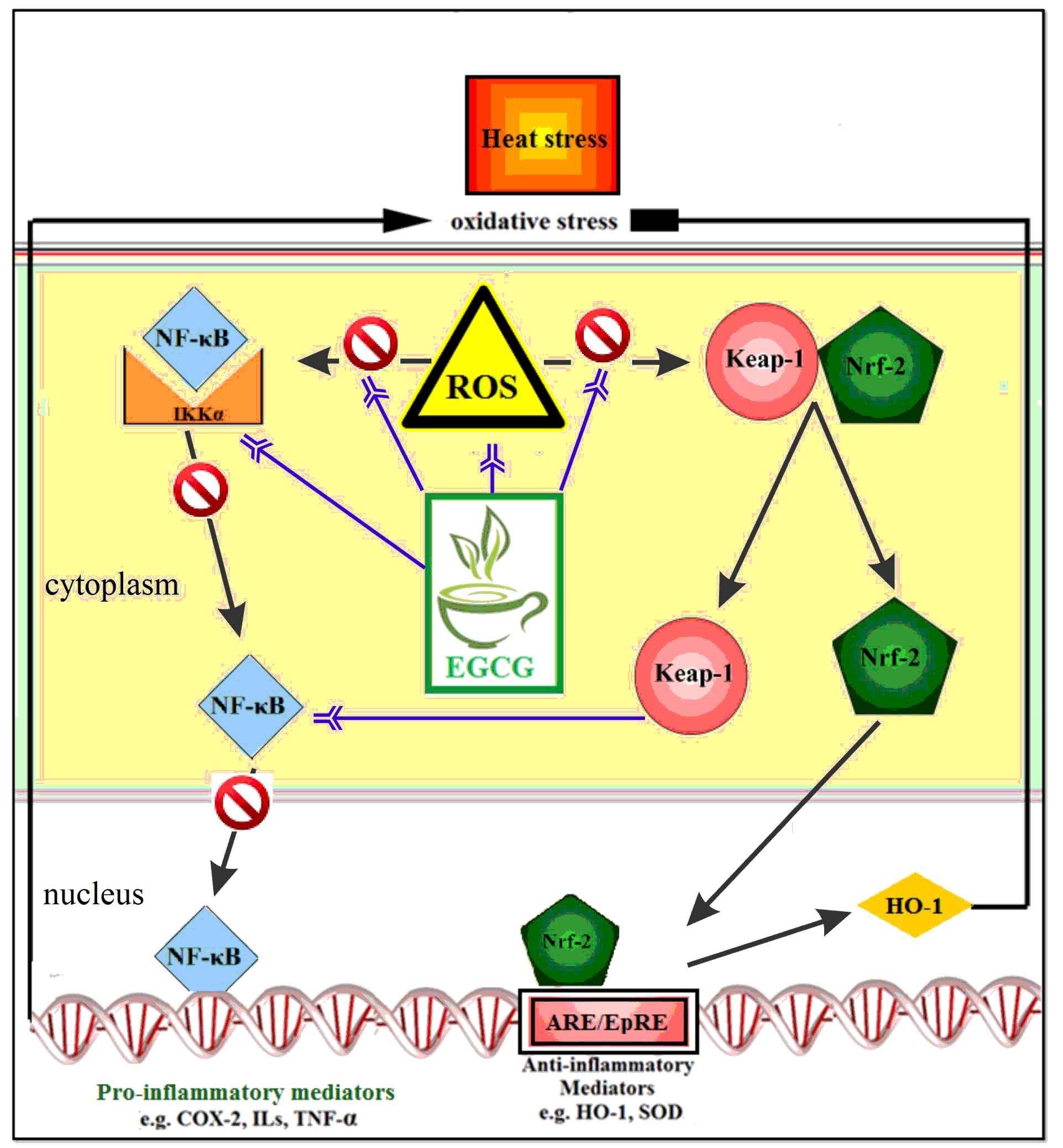
Additionally, EGCG has been found to be a potent inhibitor of NF-ΚB in poultry (Sahin et al., Reference SAHIN, ORHAN, TUZCU, ALI, SAHIN and HAYIRLI2010). Research has shown that NF-κB expression was inhibited by 42% due to dietary EGCG supplementation in hepatic cell of quail reared under heat stress (Sahin et al., Reference SAHIN, ORHAN, TUZCU, ALI, SAHIN and HAYIRLI2010). There was an environmental temperature EGCG level interaction, as decreases in NF-κB expression in response to increasing supplemental EGCG level were greater in the thermoneutral environment (Figure 1). In another study, it was reported that hepatic MDA level was positively correlated with NF-κB expression and that antioxidant enzyme activities were negatively correlated with NF-κB expression (Sahin et al., Reference SAHIN, ORHAN, TUZCU, ALI, SAHIN and HAYIRLI2010). Moreover, Orhan et al. (Reference ORHAN, TUZCU, GENCOGLU, SAHIN, HAYIRLI and SAHIN2013) has shown that, with increasing dietary EGCG supplementation, AP-1 expression was inhibited in hepatic cell of quail reared under heat stress. It has been reported that hepatic c-Jun, c-Fos, COX-2 and HSPs gene expression for quails reared under the HS environment was greater than those reared under the thermoneutral environment. However, supplemental EGCG decreased hepatic expression of these proteins at a greater extent under heat stress than thermoneutral (Orhan et al., Reference ORHAN, TUZCU, GENCOGLU, SAHIN, HAYIRLI and SAHIN2013).
Regulation of NF-kB and Nrf2 signalling pathways by EGCG in poultry reared under heat stress.

Regulation nuclear factor-erythroid 2-related factor 2 (Nrf2) pathway by EGCG
Nuclear factor-erythroid 2-related factor 2 (Nrf2) has emerged as a factor that plays a significant role in cellular protection against oxidative stress in heat-stressed poultry (Sahin et al., Reference SAHIN, ORHAN, SMITH and SAHIN2013). Relative to NF-κB, in contrast, Nrf2 is responsible for the constitutive and inducible expression of antioxidant response element-regulated genes. It is also recognised as a major contributor to the cellular defence mechanism against oxidative stress (Kim et al., Reference KIM, CHA and SURH2010). In addition, it has been shown that Nrf2 inhibits inflammation by inactivating the NF-κB pathway (Li et al., Reference LI, KHOR, XU, SHEN, JEONG, YU and KONG2008). The 605 amino acid containing Nrf2 molecule, which belongs to the basic region leucine zipper superfamily, is expressed in several tissues and plays an important role in the regulation of ARE-mediated activities (Na and Surh Reference NA and SURH2008; Nair et al., Reference NAIR, LI and KONG2007). Under normal quiescent conditions, Nrf2 is bound in the cytoplasm with its repressor, a cytoskeleton binding protein called Kelch-like erythroid CNC homologue (ECH)-associated protein1 (Keap-1). This protein contains 27 cysteine residues which helps in downregulating Nrf2 activity and promotes its degradation by the ubiquitin proteasome pathway (Kaspar et al., Reference KASPAR, NITURE and JAISWAL2009). Nrf2 activation by oxidants and electrophiles leads to a structural modification of Keap residues, altering its conformation and leading to nuclear translocation of Nrf2 (Surh and Na, Reference SURH and NA2008; Lau et al., 2010). The binding of Nrf2 to the antioxidant response element (ARE) in the promoter regions of target genes located in the nucleus, leads to the expression of many inflammatory and Phase 2 detoxifying enzymes (Lau et al., 2010). In one study, heat stressed birds had decreased expression of the transcription factor Nrf2, when compared to birds reared under thermoneutral conditions (Sahin et al., Reference SAHIN, ORHAN, TUZCU, ALI, SAHIN and HAYIRLI2010). It was argued that the increase of the factor may be necessary for upregulating the antioxidant system. Moreover, a decreased level of malondialdehyde was observed during heat stress (Tuzcu et al., Reference TUZCU, SAHIN, KARATEPE, CIKIM, KILINC and SAHIN2008). Nrf2 activation has been studied, and bioactive foods, such as polyphenols, EGCG, may have an important role in its activation (Sahin et al., Reference SAHIN, ORHAN, TUZCU, ALI, SAHIN and HAYIRLI2010). A number of studies have shown that the phytochemicals derived from plants exert their anti-stress effects through the activation of Nrf2/HO-1 pathways, however, there are few studies that relate the effect of heat stress and EGCG to Nrf2 expression (Sahin et al., Reference SAHIN, ORHAN, SMITH and SAHIN2013).
Sahin et al. (Reference SAHIN, ORHAN, TUZCU, ALI, SAHIN and HAYIRLI2010) performed chronic heat stress in quail and observed that the Nrf2/ARE system was activated in birds after heat stress. However, there was diminished Nrf2 translocation and impaired ARE signalling after heat exposure in birds. It has been reported (Na and Surh, Reference NA and SURH2008), that EGCG from green tea exerts its effect by regulating the transcription factor Nrf2 as well as Nrf2-regulated HO-1. With increasing dietary EGCG supplementation in quails, Nrf2 expression was shown to be enhanced by 59%. This increase was greater in the thermoneutral environment than under heat stress (Sahin et al., Reference SAHIN, ORHAN, TUZCU, ALI, SAHIN and HAYIRLI2010), whereby hepatic MDA level was negatively correlated with anti-oxidant enzyme activity and Nrf2 expression while antioxidant enzyme activity was positively correlated with Nrf2 expression. These data indicate that polyphenols act as modifiers of signal transduction pathways by enhancing Keap-1 dissociation from Nrf2. This occurs in response to stressors which are accompanied by expression of lipid peroxidation and elevation of antioxidant enzyme activity. It was also established that Nrf2 enhanced the level of antioxidant enzymes such as CAT, SOD and GST that EGCG augmented cellular antioxidant defence capability through the induction of HO-1 signalling.
Conclusions
Research has shown that EGCG can be used to alleviate heat stress in poultry by regulation of Nrf2/ARE signalling pathways for inducing detoxification and antioxidant enzyme systems and by modulation of NF-ΚB signalling pathway. Although the significance of the induction of detoxifying enzymes by EGCG has been well established, many details of the molecular mechanisms in these regulatory signalling pathways remain to be further investigated.
Acknowledgements
This work was supported by the Turkish Academy of Sciences (KS).