Introduction
Tonsillectomy is the one of the most frequently performed otorhinolaryngological procedures. Post-operative haemorrhage is the most serious and potentially life-threatening complication associated with the operation. Reported haemorrhage rates vary from 0.3 per cent to more than 10 per cent.Reference Windfuhr 1 This variation results from differences in definitions, populations and operation techniques. Post-operative haemorrhage is traditionally classified as primary bleeding (occurring less than 24 hours after tonsillectomy) or secondary bleeding (occurring more than 24 hours after tonsillectomy). The latter is more common, and it is regarded as more serious, as it occurs following patient discharge from hospital.Reference Mowatt, Cook, Fraser, McKerrow and Burr 2 Secondary haemorrhage typically occurs 4–7 days post-operatively.Reference Attner, Haraldsson, Hemlin and Hessén Soderman 3 It is assumed to be due to post-operative infection,Reference Ahsan, Rashid, Eng, Bennett and Ah-See 4 , Reference Stephens, Georgalas, Kyi and Ghufoor 5 and it is also associated with detachment of the crust from the site of the removed tonsils.Reference Liu, Anderson, Willging, Myer, Shott and Bratcher 6
Traditional ‘cold’ dissection, wherein bleeding is stopped with ties or gauze packs, is regarded as the ‘gold standard’ surgical technique. During the past 20–40 years, the use of ‘hot’ electrosurgical techniques, such as bipolar diathermy, has increased greatly because of their advantages. These advantages include shorter operation times and low peri-operative blood loss.Reference Lowe and van der Meulen 7 , Reference Söderman, Odhagen, Ericsson, Hemlin, Hultcrantz and Sunnergren 8 Most studies addressing the risk factors of post-operative haemorrhage have concentrated on surgical techniques. Larger studies have pointed out that all the hot techniques carry a notably elevated risk for secondary bleeding.Reference Söderman, Odhagen, Ericsson, Hemlin, Hultcrantz and Sunnergren 8 – Reference Tomkinson, Harrison, Owens, Harris, McClure and Temple 10 There are only a few studies that have concentrated on evaluating the relationship between post-operative bleeding and other risk factors, such as the primary indication for the tonsillectomy, and results have been somewhat controversial.Reference Perkins, Liang, Gao, Shultz and Friedman 11 , Reference Achar, Sharma, De and Donne 12
This retrospective study aimed to analyse risk factors associated with secondary post-operative bleeding, such as the primary indication for the tonsillectomy, age, sex and the surgeon's experience, when only one technique, namely bipolar scissors, is used.
Materials and methods
The study was carried out at Tampere University Hospital, in Finland. The medical records of all consecutive patients aged six years or older who underwent tonsillectomy or adenotonsillectomy in the Department of Otorhinolaryngology at Tampere University Hospital, between 1 December 2010 and 30 November 2014, were retrospectively analysed. The institutional review board approved the study design.
All patients included were operated on under general anaesthesia using bipolar scissors, and intra-operative haemostasis was achieved with bipolar diathermy. A large number of tonsillectomies are carried out using bipolar scissors in our department, hence this was our choice of technique. Patients operated on with ‘cold’ dissection were excluded from the study. All the operating resident surgeons had at least 1.5 years’ ENT specialty experience, and they were all familiar with the use of bipolar scissors. All cases of tonsillotomy were excluded. In our department, most of the children younger than six years of age with pharyngeal obstruction are treated with tonsillotomy, and this is why younger children were not included. Patients undergoing unilateral tonsillectomy, tonsillar biopsy and tonsillectomy for known malignancy were also excluded.
Data on patient demographics, primary indications for the operation, and the surgeons’ experience were collected and evaluated. All episodes of post-tonsillectomy haemorrhage were recorded and analysed. Secondary haemorrhage was defined as any bleeding that led to treatment in the ENT department over 24 hours after surgery. IBM SPSS® Statistics 21.0 software was used for the statistical analyses. Univariate and multivariate logistic regressions were used to examine the candidate risk factors for a haemorrhage event.
Results
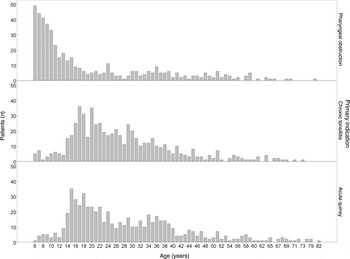
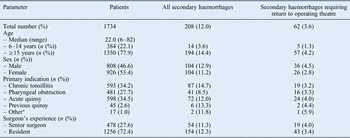
Over 4 years, 1794 patients underwent surgery, and, of these, 1734 were included in the study. Fifty-three per cent of the patients were females and 47 per cent were males. The median patient age at the time of the operation was 22 years (range, 6–82 years). A total of 384 patients (22 per cent) were in the category of 6–14 years, and 1350 patients (78 per cent) were in the category of 15 years or older. Acute quinsy (35 per cent), chronic tonsillitis (34 per cent) and pharyngeal obstruction (28 per cent) (which included patients suffering from harmful snoring or obstructive sleep apnoea syndrome (OSAS)) were the main primary indications for tonsillectomy. The age distributions for the three main primary indications are shown in Figure 1. A senior surgeon operated on 28 per cent of the patients, and the remaining 72 per cent were operated on by a resident surgeon (Table I).
Distribution of age in the three main primary indication categories.

Patient and secondary post-operative haemorrhage data

*Included periodic fever, lymphoma, papilloma, tonsillar cyst, dysphagia and mononucleosis
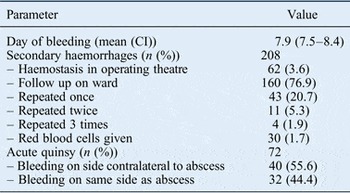
A secondary haemorrhage occurred in 208 patients (12 per cent), and 62 patients (4 per cent) required haemostasis in the operating theatre. The mean time of presentation with bleeding was 7.9 days (95 per cent confidence interval (CI) = 7.5–8.4). In 20 per cent of the cases, the bleeding reoccurred at least once. When the primary indication was acute quinsy, the bleeding more often came from the side contralateral to the abscess (Table II).
Secondary post-operative haemorrhage and quinsy characteristics

CI = confidence interval
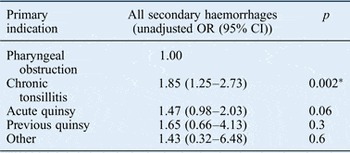
The secondary haemorrhage rates for different primary indications are shown in Table I. Univariate analysis revealed that chronic tonsillitis has a significantly elevated risk for secondary haemorrhage compared to pharyngeal obstruction (Table III). No significant differences were found between other primary indications. In addition, there were no significant differences between any of the indication groups in terms of the risk for a return to the operating theatre.
Univariate analysis of risk for secondary post-operative haemorrhage by primary indication

*Statistically significant. OR = odds ratio; CI = confidence interval
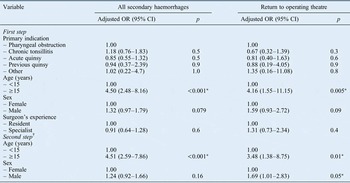
The variables analysed in a multivariate logistic regression model for factors associated with secondary haemorrhage included primary indication, sex, age and the surgeon's experience. The results of the multivariate logistic regression are shown in Table IV. After controlling for age, sex and the surgeon's experience, there were no significant differences in the likelihood of secondary haemorrhage or a return to the operating theatre between pharyngeal obstruction and other primary indications. The model was also tested using both chronic tonsillitis and acute quinsy as a reference category (not shown in Table IV), and there were no significant differences between the primary indications in either of these cases. Likewise, the experience of the surgeon did not seem to be a significant risk factor when age, sex and primary indication were controlled for. The primary indication and the surgeon's experience were both dropped from the second step of the model.
Multivariate logistic regression model of risks for secondary post-operative haemorrhage and return to operating theatre

*Statistically significant. † P values less than 0.1 in the first step were included in the second step. OR = odds ratio; CI = confidence interval
In the second step of the model, when controlling for age, there was no statistically significant difference in odds of secondary haemorrhage between males and females, but males did have a significantly higher likelihood of a return to the operating theatre (1.7 times; 95 per cent CI = 1.0–2.8; p = 0.05). When sex was controlled for, patients aged 15 years or older were 4.5 times (95 per cent CI = 2.6–7.9; p < 0.001) more likely to experience secondary haemorrhage and 3.5 times (95 per cent CI = 1.4–8.8; p = 0.01) more likely to return to the operating theatre (Table IV).
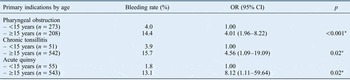
The findings of an analysis of the risk of secondary haemorrhage by age in the three main primary indication categories are shown in Table V. When the indication was pharyngeal obstruction, patients aged 15 years or older were 4.0 times (95 per cent CI = 2.0–8.2; p < 0.001) more likely to experience secondary haemorrhage. When the pre-operative diagnosis was chronic tonsillitis, the chance was 4.6 times (95 per cent CI = 1.1–19.1; p = 0.02) higher among patients aged 15 years or older. In cases of acute quinsy, patients aged 15 years or older had an 8.1-fold (95 per cent CI = 1.1–59.6; p = 0.02) increased likelihood of secondary haemorrhage.
Risk of secondary haemorrhage by age in the three main primary indication categories

*Statistically significant. OR = odds ratio; CI = confidence interval
Discussion
The limitations of our study are related to its retrospective character. The main diagnosis of the patient was considered the primary indication. It is possible that there may been some overlapping or mixing of the diagnoses, especially in cases of chronic tonsillitis and pharyngeal obstruction, which is a possible source of bias. Our clinic is the only referral clinic with ENT on-call personnel in our region. Patients usually avoid trips away during the first two weeks after the operation, which means that few haemorrhaging patients are treated elsewhere. Patients are instructed to always contact the ENT department in the case of post-tonsillectomy bleeding, which means that only the most minor haemorrhages – when the bleeding stops quickly by itself without the patient coming to the hospital – were not included in the count of the present study.
It has been pointed out in larger studies that all the ‘hot’ techniques carry a notably elevated risk for secondary bleeding compared with traditional ‘cold’ dissection.Reference Söderman, Odhagen, Ericsson, Hemlin, Hultcrantz and Sunnergren 8 – Reference Tomkinson, Harrison, Owens, Harris, McClure and Temple 10 In the National Prospective Tonsillectomy Audit in the UK, the secondary haemorrhage rate of the bipolar scissors technique before national guidance was 5.2 per cent.Reference Lowe, van der Meulen, Cromwell, Lewsey, Copley and Browne 9 However, only patients registered and consenting to participate were considered in this audit. Hence, there could be patients who presented with post-operative bleeding and were not recorded. In a recent large study of the National Tonsil Surgery Register in Sweden, the secondary haemorrhage rate of the bipolar scissors technique was 13.4 per cent.Reference Söderman, Odhagen, Ericsson, Hemlin, Hultcrantz and Sunnergren 8 In the present study, the bleeding rate was 12.0 per cent, which is in line with the Swedish results.
The surgeon's experience was not found to be a significant risk factor for secondary haemorrhage in the present study, which is in line with previous studies.Reference Lowe, van der Meulen, Cromwell, Lewsey, Copley and Browne 9 , Reference Tomkinson, Harrison, Owens, Harris, McClure and Temple 10 The surgeon's experience seems to have a greater impact on primary haemorrhage.Reference Tomkinson, Harrison, Owens, Harris, McClure and Temple 10
In previous large studies, males have had significantly higher risk for post-tonsillectomy haemorrhage.Reference Lowe, van der Meulen, Cromwell, Lewsey, Copley and Browne 9 , Reference Tomkinson, Harrison, Owens, Harris, McClure and Temple 10 , Reference Windfuhr, Chen and Remmert 13 , Reference Sarny, Ossimitz, Habermann and Stammberger 14 However, there are some studies where the patient's sex has not been shown to be a significant risk factor for post-operative bleeding.Reference Alexander, Kukreja and Ford 15 – Reference Akin, Holst and Schousboe 17 In the present study, males had a significantly higher risk for secondary bleeding with a return to the operating theatre only. This result is in line with the previous studies.
Age has been documented to be a clear risk factor for post-tonsillectomy bleeding in many large studies.Reference Lowe, van der Meulen, Cromwell, Lewsey, Copley and Browne 9 , Reference Tomkinson, Harrison, Owens, Harris, McClure and Temple 10 , Reference Windfuhr, Chen and Remmert 13 , Reference Windfuhr and Chen 18 However, there are fewer studies evaluating the relationship between the primary indication for the surgery and post-operative bleeding. In a large British audit, the overall haemorrhage rate was lower for patients with pharyngeal obstruction compared to patients with recurrent tonsillitis. It also showed that the risk for haemorrhage increases with age.Reference Lowe, van der Meulen, Cromwell, Lewsey, Copley and Browne 9 In a multivariate regression analysis by Perkins et al., children with OSAS were half as likely to haemorrhage compared to children with chronic tonsillitis.Reference Perkins, Liang, Gao, Shultz and Friedman 11 Patients older than six years also had a higher haemorrhage rate. The study included both primary and secondary haemorrhage cases. The authors suggested that either OSAS is protective against post-operative haemorrhage or recurrent tonsil infections increase the risk for bleeding.Reference Perkins, Liang, Gao, Shultz and Friedman 11 In a study by Achar et al., the secondary bleeding rate for OSAS was unexpectedly higher than for recurrent tonsillitis.Reference Achar, Sharma, De and Donne 12 That study included children of all ages and no adults. However, they did not specify the bleeding rates of older and younger children. Tomkinson et al. found that patients aged 12 years or older were 3 times more likely to experience secondary haemorrhage.Reference Tomkinson, Harrison, Owens, Harris, McClure and Temple 10 They demonstrated how the haemorrhage rate appears to increase suddenly in the early teenage years. The study did not evaluate the role of primary indication.
In the present study, age was the most evident risk factor for post-tonsillectomy secondary haemorrhage. Our finding that patients aged 15 years or older have a 4.5 and 3.5 times higher risk for secondary haemorrhage and a return to the operating theatre, respectively, is in line with the findings demonstrated by Tomkinson et al.Reference Tomkinson, Harrison, Owens, Harris, McClure and Temple 10 The present study did not include the youngest children (aged less than six years). If these children were included, the odds ratios might have been even higher when taking the previous studies into account.Reference Lowe, van der Meulen, Cromwell, Lewsey, Copley and Browne 9 , Reference Perkins, Liang, Gao, Shultz and Friedman 11 Patients with the primary indication of chronic tonsillitis are older than patients with pharyngeal obstruction (Figure 1) and this may explain why their bleeding risk was higher in the univariate analysis (Table III). Figure 1 shows how the incidence of pharyngeal obstruction as an indication for surgery decreases and chronic tonsillitis and acute quinsy increase in the early teenage years. Based on this finding, the age of 15 years was chosen to divide the two age groups in the present study. Chronic infection from teenage years onwards might be a factor in the elevated risk for secondary haemorrhage. Infection has been suggested to be a significant risk factor for post-tonsillectomy bleeding in a few previous studies.Reference Ahsan, Rashid, Eng, Bennett and Ah-See 4 , Reference Stephens, Georgalas, Kyi and Ghufoor 5 , Reference Schrock, Send, Heukamp, Gerstner, Bootz and Jakob 16 It is likely that many of the patients aged 15 years or older with the primary indication of pharyngeal obstruction also have chronic tonsillitis at some level. This might also explain why their secondary bleeding risk suddenly increases in the teenage years, as this happens to the patients with chronic tonsillitis and acute quinsy as well.
-
• Previous studies investigating post-tonsillectomy haemorrhage have concentrated on comparing surgical techniques
-
• This retrospective study evaluated the relationship between post-operative bleeding and other risk factors when bipolar scissors are used
-
• The risk of secondary haemorrhage does not seem to depend on the primary indication for the tonsillectomy
-
• Patients aged 15 years or older have a higher risk of bleeding in all the primary indication categories
The treatment of quinsy in Nordic countries varies greatly. In Finland, 20 per cent of patients are operated on immediately, whereas in Denmark almost all are operated on.Reference Wikstén, Blomgren, Eriksson, Guldfred, Bratt and Pitkäranta 19 Our clinic's average percentage is probably higher than the Finnish average, because our primary protocol of treatment for patients aged less than 40 years is acute abscess tonsillectomy. For older patients, acute abscess tonsillectomy is carried out only in cases of recurrent quinsy or prior recurrent tonsillitis, or if the patient's situation does not improve after incision drainage and antibiotic treatment. This procedure is supported by previous findings that show recurrent quinsy is more common among patients with a history of recurrent tonsillitis or if patients are younger than 40 years at the time of the initial peritonsillar abscess.Reference Herbild and Bonding 20 , Reference Kronenberg, Wolf and Leventon 21 The overall recurrence rate of quinsy has previously been reported to be 10–15 per cent.Reference Herzon and Harris 22 A young age has been shown to cause an increased probability of delayed tonsillectomy. In a Finnish study, 43 per cent of the conservatively treated 7- to 17-year-old patients and 31 per cent of 17- to 30-year-old patients later required an abscess or interval tonsillectomy; 13 per cent of patients aged over 30 years required an abscess or interval tonsillectomy within the 5-year follow up.Reference Wikstén, Hytönen, Pitkäranta and Blomgren 23 Acute abscess tonsillectomy is also associated with the loss of fewer work days compared to interval tonsillectomy, which is carried out later,Reference Fagan and Wormald 24 so acute abscess tonsillectomy can therefore be considered cost-effective.
In the present study, there were no significant differences in the secondary post-tonsillectomy haemorrhage rates between patients treated with acute abscess tonsillectomy and elective patients (pharyngeal obstruction, chronic tonsillitis, previous quinsy treated with interval tonsillectomy), which is in line with previous studies.Reference Akin, Holst and Schousboe 17 , Reference Windfuhr and Chen 25 , Reference Lehnerdt, Senska, Jahnke and Fischer 26 However, patients aged 15 years or older had an 8-fold risk of secondary bleeding compared to younger patients. The increase in risk was two times higher than that among patients with elective primary indications. An age-dependent risk for post-operative bleeding after acute abscess tonsillectomy has received only minor attention in the previous literature. In a study by Akin et al., patients aged over 40 years were estimated to have a 2.5 times higher risk for post-operative bleeding requiring a return to the operating theatre than patients aged under 40 years.Reference Akin, Holst and Schousboe 17
Conclusion
Age seems to be the most evident risk factor for post-tonsillectomy secondary haemorrhage when only one technique, namely bipolar scissors, is used. Patients aged 15 years or older have a higher risk for bleeding, regardless of the primary indication for the tonsillectomy. The risk for secondary haemorrhage does not seem to depend on the primary indication itself or on the surgeon's experience. Male sex is also associated with an elevated risk for secondary bleeding requiring a return to the operating theatre for haemostasis. The incidence of pharyngeal obstruction as an indication for surgery decreases and chronic tonsillitis and acute quinsy increase in the early teenage years. Chronic infection from teenage years onwards might be a factor in the elevated risk for secondary haemorrhage.
In terms of the risk for secondary haemorrhage, acute abscess tonsillectomy seems to be a safe choice of treatment for patients aged under 15 years who often do not withstand an awake procedure such as incision drainage. However, despite the risk of abscess recurrence associated with conservative treatment, in order to avoid secondary haemorrhage, it would be better to carry out acute abscess tonsillectomy for patients aged 15 years or older only in cases of recurrent quinsy or prior recurrent tonsillitis, or if the patient's situation does not improve after incision drainage and antibiotic treatment.