1. Introduction
Quartz-free sapphirine–spinel-bearing granulites are often associated with the supracrustal rock types which together form large xenoliths within the granite gneiss complex. They contain a wide range of mineral assemblages that are sensitive to P–T conditions and commonly preserve spectacular reaction textures produced by a sequence of mineral reactions which can be used to decipher P–T paths during their metamorphic evolution. Most of the Mg–Al granulites are formed under ultrahigh-temperature (UHT) metamorphic conditions where temperatures at the thermal peak range from 900 to 1100°C at pressures of 7–13 kbar (Harley, Reference Harley, Treloar and O'Brien1998). On the other hand, there are many quartz-free Mg–Al granulites that are characterized by sapphirine–spinel–biotite–cordierite–corundum–orthopyroxene associations occurring as enclaves within the granulites and are formed under lower P–T conditions (<6 kbar and <900°C). Such Mg–Al granulites have been studied from many localities worldwide, including Sonapahar, India (Lal et al. Reference Lal, Ackermand, Seifert and Halder1978), the Namaqualand and Limpopo belt, South Africa (Horrock, Reference Horrock1983; Windley, Ackermand & Herd, Reference Windley, Ackermand and Herd1984; Water, Reference Water1986; Droop, Reference Droop1989), the Central Arunta Block, Central Australia (Warren, Reference Warren1983; Goscombe, Reference Goscombe1992), the Pikwitonei complex, Canada (Arima & Barnett, Reference Arima and Barnett1984), the Gruf complex, Italian central Alps (Droop & Bucher Nurminen, Reference Droop and Bucher-Nurminen1984), Kyushu, Japan (Osanai et al. Reference Osanai, Hamamoto, Maishima and Kagami1998), central Sri Lanka (Kriegsman & Schumacher, Reference Kriegsman and Schumacher1999), Ouzzal, Algeria (Ouzegane, Guiraud & Kienast, Reference Ouzegane, Guiraud and Kienast2003), East Antarctica (Kelly & Harley, Reference Kelly and Harley2004) and the Epupa Complex, NW Namibia (Brandt, Will & Klemd, Reference Brandt, Will and Klemd2007).
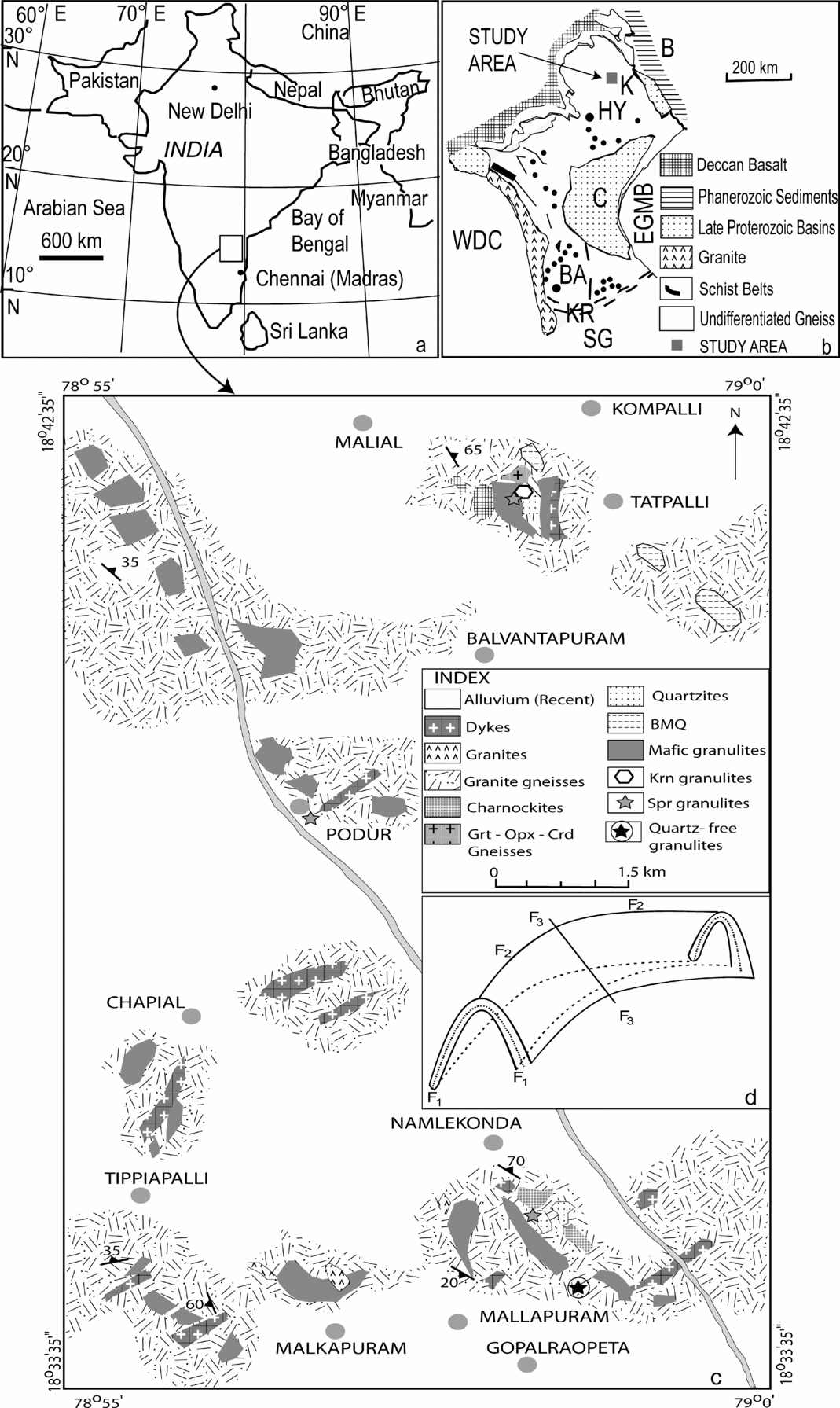
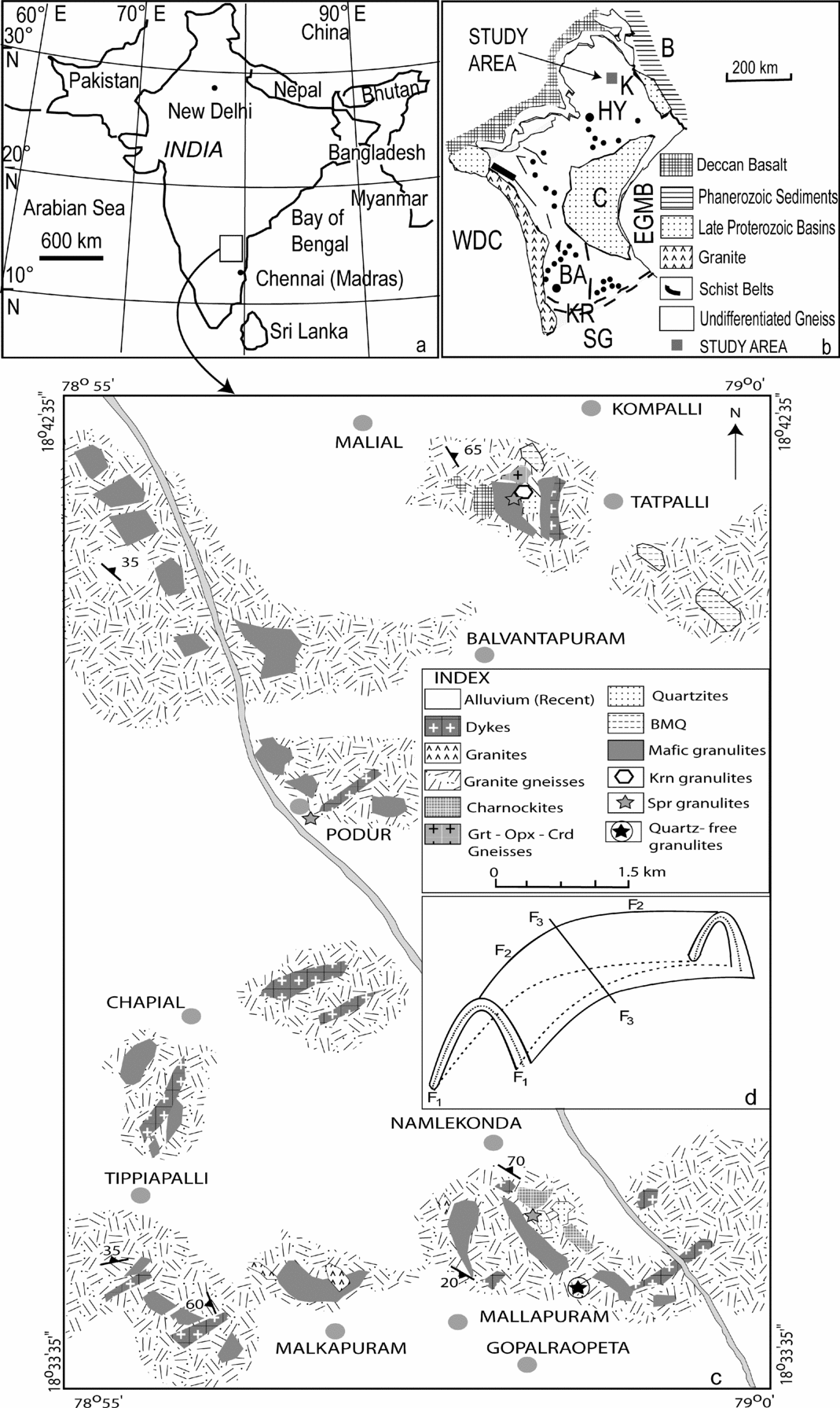
Sarvothaman (Reference Sarvothaman1984) and Rajesham, Bhaskar Rao & Murti (Reference Rajesham, Bhaskar Rao and Murti1993) first reported sapphirine–spinel-bearing granulites from the Eastern Dharwar Craton. The Karimnagar granulite belt is the only locality in the Eastern Dharwar Craton from where sapphirine–spinel-bearing granulites have been reported so far (Fig. 1a). The quartz-free Mg–Al granulites occur in three localities: Malial, Podur and Namlekonda (Sharma & Prakash, Reference Sharma and Prakash2006, Reference Sharma and Prakash2008; Prakash & Sharma, Reference Prakash and Sharma2008). In this study, we present a detailed petrology of the granulites of the Karimanagar area with respect to reaction textures, mineral chemistry, chemographic phase relationships, P–T conditions and P–T trajectory during metamorphism.
(a) Reference map of India. (b) Lithological patterns for Precambrian rocks of the Eastern Dharwar Craton along with craton boundaries. The abbreviations used are: WDC – Western Dharwar Craton, SG – Southern Granulite, EGMB – Eastern Ghats Mobile Belt, B – Bastar Craton, Hy – Hyderabad, K – Karimnagar, C – Cuddapah, BA – Bangalore, KR – Krishnagiri. (c) Geological map of the area around Karimnagar. Inset (d) shows the surface of the non-dissected folds (modified after Prakash & Sharma, Reference Prakash and Sharma2008).
2. Geological setting
The Dharwar Craton consists of a NNW- and N-trending greenstone-granite belt surrounded by granite gneisses. It is divided into the Western Dharwar Craton (WDC) and Eastern Dharwar Craton (EDC), which are separated by a N–S-trending thrust located about 25 km west of the N–S-trending arcuate Closepet Granite. The Karimnagar area lies in the northeastern part of the Eastern Dharwar Craton, in the north of which lies the Permocarboniferous sedimentary formations of Godavari Graben (Fig. 1b). The Karimnagar Granulite Terrane (KGT) is predominantly made up of massive granite gneisses, granites and charnockites in which quartz-free granulites and other high-grade rocks occur as enclaves within granite gneisses (Fig. 1c). The earliest recognizable metamorphic event is M1 (c. 3.0 Ga), which affected the basement gneiss (3.58–3.4 Ga in the Western Block: Nutman et al. Reference Nutman, Chadwick, Ramakrishnan and Vishwanatha1992), Peninsular Gneiss (c. 3.0 Ga) and enclaves of older supracrustals (Sargur Group, 3.2–3.1 Ga: Nutman et al. Reference Nutman, Chadwick, Ramakrishnan and Vishwanatha1992 and references therein). The M2 metamorphic event affected the older rocks mentioned above as well as the greenstone belts (2.7–2.6 Ga) of the Dharwar Craton; it was followed by emplacement of the Chitradurga Granite (2.6 Ga) in the western block and the Closepet granite and granitoids of the Kolar belt in Eastern Block at 2.5 Ga (Friend & Nutman, Reference Friend and Nutman1991; Jayananda et al. Reference Jayananda, Moyen, Martin, Peucat, Auvray and Mahabaleswar2000).
The exposures are normally found in the form of boulders or are massive in nature, so structural data are meagre. However, some strike trends can be measured in gneisses and biotite-schists. The general strike trend is NW–SE with a variation between NNW–SSE to WNW–ESE with moderate dip. The high-grade supracrustal rocks are found as highly attenuated and dismembered units restricted as enclaves within granite gneisses and charnockites.
Three phases of deformation have been recorded (Fig. 1d): (1) a first phase produced tight isoclinal folds trending NE–SW; (2) the second phase with tight upright to reclined folds that strike NW–SE, the pronounced structural trend in the rocks of the area, refolded the earlier generation of folds; (3) the third phase produced open cross-folds trending NW–SE.
The metamorphic rocks of the Eastern Dharwar Craton show an increase in grade of metamorphism southward from greenschist (Sandur, Hospet and Ramgiri belts east of Closepet granite) to amphibolite facies (Kolar belt) to granulite facies (Krishnagiri–Dharmapuri area). The pelitic schists are characterized by the presence of andalusite in the greenschist facies, andalusite/sillimanite–cordierite in the amphibolite facies and sillimanite–cordierite±garnet in the granulite facies, thus displaying the andalusite–sillimanite type of facies series. This is in contrast to the Western Dharwar Craton, which is chracterized by the kyanite–sillimanite type of facies series (Swami Nath & Ramakrishnan, Reference Swami Nath and Ramakrishnan1981; Raith et al. Reference Raith, Raase, Ackermand and Lal1983). The Karimnagar granulite terrane is important because of the presence of high-grade granulite-facies rocks further northeast of the greenschist belt of the Eastern Dharwar Craton.
3. Rock types and their field relations
Garnet–cordierite gneisses are extensively exposed, especially in the Malial region. These garnet-bearing gneisses lie adjacent to charnockite and banded magnetite quartzite.
Charnockites and enderbites are dark-coloured, medium- to coarse-grained, hard and compact rocks with greasy appearance. They are massive in exposure and show both sharp and gradational contacts with the granite gneisses. Wherever they display retrogression, a thin band of biotite gneiss separates them from the granite gneisses.
Quartz-free sapphirine–spinel granulites occur as enclaves within the granite gneiss complex with charnockites displaying sharp contacts. At Gopalraopeta they are biotite-rich, dark-coloured rocks with well-defined schistosity; sapphirine is not visible in hand specimen. By contrast, in Podur, these granulites are rich in cordierite and blue crystals of sapphirine can be seen megascopically.
Mafic granulites and ultramafic granulites that also occur as enclaves within granite gneisses and charnockites are dark-coloured, very hard and compact, medium-grained rocks. In places, they tend to become biotite rich, particularly in the vicinity of the biotite-rich quartz-free rocks.
Metamorphosed banded iron formation (BIF) is one of the important lithological units in the working area where they are widely distributed. Its most extensive exposure was found in the Malial area where they are present in the lower and middle part of the hill.
4. Textural relations and interpretation of metamorphic reactions
4.a. Garnet–cordierite gneisses
These include orthopyroxene–cordierite–garnet gneisses (A-1 and A-2), garnet–biotite–cordierite–sillimanite gneisses (A-3) and biotite gneisses (A-4 and A-5). The gneisses are medium- (2–5 mm) to coarse-grained (>5 mm) and foliated with preferred orientation of biotite, rarely orthopyroxene.
The mineral assemblages (mineral abbreviations after Kretz, Reference Kretz1983) are as follows:
(A-1) Opx–Crd–Bt–Pl–Kfs–Qtz (±Spl)
(A-2) Grt–Opx–Bt–Crd–Qtz–Pl–Kfs (±Spl)
(A-3) Bt–Crd–Qtz–Sil–Kfs–Pl±Grt (±Spl)
(A-4) Bt–Qtz–Kfs–Pl
(A-5) Bt–Hbl–Qtz–Pl–Kfs
Minor amounts of magnetite, ilmenite, rutile, zircon and apatite are also present, in addition to the minerals listed above, in these assemblages.
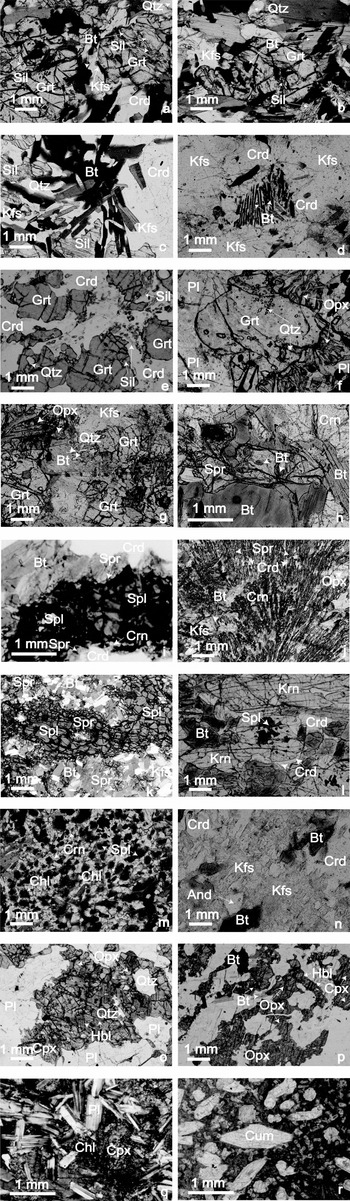
Orthopyroxene and garnet occur as coarse subhedral to anhedral grains containing internal linear trails of elongated sillimanite and biotite as inclusions merging with the foliation of the matrix (Fig. 2a, b). Cordierite, besides occurring in granoblastic mosaics together with quartz and feldspars in the matrix, forms moats around garnet (Fig. 2e). Biotite and biotite+quartz symplectites form rims on coarse porphyroblasts of garnet, orthopyroxene, cordierite and potash feldspar (Fig. 2g). In the assemblage A-3, linear trails of coarse needles of sillimanite are present within cordierite and rarely garnet (Fig. 2e). Coarse poikiloblasts of garnet sometimes display symplectites of orthopyroxene+plagioclase+cordierite (Fig. 2f). The presence of inclusions of sillimanite, corroded biotite and quartz in the garnet porphyroblasts and cordierite (Fig. 2a) suggests the reaction (A-1):


This reaction is evident from the presence of inclusions of sillimanite, corroded biotite and quartz in the garnet porphyroblasts. This is one of the reactions responsible for the formation of garnet (Fig. 2b).

This reaction is shown by the presence of inclusion of sillimanite, corroded biotite and quartz in cordierite (Fig. 2c).

Photomicrographs illustrating textural relations in Karimnagar granulites: (a) prograde biotite and sillimanite occurring as inclusion in megacrystic garnet; (b) prograde biotite and sillimanite within corroded garnet partly rimmed by K-feldspar; (c) biotite is detached from sillimanite; biotite is in the cordierite matrix and sillimanite is partly rimmed by K-feldspar; (d) elongated biotite with cordierite in the matrix of K-feldspar; small garnet crystal is also seen the matrix; (e) garnet, sillimanite and quartz are embedded in a cordierite groundmass; (f) highly corroded garnet blast surrounded by vermicular intergrowth of orthopyroxene-plagioclase. Photomicrographs illustrating textural relations in Karimnagar granulites: (g) intergrowth of biotite and quartz symplectites replacing garnet, orthopyroxene and K-feldspar; (h) biotite occurring as inclusion in megacrystic sapphirine; (i) spinel and cordierite are separated by a rim of sapphirine on spinel; (j) sapphirine–cordierite symplectite around biotite and corundum; (k) spinel and biotite are separated by thin rim of sapphirine; (l) spinel and cordierite isolated to form kornerupine. Photomicrographs illustrating textural relations in Karimnagar granulites: (m) complete breakdown of sapphirine into chlorite, spinel and corundum; (n) andalusite as a breakdown product of cordierite; (o) prograde hornblende within pyroxene; (p) hornblende rimming pyroxene; (q) subophitic texture showing intergrowth of clinopyroxene and plagioclase; (r) elongated cummingtonite in a fine-grained groundmass.

The presence of biotite and cordierite within potash feldspar (Fig. 2d) confirms reaction (A1-3).

The above reaction is evident from the presence of corroded garnet, coarse sillimanite needles and quartz within cordierite (Fig. 2e).

The reaction (A-2) is one of the important reactions inferred in the study area and is responsible for the presence of all six reactant and product minerals in the gneisses. The reaction (A-2) is suggested by the presence of prograde corroded garnet, biotite and quartz within orthopyroxene and cordierite.

The reaction is inferred from the presence of prograde, corroded garnet and quartz within orthopyroxene and cordierite.

This reaction is suggested by the presence of corroded bioitite within orthopyroxene and cordierite.
Gneisses provide textural evidence of mantling of resorbed garnet porphyroblasts by plagioclase and orthopyroxene–plagioclase symplectite (Fig. 2f). Such textural features suggest a much cited reaction (A2-3), diagnostic of isothermal decompression.

After the partial breakdown of garnet, there is textural evidence of retrograde formation of biotite and biotite+quartz symplectites from garnet, orthopyroxene, cordierite and K-feldspar through the ‘back reactions’ by reversals of the reactions (A1-3 and A2-2; Fig. 2g) emerging from the (Sil) reaction (A2).
4.b. Charnockites and enderbites
The mineral assemblages are as follows:
(B-1) Opx–Kfs–Pl–Bt–Qtz
(B-2) Grt–Opx–Kfs–Pl–Bt–Qtz
K-feldspar is hair perthite, while plagioclase is sometimes antiperthite. Minor amounts of magnetite, ilmenite, zircon and apatite are also present in these assemblages. Locally calcite occurs along the grain borders.
Biotite occurs as (a) corroded flakes or linear trails within coarse garnet, orthopyroxene and feldspars overprinting the fabric of the matrix,


and (b) randomly arranged biotite or biotite+quartz symplectite at the grain borders and fractures of garnet and orthopyroxene. In a few samples, these biotites (type b) are greenish in colour, whereas brown biotites define the foliation.
4.c. Quartz-free sapphirine–spinel granulites
A variety of coronas and symplectites characterizes these rocks from which a number of reactions can be inferred. Minerals present in the different rock types are as follows:
(C-1) Crn–Spl±Crd–Bt–Kfs
(C-2) Crn–Spl–Spr–Bt–Kfs
(C-3) Spl–Spr–Crd–Kfs–Bt±Crn
(C-4) Crn–Spl–Spr–Crd–Opx–Bt–Kfs
(C-5) Krn–Crd–Spl–Bt–Kfs
(C-6) Bt–And–Crn–Spl–Chl±Crd
Minor amounts of magnetite, ilmenite, rutile and zircon are also present. Retrograde chlorite and sericite occur and are predominant in assemblage C-6.
Biotite occurs as (a) corroded flakes within the minerals listed in type (C-1) to (C-5) (Fig. 2h–l), (b) coarse flakes with preferred orientation defining a crude foliation, and (c) cross-cutting flakes rimming the minerals mentioned in types (C-1) to (C-5) (Fig. 2h, i, k), and are also present in the matrix (Fig. 2j). Some coarse flakes of biotite are microfolded, indicating post-crystalline deformation.
Reaction coronas and symplectites present in a matrix of biotite±K-feldspar in the types (C-1) to (C-5) include:
(a) corundum rimmed by spinel±cordierite in C-1;
(b) corundum with successive rims of spinel and sapphirine in C-2;
(c) successive rims of spinel, sapphirine and cordierite on corundum or similar coronas in which corundum is absent in (C-3) (Fig. 2i);
(d) successive rims of spinel, sapphirine, cordierite and orthopyroxene on corundum in C-4;
(e) coarse subhedral to anhedral grains of kornerupine with spinel and biotite inclusions in a matrix of cordierite, biotite and K-feldspar. In assemblage C-5, spinel and cordierite are never in mutual grain contact (Fig. 2l).
In type C-3, skeletal symplectitic intergrowths of sapphirine, cordierite and K-feldspar with a few inclusions of spinel in sapphirine are present (Fig. 2j). Coarse rib-like intergrowths of corundum and cordierite are present near this symplectite. In types C-1 to C-4, isolated grains of corundum, spinel and sapphirine occur within cordierite, in addition to the coronas and symplectites mentioned above. Retrogression is intense in type C-6 with the formation of chlorite, sericite, spinel, large subhedral grains of inclusion-free corundum and andalusite (Fig. 2m, n). Small grains of corundum dusted with opaques and relics of cordierite are commonly present. This textural relation may be attributed to retrogression of quartz-absent sapphirine–cordierite–spinel–corundum-bearing granulites.

The above reaction is shown by the presence of prograde, corroded biotite and corundum within spinel. This reaction also explains the presence of corona rims of spinel on corundum in the matrix of biotite. This seems to be the basic reaction and from this all other phases appeared.

Values of XMg, AlVI in phlogopite and eastonite are 0.843, 0.401 and 0.804, 0.653, respectively. The above reaction is inferred from the presence of anhedral biotite relics within sapphirine and cordierite (Fig. 2h).
The reaction

results in isolation of the three reactants and formation of a rim of Spr on Spl (Fig. 2i) in the corona type (5).

due to which the reactants Spl and Crd are separated by a rim of Spr on Spl (Fig. 2i).
The multiphase corona of type (11) may have formed by several reactions such as

which forms the corona type Spr–Opx–Crd, followed by a reversal of the reaction (B4) that separates the reactants Opx+Spr by Crd, forming a Spr–Crd–Opx corona, with Spr in the core nucleating on an earlier Crn–Spl corona formed by the reaction (B1). It is also likely that this corona is formed due to the univariant (Bt) reaction:

in which successive rims of Spl, Spr, Crd and Opx are formed on Crn. Thus the two reactants Opx and Crn are separated, resulting in the corona type (11). The other univariant (Spl) reaction:

forms a Spr–Crd symplectite around Bt and Crn (Fig. 2j). Other corona types e.g. (1), (3), (4), (6), (7), (9) and (10) represent the three phase assemblages formed due to reactions B1 to B3 (Fig. 4a).


The above reactions are evident from the presence of prograde corroded biotite, corundum and spinel within sapphirine and K-feldspar (Fig. 2k).
In one sample, spinel and cordierite are isolated to form coarse idioblastic or subidioblastic kornerupine (Fig. 2l) and suggest the reaction

In some samples, K-feldspar is absent within or in the matrix of the coronas mentioned above and appears to have been partly or wholly replaced by biotite due to a retrograde ‘back reaction’. On the other hand, in a few samples, there is intense retrogression of the quartz-absent sapphirine–spinel granulites to form chlorite, corundum and andalusite (Fig. 2m, n) through reactions of the type:


4.d. Mafic granulites and ultramafic granulites
The mineral assemblages are as follows:
(D-1) Cpx–Opx–Bt–Qtz–Pl±Hbl
(D-2) Cpx–Hbl–Act
(D-3) Chl–Trem–Tlc
In quartz-poor varieties, prograde hornblendes occur within pyroxenes (Fig. 2o). In a few varieties, the complete absence of hornblende suggests that it has been consumed by the reaction:

Presence of both Ti-poor and Ti-rich hornblende is suggestive of the reaction:

where Ti in Hbl2 > Hbl1.
During the subsequent stage, the occurrence of hornblende rimming orthopyroxene and clinopyroxene (Fig. 2p) could be related to the retrograde hydration reaction:

Metadolerite shows subophitic texture which is evident by the typical intergrowths of clinopyroxene and plagioclase (Fig. 2q).
4.e. Metamorphosed banded iron formation
Metamorphosed banded iron formation is one of the most extensively exposed lithological units in the working area. Cummingtonite-bearing rocks, the marker rocks for the banded iron formation, are fine-grained, dull-lustred and grey-coloured. Under the microscope, these rocks display a fine-grained, granoblastic matrix formed by interlocking grains of magnetite as well as minor ilmenite and plagioclase, while cummingtonite forms porphyroblasts up to 2 mm in length (Fig. 2r). A few ilmenite grains also occur with magnetite. The assemblages observed in banded iron formation are:
(F-1) Qtz–Mt–Ilm±Ap
(F-2) Cum±Mt±Ilm±Pl
Minute euhedral crystals of apatite form inclusions in quartz and magnetite.
The presence of cummingtonite partly rimming relics of orthopyroxene suggests the hydration reaction:

5. Mineralogy
Electron probe microanalysis (EPMA) of minerals was carried out in IIT Roorkee on a JEOL JXA8600M electron microprobe with three fully focused spectrophotometers. The instrument operated at a probe current of 2 × 10⁻⁸ A with an accelerating voltage of 15 kV. The electron beam diameter was 2 μm for all the minerals, except for feldspars, where a beam diameter of 10 μm was used. ZAF oxide correction was employed for the correction in the analytical values. The accuracy of the oxide determination ranges from ±1 to 2% of the amount present. Representative compositions of minerals in the analysed samples are given in online Appendix Tables A1 to A8 at http://journals.cambridge.org/geo.
5.a. Garnet
Garnets in the area are essentially a solid solution of Alm47–74 and Prp18–50 with minor amounts of Sps1.5–11 and Grs2.0–5.5 (see Fig. A1a, b at http://journals.cambridge.org/geo). There are two types of garnet: the porphyroblastic, anhedral and seived garnets are more iron-rich, whereas euhedral, almost inclusion-free garnets are more magnesium- and manganese-rich. XMg (XMg = Mg/(Mg+Fe2+)) of garnets ranges between 0.178 and 0.496. The sieved garnets have low XMg and XMn as compared to the inclusion-free garnets, whereas there is not much difference in XCa. Individual garnet grains show very little variation in the composition from core to rim.
5.b. Cordierite
The structural formulae calculated from EPMA correspond to the ideal formulae. The anhydrous sum of oxides is generally less than 100%, reflecting a certain amount of volatiles in the channels of the cordierite structure. Minor elements like Mn, Ca, Na and K are present in insignificant amounts and their contents are less than 0.04 p.f.u. except in kornerupine-bearing granulites where Mn content is higher (~1.75 p.f.u.). XMg (XMg = Mg/(Mg+Fe2+)) in cordierite varies from 0.754 to 0.819 in gneisses and from 0.855 to 0.946 in sapphirine–spinel-bearing rocks. No compositional variation was recorded in individual cordierite grains.
5.c. Biotite
The analysed biotites display a wide range in XMg, from 0.542 to 0.895. As shown in the triangular diagram Mg–(Fe+Mn)–Al (see Fig. A2 at http://journals.cambridge.org/geo), the data points plot in bands displaying a decrease of total Al with an increase of Mg.
Biotite from the mafic granulites has the lowest Al2O3, followed by the gneisses and quartz-free granulites that display the highest Al2O3 content. AlVI content is lower in gneisses. The TiO2 contents of biotite cover a wide range, from 0.76 to 6.27 wt% or 0.082 to 0.743 p.f.u.
5.d. Pyroxene
Orthopyroxene is an important constituent of the gneisses, charnockites and basic granulites, and also occurs in the quartz-free granulites, whereas clinopyroxene occurs in mafic granulites. The analysed pyroxenes are plotted in the pyroxene quadrilateral, displaying no crossing tie-lines between opx and cpx (see Fig. A3 at http://journals.cambridge.org/geo). XMg in opx ranges from 0.52 to 0.91 while cpx displays XMg values of 0.62–0.82 that are always higher than in coexisting opx. The Al2O3 contents in orthopyroxene range between 0.67 and 4.24 wt%, with the highest values in gneisses (up to 4.24 wt%), the lowest in mafic granulites (0.67 to 0.94 wt%) and intermediate values in the quartz-free granulites (3.44 to 3.75 wt%). In clinopyroxene, Al2O3 ranges between 1.01 and 1.89.
5.e. Hornblende
Hornblende is normally found in mafic granulites, although few hornblende gneisses do exist in the study area. Hornblende analyses have been normalized to the 13ex CNK scheme of Robinson et al. (Reference Robinson, Spear, Schumacher, Laird, Klein, Evana, Doolan, Veblen and Ribbe1982) and the nomenclature used follows Leake et al. (Reference Leake, Woolley and Arps1997). The Fe3+ content calculated from Droop (Reference Droop1987) equation no. 6 gives the maximum Fe3+ estimate reaching up to 0.918 and the XMg values after Fe3+ extraction range from 0.542 to 0.792. The hornblende compositions range from edenite to magnesiohornblende. Hornblende grains in contact with ilmenite contain less Ti than those associated with orthopyroxene, clinopyroxene and plagioclase. The Ti contents tend to increase with decreasing XMg.
5.f. Sapphirine
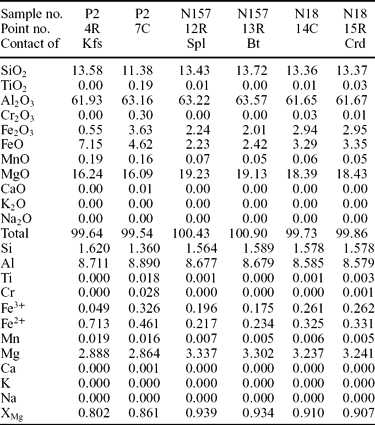
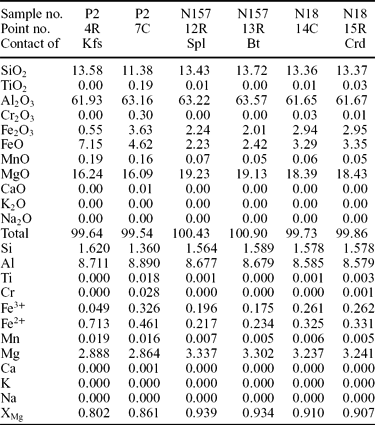
Experimental work (Seifert, Reference Seifert1974; Ackermand, Seifert & Schreyer, Reference Ackermand, Seifert and Schreyer1975) shows that there are two stable end-members of sapphirine related to a substitution Mg,Si = AlIV, AlVI; the end members are 2MgO·2Al2O3·SiO2 (2:2:1) and 7MgO·9Al2O3·3SiO2 (7:9:3). In natural occurrences sometimes sapphirine composition goes beyond 7:9:3 towards 3:5:1 (3MgO·5Al2O3·SiO2) composition (see Fig. A4a in online Appendix at http://journals.cambridge.org/geo). The sapphirine compositions of the working area (Table 1) plotted in the triangular diagram SiO2–(Mg,Fe2+)O–(Al,Fe3+, Cr)2O3 scatter around the 7:9:3 composition. The Si contents range between 1.360 and 1.620 p.f.u. and XMg (XMg = Mg/(Mg+Fe2+)) between 0.802 and 0.939.
Representative microprobe analysis of sapphirine (20 oxygen basis)
5.g. Kornerupine
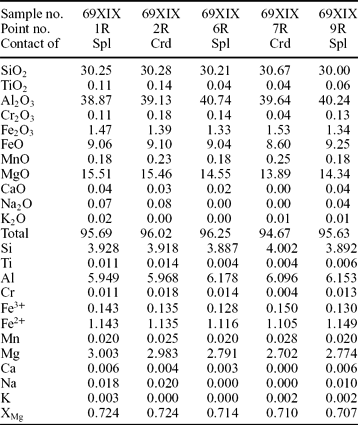
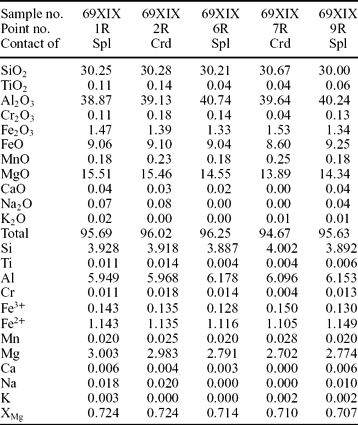
Kornerupine analyses (Table 2), plotted in the triangular diagram SiO2–(Mg,Fe2+)O–(Al,Fe3+, Cr)2O3, lie close to the 4MgO·3Al2O3·4SiO2 (4:3:4) composition along the solid solution join, extending towards the 1:1:1 end-member (0.5MgO·0.5Al2O3·0.5SiO2) (see Fig. A4b at http://journals.cambridge.org/geo). The analysed kornerupine contains a considerable amount of Fe3+ between 0.128 and 0.150 p.f.u. The XMg (XMg = Mg/(Mg+Fe2+)) values range between 0.707 and 0.724.
Representative microprobe analysis of kornerupine (21 oxygen basis)
5.h. Feldspar
Feldspars analysed from different rock types are plotted in a triangular diagram (see Fig. A5 at http://journals.cambridge.org/geo). XAn(Ca/(Ca+Na+K)) in plagioclase ranges between 0.317 and 0.510. In gneisses the XK (K/(K+Na+Ca)) in K-feldspar ranges between 0.542 and 0.826, in quartz-free granulites between 0.799 and 0.886.
5.i. Spinel
Spinel found mainly in quartz-free granulites is essentially a solid solution between spinel and hercynite (Mg = Fe2+) with XMg ranging from 0.366 to 0.647. The spinels from the sapphirine-bearing rocks have high Al content (3.859–3.954 p.f.u.), whereas from kornerupine-bearing rocks they have only 1.874 to 1.930 p.f.u. Al contents. Some of the spinels from the kornerupine-bearing rocks have appreciable amounts of Cr2O3 (up to 3.23 wt%), whereas it is normally absent in spinels from the sapphirine-bearing rocks. In addition to the Fe2+ = Mg substitution, Al = Fe3+ substitution also occurs, with Fe3+ content ranging between 0.017 and 0.107 p.f.u.
5.j. Opaques
Opaques include magnetite, ilmenite and rutile. The analyses of magnetite, ilmenite and rutile are plotted in a FeO–Fe2O3–TiO2 triangular diagram (see Fig. A6 at http://journals.cambridge.org/geo). Magnetite is essentially iron oxides (FeO·Fe2O3 or Fe3O4) containing other oxides in minor amounts. Ilmenites from mafic granulites and gneisses have been analysed. TiO2 and FeO are the dominant oxides.
6. Chemographic relationships
The mineral assemblages of the garnet–sillimanite and the orthopyroxene–cordierite–garnet gneisses and the quartz-free sapphirine–spinel granulites may be discussed in the model K2O–FeO–MgO–Al2O3–SiO2–H2O (KFMASH) system because of the ubiquitous presence of biotite and potash feldspar.
6.a. Charnockite/enderbite, garnet–cordierite–sillimanite and orthopyroxene–cordierite–garnet gneisses
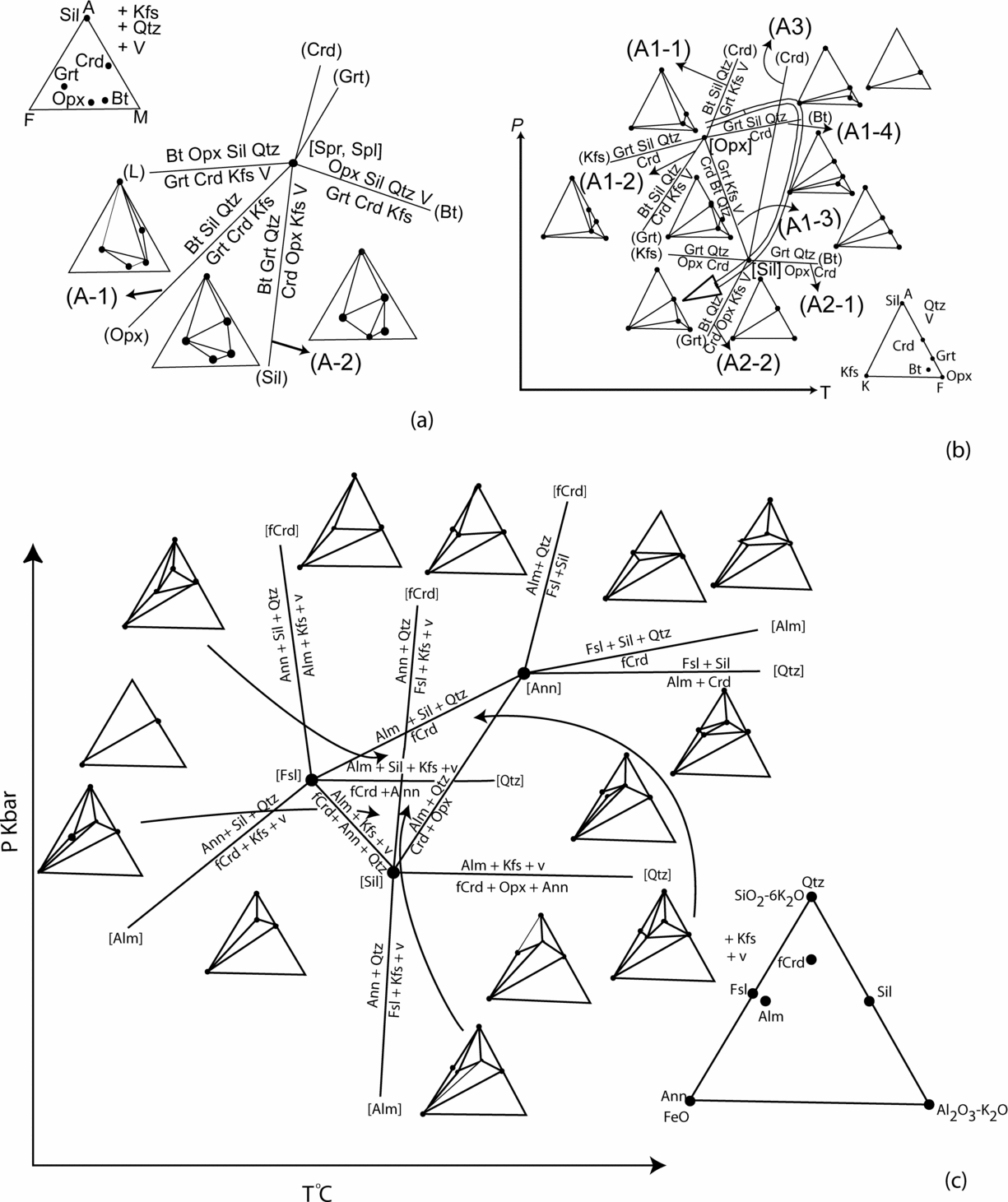
The phase relationships in these rocks portrayed in AFM projection from K-feldspar (with quartz, plagioclase and vapour present) are shown in Figure A7 at http://journals.cambridge.org/geo. Metamorphic evolution of these rocks involves two reactions (A1) and (A2), which are located on the lower pressure side of the invariant point [Spr, Spl] of Hensen & Harley (Reference Hensen, Harley, Ashworth and Brown1990) and Spear, Kohn & Cheney (Reference Spear, Kohn and Cheney1999), equivalent to the invariant point [osumilite] experimentally determined at 900°C/8.8 kbar by Carrington & Harley (Reference Carrington and Harley1995) (Fig. 3a).
(a) Petrogenetic grid (after Sharma & Prakash, Reference Sharma and Prakash2007) showing the [Spr,Spl] invariant point (Hensen & Harley, Reference Hensen, Harley, Ashworth and Brown1990) which corresponds to [osumilite] invariant point experimentally determined by Carrington & Harley (Reference Carrington and Harley1995). The (Opx) and (Sil) equilibria are applicable to the orthopyroxene or sillimanite-bearing cordierite–garnet gneiss and charnockite. Numbers within parentheses with prefix (A) correspond to univariant and divariant reactions given in the text. The topology in the divariant P–T fields on low and high temperature sides of (Opx)- and (Sil)-absent reactions are depicted by the AFM diagram (see inset). (b) Petrogenetic grid in the KFMASH system showing the divariant reactions which emerge from univariant (Opx) and (Sil) reactions given in Figure A8 at http://journals.cambridge.org/geo. Divariant reactions are depicted by lines instead of fields, for clarity. The topology changes related to the divariant reactions are portrayed by AKF diagram (A = Al2O3–K2O, K = K2O, F = FeO+MgO). The numbers with prefix (A) correspond to the reactions given in the text. The inferred clockwise P–T path is shown by curved arrow (after Sharma & Prakash, Reference Sharma and Prakash2007). (c) P–T petrogenetic grid using the ‘THERMOCALC’ program of Holland & Powell (Reference Holland and Powell1998) in the K2O–FeO–Al2O3–SiO2–H2O (KFASH) system involving the phases ferrosilite (Fsl), sillimanite (Sil), annite (Ann), almandine (Alm), iron-cordierite (fCrd) and quartz (Qtz) as shown in the triangular (SiO2–6K2O)–FeO–(Al2O3–K2O) diagram.
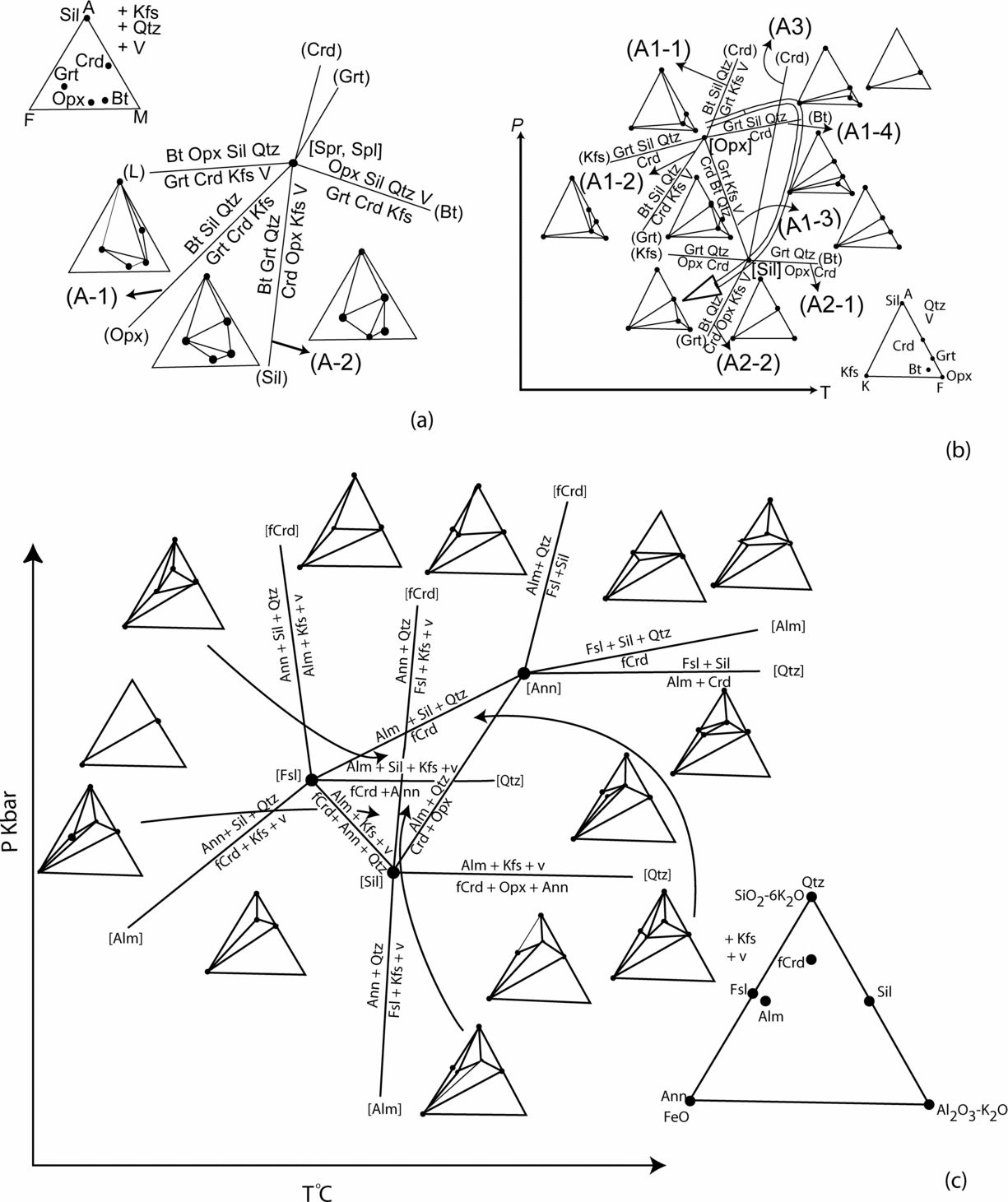
The AFM topologies on both sides of (Opx) and (Sil) univariant reactions (A1 and A2) are displayed in the petrogenetic grid in the KFMASH system (Fig. 3a). The sequence of divariant reactions, with increasing temperatures, in the assemblages of the three-phase fields in the AFM projection, can be deduced from the AKF diagram. The cordierite–biotite–sillimanite–garnet gneisses involve the (Opx) reaction (A1) in bulk compositions towards the higher Al2O3 side in the AFM projection. Towards the lower temperature side of the (Opx), the assemblages of the three-phase fields of Grt–Bt–Sil and Bt–Crd–Sil involve two divariant reactions (A1–1) and (A1–2).
On the higher temperature side of (Opx) reaction (A1), Bt+Sil+Qtz react to form Grt+Crd+Kfs+vapour and thus the Bt–Sil join is replaced by the Grt–Crd field. Two divariant reactions will occur in the mineral assemblages represented by the three-phase fields of Grt–Crd–Bt and Grt–Crd–Sil, which are (A1–3) and (A1–4), respectively. The common occurrence of Grt+Crd assemblages in the gneisses of the area suggests that the (Opx) reaction (A1) was crossed during the prograde path of metamorphism. The reaction (A1–4) may have occurred after the thermal peak during decompression, as evident from the low dP/dT slope of this reaction.
In the petrogenetic grid of the KFMASH system (Fig. 3a), the orthopyroxene–cordierite gneisses (±garnet) indicate the involvement of the discontinuous reaction (A2), which is located at higher temperature than the (Opx) reaction (A1). Towards the low temperature side of the (Sil) reaction (A2), these gneisses are represented by three-phase fields of Grt–Crd–Bt in the AFM diagram in which a divariant reaction (A1–3, see above) occurs. On the higher temperature side, the Grt–Bt tie-line is replaced by the Crd–Opx join. Two three-phase fields are developed, namely, Grt–Opx–Crd and Opx–Crd–Bt, and inferred reactions are (A2–1) and (A2–2), respectively. Opx+Pl symplectites are formed due to the breakdown of garnet which may be attributed to the divariant reaction (A2–3) in the CaO–FeO–MgO–Al2O3–SiO2 (CFMAS) system. Corroded relics of biotite and linear trails of biotite merging into the fabric of the matrix within cordierite, orthopyroxene and K-feldspar provide textural evidence of the univariant reaction (A2). The inferred reactions (A1–4), (A2–1) and (A2–3) have shallow dP/dT slopes suggesting isothermal decompression after the thermal peak of metamorphism (Fig. 3b).
The assemblages of charnockites/enderbites, with or without garnet, are represented by the three-phase field of Grt–Opx–Bt and the two-phase field of Opx–Bt in the AFM projection which involve the (Sil,Crd) reaction (A3) and reaction (A3–1) (Sil,Crd,Grt) in the MASH system. The reaction (A3–1) has been experimentally studied by Peterson & Newton (Reference Peterson and Newton1989) and occurs at temperatures of approximately 800°C, at pressures of 0.5–10 kbar. The steep dP/dT slopes of reactions (A1–3, A2–2, A3 and A3–1) suggest isobaric cooling (Fig. 3b). The presence of reactant minerals as relics in the product minerals in these ‘back reactions’ may possibly be due to partial removal of melt prior to its crystallization during isobaric cooling and also because of the refractory nature of reactant minerals (Spear, Kohn & Cheney, Reference Spear, Kohn and Cheney1999; Thompson, Reference Thompson2001; Brown, Reference Brown2002).
Another P–T petrogenetic grid for the Grt–Opx–Crd–Bt gneisses (sample no. M1) based on Schreinmaker's rule has been proposed in the K2O–FeO–Al2O3–SiO2–H2O (KFASH) system, depicted through the triangular plot of (SiO2–6K2O)–(FeO)–(Al2O3–K2O). The ‘THERMOCALC’ computer program of Holland & Powell (Reference Holland and Powell1998) has been used in finding out the stable invariant points and construction of the grid (Fig. 3c). The iron end-members have been used for the grid construction, as the rock is iron-rich, which is evident from the mineral compositions. The P–T conditions of the different intersections are as follows:
For XH2O = 0.2:
[Ann] – 5.9 kbar (±3.7)/744°C (±394)
[Sil] – 5.2 kbar (±0.8)/680°C (±64)
[Fsl] – 5.3 kbar (±0.8)/673°C (±61)
6.b. Quartz-free sapphirine–spinel granulite
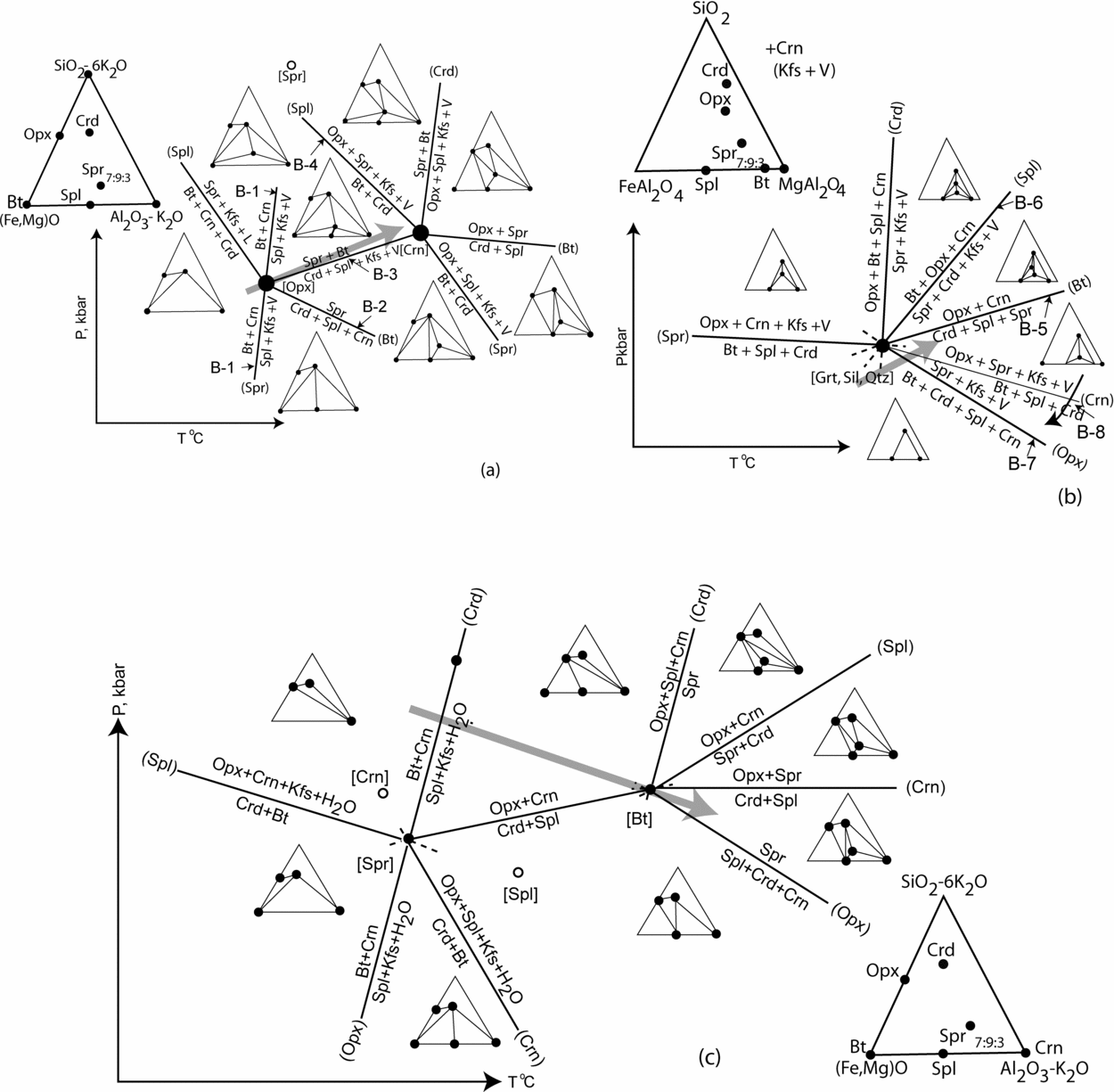
Mineral compositions of these granulites are portrayed in a (Fe,Mg)O–(Al,Fe3+, Cr)2O3–SiO2 diagram and a projection from corundum and K-feldspar onto the SiO2–FeAl2O4–MgAl2O4 plane (see Fig. A8a, b in online Appendix at http://journals.cambridge.org/geo). The rocks display a variety of spectacular reaction coronas and symplectites developed during their metamorphic evolution. These include (minerals listed successively from the core to the rim of the coronas in a matrix of biotite and K-feldspar, biotite also present in coronas): (1) Crn–Crd, (2) Crn–Spl, (3) Crn–Spl–Crd, (4) Spl–Crd, (5) Crn–Spl–Spr–Crd, (6) Crn–Spl–Spr, (7) Crn–Spr–Crd, (8) Spl–Spr–Crd, (9) Spr–Crd, (10) Spl–Spr and (11) Crn–Spl–Spr–Crd–Opx. (B1, B1-1, B2, B3, B4, B5 and B6) reactions involved in the formation of these coronas are attributed to continuous reactions in KFMASH system.
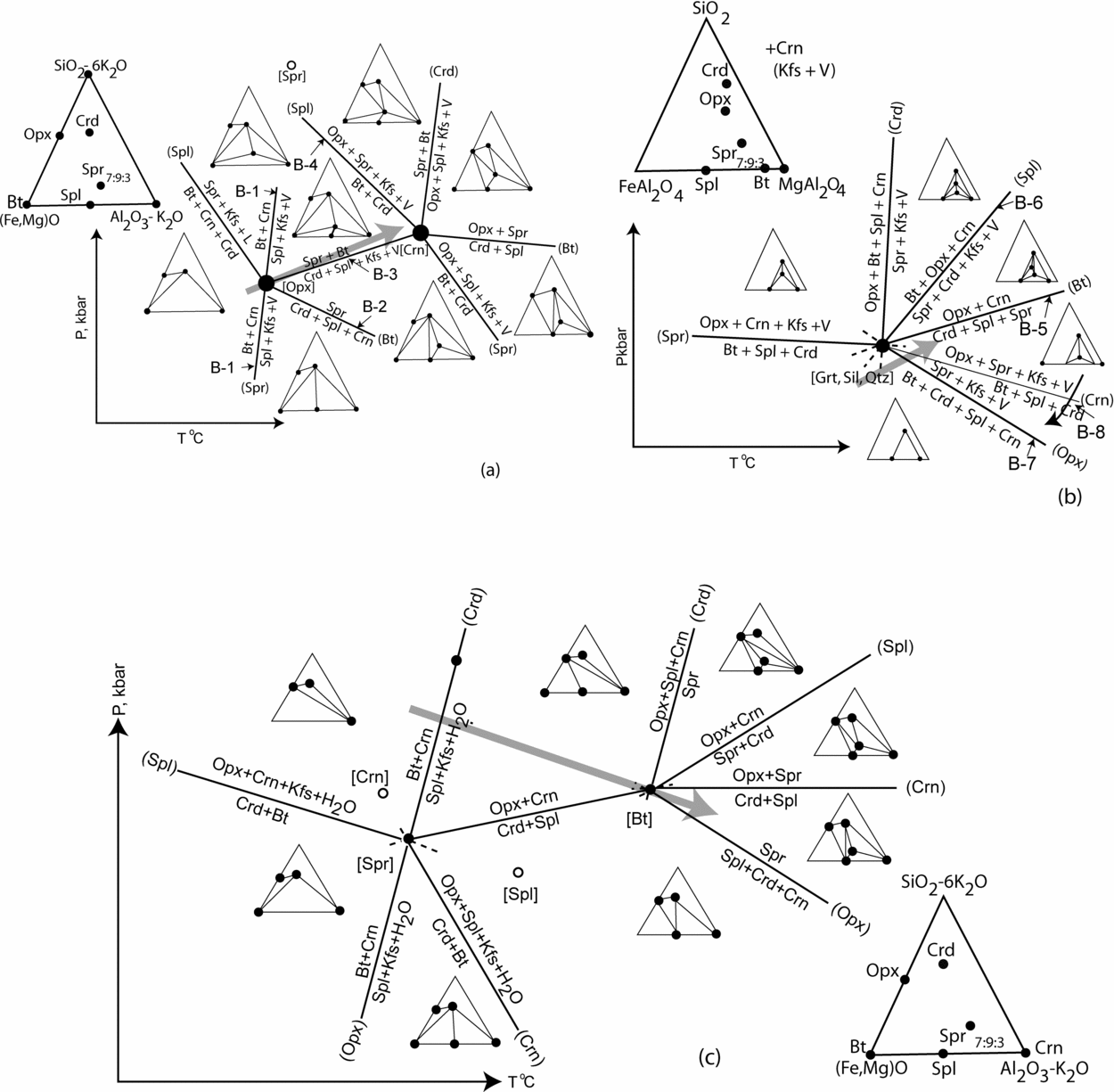
The prograde path during the formation of the above-mentioned coronas can be portrayed in the KFMASH system involving the phases Crn, Crd, Spl, Spr, Opx, Bt, Kfs and V. There are six univariant reactions emerging from the [Grt,Qtz,Sil]-absent invariant point (Fig. 4b). Hensen & Harley (Reference Hensen, Harley, Ashworth and Brown1990) have qualitatively shown that the univariant reactions (B7, B8 and B5) are stable and these may be depicted in the petrogenetic grid (Fig. 4b). All the reactions involved in the formation of coronas, mentioned above, could be inferred from the divariant fields in the projection from corundum and K-feldspar in the P–T domains between (Opx) and (Bt) with a prograde path passing through the (Opx) and (Crn) reactions. A petrogenetic grid in which divariant reactions emerging from the (Opx) and (Crn) reactions is shown in Figure 4a, along with the topology depicted by a projection from K-feldspar onto the (Fe, Mg)O–Al2O3–SiO2 plane, observed coronas mentioned above and inferred prograde P–T path. The presence of K-feldspar in the Spr+Crd symplectite suggests that biotite may be a reactant mineral in the reaction (B8).
(a) Divariant reactions (shown as lines for clarity) which emerge from the [Opx] and [Crn] reactions. The metastable reactions are shown by open circles within square brackets. The topology changes due to the divariant reactions are represented by projection from K-feldspar on to the SiO2–(Fe,Mg)O–Al2O3 plane (see inset). (b) Petrogenetic grid in the KFMASH system involving Spr, Crn, Crd, Bt, Opx, Kfs and V (vapour) for the quartz-absent granulites. Univariant reactions emerging from the [Grt,Sil,Qtz] invariant point and changes in topology of the corundum and K-feldspar projection (see inset) in the divariant fields are depicted. Numbers in parentheses with prefix (B) are reactions mentioned in the text. The inferred P–T path, shown by arrow, which crosses the (Opx) and (Crn) reactions. (c) P–T petrogenetic grid (after Prakash & Sharma, Reference Prakash and Sharma2008) based on the Schreinmaker's method in the K2O–(FeO–MgO)–Al2O3–SiO2–H2O [K(FM)ASH] system involving the phases cordierite (Crd), orthopyroxene (Opx), sapphirine7:9:3 (Spr7:9:3), biotite (Bt), spinel (Spl) and corundum (Crn) as shown in the triangular (SiO2–6K2O)–(Fe,Mg)O–(Al2O3–K2O) diagram. This petrogenetic grid is applicable to the quartz-free granulites of the study area. The stable invariant points are shown by large solid circles, whereas as the metastable invariant points are shown by open circles. The minerals in parentheses are not involved in that particular univariant reaction. The arrow shows the prograde P–T path.
In the (Fe,Mg)O–Al2O3–SiO2 diagram (Fig. A8a at http://journals.cambridge.org/geo), the analysed kornerupine plots close to the spinel–cordierite join, suggesting the reaction (B9). Reactions (B10) and (B13) have been experimentally studied by Seifert (Reference Seifert1974) and because of the steep dP/dT slopes of the equilibrium curves, it can be inferred that these retrograde reactions occurred during isobaric cooling following isothermal decompression.
A schematic P–T petrogenetic grid based on the Schreinmaker's method in the KFMASH system K2O–(FeO–MgO)–Al2O3–SiO2–H2O involving the phases cordierite, orthopyroxene, sapphirine7:9:3, biotite, spinel and corundum has been drawn (Fig. 4c) with the help of the triangular (SiO2–6K2O)–(Fe,Mg)O–(Al2O3–K2O) diagram. This petrogenetic grid involves [Spr] and [Bt] as stable invariant points and [Spl], [Crn] and [Opx] as metastable invariant points. An inferred prograde path is shown by the arrow. This P–T petrogenetic grid is applicable to the quartz-free sapphirine–spinel-bearing granulites.
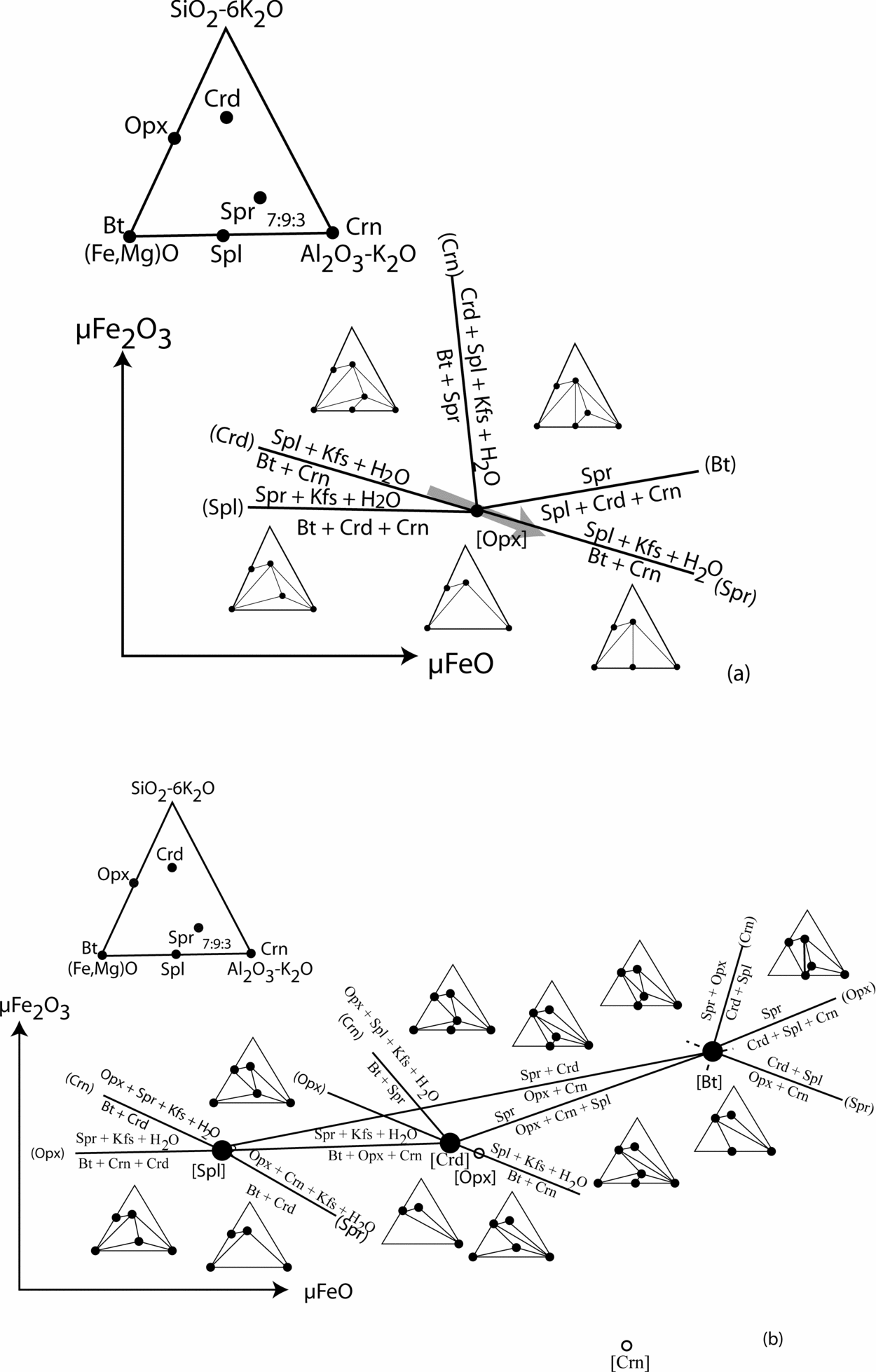
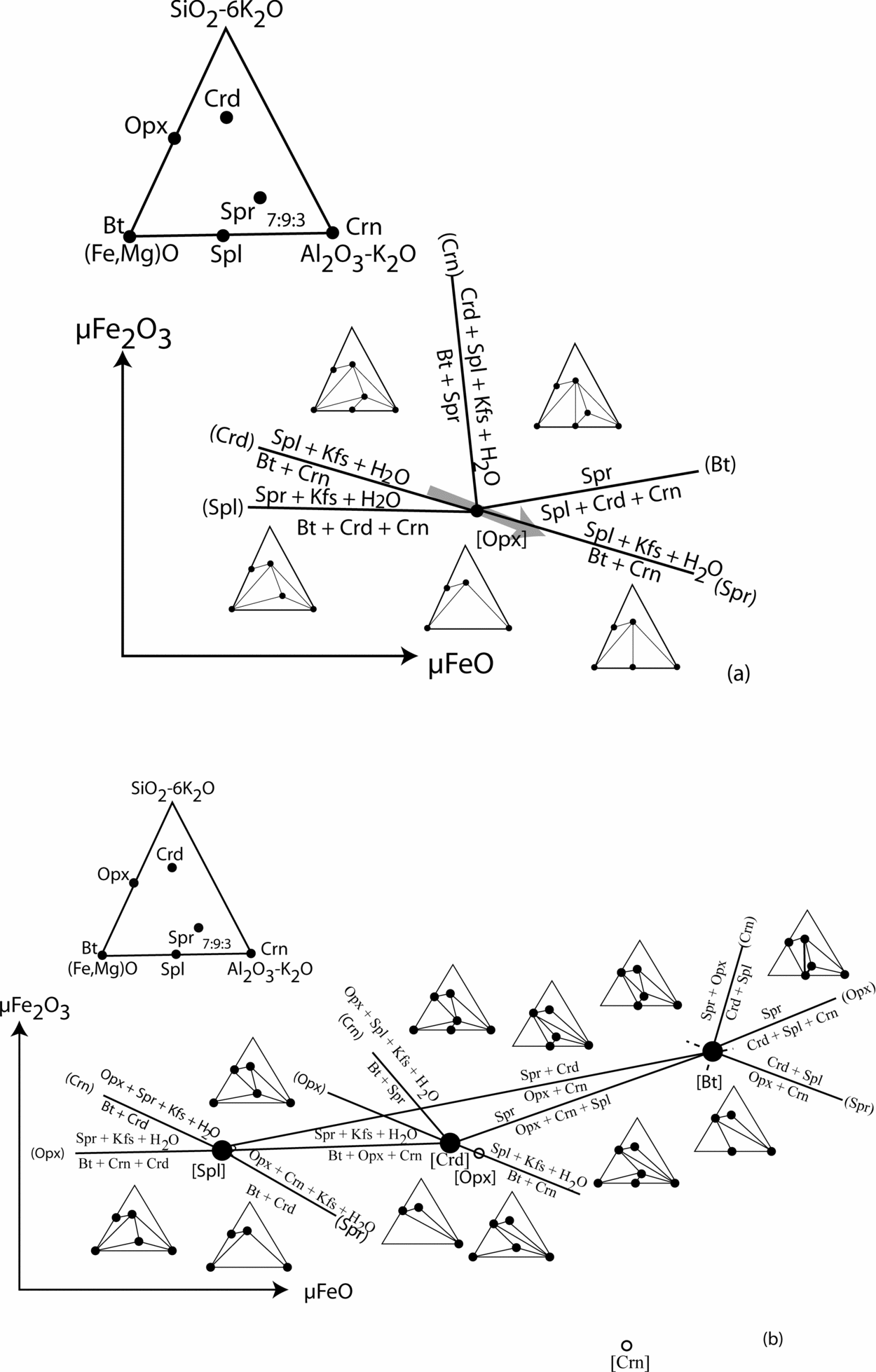
In addition, two chemical potential grids, namely μFe2O3 v. μFeO have been drawn (Fig. 5a, b). In Figure 5a, b the grids for the stable [Opx] as well as the stable [Bt], [Crd] and [Spl] invariant points are shown, along with the topologies and inferred reactions. These grids clearly indicate that sapphirine is stable at higher μFe2O3 and lower μFeO as compared to spinel. This is also evident from microprobe data, where sapphirine contains higher Fe2O3 and XMg than spinel.
(a) μFe2O3–μFeO petrogenetic grid in the K2O–(FeO–MgO)–Al2O3–SiO2–H2O [K(FM)ASH] system involving the phases cordierite (Crd), sapphirine7:9:3 (Spr7:9:3), biotite (Bt), spinel (Spl) and corundum (Crn) as shown in the triangular (SiO2–6K2O)–(Fe,Mg)O–(Al2O3–K2O) diagram. This petrogenetic grid is applicable to the orthopyroxene-absent sapphirine–spinel-bearing quartz-free granulites of the study area. The invariant point [Opx] is shown by a solid circle from which five univariant reactions emerge. The minerals in parentheses are not involved in that particular univariant reaction. (b) μFe2O3–μFeO petrogenetic grid in the K2O–(FeO–MgO)–Al2O3–SiO2–H2O [K(FM)ASH] system involving the phases cordierite (Crd), orthopyroxene (Opx), Sapphirine7:9:3 (Spr7:9:3), biotite (Bt), spinel (Spl) and corundum (Crn) as shown in the triangular (SiO2–6K2O)–(Fe,Mg)O–(Al2O3–K2O) diagram. This petrogenetic grid is applicable to the quartz-free sapphirine–spinel-bearing granulites of the study area. The stable invariant points are shown by solid circles, whereas the metastable invariant points are shown by open circles. The minerals in parentheses are not involved in that particular univariant reaction.
6.c. Mafic granulites and other rock types
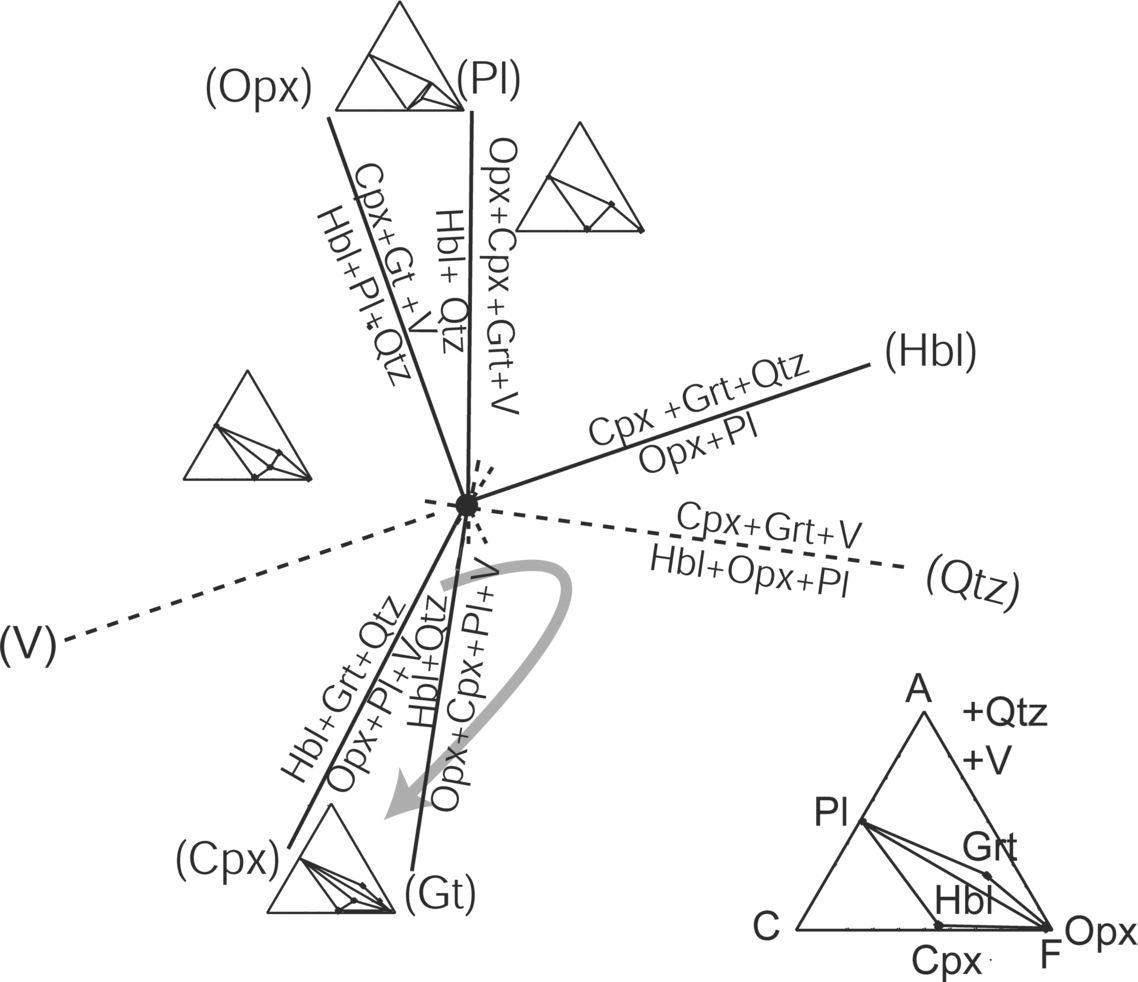
Mafic granulites contain Opx, Cpx, Hbl, Pl, Bt and also contain magnetite, ilmenite and apatite in minor amounts. The reaction (C1) is clearly evident in the ACF diagram (Fig. 6), in which hornblende occurs within the three-phase field of orthopyroxene, clinopyroxene and plagioclase. Titanium is an important component of hornblende and its concentration increases with increasing temperature.
Petrogenetic grid for mafic granulites in the CaO–(FeO+MgO)–Al2O3–SiO2–V system. The topology in the divariant fields is shown in the ACF diagram with quartz and vapour as excess phases. Inferred P–T path shown by the arrow.
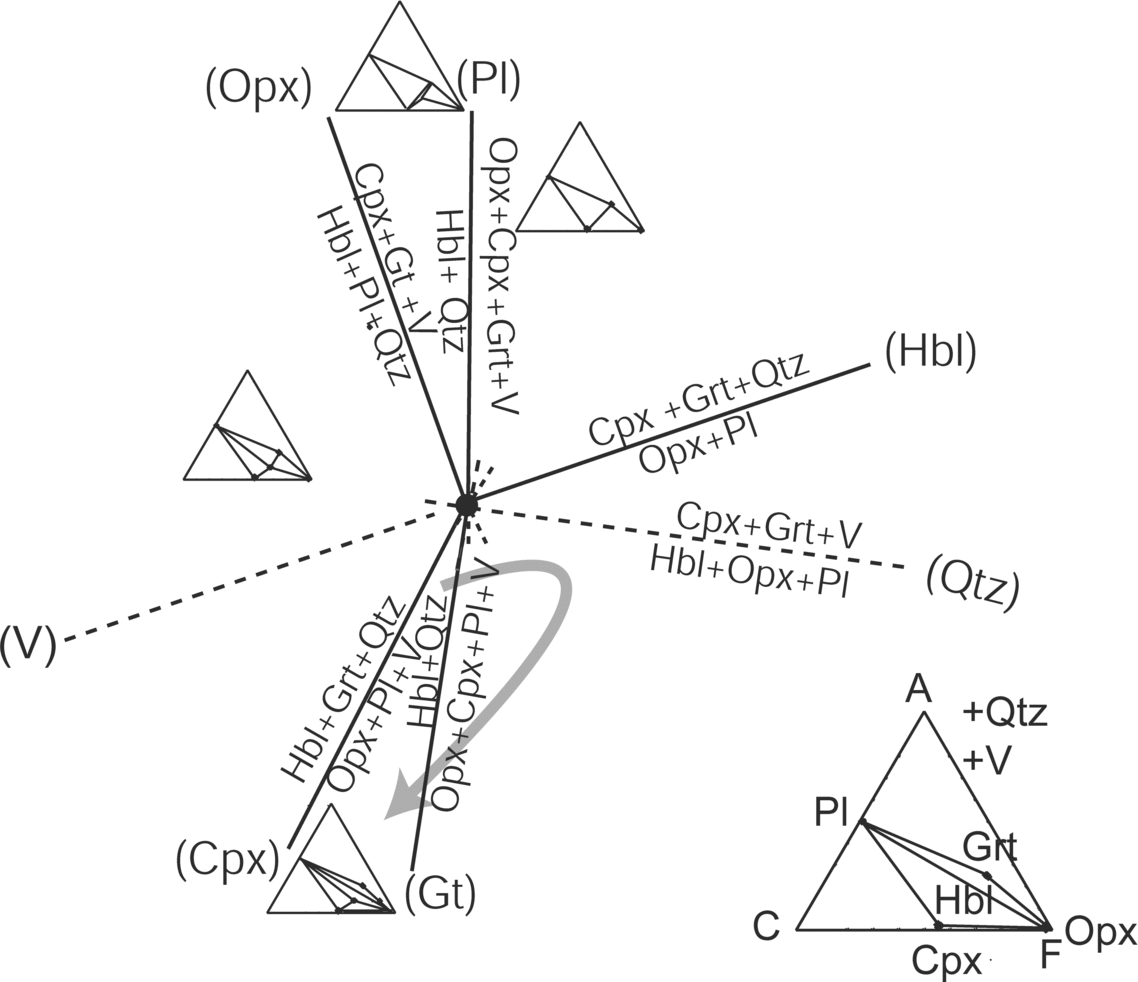
The mafic granulites may be discussed in the CFMASH system. The mineral assemblages of the basic granulites suggest that only one of the five reactions, that is, the (Grt)-absent reaction, is possible and P–T conditions lie between the (Hbl)–(Cpx)-absent reactions (Fig. 6). The path for the progress of the (Grt)-absent reaction has been shown by the arrows which suggest that both prograde and retrograde hornblende are present.
7. Metamorphic conditions
The P–T evolution of the Karimnagar granulites have been constrained through the use of the internally consistent TWQ program (version 2.32, updated 2006). In the TWQ program, P and T were determined from the intersection of three or more independent reactions in P–T space, using the thermodynamic datasets of Berman (Reference Berman1988), Berman, Aranovich & Pattison (Reference Berman, Aranovich and Pattison1995) and Berman & Aranovich (Reference Berman and Aranovich1996) for end-member phases. For precision, only those P–T values from the equilibria intersection which yield σ < ±0.5 kbar and ±15°C were considered. The end–member phases used in the TWQ calculation for quartz-free Spr–Spl granulites are given in Table A9 at http://journals.cambridge.org/geo. Four possible equilibria can be written for the selected end-member phases. Core compositions for sample N157 give a precise intersection using these equilibria (see Fig. A9a at http://journals.cambridge.org/geo), suggesting near-thermal peak conditions of granulite-facies metamorphism of 840°C at 7.2 kbar. The P–T conditions calculated using the TWQ program (version 2.32) compare well with those obtained from conventional thermobarometry (see Table A10 at http://journals.cambridge.org/geo). Two geothermometers involving sapphirine–spinel assemblages have been published by Owen & Greenough (Reference Owen and Greenough1991) and Sato, Miyamoto & Kawasaki (Reference Sato, Miyamoto and Kawasaki2006). P–T conditions deduced from these geothermometers give a temperature estimate of 800 to 850°C (see Table A10 at http://journals.cambridge.org/geo).
P–T calculations for mafic granulites for sample P7 were attempted on a core composition of orthopyroxene, clinopyroxene, hornblende and plagioclase. Seven possible equilibria for the end-member phases are shown in Table A9 at http://journals.cambridge.org/geo. Using these equilibria, the core composition gives a precise intersection at about 6.2 kbar at 898°C (see Fig. A9b at http://journals.cambridge.org/geo). The conventional hornblende–plagioclase thermometer of Blundy & Holland (Reference Blundy and Holland1990) has been used, and the calculated temperatures are about 850°C for mafic granulites. The temperature of metamorphism is estimated at >850°C from the pertinent opx–cpx thermometer (see Table A10 at http://journals.cambridge.org/geo). The clinopyroxene–plagioclase–quartz barometer has been used for estimating pressure conditions of mafic granulites. Results are broadly similar to P estimates obtained from the TWQ program. The Al content of hornblende was experimentally calibrated for geobarometry by Hollister et al. (Reference Hollister, Grissom, Peters, Stowell and Sisson1987) and the calculated pressure is 5.7 kbar.
The TWQ results based on the intersection of five possible equilibria for samples 508A and M1 for the Grt–Opx–Crd gneisses are given in Table A9 and Figure A9c, d at http://journals.cambridge.org/geo. The lower pressure conditions of 835°C at 5.5 kbar and 800°C at 4.9 kbar resulted in the breakdown of corroded garnet and development of symplectites during decompression. The temperatures were calculated from the Fe–Mg exchange geothermometers for garnet–orthopyroxene gneisses. The thermometric models of Harley (Reference Harley1984), Perchuk et al. (Reference Perchuk, Aranovich, Podleskii, Laverent'eva, Gerasimov, Kitseel, Kersakov and Perdnikov1985), Aranovich & Podlesskii (Reference Aranovich, Podlesskii, Cliff, Yardley and Daly1989), Perchuk & Laverent'eva (Reference Perchuk and Laverent'eva1990), Bhattacharya et al. (Reference Bhattacharya, Krishnakumar, Raith and Sen1991) and Lal (Reference Lal1993) provide average temperatures of 862±11 and 739±20°C for core and rim, respectively. Pressure estimates were obtained from garnet–orthopyroxene–plagioclase–quartz assemblages employing three different calibrations (Table A10 at http://journals.cambridge.org/geo), which are in close agreement with P estimates obtained from the TWQ program.
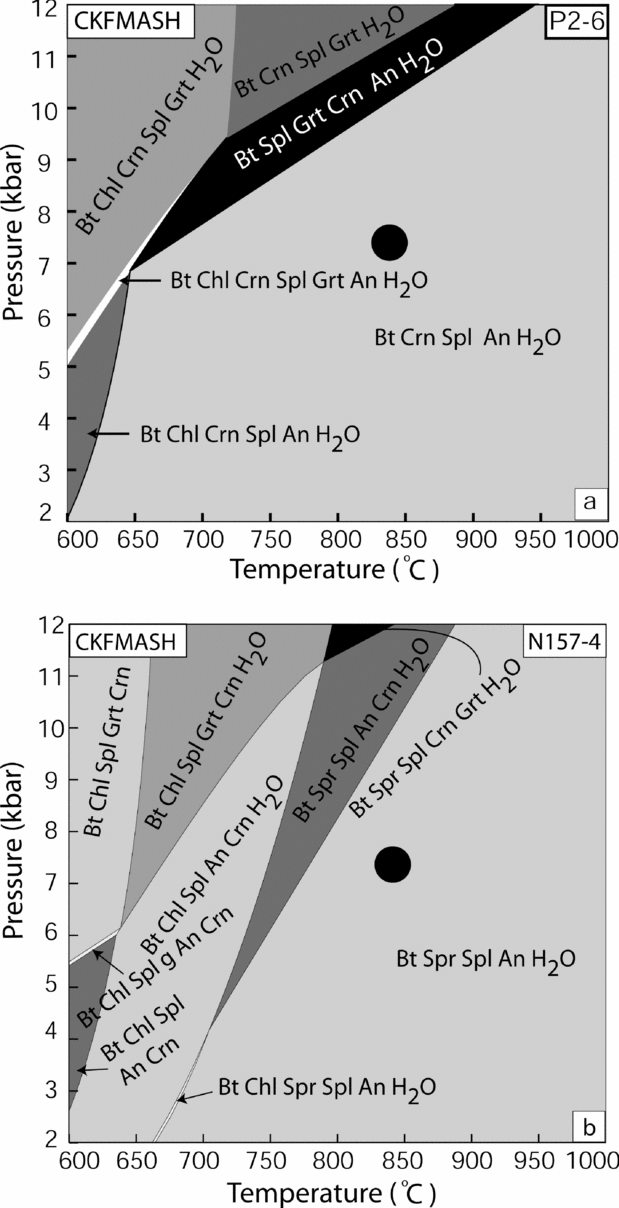
For the rigorous interpretation of the P–T path in the Karimnagar area, a quantitative phase diagram (P–T pseudosection) has been constructed in the CKFMASH system for specific bulk compositions of the quartz-free sapphirine-spinel bearing granulites. The phase diagram and pseudosections were computed using the program THERMOCALC (v. 3.33) with the updated thermodynamic data and solution models of Holland & Powell (Reference Holland and Powell1998) as input parameters. Bulk rock compositions were calculated using XRF analyses. Pseudosections have been constructed for corundum ± spinel and sapphirine ± spinel-bearing quartz-free sapphirine-spinel granulites (Fig. 7). The stability fields for sapphirine- and spinel-bearing granulites give the lower temperature limit of 650–700°C and 4–6 kbar pressure. Development of chlorite-spinel aggregate replacing sapphirine provides evidence for late hydration during retrograde cooling. Thus P–T pseudosection allows textural observation to be compared with specific bulk composition from the Karimnagar area.
(a) and (b) P–T pseudosections showing the stability fields of corundum±spinel and sapphirine±spinel-bearing quartz-free sapphirine–spinel granulites. The solid circle indicates the peak metamorphic condition from the Karimnagar area (P2-6: SiO2 4.75, TiO2 0.04, Al2O3 87.20, FeO 0.80, MnO 0.0, MgO 3.00, CaO 0.37, Na2O 0.03, K2O 1.28, P2O5 0.17, H2O 2.13; N157-4: SiO2 27.75, TiO2 0.21, Al2O3 34.52, FeO 1.27, MnO 0.02, MgO 23.28, CaO 0.09, Na2O 0.16, K2O 7.73, P2O5 0.11, H2O 4.90).
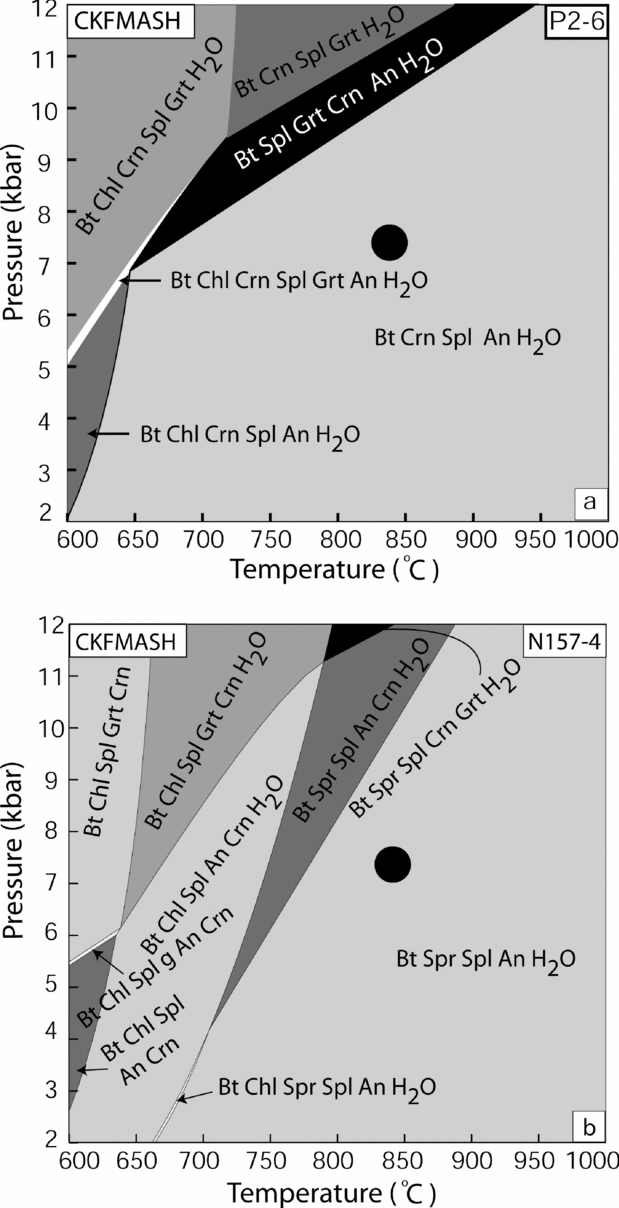
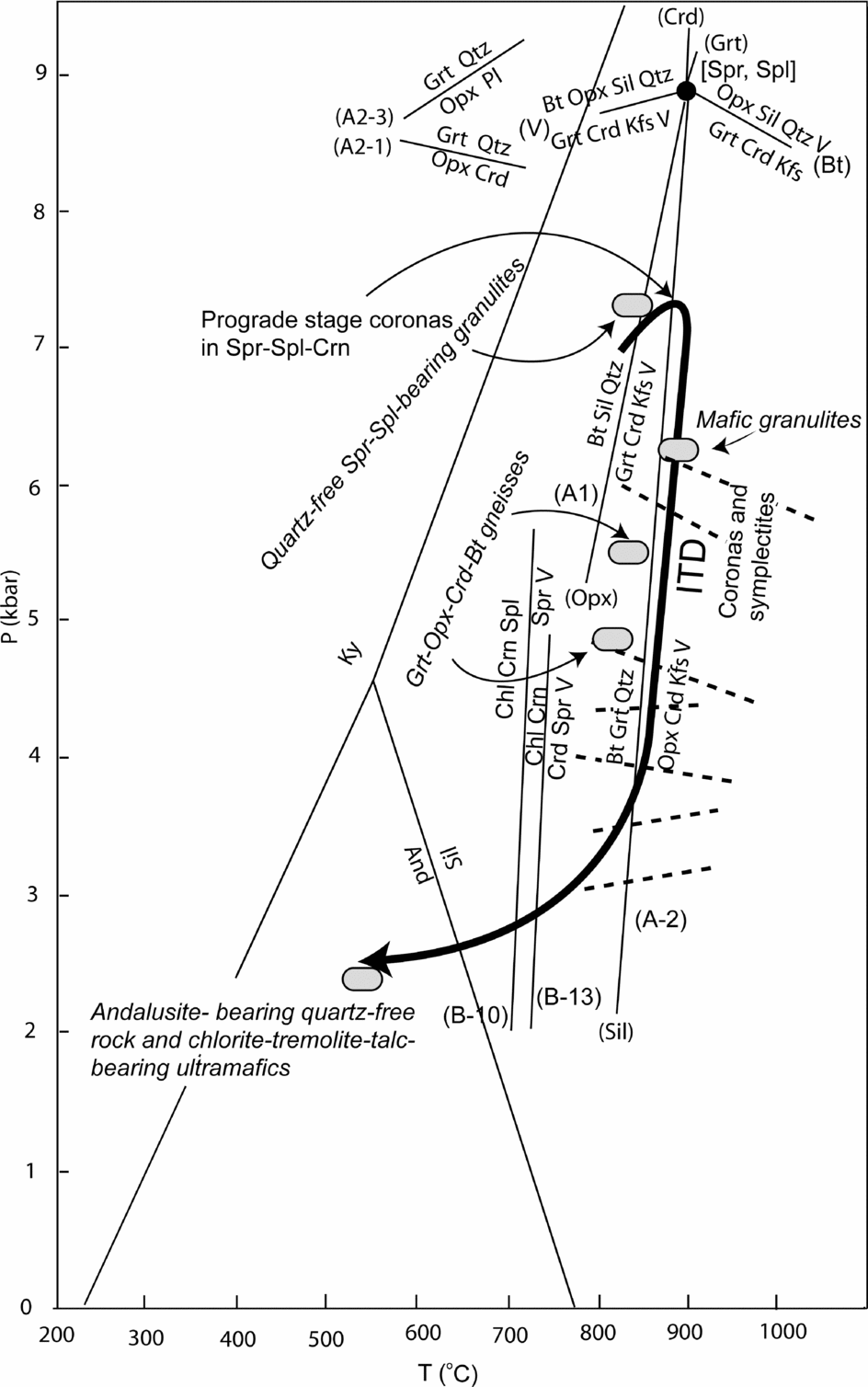
A clockwise decompressive path is being suggested because of the presence of andalusite which shows a drop in pressure from 7 kbar to 2.5 kbar.
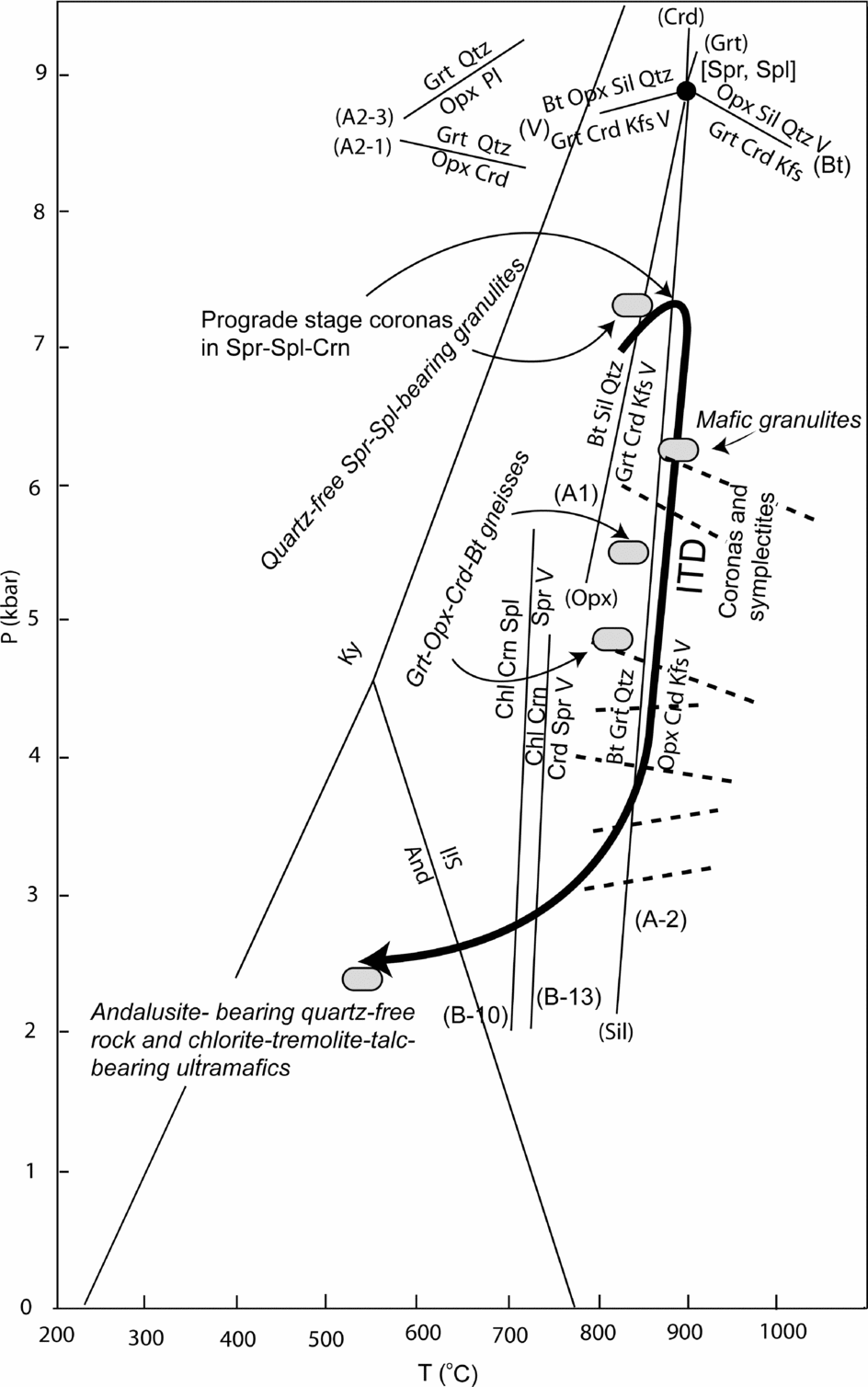
The metamorphic evolution inferred from the reaction textures, petrogenetic grid in KFMASH system and geothermobarometry involves three stages along a clockwise P–T–t trajectory (Fig. 8): (1) a prograde path with a moderate increase in pressure with a thermal peak at 898°C/6.2 kbar to 840°C/7.2 kbar (see Fig. 4a, b and reactions inferred above from corona textures); (2) isothermal decompression (ITD) from the thermal peak to 3 kbar. ITD is evident from coronas and symplectites of Opx+Pl and/or Crd around garnet in the garnet–cordierite–orthopyroxene gneisses (835°C/5.5 kbar and 800°C/4.9 kbar) and the presence of spectacular skeletal symplectites of Spr+Crd+Kfs in quartz-absent granulites; (3) ITD is followed by isobaric cooling (IBC) up to about 550°C/2.5 kbar during which (a) Bt and Bt+Qtz symplectites were formed by ‘back reactions’ from Opx, Crd, Grt and Kfs in the garnet–cordierite–orthopyroxene gneisses, and (b) hydration reactions with breakdown of sapphirine and cordierite produced chlorite, coarse subidioblasts of corundum, spinel and andalusite (Fig. 8).
P–T plot showing the clockwise P–T path (arrow) inferred from the reaction textures, petrogenetic grid in the KFMASH system and geothermobarometry. Reaction numbers in parentheses with prefix (A) are those given in the text. Invariant point [Spr,Spl] is based on experimental data of Carrington & Harley (Reference Carrington and Harley1995, their [osumilite] reaction). Reaction curves (B-10) and (B-13) are experimental data of these equilibria from Seifert (Reference Seifert1974). (XMg)Grt isopleths shown by dotted lines are from Spear, Kohn & Cheney (Reference Spear, Kohn and Cheney1999). Andalusite (And) = Sillimanite (Sil) curve is from Holdaway & Mukhopadhyay (Reference Holdaway and Mukhopadhyay1993). ITD – isothermal decompression.
8. Implications for supercontinent history
The symmetrical distribution of granulite belts along the flanks of the Godavari graben, that is, the Karimnagar Granulite Terrane along the southern flank and the Bhopalpatnam granulites along the northern flank, offer a new perspective on the implications for supercontinent history. Rajesham, Bhaskar Rao & Murti (Reference Rajesham, Bhaskar Rao and Murti1993) have reported Rb–Sr isochron dates for the different rock types in the Karimnagar area. Zircons from Karimnagar Granulite Belt charnockites show core ages of up to 3100 Ma mantled by rims of 2600 Ma (Santosh, Yokoyama & Acharyya, Reference Santosh, Yokoyama and Acharyya2004). Monazites and uranitites from the Karimnagar Granulite Belt show clear peaks with well-defined ages in the narrow range between 2420±80 Ma and 2470±30 Ma. There is one major metamorphic event around 2500 Ma (MII), when charnockites were formed. Around 2200 Ma, there is intrusion of younger granites. There is no evidence as yet for the younger events (1000 Ma and 500 Ma) in the Karimnagar granulite terrane. The high-grade supracrustals have not been dated, but their protolith may be older than 2500 Ma, as they occur as enclaves within charnockites and granite gneisses.
The Nd (TDM) ages for the granitoids of the Eastern Dharwar Craton are younger (2900–2600 Ma) than TTG gneisses of the Western and Eastern Dharwar Craton which range between 3400 and 3100 Ma (Peucat et al. Reference Peucat, Vidal, Bernard-Griffiths and Condie1989; Peucat, Mahabaleshwar & Jayananda, Reference Peucat, Mahabaleshwar and Jayananda1993; Jayananda et al. Reference Jayananda, Martin, Peucat and Mahabaleshwar1995; Krogstad, Hanson & Rajamani, Reference Krogstad, Hanson and Rajamani1995; Jayananda et al. Reference Jayananda, Moyen, Martin, Peucat, Auvray and Mahabaleswar2000). The ages of crustal growth are indicated by overlap between Rb modal ages and geochronological data in both the above cases. The leucogranites from the Bangalore area suggest crustal reworking during the late Archaean, that is, Nd (TDM) ages of 3400–3200 Ma (Jayananda et al. Reference Jayananda, Moyen, Martin, Peucat, Auvray and Mahabaleswar2000) corresponding to ɛNd values of −7 (at 2540 Ma). Chadwick, Vasudev & Hegde (Reference Chadwick, Vasudev and Hegde2000) suggest a major accretionary event in an Andean margin setting, which resulted in final stabilization of the craton at c. 2500 Ma, whereas Jayananda et al. (Reference Jayananda, Moyen, Martin, Peucat, Auvray and Mahabaleswar2000) emphasized that the above data are best explained by the plume model. Chadwick's model was supported by geochemical modelling from the Closepet batholith. It suggests that granitoids were derived from two sources of magma: (1) enriched mantle and (2) partial melting of Dharwar TTG gneisses (Moyen, Martin, & Jayananda, Reference Moyen, Martin and Jayananda2001).
The collision of the Napier complex with the Eastern Dharwar Craton in late Palaeoproterozoic time resulted in west-vergent stacking of the continent. This is supported by isotopic data that indicate a tectonothermal event at c. 1600 Ma in the Napier complex (Dobmeier & Raith, Reference Dobmeier, Raith, Yoshida, Windley and Dasgupta2003; Grew, Suzuki & Asami, Reference Grew, Suzuki and Asami2001; Owada et al. Reference Owada, Osanai, Toyoshima, Tsunogae, Hokada and Kagami2001). It is in accordance with the views of Fitzsimons (Reference Fitzsimons2000) and Boger, Wilson & Fanning (Reference Boger, Wilson and Fanning2001) on the pre-Panafrican configuration of Antarctica.
The margin of the Eastern Dharwar Craton was a centre of repeated accretionary activity during Proterozoic time. Between 1900 and 1700 Ma, volcano-sedimentary sequences were deposited in the Eastern Dharwar Craton during the first orogenic cycle. During subsequent nappe tectonics, these platform sequences were segmented and transported towards the west. The Western Cuddapah basin forms the stack of the Krishna province which is weakly deformed and metamorphosed (Dobmeier & Raith, Reference Dobmeier, Raith, Yoshida, Windley and Dasgupta2003). The pile consists of three major tectonic units: the base of the pile consists of greenschist facies, which is overlain by the amphibolite facies and on the top is the granulite facies which were formed during the period 1700–1550 Ma. The assembly and break-up during plate reorganization of Rhodinia and Gondwana make it difficult to identify the eastern margin of the Eastern Dharwar Craton. The intrusion of mafic and alkaline complexes indicates post-collisional relaxation of the thickened lithosphere between 1400 and 1200 Ma (Dobmeier & Raith, Reference Dobmeier, Raith, Yoshida, Windley and Dasgupta2003). Uplift and cooling were completed before the formation of Rhodinia.
9. Conclusions
The Karimnagar granulite belt that lies towards the NE part of the Eastern Dharwar Craton contains enclaves of cordierite–sillimanite±garnet and garnet–cordierite–orthopyroxene gneisses, mafic granulites and quartz-absent sapphirine–spinel–corundum–cordierite–orthopyroxene±kornerupine rocks within 2.5 Ga old granitic gneisses. Reaction textures in the gneisses of the enclaves include coronas and symplectites of Opx+Pl and/or Crd inferred to have formed by the breakdown of garnet in the garnet–cordierite–orthopyroxene gneisses. The moat of cordierite, with or without sillimanite inclusions, on garnet presumably formed from Grt+Sil+Qtz in the garnet–cordierite–sillimanite gneisses during isothermal decompression (ITD). The quartz-absent sapphirine–spinel-bearing rocks display spectacular coronas (minerals from the core to the rim in a matrix of biotite and K-feldspar): Crn–Spl–Crd, Crn–Spl–Spr–Crd, Crn–Spl–Spr, Crn–Spr–Crd, Spl–Spr–Crd, Crn–Spl–Spr–Crd–Opx, etc. Chemographic relationships, petrogenetic grids in the KFMASH system and inferred reactions in these quartz-absent rocks suggest prograde evolution of the coronas with moderate increase in pressure. Rare skeletal intergrowths of Spr+Crd+Kfs presumably developed during ITD. ITD was followed by isobaric cooling which has been inferred from (a) retrograde formation of biotite and biotite+quartz symplectites through ‘back reactions’ related to the univariant (Opx) reaction Bt+Grt+Qtz = Opx+Crd+Kfs+V in the garnet–cordierite orthopyroxene gneisses, and (b) retrograde hydration reactions of the breakdown of sapphirine and cordierite to form chlorite, corundum, spinel and andalusite. The P–T path is inferred to be clockwise with a prograde path and a thermal peak at 898°C/6.2 kbar, followed by isothermal decompression down to 3 kbar, and isobaric cooling down to 550°C/2.5 kbar, passing from the sillimanite to the andalusite stability field. Characterization of the P–T paths for evolution of the Karimnagar granulite terrane should help in evaluating the crustal evolution, and further isotopic data from this region would provide important constraints on the exhumation history of the Karimnagar granulite terrane.
Acknowledgements
We thank Professors R. K. Lal and Anand Mohan for their helpful and critical comments on an earlier version of this paper. This work was supported by DST (ESS/16/265/2006), New Delhi. The authors thank Prof. Martin Okrusch and anonymous reviewer for constructive comments that led to substantial improvement in the manuscript.