Under what conditions do legislatures constrain unilateral executive action? Executive rule making in presidential systems – whether through decrees, executive orders or subsidiary legislation – is universally accepted as a key feature of presidential power (Punder Reference Punder2009). However, constitutional protections of executive rule making differ around the world. In some contexts, like in the Americas, constitutions grant chief executives expansive rule-making powers that are independent of legislatures. In other contexts, like in presidential systems with a Westminster tradition, executive rule making is often delegated to presidents by legislatures, and takes the form of subsidiary legislation. That said, regardless of the source of executive rule-making authority, the incidence of such rules often reflects outcomes of strategic bargaining between presidents and legislators. Legislatures may cede significant rule-making authority to presidents due to inter-branch partisan alignment, the technical complexity of the policy area, or in order to overcome legislative gridlock. Yet in states where both legislatures and judiciaries are weak, chief executives may simply usurp legislative lawmaking powers.
Previous studies on executive rule-making authority mostly rely on material evidence from the Americas, where presidential systems with expansive executive rule-making powers predominate.Footnote 1 I contribute to this literature by examining executive rule making in an African country with a Westminster tradition. To the best of my knowledge, this study is the first to evaluate executive rule making in Africa – a region dominated by presidential systems of government. Prior work has not done so for two reasons. First, a dearth of data on executive action in Africa’s autocracies and young democracies makes it difficult to systematically study the incidence of executive rule making in the region. Secondly, conventional wisdom (erroneously) holds that presidential preponderance in Africa obviates the need to study strategic inter-branch bargaining over unilateral executive action in the region. In this article, I expand the research on executive–legislative relations by analyzing historical material evidence from Kenya. This study adds to a small but growing literature on institutional politics in Africa.Footnote 2
The preponderance of unchecked presidential power in Africa has been a central concern for students of African politics. Termed as ‘personalist rule’, ‘big man presidentialism’ or ‘neo-patrimonial rule’, unimpeded presidential power and the discretionary authority it grants African presidents has been characterized as a key obstacle to the institutionalization of politics and democratic consolidation in the region (Bratton and van de Walle Reference Bratton and van de Walle1994; Dulani Reference Dulani2011; Jackson and Rosberg Reference Jackson and Rosberg1982; Mkandawire Reference Mkandawire2015). Yet like autocrats elsewhere (Blaydes Reference Blaydes2011; Gandhi Reference Gandhi2008; Jensen, Malesky and Weymouth Reference Jensen, Malesky and Weymouth2014; Wright Reference Wright2008), African presidents have historically sought to foster political stability through credible (institutionalized) commitments to share power and governance rents with fellow elites. Examples include institutionalized political parties – like Tanzania’s Chama Cha Mapinduzi, which has presidential term limits (Morse Reference Morse2014); as well as legislatures that function as focal arenas for intra-elite bargaining – like in Senegal (Sissokho and Thomas Reference Sissokho and Thomas2005). While certainly not the case in the modal African country, the existence of pockets of institutionalized rule calls for a systematic study of institutional checks on presidential authority in the region.
In this article, I use original data on unilateral executive action (subsidiary legislation) to examine how legislative independence conditions the exercise of presidential rule-making authority in Kenya. The Kenyan case allows me to empirically demonstrate the dynamics of executive–legislative relations in a country with a Westminster tradition of limited executive constitutional rule-making authority. I find that executive rule making in Kenya is conditioned by legislative independence. Periods of legislative ascendancy are marked by a reduction in the volume of subsidiary legislation issued by government ministries and agencies. In addition, Kenyan presidents are more likely to resort to executive rule making during election years, regardless of legislative strength and capacity. This relationship between legislative independence and strength and executive rule making holds both under autocracy and democracy.
To identify the effects of legislative independence on executive rule making, I exploit two quasi-exogenous changes in executive–legislative relations in Kenya. The first change was occasioned by the (unplanned) death of Jomo Kenyatta in 1978, and the second the (forced) end of single-party rule under Daniel Moi in 1992. This design allows me to observe the incidence of executive rule making during periods of both legislative weakness and independence, while holding regime type constant around the first change, and the identity of the president constant in the second. I identify periods characterized by legislative independence (1963–1975, and after 1992) and legislative weakness (1978–1992). These periods roughly correspond to the autocratic presidencies of Jomo Kenyatta (1963–1978) and Daniel arap Moi (1978–1992), and the post-autocratic multiparty era (after 1992).
Under Kenyatta, the Kenyan legislature enjoyed a modicum of institutional autonomy, and served as the focal arena of intra-elite politics (Gertzel Reference Gertzel1970; Hakes Reference Hakes1970). At Kenyatta’s death, he was succeeded by his deputy, Moi. Thereafter, Moi’s quest to consolidate power and create a party-state led to a rapid and significant rebalancing of executive–legislative relations in Kenya, and the subordination of the legislature to the ruling party (Opalo Reference Opalo2014; Widner Reference Widner1992). Moi’s political dominance over the legislature via KANU (Kenya African National Union) came to an abrupt end in 1992. A combination of domestic protests and donor pressure after the collapse of the Soviet Union forced Moi into accepting multiparty politics (Brown Reference Brown2001).Footnote 3 The end of single-party rule freed legislators from KANU’s political control, thereby rebalancing executive–legislative relations in favor of the legislature.
I show that trends in observable quantitative measures of legislative independence and strength mirror changes in the incidence of executive rule making. Qualitative evidence from debates in the legislature corroborates these findings. Legislators debated the need to curtail unchecked executive rule making. As further evidence, after formal institutional autonomy of the legislature was achieved in 2000, a dedicated parliamentary committee instituted stricter legislative oversight over executive rule making.
These findings shed new light on the exercise of presidential power in Africa in general, and Kenya in particular. Kenyan presidents do not have unchecked executive authority to issue subsidiary legislation. Simply stated, unilateral executive action in Kenya is conditioned by the level of legislative independence.
Background on executive rule making in Kenya
Kenyan law grants the executive branch delegated rule-making powers. Delegated (subsidiary) legislation has historically included ‘[a]ny legislative provision, (including a transfer or delegation of powers or duties,) made in exercise of a power in that behalf conferred by a written law, by way of by-law, notice, order, proclamation, regulation, rule, rule of court or other instrument’.Footnote 4 The executive exercises these powers for a variety of purposes, including exempting specific entities from the law, filling lacunae in statutes or creating new policy under the rubric of existing law. Rules issued by the executive have the force of law once they are published as Legal Notices in the Kenya Gazette (the official publication of the Government of Kenya), and can only be reversed by non-executive authorities via the courts or legislative statute.
I distinguish between three different rules or notices emanating from the executive branch under Kenyan law (1963–2013): (1) Legal Notices issued primarily by the cabinet, (2) Administrative Rules and Notices issued by government agencies and (3) By-Laws made by sub-national governing entities such as urban councils. I focus on Legal Notices for two main reasons. First, they are instances of subsidiary legislation by politicians that have the force of law (hence the designation as Statutory Instruments). As such, the legislature has a direct interest in regulating their issuance. This is unlike purely Administrative Rules and Notices, which fall squarely within the purview of the executive branch, and are generally governed by precedents set under the rubric of Administrative Law and Judicial Review.Footnote 5 Secondly, unlike bureaucrats, cabinet ministers are high-profile political appointees whose actions are often readily visible and attributable by legislators.
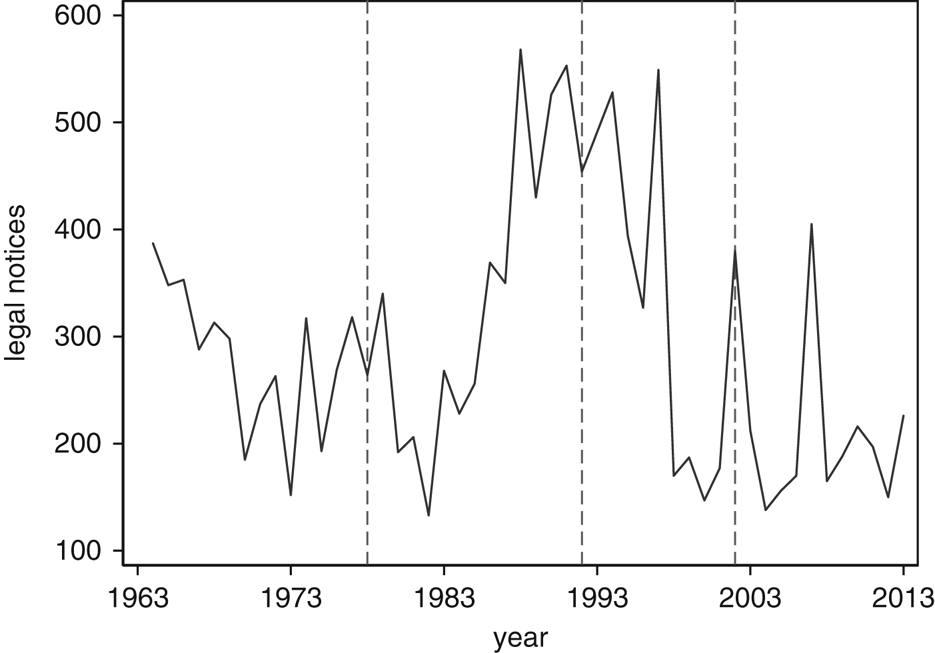
Figure 1 shows the trends in the number of Legal Notices issued by the executive branch between 1963 and 2013. In the first decade of independence, the number dropped by half, before increasing for the rest of Kenyatta’s presidency. After Moi succeeded Kenyatta in 1978 there was a decline in the number of Legal Notices issued. However, following the 1983 snap election the number of Legal Notices ballooned to unprecedented levels.Footnote 6 The number of Legal Notices issued each year declined following the re-introduction of multiparty politics in 1992. Finally, the general decline in the issuance of Legal Notices after 1992 was punctuated by significant up-ticks during election years (1997, 2002 and 2007).
Trends in the issuance of legal notices Note: the graph shows the total number of legal notices issued each year as published in the Kenya Gazette. Vertical lines show changes in executive–legislative relations occasioned by Kenyatta’s death (1978), the end of single-party rule under Moi (1992), and Moi’s retirement (2002). Notice the rise in the number of Legal Notices after Moi took office, and decline following the end of single-party rule.

I consider the executive to be a unitary branch, and treat all Legal Notices as emanating from the head of the executive – the president. This is a reasonable assumption since throughout the period under study, Kenyan cabinet ministers (appointed among incumbent legislators) served at the pleasure of the president. This chain of command implies that all Legal Notices issued were consistent with the preferences of the president. Furthermore, due to their statutory implications, all Legal Notices required the approval of the Attorney General (a presidential appointee).Footnote 7 This gate-keeping authority is further justification of the assumption of a unitary executive branch.
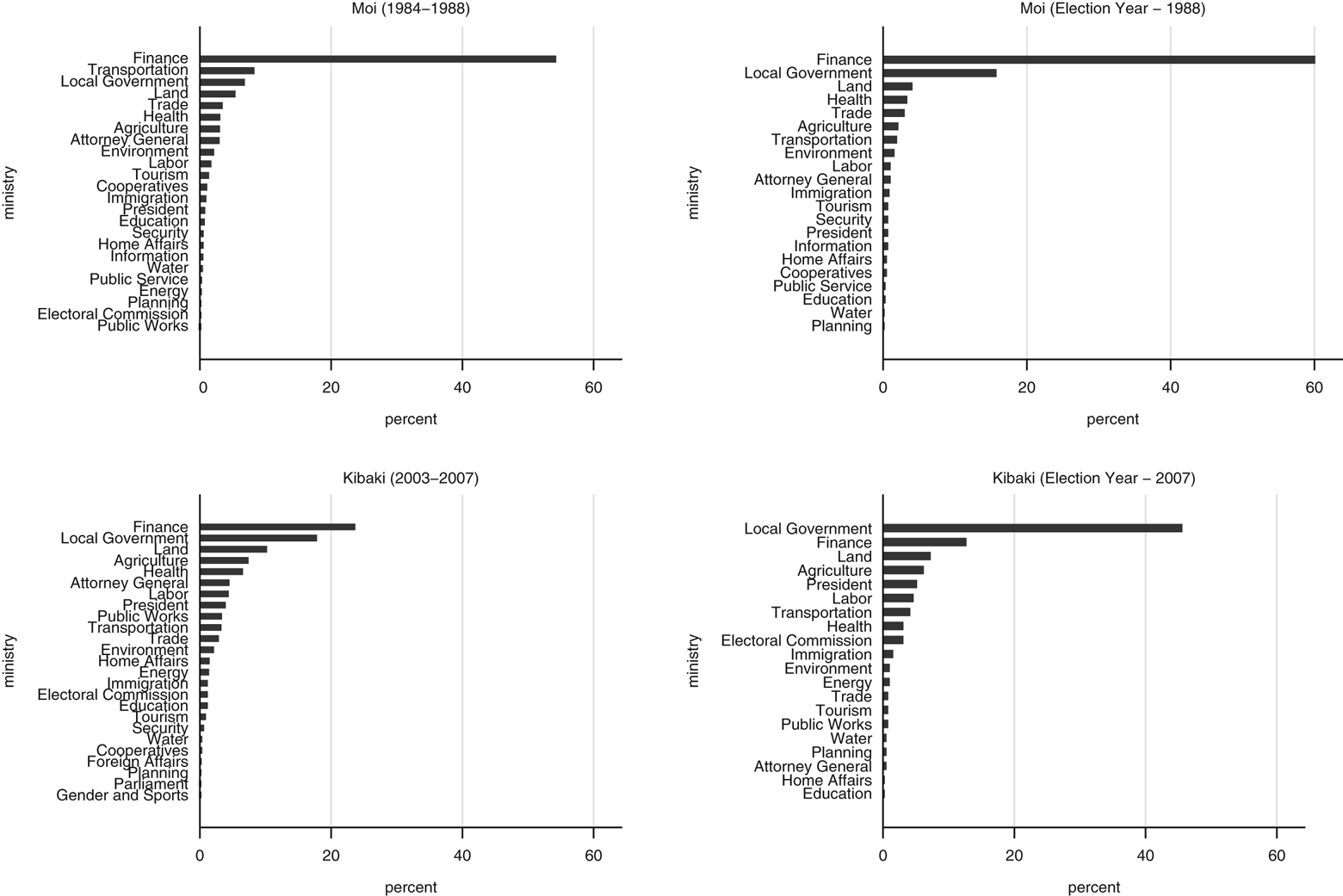
The content of Legal Notices merits discussion. While a detailed analysis of over 14,000 Legal Notices issued between 1963 and 2013 is beyond the scope of this article, a sample of notices (2,757) reveals interesting details (see Figure 2). The sample covers 1,693 notices issued under Moi (1984–88) and 1,064 under Kibaki (2003–07). First, a small number of ministers dominated the issuance of Legal Notices. The top five ministries are Finance (54.3 per cent), Transportation (8.3), Local Government (6.9), Land (5.5) and Trade (3.5) under Moi; and Finance (23.5), Local Government (17.9), Land (10.2), Agriculture (7.4) and Health (6.6) under Kibaki. Secondly, a significant proportion of Legal Notices provide targeted benefits including tax exemptions for specific firms, land allocations, waivers of licenses and fees, and designation of hospitals eligible for rebates from the National Hospital Insurance Fund. Thirdly, some Legal Notices are universalist in orientation and adhere to legislative intent. For example, several notices from the Ministry of Environment created protected forest areas.
The distribution of ministerial issuance of legal notices Note: figures indicate the distribution (percentages) of Legal Notices issued over five-year cycles under Moi (1984–1988) and Kibaki (2003–2007). Note that (1) a few ministries dominate the issuance of Legal Notices; and (2) the composition of the top issuing ministries changes during election years.

Fourthly, during election years (1988 and 2007) there was a marked increase in the number of Legal Notices targeting voters. For example, in 1988 a majority of the Legal Notices from the Finance Ministry gazetted price controls and tax exemptions for basic commodities. The Ministry of Local Government’s eighty-nine notices reorganized district administrations to create jobs. Similarly, in 2007 Kibaki’s minister of local government issued 169 Legal Notices creating new municipalities across the country.Footnote 8 Kibaki also gazetted several new universities as part of his campaign strategy. Tellingly, 52 per cent of all Legal Notices issued in 2007 were gazetted in November, a month before the election. These examples illustrate the political significance of Legal Notices, and why Kenyan legislators have an interest in regulating executive action in this domain.
Legislative independence and unilateral executive action
Executive–legislative relations in Kenya exhibit strong Westminster influences. The legislature – via enabling legislation – delegates rule-making authority to the president. In theory, this subordinates all rules made by the executive branch to the parent statute. Indeed, each Legal Notice includes an invocation of the enabling legislation. However, executive rule making often deviates from the spirit of the parent legislation. For example, presidents may exempt cronies from important clauses of legislative statutes, thereby violating the universalist intent of legislation.Footnote 9
Despite the risk of agency loss, there are a number of reasons why parliament may delegate rule-making authority to the executive. These include the fact that legislators lack sufficient time to anticipate every possible scenario while drafting legislation; the executive has superior expertise and information on the process of implementing statutes; and in some cases legislators may delegate to the executive in order to avoid legislative gridlock. In addition, parliament routinely leaves it up to the executive to determine the onset of specific clauses of legislation, or to be able to exempt specific firms or individuals from certain clauses as a matter of industrial policy.Footnote 10 However, in all these cases, the executive only engages in subsidiary legislation under delegated powers that can be revoked by the legislature.
The ability of the legislature to enforce this principal–agent relationship is conditional on legislative independence (more on this below). Independent legislatures can credibly threaten to override instances of executive overreach, thereby restricting presidential rule making within acceptable bounds. Indeed, the trends in the incidence of Legal Notices shown in Figure 1 mirror a number of established facts about presidential politics and executive–legislative relations in Kenya. First, Kenyatta and Moi differed in their style of rule and relationship with the legislature. Under Kenyatta, KANU was weak, thereby making the legislature the key arena of intra-elite politics. KANU’s weakness ensured that important policy debates took place in the National Assembly, and that Kenyatta went through great lengths to buy the support of Kenyan legislators (Hornsby Reference Hornsby1985; Opalo Reference Opalo2015). This situation changed under Moi. In his quest to consolidate power, Moi sought to empower KANU and turn Kenya into a party-state (Oyugi Reference Oyugi1994; Widner Reference Widner1992). KANU’s rise came at the expense of the legislature, so much so that in 1986 Moi declared the party to be supreme over the legislature.Footnote 11 The differences in the stature of parliament under the two presidents were reflected in the incidence of executive rule making in the autocratic period: more Legal Notices were issued per year under Moi (348) than under Kenyatta (279).Footnote 12
Secondly, the end of single-party rule in 1992 occasioned a rebalancing of executive–legislative relations in Kenya. Multipartyism emboldened legislators in their quest to balance the executive branch. Since their legislative careers were no longer dependent on their membership in KANU, Kenyan legislators leveraged their political independence to demand the institutional autonomy of the legislature (Barkan and Matiangi Reference Barkan and Matiangi2009). A raft of reforms followed, culminating in 2000 with the establishment of the Parliamentary Service Commission (PARLSCOM) as a parliamentary bureaucracy that was independent of the executive. This independence granted the legislature fiscal and calendar autonomy.Footnote 13 The achievement of legislative administrative autonomy was followed by the curtailment of executive rule-making authority, which culminated in the passage of the Statutory Instruments Act, No. 23 in 2013 that explicitly regulates subsidiary legislation issued by the executive branch.
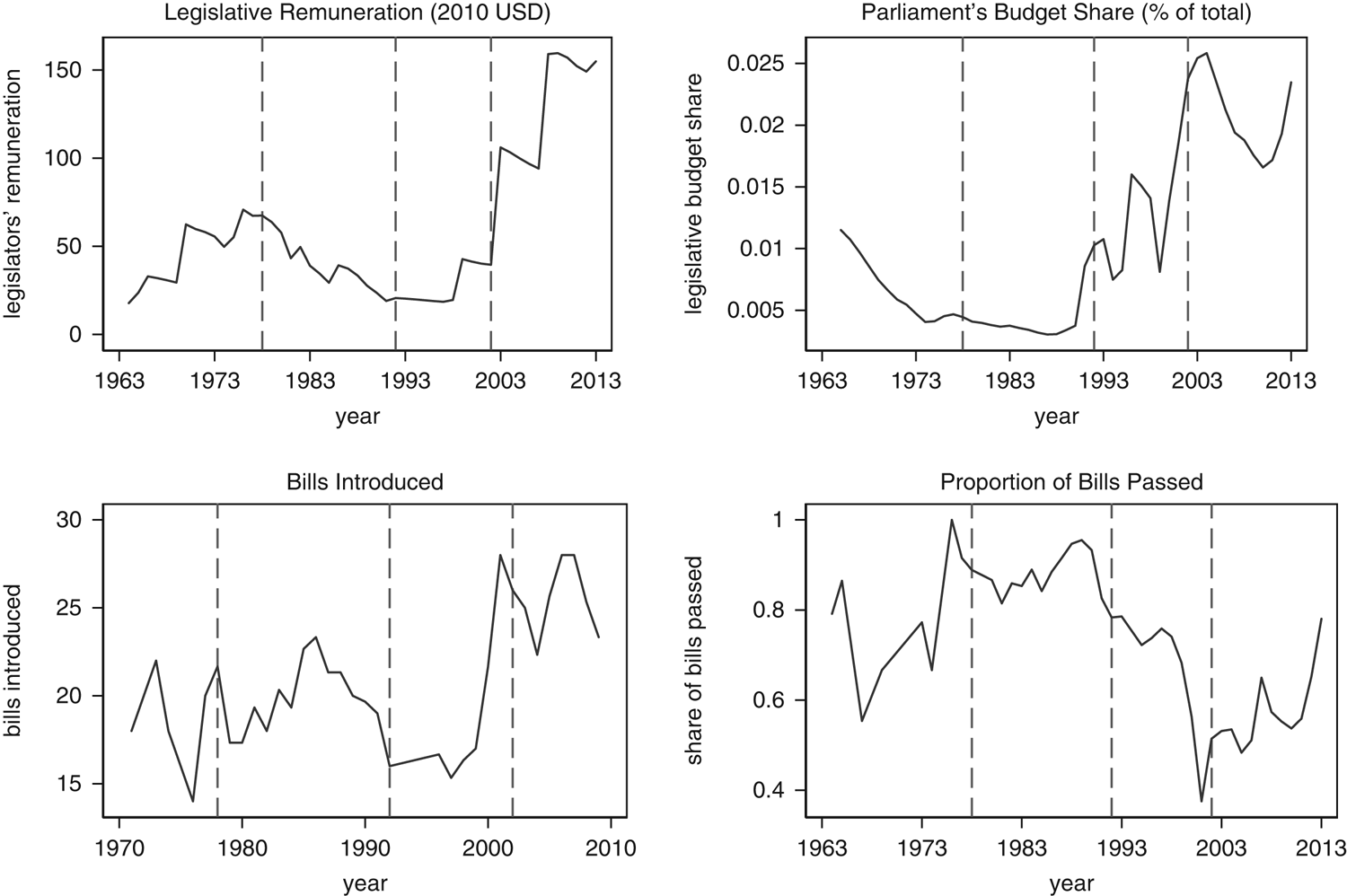
These stylized facts about executive–legislative relations are shown in Figures 3 and 4.Footnote 14 As evidence of the increase in legislators’ bargaining power and access to resources, the top graphs in Figure 3 show sustained increases in the remuneration of legislators and the share of the budget allocated to parliament after the end of single-party rule in 1992. The bottom right graph shows the proportion of executive bills passed by the legislature over time (acts/bills). It is clear that while the proportion was higher under autocracy, it was higher under Moi than Kenyatta. The higher rate of passage of executive bills under Moi reflects the fact that after 1978, KANU increasingly usurped parliament’s role as the main arena of policy bargaining, thereby relegating the legislature to a mere rubber-stamp institution. This changed in 1992, after which the share of executive bills passed declined precipitously in tandem with the increase in legislators’ bargaining power and political independence.
Trends in executive–legislative relations Note: legislators’ salaries include annual pay plus average perks. The parliamentary budget, bills introduced and proportion of bills passed show three-year moving averages. For bills, years before 1977 show row counts. Vertical lines correspond to the years 1978, 1992, and 2002. Data from author’s calculations (sources described below).

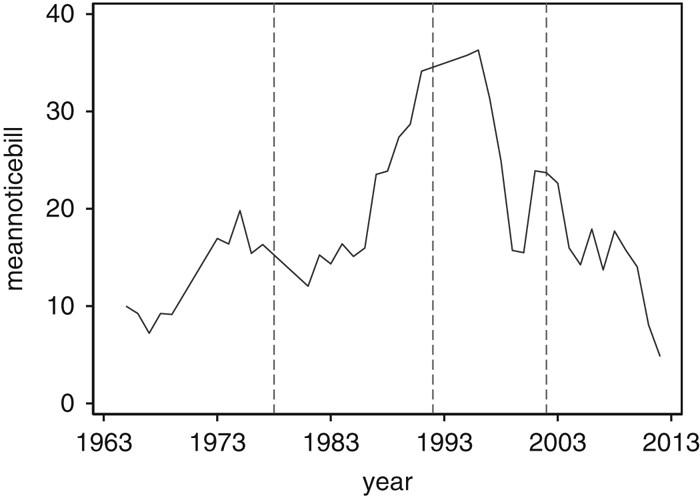
Trends in legal notices per bill passed Note: the graph shows trends in the number of legal notices per bill passed each year (i.e., the ratio of Legal Notices/acts). The graph shows three-year moving averages. Vertical lines correspond to the years 1978, 1992 and 2002.

The decline in the share of executive bills passed after 1992 is remarkable. Moi’s KANU maintained parliamentary majorities between 1992 and 2002. It is rational to assume that Moi only introduced bills that had a high likelihood of getting passed. Indeed, we see some selection, with the period after 1992 having the smallest number of executive bills introduced in Kenya’s history (see Figure 3). Yet even accounting for this selection effect, Moi was still unable to predict the preferences of pivotal legislators or to coerce them into passing his legislative initiatives after 1992. During his last decade in power, parliament rejected 45 per cent of the bills introduced.
Figure 4 shows the number of Legal Notices issued per bill passed. Two important observations are apparent. First, it is clear that after the mid-1980s the proportion of notices per bill passed rose well above the averages in the Kenyatta years and after 1992. In other words under Moi the executive branch issued Legal Notices above and beyond what was necessary to implement legislative statutes. Secondly, the ratio of Legal Notices per bill passed decreased significantly after 1992, despite a decline in the proportion of executive bills passed in the legislature (see bottom right graph in Figure 3). Legislative independence after 1992 was accompanied by a decline in both the share of executive bills passed and the incidence of executive rule making.
The quest to tame executive rule making in Kenya involved significant legislative input. As early as 1962, African members of the colonial Legislative Council protested the administrative misuse of delegated legislation to make policy.Footnote 15 However, legislators were only able to take proactive steps against unilateral executive action after the end of single-party rule in 1992. The executive responded to the legislature’s reactive (credible threat of override) and proactive (scrutiny) powers by drastically reducing the number of gazetted Legal Notices.
For example, in 1994, Member of Parliament (MP) Rashid Mzee (Kisauni) complained in parliament about a Legal Notice creating marine parks but which his constituents opposed.Footnote 16 He argued that ‘Legal Notice No. 315 is erroneous […] and defective, and I pray through this Motion that the Minister withdraws Legal Notice No. 315 and comes out with appropriate legislation through Parliament for the creation of marine parks’ (emphasis added).Footnote 17 The election of Kibaki in 2002 atop a coalition government in which his own party was a minority reinforced legislative bargaining power and assertiveness. During this period, parliament’s staff increased from 254 in 2002 to 1,183 in 2012.Footnote 18
In 2004 Amina Abdalla (nominated MP) submitted a motion to establish a dedicated Delegated Legislation Committee in the National Assembly. At the time, Abdalla noted the need to ensure that ‘subsidiary legislation is consistent with current statutes’, and to stop the abuse of delegated authorities by agencies that gazette ‘regulations that are ultra vires to the parent law’.Footnote 19 Supporting the motion, Justin Muturi (MP, Siakago), argued that legislators were ‘seeking that this House gets the power; its own residual power to scrutinize and monitor what the Civil Service is doing with effecting legislation’.Footnote 20 Bonaya Godana (MP, North Horr) concurred, warning that unchecked executive rule-making authority ‘erodes the very principle of Parliament as the ultimate authority for legislating for this land’.Footnote 21
Abdalla’s motion was adopted, and made part of the National Assembly’s Standing Orders. Currently, the Statutory Instruments Act No. 23 (2013) governs executive rule making. The act empowers the legislature’s Committee on Delegated Legislation to scrutinize and nullify any executive rule (including Legal Notices) that is at odds with the enabling legislation. Section 5 of the act obligates executive agencies to hold consultations with entities likely to be affected by the proposed rules. Section 11 establishes strict reporting requirements for all subsidiary legislation, with accompanying regulatory impact statements (as stipulated in Sections 6, 7 and 8). Section 19 grants parliament the power to revoke subsidiary legislation, while Section 21 imposes automatic revocation of all subsidiary legislation after 10 years of issuance (unless extended). These examples show that executive rule making in Kenya is conditioned, to a significant degree, by the level of legislative independence and legislators’ (un)willingness to grant the executive a blank check on unilateral rule making.
Conceptualizing unilateral executive action in Kenya
Executive–legislative relations in Kenya reflect strategic interactions in a context of strong Westminster-style constraints (that is, parliamentary supremacy).Footnote 22 This is unlike in contexts where constitutions grant expansive presidential decree powers. However, despite this institutional inheritance, Kenya also has a history of personalist rule and subservient legislatures. This is different, for instance, from Latin America where executive rule making is borne of a legacy of bureaucratic authoritarianism in the face of weak legislatures.Footnote 23 Therefore, the findings from Kenya speak to other former British colonies where excessive executive rule making may occur despite strong formal institutional checks.Footnote 24
As a general matter, the institutional environment informs the strategic considerations of presidents and individual legislators interested in regulating executive rule making. Assuming that presidents prefer stable policy environments, they have strong incentives to seek policy stability through primary legislation rather than easily reversible subsidiary legislation (Saiegh Reference Saiegh2011; Thrower Reference Thrower2017). However, the opportunity to engage in subsidiary legislation offers presidents policy flexibility and a chance to tweak the implementation of legislative statutes for their own political benefit – for example, by targeting specific interest groups, or buying electoral support from important constituencies. All else equal, presidents prefer to engage in as much unencumbered rule making as possible in order to satisfy different interest groups without having to bargain directly with legislators.
Legislators prefer the implementation of legislative statutes to mirror their policy intent. At the same time, they have incentives to rationally leave room for executive rule making in the process of implementing legislation (for reasons outlined above). All else equal, legislators want to play as big a role as possible in bargaining over policy and supporting legislation, including the ability to determine the distributional benefits of legislation (to avoid, for instance, unilateral alteration of tax laws). For this reason, they prefer less presidential rule making to more, and the capacity to prevent agency loss by limiting executive rule making within acceptable bounds.Footnote 25
Legislators’ ability to limit the incidence of executive rule making depends on legislative independence. I define legislative independence as a combination of legislators’ relative bargaining power vis-à-vis the chief executive and the legislature’s institutional capacity. Legislators’ bargaining power increases with their ability to cultivate a personal vote in their constituencies independently of the chief executive (that is, when their political careers are not controlled by the chief executive). This is because legislators’ political independence enables them to engage in legislative actions that are inconsistent with the preferences of the chief executive without the risk of electoral loss. Legislative capacity increases with the extent to which the legislature has access to material resources and is the focal locus of intra-elite bargaining over policy and redistributive concerns. Material resources afford legislators the capacity to oversee executive rule making (Bolton and Thrower Reference Bolton and Thrower2016), while being the primary arena of policy bargaining limits the incidence of extra-legislative policy making – either by the executive or parties (Opalo Reference Opalo2015).
More broadly, electoral (political) independence allows legislators to pass laws and restrict executive rule making without fear of losing their seats. The ability to determine or influence the outcome of legislative elections is a strong tool in the arsenal of chief executives intent on curtailing legislative independence (Opalo forthcoming; Throup Reference Throup1993). In the same vein, an organizationally strong legislature (one with a stronger bargaining power for material resources) is better able to invest in legislative scrutiny of executive action – for example by hiring staff and strengthening the operations of departmental committees. Therefore, all else equal, the incidence of executive rule making is inversely proportional to legislative independence.
The idea that independent and institutionalized legislatures are better able to constrain unilateral executive rule making is not unique to Kenya. However, because the realized nature of inter-branch relations is conditional not just on formal rules but also on history and political culture, measures of legislative institutional power (that is, the ability to constrain executive action) differ by context. For example, scholars of executive rule making in the United States typically take Congressional independence and de facto separation of powers for granted, and focus on the conditional effects of partisanship and legislative organizational capacity (Bolton and Thrower Reference Bolton and Thrower2016; Chiou and Rothenberg Reference Chiou and Rothenberg2016; Cockerham and Crew Reference Cockerham and Crew2017). In Latin America, scholars of executive–legislative relations often analyze the impact of both formal rules (expansive decree authority) and legislative institutional weakness on unilateral executive action (Aleman and Tsebelis Reference Aleman and Tsebelis2005; Carey and Shugart Reference Carey and Shugart1998; Negretto Reference Negretto2004; Pereira, Power and Renno Reference Pereira, Power and Renno2008; Shair-Rosenfield and Stoyan Reference Shair-Rosenfield and Stoyan2017).
The Kenyan case is an interesting addition to this literature. It is a context in which strong (Westminster-style) constitutional constraints on executive rule making have historically been blunted by the lack of legislative independence under the shadow of personalist rule (Barkan and Chege Reference Barkan and Chege1989) and a volatile party system marked by defections and low levels of party discipline (Hassan and Sheely Reference Hassan and Sheely2017).
It is worth reiterating that even under personalist rule, the potential for a legislative veto of subsidiary legislation informs presidential rule making (Cox and Morgenstern Reference Cox and Morgenstern2001). It also follows that under conditions of greater legislative independence, chief executives will update their subjective expectation of a legislative veto for the reasons outlined above. More generally, presidential strategic rule making will depend on whether: (1) the subsidiary legislation conforms to the strictures and intent of the delegated powers as prescribed in the enabling legislation and (2) the legislature is sufficiently independent (both politically and with regard to access to material resources) to veto any rules that overstep the bounds set by legislators.
This conceptual model leads to three empirically testable hypotheses: (1) the incidence of executive rule making is higher under autocracy (lower levels of legislative independence) than democracy (higher levels of independence); (2) under autocracy, executive rule making is lower during periods of legislative ascendancy (under Kenyatta), and vice versa (under Moi). This is because compared to the Moi period, under Kenyatta the legislature had a relatively higher political stature, was the focal arena for intra-elite bargaining, and therefore demanded greater input in both the policy-making process and the allocation of distributional benefits; and (3) the incidence of executive rule making is lower under conditions of legislative independence relative to periods of legislative weakness. This is for two reasons. First, legislative independence strengthens the implicit constraint on unilateral executive action under the law of anticipated reactions. That is, the threat of a statutory override of unilateral executive action is more credible under conditions of legislative independence (because individual legislators’ political fortunes are not dependent on the president). Secondly, independence allows legislatures to be proactive in overseeing and limiting unilateral executive action, as demonstrated in Kenya after 2004 (because of better access to material resources for legislative oversight). In the next section, I empirically test these claims using data from 50 years of executive rule making in Kenya.
Data and empirical strategy
The data
To examine the impact of legislative independence on the incidence of executive rule making in Kenya, I use data on Legal Notices issued between 1963 and 2013. My primary dependent variable is the count of Legal Notices published each year in the Legislative Supplement of the Kenya Gazette, the official publication of the Government of Kenya. The Legal Notices are numbered and ordered by year in the Kenya Gazette. For example, in 1965 the executive issued 348 Legal Notices, the first (Legal Notice No. 1 of 1965) and last (Legal Notice No. 348 of 1965) of which were posted in the 5 January and 28 December issues of the Kenya Gazette, respectively. Similarly, in 2012 the executive issued 257 Legal Notices, the first and last of which were issued on 27 January and 31 December 31, respectively. Issues of the Kenya Gazette – going back to 1899 – are available in the library of the National Assembly in Nairobi.Footnote 26
My main independent variable is a binary indicator of legislative independence (as defined above). Because Legislative Independence is a slow-moving institutional variable, I employ three different observable characteristics of executive–legislative relations operationalized as dichotomous variables. First, I distinguish between years under autocracy (1963–1992) and electoral democracy (1992–2013). As argued above, legislators are more likely to be politically independent under multiparty electoral democracy than under autocracy. Secondly, I distinguish between years under Moi and those under Kenyatta and Kibaki. As argued above, Moi’s rule was marked by significant attempts to subordinate the legislature to the executive branch. Finally, I distinguish between periods under multiparty politics (1963–1969 and 1992–2013) and those under de facto single-party rule (1969–1992), since the legislature had relatively more autonomy and oversight authority under multiparty politics than under single-party rule. These periods correspond to the variables Autocracy, Moi Years and Single Party, respectively.
I control for a number of factors that may influence the issuance of Legal Notices over time in order to validate the stability and magnitude of the correlation between legislative independence and issuance of Legal Notices. These include: (1) the amount of government spending as a share of gross domestic product (GDP) – it is possible that a higher level of government spending involves greater intervention in the economy for structural reasons unrelated to inter-branch bargaining over executive rule making; (2) inflation – bad economic times (such as periods of high inflation) may increase popular demand for unilateral executive action; (3) the number of bills passed – in order to directly capture the mechanical demand for subsidiary legislation in the process of implementing legislative statutes; (4) election years – to account for the fact that presidents may issue relatively more Legal Notices in election years in order to buy support from interest groups; and (5) cabinet ministers – a bigger cabinet mechanically increases the number of cabinet ministers with the administrative power to issue Legal Notices. Since during the period under study ministers were appointed from among serving legislators, a bigger cabinet may also reduce the legislature’s ability to check executive rule making.
The data on government spending as a share of GDP and inflation are from the statistical abstracts published annually by the Kenya National Bureau of Statistics.Footnote 27 The data on the number of bills passed are from annual summaries published in the Bills Supplement of the Kenya Gazette.Footnote 28 The data on the size of the cabinet are available from Arriola (Reference Arriola2009). I extended these data to 2013 with data from annual publications of Africa South of the Sahara.Footnote 29 Any errors in the transcription of these data are my own.Footnote 30
To identify the effect of legislative independence on unilateral executive action, I exploit two quasi-exogenous changes in legislative independence in Kenya. Kenyatta’s (unplanned) death occasioned the first change in 1978.Footnote 31 Not only was the timing of his death a surprise, but it also came at a time of significant uncertainty over whether Moi, as vice president, would succeed him as constitutionally required. Since 1976, a powerful faction favored by Kenyatta – the Change the Constitution Movement – had conspired to deny Moi the presidency following Kenyatta’s demise (Kyapoya Reference Kyapoya1979). In short, Kenyatta’s death exogenously altered executive–legislative relations in ways not fully anticipated by Kenya’s legislators. It also reduced legislative independence by exposing the legislature to a president intent on subordinating the institution to the party (Opalo Reference Opalo2012; Widner Reference Widner1992).
In this set-up, the treatment is the increase in constraints on legislative independence under Moi’s presidency. This research design enables me to examine the impact of changes in legislative independence on unilateral executive action, while holding regime type constant. Kenya was an autocracy (average Polity II score of −5) between 1963 and 1992.
The second change occurred in 1992 when Moi was forced to accept multipartyism due to domestic protests and donor pressure following the end of the Cold War (Brown Reference Brown2001; Posner Reference Posner2005). To fully understand the exogeneity of this regime change, it is worth highlighting regional (and global) trends at the time. Between 1989 and 1995, the proportion of African countries under single-party rule dramatically shrank from over 70 per cent to under 15 per cent. Indeed, from the early 1990s the scholarship on democratization widely discusses the adverse impact of the end of the Cold War on autocracies around the world (Levitsky and Way Reference Levitsky and Way2010). And so while domestic pressure for political change certainly existed in Kenya (going back to the late 1960s), the end of the Cold War was an important catalyst in the process that brought about the end of KANU’s political monopoly. It is readily accepted by Kenyanists that ‘[t]he Moi regime legalised (sic) opposition parties in December 1991, in large part because of the donors’ suspension of financial assistance’ (Brown Reference Brown2001, 731).
Around this second change, the treatment is the increase in legislative independence occasioned by the availability of outside options (in the form of political parties) for legislators under multipartyism. In other words, after the end of single-party rule, a significant proportion of Kenyan legislators could challenge Moi without jeopardizing their political careers. Moi could no longer credibly threaten to end legislators’ careers by expelling them from KANU as he had done for much of the 1980s. This newfound political freedom also enabled the legislature to effectively bargain for the additional material resources needed to perform its oversight duties (see Figure 3). This design allows me to vary the level of legislative independence (before and after 1992), while holding the identity of the chief executive (Moi) constant.
Results
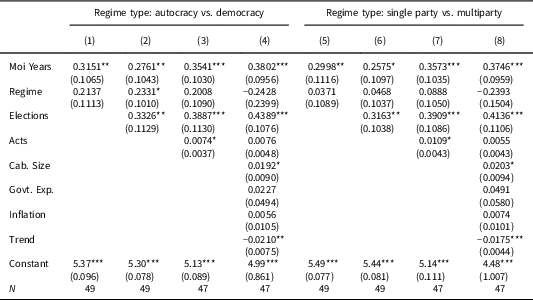
To analyze the incidence of Legal Notices, I use negative binomial regression models to account for overdispersion in the outcome variable.Footnote 32 The results in Table 1 show strong support for the predicted effects of legislative independence on the issuance of Legal Notices. The indicators for regime type in the first four and last four columns are Autocracy and Single Party, respectively. Moi Years indicates the period under his rule. I find that legislative weakness is correlated with an increased incidence of executive rule making – especially during Moi’s tenure.Footnote 33 Under Moi, 46 per cent more Legal Notices were issued (Column 4). I also find that presidents issue significantly more Legal Notices (55 per cent, on average) during election years. This is consistent with the claim that Kenyan presidents use their executive authority during election years to buy political support – for example by creating new local administrative units (Hassan Reference Hassan2016).Footnote 34 I also find that the number of cabinet ministers (Cab. Size) and bills passed (Acts) are positively correlated with the issuance of Legal Notices. This outcome is by construction, and validates the measure of Legal Notices. Increasing the number of cabinet ministers mechanically increases the supply of Legal Notices. In the same vein, increasing the number of bills passed increases the demand for Legal Notices in the process of implementing legislative statutes.
Effect of legislative independence on executive rule making (Legal Notices)

Note: negative binomial regression coefficients with robust standard errors in parentheses. Columns 1–4 show results with Autocracy as the dummy variable for regime type. In Columns 5–8 the indicator of regime type is Single Party. Both Moi Years and Election Years are positively correlated with the issuance of Legal Notices. *p<0.05 ** p<0.01 *** p<0.001
These results remain unchanged whether I use Autocracy or Single Party to indicate regime type (Regime). Although unstable across specifications, there is suggestive evidence that Kenyan presidents issued more Legal Notices under autocracy and single-party rule than during periods of multiparty electoral democracy. This further supports the claim that the legislature lacked institutional independence under autocracy and single-party rule. Note that the inconsistency of the point estimates of the Regime variable results from the introduction of the time trend.
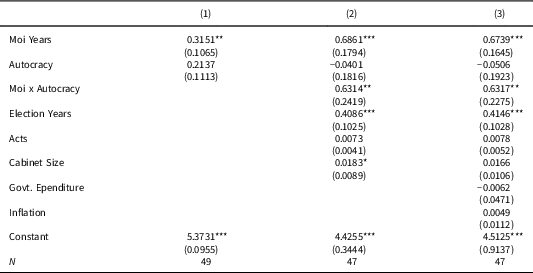
To identify the impact of legislative independence on the incidence of executive rule making, I employ an interactive model to compare the number of Legal Notices implemented under Moi during periods of autocracy and democracy (Table 2). Two important observations are apparent in the results. First, the indicator of legislative weakness (Moi Years) remains positive and statistically significant in the interaction model. The point estimate in Column 3 implies an increase in the number of Legal Notices under Moi by a factor of 1.96. Secondly, the interactive term suggests that the effect of legislative weakness (under Moi) on the issuance of Legal Notices increases by a factor of 1.88 in the autocratic period relative to the democratic period. In other words, under autocracy Moi issued 88 per cent more Legal Notices than he did under democracy. This is consistent with a model in which presidential rule making is higher when presidents know there is little risk of legislative retaliation (or override) against executive usurpation of legislative authority, or the abuse of executive rule-making authority. Moi, as an autocratic president with a majority in the legislature throughout his rule (1978–2002), was predisposed to engage in high levels of executive rule making. But he did so at a relatively lower rate under electoral democracy (1992–2002).
Effect of regime type on executive rule making (Legal Notices)

Note: negative binomial regression coefficients with robust standard errors in parentheses. The indicator for regime type is Autocracy. Periods of legislative independence correspondent with lower rates of issuance of legal notices. The effect of legislative weakness on executive rule making increases by a factor of 1.88 (88 per cent) under autocracy. *p<0.05 ** p<0.01 *** p<0.001
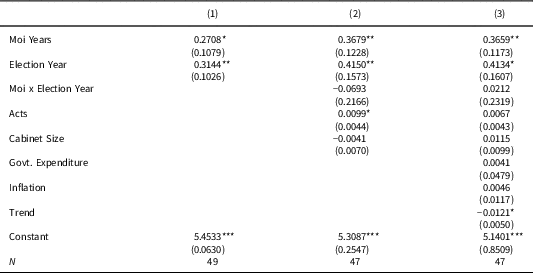
Next, I investigate whether the incidence of executive rule making during election years is substantially higher during periods of parliamentary weakness. Recall from the findings in Table 1 that there was a marked increase in the number of Legal Notices issued in election years. Therefore I interact the primary indicator of periods of legislative weakness (Moi Years) with the dummy variable indicating election years (Election Years). The results are shown in Table 3. The correlation between legislative weakness (Moi Years) and election years and the issuance of Legal Notices is still positive and statistically significant in both the simple model (Column 1) and with controls (Columns 2–3). However, the interaction effect between the two variables is not statistically significant from zero. In other words, there is no evidence of a substantial increase in the incidence of Legal Notices in election years during periods of legislative weakness.
Effect of elections on executive rule making (Legal Notices)

Note: negative binomial regression coefficients with robust standard errors in parentheses. The indicator for regime type is Autocracy. While the coefficients of the indicators of legislative weakness and election years are consistent with the above predictions, the interactive effect between the two is not statistically significant. In other words, presidential rule making during election years was not substantially different under Moi relative to other presidents. *p<0.05 ** p<0.01 *** p<0.001
This is an interesting finding, in line with the graphical evidence in Figure 1. It appears that the Kenyan legislature, even after the end of single-party rule and the emergence of legislative autonomy, is still willing to allow for significant increases in the incidence of executive rule making during election years. This finding calls for future research into the specific types and contents of Legal Notices that emanate from the Kenyan executive during election years, and how these differ from those issued during non-election years.
Overall, these findings illustrate three simple facts. First, Kenya’s Westminster institutional inheritance bequeathed it significant legislative constraints on unilateral executive action. However, for the first three decades of independence, these constitutional constraints largely remained latent on account of legislative weakness and personalist, single-party rule. The end of single-party rule boosted legislative independence, and activated latent constraints on executive rule making. Secondly, armed with the necessary data, it is possible to systematically analyze institutional politics in Africa. Thirdly, the logics of institutional politics in Africa largely conform to standard predictions developed by scholars who study similar topics in other parts of the world. This is a call for more data collection and rigorous studies of institutional politics in Africa. Claims of untrammeled presidential authority in the region must be backed up by data.
Discussion and caveats
This article contributes to the wider comparative literature on executive–legislative relations. Previous studies have shown the dynamics of executive rule making in contexts where presidents enjoy considerable constitutional authority to act unilaterally. This article examines executive rule making under Westminster-style constitutional constraints. It is interesting how strikingly similar executive–legislative relations in the Kenyan context are to the dynamics observed in presidential systems with more expansive rule-making powers. Regardless of the source of presidential rule-making powers (whether constitutional or delegated), it is clear that what matters for unilateral executive action is the balance of power between presidents and legislatures.
Factors that may shift the balance of power in favor of legislatures may include: the partisan composition of the legislature (Howell Reference Howell2003), the organizational capacity of the legislature (Bolton and Thrower Reference Bolton and Thrower2016; Pereira, Power and Renno Reference Pereira, Power and Renno2005), the professionalization of individual legislators (Shair-Rosenfield and Stoyan Reference Shair-Rosenfield and Stoyan2017) and legislative independence, as shown in this article. As argued above, the salience of these factors is conditional on institutional history and the political culture of states.
It is worth emphasizing the scope conditions of the findings above. First, this article largely speaks to executive–legislative relations in former British colonies with a Westminster tradition of delegated executive rule-making powers. The nature of these relations may be different in former colonies with (semi-)presidential systems and constitutionally protected presidential rule-making authority. Secondly, this article does not examine individual instances of presidential rule making. Future work should explore how factors other than legislative independence – including partisanship and the specific content of the rules – impact both the willingness and ability of African legislatures to constrain executive rule making. Such efforts would enrich the comparative institutions literature by enabling scholars to explore the causes and consequences of intra-African variation in institutional forms, practices and outcomes.
Conclusion
This article shows that, contrary to conventional wisdom, institutional constraints on unilateral presidential action are observable in Kenya. Using original data on unilateral executive rule making, I have demonstrated that Kenyan presidents issue relatively fewer legal notices during periods of legislative independence compared to periods of legislative weakness. In particular, I have shown that the advent of multiparty electoral competition in Kenya occasioned a sustained decrease in the incidence of unilateral executive action in the country, even as the legislature passed relatively fewer executive bills. Qualitative evidence from debates in the National Assembly corroborate these claims, and show that beginning in the mid-1990s, Kenyan legislators began to proactively reign in the executive branch’s abuse of delegated rule-making authority. I also show that legislative assertiveness after 1992 mirrors trends in legislative empowerment – observable as increases in the remuneration of legislators, budget allocation to the legislature, and decreases in the proportion of executive bills passed by the legislature.
These findings have important implications for our understanding of presidential power in Africa. For the last five decades, the literature on African politics has been dominated by the assumption of untrammeled presidential preponderance and general institutional impotence. Yet as I show in this article, presidential power in Kenya has waxed and waned, as has legislative institutional capacity and independence. In this regard Kenya is not unique. For example, recent works have documented the rise of legislatures in Africa’s fledgling democracies (Barkan Reference Barkan2009). More than ever before, institutions and norms are emerging to give structure and predictability to African politics. With this in mind, a data-driven systematic study of legislative politics and executive–legislative relations in the region will go a long way towards enriching the literature on comparative political institutions.
Supplementary material
Data replication sets are available in Harvard Dataverse at: https:/doi.org/10.7910/DVN/3RVUT0 and online appendices at: https:/doi.org/10.1017/S0007123418000492
Acknowledgements
I thank participants at the Comparative Politics seminars at Stanford and the Ohio State University and anonymous reviewers for helpful comments. This research was partly funded by the Susan Ford Dorsey Fellowship from the Center for African Studies at Stanford University.